
Chemical kinetics plays a crucial role in understanding reaction rates...
 AP Chemistry30 views·Updated Jul 24, 2026·2 pages
How Chemistry Helps Make Medicines Faster
A
Alexandria Walgren@strawberries24
1
of 2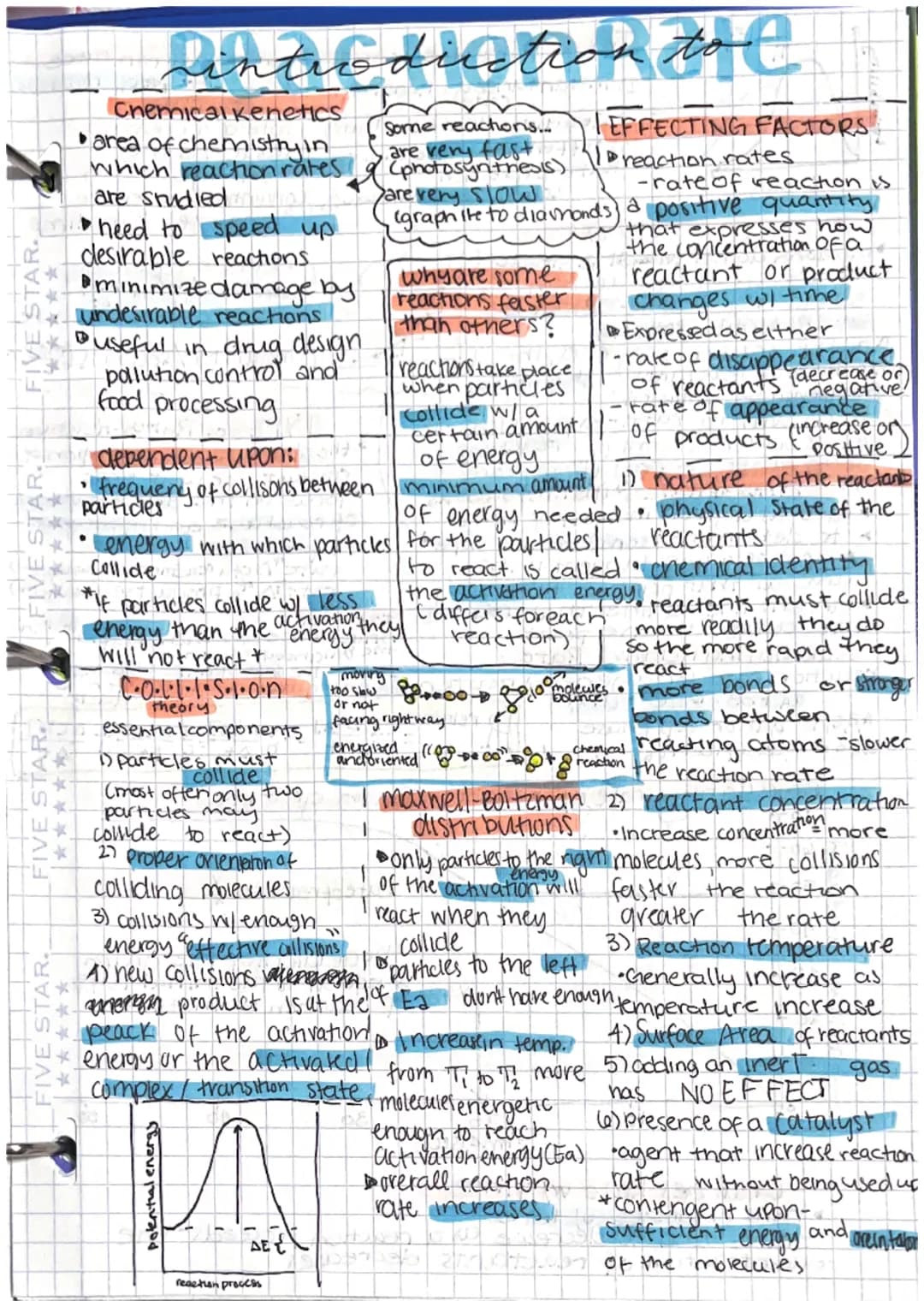
Page 2: Reaction Rates and Their Measurement
This page delves into the practical aspects of measuring and calculating reaction rates, emphasizing how rates change over time during chemical reactions.
Definition: The rate of a chemical reaction is the change in concentration over time, measured either by reactant disappearance or product appearance.
The text identifies three main types of reaction rates:
- Instantaneous reaction rates
- Relative reaction rates
- Differential rate law or rate expression
Highlight: Reactions typically don't proceed at a steady rate but start fast and gradually slow down as reactant concentrations decrease.
Example: When calculating relative rates for a reaction aA + bB → cC + dD, coefficients from the balanced equation are used with appropriate signs (negative for reactants, positive for products).
Vocabulary: A tangent line in rate calculations is a line that touches the reaction curve at a single point, used to determine instantaneous rates.
The measurement of reaction rates typically uses:
- Concentration changes over time
- Units of molarity per second (M/s)
- Graphical analysis methods
2
of 2
Page 1: Fundamentals of Chemical Kinetics
Chemical kinetics explores the study of reaction rates and their controlling factors. The field emphasizes understanding how reactions proceed and what influences their speed.
Definition: Chemical kinetics is the area of chemistry that studies reaction rates and the factors that influence them.
Highlight: Collision theory states that reactions occur when particles collide with sufficient energy and proper orientation.
The rate of chemical reactions depends on several key factors:
- Frequency of particle collisions
- Energy of colliding particles
- Proper molecular orientation
Vocabulary: Activation energy is the minimum energy required for particles to react when they collide.
Example: The Maxwell-Boltzmann distribution shows that only particles with energy exceeding the activation energy will react upon collision.
Factors affecting reaction rates include:
- Nature and physical state of reactants
- Reactant concentration
- Temperature
- Surface area
- Catalyst presence
Quote: "Reactions take place when particles collide with a certain amount of energy."
We thought you’d never ask...
Our AI companion is specifically built for the needs of students. Based on the millions of content pieces we have on the platform we can provide truly meaningful and relevant answers to students. But its not only about answers, the companion is even more about guiding students through their daily learning challenges, with personalised study plans, quizzes or content pieces in the chat and 100% personalisation based on the students skills and developments.
You can download the app in the Google Play Store and in the Apple App Store.
That's right! Enjoy free access to study content, connect with fellow students, and get instant help – all at your fingertips.
Similar Content
Most popular content in AP Chemistry
9I
AP ChemistryIntroduction to Elemental Composition
Practice fundamental concepts of mass percentage and the law of definite proportions to determine the relative mass of elements in a pure substance.
9th7160
I
AP ChemistryIntroduction to Electron Configuration
Practice identifying ground-state electron configurations using the Aufbau principle, Hund's rule, and the Pauli exclusion principle.
9th3810
I
AP ChemistryIntroduction to Moles and Avogadro's Number
Practice converting between mass, moles, and number of particles using Avogadro's constant and the fundamental concept of the mole.
9th1830
AP Chemistryunits 1-9 ap chem
dives pretty deeply into each unit of the ap chem curriculum
10th3277
AP ChemistryEngineering Chemistry
This note contains the summary of the topics redox reaction, electrochemistry, nuclear chemistry, and stoichiometry.
523
AP ChemistryIntegrated Rate Law, Reaction Mechanisms, and Multistep Energy Diagrams
Introduction to integrated rate law, formulas for finding orders, example of half-life, steps for reaction completion, how to find rate determining step, identifying parts of a multistep energy diagram
739
AP ChemistryAP Chem periodic table
Periodic table, atomic mass, etc.
430305
AP ChemistryIntroduction to Analytical Chemistry
This study note contains information on the basics of Analytical Chemistry, its applications, and minor concepts with examples.
680
AP ChemistryCompleted Nomenclature Practice
This Worksheet is completed with more than 100 named Chemical Compounds to practice finding the patterns on how to do it for yourself.
12th1408
Most popular content
9O
 AP US History
Origins and Dynamics of the Columbian Exchange
Analyze the ecological and economic motivations behind the initial transfer of goods, people, and diseases between the Old and New Worlds.
9th3,1280
I
AP US HistoryIntroduction to Early Cultural Interactions
Analyze the initial social and religious encounters between Europeans, Africans, and Indigenous peoples in the colonial Americas.
9th2,7730
F
 AP Psychology
Foundations of Ethical Guidelines in Research
Practice the core principles of the APA ethical code including informed consent, debriefing, and the role of Institutional Review Boards.
9th1,3360
M
AP US HistoryMotivations for European Exploration
Analyze the economic, religious, and political factors that drove European powers to the Americas during the 15th and 16th centuries.
9th1,7780
O
 AP World History
Origins of Ancient River Civilizations
Analyze the environmental factors and technological innovations that led to the rise of early states in Mesopotamia, Egypt, and the Indus Valley.
9th3,1870
F
AP PsychologyFoundations of Research Design and Methodology
Practice distinguishing between different research methods including experiments, correlations, and case studies while identifying key variables.
9th6670
I
AP US HistoryIntroduction to Native American Societies
Examine the diverse social, political, and economic structures of North American indigenous groups prior to European contact.
9th1,1100
I
 SAT®
SAT®Introduction to SAT Error Pattern Analysis
Practice identifying common reasoning traps and misinterpretations in SAT reading and math stimuli to understand why distractors are plausible.
9th2,0350
H
AP PsychologyHistorical Foundations of Psychology
Practice distinguishing between structuralism, functionalism, and the early philosophical roots of psychological science.
9th1,0940
Students love us — and so will you.
4.6/5App Store
4.7/5Google Play
The app is very easy to use and well designed. I have found everything I was looking for so far and have been able to learn a lot from the presentations! I will definitely use the app for a class assignment! And of course it also helps a lot as an inspiration.
Stefan SiOS user
This app is really great. There are so many study notes and help [...]. My problem subject is French, for example, and the app has so many options for help. Thanks to this app, I have improved my French. I would recommend it to anyone.
Samantha KlichAndroid user
Wow, I am really amazed. I just tried the app because I've seen it advertised many times and was absolutely stunned. This app is THE HELP you want for school and above all, it offers so many things, such as workouts and fact sheets, which have been VERY helpful to me personally.
AnnaiOS user
AP Chemistry30 views·Updated Jul 24, 2026·2 pagesHow Chemistry Helps Make Medicines Faster
A
Alexandria Walgren@strawberries24
Chemical kinetics plays a crucial role in understanding reaction rates and their applications in various fields. Factors affecting reaction rates in chemistry include collision frequency, particle energy, and molecular orientation.
• Chemical reactions vary significantly in speed, from rapid processes...
1
of 2
Sign up to see the content. It's free!
- Access to all documents
- Improve your grades
- Join milions of students
Page 2: Reaction Rates and Their Measurement
This page delves into the practical aspects of measuring and calculating reaction rates, emphasizing how rates change over time during chemical reactions.
Definition: The rate of a chemical reaction is the change in concentration over time, measured either by reactant disappearance or product appearance.
The text identifies three main types of reaction rates:
- Instantaneous reaction rates
- Relative reaction rates
- Differential rate law or rate expression
Highlight: Reactions typically don't proceed at a steady rate but start fast and gradually slow down as reactant concentrations decrease.
Example: When calculating relative rates for a reaction aA + bB → cC + dD, coefficients from the balanced equation are used with appropriate signs (negative for reactants, positive for products).
Vocabulary: A tangent line in rate calculations is a line that touches the reaction curve at a single point, used to determine instantaneous rates.
The measurement of reaction rates typically uses:
- Concentration changes over time
- Units of molarity per second (M/s)
- Graphical analysis methods
2
of 2Sign up to see the content. It's free!
- Access to all documents
- Improve your grades
- Join milions of students
Page 1: Fundamentals of Chemical Kinetics
Chemical kinetics explores the study of reaction rates and their controlling factors. The field emphasizes understanding how reactions proceed and what influences their speed.
Definition: Chemical kinetics is the area of chemistry that studies reaction rates and the factors that influence them.
Highlight: Collision theory states that reactions occur when particles collide with sufficient energy and proper orientation.
The rate of chemical reactions depends on several key factors:
- Frequency of particle collisions
- Energy of colliding particles
- Proper molecular orientation
Vocabulary: Activation energy is the minimum energy required for particles to react when they collide.
Example: The Maxwell-Boltzmann distribution shows that only particles with energy exceeding the activation energy will react upon collision.
Factors affecting reaction rates include:
- Nature and physical state of reactants
- Reactant concentration
- Temperature
- Surface area
- Catalyst presence
Quote: "Reactions take place when particles collide with a certain amount of energy."
We thought you’d never ask...
Our AI companion is specifically built for the needs of students. Based on the millions of content pieces we have on the platform we can provide truly meaningful and relevant answers to students. But its not only about answers, the companion is even more about guiding students through their daily learning challenges, with personalised study plans, quizzes or content pieces in the chat and 100% personalisation based on the students skills and developments.
You can download the app in the Google Play Store and in the Apple App Store.
That's right! Enjoy free access to study content, connect with fellow students, and get instant help – all at your fingertips.
Similar Content
Most popular content in AP Chemistry
9I
AP ChemistryIntroduction to Elemental Composition
Practice fundamental concepts of mass percentage and the law of definite proportions to determine the relative mass of elements in a pure substance.
9th7160
I
AP ChemistryIntroduction to Electron Configuration
Practice identifying ground-state electron configurations using the Aufbau principle, Hund's rule, and the Pauli exclusion principle.
9th3810
I
AP ChemistryIntroduction to Moles and Avogadro's Number
Practice converting between mass, moles, and number of particles using Avogadro's constant and the fundamental concept of the mole.
9th1830
AP Chemistryunits 1-9 ap chem
dives pretty deeply into each unit of the ap chem curriculum
10th3277
AP ChemistryEngineering Chemistry
This note contains the summary of the topics redox reaction, electrochemistry, nuclear chemistry, and stoichiometry.
523
AP ChemistryIntegrated Rate Law, Reaction Mechanisms, and Multistep Energy Diagrams
Introduction to integrated rate law, formulas for finding orders, example of half-life, steps for reaction completion, how to find rate determining step, identifying parts of a multistep energy diagram
739
AP ChemistryAP Chem periodic table
Periodic table, atomic mass, etc.
430305
AP ChemistryIntroduction to Analytical Chemistry
This study note contains information on the basics of Analytical Chemistry, its applications, and minor concepts with examples.
680
AP ChemistryCompleted Nomenclature Practice
This Worksheet is completed with more than 100 named Chemical Compounds to practice finding the patterns on how to do it for yourself.
12th1408
Most popular content
9O
AP US HistoryOrigins and Dynamics of the Columbian Exchange
Analyze the ecological and economic motivations behind the initial transfer of goods, people, and diseases between the Old and New Worlds.
9th3,1280
I
AP US HistoryIntroduction to Early Cultural Interactions
Analyze the initial social and religious encounters between Europeans, Africans, and Indigenous peoples in the colonial Americas.
9th2,7730
F
AP PsychologyFoundations of Ethical Guidelines in Research
Practice the core principles of the APA ethical code including informed consent, debriefing, and the role of Institutional Review Boards.
9th1,3360
M
AP US HistoryMotivations for European Exploration
Analyze the economic, religious, and political factors that drove European powers to the Americas during the 15th and 16th centuries.
9th1,7780
O
AP World HistoryOrigins of Ancient River Civilizations
Analyze the environmental factors and technological innovations that led to the rise of early states in Mesopotamia, Egypt, and the Indus Valley.
9th3,1870
F
AP PsychologyFoundations of Research Design and Methodology
Practice distinguishing between different research methods including experiments, correlations, and case studies while identifying key variables.
9th6670
I
AP US HistoryIntroduction to Native American Societies
Examine the diverse social, political, and economic structures of North American indigenous groups prior to European contact.
9th1,1100
I
SAT®Introduction to SAT Error Pattern Analysis
Practice identifying common reasoning traps and misinterpretations in SAT reading and math stimuli to understand why distractors are plausible.
9th2,0350
H
AP PsychologyHistorical Foundations of Psychology
Practice distinguishing between structuralism, functionalism, and the early philosophical roots of psychological science.
9th1,0940
Students love us — and so will you.
4.6/5App Store
4.7/5Google Play
The app is very easy to use and well designed. I have found everything I was looking for so far and have been able to learn a lot from the presentations! I will definitely use the app for a class assignment! And of course it also helps a lot as an inspiration.
Stefan SiOS user
This app is really great. There are so many study notes and help [...]. My problem subject is French, for example, and the app has so many options for help. Thanks to this app, I have improved my French. I would recommend it to anyone.
Samantha KlichAndroid user
Wow, I am really amazed. I just tried the app because I've seen it advertised many times and was absolutely stunned. This app is THE HELP you want for school and above all, it offers so many things, such as workouts and fact sheets, which have been VERY helpful to me personally.
AnnaiOS user