
A comprehensive guide to key GCSE Poetry anthology poems exploring... Show more
 Biology
 Sociology
Sign up to see the contentIt's free!
Access to all documents
Improve your grades
Join milions of students
By signing up you accept Terms of Service and Privacy Policy
Subjects

Biology

Chemistry
AP Chemistry

English
AP English Literature
728
•
Dec 14, 2025
•

emma
@emmasnotes111
A comprehensive guide to key GCSE Poetry anthology poems exploring... Show more
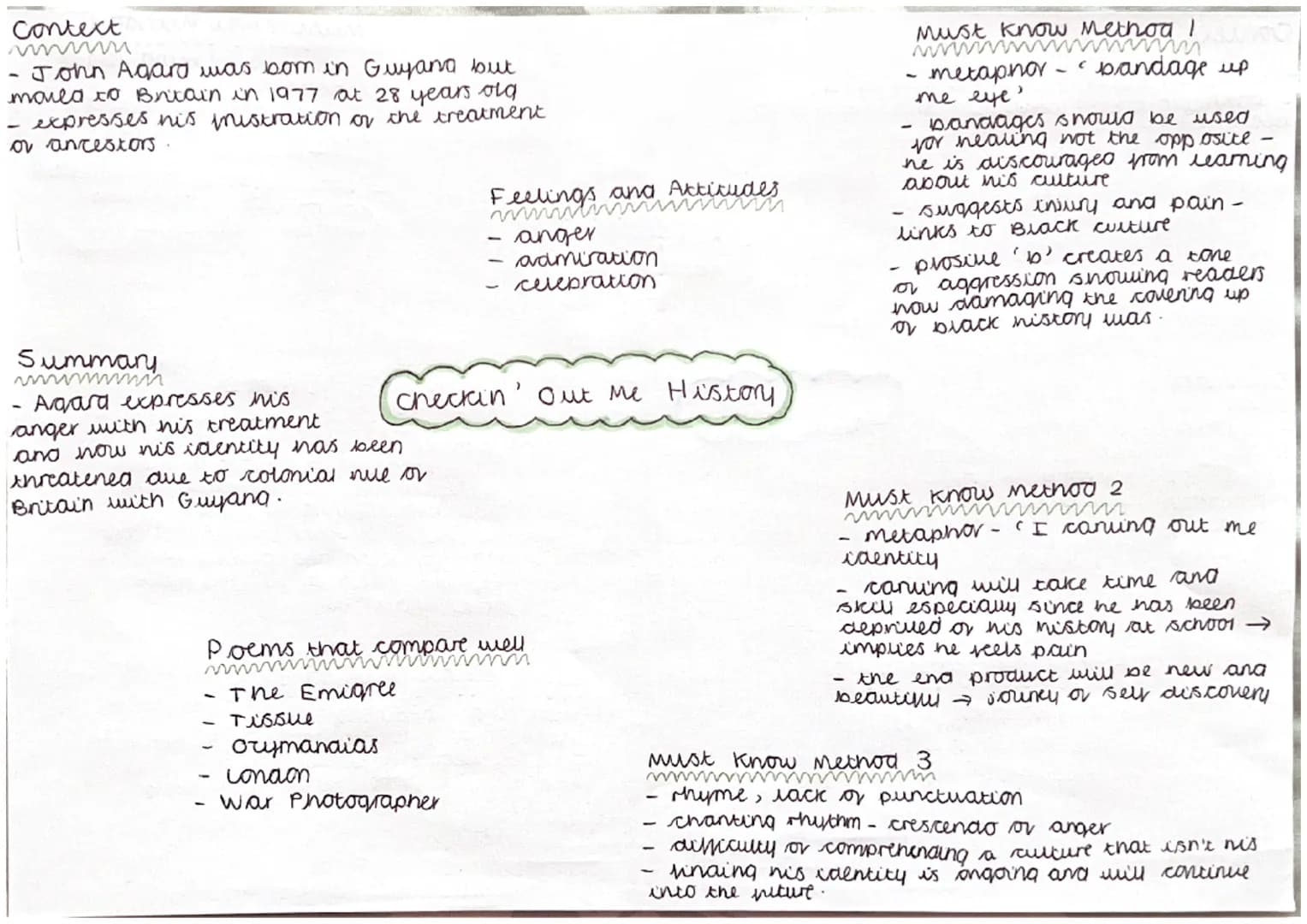
William Blake's "London"
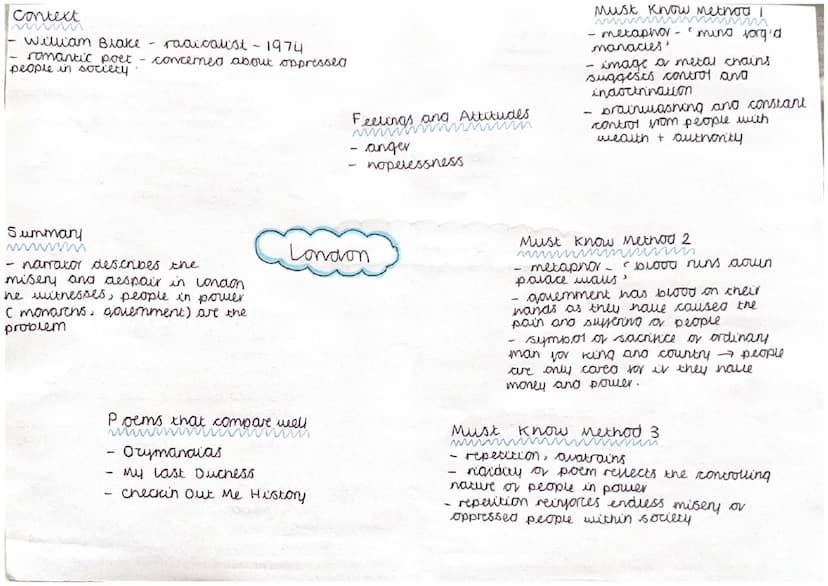
This section explores William Blake's poem "London", written in 1794 by the romantic poet and radicalist.
Context: Blake was concerned about oppressed people in society and used his poetry to critique social injustice.
The poem describes the misery and despair witnessed in London, pointing to people in power (monarchs, government) as the source of problems. It conveys feelings of anger and hopelessness.
"London" compares well with poems like "Ozymandias", "My Last Duchess", and "Checking Out Me History".
Key literary techniques analyzed include:
Metaphor: "Mind-forg'd manacles" creates an image of metal chains, suggesting control and indoctrination. This represents the brainwashing and constant control exerted by those with wealth and authority.
Metaphor: "Palace walls / With blood" implies that the government has blood on their hands, having caused pain and suffering to the people. It symbolizes the sacrifice of ordinary citizens for king and country.
Repetition and structure: The rigidity of the poem reflects the controlling nature of people in power. The repetition reinforces the endless misery of oppressed people within society.
Quote: "In every cry of every Man, / In every Infant's cry of fear, / In every voice, in every ban, / The mind-forg'd manacles I hear"
This powerful stanza emphasizes the pervasive nature of oppression in London society.
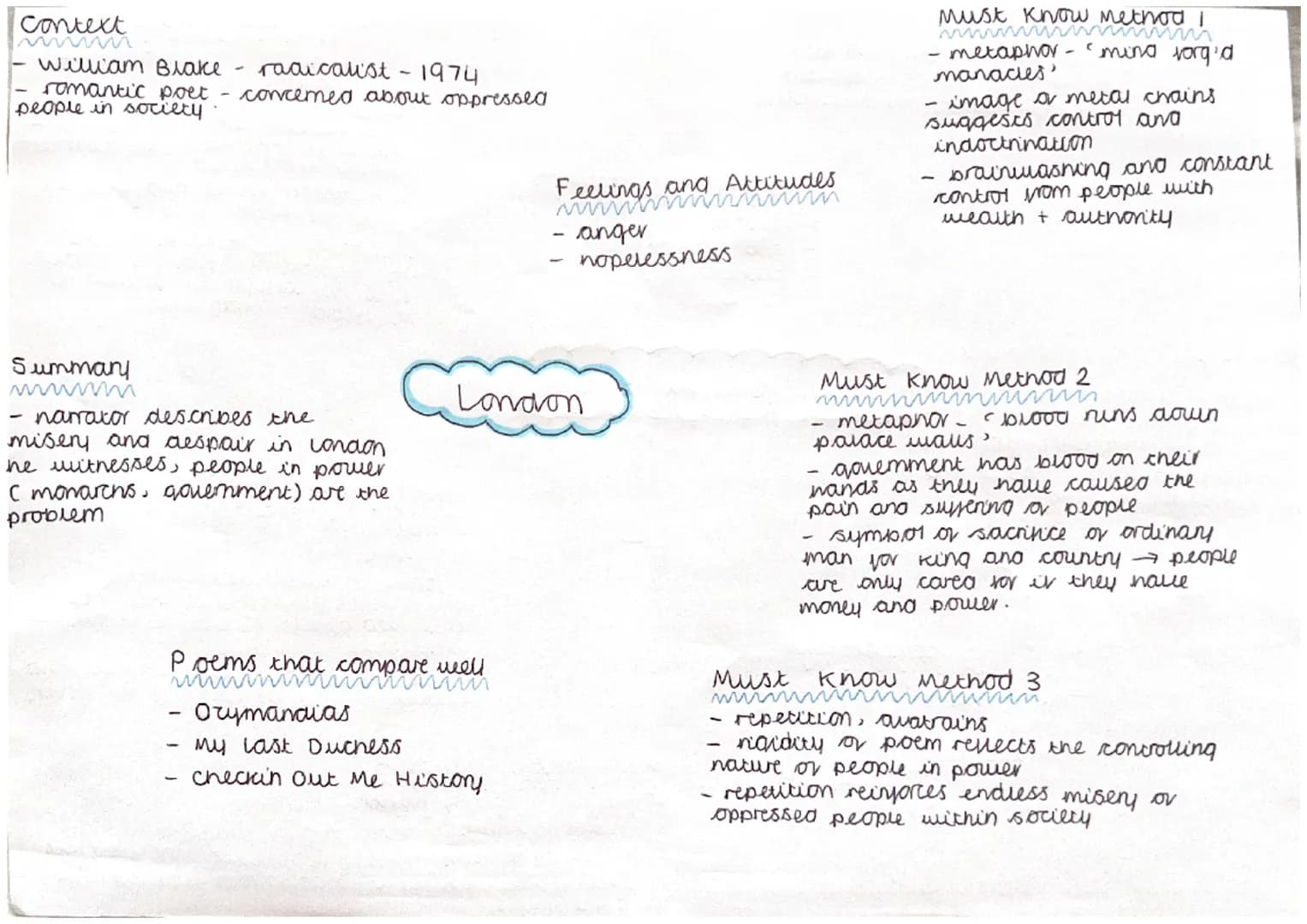
Carol Ann Duffy's "War Photographer"
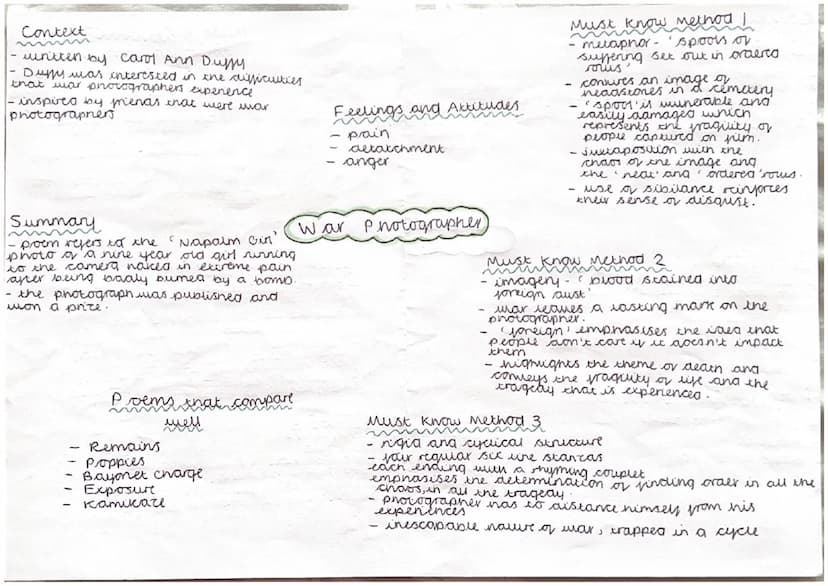
This section examines Carol Ann Duffy's poem "War Photographer", inspired by her friends who were war photographers.
Context: Duffy was interested in the difficulties that war photographers experience and used this poem to explore their emotional struggles.
The poem refers to the famous "Napalm Girl" photograph of a nine-year-old girl running naked and in extreme pain after being badly burned by a bomb. This powerful image won a prize and was widely published.
"War Photographer" compares well with poems like "Remains", "Poppies", "Bayonet Charge", and "Exposure".
Key literary techniques analyzed include:
Metaphor: "Spools of suffering set out in ordered rows" creates an image reminiscent of headstones in a cemetery. The fragility of the spools represents the vulnerability of the people captured on film.
Imagery: "Blood stained into foreign dust" emphasizes how war leaves a lasting mark on the photographer and highlights the theme of death and the fragility of life.
Structure: The regular six-line stanzas, each ending with a rhyming couplet, emphasize the photographer's determination to find order in chaos and tragedy.
Quote: "A hundred agonies in black-and-white / From which his editor will pick out five or six / For Sunday's supplement"
This line highlights the contrast between the photographer's experiences and the limited exposure given to the public, emphasizing the disconnect between war zones and comfortable civilian life.
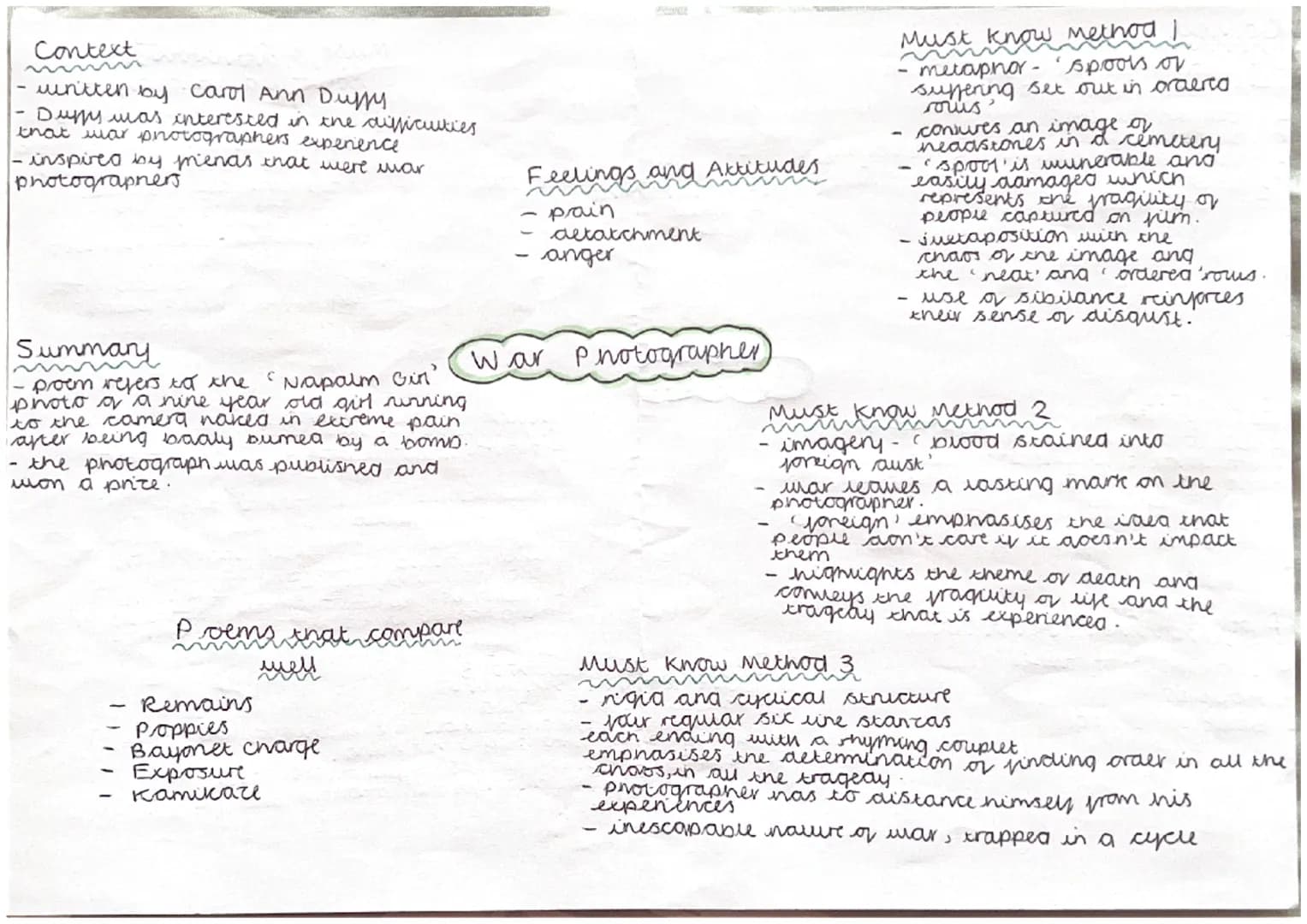
Simon Armitage's "Remains"
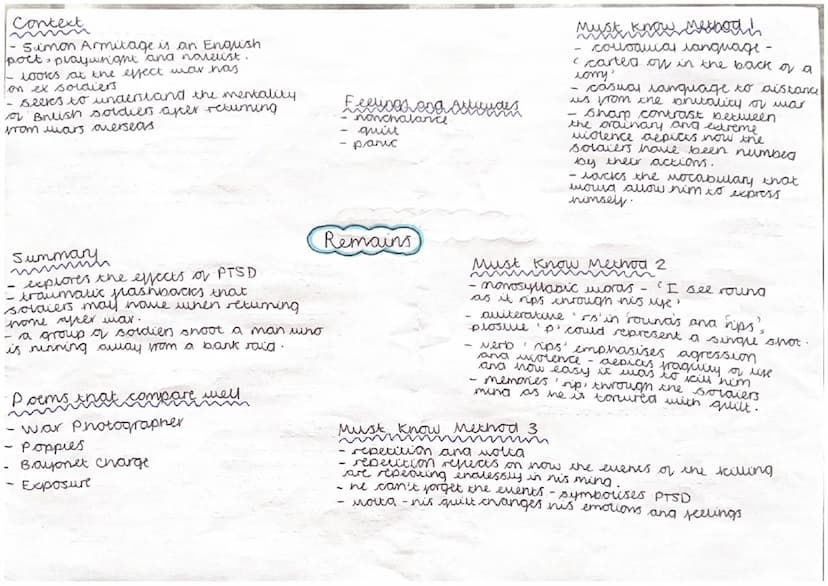
This section explores Simon Armitage's poem "Remains", which examines the effects of PTSD on soldiers returning from war.
Context: Armitage, an English poet, playwright, and novelist, seeks to understand the mentality of British soldiers after returning from wars overseas.
The poem describes a group of soldiers who shoot a man running away from a bank raid and explores the traumatic flashbacks they experience upon returning home. It conveys feelings of nonchalance, guilt, and panic.
"Remains" compares well with poems like "War Photographer", "Poppies", "Bayonet Charge", and "Exposure".
Key literary techniques analyzed include:
Colloquial language: Phrases like "carted off in the back of a lorry" use casual language to distance readers from the brutality of war, highlighting how soldiers have been numbed by their actions.
Sound devices: The use of monosyllabic words, alliteration, and plosive sounds in lines like "rips through his life" emphasizes the violence and aggression of the killing.
Repetition and volta: The repetition reflects how the events of the killing are repeating endlessly in the soldier's mind, emphasizing his inability to forget.
Quote: "He's here in my head when I close my eyes, / dug in behind enemy lines"
This powerful imagery illustrates how the memory of the killing haunts the soldier, becoming an inescapable part of his psyche.
Simon Armitage's examination of PTSD and war trauma through a soldier's perspective of a shooting incident.
Context: Written to understand returning soldiers' mental state
Vocabulary: Colloquial language used to show psychological distancing
Highlight: Explores the lasting impact of combat trauma
Example: Links to War Photographer and Exposure through shared themes of war's psychological impact
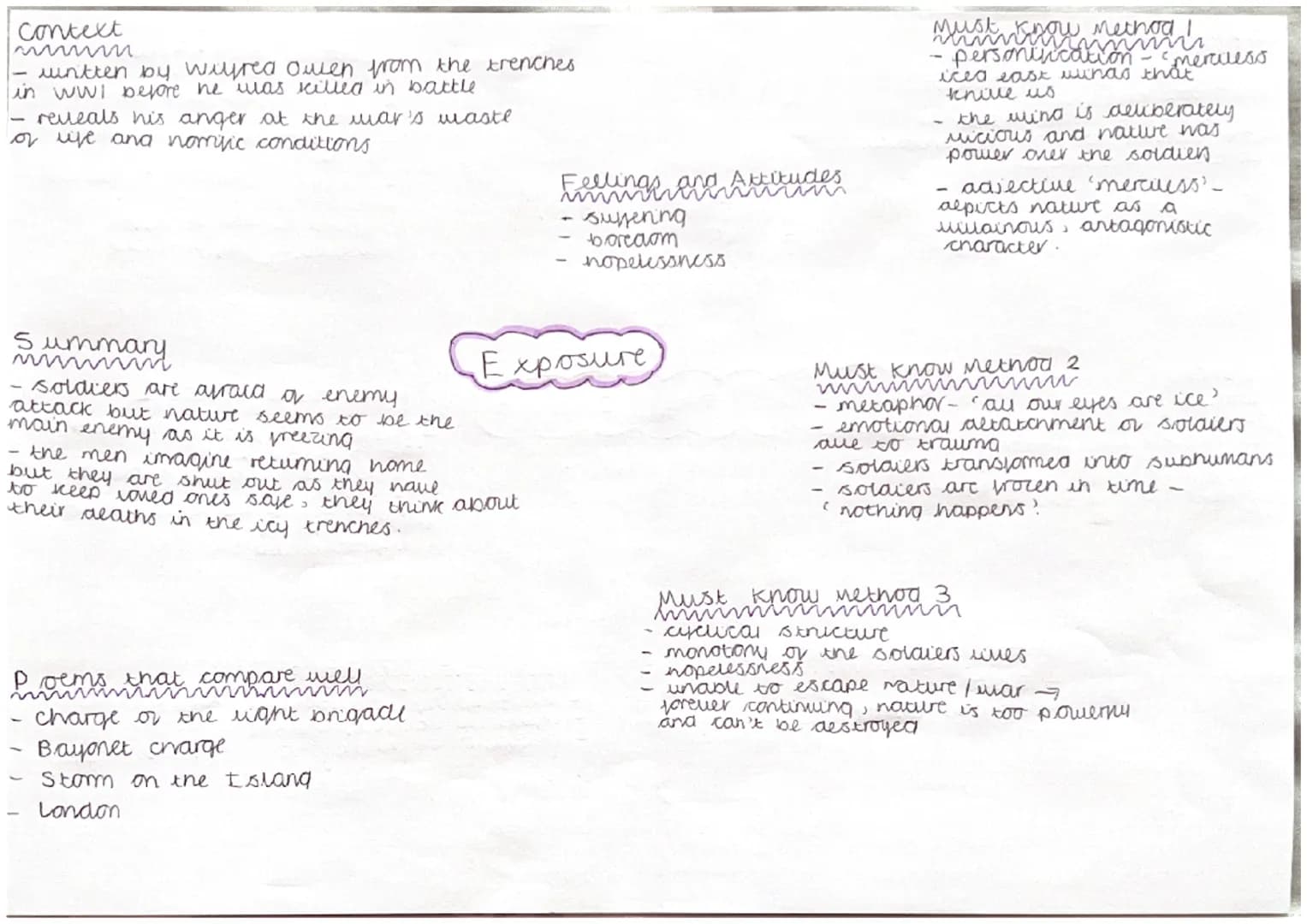
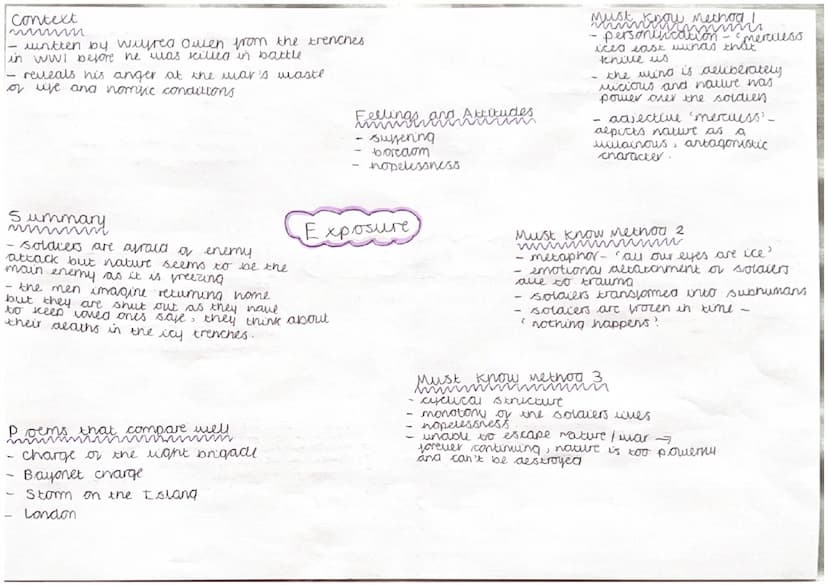
Wilfred Owen's WWI poem focusing on soldiers' suffering from extreme weather conditions rather than combat.
Context: Written from trenches before Owen's death in battle
Quote: "Merciless ices east winds that knive"
Highlight: Nature presented as more threatening than human enemies
Example: Connects with Storm on the Island through theme of nature's power
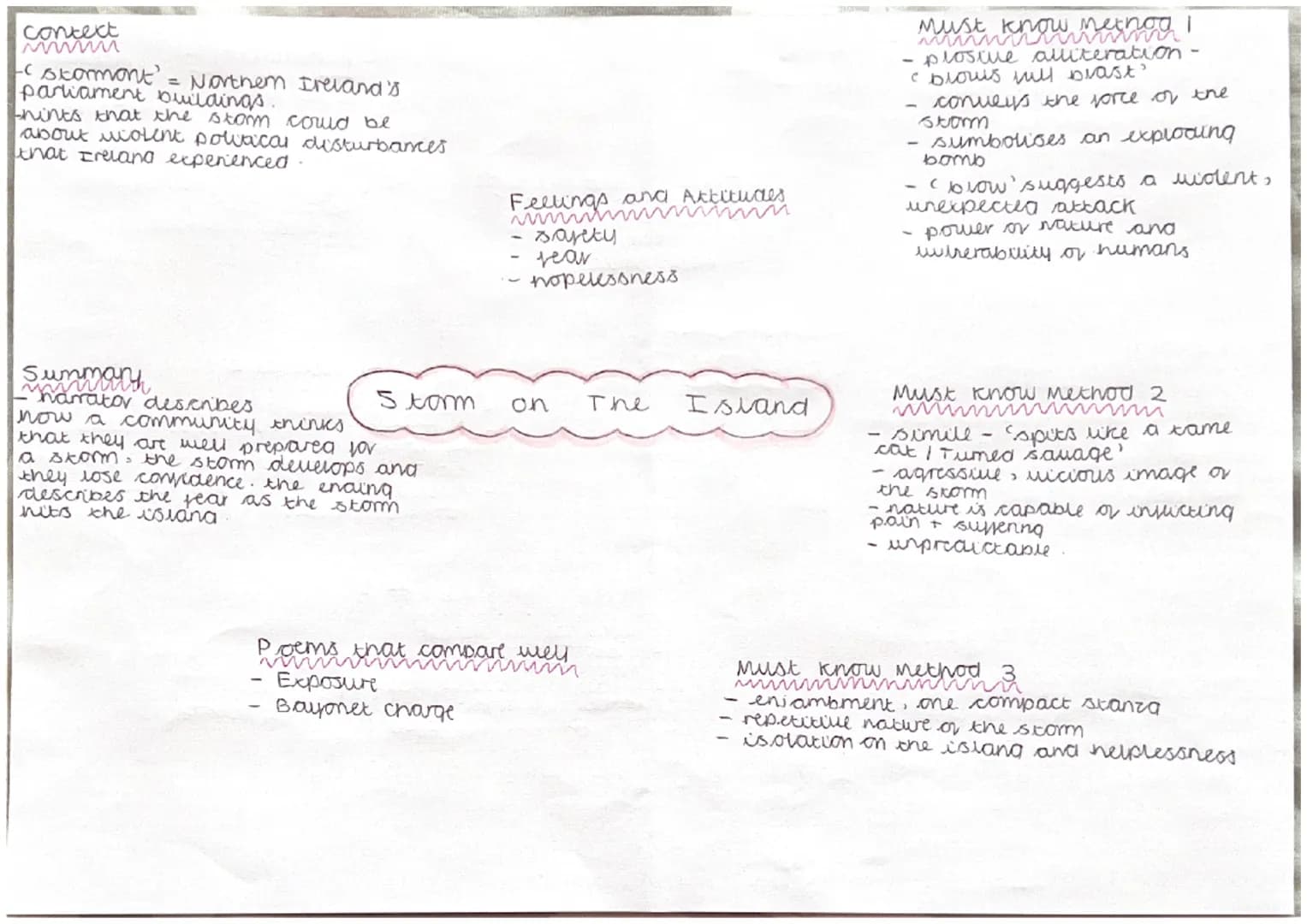
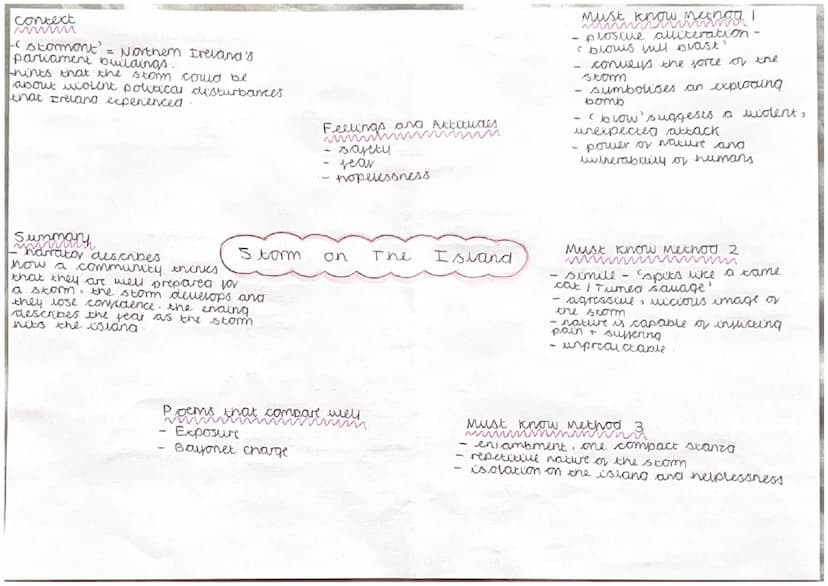
A poem examining community response to extreme weather, with political undertones relating to Northern Ireland.
Context: "Stormont" reference connects to Northern Ireland politics
Vocabulary: "Plosive alliteration" used to convey storm's force
Highlight: Storm serves as metaphor for political upheaval
Example: Shares themes with Exposure about nature's overwhelming force
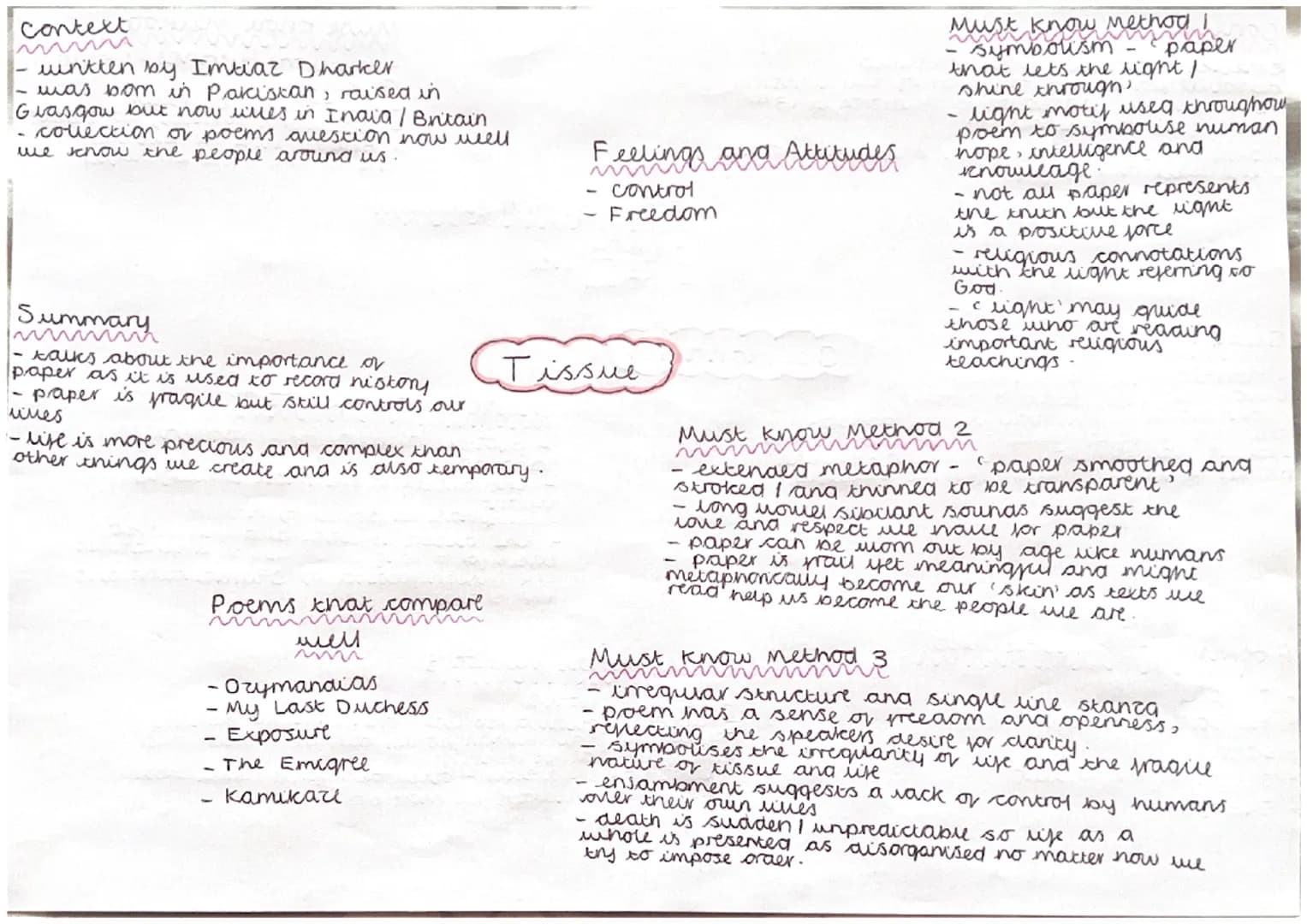
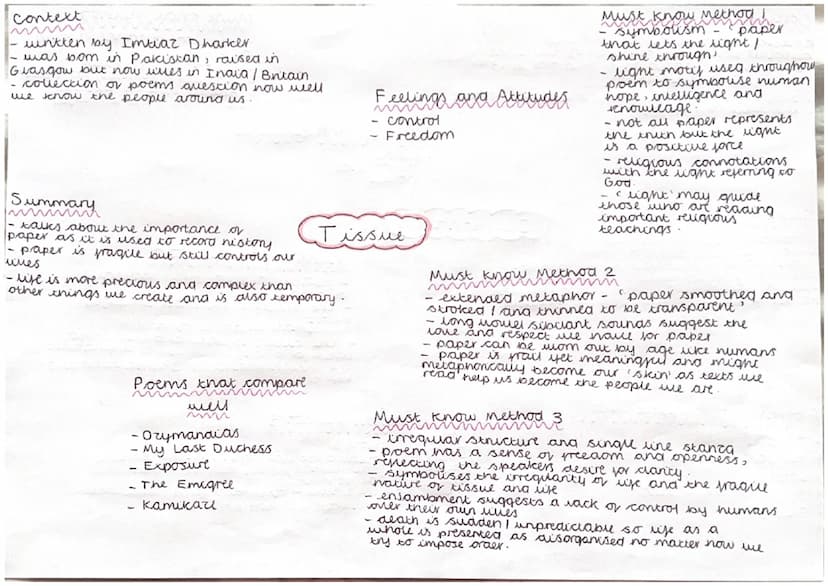
Imtiaz Dharker's exploration of paper's significance in recording human history and controlling lives.
Context: Written from multicultural perspective
Quote: "paper that lets the light shine through"
Highlight: Uses paper as metaphor for life's fragility and power
Example: Connects with Ozymandias through themes of temporary power
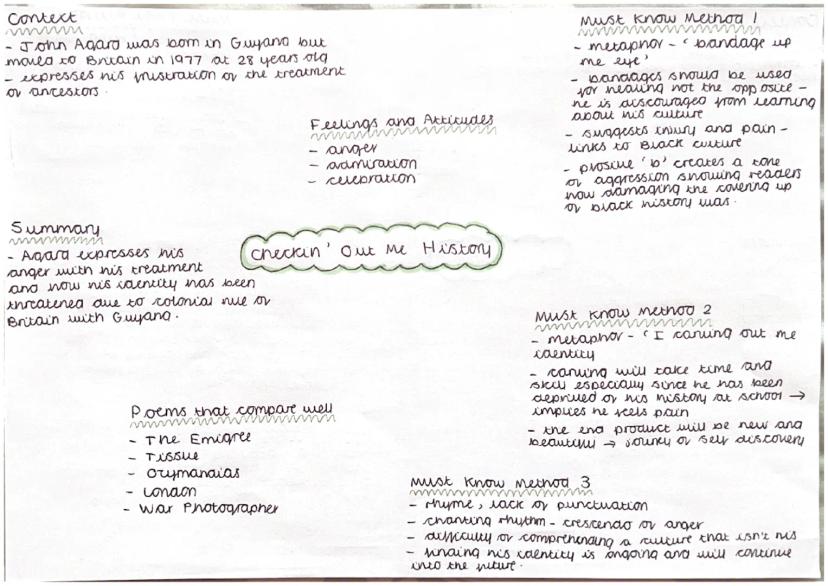
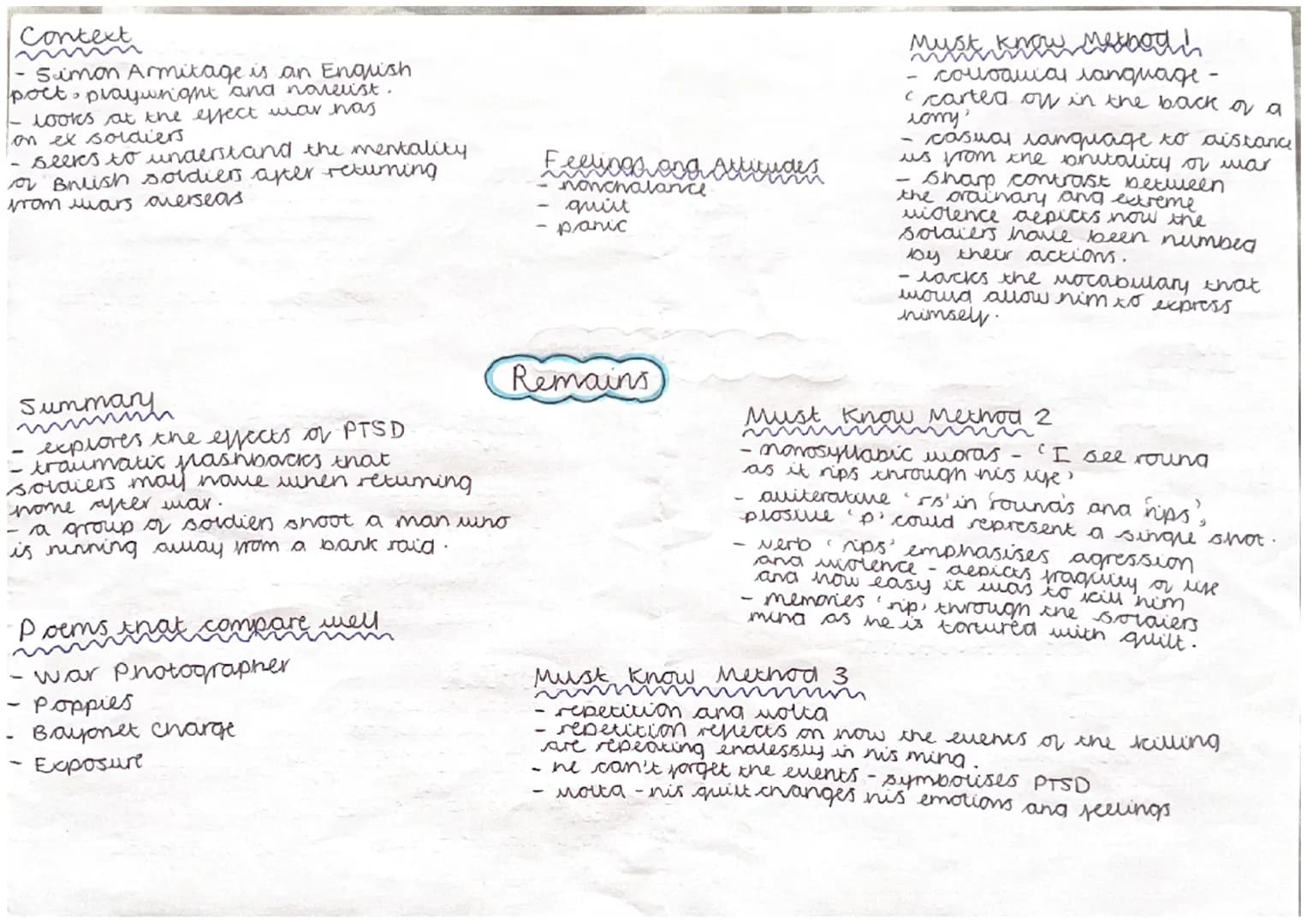
John Agard's "Checking Out Me History"
This section examines John Agard's poem "Checking Out Me History", which expresses frustration with colonial rule and its impact on cultural identity.
Highlight: Agard, born in Guyana, moved to Britain in 1977 at age 28 and uses this poem to voice his anger about the treatment of his ancestors and the threat to his identity due to British colonial rule.
The poem conveys feelings of anger, admiration, and celebration. It compares well with other poems like "The Emigree", "Tissue", "Ozymandias", "London", and "War Photographer".
Key literary techniques analyzed include:
Metaphor: "Bandage up me eye" suggests injury and pain, linking to Black culture. The 'b' sound creates a tone of aggression, highlighting the damaging effect of covering up Black history.
Metaphor: "Carving out me identity" implies a painful journey of self-discovery, emphasizing the skill and time required to reclaim one's history after being deprived of it in school.
Rhyme and lack of punctuation: The chanting rhythm creates a crescendo of anger, reflecting the ongoing process of finding one's identity and the difficulty of comprehending an unfamiliar culture.
Quote: "Dem tell me wha dem want to tell me"
This line emphasizes the selective teaching of history from a colonial perspective, ignoring the rich cultural heritage of the colonized people.
Our AI companion is specifically built for the needs of students. Based on the millions of content pieces we have on the platform we can provide truly meaningful and relevant answers to students. But its not only about answers, the companion is even more about guiding students through their daily learning challenges, with personalised study plans, quizzes or content pieces in the chat and 100% personalisation based on the students skills and developments.
You can download the app in the Google Play Store and in the Apple App Store.
That's right! Enjoy free access to study content, connect with fellow students, and get instant help – all at your fingertips.
App Store
Google Play
The app is very easy to use and well designed. I have found everything I was looking for so far and have been able to learn a lot from the presentations! I will definitely use the app for a class assignment! And of course it also helps a lot as an inspiration.
Stefan S
iOS user
This app is really great. There are so many study notes and help [...]. My problem subject is French, for example, and the app has so many options for help. Thanks to this app, I have improved my French. I would recommend it to anyone.
Samantha Klich
Android user
Wow, I am really amazed. I just tried the app because I've seen it advertised many times and was absolutely stunned. This app is THE HELP you want for school and above all, it offers so many things, such as workouts and fact sheets, which have been VERY helpful to me personally.
Anna
iOS user
I think it’s very much worth it and you’ll end up using it a lot once you get the hang of it and even after looking at others notes you can still ask your Artificial intelligence buddy the question and ask to simplify it if you still don’t get it!!! In the end I think it’s worth it 😊👍 ⚠️Also DID I MENTION ITS FREEE YOU DON’T HAVE TO PAY FOR ANYTHING AND STILL GET YOUR GRADES IN PERFECTLY❗️❗️⚠️
Thomas R
iOS user
Knowunity is the BEST app I’ve used in a minute. This is not an ai review or anything this is genuinely coming from a 7th grade student (I know 2011 im young) but dude this app is a 10/10 i have maintained a 3.8 gpa and have plenty of time for gaming. I love it and my mom is just happy I got good grades
Brad T
Android user
Not only did it help me find the answer but it also showed me alternative ways to solve it. I was horrible in math and science but now I have an a in both subjects. Thanks for the help🤍🤍
David K
iOS user
The app's just great! All I have to do is enter the topic in the search bar and I get the response real fast. I don't have to watch 10 YouTube videos to understand something, so I'm saving my time. Highly recommended!
Sudenaz Ocak
Android user
In school I was really bad at maths but thanks to the app, I am doing better now. I am so grateful that you made the app.
Greenlight Bonnie
Android user
I found this app a couple years ago and it has only gotten better since then. I really love it because it can help with written questions and photo questions. Also, it can find study guides that other people have made as well as flashcard sets and practice tests. The free version is also amazing for students who might not be able to afford it. Would 100% recommend
Aubrey
iOS user
Best app if you're in Highschool or Junior high. I have been using this app for 2 school years and it's the best, it's good if you don't have anyone to help you with school work.😋🩷🎀
Marco B
iOS user
THE QUIZES AND FLASHCARDS ARE SO USEFUL AND I LOVE THE SCHOOLGPT. IT ALSO IS LITREALLY LIKE CHATGPT BUT SMARTER!! HELPED ME WITH MY MASCARA PROBLEMS TOO!! AS WELL AS MY REAL SUBJECTS ! DUHHH 😍😁😲🤑💗✨🎀😮
Elisha
iOS user
This app is phenomenal down to the correct info and the various topics you can study! I greatly recommend it for people who struggle with procrastination and those who need homework help. It has been perfectly accurate for world 1 history as far as I’ve seen! Geometry too!
Paul T
iOS user
The app is very easy to use and well designed. I have found everything I was looking for so far and have been able to learn a lot from the presentations! I will definitely use the app for a class assignment! And of course it also helps a lot as an inspiration.
Stefan S
iOS user
This app is really great. There are so many study notes and help [...]. My problem subject is French, for example, and the app has so many options for help. Thanks to this app, I have improved my French. I would recommend it to anyone.
Samantha Klich
Android user
Wow, I am really amazed. I just tried the app because I've seen it advertised many times and was absolutely stunned. This app is THE HELP you want for school and above all, it offers so many things, such as workouts and fact sheets, which have been VERY helpful to me personally.
Anna
iOS user
I think it’s very much worth it and you’ll end up using it a lot once you get the hang of it and even after looking at others notes you can still ask your Artificial intelligence buddy the question and ask to simplify it if you still don’t get it!!! In the end I think it’s worth it 😊👍 ⚠️Also DID I MENTION ITS FREEE YOU DON’T HAVE TO PAY FOR ANYTHING AND STILL GET YOUR GRADES IN PERFECTLY❗️❗️⚠️
Thomas R
iOS user
Knowunity is the BEST app I’ve used in a minute. This is not an ai review or anything this is genuinely coming from a 7th grade student (I know 2011 im young) but dude this app is a 10/10 i have maintained a 3.8 gpa and have plenty of time for gaming. I love it and my mom is just happy I got good grades
Brad T
Android user
Not only did it help me find the answer but it also showed me alternative ways to solve it. I was horrible in math and science but now I have an a in both subjects. Thanks for the help🤍🤍
David K
iOS user
The app's just great! All I have to do is enter the topic in the search bar and I get the response real fast. I don't have to watch 10 YouTube videos to understand something, so I'm saving my time. Highly recommended!
Sudenaz Ocak
Android user
In school I was really bad at maths but thanks to the app, I am doing better now. I am so grateful that you made the app.
Greenlight Bonnie
Android user
I found this app a couple years ago and it has only gotten better since then. I really love it because it can help with written questions and photo questions. Also, it can find study guides that other people have made as well as flashcard sets and practice tests. The free version is also amazing for students who might not be able to afford it. Would 100% recommend
Aubrey
iOS user
Best app if you're in Highschool or Junior high. I have been using this app for 2 school years and it's the best, it's good if you don't have anyone to help you with school work.😋🩷🎀
Marco B
iOS user
THE QUIZES AND FLASHCARDS ARE SO USEFUL AND I LOVE THE SCHOOLGPT. IT ALSO IS LITREALLY LIKE CHATGPT BUT SMARTER!! HELPED ME WITH MY MASCARA PROBLEMS TOO!! AS WELL AS MY REAL SUBJECTS ! DUHHH 😍😁😲🤑💗✨🎀😮
Elisha
iOS user
This app is phenomenal down to the correct info and the various topics you can study! I greatly recommend it for people who struggle with procrastination and those who need homework help. It has been perfectly accurate for world 1 history as far as I’ve seen! Geometry too!
Paul T
iOS user
emma
@emmasnotes111
A comprehensive guide to key GCSE Poetry anthology poems exploring themes of power, identity, and conflict across different time periods and contexts. The collection features works from diverse poets examining colonial history, war trauma, natural forces, and political power.
Access to all documents
Improve your grades
Join milions of students
By signing up you accept Terms of Service and Privacy Policy
William Blake's "London"
This section explores William Blake's poem "London", written in 1794 by the romantic poet and radicalist.
Context: Blake was concerned about oppressed people in society and used his poetry to critique social injustice.
The poem describes the misery and despair witnessed in London, pointing to people in power (monarchs, government) as the source of problems. It conveys feelings of anger and hopelessness.
"London" compares well with poems like "Ozymandias", "My Last Duchess", and "Checking Out Me History".
Key literary techniques analyzed include:
Metaphor: "Mind-forg'd manacles" creates an image of metal chains, suggesting control and indoctrination. This represents the brainwashing and constant control exerted by those with wealth and authority.
Metaphor: "Palace walls / With blood" implies that the government has blood on their hands, having caused pain and suffering to the people. It symbolizes the sacrifice of ordinary citizens for king and country.
Repetition and structure: The rigidity of the poem reflects the controlling nature of people in power. The repetition reinforces the endless misery of oppressed people within society.
Quote: "In every cry of every Man, / In every Infant's cry of fear, / In every voice, in every ban, / The mind-forg'd manacles I hear"
This powerful stanza emphasizes the pervasive nature of oppression in London society.
Access to all documents
Improve your grades
Join milions of students
By signing up you accept Terms of Service and Privacy Policy
Carol Ann Duffy's "War Photographer"
This section examines Carol Ann Duffy's poem "War Photographer", inspired by her friends who were war photographers.
Context: Duffy was interested in the difficulties that war photographers experience and used this poem to explore their emotional struggles.
The poem refers to the famous "Napalm Girl" photograph of a nine-year-old girl running naked and in extreme pain after being badly burned by a bomb. This powerful image won a prize and was widely published.
"War Photographer" compares well with poems like "Remains", "Poppies", "Bayonet Charge", and "Exposure".
Key literary techniques analyzed include:
Metaphor: "Spools of suffering set out in ordered rows" creates an image reminiscent of headstones in a cemetery. The fragility of the spools represents the vulnerability of the people captured on film.
Imagery: "Blood stained into foreign dust" emphasizes how war leaves a lasting mark on the photographer and highlights the theme of death and the fragility of life.
Structure: The regular six-line stanzas, each ending with a rhyming couplet, emphasize the photographer's determination to find order in chaos and tragedy.
Quote: "A hundred agonies in black-and-white / From which his editor will pick out five or six / For Sunday's supplement"
This line highlights the contrast between the photographer's experiences and the limited exposure given to the public, emphasizing the disconnect between war zones and comfortable civilian life.
Access to all documents
Improve your grades
Join milions of students
By signing up you accept Terms of Service and Privacy Policy
Simon Armitage's "Remains"
This section explores Simon Armitage's poem "Remains", which examines the effects of PTSD on soldiers returning from war.
Context: Armitage, an English poet, playwright, and novelist, seeks to understand the mentality of British soldiers after returning from wars overseas.
The poem describes a group of soldiers who shoot a man running away from a bank raid and explores the traumatic flashbacks they experience upon returning home. It conveys feelings of nonchalance, guilt, and panic.
"Remains" compares well with poems like "War Photographer", "Poppies", "Bayonet Charge", and "Exposure".
Key literary techniques analyzed include:
Colloquial language: Phrases like "carted off in the back of a lorry" use casual language to distance readers from the brutality of war, highlighting how soldiers have been numbed by their actions.
Sound devices: The use of monosyllabic words, alliteration, and plosive sounds in lines like "rips through his life" emphasizes the violence and aggression of the killing.
Repetition and volta: The repetition reflects how the events of the killing are repeating endlessly in the soldier's mind, emphasizing his inability to forget.
Quote: "He's here in my head when I close my eyes, / dug in behind enemy lines"
This powerful imagery illustrates how the memory of the killing haunts the soldier, becoming an inescapable part of his psyche.
Access to all documents
Improve your grades
Join milions of students
By signing up you accept Terms of Service and Privacy Policy
Simon Armitage's examination of PTSD and war trauma through a soldier's perspective of a shooting incident.
Context: Written to understand returning soldiers' mental state
Vocabulary: Colloquial language used to show psychological distancing
Highlight: Explores the lasting impact of combat trauma
Example: Links to War Photographer and Exposure through shared themes of war's psychological impact
Access to all documents
Improve your grades
Join milions of students
By signing up you accept Terms of Service and Privacy Policy
Wilfred Owen's WWI poem focusing on soldiers' suffering from extreme weather conditions rather than combat.
Context: Written from trenches before Owen's death in battle
Quote: "Merciless ices east winds that knive"
Highlight: Nature presented as more threatening than human enemies
Example: Connects with Storm on the Island through theme of nature's power
Access to all documents
Improve your grades
Join milions of students
By signing up you accept Terms of Service and Privacy Policy
A poem examining community response to extreme weather, with political undertones relating to Northern Ireland.
Context: "Stormont" reference connects to Northern Ireland politics
Vocabulary: "Plosive alliteration" used to convey storm's force
Highlight: Storm serves as metaphor for political upheaval
Example: Shares themes with Exposure about nature's overwhelming force
Access to all documents
Improve your grades
Join milions of students
By signing up you accept Terms of Service and Privacy Policy
Imtiaz Dharker's exploration of paper's significance in recording human history and controlling lives.
Context: Written from multicultural perspective
Quote: "paper that lets the light shine through"
Highlight: Uses paper as metaphor for life's fragility and power
Example: Connects with Ozymandias through themes of temporary power
Access to all documents
Improve your grades
Join milions of students
By signing up you accept Terms of Service and Privacy Policy
John Agard's "Checking Out Me History"
This section examines John Agard's poem "Checking Out Me History", which expresses frustration with colonial rule and its impact on cultural identity.
Highlight: Agard, born in Guyana, moved to Britain in 1977 at age 28 and uses this poem to voice his anger about the treatment of his ancestors and the threat to his identity due to British colonial rule.
The poem conveys feelings of anger, admiration, and celebration. It compares well with other poems like "The Emigree", "Tissue", "Ozymandias", "London", and "War Photographer".
Key literary techniques analyzed include:
Metaphor: "Bandage up me eye" suggests injury and pain, linking to Black culture. The 'b' sound creates a tone of aggression, highlighting the damaging effect of covering up Black history.
Metaphor: "Carving out me identity" implies a painful journey of self-discovery, emphasizing the skill and time required to reclaim one's history after being deprived of it in school.
Rhyme and lack of punctuation: The chanting rhythm creates a crescendo of anger, reflecting the ongoing process of finding one's identity and the difficulty of comprehending an unfamiliar culture.
Quote: "Dem tell me wha dem want to tell me"
This line emphasizes the selective teaching of history from a colonial perspective, ignoring the rich cultural heritage of the colonized people.
Our AI companion is specifically built for the needs of students. Based on the millions of content pieces we have on the platform we can provide truly meaningful and relevant answers to students. But its not only about answers, the companion is even more about guiding students through their daily learning challenges, with personalised study plans, quizzes or content pieces in the chat and 100% personalisation based on the students skills and developments.
You can download the app in the Google Play Store and in the Apple App Store.
That's right! Enjoy free access to study content, connect with fellow students, and get instant help – all at your fingertips.
17
Smart Tools NEW
Transform this note into: ✓ 50+ Practice Questions ✓ Interactive Flashcards ✓ Full Mock Exam ✓ Essay Outlines
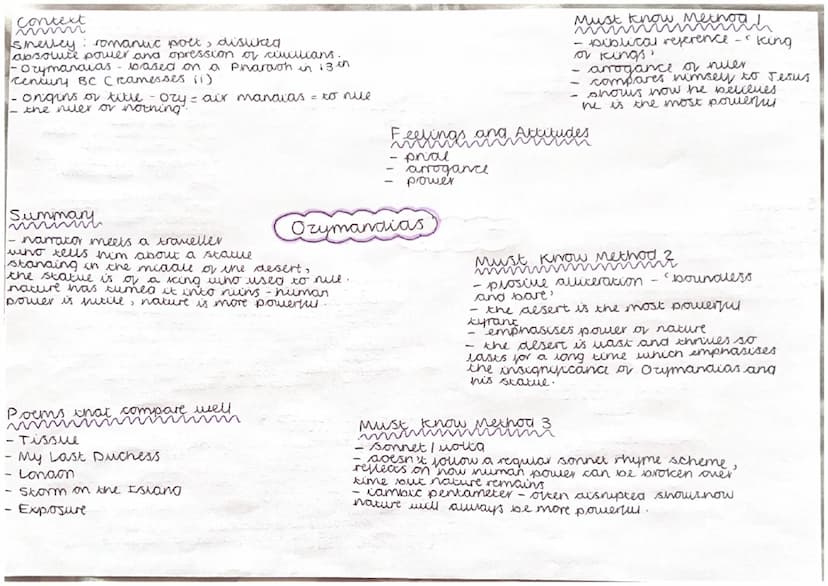
Explore the themes of power, legacy, and despair in Percy Bysshe Shelley's 'Ozymandias'. This mindmap highlights key annotations, including metaphors, imagery, and the ironic contrast between the king's ambition and his eventual downfall. Ideal for students studying literature and poetry analysis.
English LiteratureExplore a detailed analysis of Seamus Heaney's poem 'Follower,' focusing on themes of love, relationships, and the evolving parent-child dynamic. This study note delves into the poem's structure, use of rhyme, enjambment, and extended metaphors, highlighting the admiration and complexity of familial bonds. Ideal for students studying the Love and Relationships cluster in English Literature.
English LiteratureExplore a detailed analysis of Wilfred Owen's poem 'Exposure', focusing on themes of war, despair, and the psychological impact on soldiers. This study note includes annotations, key interpretations, and literary devices used in the poem, making it essential for GCSE English Literature students studying war poetry. Gain insights into the poignant imagery and the emotional depth of Owen's work.
English LiteratureExplore a detailed analysis of Simon Armitage's poem 'The Manhunt,' focusing on its themes of PTSD, the emotional and physical scars of war, and the impact on relationships. This study note includes comparisons to 'A Wife in London' and highlights key metaphors and interpretations. Ideal for GCSE poetry studies.
English LiteratureExplore a detailed analysis of Act 1 of Shakespeare's Macbeth, focusing on key themes such as ambition, betrayal, and the supernatural. This summary highlights the pivotal moments between Macbeth and Lady Macbeth, the significance of the witches' prophecies, and the dramatic irony present in the characters' interactions. Ideal for students seeking to understand the foundational elements of the play.
English LiteratureExplore a detailed analysis of Beatrice Garland's 'Kamikaze', focusing on key themes such as honour, nature, and irony. This summary highlights significant quotations, structural techniques, and comparisons with other poems like 'Poppies' and 'The Emigree'. Ideal for students preparing for exams or seeking to deepen their understanding of war poetry.
English LiteratureApp Store
Google Play
The app is very easy to use and well designed. I have found everything I was looking for so far and have been able to learn a lot from the presentations! I will definitely use the app for a class assignment! And of course it also helps a lot as an inspiration.
Stefan S
iOS user
This app is really great. There are so many study notes and help [...]. My problem subject is French, for example, and the app has so many options for help. Thanks to this app, I have improved my French. I would recommend it to anyone.
Samantha Klich
Android user
Wow, I am really amazed. I just tried the app because I've seen it advertised many times and was absolutely stunned. This app is THE HELP you want for school and above all, it offers so many things, such as workouts and fact sheets, which have been VERY helpful to me personally.
Anna
iOS user
I think it’s very much worth it and you’ll end up using it a lot once you get the hang of it and even after looking at others notes you can still ask your Artificial intelligence buddy the question and ask to simplify it if you still don’t get it!!! In the end I think it’s worth it 😊👍 ⚠️Also DID I MENTION ITS FREEE YOU DON’T HAVE TO PAY FOR ANYTHING AND STILL GET YOUR GRADES IN PERFECTLY❗️❗️⚠️
Thomas R
iOS user
Knowunity is the BEST app I’ve used in a minute. This is not an ai review or anything this is genuinely coming from a 7th grade student (I know 2011 im young) but dude this app is a 10/10 i have maintained a 3.8 gpa and have plenty of time for gaming. I love it and my mom is just happy I got good grades
Brad T
Android user
Not only did it help me find the answer but it also showed me alternative ways to solve it. I was horrible in math and science but now I have an a in both subjects. Thanks for the help🤍🤍
David K
iOS user
The app's just great! All I have to do is enter the topic in the search bar and I get the response real fast. I don't have to watch 10 YouTube videos to understand something, so I'm saving my time. Highly recommended!
Sudenaz Ocak
Android user
In school I was really bad at maths but thanks to the app, I am doing better now. I am so grateful that you made the app.
Greenlight Bonnie
Android user
I found this app a couple years ago and it has only gotten better since then. I really love it because it can help with written questions and photo questions. Also, it can find study guides that other people have made as well as flashcard sets and practice tests. The free version is also amazing for students who might not be able to afford it. Would 100% recommend
Aubrey
iOS user
Best app if you're in Highschool or Junior high. I have been using this app for 2 school years and it's the best, it's good if you don't have anyone to help you with school work.😋🩷🎀
Marco B
iOS user
THE QUIZES AND FLASHCARDS ARE SO USEFUL AND I LOVE THE SCHOOLGPT. IT ALSO IS LITREALLY LIKE CHATGPT BUT SMARTER!! HELPED ME WITH MY MASCARA PROBLEMS TOO!! AS WELL AS MY REAL SUBJECTS ! DUHHH 😍😁😲🤑💗✨🎀😮
Elisha
iOS user
This app is phenomenal down to the correct info and the various topics you can study! I greatly recommend it for people who struggle with procrastination and those who need homework help. It has been perfectly accurate for world 1 history as far as I’ve seen! Geometry too!
Paul T
iOS user
The app is very easy to use and well designed. I have found everything I was looking for so far and have been able to learn a lot from the presentations! I will definitely use the app for a class assignment! And of course it also helps a lot as an inspiration.
Stefan S
iOS user
This app is really great. There are so many study notes and help [...]. My problem subject is French, for example, and the app has so many options for help. Thanks to this app, I have improved my French. I would recommend it to anyone.
Samantha Klich
Android user
Wow, I am really amazed. I just tried the app because I've seen it advertised many times and was absolutely stunned. This app is THE HELP you want for school and above all, it offers so many things, such as workouts and fact sheets, which have been VERY helpful to me personally.
Anna
iOS user
I think it’s very much worth it and you’ll end up using it a lot once you get the hang of it and even after looking at others notes you can still ask your Artificial intelligence buddy the question and ask to simplify it if you still don’t get it!!! In the end I think it’s worth it 😊👍 ⚠️Also DID I MENTION ITS FREEE YOU DON’T HAVE TO PAY FOR ANYTHING AND STILL GET YOUR GRADES IN PERFECTLY❗️❗️⚠️
Thomas R
iOS user
Knowunity is the BEST app I’ve used in a minute. This is not an ai review or anything this is genuinely coming from a 7th grade student (I know 2011 im young) but dude this app is a 10/10 i have maintained a 3.8 gpa and have plenty of time for gaming. I love it and my mom is just happy I got good grades
Brad T
Android user
Not only did it help me find the answer but it also showed me alternative ways to solve it. I was horrible in math and science but now I have an a in both subjects. Thanks for the help🤍🤍
David K
iOS user
The app's just great! All I have to do is enter the topic in the search bar and I get the response real fast. I don't have to watch 10 YouTube videos to understand something, so I'm saving my time. Highly recommended!
Sudenaz Ocak
Android user
In school I was really bad at maths but thanks to the app, I am doing better now. I am so grateful that you made the app.
Greenlight Bonnie
Android user
I found this app a couple years ago and it has only gotten better since then. I really love it because it can help with written questions and photo questions. Also, it can find study guides that other people have made as well as flashcard sets and practice tests. The free version is also amazing for students who might not be able to afford it. Would 100% recommend
Aubrey
iOS user
Best app if you're in Highschool or Junior high. I have been using this app for 2 school years and it's the best, it's good if you don't have anyone to help you with school work.😋🩷🎀
Marco B
iOS user
THE QUIZES AND FLASHCARDS ARE SO USEFUL AND I LOVE THE SCHOOLGPT. IT ALSO IS LITREALLY LIKE CHATGPT BUT SMARTER!! HELPED ME WITH MY MASCARA PROBLEMS TOO!! AS WELL AS MY REAL SUBJECTS ! DUHHH 😍😁😲🤑💗✨🎀😮
Elisha
iOS user
This app is phenomenal down to the correct info and the various topics you can study! I greatly recommend it for people who struggle with procrastination and those who need homework help. It has been perfectly accurate for world 1 history as far as I’ve seen! Geometry too!
Paul T
iOS user