Key Wartime Conferences and Their Impact
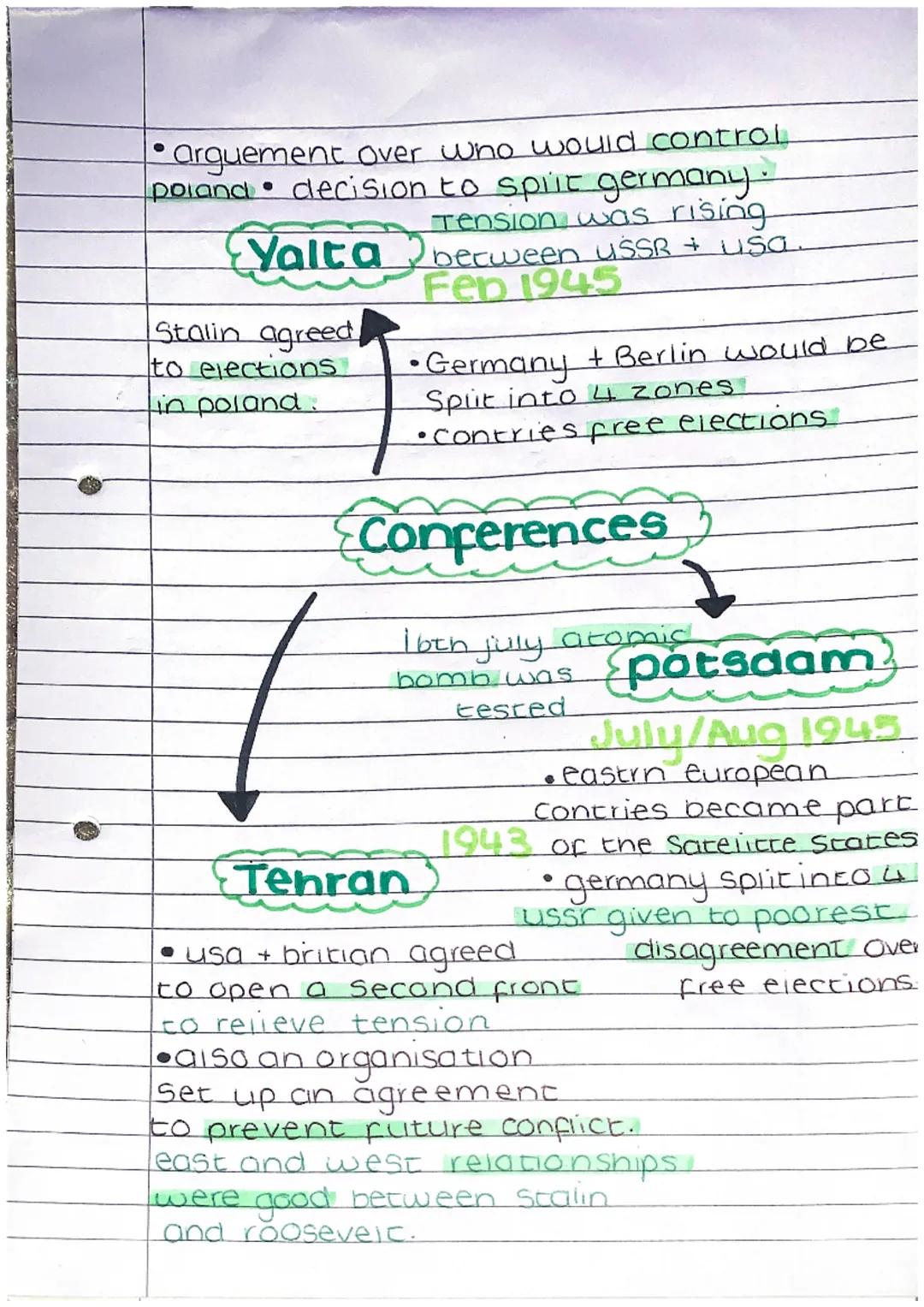
The wartime conferences between 1943-1945 played a pivotal role in shaping post-war Europe and international relations. Beginning with the Tehran Conference in 1943, where initial cooperation between the Allied powers was established, through to the Potsdam Conference in 1945, these meetings set the foundation for post-war arrangements and revealed growing tensions between the superpowers.
Definition: Satellite States were countries in Eastern Europe that fell under Soviet control after World War II, while maintaining nominal independence.
Example: The division of Germany into four zones, controlled by the USA, USSR, Britain, and France, demonstrated the practical implementation of wartime agreements.
Highlight: The development and testing of the atomic bomb during the Potsdam Conference significantly altered the power dynamics between the Allied nations.
Quote: "East and west relationships were good between Stalin and Roosevelt" during the Tehran Conference of 1943, though this would deteriorate in subsequent years.
Vocabulary: The term "Second Front" refers to the Allied invasion of Western Europe, which the USSR had been demanding to relieve pressure on their forces.


 Sociology
 Biology