
Ever wonder why some animals have backbones while others don't?... Show more
 Biology108 views·Updated May 14, 2026·12 pages
Understanding Invertebrate Animals: Kingdom Insights 2023 PDF

C@cnnotes
1 / 10
1
of 10
Animals: Invertebrates
Welcome to the world of invertebrates! These are the animals that dominate our planet in both numbers and diversity.
Throughout this unit, we'll discover how these backbone-free creatures have evolved amazing adaptations to survive in virtually every environment on Earth. From the ocean depths to your backyard, invertebrates play crucial roles in ecosystems worldwide.
You'll be surprised at how complex these seemingly simple animals can be!
2
of 10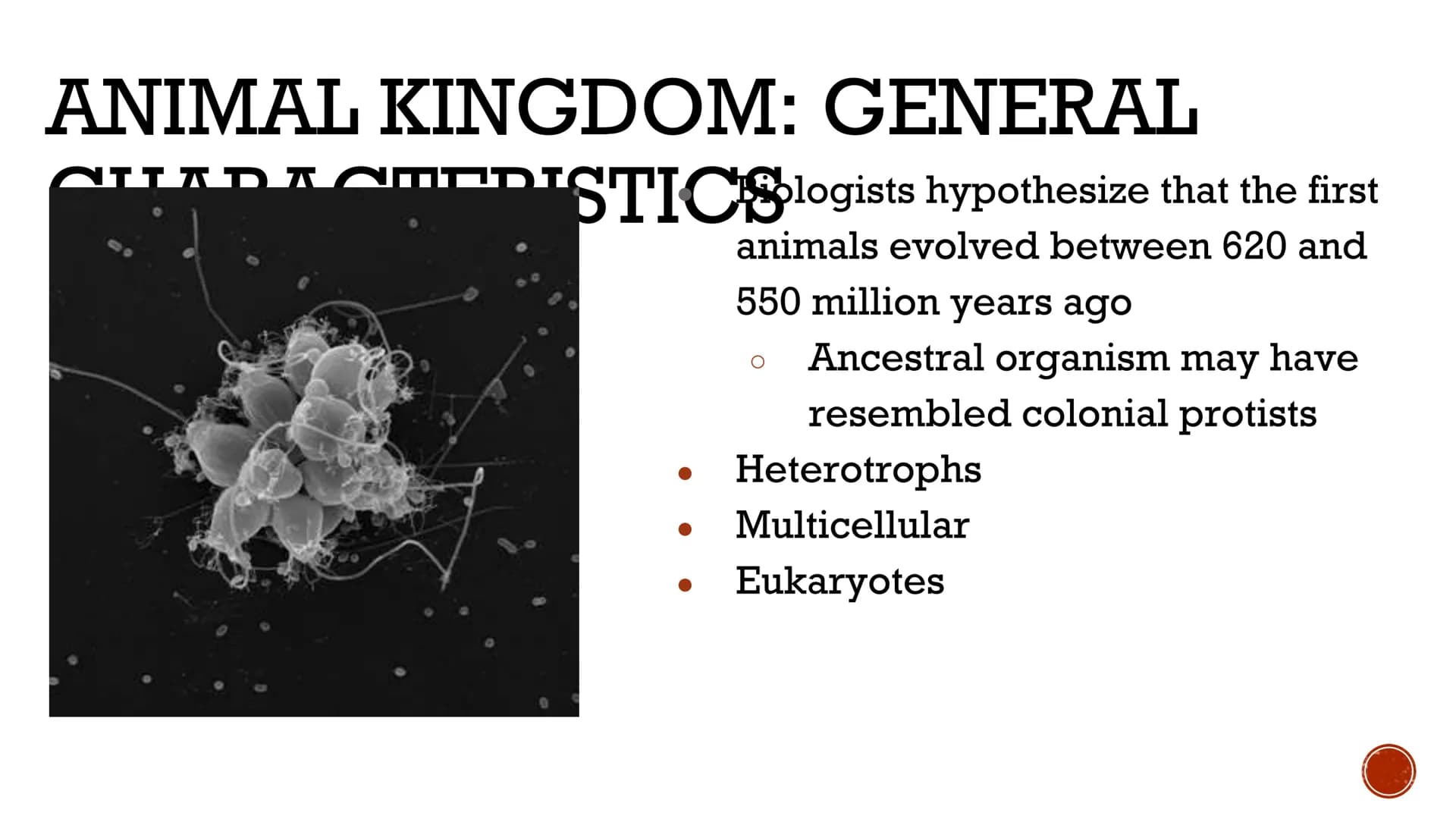
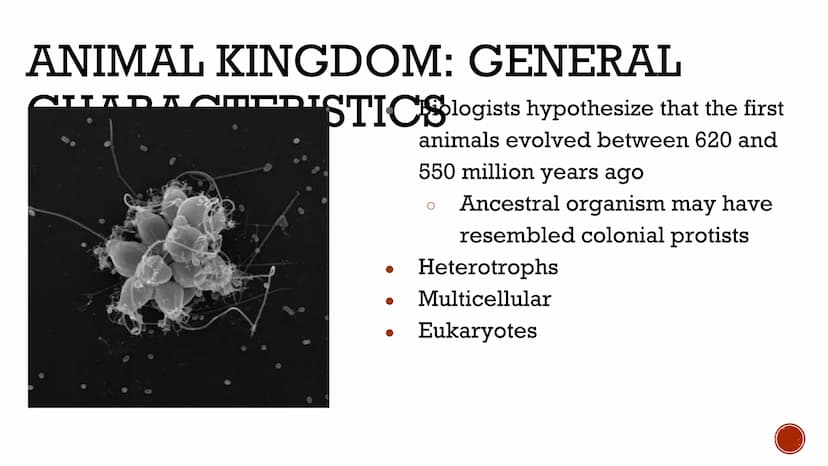
Animal Kingdom: General Characteristics
Animals first appeared on Earth between 550-620 million years ago, possibly evolving from organisms similar to colonial protists. That's over half a billion years of animal evolution!
All animals share three key characteristics. They're heterotrophs (they consume other organisms for energy), multicellular (made of many specialized cells working together), and eukaryotes (their cells contain a nucleus and specialized structures).
These fundamental traits distinguish animals from other living things like plants and bacteria. Even the simplest animal is an intricate collection of cells working together as a unified organism.
Fun fact: The earliest animal fossils come from the Ediacaran period and look nothing like modern animals we know today!
3
of 10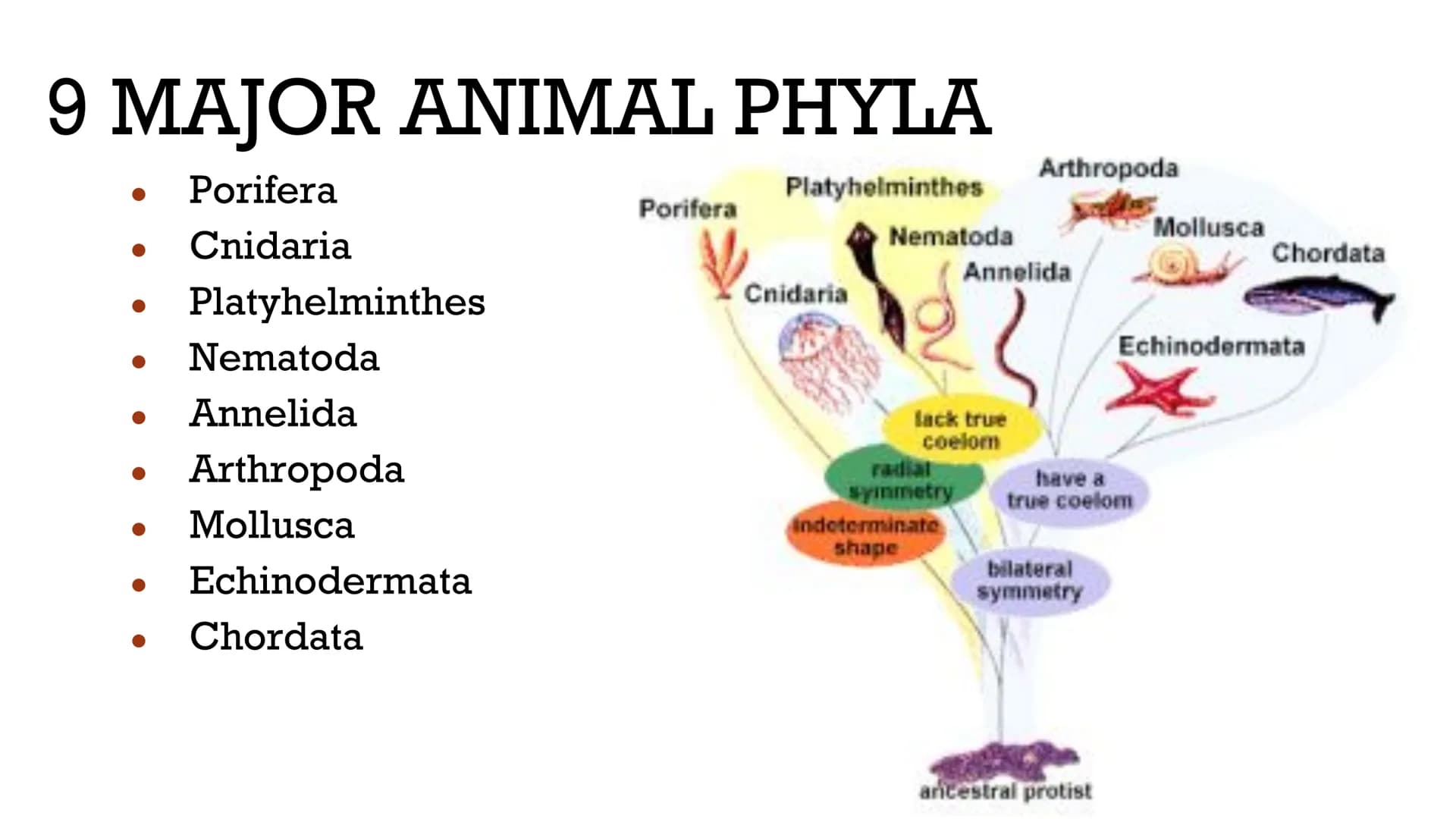
9 Major Animal Phyla
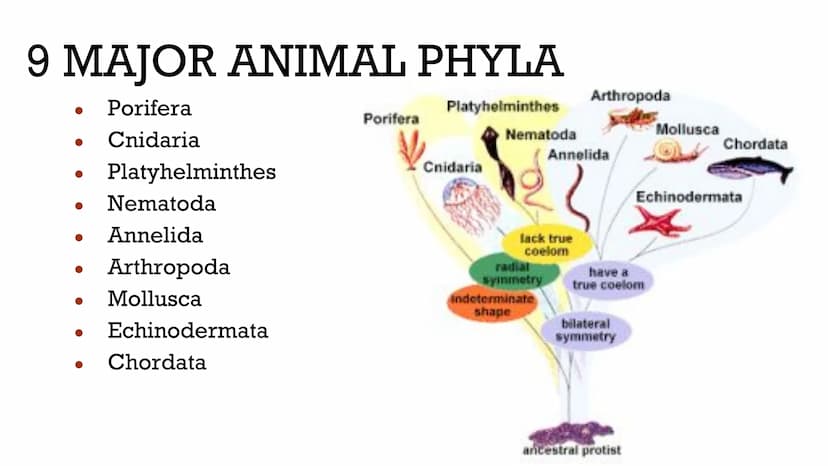
Scientists classify animals into major groups called phyla based on their body structure and development. The nine major animal phyla are Porifera, Cnidaria, Platyhelminthes, Nematoda, Annelida, Arthropoda, Mollusca, Echinodermata, and Chordata.
These phyla can be organized by key evolutionary features. Some have radial symmetry (can be divided equally along any plane through the center), while others show bilateral symmetry (have distinct left and right sides). Some lack a body cavity called a coelom, while others have developed this important feature.
The evolutionary relationships between these groups form a branching tree that started with a common ancestor similar to protists. Each branch represents adaptations that helped animals survive in different environments.
Remember this: Bilateral symmetry was a game-changing adaptation that allowed animals to develop specialized front and back ends, leading to more complex movement and nervous systems!
4
of 10
Invertebrates
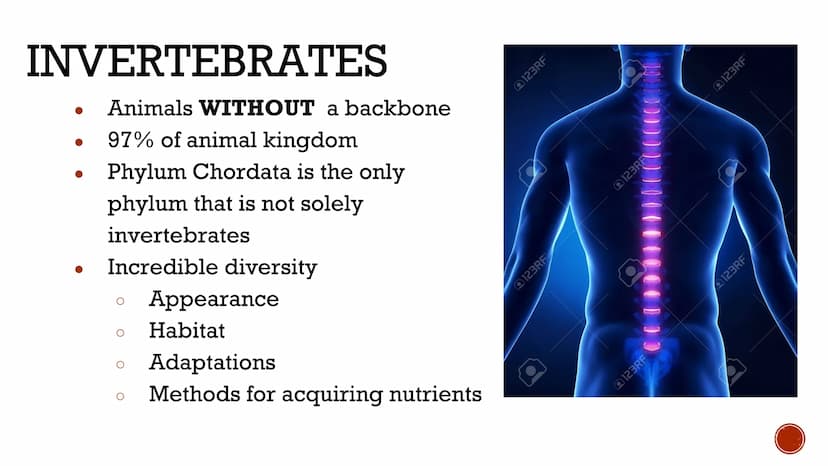
Invertebrates are animals that don't have a backbone. That might seem like a simple distinction, but it encompasses an incredible 97% of all animal species on Earth!
These backbone-free creatures come in astonishing varieties. They range from microscopic worms to giant squid, from colorful butterflies to bizarre deep-sea creatures. Their adaptations for survival are just as diverse – some filter nutrients from water, others parasitize hosts, and many actively hunt prey.
Only one phylum, Chordata, contains both invertebrates and vertebrates (animals with backbones). The incredible diversity of invertebrates shows how successful this body plan has been throughout evolutionary history.
Mind-blowing fact: For every person on Earth, there are about 200 million invertebrates! They outnumber us by a truly staggering margin.
5
of 10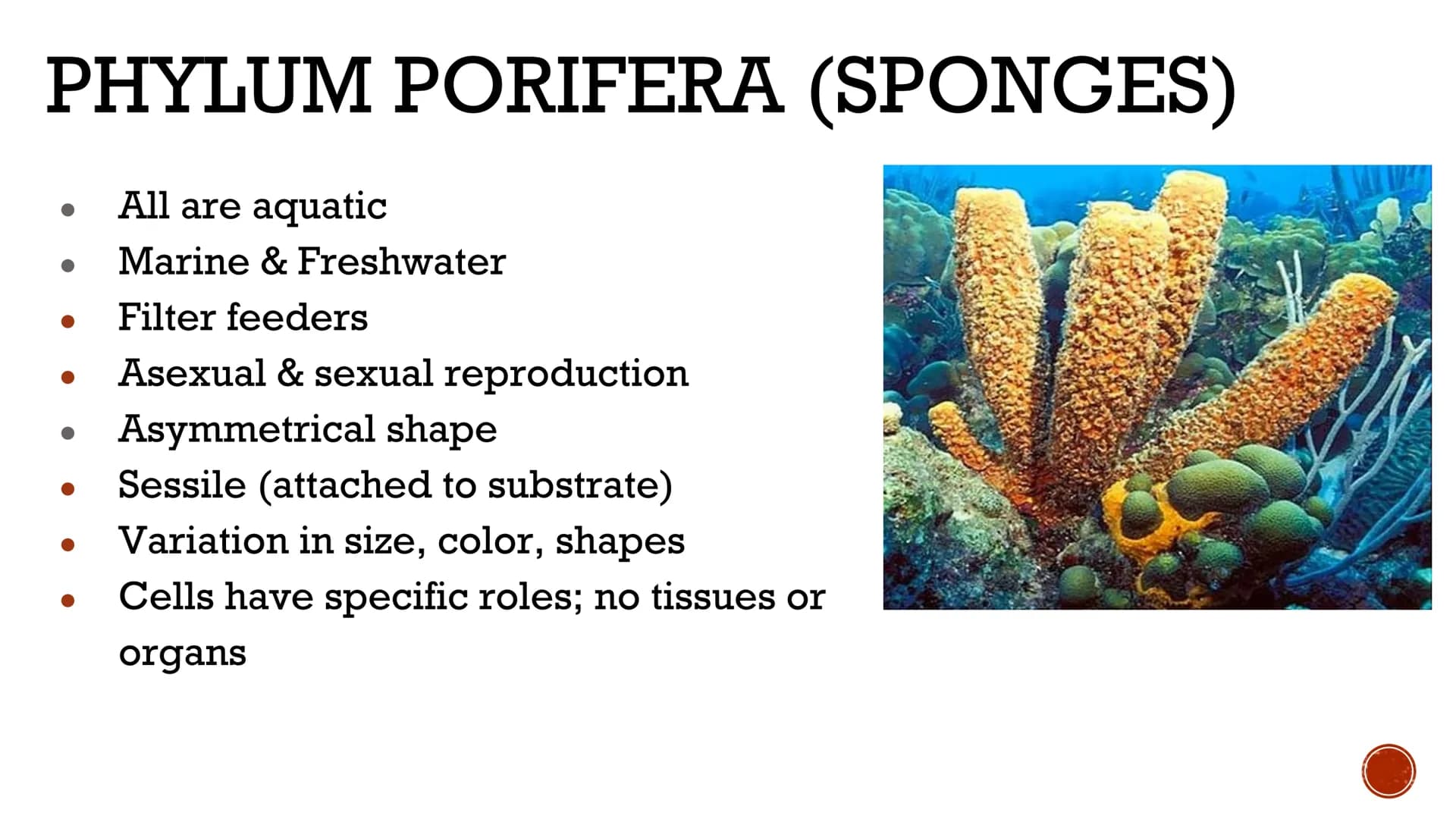
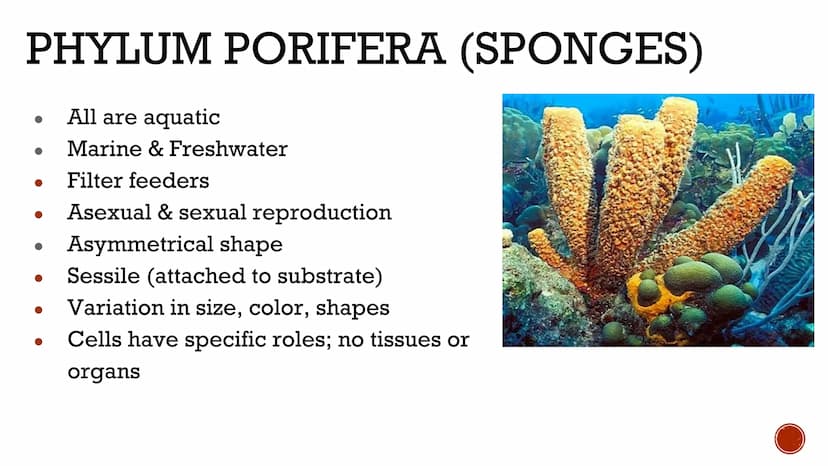
Phylum Porifera (Sponges)
Sponges are among the simplest animals on Earth, yet they've survived for over 500 million years! These aquatic creatures live in both freshwater and marine environments where they attach themselves permanently to surfaces.
As filter feeders, sponges pump water through their porous bodies to capture tiny food particles. Unlike most animals, sponges have no true tissues or organs. Instead, they have specialized cells that perform different functions, making them unique in the animal kingdom.
Sponges can reproduce both sexually and asexually, giving them flexibility in how they produce offspring. They come in countless sizes, shapes, and colors, from tiny encrustations to barrel-shaped giants over six feet tall!
Cool connection: The sponge you might use in your shower is inspired by these animals, though modern bathroom sponges are usually synthetic. Real sponges were harvested for centuries for cleaning purposes!
6
of 10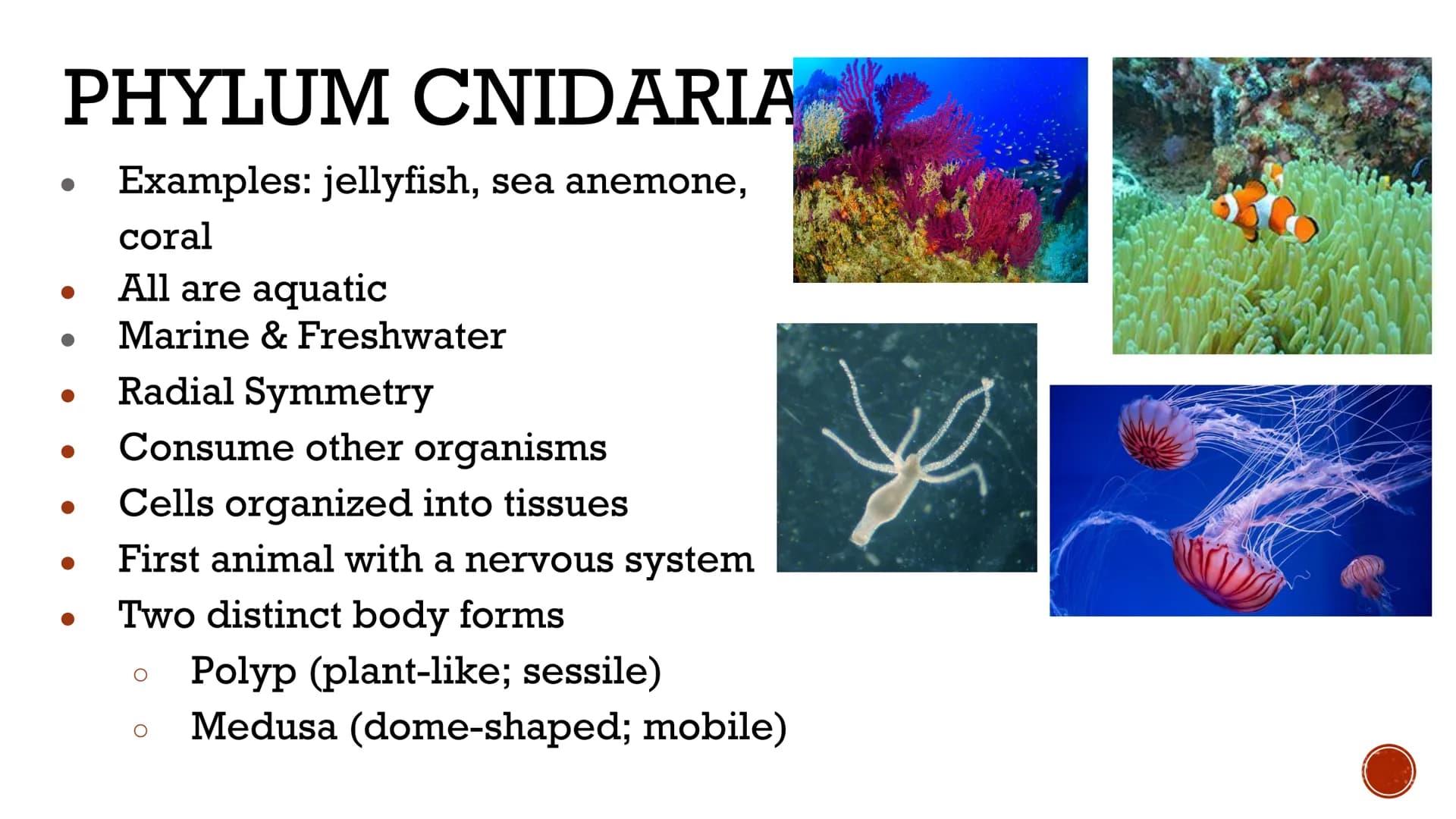
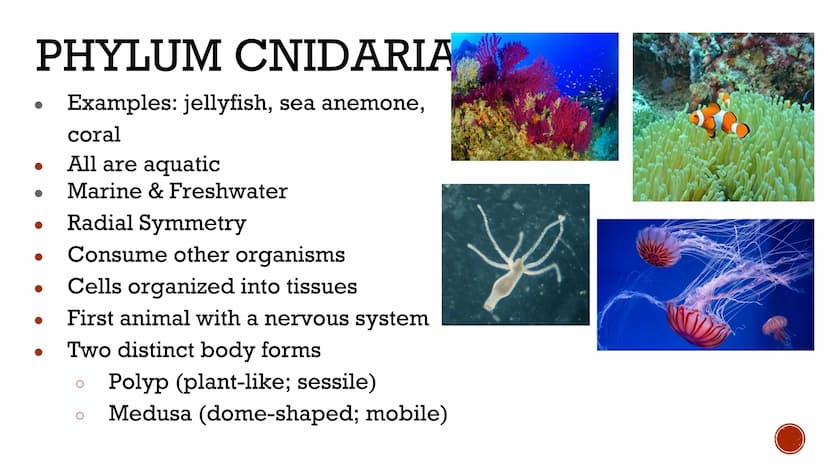
Phylum Cnidaria
Jellyfish, sea anemones, and corals might look completely different, but they're all members of the same animal group: Cnidaria. These primarily marine creatures were the first animals to develop a true nervous system!
Cnidarians have a unique body plan with radial symmetry - they can be divided into equal halves along any plane through the center axis. They capture prey using special stinging cells called cnidocytes that inject venom into their victims.
What makes cnidarians especially interesting is that many species can exist in two distinct body forms: the sessile (stationary) polyp form that resembles a plant, and the mobile medusa form that resembles the classic jellyfish shape. Some species alternate between these forms during their life cycle!
Watch out! The Portuguese Man o' War, often mistaken for a jellyfish, is actually a colony of specialized polyps working together. Its sting can be extremely painful to humans!
7
of 10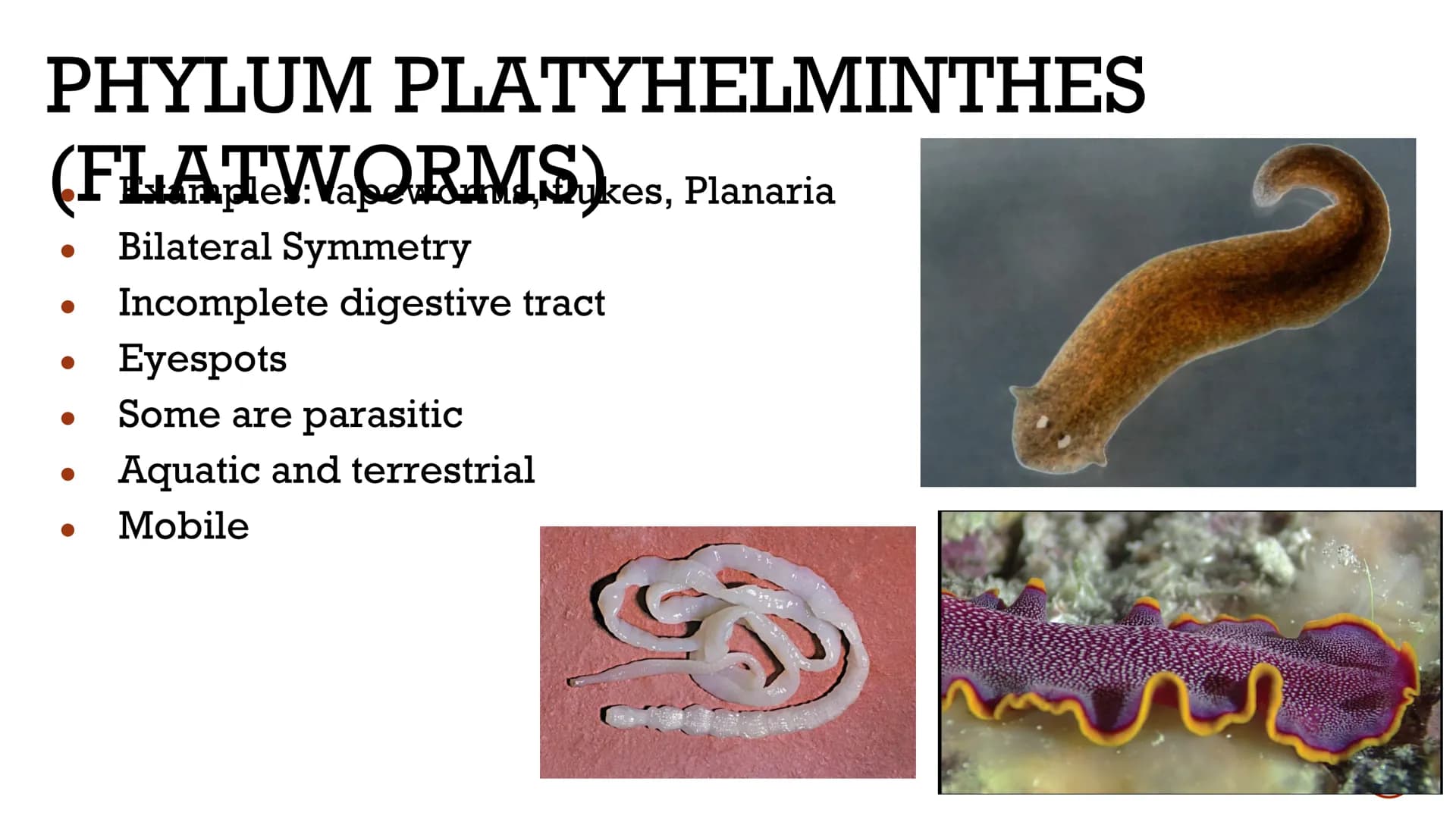
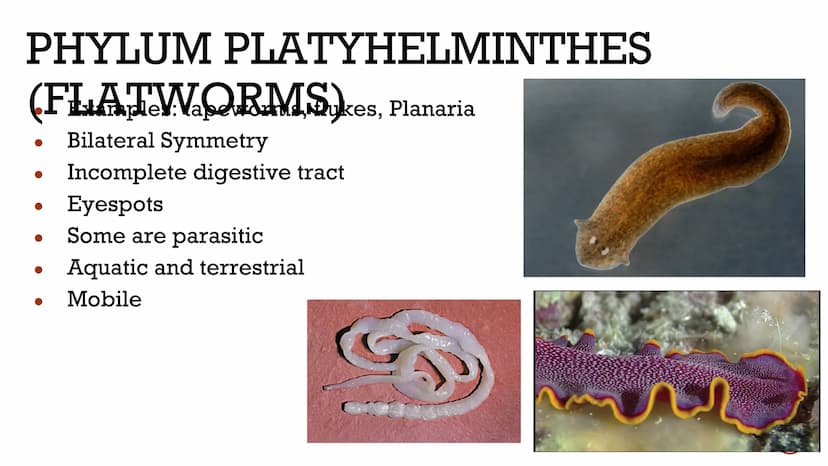
Phylum Platyhelminthes (Flatworms)
Flatworms represent a significant evolutionary step forward with their bilateral symmetry - they have distinct front and back ends, which allows for more directed movement and specialized sense organs like eyespots for detecting light.
These worms have a simple, flattened body shape (hence the name) and can be found in aquatic and terrestrial environments. While some flatworms like planaria are free-living, many species have evolved to become parasites that live inside other organisms.
One of the most interesting features of flatworms is their incomplete digestive system - they have a mouth but no anus! This means waste must exit through the same opening that food enters, limiting their digestive efficiency.
Did you know? Some flatworms can regenerate their entire body from just a tiny fragment - cut a planarian into pieces and each piece can grow into a complete new worm!
8
of 10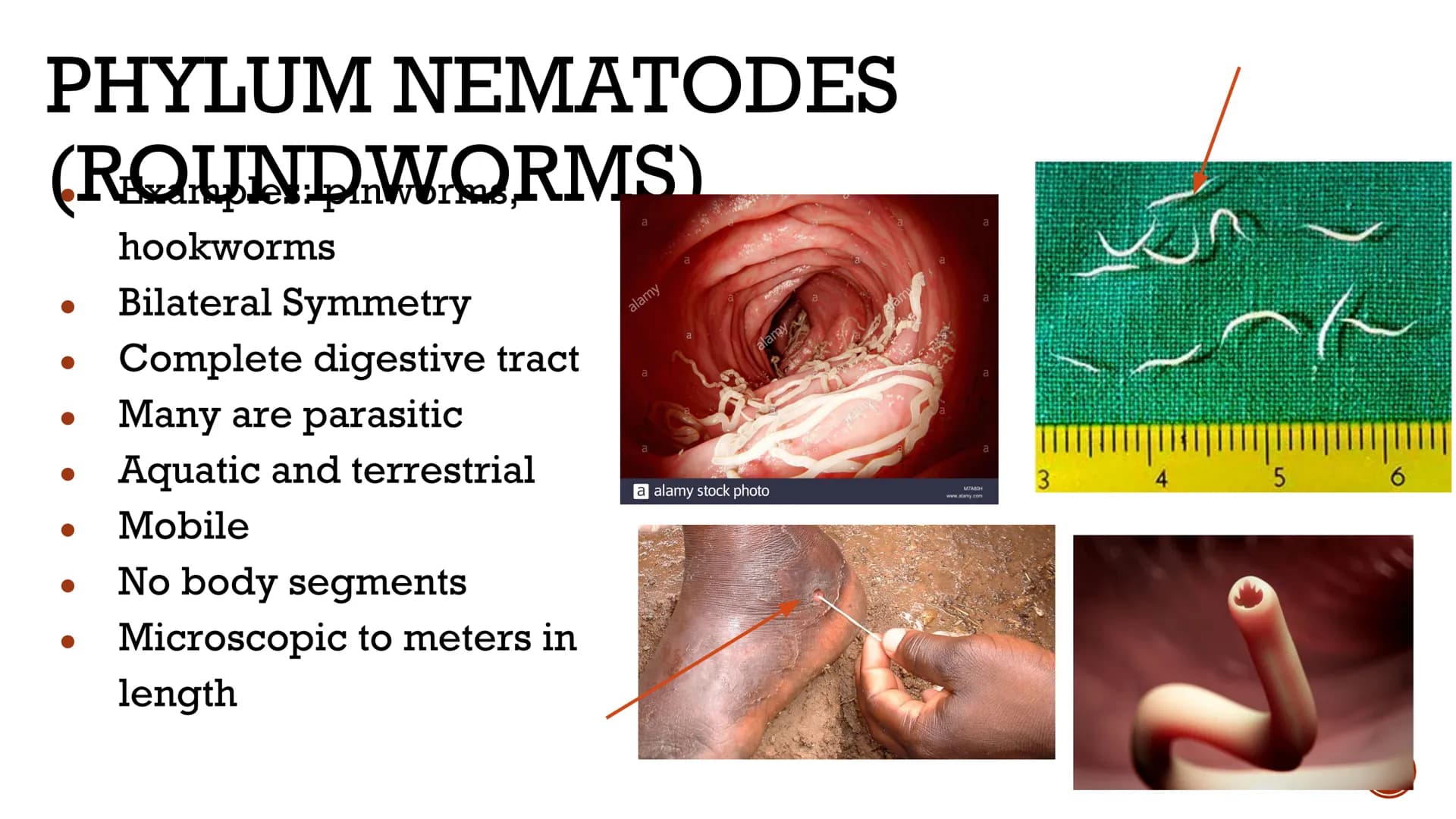
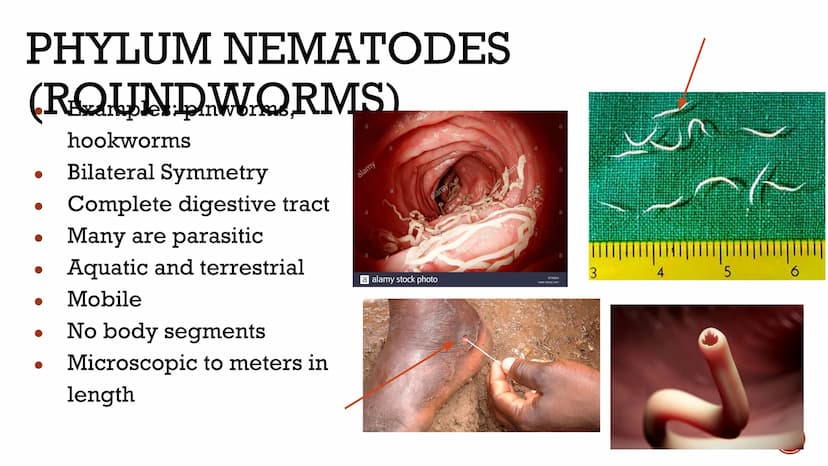
Phylum Nematodes (Roundworms)
Roundworms are everywhere - in soil, water, plants, and even inside your body! These tiny creatures range from microscopic to several meters long and can be found in almost every habitat on Earth.
Unlike flatworms, nematodes have a complete digestive tract with both a mouth and anus, allowing food to move in one direction through their body. This improved efficiency helps them thrive in diverse environments.
Many roundworms are parasites that infect plants, animals, and humans. Hookworms, for instance, can enter through human skin and live in the intestines. Despite their simple appearance, nematodes have sophisticated nervous systems and complex behaviors.
Astonishing fact: Scientists estimate there may be over a million nematode species, with possibly 80% of all animals on Earth being roundworms! Only about 25,000 species have been described so far.
9
of 10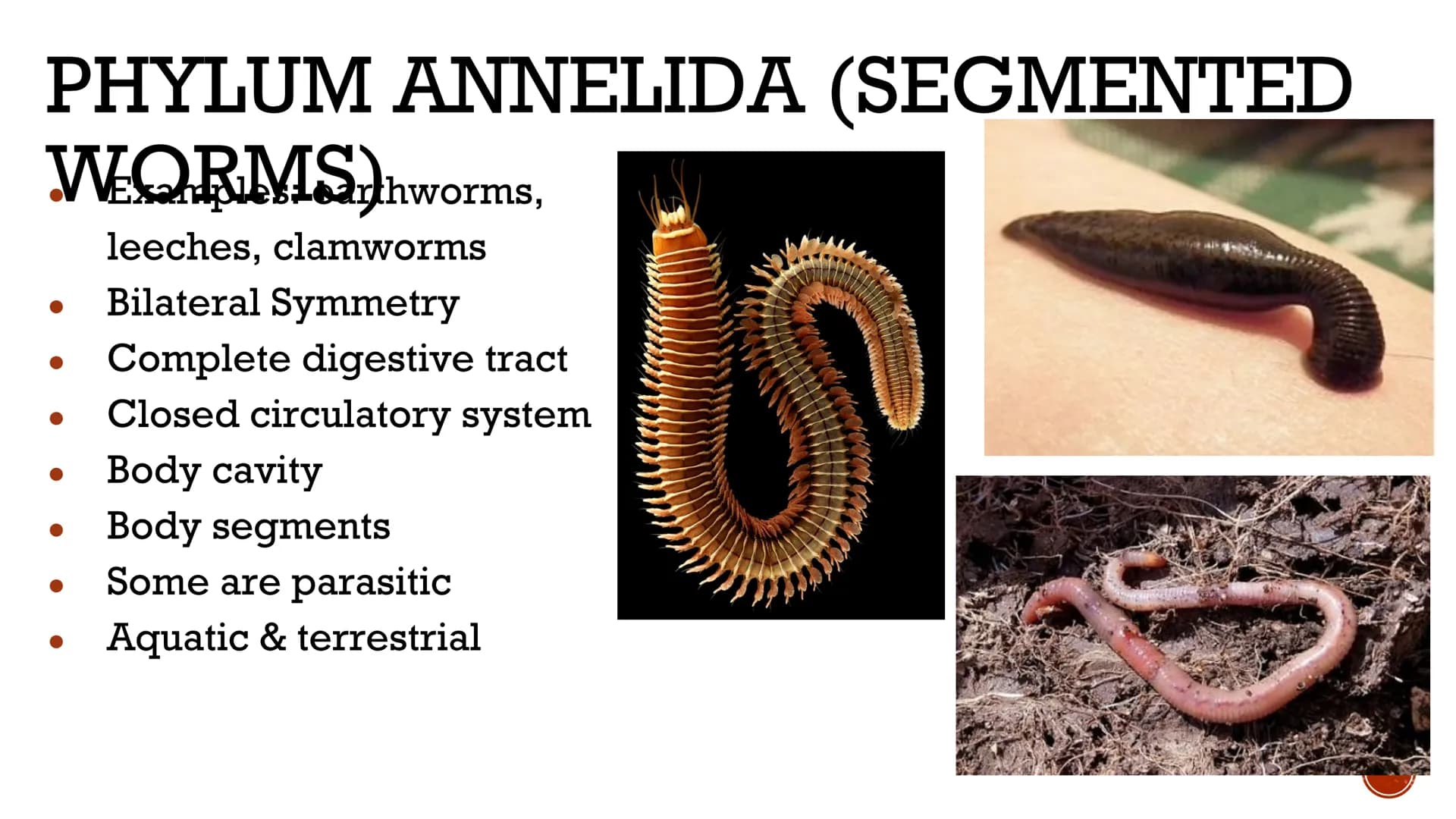
Phylum Annelida (Segmented Worms)
Earthworms, leeches, and marine clamworms might not seem impressive at first glance, but these segmented worms represent a major leap in animal complexity. Their bodies are divided into repeating segments, like a train with many similar cars.
Annelids have several advanced features, including a closed circulatory system that efficiently transports nutrients and oxygen throughout their body. They also have a fluid-filled body cavity that acts like a hydrostatic skeleton, helping them move effectively.
These worms inhabit diverse environments from ocean depths to garden soil. While many are beneficial decomposers that improve soil quality, some like leeches have evolved as parasites that feed on the blood of other animals.
Garden helper: A single acre of good farmland may contain over a million earthworms! Their tunneling aerates soil, and their digestive activity converts organic matter into nutrient-rich castings that boost plant growth.
10
of 10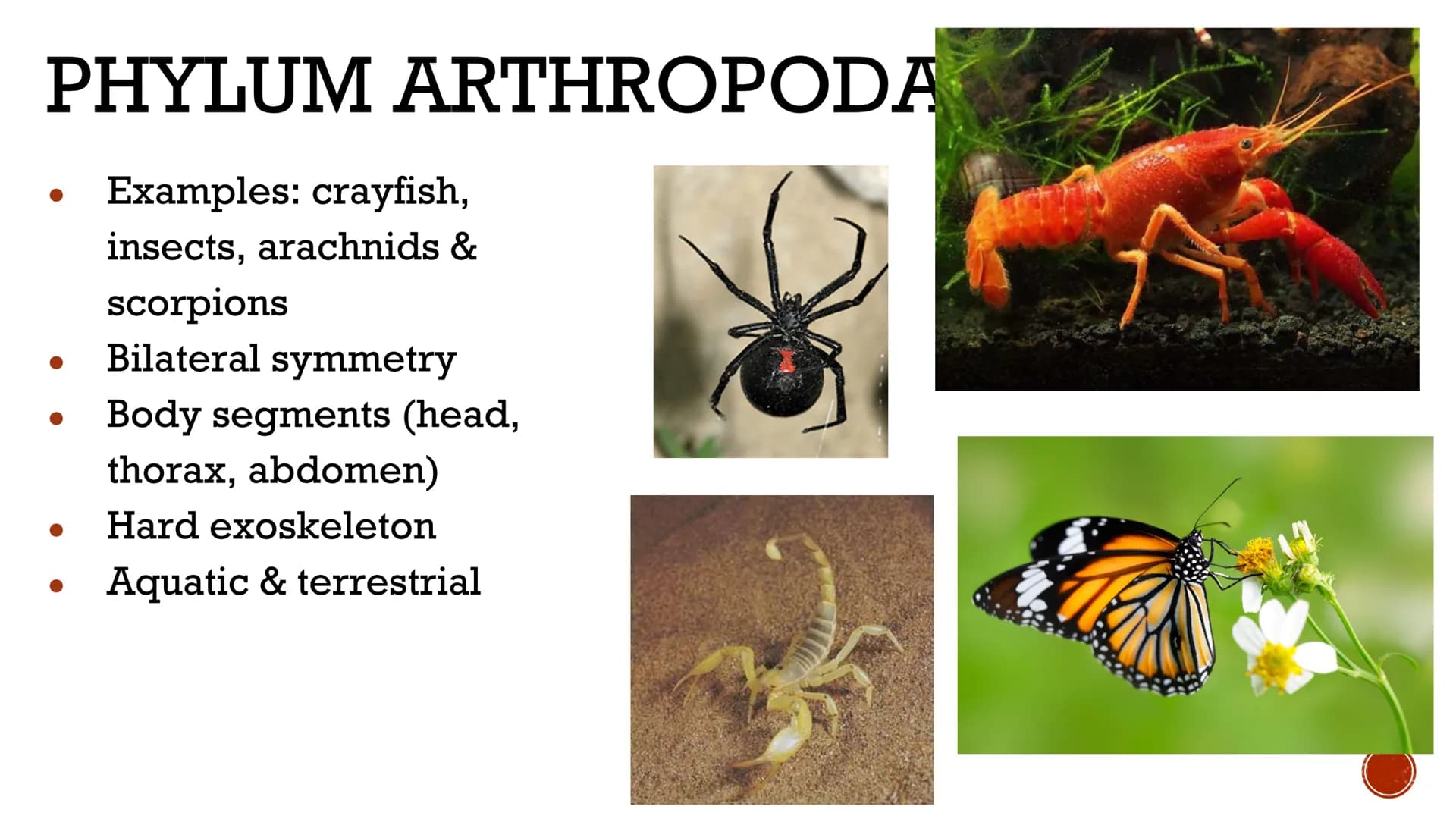
Phylum Arthropoda
Meet the most successful animals on Earth! Arthropods include insects, spiders, crustaceans, and many other familiar creatures that dominate virtually every habitat on the planet.
The secret to their success? A versatile design featuring jointed appendages and a protective exoskeleton made of chitin that supports and protects their bodies. This external armor must be shed periodically as the animal grows, a process called molting.
Arthropods have clearly defined body segments, typically organized into a head, thorax, and abdomen. This segmentation allows for specialized body regions that can perform different functions. Their incredible diversity ranges from tiny mites to giant Japanese spider crabs with leg spans over 12 feet!
Mind-boggling diversity: Of all known animal species, over 80% are arthropods! If you lined up specimens of every arthropod species, the line would stretch thousands of miles.
We thought you’d never ask...
What is the Knowunity AI companion?
Our AI companion is specifically built for the needs of students. Based on the millions of content pieces we have on the platform we can provide truly meaningful and relevant answers to students. But its not only about answers, the companion is even more about guiding students through their daily learning challenges, with personalised study plans, quizzes or content pieces in the chat and 100% personalisation based on the students skills and developments.
Where can I download the Knowunity app?
You can download the app in the Google Play Store and in the Apple App Store.
Is Knowunity really free of charge?
That's right! Enjoy free access to study content, connect with fellow students, and get instant help – all at your fingertips.
Similar Content
 Health & Medicine
Most popular content: Invertebrates
5BiologyVertebrates and Invertebrates
Basics into classification
6th1081
BiologyNervous System of Invertebrates
Nervous System is made up of all the nerve cell in the body.
1513
AP BiologyInvertebrates
Reviews invertebrates for AP Biology
1082
BiologyInvertebrates Basics Notes
Study notes
9th281
Biologyinvertebrates
invertebrates
6th531
Most popular content in Biology
9D
BiologyDNA and RNA
Uncover the secrets of life with this comprehensive Biology flashcard set. Perfect for grade 10 students studying Living Environment.
10th1,0452
C
BiologyCell Organelles
This Quiz Is To Test Your Knowledge Of Cell Organelles And Their Functions Inside The Cell. It Can Also Be A Study Guide To Remember Them Better.
6th5830
B
Biologybiology cell organelles and functions
Do you know the cell organelles and their functions?
9th3770
M
BiologyMitosis and Cell Division Flashcards
These flashcards cover the basics of mitosis and why cell division occurs in the first place.
9th3000
A
BiologyAnimal and plant cell structure
Quiz on animal and plant cell structures
9th2890
D
BiologyDiscover the Fascinating World of Living Organisms
Uncover the secrets of biology and explore the diverse and amazing life forms that inhabit our planet with this captivating flashcard set.
7th3800
D
BiologyDiscover Punnet Squares
Uncover the secrets of life with this comprehensive Biology flashcard set. Perfect for grade 10 students studying Living Environment.
10th3481
D
BiologyDNA
Parts of DNA
9th2630
S
BiologySteps of Cellular Respiration
3 basic steps and Molecule Vocab
9th2300
Most popular content
9O
 AP US History
Origins and Dynamics of the Columbian Exchange
Analyze the ecological and economic motivations behind the initial transfer of goods, people, and diseases between the Old and New Worlds.
9th3,1280
I
AP US HistoryIntroduction to Early Cultural Interactions
Analyze the initial social and religious encounters between Europeans, Africans, and Indigenous peoples in the colonial Americas.
9th2,7730
O
 AP World History
Origins of Ancient River Civilizations
Analyze the environmental factors and technological innovations that led to the rise of early states in Mesopotamia, Egypt, and the Indus Valley.
9th3,1860
M
AP US HistoryMotivations for European Exploration
Analyze the economic, religious, and political factors that drove European powers to the Americas during the 15th and 16th centuries.
9th1,7780
F
 AP Psychology
Foundations of Ethical Guidelines in Research
Practice the core principles of the APA ethical code including informed consent, debriefing, and the role of Institutional Review Boards.
9th1,3360
I
AP US HistoryIntroduction to Native American Societies
Examine the diverse social, political, and economic structures of North American indigenous groups prior to European contact.
9th1,1100
I
AP BiologyIntroduction to Biological Elements of Life
Practice identifying the essential elements including carbon, nitrogen, phosphorus, and sulfur that compose biological macromolecules.
9th1,7360
I
AP US HistoryIntroduction to the Spanish Encomienda System
Explore the fundamental economic and social structures of the Spanish colonial system, focusing on the encomienda and the casta social hierarchy.
9th8890
O
AP World HistoryOrigins and Continuity of the Byzantine Empire
Analyze the political and cultural transitions from the Roman Empire to the Byzantine Empire, focusing on the reign of Justinian I and his code.
9th1,6320
Can't find what you're looking for? Explore other subjects.
Students love us — and so will you.
4.6/5App Store
4.7/5Google Play
The app is very easy to use and well designed. I have found everything I was looking for so far and have been able to learn a lot from the presentations! I will definitely use the app for a class assignment! And of course it also helps a lot as an inspiration.
Stefan SiOS user
This app is really great. There are so many study notes and help [...]. My problem subject is French, for example, and the app has so many options for help. Thanks to this app, I have improved my French. I would recommend it to anyone.
Samantha KlichAndroid user
Wow, I am really amazed. I just tried the app because I've seen it advertised many times and was absolutely stunned. This app is THE HELP you want for school and above all, it offers so many things, such as workouts and fact sheets, which have been VERY helpful to me personally.
AnnaiOS user
Biology108 views·Updated May 14, 2026·12 pagesUnderstanding Invertebrate Animals: Kingdom Insights 2023 PDF
C@cnnotes
Ever wonder why some animals have backbones while others don't? Invertebrates make up a whopping 97% of all animals on Earth and include an incredible variety of creatures from tiny sponges to complex insects. Let's explore these fascinating animals that... Show more
1
of 10Sign up to see the content. It's free!
- Access to all documents
- Improve your grades
- Join milions of students
Animals: Invertebrates
Welcome to the world of invertebrates! These are the animals that dominate our planet in both numbers and diversity.
Throughout this unit, we'll discover how these backbone-free creatures have evolved amazing adaptations to survive in virtually every environment on Earth. From the ocean depths to your backyard, invertebrates play crucial roles in ecosystems worldwide.
You'll be surprised at how complex these seemingly simple animals can be!
2
of 10Sign up to see the content. It's free!
- Access to all documents
- Improve your grades
- Join milions of students
Animal Kingdom: General Characteristics
Animals first appeared on Earth between 550-620 million years ago, possibly evolving from organisms similar to colonial protists. That's over half a billion years of animal evolution!
All animals share three key characteristics. They're heterotrophs (they consume other organisms for energy), multicellular (made of many specialized cells working together), and eukaryotes (their cells contain a nucleus and specialized structures).
These fundamental traits distinguish animals from other living things like plants and bacteria. Even the simplest animal is an intricate collection of cells working together as a unified organism.
Fun fact: The earliest animal fossils come from the Ediacaran period and look nothing like modern animals we know today!
3
of 10Sign up to see the content. It's free!
- Access to all documents
- Improve your grades
- Join milions of students
9 Major Animal Phyla
Scientists classify animals into major groups called phyla based on their body structure and development. The nine major animal phyla are Porifera, Cnidaria, Platyhelminthes, Nematoda, Annelida, Arthropoda, Mollusca, Echinodermata, and Chordata.
These phyla can be organized by key evolutionary features. Some have radial symmetry (can be divided equally along any plane through the center), while others show bilateral symmetry (have distinct left and right sides). Some lack a body cavity called a coelom, while others have developed this important feature.
The evolutionary relationships between these groups form a branching tree that started with a common ancestor similar to protists. Each branch represents adaptations that helped animals survive in different environments.
Remember this: Bilateral symmetry was a game-changing adaptation that allowed animals to develop specialized front and back ends, leading to more complex movement and nervous systems!
4
of 10Sign up to see the content. It's free!
- Access to all documents
- Improve your grades
- Join milions of students
Invertebrates
Invertebrates are animals that don't have a backbone. That might seem like a simple distinction, but it encompasses an incredible 97% of all animal species on Earth!
These backbone-free creatures come in astonishing varieties. They range from microscopic worms to giant squid, from colorful butterflies to bizarre deep-sea creatures. Their adaptations for survival are just as diverse – some filter nutrients from water, others parasitize hosts, and many actively hunt prey.
Only one phylum, Chordata, contains both invertebrates and vertebrates (animals with backbones). The incredible diversity of invertebrates shows how successful this body plan has been throughout evolutionary history.
Mind-blowing fact: For every person on Earth, there are about 200 million invertebrates! They outnumber us by a truly staggering margin.
5
of 10Sign up to see the content. It's free!
- Access to all documents
- Improve your grades
- Join milions of students
Phylum Porifera (Sponges)
Sponges are among the simplest animals on Earth, yet they've survived for over 500 million years! These aquatic creatures live in both freshwater and marine environments where they attach themselves permanently to surfaces.
As filter feeders, sponges pump water through their porous bodies to capture tiny food particles. Unlike most animals, sponges have no true tissues or organs. Instead, they have specialized cells that perform different functions, making them unique in the animal kingdom.
Sponges can reproduce both sexually and asexually, giving them flexibility in how they produce offspring. They come in countless sizes, shapes, and colors, from tiny encrustations to barrel-shaped giants over six feet tall!
Cool connection: The sponge you might use in your shower is inspired by these animals, though modern bathroom sponges are usually synthetic. Real sponges were harvested for centuries for cleaning purposes!
6
of 10Sign up to see the content. It's free!
- Access to all documents
- Improve your grades
- Join milions of students
Phylum Cnidaria
Jellyfish, sea anemones, and corals might look completely different, but they're all members of the same animal group: Cnidaria. These primarily marine creatures were the first animals to develop a true nervous system!
Cnidarians have a unique body plan with radial symmetry - they can be divided into equal halves along any plane through the center axis. They capture prey using special stinging cells called cnidocytes that inject venom into their victims.
What makes cnidarians especially interesting is that many species can exist in two distinct body forms: the sessile (stationary) polyp form that resembles a plant, and the mobile medusa form that resembles the classic jellyfish shape. Some species alternate between these forms during their life cycle!
Watch out! The Portuguese Man o' War, often mistaken for a jellyfish, is actually a colony of specialized polyps working together. Its sting can be extremely painful to humans!
7
of 10Sign up to see the content. It's free!
- Access to all documents
- Improve your grades
- Join milions of students
Phylum Platyhelminthes (Flatworms)
Flatworms represent a significant evolutionary step forward with their bilateral symmetry - they have distinct front and back ends, which allows for more directed movement and specialized sense organs like eyespots for detecting light.
These worms have a simple, flattened body shape (hence the name) and can be found in aquatic and terrestrial environments. While some flatworms like planaria are free-living, many species have evolved to become parasites that live inside other organisms.
One of the most interesting features of flatworms is their incomplete digestive system - they have a mouth but no anus! This means waste must exit through the same opening that food enters, limiting their digestive efficiency.
Did you know? Some flatworms can regenerate their entire body from just a tiny fragment - cut a planarian into pieces and each piece can grow into a complete new worm!
8
of 10Sign up to see the content. It's free!
- Access to all documents
- Improve your grades
- Join milions of students
Phylum Nematodes (Roundworms)
Roundworms are everywhere - in soil, water, plants, and even inside your body! These tiny creatures range from microscopic to several meters long and can be found in almost every habitat on Earth.
Unlike flatworms, nematodes have a complete digestive tract with both a mouth and anus, allowing food to move in one direction through their body. This improved efficiency helps them thrive in diverse environments.
Many roundworms are parasites that infect plants, animals, and humans. Hookworms, for instance, can enter through human skin and live in the intestines. Despite their simple appearance, nematodes have sophisticated nervous systems and complex behaviors.
Astonishing fact: Scientists estimate there may be over a million nematode species, with possibly 80% of all animals on Earth being roundworms! Only about 25,000 species have been described so far.
9
of 10Sign up to see the content. It's free!
- Access to all documents
- Improve your grades
- Join milions of students
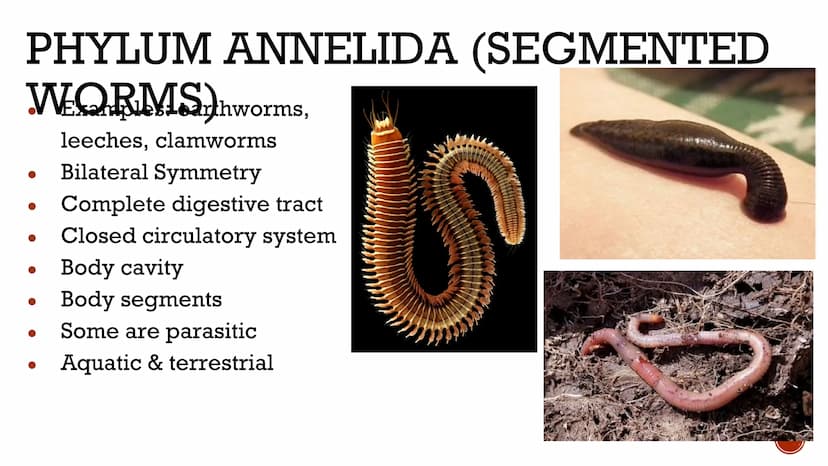
Phylum Annelida (Segmented Worms)
Earthworms, leeches, and marine clamworms might not seem impressive at first glance, but these segmented worms represent a major leap in animal complexity. Their bodies are divided into repeating segments, like a train with many similar cars.
Annelids have several advanced features, including a closed circulatory system that efficiently transports nutrients and oxygen throughout their body. They also have a fluid-filled body cavity that acts like a hydrostatic skeleton, helping them move effectively.
These worms inhabit diverse environments from ocean depths to garden soil. While many are beneficial decomposers that improve soil quality, some like leeches have evolved as parasites that feed on the blood of other animals.
Garden helper: A single acre of good farmland may contain over a million earthworms! Their tunneling aerates soil, and their digestive activity converts organic matter into nutrient-rich castings that boost plant growth.
10
of 10Sign up to see the content. It's free!
- Access to all documents
- Improve your grades
- Join milions of students
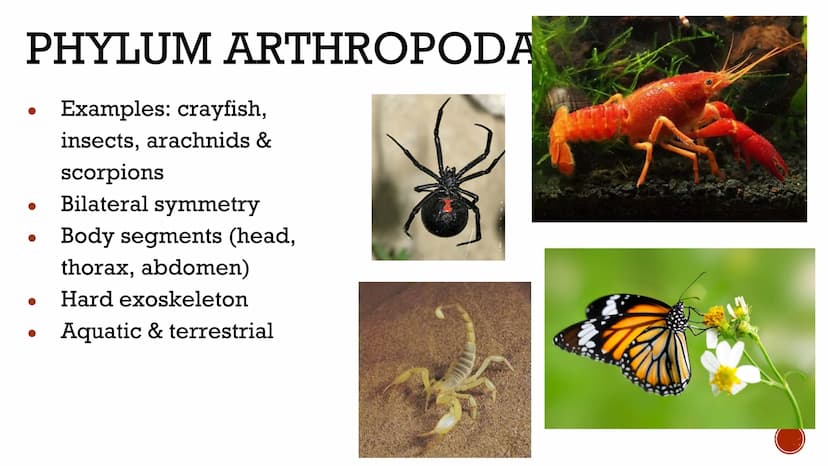
Phylum Arthropoda
Meet the most successful animals on Earth! Arthropods include insects, spiders, crustaceans, and many other familiar creatures that dominate virtually every habitat on the planet.
The secret to their success? A versatile design featuring jointed appendages and a protective exoskeleton made of chitin that supports and protects their bodies. This external armor must be shed periodically as the animal grows, a process called molting.
Arthropods have clearly defined body segments, typically organized into a head, thorax, and abdomen. This segmentation allows for specialized body regions that can perform different functions. Their incredible diversity ranges from tiny mites to giant Japanese spider crabs with leg spans over 12 feet!
Mind-boggling diversity: Of all known animal species, over 80% are arthropods! If you lined up specimens of every arthropod species, the line would stretch thousands of miles.
We thought you’d never ask...
What is the Knowunity AI companion?
Our AI companion is specifically built for the needs of students. Based on the millions of content pieces we have on the platform we can provide truly meaningful and relevant answers to students. But its not only about answers, the companion is even more about guiding students through their daily learning challenges, with personalised study plans, quizzes or content pieces in the chat and 100% personalisation based on the students skills and developments.
Where can I download the Knowunity app?
You can download the app in the Google Play Store and in the Apple App Store.
Is Knowunity really free of charge?
That's right! Enjoy free access to study content, connect with fellow students, and get instant help – all at your fingertips.
Similar Content
Most popular content: Invertebrates
5BiologyVertebrates and Invertebrates
Basics into classification
6th1081
BiologyNervous System of Invertebrates
Nervous System is made up of all the nerve cell in the body.
1513
AP BiologyInvertebrates
Reviews invertebrates for AP Biology
1082
BiologyInvertebrates Basics Notes
Study notes
9th281
Biologyinvertebrates
invertebrates
6th531
Most popular content in Biology
9D
BiologyDNA and RNA
Uncover the secrets of life with this comprehensive Biology flashcard set. Perfect for grade 10 students studying Living Environment.
10th1,0452
C
BiologyCell Organelles
This Quiz Is To Test Your Knowledge Of Cell Organelles And Their Functions Inside The Cell. It Can Also Be A Study Guide To Remember Them Better.
6th5830
B
Biologybiology cell organelles and functions
Do you know the cell organelles and their functions?
9th3770
M
BiologyMitosis and Cell Division Flashcards
These flashcards cover the basics of mitosis and why cell division occurs in the first place.
9th3000
A
BiologyAnimal and plant cell structure
Quiz on animal and plant cell structures
9th2890
D
BiologyDiscover the Fascinating World of Living Organisms
Uncover the secrets of biology and explore the diverse and amazing life forms that inhabit our planet with this captivating flashcard set.
7th3800
D
BiologyDiscover Punnet Squares
Uncover the secrets of life with this comprehensive Biology flashcard set. Perfect for grade 10 students studying Living Environment.
10th3481
D
BiologyDNA
Parts of DNA
9th2630
S
BiologySteps of Cellular Respiration
3 basic steps and Molecule Vocab
9th2300
Most popular content
9O
AP US HistoryOrigins and Dynamics of the Columbian Exchange
Analyze the ecological and economic motivations behind the initial transfer of goods, people, and diseases between the Old and New Worlds.
9th3,1280
I
AP US HistoryIntroduction to Early Cultural Interactions
Analyze the initial social and religious encounters between Europeans, Africans, and Indigenous peoples in the colonial Americas.
9th2,7730
O
AP World HistoryOrigins of Ancient River Civilizations
Analyze the environmental factors and technological innovations that led to the rise of early states in Mesopotamia, Egypt, and the Indus Valley.
9th3,1860
M
AP US HistoryMotivations for European Exploration
Analyze the economic, religious, and political factors that drove European powers to the Americas during the 15th and 16th centuries.
9th1,7780
F
AP PsychologyFoundations of Ethical Guidelines in Research
Practice the core principles of the APA ethical code including informed consent, debriefing, and the role of Institutional Review Boards.
9th1,3360
I
AP US HistoryIntroduction to Native American Societies
Examine the diverse social, political, and economic structures of North American indigenous groups prior to European contact.
9th1,1100
I
AP BiologyIntroduction to Biological Elements of Life
Practice identifying the essential elements including carbon, nitrogen, phosphorus, and sulfur that compose biological macromolecules.
9th1,7360
I
AP US HistoryIntroduction to the Spanish Encomienda System
Explore the fundamental economic and social structures of the Spanish colonial system, focusing on the encomienda and the casta social hierarchy.
9th8890
O
AP World HistoryOrigins and Continuity of the Byzantine Empire
Analyze the political and cultural transitions from the Roman Empire to the Byzantine Empire, focusing on the reign of Justinian I and his code.
9th1,6320
Can't find what you're looking for? Explore other subjects.
Students love us — and so will you.
4.6/5App Store
4.7/5Google Play
The app is very easy to use and well designed. I have found everything I was looking for so far and have been able to learn a lot from the presentations! I will definitely use the app for a class assignment! And of course it also helps a lot as an inspiration.
Stefan SiOS user
This app is really great. There are so many study notes and help [...]. My problem subject is French, for example, and the app has so many options for help. Thanks to this app, I have improved my French. I would recommend it to anyone.
Samantha KlichAndroid user
Wow, I am really amazed. I just tried the app because I've seen it advertised many times and was absolutely stunned. This app is THE HELP you want for school and above all, it offers so many things, such as workouts and fact sheets, which have been VERY helpful to me personally.
AnnaiOS user