
Differential calculus is all about understanding how quantities change, a... Show more
 Calculus 1
 Algebra 1
 Algebra
 Biology
Sign up to see the contentIt's free!
Access to all documents
Improve your grades
Join milions of students
Knowunity AI
Subjects
Triangle Congruence and Similarity Theorems
Triangle Properties and Classification
Linear Equations and Graphs
Geometric Angle Relationships
Trigonometric Functions and Identities
Equation Solving Techniques
Circle Geometry Fundamentals
Division Operations and Methods
Basic Differentiation Rules
Exponent and Logarithm Properties
Show all topics
Human Organ Systems
Reproductive Cell Cycles
Biological Sciences Subdisciplines
Cellular Energy Metabolism
Autotrophic Energy Processes
Inheritance Patterns and Principles
Biomolecular Structure and Organization
Cell Cycle and Division Mechanics
Cellular Organization and Development
Biological Structural Organization
Show all topics
Chemical Sciences and Applications
Atomic Structure and Composition
Molecular Electron Structure Representation
Atomic Electron Behavior
Matter Properties and Water
Mole Concept and Calculations
Gas Laws and Behavior
Periodic Table Organization
Chemical Thermodynamics Fundamentals
Chemical Bond Types and Properties
Show all topics
European Renaissance and Enlightenment
European Cultural Movements 800-1920
American Revolution Era 1763-1797
American Civil War 1861-1865
Global Imperial Systems
Mongol and Chinese Dynasties
U.S. Presidents and World Leaders
Historical Sources and Documentation
World Wars Era and Impact
World Religious Systems
Show all topics
Classic and Contemporary Novels
Literary Character Analysis
Rhetorical Theory and Practice
Classic Literary Narratives
Reading Analysis and Interpretation
Narrative Structure and Techniques
English Language Components
Influential English-Language Authors
Basic Sentence Structure
Narrative Voice and Perspective
Show all topics
1,269
•
Updated Mar 21, 2026
•

Ann Villamor
@annevillamor_sun
Differential calculus is all about understanding how quantities change, a... Show more
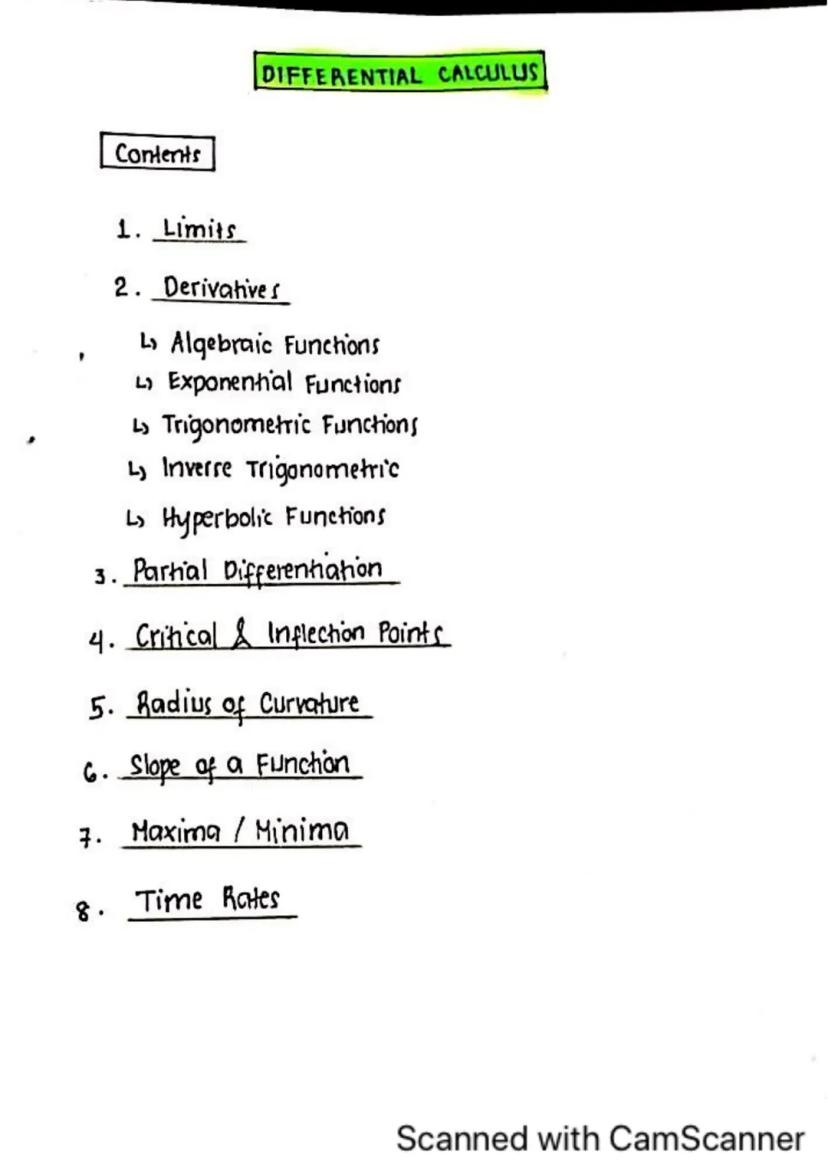
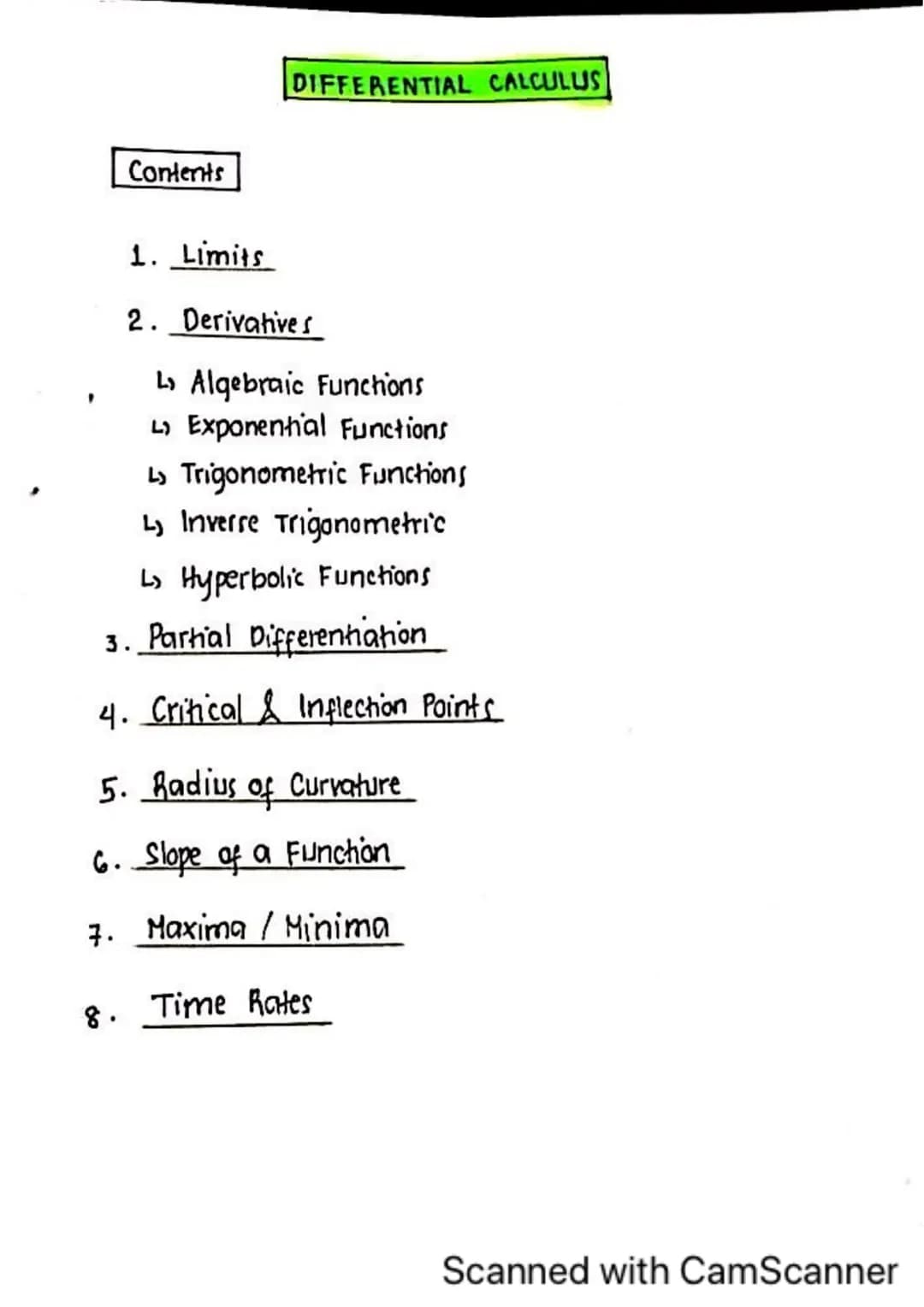
Differential calculus focuses on understanding how functions change at any given point. This powerful mathematical tool helps us analyze rates of change, find optimal values, and model real-world phenomena.
The main components of differential calculus include limits (how functions behave as they approach specific values) and derivatives (the instantaneous rate of change of a function). These concepts apply to various function types - algebraic, exponential, trigonometric, and more.
Beyond basic derivatives, differential calculus extends to partial differentiation (for functions with multiple variables), finding critical points, and analyzing the behavior of curves through concepts like radius of curvature and inflection points.
Pro Tip: As you learn each new concept in calculus, connect it back to real applications. Understanding how calculus is used to solve practical problems will help make these abstract ideas more meaningful!
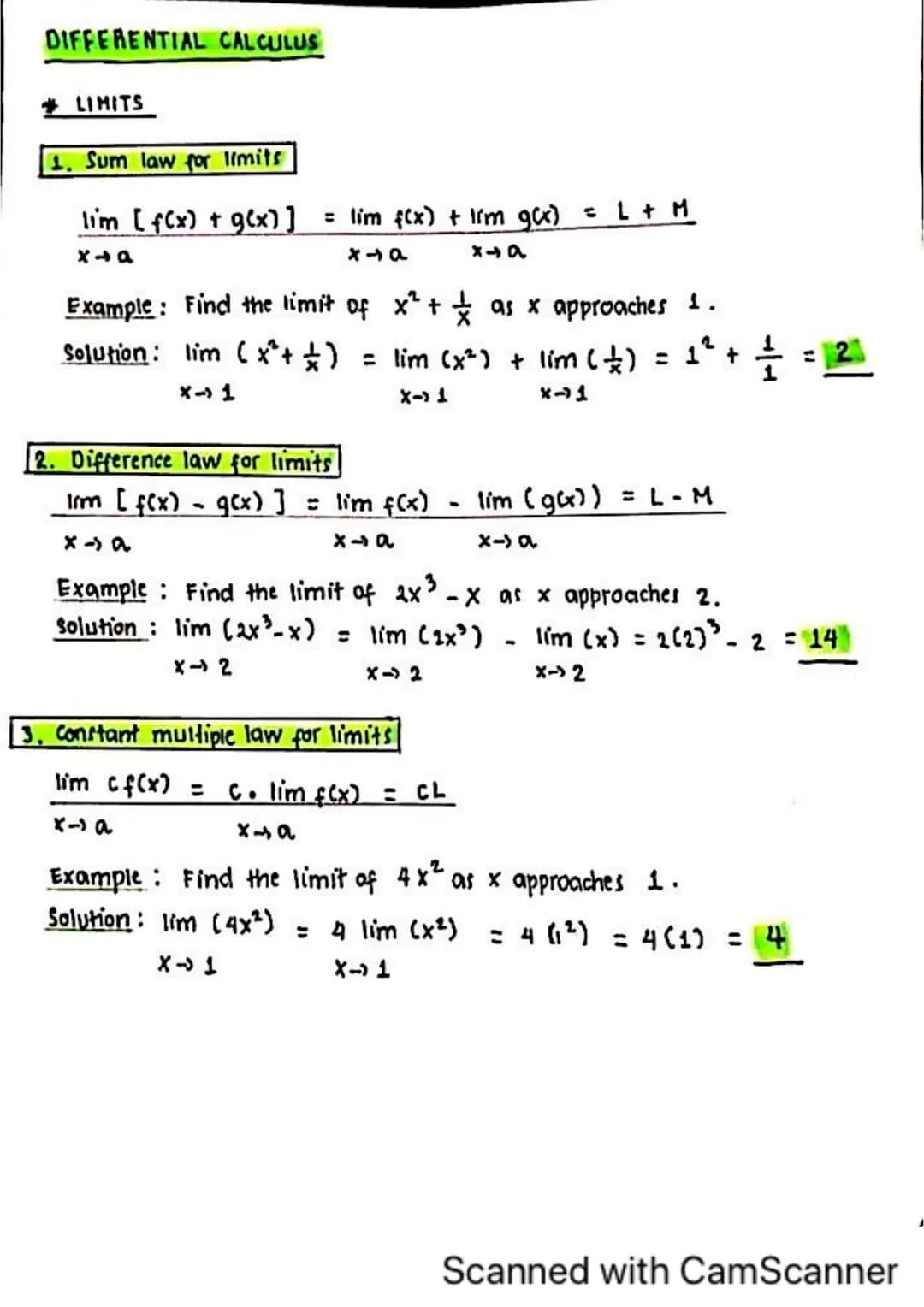
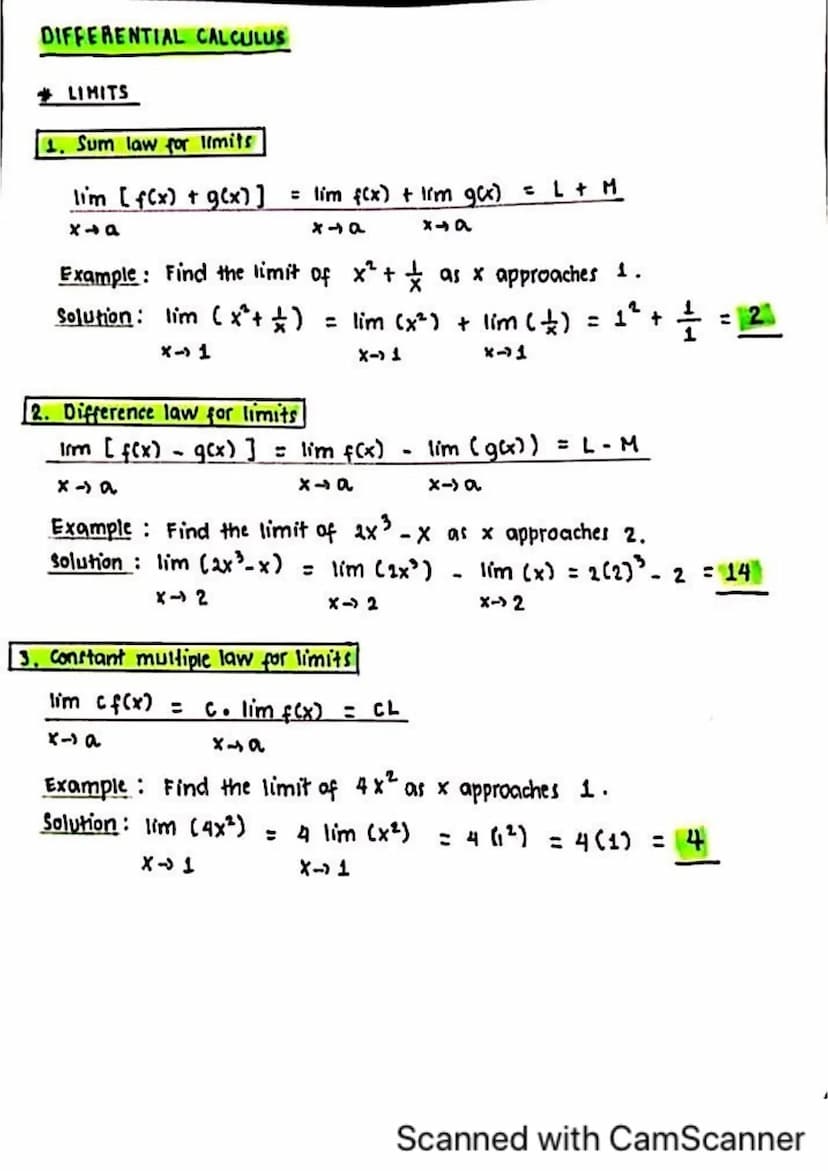
Limits form the foundation of calculus by describing what happens as a function approaches a specific value. The sum law lets us break down complex limits into simpler pieces: when finding the limit of a sum, we can find the limits of each part separately and add them together.
Similarly, the difference law works the same way for subtraction, while the constant multiple law tells us we can pull constants outside the limit. For example, when finding the limit of 4x² as x approaches 1, we can rewrite it as 4 times the limit of x², which equals 4(1) = 4.
These laws help simplify complicated limit problems. Instead of tackling an intimidating expression all at once, you can break it down into manageable pieces. Just remember to check that each individual limit exists before applying these rules.
Remember: Limits are about the behavior of a function as it gets arbitrarily close to a point, not necessarily the value at that exact point!
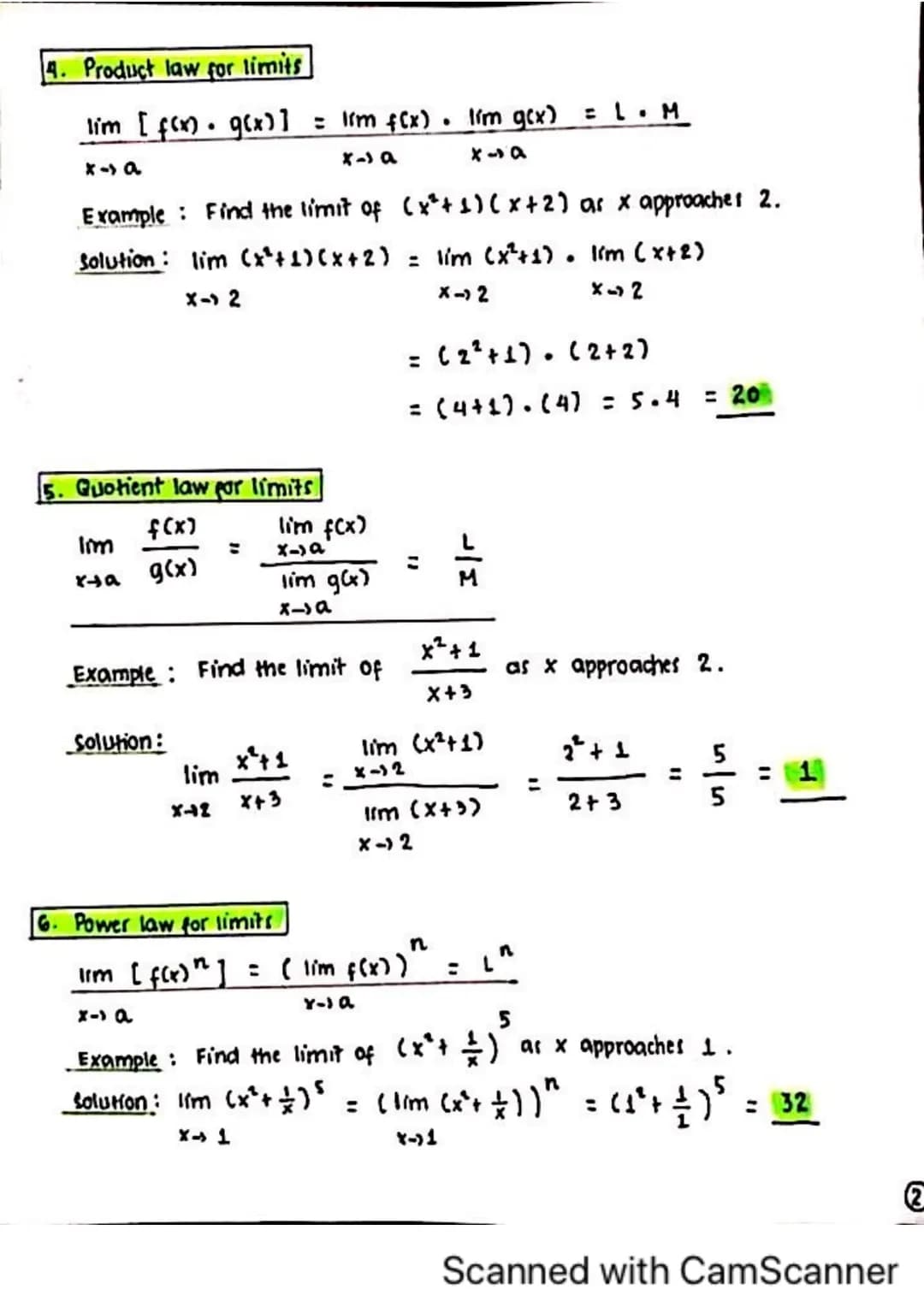
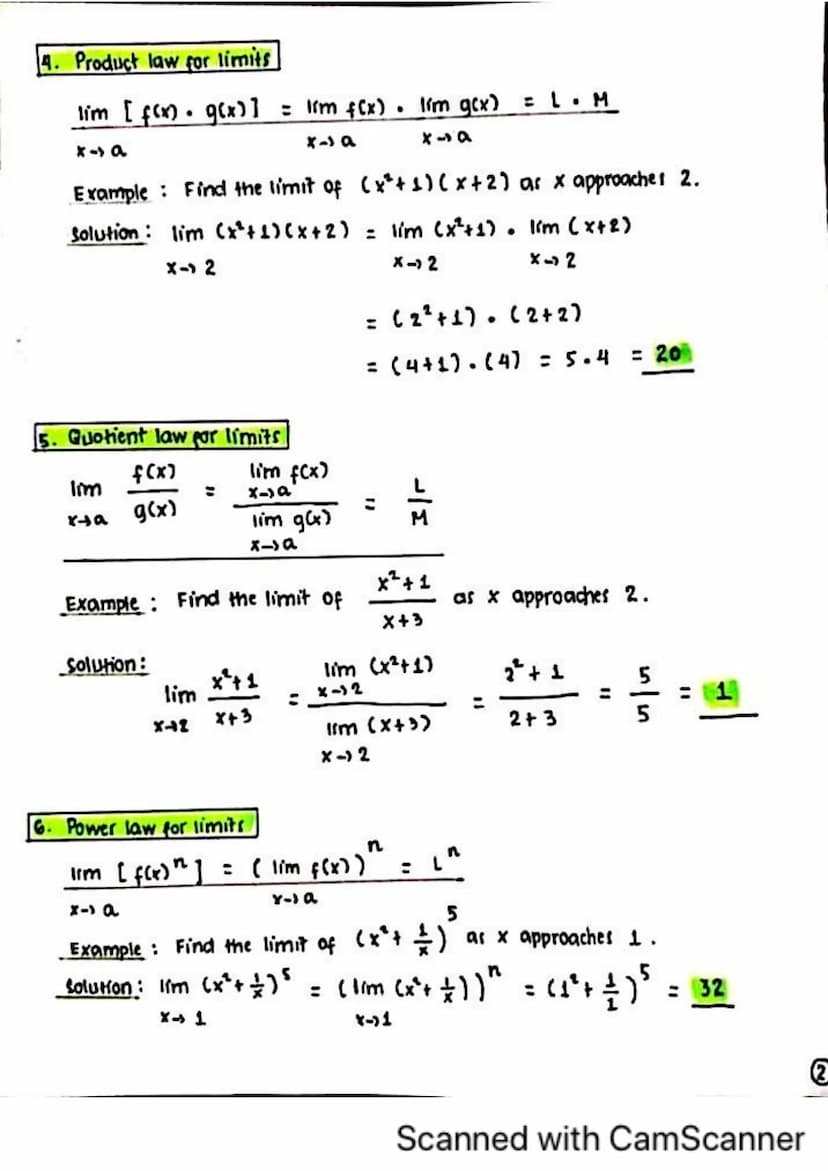
The product law lets you find limits of multiplied functions by multiplying their individual limits. For instance, when finding the limit of as x approaches 2, you can separately find the limit of each factor, then multiply those results: (2²+1)(2+2) = 5×4 = 20.
The quotient law works similarly for division, allowing you to divide the limits of the numerator and denominator. This works as long as the limit of the denominator isn't zero. For example, the limit of / as x approaches 2 equals (2²+1)/(2+3) = 5/5 = 1.
The power law lets you handle expressions raised to powers. When finding the limit of [f(x)]ⁿ, you can first find the limit of f(x) and then raise that result to the power n. This simplifies problems like finding the limit of ⁵ as x approaches 1.
Watch Out: These laws only work when the individual limits exist! If any component limit doesn't exist or gives an indeterminate form, you'll need to try a different approach.
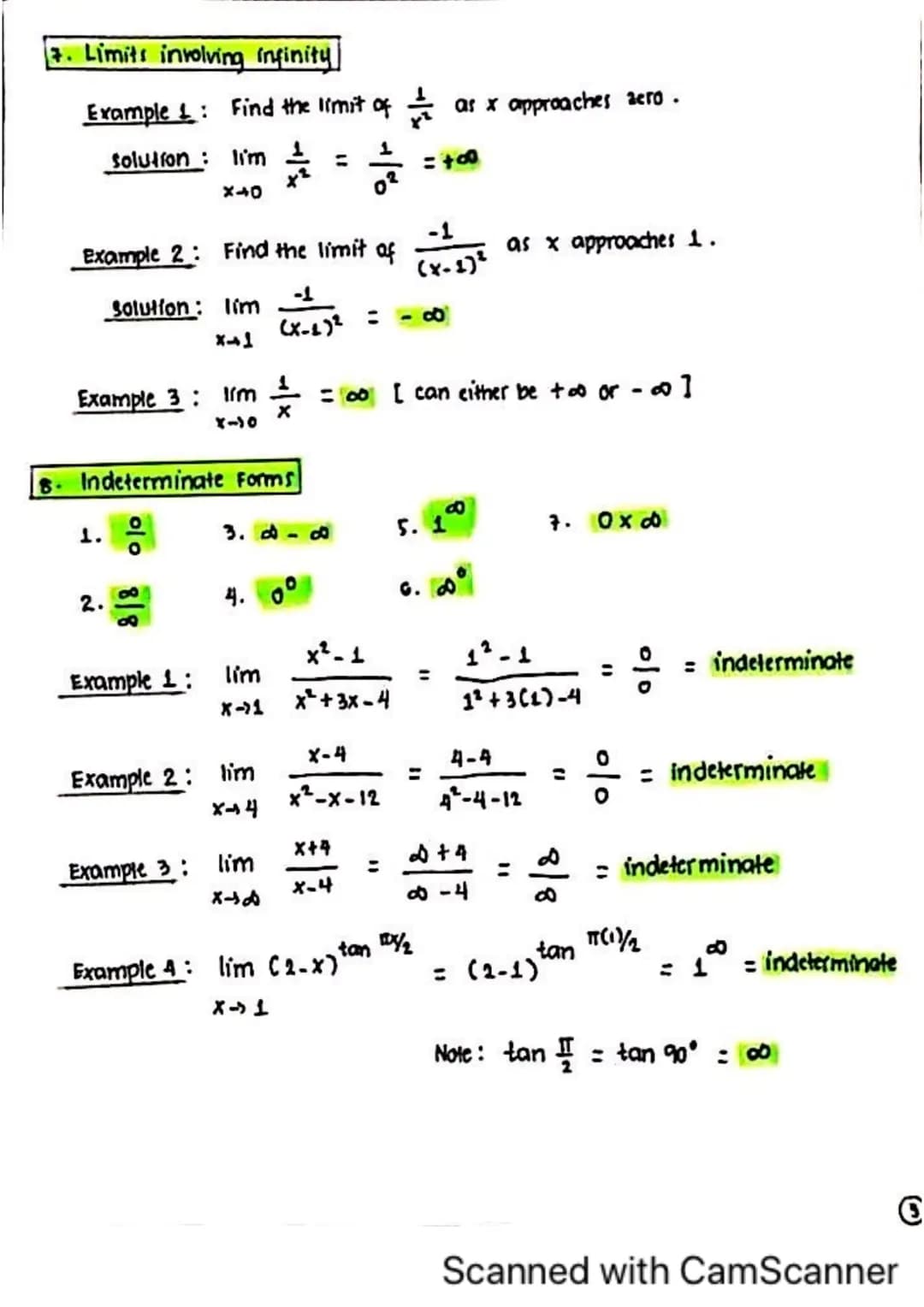
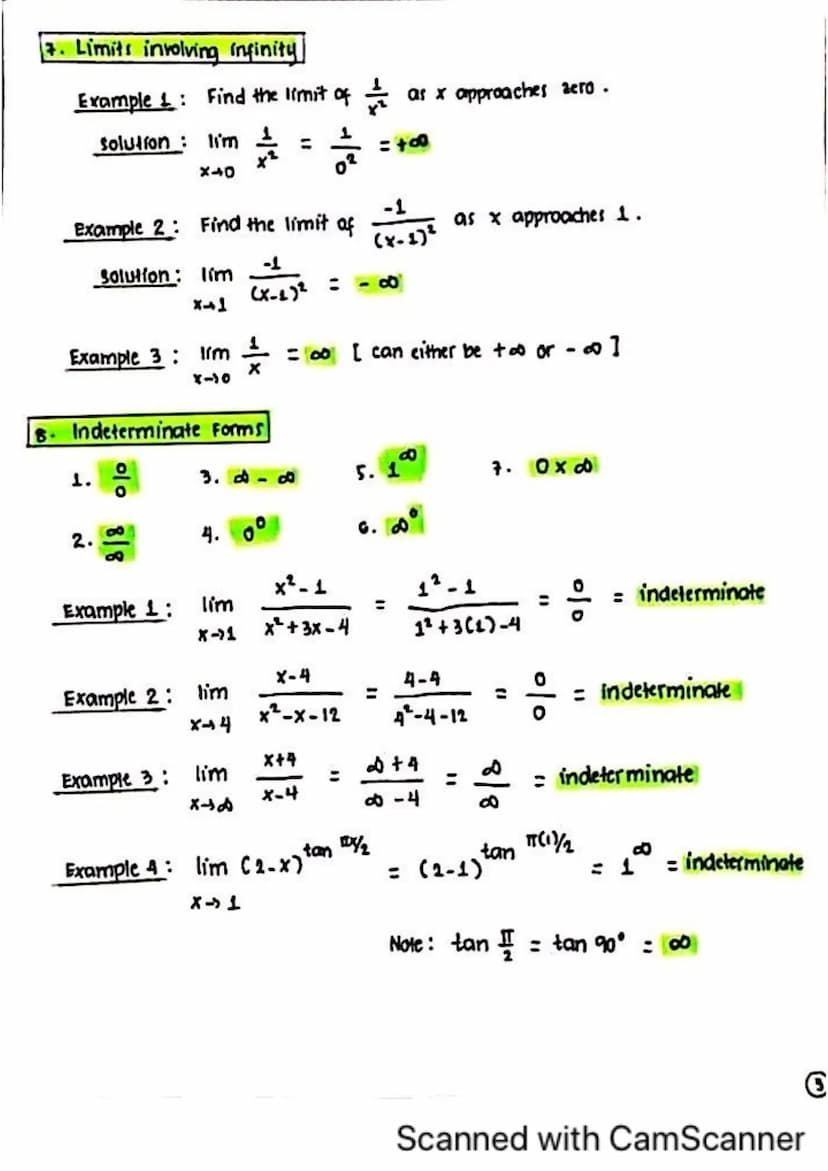
When dealing with limits involving infinity, we often encounter expressions that approach infinity or negative infinity. For example, as x approaches zero, 1/x² grows without bound, so we say the limit equals positive infinity.
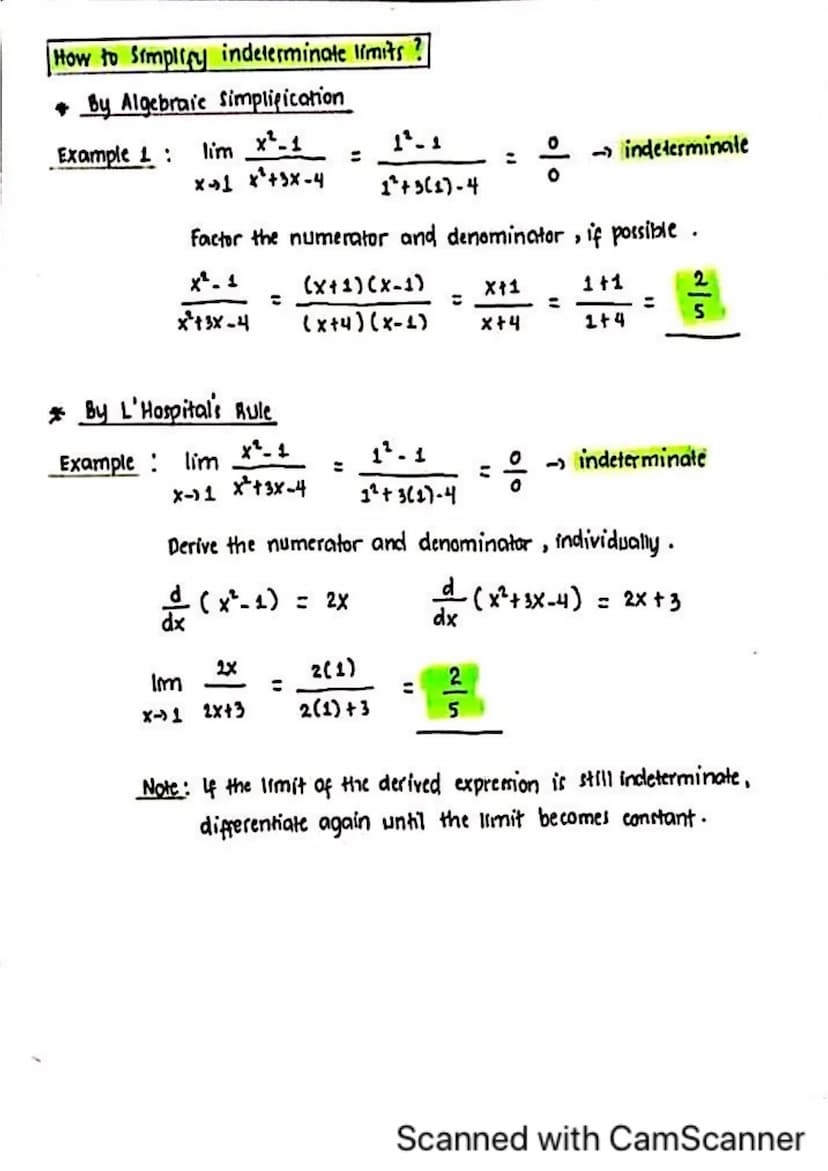
Indeterminate forms occur when limit evaluations lead to ambiguous expressions like 0/0 or ∞/∞. These forms don't have a definite value and require special techniques to resolve. When you encounter expressions like / as x approaches 1, direct substitution gives 0/0, indicating more work is needed.
Other indeterminate forms include ∞-∞, 0×∞, and 0/∞. Each requires careful analysis rather than simple arithmetic. For instance, the limit of tan as x approaches 1 gives 1×∞, which is indeterminate.
Quick Tip: When you get an indeterminate form, it's a signal to dig deeper! It doesn't mean the limit doesn't exist—it means you need more sophisticated techniques to find it.
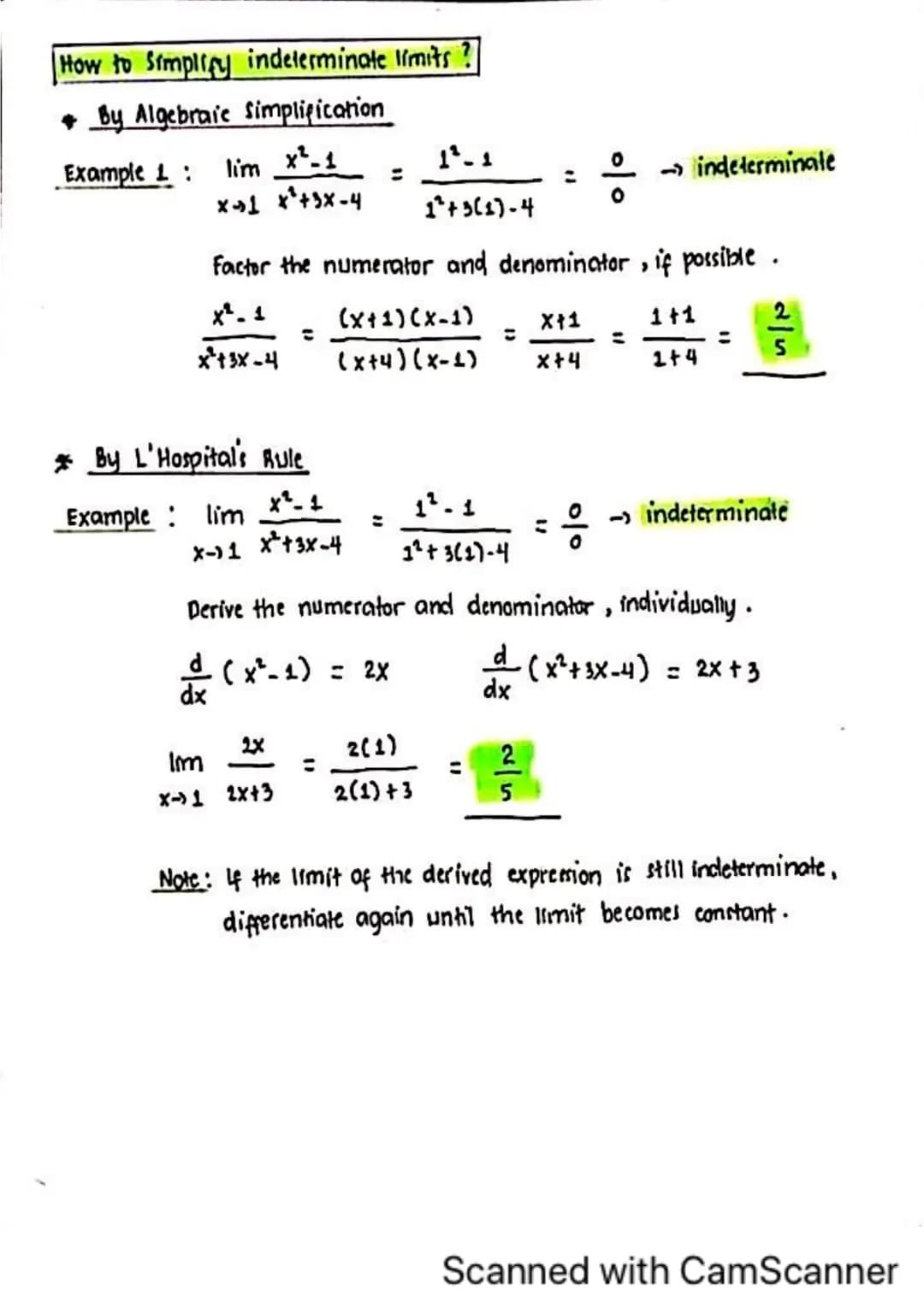
When faced with indeterminate forms, algebraic simplification often helps clear the path to a solution. For the limit of / as x approaches 1, factoring reveals a common factor that can be canceled: / = /. This simplified form easily evaluates to 2/5.
L'Hospital's Rule offers another powerful approach when algebraic tricks don't work. This method states that for 0/0 or ∞/∞ forms, you can differentiate both numerator and denominator separately and then take the limit. Using the same example from above, differentiating gives us the limit of 2x/ as x approaches 1, which equals 2/5.
Sometimes one application of L'Hospital's Rule isn't enough. If the result is still indeterminate, continue differentiating until you reach a form that can be evaluated directly.
Remember: L'Hospital's Rule only works for the indeterminate forms 0/0 and ∞/∞. For other indeterminate forms, you'll need to rewrite the expression first!
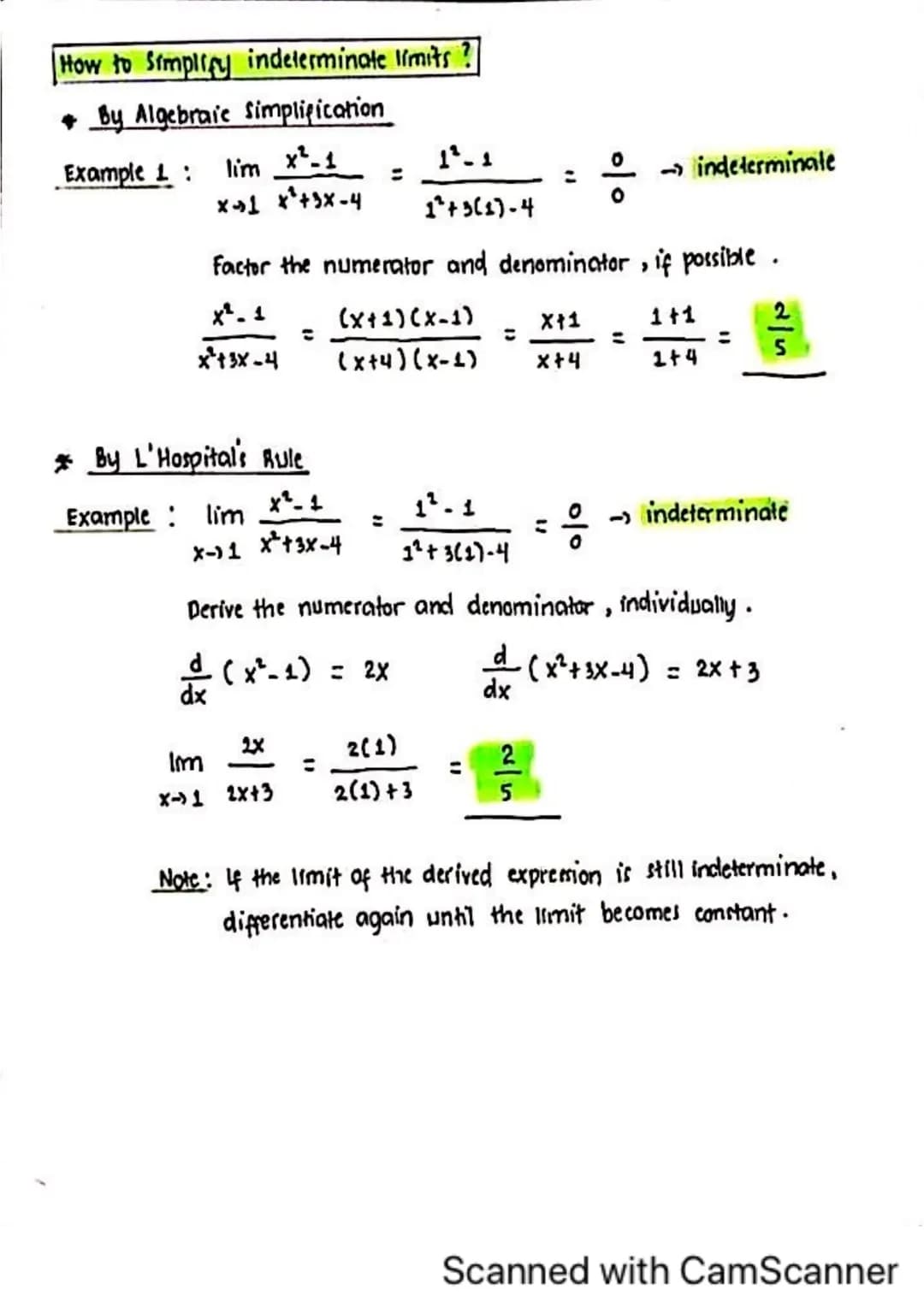
Algebraic simplification remains one of the most straightforward approaches to handling indeterminate forms. By factoring and simplifying expressions, you can often eliminate the source of the indeterminacy. In our example of /, factoring both parts reveals a common factor of that cancels out, transforming our expression into /.
When algebraic methods aren't enough, L'Hospital's Rule provides a systematic approach. This powerful technique involves taking the derivatives of both the numerator and denominator separately. For the limit of /, differentiating gives us 2x/, which evaluates to 2/5 when x=1.
The beauty of L'Hospital's Rule is that it can be applied repeatedly if needed. If your first application still results in an indeterminate form, simply differentiate again until you reach a determinable expression.
Study Strategy: When working with limits, always try direct substitution first. If that gives an indeterminate form, try algebraic simplification before jumping to L'Hospital's Rule—it's often quicker!
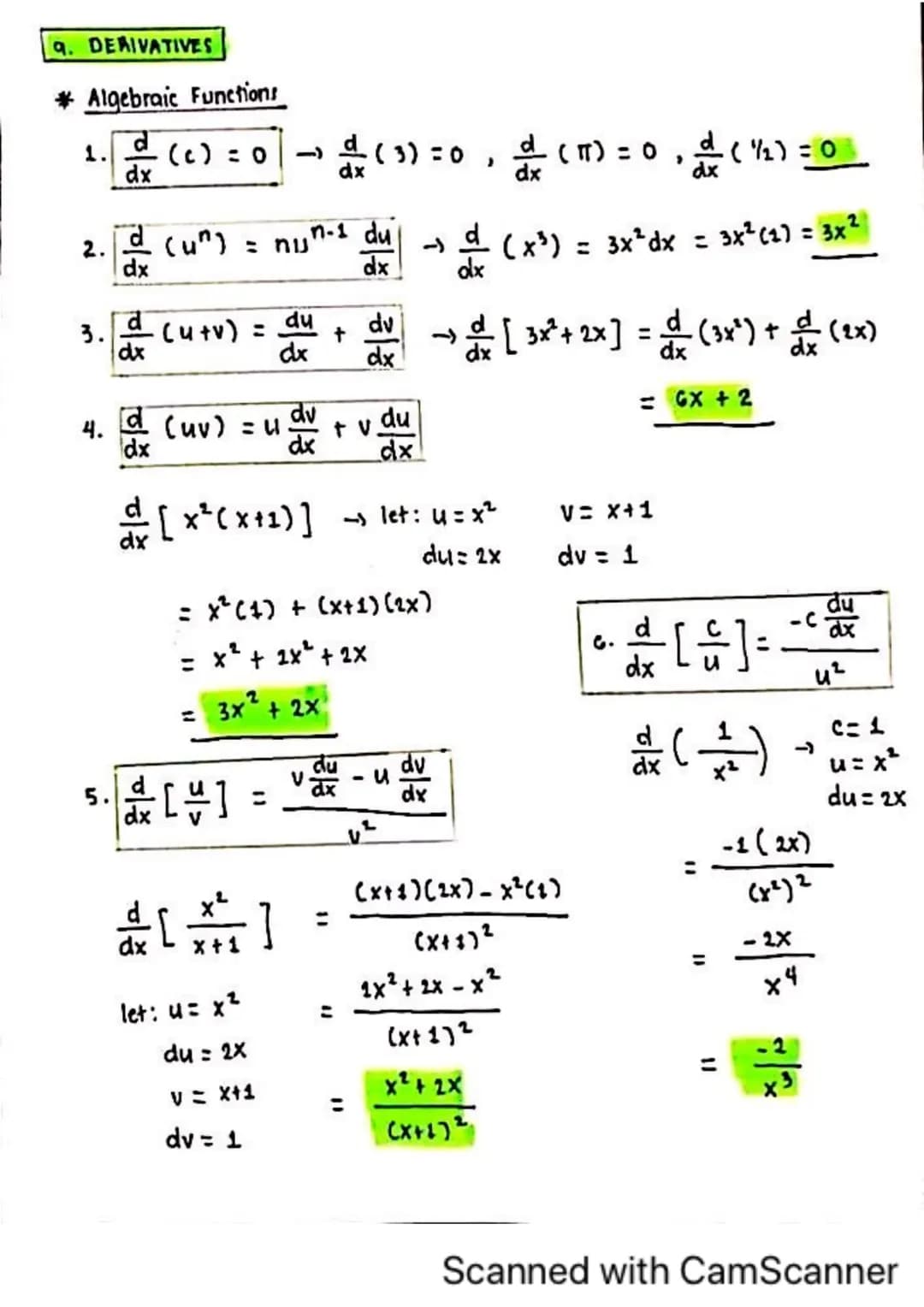
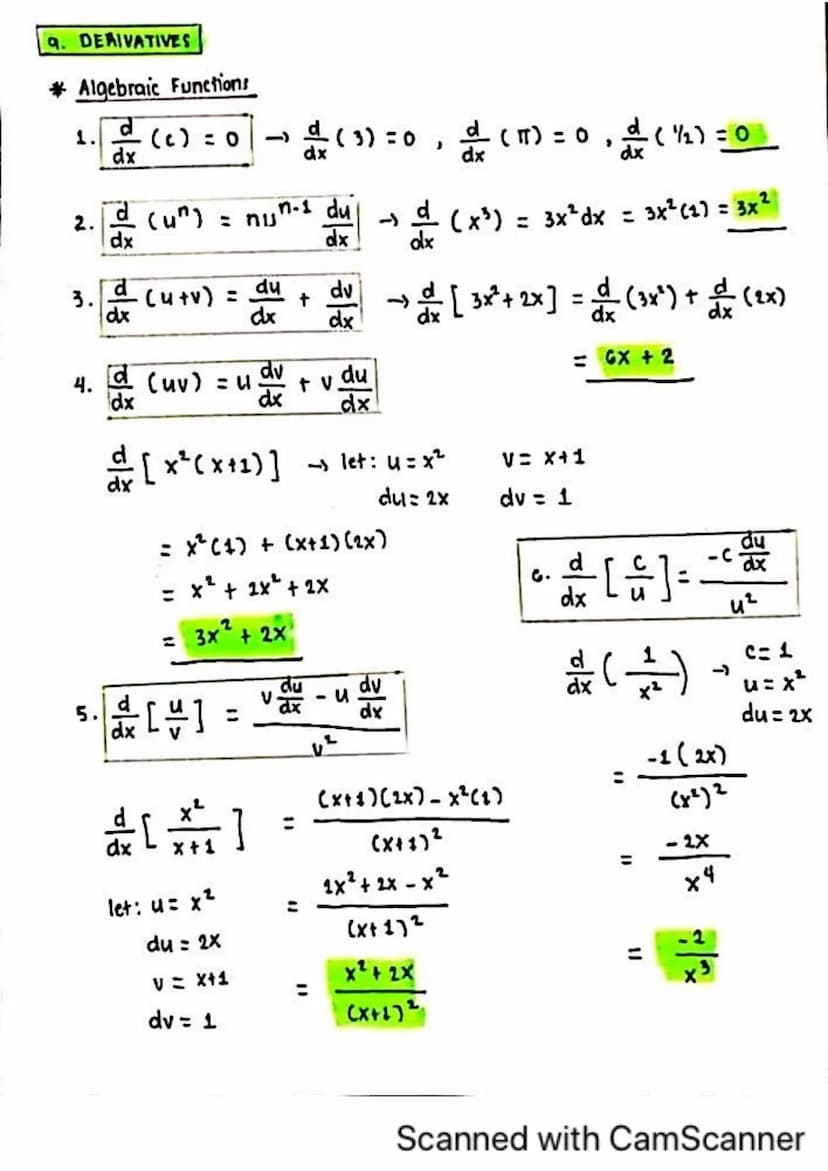
Derivatives measure the instantaneous rate of change of functions. For constant functions, the derivative is always zero since constants don't change as x changes. For example, the derivative of 3 or π is 0.
The power rule states that the derivative of u^n is nu^ multiplied by the derivative of u. This versatile rule applies to expressions like x³, where the derivative is 3x².
When dealing with sums and differences, the derivative distributes across terms. For instance, the derivative of 3x²+2x is simply 6x+2—you derive each term separately and add the results.
For products of functions, we use the product rule: (uv)' = u'v + uv'. When finding the derivative of x², we get x²(1) + (2x) = 3x² + 2x. The quotient rule for u/v gives /v², which helps with expressions like x²/.
Quick Trick: When applying derivative rules, identify the general form first (product, quotient, etc.), then substitute the specific functions into the formula. This systematic approach prevents mistakes!
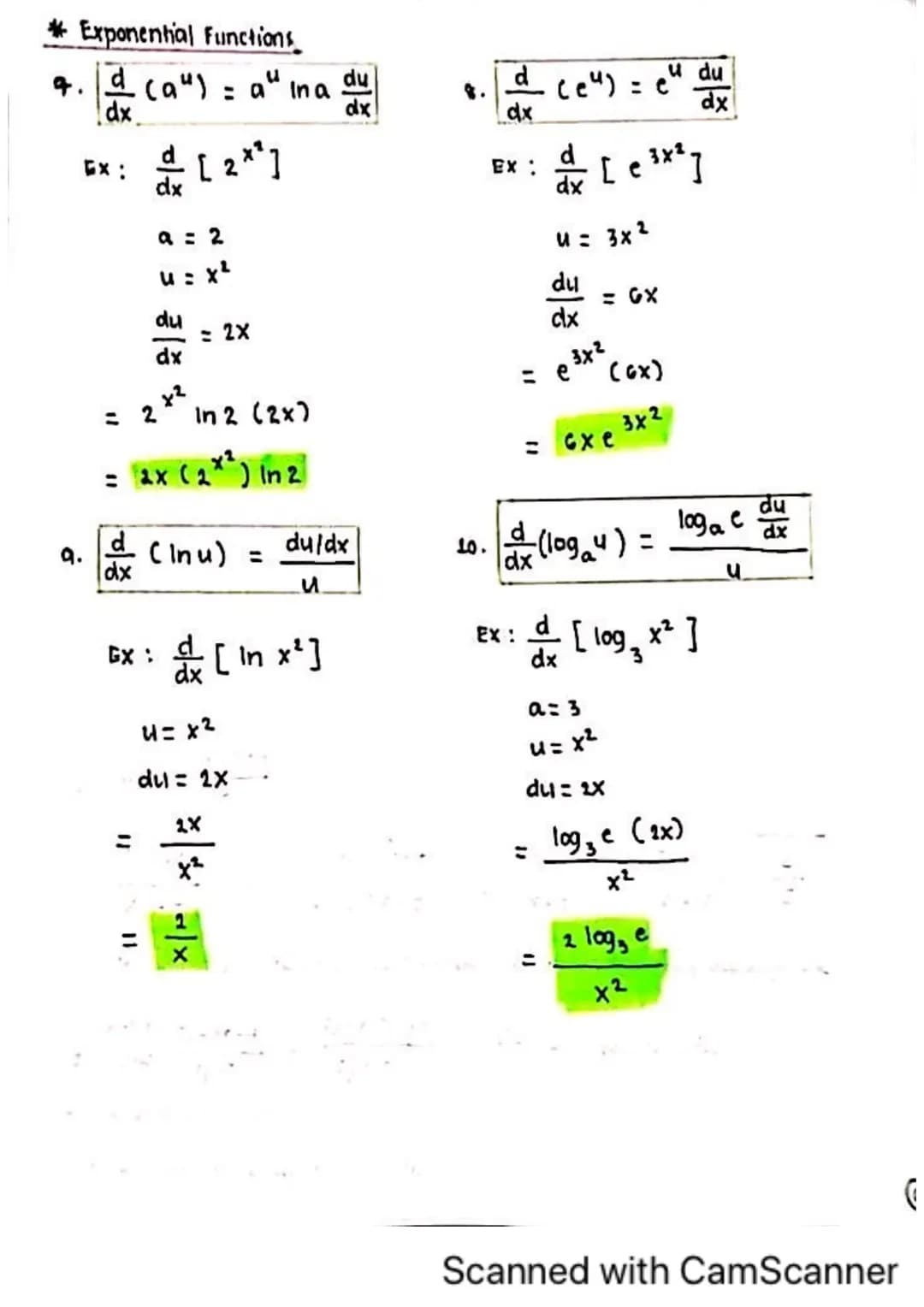
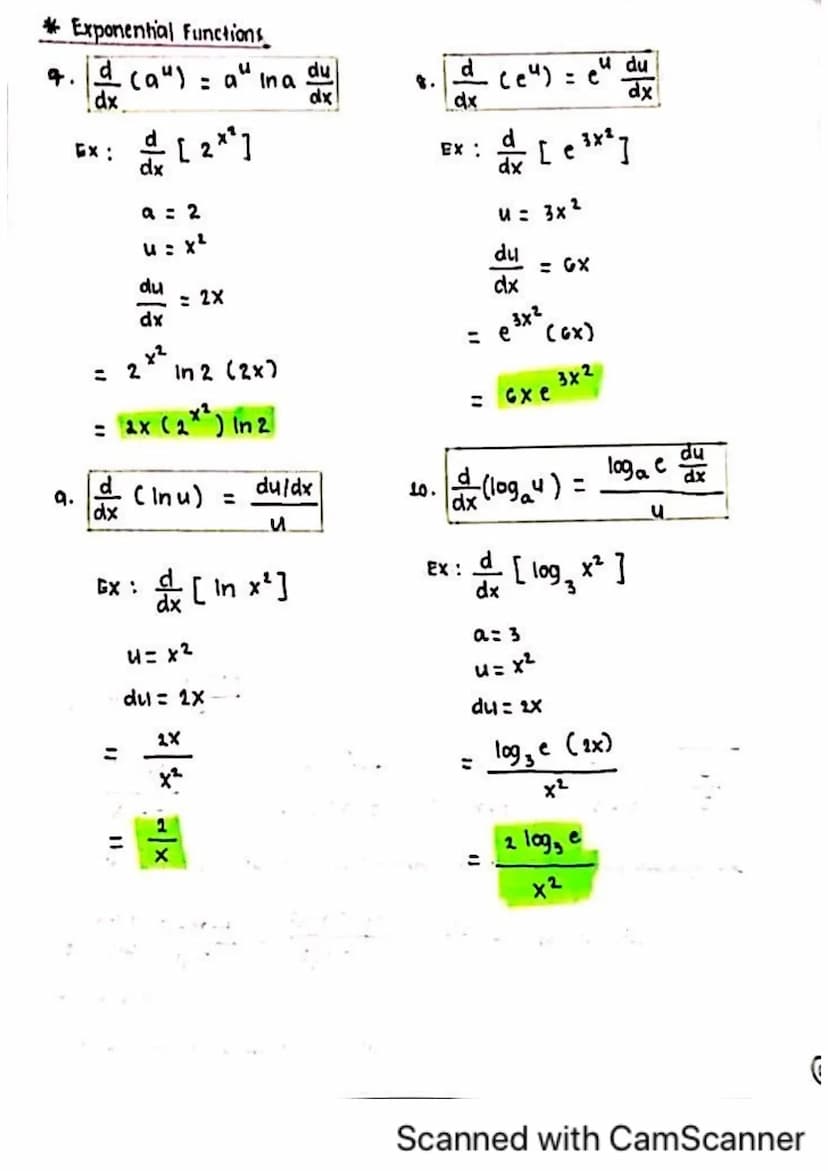
Exponential functions are crucial in modeling growth and decay. The derivative of a^u equals a^u·ln(a)·du/dx. For example, when finding the derivative of 2^(x²), we get 2^(x²)·ln(2)·(2x) = 2x·ln(2)·2^(x²).
When working with natural logarithms, the derivative of ln(u) equals /u. For ln(x²), the derivative simplifies to 2x/x² = 2/x. This explains why the natural logarithm appears so frequently in calculus.
The special case of e^u has an elegant derivative: simply e^u·. For e^(3x²), the derivative is e^(3x²)·(6x) = 6x·e^(3x²). This property makes e the preferred base for many exponential models.
For logarithms with other bases, the derivative of log_a(u) involves converting to natural logs: /u. When finding the derivative of log₃(x²), we get (2·log₃(e))/x.
Real-World Connection: Exponential functions model compound interest, population growth, and radioactive decay. The derivatives of these functions help predict rates of change in these important real-world scenarios!
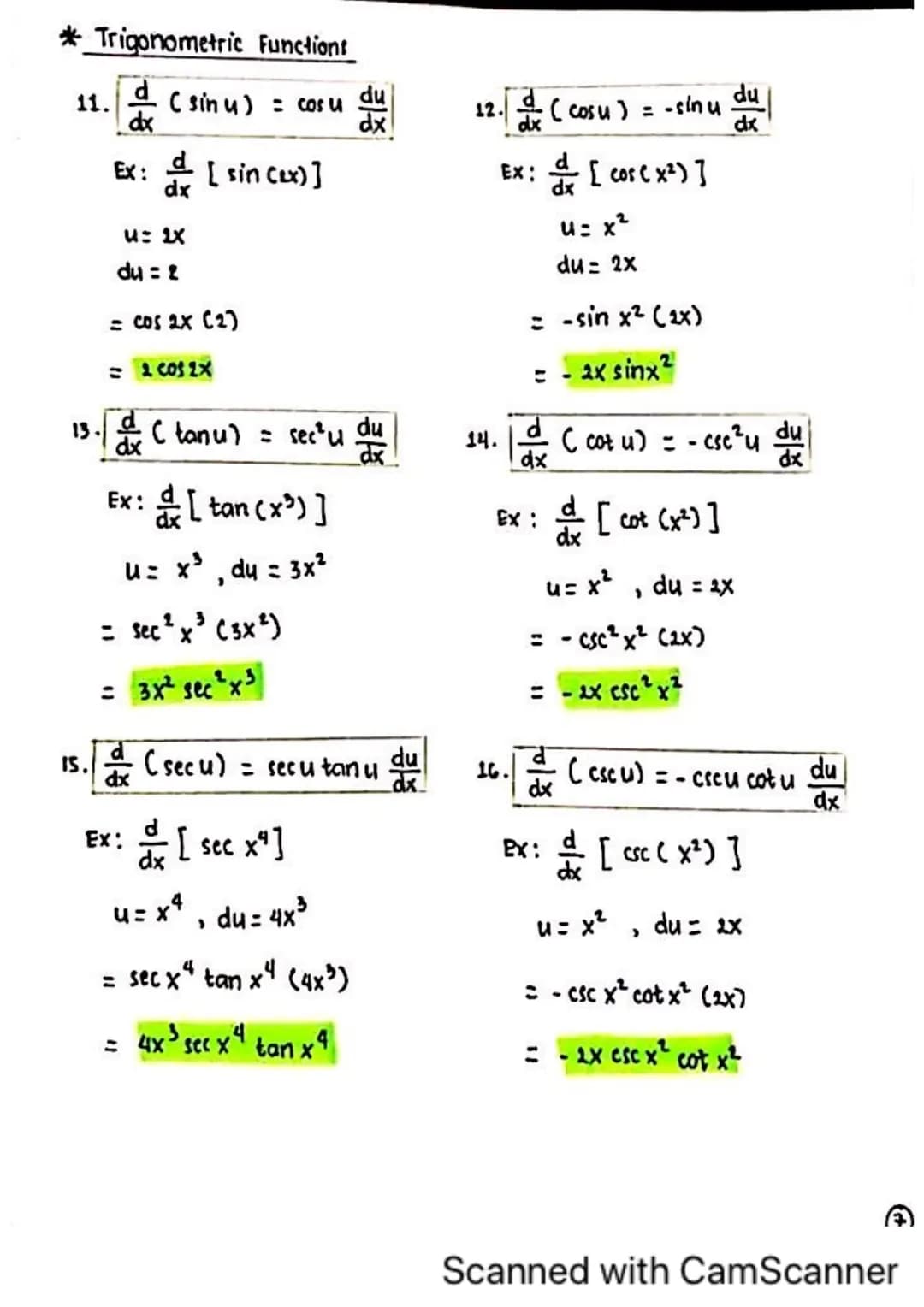
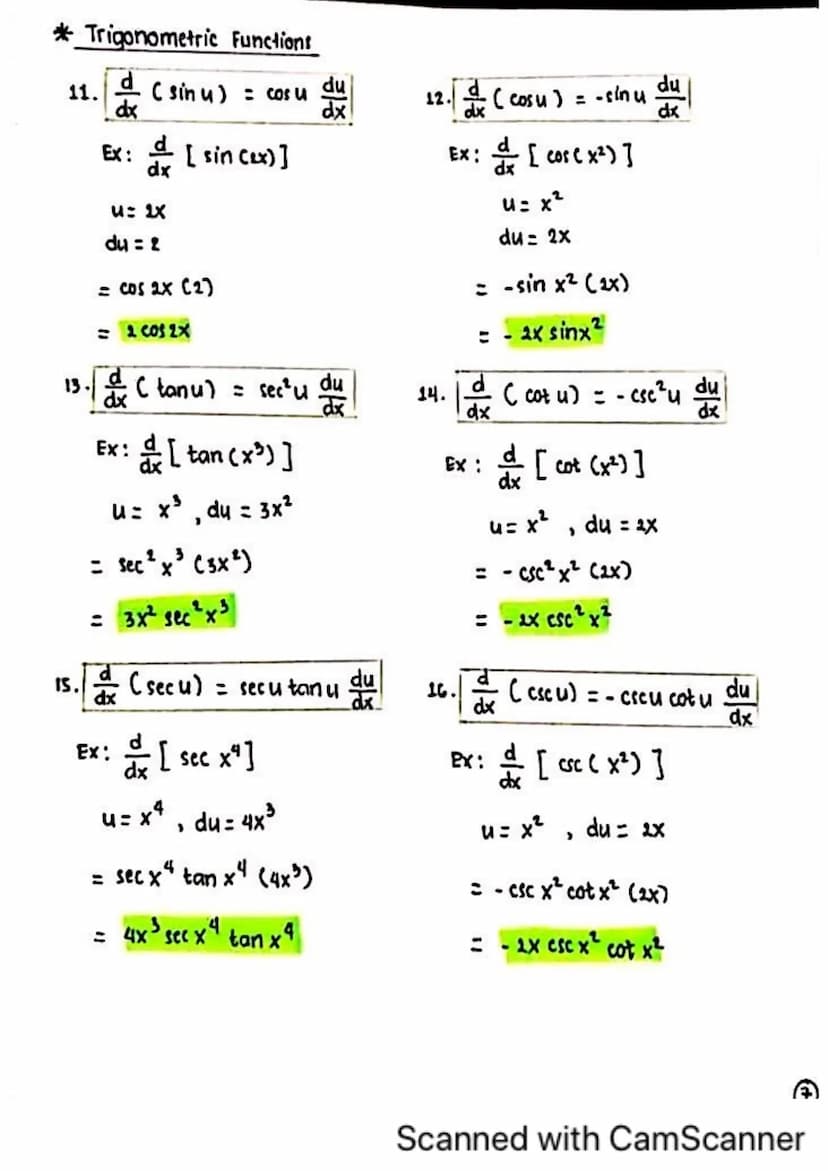
Trigonometric functions model periodic phenomena, and their derivatives follow consistent patterns. The derivative of sin(u) equals cos(u)·. For example, the derivative of sin(2x) is cos(2x)·(2) = 2cos(2x).
For cosine, the derivative includes a negative sign: -sin(u)·. This explains why the derivative of cos(x²) equals -sin(x²)·(2x) = -2x·sin(x²).
The derivative of tangent is sec²(u)·. When finding the derivative of tan(x³), we get sec²(x³)·(3x²) = 3x²·sec²(x³). Similarly, cotangent's derivative is -csc²(u)·, giving us -2x·csc²(x²) for cot(x²).
For secant, the derivative is sec(u)·tan(u)·, resulting in 4x³·sec(x⁴)·tan(x⁴) for sec(x⁴). The derivative of cosecant follows a similar pattern with a negative sign: -csc(u)·cot(u)·.
Memory Aid: For sin, the derivative is cos. For cos, the derivative is -sin. The other four trig functions all involve squared terms (sec² or csc²) or products of the original function with another trig function.
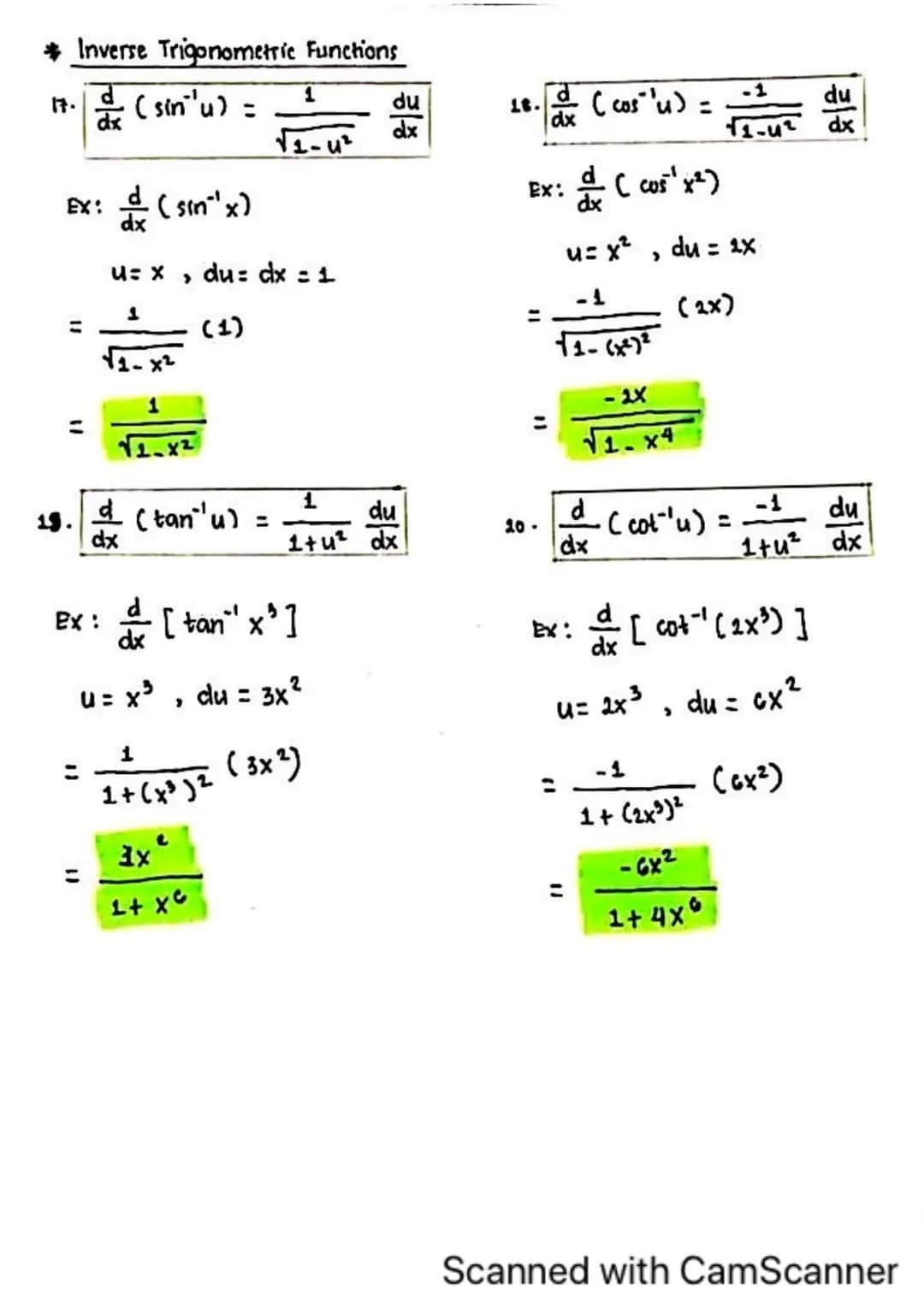
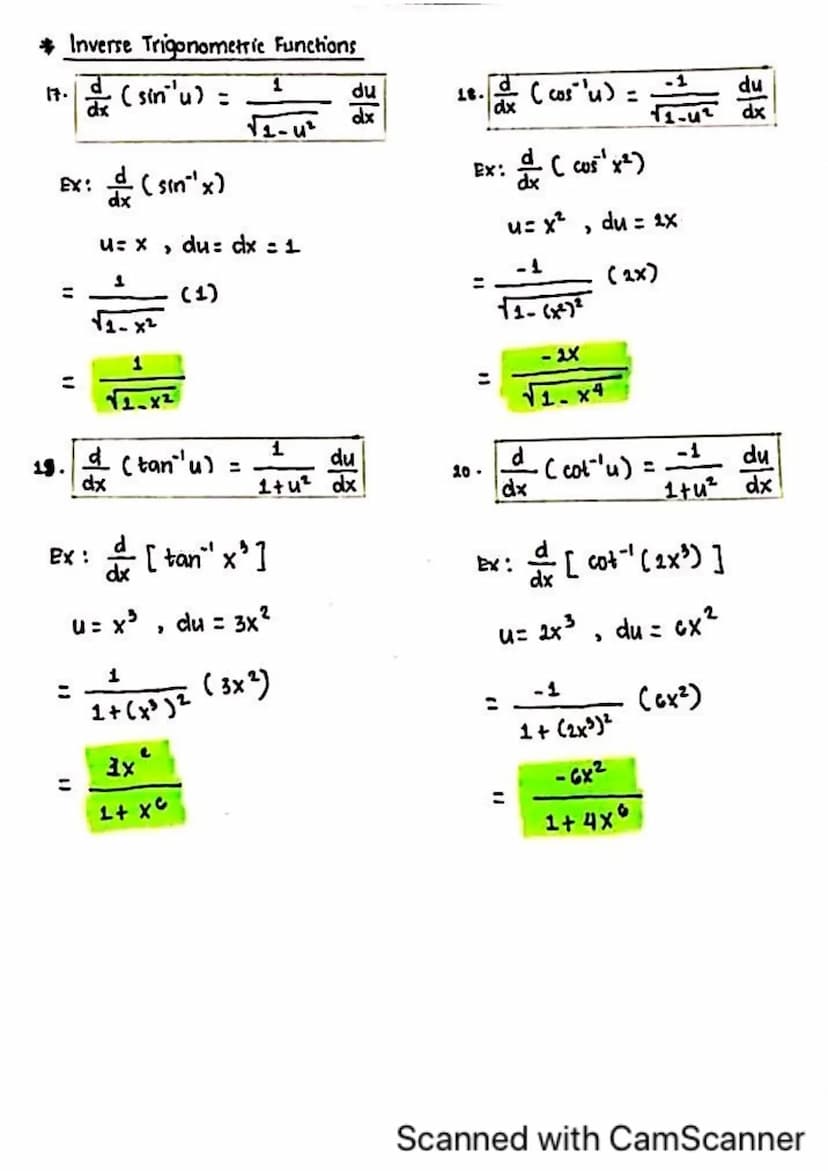
Inverse trigonometric functions help us find angles when we know ratio values. The derivative of arcsin(u) equals 1/√·. For example, the derivative of sin⁻¹(x) is simply 1/√, while the derivative of sin⁻¹(x²) is 2x/√.
For arccos(u), the derivative includes a negative sign: -1/√·. This explains why the derivative of cos⁻¹(x²) equals -2x/√.
The derivative of arctan(u) has the elegant form 1/·. When finding the derivative of tan⁻¹(x³), we get 3x²/. Similarly, arccot(u) has the derivative -1/·, leading to -6x²/ for cot⁻¹(2x³).
These derivatives appear frequently in physics and engineering problems involving angles and triangulation.
Application Insight: Inverse trigonometric derivatives are essential in physics problems involving projectile motion and in calculus problems where you need to integrate rational functions. The structures of these derivatives may seem complex, but they follow logical patterns!
Our AI companion is specifically built for the needs of students. Based on the millions of content pieces we have on the platform we can provide truly meaningful and relevant answers to students. But its not only about answers, the companion is even more about guiding students through their daily learning challenges, with personalised study plans, quizzes or content pieces in the chat and 100% personalisation based on the students skills and developments.
You can download the app in the Google Play Store and in the Apple App Store.
That's right! Enjoy free access to study content, connect with fellow students, and get instant help – all at your fingertips.
App Store
Google Play
The app is very easy to use and well designed. I have found everything I was looking for so far and have been able to learn a lot from the presentations! I will definitely use the app for a class assignment! And of course it also helps a lot as an inspiration.
Stefan S
iOS user
This app is really great. There are so many study notes and help [...]. My problem subject is French, for example, and the app has so many options for help. Thanks to this app, I have improved my French. I would recommend it to anyone.
Samantha Klich
Android user
Wow, I am really amazed. I just tried the app because I've seen it advertised many times and was absolutely stunned. This app is THE HELP you want for school and above all, it offers so many things, such as workouts and fact sheets, which have been VERY helpful to me personally.
Anna
iOS user
I think it’s very much worth it and you’ll end up using it a lot once you get the hang of it and even after looking at others notes you can still ask your Artificial intelligence buddy the question and ask to simplify it if you still don’t get it!!! In the end I think it’s worth it 😊👍 ⚠️Also DID I MENTION ITS FREEE YOU DON’T HAVE TO PAY FOR ANYTHING AND STILL GET YOUR GRADES IN PERFECTLY❗️❗️⚠️
Thomas R
iOS user
Knowunity is the BEST app I’ve used in a minute. This is not an ai review or anything this is genuinely coming from a 7th grade student (I know 2011 im young) but dude this app is a 10/10 i have maintained a 3.8 gpa and have plenty of time for gaming. I love it and my mom is just happy I got good grades
Brad T
Android user
Not only did it help me find the answer but it also showed me alternative ways to solve it. I was horrible in math and science but now I have an a in both subjects. Thanks for the help🤍🤍
David K
iOS user
The app's just great! All I have to do is enter the topic in the search bar and I get the response real fast. I don't have to watch 10 YouTube videos to understand something, so I'm saving my time. Highly recommended!
Sudenaz Ocak
Android user
In school I was really bad at maths but thanks to the app, I am doing better now. I am so grateful that you made the app.
Greenlight Bonnie
Android user
I found this app a couple years ago and it has only gotten better since then. I really love it because it can help with written questions and photo questions. Also, it can find study guides that other people have made as well as flashcard sets and practice tests. The free version is also amazing for students who might not be able to afford it. Would 100% recommend
Aubrey
iOS user
Best app if you're in Highschool or Junior high. I have been using this app for 2 school years and it's the best, it's good if you don't have anyone to help you with school work.😋🩷🎀
Marco B
iOS user
THE QUIZES AND FLASHCARDS ARE SO USEFUL AND I LOVE Knowunity AI. IT ALSO IS LITREALLY LIKE CHATGPT BUT SMARTER!! HELPED ME WITH MY MASCARA PROBLEMS TOO!! AS WELL AS MY REAL SUBJECTS ! DUHHH 😍😁😲🤑💗✨🎀😮
Elisha
iOS user
This app is phenomenal down to the correct info and the various topics you can study! I greatly recommend it for people who struggle with procrastination and those who need homework help. It has been perfectly accurate for world 1 history as far as I’ve seen! Geometry too!
Paul T
iOS user
The app is very easy to use and well designed. I have found everything I was looking for so far and have been able to learn a lot from the presentations! I will definitely use the app for a class assignment! And of course it also helps a lot as an inspiration.
Stefan S
iOS user
This app is really great. There are so many study notes and help [...]. My problem subject is French, for example, and the app has so many options for help. Thanks to this app, I have improved my French. I would recommend it to anyone.
Samantha Klich
Android user
Wow, I am really amazed. I just tried the app because I've seen it advertised many times and was absolutely stunned. This app is THE HELP you want for school and above all, it offers so many things, such as workouts and fact sheets, which have been VERY helpful to me personally.
Anna
iOS user
I think it’s very much worth it and you’ll end up using it a lot once you get the hang of it and even after looking at others notes you can still ask your Artificial intelligence buddy the question and ask to simplify it if you still don’t get it!!! In the end I think it’s worth it 😊👍 ⚠️Also DID I MENTION ITS FREEE YOU DON’T HAVE TO PAY FOR ANYTHING AND STILL GET YOUR GRADES IN PERFECTLY❗️❗️⚠️
Thomas R
iOS user
Knowunity is the BEST app I’ve used in a minute. This is not an ai review or anything this is genuinely coming from a 7th grade student (I know 2011 im young) but dude this app is a 10/10 i have maintained a 3.8 gpa and have plenty of time for gaming. I love it and my mom is just happy I got good grades
Brad T
Android user
Not only did it help me find the answer but it also showed me alternative ways to solve it. I was horrible in math and science but now I have an a in both subjects. Thanks for the help🤍🤍
David K
iOS user
The app's just great! All I have to do is enter the topic in the search bar and I get the response real fast. I don't have to watch 10 YouTube videos to understand something, so I'm saving my time. Highly recommended!
Sudenaz Ocak
Android user
In school I was really bad at maths but thanks to the app, I am doing better now. I am so grateful that you made the app.
Greenlight Bonnie
Android user
I found this app a couple years ago and it has only gotten better since then. I really love it because it can help with written questions and photo questions. Also, it can find study guides that other people have made as well as flashcard sets and practice tests. The free version is also amazing for students who might not be able to afford it. Would 100% recommend
Aubrey
iOS user
Best app if you're in Highschool or Junior high. I have been using this app for 2 school years and it's the best, it's good if you don't have anyone to help you with school work.😋🩷🎀
Marco B
iOS user
THE QUIZES AND FLASHCARDS ARE SO USEFUL AND I LOVE Knowunity AI. IT ALSO IS LITREALLY LIKE CHATGPT BUT SMARTER!! HELPED ME WITH MY MASCARA PROBLEMS TOO!! AS WELL AS MY REAL SUBJECTS ! DUHHH 😍😁😲🤑💗✨🎀😮
Elisha
iOS user
This app is phenomenal down to the correct info and the various topics you can study! I greatly recommend it for people who struggle with procrastination and those who need homework help. It has been perfectly accurate for world 1 history as far as I’ve seen! Geometry too!
Paul T
iOS user
Ann Villamor
@annevillamor_sun
Differential calculus is all about understanding how quantities change, a concept at the heart of advanced mathematics. Whether you're analyzing rates of change, finding maximum and minimum values, or solving real-world problems, mastering the fundamentals of limits and derivatives is... Show more
Access to all documents
Improve your grades
Join milions of students
Differential calculus focuses on understanding how functions change at any given point. This powerful mathematical tool helps us analyze rates of change, find optimal values, and model real-world phenomena.
The main components of differential calculus include limits (how functions behave as they approach specific values) and derivatives (the instantaneous rate of change of a function). These concepts apply to various function types - algebraic, exponential, trigonometric, and more.
Beyond basic derivatives, differential calculus extends to partial differentiation (for functions with multiple variables), finding critical points, and analyzing the behavior of curves through concepts like radius of curvature and inflection points.
Pro Tip: As you learn each new concept in calculus, connect it back to real applications. Understanding how calculus is used to solve practical problems will help make these abstract ideas more meaningful!
Access to all documents
Improve your grades
Join milions of students
Limits form the foundation of calculus by describing what happens as a function approaches a specific value. The sum law lets us break down complex limits into simpler pieces: when finding the limit of a sum, we can find the limits of each part separately and add them together.
Similarly, the difference law works the same way for subtraction, while the constant multiple law tells us we can pull constants outside the limit. For example, when finding the limit of 4x² as x approaches 1, we can rewrite it as 4 times the limit of x², which equals 4(1) = 4.
These laws help simplify complicated limit problems. Instead of tackling an intimidating expression all at once, you can break it down into manageable pieces. Just remember to check that each individual limit exists before applying these rules.
Remember: Limits are about the behavior of a function as it gets arbitrarily close to a point, not necessarily the value at that exact point!
Access to all documents
Improve your grades
Join milions of students
The product law lets you find limits of multiplied functions by multiplying their individual limits. For instance, when finding the limit of as x approaches 2, you can separately find the limit of each factor, then multiply those results: (2²+1)(2+2) = 5×4 = 20.
The quotient law works similarly for division, allowing you to divide the limits of the numerator and denominator. This works as long as the limit of the denominator isn't zero. For example, the limit of / as x approaches 2 equals (2²+1)/(2+3) = 5/5 = 1.
The power law lets you handle expressions raised to powers. When finding the limit of [f(x)]ⁿ, you can first find the limit of f(x) and then raise that result to the power n. This simplifies problems like finding the limit of ⁵ as x approaches 1.
Watch Out: These laws only work when the individual limits exist! If any component limit doesn't exist or gives an indeterminate form, you'll need to try a different approach.
Access to all documents
Improve your grades
Join milions of students
When dealing with limits involving infinity, we often encounter expressions that approach infinity or negative infinity. For example, as x approaches zero, 1/x² grows without bound, so we say the limit equals positive infinity.
Indeterminate forms occur when limit evaluations lead to ambiguous expressions like 0/0 or ∞/∞. These forms don't have a definite value and require special techniques to resolve. When you encounter expressions like / as x approaches 1, direct substitution gives 0/0, indicating more work is needed.
Other indeterminate forms include ∞-∞, 0×∞, and 0/∞. Each requires careful analysis rather than simple arithmetic. For instance, the limit of tan as x approaches 1 gives 1×∞, which is indeterminate.
Quick Tip: When you get an indeterminate form, it's a signal to dig deeper! It doesn't mean the limit doesn't exist—it means you need more sophisticated techniques to find it.
Access to all documents
Improve your grades
Join milions of students
When faced with indeterminate forms, algebraic simplification often helps clear the path to a solution. For the limit of / as x approaches 1, factoring reveals a common factor that can be canceled: / = /. This simplified form easily evaluates to 2/5.
L'Hospital's Rule offers another powerful approach when algebraic tricks don't work. This method states that for 0/0 or ∞/∞ forms, you can differentiate both numerator and denominator separately and then take the limit. Using the same example from above, differentiating gives us the limit of 2x/ as x approaches 1, which equals 2/5.
Sometimes one application of L'Hospital's Rule isn't enough. If the result is still indeterminate, continue differentiating until you reach a form that can be evaluated directly.
Remember: L'Hospital's Rule only works for the indeterminate forms 0/0 and ∞/∞. For other indeterminate forms, you'll need to rewrite the expression first!
Access to all documents
Improve your grades
Join milions of students
Algebraic simplification remains one of the most straightforward approaches to handling indeterminate forms. By factoring and simplifying expressions, you can often eliminate the source of the indeterminacy. In our example of /, factoring both parts reveals a common factor of that cancels out, transforming our expression into /.
When algebraic methods aren't enough, L'Hospital's Rule provides a systematic approach. This powerful technique involves taking the derivatives of both the numerator and denominator separately. For the limit of /, differentiating gives us 2x/, which evaluates to 2/5 when x=1.
The beauty of L'Hospital's Rule is that it can be applied repeatedly if needed. If your first application still results in an indeterminate form, simply differentiate again until you reach a determinable expression.
Study Strategy: When working with limits, always try direct substitution first. If that gives an indeterminate form, try algebraic simplification before jumping to L'Hospital's Rule—it's often quicker!
Access to all documents
Improve your grades
Join milions of students
Derivatives measure the instantaneous rate of change of functions. For constant functions, the derivative is always zero since constants don't change as x changes. For example, the derivative of 3 or π is 0.
The power rule states that the derivative of u^n is nu^ multiplied by the derivative of u. This versatile rule applies to expressions like x³, where the derivative is 3x².
When dealing with sums and differences, the derivative distributes across terms. For instance, the derivative of 3x²+2x is simply 6x+2—you derive each term separately and add the results.
For products of functions, we use the product rule: (uv)' = u'v + uv'. When finding the derivative of x², we get x²(1) + (2x) = 3x² + 2x. The quotient rule for u/v gives /v², which helps with expressions like x²/.
Quick Trick: When applying derivative rules, identify the general form first (product, quotient, etc.), then substitute the specific functions into the formula. This systematic approach prevents mistakes!
Access to all documents
Improve your grades
Join milions of students
Exponential functions are crucial in modeling growth and decay. The derivative of a^u equals a^u·ln(a)·du/dx. For example, when finding the derivative of 2^(x²), we get 2^(x²)·ln(2)·(2x) = 2x·ln(2)·2^(x²).
When working with natural logarithms, the derivative of ln(u) equals /u. For ln(x²), the derivative simplifies to 2x/x² = 2/x. This explains why the natural logarithm appears so frequently in calculus.
The special case of e^u has an elegant derivative: simply e^u·. For e^(3x²), the derivative is e^(3x²)·(6x) = 6x·e^(3x²). This property makes e the preferred base for many exponential models.
For logarithms with other bases, the derivative of log_a(u) involves converting to natural logs: /u. When finding the derivative of log₃(x²), we get (2·log₃(e))/x.
Real-World Connection: Exponential functions model compound interest, population growth, and radioactive decay. The derivatives of these functions help predict rates of change in these important real-world scenarios!
Access to all documents
Improve your grades
Join milions of students
Trigonometric functions model periodic phenomena, and their derivatives follow consistent patterns. The derivative of sin(u) equals cos(u)·. For example, the derivative of sin(2x) is cos(2x)·(2) = 2cos(2x).
For cosine, the derivative includes a negative sign: -sin(u)·. This explains why the derivative of cos(x²) equals -sin(x²)·(2x) = -2x·sin(x²).
The derivative of tangent is sec²(u)·. When finding the derivative of tan(x³), we get sec²(x³)·(3x²) = 3x²·sec²(x³). Similarly, cotangent's derivative is -csc²(u)·, giving us -2x·csc²(x²) for cot(x²).
For secant, the derivative is sec(u)·tan(u)·, resulting in 4x³·sec(x⁴)·tan(x⁴) for sec(x⁴). The derivative of cosecant follows a similar pattern with a negative sign: -csc(u)·cot(u)·.
Memory Aid: For sin, the derivative is cos. For cos, the derivative is -sin. The other four trig functions all involve squared terms (sec² or csc²) or products of the original function with another trig function.
Access to all documents
Improve your grades
Join milions of students
Inverse trigonometric functions help us find angles when we know ratio values. The derivative of arcsin(u) equals 1/√·. For example, the derivative of sin⁻¹(x) is simply 1/√, while the derivative of sin⁻¹(x²) is 2x/√.
For arccos(u), the derivative includes a negative sign: -1/√·. This explains why the derivative of cos⁻¹(x²) equals -2x/√.
The derivative of arctan(u) has the elegant form 1/·. When finding the derivative of tan⁻¹(x³), we get 3x²/. Similarly, arccot(u) has the derivative -1/·, leading to -6x²/ for cot⁻¹(2x³).
These derivatives appear frequently in physics and engineering problems involving angles and triangulation.
Application Insight: Inverse trigonometric derivatives are essential in physics problems involving projectile motion and in calculus problems where you need to integrate rational functions. The structures of these derivatives may seem complex, but they follow logical patterns!
Our AI companion is specifically built for the needs of students. Based on the millions of content pieces we have on the platform we can provide truly meaningful and relevant answers to students. But its not only about answers, the companion is even more about guiding students through their daily learning challenges, with personalised study plans, quizzes or content pieces in the chat and 100% personalisation based on the students skills and developments.
You can download the app in the Google Play Store and in the Apple App Store.
That's right! Enjoy free access to study content, connect with fellow students, and get instant help – all at your fingertips.
36
Smart Tools NEW
Transform this note into: ✓ 50+ Practice Questions ✓ Interactive Flashcards ✓ Full Practice Test ✓ Essay Outlines
App Store
Google Play
The app is very easy to use and well designed. I have found everything I was looking for so far and have been able to learn a lot from the presentations! I will definitely use the app for a class assignment! And of course it also helps a lot as an inspiration.
Stefan S
iOS user
This app is really great. There are so many study notes and help [...]. My problem subject is French, for example, and the app has so many options for help. Thanks to this app, I have improved my French. I would recommend it to anyone.
Samantha Klich
Android user
Wow, I am really amazed. I just tried the app because I've seen it advertised many times and was absolutely stunned. This app is THE HELP you want for school and above all, it offers so many things, such as workouts and fact sheets, which have been VERY helpful to me personally.
Anna
iOS user
I think it’s very much worth it and you’ll end up using it a lot once you get the hang of it and even after looking at others notes you can still ask your Artificial intelligence buddy the question and ask to simplify it if you still don’t get it!!! In the end I think it’s worth it 😊👍 ⚠️Also DID I MENTION ITS FREEE YOU DON’T HAVE TO PAY FOR ANYTHING AND STILL GET YOUR GRADES IN PERFECTLY❗️❗️⚠️
Thomas R
iOS user
Knowunity is the BEST app I’ve used in a minute. This is not an ai review or anything this is genuinely coming from a 7th grade student (I know 2011 im young) but dude this app is a 10/10 i have maintained a 3.8 gpa and have plenty of time for gaming. I love it and my mom is just happy I got good grades
Brad T
Android user
Not only did it help me find the answer but it also showed me alternative ways to solve it. I was horrible in math and science but now I have an a in both subjects. Thanks for the help🤍🤍
David K
iOS user
The app's just great! All I have to do is enter the topic in the search bar and I get the response real fast. I don't have to watch 10 YouTube videos to understand something, so I'm saving my time. Highly recommended!
Sudenaz Ocak
Android user
In school I was really bad at maths but thanks to the app, I am doing better now. I am so grateful that you made the app.
Greenlight Bonnie
Android user
I found this app a couple years ago and it has only gotten better since then. I really love it because it can help with written questions and photo questions. Also, it can find study guides that other people have made as well as flashcard sets and practice tests. The free version is also amazing for students who might not be able to afford it. Would 100% recommend
Aubrey
iOS user
Best app if you're in Highschool or Junior high. I have been using this app for 2 school years and it's the best, it's good if you don't have anyone to help you with school work.😋🩷🎀
Marco B
iOS user
THE QUIZES AND FLASHCARDS ARE SO USEFUL AND I LOVE Knowunity AI. IT ALSO IS LITREALLY LIKE CHATGPT BUT SMARTER!! HELPED ME WITH MY MASCARA PROBLEMS TOO!! AS WELL AS MY REAL SUBJECTS ! DUHHH 😍😁😲🤑💗✨🎀😮
Elisha
iOS user
This app is phenomenal down to the correct info and the various topics you can study! I greatly recommend it for people who struggle with procrastination and those who need homework help. It has been perfectly accurate for world 1 history as far as I’ve seen! Geometry too!
Paul T
iOS user
The app is very easy to use and well designed. I have found everything I was looking for so far and have been able to learn a lot from the presentations! I will definitely use the app for a class assignment! And of course it also helps a lot as an inspiration.
Stefan S
iOS user
This app is really great. There are so many study notes and help [...]. My problem subject is French, for example, and the app has so many options for help. Thanks to this app, I have improved my French. I would recommend it to anyone.
Samantha Klich
Android user
Wow, I am really amazed. I just tried the app because I've seen it advertised many times and was absolutely stunned. This app is THE HELP you want for school and above all, it offers so many things, such as workouts and fact sheets, which have been VERY helpful to me personally.
Anna
iOS user
I think it’s very much worth it and you’ll end up using it a lot once you get the hang of it and even after looking at others notes you can still ask your Artificial intelligence buddy the question and ask to simplify it if you still don’t get it!!! In the end I think it’s worth it 😊👍 ⚠️Also DID I MENTION ITS FREEE YOU DON’T HAVE TO PAY FOR ANYTHING AND STILL GET YOUR GRADES IN PERFECTLY❗️❗️⚠️
Thomas R
iOS user
Knowunity is the BEST app I’ve used in a minute. This is not an ai review or anything this is genuinely coming from a 7th grade student (I know 2011 im young) but dude this app is a 10/10 i have maintained a 3.8 gpa and have plenty of time for gaming. I love it and my mom is just happy I got good grades
Brad T
Android user
Not only did it help me find the answer but it also showed me alternative ways to solve it. I was horrible in math and science but now I have an a in both subjects. Thanks for the help🤍🤍
David K
iOS user
The app's just great! All I have to do is enter the topic in the search bar and I get the response real fast. I don't have to watch 10 YouTube videos to understand something, so I'm saving my time. Highly recommended!
Sudenaz Ocak
Android user
In school I was really bad at maths but thanks to the app, I am doing better now. I am so grateful that you made the app.
Greenlight Bonnie
Android user
I found this app a couple years ago and it has only gotten better since then. I really love it because it can help with written questions and photo questions. Also, it can find study guides that other people have made as well as flashcard sets and practice tests. The free version is also amazing for students who might not be able to afford it. Would 100% recommend
Aubrey
iOS user
Best app if you're in Highschool or Junior high. I have been using this app for 2 school years and it's the best, it's good if you don't have anyone to help you with school work.😋🩷🎀
Marco B
iOS user
THE QUIZES AND FLASHCARDS ARE SO USEFUL AND I LOVE Knowunity AI. IT ALSO IS LITREALLY LIKE CHATGPT BUT SMARTER!! HELPED ME WITH MY MASCARA PROBLEMS TOO!! AS WELL AS MY REAL SUBJECTS ! DUHHH 😍😁😲🤑💗✨🎀😮
Elisha
iOS user
This app is phenomenal down to the correct info and the various topics you can study! I greatly recommend it for people who struggle with procrastination and those who need homework help. It has been perfectly accurate for world 1 history as far as I’ve seen! Geometry too!
Paul T
iOS user