

Earth's four key layers—atmosphere, hydrosphere, lithosphere, and the dynamic forces... Show more
 Algebra
 Biology
Sign up to see the contentIt's free!
Access to all documents
Improve your grades
Join milions of students
Knowunity AI
Subjects
Triangle Congruence and Similarity Theorems
Triangle Properties and Classification
Linear Equations and Graphs
Geometric Angle Relationships
Trigonometric Functions and Identities
Equation Solving Techniques
Circle Geometry Fundamentals
Division Operations and Methods
Basic Differentiation Rules
Exponent and Logarithm Properties
Show all topics
Human Organ Systems
Reproductive Cell Cycles
Biological Sciences Subdisciplines
Cellular Energy Metabolism
Autotrophic Energy Processes
Inheritance Patterns and Principles
Biomolecular Structure and Organization
Cell Cycle and Division Mechanics
Cellular Organization and Development
Biological Structural Organization
Show all topics
Chemical Sciences and Applications
Atomic Structure and Composition
Molecular Electron Structure Representation
Atomic Electron Behavior
Matter Properties and Water
Mole Concept and Calculations
Gas Laws and Behavior
Periodic Table Organization
Chemical Thermodynamics Fundamentals
Chemical Bond Types and Properties
Show all topics
European Renaissance and Enlightenment
European Cultural Movements 800-1920
American Revolution Era 1763-1797
American Civil War 1861-1865
Global Imperial Systems
Mongol and Chinese Dynasties
U.S. Presidents and World Leaders
Historical Sources and Documentation
World Wars Era and Impact
World Religious Systems
Show all topics
Classic and Contemporary Novels
Literary Character Analysis
Rhetorical Theory and Practice
Classic Literary Narratives
Reading Analysis and Interpretation
Narrative Structure and Techniques
English Language Components
Influential English-Language Authors
Basic Sentence Structure
Narrative Voice and Perspective
Show all topics
325
•
Updated Mar 21, 2026
•
Earth's four key layers—atmosphere, hydrosphere, lithosphere, and the dynamic forces... Show more
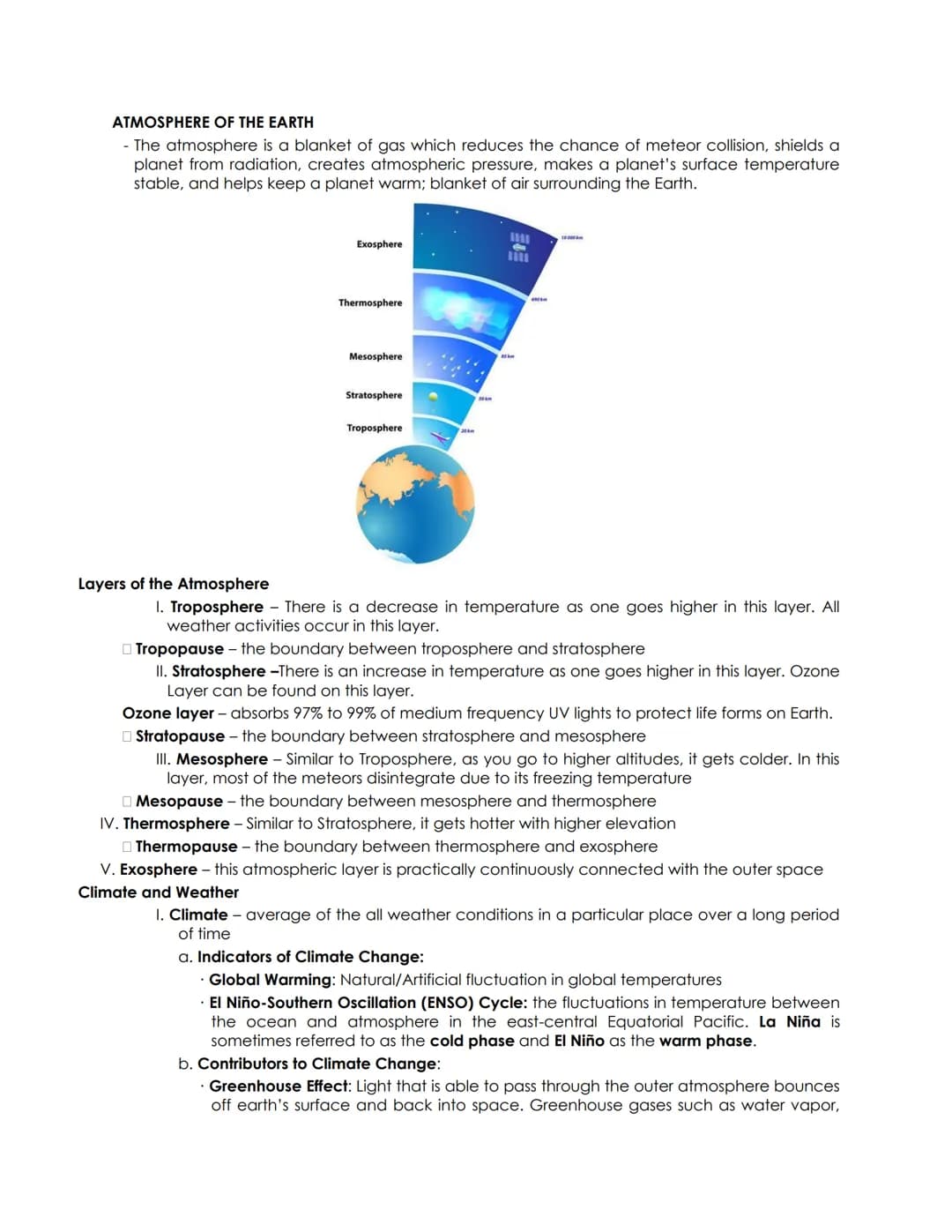
The atmosphere is like a protective shield around Earth, guarding against meteors, radiation, and temperature extremes. It's divided into five main layers, each with unique properties that affect our planet.
The troposphere is where we live and breathe—it's where all weather happens! Temperature decreases as you go higher in this layer. Above it lies the stratosphere, where temperatures actually increase with altitude. This layer contains the crucial ozone layer that absorbs 97-99% of harmful UV radiation, protecting life on Earth.
Higher up, the mesosphere gets progressively colder with altitude and burns up most meteors before they can reach Earth. The thermosphere above it gets hotter at higher elevations, while the outermost exosphere gradually transitions into space.
Fun fact: The atmosphere isn't just protective—it's why our planet isn't freezing cold or burning hot! By trapping some heat through the greenhouse effect, the atmosphere maintains temperatures suitable for life.
Climate represents the long-term average of weather conditions, while weather is the day-to-day atmospheric state. Global warming and El Niño-Southern Oscillation (ENSO) are key indicators of climate change. The greenhouse effect occurs when gases like carbon dioxide and methane trap heat in the atmosphere, while ozone holes from chemicals like CFCs allow harmful radiation to reach Earth's surface.
Weather is what's happening in the atmosphere right now, and we can measure it in several ways. Temperature (measured by thermometers) tells us how hot or cold it is, while atmospheric pressure (measured by barometers) indicates the force exerted by air on surfaces.
Humidity—the amount of water vapor in the air—can be measured with hygrometers. When this water vapor condenses, it forms different types of clouds: wispy cirrus clouds high in the sky, fluffy cumulus clouds with flat bottoms, spread-out stratus clouds, or dark, heavy nimbus rain clouds.
When clouds can't hold moisture anymore, we get precipitation. This can take many forms: raindrops, fine drizzle, icy sleet, snow crystals, or even hailstones bouncing off the ground.
Remember this: Air always moves from high-pressure areas to low-pressure areas, creating wind. This simple principle explains everything from gentle breezes to powerful typhoons!
Air movement creates patterns like sea breezes (daytime air flow from sea to land) and land breezes (nighttime air flow from land to sea). In the Philippines, these seasonal patterns create monsoons: Habagat (Southwest Monsoon) and Amihan (Northeast Monsoon). More dramatic air movements create atmospheric disturbances like thunderstorms, tropical cyclones (called hurricanes in the western hemisphere and typhoons in the eastern), and tornadoes—those frightening funnel-shaped whirlwinds.
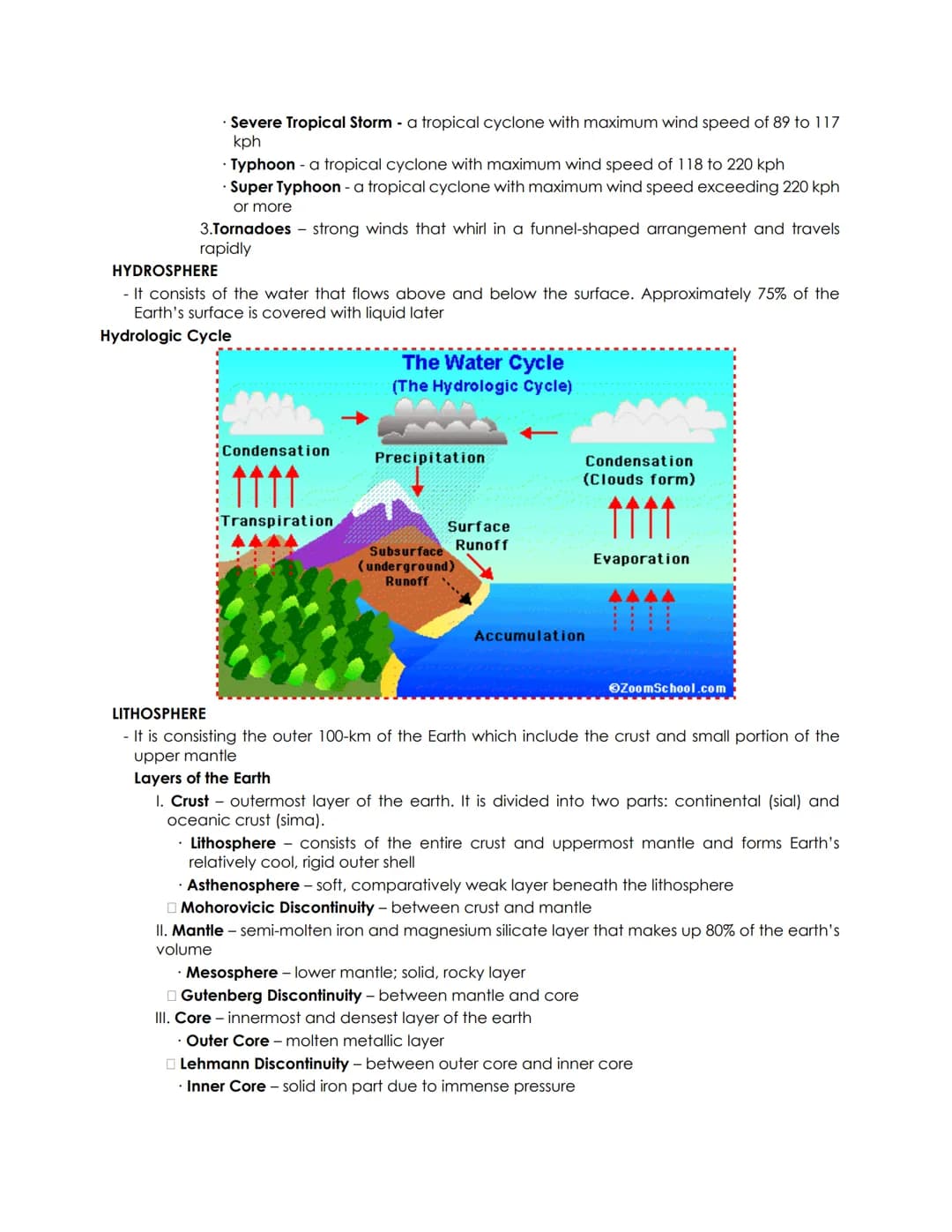
The hydrosphere includes all of Earth's water—oceans, lakes, rivers, groundwater, and even water vapor. About 75% of Earth's surface is covered with liquid water, constantly cycling through the hydrologic cycle: evaporation, condensation, precipitation, and accumulation.
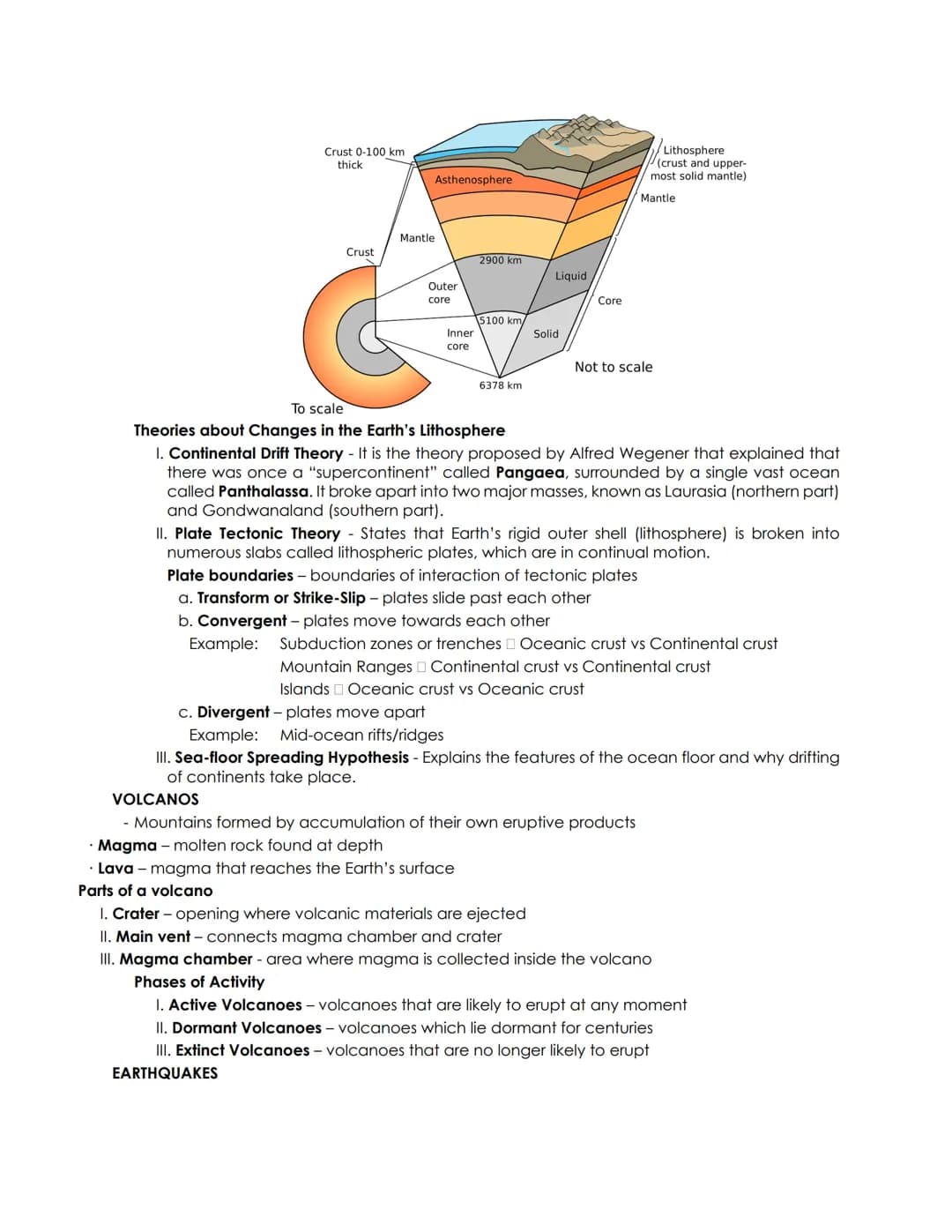
Below the water and land surface lies the lithosphere—Earth's outer shell consisting of the crust and uppermost portion of the mantle. Think of Earth's structure like a peach: the skin is the crust, the flesh is the mantle, and the pit is the core.
The crust is Earth's outermost layer, divided into continental crust (sial) and oceanic crust (sima). Below this lies the mantle, a semi-molten layer making up about 80% of Earth's volume. The mantle includes the asthenosphere, a relatively soft layer that allows the plates above to move.
Mind-blowing fact: Earth's inner core is actually solid despite being hotter than the outer core! The immense pressure at Earth's center prevents the metal from melting.
At Earth's center is the core, consisting of an outer liquid layer and a solid inner core made primarily of iron. The boundaries between these layers have special names: the Mohorovicic Discontinuity between crust and mantle, the Gutenberg Discontinuity between mantle and core, and the Lehmann Discontinuity between outer and inner core.
The continents weren't always where they are today! According to Alfred Wegener's Continental Drift Theory, Earth once had a single supercontinent called Pangaea surrounded by a vast ocean called Panthalassa. This supercontinent eventually split into two landmasses—Laurasia in the north and Gondwanaland in the south—which further broke apart into today's continents.
The modern Plate Tectonic Theory explains that Earth's lithosphere is broken into plates that constantly move. These plates interact at boundaries: transform boundaries where plates slide past each other, convergent boundaries where plates collide (creating trenches, mountains, or islands), and divergent boundaries where plates move apart .
The Sea-floor Spreading Hypothesis complements plate tectonics by explaining how new oceanic crust forms at mid-ocean ridges as plates move apart. This continuous cycle of crust creation and destruction drives the movement of continents.
Visualization tip: Think of Earth's plates like puzzle pieces floating on a pot of simmering stew. They move slowly but constantly, occasionally bumping into each other or pulling apart.
Volcanoes form when magma from inside Earth reaches the surface. A volcano consists of a crater (the opening), a main vent (the pathway), and a magma chamber (where molten rock collects). Volcanoes can be classified as active (could erupt at any time), dormant (not currently erupting but might in the future), or extinct (no longer likely to erupt).
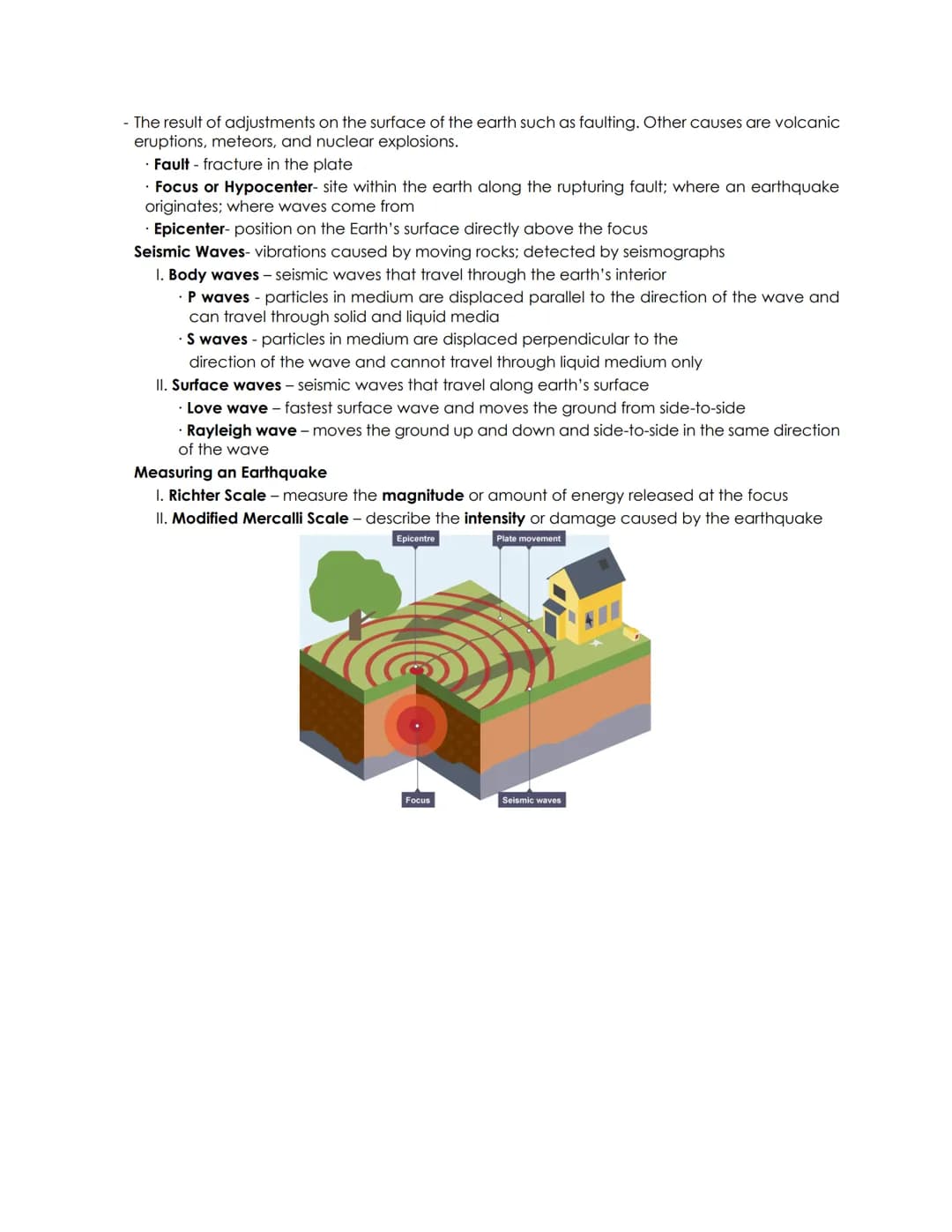
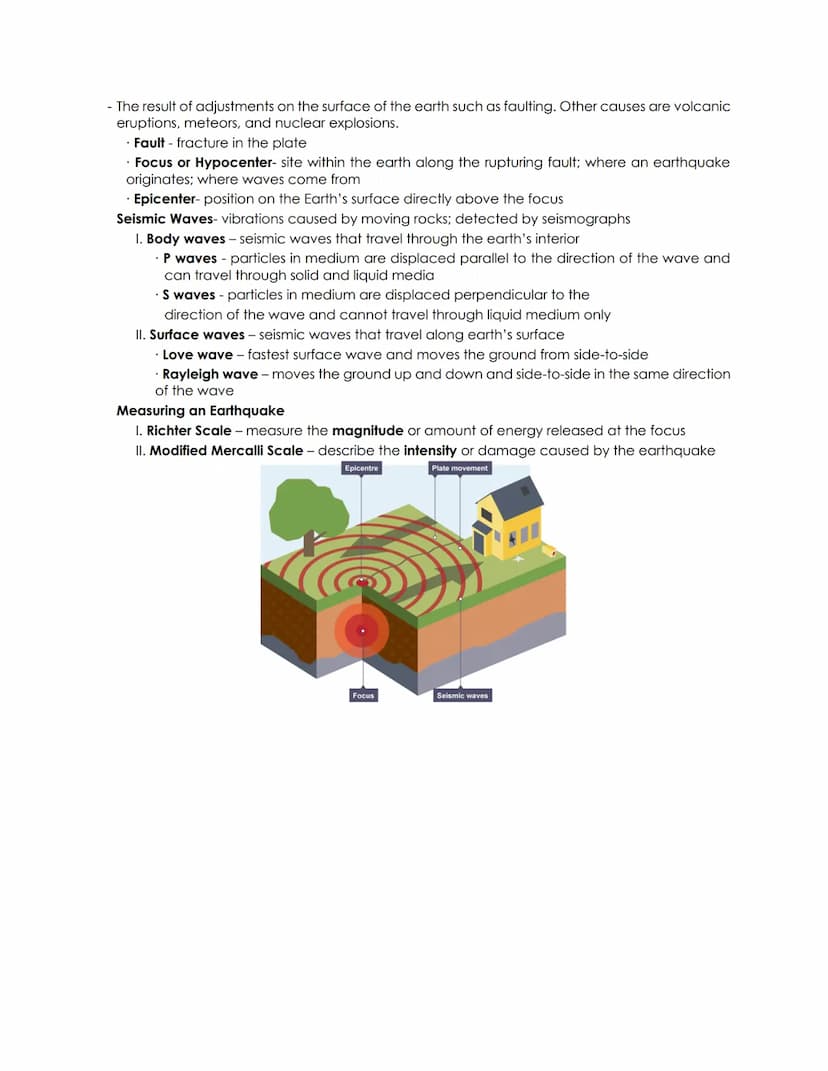
Earthquakes typically result from sudden movements along faults—fractures in Earth's crust. The point within Earth where the rupture begins is called the focus or hypocenter, while the point directly above it on the surface is the epicenter. These tremors can also be caused by volcanic eruptions, meteor impacts, or even nuclear explosions.
When an earthquake occurs, it generates seismic waves that travel through Earth. Body waves move through Earth's interior and include P waves (which compress and expand the ground like an accordion and can move through solids and liquids) and S waves .
Surface waves travel along Earth's surface and cause the most damage. Love waves move the ground side-to-side, while Rayleigh waves create a rolling motion like ocean waves. Scientists use seismographs to detect and measure these waves.
Real-world application: Scientists can't predict exactly when earthquakes will happen, but understanding plate boundaries helps identify areas at higher risk. That's why places along the "Ring of Fire" around the Pacific Ocean experience more frequent earthquakes.
Earthquake strength is measured in two ways: the Richter Scale measures magnitude (energy released at the source), while the Modified Mercalli Scale describes intensity (the actual damage caused). This distinction is important because a powerful earthquake in an unpopulated area might cause less damage than a moderate earthquake in a densely populated city.
Our AI companion is specifically built for the needs of students. Based on the millions of content pieces we have on the platform we can provide truly meaningful and relevant answers to students. But its not only about answers, the companion is even more about guiding students through their daily learning challenges, with personalised study plans, quizzes or content pieces in the chat and 100% personalisation based on the students skills and developments.
You can download the app in the Google Play Store and in the Apple App Store.
That's right! Enjoy free access to study content, connect with fellow students, and get instant help – all at your fingertips.
App Store
Google Play
The app is very easy to use and well designed. I have found everything I was looking for so far and have been able to learn a lot from the presentations! I will definitely use the app for a class assignment! And of course it also helps a lot as an inspiration.
Stefan S
iOS user
This app is really great. There are so many study notes and help [...]. My problem subject is French, for example, and the app has so many options for help. Thanks to this app, I have improved my French. I would recommend it to anyone.
Samantha Klich
Android user
Wow, I am really amazed. I just tried the app because I've seen it advertised many times and was absolutely stunned. This app is THE HELP you want for school and above all, it offers so many things, such as workouts and fact sheets, which have been VERY helpful to me personally.
Anna
iOS user
I think it’s very much worth it and you’ll end up using it a lot once you get the hang of it and even after looking at others notes you can still ask your Artificial intelligence buddy the question and ask to simplify it if you still don’t get it!!! In the end I think it’s worth it 😊👍 ⚠️Also DID I MENTION ITS FREEE YOU DON’T HAVE TO PAY FOR ANYTHING AND STILL GET YOUR GRADES IN PERFECTLY❗️❗️⚠️
Thomas R
iOS user
Knowunity is the BEST app I’ve used in a minute. This is not an ai review or anything this is genuinely coming from a 7th grade student (I know 2011 im young) but dude this app is a 10/10 i have maintained a 3.8 gpa and have plenty of time for gaming. I love it and my mom is just happy I got good grades
Brad T
Android user
Not only did it help me find the answer but it also showed me alternative ways to solve it. I was horrible in math and science but now I have an a in both subjects. Thanks for the help🤍🤍
David K
iOS user
The app's just great! All I have to do is enter the topic in the search bar and I get the response real fast. I don't have to watch 10 YouTube videos to understand something, so I'm saving my time. Highly recommended!
Sudenaz Ocak
Android user
In school I was really bad at maths but thanks to the app, I am doing better now. I am so grateful that you made the app.
Greenlight Bonnie
Android user
I found this app a couple years ago and it has only gotten better since then. I really love it because it can help with written questions and photo questions. Also, it can find study guides that other people have made as well as flashcard sets and practice tests. The free version is also amazing for students who might not be able to afford it. Would 100% recommend
Aubrey
iOS user
Best app if you're in Highschool or Junior high. I have been using this app for 2 school years and it's the best, it's good if you don't have anyone to help you with school work.😋🩷🎀
Marco B
iOS user
THE QUIZES AND FLASHCARDS ARE SO USEFUL AND I LOVE Knowunity AI. IT ALSO IS LITREALLY LIKE CHATGPT BUT SMARTER!! HELPED ME WITH MY MASCARA PROBLEMS TOO!! AS WELL AS MY REAL SUBJECTS ! DUHHH 😍😁😲🤑💗✨🎀😮
Elisha
iOS user
This app is phenomenal down to the correct info and the various topics you can study! I greatly recommend it for people who struggle with procrastination and those who need homework help. It has been perfectly accurate for world 1 history as far as I’ve seen! Geometry too!
Paul T
iOS user
The app is very easy to use and well designed. I have found everything I was looking for so far and have been able to learn a lot from the presentations! I will definitely use the app for a class assignment! And of course it also helps a lot as an inspiration.
Stefan S
iOS user
This app is really great. There are so many study notes and help [...]. My problem subject is French, for example, and the app has so many options for help. Thanks to this app, I have improved my French. I would recommend it to anyone.
Samantha Klich
Android user
Wow, I am really amazed. I just tried the app because I've seen it advertised many times and was absolutely stunned. This app is THE HELP you want for school and above all, it offers so many things, such as workouts and fact sheets, which have been VERY helpful to me personally.
Anna
iOS user
I think it’s very much worth it and you’ll end up using it a lot once you get the hang of it and even after looking at others notes you can still ask your Artificial intelligence buddy the question and ask to simplify it if you still don’t get it!!! In the end I think it’s worth it 😊👍 ⚠️Also DID I MENTION ITS FREEE YOU DON’T HAVE TO PAY FOR ANYTHING AND STILL GET YOUR GRADES IN PERFECTLY❗️❗️⚠️
Thomas R
iOS user
Knowunity is the BEST app I’ve used in a minute. This is not an ai review or anything this is genuinely coming from a 7th grade student (I know 2011 im young) but dude this app is a 10/10 i have maintained a 3.8 gpa and have plenty of time for gaming. I love it and my mom is just happy I got good grades
Brad T
Android user
Not only did it help me find the answer but it also showed me alternative ways to solve it. I was horrible in math and science but now I have an a in both subjects. Thanks for the help🤍🤍
David K
iOS user
The app's just great! All I have to do is enter the topic in the search bar and I get the response real fast. I don't have to watch 10 YouTube videos to understand something, so I'm saving my time. Highly recommended!
Sudenaz Ocak
Android user
In school I was really bad at maths but thanks to the app, I am doing better now. I am so grateful that you made the app.
Greenlight Bonnie
Android user
I found this app a couple years ago and it has only gotten better since then. I really love it because it can help with written questions and photo questions. Also, it can find study guides that other people have made as well as flashcard sets and practice tests. The free version is also amazing for students who might not be able to afford it. Would 100% recommend
Aubrey
iOS user
Best app if you're in Highschool or Junior high. I have been using this app for 2 school years and it's the best, it's good if you don't have anyone to help you with school work.😋🩷🎀
Marco B
iOS user
THE QUIZES AND FLASHCARDS ARE SO USEFUL AND I LOVE Knowunity AI. IT ALSO IS LITREALLY LIKE CHATGPT BUT SMARTER!! HELPED ME WITH MY MASCARA PROBLEMS TOO!! AS WELL AS MY REAL SUBJECTS ! DUHHH 😍😁😲🤑💗✨🎀😮
Elisha
iOS user
This app is phenomenal down to the correct info and the various topics you can study! I greatly recommend it for people who struggle with procrastination and those who need homework help. It has been perfectly accurate for world 1 history as far as I’ve seen! Geometry too!
Paul T
iOS user
Earth's four key layers—atmosphere, hydrosphere, lithosphere, and the dynamic forces that shape them—create our living environment. These systems interact constantly, influencing everything from the weather you experience to the ground beneath your feet. Understanding these layers helps explain natural phenomena... Show more
Access to all documents
Improve your grades
Join milions of students
The atmosphere is like a protective shield around Earth, guarding against meteors, radiation, and temperature extremes. It's divided into five main layers, each with unique properties that affect our planet.
The troposphere is where we live and breathe—it's where all weather happens! Temperature decreases as you go higher in this layer. Above it lies the stratosphere, where temperatures actually increase with altitude. This layer contains the crucial ozone layer that absorbs 97-99% of harmful UV radiation, protecting life on Earth.
Higher up, the mesosphere gets progressively colder with altitude and burns up most meteors before they can reach Earth. The thermosphere above it gets hotter at higher elevations, while the outermost exosphere gradually transitions into space.
Fun fact: The atmosphere isn't just protective—it's why our planet isn't freezing cold or burning hot! By trapping some heat through the greenhouse effect, the atmosphere maintains temperatures suitable for life.
Climate represents the long-term average of weather conditions, while weather is the day-to-day atmospheric state. Global warming and El Niño-Southern Oscillation (ENSO) are key indicators of climate change. The greenhouse effect occurs when gases like carbon dioxide and methane trap heat in the atmosphere, while ozone holes from chemicals like CFCs allow harmful radiation to reach Earth's surface.
Access to all documents
Improve your grades
Join milions of students
Weather is what's happening in the atmosphere right now, and we can measure it in several ways. Temperature (measured by thermometers) tells us how hot or cold it is, while atmospheric pressure (measured by barometers) indicates the force exerted by air on surfaces.
Humidity—the amount of water vapor in the air—can be measured with hygrometers. When this water vapor condenses, it forms different types of clouds: wispy cirrus clouds high in the sky, fluffy cumulus clouds with flat bottoms, spread-out stratus clouds, or dark, heavy nimbus rain clouds.
When clouds can't hold moisture anymore, we get precipitation. This can take many forms: raindrops, fine drizzle, icy sleet, snow crystals, or even hailstones bouncing off the ground.
Remember this: Air always moves from high-pressure areas to low-pressure areas, creating wind. This simple principle explains everything from gentle breezes to powerful typhoons!
Air movement creates patterns like sea breezes (daytime air flow from sea to land) and land breezes (nighttime air flow from land to sea). In the Philippines, these seasonal patterns create monsoons: Habagat (Southwest Monsoon) and Amihan (Northeast Monsoon). More dramatic air movements create atmospheric disturbances like thunderstorms, tropical cyclones (called hurricanes in the western hemisphere and typhoons in the eastern), and tornadoes—those frightening funnel-shaped whirlwinds.
Access to all documents
Improve your grades
Join milions of students
The hydrosphere includes all of Earth's water—oceans, lakes, rivers, groundwater, and even water vapor. About 75% of Earth's surface is covered with liquid water, constantly cycling through the hydrologic cycle: evaporation, condensation, precipitation, and accumulation.
Below the water and land surface lies the lithosphere—Earth's outer shell consisting of the crust and uppermost portion of the mantle. Think of Earth's structure like a peach: the skin is the crust, the flesh is the mantle, and the pit is the core.
The crust is Earth's outermost layer, divided into continental crust (sial) and oceanic crust (sima). Below this lies the mantle, a semi-molten layer making up about 80% of Earth's volume. The mantle includes the asthenosphere, a relatively soft layer that allows the plates above to move.
Mind-blowing fact: Earth's inner core is actually solid despite being hotter than the outer core! The immense pressure at Earth's center prevents the metal from melting.
At Earth's center is the core, consisting of an outer liquid layer and a solid inner core made primarily of iron. The boundaries between these layers have special names: the Mohorovicic Discontinuity between crust and mantle, the Gutenberg Discontinuity between mantle and core, and the Lehmann Discontinuity between outer and inner core.
Access to all documents
Improve your grades
Join milions of students
The continents weren't always where they are today! According to Alfred Wegener's Continental Drift Theory, Earth once had a single supercontinent called Pangaea surrounded by a vast ocean called Panthalassa. This supercontinent eventually split into two landmasses—Laurasia in the north and Gondwanaland in the south—which further broke apart into today's continents.
The modern Plate Tectonic Theory explains that Earth's lithosphere is broken into plates that constantly move. These plates interact at boundaries: transform boundaries where plates slide past each other, convergent boundaries where plates collide (creating trenches, mountains, or islands), and divergent boundaries where plates move apart .
The Sea-floor Spreading Hypothesis complements plate tectonics by explaining how new oceanic crust forms at mid-ocean ridges as plates move apart. This continuous cycle of crust creation and destruction drives the movement of continents.
Visualization tip: Think of Earth's plates like puzzle pieces floating on a pot of simmering stew. They move slowly but constantly, occasionally bumping into each other or pulling apart.
Volcanoes form when magma from inside Earth reaches the surface. A volcano consists of a crater (the opening), a main vent (the pathway), and a magma chamber (where molten rock collects). Volcanoes can be classified as active (could erupt at any time), dormant (not currently erupting but might in the future), or extinct (no longer likely to erupt).
Access to all documents
Improve your grades
Join milions of students
Earthquakes typically result from sudden movements along faults—fractures in Earth's crust. The point within Earth where the rupture begins is called the focus or hypocenter, while the point directly above it on the surface is the epicenter. These tremors can also be caused by volcanic eruptions, meteor impacts, or even nuclear explosions.
When an earthquake occurs, it generates seismic waves that travel through Earth. Body waves move through Earth's interior and include P waves (which compress and expand the ground like an accordion and can move through solids and liquids) and S waves .
Surface waves travel along Earth's surface and cause the most damage. Love waves move the ground side-to-side, while Rayleigh waves create a rolling motion like ocean waves. Scientists use seismographs to detect and measure these waves.
Real-world application: Scientists can't predict exactly when earthquakes will happen, but understanding plate boundaries helps identify areas at higher risk. That's why places along the "Ring of Fire" around the Pacific Ocean experience more frequent earthquakes.
Earthquake strength is measured in two ways: the Richter Scale measures magnitude (energy released at the source), while the Modified Mercalli Scale describes intensity (the actual damage caused). This distinction is important because a powerful earthquake in an unpopulated area might cause less damage than a moderate earthquake in a densely populated city.
Our AI companion is specifically built for the needs of students. Based on the millions of content pieces we have on the platform we can provide truly meaningful and relevant answers to students. But its not only about answers, the companion is even more about guiding students through their daily learning challenges, with personalised study plans, quizzes or content pieces in the chat and 100% personalisation based on the students skills and developments.
You can download the app in the Google Play Store and in the Apple App Store.
That's right! Enjoy free access to study content, connect with fellow students, and get instant help – all at your fingertips.
14
Smart Tools NEW
Transform this note into: ✓ 50+ Practice Questions ✓ Interactive Flashcards ✓ Full Practice Test ✓ Essay Outlines
Notes about marine and coastal processes
 Earth and Space Science
This tackles the continental drift theory and the Evidences for continental drift theory.
Earth and Space ScienceEarth layer
Earth and Space Sciencemarine science
Earth and Space ScienceThis talks about the bigbang theory, formation of solar system, plate tectonics , active and non-active volcanoes and earthquakes.
Earth and Space SciencePlate of boundaries
Earth and Space ScienceApp Store
Google Play
The app is very easy to use and well designed. I have found everything I was looking for so far and have been able to learn a lot from the presentations! I will definitely use the app for a class assignment! And of course it also helps a lot as an inspiration.
Stefan S
iOS user
This app is really great. There are so many study notes and help [...]. My problem subject is French, for example, and the app has so many options for help. Thanks to this app, I have improved my French. I would recommend it to anyone.
Samantha Klich
Android user
Wow, I am really amazed. I just tried the app because I've seen it advertised many times and was absolutely stunned. This app is THE HELP you want for school and above all, it offers so many things, such as workouts and fact sheets, which have been VERY helpful to me personally.
Anna
iOS user
I think it’s very much worth it and you’ll end up using it a lot once you get the hang of it and even after looking at others notes you can still ask your Artificial intelligence buddy the question and ask to simplify it if you still don’t get it!!! In the end I think it’s worth it 😊👍 ⚠️Also DID I MENTION ITS FREEE YOU DON’T HAVE TO PAY FOR ANYTHING AND STILL GET YOUR GRADES IN PERFECTLY❗️❗️⚠️
Thomas R
iOS user
Knowunity is the BEST app I’ve used in a minute. This is not an ai review or anything this is genuinely coming from a 7th grade student (I know 2011 im young) but dude this app is a 10/10 i have maintained a 3.8 gpa and have plenty of time for gaming. I love it and my mom is just happy I got good grades
Brad T
Android user
Not only did it help me find the answer but it also showed me alternative ways to solve it. I was horrible in math and science but now I have an a in both subjects. Thanks for the help🤍🤍
David K
iOS user
The app's just great! All I have to do is enter the topic in the search bar and I get the response real fast. I don't have to watch 10 YouTube videos to understand something, so I'm saving my time. Highly recommended!
Sudenaz Ocak
Android user
In school I was really bad at maths but thanks to the app, I am doing better now. I am so grateful that you made the app.
Greenlight Bonnie
Android user
I found this app a couple years ago and it has only gotten better since then. I really love it because it can help with written questions and photo questions. Also, it can find study guides that other people have made as well as flashcard sets and practice tests. The free version is also amazing for students who might not be able to afford it. Would 100% recommend
Aubrey
iOS user
Best app if you're in Highschool or Junior high. I have been using this app for 2 school years and it's the best, it's good if you don't have anyone to help you with school work.😋🩷🎀
Marco B
iOS user
THE QUIZES AND FLASHCARDS ARE SO USEFUL AND I LOVE Knowunity AI. IT ALSO IS LITREALLY LIKE CHATGPT BUT SMARTER!! HELPED ME WITH MY MASCARA PROBLEMS TOO!! AS WELL AS MY REAL SUBJECTS ! DUHHH 😍😁😲🤑💗✨🎀😮
Elisha
iOS user
This app is phenomenal down to the correct info and the various topics you can study! I greatly recommend it for people who struggle with procrastination and those who need homework help. It has been perfectly accurate for world 1 history as far as I’ve seen! Geometry too!
Paul T
iOS user
The app is very easy to use and well designed. I have found everything I was looking for so far and have been able to learn a lot from the presentations! I will definitely use the app for a class assignment! And of course it also helps a lot as an inspiration.
Stefan S
iOS user
This app is really great. There are so many study notes and help [...]. My problem subject is French, for example, and the app has so many options for help. Thanks to this app, I have improved my French. I would recommend it to anyone.
Samantha Klich
Android user
Wow, I am really amazed. I just tried the app because I've seen it advertised many times and was absolutely stunned. This app is THE HELP you want for school and above all, it offers so many things, such as workouts and fact sheets, which have been VERY helpful to me personally.
Anna
iOS user
I think it’s very much worth it and you’ll end up using it a lot once you get the hang of it and even after looking at others notes you can still ask your Artificial intelligence buddy the question and ask to simplify it if you still don’t get it!!! In the end I think it’s worth it 😊👍 ⚠️Also DID I MENTION ITS FREEE YOU DON’T HAVE TO PAY FOR ANYTHING AND STILL GET YOUR GRADES IN PERFECTLY❗️❗️⚠️
Thomas R
iOS user
Knowunity is the BEST app I’ve used in a minute. This is not an ai review or anything this is genuinely coming from a 7th grade student (I know 2011 im young) but dude this app is a 10/10 i have maintained a 3.8 gpa and have plenty of time for gaming. I love it and my mom is just happy I got good grades
Brad T
Android user
Not only did it help me find the answer but it also showed me alternative ways to solve it. I was horrible in math and science but now I have an a in both subjects. Thanks for the help🤍🤍
David K
iOS user
The app's just great! All I have to do is enter the topic in the search bar and I get the response real fast. I don't have to watch 10 YouTube videos to understand something, so I'm saving my time. Highly recommended!
Sudenaz Ocak
Android user
In school I was really bad at maths but thanks to the app, I am doing better now. I am so grateful that you made the app.
Greenlight Bonnie
Android user
I found this app a couple years ago and it has only gotten better since then. I really love it because it can help with written questions and photo questions. Also, it can find study guides that other people have made as well as flashcard sets and practice tests. The free version is also amazing for students who might not be able to afford it. Would 100% recommend
Aubrey
iOS user
Best app if you're in Highschool or Junior high. I have been using this app for 2 school years and it's the best, it's good if you don't have anyone to help you with school work.😋🩷🎀
Marco B
iOS user
THE QUIZES AND FLASHCARDS ARE SO USEFUL AND I LOVE Knowunity AI. IT ALSO IS LITREALLY LIKE CHATGPT BUT SMARTER!! HELPED ME WITH MY MASCARA PROBLEMS TOO!! AS WELL AS MY REAL SUBJECTS ! DUHHH 😍😁😲🤑💗✨🎀😮
Elisha
iOS user
This app is phenomenal down to the correct info and the various topics you can study! I greatly recommend it for people who struggle with procrastination and those who need homework help. It has been perfectly accurate for world 1 history as far as I’ve seen! Geometry too!
Paul T
iOS user