
Learning about road safety helps everyone stay safe while traveling. ... Show more
 Fun Stuff71 views·Updated May 17, 2026·10 pages
Get to Know Traffic Signals and Intersections: Roundabouts vs. Traffic Lights

Selina@suuhleena
1 / 10
1
of 10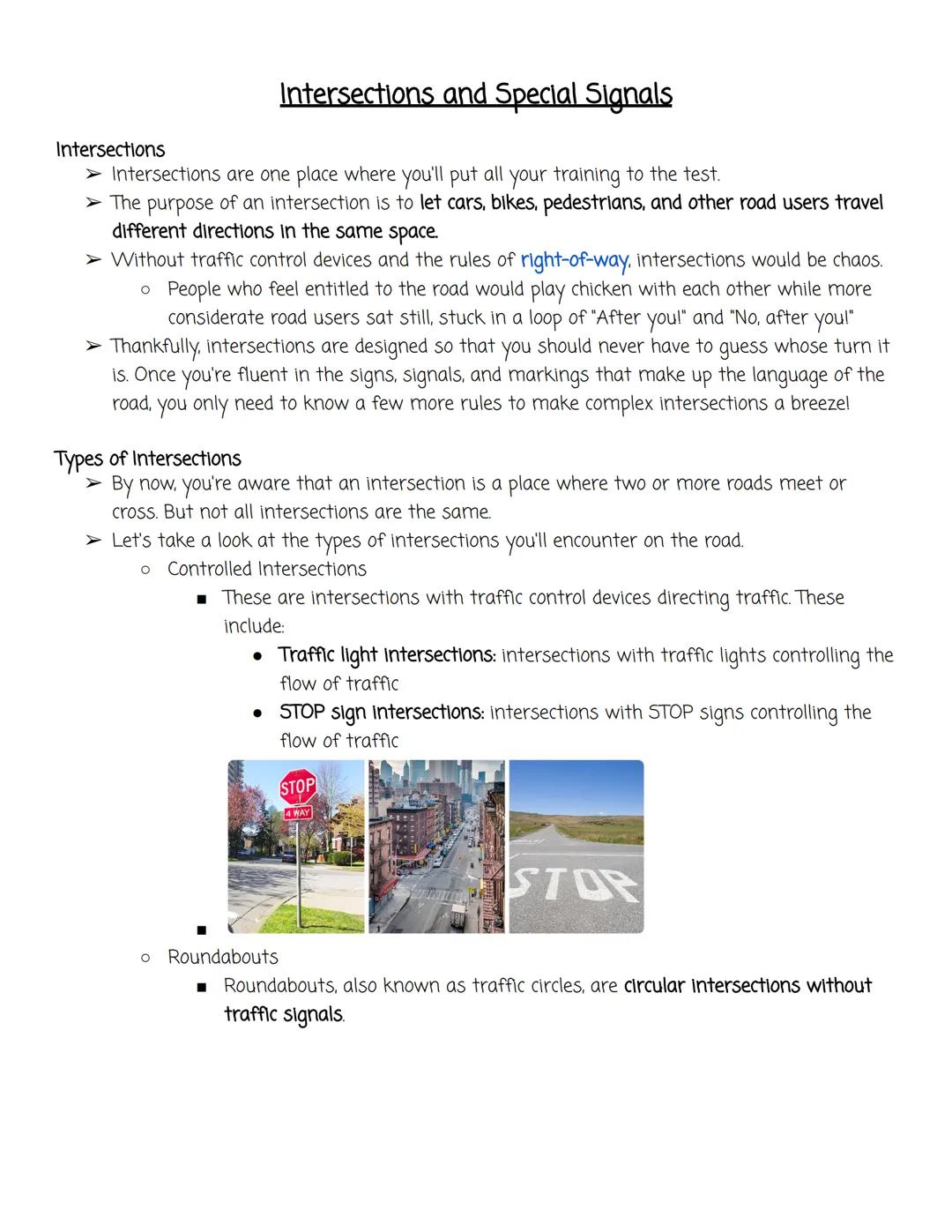
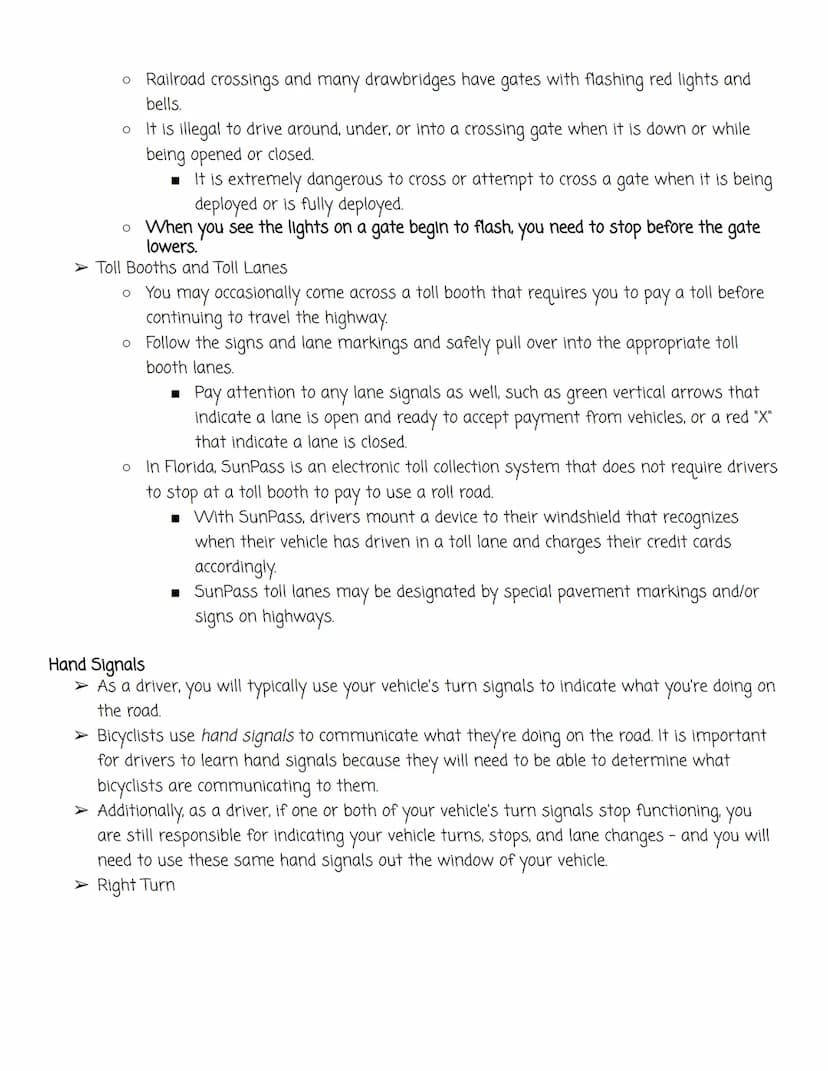
Understanding Intersection Types and Traffic Control
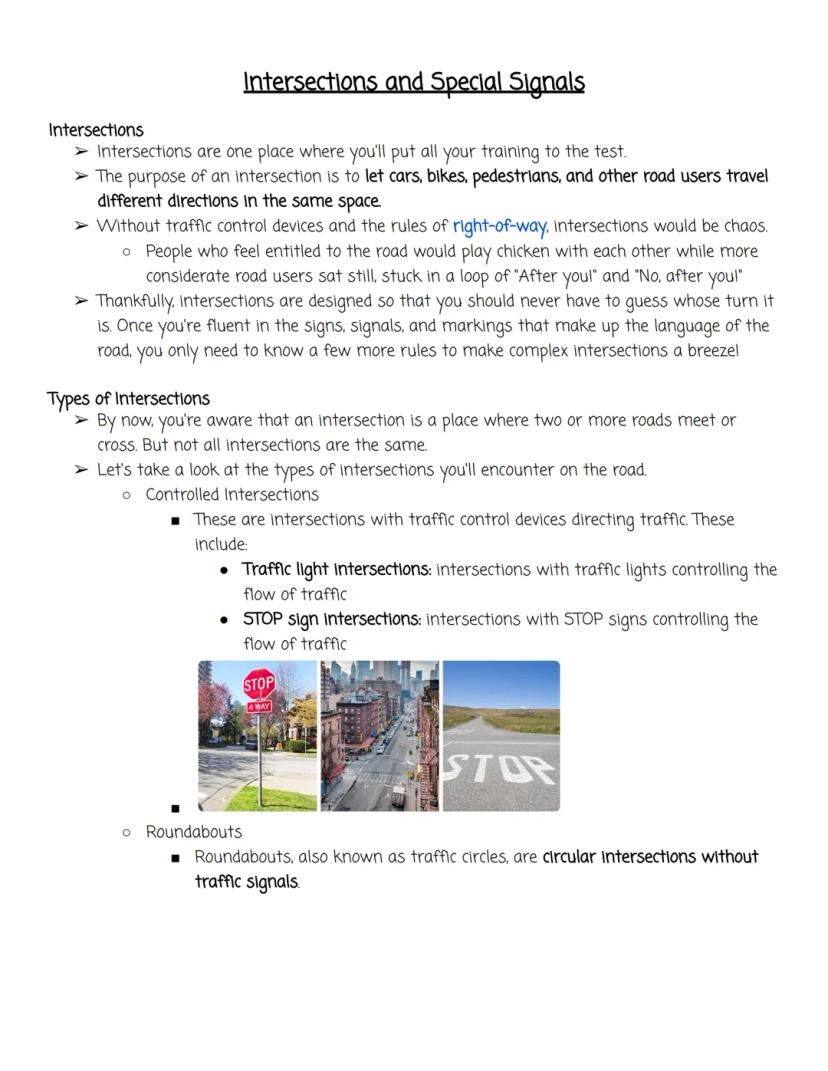
At their core, intersections serve as meeting points where different types of road users converge and navigate shared spaces. Understanding controlled intersections and traffic signals is essential for safe driving. These crucial junctions require careful attention to various traffic control devices that maintain order and prevent chaos.
Definition: Controlled intersections are points where roads meet or cross, managed by traffic signals, signs, or other control devices that direct the flow of traffic.
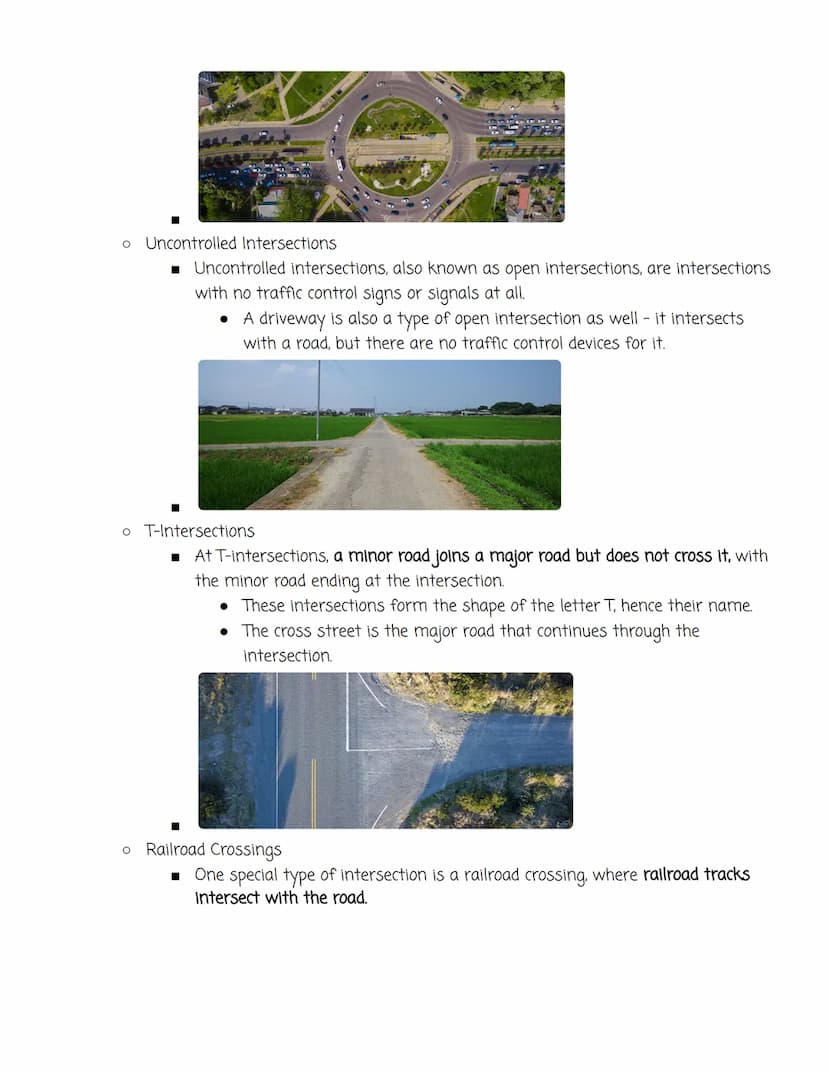
Modern intersections fall into several distinct categories, each with unique characteristics and rules. The most common type is the controlled intersection, featuring traffic lights or STOP signs. The difference between roundabouts and traffic light intersections lies in their flow patterns - while traffic lights create alternating stop-and-go movements, roundabouts promote continuous flow through a circular design.
Highlight: Roundabouts reduce collision severity by eliminating perpendicular crashes and forcing slower speeds through their circular design.
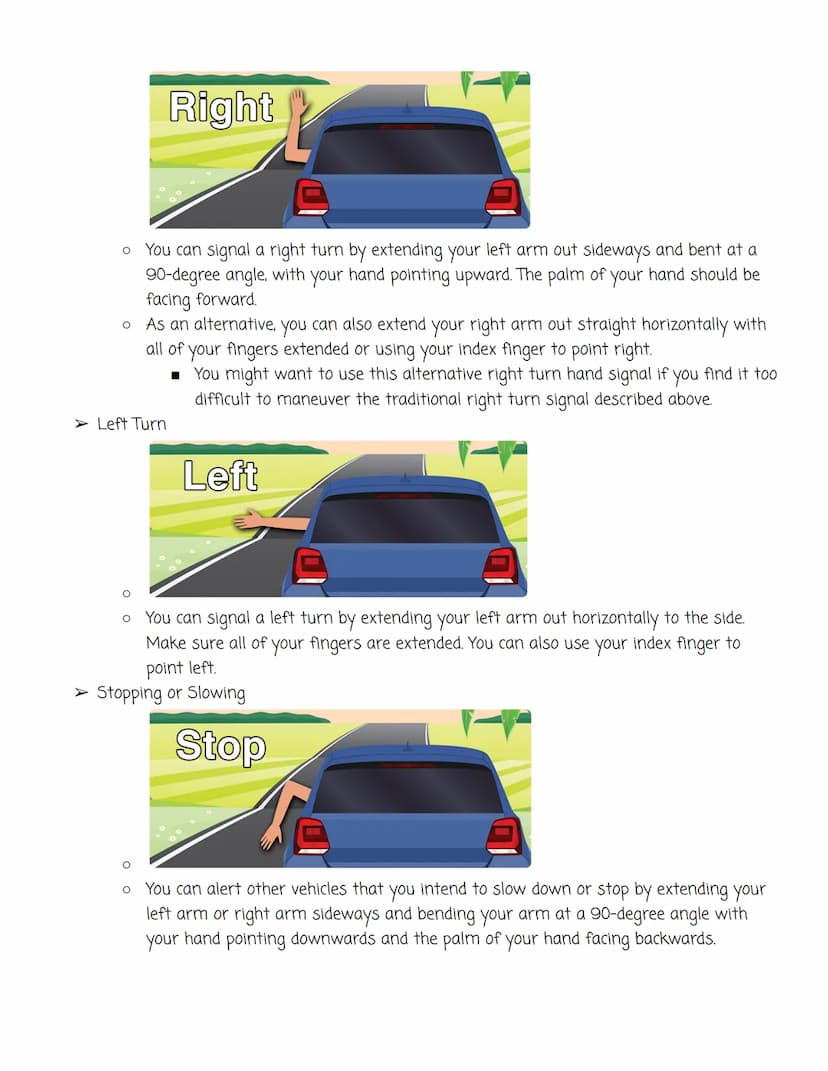
T-intersections represent another common configuration where a minor road terminates at a major road, forming a T-shape. These intersections often incorporate specific traffic control measures based on traffic volume and visibility conditions. Railroad crossings constitute a specialized intersection type requiring extra caution due to the interaction between vehicles and trains.
2
of 10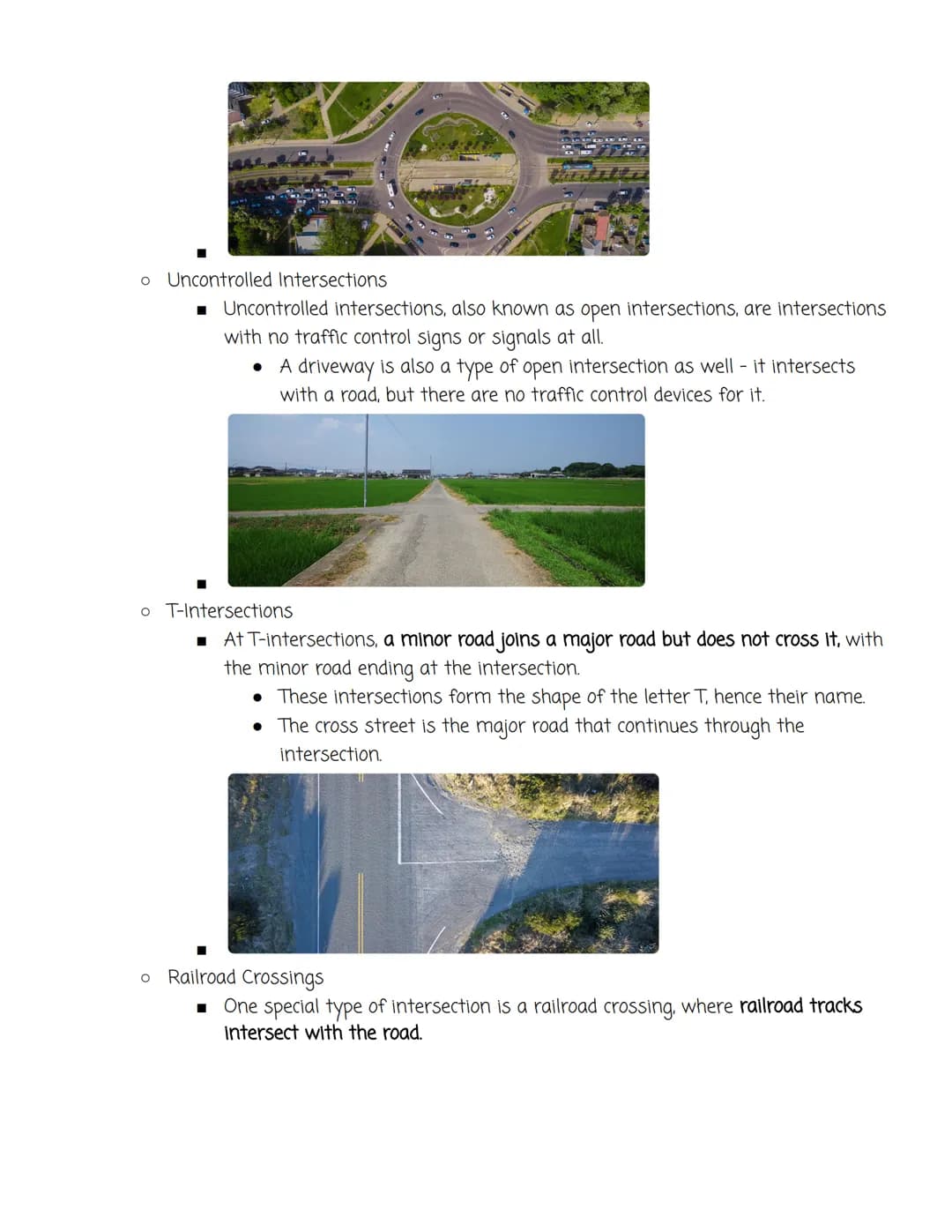
Intersection Markings and Safety Features
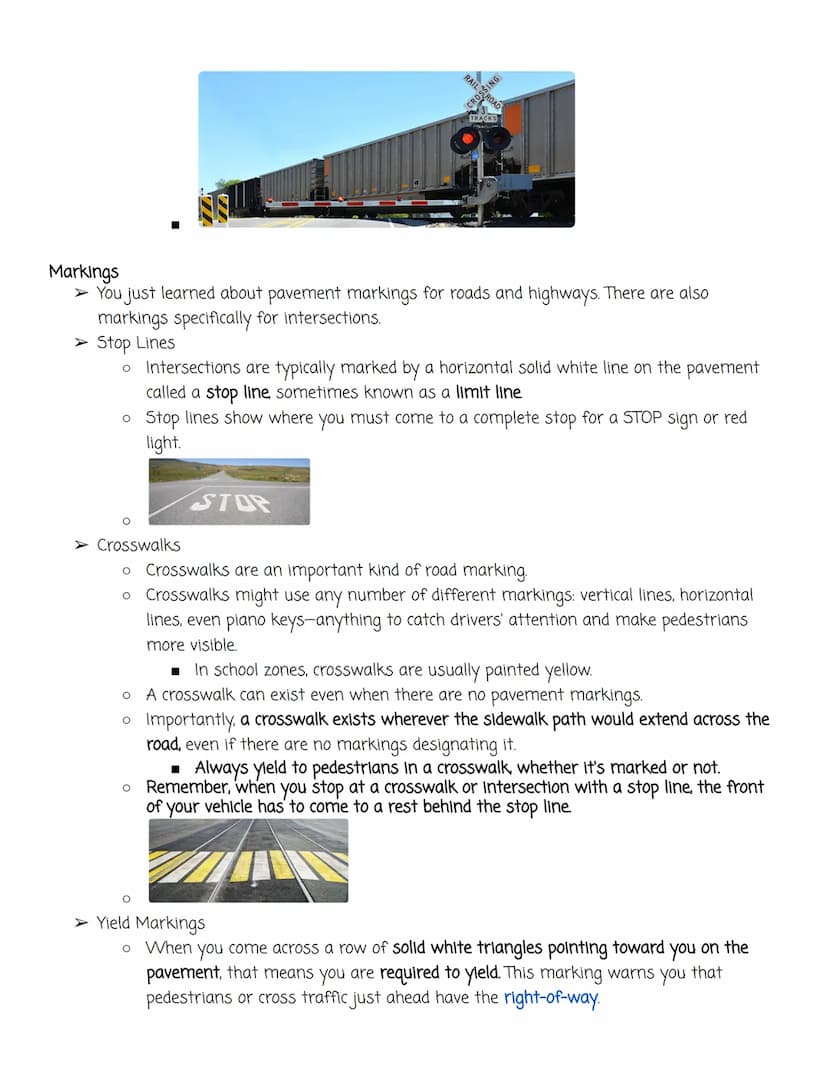
The importance of road markings at intersections cannot be overstated, as these visual guides help direct traffic and enhance safety. Stop lines, crosswalks, and yield markings each serve specific purposes in managing traffic flow and protecting vulnerable road users.
Vocabulary: Stop lines (also called limit lines) are solid white lines indicating where vehicles must come to a complete stop at intersections.
Crosswalks deserve special attention as they exist in both marked and unmarked forms. While marked crosswalks may feature various patterns like zebra stripes or parallel lines, unmarked crosswalks legally exist wherever sidewalks would naturally extend across the road. In school zones, yellow crosswalk markings provide enhanced visibility for added safety.
Yield markings, typically appearing as a row of solid white triangles pointing toward approaching vehicles, signal areas where drivers must give right-of-way to other road users. These markings often appear before crosswalks or at roundabout entries.
3
of 10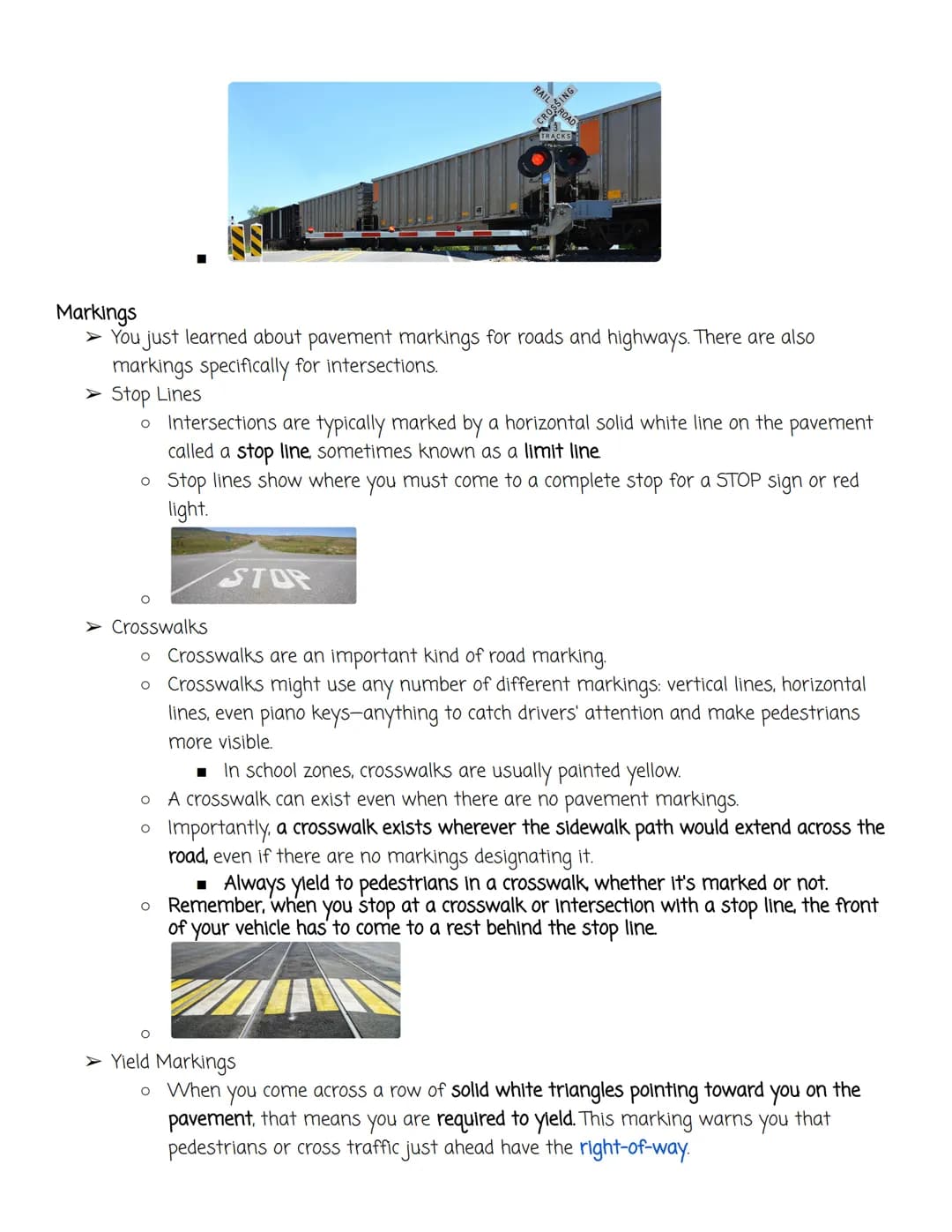
Right-of-Way Rules and Procedures
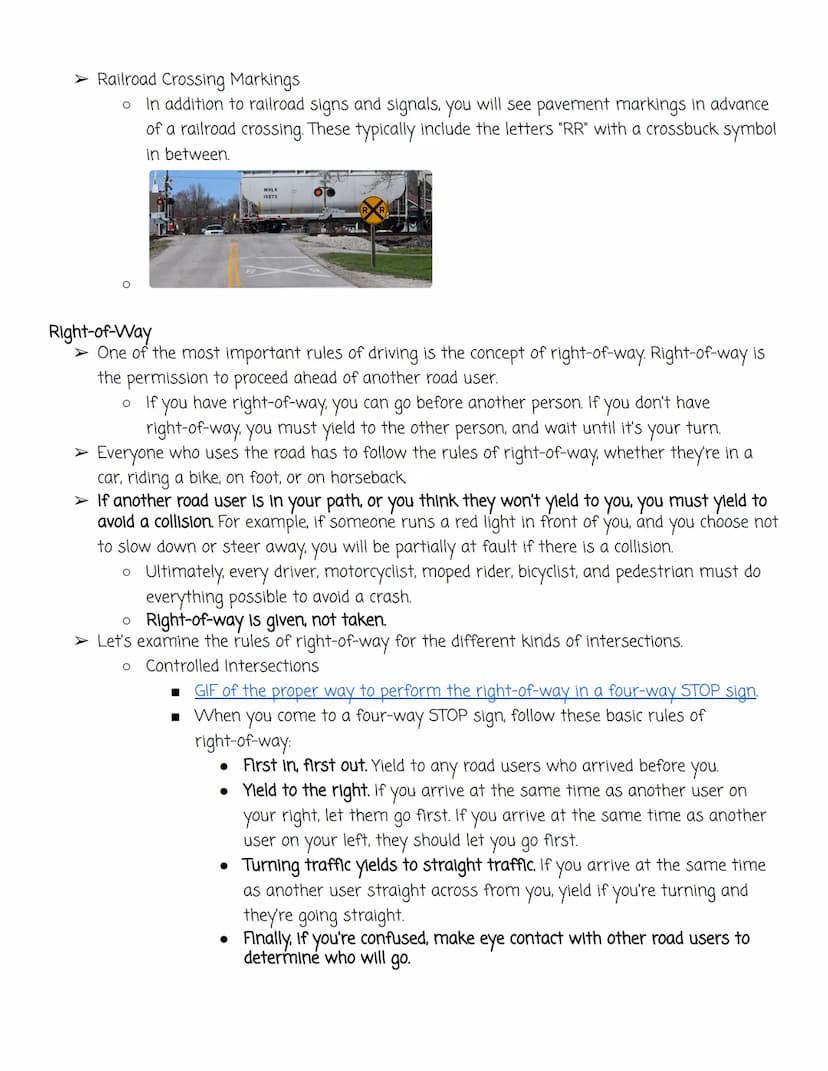
Understanding right-of-way rules is fundamental to safe intersection navigation. These rules establish a clear hierarchy for determining which road user may proceed first in various situations.
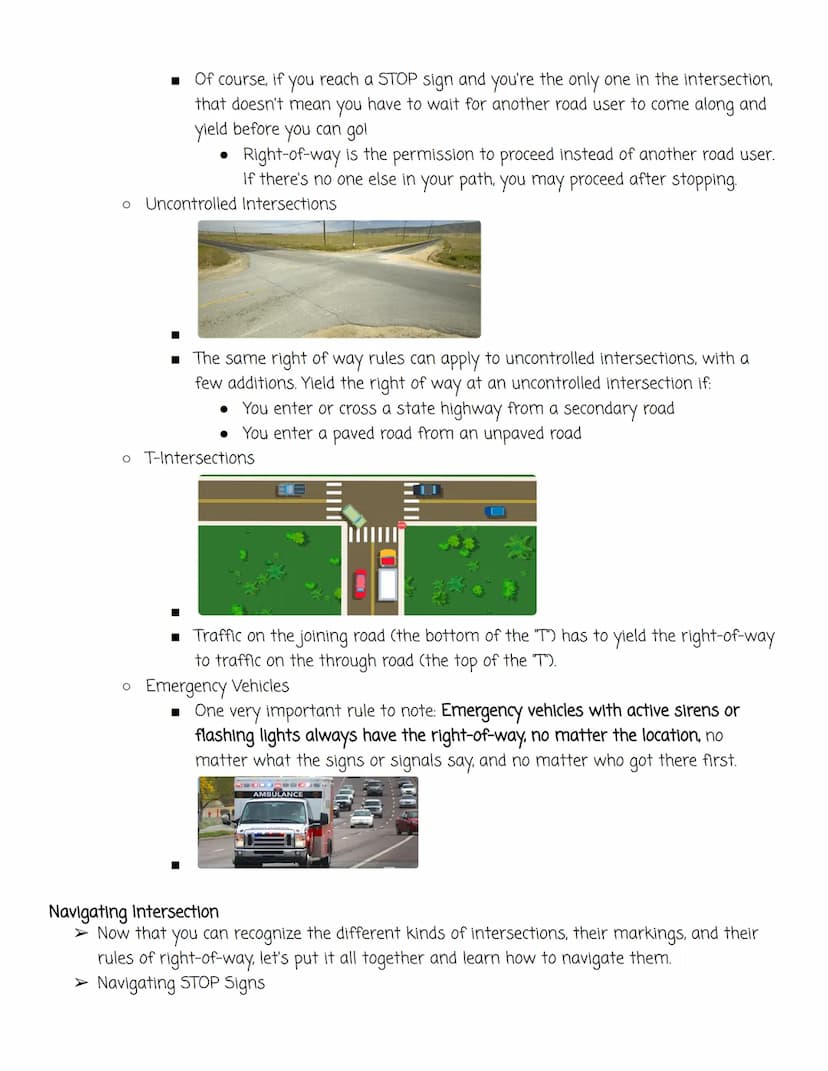
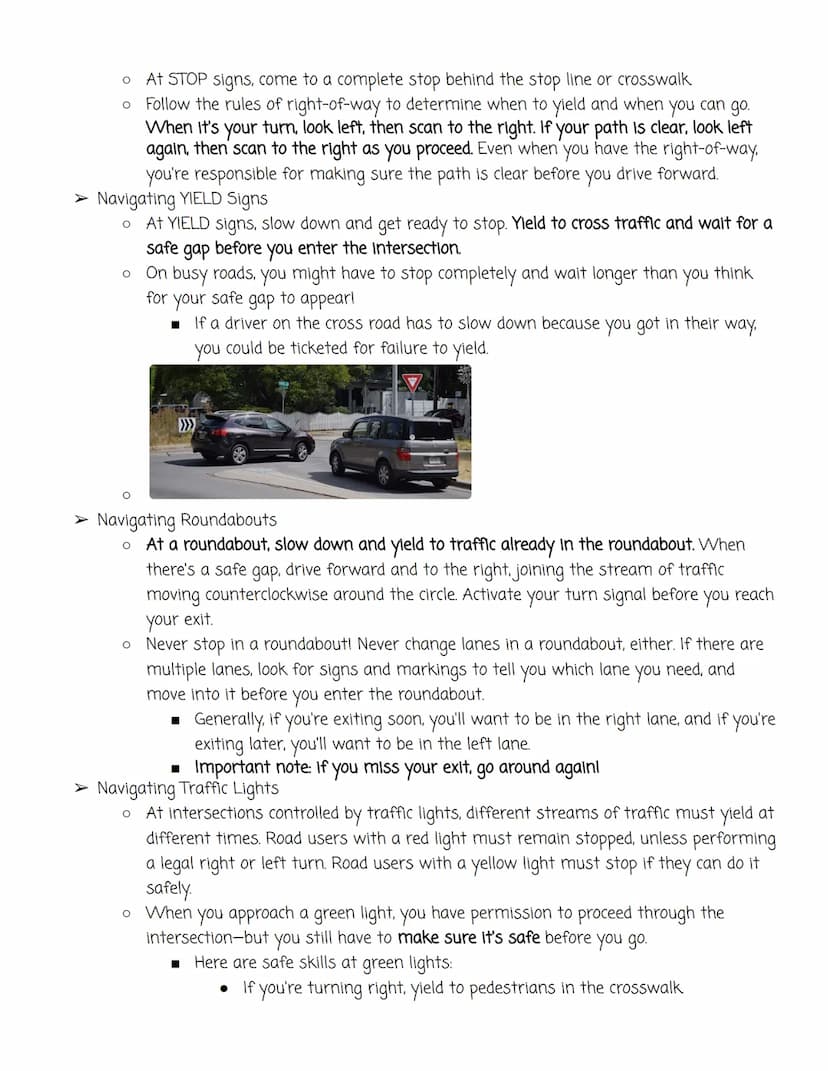
Example: At a four-way stop, drivers follow the "first in, first out" principle. When vehicles arrive simultaneously, the driver on the right has priority.
The concept of right-of-way extends beyond vehicles to include all road users - pedestrians, cyclists, and even equestrians. A crucial principle states that right-of-way is given, not taken, meaning drivers should always be prepared to yield even when they technically have priority.
When approaching controlled intersections, drivers must remain vigilant and prepared to yield regardless of their right-of-way status. This defensive driving approach helps prevent collisions with road users who might not follow proper procedures.
4
of 10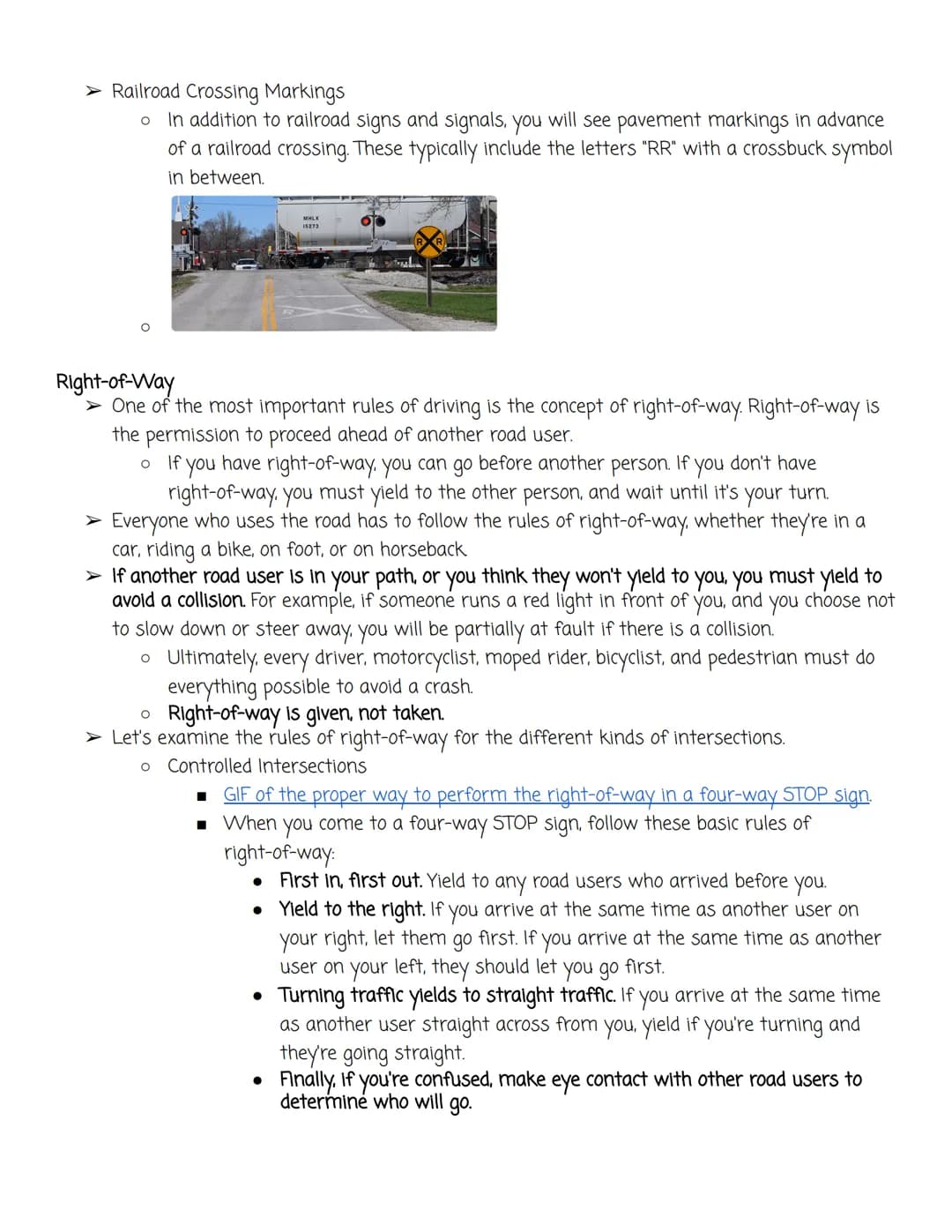
Advanced Intersection Navigation Techniques
Mastering intersection navigation requires understanding both basic rules and nuanced situations. Drivers must develop skills in reading and interpreting various traffic control devices while maintaining awareness of other road users.
Definition: Right-of-way is the legal permission to proceed before other road users, determined by traffic control devices and established rules.
Complex intersections may combine multiple types of traffic control devices and require drivers to process several pieces of information simultaneously. For example, a single intersection might include traffic signals, turn lanes, crosswalks, and bicycle lanes, each with its own set of rules and priorities.
Railroad crossing intersections demand extra attention due to their unique risks. These crossings feature specialized markings, including "RR" pavement markings and crossbuck symbols, along with warning devices like gates, lights, and bells. Drivers must always yield to trains and never attempt to beat them through the crossing.
5
of 10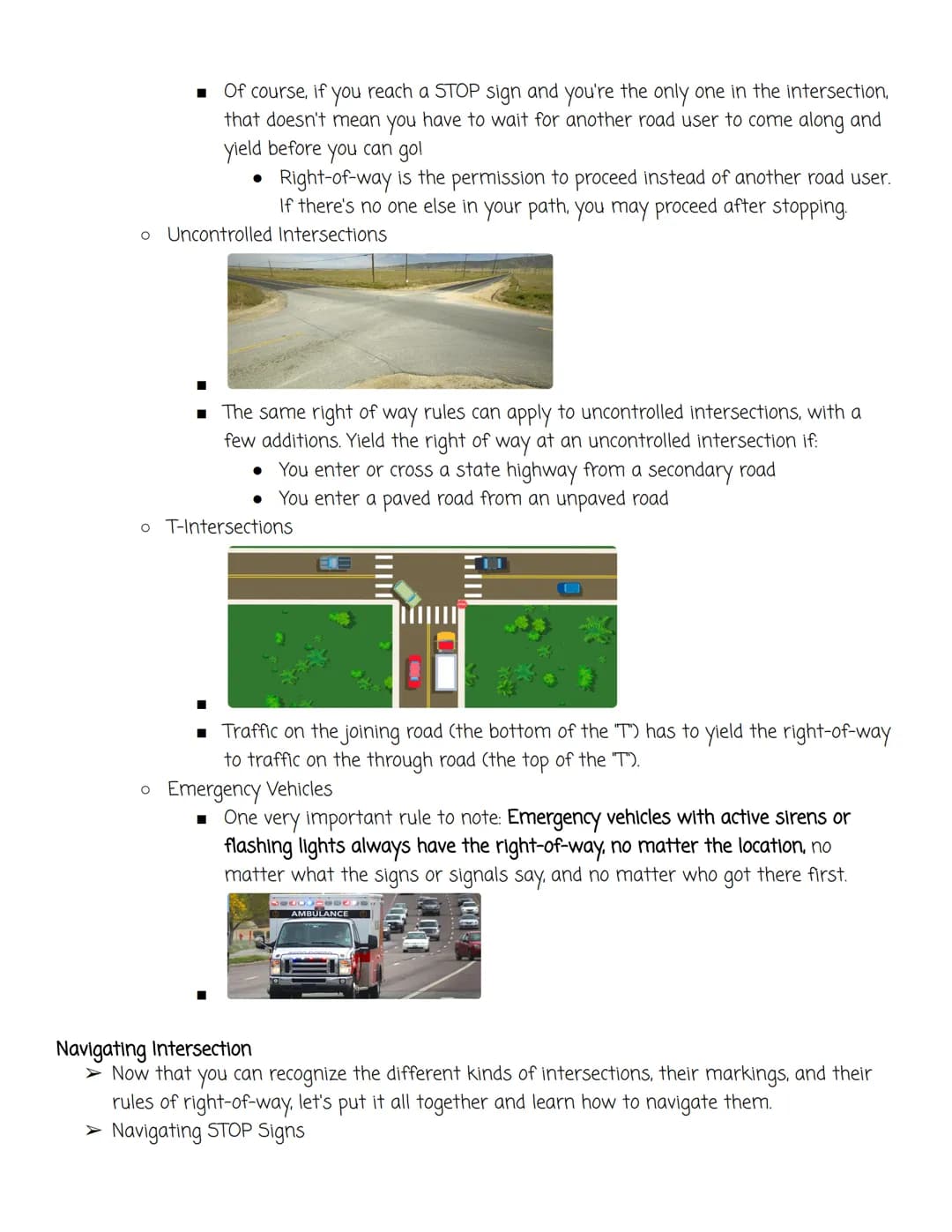
Understanding Intersection Navigation and Right-of-Way Rules
At controlled intersections, understanding right-of-way rules is crucial for safe driving. When you reach a STOP sign, you must come to a complete stop and yield appropriately, even if you're the only vehicle present. Right-of-way gives you permission to proceed before other road users, but safety always comes first.
For uncontrolled intersections, additional rules apply. You must yield when entering a state highway from a secondary road or when moving from an unpaved to a paved road. At T-intersections, vehicles on the joining road (bottom of the "T") must yield to traffic on the through road (top of the "T").
Definition: Right-of-way is the legal permission to proceed through an intersection before other road users.
Emergency vehicles with active sirens or flashing lights always have absolute right-of-way, regardless of signs, signals, or arrival order. This rule supersedes all other traffic regulations to ensure rapid emergency response times.
Highlight: When navigating any intersection, even with right-of-way, always verify your path is clear before proceeding. Look left, then right, then left again before moving forward.
6
of 10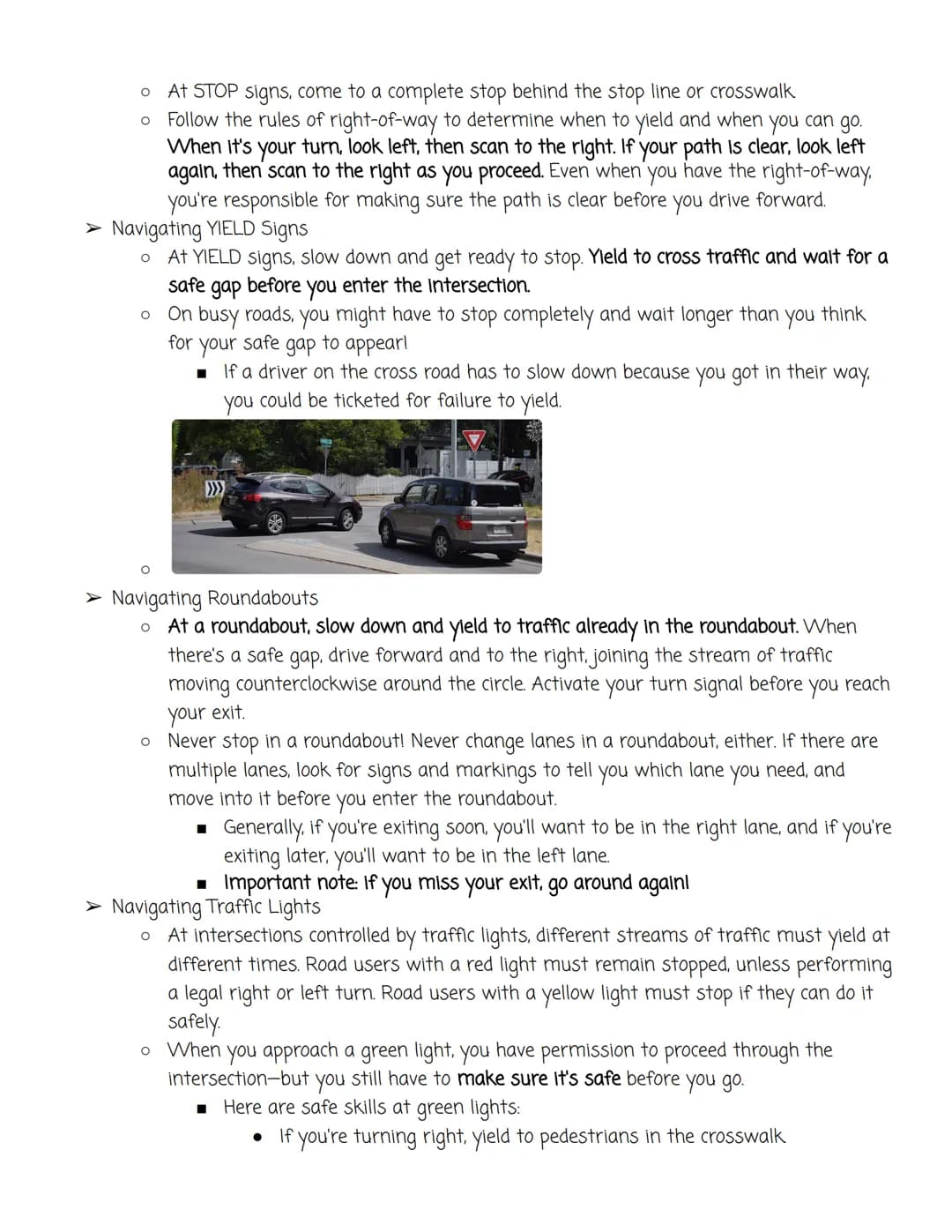
Mastering Different Types of Intersection Controls
The difference between roundabouts and traffic light intersections is significant in terms of traffic flow and safety requirements. At roundabouts, drivers must slow down and yield to traffic already in the circle, moving counterclockwise until reaching their exit. Never stop or change lanes within a roundabout.
Traffic light intersections require different responses based on signal colors. Red means stop unless making a legal turn, yellow requires stopping if safe, and green allows proceeding after ensuring the intersection is clear. When turning right on green, yield to pedestrians; when turning left, yield to oncoming traffic.
Example: In a roundabout, if you miss your exit, continue around the circle again rather than stopping or making sudden lane changes.
The importance of road markings at intersections cannot be overstated. These markings guide proper lane positioning, indicate turn options, and help maintain orderly traffic flow. Pay special attention to stop lines, crosswalks, and lane designation arrows.
7
of 10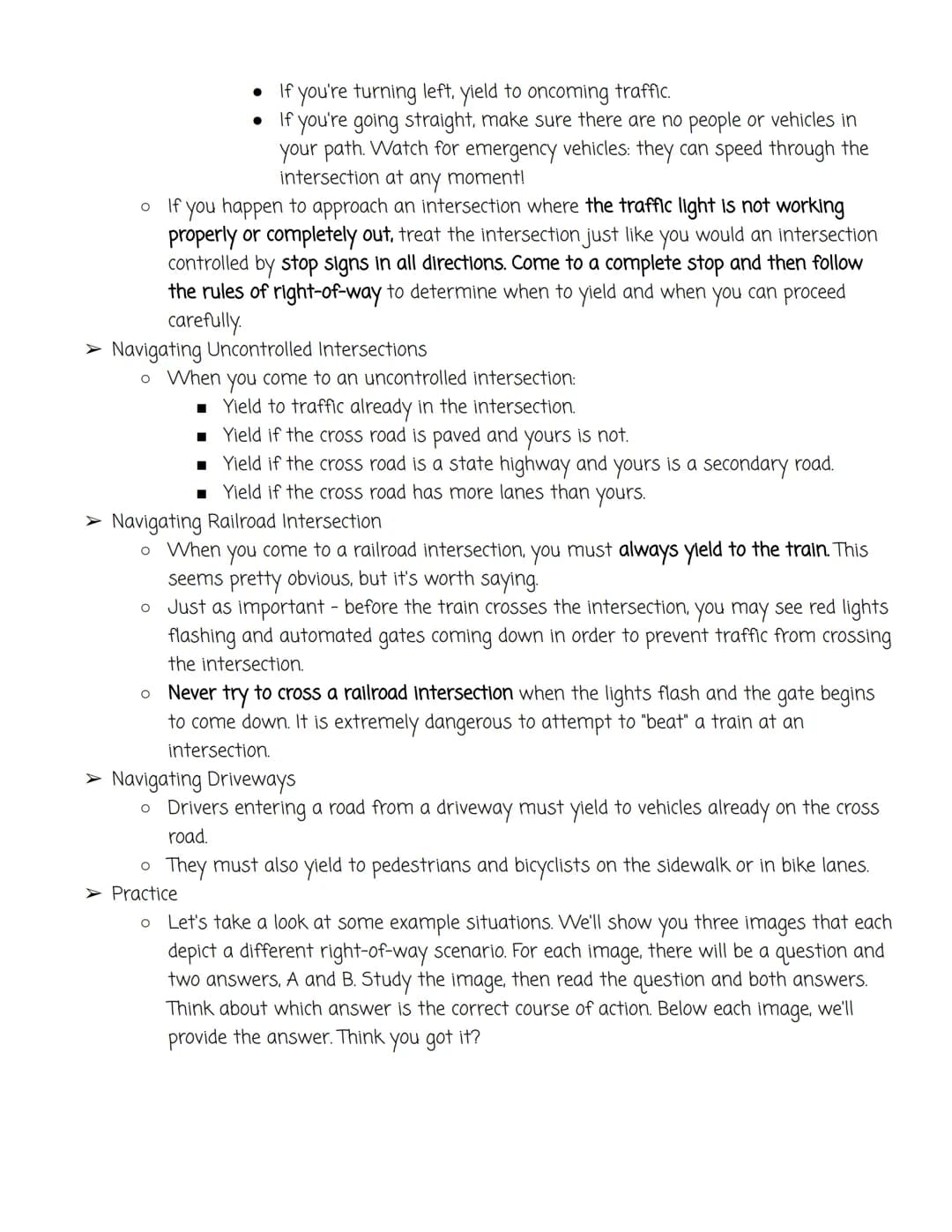
Navigating Special Intersection Types and Railroad Crossings
Railroad intersections demand absolute attention and compliance with safety signals. When approaching railroad crossings, always yield to trains and never attempt to "beat" the gates. Flashing lights and lowering gates indicate an approaching train - stop and wait until the crossing is clear.
For uncontrolled intersections, yield to vehicles already in the intersection, traffic on paved roads when you're on unpaved surfaces, and vehicles on state highways when you're on secondary roads. The number of lanes also affects right-of-way - yield to roads with more lanes than yours.
Vocabulary: Uncontrolled intersections are those without traffic signals or signs regulating right-of-way.
When entering from driveways, drivers must yield to all traffic on the main road, including vehicles, pedestrians, and cyclists. This helps maintain traffic flow and protect vulnerable road users.
8
of 10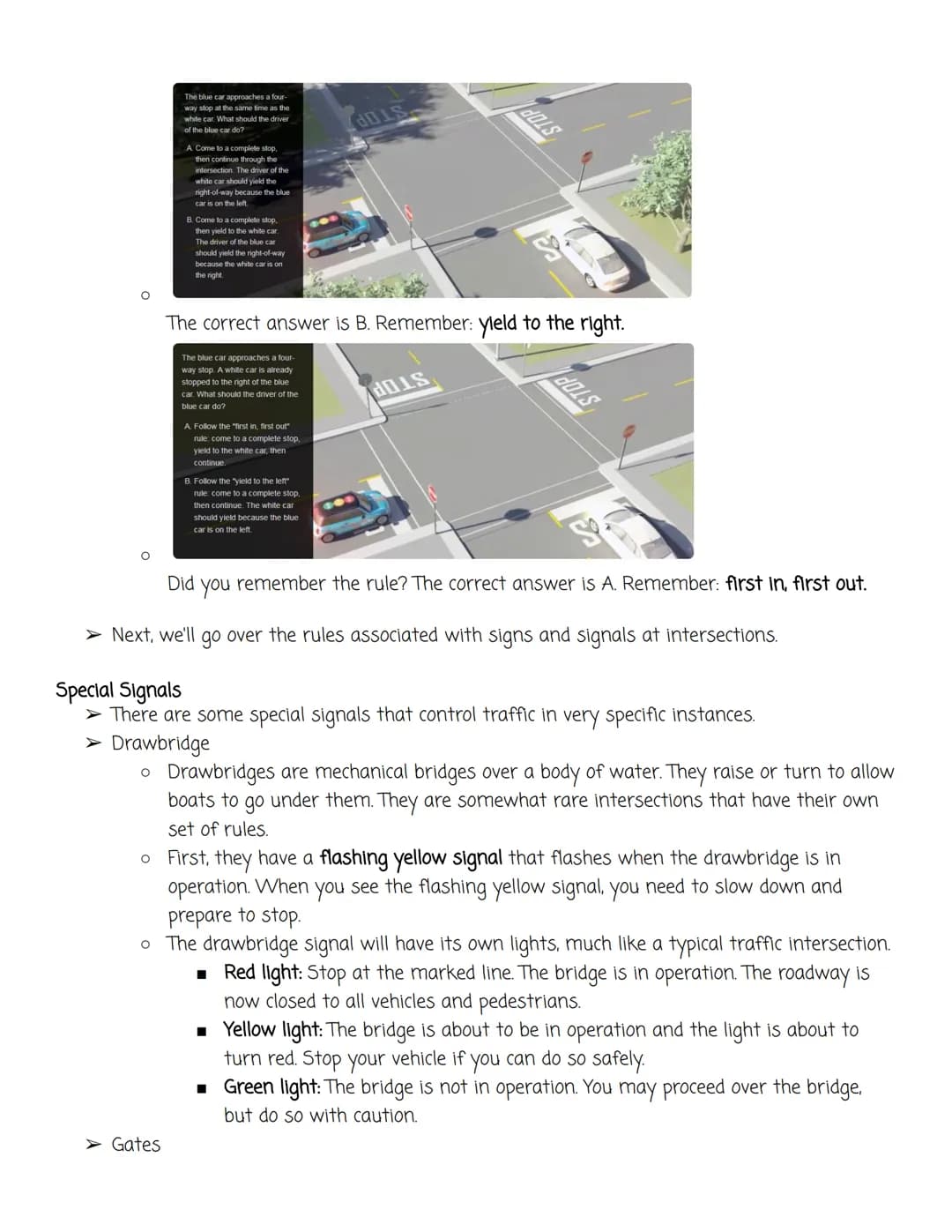
Special Traffic Control Devices and Signals
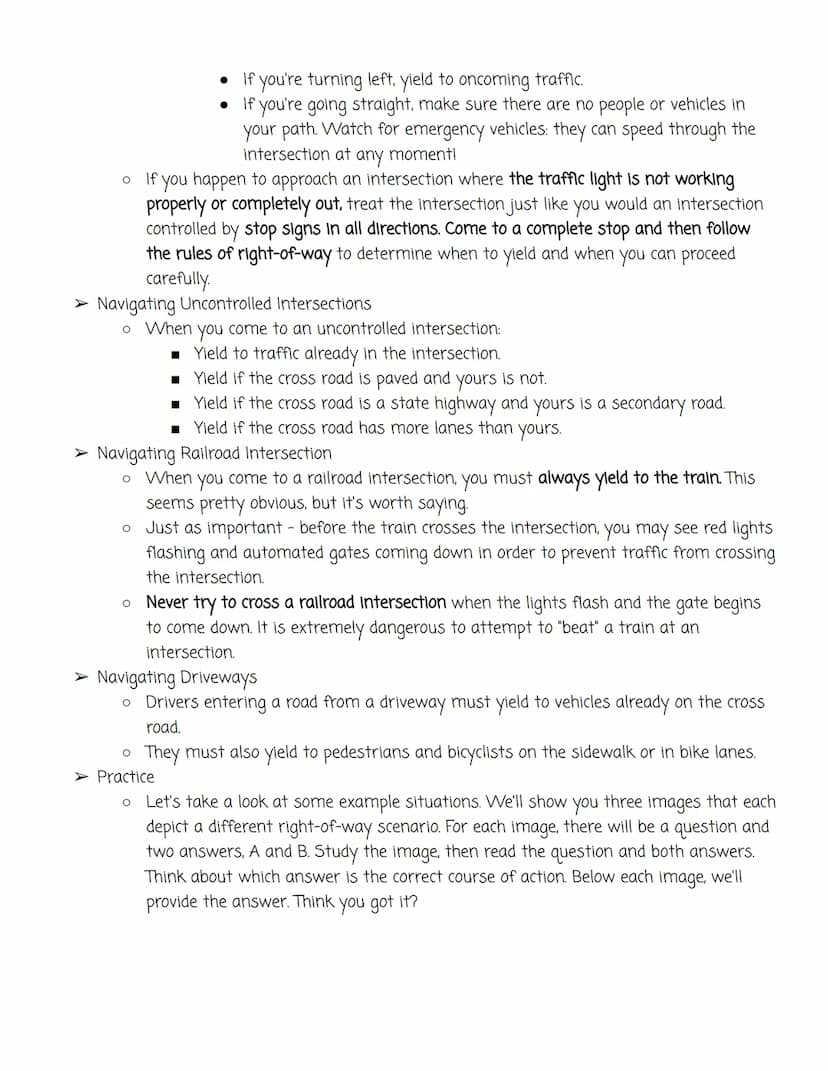
Drawbridges represent unique intersections with specific signal systems. When approaching a drawbridge, watch for flashing yellow signals indicating bridge operation. Red lights require a complete stop, yellow lights warn of imminent closure, and green lights permit careful crossing.
Toll booths and electronic toll collection systems require special attention to lane markings and signals. Watch for green arrows indicating open lanes and red X's showing closed ones. Modern systems like SunPass allow electronic payment without stopping.
Example: At drawbridges, never attempt to cross when gates are moving or fully lowered, regardless of how long you might have to wait.
Hand signals remain important for both cyclists and drivers with malfunctioning turn signals. Understanding these universal signals ensures clear communication between all road users and maintains safe traffic flow.
9
of 10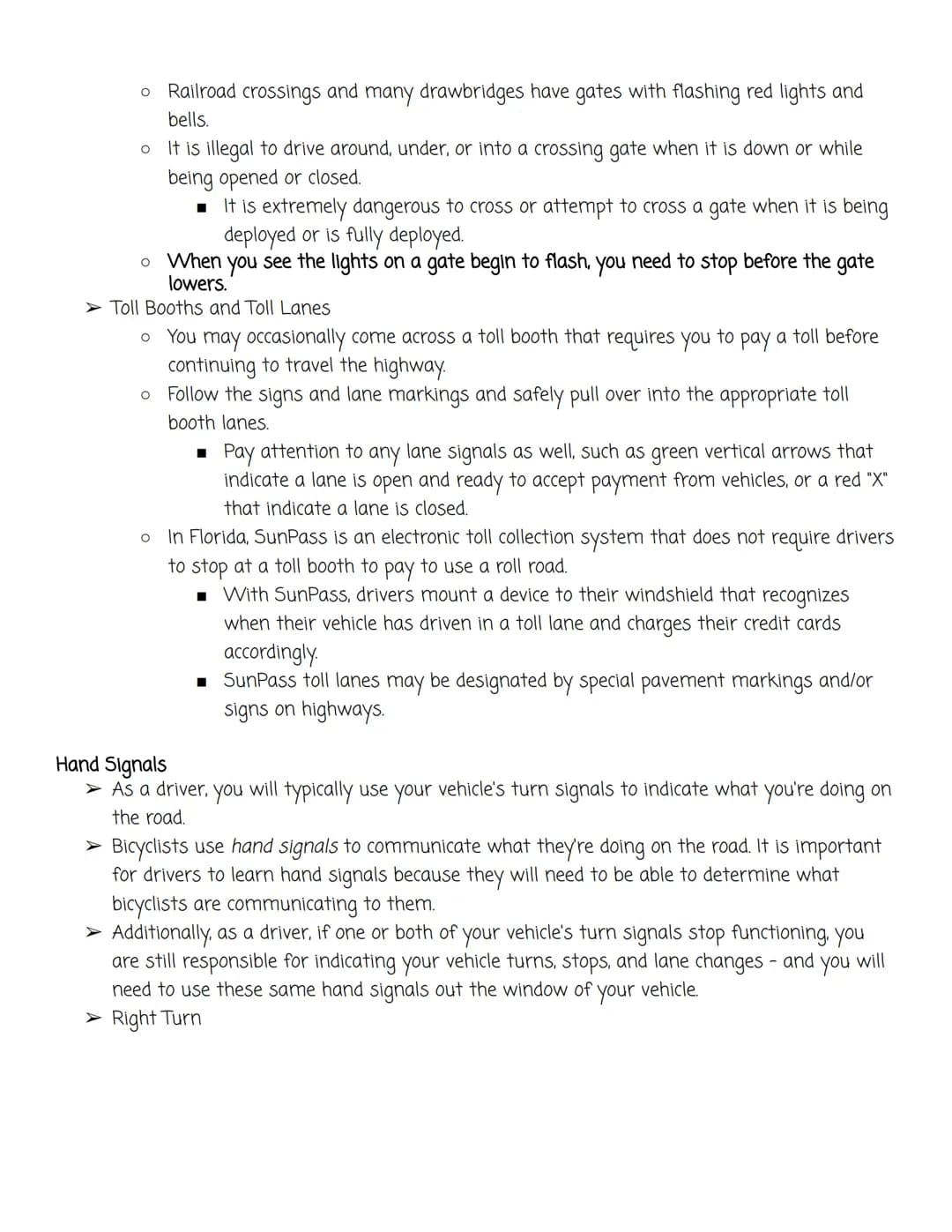
Hand Signals for Safe Cycling: A Complete Guide
Understanding proper hand signals is crucial for cyclists to communicate their intentions to other road users. These standardized signals help maintain safety and predictability on shared roads, especially at controlled intersections and traffic signals. When used correctly, hand signals act as your bicycle's turn signals and brake lights.
Definition: Hand signals are standardized arm movements cyclists use to communicate turning, stopping, or slowing down to other road users.
For right turns, cyclists have two accepted methods. The traditional signal involves extending your left arm sideways with a 90-degree bend at the elbow, pointing your hand upward with palm facing forward. The alternative method, which many find more intuitive, is simply extending your right arm straight out horizontally. Both signals are equally valid, and cyclists can choose the one that feels more comfortable while maintaining balance.
Left turn signals are more straightforward - extend your left arm straight out horizontally from your side. Your fingers can either be fully extended or you can point with your index finger. This clear, unambiguous signal is particularly important at roundabouts and traffic light intersections, where multiple vehicles may be navigating simultaneously.
When slowing down or stopping, cyclists should signal by extending either arm sideways and downward at a 90-degree angle, palm facing backward. This signal is especially important near intersections or when approaching areas with heavy pedestrian traffic. The stopping signal gives following traffic adequate time to react, preventing potential collisions.
Highlight: Always signal well in advance of your intended action, and maintain a firm grip on your handlebars while signaling. Return your hand to the handlebars before executing the turn or stop.
10
of 10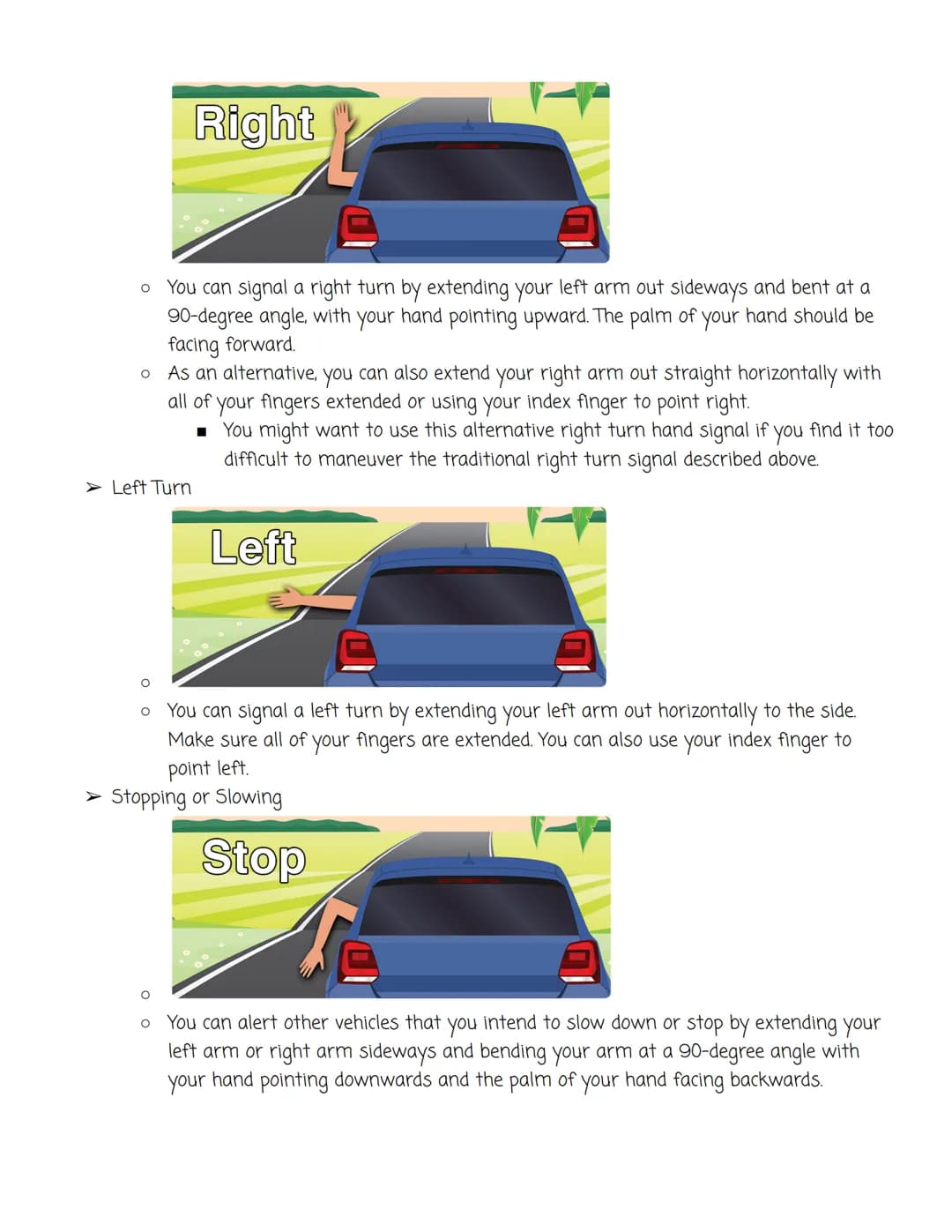
Advanced Intersection Navigation for Cyclists
Mastering intersection navigation requires understanding both hand signals and road positioning. The importance of road markings at intersections cannot be overstated, as they guide cyclists to position themselves correctly for turns and straight-through maneuvers. Proper positioning, combined with clear signaling, helps prevent conflicts with other road users.
When approaching an intersection, scan thoroughly for potential hazards and begin signaling at least 100 feet before your turn. This advanced warning gives other road users time to adjust their speed and position. Pay particular attention to vehicles that might be turning right while you're proceeding straight, as this is a common conflict point.
Example: When making a left turn at a busy intersection, signal early, scan over your left shoulder, and when safe, move gradually toward the center of the lane. Position yourself near the center line while waiting to turn, keeping your signal visible to both approaching and following traffic.
Understanding the relationship between hand signals and lane positioning helps cyclists navigate complex traffic situations safely. For instance, when using the traditional right turn signal (left arm up), you should simultaneously position yourself toward the right side of the lane. This combination of clear signaling and proper positioning leaves no doubt about your intentions.
Vocabulary: "Taking the lane" refers to moving toward the center of the lane to increase visibility and prevent unsafe passing, particularly before turns or when lanes narrow.
We thought you’d never ask...
What is the Knowunity AI companion?
Our AI companion is specifically built for the needs of students. Based on the millions of content pieces we have on the platform we can provide truly meaningful and relevant answers to students. But its not only about answers, the companion is even more about guiding students through their daily learning challenges, with personalised study plans, quizzes or content pieces in the chat and 100% personalisation based on the students skills and developments.
Where can I download the Knowunity app?
You can download the app in the Google Play Store and in the Apple App Store.
Is Knowunity really free of charge?
That's right! Enjoy free access to study content, connect with fellow students, and get instant help – all at your fingertips.
Similar Content
 Other
Other Criminology
 Dance
DanceMost popular content: Driving Skills
2Most popular content in Fun Stuff
9S
Fun StuffSuper Easy Quiz (+)
Are you smarter than a 3rd grader in math? Let’s see.
6th1850
Fun StuffAnatomy and Physiology Chapter 1
Chpater 1 : The orientation of the body / College Level Anatomy and Physiology
82838
Fun Stuff🌈 LGBTQ+ Pride Flags: Context & Symbolism
Use this Know as a quick reference to identify all of the different Pride flags and learn about their context & symbolism
9th36017
Fun StuffALL ABOUT PHILOSOPHY
This document tackles my impression towards "pilosopo" people, what does it mean to love wisdom, implication of face value, and the significance of impartiality.
542
Fun StuffPhilosophy of Education
Notes on chapter 6- philosophy of education for intro to EDUC
10th732
Fun StuffFamily Types
Different family dynamics typical and atypical
210
Fun StuffMicroEconomics
Economics
1406
Fun StuffIntro to Python Pt 1
This is a summary of the basics of python such as variables, print, and if statements.
10th2665
Fun StuffPractice: Languages of Common Signs
Practice quiz on languages of common (road) signs
10th875
Most popular content
9O
 AP US History
Origins and Dynamics of the Columbian Exchange
Analyze the ecological and economic motivations behind the initial transfer of goods, people, and diseases between the Old and New Worlds.
9th3,1280
I
AP US HistoryIntroduction to Early Cultural Interactions
Analyze the initial social and religious encounters between Europeans, Africans, and Indigenous peoples in the colonial Americas.
9th2,7730
O
 AP World History
Origins of Ancient River Civilizations
Analyze the environmental factors and technological innovations that led to the rise of early states in Mesopotamia, Egypt, and the Indus Valley.
9th3,1860
M
AP US HistoryMotivations for European Exploration
Analyze the economic, religious, and political factors that drove European powers to the Americas during the 15th and 16th centuries.
9th1,7780
F
 AP Psychology
Foundations of Ethical Guidelines in Research
Practice the core principles of the APA ethical code including informed consent, debriefing, and the role of Institutional Review Boards.
9th1,3360
I
AP US HistoryIntroduction to Native American Societies
Examine the diverse social, political, and economic structures of North American indigenous groups prior to European contact.
9th1,1100
I
 AP Biology
Introduction to Biological Elements of Life
Practice identifying the essential elements including carbon, nitrogen, phosphorus, and sulfur that compose biological macromolecules.
9th1,7360
I
AP US HistoryIntroduction to the Spanish Encomienda System
Explore the fundamental economic and social structures of the Spanish colonial system, focusing on the encomienda and the casta social hierarchy.
9th8890
O
AP World HistoryOrigins and Continuity of the Byzantine Empire
Analyze the political and cultural transitions from the Roman Empire to the Byzantine Empire, focusing on the reign of Justinian I and his code.
9th1,6320
Can't find what you're looking for? Explore other subjects.
Students love us — and so will you.
4.6/5App Store
4.7/5Google Play
The app is very easy to use and well designed. I have found everything I was looking for so far and have been able to learn a lot from the presentations! I will definitely use the app for a class assignment! And of course it also helps a lot as an inspiration.
Stefan SiOS user
This app is really great. There are so many study notes and help [...]. My problem subject is French, for example, and the app has so many options for help. Thanks to this app, I have improved my French. I would recommend it to anyone.
Samantha KlichAndroid user
Wow, I am really amazed. I just tried the app because I've seen it advertised many times and was absolutely stunned. This app is THE HELP you want for school and above all, it offers so many things, such as workouts and fact sheets, which have been VERY helpful to me personally.
AnnaiOS user
Fun Stuff71 views·Updated May 17, 2026·10 pagesGet to Know Traffic Signals and Intersections: Roundabouts vs. Traffic Lights
Selina@suuhleena
Learning about road safety helps everyone stay safe while traveling.
Understanding controlled intersections and traffic signalsis essential for both drivers and pedestrians. Traffic signals use a standard system of red, yellow, and green lights to control the flow of... Show more
1
of 10Sign up to see the content. It's free!
- Access to all documents
- Improve your grades
- Join milions of students
Understanding Intersection Types and Traffic Control
At their core, intersections serve as meeting points where different types of road users converge and navigate shared spaces. Understanding controlled intersections and traffic signals is essential for safe driving. These crucial junctions require careful attention to various traffic control devices that maintain order and prevent chaos.
Definition: Controlled intersections are points where roads meet or cross, managed by traffic signals, signs, or other control devices that direct the flow of traffic.
Modern intersections fall into several distinct categories, each with unique characteristics and rules. The most common type is the controlled intersection, featuring traffic lights or STOP signs. The difference between roundabouts and traffic light intersections lies in their flow patterns - while traffic lights create alternating stop-and-go movements, roundabouts promote continuous flow through a circular design.
Highlight: Roundabouts reduce collision severity by eliminating perpendicular crashes and forcing slower speeds through their circular design.
T-intersections represent another common configuration where a minor road terminates at a major road, forming a T-shape. These intersections often incorporate specific traffic control measures based on traffic volume and visibility conditions. Railroad crossings constitute a specialized intersection type requiring extra caution due to the interaction between vehicles and trains.
2
of 10Sign up to see the content. It's free!
- Access to all documents
- Improve your grades
- Join milions of students
Intersection Markings and Safety Features
The importance of road markings at intersections cannot be overstated, as these visual guides help direct traffic and enhance safety. Stop lines, crosswalks, and yield markings each serve specific purposes in managing traffic flow and protecting vulnerable road users.
Vocabulary: Stop lines (also called limit lines) are solid white lines indicating where vehicles must come to a complete stop at intersections.
Crosswalks deserve special attention as they exist in both marked and unmarked forms. While marked crosswalks may feature various patterns like zebra stripes or parallel lines, unmarked crosswalks legally exist wherever sidewalks would naturally extend across the road. In school zones, yellow crosswalk markings provide enhanced visibility for added safety.
Yield markings, typically appearing as a row of solid white triangles pointing toward approaching vehicles, signal areas where drivers must give right-of-way to other road users. These markings often appear before crosswalks or at roundabout entries.
3
of 10Sign up to see the content. It's free!
- Access to all documents
- Improve your grades
- Join milions of students
Right-of-Way Rules and Procedures
Understanding right-of-way rules is fundamental to safe intersection navigation. These rules establish a clear hierarchy for determining which road user may proceed first in various situations.
Example: At a four-way stop, drivers follow the "first in, first out" principle. When vehicles arrive simultaneously, the driver on the right has priority.
The concept of right-of-way extends beyond vehicles to include all road users - pedestrians, cyclists, and even equestrians. A crucial principle states that right-of-way is given, not taken, meaning drivers should always be prepared to yield even when they technically have priority.
When approaching controlled intersections, drivers must remain vigilant and prepared to yield regardless of their right-of-way status. This defensive driving approach helps prevent collisions with road users who might not follow proper procedures.
4
of 10Sign up to see the content. It's free!
- Access to all documents
- Improve your grades
- Join milions of students
Advanced Intersection Navigation Techniques
Mastering intersection navigation requires understanding both basic rules and nuanced situations. Drivers must develop skills in reading and interpreting various traffic control devices while maintaining awareness of other road users.
Definition: Right-of-way is the legal permission to proceed before other road users, determined by traffic control devices and established rules.
Complex intersections may combine multiple types of traffic control devices and require drivers to process several pieces of information simultaneously. For example, a single intersection might include traffic signals, turn lanes, crosswalks, and bicycle lanes, each with its own set of rules and priorities.
Railroad crossing intersections demand extra attention due to their unique risks. These crossings feature specialized markings, including "RR" pavement markings and crossbuck symbols, along with warning devices like gates, lights, and bells. Drivers must always yield to trains and never attempt to beat them through the crossing.
5
of 10Sign up to see the content. It's free!
- Access to all documents
- Improve your grades
- Join milions of students
Understanding Intersection Navigation and Right-of-Way Rules
At controlled intersections, understanding right-of-way rules is crucial for safe driving. When you reach a STOP sign, you must come to a complete stop and yield appropriately, even if you're the only vehicle present. Right-of-way gives you permission to proceed before other road users, but safety always comes first.
For uncontrolled intersections, additional rules apply. You must yield when entering a state highway from a secondary road or when moving from an unpaved to a paved road. At T-intersections, vehicles on the joining road (bottom of the "T") must yield to traffic on the through road (top of the "T").
Definition: Right-of-way is the legal permission to proceed through an intersection before other road users.
Emergency vehicles with active sirens or flashing lights always have absolute right-of-way, regardless of signs, signals, or arrival order. This rule supersedes all other traffic regulations to ensure rapid emergency response times.
Highlight: When navigating any intersection, even with right-of-way, always verify your path is clear before proceeding. Look left, then right, then left again before moving forward.
6
of 10Sign up to see the content. It's free!
- Access to all documents
- Improve your grades
- Join milions of students
Mastering Different Types of Intersection Controls
The difference between roundabouts and traffic light intersections is significant in terms of traffic flow and safety requirements. At roundabouts, drivers must slow down and yield to traffic already in the circle, moving counterclockwise until reaching their exit. Never stop or change lanes within a roundabout.
Traffic light intersections require different responses based on signal colors. Red means stop unless making a legal turn, yellow requires stopping if safe, and green allows proceeding after ensuring the intersection is clear. When turning right on green, yield to pedestrians; when turning left, yield to oncoming traffic.
Example: In a roundabout, if you miss your exit, continue around the circle again rather than stopping or making sudden lane changes.
The importance of road markings at intersections cannot be overstated. These markings guide proper lane positioning, indicate turn options, and help maintain orderly traffic flow. Pay special attention to stop lines, crosswalks, and lane designation arrows.
7
of 10Sign up to see the content. It's free!
- Access to all documents
- Improve your grades
- Join milions of students
Navigating Special Intersection Types and Railroad Crossings
Railroad intersections demand absolute attention and compliance with safety signals. When approaching railroad crossings, always yield to trains and never attempt to "beat" the gates. Flashing lights and lowering gates indicate an approaching train - stop and wait until the crossing is clear.
For uncontrolled intersections, yield to vehicles already in the intersection, traffic on paved roads when you're on unpaved surfaces, and vehicles on state highways when you're on secondary roads. The number of lanes also affects right-of-way - yield to roads with more lanes than yours.
Vocabulary: Uncontrolled intersections are those without traffic signals or signs regulating right-of-way.
When entering from driveways, drivers must yield to all traffic on the main road, including vehicles, pedestrians, and cyclists. This helps maintain traffic flow and protect vulnerable road users.
8
of 10Sign up to see the content. It's free!
- Access to all documents
- Improve your grades
- Join milions of students
Special Traffic Control Devices and Signals
Drawbridges represent unique intersections with specific signal systems. When approaching a drawbridge, watch for flashing yellow signals indicating bridge operation. Red lights require a complete stop, yellow lights warn of imminent closure, and green lights permit careful crossing.
Toll booths and electronic toll collection systems require special attention to lane markings and signals. Watch for green arrows indicating open lanes and red X's showing closed ones. Modern systems like SunPass allow electronic payment without stopping.
Example: At drawbridges, never attempt to cross when gates are moving or fully lowered, regardless of how long you might have to wait.
Hand signals remain important for both cyclists and drivers with malfunctioning turn signals. Understanding these universal signals ensures clear communication between all road users and maintains safe traffic flow.
9
of 10Sign up to see the content. It's free!
- Access to all documents
- Improve your grades
- Join milions of students
Hand Signals for Safe Cycling: A Complete Guide
Understanding proper hand signals is crucial for cyclists to communicate their intentions to other road users. These standardized signals help maintain safety and predictability on shared roads, especially at controlled intersections and traffic signals. When used correctly, hand signals act as your bicycle's turn signals and brake lights.
Definition: Hand signals are standardized arm movements cyclists use to communicate turning, stopping, or slowing down to other road users.
For right turns, cyclists have two accepted methods. The traditional signal involves extending your left arm sideways with a 90-degree bend at the elbow, pointing your hand upward with palm facing forward. The alternative method, which many find more intuitive, is simply extending your right arm straight out horizontally. Both signals are equally valid, and cyclists can choose the one that feels more comfortable while maintaining balance.
Left turn signals are more straightforward - extend your left arm straight out horizontally from your side. Your fingers can either be fully extended or you can point with your index finger. This clear, unambiguous signal is particularly important at roundabouts and traffic light intersections, where multiple vehicles may be navigating simultaneously.
When slowing down or stopping, cyclists should signal by extending either arm sideways and downward at a 90-degree angle, palm facing backward. This signal is especially important near intersections or when approaching areas with heavy pedestrian traffic. The stopping signal gives following traffic adequate time to react, preventing potential collisions.
Highlight: Always signal well in advance of your intended action, and maintain a firm grip on your handlebars while signaling. Return your hand to the handlebars before executing the turn or stop.
10
of 10Sign up to see the content. It's free!
- Access to all documents
- Improve your grades
- Join milions of students
Advanced Intersection Navigation for Cyclists
Mastering intersection navigation requires understanding both hand signals and road positioning. The importance of road markings at intersections cannot be overstated, as they guide cyclists to position themselves correctly for turns and straight-through maneuvers. Proper positioning, combined with clear signaling, helps prevent conflicts with other road users.
When approaching an intersection, scan thoroughly for potential hazards and begin signaling at least 100 feet before your turn. This advanced warning gives other road users time to adjust their speed and position. Pay particular attention to vehicles that might be turning right while you're proceeding straight, as this is a common conflict point.
Example: When making a left turn at a busy intersection, signal early, scan over your left shoulder, and when safe, move gradually toward the center of the lane. Position yourself near the center line while waiting to turn, keeping your signal visible to both approaching and following traffic.
Understanding the relationship between hand signals and lane positioning helps cyclists navigate complex traffic situations safely. For instance, when using the traditional right turn signal (left arm up), you should simultaneously position yourself toward the right side of the lane. This combination of clear signaling and proper positioning leaves no doubt about your intentions.
Vocabulary: "Taking the lane" refers to moving toward the center of the lane to increase visibility and prevent unsafe passing, particularly before turns or when lanes narrow.
We thought you’d never ask...
What is the Knowunity AI companion?
Our AI companion is specifically built for the needs of students. Based on the millions of content pieces we have on the platform we can provide truly meaningful and relevant answers to students. But its not only about answers, the companion is even more about guiding students through their daily learning challenges, with personalised study plans, quizzes or content pieces in the chat and 100% personalisation based on the students skills and developments.
Where can I download the Knowunity app?
You can download the app in the Google Play Store and in the Apple App Store.
Is Knowunity really free of charge?
That's right! Enjoy free access to study content, connect with fellow students, and get instant help – all at your fingertips.
Similar Content
Most popular content: Driving Skills
2Most popular content in Fun Stuff
9S
Fun StuffSuper Easy Quiz (+)
Are you smarter than a 3rd grader in math? Let’s see.
6th1850
Fun StuffAnatomy and Physiology Chapter 1
Chpater 1 : The orientation of the body / College Level Anatomy and Physiology
82838
Fun Stuff🌈 LGBTQ+ Pride Flags: Context & Symbolism
Use this Know as a quick reference to identify all of the different Pride flags and learn about their context & symbolism
9th36017
Fun StuffALL ABOUT PHILOSOPHY
This document tackles my impression towards "pilosopo" people, what does it mean to love wisdom, implication of face value, and the significance of impartiality.
542
Fun StuffPhilosophy of Education
Notes on chapter 6- philosophy of education for intro to EDUC
10th732
Fun StuffFamily Types
Different family dynamics typical and atypical
210
Fun StuffMicroEconomics
Economics
1406
Fun StuffIntro to Python Pt 1
This is a summary of the basics of python such as variables, print, and if statements.
10th2665
Fun StuffPractice: Languages of Common Signs
Practice quiz on languages of common (road) signs
10th875
Most popular content
9O
AP US HistoryOrigins and Dynamics of the Columbian Exchange
Analyze the ecological and economic motivations behind the initial transfer of goods, people, and diseases between the Old and New Worlds.
9th3,1280
I
AP US HistoryIntroduction to Early Cultural Interactions
Analyze the initial social and religious encounters between Europeans, Africans, and Indigenous peoples in the colonial Americas.
9th2,7730
O
AP World HistoryOrigins of Ancient River Civilizations
Analyze the environmental factors and technological innovations that led to the rise of early states in Mesopotamia, Egypt, and the Indus Valley.
9th3,1860
M
AP US HistoryMotivations for European Exploration
Analyze the economic, religious, and political factors that drove European powers to the Americas during the 15th and 16th centuries.
9th1,7780
F
AP PsychologyFoundations of Ethical Guidelines in Research
Practice the core principles of the APA ethical code including informed consent, debriefing, and the role of Institutional Review Boards.
9th1,3360
I
AP US HistoryIntroduction to Native American Societies
Examine the diverse social, political, and economic structures of North American indigenous groups prior to European contact.
9th1,1100
I
AP BiologyIntroduction to Biological Elements of Life
Practice identifying the essential elements including carbon, nitrogen, phosphorus, and sulfur that compose biological macromolecules.
9th1,7360
I
AP US HistoryIntroduction to the Spanish Encomienda System
Explore the fundamental economic and social structures of the Spanish colonial system, focusing on the encomienda and the casta social hierarchy.
9th8890
O
AP World HistoryOrigins and Continuity of the Byzantine Empire
Analyze the political and cultural transitions from the Roman Empire to the Byzantine Empire, focusing on the reign of Justinian I and his code.
9th1,6320
Can't find what you're looking for? Explore other subjects.
Students love us — and so will you.
4.6/5App Store
4.7/5Google Play
The app is very easy to use and well designed. I have found everything I was looking for so far and have been able to learn a lot from the presentations! I will definitely use the app for a class assignment! And of course it also helps a lot as an inspiration.
Stefan SiOS user
This app is really great. There are so many study notes and help [...]. My problem subject is French, for example, and the app has so many options for help. Thanks to this app, I have improved my French. I would recommend it to anyone.
Samantha KlichAndroid user
Wow, I am really amazed. I just tried the app because I've seen it advertised many times and was absolutely stunned. This app is THE HELP you want for school and above all, it offers so many things, such as workouts and fact sheets, which have been VERY helpful to me personally.
AnnaiOS user