
PTSD and trauma-related disorders represent complex mental health conditions requiring... Show more
 Algebra
Sign up to see the contentIt's free!
Access to all documents
Improve your grades
Join milions of students
Knowunity AI
Subjects
Triangle Congruence and Similarity Theorems
Triangle Properties and Classification
Linear Equations and Graphs
Geometric Angle Relationships
Trigonometric Functions and Identities
Equation Solving Techniques
Circle Geometry Fundamentals
Division Operations and Methods
Basic Differentiation Rules
Exponent and Logarithm Properties
Show all topics
Human Organ Systems
Reproductive Cell Cycles
Biological Sciences Subdisciplines
Cellular Energy Metabolism
Autotrophic Energy Processes
Inheritance Patterns and Principles
Biomolecular Structure and Organization
Cell Cycle and Division Mechanics
Cellular Organization and Development
Biological Structural Organization
Show all topics
Chemical Sciences and Applications
Atomic Structure and Composition
Molecular Electron Structure Representation
Atomic Electron Behavior
Matter Properties and Water
Mole Concept and Calculations
Gas Laws and Behavior
Periodic Table Organization
Chemical Thermodynamics Fundamentals
Chemical Bond Types and Properties
Show all topics
European Renaissance and Enlightenment
European Cultural Movements 800-1920
American Revolution Era 1763-1797
American Civil War 1861-1865
Global Imperial Systems
Mongol and Chinese Dynasties
U.S. Presidents and World Leaders
Historical Sources and Documentation
World Wars Era and Impact
World Religious Systems
Show all topics
Classic and Contemporary Novels
Literary Character Analysis
Rhetorical Theory and Practice
Classic Literary Narratives
Reading Analysis and Interpretation
Narrative Structure and Techniques
English Language Components
Influential English-Language Authors
Basic Sentence Structure
Narrative Voice and Perspective
Show all topics
60
•
Updated Mar 3, 2026
•
Rachel Campanile
@rachelcampanile_ievt
PTSD and trauma-related disorders represent complex mental health conditions requiring... Show more
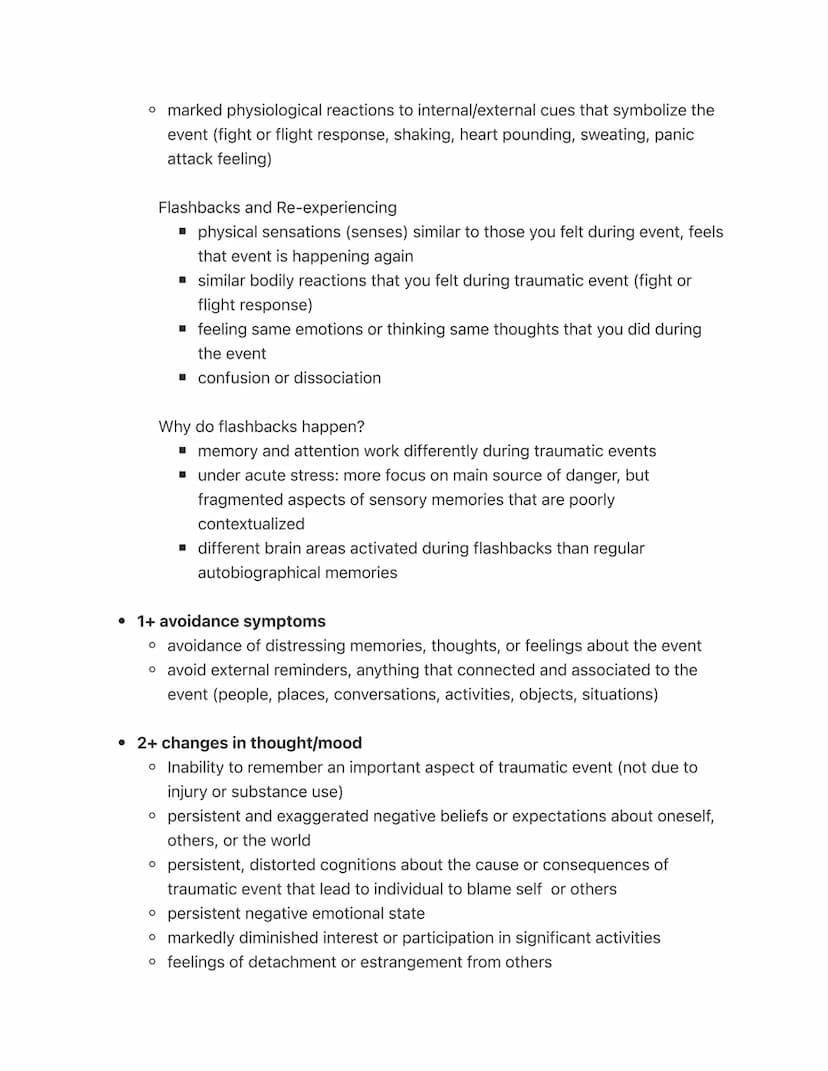
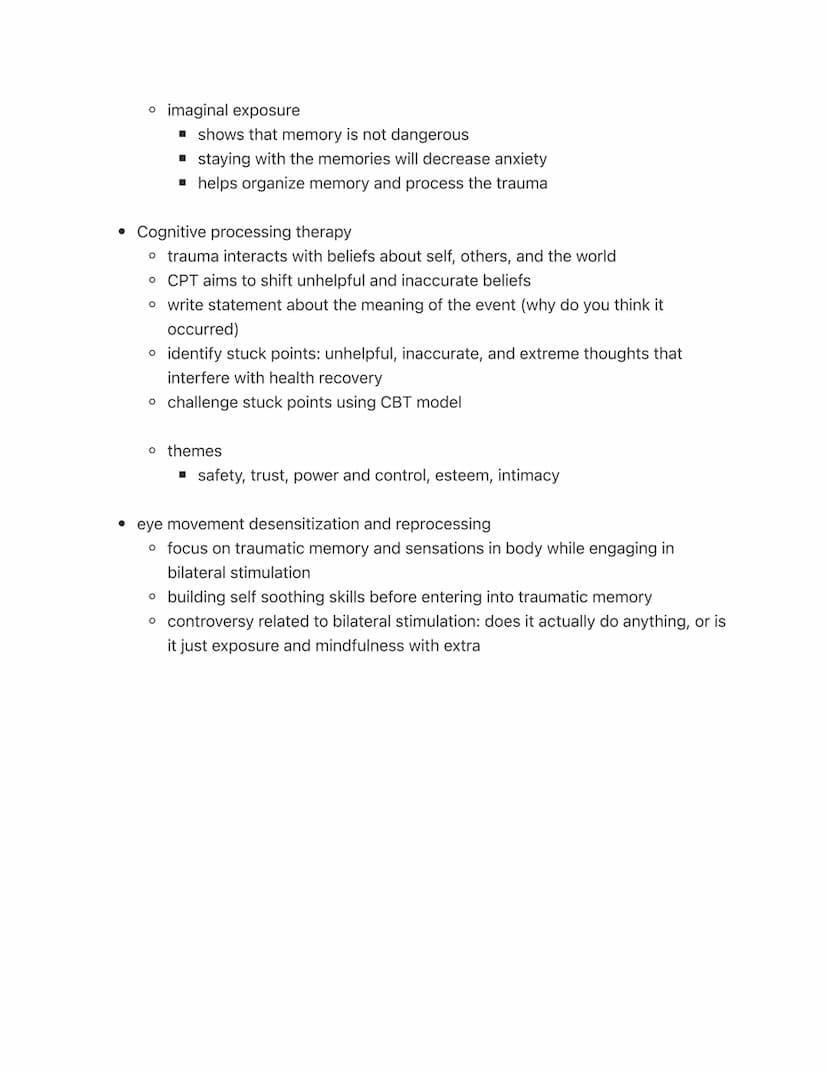
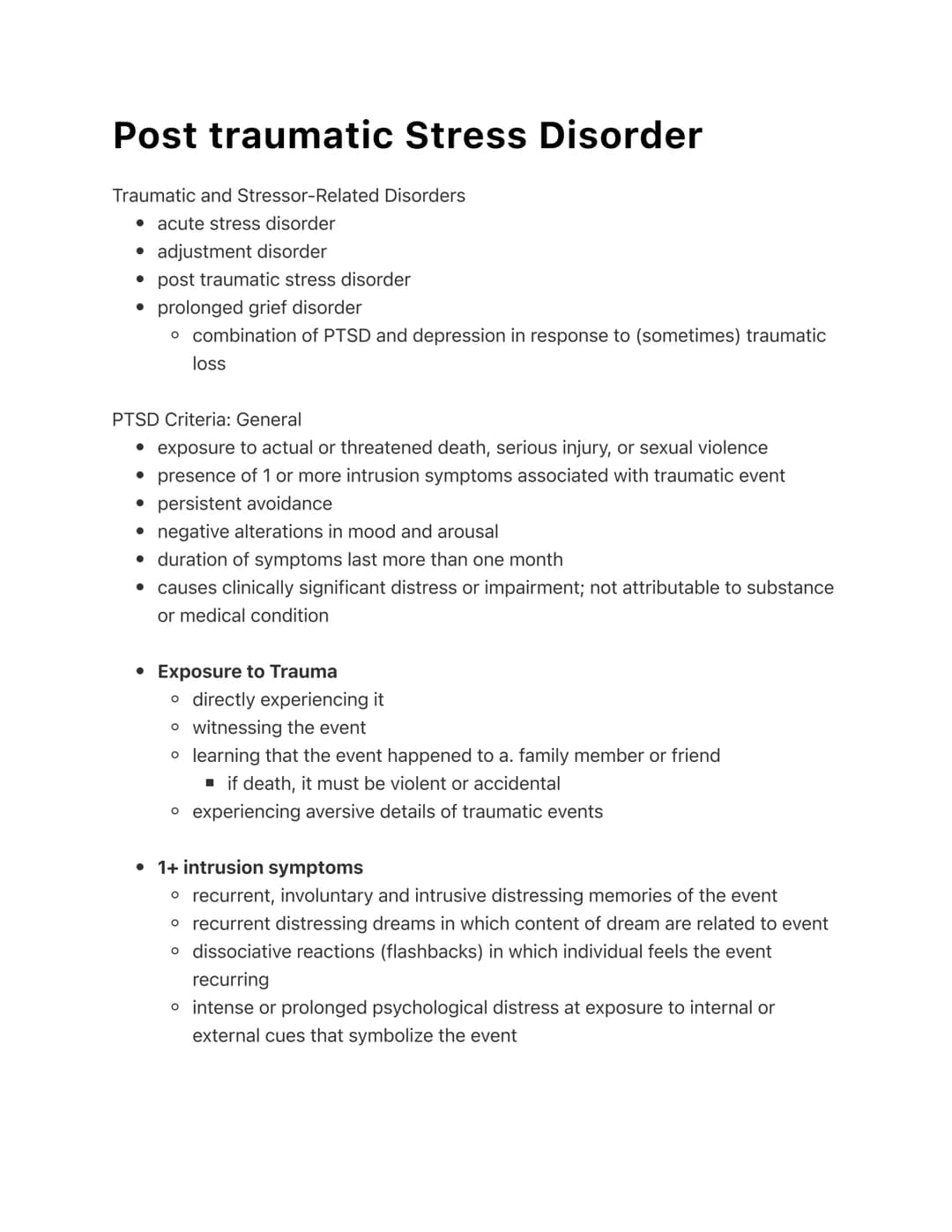
The second page delves into the physiological and psychological aspects of flashbacks and avoidance symptoms in PTSD. It explains the neurological basis for flashbacks and details various avoidance behaviors.
Vocabulary: Flashbacks are dissociative reactions where individuals feel as if the traumatic event is recurring in the present moment.
Highlight: During traumatic events, memory processing changes significantly, focusing intensely on the primary threat while creating fragmented sensory memories.
Example: Someone might avoid certain locations, people, or activities that remind them of the traumatic event, demonstrating avoidance symptoms.
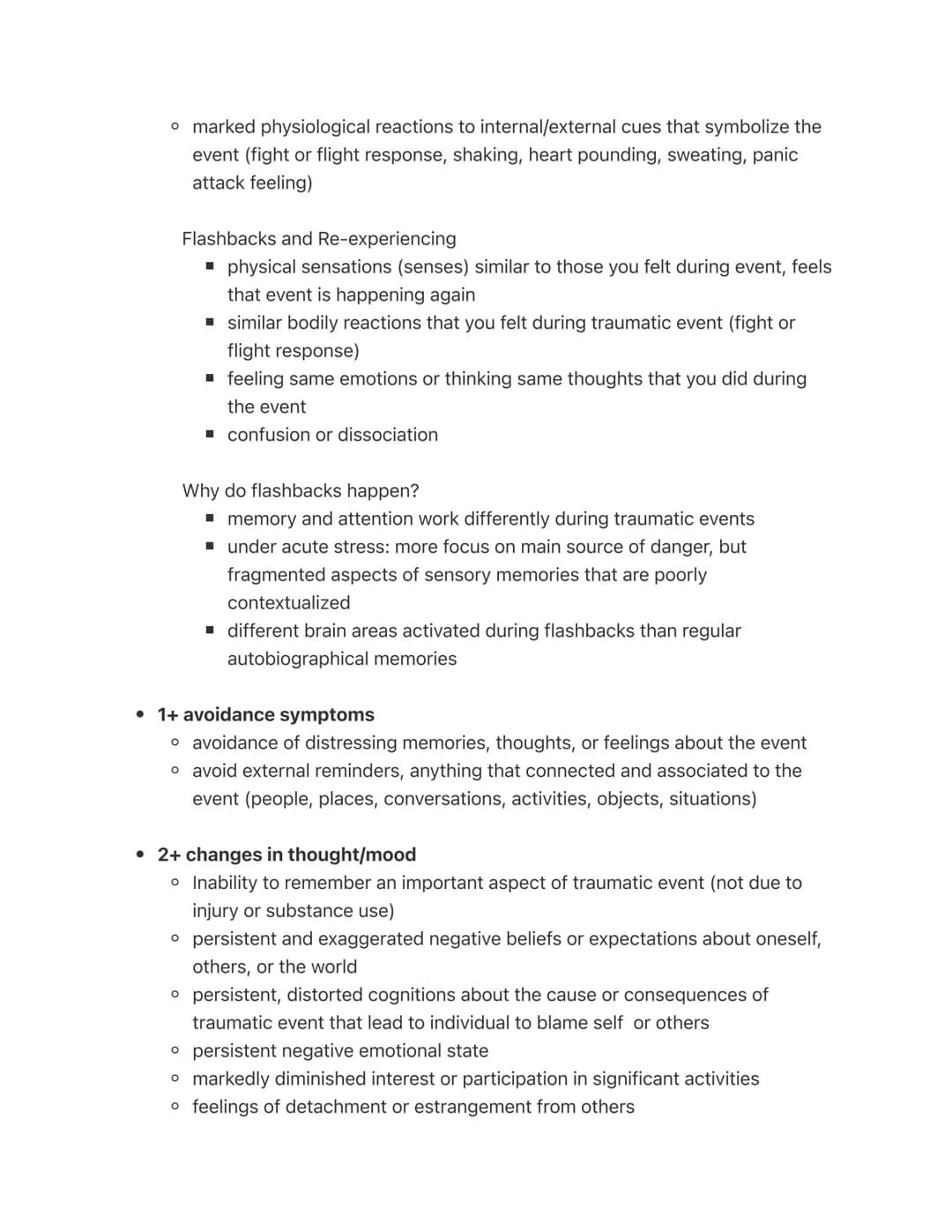
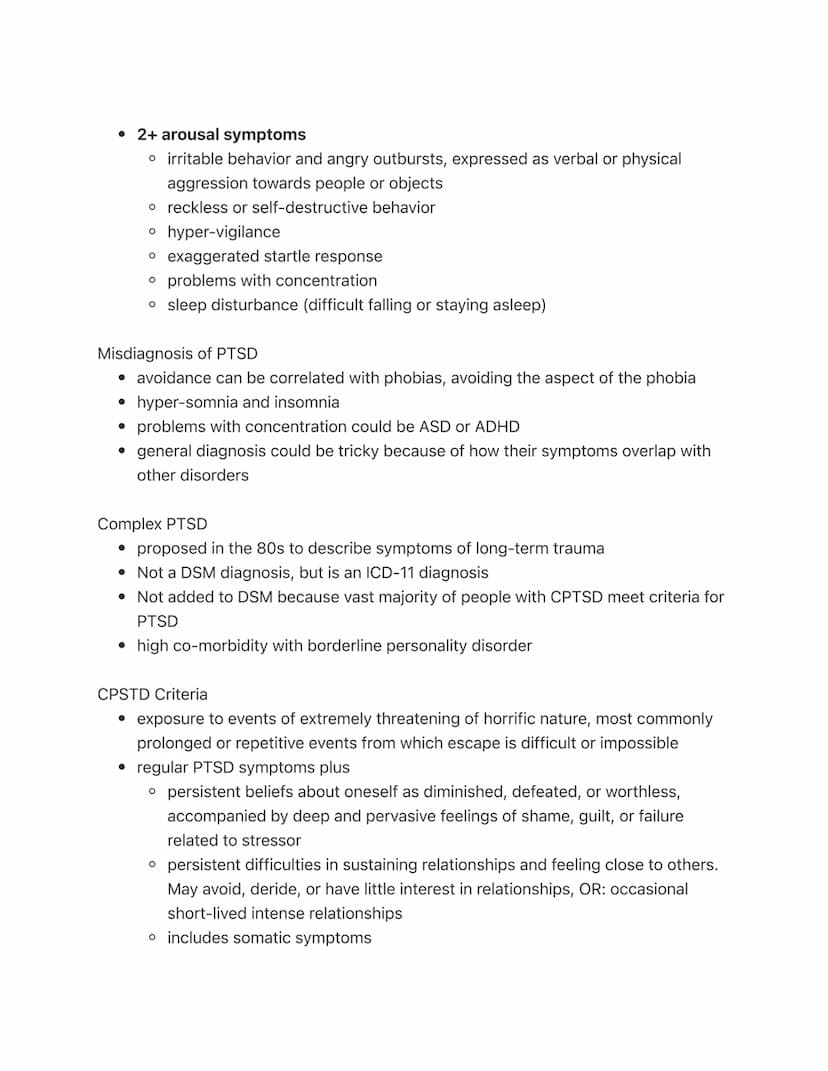
This section covers the arousal symptoms associated with PTSD and introduces Complex PTSD as a distinct but related condition. The text explains how PTSD can be misdiagnosed due to symptom overlap with other disorders.
Definition: Complex PTSD involves additional symptoms beyond standard PTSD, typically resulting from prolonged or repetitive trauma exposure.
Highlight: Arousal symptoms include irritability, reckless behavior, hypervigilance, and sleep disturbances.
Quote: "Not added to DSM because vast majority of people with CPTSD meet criteria for PTSD"
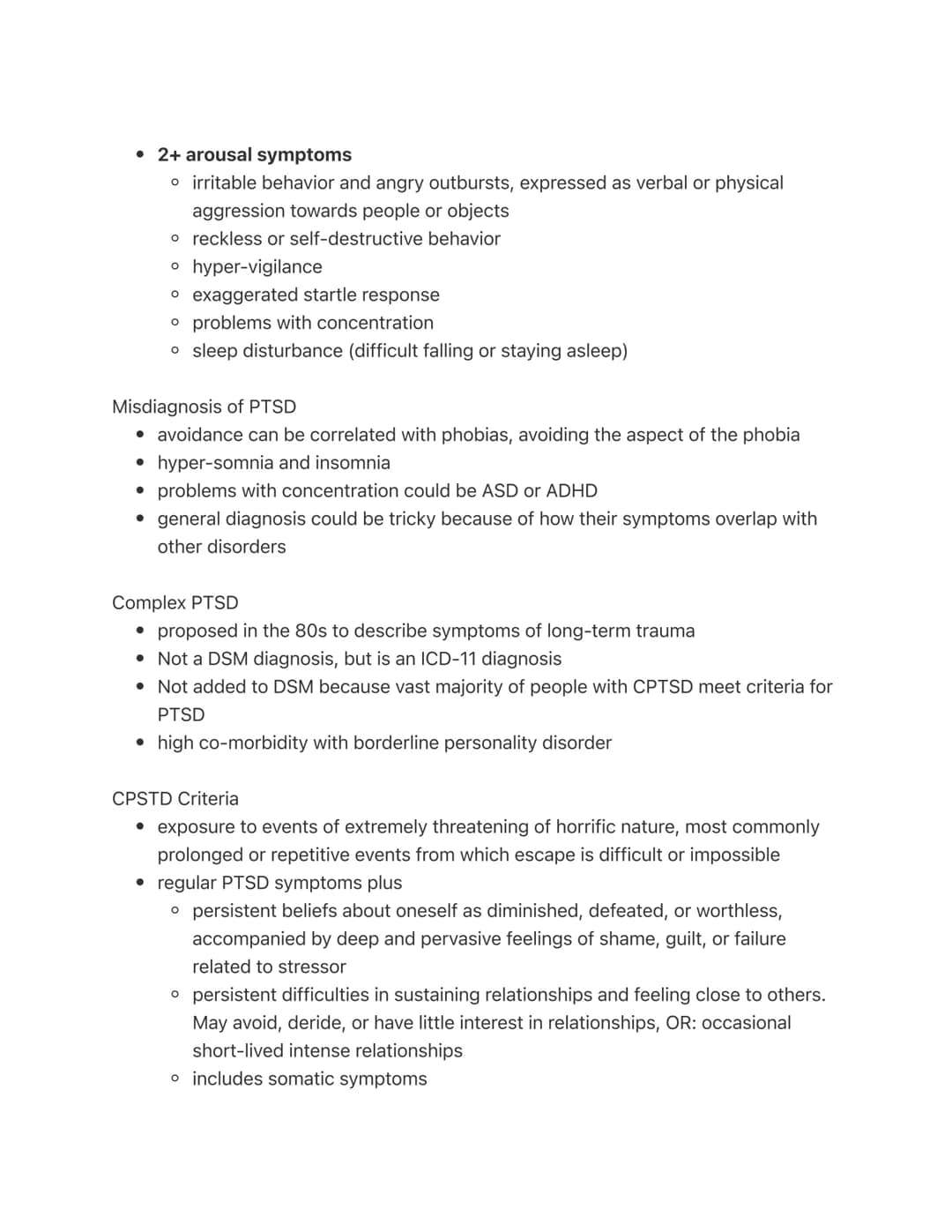
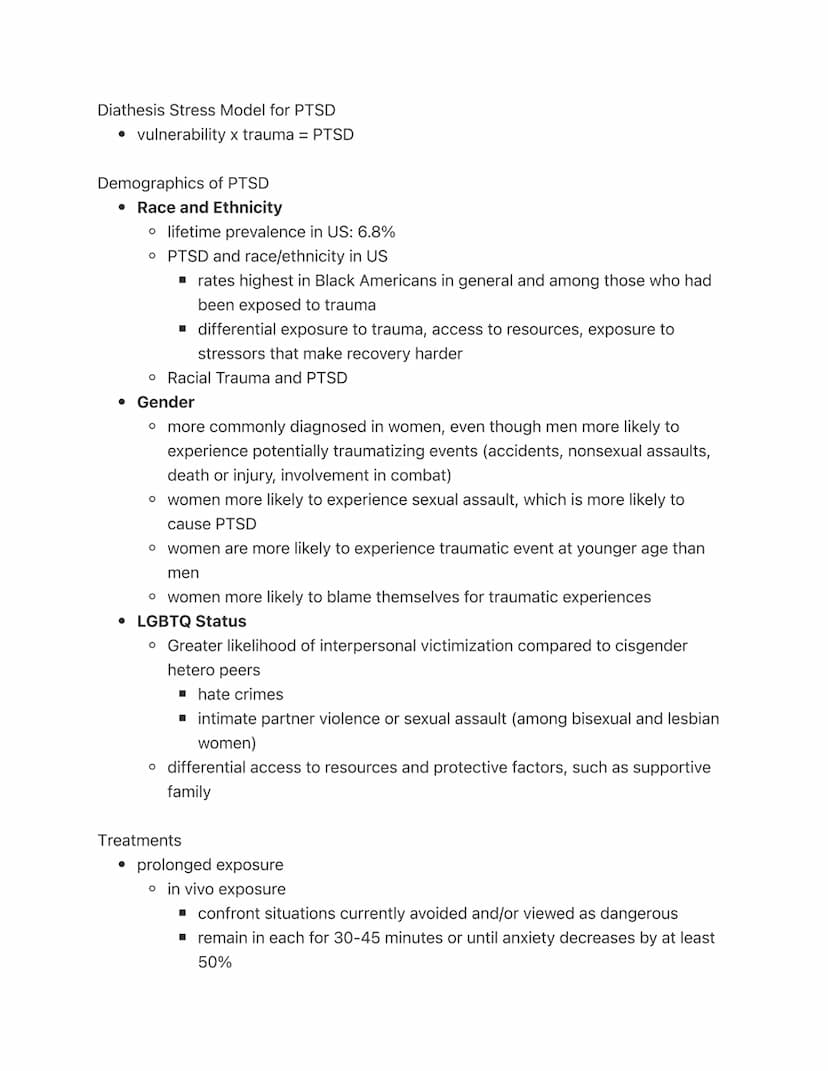
The final section examines the demographic distribution of PTSD across different populations, focusing on race, ethnicity, and gender differences in prevalence and manifestation.
Highlight: Lifetime prevalence of PTSD in the US is 6.8%, with higher rates among Black Americans.
Example: Women are more frequently diagnosed with PTSD despite men experiencing more potentially traumatic events, possibly due to different types of trauma exposure.
Definition: The diathesis-stress model suggests that PTSD results from the interaction between individual vulnerability and traumatic experiences.

This section examines PTSD prevalence across different demographic groups and explores the diathesis-stress model.
Definition: The diathesis-stress model suggests that PTSD results from the interaction between individual vulnerability and traumatic experiences.
Highlight: PTSD rates vary significantly across racial and ethnic groups, with Black Americans showing higher prevalence rates.
Example: Women are more commonly diagnosed with PTSD despite men experiencing more potentially traumatic events, partly due to differences in trauma types and age of exposure.
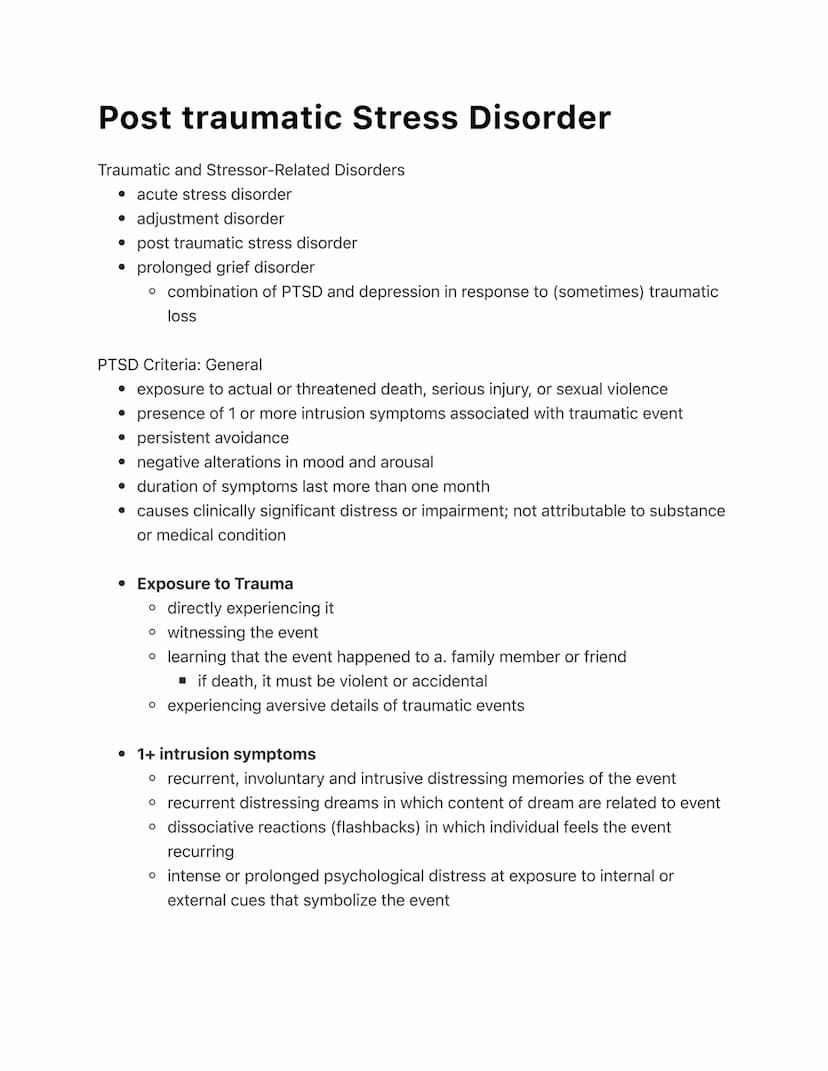
Post-traumatic Stress Disorder belongs to the category of Traumatic and Stressor-Related Disorders, alongside acute stress disorder, adjustment disorder, and prolonged grief disorder. The fundamental criteria for PTSD diagnosis include exposure to trauma, intrusion symptoms, persistent avoidance, mood alterations, and arousal symptoms lasting over one month.
Definition: PTSD requires exposure to actual or threatened death, serious injury, or sexual violence, either through direct experience, witnessing, or learning about it happening to close ones.
Highlight: Intrusion symptoms manifest as involuntary distressing memories, dreams, flashbacks, and psychological distress when exposed to trauma-related cues.
Example: A person might experience recurring nightmares about the traumatic event or have intense anxiety when encountering situations reminiscent of the trauma.
Our AI companion is specifically built for the needs of students. Based on the millions of content pieces we have on the platform we can provide truly meaningful and relevant answers to students. But its not only about answers, the companion is even more about guiding students through their daily learning challenges, with personalised study plans, quizzes or content pieces in the chat and 100% personalisation based on the students skills and developments.
You can download the app in the Google Play Store and in the Apple App Store.
That's right! Enjoy free access to study content, connect with fellow students, and get instant help – all at your fingertips.
App Store
Google Play
The app is very easy to use and well designed. I have found everything I was looking for so far and have been able to learn a lot from the presentations! I will definitely use the app for a class assignment! And of course it also helps a lot as an inspiration.
Stefan S
iOS user
This app is really great. There are so many study notes and help [...]. My problem subject is French, for example, and the app has so many options for help. Thanks to this app, I have improved my French. I would recommend it to anyone.
Samantha Klich
Android user
Wow, I am really amazed. I just tried the app because I've seen it advertised many times and was absolutely stunned. This app is THE HELP you want for school and above all, it offers so many things, such as workouts and fact sheets, which have been VERY helpful to me personally.
Anna
iOS user
I think it’s very much worth it and you’ll end up using it a lot once you get the hang of it and even after looking at others notes you can still ask your Artificial intelligence buddy the question and ask to simplify it if you still don’t get it!!! In the end I think it’s worth it 😊👍 ⚠️Also DID I MENTION ITS FREEE YOU DON’T HAVE TO PAY FOR ANYTHING AND STILL GET YOUR GRADES IN PERFECTLY❗️❗️⚠️
Thomas R
iOS user
Knowunity is the BEST app I’ve used in a minute. This is not an ai review or anything this is genuinely coming from a 7th grade student (I know 2011 im young) but dude this app is a 10/10 i have maintained a 3.8 gpa and have plenty of time for gaming. I love it and my mom is just happy I got good grades
Brad T
Android user
Not only did it help me find the answer but it also showed me alternative ways to solve it. I was horrible in math and science but now I have an a in both subjects. Thanks for the help🤍🤍
David K
iOS user
The app's just great! All I have to do is enter the topic in the search bar and I get the response real fast. I don't have to watch 10 YouTube videos to understand something, so I'm saving my time. Highly recommended!
Sudenaz Ocak
Android user
In school I was really bad at maths but thanks to the app, I am doing better now. I am so grateful that you made the app.
Greenlight Bonnie
Android user
I found this app a couple years ago and it has only gotten better since then. I really love it because it can help with written questions and photo questions. Also, it can find study guides that other people have made as well as flashcard sets and practice tests. The free version is also amazing for students who might not be able to afford it. Would 100% recommend
Aubrey
iOS user
Best app if you're in Highschool or Junior high. I have been using this app for 2 school years and it's the best, it's good if you don't have anyone to help you with school work.😋🩷🎀
Marco B
iOS user
THE QUIZES AND FLASHCARDS ARE SO USEFUL AND I LOVE Knowunity AI. IT ALSO IS LITREALLY LIKE CHATGPT BUT SMARTER!! HELPED ME WITH MY MASCARA PROBLEMS TOO!! AS WELL AS MY REAL SUBJECTS ! DUHHH 😍😁😲🤑💗✨🎀😮
Elisha
iOS user
This app is phenomenal down to the correct info and the various topics you can study! I greatly recommend it for people who struggle with procrastination and those who need homework help. It has been perfectly accurate for world 1 history as far as I’ve seen! Geometry too!
Paul T
iOS user
The app is very easy to use and well designed. I have found everything I was looking for so far and have been able to learn a lot from the presentations! I will definitely use the app for a class assignment! And of course it also helps a lot as an inspiration.
Stefan S
iOS user
This app is really great. There are so many study notes and help [...]. My problem subject is French, for example, and the app has so many options for help. Thanks to this app, I have improved my French. I would recommend it to anyone.
Samantha Klich
Android user
Wow, I am really amazed. I just tried the app because I've seen it advertised many times and was absolutely stunned. This app is THE HELP you want for school and above all, it offers so many things, such as workouts and fact sheets, which have been VERY helpful to me personally.
Anna
iOS user
I think it’s very much worth it and you’ll end up using it a lot once you get the hang of it and even after looking at others notes you can still ask your Artificial intelligence buddy the question and ask to simplify it if you still don’t get it!!! In the end I think it’s worth it 😊👍 ⚠️Also DID I MENTION ITS FREEE YOU DON’T HAVE TO PAY FOR ANYTHING AND STILL GET YOUR GRADES IN PERFECTLY❗️❗️⚠️
Thomas R
iOS user
Knowunity is the BEST app I’ve used in a minute. This is not an ai review or anything this is genuinely coming from a 7th grade student (I know 2011 im young) but dude this app is a 10/10 i have maintained a 3.8 gpa and have plenty of time for gaming. I love it and my mom is just happy I got good grades
Brad T
Android user
Not only did it help me find the answer but it also showed me alternative ways to solve it. I was horrible in math and science but now I have an a in both subjects. Thanks for the help🤍🤍
David K
iOS user
The app's just great! All I have to do is enter the topic in the search bar and I get the response real fast. I don't have to watch 10 YouTube videos to understand something, so I'm saving my time. Highly recommended!
Sudenaz Ocak
Android user
In school I was really bad at maths but thanks to the app, I am doing better now. I am so grateful that you made the app.
Greenlight Bonnie
Android user
I found this app a couple years ago and it has only gotten better since then. I really love it because it can help with written questions and photo questions. Also, it can find study guides that other people have made as well as flashcard sets and practice tests. The free version is also amazing for students who might not be able to afford it. Would 100% recommend
Aubrey
iOS user
Best app if you're in Highschool or Junior high. I have been using this app for 2 school years and it's the best, it's good if you don't have anyone to help you with school work.😋🩷🎀
Marco B
iOS user
THE QUIZES AND FLASHCARDS ARE SO USEFUL AND I LOVE Knowunity AI. IT ALSO IS LITREALLY LIKE CHATGPT BUT SMARTER!! HELPED ME WITH MY MASCARA PROBLEMS TOO!! AS WELL AS MY REAL SUBJECTS ! DUHHH 😍😁😲🤑💗✨🎀😮
Elisha
iOS user
This app is phenomenal down to the correct info and the various topics you can study! I greatly recommend it for people who struggle with procrastination and those who need homework help. It has been perfectly accurate for world 1 history as far as I’ve seen! Geometry too!
Paul T
iOS user
Rachel Campanile
@rachelcampanile_ievt
PTSD and trauma-related disorders represent complex mental health conditions requiring careful understanding and treatment. Understanding PTSD symptoms and criteria is essential for proper diagnosis and support.
Key aspects include:
Access to all documents
Improve your grades
Join milions of students
The second page delves into the physiological and psychological aspects of flashbacks and avoidance symptoms in PTSD. It explains the neurological basis for flashbacks and details various avoidance behaviors.
Vocabulary: Flashbacks are dissociative reactions where individuals feel as if the traumatic event is recurring in the present moment.
Highlight: During traumatic events, memory processing changes significantly, focusing intensely on the primary threat while creating fragmented sensory memories.
Example: Someone might avoid certain locations, people, or activities that remind them of the traumatic event, demonstrating avoidance symptoms.
Access to all documents
Improve your grades
Join milions of students
This section covers the arousal symptoms associated with PTSD and introduces Complex PTSD as a distinct but related condition. The text explains how PTSD can be misdiagnosed due to symptom overlap with other disorders.
Definition: Complex PTSD involves additional symptoms beyond standard PTSD, typically resulting from prolonged or repetitive trauma exposure.
Highlight: Arousal symptoms include irritability, reckless behavior, hypervigilance, and sleep disturbances.
Quote: "Not added to DSM because vast majority of people with CPTSD meet criteria for PTSD"
Access to all documents
Improve your grades
Join milions of students
The final section examines the demographic distribution of PTSD across different populations, focusing on race, ethnicity, and gender differences in prevalence and manifestation.
Highlight: Lifetime prevalence of PTSD in the US is 6.8%, with higher rates among Black Americans.
Example: Women are more frequently diagnosed with PTSD despite men experiencing more potentially traumatic events, possibly due to different types of trauma exposure.
Definition: The diathesis-stress model suggests that PTSD results from the interaction between individual vulnerability and traumatic experiences.
Access to all documents
Improve your grades
Join milions of students
This section examines PTSD prevalence across different demographic groups and explores the diathesis-stress model.
Definition: The diathesis-stress model suggests that PTSD results from the interaction between individual vulnerability and traumatic experiences.
Highlight: PTSD rates vary significantly across racial and ethnic groups, with Black Americans showing higher prevalence rates.
Example: Women are more commonly diagnosed with PTSD despite men experiencing more potentially traumatic events, partly due to differences in trauma types and age of exposure.
Access to all documents
Improve your grades
Join milions of students
Post-traumatic Stress Disorder belongs to the category of Traumatic and Stressor-Related Disorders, alongside acute stress disorder, adjustment disorder, and prolonged grief disorder. The fundamental criteria for PTSD diagnosis include exposure to trauma, intrusion symptoms, persistent avoidance, mood alterations, and arousal symptoms lasting over one month.
Definition: PTSD requires exposure to actual or threatened death, serious injury, or sexual violence, either through direct experience, witnessing, or learning about it happening to close ones.
Highlight: Intrusion symptoms manifest as involuntary distressing memories, dreams, flashbacks, and psychological distress when exposed to trauma-related cues.
Example: A person might experience recurring nightmares about the traumatic event or have intense anxiety when encountering situations reminiscent of the trauma.
Our AI companion is specifically built for the needs of students. Based on the millions of content pieces we have on the platform we can provide truly meaningful and relevant answers to students. But its not only about answers, the companion is even more about guiding students through their daily learning challenges, with personalised study plans, quizzes or content pieces in the chat and 100% personalisation based on the students skills and developments.
You can download the app in the Google Play Store and in the Apple App Store.
That's right! Enjoy free access to study content, connect with fellow students, and get instant help – all at your fingertips.
6
Smart Tools NEW
Transform this note into: ✓ 50+ Practice Questions ✓ Interactive Flashcards ✓ Full Practice Test ✓ Essay Outlines
a presentation deck on somatic symptom disorders, including illness anxiety disorder, conversion disorder and somatic symptom disorders. featuring visuals from osmosis, "crazyhead comics", verywell and even never have i ever lol
 Psychology
adult psychopathology lecture notes
PsychologyIn class notes
 AP Psychology
Explore the effectiveness of token economy as a behavioral therapy for managing schizophrenia. This summary covers key concepts such as operant conditioning, positive reinforcement, and the impact on negative symptoms. Evaluate the pros and cons based on historical studies, including insights from Paul and Lentz (1977) and McMonagle and Sultana (2000). Ideal for psychology students and professionals seeking to understand behavioral interventions in clinical settings.
 Psychology
Adult psychopathology lecture notes
PsychologyExplore the biological underpinnings of schizophrenia, focusing on genetic vulnerabilities, the role of neurotransmitters like dopamine and glutamate, and the impact of environmental factors. This summary highlights key research findings, including family and adoption studies, and discusses the implications for genetic counseling and treatment options. Ideal for students studying psychology and mental health disorders.
PsychologyApp Store
Google Play
The app is very easy to use and well designed. I have found everything I was looking for so far and have been able to learn a lot from the presentations! I will definitely use the app for a class assignment! And of course it also helps a lot as an inspiration.
Stefan S
iOS user
This app is really great. There are so many study notes and help [...]. My problem subject is French, for example, and the app has so many options for help. Thanks to this app, I have improved my French. I would recommend it to anyone.
Samantha Klich
Android user
Wow, I am really amazed. I just tried the app because I've seen it advertised many times and was absolutely stunned. This app is THE HELP you want for school and above all, it offers so many things, such as workouts and fact sheets, which have been VERY helpful to me personally.
Anna
iOS user
I think it’s very much worth it and you’ll end up using it a lot once you get the hang of it and even after looking at others notes you can still ask your Artificial intelligence buddy the question and ask to simplify it if you still don’t get it!!! In the end I think it’s worth it 😊👍 ⚠️Also DID I MENTION ITS FREEE YOU DON’T HAVE TO PAY FOR ANYTHING AND STILL GET YOUR GRADES IN PERFECTLY❗️❗️⚠️
Thomas R
iOS user
Knowunity is the BEST app I’ve used in a minute. This is not an ai review or anything this is genuinely coming from a 7th grade student (I know 2011 im young) but dude this app is a 10/10 i have maintained a 3.8 gpa and have plenty of time for gaming. I love it and my mom is just happy I got good grades
Brad T
Android user
Not only did it help me find the answer but it also showed me alternative ways to solve it. I was horrible in math and science but now I have an a in both subjects. Thanks for the help🤍🤍
David K
iOS user
The app's just great! All I have to do is enter the topic in the search bar and I get the response real fast. I don't have to watch 10 YouTube videos to understand something, so I'm saving my time. Highly recommended!
Sudenaz Ocak
Android user
In school I was really bad at maths but thanks to the app, I am doing better now. I am so grateful that you made the app.
Greenlight Bonnie
Android user
I found this app a couple years ago and it has only gotten better since then. I really love it because it can help with written questions and photo questions. Also, it can find study guides that other people have made as well as flashcard sets and practice tests. The free version is also amazing for students who might not be able to afford it. Would 100% recommend
Aubrey
iOS user
Best app if you're in Highschool or Junior high. I have been using this app for 2 school years and it's the best, it's good if you don't have anyone to help you with school work.😋🩷🎀
Marco B
iOS user
THE QUIZES AND FLASHCARDS ARE SO USEFUL AND I LOVE Knowunity AI. IT ALSO IS LITREALLY LIKE CHATGPT BUT SMARTER!! HELPED ME WITH MY MASCARA PROBLEMS TOO!! AS WELL AS MY REAL SUBJECTS ! DUHHH 😍😁😲🤑💗✨🎀😮
Elisha
iOS user
This app is phenomenal down to the correct info and the various topics you can study! I greatly recommend it for people who struggle with procrastination and those who need homework help. It has been perfectly accurate for world 1 history as far as I’ve seen! Geometry too!
Paul T
iOS user
The app is very easy to use and well designed. I have found everything I was looking for so far and have been able to learn a lot from the presentations! I will definitely use the app for a class assignment! And of course it also helps a lot as an inspiration.
Stefan S
iOS user
This app is really great. There are so many study notes and help [...]. My problem subject is French, for example, and the app has so many options for help. Thanks to this app, I have improved my French. I would recommend it to anyone.
Samantha Klich
Android user
Wow, I am really amazed. I just tried the app because I've seen it advertised many times and was absolutely stunned. This app is THE HELP you want for school and above all, it offers so many things, such as workouts and fact sheets, which have been VERY helpful to me personally.
Anna
iOS user
I think it’s very much worth it and you’ll end up using it a lot once you get the hang of it and even after looking at others notes you can still ask your Artificial intelligence buddy the question and ask to simplify it if you still don’t get it!!! In the end I think it’s worth it 😊👍 ⚠️Also DID I MENTION ITS FREEE YOU DON’T HAVE TO PAY FOR ANYTHING AND STILL GET YOUR GRADES IN PERFECTLY❗️❗️⚠️
Thomas R
iOS user
Knowunity is the BEST app I’ve used in a minute. This is not an ai review or anything this is genuinely coming from a 7th grade student (I know 2011 im young) but dude this app is a 10/10 i have maintained a 3.8 gpa and have plenty of time for gaming. I love it and my mom is just happy I got good grades
Brad T
Android user
Not only did it help me find the answer but it also showed me alternative ways to solve it. I was horrible in math and science but now I have an a in both subjects. Thanks for the help🤍🤍
David K
iOS user
The app's just great! All I have to do is enter the topic in the search bar and I get the response real fast. I don't have to watch 10 YouTube videos to understand something, so I'm saving my time. Highly recommended!
Sudenaz Ocak
Android user
In school I was really bad at maths but thanks to the app, I am doing better now. I am so grateful that you made the app.
Greenlight Bonnie
Android user
I found this app a couple years ago and it has only gotten better since then. I really love it because it can help with written questions and photo questions. Also, it can find study guides that other people have made as well as flashcard sets and practice tests. The free version is also amazing for students who might not be able to afford it. Would 100% recommend
Aubrey
iOS user
Best app if you're in Highschool or Junior high. I have been using this app for 2 school years and it's the best, it's good if you don't have anyone to help you with school work.😋🩷🎀
Marco B
iOS user
THE QUIZES AND FLASHCARDS ARE SO USEFUL AND I LOVE Knowunity AI. IT ALSO IS LITREALLY LIKE CHATGPT BUT SMARTER!! HELPED ME WITH MY MASCARA PROBLEMS TOO!! AS WELL AS MY REAL SUBJECTS ! DUHHH 😍😁😲🤑💗✨🎀😮
Elisha
iOS user
This app is phenomenal down to the correct info and the various topics you can study! I greatly recommend it for people who struggle with procrastination and those who need homework help. It has been perfectly accurate for world 1 history as far as I’ve seen! Geometry too!
Paul T
iOS user