
The structure of atoms, including protons, neutrons, and electrons,... Show more
 Science399 views·Updated May 25, 2026·1 page
Understanding Atoms: Protons, Neutrons, and Electrons - Easy Notes for Class 7, 9, and 11

michaela@studyhard21
1
of 1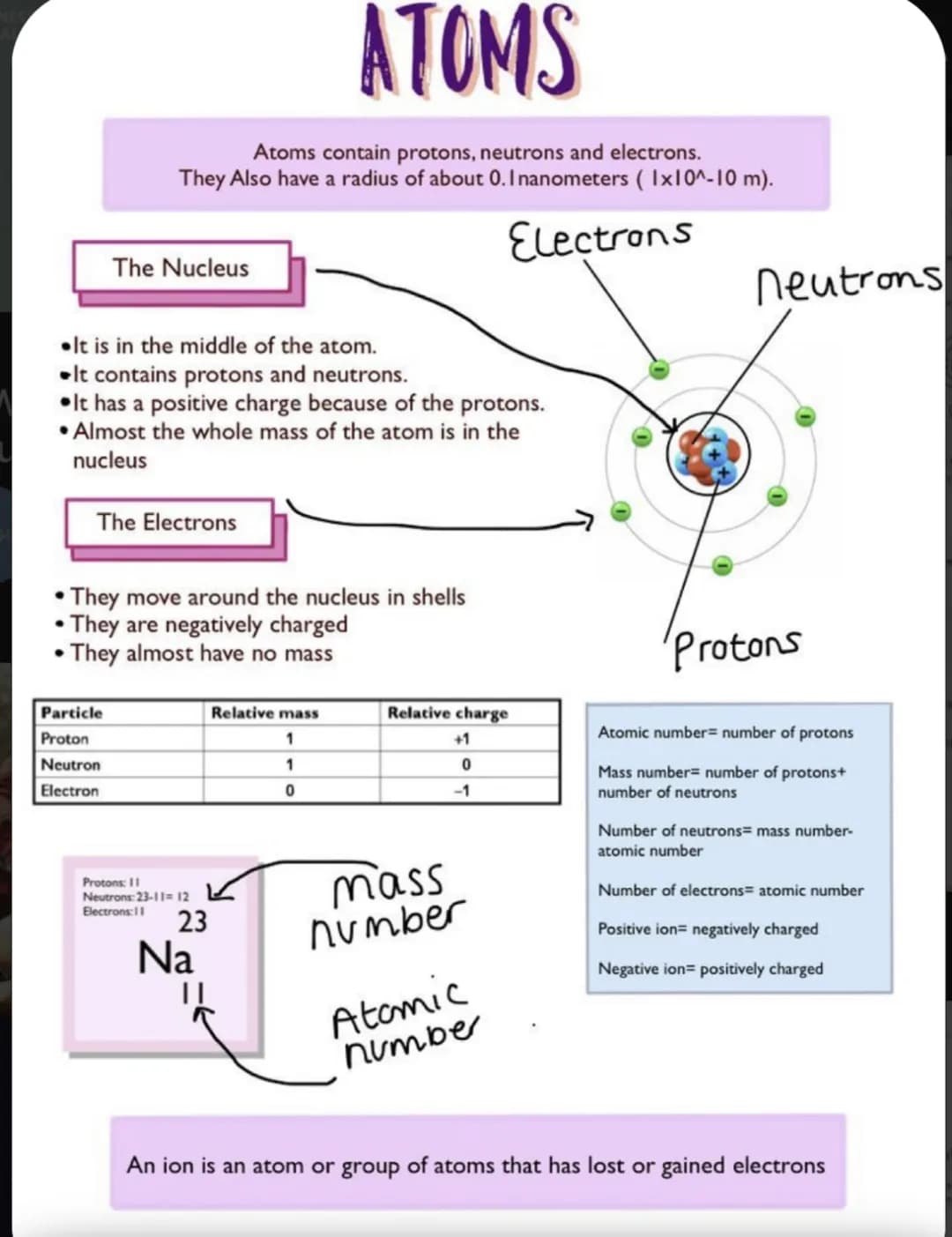
Atomic Structure and Components
The atom is the fundamental unit of matter, composed of three main particles: protons, neutrons, and electrons. Each of these components plays a crucial role in determining the atom's properties and behavior.
Definition: An atom is the smallest unit of matter that retains the properties of an element.
The structure of an atom can be divided into two main regions: the nucleus and the electron shells.
The Nucleus
The nucleus is located at the center of the atom and contains protons and neutrons.
Highlight: The nucleus, despite being much smaller than the atom itself, contains almost the entire mass of the atom.
Characteristics of the nucleus:
- It has a positive charge due to the presence of protons.
- It is extremely dense compared to the rest of the atom.
Subatomic Particles
The three main subatomic particles have distinct properties:
-
Protons:
- Positively charged (+1)
- Relative mass of 1
- Located in the nucleus
-
Neutrons:
- No electric charge (neutral)
- Relative mass of 1
- Located in the nucleus
-
Electrons:
- Negatively charged (-1)
- Negligible mass (relative mass of 0)
- Orbit the nucleus in shells
Example: A sodium atom (Na) with a mass number of 23 and an atomic number of 11 would have 11 protons, 12 neutrons (23 - 11), and 11 electrons.
Atomic Number and Mass Number
Understanding the relationship between atomic number and mass number is crucial for calculating protons, neutrons, and electrons in an atom.
Definition: The atomic number is the number of protons in an atom's nucleus, while the mass number is the total number of protons and neutrons.
Key relationships:
- Atomic number = Number of protons
- Mass number = Number of protons + Number of neutrons
- Number of neutrons = Mass number - Atomic number
- Number of electrons = Atomic number (in a neutral atom)
Ions
Atoms can gain or lose electrons to form ions, which are electrically charged particles.
Vocabulary: An ion is an atom or group of atoms that has lost or gained electrons, resulting in a net electric charge.
Types of ions:
- Positive ion (cation): formed when an atom loses electrons
- Negative ion (anion): formed when an atom gains electrons
Understanding the structure of atoms and the relationships between their components is essential for students studying chemistry at various levels, including Class 7, Class 9, and Class 11. This knowledge forms the foundation for more advanced concepts in atomic and molecular structure.
We thought you’d never ask...
What is the Knowunity AI companion?
Our AI companion is specifically built for the needs of students. Based on the millions of content pieces we have on the platform we can provide truly meaningful and relevant answers to students. But its not only about answers, the companion is even more about guiding students through their daily learning challenges, with personalised study plans, quizzes or content pieces in the chat and 100% personalisation based on the students skills and developments.
Where can I download the Knowunity app?
You can download the app in the Google Play Store and in the Apple App Store.
Is Knowunity really free of charge?
That's right! Enjoy free access to study content, connect with fellow students, and get instant help – all at your fingertips.
Similar Content
Most popular content: Il Sistema Periodico
2Most popular content in Science
9ScienceCell Organelle Functions and Structures
A detailed review of cell organelle functions, covering the nucleus, cell membrane, cell wall, cytoplasm, chloroplasts, vacuoles, and mitochondria.
6th5909
C
ScienceComparing Mitosis and Meiosis
Identify the key differences between asexual cell division and the division process required for sexual reproduction.
6th870
I
ScienceIntroduction to Plate Tectonic Basics
Learn about the Earth's lithosphere and the basic concept of how tectonic plates move on the mantle.
6th1090
I
ScienceIntroduction to Velocity and Acceleration
Learn the fundamental definitions of velocity as speed with direction and acceleration as a change in motion.
6th630
A
ScienceApplying Conservation of Mass to Equations
Solve chemical equations that model real-world reactions to demonstrate that matter is neither created nor destroyed.
6th850
 Chemistry
Chemistry: Atoms, Molecules, Ions
This is about atoms, molecules and ions.
9th1337
 Physical Science
Physical Science Notes
Physical Science Notes works as an intro to Physics and Chemistry
9th2694
 Health & Medicine
Pharmacology - Descriptions and Terms
Medical Terminology - Learn about descriptions of things related to pharmacology and additional terms about medications.
College1037
ChemistryChemistry: Colligative Properties of Solution
This is a presentation about colligative properties of solution with some examples and detailed solution.
10th1832
Most popular content
9O
 AP US History
Origins and Dynamics of the Columbian Exchange
Analyze the ecological and economic motivations behind the initial transfer of goods, people, and diseases between the Old and New Worlds.
9th3,1280
I
AP US HistoryIntroduction to Early Cultural Interactions
Analyze the initial social and religious encounters between Europeans, Africans, and Indigenous peoples in the colonial Americas.
9th2,7730
O
 AP World History
Origins of Ancient River Civilizations
Analyze the environmental factors and technological innovations that led to the rise of early states in Mesopotamia, Egypt, and the Indus Valley.
9th3,1860
M
AP US HistoryMotivations for European Exploration
Analyze the economic, religious, and political factors that drove European powers to the Americas during the 15th and 16th centuries.
9th1,7780
F
 AP Psychology
Foundations of Ethical Guidelines in Research
Practice the core principles of the APA ethical code including informed consent, debriefing, and the role of Institutional Review Boards.
9th1,3360
I
AP US HistoryIntroduction to Native American Societies
Examine the diverse social, political, and economic structures of North American indigenous groups prior to European contact.
9th1,1100
I
AP BiologyIntroduction to Biological Elements of Life
Practice identifying the essential elements including carbon, nitrogen, phosphorus, and sulfur that compose biological macromolecules.
9th1,7360
I
AP US HistoryIntroduction to the Spanish Encomienda System
Explore the fundamental economic and social structures of the Spanish colonial system, focusing on the encomienda and the casta social hierarchy.
9th8890
O
AP World HistoryOrigins and Continuity of the Byzantine Empire
Analyze the political and cultural transitions from the Roman Empire to the Byzantine Empire, focusing on the reign of Justinian I and his code.
9th1,6320
Can't find what you're looking for? Explore other subjects.
Students love us — and so will you.
4.6/5App Store
4.7/5Google Play
The app is very easy to use and well designed. I have found everything I was looking for so far and have been able to learn a lot from the presentations! I will definitely use the app for a class assignment! And of course it also helps a lot as an inspiration.
Stefan SiOS user
This app is really great. There are so many study notes and help [...]. My problem subject is French, for example, and the app has so many options for help. Thanks to this app, I have improved my French. I would recommend it to anyone.
Samantha KlichAndroid user
Wow, I am really amazed. I just tried the app because I've seen it advertised many times and was absolutely stunned. This app is THE HELP you want for school and above all, it offers so many things, such as workouts and fact sheets, which have been VERY helpful to me personally.
AnnaiOS user
Science399 views·Updated May 25, 2026·1 pageUnderstanding Atoms: Protons, Neutrons, and Electrons - Easy Notes for Class 7, 9, and 11
michaela@studyhard21
The structure of atoms, including protons, neutrons, and electrons, is a fundamental concept in chemistry. This summary explores the components of atoms, their characteristics, and the relationships between atomic numbers and mass numbers.
- Atoms are the basic units of... Show more
1
of 1Sign up to see the content. It's free!
- Access to all documents
- Improve your grades
- Join milions of students
Atomic Structure and Components
The atom is the fundamental unit of matter, composed of three main particles: protons, neutrons, and electrons. Each of these components plays a crucial role in determining the atom's properties and behavior.
Definition: An atom is the smallest unit of matter that retains the properties of an element.
The structure of an atom can be divided into two main regions: the nucleus and the electron shells.
The Nucleus
The nucleus is located at the center of the atom and contains protons and neutrons.
Highlight: The nucleus, despite being much smaller than the atom itself, contains almost the entire mass of the atom.
Characteristics of the nucleus:
- It has a positive charge due to the presence of protons.
- It is extremely dense compared to the rest of the atom.
Subatomic Particles
The three main subatomic particles have distinct properties:
-
Protons:
- Positively charged (+1)
- Relative mass of 1
- Located in the nucleus
-
Neutrons:
- No electric charge (neutral)
- Relative mass of 1
- Located in the nucleus
-
Electrons:
- Negatively charged (-1)
- Negligible mass (relative mass of 0)
- Orbit the nucleus in shells
Example: A sodium atom (Na) with a mass number of 23 and an atomic number of 11 would have 11 protons, 12 neutrons (23 - 11), and 11 electrons.
Atomic Number and Mass Number
Understanding the relationship between atomic number and mass number is crucial for calculating protons, neutrons, and electrons in an atom.
Definition: The atomic number is the number of protons in an atom's nucleus, while the mass number is the total number of protons and neutrons.
Key relationships:
- Atomic number = Number of protons
- Mass number = Number of protons + Number of neutrons
- Number of neutrons = Mass number - Atomic number
- Number of electrons = Atomic number (in a neutral atom)
Ions
Atoms can gain or lose electrons to form ions, which are electrically charged particles.
Vocabulary: An ion is an atom or group of atoms that has lost or gained electrons, resulting in a net electric charge.
Types of ions:
- Positive ion (cation): formed when an atom loses electrons
- Negative ion (anion): formed when an atom gains electrons
Understanding the structure of atoms and the relationships between their components is essential for students studying chemistry at various levels, including Class 7, Class 9, and Class 11. This knowledge forms the foundation for more advanced concepts in atomic and molecular structure.
We thought you’d never ask...
What is the Knowunity AI companion?
Our AI companion is specifically built for the needs of students. Based on the millions of content pieces we have on the platform we can provide truly meaningful and relevant answers to students. But its not only about answers, the companion is even more about guiding students through their daily learning challenges, with personalised study plans, quizzes or content pieces in the chat and 100% personalisation based on the students skills and developments.
Where can I download the Knowunity app?
You can download the app in the Google Play Store and in the Apple App Store.
Is Knowunity really free of charge?
That's right! Enjoy free access to study content, connect with fellow students, and get instant help – all at your fingertips.
Similar Content
Most popular content: Il Sistema Periodico
2Most popular content in Science
9ScienceCell Organelle Functions and Structures
A detailed review of cell organelle functions, covering the nucleus, cell membrane, cell wall, cytoplasm, chloroplasts, vacuoles, and mitochondria.
6th5909
C
ScienceComparing Mitosis and Meiosis
Identify the key differences between asexual cell division and the division process required for sexual reproduction.
6th870
I
ScienceIntroduction to Plate Tectonic Basics
Learn about the Earth's lithosphere and the basic concept of how tectonic plates move on the mantle.
6th1090
I
ScienceIntroduction to Velocity and Acceleration
Learn the fundamental definitions of velocity as speed with direction and acceleration as a change in motion.
6th630
A
ScienceApplying Conservation of Mass to Equations
Solve chemical equations that model real-world reactions to demonstrate that matter is neither created nor destroyed.
6th850
ChemistryChemistry: Atoms, Molecules, Ions
This is about atoms, molecules and ions.
9th1337
Physical SciencePhysical Science Notes
Physical Science Notes works as an intro to Physics and Chemistry
9th2694
Health & MedicinePharmacology - Descriptions and Terms
Medical Terminology - Learn about descriptions of things related to pharmacology and additional terms about medications.
College1037
ChemistryChemistry: Colligative Properties of Solution
This is a presentation about colligative properties of solution with some examples and detailed solution.
10th1832
Most popular content
9O
AP US HistoryOrigins and Dynamics of the Columbian Exchange
Analyze the ecological and economic motivations behind the initial transfer of goods, people, and diseases between the Old and New Worlds.
9th3,1280
I
AP US HistoryIntroduction to Early Cultural Interactions
Analyze the initial social and religious encounters between Europeans, Africans, and Indigenous peoples in the colonial Americas.
9th2,7730
O
AP World HistoryOrigins of Ancient River Civilizations
Analyze the environmental factors and technological innovations that led to the rise of early states in Mesopotamia, Egypt, and the Indus Valley.
9th3,1860
M
AP US HistoryMotivations for European Exploration
Analyze the economic, religious, and political factors that drove European powers to the Americas during the 15th and 16th centuries.
9th1,7780
F
AP PsychologyFoundations of Ethical Guidelines in Research
Practice the core principles of the APA ethical code including informed consent, debriefing, and the role of Institutional Review Boards.
9th1,3360
I
AP US HistoryIntroduction to Native American Societies
Examine the diverse social, political, and economic structures of North American indigenous groups prior to European contact.
9th1,1100
I
AP BiologyIntroduction to Biological Elements of Life
Practice identifying the essential elements including carbon, nitrogen, phosphorus, and sulfur that compose biological macromolecules.
9th1,7360
I
AP US HistoryIntroduction to the Spanish Encomienda System
Explore the fundamental economic and social structures of the Spanish colonial system, focusing on the encomienda and the casta social hierarchy.
9th8890
O
AP World HistoryOrigins and Continuity of the Byzantine Empire
Analyze the political and cultural transitions from the Roman Empire to the Byzantine Empire, focusing on the reign of Justinian I and his code.
9th1,6320
Can't find what you're looking for? Explore other subjects.
Students love us — and so will you.
4.6/5App Store
4.7/5Google Play
The app is very easy to use and well designed. I have found everything I was looking for so far and have been able to learn a lot from the presentations! I will definitely use the app for a class assignment! And of course it also helps a lot as an inspiration.
Stefan SiOS user
This app is really great. There are so many study notes and help [...]. My problem subject is French, for example, and the app has so many options for help. Thanks to this app, I have improved my French. I would recommend it to anyone.
Samantha KlichAndroid user
Wow, I am really amazed. I just tried the app because I've seen it advertised many times and was absolutely stunned. This app is THE HELP you want for school and above all, it offers so many things, such as workouts and fact sheets, which have been VERY helpful to me personally.
AnnaiOS user