
American government is a complex system built on principles that... Show more
 US Government and Civics
 US History
 Algebra
 Calculus 1
 Algebra 1
 Overige
Sign up to see the contentIt's free!
Access to all documents
Improve your grades
Join milions of students
By signing up you accept Terms of Service and Privacy Policy
Subjects

Biology

Chemistry
AP Chemistry

English
AP English Literature
4
0
hi
12/6/2025
US Government and Civics
Exam 1 - American History
68
•
Dec 6, 2025
•
hi
@hi_qqiy
American government is a complex system built on principles that... Show more
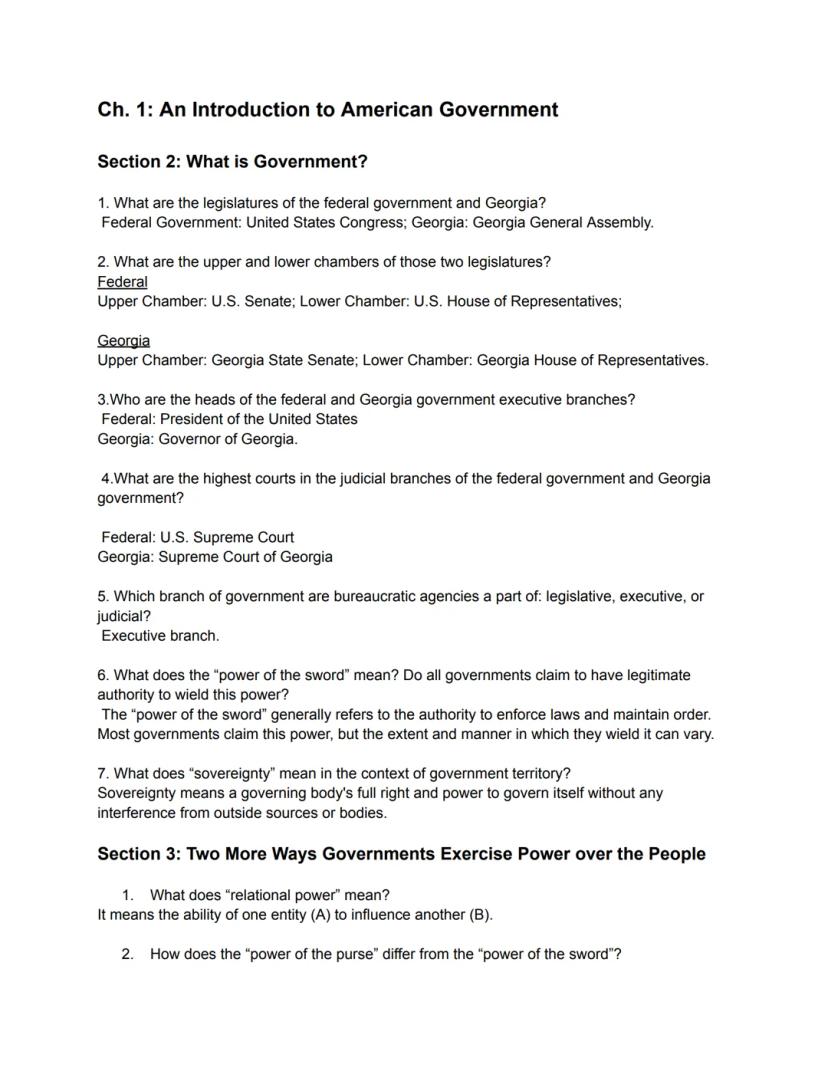
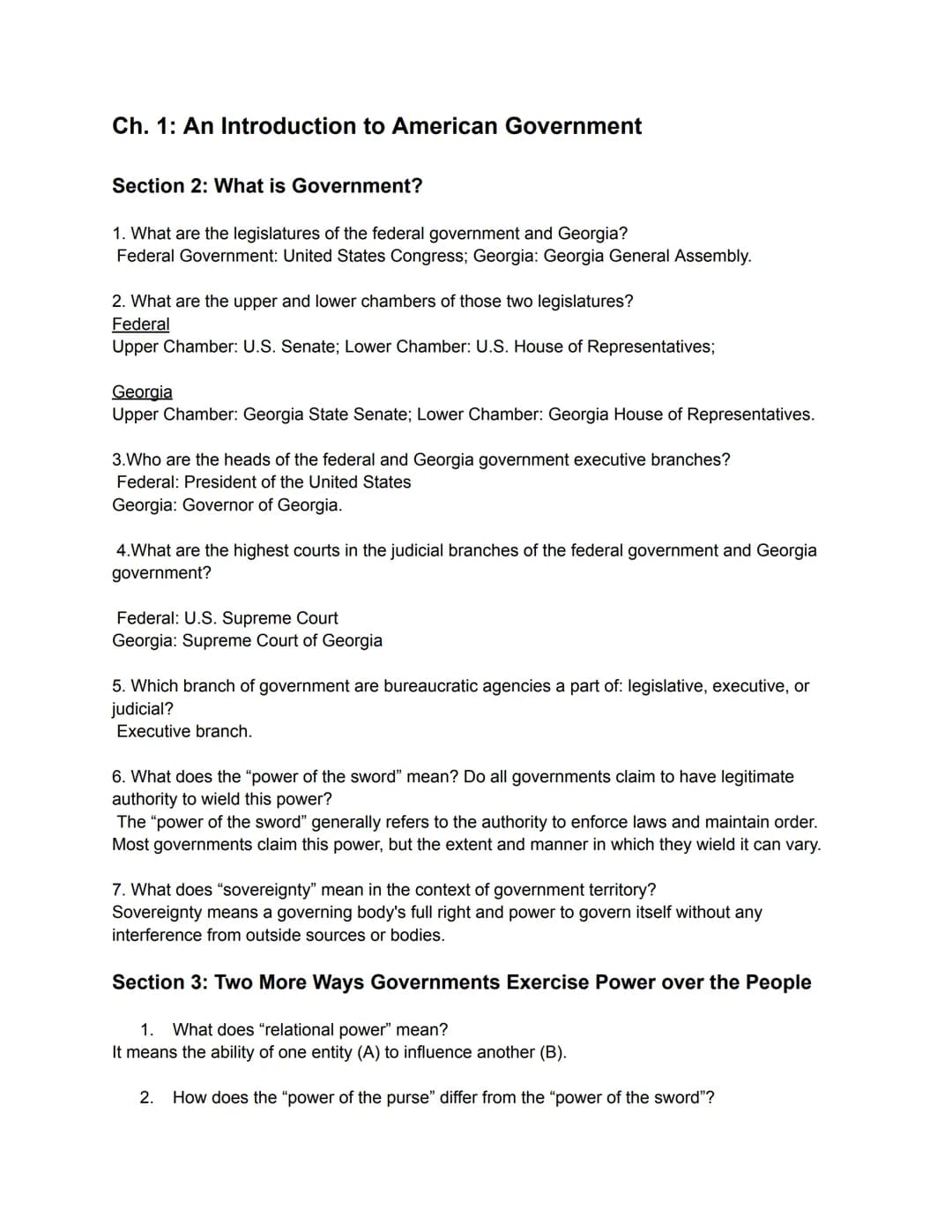
Ever wonder who's really running things in America? At the federal level, we have the United States Congress as our legislature, with the Senate (upper chamber) and House of Representatives (lower chamber). Georgia follows a similar pattern with its General Assembly, divided into the State Senate and House of Representatives.
The executive branches are headed by the President at the federal level and the Governor in Georgia. When it comes to legal matters, the highest courts are the U.S. Supreme Court federally and the Supreme Court of Georgia at the state level.
All bureaucratic agencies belong to the executive branch, helping implement and enforce laws. Governments exercise the "power of the sword" – the authority to enforce laws and maintain order. This power is central to what makes a government a government.
Think about it: The concept of "sovereignty" means a government has full right to govern itself without outside interference. This is why countries are so protective of their borders and independence!
The government also exercises power through relationships and financial control, affecting both our actions and our thinking.
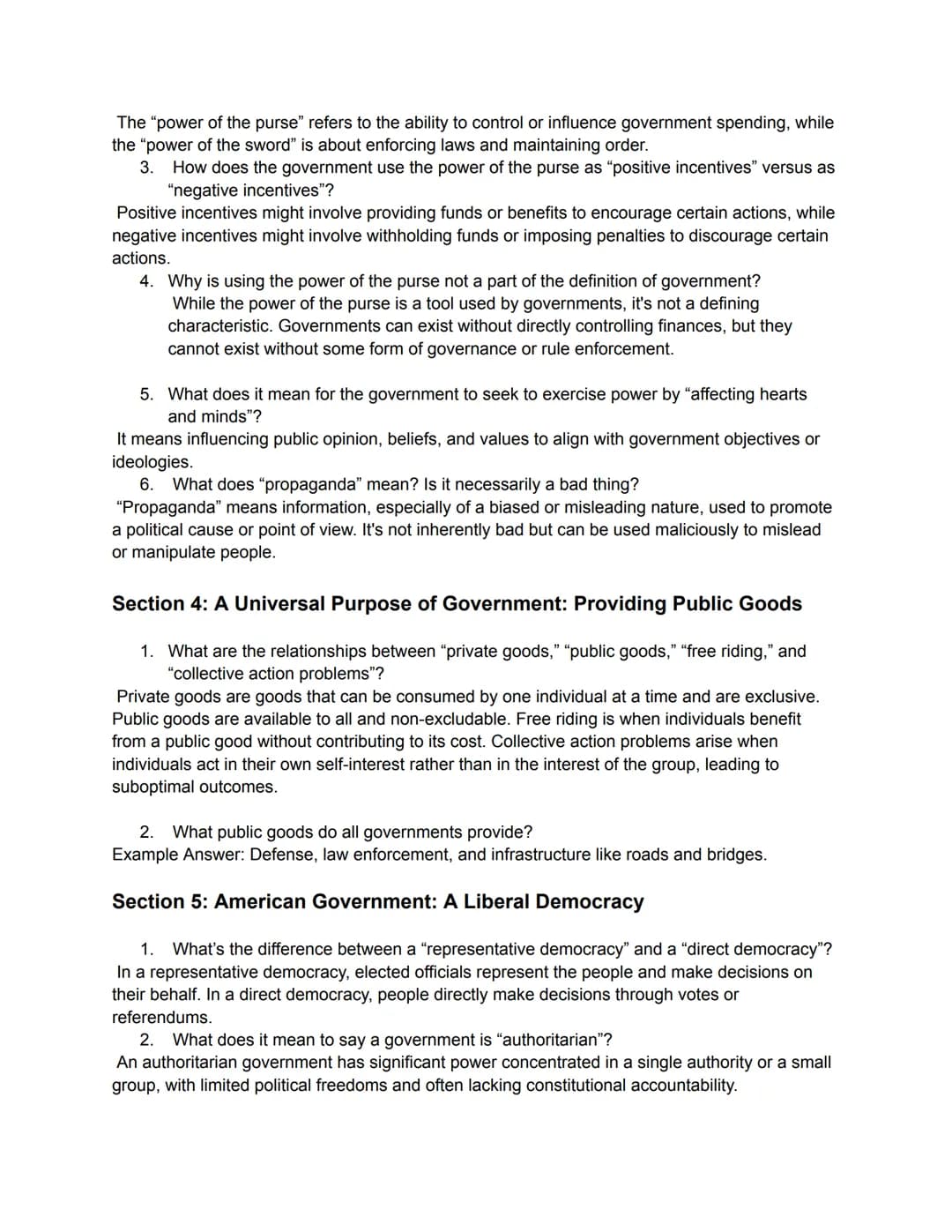
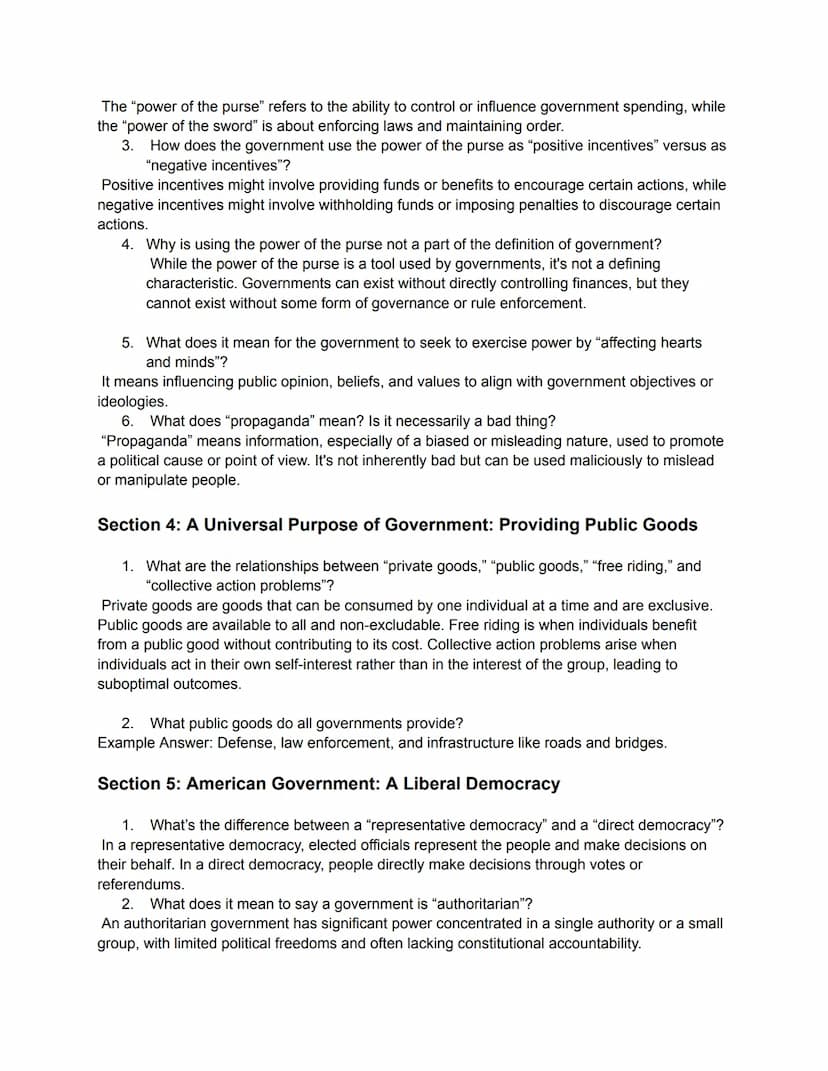
Money talks – even in government! The "power of the purse" is how governments control spending to influence behavior. Unlike the "power of the sword" (law enforcement), financial power works through incentives – positive ones like grants and benefits or negative ones like withholding funds and imposing penalties.
Governments also try to influence our "hearts and minds" through communication, education, and sometimes propaganda. While propaganda sounds sinister, it's simply information promoting a particular viewpoint – it can be honest or deceptive depending on how it's used.
All governments provide public goods – things everyone can access that are difficult to restrict to paying customers. This creates "collective action problems" where individuals might "free ride" (benefit without contributing), making government intervention necessary.
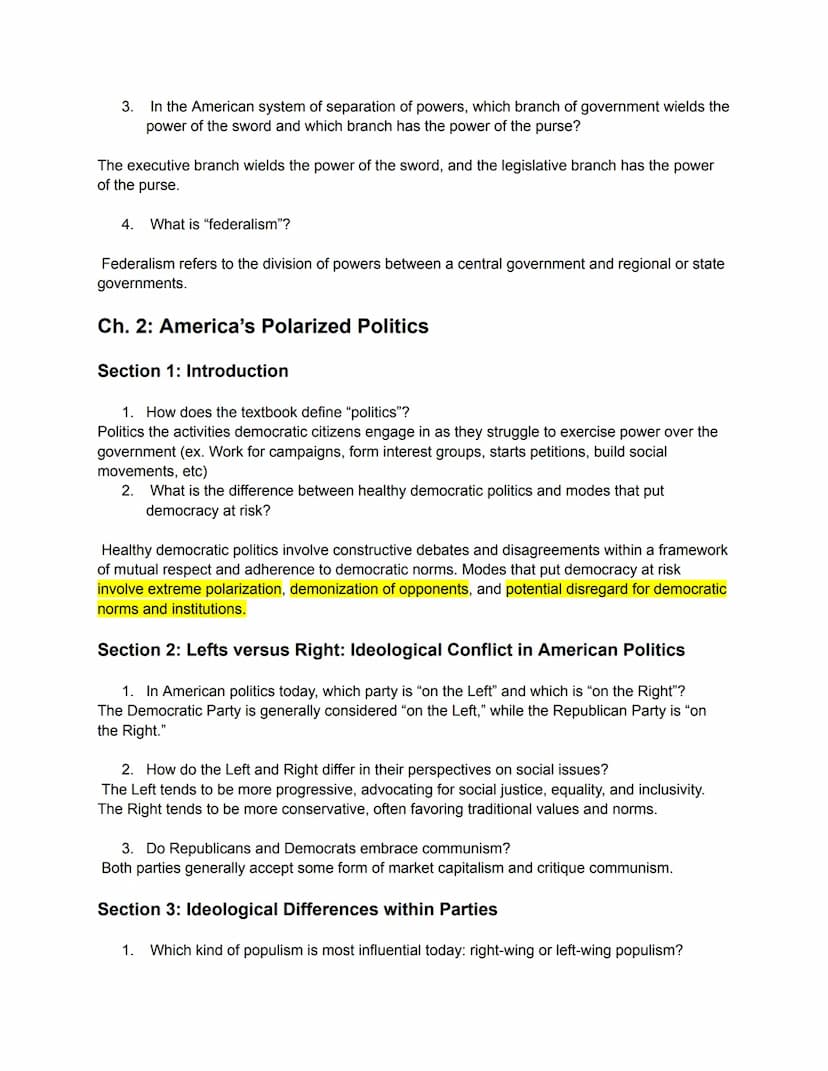
America functions as a liberal democracy – a system where citizens have protected rights and elect representatives to make decisions. This differs from a direct democracy where citizens vote on every issue. Our system features:
Important insight: The separation of powers divides authority between branches – the executive wielding the "sword" (enforcement) and the legislature controlling the "purse" (funding).
The American system also operates through federalism, dividing power between national and state governments to prevent any one authority from becoming too powerful.
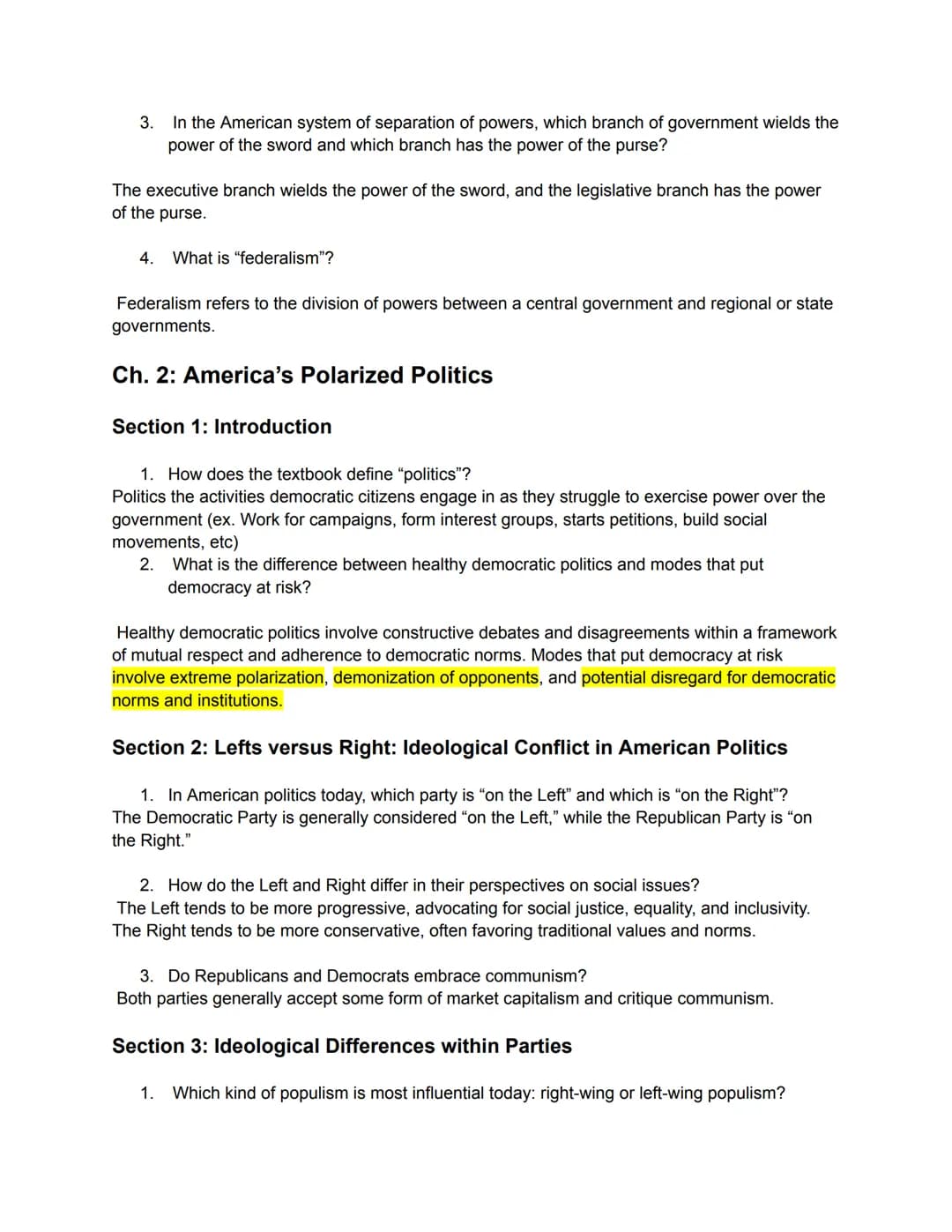
Politics isn't just what happens in Washington – it's about how citizens exercise power over their government through campaigns, interest groups, petitions, and social movements. Healthy democratic politics involves constructive debate within a framework of mutual respect, while unhealthy politics threatens democracy through extreme polarization and demonization.
The American political landscape divides primarily between Left (Democrats) and Right (Republicans). On social issues, the Left typically advocates for progressive values, equality, and inclusivity, while the Right favors more traditional values and norms. Despite their differences, both parties operate within a market capitalism framework, neither embracing communism.
These basic political divisions don't tell the whole story, though. Both major parties contain diverse ideological wings with significant internal disagreements about priorities and approaches. Understanding these nuances helps explain why politics isn't as simple as "red versus blue."
Reality check: Even people within the same party can have dramatically different views on economic policy, social issues, and the proper role of government!
The increasing complexity of American political identity has important implications for how we relate to each other as citizens and how effectively our democracy functions.
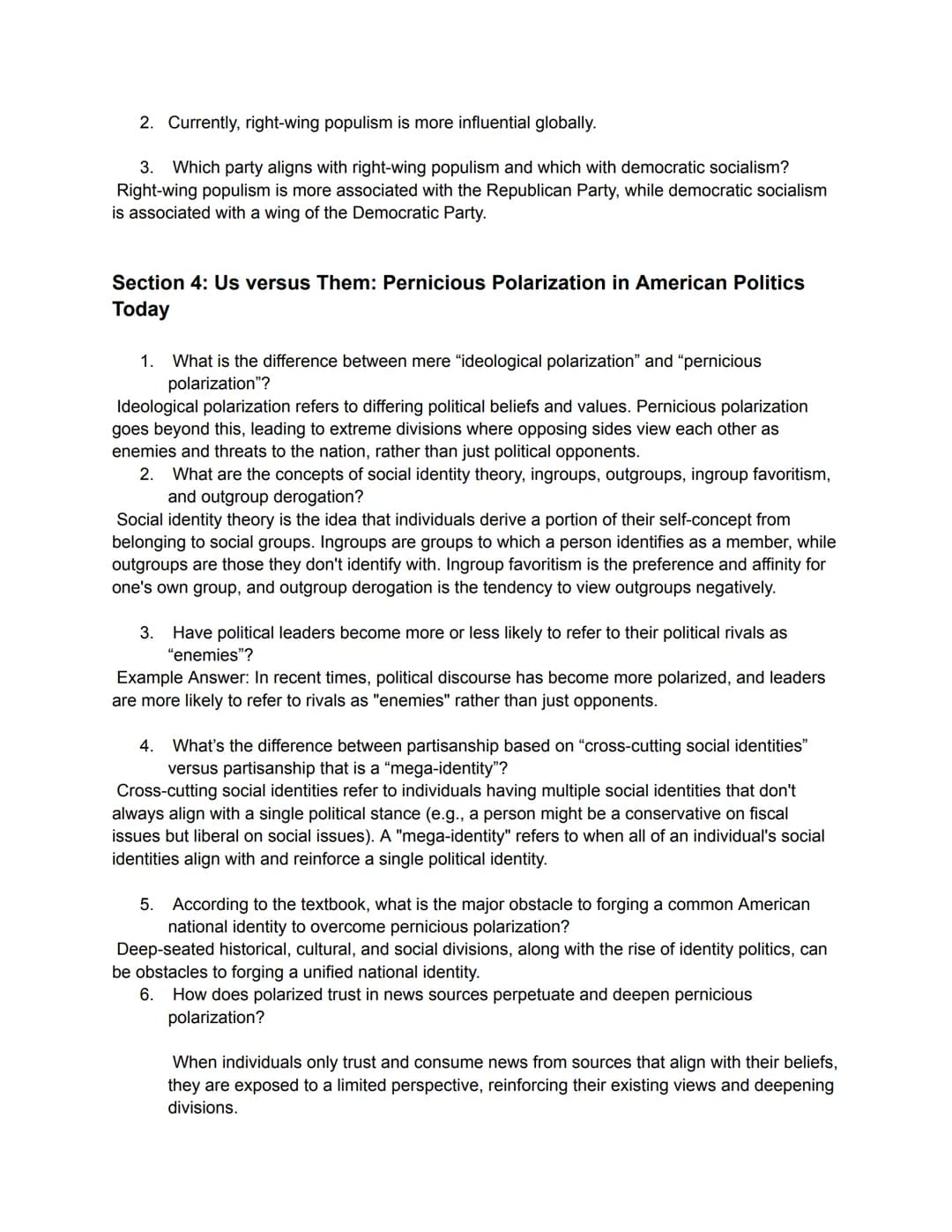
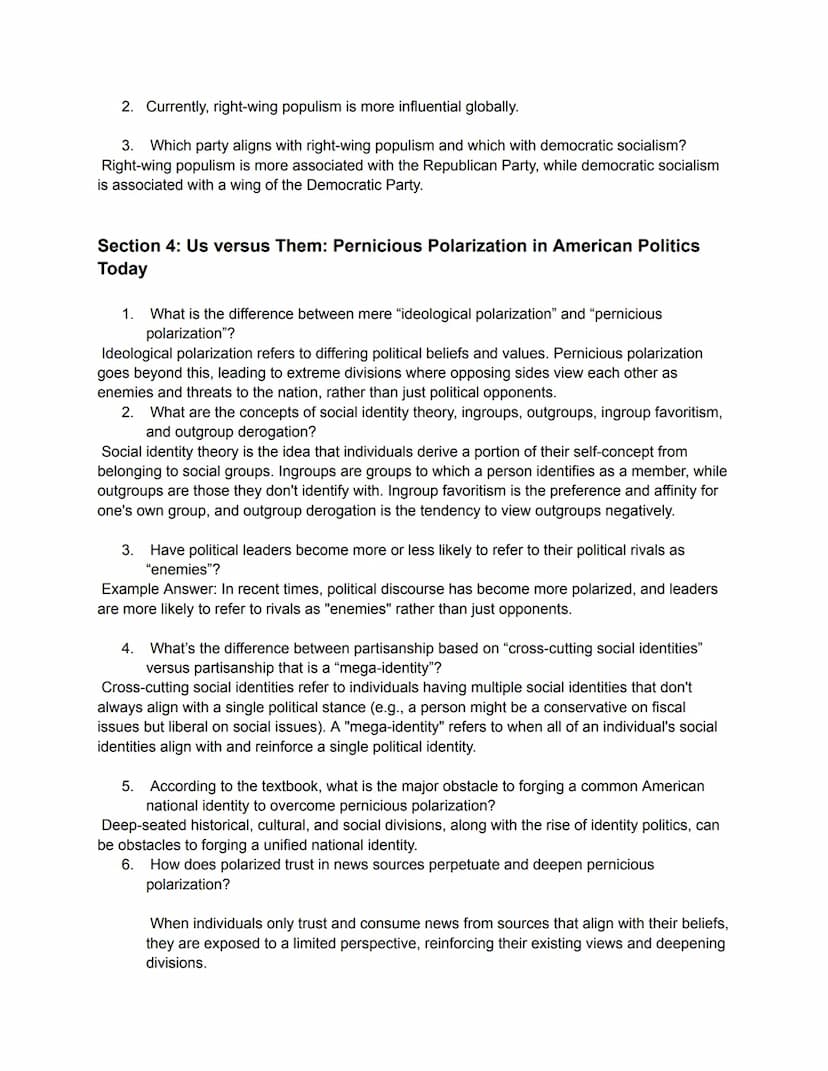
Right now, right-wing populism has more influence globally than left-wing populism. In America, right-wing populism aligns more with the Republican Party, while democratic socialism is associated with a wing of the Democratic Party.
The problem isn't just that Americans disagree on issues – it's that we've developed pernicious polarization. This goes beyond normal ideological differences to create tribal divisions where we view political opponents as enemies or threats to the nation itself.
Social identity theory helps explain this phenomenon. We naturally divide people into "ingroups" (those we identify with) and "outgroups" (those we don't). This leads to ingroup favoritism and outgroup derogation – preferring "our side" and viewing "their side" negatively.
Political leaders increasingly frame rivals as "enemies" rather than just opponents. Worse, partisan identity has become a "mega-identity" where political affiliation aligns with and reinforces other aspects of our identity like religion, geography, and cultural values.
Warning sign: When people only trust news sources that align with their existing beliefs, they enter information bubbles that reinforce their views and deepen political divisions.
Forging a common American identity to overcome this polarization is challenging due to deep historical, cultural, and social divisions that continue to shape our politics today.
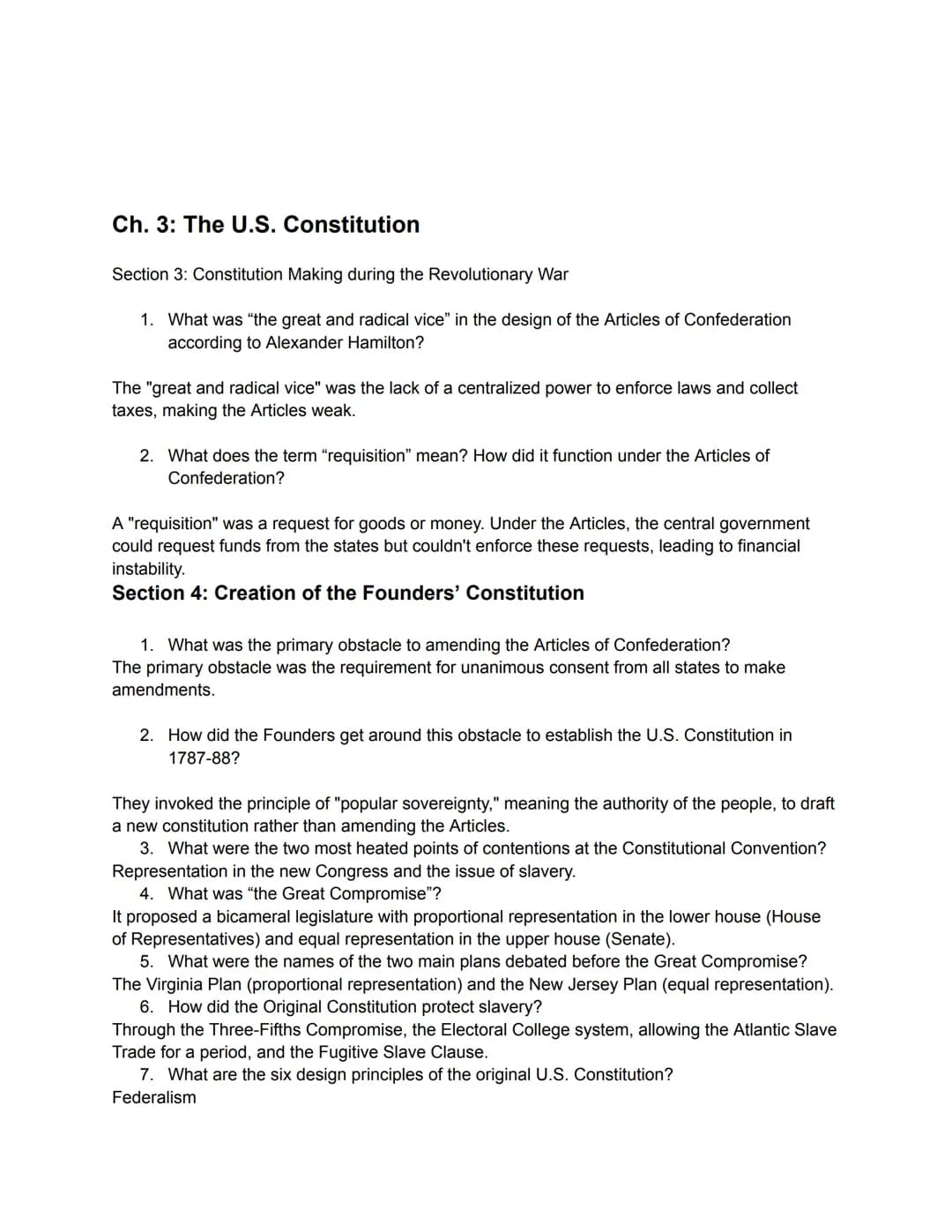
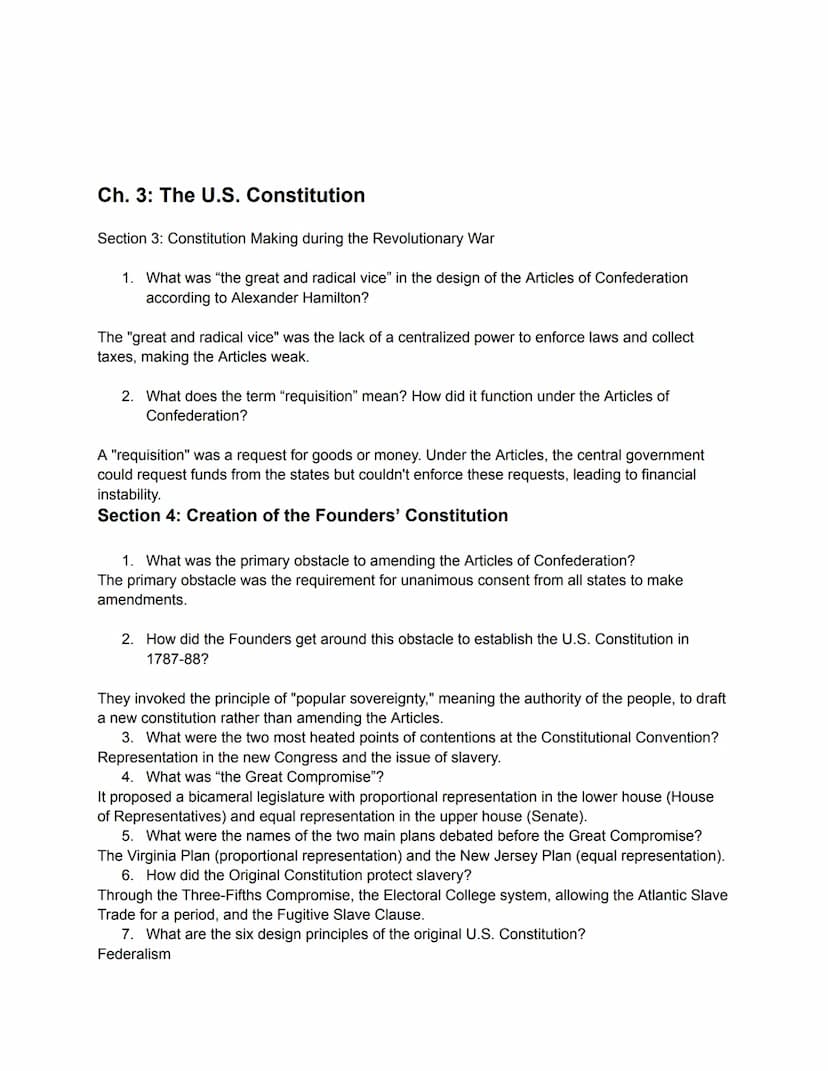
The Articles of Confederation had a fatal flaw – what Alexander Hamilton called "the great and radical vice." The central government couldn't enforce laws or collect taxes directly, relying instead on "requisitions" (requests for funds) from states that often went unfulfilled.
Amending the Articles required unanimous consent from all states, creating a nearly impossible barrier to reform. The Founders brilliantly circumvented this obstacle by invoking "popular sovereignty" – the authority of the people – to create an entirely new constitution rather than amending the existing one.
The Constitutional Convention of 1787 saw heated debates over representation in Congress and slavery. The Great Compromise resolved the first issue by creating a bicameral legislature: the House of Representatives (based on population) and the Senate (equal representation for each state). This balanced the competing Virginia Plan and New Jersey Plan.
The original Constitution protected slavery through several provisions, including the Three-Fifths Compromise, the Electoral College, allowing the Atlantic Slave Trade for a period, and the Fugitive Slave Clause.
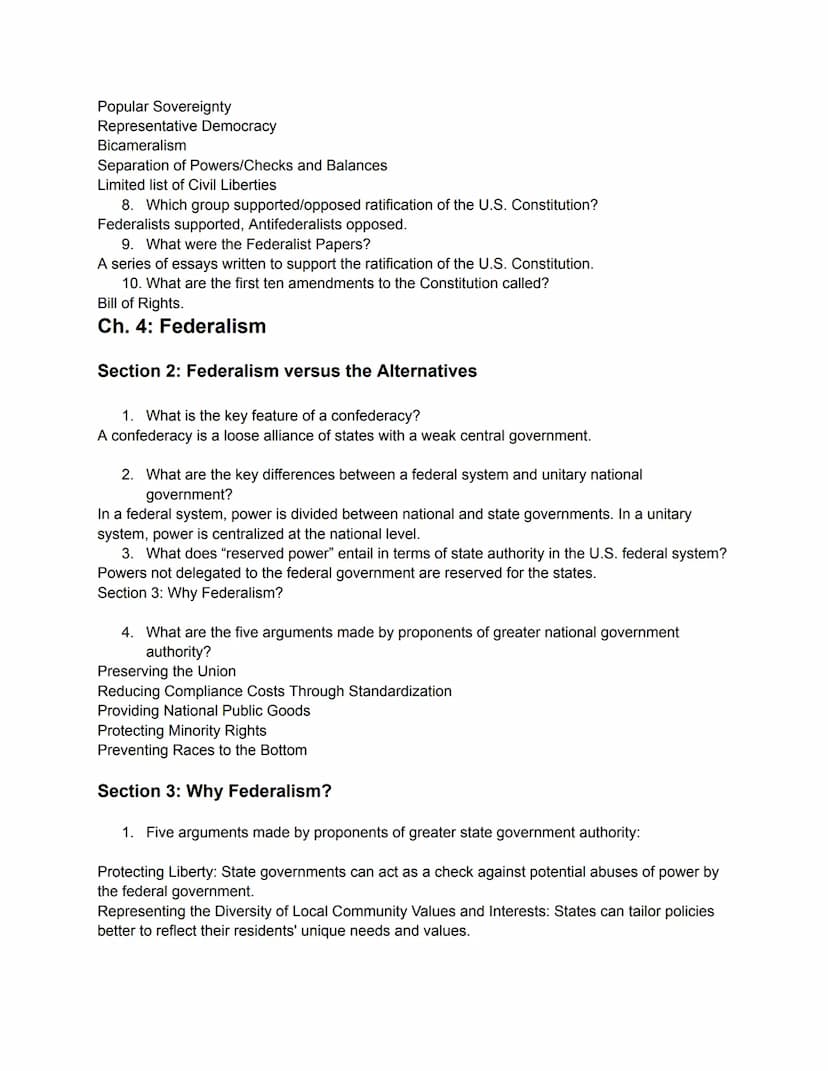
Foundation principles: The Constitution established six key design elements: federalism, popular sovereignty, representative democracy, bicameralism, separation of powers/checks and balances, and limited civil liberties.
The ratification debate pitted Federalists (supporters) against Antifederalists (opponents). The Federalist Papers argued for adoption, while concerns about centralized power led to the addition of the Bill of Rights – the first ten amendments to the Constitution.
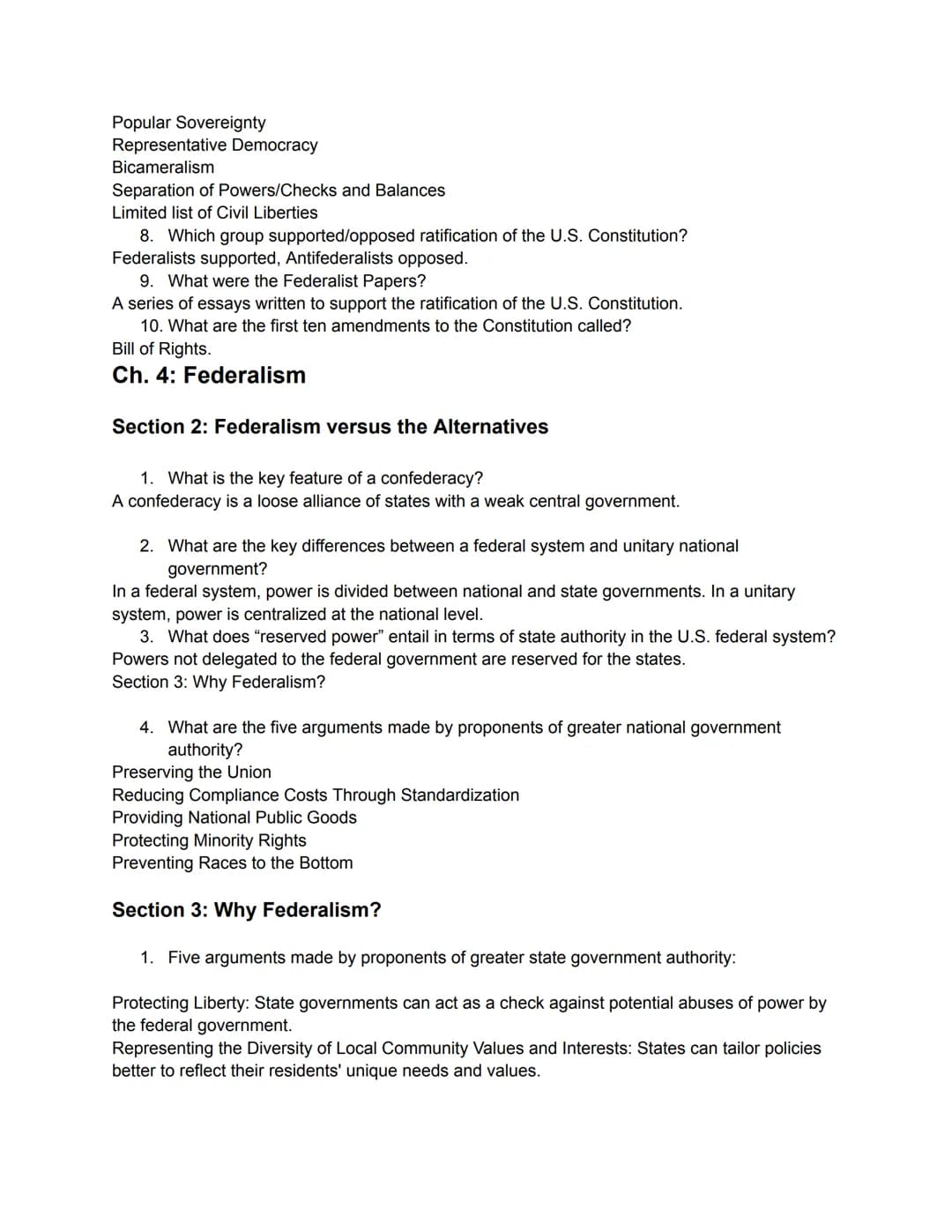
America's federal system strikes a balance between two extremes: a confederacy (where states have most power with a weak central government) and a unitary national government (where power is centralized). In our federal system, powers not explicitly given to the national government are "reserved" for the states.
Proponents of stronger national authority argue it helps preserve the union, reduces compliance costs through standardization, provides national public goods, protects minority rights, and prevents states from competing destructively by lowering standards (races to the bottom).
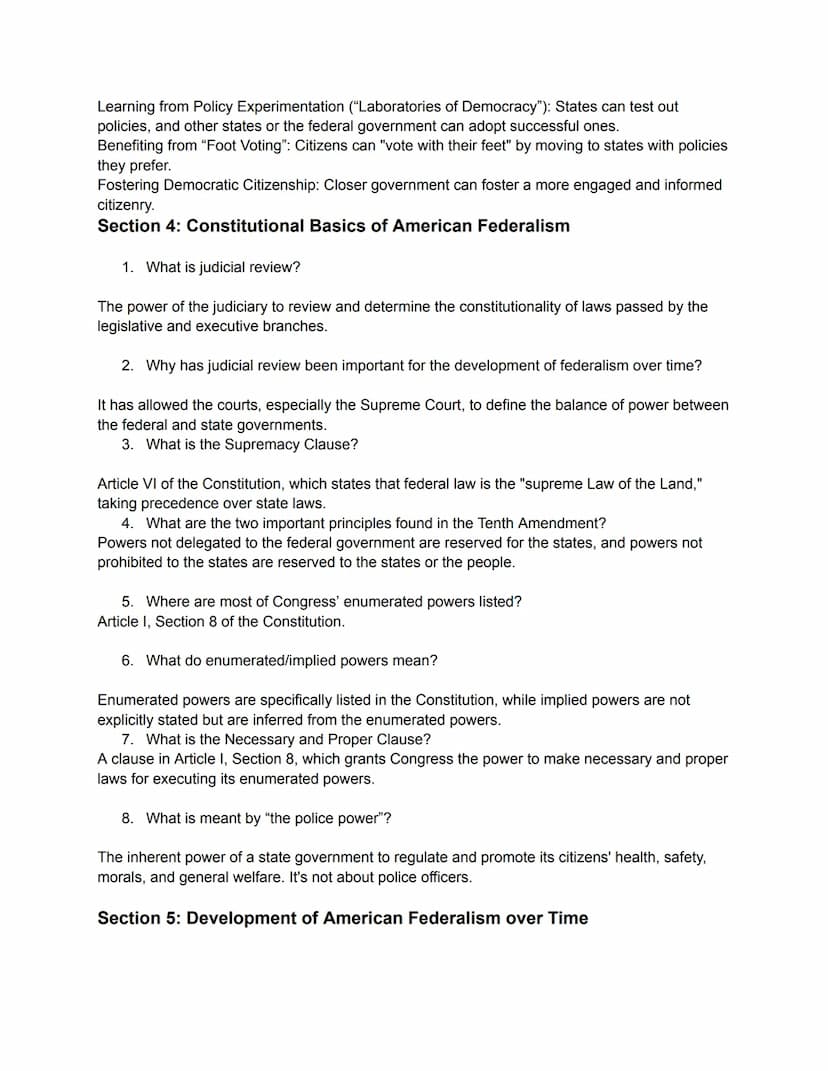
Those favoring greater state authority counter that states protect liberty by checking federal power, better represent local values, serve as "laboratories of democracy" for policy experimentation, allow citizens to "vote with their feet" by moving to states with preferred policies, and foster democratic citizenship through closer government.
The Constitution establishes federalism through several key mechanisms. Judicial review allows courts to determine the constitutionality of laws, helping define the balance between federal and state power. The Supremacy Clause establishes that federal law trumps state law when conflicts arise.
Constitutional foundation: The Tenth Amendment reinforces federalism by stating that powers not delegated to the federal government are reserved for the states or the people.
Congress has specific enumerated powers listed in Article I, Section 8, plus implied powers derived from the Necessary and Proper Clause, which allows Congress to make laws needed to execute its enumerated powers. States retain general "police power" to regulate public health, safety, and welfare.
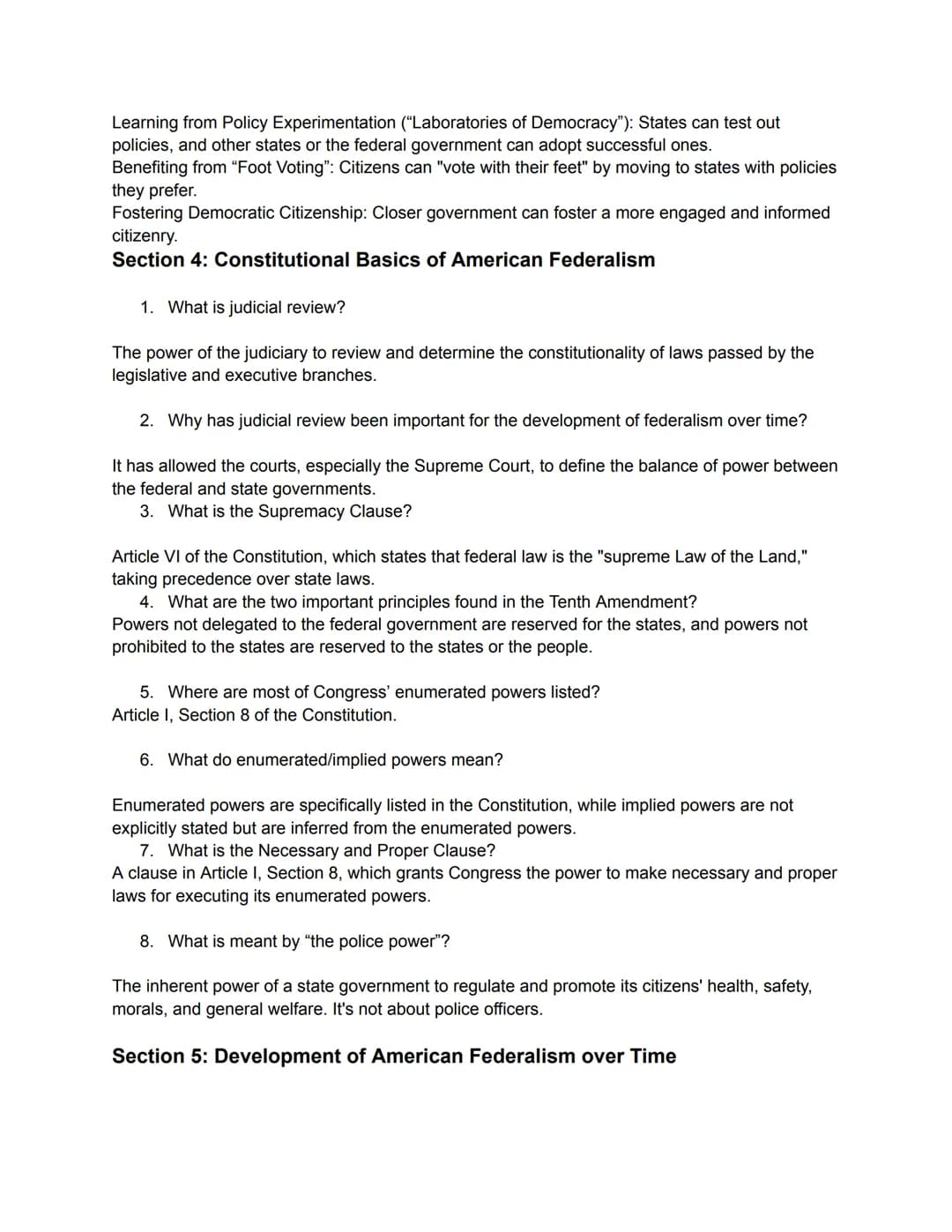
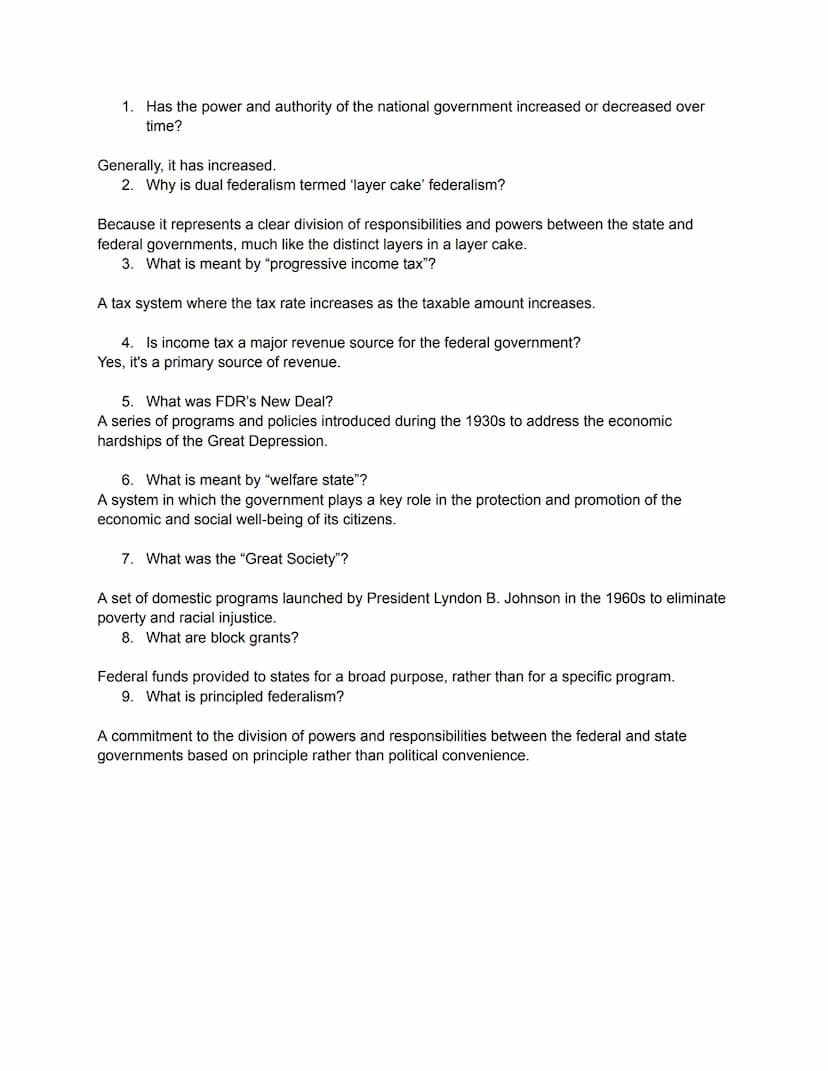
Federal power has generally increased throughout American history. Early American federalism followed a "layer cake" model called dual federalism, with clear separation between national and state responsibilities. This changed dramatically during the 20th century.
The implementation of progressive income taxation gave the federal government enormous revenue, becoming its major funding source. This financial power transformed federal capabilities and reach.
Franklin Roosevelt's New Deal responded to the Great Depression with unprecedented federal programs, establishing the modern American welfare state where government actively promotes citizens' economic and social well-being. This trend continued with Lyndon Johnson's Great Society programs in the 1960s, which sought to eliminate poverty and racial injustice.
Later, some power shifted back to states through tools like block grants, which provide federal funds to states for broad purposes rather than specific programs. This allows states more flexibility in implementation.
Power shifts: The balance between federal and state power continues to evolve, with some areas seeing increased federal authority while others experience devolution to the states.
The concept of principled federalism encourages dividing powers based on constitutional principles rather than political convenience, though in practice, many politicians favor national solutions for issues they prioritize while supporting state authority for others.
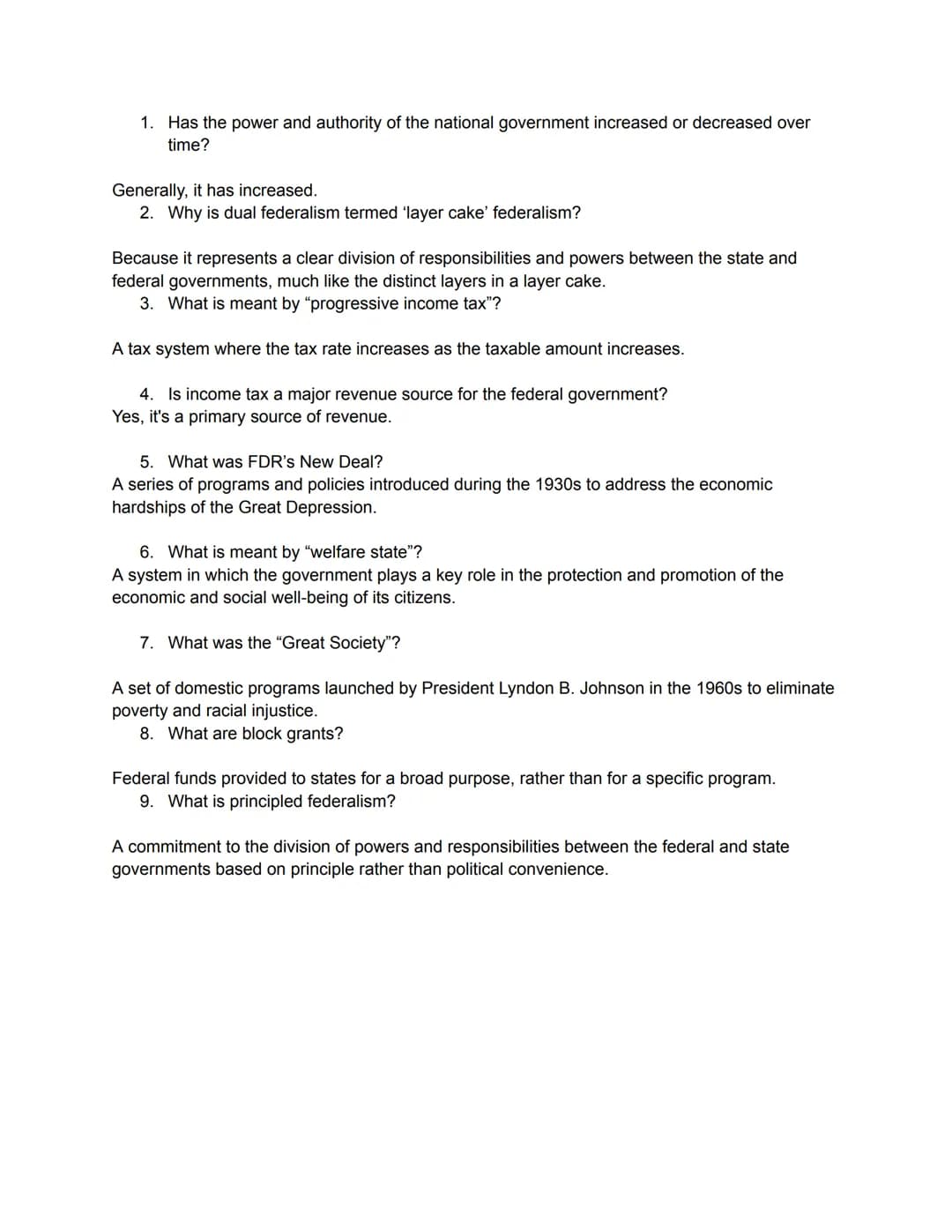
The power of the national government has substantially increased over time, shifting from the original dual federalism model where responsibilities were clearly separated like layers in a cake. Several factors drove this transformation.
The progressive income tax revolutionized government finance, making individual and corporate taxes the federal government's primary revenue source. This massive funding stream enabled unprecedented federal programs and influence.
The 1930s brought Franklin Roosevelt's New Deal – emergency programs addressing the Great Depression that permanently expanded federal responsibility. These initiatives established America's modern welfare state, where government actively supports citizens' economic security through programs like Social Security.
This expansion continued with Lyndon Johnson's Great Society in the 1960s, which created Medicare, Medicaid, and other programs targeting poverty and inequality. Later administrations adjusted the federal-state balance by using tools like block grants – federal funds given to states with general guidelines rather than strict requirements.
Reality check: Politicians often support "principled federalism" in theory but abandon it when convenient. They typically favor national solutions for issues they prioritize while supporting state authority for others.
The ongoing tension between federal and state power remains fundamental to American governance. This balance continues to shift in response to court decisions, political movements, and changing national priorities.
Our AI companion is specifically built for the needs of students. Based on the millions of content pieces we have on the platform we can provide truly meaningful and relevant answers to students. But its not only about answers, the companion is even more about guiding students through their daily learning challenges, with personalised study plans, quizzes or content pieces in the chat and 100% personalisation based on the students skills and developments.
You can download the app in the Google Play Store and in the Apple App Store.
That's right! Enjoy free access to study content, connect with fellow students, and get instant help – all at your fingertips.
App Store
Google Play
The app is very easy to use and well designed. I have found everything I was looking for so far and have been able to learn a lot from the presentations! I will definitely use the app for a class assignment! And of course it also helps a lot as an inspiration.
Stefan S
iOS user
This app is really great. There are so many study notes and help [...]. My problem subject is French, for example, and the app has so many options for help. Thanks to this app, I have improved my French. I would recommend it to anyone.
Samantha Klich
Android user
Wow, I am really amazed. I just tried the app because I've seen it advertised many times and was absolutely stunned. This app is THE HELP you want for school and above all, it offers so many things, such as workouts and fact sheets, which have been VERY helpful to me personally.
Anna
iOS user
I think it’s very much worth it and you’ll end up using it a lot once you get the hang of it and even after looking at others notes you can still ask your Artificial intelligence buddy the question and ask to simplify it if you still don’t get it!!! In the end I think it’s worth it 😊👍 ⚠️Also DID I MENTION ITS FREEE YOU DON’T HAVE TO PAY FOR ANYTHING AND STILL GET YOUR GRADES IN PERFECTLY❗️❗️⚠️
Thomas R
iOS user
Knowunity is the BEST app I’ve used in a minute. This is not an ai review or anything this is genuinely coming from a 7th grade student (I know 2011 im young) but dude this app is a 10/10 i have maintained a 3.8 gpa and have plenty of time for gaming. I love it and my mom is just happy I got good grades
Brad T
Android user
Not only did it help me find the answer but it also showed me alternative ways to solve it. I was horrible in math and science but now I have an a in both subjects. Thanks for the help🤍🤍
David K
iOS user
The app's just great! All I have to do is enter the topic in the search bar and I get the response real fast. I don't have to watch 10 YouTube videos to understand something, so I'm saving my time. Highly recommended!
Sudenaz Ocak
Android user
In school I was really bad at maths but thanks to the app, I am doing better now. I am so grateful that you made the app.
Greenlight Bonnie
Android user
I found this app a couple years ago and it has only gotten better since then. I really love it because it can help with written questions and photo questions. Also, it can find study guides that other people have made as well as flashcard sets and practice tests. The free version is also amazing for students who might not be able to afford it. Would 100% recommend
Aubrey
iOS user
Best app if you're in Highschool or Junior high. I have been using this app for 2 school years and it's the best, it's good if you don't have anyone to help you with school work.😋🩷🎀
Marco B
iOS user
THE QUIZES AND FLASHCARDS ARE SO USEFUL AND I LOVE THE SCHOOLGPT. IT ALSO IS LITREALLY LIKE CHATGPT BUT SMARTER!! HELPED ME WITH MY MASCARA PROBLEMS TOO!! AS WELL AS MY REAL SUBJECTS ! DUHHH 😍😁😲🤑💗✨🎀😮
Elisha
iOS user
This app is phenomenal down to the correct info and the various topics you can study! I greatly recommend it for people who struggle with procrastination and those who need homework help. It has been perfectly accurate for world 1 history as far as I’ve seen! Geometry too!
Paul T
iOS user
The app is very easy to use and well designed. I have found everything I was looking for so far and have been able to learn a lot from the presentations! I will definitely use the app for a class assignment! And of course it also helps a lot as an inspiration.
Stefan S
iOS user
This app is really great. There are so many study notes and help [...]. My problem subject is French, for example, and the app has so many options for help. Thanks to this app, I have improved my French. I would recommend it to anyone.
Samantha Klich
Android user
Wow, I am really amazed. I just tried the app because I've seen it advertised many times and was absolutely stunned. This app is THE HELP you want for school and above all, it offers so many things, such as workouts and fact sheets, which have been VERY helpful to me personally.
Anna
iOS user
I think it’s very much worth it and you’ll end up using it a lot once you get the hang of it and even after looking at others notes you can still ask your Artificial intelligence buddy the question and ask to simplify it if you still don’t get it!!! In the end I think it’s worth it 😊👍 ⚠️Also DID I MENTION ITS FREEE YOU DON’T HAVE TO PAY FOR ANYTHING AND STILL GET YOUR GRADES IN PERFECTLY❗️❗️⚠️
Thomas R
iOS user
Knowunity is the BEST app I’ve used in a minute. This is not an ai review or anything this is genuinely coming from a 7th grade student (I know 2011 im young) but dude this app is a 10/10 i have maintained a 3.8 gpa and have plenty of time for gaming. I love it and my mom is just happy I got good grades
Brad T
Android user
Not only did it help me find the answer but it also showed me alternative ways to solve it. I was horrible in math and science but now I have an a in both subjects. Thanks for the help🤍🤍
David K
iOS user
The app's just great! All I have to do is enter the topic in the search bar and I get the response real fast. I don't have to watch 10 YouTube videos to understand something, so I'm saving my time. Highly recommended!
Sudenaz Ocak
Android user
In school I was really bad at maths but thanks to the app, I am doing better now. I am so grateful that you made the app.
Greenlight Bonnie
Android user
I found this app a couple years ago and it has only gotten better since then. I really love it because it can help with written questions and photo questions. Also, it can find study guides that other people have made as well as flashcard sets and practice tests. The free version is also amazing for students who might not be able to afford it. Would 100% recommend
Aubrey
iOS user
Best app if you're in Highschool or Junior high. I have been using this app for 2 school years and it's the best, it's good if you don't have anyone to help you with school work.😋🩷🎀
Marco B
iOS user
THE QUIZES AND FLASHCARDS ARE SO USEFUL AND I LOVE THE SCHOOLGPT. IT ALSO IS LITREALLY LIKE CHATGPT BUT SMARTER!! HELPED ME WITH MY MASCARA PROBLEMS TOO!! AS WELL AS MY REAL SUBJECTS ! DUHHH 😍😁😲🤑💗✨🎀😮
Elisha
iOS user
This app is phenomenal down to the correct info and the various topics you can study! I greatly recommend it for people who struggle with procrastination and those who need homework help. It has been perfectly accurate for world 1 history as far as I’ve seen! Geometry too!
Paul T
iOS user
hi
@hi_qqiy
American government is a complex system built on principles that guide how power is exercised and distributed. From the structure of our three branches to the delicate balance of federalism, understanding these foundations helps us make sense of today's political... Show more
Access to all documents
Improve your grades
Join milions of students
By signing up you accept Terms of Service and Privacy Policy
Ever wonder who's really running things in America? At the federal level, we have the United States Congress as our legislature, with the Senate (upper chamber) and House of Representatives (lower chamber). Georgia follows a similar pattern with its General Assembly, divided into the State Senate and House of Representatives.
The executive branches are headed by the President at the federal level and the Governor in Georgia. When it comes to legal matters, the highest courts are the U.S. Supreme Court federally and the Supreme Court of Georgia at the state level.
All bureaucratic agencies belong to the executive branch, helping implement and enforce laws. Governments exercise the "power of the sword" – the authority to enforce laws and maintain order. This power is central to what makes a government a government.
Think about it: The concept of "sovereignty" means a government has full right to govern itself without outside interference. This is why countries are so protective of their borders and independence!
The government also exercises power through relationships and financial control, affecting both our actions and our thinking.
Access to all documents
Improve your grades
Join milions of students
By signing up you accept Terms of Service and Privacy Policy
Money talks – even in government! The "power of the purse" is how governments control spending to influence behavior. Unlike the "power of the sword" (law enforcement), financial power works through incentives – positive ones like grants and benefits or negative ones like withholding funds and imposing penalties.
Governments also try to influence our "hearts and minds" through communication, education, and sometimes propaganda. While propaganda sounds sinister, it's simply information promoting a particular viewpoint – it can be honest or deceptive depending on how it's used.
All governments provide public goods – things everyone can access that are difficult to restrict to paying customers. This creates "collective action problems" where individuals might "free ride" (benefit without contributing), making government intervention necessary.
America functions as a liberal democracy – a system where citizens have protected rights and elect representatives to make decisions. This differs from a direct democracy where citizens vote on every issue. Our system features:
Important insight: The separation of powers divides authority between branches – the executive wielding the "sword" (enforcement) and the legislature controlling the "purse" (funding).
The American system also operates through federalism, dividing power between national and state governments to prevent any one authority from becoming too powerful.
Access to all documents
Improve your grades
Join milions of students
By signing up you accept Terms of Service and Privacy Policy
Politics isn't just what happens in Washington – it's about how citizens exercise power over their government through campaigns, interest groups, petitions, and social movements. Healthy democratic politics involves constructive debate within a framework of mutual respect, while unhealthy politics threatens democracy through extreme polarization and demonization.
The American political landscape divides primarily between Left (Democrats) and Right (Republicans). On social issues, the Left typically advocates for progressive values, equality, and inclusivity, while the Right favors more traditional values and norms. Despite their differences, both parties operate within a market capitalism framework, neither embracing communism.
These basic political divisions don't tell the whole story, though. Both major parties contain diverse ideological wings with significant internal disagreements about priorities and approaches. Understanding these nuances helps explain why politics isn't as simple as "red versus blue."
Reality check: Even people within the same party can have dramatically different views on economic policy, social issues, and the proper role of government!
The increasing complexity of American political identity has important implications for how we relate to each other as citizens and how effectively our democracy functions.
Access to all documents
Improve your grades
Join milions of students
By signing up you accept Terms of Service and Privacy Policy
Right now, right-wing populism has more influence globally than left-wing populism. In America, right-wing populism aligns more with the Republican Party, while democratic socialism is associated with a wing of the Democratic Party.
The problem isn't just that Americans disagree on issues – it's that we've developed pernicious polarization. This goes beyond normal ideological differences to create tribal divisions where we view political opponents as enemies or threats to the nation itself.
Social identity theory helps explain this phenomenon. We naturally divide people into "ingroups" (those we identify with) and "outgroups" (those we don't). This leads to ingroup favoritism and outgroup derogation – preferring "our side" and viewing "their side" negatively.
Political leaders increasingly frame rivals as "enemies" rather than just opponents. Worse, partisan identity has become a "mega-identity" where political affiliation aligns with and reinforces other aspects of our identity like religion, geography, and cultural values.
Warning sign: When people only trust news sources that align with their existing beliefs, they enter information bubbles that reinforce their views and deepen political divisions.
Forging a common American identity to overcome this polarization is challenging due to deep historical, cultural, and social divisions that continue to shape our politics today.
Access to all documents
Improve your grades
Join milions of students
By signing up you accept Terms of Service and Privacy Policy
The Articles of Confederation had a fatal flaw – what Alexander Hamilton called "the great and radical vice." The central government couldn't enforce laws or collect taxes directly, relying instead on "requisitions" (requests for funds) from states that often went unfulfilled.
Amending the Articles required unanimous consent from all states, creating a nearly impossible barrier to reform. The Founders brilliantly circumvented this obstacle by invoking "popular sovereignty" – the authority of the people – to create an entirely new constitution rather than amending the existing one.
The Constitutional Convention of 1787 saw heated debates over representation in Congress and slavery. The Great Compromise resolved the first issue by creating a bicameral legislature: the House of Representatives (based on population) and the Senate (equal representation for each state). This balanced the competing Virginia Plan and New Jersey Plan.
The original Constitution protected slavery through several provisions, including the Three-Fifths Compromise, the Electoral College, allowing the Atlantic Slave Trade for a period, and the Fugitive Slave Clause.
Foundation principles: The Constitution established six key design elements: federalism, popular sovereignty, representative democracy, bicameralism, separation of powers/checks and balances, and limited civil liberties.
The ratification debate pitted Federalists (supporters) against Antifederalists (opponents). The Federalist Papers argued for adoption, while concerns about centralized power led to the addition of the Bill of Rights – the first ten amendments to the Constitution.
Access to all documents
Improve your grades
Join milions of students
By signing up you accept Terms of Service and Privacy Policy
America's federal system strikes a balance between two extremes: a confederacy (where states have most power with a weak central government) and a unitary national government (where power is centralized). In our federal system, powers not explicitly given to the national government are "reserved" for the states.
Proponents of stronger national authority argue it helps preserve the union, reduces compliance costs through standardization, provides national public goods, protects minority rights, and prevents states from competing destructively by lowering standards (races to the bottom).
Those favoring greater state authority counter that states protect liberty by checking federal power, better represent local values, serve as "laboratories of democracy" for policy experimentation, allow citizens to "vote with their feet" by moving to states with preferred policies, and foster democratic citizenship through closer government.
The Constitution establishes federalism through several key mechanisms. Judicial review allows courts to determine the constitutionality of laws, helping define the balance between federal and state power. The Supremacy Clause establishes that federal law trumps state law when conflicts arise.
Constitutional foundation: The Tenth Amendment reinforces federalism by stating that powers not delegated to the federal government are reserved for the states or the people.
Congress has specific enumerated powers listed in Article I, Section 8, plus implied powers derived from the Necessary and Proper Clause, which allows Congress to make laws needed to execute its enumerated powers. States retain general "police power" to regulate public health, safety, and welfare.
Access to all documents
Improve your grades
Join milions of students
By signing up you accept Terms of Service and Privacy Policy
Federal power has generally increased throughout American history. Early American federalism followed a "layer cake" model called dual federalism, with clear separation between national and state responsibilities. This changed dramatically during the 20th century.
The implementation of progressive income taxation gave the federal government enormous revenue, becoming its major funding source. This financial power transformed federal capabilities and reach.
Franklin Roosevelt's New Deal responded to the Great Depression with unprecedented federal programs, establishing the modern American welfare state where government actively promotes citizens' economic and social well-being. This trend continued with Lyndon Johnson's Great Society programs in the 1960s, which sought to eliminate poverty and racial injustice.
Later, some power shifted back to states through tools like block grants, which provide federal funds to states for broad purposes rather than specific programs. This allows states more flexibility in implementation.
Power shifts: The balance between federal and state power continues to evolve, with some areas seeing increased federal authority while others experience devolution to the states.
The concept of principled federalism encourages dividing powers based on constitutional principles rather than political convenience, though in practice, many politicians favor national solutions for issues they prioritize while supporting state authority for others.
Access to all documents
Improve your grades
Join milions of students
By signing up you accept Terms of Service and Privacy Policy
The power of the national government has substantially increased over time, shifting from the original dual federalism model where responsibilities were clearly separated like layers in a cake. Several factors drove this transformation.
The progressive income tax revolutionized government finance, making individual and corporate taxes the federal government's primary revenue source. This massive funding stream enabled unprecedented federal programs and influence.
The 1930s brought Franklin Roosevelt's New Deal – emergency programs addressing the Great Depression that permanently expanded federal responsibility. These initiatives established America's modern welfare state, where government actively supports citizens' economic security through programs like Social Security.
This expansion continued with Lyndon Johnson's Great Society in the 1960s, which created Medicare, Medicaid, and other programs targeting poverty and inequality. Later administrations adjusted the federal-state balance by using tools like block grants – federal funds given to states with general guidelines rather than strict requirements.
Reality check: Politicians often support "principled federalism" in theory but abandon it when convenient. They typically favor national solutions for issues they prioritize while supporting state authority for others.
The ongoing tension between federal and state power remains fundamental to American governance. This balance continues to shift in response to court decisions, political movements, and changing national priorities.
Our AI companion is specifically built for the needs of students. Based on the millions of content pieces we have on the platform we can provide truly meaningful and relevant answers to students. But its not only about answers, the companion is even more about guiding students through their daily learning challenges, with personalised study plans, quizzes or content pieces in the chat and 100% personalisation based on the students skills and developments.
You can download the app in the Google Play Store and in the Apple App Store.
That's right! Enjoy free access to study content, connect with fellow students, and get instant help – all at your fingertips.
4
Smart Tools NEW
Transform this note into: ✓ 50+ Practice Questions ✓ Interactive Flashcards ✓ Full Mock Exam ✓ Essay Outlines
App Store
Google Play
The app is very easy to use and well designed. I have found everything I was looking for so far and have been able to learn a lot from the presentations! I will definitely use the app for a class assignment! And of course it also helps a lot as an inspiration.
Stefan S
iOS user
This app is really great. There are so many study notes and help [...]. My problem subject is French, for example, and the app has so many options for help. Thanks to this app, I have improved my French. I would recommend it to anyone.
Samantha Klich
Android user
Wow, I am really amazed. I just tried the app because I've seen it advertised many times and was absolutely stunned. This app is THE HELP you want for school and above all, it offers so many things, such as workouts and fact sheets, which have been VERY helpful to me personally.
Anna
iOS user
I think it’s very much worth it and you’ll end up using it a lot once you get the hang of it and even after looking at others notes you can still ask your Artificial intelligence buddy the question and ask to simplify it if you still don’t get it!!! In the end I think it’s worth it 😊👍 ⚠️Also DID I MENTION ITS FREEE YOU DON’T HAVE TO PAY FOR ANYTHING AND STILL GET YOUR GRADES IN PERFECTLY❗️❗️⚠️
Thomas R
iOS user
Knowunity is the BEST app I’ve used in a minute. This is not an ai review or anything this is genuinely coming from a 7th grade student (I know 2011 im young) but dude this app is a 10/10 i have maintained a 3.8 gpa and have plenty of time for gaming. I love it and my mom is just happy I got good grades
Brad T
Android user
Not only did it help me find the answer but it also showed me alternative ways to solve it. I was horrible in math and science but now I have an a in both subjects. Thanks for the help🤍🤍
David K
iOS user
The app's just great! All I have to do is enter the topic in the search bar and I get the response real fast. I don't have to watch 10 YouTube videos to understand something, so I'm saving my time. Highly recommended!
Sudenaz Ocak
Android user
In school I was really bad at maths but thanks to the app, I am doing better now. I am so grateful that you made the app.
Greenlight Bonnie
Android user
I found this app a couple years ago and it has only gotten better since then. I really love it because it can help with written questions and photo questions. Also, it can find study guides that other people have made as well as flashcard sets and practice tests. The free version is also amazing for students who might not be able to afford it. Would 100% recommend
Aubrey
iOS user
Best app if you're in Highschool or Junior high. I have been using this app for 2 school years and it's the best, it's good if you don't have anyone to help you with school work.😋🩷🎀
Marco B
iOS user
THE QUIZES AND FLASHCARDS ARE SO USEFUL AND I LOVE THE SCHOOLGPT. IT ALSO IS LITREALLY LIKE CHATGPT BUT SMARTER!! HELPED ME WITH MY MASCARA PROBLEMS TOO!! AS WELL AS MY REAL SUBJECTS ! DUHHH 😍😁😲🤑💗✨🎀😮
Elisha
iOS user
This app is phenomenal down to the correct info and the various topics you can study! I greatly recommend it for people who struggle with procrastination and those who need homework help. It has been perfectly accurate for world 1 history as far as I’ve seen! Geometry too!
Paul T
iOS user
The app is very easy to use and well designed. I have found everything I was looking for so far and have been able to learn a lot from the presentations! I will definitely use the app for a class assignment! And of course it also helps a lot as an inspiration.
Stefan S
iOS user
This app is really great. There are so many study notes and help [...]. My problem subject is French, for example, and the app has so many options for help. Thanks to this app, I have improved my French. I would recommend it to anyone.
Samantha Klich
Android user
Wow, I am really amazed. I just tried the app because I've seen it advertised many times and was absolutely stunned. This app is THE HELP you want for school and above all, it offers so many things, such as workouts and fact sheets, which have been VERY helpful to me personally.
Anna
iOS user
I think it’s very much worth it and you’ll end up using it a lot once you get the hang of it and even after looking at others notes you can still ask your Artificial intelligence buddy the question and ask to simplify it if you still don’t get it!!! In the end I think it’s worth it 😊👍 ⚠️Also DID I MENTION ITS FREEE YOU DON’T HAVE TO PAY FOR ANYTHING AND STILL GET YOUR GRADES IN PERFECTLY❗️❗️⚠️
Thomas R
iOS user
Knowunity is the BEST app I’ve used in a minute. This is not an ai review or anything this is genuinely coming from a 7th grade student (I know 2011 im young) but dude this app is a 10/10 i have maintained a 3.8 gpa and have plenty of time for gaming. I love it and my mom is just happy I got good grades
Brad T
Android user
Not only did it help me find the answer but it also showed me alternative ways to solve it. I was horrible in math and science but now I have an a in both subjects. Thanks for the help🤍🤍
David K
iOS user
The app's just great! All I have to do is enter the topic in the search bar and I get the response real fast. I don't have to watch 10 YouTube videos to understand something, so I'm saving my time. Highly recommended!
Sudenaz Ocak
Android user
In school I was really bad at maths but thanks to the app, I am doing better now. I am so grateful that you made the app.
Greenlight Bonnie
Android user
I found this app a couple years ago and it has only gotten better since then. I really love it because it can help with written questions and photo questions. Also, it can find study guides that other people have made as well as flashcard sets and practice tests. The free version is also amazing for students who might not be able to afford it. Would 100% recommend
Aubrey
iOS user
Best app if you're in Highschool or Junior high. I have been using this app for 2 school years and it's the best, it's good if you don't have anyone to help you with school work.😋🩷🎀
Marco B
iOS user
THE QUIZES AND FLASHCARDS ARE SO USEFUL AND I LOVE THE SCHOOLGPT. IT ALSO IS LITREALLY LIKE CHATGPT BUT SMARTER!! HELPED ME WITH MY MASCARA PROBLEMS TOO!! AS WELL AS MY REAL SUBJECTS ! DUHHH 😍😁😲🤑💗✨🎀😮
Elisha
iOS user
This app is phenomenal down to the correct info and the various topics you can study! I greatly recommend it for people who struggle with procrastination and those who need homework help. It has been perfectly accurate for world 1 history as far as I’ve seen! Geometry too!
Paul T
iOS user