Open the App

Subjects

The 1970s: A Decade of Transformation in U.S. History

5

1

user profile picture

Kyara Patterson

11/20/2025

US History

1970s

52

Nov 20, 2025

9 pages

The 1970s: A Decade of Transformation in U.S. History

The 1970s in America was marked by political turmoil, economic... Show more

Page 1
Page 2
Page 3
Page 4
Page 5
Page 6
Page 7
Page 8
Page 9
1 / 9
The 1970s Nixon and Watergate Richard Milhous Nixon
In office 1969-1974
Raised in a poor, Quaker family
Born and raised in Southern Californ

The 1970s

The 1970s represented a pivotal decade in American history, marked by significant political upheaval and economic struggles. This era saw the presidency of Richard Nixon dramatically end with his resignation—the only president ever to do so.

The decade introduced Americans to new economic challenges like stagflation and oil shortages. It also witnessed important shifts in foreign policy as the Cold War entered a new phase.

What happened during these years would fundamentally alter how Americans viewed their government and political institutions for generations to come.

Think about it: Many historians consider the 1970s as the moment when Americans began to lose faith in their government. As you learn about this decade, consider how these events might still affect politics today.

The 1970s Nixon and Watergate Richard Milhous Nixon
In office 1969-1974
Raised in a poor, Quaker family
Born and raised in Southern Californ

Nixon and Watergate

The Watergate scandal represents one of the most shocking political scandals in American history. What began as a simple break-in at Democratic National Committee headquarters eventually exposed corruption at the highest levels of government.

Watergate revealed Nixon's abuse of presidential power, including illegal wiretapping, political sabotage, and a massive cover-up attempt. The scandal unfolded slowly through newspaper investigations, congressional hearings, and legal battles over White House tapes.

The consequences were enormous—Nixon resigned in disgrace, several top administration officials went to prison, and Americans developed a deep skepticism toward political leaders that persists today.

Important context: Before Watergate, most Americans trusted their government. After Nixon's resignation, public trust in government plummeted and has never fully recovered.

The 1970s Nixon and Watergate Richard Milhous Nixon
In office 1969-1974
Raised in a poor, Quaker family
Born and raised in Southern Californ

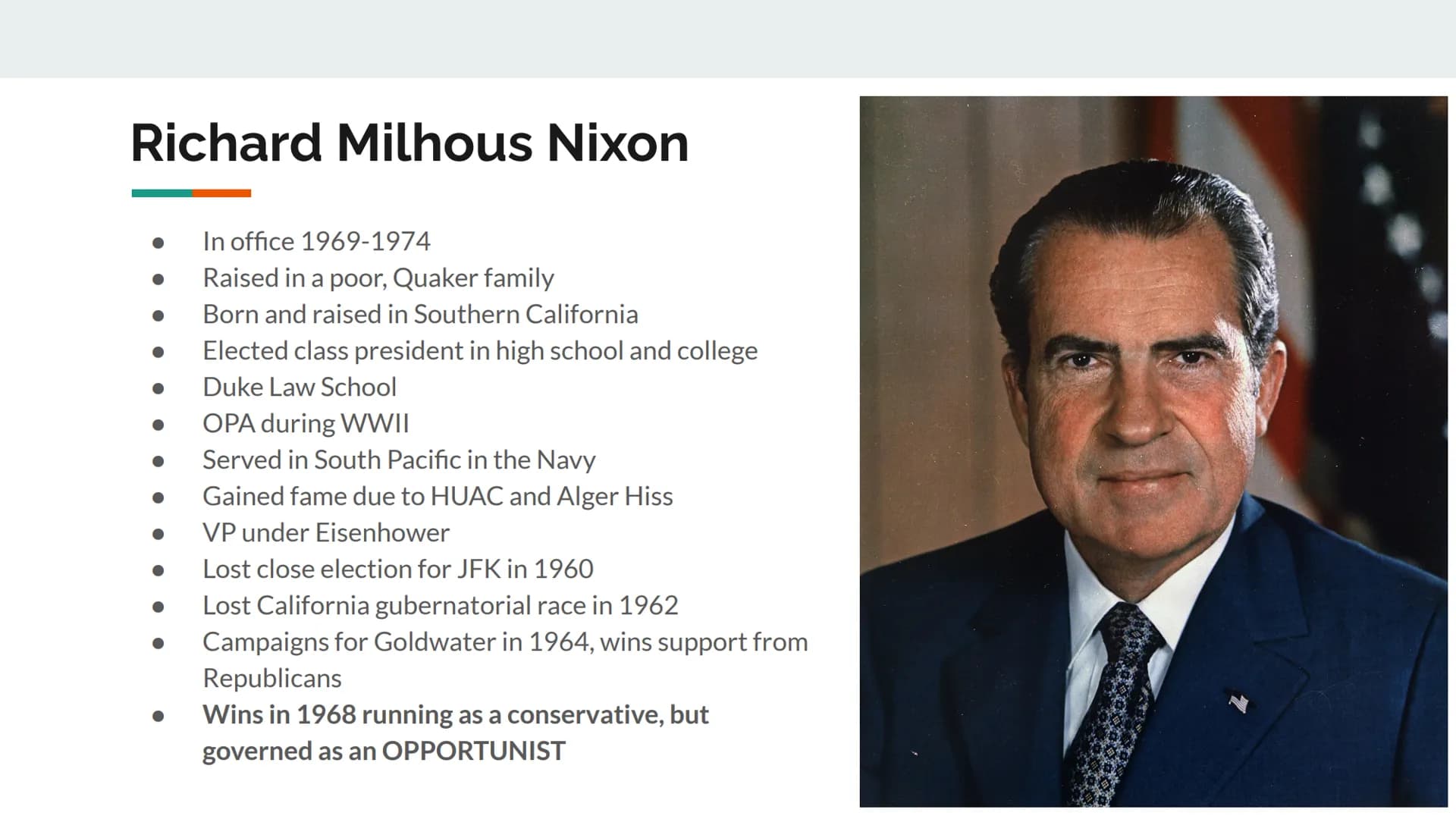
Richard Milhous Nixon

Richard Nixon's path to the presidency demonstrates his remarkable political resilience. Born to a poor Quaker family in Southern California, Nixon worked his way up from humble beginnings to Duke Law School and eventually national politics.

His early career showed both his political talents and combative nature. After serving in the Navy during WWII, he gained fame through the House Un-American Activities Committee (HUAC) and his role in exposing Alger Hiss as a Soviet spy. He served as Eisenhower's Vice President before narrowly losing to JFK in 1960.

After another defeat in California's 1962 governor's race, Nixon rebuilt his reputation by campaigning for Barry Goldwater and positioning himself as a conservative candidate. Though he ran as a conservative to win the 1968 election, Nixon actually governed as an opportunist, adopting policies that didn't always align with traditional conservative values.

Did you know? Despite his conservative campaign rhetoric, Nixon actually expanded many government programs and environmental regulations during his presidency.

The 1970s Nixon and Watergate Richard Milhous Nixon
In office 1969-1974
Raised in a poor, Quaker family
Born and raised in Southern Californ

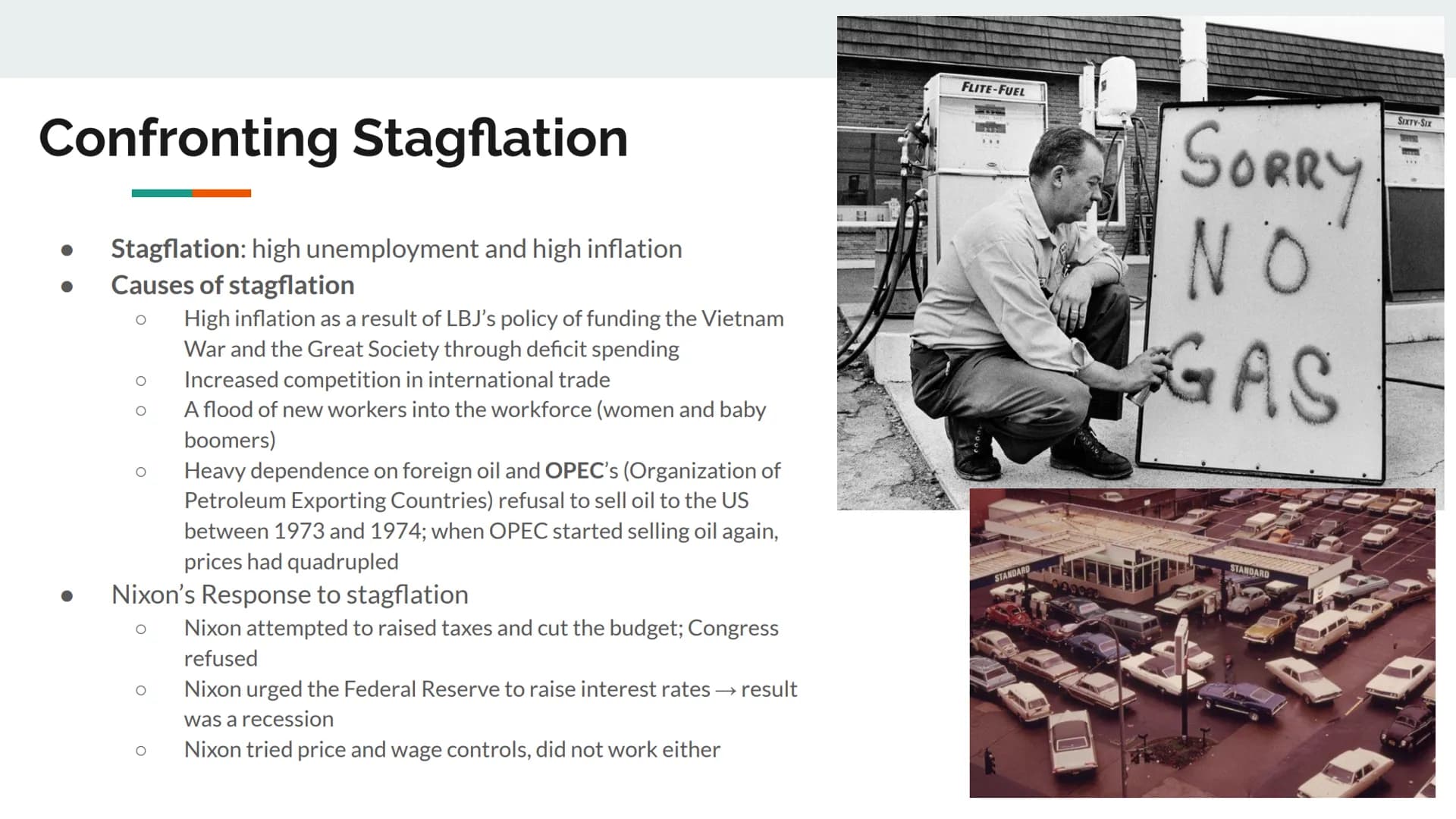
Confronting Stagflation

Imagine having no gas for your car while prices for everything skyrocket! This was the reality of stagflation in the 1970s—a devastating combination of high unemployment and high inflation that seemed impossible to fix.

Several factors created this economic nightmare. LBJ's deficit spending on Vietnam and social programs had already triggered inflation. Add to this increased international competition, millions of new workers (women and baby boomers) entering the job market, and a crippling dependence on foreign oil.

When OPEC (Organization of Petroleum Exporting Countries) refused to sell oil to the US between 1973-1974, Americans faced gas shortages and quadrupled prices. Nixon tried multiple solutions—raising taxes, cutting budgets, increasing interest rates, and imposing price controls—but nothing worked effectively.

Economic reality check: Stagflation challenged traditional economic theories because previous recessions had typically involved either inflation OR unemployment—not both simultaneously.

The 1970s Nixon and Watergate Richard Milhous Nixon
In office 1969-1974
Raised in a poor, Quaker family
Born and raised in Southern Californ

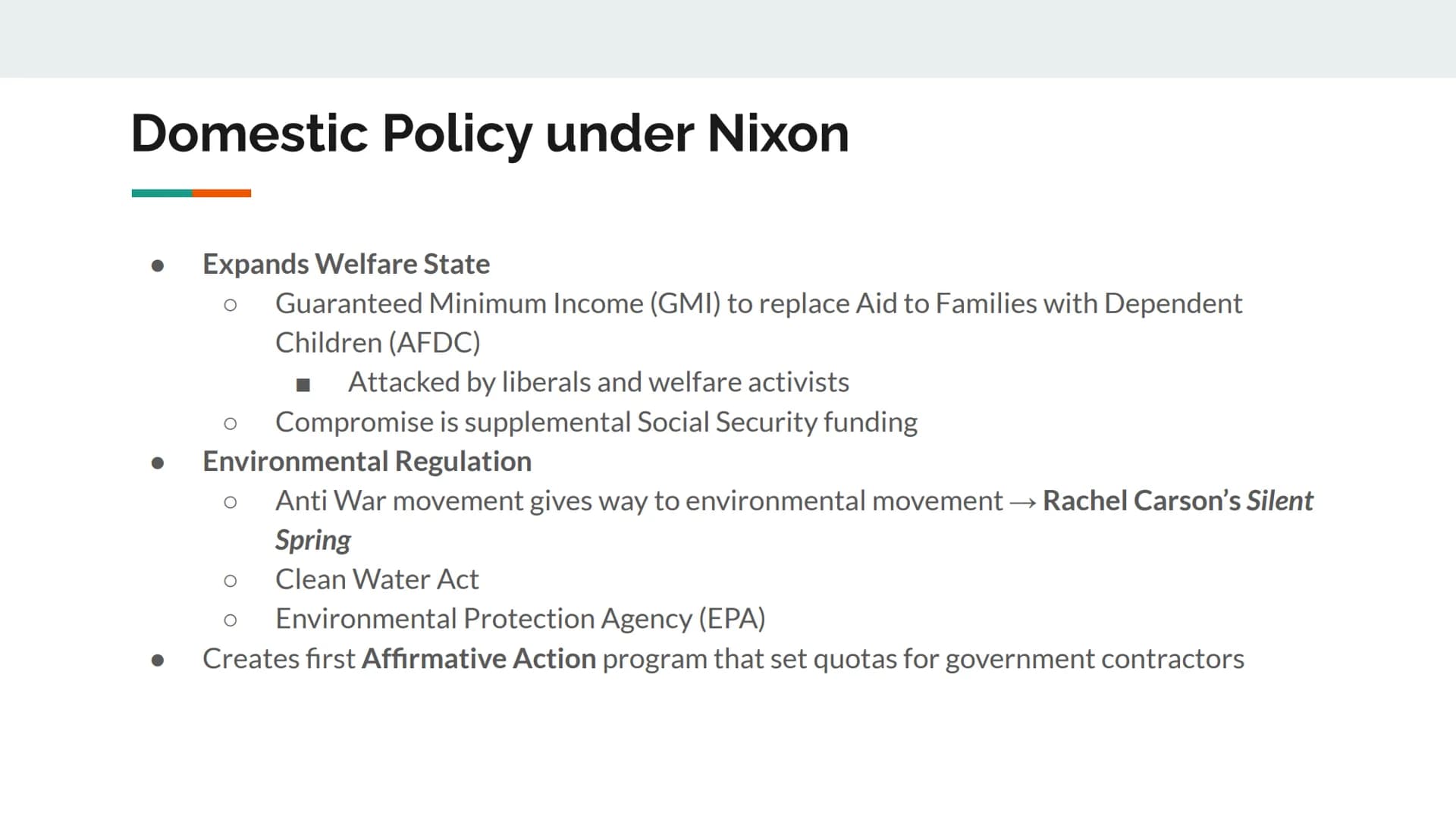
Domestic Policy under Nixon

Surprisingly, Nixon expanded many government programs despite being a Republican president. He proposed replacing Aid to Families with Dependent Children (AFDC) with a Guaranteed Minimum Income (GMI)—a bold welfare reform that ultimately became supplemental Social Security funding after facing criticism.

Environmental protection became a major focus during Nixon's administration. As anti-war activism evolved into environmental activism (influenced by Rachel Carson's Silent Spring), Nixon responded by creating the Environmental Protection Agency (EPA) and signing the Clean Water Act.

Nixon also implemented the first Affirmative Action program that set specific quotas for government contractors, aiming to increase minority representation in the workforce. These policies demonstrate how Nixon often governed pragmatically rather than ideologically.

Connect the dots: Nixon's environmental policies show how presidents sometimes respond to public movements rather than leading them—the environmental movement pushed Nixon to create lasting protections we still rely on today.

The 1970s Nixon and Watergate Richard Milhous Nixon
In office 1969-1974
Raised in a poor, Quaker family
Born and raised in Southern Californ

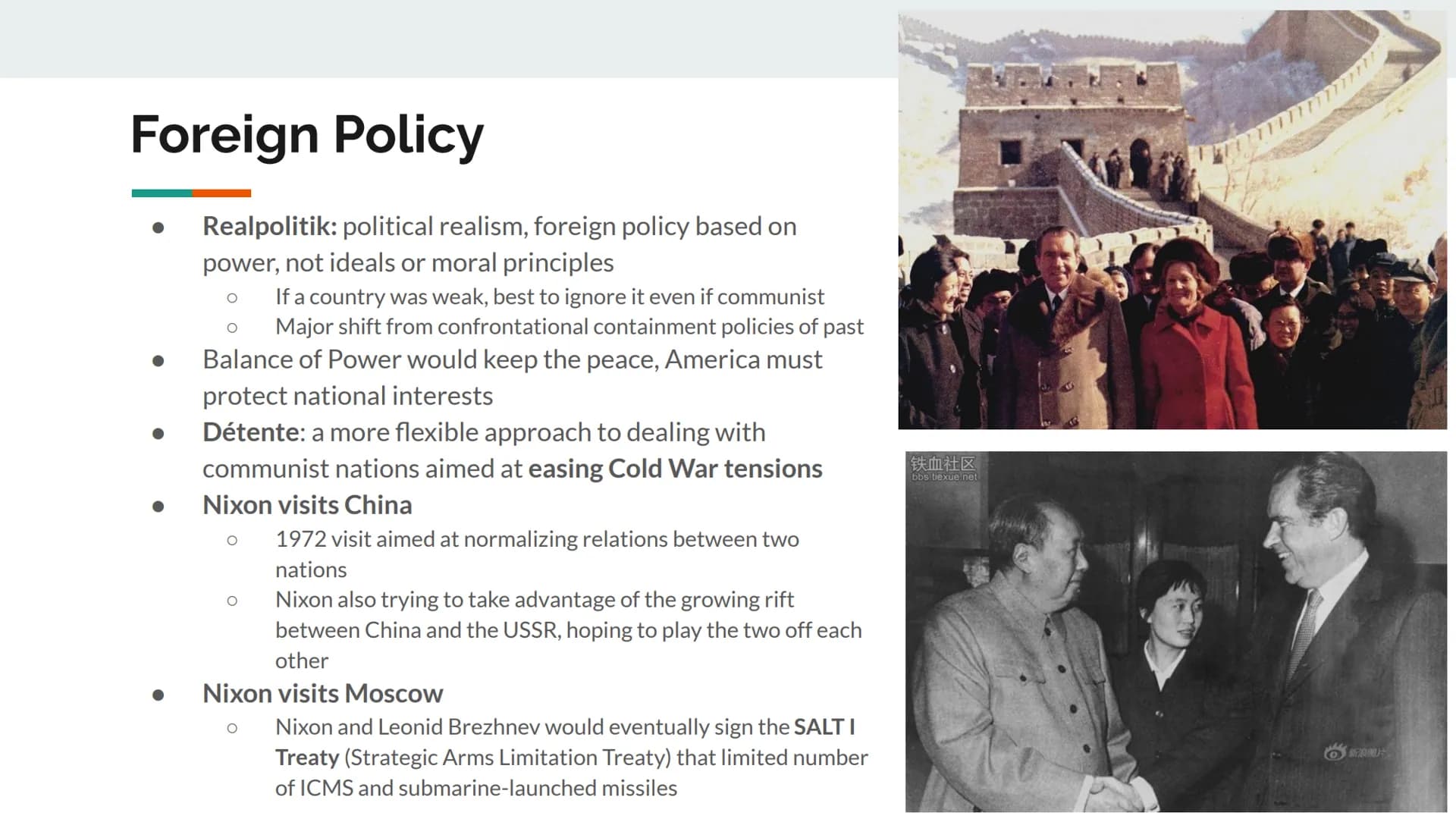
Foreign Policy

Nixon revolutionized American foreign policy through realpolitik—a pragmatic approach based on power rather than ideals. This marked a major shift from the strict containment policies of previous administrations.

Under this approach, Nixon believed weak communist countries could be ignored if they posed no threat to American interests. He focused instead on maintaining a global balance of power and pursued détente—a more flexible strategy to ease Cold War tensions.

Nixon's historic 1972 visit to China shocked the world but served two strategic purposes: normalizing relations with the massive communist nation and exploiting tensions between China and the USSR. He followed this with a visit to Moscow, where he and Soviet leader Leonid Brezhnev signed the SALT I Treaty limiting nuclear missiles.

Strategy insight: Nixon's China visit demonstrates how foreign policy can be counterintuitive—a staunchly anti-communist politician ultimately opened relations with communist China because it served America's strategic interests.

The 1970s Nixon and Watergate Richard Milhous Nixon
In office 1969-1974
Raised in a poor, Quaker family
Born and raised in Southern Californ

The 'Imperial Presidency' and Nixon's Paranoia

The concept of an "imperial presidency" took full form under Nixon as presidential powers—already expanded during the Great Depression, World War II, and Cold War—grew even further. Nixon pushed these boundaries with little concern for constitutional checks and balances.

Nixon increasingly isolated himself from Congress, relying instead on a small circle of intensely loyal advisors who shared his appetite for secrecy and power. This insulation reinforced his worst tendencies and removed potential moderating influences.

Throughout his career, Nixon was driven by a profound fear of losing. This paranoia reached its peak during the 1972 election when his team, working through the Committee to Reelect the President (aptly nicknamed CREEP), sought advantages through increasingly illegal means.

Psychology matters: Nixon's personal insecurities and paranoia directly influenced how he governed—reminding us that a leader's personality can sometimes matter as much as their policies.

The 1970s Nixon and Watergate Richard Milhous Nixon
In office 1969-1974
Raised in a poor, Quaker family
Born and raised in Southern Californ

A Bungled Burglary Leads to a President's Downfall

A simple break-in changed American history forever. At 2:30 am on June 17, 1972, five men were arrested while breaking into Democratic National Committee headquarters at the Watergate complex to repair wiretapping equipment.

Journalists Carl Bernstein and Bob Woodward of the Washington Post doggedly pursued the story, gradually uncovering connections between the burglars and Nixon's Committee to Reelect the President (CRP). While Nixon didn't plan the break-in, he immediately worked to cover up White House connections—a decision that would prove fatal to his presidency.

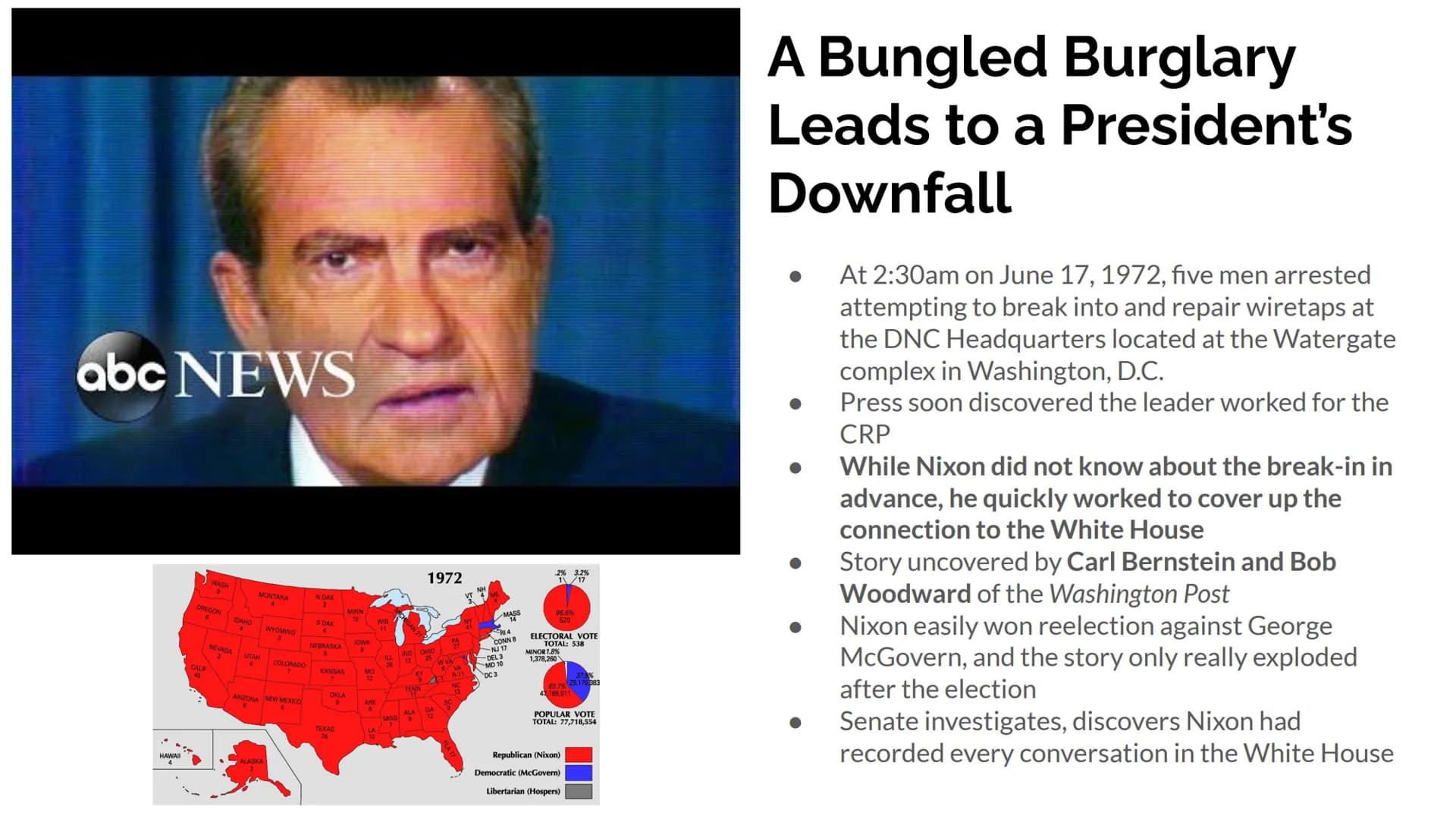
Despite the brewing scandal, Nixon easily defeated George McGovern in the 1972 election, winning a staggering 520 electoral votes to McGovern's 17. The Watergate investigation gained real momentum only after the election, especially when Senate hearings revealed Nixon had secretly recorded all White House conversations.

Critical turning point: When investigators discovered Nixon's secret White House tapes, the president's fate was essentially sealed—the evidence of his involvement in the cover-up would soon be available for all to hear.

The 1970s Nixon and Watergate Richard Milhous Nixon
In office 1969-1974
Raised in a poor, Quaker family
Born and raised in Southern Californ

Investigation and Resignation

As investigators closed in, Nixon grew desperate to stop them. In the infamous "Saturday Night Massacre," he ordered his Attorney General to fire the special prosecutor investigating Watergate. When the Attorney General refused and resigned instead, it created a constitutional crisis.

Meanwhile, Vice President Spiro Agnew resigned due to unrelated bribery charges from his time as governor of Maryland. Nixon appointed House Minority Leader Gerald Ford as the new Vice President—unknowingly selecting his own replacement.

The final blow came when Nixon reluctantly released White House tapes that contained suspicious gaps, including one 18½ minutes long. With impeachment imminent, Nixon resigned on August 9, 1974, and Gerald Ford became president, bringing the dramatic Watergate saga to its conclusion.

Historical significance: Nixon's resignation represented the first time in American history a president had resigned from office—a profound constitutional moment that demonstrated both the system's vulnerability and its ultimate resilience.


We thought you’d never ask...

What is the Knowunity AI companion?

Our AI companion is specifically built for the needs of students. Based on the millions of content pieces we have on the platform we can provide truly meaningful and relevant answers to students. But its not only about answers, the companion is even more about guiding students through their daily learning challenges, with personalised study plans, quizzes or content pieces in the chat and 100% personalisation based on the students skills and developments.

Where can I download the Knowunity app?

You can download the app in the Google Play Store and in the Apple App Store.

Is Knowunity really free of charge?

That's right! Enjoy free access to study content, connect with fellow students, and get instant help – all at your fingertips.

Can't find what you're looking for? Explore other subjects.

Students love us — and so will you.

4.9/5

App Store

4.8/5

Google Play

The app is very easy to use and well designed. I have found everything I was looking for so far and have been able to learn a lot from the presentations! I will definitely use the app for a class assignment! And of course it also helps a lot as an inspiration.

Stefan S

iOS user

This app is really great. There are so many study notes and help [...]. My problem subject is French, for example, and the app has so many options for help. Thanks to this app, I have improved my French. I would recommend it to anyone.

Samantha Klich

Android user

Wow, I am really amazed. I just tried the app because I've seen it advertised many times and was absolutely stunned. This app is THE HELP you want for school and above all, it offers so many things, such as workouts and fact sheets, which have been VERY helpful to me personally.

Anna

iOS user

I think it’s very much worth it and you’ll end up using it a lot once you get the hang of it and even after looking at others notes you can still ask your Artificial intelligence buddy the question and ask to simplify it if you still don’t get it!!! In the end I think it’s worth it 😊👍 ⚠️Also DID I MENTION ITS FREEE YOU DON’T HAVE TO PAY FOR ANYTHING AND STILL GET YOUR GRADES IN PERFECTLY❗️❗️⚠️

Thomas R

iOS user

Knowunity is the BEST app I’ve used in a minute. This is not an ai review or anything this is genuinely coming from a 7th grade student (I know 2011 im young) but dude this app is a 10/10 i have maintained a 3.8 gpa and have plenty of time for gaming. I love it and my mom is just happy I got good grades

Brad T

Android user

Not only did it help me find the answer but it also showed me alternative ways to solve it. I was horrible in math and science but now I have an a in both subjects. Thanks for the help🤍🤍

David K

iOS user

The app's just great! All I have to do is enter the topic in the search bar and I get the response real fast. I don't have to watch 10 YouTube videos to understand something, so I'm saving my time. Highly recommended!

Sudenaz Ocak

Android user

In school I was really bad at maths but thanks to the app, I am doing better now. I am so grateful that you made the app.

Greenlight Bonnie

Android user

I found this app a couple years ago and it has only gotten better since then. I really love it because it can help with written questions and photo questions. Also, it can find study guides that other people have made as well as flashcard sets and practice tests. The free version is also amazing for students who might not be able to afford it. Would 100% recommend

Aubrey

iOS user

Best app if you're in Highschool or Junior high. I have been using this app for 2 school years and it's the best, it's good if you don't have anyone to help you with school work.😋🩷🎀

Marco B

iOS user

THE QUIZES AND FLASHCARDS ARE SO USEFUL AND I LOVE THE SCHOOLGPT. IT ALSO IS LITREALLY LIKE CHATGPT BUT SMARTER!! HELPED ME WITH MY MASCARA PROBLEMS TOO!! AS WELL AS MY REAL SUBJECTS ! DUHHH 😍😁😲🤑💗✨🎀😮

Elisha

iOS user

This app is phenomenal down to the correct info and the various topics you can study! I greatly recommend it for people who struggle with procrastination and those who need homework help. It has been perfectly accurate for world 1 history as far as I’ve seen! Geometry too!

Paul T

iOS user

The app is very easy to use and well designed. I have found everything I was looking for so far and have been able to learn a lot from the presentations! I will definitely use the app for a class assignment! And of course it also helps a lot as an inspiration.

Stefan S

iOS user

This app is really great. There are so many study notes and help [...]. My problem subject is French, for example, and the app has so many options for help. Thanks to this app, I have improved my French. I would recommend it to anyone.

Samantha Klich

Android user

Wow, I am really amazed. I just tried the app because I've seen it advertised many times and was absolutely stunned. This app is THE HELP you want for school and above all, it offers so many things, such as workouts and fact sheets, which have been VERY helpful to me personally.

Anna

iOS user

I think it’s very much worth it and you’ll end up using it a lot once you get the hang of it and even after looking at others notes you can still ask your Artificial intelligence buddy the question and ask to simplify it if you still don’t get it!!! In the end I think it’s worth it 😊👍 ⚠️Also DID I MENTION ITS FREEE YOU DON’T HAVE TO PAY FOR ANYTHING AND STILL GET YOUR GRADES IN PERFECTLY❗️❗️⚠️

Thomas R

iOS user

Knowunity is the BEST app I’ve used in a minute. This is not an ai review or anything this is genuinely coming from a 7th grade student (I know 2011 im young) but dude this app is a 10/10 i have maintained a 3.8 gpa and have plenty of time for gaming. I love it and my mom is just happy I got good grades

Brad T

Android user

Not only did it help me find the answer but it also showed me alternative ways to solve it. I was horrible in math and science but now I have an a in both subjects. Thanks for the help🤍🤍

David K

iOS user

The app's just great! All I have to do is enter the topic in the search bar and I get the response real fast. I don't have to watch 10 YouTube videos to understand something, so I'm saving my time. Highly recommended!

Sudenaz Ocak

Android user

In school I was really bad at maths but thanks to the app, I am doing better now. I am so grateful that you made the app.

Greenlight Bonnie

Android user

I found this app a couple years ago and it has only gotten better since then. I really love it because it can help with written questions and photo questions. Also, it can find study guides that other people have made as well as flashcard sets and practice tests. The free version is also amazing for students who might not be able to afford it. Would 100% recommend

Aubrey

iOS user

Best app if you're in Highschool or Junior high. I have been using this app for 2 school years and it's the best, it's good if you don't have anyone to help you with school work.😋🩷🎀

Marco B

iOS user

THE QUIZES AND FLASHCARDS ARE SO USEFUL AND I LOVE THE SCHOOLGPT. IT ALSO IS LITREALLY LIKE CHATGPT BUT SMARTER!! HELPED ME WITH MY MASCARA PROBLEMS TOO!! AS WELL AS MY REAL SUBJECTS ! DUHHH 😍😁😲🤑💗✨🎀😮

Elisha

iOS user

This app is phenomenal down to the correct info and the various topics you can study! I greatly recommend it for people who struggle with procrastination and those who need homework help. It has been perfectly accurate for world 1 history as far as I’ve seen! Geometry too!

Paul T

iOS user


US History

52

Nov 20, 2025

9 pages

The 1970s: A Decade of Transformation in U.S. History

The 1970s in America was marked by political turmoil, economic challenges, and dramatic changes in how the presidency operated. Richard Nixon's administration, which began with promise, eventually collapsed under the weight of the Watergate scandal, forever changing Americans' trust in... Show more

The 1970s Nixon and Watergate Richard Milhous Nixon
In office 1969-1974
Raised in a poor, Quaker family
Born and raised in Southern Californ

Sign up to see the contentIt's free!

Access to all documents

Improve your grades

Join milions of students

By signing up you accept Terms of Service and Privacy Policy

The 1970s

The 1970s represented a pivotal decade in American history, marked by significant political upheaval and economic struggles. This era saw the presidency of Richard Nixon dramatically end with his resignation—the only president ever to do so.

The decade introduced Americans to new economic challenges like stagflation and oil shortages. It also witnessed important shifts in foreign policy as the Cold War entered a new phase.

What happened during these years would fundamentally alter how Americans viewed their government and political institutions for generations to come.

Think about it: Many historians consider the 1970s as the moment when Americans began to lose faith in their government. As you learn about this decade, consider how these events might still affect politics today.

The 1970s Nixon and Watergate Richard Milhous Nixon
In office 1969-1974
Raised in a poor, Quaker family
Born and raised in Southern Californ

Sign up to see the contentIt's free!

Access to all documents

Improve your grades

Join milions of students

By signing up you accept Terms of Service and Privacy Policy

Nixon and Watergate

The Watergate scandal represents one of the most shocking political scandals in American history. What began as a simple break-in at Democratic National Committee headquarters eventually exposed corruption at the highest levels of government.

Watergate revealed Nixon's abuse of presidential power, including illegal wiretapping, political sabotage, and a massive cover-up attempt. The scandal unfolded slowly through newspaper investigations, congressional hearings, and legal battles over White House tapes.

The consequences were enormous—Nixon resigned in disgrace, several top administration officials went to prison, and Americans developed a deep skepticism toward political leaders that persists today.

Important context: Before Watergate, most Americans trusted their government. After Nixon's resignation, public trust in government plummeted and has never fully recovered.

The 1970s Nixon and Watergate Richard Milhous Nixon
In office 1969-1974
Raised in a poor, Quaker family
Born and raised in Southern Californ

Sign up to see the contentIt's free!

Access to all documents

Improve your grades

Join milions of students

By signing up you accept Terms of Service and Privacy Policy

Richard Milhous Nixon

Richard Nixon's path to the presidency demonstrates his remarkable political resilience. Born to a poor Quaker family in Southern California, Nixon worked his way up from humble beginnings to Duke Law School and eventually national politics.

His early career showed both his political talents and combative nature. After serving in the Navy during WWII, he gained fame through the House Un-American Activities Committee (HUAC) and his role in exposing Alger Hiss as a Soviet spy. He served as Eisenhower's Vice President before narrowly losing to JFK in 1960.

After another defeat in California's 1962 governor's race, Nixon rebuilt his reputation by campaigning for Barry Goldwater and positioning himself as a conservative candidate. Though he ran as a conservative to win the 1968 election, Nixon actually governed as an opportunist, adopting policies that didn't always align with traditional conservative values.

Did you know? Despite his conservative campaign rhetoric, Nixon actually expanded many government programs and environmental regulations during his presidency.

The 1970s Nixon and Watergate Richard Milhous Nixon
In office 1969-1974
Raised in a poor, Quaker family
Born and raised in Southern Californ

Sign up to see the contentIt's free!

Access to all documents

Improve your grades

Join milions of students

By signing up you accept Terms of Service and Privacy Policy

Confronting Stagflation

Imagine having no gas for your car while prices for everything skyrocket! This was the reality of stagflation in the 1970s—a devastating combination of high unemployment and high inflation that seemed impossible to fix.

Several factors created this economic nightmare. LBJ's deficit spending on Vietnam and social programs had already triggered inflation. Add to this increased international competition, millions of new workers (women and baby boomers) entering the job market, and a crippling dependence on foreign oil.

When OPEC (Organization of Petroleum Exporting Countries) refused to sell oil to the US between 1973-1974, Americans faced gas shortages and quadrupled prices. Nixon tried multiple solutions—raising taxes, cutting budgets, increasing interest rates, and imposing price controls—but nothing worked effectively.

Economic reality check: Stagflation challenged traditional economic theories because previous recessions had typically involved either inflation OR unemployment—not both simultaneously.

The 1970s Nixon and Watergate Richard Milhous Nixon
In office 1969-1974
Raised in a poor, Quaker family
Born and raised in Southern Californ

Sign up to see the contentIt's free!

Access to all documents

Improve your grades

Join milions of students

By signing up you accept Terms of Service and Privacy Policy

Domestic Policy under Nixon

Surprisingly, Nixon expanded many government programs despite being a Republican president. He proposed replacing Aid to Families with Dependent Children (AFDC) with a Guaranteed Minimum Income (GMI)—a bold welfare reform that ultimately became supplemental Social Security funding after facing criticism.

Environmental protection became a major focus during Nixon's administration. As anti-war activism evolved into environmental activism (influenced by Rachel Carson's Silent Spring), Nixon responded by creating the Environmental Protection Agency (EPA) and signing the Clean Water Act.

Nixon also implemented the first Affirmative Action program that set specific quotas for government contractors, aiming to increase minority representation in the workforce. These policies demonstrate how Nixon often governed pragmatically rather than ideologically.

Connect the dots: Nixon's environmental policies show how presidents sometimes respond to public movements rather than leading them—the environmental movement pushed Nixon to create lasting protections we still rely on today.

The 1970s Nixon and Watergate Richard Milhous Nixon
In office 1969-1974
Raised in a poor, Quaker family
Born and raised in Southern Californ

Sign up to see the contentIt's free!

Access to all documents

Improve your grades

Join milions of students

By signing up you accept Terms of Service and Privacy Policy

Foreign Policy

Nixon revolutionized American foreign policy through realpolitik—a pragmatic approach based on power rather than ideals. This marked a major shift from the strict containment policies of previous administrations.

Under this approach, Nixon believed weak communist countries could be ignored if they posed no threat to American interests. He focused instead on maintaining a global balance of power and pursued détente—a more flexible strategy to ease Cold War tensions.

Nixon's historic 1972 visit to China shocked the world but served two strategic purposes: normalizing relations with the massive communist nation and exploiting tensions between China and the USSR. He followed this with a visit to Moscow, where he and Soviet leader Leonid Brezhnev signed the SALT I Treaty limiting nuclear missiles.

Strategy insight: Nixon's China visit demonstrates how foreign policy can be counterintuitive—a staunchly anti-communist politician ultimately opened relations with communist China because it served America's strategic interests.

The 1970s Nixon and Watergate Richard Milhous Nixon
In office 1969-1974
Raised in a poor, Quaker family
Born and raised in Southern Californ

Sign up to see the contentIt's free!

Access to all documents

Improve your grades

Join milions of students

By signing up you accept Terms of Service and Privacy Policy

The 'Imperial Presidency' and Nixon's Paranoia

The concept of an "imperial presidency" took full form under Nixon as presidential powers—already expanded during the Great Depression, World War II, and Cold War—grew even further. Nixon pushed these boundaries with little concern for constitutional checks and balances.

Nixon increasingly isolated himself from Congress, relying instead on a small circle of intensely loyal advisors who shared his appetite for secrecy and power. This insulation reinforced his worst tendencies and removed potential moderating influences.

Throughout his career, Nixon was driven by a profound fear of losing. This paranoia reached its peak during the 1972 election when his team, working through the Committee to Reelect the President (aptly nicknamed CREEP), sought advantages through increasingly illegal means.

Psychology matters: Nixon's personal insecurities and paranoia directly influenced how he governed—reminding us that a leader's personality can sometimes matter as much as their policies.

The 1970s Nixon and Watergate Richard Milhous Nixon
In office 1969-1974
Raised in a poor, Quaker family
Born and raised in Southern Californ

Sign up to see the contentIt's free!

Access to all documents

Improve your grades

Join milions of students

By signing up you accept Terms of Service and Privacy Policy

A Bungled Burglary Leads to a President's Downfall

A simple break-in changed American history forever. At 2:30 am on June 17, 1972, five men were arrested while breaking into Democratic National Committee headquarters at the Watergate complex to repair wiretapping equipment.

Journalists Carl Bernstein and Bob Woodward of the Washington Post doggedly pursued the story, gradually uncovering connections between the burglars and Nixon's Committee to Reelect the President (CRP). While Nixon didn't plan the break-in, he immediately worked to cover up White House connections—a decision that would prove fatal to his presidency.

Despite the brewing scandal, Nixon easily defeated George McGovern in the 1972 election, winning a staggering 520 electoral votes to McGovern's 17. The Watergate investigation gained real momentum only after the election, especially when Senate hearings revealed Nixon had secretly recorded all White House conversations.

Critical turning point: When investigators discovered Nixon's secret White House tapes, the president's fate was essentially sealed—the evidence of his involvement in the cover-up would soon be available for all to hear.

The 1970s Nixon and Watergate Richard Milhous Nixon
In office 1969-1974
Raised in a poor, Quaker family
Born and raised in Southern Californ

Sign up to see the contentIt's free!

Access to all documents

Improve your grades

Join milions of students

By signing up you accept Terms of Service and Privacy Policy

Investigation and Resignation

As investigators closed in, Nixon grew desperate to stop them. In the infamous "Saturday Night Massacre," he ordered his Attorney General to fire the special prosecutor investigating Watergate. When the Attorney General refused and resigned instead, it created a constitutional crisis.

Meanwhile, Vice President Spiro Agnew resigned due to unrelated bribery charges from his time as governor of Maryland. Nixon appointed House Minority Leader Gerald Ford as the new Vice President—unknowingly selecting his own replacement.

The final blow came when Nixon reluctantly released White House tapes that contained suspicious gaps, including one 18½ minutes long. With impeachment imminent, Nixon resigned on August 9, 1974, and Gerald Ford became president, bringing the dramatic Watergate saga to its conclusion.

Historical significance: Nixon's resignation represented the first time in American history a president had resigned from office—a profound constitutional moment that demonstrated both the system's vulnerability and its ultimate resilience.

We thought you’d never ask...

What is the Knowunity AI companion?

Our AI companion is specifically built for the needs of students. Based on the millions of content pieces we have on the platform we can provide truly meaningful and relevant answers to students. But its not only about answers, the companion is even more about guiding students through their daily learning challenges, with personalised study plans, quizzes or content pieces in the chat and 100% personalisation based on the students skills and developments.

Where can I download the Knowunity app?

You can download the app in the Google Play Store and in the Apple App Store.

Is Knowunity really free of charge?

That's right! Enjoy free access to study content, connect with fellow students, and get instant help – all at your fingertips.

5

Smart Tools NEW

Transform this note into: ✓ 50+ Practice Questions ✓ Interactive Flashcards ✓ Full Mock Exam ✓ Essay Outlines

Mock Exam
Quiz
Flashcards
Essay

Can't find what you're looking for? Explore other subjects.

Students love us — and so will you.

4.9/5

App Store

4.8/5

Google Play

The app is very easy to use and well designed. I have found everything I was looking for so far and have been able to learn a lot from the presentations! I will definitely use the app for a class assignment! And of course it also helps a lot as an inspiration.

Stefan S

iOS user

This app is really great. There are so many study notes and help [...]. My problem subject is French, for example, and the app has so many options for help. Thanks to this app, I have improved my French. I would recommend it to anyone.

Samantha Klich

Android user

Wow, I am really amazed. I just tried the app because I've seen it advertised many times and was absolutely stunned. This app is THE HELP you want for school and above all, it offers so many things, such as workouts and fact sheets, which have been VERY helpful to me personally.

Anna

iOS user

I think it’s very much worth it and you’ll end up using it a lot once you get the hang of it and even after looking at others notes you can still ask your Artificial intelligence buddy the question and ask to simplify it if you still don’t get it!!! In the end I think it’s worth it 😊👍 ⚠️Also DID I MENTION ITS FREEE YOU DON’T HAVE TO PAY FOR ANYTHING AND STILL GET YOUR GRADES IN PERFECTLY❗️❗️⚠️

Thomas R

iOS user

Knowunity is the BEST app I’ve used in a minute. This is not an ai review or anything this is genuinely coming from a 7th grade student (I know 2011 im young) but dude this app is a 10/10 i have maintained a 3.8 gpa and have plenty of time for gaming. I love it and my mom is just happy I got good grades

Brad T

Android user

Not only did it help me find the answer but it also showed me alternative ways to solve it. I was horrible in math and science but now I have an a in both subjects. Thanks for the help🤍🤍

David K

iOS user

The app's just great! All I have to do is enter the topic in the search bar and I get the response real fast. I don't have to watch 10 YouTube videos to understand something, so I'm saving my time. Highly recommended!

Sudenaz Ocak

Android user

In school I was really bad at maths but thanks to the app, I am doing better now. I am so grateful that you made the app.

Greenlight Bonnie

Android user

I found this app a couple years ago and it has only gotten better since then. I really love it because it can help with written questions and photo questions. Also, it can find study guides that other people have made as well as flashcard sets and practice tests. The free version is also amazing for students who might not be able to afford it. Would 100% recommend

Aubrey

iOS user

Best app if you're in Highschool or Junior high. I have been using this app for 2 school years and it's the best, it's good if you don't have anyone to help you with school work.😋🩷🎀

Marco B

iOS user

THE QUIZES AND FLASHCARDS ARE SO USEFUL AND I LOVE THE SCHOOLGPT. IT ALSO IS LITREALLY LIKE CHATGPT BUT SMARTER!! HELPED ME WITH MY MASCARA PROBLEMS TOO!! AS WELL AS MY REAL SUBJECTS ! DUHHH 😍😁😲🤑💗✨🎀😮

Elisha

iOS user

This app is phenomenal down to the correct info and the various topics you can study! I greatly recommend it for people who struggle with procrastination and those who need homework help. It has been perfectly accurate for world 1 history as far as I’ve seen! Geometry too!

Paul T

iOS user

The app is very easy to use and well designed. I have found everything I was looking for so far and have been able to learn a lot from the presentations! I will definitely use the app for a class assignment! And of course it also helps a lot as an inspiration.

Stefan S

iOS user

This app is really great. There are so many study notes and help [...]. My problem subject is French, for example, and the app has so many options for help. Thanks to this app, I have improved my French. I would recommend it to anyone.

Samantha Klich

Android user

Wow, I am really amazed. I just tried the app because I've seen it advertised many times and was absolutely stunned. This app is THE HELP you want for school and above all, it offers so many things, such as workouts and fact sheets, which have been VERY helpful to me personally.

Anna

iOS user

I think it’s very much worth it and you’ll end up using it a lot once you get the hang of it and even after looking at others notes you can still ask your Artificial intelligence buddy the question and ask to simplify it if you still don’t get it!!! In the end I think it’s worth it 😊👍 ⚠️Also DID I MENTION ITS FREEE YOU DON’T HAVE TO PAY FOR ANYTHING AND STILL GET YOUR GRADES IN PERFECTLY❗️❗️⚠️

Thomas R

iOS user

Knowunity is the BEST app I’ve used in a minute. This is not an ai review or anything this is genuinely coming from a 7th grade student (I know 2011 im young) but dude this app is a 10/10 i have maintained a 3.8 gpa and have plenty of time for gaming. I love it and my mom is just happy I got good grades

Brad T

Android user

Not only did it help me find the answer but it also showed me alternative ways to solve it. I was horrible in math and science but now I have an a in both subjects. Thanks for the help🤍🤍

David K

iOS user

The app's just great! All I have to do is enter the topic in the search bar and I get the response real fast. I don't have to watch 10 YouTube videos to understand something, so I'm saving my time. Highly recommended!

Sudenaz Ocak

Android user

In school I was really bad at maths but thanks to the app, I am doing better now. I am so grateful that you made the app.

Greenlight Bonnie

Android user

I found this app a couple years ago and it has only gotten better since then. I really love it because it can help with written questions and photo questions. Also, it can find study guides that other people have made as well as flashcard sets and practice tests. The free version is also amazing for students who might not be able to afford it. Would 100% recommend

Aubrey

iOS user

Best app if you're in Highschool or Junior high. I have been using this app for 2 school years and it's the best, it's good if you don't have anyone to help you with school work.😋🩷🎀

Marco B

iOS user

THE QUIZES AND FLASHCARDS ARE SO USEFUL AND I LOVE THE SCHOOLGPT. IT ALSO IS LITREALLY LIKE CHATGPT BUT SMARTER!! HELPED ME WITH MY MASCARA PROBLEMS TOO!! AS WELL AS MY REAL SUBJECTS ! DUHHH 😍😁😲🤑💗✨🎀😮

Elisha

iOS user

This app is phenomenal down to the correct info and the various topics you can study! I greatly recommend it for people who struggle with procrastination and those who need homework help. It has been perfectly accurate for world 1 history as far as I’ve seen! Geometry too!

Paul T

iOS user