
The American Civil War concluded with dramatic military campaigns, pivotal... Show more
 AP US History
 Algebra
 Biology
Sign up to see the contentIt's free!
Access to all documents
Improve your grades
Join milions of students
Knowunity AI
Subjects
Triangle Congruence and Similarity Theorems
Triangle Properties and Classification
Linear Equations and Graphs
Geometric Angle Relationships
Trigonometric Functions and Identities
Equation Solving Techniques
Circle Geometry Fundamentals
Division Operations and Methods
Basic Differentiation Rules
Exponent and Logarithm Properties
Show all topics
Human Organ Systems
Reproductive Cell Cycles
Biological Sciences Subdisciplines
Cellular Energy Metabolism
Autotrophic Energy Processes
Inheritance Patterns and Principles
Biomolecular Structure and Organization
Cell Cycle and Division Mechanics
Cellular Organization and Development
Biological Structural Organization
Show all topics
Chemical Sciences and Applications
Atomic Structure and Composition
Molecular Electron Structure Representation
Atomic Electron Behavior
Matter Properties and Water
Mole Concept and Calculations
Gas Laws and Behavior
Periodic Table Organization
Chemical Thermodynamics Fundamentals
Chemical Bond Types and Properties
Show all topics
European Renaissance and Enlightenment
European Cultural Movements 800-1920
American Revolution Era 1763-1797
American Civil War 1861-1865
Global Imperial Systems
Mongol and Chinese Dynasties
U.S. Presidents and World Leaders
Historical Sources and Documentation
World Wars Era and Impact
World Religious Systems
Show all topics
Classic and Contemporary Novels
Literary Character Analysis
Rhetorical Theory and Practice
Classic Literary Narratives
Reading Analysis and Interpretation
Narrative Structure and Techniques
English Language Components
Influential English-Language Authors
Basic Sentence Structure
Narrative Voice and Perspective
Show all topics
19
•
Updated Mar 17, 2026
•
The American Civil War concluded with dramatic military campaigns, pivotal... Show more

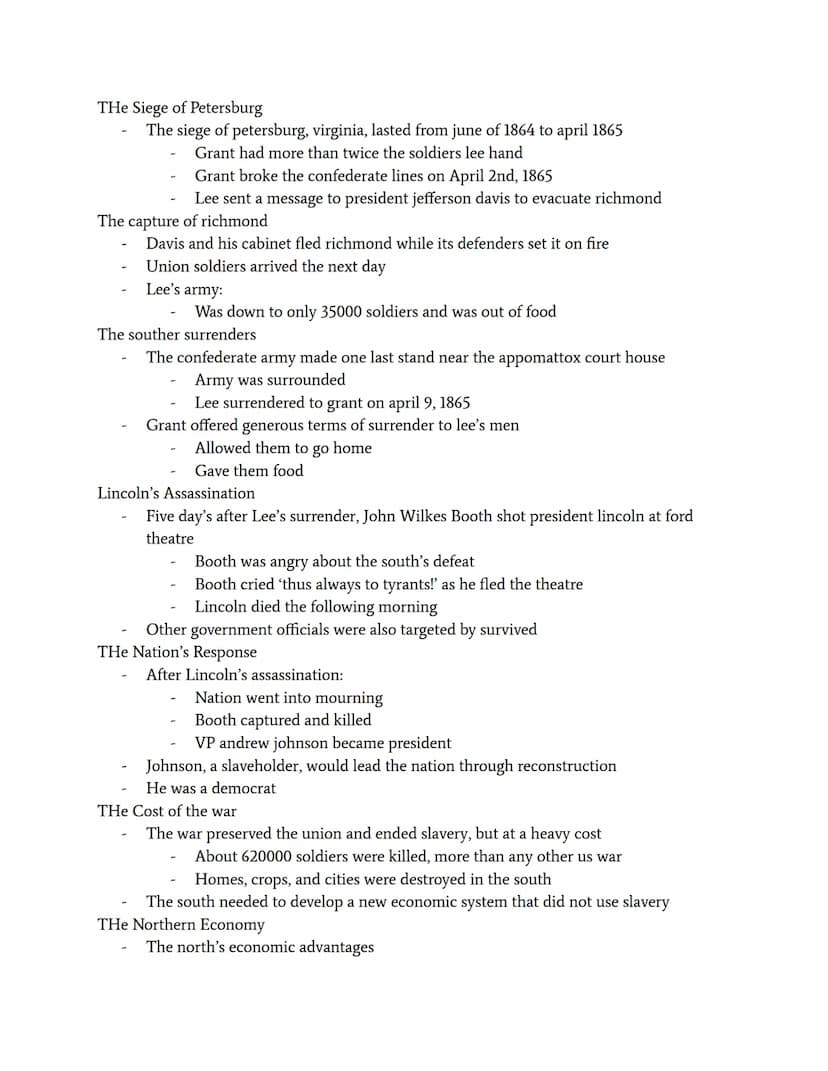
The tide turned for the Union when Ulysses S. Grant became commander of all Union forces in 1864. Known for his resilience and determination, Grant focused his strategy on defeating General Lee in Virginia, later becoming America's 18th president in 1869.
The Union adopted total war tactics, attacking both military and civilian resources throughout the South. This devastating approach involved destroying property and seizing food and animals from Southern civilians. General Sheridan's Shenandoah Valley Campaign cut off Confederate supply lines and destroyed farmland and factories, giving the Union a strategic advantage.
General Sherman's infamous "March to the Sea" began November 15, 1864, carving a path of destruction through Georgia. His forces destroyed buildings, railroads, and crops before capturing Savannah on December 21, severely weakening Southern resistance.
Remember This! Total war targeted civilian infrastructure to break not just military strength but also civilian will and ability to support the war effort.
Despite concerns about his reelection chances in 1864 due to mounting Union casualties and divisions over the Emancipation Proclamation, Lincoln's prospects improved when Sherman captured Atlanta. Lincoln chose Democrat Andrew Johnson as his running mate to broaden his appeal, ultimately defeating former general George McClellan by a large margin.
In his powerful second inaugural address, Lincoln acknowledged that slavery had been the cause of the war and called for the nation to "finish the work" and establish peace afterward, setting the stage for reconciliation.
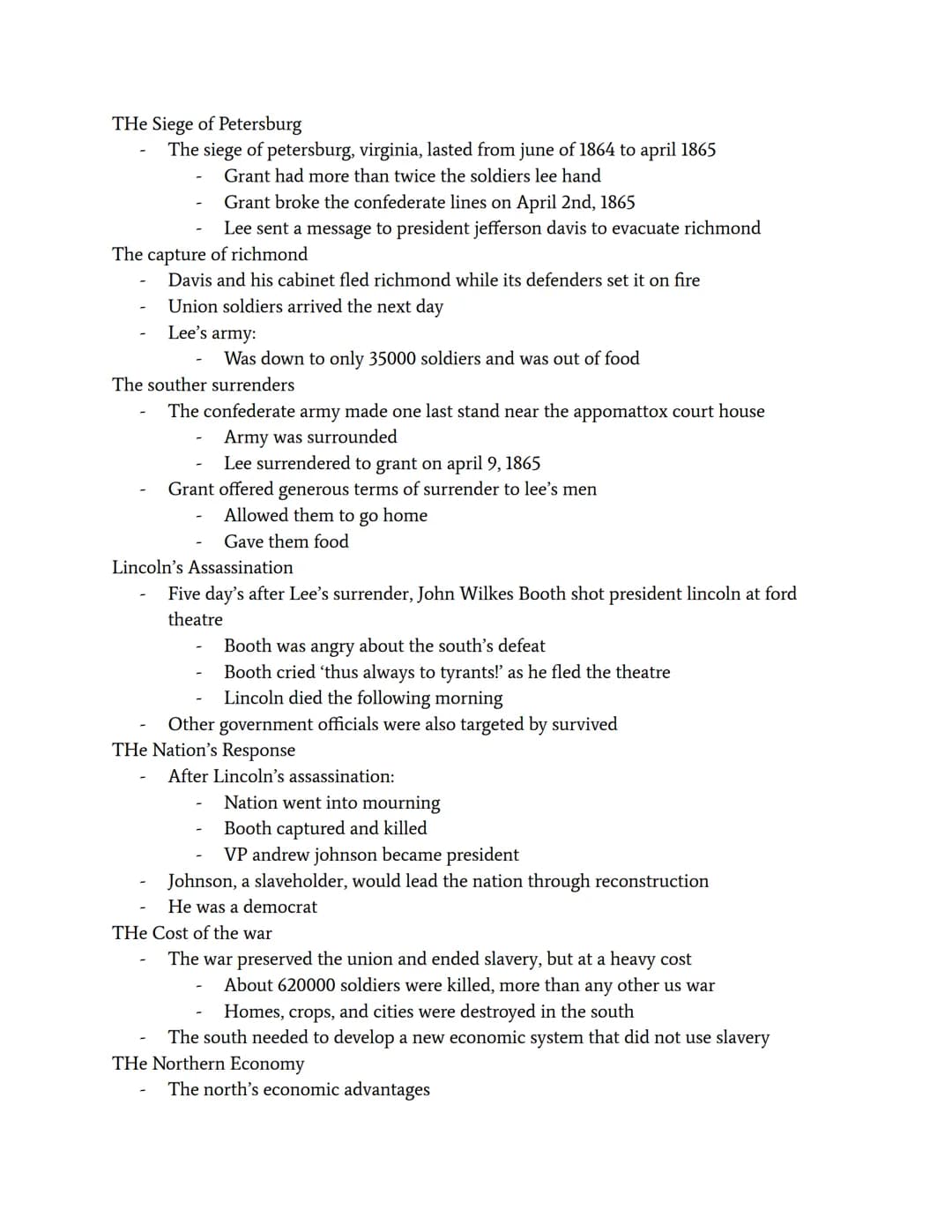
The final chapter of the war unfolded during the siege of Petersburg, Virginia, which lasted from June 1864 to April 1865. With Grant commanding more than twice the soldiers of Lee's forces, Union troops finally broke through Confederate lines on April 2, 1865, forcing Lee to tell Jefferson Davis to evacuate Richmond.
As Union soldiers approached, Confederate officials fled Richmond while defenders set parts of the city on fire. Lee's desperate army, down to only 35,000 soldiers and without food, made one last stand near Appomattox Court House before surrendering on April 9, 1865. Grant offered generous surrender terms, allowing Confederate soldiers to return home and providing them with food.
The nation's brief moment of relief was shattered just five days after Lee's surrender when John Wilkes Booth assassinated President Lincoln at Ford's Theatre. Booth, furious about the South's defeat, shot Lincoln and escaped shouting "Thus always to tyrants!" The president died the next morning, plunging the nation into mourning.
Historical Impact: Lincoln's assassination dramatically altered Reconstruction, putting Andrew Johnson—a Democrat and former slaveholder—in charge of reuniting and rebuilding the nation.
The Civil War preserved the Union and ended slavery but at an enormous cost: approximately 620,000 soldiers died—more than in any other American war. The South faced devastation with homes, crops, and cities destroyed, requiring the development of an entirely new economic system no longer based on enslaved labor.
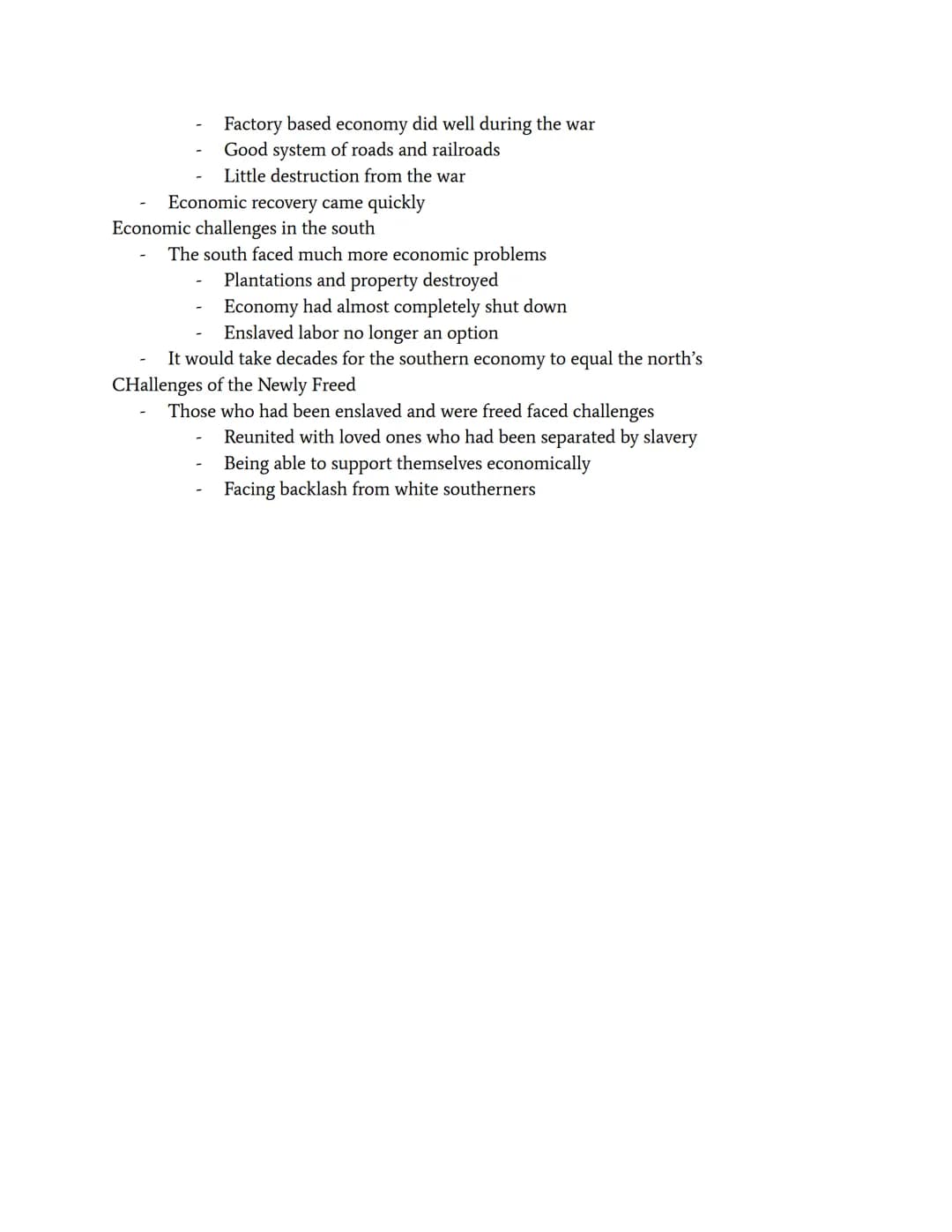
While the North's factory-based economy flourished during the war, the South's economy had virtually collapsed. The North's advantages included minimal war destruction, a solid transportation network of roads and railroads, and a diverse industrial base that helped ensure quick economic recovery.
The South faced monumentally greater challenges. Plantations lay in ruins, property was destroyed across large regions, and the economy had essentially shut down. Without enslaved labor to power their agricultural system, Southern states would take decades to reach economic parity with the North.
Newly freed African Americans confronted their own set of profound challenges. Many immediately sought to reunite with loved ones who had been separated through slavery. Economic independence became a critical concern as former enslaved people needed to support themselves in a hostile environment.
Critical Understanding: Freedom brought both opportunities and new hardships for formerly enslaved people, who faced economic uncertainty and increasing backlash from white Southerners resistant to change.
The war's aftermath created two very different Americas: a North poised for industrial growth and a South that would struggle through a difficult and sometimes violent reconstruction period, with those newly freed caught in the middle of this national transformation.
Our AI companion is specifically built for the needs of students. Based on the millions of content pieces we have on the platform we can provide truly meaningful and relevant answers to students. But its not only about answers, the companion is even more about guiding students through their daily learning challenges, with personalised study plans, quizzes or content pieces in the chat and 100% personalisation based on the students skills and developments.
You can download the app in the Google Play Store and in the Apple App Store.
That's right! Enjoy free access to study content, connect with fellow students, and get instant help – all at your fingertips.
App Store
Google Play
The app is very easy to use and well designed. I have found everything I was looking for so far and have been able to learn a lot from the presentations! I will definitely use the app for a class assignment! And of course it also helps a lot as an inspiration.
Stefan S
iOS user
This app is really great. There are so many study notes and help [...]. My problem subject is French, for example, and the app has so many options for help. Thanks to this app, I have improved my French. I would recommend it to anyone.
Samantha Klich
Android user
Wow, I am really amazed. I just tried the app because I've seen it advertised many times and was absolutely stunned. This app is THE HELP you want for school and above all, it offers so many things, such as workouts and fact sheets, which have been VERY helpful to me personally.
Anna
iOS user
I think it’s very much worth it and you’ll end up using it a lot once you get the hang of it and even after looking at others notes you can still ask your Artificial intelligence buddy the question and ask to simplify it if you still don’t get it!!! In the end I think it’s worth it 😊👍 ⚠️Also DID I MENTION ITS FREEE YOU DON’T HAVE TO PAY FOR ANYTHING AND STILL GET YOUR GRADES IN PERFECTLY❗️❗️⚠️
Thomas R
iOS user
Knowunity is the BEST app I’ve used in a minute. This is not an ai review or anything this is genuinely coming from a 7th grade student (I know 2011 im young) but dude this app is a 10/10 i have maintained a 3.8 gpa and have plenty of time for gaming. I love it and my mom is just happy I got good grades
Brad T
Android user
Not only did it help me find the answer but it also showed me alternative ways to solve it. I was horrible in math and science but now I have an a in both subjects. Thanks for the help🤍🤍
David K
iOS user
The app's just great! All I have to do is enter the topic in the search bar and I get the response real fast. I don't have to watch 10 YouTube videos to understand something, so I'm saving my time. Highly recommended!
Sudenaz Ocak
Android user
In school I was really bad at maths but thanks to the app, I am doing better now. I am so grateful that you made the app.
Greenlight Bonnie
Android user
I found this app a couple years ago and it has only gotten better since then. I really love it because it can help with written questions and photo questions. Also, it can find study guides that other people have made as well as flashcard sets and practice tests. The free version is also amazing for students who might not be able to afford it. Would 100% recommend
Aubrey
iOS user
Best app if you're in Highschool or Junior high. I have been using this app for 2 school years and it's the best, it's good if you don't have anyone to help you with school work.😋🩷🎀
Marco B
iOS user
THE QUIZES AND FLASHCARDS ARE SO USEFUL AND I LOVE Knowunity AI. IT ALSO IS LITREALLY LIKE CHATGPT BUT SMARTER!! HELPED ME WITH MY MASCARA PROBLEMS TOO!! AS WELL AS MY REAL SUBJECTS ! DUHHH 😍😁😲🤑💗✨🎀😮
Elisha
iOS user
This app is phenomenal down to the correct info and the various topics you can study! I greatly recommend it for people who struggle with procrastination and those who need homework help. It has been perfectly accurate for world 1 history as far as I’ve seen! Geometry too!
Paul T
iOS user
The app is very easy to use and well designed. I have found everything I was looking for so far and have been able to learn a lot from the presentations! I will definitely use the app for a class assignment! And of course it also helps a lot as an inspiration.
Stefan S
iOS user
This app is really great. There are so many study notes and help [...]. My problem subject is French, for example, and the app has so many options for help. Thanks to this app, I have improved my French. I would recommend it to anyone.
Samantha Klich
Android user
Wow, I am really amazed. I just tried the app because I've seen it advertised many times and was absolutely stunned. This app is THE HELP you want for school and above all, it offers so many things, such as workouts and fact sheets, which have been VERY helpful to me personally.
Anna
iOS user
I think it’s very much worth it and you’ll end up using it a lot once you get the hang of it and even after looking at others notes you can still ask your Artificial intelligence buddy the question and ask to simplify it if you still don’t get it!!! In the end I think it’s worth it 😊👍 ⚠️Also DID I MENTION ITS FREEE YOU DON’T HAVE TO PAY FOR ANYTHING AND STILL GET YOUR GRADES IN PERFECTLY❗️❗️⚠️
Thomas R
iOS user
Knowunity is the BEST app I’ve used in a minute. This is not an ai review or anything this is genuinely coming from a 7th grade student (I know 2011 im young) but dude this app is a 10/10 i have maintained a 3.8 gpa and have plenty of time for gaming. I love it and my mom is just happy I got good grades
Brad T
Android user
Not only did it help me find the answer but it also showed me alternative ways to solve it. I was horrible in math and science but now I have an a in both subjects. Thanks for the help🤍🤍
David K
iOS user
The app's just great! All I have to do is enter the topic in the search bar and I get the response real fast. I don't have to watch 10 YouTube videos to understand something, so I'm saving my time. Highly recommended!
Sudenaz Ocak
Android user
In school I was really bad at maths but thanks to the app, I am doing better now. I am so grateful that you made the app.
Greenlight Bonnie
Android user
I found this app a couple years ago and it has only gotten better since then. I really love it because it can help with written questions and photo questions. Also, it can find study guides that other people have made as well as flashcard sets and practice tests. The free version is also amazing for students who might not be able to afford it. Would 100% recommend
Aubrey
iOS user
Best app if you're in Highschool or Junior high. I have been using this app for 2 school years and it's the best, it's good if you don't have anyone to help you with school work.😋🩷🎀
Marco B
iOS user
THE QUIZES AND FLASHCARDS ARE SO USEFUL AND I LOVE Knowunity AI. IT ALSO IS LITREALLY LIKE CHATGPT BUT SMARTER!! HELPED ME WITH MY MASCARA PROBLEMS TOO!! AS WELL AS MY REAL SUBJECTS ! DUHHH 😍😁😲🤑💗✨🎀😮
Elisha
iOS user
This app is phenomenal down to the correct info and the various topics you can study! I greatly recommend it for people who struggle with procrastination and those who need homework help. It has been perfectly accurate for world 1 history as far as I’ve seen! Geometry too!
Paul T
iOS user
The American Civil War concluded with dramatic military campaigns, pivotal political developments, and a tragic assassination. This period transformed America through the final defeat of the Confederacy, the reelection of Lincoln, and the challenges of rebuilding a divided nation.
Access to all documents
Improve your grades
Join milions of students
The tide turned for the Union when Ulysses S. Grant became commander of all Union forces in 1864. Known for his resilience and determination, Grant focused his strategy on defeating General Lee in Virginia, later becoming America's 18th president in 1869.
The Union adopted total war tactics, attacking both military and civilian resources throughout the South. This devastating approach involved destroying property and seizing food and animals from Southern civilians. General Sheridan's Shenandoah Valley Campaign cut off Confederate supply lines and destroyed farmland and factories, giving the Union a strategic advantage.
General Sherman's infamous "March to the Sea" began November 15, 1864, carving a path of destruction through Georgia. His forces destroyed buildings, railroads, and crops before capturing Savannah on December 21, severely weakening Southern resistance.
Remember This! Total war targeted civilian infrastructure to break not just military strength but also civilian will and ability to support the war effort.
Despite concerns about his reelection chances in 1864 due to mounting Union casualties and divisions over the Emancipation Proclamation, Lincoln's prospects improved when Sherman captured Atlanta. Lincoln chose Democrat Andrew Johnson as his running mate to broaden his appeal, ultimately defeating former general George McClellan by a large margin.
In his powerful second inaugural address, Lincoln acknowledged that slavery had been the cause of the war and called for the nation to "finish the work" and establish peace afterward, setting the stage for reconciliation.
Access to all documents
Improve your grades
Join milions of students
The final chapter of the war unfolded during the siege of Petersburg, Virginia, which lasted from June 1864 to April 1865. With Grant commanding more than twice the soldiers of Lee's forces, Union troops finally broke through Confederate lines on April 2, 1865, forcing Lee to tell Jefferson Davis to evacuate Richmond.
As Union soldiers approached, Confederate officials fled Richmond while defenders set parts of the city on fire. Lee's desperate army, down to only 35,000 soldiers and without food, made one last stand near Appomattox Court House before surrendering on April 9, 1865. Grant offered generous surrender terms, allowing Confederate soldiers to return home and providing them with food.
The nation's brief moment of relief was shattered just five days after Lee's surrender when John Wilkes Booth assassinated President Lincoln at Ford's Theatre. Booth, furious about the South's defeat, shot Lincoln and escaped shouting "Thus always to tyrants!" The president died the next morning, plunging the nation into mourning.
Historical Impact: Lincoln's assassination dramatically altered Reconstruction, putting Andrew Johnson—a Democrat and former slaveholder—in charge of reuniting and rebuilding the nation.
The Civil War preserved the Union and ended slavery but at an enormous cost: approximately 620,000 soldiers died—more than in any other American war. The South faced devastation with homes, crops, and cities destroyed, requiring the development of an entirely new economic system no longer based on enslaved labor.
Access to all documents
Improve your grades
Join milions of students
While the North's factory-based economy flourished during the war, the South's economy had virtually collapsed. The North's advantages included minimal war destruction, a solid transportation network of roads and railroads, and a diverse industrial base that helped ensure quick economic recovery.
The South faced monumentally greater challenges. Plantations lay in ruins, property was destroyed across large regions, and the economy had essentially shut down. Without enslaved labor to power their agricultural system, Southern states would take decades to reach economic parity with the North.
Newly freed African Americans confronted their own set of profound challenges. Many immediately sought to reunite with loved ones who had been separated through slavery. Economic independence became a critical concern as former enslaved people needed to support themselves in a hostile environment.
Critical Understanding: Freedom brought both opportunities and new hardships for formerly enslaved people, who faced economic uncertainty and increasing backlash from white Southerners resistant to change.
The war's aftermath created two very different Americas: a North poised for industrial growth and a South that would struggle through a difficult and sometimes violent reconstruction period, with those newly freed caught in the middle of this national transformation.
Our AI companion is specifically built for the needs of students. Based on the millions of content pieces we have on the platform we can provide truly meaningful and relevant answers to students. But its not only about answers, the companion is even more about guiding students through their daily learning challenges, with personalised study plans, quizzes or content pieces in the chat and 100% personalisation based on the students skills and developments.
You can download the app in the Google Play Store and in the Apple App Store.
That's right! Enjoy free access to study content, connect with fellow students, and get instant help – all at your fingertips.
1
Smart Tools NEW
Transform this note into: ✓ 50+ Practice Questions ✓ Interactive Flashcards ✓ Full Practice Test ✓ Essay Outlines
App Store
Google Play
The app is very easy to use and well designed. I have found everything I was looking for so far and have been able to learn a lot from the presentations! I will definitely use the app for a class assignment! And of course it also helps a lot as an inspiration.
Stefan S
iOS user
This app is really great. There are so many study notes and help [...]. My problem subject is French, for example, and the app has so many options for help. Thanks to this app, I have improved my French. I would recommend it to anyone.
Samantha Klich
Android user
Wow, I am really amazed. I just tried the app because I've seen it advertised many times and was absolutely stunned. This app is THE HELP you want for school and above all, it offers so many things, such as workouts and fact sheets, which have been VERY helpful to me personally.
Anna
iOS user
I think it’s very much worth it and you’ll end up using it a lot once you get the hang of it and even after looking at others notes you can still ask your Artificial intelligence buddy the question and ask to simplify it if you still don’t get it!!! In the end I think it’s worth it 😊👍 ⚠️Also DID I MENTION ITS FREEE YOU DON’T HAVE TO PAY FOR ANYTHING AND STILL GET YOUR GRADES IN PERFECTLY❗️❗️⚠️
Thomas R
iOS user
Knowunity is the BEST app I’ve used in a minute. This is not an ai review or anything this is genuinely coming from a 7th grade student (I know 2011 im young) but dude this app is a 10/10 i have maintained a 3.8 gpa and have plenty of time for gaming. I love it and my mom is just happy I got good grades
Brad T
Android user
Not only did it help me find the answer but it also showed me alternative ways to solve it. I was horrible in math and science but now I have an a in both subjects. Thanks for the help🤍🤍
David K
iOS user
The app's just great! All I have to do is enter the topic in the search bar and I get the response real fast. I don't have to watch 10 YouTube videos to understand something, so I'm saving my time. Highly recommended!
Sudenaz Ocak
Android user
In school I was really bad at maths but thanks to the app, I am doing better now. I am so grateful that you made the app.
Greenlight Bonnie
Android user
I found this app a couple years ago and it has only gotten better since then. I really love it because it can help with written questions and photo questions. Also, it can find study guides that other people have made as well as flashcard sets and practice tests. The free version is also amazing for students who might not be able to afford it. Would 100% recommend
Aubrey
iOS user
Best app if you're in Highschool or Junior high. I have been using this app for 2 school years and it's the best, it's good if you don't have anyone to help you with school work.😋🩷🎀
Marco B
iOS user
THE QUIZES AND FLASHCARDS ARE SO USEFUL AND I LOVE Knowunity AI. IT ALSO IS LITREALLY LIKE CHATGPT BUT SMARTER!! HELPED ME WITH MY MASCARA PROBLEMS TOO!! AS WELL AS MY REAL SUBJECTS ! DUHHH 😍😁😲🤑💗✨🎀😮
Elisha
iOS user
This app is phenomenal down to the correct info and the various topics you can study! I greatly recommend it for people who struggle with procrastination and those who need homework help. It has been perfectly accurate for world 1 history as far as I’ve seen! Geometry too!
Paul T
iOS user
The app is very easy to use and well designed. I have found everything I was looking for so far and have been able to learn a lot from the presentations! I will definitely use the app for a class assignment! And of course it also helps a lot as an inspiration.
Stefan S
iOS user
This app is really great. There are so many study notes and help [...]. My problem subject is French, for example, and the app has so many options for help. Thanks to this app, I have improved my French. I would recommend it to anyone.
Samantha Klich
Android user
Wow, I am really amazed. I just tried the app because I've seen it advertised many times and was absolutely stunned. This app is THE HELP you want for school and above all, it offers so many things, such as workouts and fact sheets, which have been VERY helpful to me personally.
Anna
iOS user
I think it’s very much worth it and you’ll end up using it a lot once you get the hang of it and even after looking at others notes you can still ask your Artificial intelligence buddy the question and ask to simplify it if you still don’t get it!!! In the end I think it’s worth it 😊👍 ⚠️Also DID I MENTION ITS FREEE YOU DON’T HAVE TO PAY FOR ANYTHING AND STILL GET YOUR GRADES IN PERFECTLY❗️❗️⚠️
Thomas R
iOS user
Knowunity is the BEST app I’ve used in a minute. This is not an ai review or anything this is genuinely coming from a 7th grade student (I know 2011 im young) but dude this app is a 10/10 i have maintained a 3.8 gpa and have plenty of time for gaming. I love it and my mom is just happy I got good grades
Brad T
Android user
Not only did it help me find the answer but it also showed me alternative ways to solve it. I was horrible in math and science but now I have an a in both subjects. Thanks for the help🤍🤍
David K
iOS user
The app's just great! All I have to do is enter the topic in the search bar and I get the response real fast. I don't have to watch 10 YouTube videos to understand something, so I'm saving my time. Highly recommended!
Sudenaz Ocak
Android user
In school I was really bad at maths but thanks to the app, I am doing better now. I am so grateful that you made the app.
Greenlight Bonnie
Android user
I found this app a couple years ago and it has only gotten better since then. I really love it because it can help with written questions and photo questions. Also, it can find study guides that other people have made as well as flashcard sets and practice tests. The free version is also amazing for students who might not be able to afford it. Would 100% recommend
Aubrey
iOS user
Best app if you're in Highschool or Junior high. I have been using this app for 2 school years and it's the best, it's good if you don't have anyone to help you with school work.😋🩷🎀
Marco B
iOS user
THE QUIZES AND FLASHCARDS ARE SO USEFUL AND I LOVE Knowunity AI. IT ALSO IS LITREALLY LIKE CHATGPT BUT SMARTER!! HELPED ME WITH MY MASCARA PROBLEMS TOO!! AS WELL AS MY REAL SUBJECTS ! DUHHH 😍😁😲🤑💗✨🎀😮
Elisha
iOS user
This app is phenomenal down to the correct info and the various topics you can study! I greatly recommend it for people who struggle with procrastination and those who need homework help. It has been perfectly accurate for world 1 history as far as I’ve seen! Geometry too!
Paul T
iOS user