

The United States President wields significant powers across multiple domains,... Show more
 US History
 Algebra
Sign up to see the contentIt's free!
Access to all documents
Improve your grades
Join milions of students
Knowunity AI
Subjects
Triangle Congruence and Similarity Theorems
Triangle Properties and Classification
Linear Equations and Graphs
Geometric Angle Relationships
Trigonometric Functions and Identities
Equation Solving Techniques
Circle Geometry Fundamentals
Division Operations and Methods
Basic Differentiation Rules
Exponent and Logarithm Properties
Show all topics
Human Organ Systems
Reproductive Cell Cycles
Biological Sciences Subdisciplines
Cellular Energy Metabolism
Autotrophic Energy Processes
Inheritance Patterns and Principles
Biomolecular Structure and Organization
Cell Cycle and Division Mechanics
Cellular Organization and Development
Biological Structural Organization
Show all topics
Chemical Sciences and Applications
Atomic Structure and Composition
Molecular Electron Structure Representation
Atomic Electron Behavior
Matter Properties and Water
Mole Concept and Calculations
Gas Laws and Behavior
Periodic Table Organization
Chemical Thermodynamics Fundamentals
Chemical Bond Types and Properties
Show all topics
European Renaissance and Enlightenment
European Cultural Movements 800-1920
American Revolution Era 1763-1797
American Civil War 1861-1865
Global Imperial Systems
Mongol and Chinese Dynasties
U.S. Presidents and World Leaders
Historical Sources and Documentation
World Wars Era and Impact
World Religious Systems
Show all topics
Classic and Contemporary Novels
Literary Character Analysis
Rhetorical Theory and Practice
Classic Literary Narratives
Reading Analysis and Interpretation
Narrative Structure and Techniques
English Language Components
Influential English-Language Authors
Basic Sentence Structure
Narrative Voice and Perspective
Show all topics
125
•
Updated Feb 23, 2026
•
The United States President wields significant powers across multiple domains,... Show more
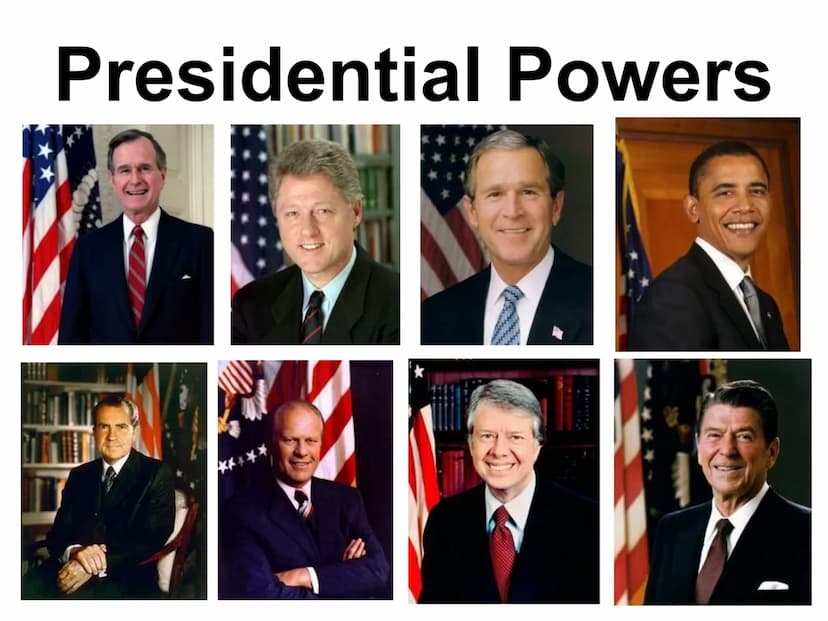
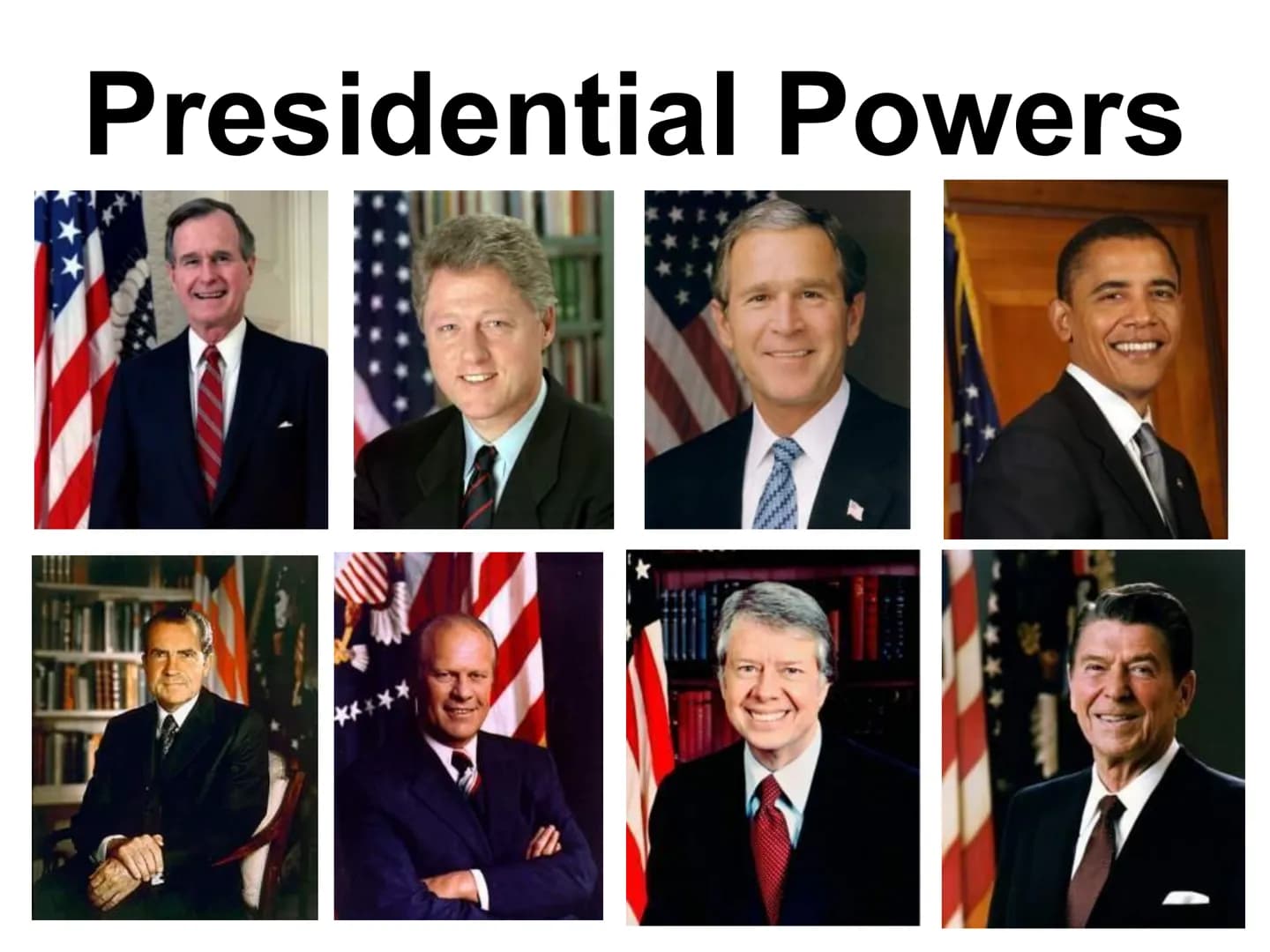
The President of the United States has a wide range of powers that span executive, diplomatic, military, legislative, and judicial domains. These powers give the President tremendous influence over government operations, foreign relations, and the armed forces.
Understanding these presidential powers helps you see how one person can have such significant impact on the country and world. The Constitution carefully distributes these powers to create checks and balances between branches of government.
You'll soon discover how these powers shape everything from the laws we follow to how America engages with other nations.
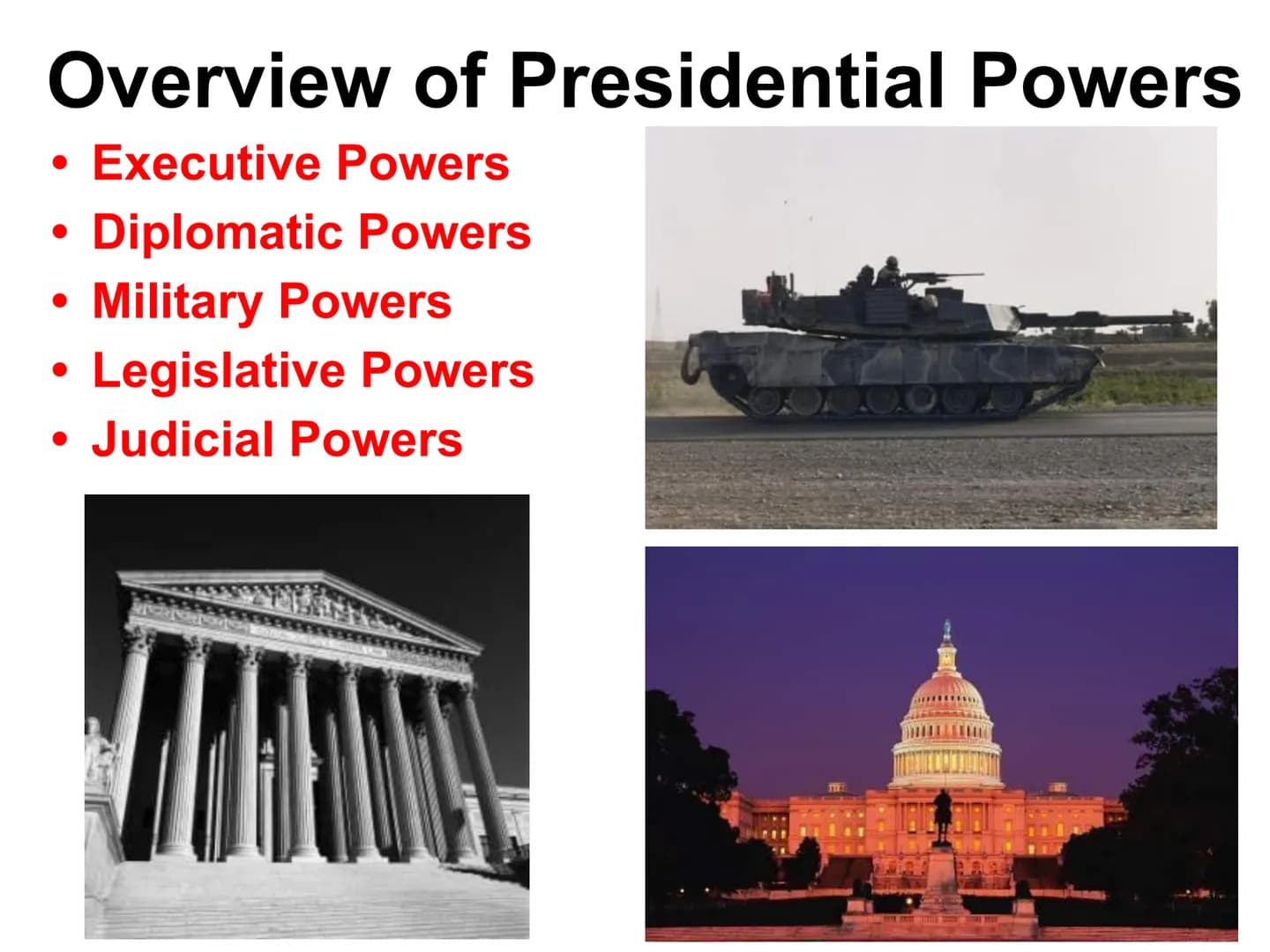
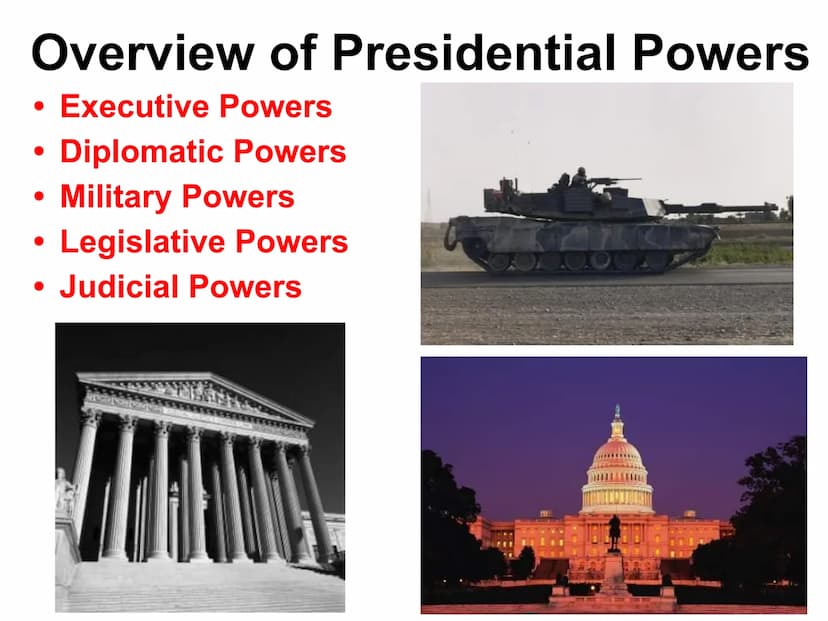
The President's authority breaks down into five main categories that touch nearly every aspect of government operations. Executive powers allow the President to run the federal government and enforce laws, while diplomatic powers enable engagement with foreign nations.
Military powers position the President as Commander-in-Chief with control over armed forces. Through legislative powers, the President can influence the lawmaking process despite not being in Congress.
Judicial powers give the President authority over certain legal matters, including the ability to grant pardons for federal crimes.
💡 Think of these five categories as different hats the President wears throughout the day—sometimes enforcing laws, other times negotiating with foreign leaders or suggesting new legislation.
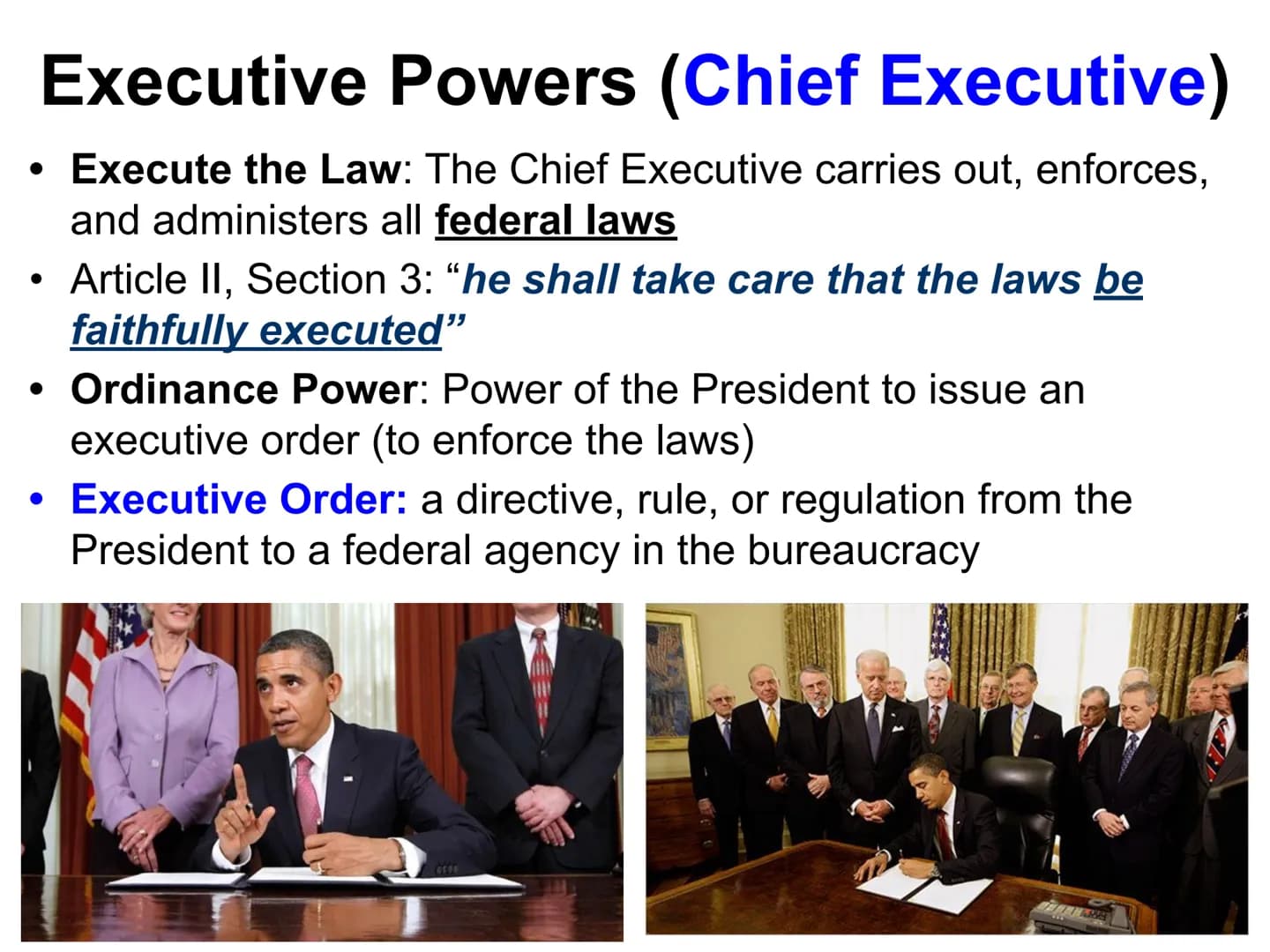
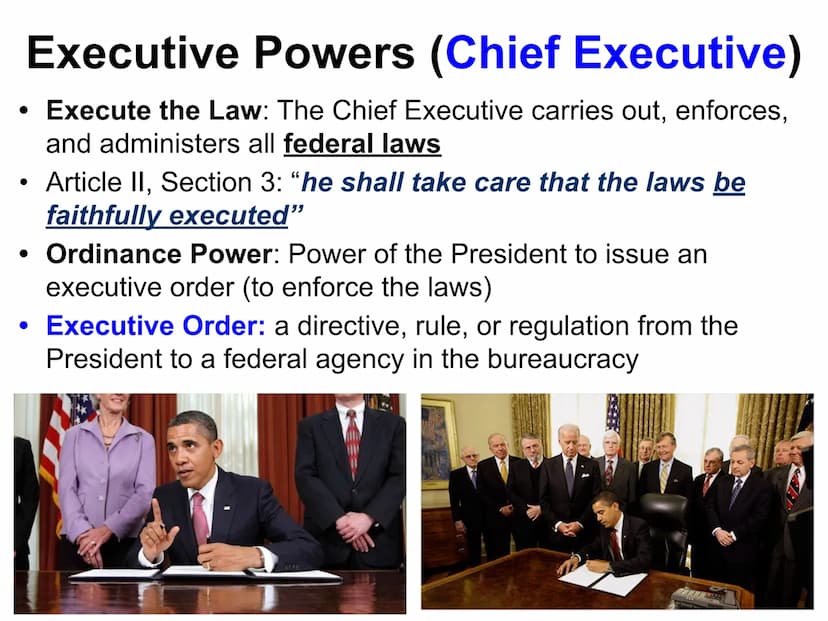
As Chief Executive, the President's primary duty is to execute and enforce federal laws. This responsibility comes directly from Article II, Section 3 of the Constitution, which states "he shall take care that the laws be faithfully executed."
The President can issue executive orders through what's called ordinance power. These are directives or regulations sent to federal agencies in the bureaucracy that help implement and enforce laws passed by Congress.
Executive orders are powerful tools that allow Presidents to make significant policy changes without congressional approval. They've been used throughout history to address everything from civil rights to national security concerns.
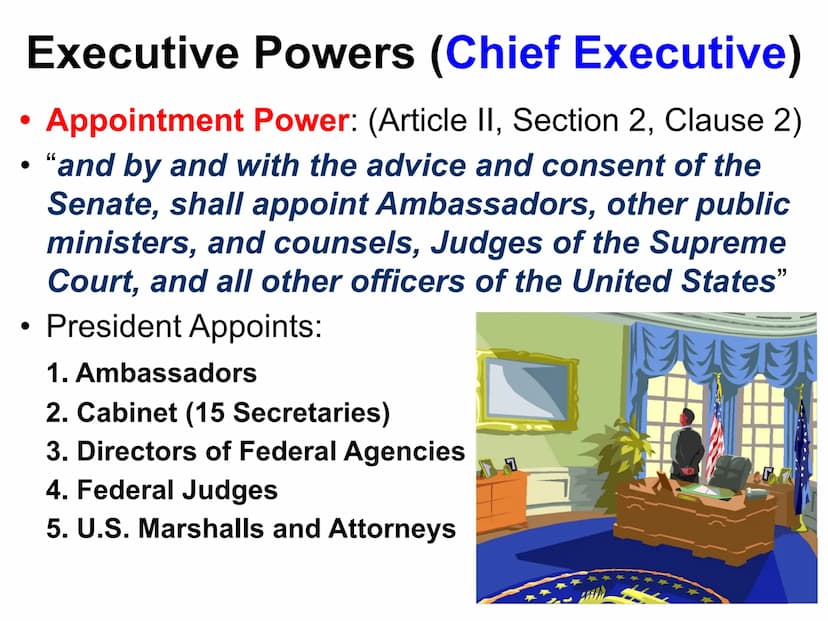
The appointment power is one of the President's most influential tools, established in Article II of the Constitution. With "advice and consent of the Senate," the President can appoint key government officials who shape policy and enforcement.
Presidents appoint thousands of positions including ambassadors who represent the U.S. abroad, Cabinet secretaries who run major departments, directors of federal agencies, federal judges who serve lifetime appointments, and U.S. Marshals and Attorneys who enforce federal law.
These appointments allow Presidents to surround themselves with officials who share their vision and policy goals. The requirement for Senate confirmation creates an important check on this power, ensuring appointees meet minimum qualifications.
🔑 Senate confirmation is required for major appointments, giving you a chance to see how the separation of powers works in practice through the "advice and consent" process.
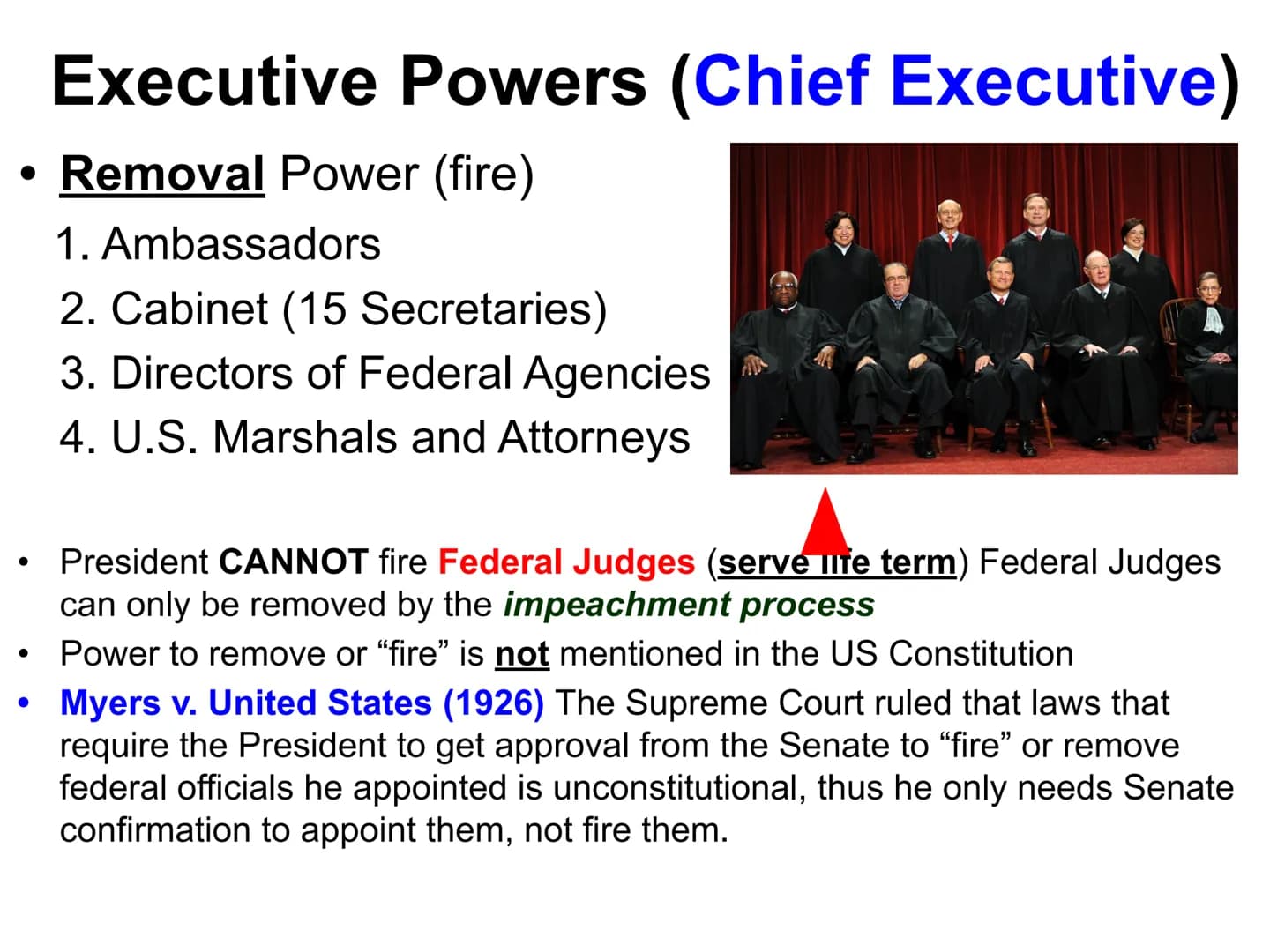
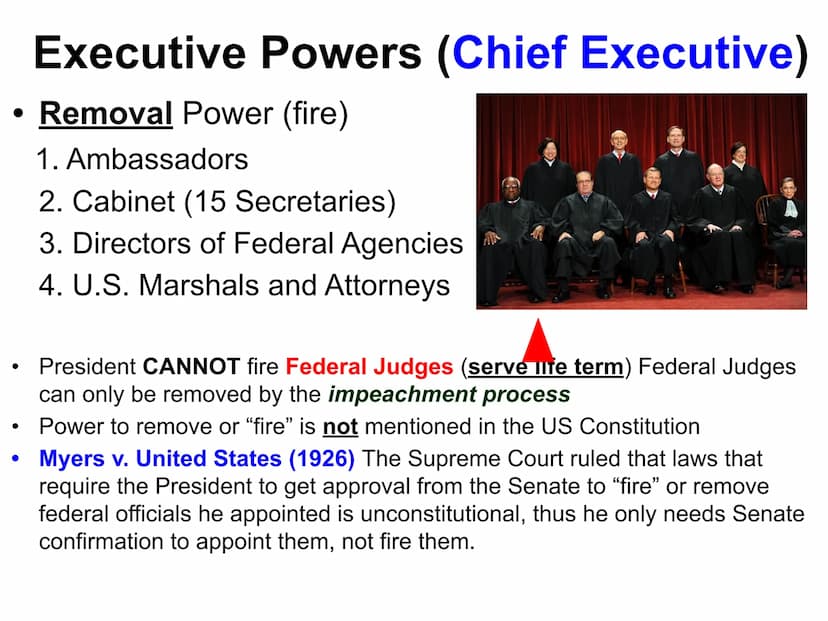
The President has the power to remove or fire most of the officials they appoint, including ambassadors, Cabinet secretaries, agency directors, and U.S. Marshals and Attorneys. This removal power gives Presidents significant control over the executive branch.
Interestingly, the Constitution doesn't explicitly mention the power to remove officials. This authority was established by the Supreme Court in Myers v. United States (1926), which ruled that requiring Senate approval for removals was unconstitutional.
One major exception exists: federal judges cannot be fired by the President. These judges serve lifetime appointments and can only be removed through the impeachment process by Congress. This protection maintains judicial independence from executive control.
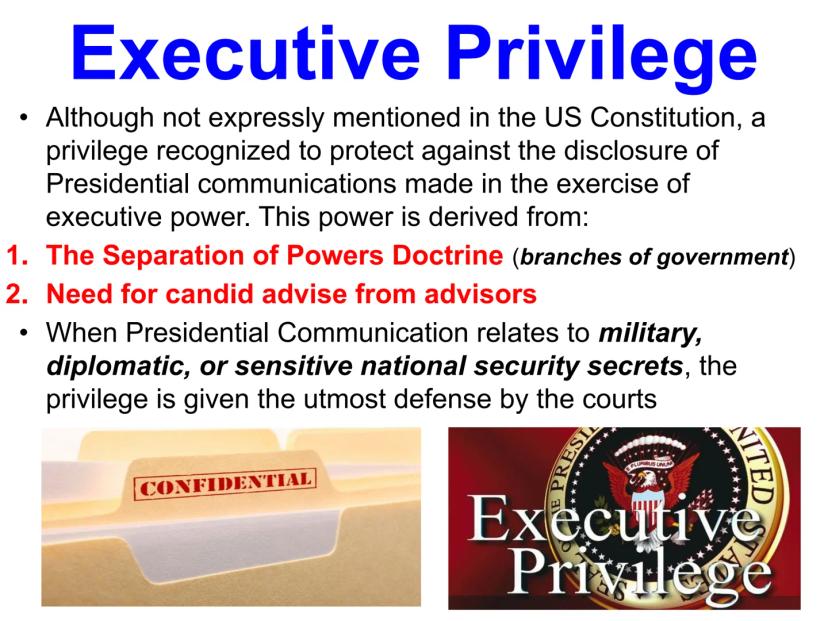
Executive privilege is a special power that protects certain presidential communications from disclosure. Though not explicitly mentioned in the Constitution, this privilege has been recognized based on two key principles: the separation of powers doctrine and the President's need for candid advice.
This privilege is strongest when communications relate to military, diplomatic, or sensitive national security matters. In these cases, courts typically give the highest protection to the President's right to keep information confidential.
Executive privilege creates a protected space where Presidents and their advisors can speak freely without fear that their discussions will become public. This encourages honest advice and deliberation on sensitive matters.
⚖️ Despite its importance, executive privilege is not absolute. As you'll see in cases like United States v. Nixon, courts have ruled that this privilege must sometimes yield to other constitutional principles.
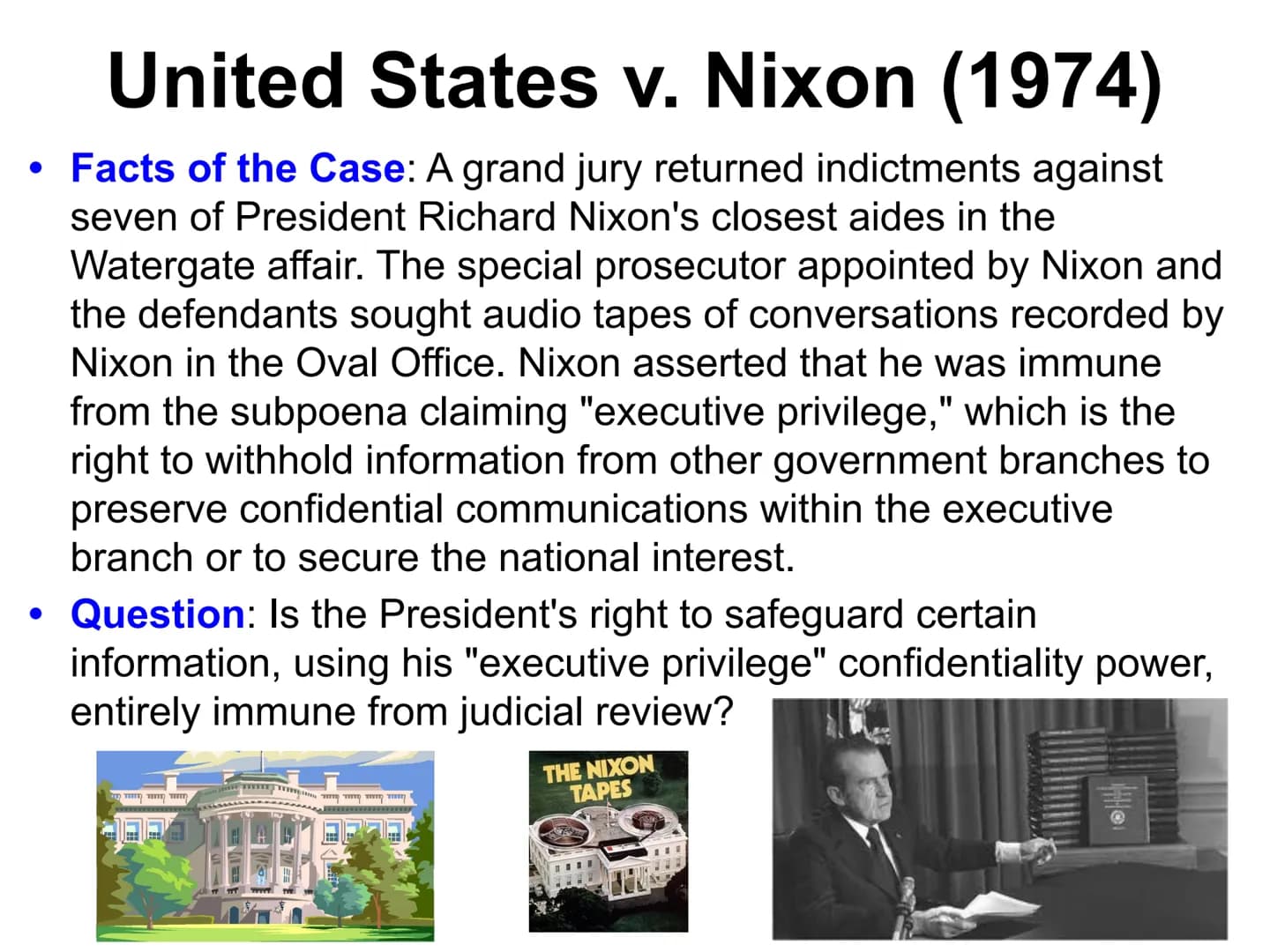
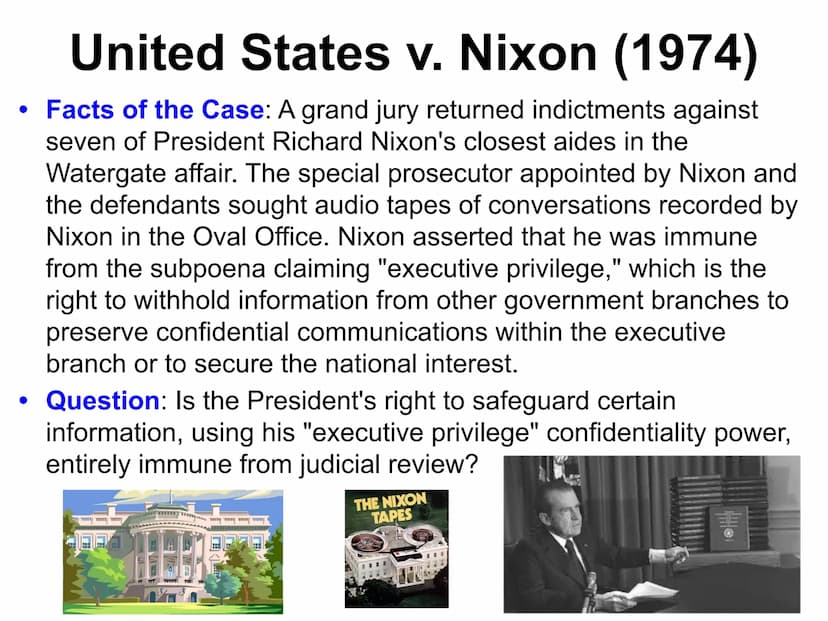
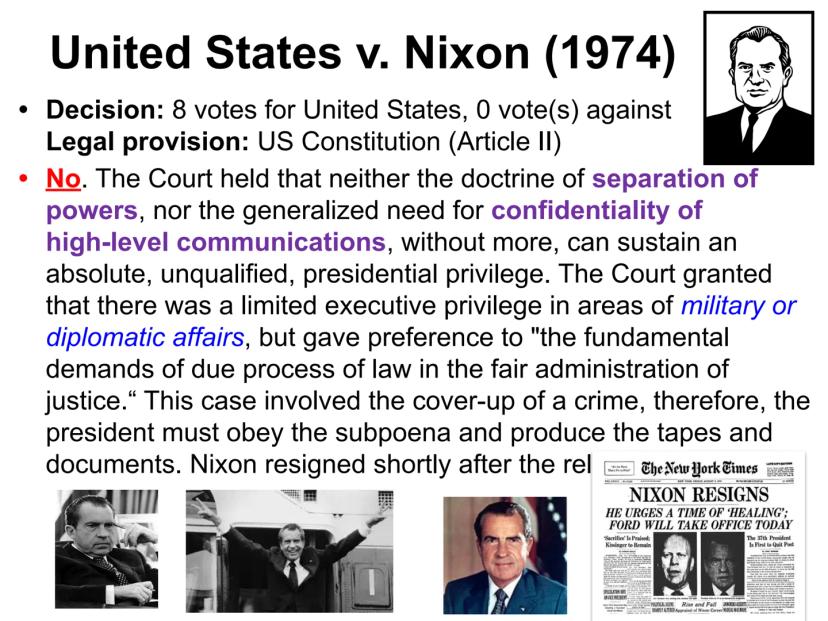
During the Watergate scandal, a grand jury indicted seven of President Nixon's closest aides. The special prosecutor sought audio tapes of Oval Office conversations as evidence, but Nixon refused to hand them over, claiming executive privilege protected them from disclosure.
This led to a historic Supreme Court case addressing a crucial question: Is the President's executive privilege completely immune from judicial review? The case tested whether a President could withhold evidence in a criminal investigation by claiming confidentiality.
Nixon argued that the separation of powers doctrine protected presidential communications from judicial scrutiny. This case forced the Court to balance executive confidentiality against the fundamental needs of the criminal justice system.
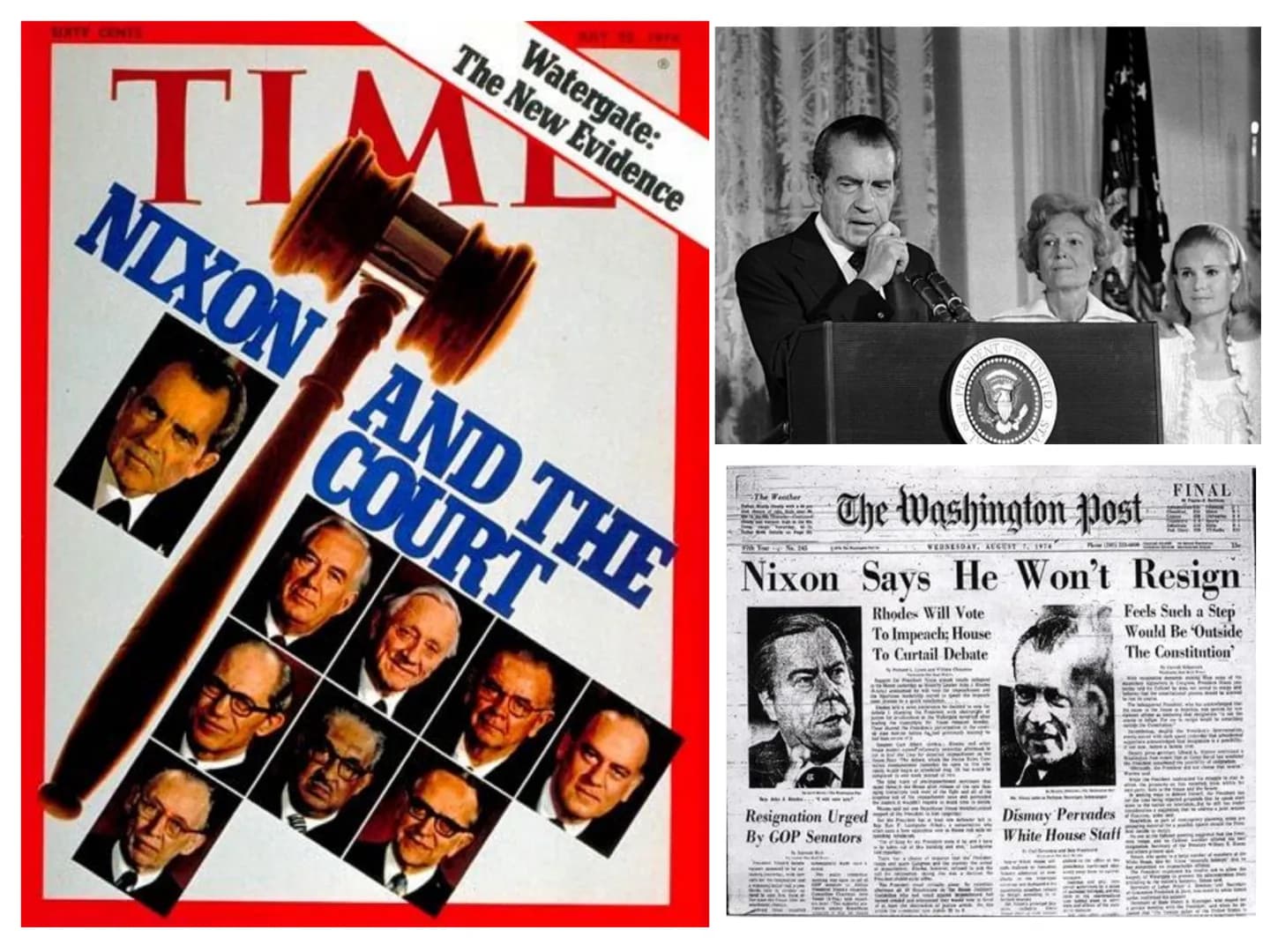
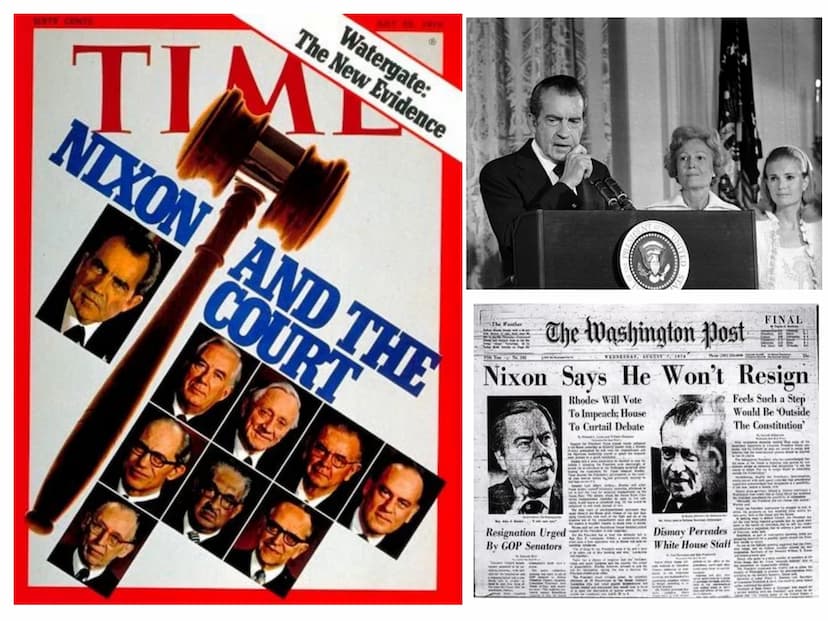
As the Watergate scandal intensified, political pressure mounted on President Nixon. The potential impeachment became front-page news across America, with headlines like "Nixon Says He Won't Resign" appearing in major newspapers.
Key Republican leaders, including Congressman Rhodes, announced they would vote to impeach the President. Meanwhile, multiple Republican senators urged Nixon to resign, creating unprecedented pressure from within his own party.
The atmosphere inside the White House was described as one of dismay and uncertainty. The constitutional crisis created by Nixon's resistance to the subpoena highlighted the tension between presidential power and the rule of law.
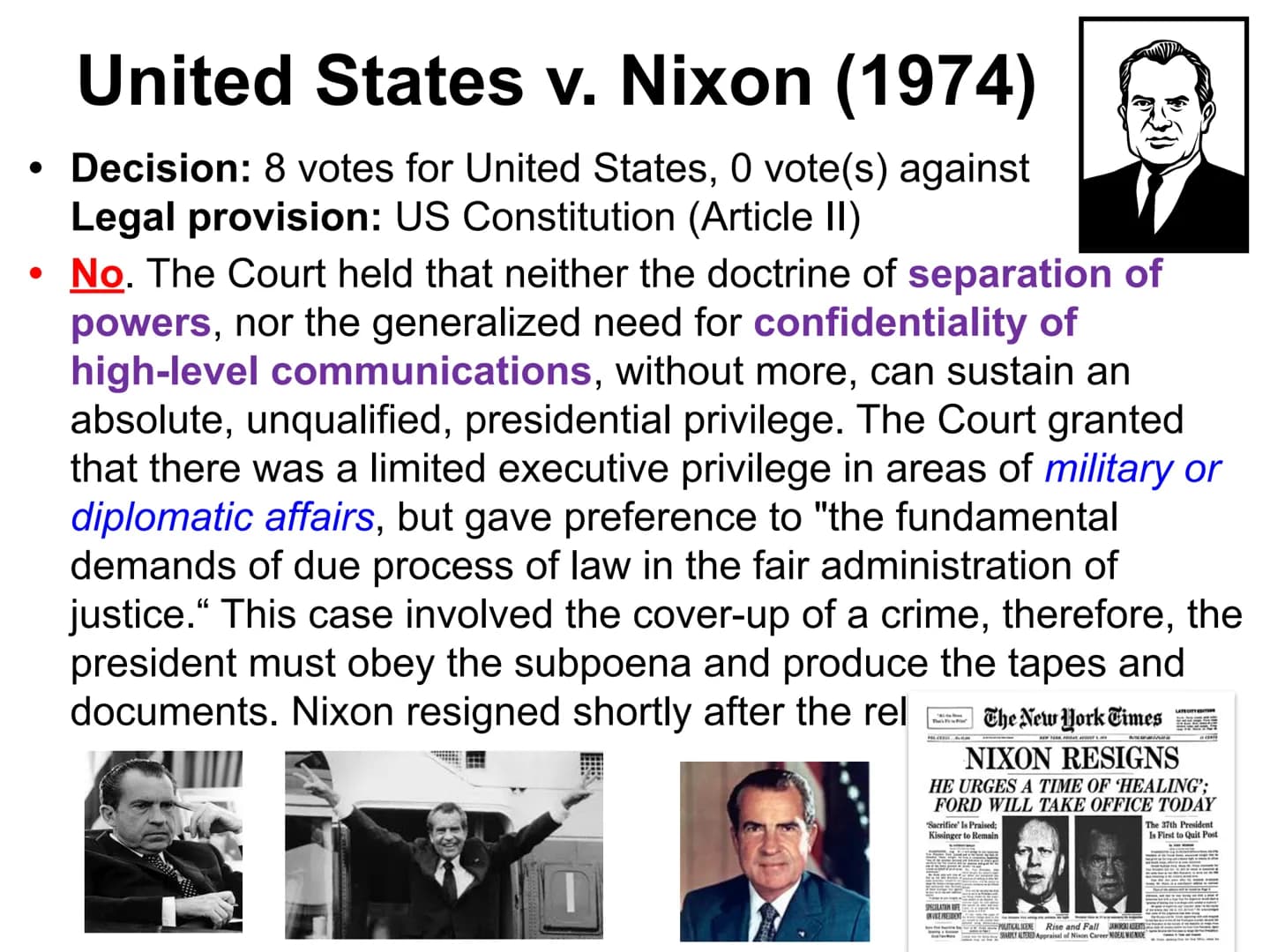
In a unanimous 8-0 decision, the Supreme Court ruled against President Nixon. The Court held that neither the separation of powers nor a general need for confidentiality could support an absolute, unqualified presidential privilege.
The Court acknowledged a limited executive privilege in military and diplomatic affairs, but gave preference to "the fundamental demands of due process of law in the fair administration of justice." Since this case involved potential crime evidence, Nixon had to produce the tapes.
Shortly after this landmark ruling, Nixon resigned from office—the first and only President to do so. This case established the crucial principle that even Presidents are not above the law and must comply with legitimate legal processes in criminal matters.
📝 The Nixon case demonstrates that executive privilege has limits. When the judicial system needs evidence of potential crimes, that need can override a President's desire for confidentiality.
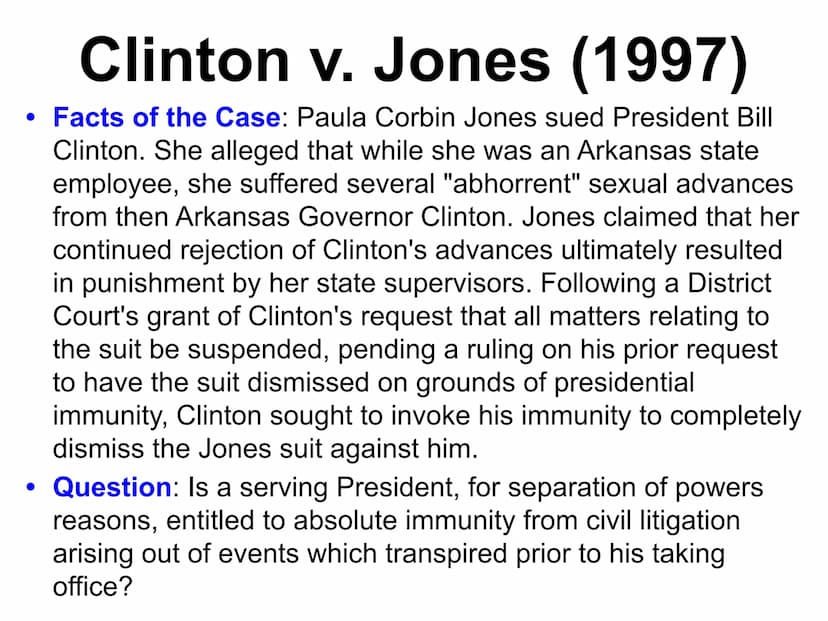
In another significant case testing presidential powers, Paula Jones sued President Bill Clinton. She alleged that while she was an Arkansas state employee, then-Governor Clinton made "abhorrent" sexual advances toward her and that her rejection resulted in punishment by state supervisors.
Clinton requested immunity from the civil lawsuit, arguing that the separation of powers doctrine protected a sitting President from such litigation. The case raised an important question: Is a sitting President entitled to absolute immunity from civil lawsuits for events that occurred before taking office?
This case differed from Nixon's because it involved alleged personal conduct before Clinton became President, not official actions while in office. The Court needed to determine whether presidential duties justified immunity from such lawsuits.
Our AI companion is specifically built for the needs of students. Based on the millions of content pieces we have on the platform we can provide truly meaningful and relevant answers to students. But its not only about answers, the companion is even more about guiding students through their daily learning challenges, with personalised study plans, quizzes or content pieces in the chat and 100% personalisation based on the students skills and developments.
You can download the app in the Google Play Store and in the Apple App Store.
That's right! Enjoy free access to study content, connect with fellow students, and get instant help – all at your fingertips.
App Store
Google Play
The app is very easy to use and well designed. I have found everything I was looking for so far and have been able to learn a lot from the presentations! I will definitely use the app for a class assignment! And of course it also helps a lot as an inspiration.
Stefan S
iOS user
This app is really great. There are so many study notes and help [...]. My problem subject is French, for example, and the app has so many options for help. Thanks to this app, I have improved my French. I would recommend it to anyone.
Samantha Klich
Android user
Wow, I am really amazed. I just tried the app because I've seen it advertised many times and was absolutely stunned. This app is THE HELP you want for school and above all, it offers so many things, such as workouts and fact sheets, which have been VERY helpful to me personally.
Anna
iOS user
I think it’s very much worth it and you’ll end up using it a lot once you get the hang of it and even after looking at others notes you can still ask your Artificial intelligence buddy the question and ask to simplify it if you still don’t get it!!! In the end I think it’s worth it 😊👍 ⚠️Also DID I MENTION ITS FREEE YOU DON’T HAVE TO PAY FOR ANYTHING AND STILL GET YOUR GRADES IN PERFECTLY❗️❗️⚠️
Thomas R
iOS user
Knowunity is the BEST app I’ve used in a minute. This is not an ai review or anything this is genuinely coming from a 7th grade student (I know 2011 im young) but dude this app is a 10/10 i have maintained a 3.8 gpa and have plenty of time for gaming. I love it and my mom is just happy I got good grades
Brad T
Android user
Not only did it help me find the answer but it also showed me alternative ways to solve it. I was horrible in math and science but now I have an a in both subjects. Thanks for the help🤍🤍
David K
iOS user
The app's just great! All I have to do is enter the topic in the search bar and I get the response real fast. I don't have to watch 10 YouTube videos to understand something, so I'm saving my time. Highly recommended!
Sudenaz Ocak
Android user
In school I was really bad at maths but thanks to the app, I am doing better now. I am so grateful that you made the app.
Greenlight Bonnie
Android user
I found this app a couple years ago and it has only gotten better since then. I really love it because it can help with written questions and photo questions. Also, it can find study guides that other people have made as well as flashcard sets and practice tests. The free version is also amazing for students who might not be able to afford it. Would 100% recommend
Aubrey
iOS user
Best app if you're in Highschool or Junior high. I have been using this app for 2 school years and it's the best, it's good if you don't have anyone to help you with school work.😋🩷🎀
Marco B
iOS user
THE QUIZES AND FLASHCARDS ARE SO USEFUL AND I LOVE Knowunity AI. IT ALSO IS LITREALLY LIKE CHATGPT BUT SMARTER!! HELPED ME WITH MY MASCARA PROBLEMS TOO!! AS WELL AS MY REAL SUBJECTS ! DUHHH 😍😁😲🤑💗✨🎀😮
Elisha
iOS user
This app is phenomenal down to the correct info and the various topics you can study! I greatly recommend it for people who struggle with procrastination and those who need homework help. It has been perfectly accurate for world 1 history as far as I’ve seen! Geometry too!
Paul T
iOS user
The app is very easy to use and well designed. I have found everything I was looking for so far and have been able to learn a lot from the presentations! I will definitely use the app for a class assignment! And of course it also helps a lot as an inspiration.
Stefan S
iOS user
This app is really great. There are so many study notes and help [...]. My problem subject is French, for example, and the app has so many options for help. Thanks to this app, I have improved my French. I would recommend it to anyone.
Samantha Klich
Android user
Wow, I am really amazed. I just tried the app because I've seen it advertised many times and was absolutely stunned. This app is THE HELP you want for school and above all, it offers so many things, such as workouts and fact sheets, which have been VERY helpful to me personally.
Anna
iOS user
I think it’s very much worth it and you’ll end up using it a lot once you get the hang of it and even after looking at others notes you can still ask your Artificial intelligence buddy the question and ask to simplify it if you still don’t get it!!! In the end I think it’s worth it 😊👍 ⚠️Also DID I MENTION ITS FREEE YOU DON’T HAVE TO PAY FOR ANYTHING AND STILL GET YOUR GRADES IN PERFECTLY❗️❗️⚠️
Thomas R
iOS user
Knowunity is the BEST app I’ve used in a minute. This is not an ai review or anything this is genuinely coming from a 7th grade student (I know 2011 im young) but dude this app is a 10/10 i have maintained a 3.8 gpa and have plenty of time for gaming. I love it and my mom is just happy I got good grades
Brad T
Android user
Not only did it help me find the answer but it also showed me alternative ways to solve it. I was horrible in math and science but now I have an a in both subjects. Thanks for the help🤍🤍
David K
iOS user
The app's just great! All I have to do is enter the topic in the search bar and I get the response real fast. I don't have to watch 10 YouTube videos to understand something, so I'm saving my time. Highly recommended!
Sudenaz Ocak
Android user
In school I was really bad at maths but thanks to the app, I am doing better now. I am so grateful that you made the app.
Greenlight Bonnie
Android user
I found this app a couple years ago and it has only gotten better since then. I really love it because it can help with written questions and photo questions. Also, it can find study guides that other people have made as well as flashcard sets and practice tests. The free version is also amazing for students who might not be able to afford it. Would 100% recommend
Aubrey
iOS user
Best app if you're in Highschool or Junior high. I have been using this app for 2 school years and it's the best, it's good if you don't have anyone to help you with school work.😋🩷🎀
Marco B
iOS user
THE QUIZES AND FLASHCARDS ARE SO USEFUL AND I LOVE Knowunity AI. IT ALSO IS LITREALLY LIKE CHATGPT BUT SMARTER!! HELPED ME WITH MY MASCARA PROBLEMS TOO!! AS WELL AS MY REAL SUBJECTS ! DUHHH 😍😁😲🤑💗✨🎀😮
Elisha
iOS user
This app is phenomenal down to the correct info and the various topics you can study! I greatly recommend it for people who struggle with procrastination and those who need homework help. It has been perfectly accurate for world 1 history as far as I’ve seen! Geometry too!
Paul T
iOS user
The United States President wields significant powers across multiple domains, allowing them to lead the nation both domestically and internationally. These powers, outlined in Article II of the Constitution, create a delicate balance between executive authority and the checks placed... Show more
Access to all documents
Improve your grades
Join milions of students
The President of the United States has a wide range of powers that span executive, diplomatic, military, legislative, and judicial domains. These powers give the President tremendous influence over government operations, foreign relations, and the armed forces.
Understanding these presidential powers helps you see how one person can have such significant impact on the country and world. The Constitution carefully distributes these powers to create checks and balances between branches of government.
You'll soon discover how these powers shape everything from the laws we follow to how America engages with other nations.
Access to all documents
Improve your grades
Join milions of students
The President's authority breaks down into five main categories that touch nearly every aspect of government operations. Executive powers allow the President to run the federal government and enforce laws, while diplomatic powers enable engagement with foreign nations.
Military powers position the President as Commander-in-Chief with control over armed forces. Through legislative powers, the President can influence the lawmaking process despite not being in Congress.
Judicial powers give the President authority over certain legal matters, including the ability to grant pardons for federal crimes.
💡 Think of these five categories as different hats the President wears throughout the day—sometimes enforcing laws, other times negotiating with foreign leaders or suggesting new legislation.
Access to all documents
Improve your grades
Join milions of students
As Chief Executive, the President's primary duty is to execute and enforce federal laws. This responsibility comes directly from Article II, Section 3 of the Constitution, which states "he shall take care that the laws be faithfully executed."
The President can issue executive orders through what's called ordinance power. These are directives or regulations sent to federal agencies in the bureaucracy that help implement and enforce laws passed by Congress.
Executive orders are powerful tools that allow Presidents to make significant policy changes without congressional approval. They've been used throughout history to address everything from civil rights to national security concerns.
Access to all documents
Improve your grades
Join milions of students
The appointment power is one of the President's most influential tools, established in Article II of the Constitution. With "advice and consent of the Senate," the President can appoint key government officials who shape policy and enforcement.
Presidents appoint thousands of positions including ambassadors who represent the U.S. abroad, Cabinet secretaries who run major departments, directors of federal agencies, federal judges who serve lifetime appointments, and U.S. Marshals and Attorneys who enforce federal law.
These appointments allow Presidents to surround themselves with officials who share their vision and policy goals. The requirement for Senate confirmation creates an important check on this power, ensuring appointees meet minimum qualifications.
🔑 Senate confirmation is required for major appointments, giving you a chance to see how the separation of powers works in practice through the "advice and consent" process.
Access to all documents
Improve your grades
Join milions of students
The President has the power to remove or fire most of the officials they appoint, including ambassadors, Cabinet secretaries, agency directors, and U.S. Marshals and Attorneys. This removal power gives Presidents significant control over the executive branch.
Interestingly, the Constitution doesn't explicitly mention the power to remove officials. This authority was established by the Supreme Court in Myers v. United States (1926), which ruled that requiring Senate approval for removals was unconstitutional.
One major exception exists: federal judges cannot be fired by the President. These judges serve lifetime appointments and can only be removed through the impeachment process by Congress. This protection maintains judicial independence from executive control.
Access to all documents
Improve your grades
Join milions of students
Executive privilege is a special power that protects certain presidential communications from disclosure. Though not explicitly mentioned in the Constitution, this privilege has been recognized based on two key principles: the separation of powers doctrine and the President's need for candid advice.
This privilege is strongest when communications relate to military, diplomatic, or sensitive national security matters. In these cases, courts typically give the highest protection to the President's right to keep information confidential.
Executive privilege creates a protected space where Presidents and their advisors can speak freely without fear that their discussions will become public. This encourages honest advice and deliberation on sensitive matters.
⚖️ Despite its importance, executive privilege is not absolute. As you'll see in cases like United States v. Nixon, courts have ruled that this privilege must sometimes yield to other constitutional principles.
Access to all documents
Improve your grades
Join milions of students
During the Watergate scandal, a grand jury indicted seven of President Nixon's closest aides. The special prosecutor sought audio tapes of Oval Office conversations as evidence, but Nixon refused to hand them over, claiming executive privilege protected them from disclosure.
This led to a historic Supreme Court case addressing a crucial question: Is the President's executive privilege completely immune from judicial review? The case tested whether a President could withhold evidence in a criminal investigation by claiming confidentiality.
Nixon argued that the separation of powers doctrine protected presidential communications from judicial scrutiny. This case forced the Court to balance executive confidentiality against the fundamental needs of the criminal justice system.
Access to all documents
Improve your grades
Join milions of students
As the Watergate scandal intensified, political pressure mounted on President Nixon. The potential impeachment became front-page news across America, with headlines like "Nixon Says He Won't Resign" appearing in major newspapers.
Key Republican leaders, including Congressman Rhodes, announced they would vote to impeach the President. Meanwhile, multiple Republican senators urged Nixon to resign, creating unprecedented pressure from within his own party.
The atmosphere inside the White House was described as one of dismay and uncertainty. The constitutional crisis created by Nixon's resistance to the subpoena highlighted the tension between presidential power and the rule of law.
Access to all documents
Improve your grades
Join milions of students
In a unanimous 8-0 decision, the Supreme Court ruled against President Nixon. The Court held that neither the separation of powers nor a general need for confidentiality could support an absolute, unqualified presidential privilege.
The Court acknowledged a limited executive privilege in military and diplomatic affairs, but gave preference to "the fundamental demands of due process of law in the fair administration of justice." Since this case involved potential crime evidence, Nixon had to produce the tapes.
Shortly after this landmark ruling, Nixon resigned from office—the first and only President to do so. This case established the crucial principle that even Presidents are not above the law and must comply with legitimate legal processes in criminal matters.
📝 The Nixon case demonstrates that executive privilege has limits. When the judicial system needs evidence of potential crimes, that need can override a President's desire for confidentiality.
Access to all documents
Improve your grades
Join milions of students
In another significant case testing presidential powers, Paula Jones sued President Bill Clinton. She alleged that while she was an Arkansas state employee, then-Governor Clinton made "abhorrent" sexual advances toward her and that her rejection resulted in punishment by state supervisors.
Clinton requested immunity from the civil lawsuit, arguing that the separation of powers doctrine protected a sitting President from such litigation. The case raised an important question: Is a sitting President entitled to absolute immunity from civil lawsuits for events that occurred before taking office?
This case differed from Nixon's because it involved alleged personal conduct before Clinton became President, not official actions while in office. The Court needed to determine whether presidential duties justified immunity from such lawsuits.
Our AI companion is specifically built for the needs of students. Based on the millions of content pieces we have on the platform we can provide truly meaningful and relevant answers to students. But its not only about answers, the companion is even more about guiding students through their daily learning challenges, with personalised study plans, quizzes or content pieces in the chat and 100% personalisation based on the students skills and developments.
You can download the app in the Google Play Store and in the Apple App Store.
That's right! Enjoy free access to study content, connect with fellow students, and get instant help – all at your fingertips.
11
Smart Tools NEW
Transform this note into: ✓ 50+ Practice Questions ✓ Interactive Flashcards ✓ Full Practice Test ✓ Essay Outlines
App Store
Google Play
The app is very easy to use and well designed. I have found everything I was looking for so far and have been able to learn a lot from the presentations! I will definitely use the app for a class assignment! And of course it also helps a lot as an inspiration.
Stefan S
iOS user
This app is really great. There are so many study notes and help [...]. My problem subject is French, for example, and the app has so many options for help. Thanks to this app, I have improved my French. I would recommend it to anyone.
Samantha Klich
Android user
Wow, I am really amazed. I just tried the app because I've seen it advertised many times and was absolutely stunned. This app is THE HELP you want for school and above all, it offers so many things, such as workouts and fact sheets, which have been VERY helpful to me personally.
Anna
iOS user
I think it’s very much worth it and you’ll end up using it a lot once you get the hang of it and even after looking at others notes you can still ask your Artificial intelligence buddy the question and ask to simplify it if you still don’t get it!!! In the end I think it’s worth it 😊👍 ⚠️Also DID I MENTION ITS FREEE YOU DON’T HAVE TO PAY FOR ANYTHING AND STILL GET YOUR GRADES IN PERFECTLY❗️❗️⚠️
Thomas R
iOS user
Knowunity is the BEST app I’ve used in a minute. This is not an ai review or anything this is genuinely coming from a 7th grade student (I know 2011 im young) but dude this app is a 10/10 i have maintained a 3.8 gpa and have plenty of time for gaming. I love it and my mom is just happy I got good grades
Brad T
Android user
Not only did it help me find the answer but it also showed me alternative ways to solve it. I was horrible in math and science but now I have an a in both subjects. Thanks for the help🤍🤍
David K
iOS user
The app's just great! All I have to do is enter the topic in the search bar and I get the response real fast. I don't have to watch 10 YouTube videos to understand something, so I'm saving my time. Highly recommended!
Sudenaz Ocak
Android user
In school I was really bad at maths but thanks to the app, I am doing better now. I am so grateful that you made the app.
Greenlight Bonnie
Android user
I found this app a couple years ago and it has only gotten better since then. I really love it because it can help with written questions and photo questions. Also, it can find study guides that other people have made as well as flashcard sets and practice tests. The free version is also amazing for students who might not be able to afford it. Would 100% recommend
Aubrey
iOS user
Best app if you're in Highschool or Junior high. I have been using this app for 2 school years and it's the best, it's good if you don't have anyone to help you with school work.😋🩷🎀
Marco B
iOS user
THE QUIZES AND FLASHCARDS ARE SO USEFUL AND I LOVE Knowunity AI. IT ALSO IS LITREALLY LIKE CHATGPT BUT SMARTER!! HELPED ME WITH MY MASCARA PROBLEMS TOO!! AS WELL AS MY REAL SUBJECTS ! DUHHH 😍😁😲🤑💗✨🎀😮
Elisha
iOS user
This app is phenomenal down to the correct info and the various topics you can study! I greatly recommend it for people who struggle with procrastination and those who need homework help. It has been perfectly accurate for world 1 history as far as I’ve seen! Geometry too!
Paul T
iOS user
The app is very easy to use and well designed. I have found everything I was looking for so far and have been able to learn a lot from the presentations! I will definitely use the app for a class assignment! And of course it also helps a lot as an inspiration.
Stefan S
iOS user
This app is really great. There are so many study notes and help [...]. My problem subject is French, for example, and the app has so many options for help. Thanks to this app, I have improved my French. I would recommend it to anyone.
Samantha Klich
Android user
Wow, I am really amazed. I just tried the app because I've seen it advertised many times and was absolutely stunned. This app is THE HELP you want for school and above all, it offers so many things, such as workouts and fact sheets, which have been VERY helpful to me personally.
Anna
iOS user
I think it’s very much worth it and you’ll end up using it a lot once you get the hang of it and even after looking at others notes you can still ask your Artificial intelligence buddy the question and ask to simplify it if you still don’t get it!!! In the end I think it’s worth it 😊👍 ⚠️Also DID I MENTION ITS FREEE YOU DON’T HAVE TO PAY FOR ANYTHING AND STILL GET YOUR GRADES IN PERFECTLY❗️❗️⚠️
Thomas R
iOS user
Knowunity is the BEST app I’ve used in a minute. This is not an ai review or anything this is genuinely coming from a 7th grade student (I know 2011 im young) but dude this app is a 10/10 i have maintained a 3.8 gpa and have plenty of time for gaming. I love it and my mom is just happy I got good grades
Brad T
Android user
Not only did it help me find the answer but it also showed me alternative ways to solve it. I was horrible in math and science but now I have an a in both subjects. Thanks for the help🤍🤍
David K
iOS user
The app's just great! All I have to do is enter the topic in the search bar and I get the response real fast. I don't have to watch 10 YouTube videos to understand something, so I'm saving my time. Highly recommended!
Sudenaz Ocak
Android user
In school I was really bad at maths but thanks to the app, I am doing better now. I am so grateful that you made the app.
Greenlight Bonnie
Android user
I found this app a couple years ago and it has only gotten better since then. I really love it because it can help with written questions and photo questions. Also, it can find study guides that other people have made as well as flashcard sets and practice tests. The free version is also amazing for students who might not be able to afford it. Would 100% recommend
Aubrey
iOS user
Best app if you're in Highschool or Junior high. I have been using this app for 2 school years and it's the best, it's good if you don't have anyone to help you with school work.😋🩷🎀
Marco B
iOS user
THE QUIZES AND FLASHCARDS ARE SO USEFUL AND I LOVE Knowunity AI. IT ALSO IS LITREALLY LIKE CHATGPT BUT SMARTER!! HELPED ME WITH MY MASCARA PROBLEMS TOO!! AS WELL AS MY REAL SUBJECTS ! DUHHH 😍😁😲🤑💗✨🎀😮
Elisha
iOS user
This app is phenomenal down to the correct info and the various topics you can study! I greatly recommend it for people who struggle with procrastination and those who need homework help. It has been perfectly accurate for world 1 history as far as I’ve seen! Geometry too!
Paul T
iOS user