
The Age of Exploration transformed our world as European powers... Show more
 Social Studies
 Algebra
Sign up to see the contentIt's free!
Access to all documents
Improve your grades
Join milions of students
Knowunity AI
Subjects
Triangle Congruence and Similarity Theorems
Triangle Properties and Classification
Linear Equations and Graphs
Geometric Angle Relationships
Trigonometric Functions and Identities
Equation Solving Techniques
Circle Geometry Fundamentals
Division Operations and Methods
Basic Differentiation Rules
Exponent and Logarithm Properties
Show all topics
Human Organ Systems
Reproductive Cell Cycles
Biological Sciences Subdisciplines
Cellular Energy Metabolism
Autotrophic Energy Processes
Inheritance Patterns and Principles
Biomolecular Structure and Organization
Cell Cycle and Division Mechanics
Cellular Organization and Development
Biological Structural Organization
Show all topics
Chemical Sciences and Applications
Atomic Structure and Composition
Molecular Electron Structure Representation
Atomic Electron Behavior
Matter Properties and Water
Mole Concept and Calculations
Gas Laws and Behavior
Periodic Table Organization
Chemical Thermodynamics Fundamentals
Chemical Bond Types and Properties
Show all topics
European Renaissance and Enlightenment
European Cultural Movements 800-1920
American Revolution Era 1763-1797
American Civil War 1861-1865
Global Imperial Systems
Mongol and Chinese Dynasties
U.S. Presidents and World Leaders
Historical Sources and Documentation
World Wars Era and Impact
World Religious Systems
Show all topics
Classic and Contemporary Novels
Literary Character Analysis
Rhetorical Theory and Practice
Classic Literary Narratives
Reading Analysis and Interpretation
Narrative Structure and Techniques
English Language Components
Influential English-Language Authors
Basic Sentence Structure
Narrative Voice and Perspective
Show all topics
60
•
Feb 17, 2026
•

Thalia Fickett
@frostyfeet
The Age of Exploration transformed our world as European powers... Show more
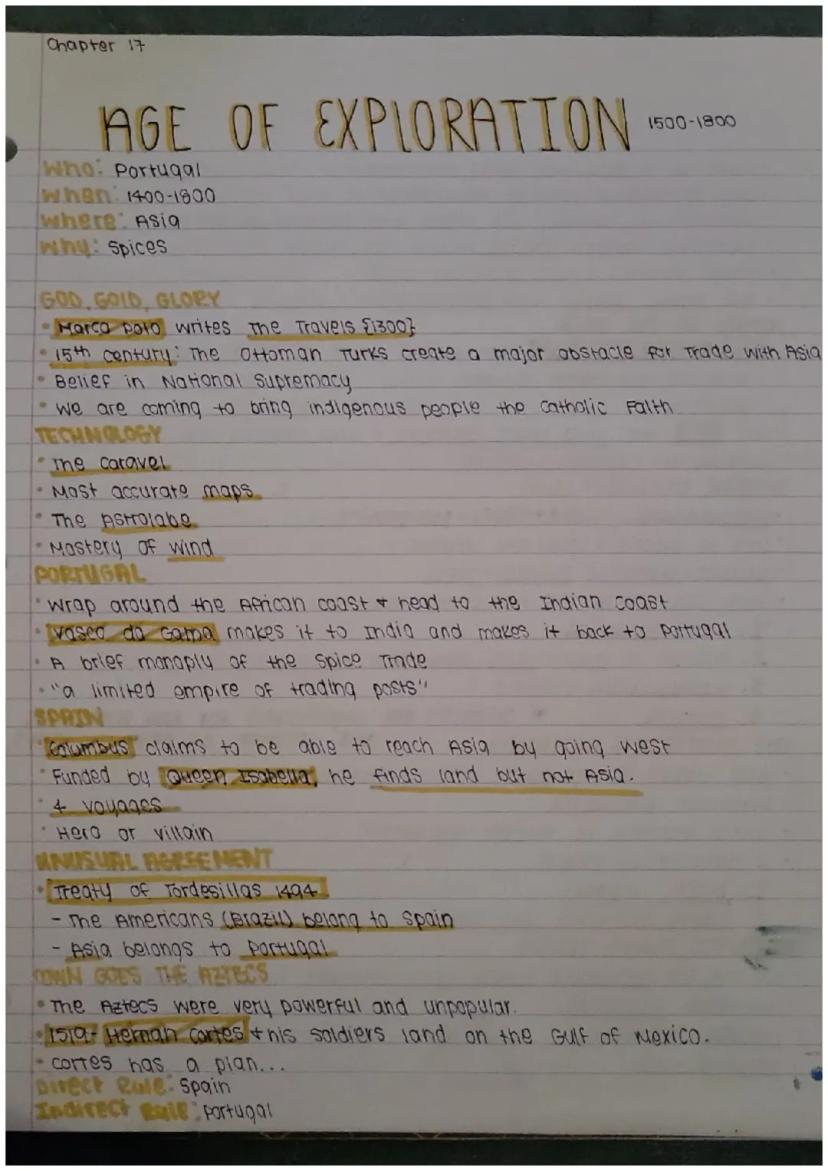
Why did Europeans suddenly sail across unknown oceans? They sought God, Gold, and Glory - spreading Christianity, finding wealth (especially spices), and gaining national prestige. Marco Polo's writings about Asia in 1300 had fueled European imagination, while Ottoman control of land routes to Asia made sea routes necessary.
New technologies made these journeys possible. The caravel ship design allowed better navigation in rough waters, while more accurate maps, the astrolabe for navigation, and better understanding of wind patterns enabled long voyages. Portugal led early explorations, sailing around Africa to reach India with Vasco da Gama establishing valuable trading posts.
Spain followed with Columbus's westward voyages seeking Asia but finding the Americas instead. The 1494 Treaty of Tordesillas divided these new discoveries - most of the Americas going to Spain and routes to Asia to Portugal. This agreement shaped colonial boundaries for centuries.
Quick Fact: The Spanish conquest of the Americas wasn't just about superior weapons. Disease played a devastating role, with smallpox killing millions of indigenous people who had no immunity to European illnesses.
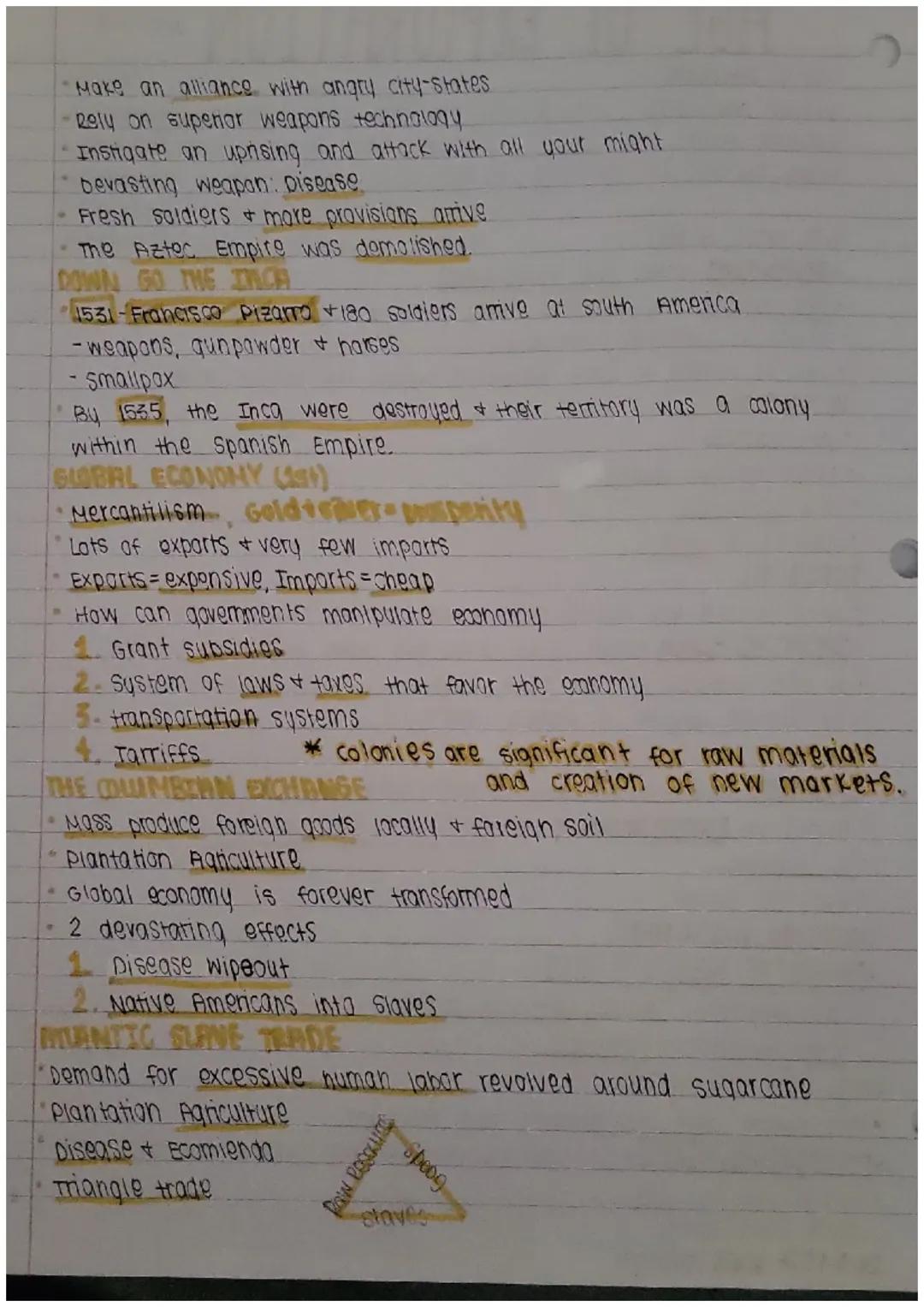
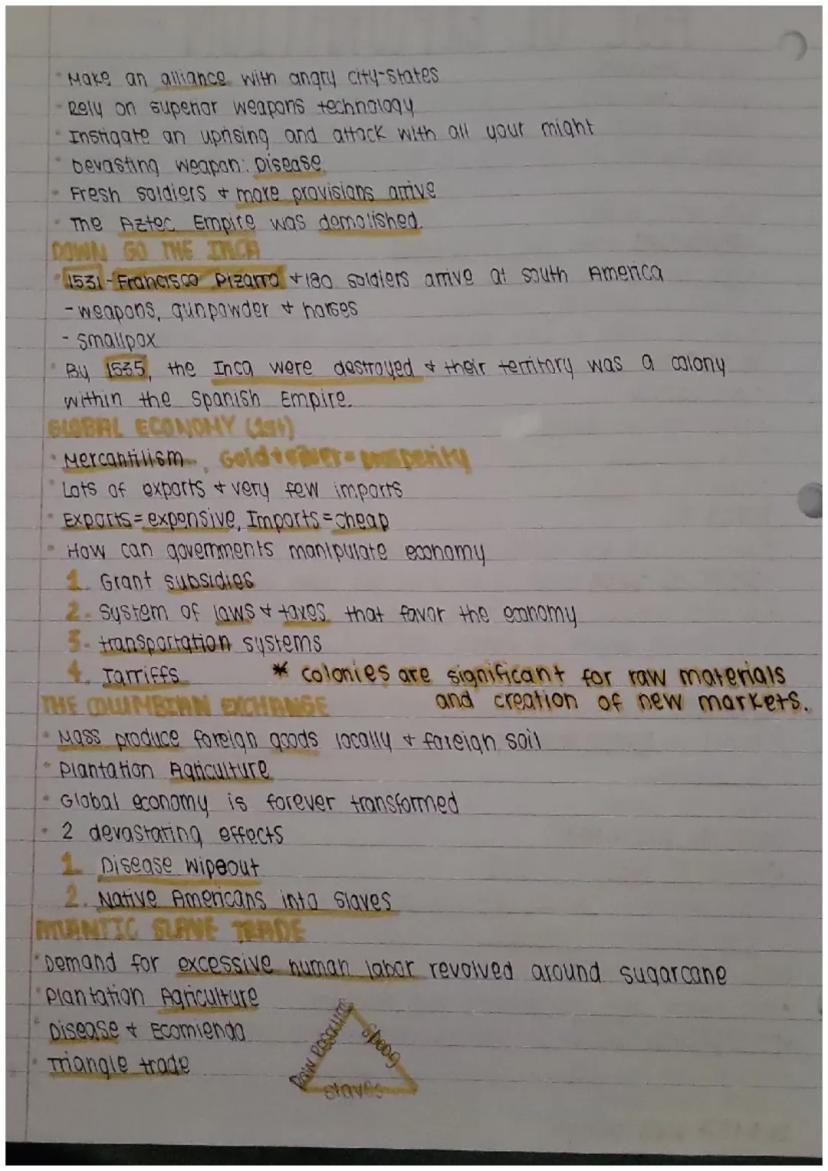
The Spanish conquered powerful indigenous empires through clever tactics. Hernán Cortés defeated the Aztecs in 1519 by forming alliances with their enemies, using superior weapons, and unintentionally spreading disease. Similarly, Francisco Pizarro destroyed the Inca Empire with just 180 soldiers, helped by smallpox that had already weakened the population.
A new global economy emerged based on mercantilism - the belief that national wealth depended on accumulating gold and silver while maintaining favorable trade balances. European powers wanted colonies to provide raw materials while buying finished goods. Governments manipulated economies through subsidies, tax systems, and transportation networks to maintain this advantage.
The Columbian Exchange transformed the world as plants, animals, and diseases moved between hemispheres. Europeans created plantation agriculture in the Americas, producing sugar, tobacco, and cotton. This system had devastating effects: disease killed millions of indigenous people, and the demand for labor led to the Atlantic slave trade.
Remember this: The Triangle Trade connected Europe, Africa and the Americas in a profitable but deadly system - European goods to Africa, enslaved people to the Americas, and colonial products back to Europe.
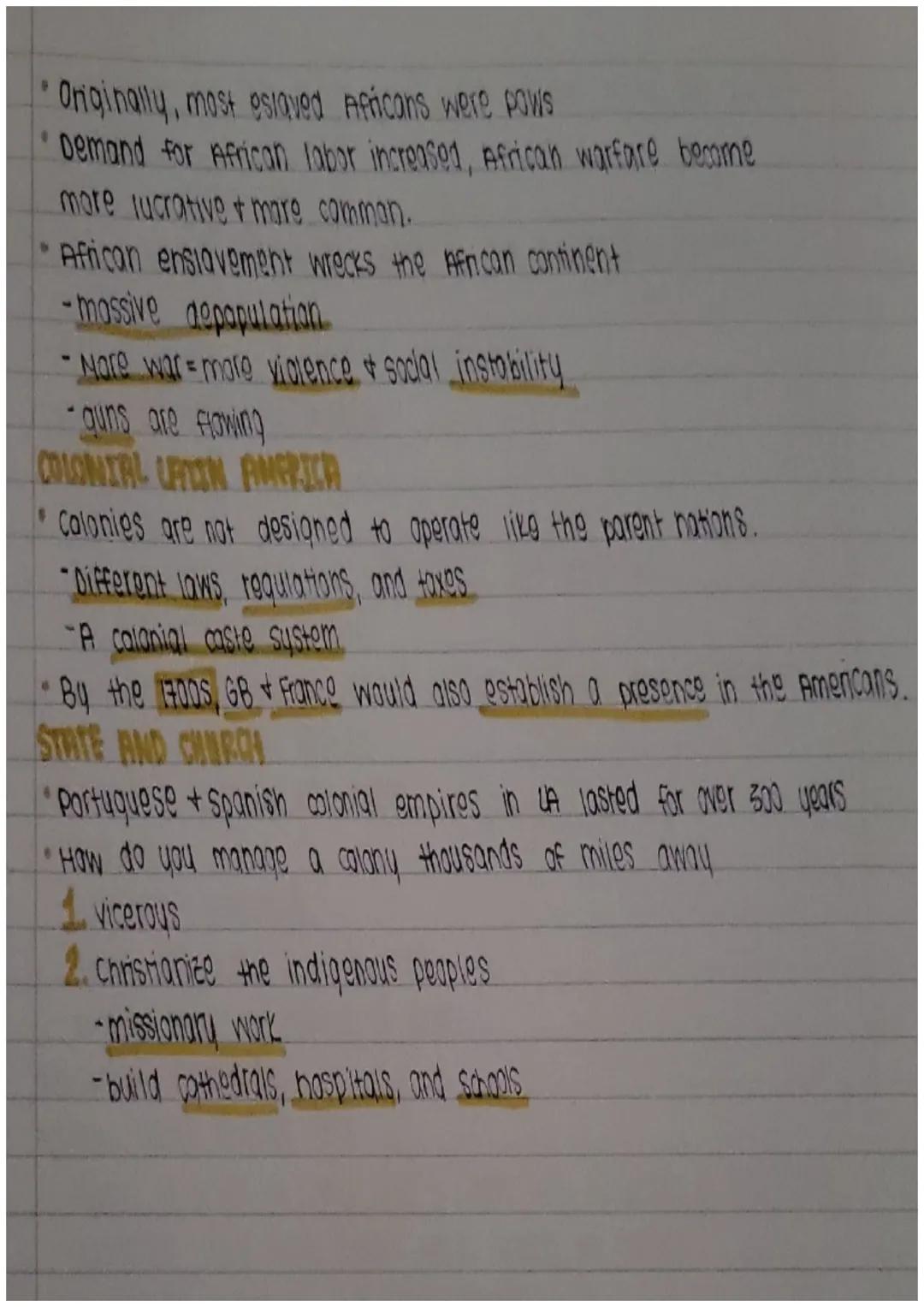
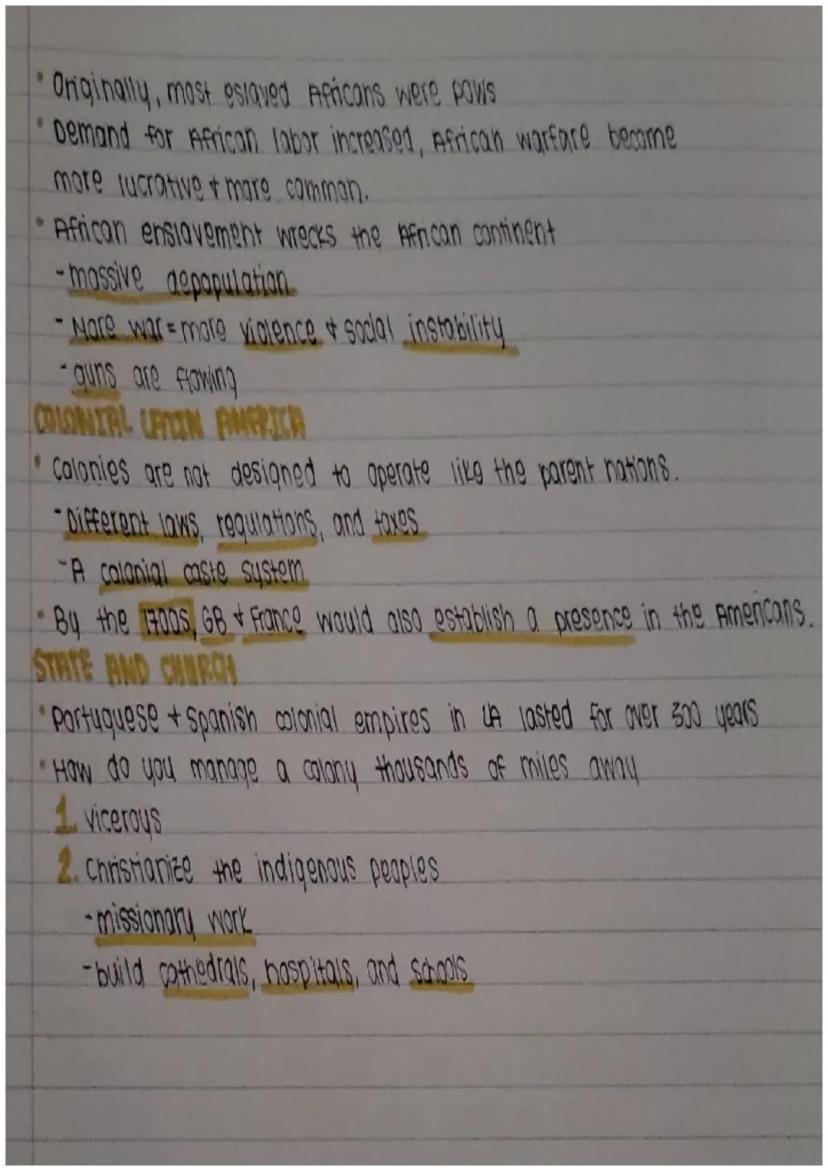
The Atlantic slave trade devastated Africa for centuries. Initially, most enslaved Africans were prisoners of war, but as European demand increased, African warfare became more common. The continent suffered massive depopulation, increased violence, and social instability as guns flowed in and people flowed out.
Colonial systems in Latin America weren't designed to benefit local populations. The Spanish and Portuguese established different laws, regulations, and taxes for their colonies, with a strict colonial caste system based on birth and race. By the 1700s, Britain and France had also established American colonies using similar systems.
Managing colonies thousands of miles away required careful organization. Spain and Portugal appointed viceroys as royal representatives with extensive powers. The Catholic Church played a crucial role in colonial control through missionary work and building cathedrals, hospitals, and schools - helping to spread European culture while establishing long-lasting colonial empires that would continue for over 300 years.
Think about: How did technology enable exploration, and how did exploration transform technology? This cycle of innovation and expansion continues to shape our world today.
Our AI companion is specifically built for the needs of students. Based on the millions of content pieces we have on the platform we can provide truly meaningful and relevant answers to students. But its not only about answers, the companion is even more about guiding students through their daily learning challenges, with personalised study plans, quizzes or content pieces in the chat and 100% personalisation based on the students skills and developments.
You can download the app in the Google Play Store and in the Apple App Store.
That's right! Enjoy free access to study content, connect with fellow students, and get instant help – all at your fingertips.
App Store
Google Play
The app is very easy to use and well designed. I have found everything I was looking for so far and have been able to learn a lot from the presentations! I will definitely use the app for a class assignment! And of course it also helps a lot as an inspiration.
Stefan S
iOS user
This app is really great. There are so many study notes and help [...]. My problem subject is French, for example, and the app has so many options for help. Thanks to this app, I have improved my French. I would recommend it to anyone.
Samantha Klich
Android user
Wow, I am really amazed. I just tried the app because I've seen it advertised many times and was absolutely stunned. This app is THE HELP you want for school and above all, it offers so many things, such as workouts and fact sheets, which have been VERY helpful to me personally.
Anna
iOS user
I think it’s very much worth it and you’ll end up using it a lot once you get the hang of it and even after looking at others notes you can still ask your Artificial intelligence buddy the question and ask to simplify it if you still don’t get it!!! In the end I think it’s worth it 😊👍 ⚠️Also DID I MENTION ITS FREEE YOU DON’T HAVE TO PAY FOR ANYTHING AND STILL GET YOUR GRADES IN PERFECTLY❗️❗️⚠️
Thomas R
iOS user
Knowunity is the BEST app I’ve used in a minute. This is not an ai review or anything this is genuinely coming from a 7th grade student (I know 2011 im young) but dude this app is a 10/10 i have maintained a 3.8 gpa and have plenty of time for gaming. I love it and my mom is just happy I got good grades
Brad T
Android user
Not only did it help me find the answer but it also showed me alternative ways to solve it. I was horrible in math and science but now I have an a in both subjects. Thanks for the help🤍🤍
David K
iOS user
The app's just great! All I have to do is enter the topic in the search bar and I get the response real fast. I don't have to watch 10 YouTube videos to understand something, so I'm saving my time. Highly recommended!
Sudenaz Ocak
Android user
In school I was really bad at maths but thanks to the app, I am doing better now. I am so grateful that you made the app.
Greenlight Bonnie
Android user
I found this app a couple years ago and it has only gotten better since then. I really love it because it can help with written questions and photo questions. Also, it can find study guides that other people have made as well as flashcard sets and practice tests. The free version is also amazing for students who might not be able to afford it. Would 100% recommend
Aubrey
iOS user
Best app if you're in Highschool or Junior high. I have been using this app for 2 school years and it's the best, it's good if you don't have anyone to help you with school work.😋🩷🎀
Marco B
iOS user
THE QUIZES AND FLASHCARDS ARE SO USEFUL AND I LOVE Knowunity AI. IT ALSO IS LITREALLY LIKE CHATGPT BUT SMARTER!! HELPED ME WITH MY MASCARA PROBLEMS TOO!! AS WELL AS MY REAL SUBJECTS ! DUHHH 😍😁😲🤑💗✨🎀😮
Elisha
iOS user
This app is phenomenal down to the correct info and the various topics you can study! I greatly recommend it for people who struggle with procrastination and those who need homework help. It has been perfectly accurate for world 1 history as far as I’ve seen! Geometry too!
Paul T
iOS user
The app is very easy to use and well designed. I have found everything I was looking for so far and have been able to learn a lot from the presentations! I will definitely use the app for a class assignment! And of course it also helps a lot as an inspiration.
Stefan S
iOS user
This app is really great. There are so many study notes and help [...]. My problem subject is French, for example, and the app has so many options for help. Thanks to this app, I have improved my French. I would recommend it to anyone.
Samantha Klich
Android user
Wow, I am really amazed. I just tried the app because I've seen it advertised many times and was absolutely stunned. This app is THE HELP you want for school and above all, it offers so many things, such as workouts and fact sheets, which have been VERY helpful to me personally.
Anna
iOS user
I think it’s very much worth it and you’ll end up using it a lot once you get the hang of it and even after looking at others notes you can still ask your Artificial intelligence buddy the question and ask to simplify it if you still don’t get it!!! In the end I think it’s worth it 😊👍 ⚠️Also DID I MENTION ITS FREEE YOU DON’T HAVE TO PAY FOR ANYTHING AND STILL GET YOUR GRADES IN PERFECTLY❗️❗️⚠️
Thomas R
iOS user
Knowunity is the BEST app I’ve used in a minute. This is not an ai review or anything this is genuinely coming from a 7th grade student (I know 2011 im young) but dude this app is a 10/10 i have maintained a 3.8 gpa and have plenty of time for gaming. I love it and my mom is just happy I got good grades
Brad T
Android user
Not only did it help me find the answer but it also showed me alternative ways to solve it. I was horrible in math and science but now I have an a in both subjects. Thanks for the help🤍🤍
David K
iOS user
The app's just great! All I have to do is enter the topic in the search bar and I get the response real fast. I don't have to watch 10 YouTube videos to understand something, so I'm saving my time. Highly recommended!
Sudenaz Ocak
Android user
In school I was really bad at maths but thanks to the app, I am doing better now. I am so grateful that you made the app.
Greenlight Bonnie
Android user
I found this app a couple years ago and it has only gotten better since then. I really love it because it can help with written questions and photo questions. Also, it can find study guides that other people have made as well as flashcard sets and practice tests. The free version is also amazing for students who might not be able to afford it. Would 100% recommend
Aubrey
iOS user
Best app if you're in Highschool or Junior high. I have been using this app for 2 school years and it's the best, it's good if you don't have anyone to help you with school work.😋🩷🎀
Marco B
iOS user
THE QUIZES AND FLASHCARDS ARE SO USEFUL AND I LOVE Knowunity AI. IT ALSO IS LITREALLY LIKE CHATGPT BUT SMARTER!! HELPED ME WITH MY MASCARA PROBLEMS TOO!! AS WELL AS MY REAL SUBJECTS ! DUHHH 😍😁😲🤑💗✨🎀😮
Elisha
iOS user
This app is phenomenal down to the correct info and the various topics you can study! I greatly recommend it for people who struggle with procrastination and those who need homework help. It has been perfectly accurate for world 1 history as far as I’ve seen! Geometry too!
Paul T
iOS user
Thalia Fickett
@frostyfeet
The Age of Exploration transformed our world as European powers ventured across oceans in search of new trade routes, wealth, and territories. From 1500-1800, countries like Portugal and Spain led expeditions that changed global power dynamics, established colonies, and created... Show more
Access to all documents
Improve your grades
Join milions of students
Why did Europeans suddenly sail across unknown oceans? They sought God, Gold, and Glory - spreading Christianity, finding wealth (especially spices), and gaining national prestige. Marco Polo's writings about Asia in 1300 had fueled European imagination, while Ottoman control of land routes to Asia made sea routes necessary.
New technologies made these journeys possible. The caravel ship design allowed better navigation in rough waters, while more accurate maps, the astrolabe for navigation, and better understanding of wind patterns enabled long voyages. Portugal led early explorations, sailing around Africa to reach India with Vasco da Gama establishing valuable trading posts.
Spain followed with Columbus's westward voyages seeking Asia but finding the Americas instead. The 1494 Treaty of Tordesillas divided these new discoveries - most of the Americas going to Spain and routes to Asia to Portugal. This agreement shaped colonial boundaries for centuries.
Quick Fact: The Spanish conquest of the Americas wasn't just about superior weapons. Disease played a devastating role, with smallpox killing millions of indigenous people who had no immunity to European illnesses.
Access to all documents
Improve your grades
Join milions of students
The Spanish conquered powerful indigenous empires through clever tactics. Hernán Cortés defeated the Aztecs in 1519 by forming alliances with their enemies, using superior weapons, and unintentionally spreading disease. Similarly, Francisco Pizarro destroyed the Inca Empire with just 180 soldiers, helped by smallpox that had already weakened the population.
A new global economy emerged based on mercantilism - the belief that national wealth depended on accumulating gold and silver while maintaining favorable trade balances. European powers wanted colonies to provide raw materials while buying finished goods. Governments manipulated economies through subsidies, tax systems, and transportation networks to maintain this advantage.
The Columbian Exchange transformed the world as plants, animals, and diseases moved between hemispheres. Europeans created plantation agriculture in the Americas, producing sugar, tobacco, and cotton. This system had devastating effects: disease killed millions of indigenous people, and the demand for labor led to the Atlantic slave trade.
Remember this: The Triangle Trade connected Europe, Africa and the Americas in a profitable but deadly system - European goods to Africa, enslaved people to the Americas, and colonial products back to Europe.
Access to all documents
Improve your grades
Join milions of students
The Atlantic slave trade devastated Africa for centuries. Initially, most enslaved Africans were prisoners of war, but as European demand increased, African warfare became more common. The continent suffered massive depopulation, increased violence, and social instability as guns flowed in and people flowed out.
Colonial systems in Latin America weren't designed to benefit local populations. The Spanish and Portuguese established different laws, regulations, and taxes for their colonies, with a strict colonial caste system based on birth and race. By the 1700s, Britain and France had also established American colonies using similar systems.
Managing colonies thousands of miles away required careful organization. Spain and Portugal appointed viceroys as royal representatives with extensive powers. The Catholic Church played a crucial role in colonial control through missionary work and building cathedrals, hospitals, and schools - helping to spread European culture while establishing long-lasting colonial empires that would continue for over 300 years.
Think about: How did technology enable exploration, and how did exploration transform technology? This cycle of innovation and expansion continues to shape our world today.
Our AI companion is specifically built for the needs of students. Based on the millions of content pieces we have on the platform we can provide truly meaningful and relevant answers to students. But its not only about answers, the companion is even more about guiding students through their daily learning challenges, with personalised study plans, quizzes or content pieces in the chat and 100% personalisation based on the students skills and developments.
You can download the app in the Google Play Store and in the Apple App Store.
That's right! Enjoy free access to study content, connect with fellow students, and get instant help – all at your fingertips.
1
Smart Tools NEW
Transform this note into: ✓ 50+ Practice Questions ✓ Interactive Flashcards ✓ Full Practice Test ✓ Essay Outlines
Lesson 4.2
 World History
Vocabulary terms defined in chapter 4 of world history
World HistoryExercise once again the skill for doing context and text (content) analysis primary sources for history.
World HistoryLecture on Spanish California
World Historyworld history
World HistoryExplore the pivotal Battle of Gate Fulford, where Harald Hardrada and Tostig Godwinson faced off against Harold Godwinson and the forces of Edwin and Morcar. This summary highlights key strategies, troop movements, and the impact of terrain on the battle's outcome. Ideal for students studying Anglo-Saxon and Norman England.
 History
App Store
Google Play
The app is very easy to use and well designed. I have found everything I was looking for so far and have been able to learn a lot from the presentations! I will definitely use the app for a class assignment! And of course it also helps a lot as an inspiration.
Stefan S
iOS user
This app is really great. There are so many study notes and help [...]. My problem subject is French, for example, and the app has so many options for help. Thanks to this app, I have improved my French. I would recommend it to anyone.
Samantha Klich
Android user
Wow, I am really amazed. I just tried the app because I've seen it advertised many times and was absolutely stunned. This app is THE HELP you want for school and above all, it offers so many things, such as workouts and fact sheets, which have been VERY helpful to me personally.
Anna
iOS user
I think it’s very much worth it and you’ll end up using it a lot once you get the hang of it and even after looking at others notes you can still ask your Artificial intelligence buddy the question and ask to simplify it if you still don’t get it!!! In the end I think it’s worth it 😊👍 ⚠️Also DID I MENTION ITS FREEE YOU DON’T HAVE TO PAY FOR ANYTHING AND STILL GET YOUR GRADES IN PERFECTLY❗️❗️⚠️
Thomas R
iOS user
Knowunity is the BEST app I’ve used in a minute. This is not an ai review or anything this is genuinely coming from a 7th grade student (I know 2011 im young) but dude this app is a 10/10 i have maintained a 3.8 gpa and have plenty of time for gaming. I love it and my mom is just happy I got good grades
Brad T
Android user
Not only did it help me find the answer but it also showed me alternative ways to solve it. I was horrible in math and science but now I have an a in both subjects. Thanks for the help🤍🤍
David K
iOS user
The app's just great! All I have to do is enter the topic in the search bar and I get the response real fast. I don't have to watch 10 YouTube videos to understand something, so I'm saving my time. Highly recommended!
Sudenaz Ocak
Android user
In school I was really bad at maths but thanks to the app, I am doing better now. I am so grateful that you made the app.
Greenlight Bonnie
Android user
I found this app a couple years ago and it has only gotten better since then. I really love it because it can help with written questions and photo questions. Also, it can find study guides that other people have made as well as flashcard sets and practice tests. The free version is also amazing for students who might not be able to afford it. Would 100% recommend
Aubrey
iOS user
Best app if you're in Highschool or Junior high. I have been using this app for 2 school years and it's the best, it's good if you don't have anyone to help you with school work.😋🩷🎀
Marco B
iOS user
THE QUIZES AND FLASHCARDS ARE SO USEFUL AND I LOVE Knowunity AI. IT ALSO IS LITREALLY LIKE CHATGPT BUT SMARTER!! HELPED ME WITH MY MASCARA PROBLEMS TOO!! AS WELL AS MY REAL SUBJECTS ! DUHHH 😍😁😲🤑💗✨🎀😮
Elisha
iOS user
This app is phenomenal down to the correct info and the various topics you can study! I greatly recommend it for people who struggle with procrastination and those who need homework help. It has been perfectly accurate for world 1 history as far as I’ve seen! Geometry too!
Paul T
iOS user
The app is very easy to use and well designed. I have found everything I was looking for so far and have been able to learn a lot from the presentations! I will definitely use the app for a class assignment! And of course it also helps a lot as an inspiration.
Stefan S
iOS user
This app is really great. There are so many study notes and help [...]. My problem subject is French, for example, and the app has so many options for help. Thanks to this app, I have improved my French. I would recommend it to anyone.
Samantha Klich
Android user
Wow, I am really amazed. I just tried the app because I've seen it advertised many times and was absolutely stunned. This app is THE HELP you want for school and above all, it offers so many things, such as workouts and fact sheets, which have been VERY helpful to me personally.
Anna
iOS user
I think it’s very much worth it and you’ll end up using it a lot once you get the hang of it and even after looking at others notes you can still ask your Artificial intelligence buddy the question and ask to simplify it if you still don’t get it!!! In the end I think it’s worth it 😊👍 ⚠️Also DID I MENTION ITS FREEE YOU DON’T HAVE TO PAY FOR ANYTHING AND STILL GET YOUR GRADES IN PERFECTLY❗️❗️⚠️
Thomas R
iOS user
Knowunity is the BEST app I’ve used in a minute. This is not an ai review or anything this is genuinely coming from a 7th grade student (I know 2011 im young) but dude this app is a 10/10 i have maintained a 3.8 gpa and have plenty of time for gaming. I love it and my mom is just happy I got good grades
Brad T
Android user
Not only did it help me find the answer but it also showed me alternative ways to solve it. I was horrible in math and science but now I have an a in both subjects. Thanks for the help🤍🤍
David K
iOS user
The app's just great! All I have to do is enter the topic in the search bar and I get the response real fast. I don't have to watch 10 YouTube videos to understand something, so I'm saving my time. Highly recommended!
Sudenaz Ocak
Android user
In school I was really bad at maths but thanks to the app, I am doing better now. I am so grateful that you made the app.
Greenlight Bonnie
Android user
I found this app a couple years ago and it has only gotten better since then. I really love it because it can help with written questions and photo questions. Also, it can find study guides that other people have made as well as flashcard sets and practice tests. The free version is also amazing for students who might not be able to afford it. Would 100% recommend
Aubrey
iOS user
Best app if you're in Highschool or Junior high. I have been using this app for 2 school years and it's the best, it's good if you don't have anyone to help you with school work.😋🩷🎀
Marco B
iOS user
THE QUIZES AND FLASHCARDS ARE SO USEFUL AND I LOVE Knowunity AI. IT ALSO IS LITREALLY LIKE CHATGPT BUT SMARTER!! HELPED ME WITH MY MASCARA PROBLEMS TOO!! AS WELL AS MY REAL SUBJECTS ! DUHHH 😍😁😲🤑💗✨🎀😮
Elisha
iOS user
This app is phenomenal down to the correct info and the various topics you can study! I greatly recommend it for people who struggle with procrastination and those who need homework help. It has been perfectly accurate for world 1 history as far as I’ve seen! Geometry too!
Paul T
iOS user