
The National Service Training Program (NSTP) is a civic education... Show more
 World History
 Algebra
 Biology
Sign up to see the contentIt's free!
Access to all documents
Improve your grades
Join milions of students
Knowunity AI
Subjects
Triangle Congruence and Similarity Theorems
Triangle Properties and Classification
Linear Equations and Graphs
Geometric Angle Relationships
Trigonometric Functions and Identities
Equation Solving Techniques
Circle Geometry Fundamentals
Division Operations and Methods
Basic Differentiation Rules
Exponent and Logarithm Properties
Show all topics
Human Organ Systems
Reproductive Cell Cycles
Biological Sciences Subdisciplines
Cellular Energy Metabolism
Autotrophic Energy Processes
Inheritance Patterns and Principles
Biomolecular Structure and Organization
Cell Cycle and Division Mechanics
Cellular Organization and Development
Biological Structural Organization
Show all topics
Chemical Sciences and Applications
Atomic Structure and Composition
Molecular Electron Structure Representation
Atomic Electron Behavior
Matter Properties and Water
Mole Concept and Calculations
Gas Laws and Behavior
Periodic Table Organization
Chemical Thermodynamics Fundamentals
Chemical Bond Types and Properties
Show all topics
European Renaissance and Enlightenment
European Cultural Movements 800-1920
American Revolution Era 1763-1797
American Civil War 1861-1865
Global Imperial Systems
Mongol and Chinese Dynasties
U.S. Presidents and World Leaders
Historical Sources and Documentation
World Wars Era and Impact
World Religious Systems
Show all topics
Classic and Contemporary Novels
Literary Character Analysis
Rhetorical Theory and Practice
Classic Literary Narratives
Reading Analysis and Interpretation
Narrative Structure and Techniques
English Language Components
Influential English-Language Authors
Basic Sentence Structure
Narrative Voice and Perspective
Show all topics
159
•
Updated Mar 14, 2026
•
z y
@zy_dd2we
The National Service Training Program (NSTP) is a civic education... Show more
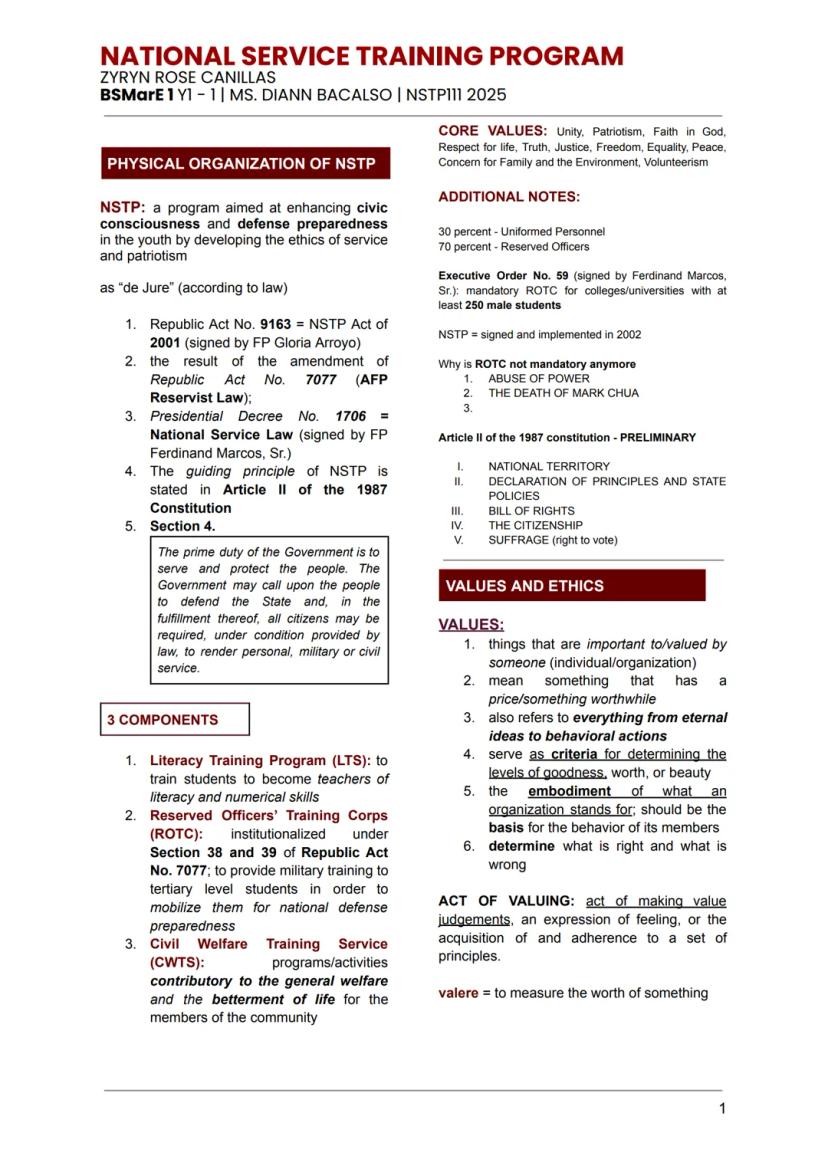
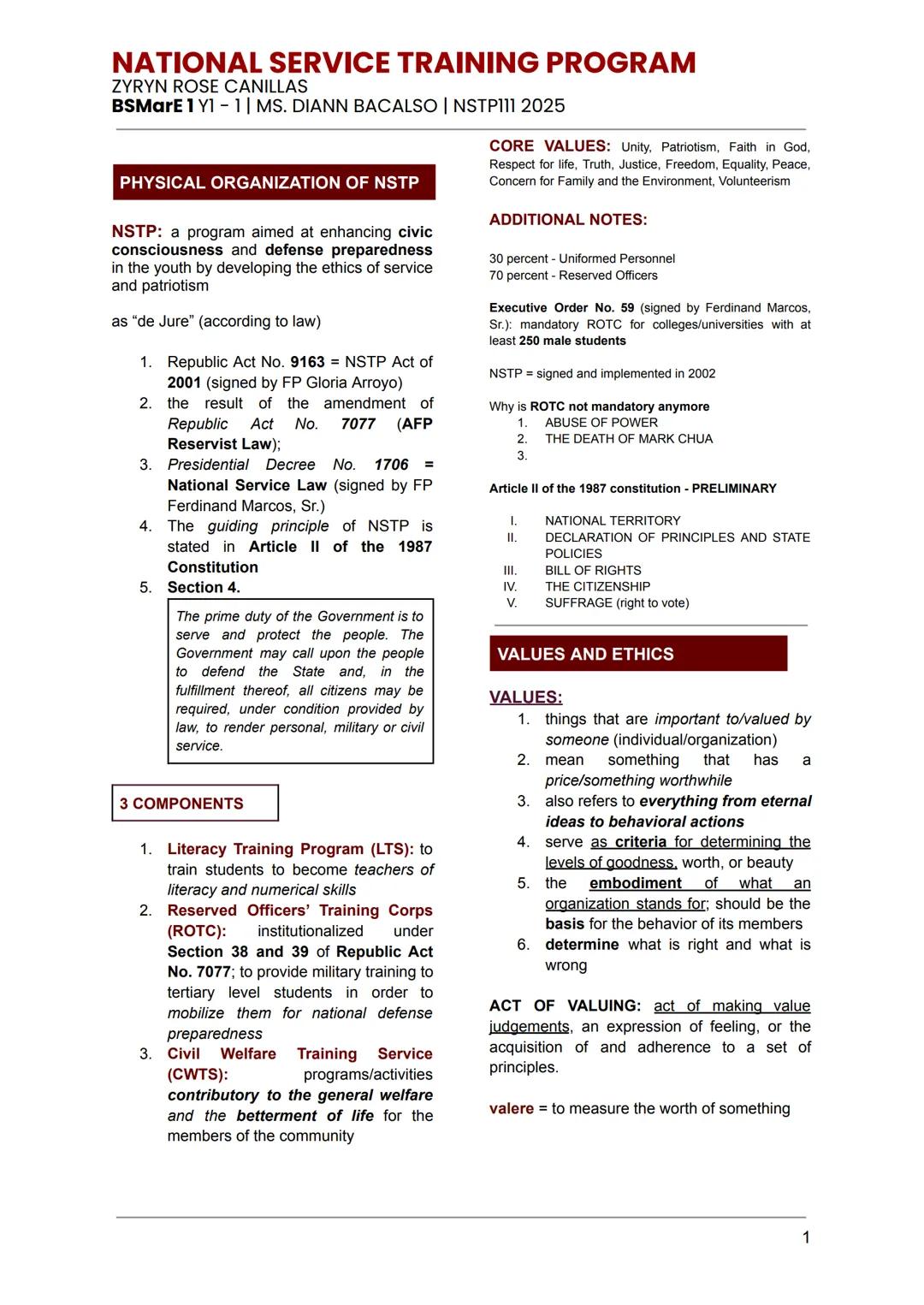
NSTP was established to enhance civic consciousness and defense preparedness among Filipino youth. It was signed into law as Republic Act No. 9163 (NSTP Act of 2001) by President Gloria Arroyo, amending the earlier Republic Act No. 7077 (AFP Reservist Law). The program is deeply rooted in the 1987 Philippine Constitution, specifically Article II, which states that citizens may be required to render personal, military, or civil service to defend the state.
The program consists of three distinct components. The Literacy Training Program (LTS) trains students to become teachers of literacy and numerical skills. The Reserved Officers' Training Corps (ROTC) provides military training for national defense preparedness. The Civil Welfare Training Service (CWTS) focuses on programs that contribute to community welfare and development.
NSTP embraces core values that shape responsible citizenship: Unity, Patriotism, Faith in God, Respect for life, Truth, Justice, Freedom, Equality, Peace, Concern for Family and the Environment, and Volunteerism. These values form the foundation for the program's activities and objectives.
Did you know? ROTC was once mandatory for all colleges with at least 250 male students under Executive Order No. 59, but this changed after concerns about abuse of power and notably after the death of Mark Chua, a student who exposed corruption in the ROTC program.
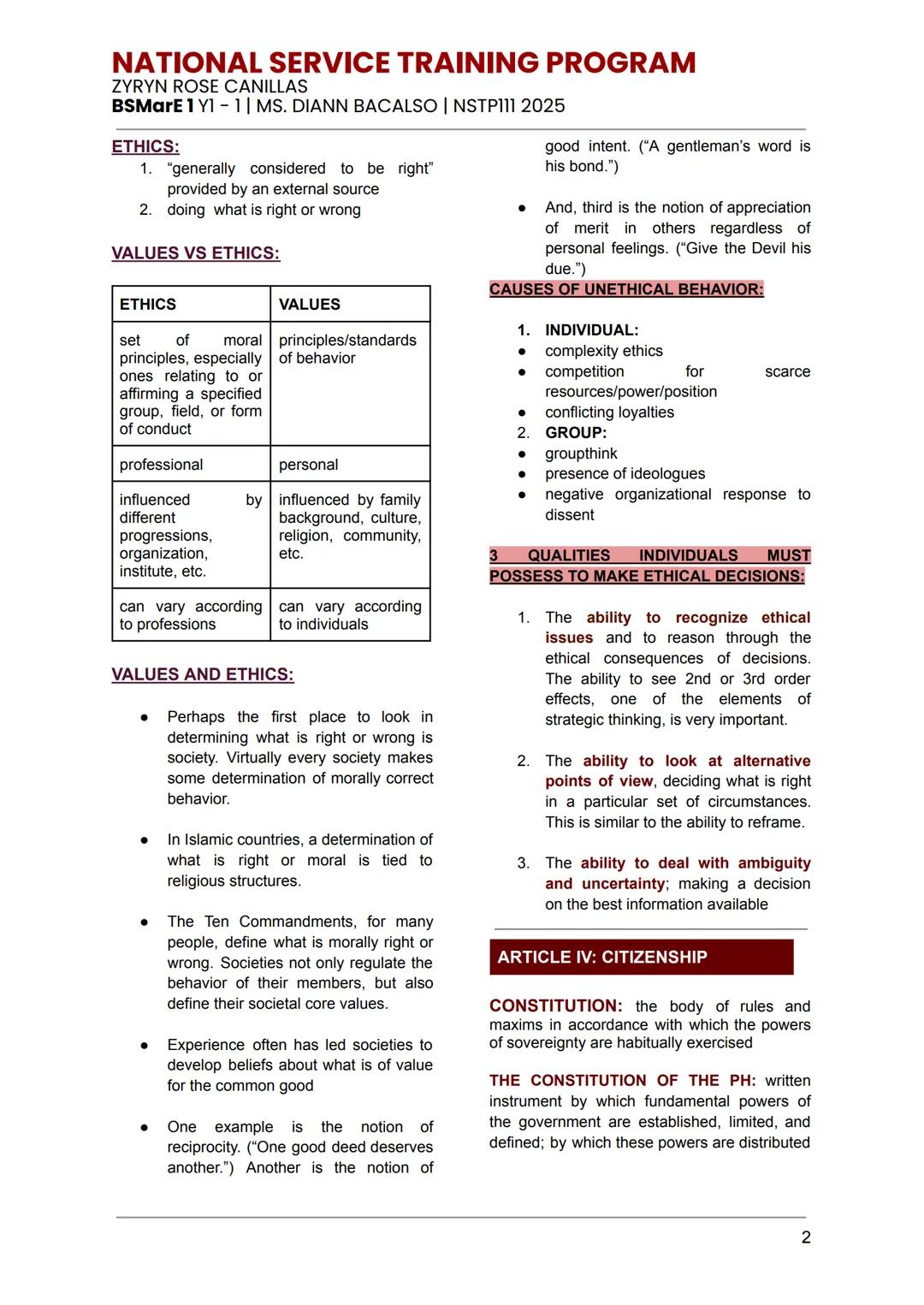
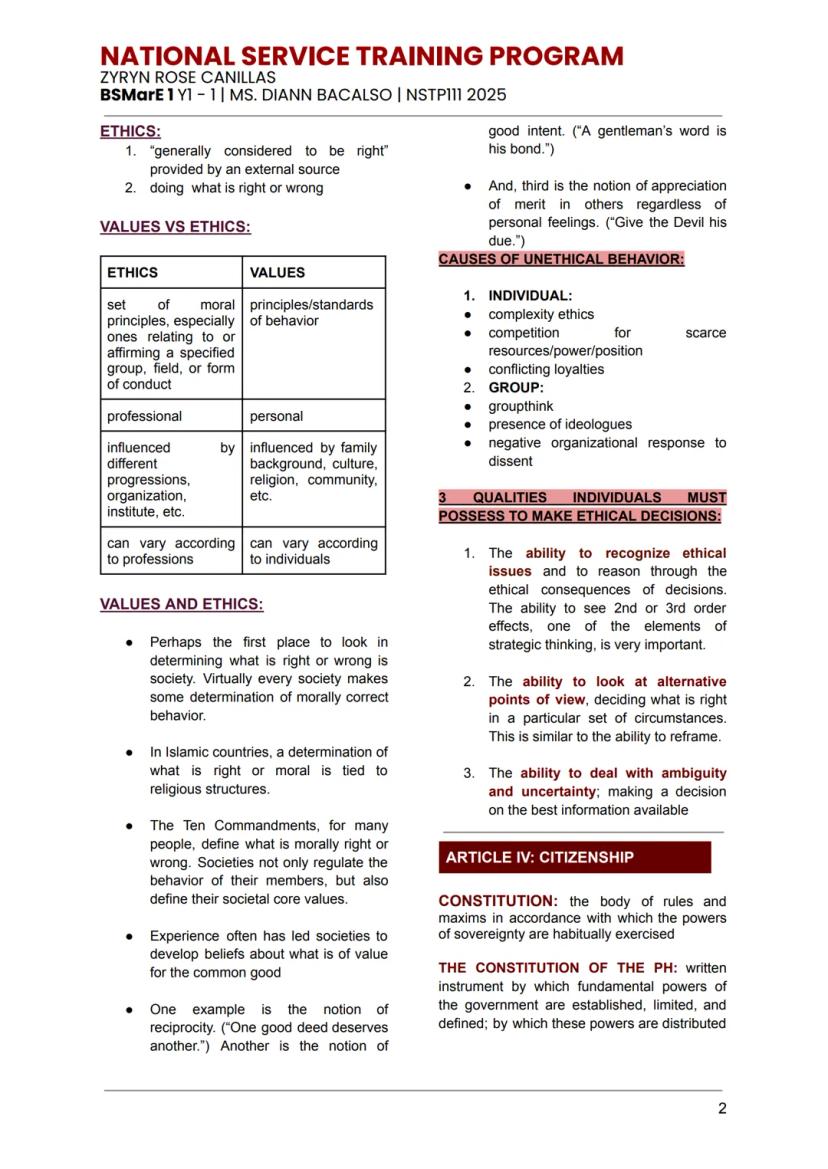
Values and ethics form the foundation of the NSTP program. Values are things important to individuals or organizations—principles that determine what is right or wrong. They represent what matters most to us and serve as criteria for determining goodness, worth, and beauty. The act of valuing involves making judgments about the worth of something.
Ethics, on the other hand, are standards considered to be "generally right" provided by an external source. While values can be personal and influenced by family, background, and culture, ethics are often professional and influenced by organizations and professions. Both can vary—values according to individuals and ethics according to professions.
Societies develop moral codes based on their experiences of what benefits the common good. Examples include concepts like reciprocity ("one good deed deserves another"), good intent ("a gentleman's word is his bond"), and recognition of merit regardless of personal feelings ("give the Devil his due").
To make ethical decisions, individuals need several key abilities: recognizing ethical issues and reasoning through consequences, considering alternative viewpoints, and dealing with ambiguity when making decisions with limited information.
Remember: Unethical behavior can stem from individual factors (like competing for scarce resources) or group dynamics (such as groupthink or negative responses to dissent). Being aware of these influences helps you make better ethical choices.
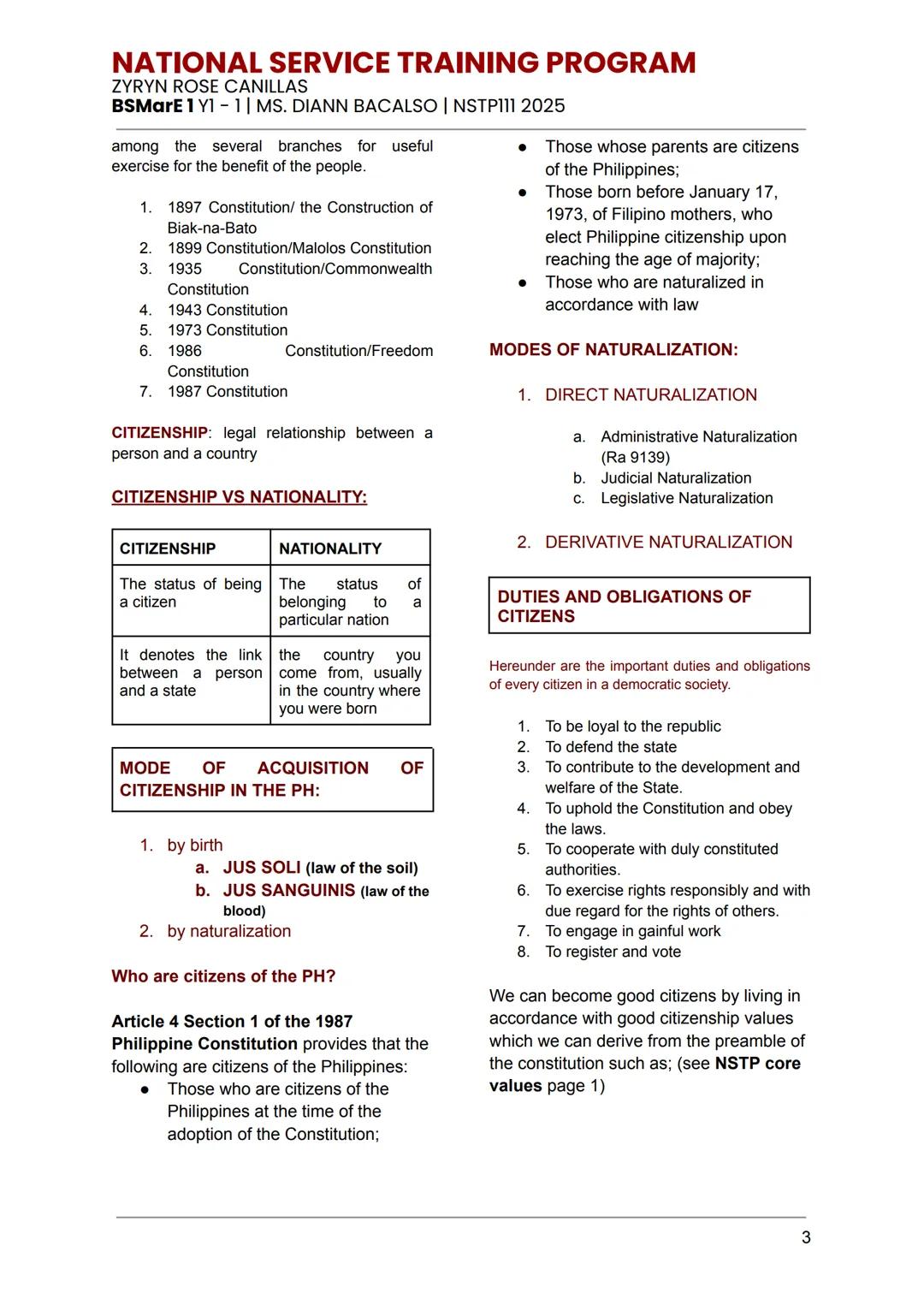
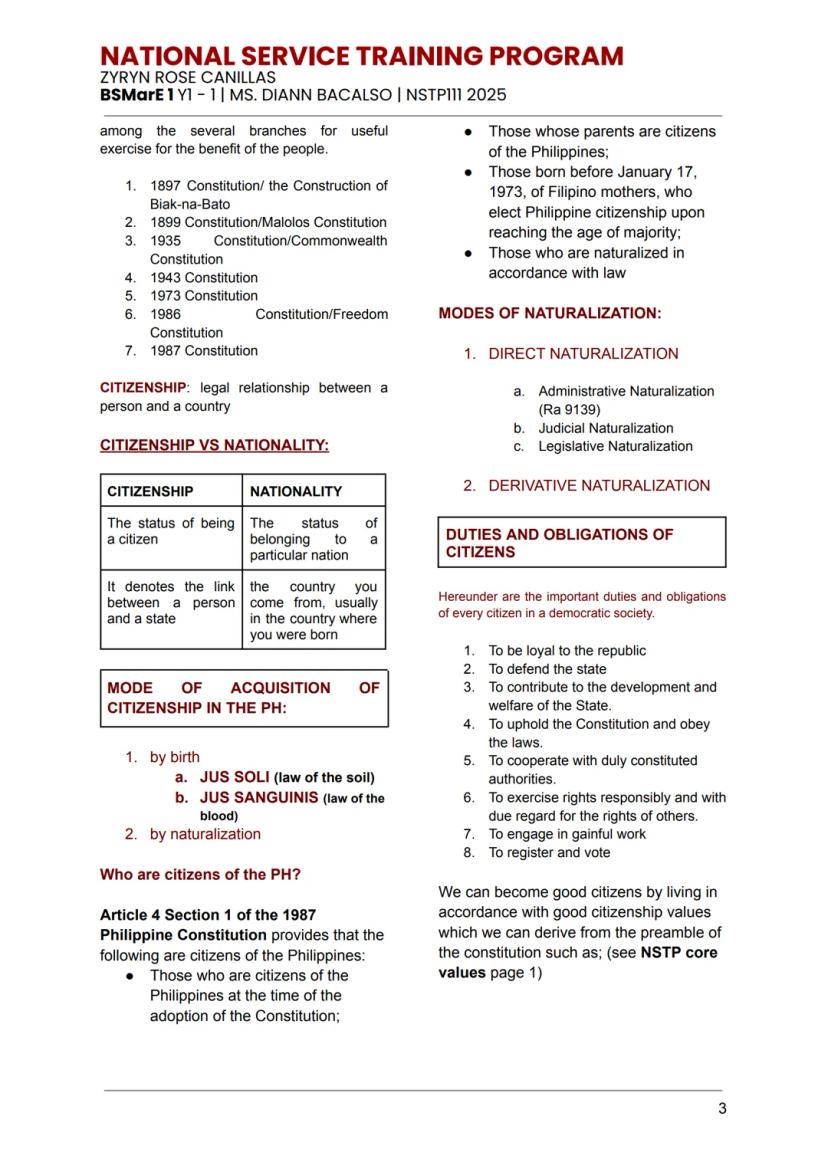
Citizenship represents the legal relationship between a person and a country. While citizenship denotes the link between a person and a state, nationality refers to the country you come from, typically where you were born. In the Philippines, citizenship can be acquired by birth or through naturalization.
According to Article 4 Section 1 of the 1987 Philippine Constitution, citizens include: those who were citizens when the Constitution was adopted, those whose parents are Filipino citizens, those born before January 17, 1973 to Filipino mothers who elected Philippine citizenship upon reaching majority age, and those naturalized according to law.
Naturalization can occur through direct means (administrative, judicial, or legislative processes) or derivative means. This pathway allows non-citizens to legally become members of the Filipino nation.
Every citizen has fundamental duties in a democratic society. These include loyalty to the republic, defending the state, contributing to development and welfare, upholding the Constitution, cooperating with authorities, exercising rights responsibly, engaging in work, and participating in elections through registration and voting.
Take action: Good citizenship isn't just about legal status—it's about living according to values like unity, patriotism, faith, respect for life, truth, justice, freedom, equality, peace, and concern for family and environment. How can you demonstrate these values in your daily life?
The Preamble of the 1987 Philippine Constitution embodies the nation's aspirations to build a just society based on truth, justice, freedom, love, equality and peace. It serves as a powerful reminder of the Filipino people's commitment to independence and democracy under the rule of law.
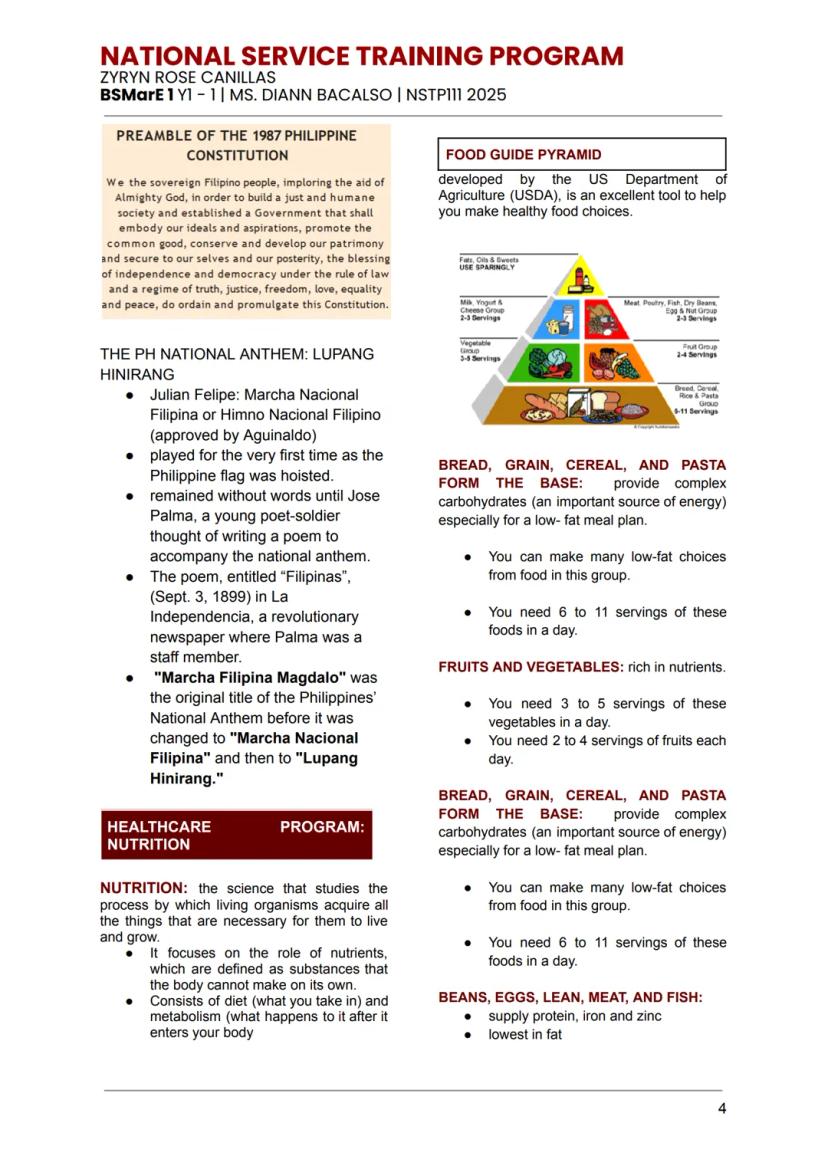
The Philippine National Anthem, "Lupang Hinirang," has a rich history. Originally composed by Julian Felipe as "Marcha Nacional Filipina," it was first played as the Philippine flag was raised. The anthem remained without words until poet-soldier Jose Palma wrote a poem titled "Filipinas" in 1899 for the revolutionary newspaper La Independencia. Before becoming "Lupang Hinirang," it was known as "Marcha Filipina Magdalo" and later "Marcha Nacional Filipina."
Nutrition plays a crucial role in health and development. It's the science that studies how living organisms acquire necessities for life and growth, focusing on nutrients the body cannot produce itself. Nutrition involves both diet (what you consume) and metabolism (what happens after consumption).
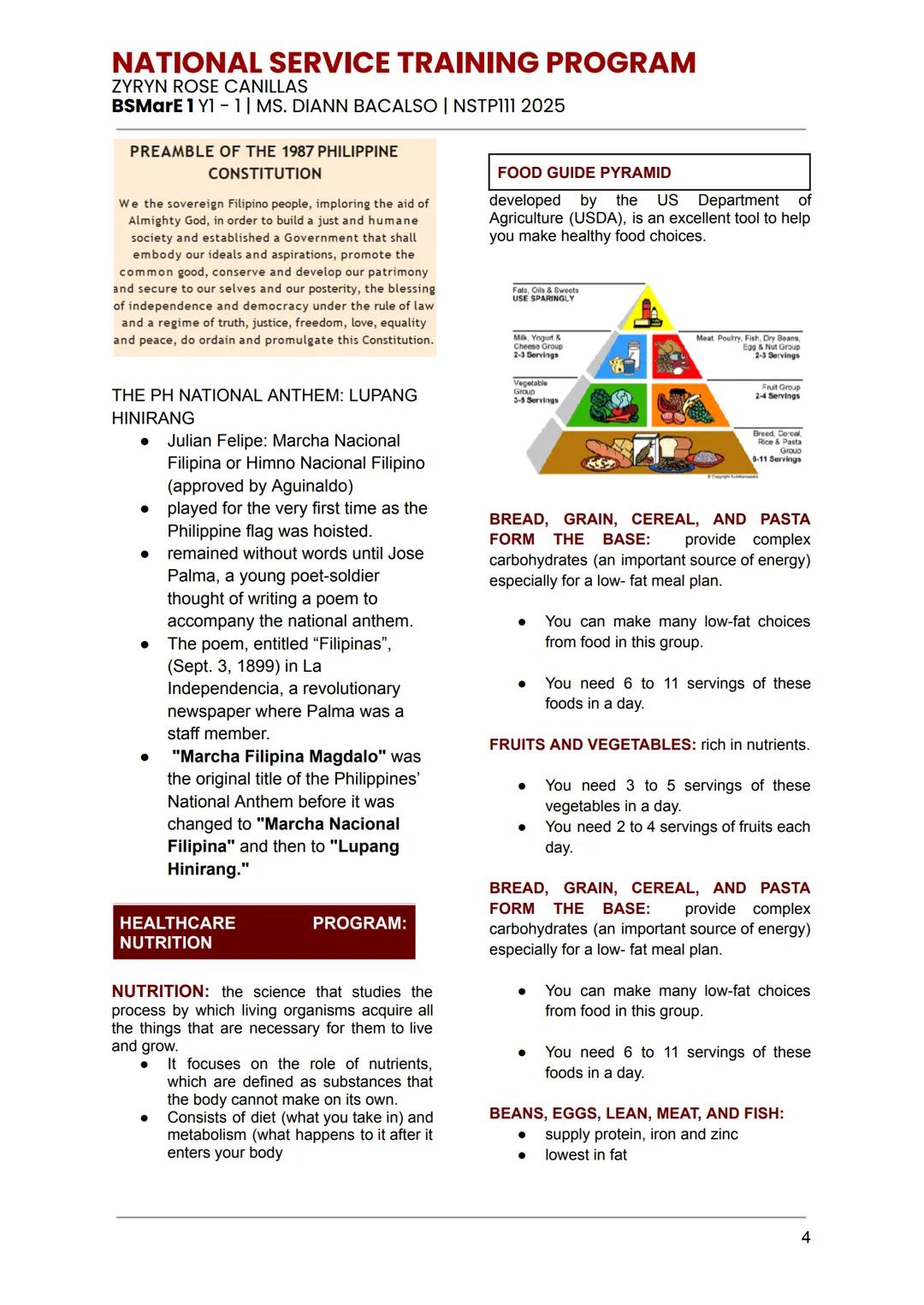
The Food Guide Pyramid, developed by the USDA, helps make healthy food choices. At its base are breads, grains, cereals, and pasta, providing complex carbohydrates and energy . Fruits and vegetables provide essential nutrients. Protein sources like beans, eggs, lean meat, and fish supply protein, iron, and zinc.
Health tip: The food pyramid places fats and sweets at the tip because they should comprise the smallest percentage of your daily diet and should be eaten sparingly. This simple visual guide can help you maintain balanced nutrition!
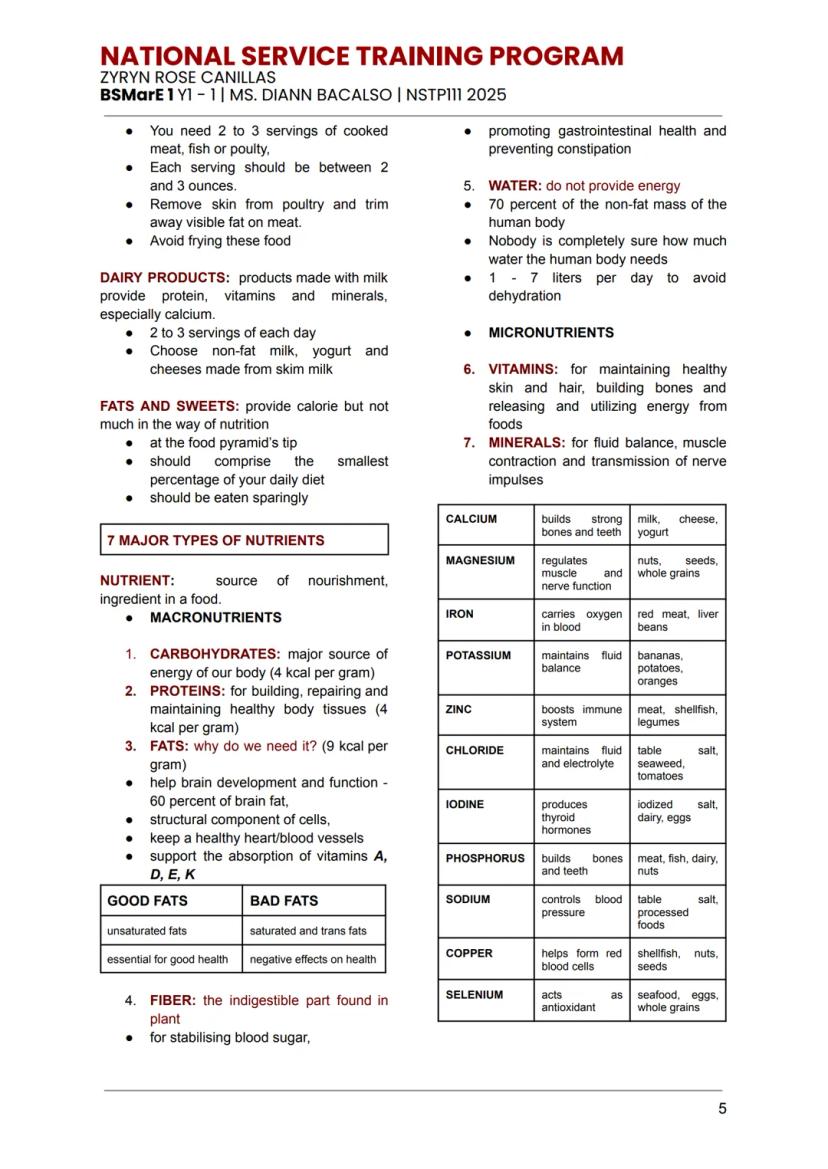
Understanding the seven major types of nutrients is key to maintaining good health. These are divided into macronutrients (needed in large amounts) and micronutrients (needed in smaller quantities).
The main macronutrients include carbohydrates, proteins, fats, fiber, and water. Carbohydrates provide 4 kcal per gram and are our body's major energy source. Proteins (4 kcal per gram) build, repair, and maintain healthy tissues. Fats (9 kcal per gram) support brain development (which is 60% fat), act as structural components of cells, and help absorb vitamins A, D, E, and K. Choose unsaturated "good fats" over saturated and trans "bad fats" for health benefits.
Fiber, the indigestible part found in plants, stabilizes blood sugar and promotes gastrointestinal health. Water, while not energy-providing, makes up 70% of the body's non-fat mass and requires 1-7 liters daily to prevent dehydration.
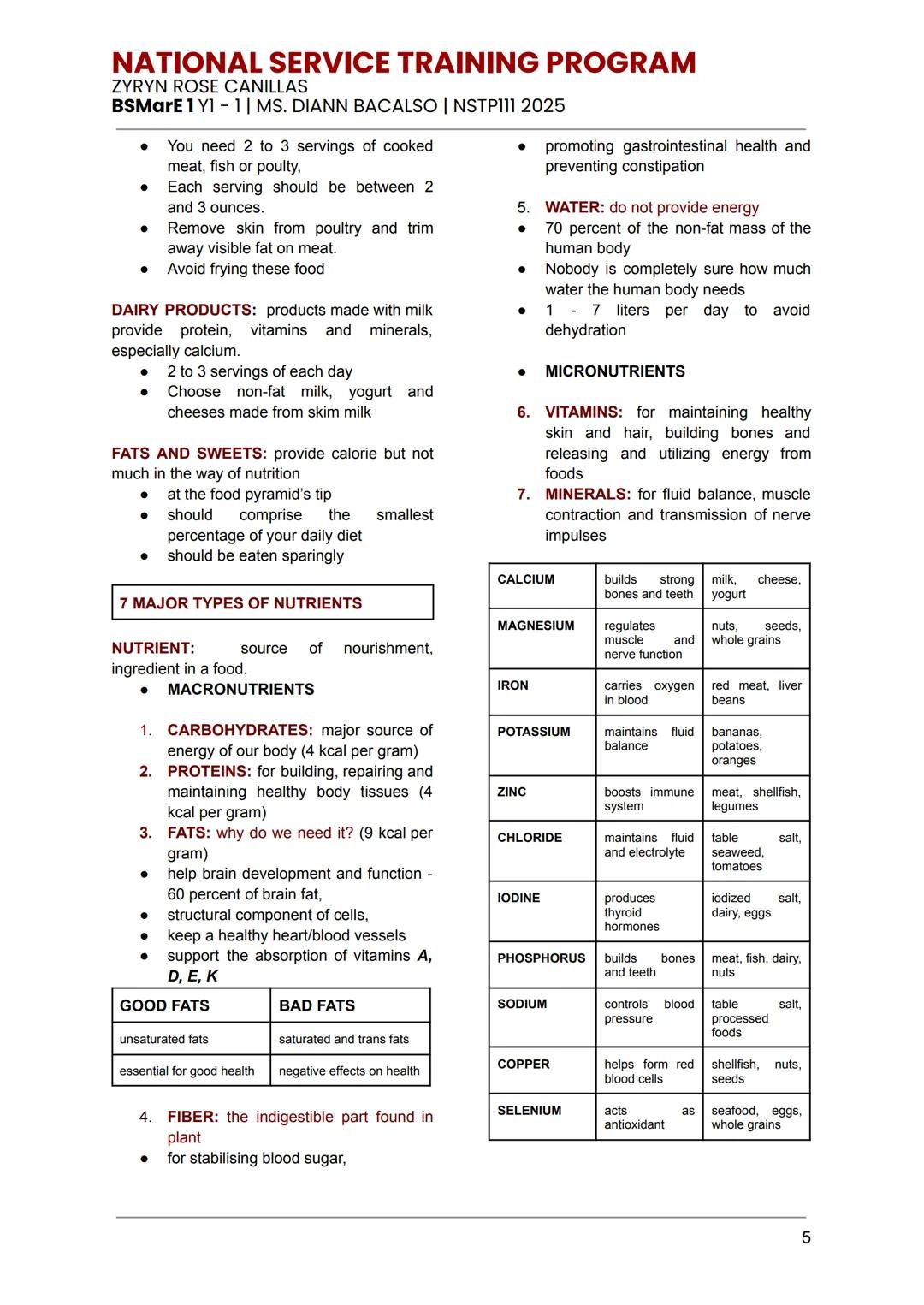
Micronutrients include vitamins and minerals. Vitamins maintain healthy skin and hair, build bones, and help release energy from foods. Minerals like calcium, magnesium, iron, and zinc perform critical functions from building strong bones to regulating muscle contractions and supporting immune function.
Each mineral serves a specific purpose—potassium maintains fluid balance, iodine produces thyroid hormones, and selenium acts as an antioxidant. Good sources include meat, dairy, nuts, fruits, and vegetables, varying by the specific mineral.
Nutrition fact: While fats provide more than twice the calories per gram (9 kcal) compared to proteins and carbohydrates (4 kcal each), certain fats are essential for brain health and hormone production. It's about choosing the right kinds rather than eliminating them completely!
Our AI companion is specifically built for the needs of students. Based on the millions of content pieces we have on the platform we can provide truly meaningful and relevant answers to students. But its not only about answers, the companion is even more about guiding students through their daily learning challenges, with personalised study plans, quizzes or content pieces in the chat and 100% personalisation based on the students skills and developments.
You can download the app in the Google Play Store and in the Apple App Store.
That's right! Enjoy free access to study content, connect with fellow students, and get instant help – all at your fingertips.
App Store
Google Play
The app is very easy to use and well designed. I have found everything I was looking for so far and have been able to learn a lot from the presentations! I will definitely use the app for a class assignment! And of course it also helps a lot as an inspiration.
Stefan S
iOS user
This app is really great. There are so many study notes and help [...]. My problem subject is French, for example, and the app has so many options for help. Thanks to this app, I have improved my French. I would recommend it to anyone.
Samantha Klich
Android user
Wow, I am really amazed. I just tried the app because I've seen it advertised many times and was absolutely stunned. This app is THE HELP you want for school and above all, it offers so many things, such as workouts and fact sheets, which have been VERY helpful to me personally.
Anna
iOS user
I think it’s very much worth it and you’ll end up using it a lot once you get the hang of it and even after looking at others notes you can still ask your Artificial intelligence buddy the question and ask to simplify it if you still don’t get it!!! In the end I think it’s worth it 😊👍 ⚠️Also DID I MENTION ITS FREEE YOU DON’T HAVE TO PAY FOR ANYTHING AND STILL GET YOUR GRADES IN PERFECTLY❗️❗️⚠️
Thomas R
iOS user
Knowunity is the BEST app I’ve used in a minute. This is not an ai review or anything this is genuinely coming from a 7th grade student (I know 2011 im young) but dude this app is a 10/10 i have maintained a 3.8 gpa and have plenty of time for gaming. I love it and my mom is just happy I got good grades
Brad T
Android user
Not only did it help me find the answer but it also showed me alternative ways to solve it. I was horrible in math and science but now I have an a in both subjects. Thanks for the help🤍🤍
David K
iOS user
The app's just great! All I have to do is enter the topic in the search bar and I get the response real fast. I don't have to watch 10 YouTube videos to understand something, so I'm saving my time. Highly recommended!
Sudenaz Ocak
Android user
In school I was really bad at maths but thanks to the app, I am doing better now. I am so grateful that you made the app.
Greenlight Bonnie
Android user
I found this app a couple years ago and it has only gotten better since then. I really love it because it can help with written questions and photo questions. Also, it can find study guides that other people have made as well as flashcard sets and practice tests. The free version is also amazing for students who might not be able to afford it. Would 100% recommend
Aubrey
iOS user
Best app if you're in Highschool or Junior high. I have been using this app for 2 school years and it's the best, it's good if you don't have anyone to help you with school work.😋🩷🎀
Marco B
iOS user
THE QUIZES AND FLASHCARDS ARE SO USEFUL AND I LOVE Knowunity AI. IT ALSO IS LITREALLY LIKE CHATGPT BUT SMARTER!! HELPED ME WITH MY MASCARA PROBLEMS TOO!! AS WELL AS MY REAL SUBJECTS ! DUHHH 😍😁😲🤑💗✨🎀😮
Elisha
iOS user
This app is phenomenal down to the correct info and the various topics you can study! I greatly recommend it for people who struggle with procrastination and those who need homework help. It has been perfectly accurate for world 1 history as far as I’ve seen! Geometry too!
Paul T
iOS user
The app is very easy to use and well designed. I have found everything I was looking for so far and have been able to learn a lot from the presentations! I will definitely use the app for a class assignment! And of course it also helps a lot as an inspiration.
Stefan S
iOS user
This app is really great. There are so many study notes and help [...]. My problem subject is French, for example, and the app has so many options for help. Thanks to this app, I have improved my French. I would recommend it to anyone.
Samantha Klich
Android user
Wow, I am really amazed. I just tried the app because I've seen it advertised many times and was absolutely stunned. This app is THE HELP you want for school and above all, it offers so many things, such as workouts and fact sheets, which have been VERY helpful to me personally.
Anna
iOS user
I think it’s very much worth it and you’ll end up using it a lot once you get the hang of it and even after looking at others notes you can still ask your Artificial intelligence buddy the question and ask to simplify it if you still don’t get it!!! In the end I think it’s worth it 😊👍 ⚠️Also DID I MENTION ITS FREEE YOU DON’T HAVE TO PAY FOR ANYTHING AND STILL GET YOUR GRADES IN PERFECTLY❗️❗️⚠️
Thomas R
iOS user
Knowunity is the BEST app I’ve used in a minute. This is not an ai review or anything this is genuinely coming from a 7th grade student (I know 2011 im young) but dude this app is a 10/10 i have maintained a 3.8 gpa and have plenty of time for gaming. I love it and my mom is just happy I got good grades
Brad T
Android user
Not only did it help me find the answer but it also showed me alternative ways to solve it. I was horrible in math and science but now I have an a in both subjects. Thanks for the help🤍🤍
David K
iOS user
The app's just great! All I have to do is enter the topic in the search bar and I get the response real fast. I don't have to watch 10 YouTube videos to understand something, so I'm saving my time. Highly recommended!
Sudenaz Ocak
Android user
In school I was really bad at maths but thanks to the app, I am doing better now. I am so grateful that you made the app.
Greenlight Bonnie
Android user
I found this app a couple years ago and it has only gotten better since then. I really love it because it can help with written questions and photo questions. Also, it can find study guides that other people have made as well as flashcard sets and practice tests. The free version is also amazing for students who might not be able to afford it. Would 100% recommend
Aubrey
iOS user
Best app if you're in Highschool or Junior high. I have been using this app for 2 school years and it's the best, it's good if you don't have anyone to help you with school work.😋🩷🎀
Marco B
iOS user
THE QUIZES AND FLASHCARDS ARE SO USEFUL AND I LOVE Knowunity AI. IT ALSO IS LITREALLY LIKE CHATGPT BUT SMARTER!! HELPED ME WITH MY MASCARA PROBLEMS TOO!! AS WELL AS MY REAL SUBJECTS ! DUHHH 😍😁😲🤑💗✨🎀😮
Elisha
iOS user
This app is phenomenal down to the correct info and the various topics you can study! I greatly recommend it for people who struggle with procrastination and those who need homework help. It has been perfectly accurate for world 1 history as far as I’ve seen! Geometry too!
Paul T
iOS user
z y
@zy_dd2we
The National Service Training Program (NSTP) is a civic education and defense preparedness initiative for Filipino youth established by Republic Act 9163 in 2001. The program aims to develop ethics of service and patriotism in students through structured training components... Show more
Access to all documents
Improve your grades
Join milions of students
NSTP was established to enhance civic consciousness and defense preparedness among Filipino youth. It was signed into law as Republic Act No. 9163 (NSTP Act of 2001) by President Gloria Arroyo, amending the earlier Republic Act No. 7077 (AFP Reservist Law). The program is deeply rooted in the 1987 Philippine Constitution, specifically Article II, which states that citizens may be required to render personal, military, or civil service to defend the state.
The program consists of three distinct components. The Literacy Training Program (LTS) trains students to become teachers of literacy and numerical skills. The Reserved Officers' Training Corps (ROTC) provides military training for national defense preparedness. The Civil Welfare Training Service (CWTS) focuses on programs that contribute to community welfare and development.
NSTP embraces core values that shape responsible citizenship: Unity, Patriotism, Faith in God, Respect for life, Truth, Justice, Freedom, Equality, Peace, Concern for Family and the Environment, and Volunteerism. These values form the foundation for the program's activities and objectives.
Did you know? ROTC was once mandatory for all colleges with at least 250 male students under Executive Order No. 59, but this changed after concerns about abuse of power and notably after the death of Mark Chua, a student who exposed corruption in the ROTC program.
Access to all documents
Improve your grades
Join milions of students
Values and ethics form the foundation of the NSTP program. Values are things important to individuals or organizations—principles that determine what is right or wrong. They represent what matters most to us and serve as criteria for determining goodness, worth, and beauty. The act of valuing involves making judgments about the worth of something.
Ethics, on the other hand, are standards considered to be "generally right" provided by an external source. While values can be personal and influenced by family, background, and culture, ethics are often professional and influenced by organizations and professions. Both can vary—values according to individuals and ethics according to professions.
Societies develop moral codes based on their experiences of what benefits the common good. Examples include concepts like reciprocity ("one good deed deserves another"), good intent ("a gentleman's word is his bond"), and recognition of merit regardless of personal feelings ("give the Devil his due").
To make ethical decisions, individuals need several key abilities: recognizing ethical issues and reasoning through consequences, considering alternative viewpoints, and dealing with ambiguity when making decisions with limited information.
Remember: Unethical behavior can stem from individual factors (like competing for scarce resources) or group dynamics (such as groupthink or negative responses to dissent). Being aware of these influences helps you make better ethical choices.
Access to all documents
Improve your grades
Join milions of students
Citizenship represents the legal relationship between a person and a country. While citizenship denotes the link between a person and a state, nationality refers to the country you come from, typically where you were born. In the Philippines, citizenship can be acquired by birth or through naturalization.
According to Article 4 Section 1 of the 1987 Philippine Constitution, citizens include: those who were citizens when the Constitution was adopted, those whose parents are Filipino citizens, those born before January 17, 1973 to Filipino mothers who elected Philippine citizenship upon reaching majority age, and those naturalized according to law.
Naturalization can occur through direct means (administrative, judicial, or legislative processes) or derivative means. This pathway allows non-citizens to legally become members of the Filipino nation.
Every citizen has fundamental duties in a democratic society. These include loyalty to the republic, defending the state, contributing to development and welfare, upholding the Constitution, cooperating with authorities, exercising rights responsibly, engaging in work, and participating in elections through registration and voting.
Take action: Good citizenship isn't just about legal status—it's about living according to values like unity, patriotism, faith, respect for life, truth, justice, freedom, equality, peace, and concern for family and environment. How can you demonstrate these values in your daily life?
Access to all documents
Improve your grades
Join milions of students
The Preamble of the 1987 Philippine Constitution embodies the nation's aspirations to build a just society based on truth, justice, freedom, love, equality and peace. It serves as a powerful reminder of the Filipino people's commitment to independence and democracy under the rule of law.
The Philippine National Anthem, "Lupang Hinirang," has a rich history. Originally composed by Julian Felipe as "Marcha Nacional Filipina," it was first played as the Philippine flag was raised. The anthem remained without words until poet-soldier Jose Palma wrote a poem titled "Filipinas" in 1899 for the revolutionary newspaper La Independencia. Before becoming "Lupang Hinirang," it was known as "Marcha Filipina Magdalo" and later "Marcha Nacional Filipina."
Nutrition plays a crucial role in health and development. It's the science that studies how living organisms acquire necessities for life and growth, focusing on nutrients the body cannot produce itself. Nutrition involves both diet (what you consume) and metabolism (what happens after consumption).
The Food Guide Pyramid, developed by the USDA, helps make healthy food choices. At its base are breads, grains, cereals, and pasta, providing complex carbohydrates and energy . Fruits and vegetables provide essential nutrients. Protein sources like beans, eggs, lean meat, and fish supply protein, iron, and zinc.
Health tip: The food pyramid places fats and sweets at the tip because they should comprise the smallest percentage of your daily diet and should be eaten sparingly. This simple visual guide can help you maintain balanced nutrition!
Access to all documents
Improve your grades
Join milions of students
Understanding the seven major types of nutrients is key to maintaining good health. These are divided into macronutrients (needed in large amounts) and micronutrients (needed in smaller quantities).
The main macronutrients include carbohydrates, proteins, fats, fiber, and water. Carbohydrates provide 4 kcal per gram and are our body's major energy source. Proteins (4 kcal per gram) build, repair, and maintain healthy tissues. Fats (9 kcal per gram) support brain development (which is 60% fat), act as structural components of cells, and help absorb vitamins A, D, E, and K. Choose unsaturated "good fats" over saturated and trans "bad fats" for health benefits.
Fiber, the indigestible part found in plants, stabilizes blood sugar and promotes gastrointestinal health. Water, while not energy-providing, makes up 70% of the body's non-fat mass and requires 1-7 liters daily to prevent dehydration.
Micronutrients include vitamins and minerals. Vitamins maintain healthy skin and hair, build bones, and help release energy from foods. Minerals like calcium, magnesium, iron, and zinc perform critical functions from building strong bones to regulating muscle contractions and supporting immune function.
Each mineral serves a specific purpose—potassium maintains fluid balance, iodine produces thyroid hormones, and selenium acts as an antioxidant. Good sources include meat, dairy, nuts, fruits, and vegetables, varying by the specific mineral.
Nutrition fact: While fats provide more than twice the calories per gram (9 kcal) compared to proteins and carbohydrates (4 kcal each), certain fats are essential for brain health and hormone production. It's about choosing the right kinds rather than eliminating them completely!
Our AI companion is specifically built for the needs of students. Based on the millions of content pieces we have on the platform we can provide truly meaningful and relevant answers to students. But its not only about answers, the companion is even more about guiding students through their daily learning challenges, with personalised study plans, quizzes or content pieces in the chat and 100% personalisation based on the students skills and developments.
You can download the app in the Google Play Store and in the Apple App Store.
That's right! Enjoy free access to study content, connect with fellow students, and get instant help – all at your fingertips.
1
Smart Tools NEW
Transform this note into: ✓ 50+ Practice Questions ✓ Interactive Flashcards ✓ Full Practice Test ✓ Essay Outlines
App Store
Google Play
The app is very easy to use and well designed. I have found everything I was looking for so far and have been able to learn a lot from the presentations! I will definitely use the app for a class assignment! And of course it also helps a lot as an inspiration.
Stefan S
iOS user
This app is really great. There are so many study notes and help [...]. My problem subject is French, for example, and the app has so many options for help. Thanks to this app, I have improved my French. I would recommend it to anyone.
Samantha Klich
Android user
Wow, I am really amazed. I just tried the app because I've seen it advertised many times and was absolutely stunned. This app is THE HELP you want for school and above all, it offers so many things, such as workouts and fact sheets, which have been VERY helpful to me personally.
Anna
iOS user
I think it’s very much worth it and you’ll end up using it a lot once you get the hang of it and even after looking at others notes you can still ask your Artificial intelligence buddy the question and ask to simplify it if you still don’t get it!!! In the end I think it’s worth it 😊👍 ⚠️Also DID I MENTION ITS FREEE YOU DON’T HAVE TO PAY FOR ANYTHING AND STILL GET YOUR GRADES IN PERFECTLY❗️❗️⚠️
Thomas R
iOS user
Knowunity is the BEST app I’ve used in a minute. This is not an ai review or anything this is genuinely coming from a 7th grade student (I know 2011 im young) but dude this app is a 10/10 i have maintained a 3.8 gpa and have plenty of time for gaming. I love it and my mom is just happy I got good grades
Brad T
Android user
Not only did it help me find the answer but it also showed me alternative ways to solve it. I was horrible in math and science but now I have an a in both subjects. Thanks for the help🤍🤍
David K
iOS user
The app's just great! All I have to do is enter the topic in the search bar and I get the response real fast. I don't have to watch 10 YouTube videos to understand something, so I'm saving my time. Highly recommended!
Sudenaz Ocak
Android user
In school I was really bad at maths but thanks to the app, I am doing better now. I am so grateful that you made the app.
Greenlight Bonnie
Android user
I found this app a couple years ago and it has only gotten better since then. I really love it because it can help with written questions and photo questions. Also, it can find study guides that other people have made as well as flashcard sets and practice tests. The free version is also amazing for students who might not be able to afford it. Would 100% recommend
Aubrey
iOS user
Best app if you're in Highschool or Junior high. I have been using this app for 2 school years and it's the best, it's good if you don't have anyone to help you with school work.😋🩷🎀
Marco B
iOS user
THE QUIZES AND FLASHCARDS ARE SO USEFUL AND I LOVE Knowunity AI. IT ALSO IS LITREALLY LIKE CHATGPT BUT SMARTER!! HELPED ME WITH MY MASCARA PROBLEMS TOO!! AS WELL AS MY REAL SUBJECTS ! DUHHH 😍😁😲🤑💗✨🎀😮
Elisha
iOS user
This app is phenomenal down to the correct info and the various topics you can study! I greatly recommend it for people who struggle with procrastination and those who need homework help. It has been perfectly accurate for world 1 history as far as I’ve seen! Geometry too!
Paul T
iOS user
The app is very easy to use and well designed. I have found everything I was looking for so far and have been able to learn a lot from the presentations! I will definitely use the app for a class assignment! And of course it also helps a lot as an inspiration.
Stefan S
iOS user
This app is really great. There are so many study notes and help [...]. My problem subject is French, for example, and the app has so many options for help. Thanks to this app, I have improved my French. I would recommend it to anyone.
Samantha Klich
Android user
Wow, I am really amazed. I just tried the app because I've seen it advertised many times and was absolutely stunned. This app is THE HELP you want for school and above all, it offers so many things, such as workouts and fact sheets, which have been VERY helpful to me personally.
Anna
iOS user
I think it’s very much worth it and you’ll end up using it a lot once you get the hang of it and even after looking at others notes you can still ask your Artificial intelligence buddy the question and ask to simplify it if you still don’t get it!!! In the end I think it’s worth it 😊👍 ⚠️Also DID I MENTION ITS FREEE YOU DON’T HAVE TO PAY FOR ANYTHING AND STILL GET YOUR GRADES IN PERFECTLY❗️❗️⚠️
Thomas R
iOS user
Knowunity is the BEST app I’ve used in a minute. This is not an ai review or anything this is genuinely coming from a 7th grade student (I know 2011 im young) but dude this app is a 10/10 i have maintained a 3.8 gpa and have plenty of time for gaming. I love it and my mom is just happy I got good grades
Brad T
Android user
Not only did it help me find the answer but it also showed me alternative ways to solve it. I was horrible in math and science but now I have an a in both subjects. Thanks for the help🤍🤍
David K
iOS user
The app's just great! All I have to do is enter the topic in the search bar and I get the response real fast. I don't have to watch 10 YouTube videos to understand something, so I'm saving my time. Highly recommended!
Sudenaz Ocak
Android user
In school I was really bad at maths but thanks to the app, I am doing better now. I am so grateful that you made the app.
Greenlight Bonnie
Android user
I found this app a couple years ago and it has only gotten better since then. I really love it because it can help with written questions and photo questions. Also, it can find study guides that other people have made as well as flashcard sets and practice tests. The free version is also amazing for students who might not be able to afford it. Would 100% recommend
Aubrey
iOS user
Best app if you're in Highschool or Junior high. I have been using this app for 2 school years and it's the best, it's good if you don't have anyone to help you with school work.😋🩷🎀
Marco B
iOS user
THE QUIZES AND FLASHCARDS ARE SO USEFUL AND I LOVE Knowunity AI. IT ALSO IS LITREALLY LIKE CHATGPT BUT SMARTER!! HELPED ME WITH MY MASCARA PROBLEMS TOO!! AS WELL AS MY REAL SUBJECTS ! DUHHH 😍😁😲🤑💗✨🎀😮
Elisha
iOS user
This app is phenomenal down to the correct info and the various topics you can study! I greatly recommend it for people who struggle with procrastination and those who need homework help. It has been perfectly accurate for world 1 history as far as I’ve seen! Geometry too!
Paul T
iOS user