

Explore the powerful movements that led to independence across India,... Show more
 Algebra
Sign up to see the contentIt's free!
Access to all documents
Improve your grades
Join milions of students
Knowunity AI
Subjects
Triangle Congruence and Similarity Theorems
Triangle Properties and Classification
Linear Equations and Graphs
Geometric Angle Relationships
Trigonometric Functions and Identities
Equation Solving Techniques
Circle Geometry Fundamentals
Division Operations and Methods
Basic Differentiation Rules
Exponent and Logarithm Properties
Show all topics
Human Organ Systems
Reproductive Cell Cycles
Biological Sciences Subdisciplines
Cellular Energy Metabolism
Autotrophic Energy Processes
Inheritance Patterns and Principles
Biomolecular Structure and Organization
Cell Cycle and Division Mechanics
Cellular Organization and Development
Biological Structural Organization
Show all topics
Chemical Sciences and Applications
Atomic Structure and Composition
Molecular Electron Structure Representation
Atomic Electron Behavior
Matter Properties and Water
Mole Concept and Calculations
Gas Laws and Behavior
Periodic Table Organization
Chemical Thermodynamics Fundamentals
Chemical Bond Types and Properties
Show all topics
European Renaissance and Enlightenment
European Cultural Movements 800-1920
American Revolution Era 1763-1797
American Civil War 1861-1865
Global Imperial Systems
Mongol and Chinese Dynasties
U.S. Presidents and World Leaders
Historical Sources and Documentation
World Wars Era and Impact
World Religious Systems
Show all topics
Classic and Contemporary Novels
Literary Character Analysis
Rhetorical Theory and Practice
Classic Literary Narratives
Reading Analysis and Interpretation
Narrative Structure and Techniques
English Language Components
Influential English-Language Authors
Basic Sentence Structure
Narrative Voice and Perspective
Show all topics
209
•
Feb 9, 2026
•
Explore the powerful movements that led to independence across India,... Show more
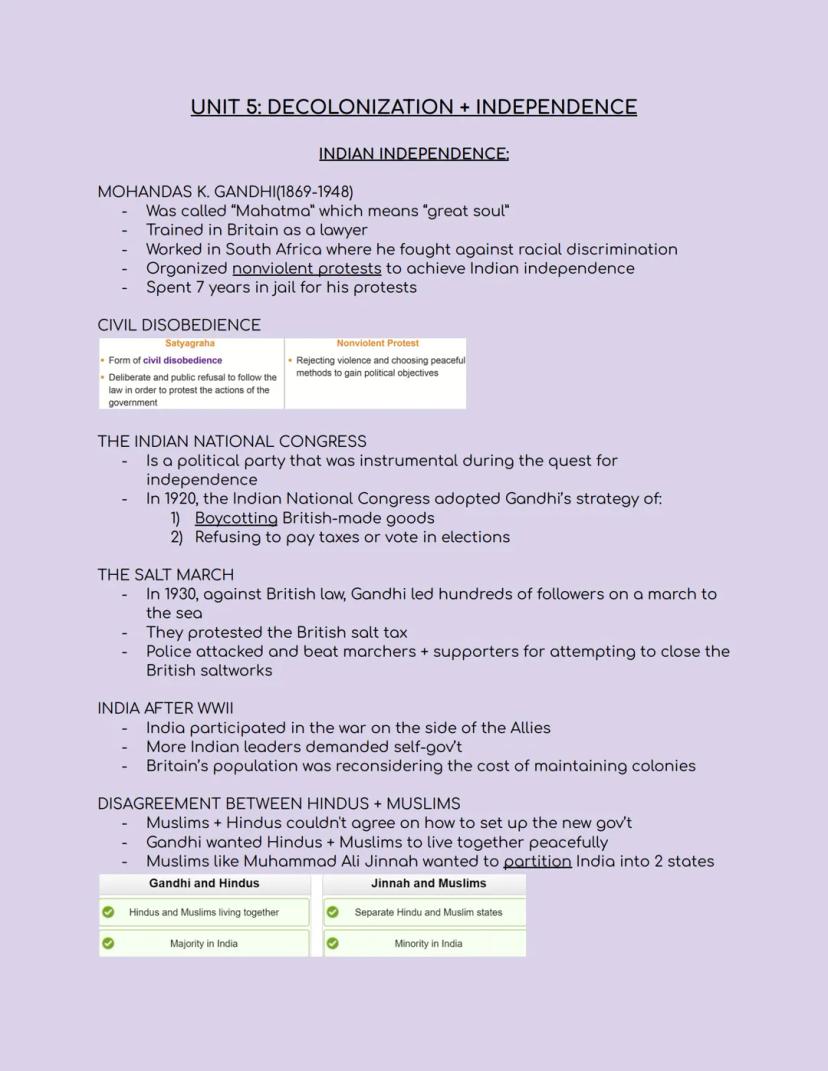
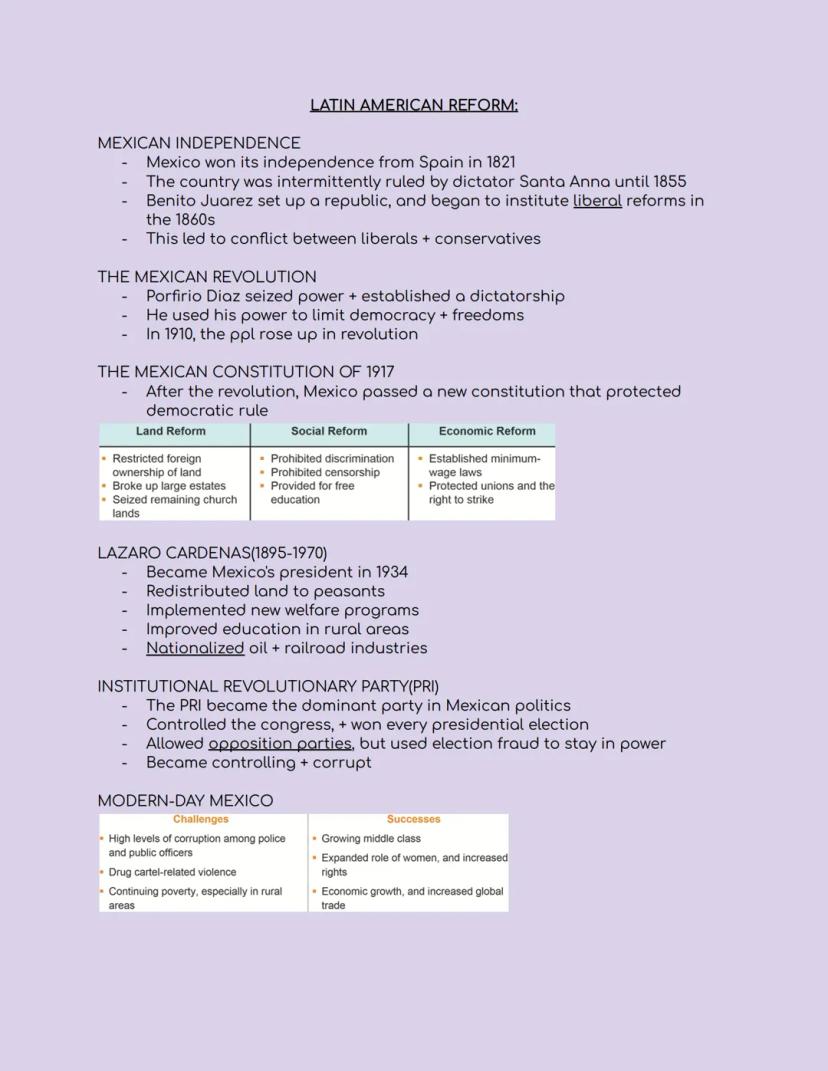
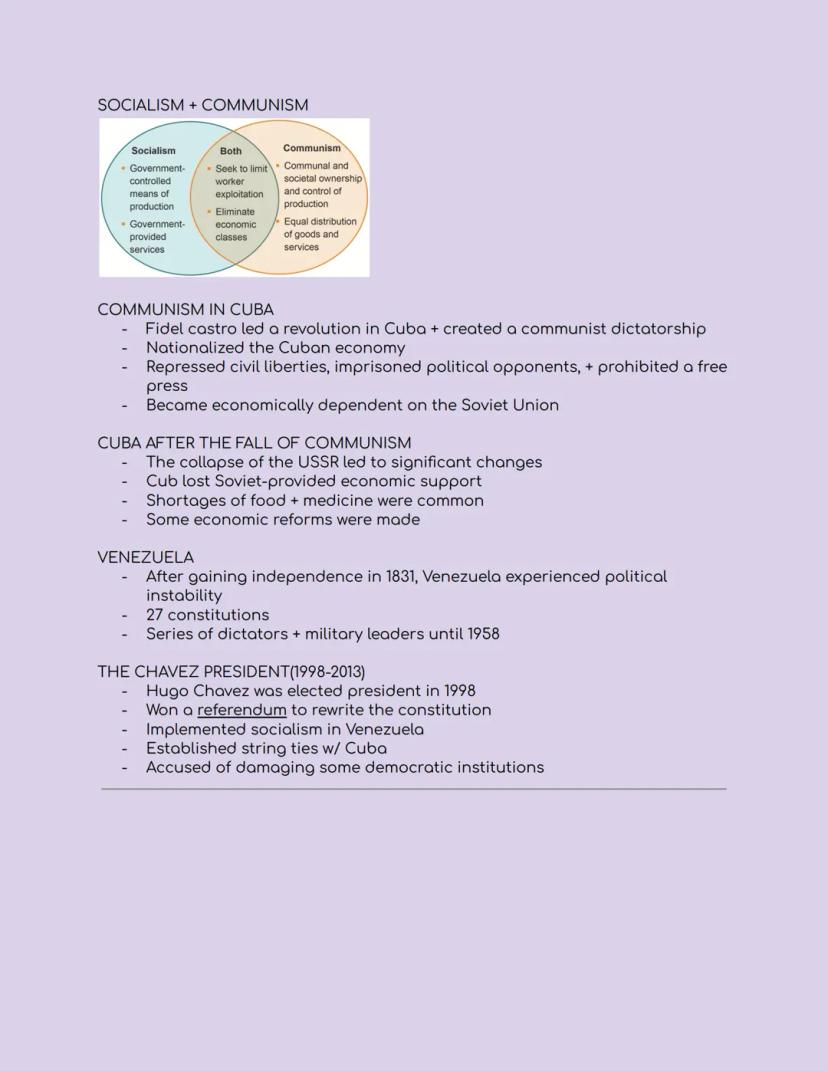
Mohandas K. Gandhi, known as "Mahatma" (great soul), transformed India's struggle for independence through nonviolent resistance. After working as a lawyer in Britain and fighting racial discrimination in South Africa, Gandhi returned to India to lead the independence movement.
Gandhi's philosophy of Satyagraha (civil disobedience) involved deliberately and publicly refusing to follow unjust laws. The Indian National Congress embraced Gandhi's strategy in 1920, boycotting British goods and refusing to pay taxes or vote in elections.
The Salt March of 1930 demonstrated Gandhi's approach in action. Leading hundreds of followers to the sea to protest the British salt tax, Gandhi and his supporters faced brutal police attacks but maintained their nonviolent stance.
Did you know? Gandhi spent 7 years in jail for his protests, but his peaceful resistance eventually helped India gain independence from Britain after World War II.
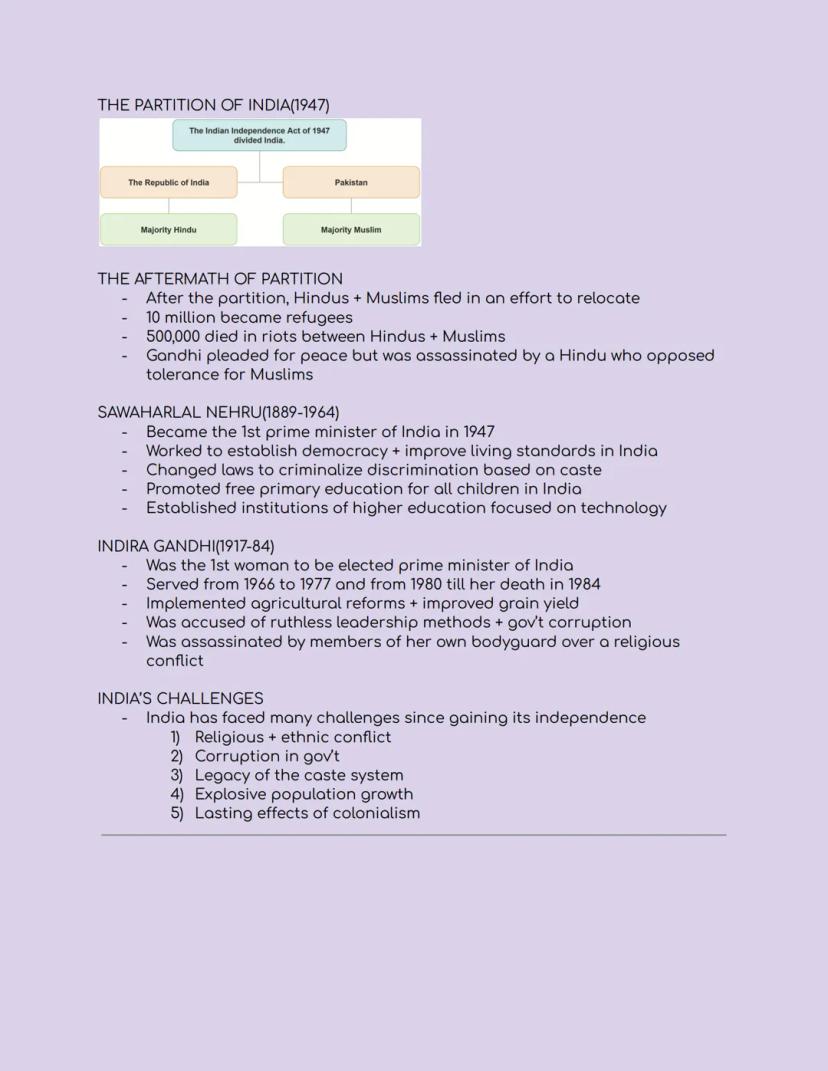
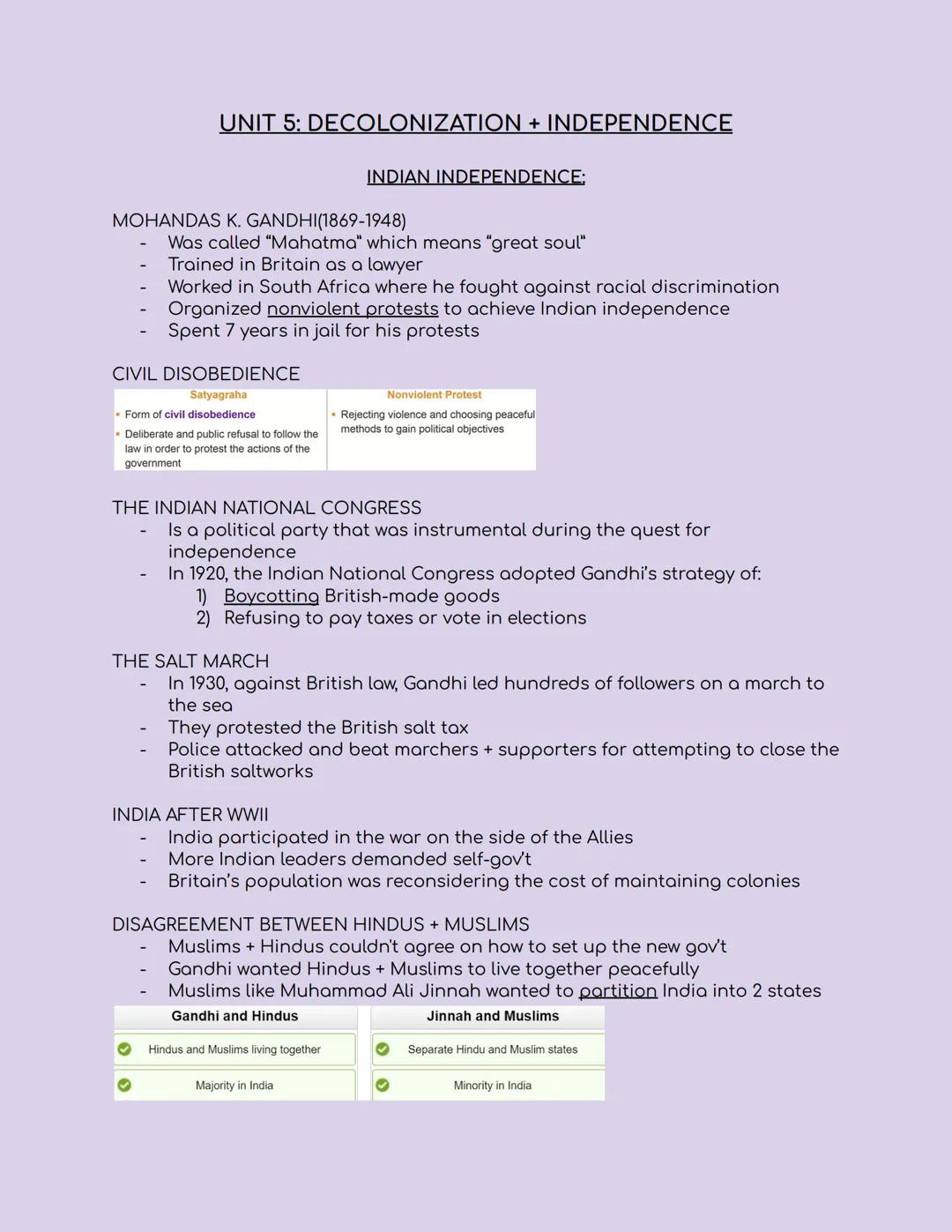
After WWII, independence seemed within reach, but a deep divide emerged between Hindus and Muslims over the future government. Gandhi wanted both groups to live together peacefully in one nation, while Muslim leader Muhammad Ali Jinnah pushed for separate Hindu and Muslim states.
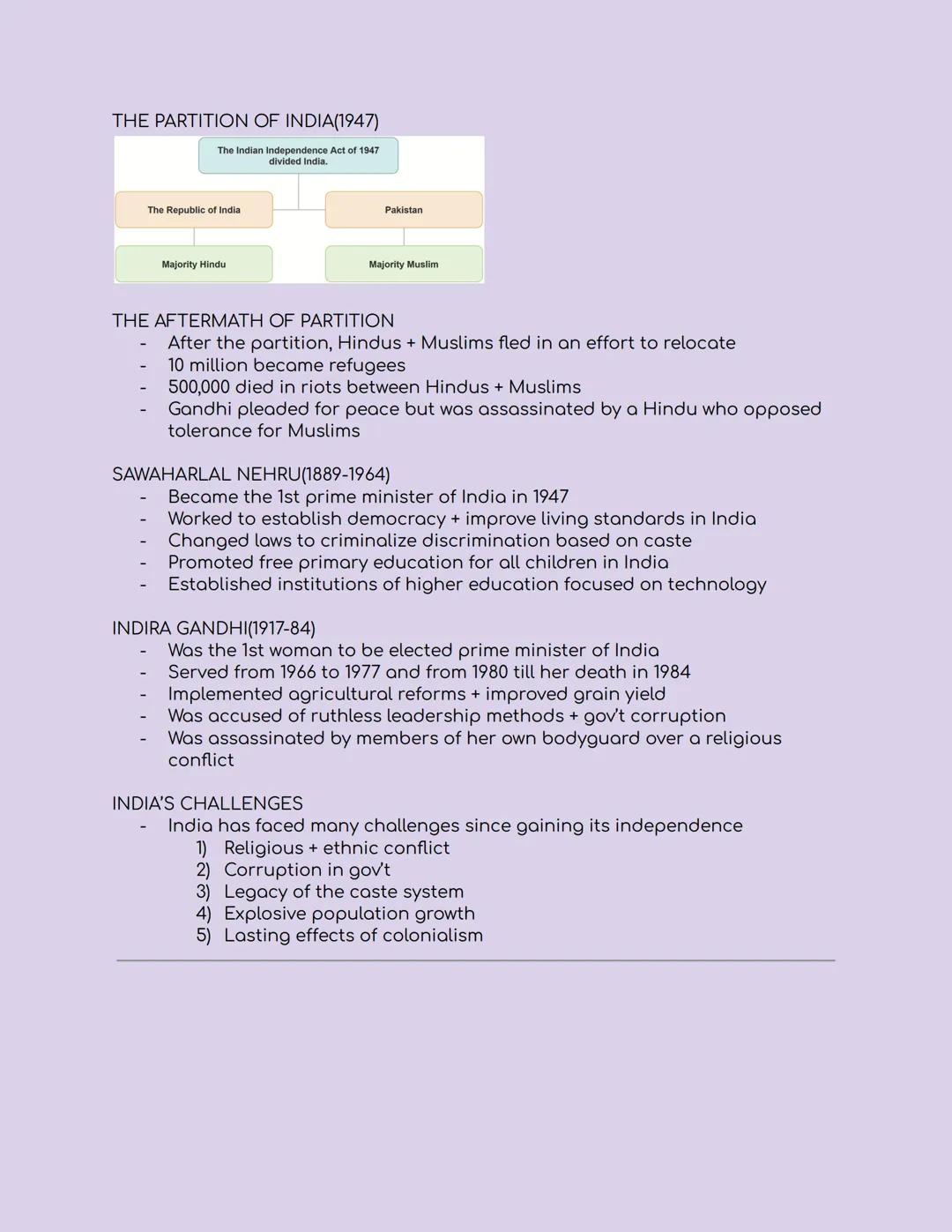
The 1947 Indian Independence Act created two separate nations: the Republic of India (majority Hindu) and Pakistan (majority Muslim). This division, known as the Partition of India, led to one of history's largest migrations and humanitarian crises.
The aftermath was devastating. About 10 million people became refugees as Hindus and Muslims frantically relocated to their respective countries. Religious violence claimed approximately 500,000 lives despite Gandhi's pleas for peace. Tragically, Gandhi himself was assassinated by a Hindu extremist who opposed his tolerance toward Muslims.
Jawaharlal Nehru became India's first prime minister in 1947 and worked to establish democracy and improve living standards. He criminalized caste discrimination, promoted free primary education, and built technical institutions of higher learning.
Think about it: India faced enormous challenges after independence, including religious conflicts, government corruption, the caste system's legacy, explosive population growth, and the lasting effects of colonialism.
Later, Indira Gandhi (no relation to Mahatma) became India's first female prime minister, serving from 1966-1977 and 1980-1984. Though she implemented important agricultural reforms, she was criticized for ruthless leadership and corruption before being assassinated by her own bodyguards during a religious conflict.
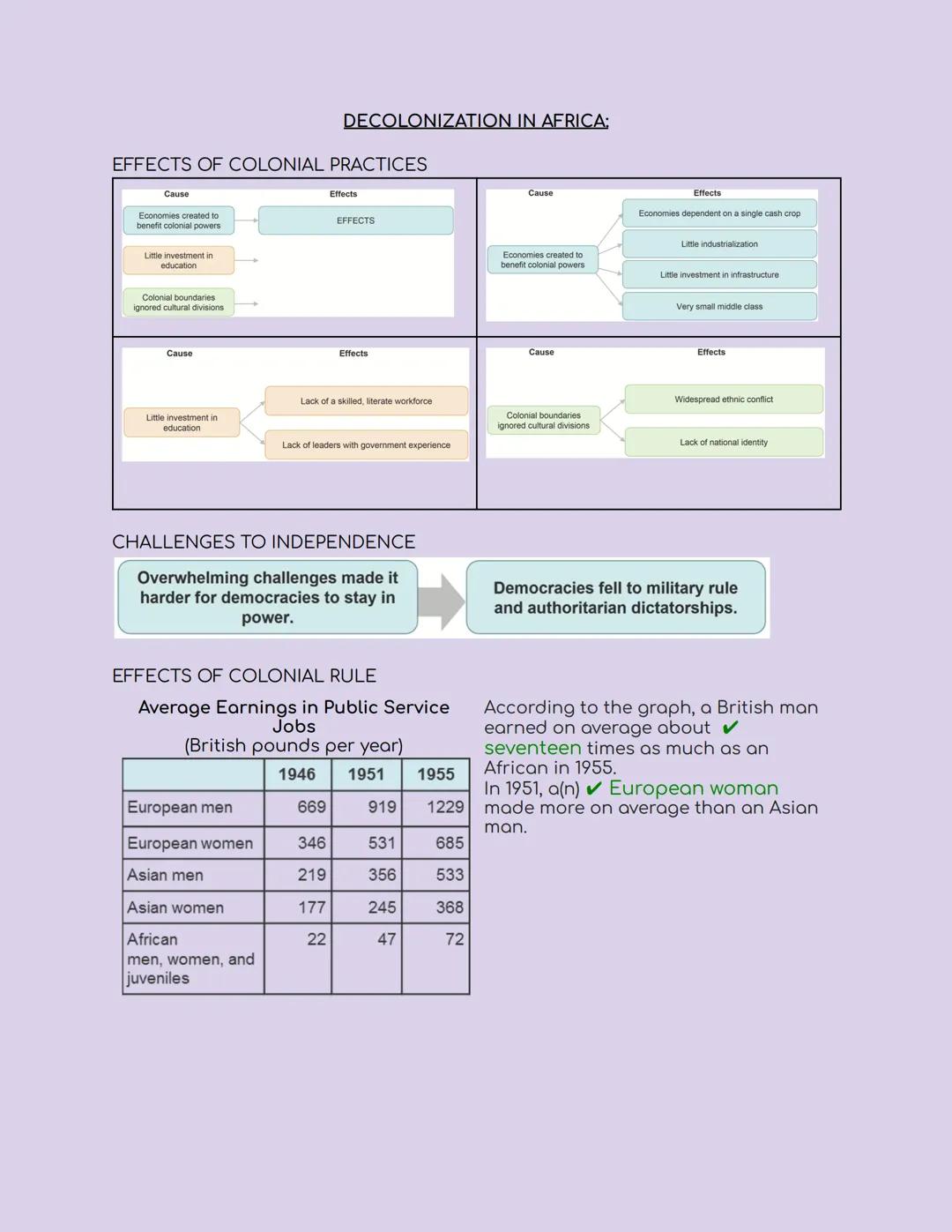
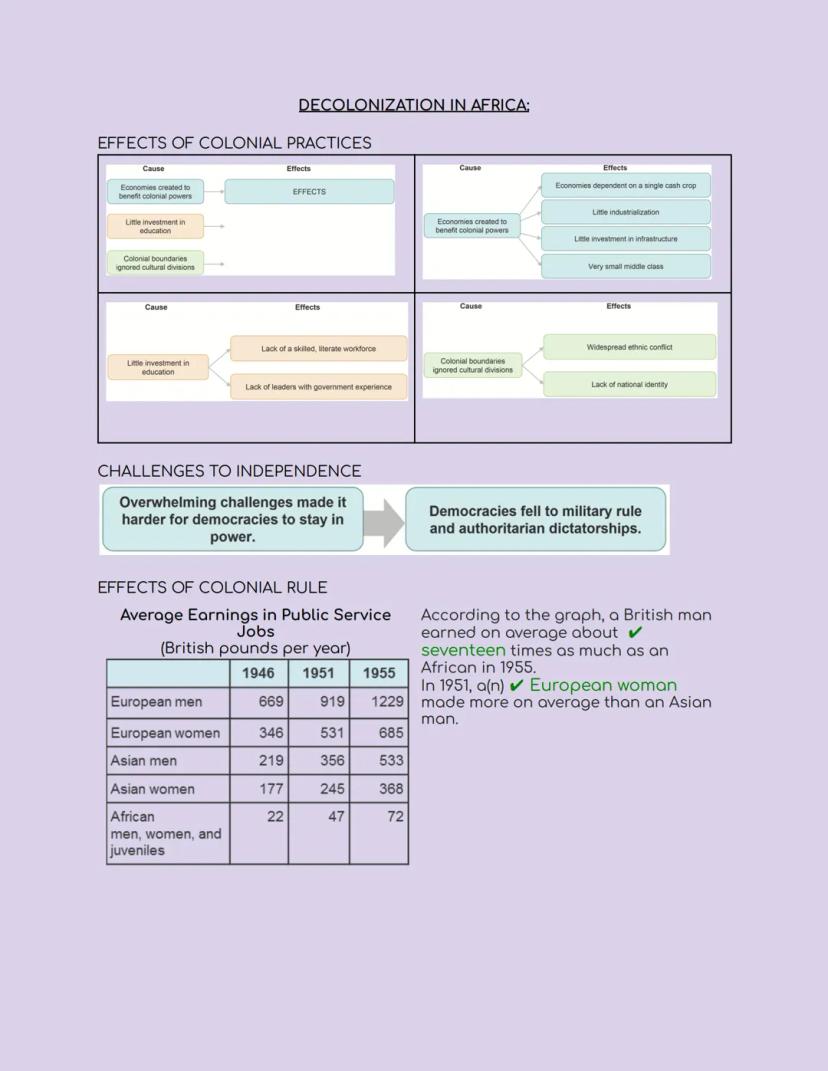
When African nations gained independence, they inherited serious problems from colonial rule. The European powers had built economies that benefited themselves rather than Africans, creating nations dependent on single cash crops with little infrastructure or industrialization.
Colonial authorities also invested minimally in education, leaving new nations with few skilled workers or experienced leaders. Perhaps most damaging, colonial boundaries ignored cultural divisions, grouping diverse ethnic groups together while splitting others apart.
These problems created a perfect storm of challenges: ethnic conflicts, weak national identities, underdeveloped economies, and leadership vacuums. Many new democracies quickly fell to military rule or authoritarian dictatorships as they struggled to overcome these obstacles.
Reality check: Colonial inequality was extreme. In 1955, European men working in public service earned about 17 times more than Africans in the same jobs. Even European women earned significantly more than Asian men.
The overwhelming legacy of colonialism made it incredibly difficult for new African nations to establish stable governments. Economic inequality, ethnic tensions, and lack of democratic experience created conditions where military coups and dictatorships frequently replaced early democratic efforts.
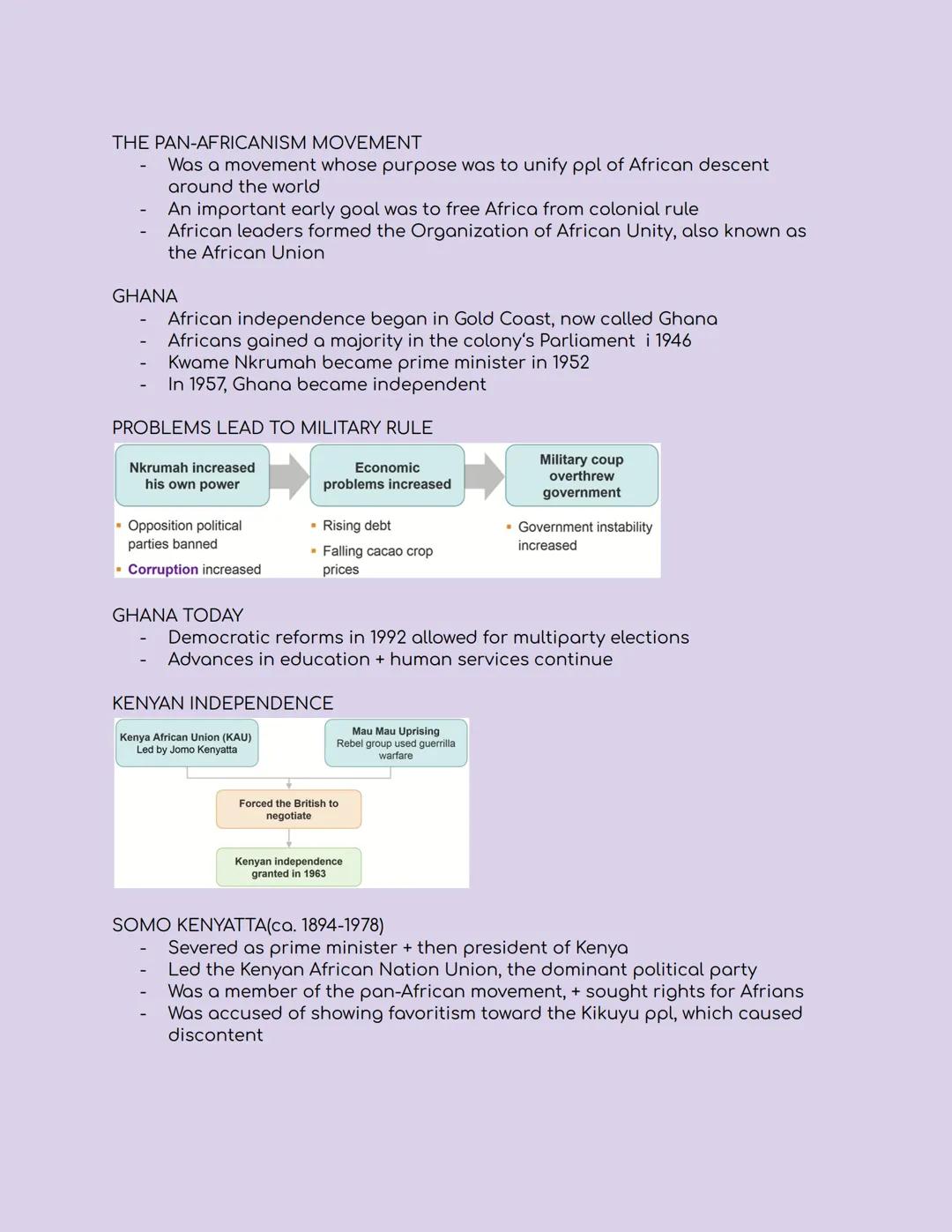
Pan-Africanism became a powerful movement uniting people of African descent worldwide with the goal of freeing Africa from colonial rule. This movement eventually led to the formation of the Organization of African Unity (now the African Union) to represent African interests globally.
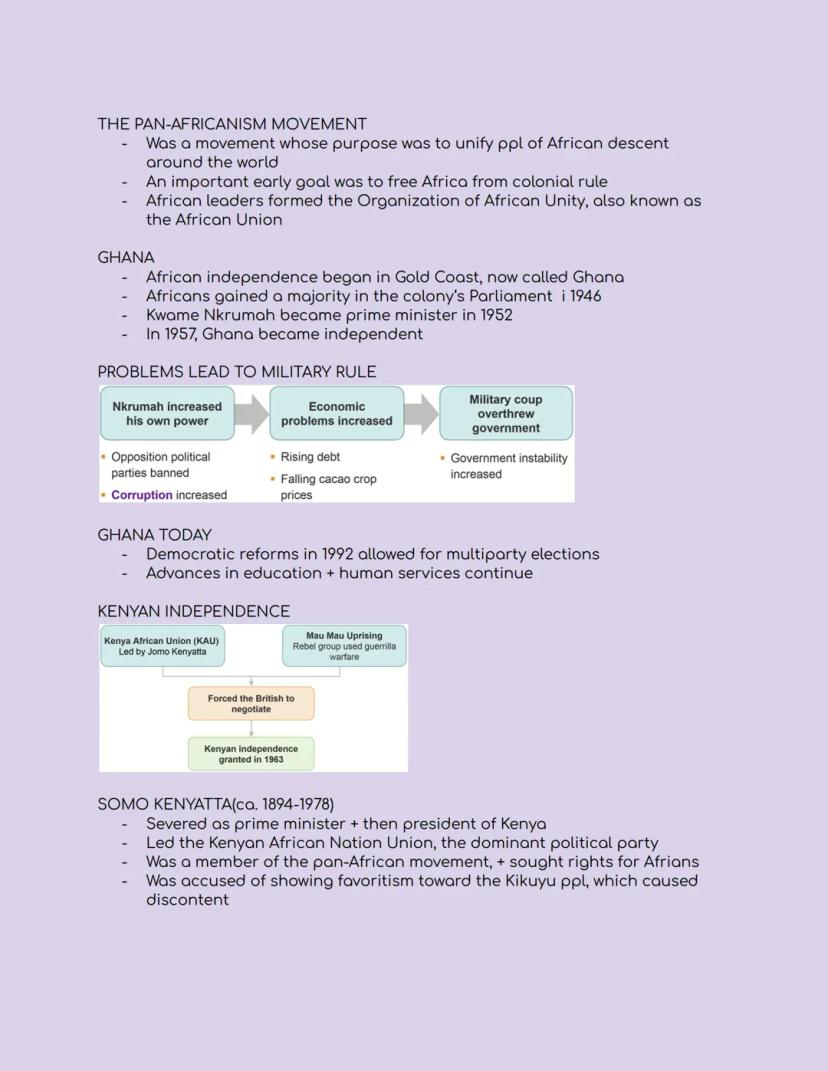
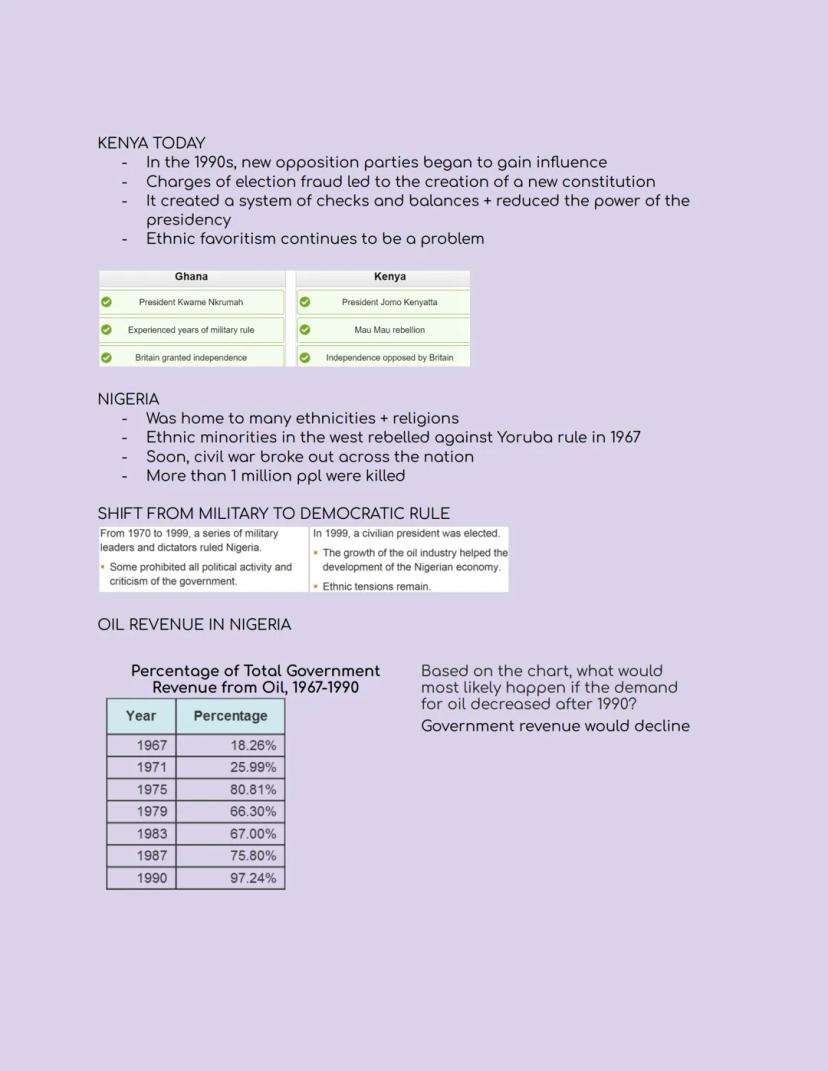
Ghana (formerly Gold Coast) led the way in African independence. Under Kwame Nkrumah, Africans gained a parliamentary majority in 1946 and achieved full independence by 1957. However, Ghana's early promise faded as Nkrumah banned opposition parties, economic problems mounted, and corruption increased. Eventually, a military coup overthrew the government.
In Kenya, independence came through both political organization and armed resistance. The Kenya African Union (KAU) led by Jomo Kenyatta worked alongside the Mau Mau Uprising, a rebel group using guerrilla warfare tactics. This combination forced British negotiations, resulting in Kenyan independence in 1963.
Connect the dots: Both Ghana and Kenya gained independence from Britain but took different paths. Ghana's was relatively peaceful, while Kenya's involved armed rebellion. Both later faced challenges with ethnic favoritism and government corruption.
Kenyatta served as Kenya's first prime minister and later president. Though he was part of the pan-African movement and fought for African rights, he was accused of showing favoritism toward his own Kikuyu people, creating ethnic tensions that continue to this day.
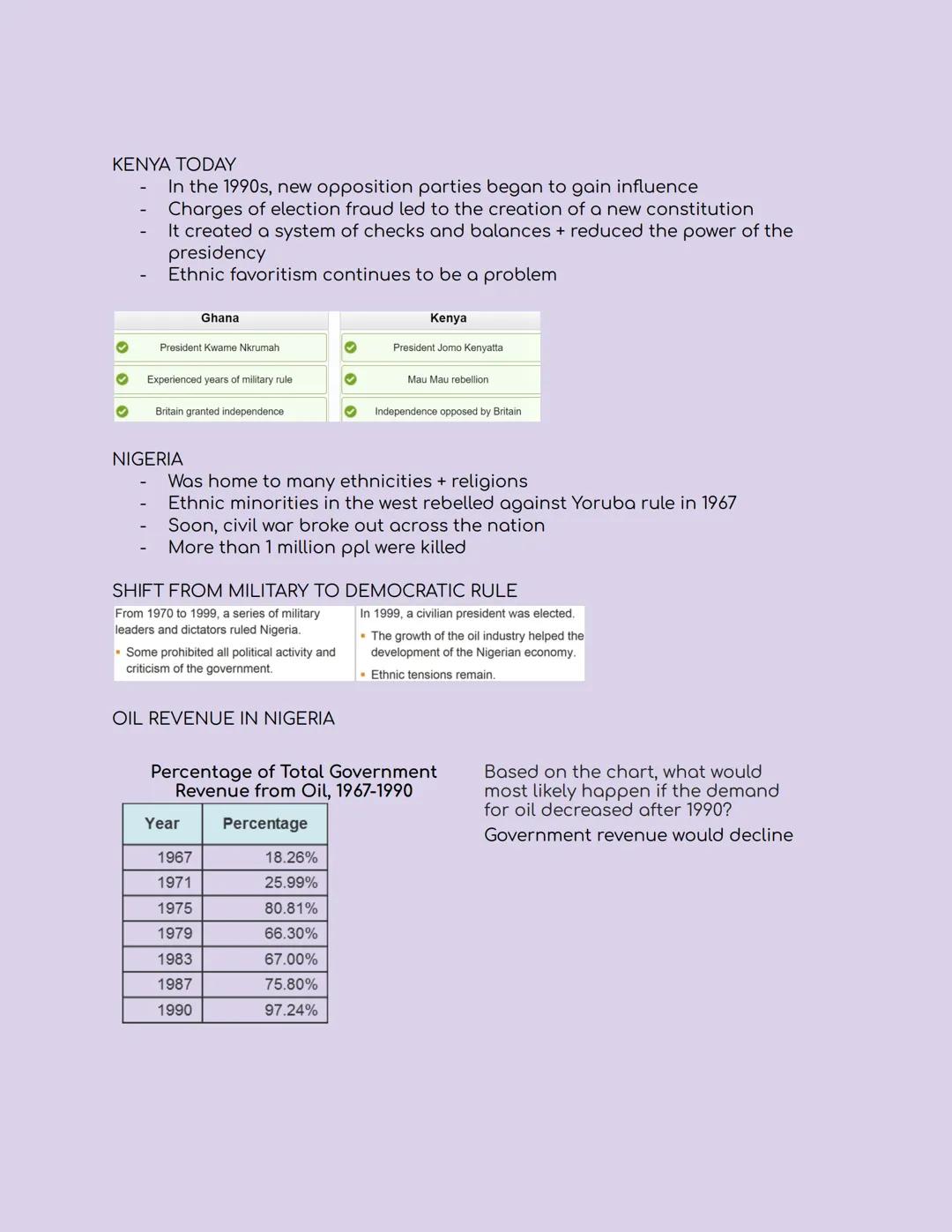
Nigeria's path to stability was complicated by its diverse population of many ethnicities and religions. In 1967, ethnic tensions exploded into civil war when minorities in the west rebelled against Yoruba rule. This devastating conflict killed more than 1 million people.
From 1970 to 1999, Nigeria endured a series of military leaders and dictators. Some prohibited all political activity and crushed any criticism of the government. The growth of Nigeria's oil industry dramatically changed its economy—by 1990, oil accounted for an astounding 97% of government revenue, creating both opportunities and risks.
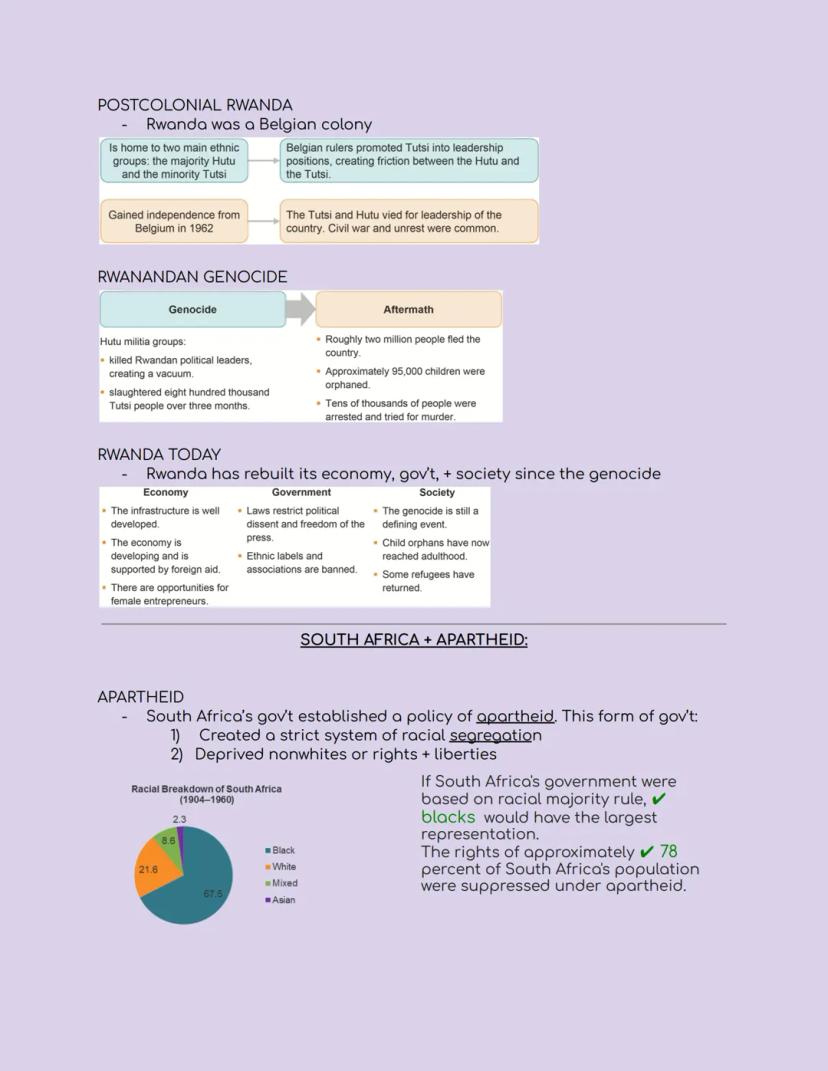
Rwanda, a former Belgian colony, experienced one of history's most horrific genocides. Belgian rulers had promoted the minority Tutsi into leadership positions, creating friction with the majority Hutu. After independence in 1962, these tensions festered until 1994 when Hutu militia groups slaughtered 800,000 Tutsi over just three months.
Hard truth: The Rwandan genocide orphaned approximately 95,000 children and caused about 2 million people to flee the country. The aftermath included tens of thousands of murder trials and a traumatized society.
Rwanda has made remarkable progress since this tragedy. The country has rebuilt its economy with well-developed infrastructure, created opportunities for female entrepreneurs, and received substantial foreign aid. However, the government restricts political dissent and has banned ethnic labels in an attempt to prevent future conflict.
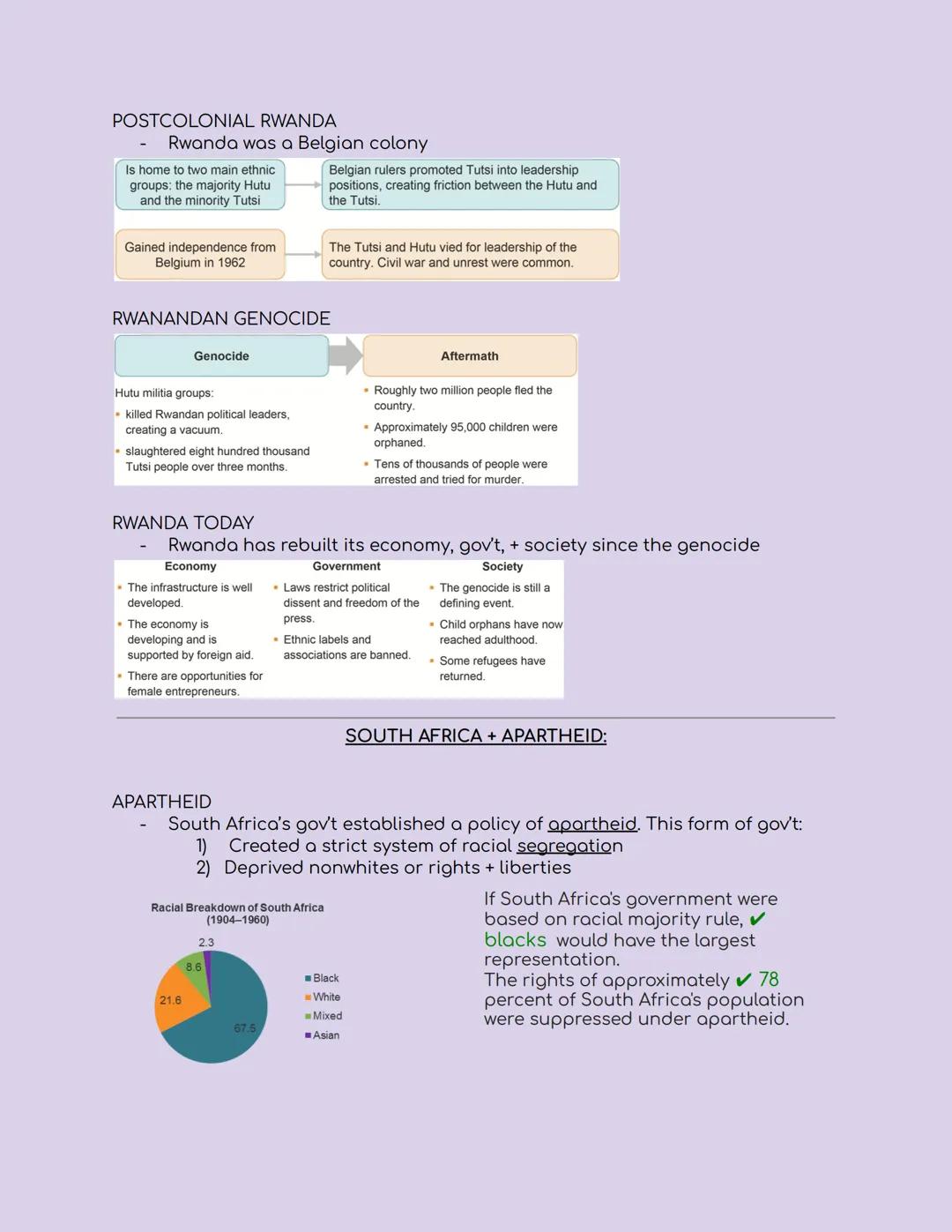
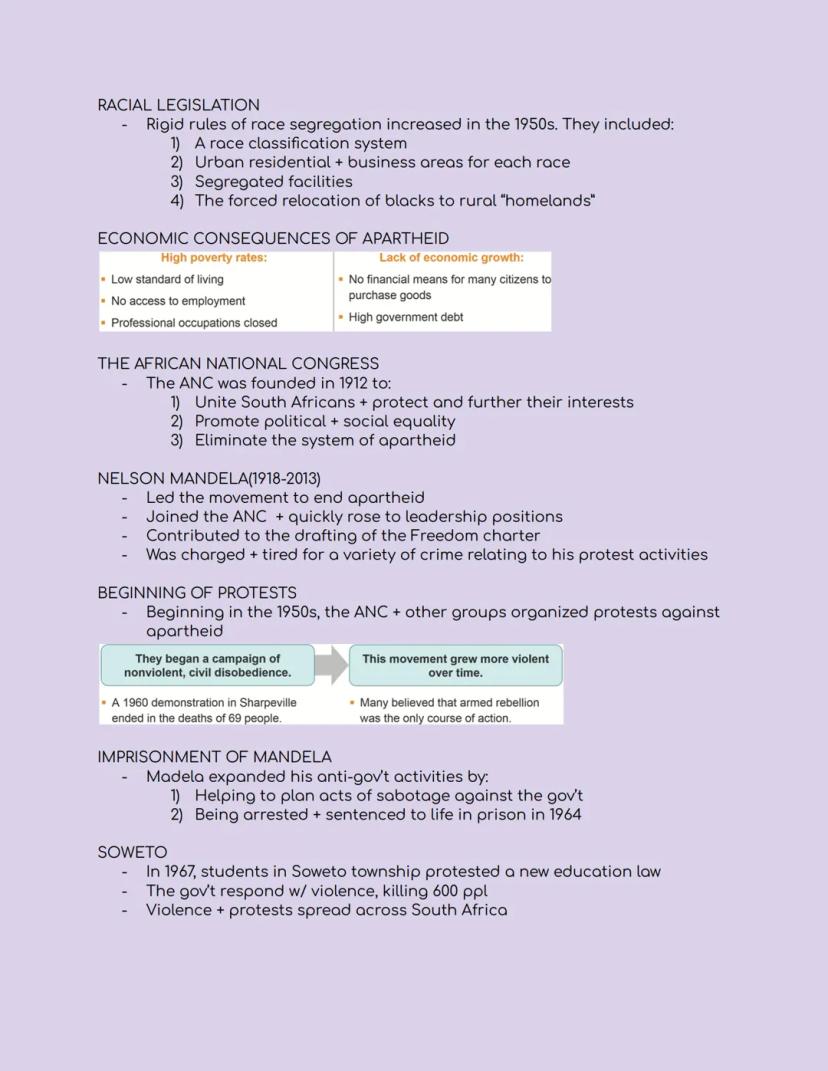
South Africa's government established apartheid, a strict system of racial segregation that deprived non-whites of basic rights and liberties. Although Black South Africans made up about 68% of the population, with mixed race and Asian citizens adding another 10%, the white minority controlled all political power.
Racial legislation in the 1950s created a comprehensive system of segregation, including race classification, separate urban living areas, segregated facilities, and the forced relocation of blacks to rural "homelands." These policies led to high poverty rates, restricted economic growth, and widespread suffering.
The African National Congress (ANC) formed in 1912 to unite South Africans and fight for political and social equality. In the 1950s, the ANC and other groups began organizing nonviolent civil disobedience protests against apartheid. However, the government responded with violence, as seen in the 1960 Sharpeville massacre where 69 protesters were killed.
Think critically: The South African government suppressed the rights of nearly 78% of its population under apartheid. How could such an unjust system last for decades?
Nelson Mandela emerged as a key leader in the anti-apartheid movement. After helping to plan acts of sabotage against the government, he was arrested and sentenced to life imprisonment in 1964. Meanwhile, protests continued, with the 1967 Soweto township student demonstrations resulting in 600 deaths when the government responded with violence.
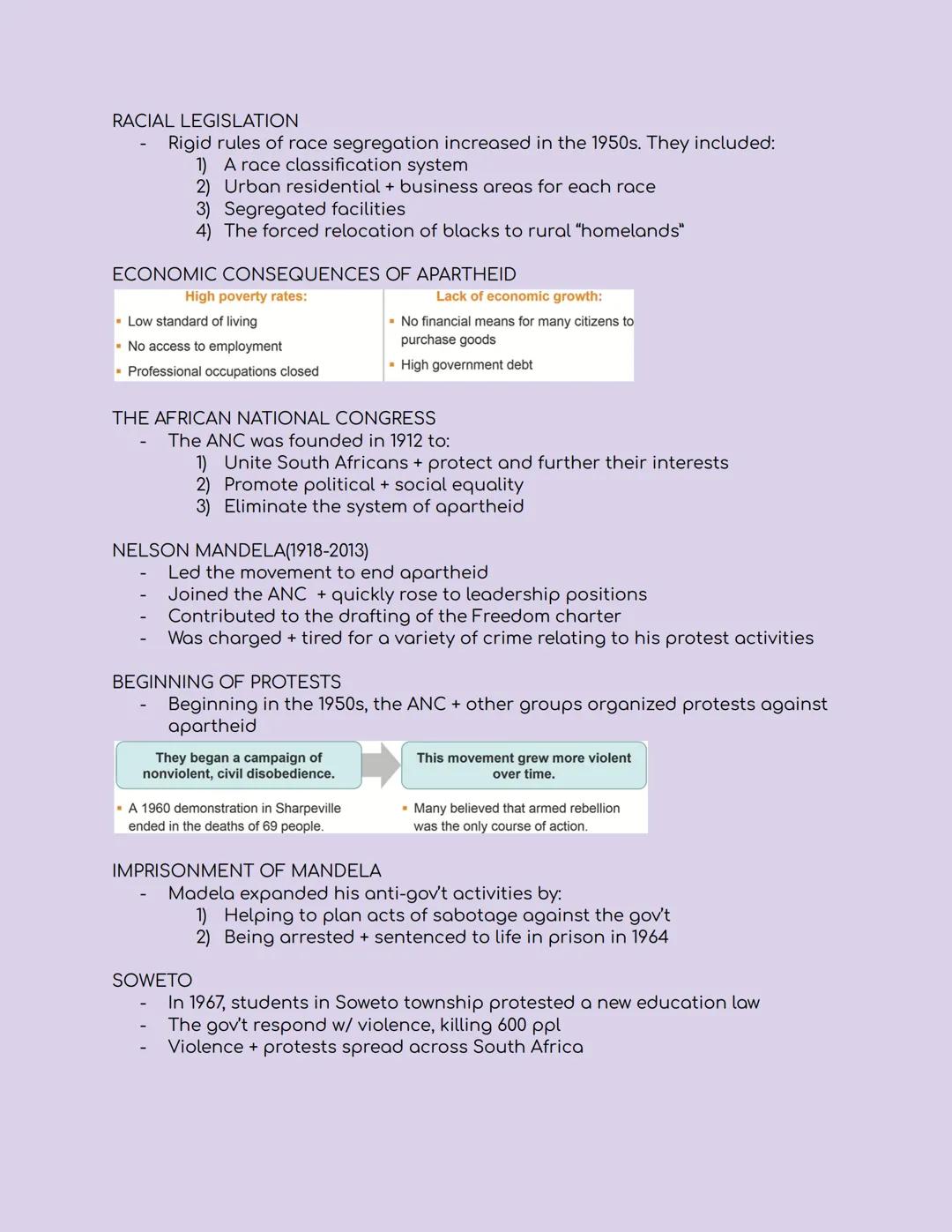
As apartheid continued, resistance movements grew more determined. Following the violent government response to protests, many activists believed armed rebellion was the only possible solution. The movement that had begun with nonviolent civil disobedience became increasingly militant as peaceful options seemed to fail.
Nelson Mandela expanded his anti-government activities by planning acts of sabotage against the government before his arrest and life sentence in 1964. From prison, he continued to inspire the resistance movement for decades.
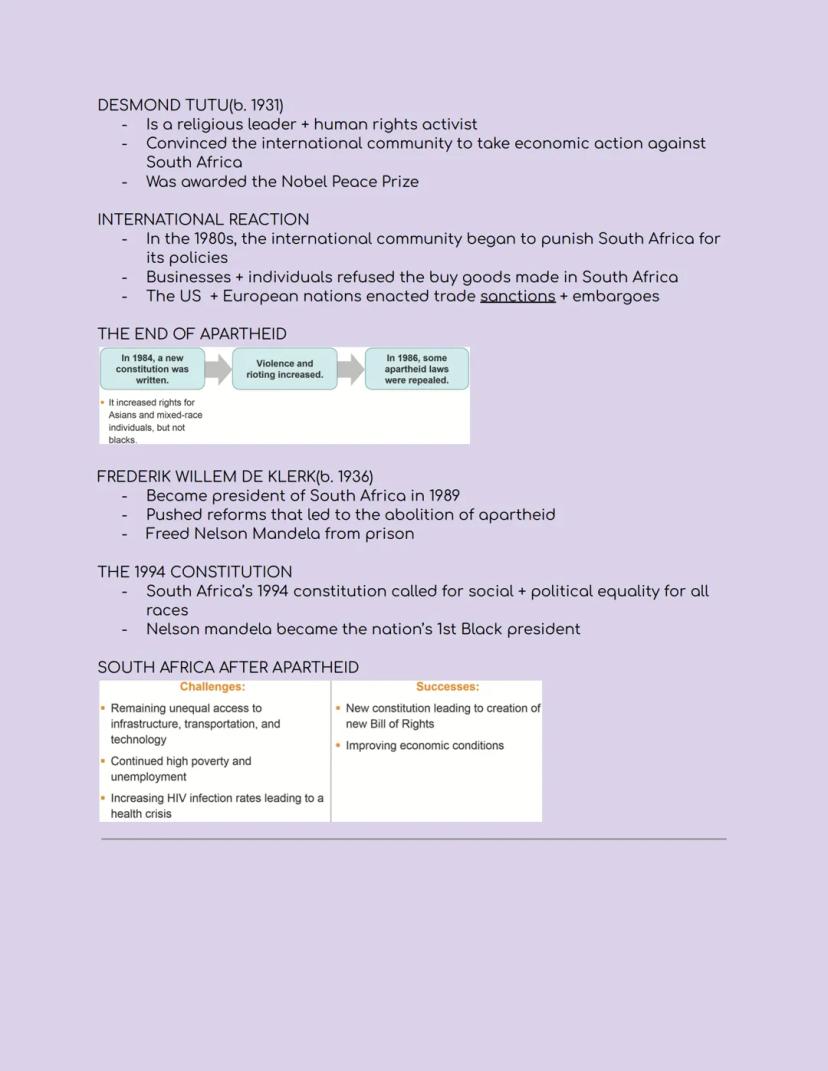
Desmond Tutu, a religious leader and human rights activist, took a different approach. He worked to convince the international community to take economic action against South Africa and was awarded the Nobel Peace Prize for his efforts.
Power of unity: The combination of internal resistance and international pressure eventually forced the South African government to negotiate. Boycotts, trade sanctions, and embargoes from businesses and nations worldwide created economic pressure that couldn't be ignored.
By the mid-1980s, change began. Some apartheid laws were repealed in 1986, though these changes initially extended rights to Asians and mixed-race individuals but not blacks. Violence and protests intensified until Frederik Willem de Klerk became president in 1989 and pushed for reforms that led to apartheid's abolition and Mandela's release from prison.
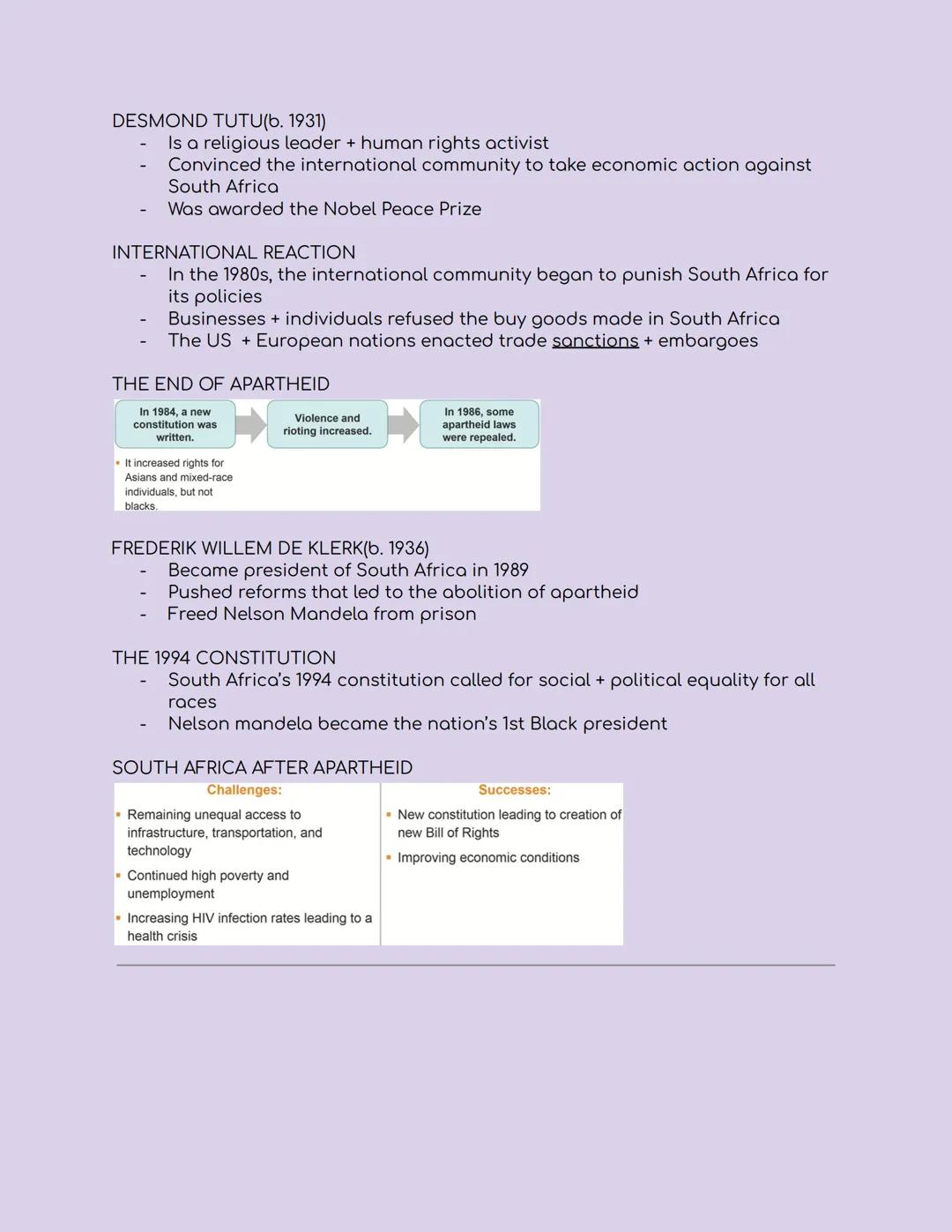
After decades of struggle, South Africa finally dismantled apartheid in the early 1990s. Frederik Willem de Klerk pushed for reforms that freed Nelson Mandela from prison after 27 years of imprisonment and set the stage for a new democratic South Africa.
The 1994 Constitution established social and political equality for all races, marking the official end of apartheid. Nelson Mandela became the nation's first Black president, symbolizing the country's dramatic transformation from a white-dominated state to a multiracial democracy.
Post-apartheid South Africa has achieved significant successes. The new constitution created a Bill of Rights protecting all citizens, economic conditions have improved for many, and democratic institutions have taken root. However, serious challenges remain from apartheid's legacy.
Progress takes time: Even decades after apartheid ended, South Africa still struggles with unequal access to infrastructure and technology, high poverty and unemployment rates, and a serious HIV crisis that has strained the healthcare system.
The transition from apartheid to democracy represents one of history's most remarkable peaceful revolutions. Though imperfect, South Africa avoided the widespread bloodshed many feared would accompany such a dramatic transfer of power. The country continues working to overcome centuries of racial division and build a more equitable society.
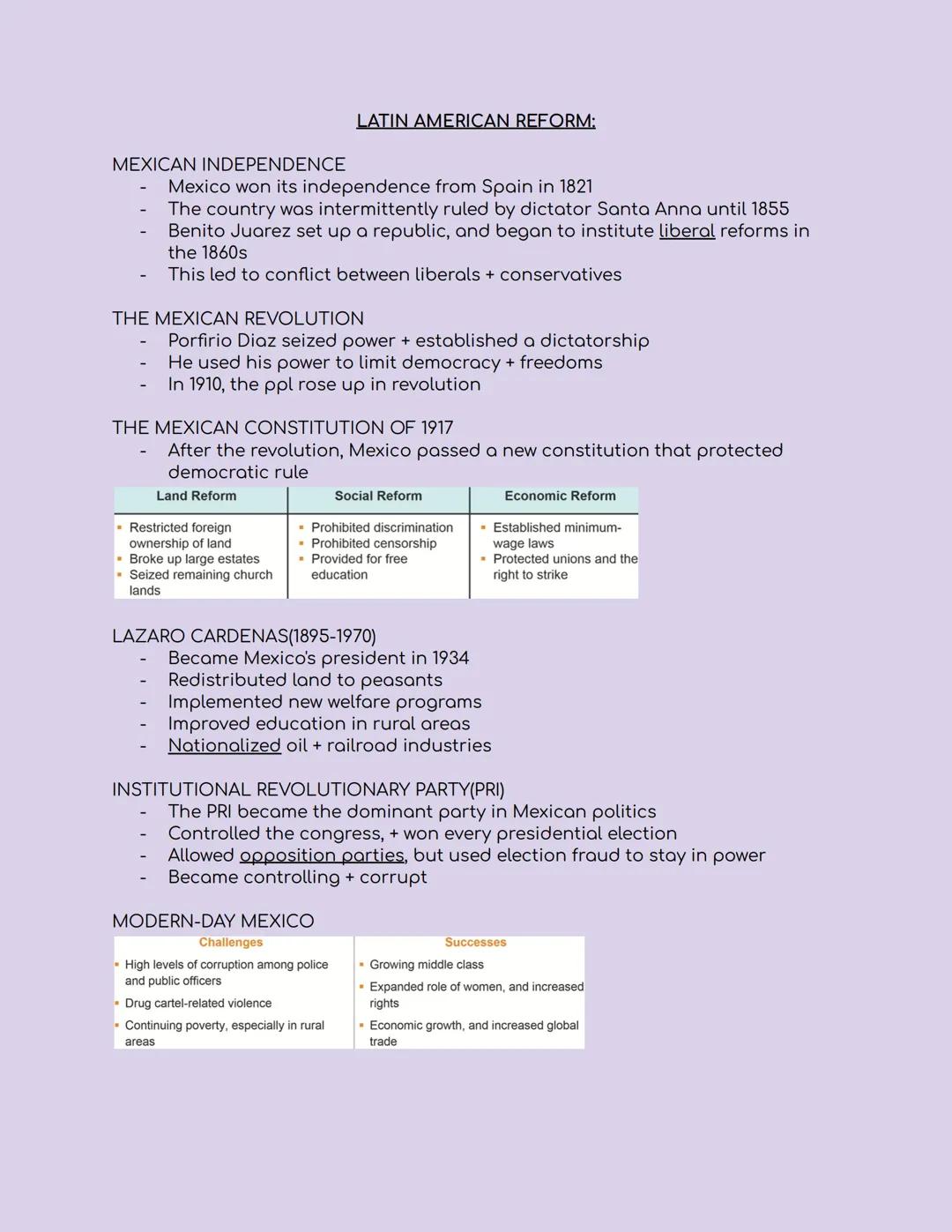
Mexico's journey to democracy began with independence from Spain in 1821, but true reform came slowly. After years of dictatorial rule, Benito Juarez established a republic in the 1860s and introduced liberal reforms, triggering conflict between progressive and conservative factions.
The Mexican Revolution erupted in 1910 when citizens rose up against Porfirio Diaz's oppressive dictatorship. This uprising led to the progressive Constitution of 1917, which protected democratic rule through comprehensive reforms. It restricted foreign land ownership, broke up large estates, prohibited discrimination, provided free education, established minimum wages, and protected workers' rights.
President Lazaro Cardenas (1934-1940) implemented many of these reforms, redistributing land to peasants, creating welfare programs, improving rural education, and nationalizing oil and railroad industries. His policies helped ordinary Mexicans but created tension with foreign investors.
Power shift: For decades, the Institutional Revolutionary Party (PRI) dominated Mexican politics. Though they allowed opposition parties to exist, they used election fraud to maintain control and became increasingly corrupt over time.
Modern Mexico faces significant challenges including police corruption, drug cartel violence, and rural poverty. However, the country has also achieved important successes: a growing middle class, expanded women's rights, economic growth, and increased global trade. Mexico continues to balance its revolutionary ideals with the realities of modern governance.
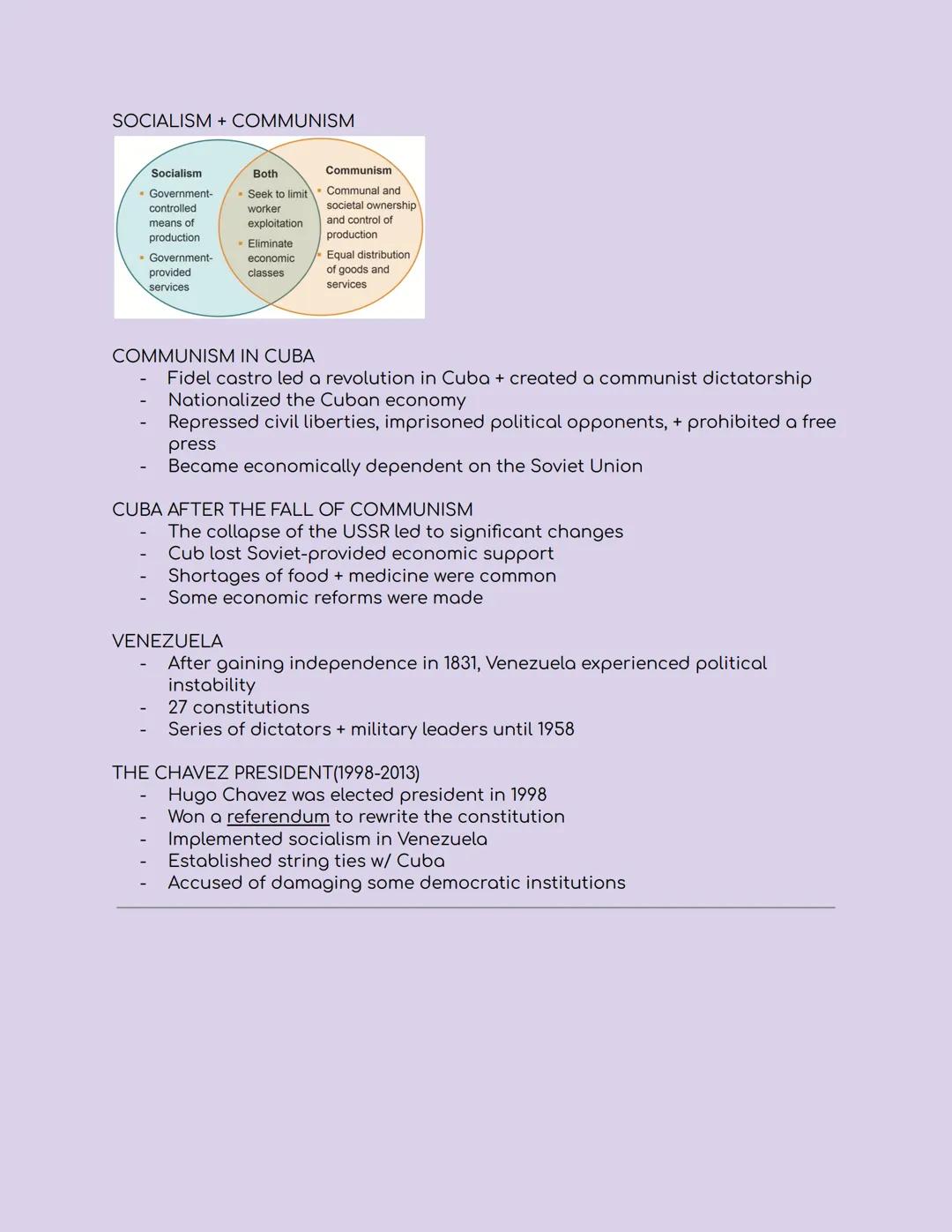
Socialism and communism gained popularity in parts of Latin America as responses to inequality and foreign domination. Both ideologies seek to limit worker exploitation and eliminate economic classes, but they differ in important ways. Socialism typically involves government-controlled production and services, while communism pushes for communal ownership and equal distribution of goods.
In Cuba, Fidel Castro led a revolution that established a communist dictatorship. He nationalized the economy, repressed civil liberties, imprisoned political opponents, and prohibited free press. Cuba became economically dependent on the Soviet Union, which created a crisis when the USSR collapsed. Without Soviet support, Cuba experienced severe shortages of food and medicine, forcing some economic reforms.
Venezuela's path differed from Cuba's. After gaining independence in 1831, the country experienced political instability with 27 different constitutions and a series of dictators until democratic reforms in 1958. Democracy took hold but faced challenges.
Competing visions: Latin American nations have taken different approaches to economic and political development. While some embraced socialism or communism, others pursued capitalist democracy. Each system brought both benefits and problems.
Hugo Chavez was elected Venezuela's president in 1998 and implemented socialist policies. He rewrote the constitution, established strong ties with Cuba, and used oil wealth to fund social programs. Critics accused him of damaging democratic institutions, while supporters praised his efforts to reduce poverty and inequality.
Our AI companion is specifically built for the needs of students. Based on the millions of content pieces we have on the platform we can provide truly meaningful and relevant answers to students. But its not only about answers, the companion is even more about guiding students through their daily learning challenges, with personalised study plans, quizzes or content pieces in the chat and 100% personalisation based on the students skills and developments.
You can download the app in the Google Play Store and in the Apple App Store.
That's right! Enjoy free access to study content, connect with fellow students, and get instant help – all at your fingertips.
App Store
Google Play
The app is very easy to use and well designed. I have found everything I was looking for so far and have been able to learn a lot from the presentations! I will definitely use the app for a class assignment! And of course it also helps a lot as an inspiration.
Stefan S
iOS user
This app is really great. There are so many study notes and help [...]. My problem subject is French, for example, and the app has so many options for help. Thanks to this app, I have improved my French. I would recommend it to anyone.
Samantha Klich
Android user
Wow, I am really amazed. I just tried the app because I've seen it advertised many times and was absolutely stunned. This app is THE HELP you want for school and above all, it offers so many things, such as workouts and fact sheets, which have been VERY helpful to me personally.
Anna
iOS user
I think it’s very much worth it and you’ll end up using it a lot once you get the hang of it and even after looking at others notes you can still ask your Artificial intelligence buddy the question and ask to simplify it if you still don’t get it!!! In the end I think it’s worth it 😊👍 ⚠️Also DID I MENTION ITS FREEE YOU DON’T HAVE TO PAY FOR ANYTHING AND STILL GET YOUR GRADES IN PERFECTLY❗️❗️⚠️
Thomas R
iOS user
Knowunity is the BEST app I’ve used in a minute. This is not an ai review or anything this is genuinely coming from a 7th grade student (I know 2011 im young) but dude this app is a 10/10 i have maintained a 3.8 gpa and have plenty of time for gaming. I love it and my mom is just happy I got good grades
Brad T
Android user
Not only did it help me find the answer but it also showed me alternative ways to solve it. I was horrible in math and science but now I have an a in both subjects. Thanks for the help🤍🤍
David K
iOS user
The app's just great! All I have to do is enter the topic in the search bar and I get the response real fast. I don't have to watch 10 YouTube videos to understand something, so I'm saving my time. Highly recommended!
Sudenaz Ocak
Android user
In school I was really bad at maths but thanks to the app, I am doing better now. I am so grateful that you made the app.
Greenlight Bonnie
Android user
I found this app a couple years ago and it has only gotten better since then. I really love it because it can help with written questions and photo questions. Also, it can find study guides that other people have made as well as flashcard sets and practice tests. The free version is also amazing for students who might not be able to afford it. Would 100% recommend
Aubrey
iOS user
Best app if you're in Highschool or Junior high. I have been using this app for 2 school years and it's the best, it's good if you don't have anyone to help you with school work.😋🩷🎀
Marco B
iOS user
THE QUIZES AND FLASHCARDS ARE SO USEFUL AND I LOVE Knowunity AI. IT ALSO IS LITREALLY LIKE CHATGPT BUT SMARTER!! HELPED ME WITH MY MASCARA PROBLEMS TOO!! AS WELL AS MY REAL SUBJECTS ! DUHHH 😍😁😲🤑💗✨🎀😮
Elisha
iOS user
This app is phenomenal down to the correct info and the various topics you can study! I greatly recommend it for people who struggle with procrastination and those who need homework help. It has been perfectly accurate for world 1 history as far as I’ve seen! Geometry too!
Paul T
iOS user
The app is very easy to use and well designed. I have found everything I was looking for so far and have been able to learn a lot from the presentations! I will definitely use the app for a class assignment! And of course it also helps a lot as an inspiration.
Stefan S
iOS user
This app is really great. There are so many study notes and help [...]. My problem subject is French, for example, and the app has so many options for help. Thanks to this app, I have improved my French. I would recommend it to anyone.
Samantha Klich
Android user
Wow, I am really amazed. I just tried the app because I've seen it advertised many times and was absolutely stunned. This app is THE HELP you want for school and above all, it offers so many things, such as workouts and fact sheets, which have been VERY helpful to me personally.
Anna
iOS user
I think it’s very much worth it and you’ll end up using it a lot once you get the hang of it and even after looking at others notes you can still ask your Artificial intelligence buddy the question and ask to simplify it if you still don’t get it!!! In the end I think it’s worth it 😊👍 ⚠️Also DID I MENTION ITS FREEE YOU DON’T HAVE TO PAY FOR ANYTHING AND STILL GET YOUR GRADES IN PERFECTLY❗️❗️⚠️
Thomas R
iOS user
Knowunity is the BEST app I’ve used in a minute. This is not an ai review or anything this is genuinely coming from a 7th grade student (I know 2011 im young) but dude this app is a 10/10 i have maintained a 3.8 gpa and have plenty of time for gaming. I love it and my mom is just happy I got good grades
Brad T
Android user
Not only did it help me find the answer but it also showed me alternative ways to solve it. I was horrible in math and science but now I have an a in both subjects. Thanks for the help🤍🤍
David K
iOS user
The app's just great! All I have to do is enter the topic in the search bar and I get the response real fast. I don't have to watch 10 YouTube videos to understand something, so I'm saving my time. Highly recommended!
Sudenaz Ocak
Android user
In school I was really bad at maths but thanks to the app, I am doing better now. I am so grateful that you made the app.
Greenlight Bonnie
Android user
I found this app a couple years ago and it has only gotten better since then. I really love it because it can help with written questions and photo questions. Also, it can find study guides that other people have made as well as flashcard sets and practice tests. The free version is also amazing for students who might not be able to afford it. Would 100% recommend
Aubrey
iOS user
Best app if you're in Highschool or Junior high. I have been using this app for 2 school years and it's the best, it's good if you don't have anyone to help you with school work.😋🩷🎀
Marco B
iOS user
THE QUIZES AND FLASHCARDS ARE SO USEFUL AND I LOVE Knowunity AI. IT ALSO IS LITREALLY LIKE CHATGPT BUT SMARTER!! HELPED ME WITH MY MASCARA PROBLEMS TOO!! AS WELL AS MY REAL SUBJECTS ! DUHHH 😍😁😲🤑💗✨🎀😮
Elisha
iOS user
This app is phenomenal down to the correct info and the various topics you can study! I greatly recommend it for people who struggle with procrastination and those who need homework help. It has been perfectly accurate for world 1 history as far as I’ve seen! Geometry too!
Paul T
iOS user
Explore the powerful movements that led to independence across India, Africa, and Latin America. You'll discover how brave leaders used different strategies to overcome colonialism and create new nations, and the challenges they faced after gaining freedom.
Access to all documents
Improve your grades
Join milions of students
Mohandas K. Gandhi, known as "Mahatma" (great soul), transformed India's struggle for independence through nonviolent resistance. After working as a lawyer in Britain and fighting racial discrimination in South Africa, Gandhi returned to India to lead the independence movement.
Gandhi's philosophy of Satyagraha (civil disobedience) involved deliberately and publicly refusing to follow unjust laws. The Indian National Congress embraced Gandhi's strategy in 1920, boycotting British goods and refusing to pay taxes or vote in elections.
The Salt March of 1930 demonstrated Gandhi's approach in action. Leading hundreds of followers to the sea to protest the British salt tax, Gandhi and his supporters faced brutal police attacks but maintained their nonviolent stance.
Did you know? Gandhi spent 7 years in jail for his protests, but his peaceful resistance eventually helped India gain independence from Britain after World War II.
After WWII, independence seemed within reach, but a deep divide emerged between Hindus and Muslims over the future government. Gandhi wanted both groups to live together peacefully in one nation, while Muslim leader Muhammad Ali Jinnah pushed for separate Hindu and Muslim states.
Access to all documents
Improve your grades
Join milions of students
The 1947 Indian Independence Act created two separate nations: the Republic of India (majority Hindu) and Pakistan (majority Muslim). This division, known as the Partition of India, led to one of history's largest migrations and humanitarian crises.
The aftermath was devastating. About 10 million people became refugees as Hindus and Muslims frantically relocated to their respective countries. Religious violence claimed approximately 500,000 lives despite Gandhi's pleas for peace. Tragically, Gandhi himself was assassinated by a Hindu extremist who opposed his tolerance toward Muslims.
Jawaharlal Nehru became India's first prime minister in 1947 and worked to establish democracy and improve living standards. He criminalized caste discrimination, promoted free primary education, and built technical institutions of higher learning.
Think about it: India faced enormous challenges after independence, including religious conflicts, government corruption, the caste system's legacy, explosive population growth, and the lasting effects of colonialism.
Later, Indira Gandhi (no relation to Mahatma) became India's first female prime minister, serving from 1966-1977 and 1980-1984. Though she implemented important agricultural reforms, she was criticized for ruthless leadership and corruption before being assassinated by her own bodyguards during a religious conflict.
Access to all documents
Improve your grades
Join milions of students
When African nations gained independence, they inherited serious problems from colonial rule. The European powers had built economies that benefited themselves rather than Africans, creating nations dependent on single cash crops with little infrastructure or industrialization.
Colonial authorities also invested minimally in education, leaving new nations with few skilled workers or experienced leaders. Perhaps most damaging, colonial boundaries ignored cultural divisions, grouping diverse ethnic groups together while splitting others apart.
These problems created a perfect storm of challenges: ethnic conflicts, weak national identities, underdeveloped economies, and leadership vacuums. Many new democracies quickly fell to military rule or authoritarian dictatorships as they struggled to overcome these obstacles.
Reality check: Colonial inequality was extreme. In 1955, European men working in public service earned about 17 times more than Africans in the same jobs. Even European women earned significantly more than Asian men.
The overwhelming legacy of colonialism made it incredibly difficult for new African nations to establish stable governments. Economic inequality, ethnic tensions, and lack of democratic experience created conditions where military coups and dictatorships frequently replaced early democratic efforts.
Access to all documents
Improve your grades
Join milions of students
Pan-Africanism became a powerful movement uniting people of African descent worldwide with the goal of freeing Africa from colonial rule. This movement eventually led to the formation of the Organization of African Unity (now the African Union) to represent African interests globally.
Ghana (formerly Gold Coast) led the way in African independence. Under Kwame Nkrumah, Africans gained a parliamentary majority in 1946 and achieved full independence by 1957. However, Ghana's early promise faded as Nkrumah banned opposition parties, economic problems mounted, and corruption increased. Eventually, a military coup overthrew the government.
In Kenya, independence came through both political organization and armed resistance. The Kenya African Union (KAU) led by Jomo Kenyatta worked alongside the Mau Mau Uprising, a rebel group using guerrilla warfare tactics. This combination forced British negotiations, resulting in Kenyan independence in 1963.
Connect the dots: Both Ghana and Kenya gained independence from Britain but took different paths. Ghana's was relatively peaceful, while Kenya's involved armed rebellion. Both later faced challenges with ethnic favoritism and government corruption.
Kenyatta served as Kenya's first prime minister and later president. Though he was part of the pan-African movement and fought for African rights, he was accused of showing favoritism toward his own Kikuyu people, creating ethnic tensions that continue to this day.
Access to all documents
Improve your grades
Join milions of students
Nigeria's path to stability was complicated by its diverse population of many ethnicities and religions. In 1967, ethnic tensions exploded into civil war when minorities in the west rebelled against Yoruba rule. This devastating conflict killed more than 1 million people.
From 1970 to 1999, Nigeria endured a series of military leaders and dictators. Some prohibited all political activity and crushed any criticism of the government. The growth of Nigeria's oil industry dramatically changed its economy—by 1990, oil accounted for an astounding 97% of government revenue, creating both opportunities and risks.
Rwanda, a former Belgian colony, experienced one of history's most horrific genocides. Belgian rulers had promoted the minority Tutsi into leadership positions, creating friction with the majority Hutu. After independence in 1962, these tensions festered until 1994 when Hutu militia groups slaughtered 800,000 Tutsi over just three months.
Hard truth: The Rwandan genocide orphaned approximately 95,000 children and caused about 2 million people to flee the country. The aftermath included tens of thousands of murder trials and a traumatized society.
Rwanda has made remarkable progress since this tragedy. The country has rebuilt its economy with well-developed infrastructure, created opportunities for female entrepreneurs, and received substantial foreign aid. However, the government restricts political dissent and has banned ethnic labels in an attempt to prevent future conflict.
Access to all documents
Improve your grades
Join milions of students
South Africa's government established apartheid, a strict system of racial segregation that deprived non-whites of basic rights and liberties. Although Black South Africans made up about 68% of the population, with mixed race and Asian citizens adding another 10%, the white minority controlled all political power.
Racial legislation in the 1950s created a comprehensive system of segregation, including race classification, separate urban living areas, segregated facilities, and the forced relocation of blacks to rural "homelands." These policies led to high poverty rates, restricted economic growth, and widespread suffering.
The African National Congress (ANC) formed in 1912 to unite South Africans and fight for political and social equality. In the 1950s, the ANC and other groups began organizing nonviolent civil disobedience protests against apartheid. However, the government responded with violence, as seen in the 1960 Sharpeville massacre where 69 protesters were killed.
Think critically: The South African government suppressed the rights of nearly 78% of its population under apartheid. How could such an unjust system last for decades?
Nelson Mandela emerged as a key leader in the anti-apartheid movement. After helping to plan acts of sabotage against the government, he was arrested and sentenced to life imprisonment in 1964. Meanwhile, protests continued, with the 1967 Soweto township student demonstrations resulting in 600 deaths when the government responded with violence.
Access to all documents
Improve your grades
Join milions of students
As apartheid continued, resistance movements grew more determined. Following the violent government response to protests, many activists believed armed rebellion was the only possible solution. The movement that had begun with nonviolent civil disobedience became increasingly militant as peaceful options seemed to fail.
Nelson Mandela expanded his anti-government activities by planning acts of sabotage against the government before his arrest and life sentence in 1964. From prison, he continued to inspire the resistance movement for decades.
Desmond Tutu, a religious leader and human rights activist, took a different approach. He worked to convince the international community to take economic action against South Africa and was awarded the Nobel Peace Prize for his efforts.
Power of unity: The combination of internal resistance and international pressure eventually forced the South African government to negotiate. Boycotts, trade sanctions, and embargoes from businesses and nations worldwide created economic pressure that couldn't be ignored.
By the mid-1980s, change began. Some apartheid laws were repealed in 1986, though these changes initially extended rights to Asians and mixed-race individuals but not blacks. Violence and protests intensified until Frederik Willem de Klerk became president in 1989 and pushed for reforms that led to apartheid's abolition and Mandela's release from prison.
Access to all documents
Improve your grades
Join milions of students
After decades of struggle, South Africa finally dismantled apartheid in the early 1990s. Frederik Willem de Klerk pushed for reforms that freed Nelson Mandela from prison after 27 years of imprisonment and set the stage for a new democratic South Africa.
The 1994 Constitution established social and political equality for all races, marking the official end of apartheid. Nelson Mandela became the nation's first Black president, symbolizing the country's dramatic transformation from a white-dominated state to a multiracial democracy.
Post-apartheid South Africa has achieved significant successes. The new constitution created a Bill of Rights protecting all citizens, economic conditions have improved for many, and democratic institutions have taken root. However, serious challenges remain from apartheid's legacy.
Progress takes time: Even decades after apartheid ended, South Africa still struggles with unequal access to infrastructure and technology, high poverty and unemployment rates, and a serious HIV crisis that has strained the healthcare system.
The transition from apartheid to democracy represents one of history's most remarkable peaceful revolutions. Though imperfect, South Africa avoided the widespread bloodshed many feared would accompany such a dramatic transfer of power. The country continues working to overcome centuries of racial division and build a more equitable society.
Access to all documents
Improve your grades
Join milions of students
Mexico's journey to democracy began with independence from Spain in 1821, but true reform came slowly. After years of dictatorial rule, Benito Juarez established a republic in the 1860s and introduced liberal reforms, triggering conflict between progressive and conservative factions.
The Mexican Revolution erupted in 1910 when citizens rose up against Porfirio Diaz's oppressive dictatorship. This uprising led to the progressive Constitution of 1917, which protected democratic rule through comprehensive reforms. It restricted foreign land ownership, broke up large estates, prohibited discrimination, provided free education, established minimum wages, and protected workers' rights.
President Lazaro Cardenas (1934-1940) implemented many of these reforms, redistributing land to peasants, creating welfare programs, improving rural education, and nationalizing oil and railroad industries. His policies helped ordinary Mexicans but created tension with foreign investors.
Power shift: For decades, the Institutional Revolutionary Party (PRI) dominated Mexican politics. Though they allowed opposition parties to exist, they used election fraud to maintain control and became increasingly corrupt over time.
Modern Mexico faces significant challenges including police corruption, drug cartel violence, and rural poverty. However, the country has also achieved important successes: a growing middle class, expanded women's rights, economic growth, and increased global trade. Mexico continues to balance its revolutionary ideals with the realities of modern governance.
Access to all documents
Improve your grades
Join milions of students
Socialism and communism gained popularity in parts of Latin America as responses to inequality and foreign domination. Both ideologies seek to limit worker exploitation and eliminate economic classes, but they differ in important ways. Socialism typically involves government-controlled production and services, while communism pushes for communal ownership and equal distribution of goods.
In Cuba, Fidel Castro led a revolution that established a communist dictatorship. He nationalized the economy, repressed civil liberties, imprisoned political opponents, and prohibited free press. Cuba became economically dependent on the Soviet Union, which created a crisis when the USSR collapsed. Without Soviet support, Cuba experienced severe shortages of food and medicine, forcing some economic reforms.
Venezuela's path differed from Cuba's. After gaining independence in 1831, the country experienced political instability with 27 different constitutions and a series of dictators until democratic reforms in 1958. Democracy took hold but faced challenges.
Competing visions: Latin American nations have taken different approaches to economic and political development. While some embraced socialism or communism, others pursued capitalist democracy. Each system brought both benefits and problems.
Hugo Chavez was elected Venezuela's president in 1998 and implemented socialist policies. He rewrote the constitution, established strong ties with Cuba, and used oil wealth to fund social programs. Critics accused him of damaging democratic institutions, while supporters praised his efforts to reduce poverty and inequality.
Our AI companion is specifically built for the needs of students. Based on the millions of content pieces we have on the platform we can provide truly meaningful and relevant answers to students. But its not only about answers, the companion is even more about guiding students through their daily learning challenges, with personalised study plans, quizzes or content pieces in the chat and 100% personalisation based on the students skills and developments.
You can download the app in the Google Play Store and in the Apple App Store.
That's right! Enjoy free access to study content, connect with fellow students, and get instant help – all at your fingertips.
9
Smart Tools NEW
Transform this note into: ✓ 50+ Practice Questions ✓ Interactive Flashcards ✓ Full Practice Test ✓ Essay Outlines
In this know, we cover ancient Mesopotamia, different societies, their cultural achievements and more.
 World History
All of the World History notes I took in 9th grade
World HistoryVocabulary terms defined in chapter 10 of world history
World Historyflashcards on 19th century medicine
 History
Explore the pivotal events and strategies of the Battle of Bannockburn (June 1314) that led to Scottish success against English forces. This revision guide covers key moments, leadership decisions, and battlefield tactics that shaped the outcome. Ideal for students preparing for exams or seeking a deeper understanding of this significant historical event.
HistoryExplore the complexities of the 1066 succession crisis in England, focusing on Edward the Confessor's lack of a direct heir and the resulting claims from Harold Godwinson, William of Normandy, and Harald Hardrada. This essay examines the political dynamics, promises made, and the implications of Saxon customs on the rivalry for the throne. Ideal for Grade 8 students studying Anglo-Saxon and Norman England.
HistoryApp Store
Google Play
The app is very easy to use and well designed. I have found everything I was looking for so far and have been able to learn a lot from the presentations! I will definitely use the app for a class assignment! And of course it also helps a lot as an inspiration.
Stefan S
iOS user
This app is really great. There are so many study notes and help [...]. My problem subject is French, for example, and the app has so many options for help. Thanks to this app, I have improved my French. I would recommend it to anyone.
Samantha Klich
Android user
Wow, I am really amazed. I just tried the app because I've seen it advertised many times and was absolutely stunned. This app is THE HELP you want for school and above all, it offers so many things, such as workouts and fact sheets, which have been VERY helpful to me personally.
Anna
iOS user
I think it’s very much worth it and you’ll end up using it a lot once you get the hang of it and even after looking at others notes you can still ask your Artificial intelligence buddy the question and ask to simplify it if you still don’t get it!!! In the end I think it’s worth it 😊👍 ⚠️Also DID I MENTION ITS FREEE YOU DON’T HAVE TO PAY FOR ANYTHING AND STILL GET YOUR GRADES IN PERFECTLY❗️❗️⚠️
Thomas R
iOS user
Knowunity is the BEST app I’ve used in a minute. This is not an ai review or anything this is genuinely coming from a 7th grade student (I know 2011 im young) but dude this app is a 10/10 i have maintained a 3.8 gpa and have plenty of time for gaming. I love it and my mom is just happy I got good grades
Brad T
Android user
Not only did it help me find the answer but it also showed me alternative ways to solve it. I was horrible in math and science but now I have an a in both subjects. Thanks for the help🤍🤍
David K
iOS user
The app's just great! All I have to do is enter the topic in the search bar and I get the response real fast. I don't have to watch 10 YouTube videos to understand something, so I'm saving my time. Highly recommended!
Sudenaz Ocak
Android user
In school I was really bad at maths but thanks to the app, I am doing better now. I am so grateful that you made the app.
Greenlight Bonnie
Android user
I found this app a couple years ago and it has only gotten better since then. I really love it because it can help with written questions and photo questions. Also, it can find study guides that other people have made as well as flashcard sets and practice tests. The free version is also amazing for students who might not be able to afford it. Would 100% recommend
Aubrey
iOS user
Best app if you're in Highschool or Junior high. I have been using this app for 2 school years and it's the best, it's good if you don't have anyone to help you with school work.😋🩷🎀
Marco B
iOS user
THE QUIZES AND FLASHCARDS ARE SO USEFUL AND I LOVE Knowunity AI. IT ALSO IS LITREALLY LIKE CHATGPT BUT SMARTER!! HELPED ME WITH MY MASCARA PROBLEMS TOO!! AS WELL AS MY REAL SUBJECTS ! DUHHH 😍😁😲🤑💗✨🎀😮
Elisha
iOS user
This app is phenomenal down to the correct info and the various topics you can study! I greatly recommend it for people who struggle with procrastination and those who need homework help. It has been perfectly accurate for world 1 history as far as I’ve seen! Geometry too!
Paul T
iOS user
The app is very easy to use and well designed. I have found everything I was looking for so far and have been able to learn a lot from the presentations! I will definitely use the app for a class assignment! And of course it also helps a lot as an inspiration.
Stefan S
iOS user
This app is really great. There are so many study notes and help [...]. My problem subject is French, for example, and the app has so many options for help. Thanks to this app, I have improved my French. I would recommend it to anyone.
Samantha Klich
Android user
Wow, I am really amazed. I just tried the app because I've seen it advertised many times and was absolutely stunned. This app is THE HELP you want for school and above all, it offers so many things, such as workouts and fact sheets, which have been VERY helpful to me personally.
Anna
iOS user
I think it’s very much worth it and you’ll end up using it a lot once you get the hang of it and even after looking at others notes you can still ask your Artificial intelligence buddy the question and ask to simplify it if you still don’t get it!!! In the end I think it’s worth it 😊👍 ⚠️Also DID I MENTION ITS FREEE YOU DON’T HAVE TO PAY FOR ANYTHING AND STILL GET YOUR GRADES IN PERFECTLY❗️❗️⚠️
Thomas R
iOS user
Knowunity is the BEST app I’ve used in a minute. This is not an ai review or anything this is genuinely coming from a 7th grade student (I know 2011 im young) but dude this app is a 10/10 i have maintained a 3.8 gpa and have plenty of time for gaming. I love it and my mom is just happy I got good grades
Brad T
Android user
Not only did it help me find the answer but it also showed me alternative ways to solve it. I was horrible in math and science but now I have an a in both subjects. Thanks for the help🤍🤍
David K
iOS user
The app's just great! All I have to do is enter the topic in the search bar and I get the response real fast. I don't have to watch 10 YouTube videos to understand something, so I'm saving my time. Highly recommended!
Sudenaz Ocak
Android user
In school I was really bad at maths but thanks to the app, I am doing better now. I am so grateful that you made the app.
Greenlight Bonnie
Android user
I found this app a couple years ago and it has only gotten better since then. I really love it because it can help with written questions and photo questions. Also, it can find study guides that other people have made as well as flashcard sets and practice tests. The free version is also amazing for students who might not be able to afford it. Would 100% recommend
Aubrey
iOS user
Best app if you're in Highschool or Junior high. I have been using this app for 2 school years and it's the best, it's good if you don't have anyone to help you with school work.😋🩷🎀
Marco B
iOS user
THE QUIZES AND FLASHCARDS ARE SO USEFUL AND I LOVE Knowunity AI. IT ALSO IS LITREALLY LIKE CHATGPT BUT SMARTER!! HELPED ME WITH MY MASCARA PROBLEMS TOO!! AS WELL AS MY REAL SUBJECTS ! DUHHH 😍😁😲🤑💗✨🎀😮
Elisha
iOS user
This app is phenomenal down to the correct info and the various topics you can study! I greatly recommend it for people who struggle with procrastination and those who need homework help. It has been perfectly accurate for world 1 history as far as I’ve seen! Geometry too!
Paul T
iOS user