

Dive into the foundations of modern government and society as... Show more
 Algebra
Sign up to see the contentIt's free!
Access to all documents
Improve your grades
Join milions of students
Knowunity AI
Subjects
Triangle Congruence and Similarity Theorems
Triangle Properties and Classification
Linear Equations and Graphs
Geometric Angle Relationships
Trigonometric Functions and Identities
Equation Solving Techniques
Circle Geometry Fundamentals
Division Operations and Methods
Basic Differentiation Rules
Exponent and Logarithm Properties
Show all topics
Human Organ Systems
Reproductive Cell Cycles
Biological Sciences Subdisciplines
Cellular Energy Metabolism
Autotrophic Energy Processes
Inheritance Patterns and Principles
Biomolecular Structure and Organization
Cell Cycle and Division Mechanics
Cellular Organization and Development
Biological Structural Organization
Show all topics
Chemical Sciences and Applications
Atomic Structure and Composition
Molecular Electron Structure Representation
Atomic Electron Behavior
Matter Properties and Water
Mole Concept and Calculations
Gas Laws and Behavior
Periodic Table Organization
Chemical Thermodynamics Fundamentals
Chemical Bond Types and Properties
Show all topics
European Renaissance and Enlightenment
European Cultural Movements 800-1920
American Revolution Era 1763-1797
American Civil War 1861-1865
Global Imperial Systems
Mongol and Chinese Dynasties
U.S. Presidents and World Leaders
Historical Sources and Documentation
World Wars Era and Impact
World Religious Systems
Show all topics
Classic and Contemporary Novels
Literary Character Analysis
Rhetorical Theory and Practice
Classic Literary Narratives
Reading Analysis and Interpretation
Narrative Structure and Techniques
English Language Components
Influential English-Language Authors
Basic Sentence Structure
Narrative Voice and Perspective
Show all topics
164
•
Feb 16, 2026
•
Dive into the foundations of modern government and society as... Show more
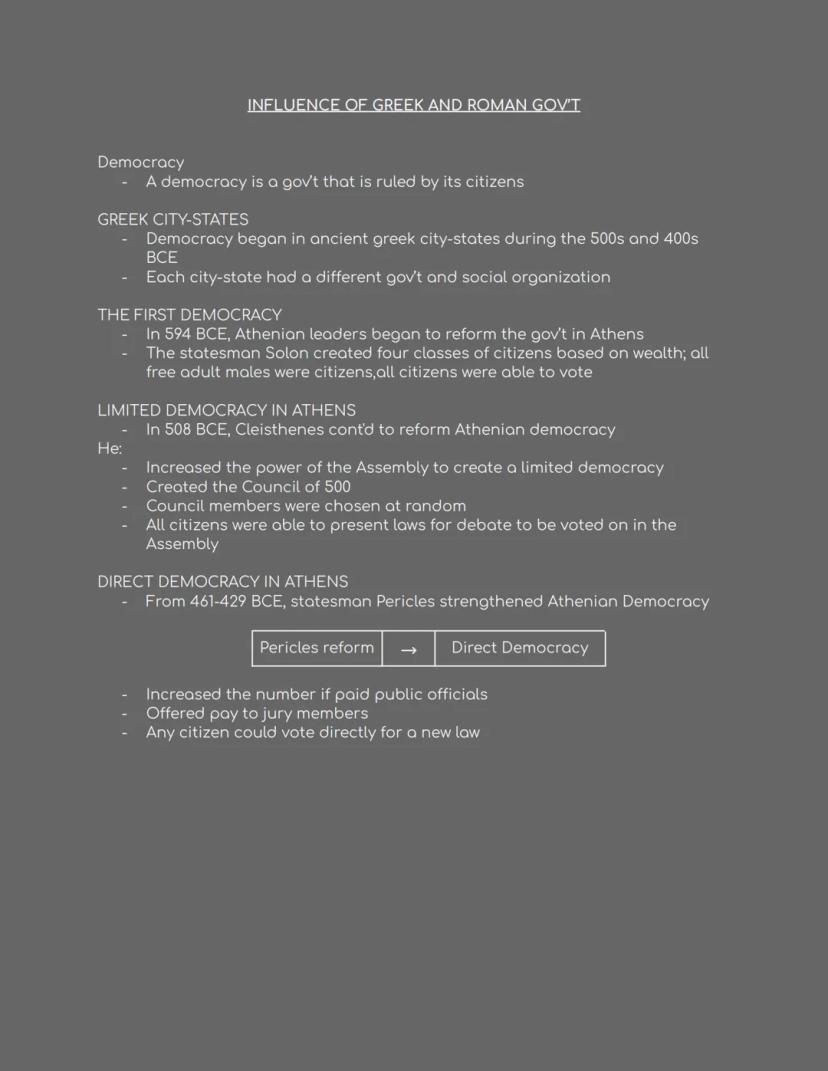
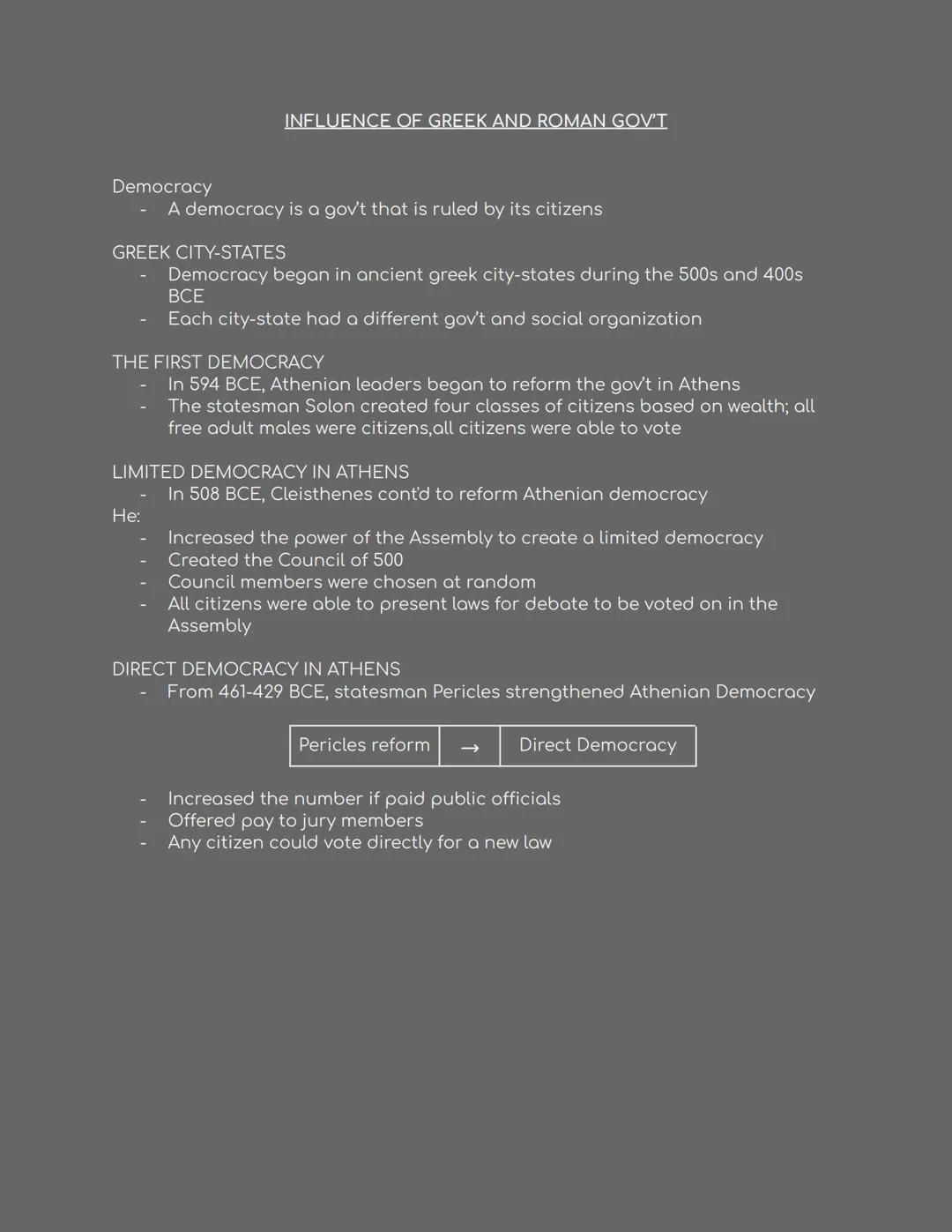
Ever wondered where the idea that citizens should have a say in government came from? It all started in ancient Greek city-states during the 500s-400s BCE. Each city-state had its own unique government, but Athens developed something revolutionary - democracy.
The journey toward Athenian democracy happened in stages. In 594 BCE, the statesman Solon created four classes of citizens based on wealth. While only free adult males could be citizens, all citizens gained the right to vote - a radical idea at the time!
Later, in 508 BCE, Cleisthenes expanded these reforms by increasing the power of the Assembly and creating the Council of 500, whose members were chosen randomly. This created a limited democracy where citizens could present laws for debate.
Think About It: What would it be like to live in a society where citizens could directly propose and vote on laws rather than electing representatives to do it for them?
The most dramatic changes came during the rule of Pericles , who transformed Athens into a direct democracy. He increased the number of paid public officials, offered payment to jury members, and established a system where any citizen could vote directly on new laws.
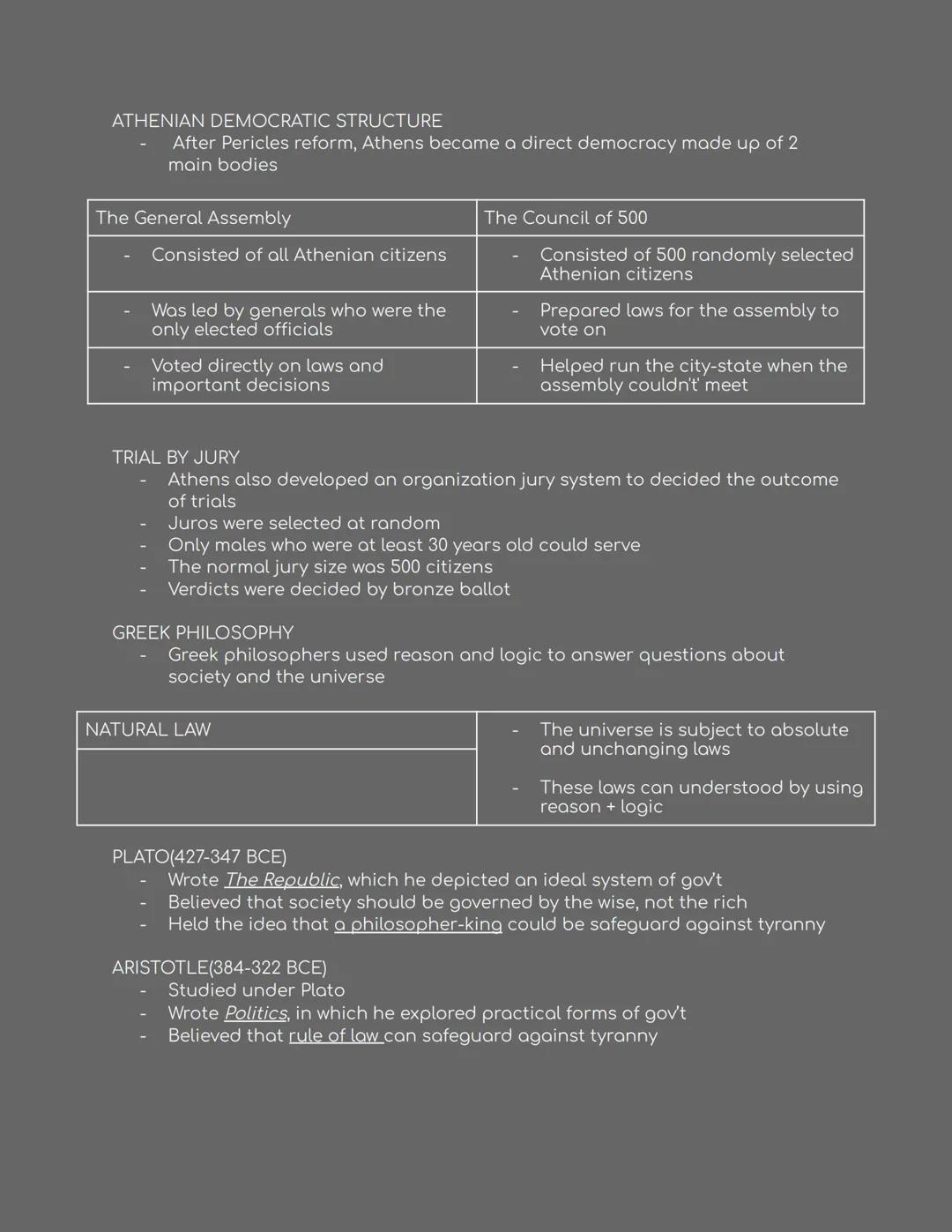
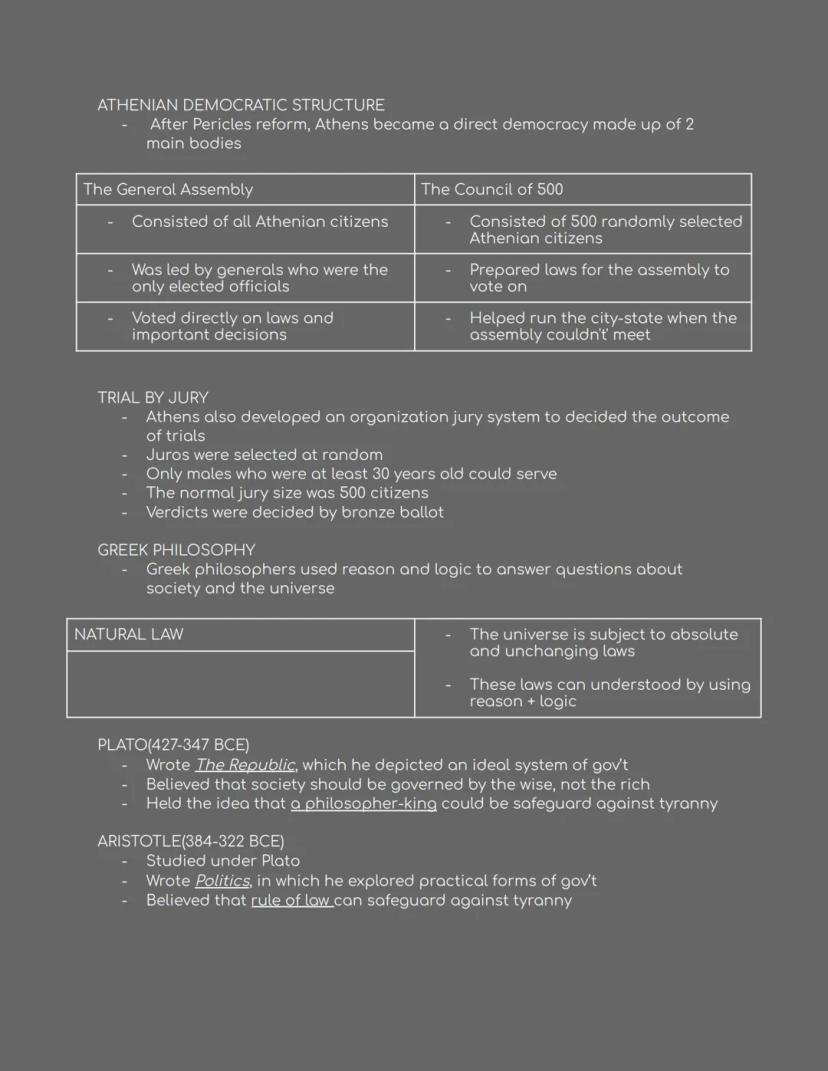
After Pericles' reforms, Athens operated as a direct democracy with two main governing bodies. The General Assembly included all Athenian citizens and voted directly on laws. Meanwhile, the Council of 500 (randomly selected citizens) prepared laws and helped run the city-state between assembly meetings.
Athens also developed an impressive jury system. Jurors were randomly selected from male citizens at least 30 years old. Most trials had 500 jurors who decided verdicts using bronze ballots. Can you imagine having 500 people decide your case?
Greek philosophers used reason and logic to understand the universe and society. They developed the concept of natural law - the idea that the universe follows absolute, unchanging laws that can be understood through reason.
Did You Know? The typical Athenian jury had 500 citizens - that's larger than most modern courtrooms!
Two philosophers had particularly influential ideas about government. Plato wrote "The Republic," arguing that society should be governed by the wise, not the rich. He believed a philosopher-king would protect against tyranny. His student Aristotle wrote "Politics," exploring practical forms of government and suggesting that rule of law could prevent tyranny.
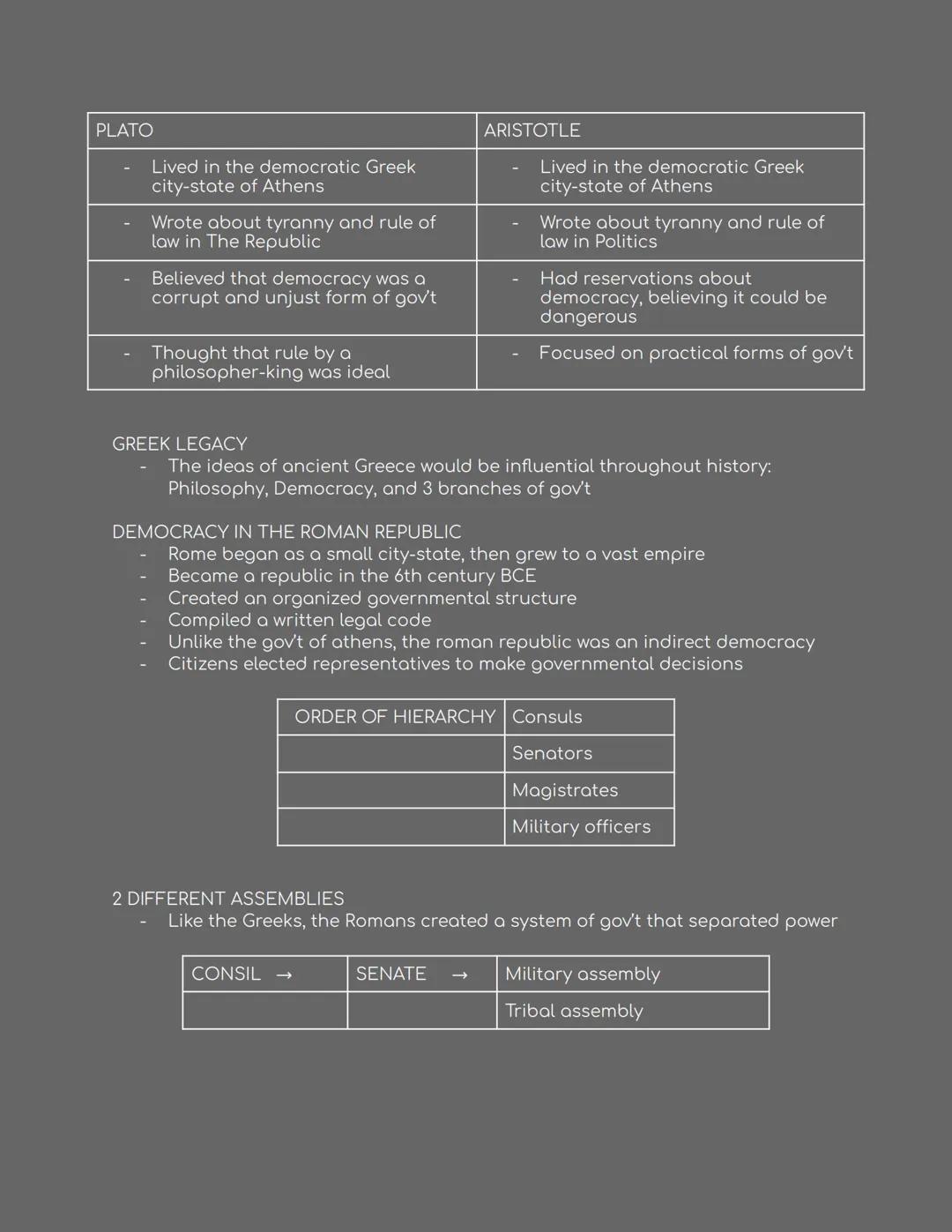
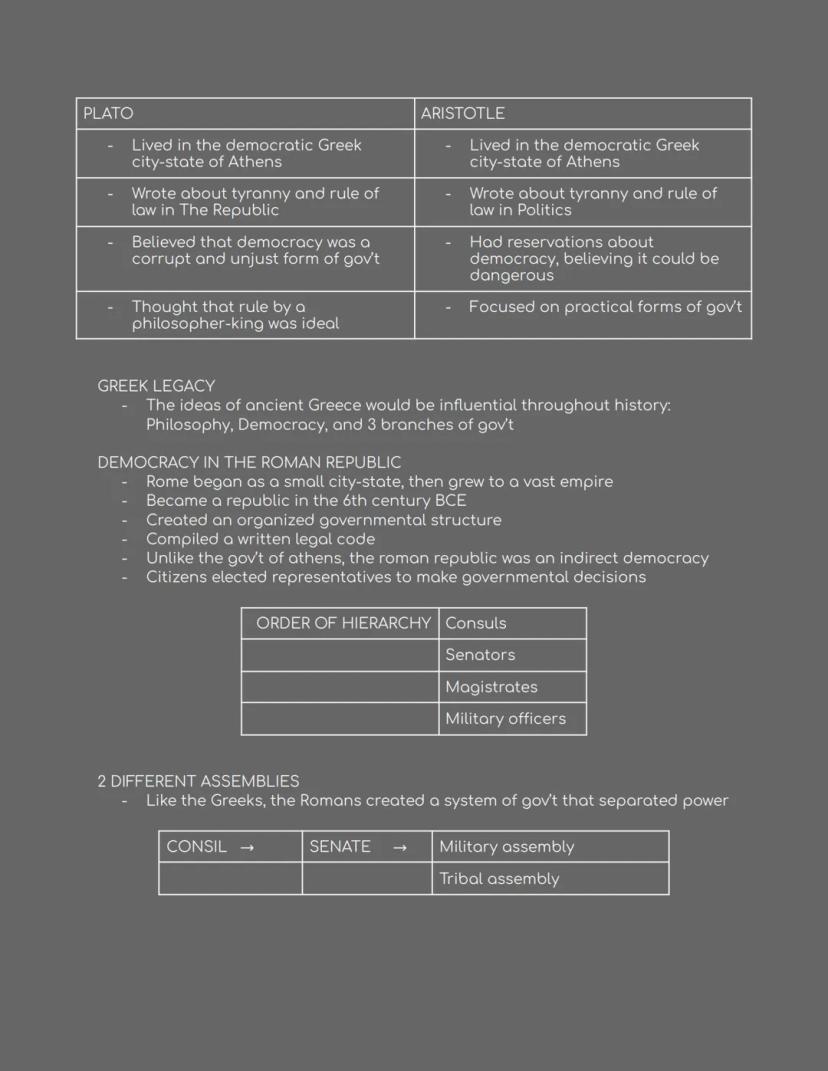
While Plato and Aristotle both lived in democratic Athens, they had different views on democracy. Plato considered democracy corrupt and unjust, preferring rule by a philosopher-king. Aristotle had reservations too, seeing democracy as potentially dangerous, but focused more on practical governmental forms.
The ideas from ancient Greece - philosophy, democracy, and the three branches of government - would influence societies for thousands of years. These concepts didn't die with the Greeks; they evolved as Rome rose to power.
Rome began as a small city-state before growing into a vast empire. After becoming a republic in the 6th century BCE, Rome created an organized government structure and a written legal code. Unlike Athens' direct democracy, the Roman Republic practiced indirect democracy where citizens elected representatives to make governmental decisions.
Connect the Dots: When you vote for student council representatives who make decisions for your school, you're participating in indirect democracy similar to the Roman model!
Like the Greeks, Romans separated power into different branches. They had two different assemblies (Military and Tribal), plus a Senate and Consuls, creating a hierarchy of power that prevented any single person or group from controlling everything.
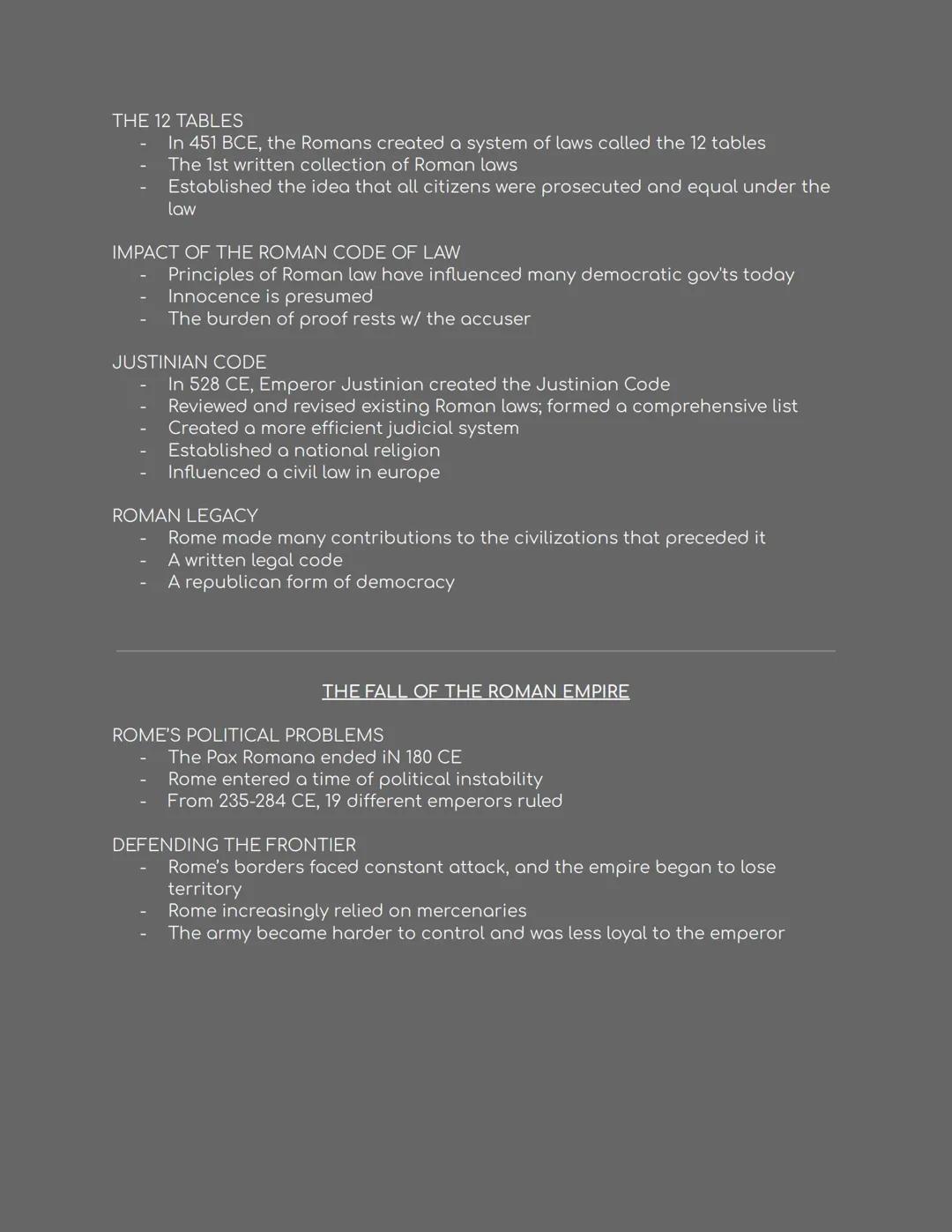
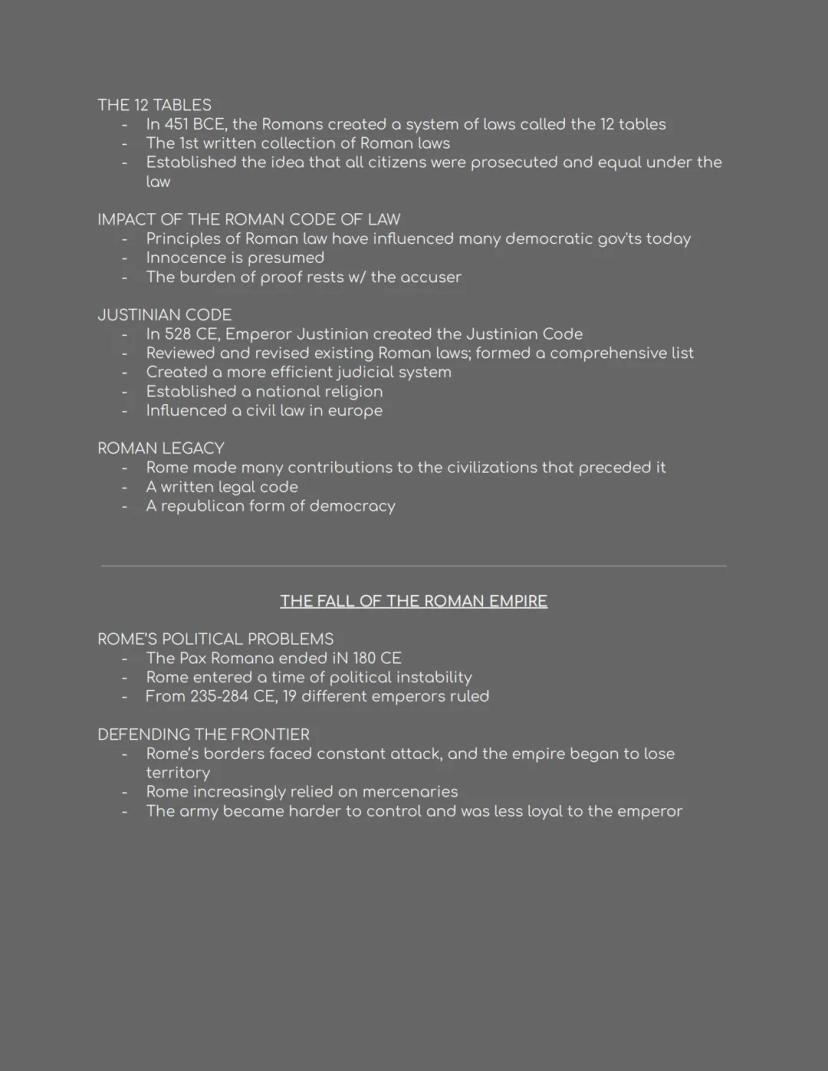
The Romans' most enduring contribution might be their legal system. In 451 BCE, they created the 12 Tables - the first written collection of Roman laws establishing that all citizens were equal under the law. These principles still influence modern democracies with ideas like presumption of innocence and placing the burden of proof on the accuser.
Later, in 528 CE, Emperor Justinian created the Justinian Code, which reviewed and revised existing Roman laws. This comprehensive legal system created a more efficient judicial process, established a national religion, and influenced civil law throughout Europe.
Despite these achievements, Rome eventually faced serious problems. The Pax Romana (Roman Peace) ended in 180 CE, leading to political instability. From 235-284 CE, nineteen different emperors ruled! At the same time, Rome's borders faced constant attacks, and the empire began losing territory.
Important Connection: Many principles in our modern legal system - like "innocent until proven guilty" - come directly from Roman law!
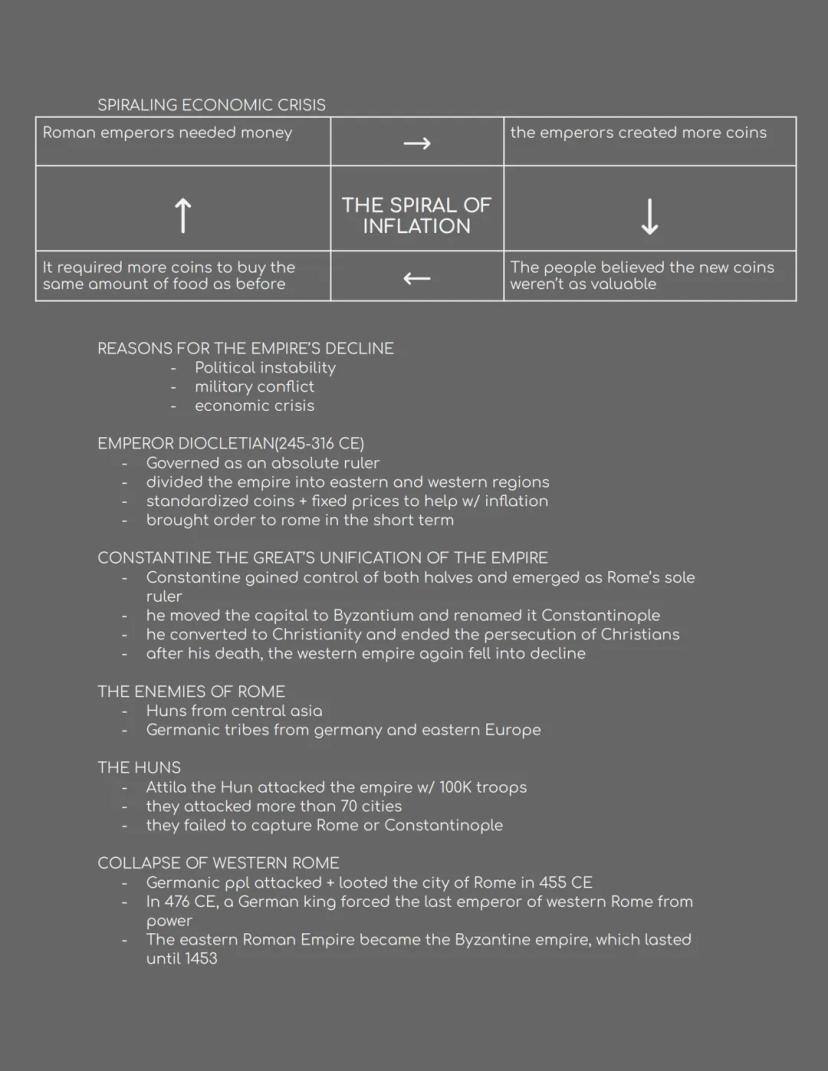
Economic troubles made everything worse. Roman emperors created more coins to fund their needs, but this led to a spiral of inflation. People believed the new coins weren't as valuable, so it took more coins to buy the same amount of food as before - a classic inflation cycle that weakened the empire from within.
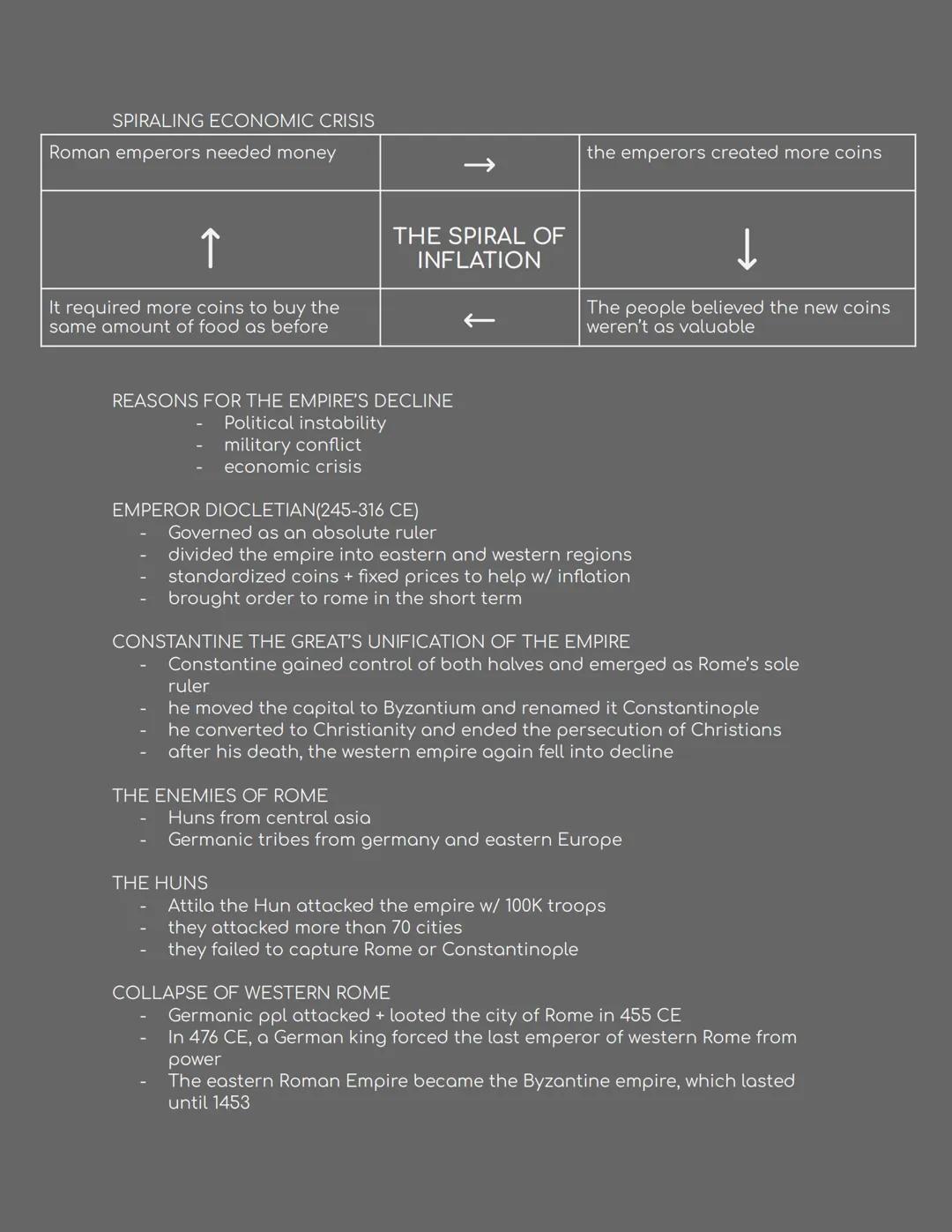
Rome's decline accelerated due to a perfect storm of problems: political instability, military conflicts, and economic crisis. Emperor Diocletian tried to fix things by governing as an absolute ruler, dividing the empire into eastern and western regions, standardizing coins, and fixing prices to control inflation. These measures helped temporarily but couldn't save Rome in the long run.
Later, Constantine the Great briefly unified both halves of the empire and made three crucial changes: moving the capital to Byzantium (renaming it Constantinople), converting to Christianity, and ending Christian persecution. After his death, however, the western empire again declined.
External threats delivered the final blows. The Huns from Central Asia, led by Attila, attacked with 100,000 troops and raided over 70 cities. Though they failed to capture Rome or Constantinople, they weakened Roman defenses. Then Germanic tribes moved in, looting Rome in 455 CE.
History Snapshot: In 476 CE, a Germanic king forced out the last western Roman emperor, marking the official end of the Western Roman Empire!
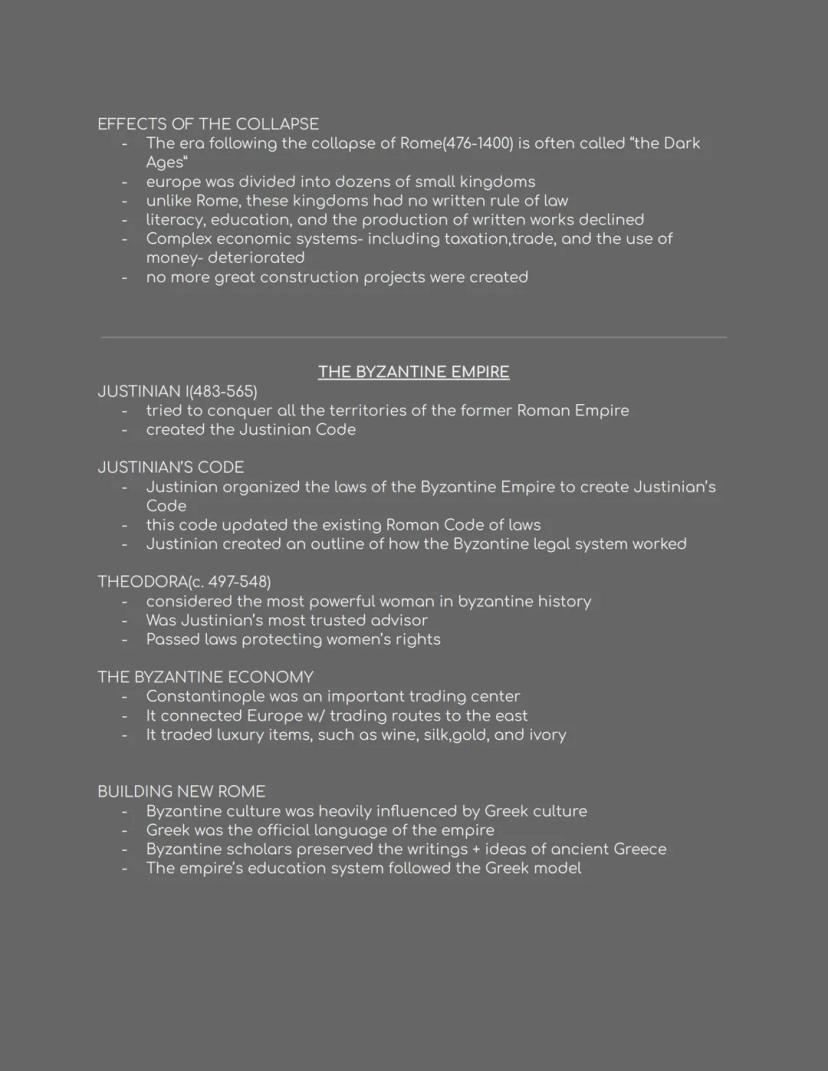
The eastern half continued as the Byzantine Empire until 1453, but western Europe entered what's often called the "Dark Ages." Europe fractured into dozens of small kingdoms without written laws, literacy declined, economic systems deteriorated, and great construction projects ceased.
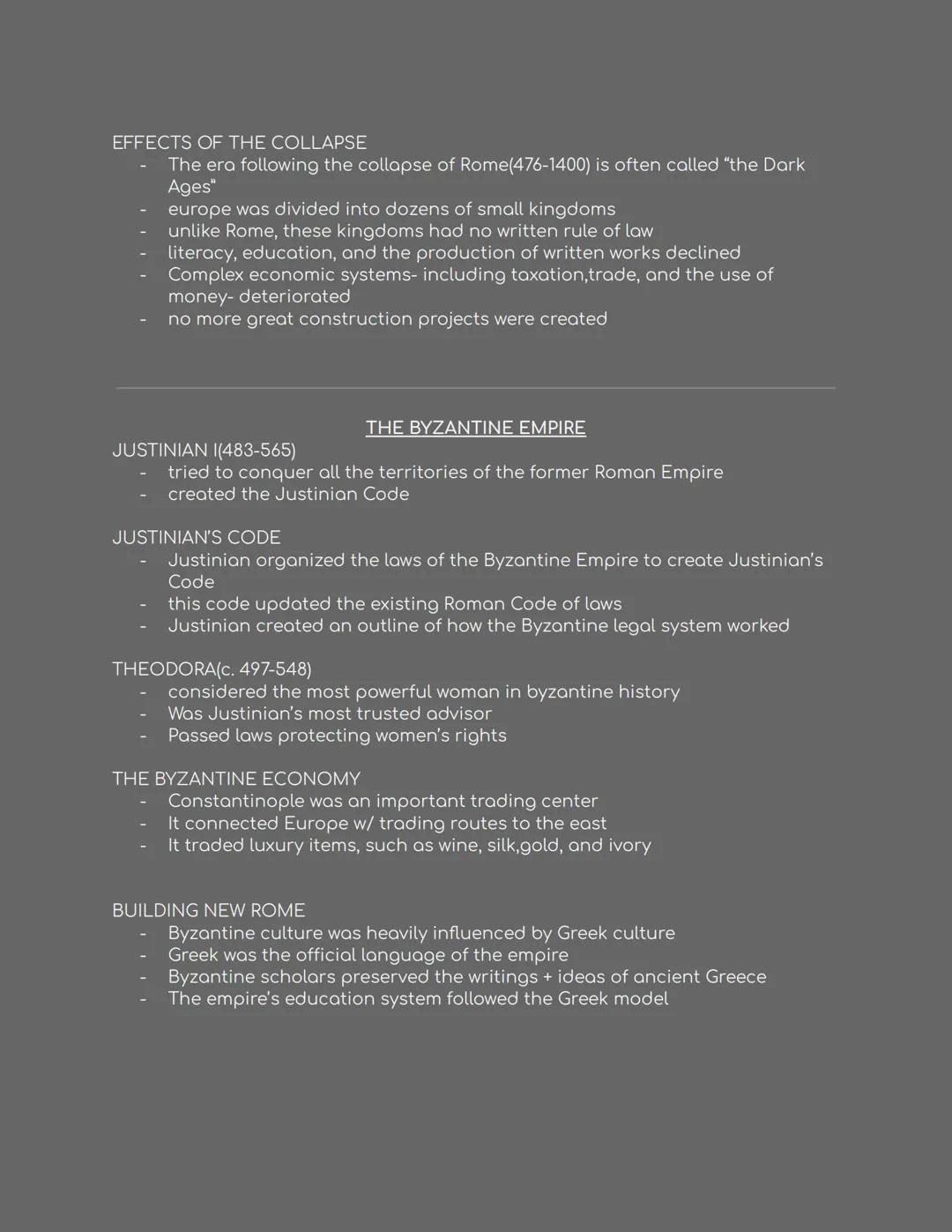
While Western Europe struggled after Rome's collapse, the Byzantine Empire thrived as the continuation of the Roman legacy in the East. Emperor Justinian I (483-565) attempted to reconquer all territories of the former Roman Empire and created his most lasting achievement - the Justinian Code.
This comprehensive legal code updated existing Roman laws and clearly outlined how the Byzantine legal system worked. Behind Justinian's success was his powerful wife Theodora , considered the most influential woman in Byzantine history. As his trusted advisor, she helped pass laws protecting women's rights.
The Byzantine economy prospered through trade. Constantinople's strategic location connected European trade routes with Eastern markets, allowing Byzantines to trade luxury items like wine, silk, gold, and ivory. This commercial success funded impressive cultural achievements.
Cultural Connection: When you study Greek philosophy or literature in school, you can thank Byzantine scholars who preserved these ancient texts while Western Europe lost much of this knowledge!
Byzantine culture was heavily influenced by Greek traditions. Greek became the empire's official language, and Byzantine scholars preserved important writings and ideas from ancient Greece. Their education system followed the Greek model, making the Byzantine Empire a crucial bridge between the ancient world and the Renaissance.
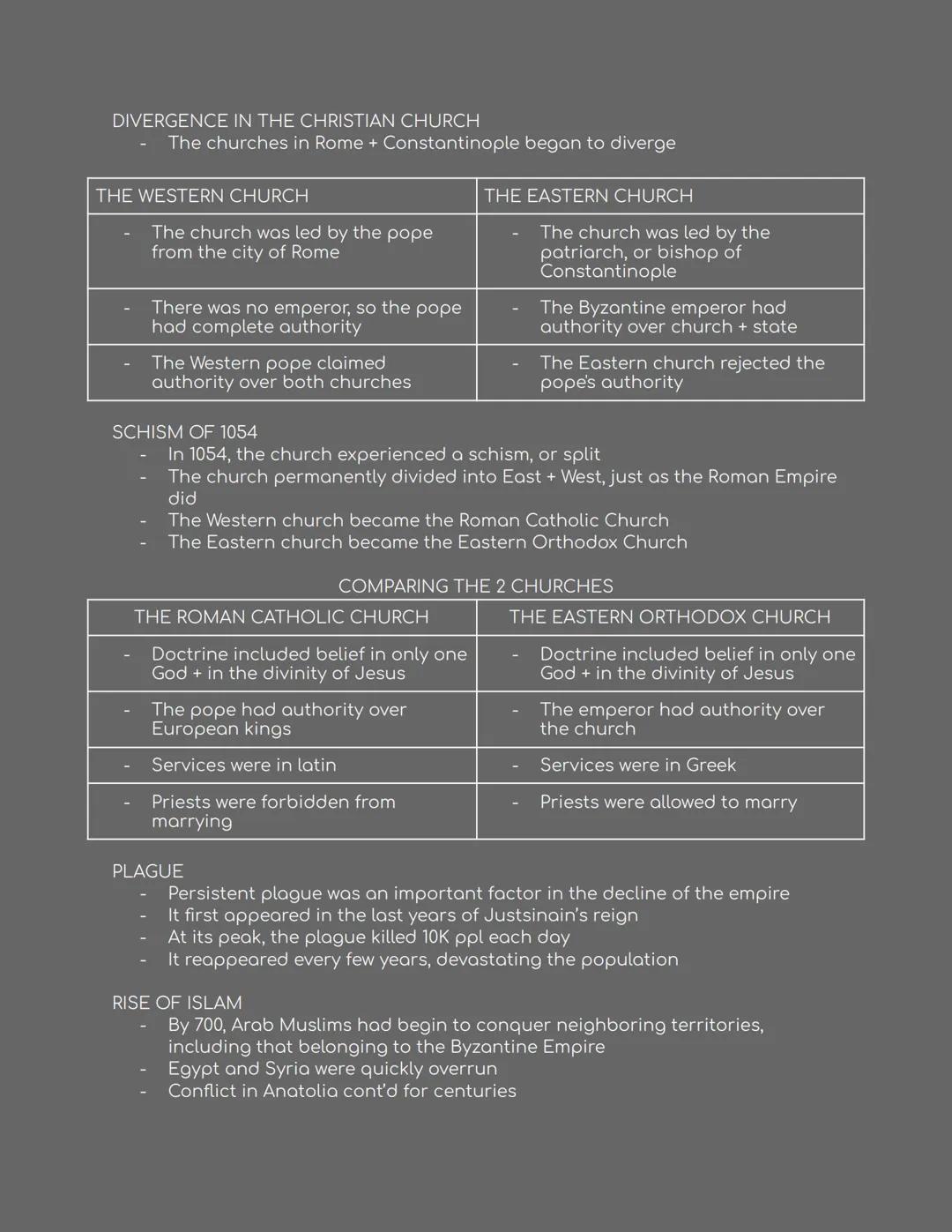
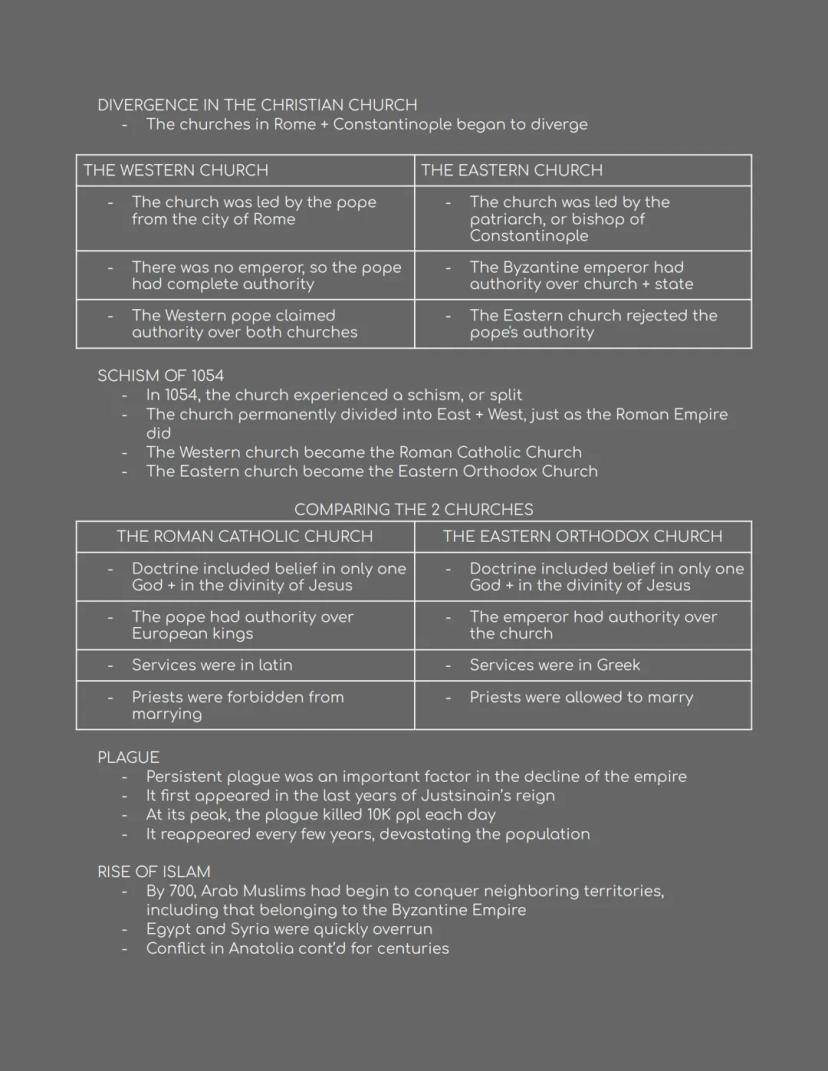
Christianity underwent a major transformation during the Byzantine era as the churches in Rome and Constantinople gradually grew apart. The Western church, led by the pope from Rome, had no emperor, giving the pope complete authority. Meanwhile, the Eastern church was led by the patriarch of Constantinople, with the Byzantine emperor having authority over both church and state.
This tension reached a breaking point in the Schism of 1054, when the church permanently divided into East and West. The Western church became the Roman Catholic Church, while the Eastern church became the Eastern Orthodox Church. Though they shared core beliefs like the divinity of Jesus, they differed in significant ways: Catholic services were in Latin while Orthodox used Greek; Catholic priests couldn't marry while Orthodox priests could.
Despite its cultural achievements, the Byzantine Empire faced serious challenges. A devastating plague first appeared during Justinian's reign, killing up to 10,000 people daily at its peak and reappearing every few years.
Did You Know? The Eastern Orthodox Church and Roman Catholic Church split in 1054 but only officially reconciled in 1965 - after 911 years of separation!
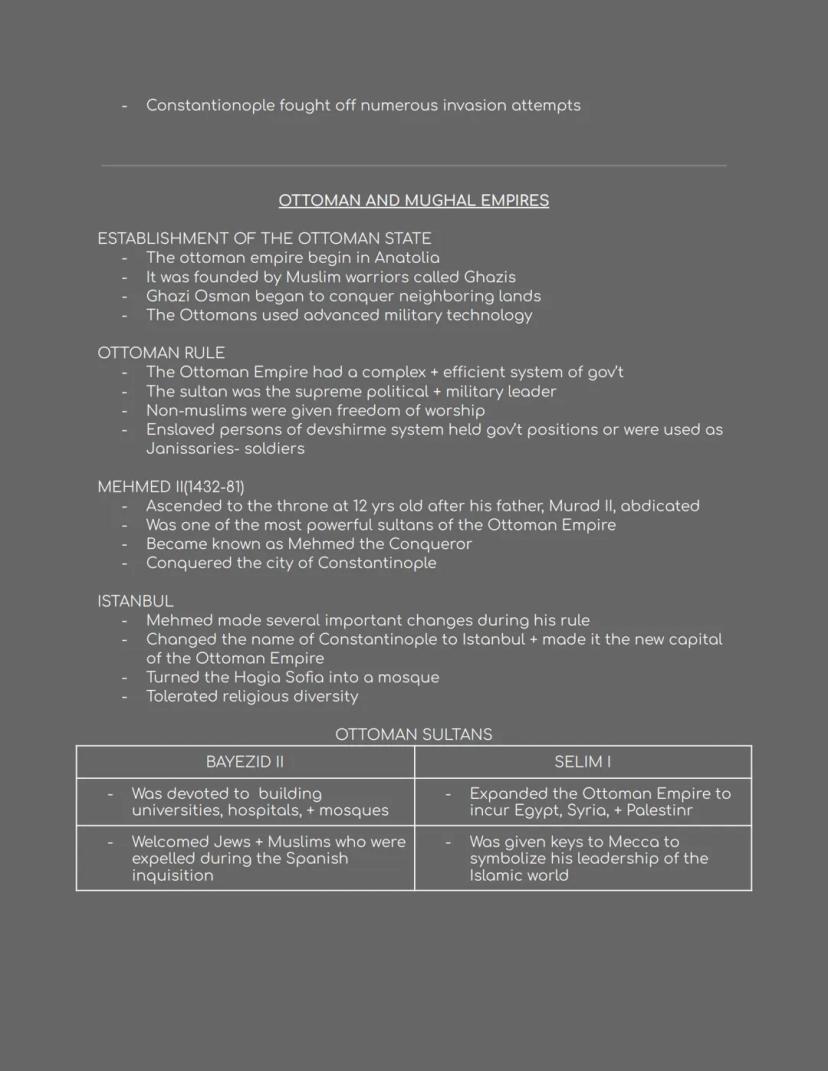
By 700 CE, Arab Muslims began conquering Byzantine territories, quickly overrunning Egypt and Syria. Conflict continued for centuries in Anatolia, though Constantinople successfully fought off numerous invasion attempts, demonstrating the empire's resilience despite these pressures.
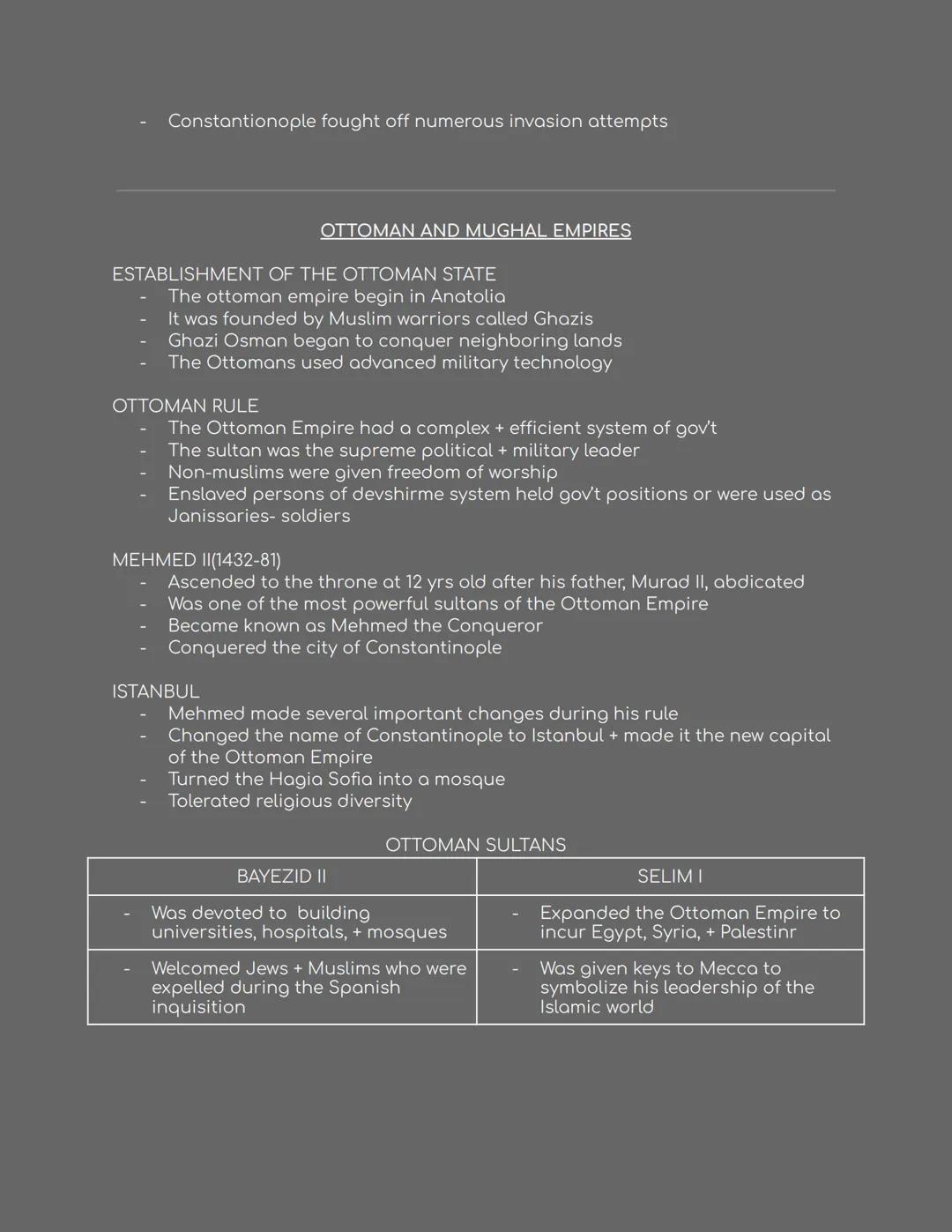
As Byzantine power declined, a new force emerged - the Ottoman Empire. Beginning in Anatolia (modern Turkey), this powerful state was founded by Muslim warriors called Ghazis. Under Ghazi Osman, they began conquering neighboring lands, using advanced military technology to build a formidable empire.
The Ottomans created a complex and efficient government system. The sultan served as the supreme political and military leader. Unlike many empires of the time, the Ottomans granted non-Muslims freedom of worship. Their unique devshirme system took enslaved people and either placed them in government positions or trained them as elite soldiers called Janissaries.
One of the greatest Ottoman rulers was Mehmed II (1432-81), who ascended to the throne at just 12 years old. Known as "Mehmed the Conqueror," he captured Constantinople in 1453, ending the Byzantine Empire after nearly 1,000 years.
Historical Turning Point: When Mehmed II conquered Constantinople in 1453, he ended the last remnant of the Roman Empire and transformed the city into Istanbul, the Ottoman capital!
After his conquest, Mehmed made significant changes. He renamed Constantinople to Istanbul and made it his new capital. He converted the Hagia Sofia (formerly a Byzantine church) into a mosque while maintaining religious tolerance. Later sultans like Bayezid II continued this tradition, welcoming Jews and Muslims expelled during the Spanish Inquisition.
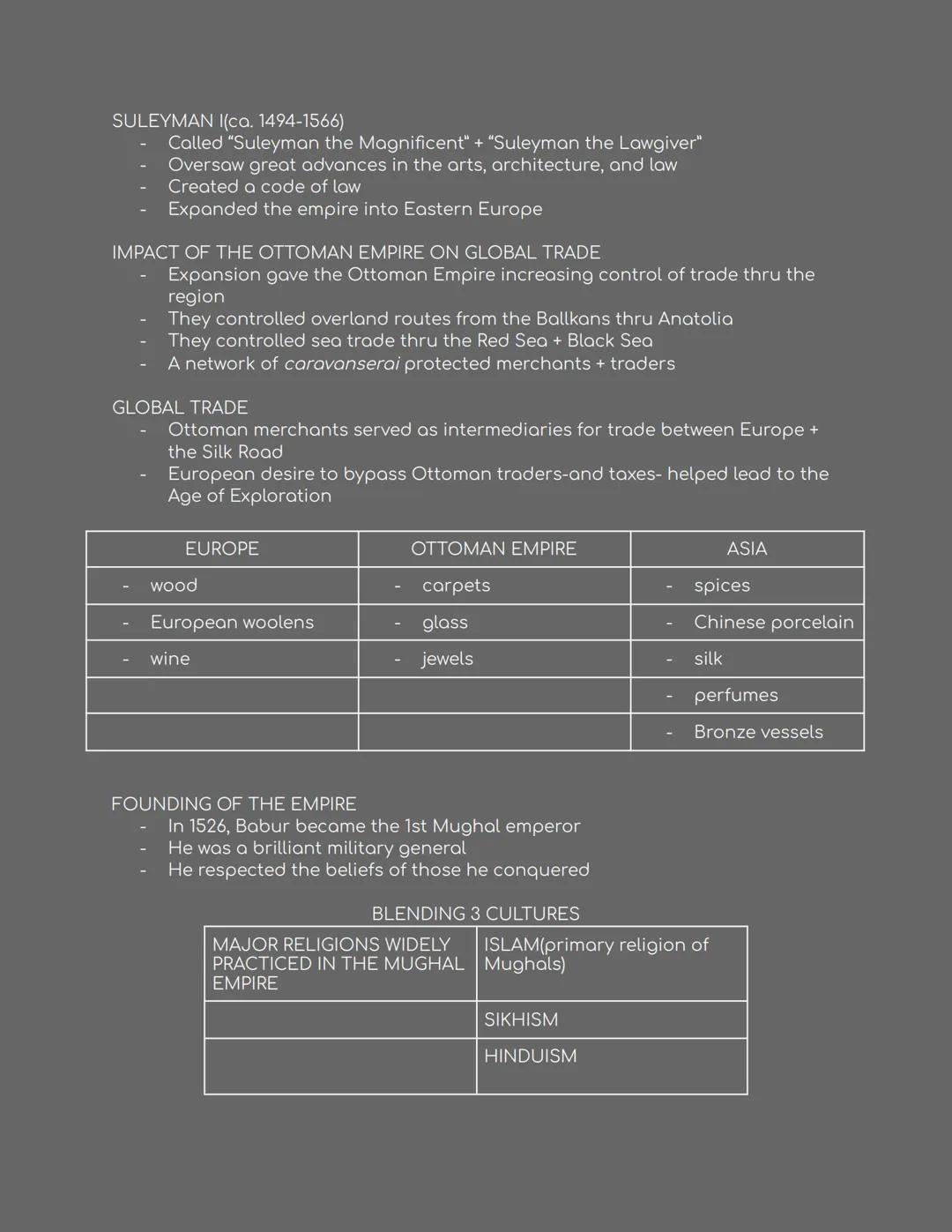
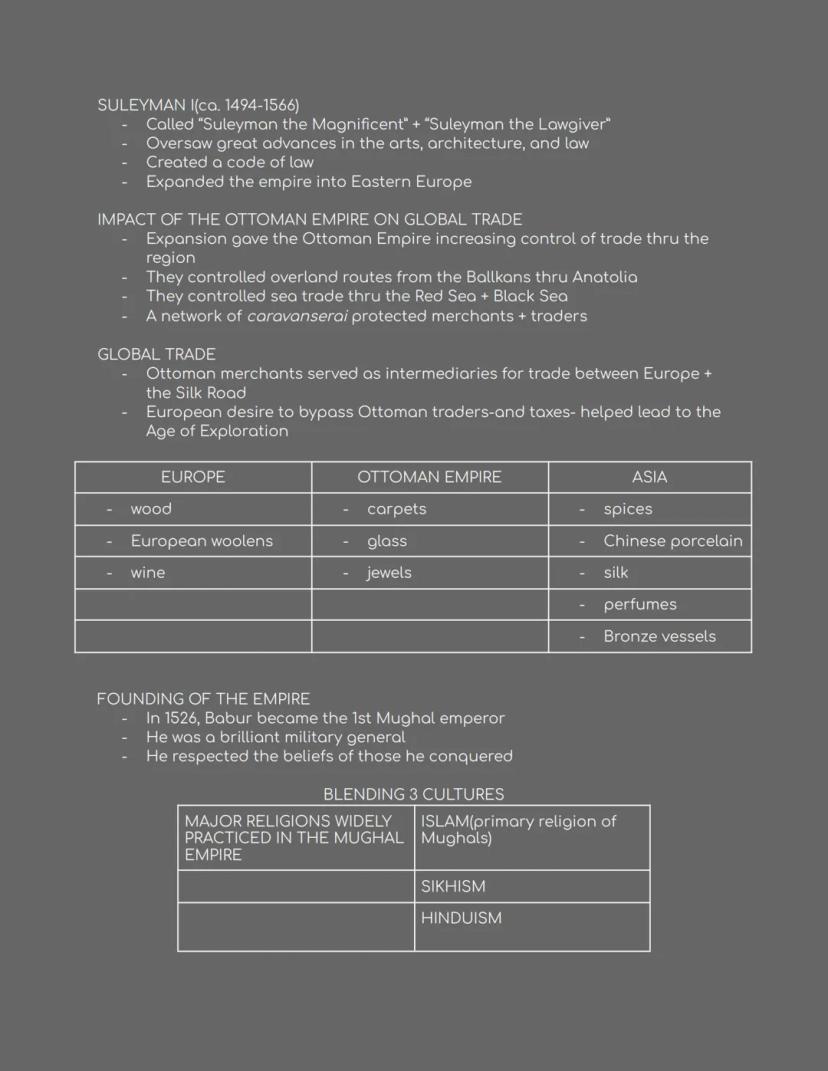
The Ottoman Empire reached its peak under Suleyman I , known as both "Suleyman the Magnificent" and "Suleyman the Lawgiver." During his reign, the empire made great advances in arts, architecture, and law. He created a comprehensive legal code and expanded Ottoman control into Eastern Europe.
The Ottomans significantly influenced global trade by controlling key routes. They dominated overland paths from the Balkans through Anatolia and sea trade through the Red and Black Seas. A network of caravanserais (protected rest stops) ensured merchant safety. Ottoman traders served as intermediaries between Europe and Asia, connecting European goods like wool, wine, and wood with Asian products including spices, silk, porcelain, and jewels.
Interestingly, European desire to bypass Ottoman trade taxes helped spark the Age of Exploration, as Europeans sought direct sea routes to Asia.
Global Connection: When Columbus sailed west looking for a route to India in 1492, he was partly motivated by Europeans' desire to avoid Ottoman trade taxes!
Meanwhile, in South Asia, another powerful Muslim empire emerged. In 1526, Babur became the first Mughal emperor. A brilliant military general, he respected the beliefs of those he conquered. The Mughal Empire blended three major cultural and religious traditions: Islam (the primary religion of the Mughals), Hinduism, and Sikhism.
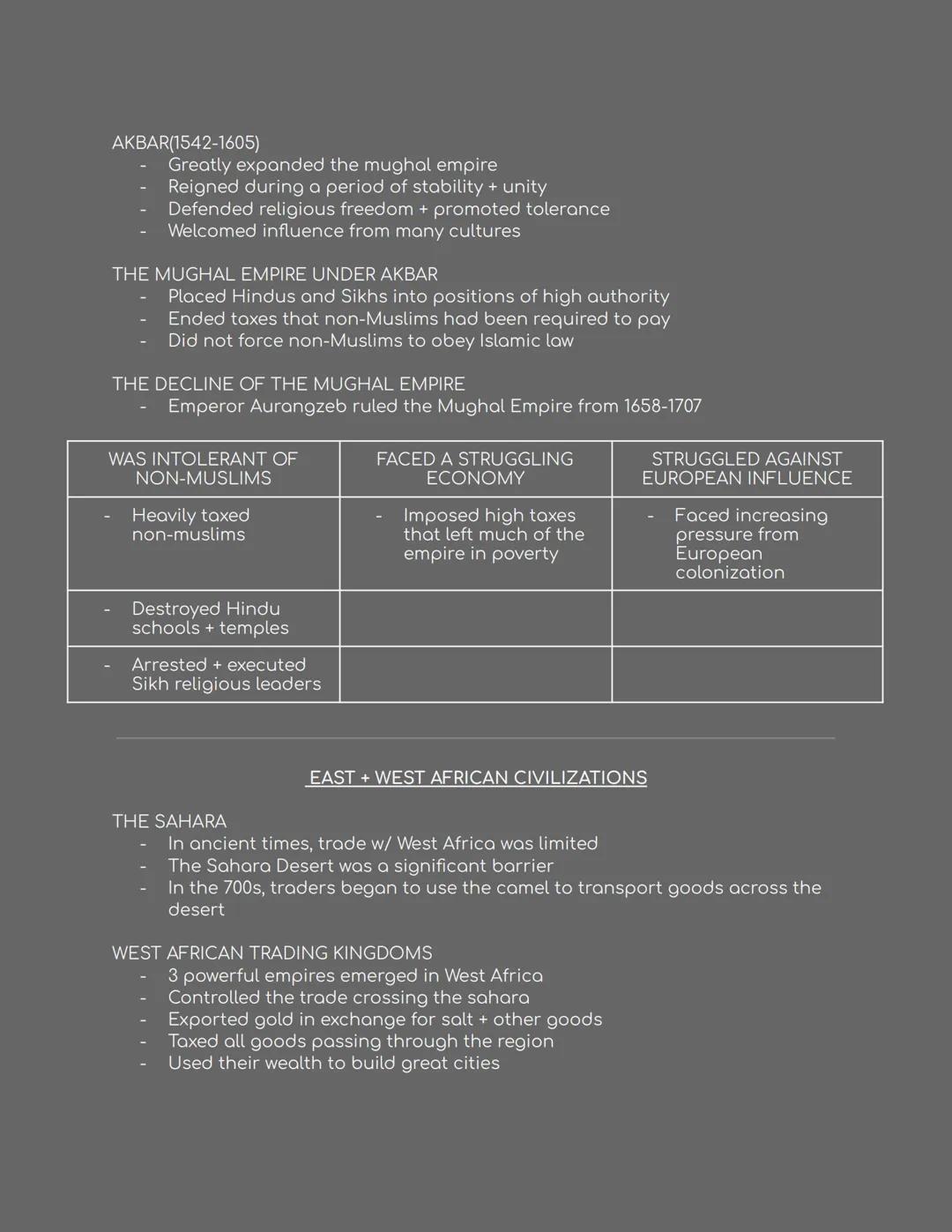
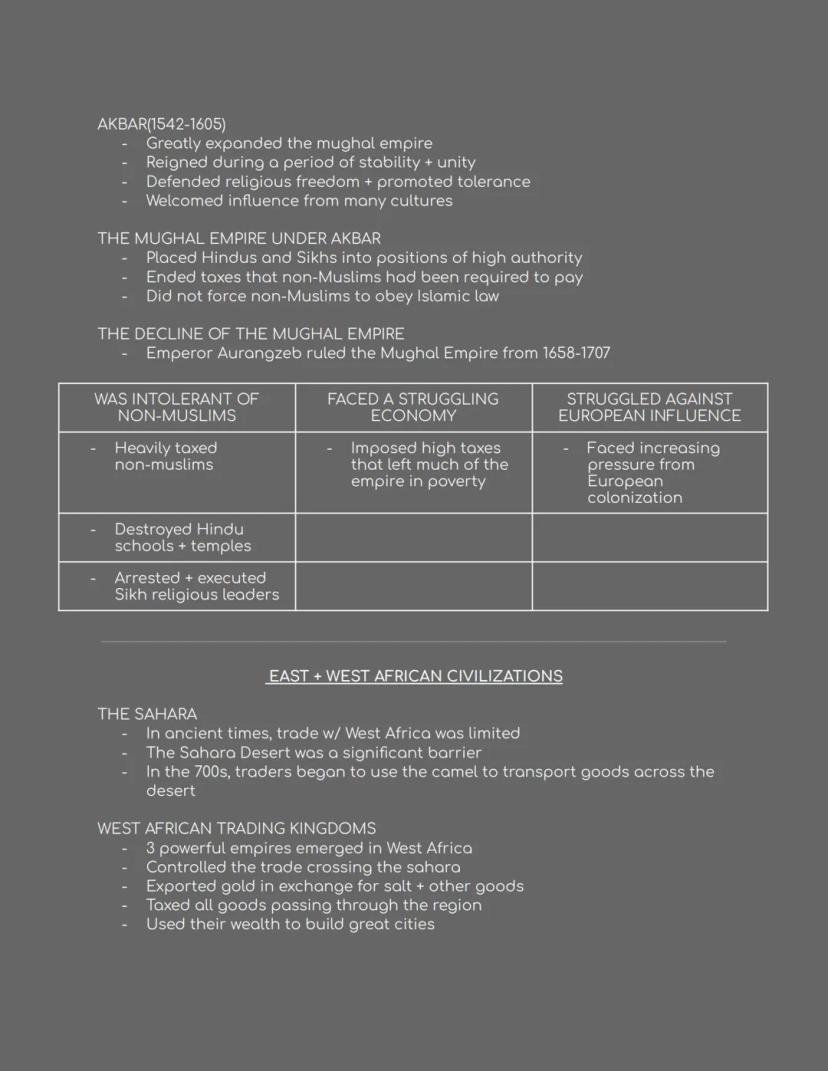
Under Emperor Akbar (1542-1605), the Mughal Empire experienced its golden age. Akbar greatly expanded the empire's territories while promoting remarkable religious tolerance. He placed Hindus and Sikhs in positions of high authority, ended special taxes on non-Muslims, and didn't force non-Muslims to follow Islamic law.
Unfortunately, this tolerance didn't last. Emperor Aurangzeb took a dramatically different approach. He heavily taxed non-Muslims, destroyed Hindu schools and temples, and executed Sikh religious leaders. Combined with a struggling economy and increasing European colonization, these policies contributed to the empire's decline.
Far to the west, powerful trading kingdoms emerged in West Africa. For centuries, the Sahara Desert limited trade with this region until merchants began using camels to cross it in the 700s. Three successive empires - Ghana, Mali, and Songhai - controlled this valuable trans-Saharan trade.
Resource Connection: When you use salt at dinner, you're enjoying a commodity so valuable in West Africa that it was traded for gold!
These West African empires exported gold in exchange for salt and other goods, taxed all passing merchandise, and used their immense wealth to build impressive cities. Ghana emerged as the first powerful kingdom in the 800s, with a powerful king controlling gold trade, a large bureaucracy, and a formidable army that dominated neighboring settlements.
Our AI companion is specifically built for the needs of students. Based on the millions of content pieces we have on the platform we can provide truly meaningful and relevant answers to students. But its not only about answers, the companion is even more about guiding students through their daily learning challenges, with personalised study plans, quizzes or content pieces in the chat and 100% personalisation based on the students skills and developments.
You can download the app in the Google Play Store and in the Apple App Store.
That's right! Enjoy free access to study content, connect with fellow students, and get instant help – all at your fingertips.
App Store
Google Play
The app is very easy to use and well designed. I have found everything I was looking for so far and have been able to learn a lot from the presentations! I will definitely use the app for a class assignment! And of course it also helps a lot as an inspiration.
Stefan S
iOS user
This app is really great. There are so many study notes and help [...]. My problem subject is French, for example, and the app has so many options for help. Thanks to this app, I have improved my French. I would recommend it to anyone.
Samantha Klich
Android user
Wow, I am really amazed. I just tried the app because I've seen it advertised many times and was absolutely stunned. This app is THE HELP you want for school and above all, it offers so many things, such as workouts and fact sheets, which have been VERY helpful to me personally.
Anna
iOS user
I think it’s very much worth it and you’ll end up using it a lot once you get the hang of it and even after looking at others notes you can still ask your Artificial intelligence buddy the question and ask to simplify it if you still don’t get it!!! In the end I think it’s worth it 😊👍 ⚠️Also DID I MENTION ITS FREEE YOU DON’T HAVE TO PAY FOR ANYTHING AND STILL GET YOUR GRADES IN PERFECTLY❗️❗️⚠️
Thomas R
iOS user
Knowunity is the BEST app I’ve used in a minute. This is not an ai review or anything this is genuinely coming from a 7th grade student (I know 2011 im young) but dude this app is a 10/10 i have maintained a 3.8 gpa and have plenty of time for gaming. I love it and my mom is just happy I got good grades
Brad T
Android user
Not only did it help me find the answer but it also showed me alternative ways to solve it. I was horrible in math and science but now I have an a in both subjects. Thanks for the help🤍🤍
David K
iOS user
The app's just great! All I have to do is enter the topic in the search bar and I get the response real fast. I don't have to watch 10 YouTube videos to understand something, so I'm saving my time. Highly recommended!
Sudenaz Ocak
Android user
In school I was really bad at maths but thanks to the app, I am doing better now. I am so grateful that you made the app.
Greenlight Bonnie
Android user
I found this app a couple years ago and it has only gotten better since then. I really love it because it can help with written questions and photo questions. Also, it can find study guides that other people have made as well as flashcard sets and practice tests. The free version is also amazing for students who might not be able to afford it. Would 100% recommend
Aubrey
iOS user
Best app if you're in Highschool or Junior high. I have been using this app for 2 school years and it's the best, it's good if you don't have anyone to help you with school work.😋🩷🎀
Marco B
iOS user
THE QUIZES AND FLASHCARDS ARE SO USEFUL AND I LOVE Knowunity AI. IT ALSO IS LITREALLY LIKE CHATGPT BUT SMARTER!! HELPED ME WITH MY MASCARA PROBLEMS TOO!! AS WELL AS MY REAL SUBJECTS ! DUHHH 😍😁😲🤑💗✨🎀😮
Elisha
iOS user
This app is phenomenal down to the correct info and the various topics you can study! I greatly recommend it for people who struggle with procrastination and those who need homework help. It has been perfectly accurate for world 1 history as far as I’ve seen! Geometry too!
Paul T
iOS user
The app is very easy to use and well designed. I have found everything I was looking for so far and have been able to learn a lot from the presentations! I will definitely use the app for a class assignment! And of course it also helps a lot as an inspiration.
Stefan S
iOS user
This app is really great. There are so many study notes and help [...]. My problem subject is French, for example, and the app has so many options for help. Thanks to this app, I have improved my French. I would recommend it to anyone.
Samantha Klich
Android user
Wow, I am really amazed. I just tried the app because I've seen it advertised many times and was absolutely stunned. This app is THE HELP you want for school and above all, it offers so many things, such as workouts and fact sheets, which have been VERY helpful to me personally.
Anna
iOS user
I think it’s very much worth it and you’ll end up using it a lot once you get the hang of it and even after looking at others notes you can still ask your Artificial intelligence buddy the question and ask to simplify it if you still don’t get it!!! In the end I think it’s worth it 😊👍 ⚠️Also DID I MENTION ITS FREEE YOU DON’T HAVE TO PAY FOR ANYTHING AND STILL GET YOUR GRADES IN PERFECTLY❗️❗️⚠️
Thomas R
iOS user
Knowunity is the BEST app I’ve used in a minute. This is not an ai review or anything this is genuinely coming from a 7th grade student (I know 2011 im young) but dude this app is a 10/10 i have maintained a 3.8 gpa and have plenty of time for gaming. I love it and my mom is just happy I got good grades
Brad T
Android user
Not only did it help me find the answer but it also showed me alternative ways to solve it. I was horrible in math and science but now I have an a in both subjects. Thanks for the help🤍🤍
David K
iOS user
The app's just great! All I have to do is enter the topic in the search bar and I get the response real fast. I don't have to watch 10 YouTube videos to understand something, so I'm saving my time. Highly recommended!
Sudenaz Ocak
Android user
In school I was really bad at maths but thanks to the app, I am doing better now. I am so grateful that you made the app.
Greenlight Bonnie
Android user
I found this app a couple years ago and it has only gotten better since then. I really love it because it can help with written questions and photo questions. Also, it can find study guides that other people have made as well as flashcard sets and practice tests. The free version is also amazing for students who might not be able to afford it. Would 100% recommend
Aubrey
iOS user
Best app if you're in Highschool or Junior high. I have been using this app for 2 school years and it's the best, it's good if you don't have anyone to help you with school work.😋🩷🎀
Marco B
iOS user
THE QUIZES AND FLASHCARDS ARE SO USEFUL AND I LOVE Knowunity AI. IT ALSO IS LITREALLY LIKE CHATGPT BUT SMARTER!! HELPED ME WITH MY MASCARA PROBLEMS TOO!! AS WELL AS MY REAL SUBJECTS ! DUHHH 😍😁😲🤑💗✨🎀😮
Elisha
iOS user
This app is phenomenal down to the correct info and the various topics you can study! I greatly recommend it for people who struggle with procrastination and those who need homework help. It has been perfectly accurate for world 1 history as far as I’ve seen! Geometry too!
Paul T
iOS user
Dive into the foundations of modern government and society as we explore the legacy of ancient civilizations. From the birthplace of democracy in Greece to the structured governance of Rome and the powerful empires that followed, these societies created systems... Show more
Access to all documents
Improve your grades
Join milions of students
Ever wondered where the idea that citizens should have a say in government came from? It all started in ancient Greek city-states during the 500s-400s BCE. Each city-state had its own unique government, but Athens developed something revolutionary - democracy.
The journey toward Athenian democracy happened in stages. In 594 BCE, the statesman Solon created four classes of citizens based on wealth. While only free adult males could be citizens, all citizens gained the right to vote - a radical idea at the time!
Later, in 508 BCE, Cleisthenes expanded these reforms by increasing the power of the Assembly and creating the Council of 500, whose members were chosen randomly. This created a limited democracy where citizens could present laws for debate.
Think About It: What would it be like to live in a society where citizens could directly propose and vote on laws rather than electing representatives to do it for them?
The most dramatic changes came during the rule of Pericles , who transformed Athens into a direct democracy. He increased the number of paid public officials, offered payment to jury members, and established a system where any citizen could vote directly on new laws.
Access to all documents
Improve your grades
Join milions of students
After Pericles' reforms, Athens operated as a direct democracy with two main governing bodies. The General Assembly included all Athenian citizens and voted directly on laws. Meanwhile, the Council of 500 (randomly selected citizens) prepared laws and helped run the city-state between assembly meetings.
Athens also developed an impressive jury system. Jurors were randomly selected from male citizens at least 30 years old. Most trials had 500 jurors who decided verdicts using bronze ballots. Can you imagine having 500 people decide your case?
Greek philosophers used reason and logic to understand the universe and society. They developed the concept of natural law - the idea that the universe follows absolute, unchanging laws that can be understood through reason.
Did You Know? The typical Athenian jury had 500 citizens - that's larger than most modern courtrooms!
Two philosophers had particularly influential ideas about government. Plato wrote "The Republic," arguing that society should be governed by the wise, not the rich. He believed a philosopher-king would protect against tyranny. His student Aristotle wrote "Politics," exploring practical forms of government and suggesting that rule of law could prevent tyranny.
Access to all documents
Improve your grades
Join milions of students
While Plato and Aristotle both lived in democratic Athens, they had different views on democracy. Plato considered democracy corrupt and unjust, preferring rule by a philosopher-king. Aristotle had reservations too, seeing democracy as potentially dangerous, but focused more on practical governmental forms.
The ideas from ancient Greece - philosophy, democracy, and the three branches of government - would influence societies for thousands of years. These concepts didn't die with the Greeks; they evolved as Rome rose to power.
Rome began as a small city-state before growing into a vast empire. After becoming a republic in the 6th century BCE, Rome created an organized government structure and a written legal code. Unlike Athens' direct democracy, the Roman Republic practiced indirect democracy where citizens elected representatives to make governmental decisions.
Connect the Dots: When you vote for student council representatives who make decisions for your school, you're participating in indirect democracy similar to the Roman model!
Like the Greeks, Romans separated power into different branches. They had two different assemblies (Military and Tribal), plus a Senate and Consuls, creating a hierarchy of power that prevented any single person or group from controlling everything.
Access to all documents
Improve your grades
Join milions of students
The Romans' most enduring contribution might be their legal system. In 451 BCE, they created the 12 Tables - the first written collection of Roman laws establishing that all citizens were equal under the law. These principles still influence modern democracies with ideas like presumption of innocence and placing the burden of proof on the accuser.
Later, in 528 CE, Emperor Justinian created the Justinian Code, which reviewed and revised existing Roman laws. This comprehensive legal system created a more efficient judicial process, established a national religion, and influenced civil law throughout Europe.
Despite these achievements, Rome eventually faced serious problems. The Pax Romana (Roman Peace) ended in 180 CE, leading to political instability. From 235-284 CE, nineteen different emperors ruled! At the same time, Rome's borders faced constant attacks, and the empire began losing territory.
Important Connection: Many principles in our modern legal system - like "innocent until proven guilty" - come directly from Roman law!
Economic troubles made everything worse. Roman emperors created more coins to fund their needs, but this led to a spiral of inflation. People believed the new coins weren't as valuable, so it took more coins to buy the same amount of food as before - a classic inflation cycle that weakened the empire from within.
Access to all documents
Improve your grades
Join milions of students
Rome's decline accelerated due to a perfect storm of problems: political instability, military conflicts, and economic crisis. Emperor Diocletian tried to fix things by governing as an absolute ruler, dividing the empire into eastern and western regions, standardizing coins, and fixing prices to control inflation. These measures helped temporarily but couldn't save Rome in the long run.
Later, Constantine the Great briefly unified both halves of the empire and made three crucial changes: moving the capital to Byzantium (renaming it Constantinople), converting to Christianity, and ending Christian persecution. After his death, however, the western empire again declined.
External threats delivered the final blows. The Huns from Central Asia, led by Attila, attacked with 100,000 troops and raided over 70 cities. Though they failed to capture Rome or Constantinople, they weakened Roman defenses. Then Germanic tribes moved in, looting Rome in 455 CE.
History Snapshot: In 476 CE, a Germanic king forced out the last western Roman emperor, marking the official end of the Western Roman Empire!
The eastern half continued as the Byzantine Empire until 1453, but western Europe entered what's often called the "Dark Ages." Europe fractured into dozens of small kingdoms without written laws, literacy declined, economic systems deteriorated, and great construction projects ceased.
Access to all documents
Improve your grades
Join milions of students
While Western Europe struggled after Rome's collapse, the Byzantine Empire thrived as the continuation of the Roman legacy in the East. Emperor Justinian I (483-565) attempted to reconquer all territories of the former Roman Empire and created his most lasting achievement - the Justinian Code.
This comprehensive legal code updated existing Roman laws and clearly outlined how the Byzantine legal system worked. Behind Justinian's success was his powerful wife Theodora , considered the most influential woman in Byzantine history. As his trusted advisor, she helped pass laws protecting women's rights.
The Byzantine economy prospered through trade. Constantinople's strategic location connected European trade routes with Eastern markets, allowing Byzantines to trade luxury items like wine, silk, gold, and ivory. This commercial success funded impressive cultural achievements.
Cultural Connection: When you study Greek philosophy or literature in school, you can thank Byzantine scholars who preserved these ancient texts while Western Europe lost much of this knowledge!
Byzantine culture was heavily influenced by Greek traditions. Greek became the empire's official language, and Byzantine scholars preserved important writings and ideas from ancient Greece. Their education system followed the Greek model, making the Byzantine Empire a crucial bridge between the ancient world and the Renaissance.
Access to all documents
Improve your grades
Join milions of students
Christianity underwent a major transformation during the Byzantine era as the churches in Rome and Constantinople gradually grew apart. The Western church, led by the pope from Rome, had no emperor, giving the pope complete authority. Meanwhile, the Eastern church was led by the patriarch of Constantinople, with the Byzantine emperor having authority over both church and state.
This tension reached a breaking point in the Schism of 1054, when the church permanently divided into East and West. The Western church became the Roman Catholic Church, while the Eastern church became the Eastern Orthodox Church. Though they shared core beliefs like the divinity of Jesus, they differed in significant ways: Catholic services were in Latin while Orthodox used Greek; Catholic priests couldn't marry while Orthodox priests could.
Despite its cultural achievements, the Byzantine Empire faced serious challenges. A devastating plague first appeared during Justinian's reign, killing up to 10,000 people daily at its peak and reappearing every few years.
Did You Know? The Eastern Orthodox Church and Roman Catholic Church split in 1054 but only officially reconciled in 1965 - after 911 years of separation!
By 700 CE, Arab Muslims began conquering Byzantine territories, quickly overrunning Egypt and Syria. Conflict continued for centuries in Anatolia, though Constantinople successfully fought off numerous invasion attempts, demonstrating the empire's resilience despite these pressures.
Access to all documents
Improve your grades
Join milions of students
As Byzantine power declined, a new force emerged - the Ottoman Empire. Beginning in Anatolia (modern Turkey), this powerful state was founded by Muslim warriors called Ghazis. Under Ghazi Osman, they began conquering neighboring lands, using advanced military technology to build a formidable empire.
The Ottomans created a complex and efficient government system. The sultan served as the supreme political and military leader. Unlike many empires of the time, the Ottomans granted non-Muslims freedom of worship. Their unique devshirme system took enslaved people and either placed them in government positions or trained them as elite soldiers called Janissaries.
One of the greatest Ottoman rulers was Mehmed II (1432-81), who ascended to the throne at just 12 years old. Known as "Mehmed the Conqueror," he captured Constantinople in 1453, ending the Byzantine Empire after nearly 1,000 years.
Historical Turning Point: When Mehmed II conquered Constantinople in 1453, he ended the last remnant of the Roman Empire and transformed the city into Istanbul, the Ottoman capital!
After his conquest, Mehmed made significant changes. He renamed Constantinople to Istanbul and made it his new capital. He converted the Hagia Sofia (formerly a Byzantine church) into a mosque while maintaining religious tolerance. Later sultans like Bayezid II continued this tradition, welcoming Jews and Muslims expelled during the Spanish Inquisition.
Access to all documents
Improve your grades
Join milions of students
The Ottoman Empire reached its peak under Suleyman I , known as both "Suleyman the Magnificent" and "Suleyman the Lawgiver." During his reign, the empire made great advances in arts, architecture, and law. He created a comprehensive legal code and expanded Ottoman control into Eastern Europe.
The Ottomans significantly influenced global trade by controlling key routes. They dominated overland paths from the Balkans through Anatolia and sea trade through the Red and Black Seas. A network of caravanserais (protected rest stops) ensured merchant safety. Ottoman traders served as intermediaries between Europe and Asia, connecting European goods like wool, wine, and wood with Asian products including spices, silk, porcelain, and jewels.
Interestingly, European desire to bypass Ottoman trade taxes helped spark the Age of Exploration, as Europeans sought direct sea routes to Asia.
Global Connection: When Columbus sailed west looking for a route to India in 1492, he was partly motivated by Europeans' desire to avoid Ottoman trade taxes!
Meanwhile, in South Asia, another powerful Muslim empire emerged. In 1526, Babur became the first Mughal emperor. A brilliant military general, he respected the beliefs of those he conquered. The Mughal Empire blended three major cultural and religious traditions: Islam (the primary religion of the Mughals), Hinduism, and Sikhism.
Access to all documents
Improve your grades
Join milions of students
Under Emperor Akbar (1542-1605), the Mughal Empire experienced its golden age. Akbar greatly expanded the empire's territories while promoting remarkable religious tolerance. He placed Hindus and Sikhs in positions of high authority, ended special taxes on non-Muslims, and didn't force non-Muslims to follow Islamic law.
Unfortunately, this tolerance didn't last. Emperor Aurangzeb took a dramatically different approach. He heavily taxed non-Muslims, destroyed Hindu schools and temples, and executed Sikh religious leaders. Combined with a struggling economy and increasing European colonization, these policies contributed to the empire's decline.
Far to the west, powerful trading kingdoms emerged in West Africa. For centuries, the Sahara Desert limited trade with this region until merchants began using camels to cross it in the 700s. Three successive empires - Ghana, Mali, and Songhai - controlled this valuable trans-Saharan trade.
Resource Connection: When you use salt at dinner, you're enjoying a commodity so valuable in West Africa that it was traded for gold!
These West African empires exported gold in exchange for salt and other goods, taxed all passing merchandise, and used their immense wealth to build impressive cities. Ghana emerged as the first powerful kingdom in the 800s, with a powerful king controlling gold trade, a large bureaucracy, and a formidable army that dominated neighboring settlements.
Our AI companion is specifically built for the needs of students. Based on the millions of content pieces we have on the platform we can provide truly meaningful and relevant answers to students. But its not only about answers, the companion is even more about guiding students through their daily learning challenges, with personalised study plans, quizzes or content pieces in the chat and 100% personalisation based on the students skills and developments.
You can download the app in the Google Play Store and in the Apple App Store.
That's right! Enjoy free access to study content, connect with fellow students, and get instant help – all at your fingertips.
11
Smart Tools NEW
Transform this note into: ✓ 50+ Practice Questions ✓ Interactive Flashcards ✓ Full Practice Test ✓ Essay Outlines
world history
 World History
Byzantines achievements
World Historyworld history
World Historyworld history
World HistoryAll notes taken in 2023 compiled into one file. Doesn’t include 2022 notes, I lost them.
World HistoryExplore the pivotal Battle of Gate Fulford, where Harald Hardrada and Tostig Godwinson faced off against Harold Godwinson and the forces of Edwin and Morcar. This summary highlights key strategies, troop movements, and the impact of terrain on the battle's outcome. Ideal for students studying Anglo-Saxon and Norman England.
 History
App Store
Google Play
The app is very easy to use and well designed. I have found everything I was looking for so far and have been able to learn a lot from the presentations! I will definitely use the app for a class assignment! And of course it also helps a lot as an inspiration.
Stefan S
iOS user
This app is really great. There are so many study notes and help [...]. My problem subject is French, for example, and the app has so many options for help. Thanks to this app, I have improved my French. I would recommend it to anyone.
Samantha Klich
Android user
Wow, I am really amazed. I just tried the app because I've seen it advertised many times and was absolutely stunned. This app is THE HELP you want for school and above all, it offers so many things, such as workouts and fact sheets, which have been VERY helpful to me personally.
Anna
iOS user
I think it’s very much worth it and you’ll end up using it a lot once you get the hang of it and even after looking at others notes you can still ask your Artificial intelligence buddy the question and ask to simplify it if you still don’t get it!!! In the end I think it’s worth it 😊👍 ⚠️Also DID I MENTION ITS FREEE YOU DON’T HAVE TO PAY FOR ANYTHING AND STILL GET YOUR GRADES IN PERFECTLY❗️❗️⚠️
Thomas R
iOS user
Knowunity is the BEST app I’ve used in a minute. This is not an ai review or anything this is genuinely coming from a 7th grade student (I know 2011 im young) but dude this app is a 10/10 i have maintained a 3.8 gpa and have plenty of time for gaming. I love it and my mom is just happy I got good grades
Brad T
Android user
Not only did it help me find the answer but it also showed me alternative ways to solve it. I was horrible in math and science but now I have an a in both subjects. Thanks for the help🤍🤍
David K
iOS user
The app's just great! All I have to do is enter the topic in the search bar and I get the response real fast. I don't have to watch 10 YouTube videos to understand something, so I'm saving my time. Highly recommended!
Sudenaz Ocak
Android user
In school I was really bad at maths but thanks to the app, I am doing better now. I am so grateful that you made the app.
Greenlight Bonnie
Android user
I found this app a couple years ago and it has only gotten better since then. I really love it because it can help with written questions and photo questions. Also, it can find study guides that other people have made as well as flashcard sets and practice tests. The free version is also amazing for students who might not be able to afford it. Would 100% recommend
Aubrey
iOS user
Best app if you're in Highschool or Junior high. I have been using this app for 2 school years and it's the best, it's good if you don't have anyone to help you with school work.😋🩷🎀
Marco B
iOS user
THE QUIZES AND FLASHCARDS ARE SO USEFUL AND I LOVE Knowunity AI. IT ALSO IS LITREALLY LIKE CHATGPT BUT SMARTER!! HELPED ME WITH MY MASCARA PROBLEMS TOO!! AS WELL AS MY REAL SUBJECTS ! DUHHH 😍😁😲🤑💗✨🎀😮
Elisha
iOS user
This app is phenomenal down to the correct info and the various topics you can study! I greatly recommend it for people who struggle with procrastination and those who need homework help. It has been perfectly accurate for world 1 history as far as I’ve seen! Geometry too!
Paul T
iOS user
The app is very easy to use and well designed. I have found everything I was looking for so far and have been able to learn a lot from the presentations! I will definitely use the app for a class assignment! And of course it also helps a lot as an inspiration.
Stefan S
iOS user
This app is really great. There are so many study notes and help [...]. My problem subject is French, for example, and the app has so many options for help. Thanks to this app, I have improved my French. I would recommend it to anyone.
Samantha Klich
Android user
Wow, I am really amazed. I just tried the app because I've seen it advertised many times and was absolutely stunned. This app is THE HELP you want for school and above all, it offers so many things, such as workouts and fact sheets, which have been VERY helpful to me personally.
Anna
iOS user
I think it’s very much worth it and you’ll end up using it a lot once you get the hang of it and even after looking at others notes you can still ask your Artificial intelligence buddy the question and ask to simplify it if you still don’t get it!!! In the end I think it’s worth it 😊👍 ⚠️Also DID I MENTION ITS FREEE YOU DON’T HAVE TO PAY FOR ANYTHING AND STILL GET YOUR GRADES IN PERFECTLY❗️❗️⚠️
Thomas R
iOS user
Knowunity is the BEST app I’ve used in a minute. This is not an ai review or anything this is genuinely coming from a 7th grade student (I know 2011 im young) but dude this app is a 10/10 i have maintained a 3.8 gpa and have plenty of time for gaming. I love it and my mom is just happy I got good grades
Brad T
Android user
Not only did it help me find the answer but it also showed me alternative ways to solve it. I was horrible in math and science but now I have an a in both subjects. Thanks for the help🤍🤍
David K
iOS user
The app's just great! All I have to do is enter the topic in the search bar and I get the response real fast. I don't have to watch 10 YouTube videos to understand something, so I'm saving my time. Highly recommended!
Sudenaz Ocak
Android user
In school I was really bad at maths but thanks to the app, I am doing better now. I am so grateful that you made the app.
Greenlight Bonnie
Android user
I found this app a couple years ago and it has only gotten better since then. I really love it because it can help with written questions and photo questions. Also, it can find study guides that other people have made as well as flashcard sets and practice tests. The free version is also amazing for students who might not be able to afford it. Would 100% recommend
Aubrey
iOS user
Best app if you're in Highschool or Junior high. I have been using this app for 2 school years and it's the best, it's good if you don't have anyone to help you with school work.😋🩷🎀
Marco B
iOS user
THE QUIZES AND FLASHCARDS ARE SO USEFUL AND I LOVE Knowunity AI. IT ALSO IS LITREALLY LIKE CHATGPT BUT SMARTER!! HELPED ME WITH MY MASCARA PROBLEMS TOO!! AS WELL AS MY REAL SUBJECTS ! DUHHH 😍😁😲🤑💗✨🎀😮
Elisha
iOS user
This app is phenomenal down to the correct info and the various topics you can study! I greatly recommend it for people who struggle with procrastination and those who need homework help. It has been perfectly accurate for world 1 history as far as I’ve seen! Geometry too!
Paul T
iOS user