Sequence & Series
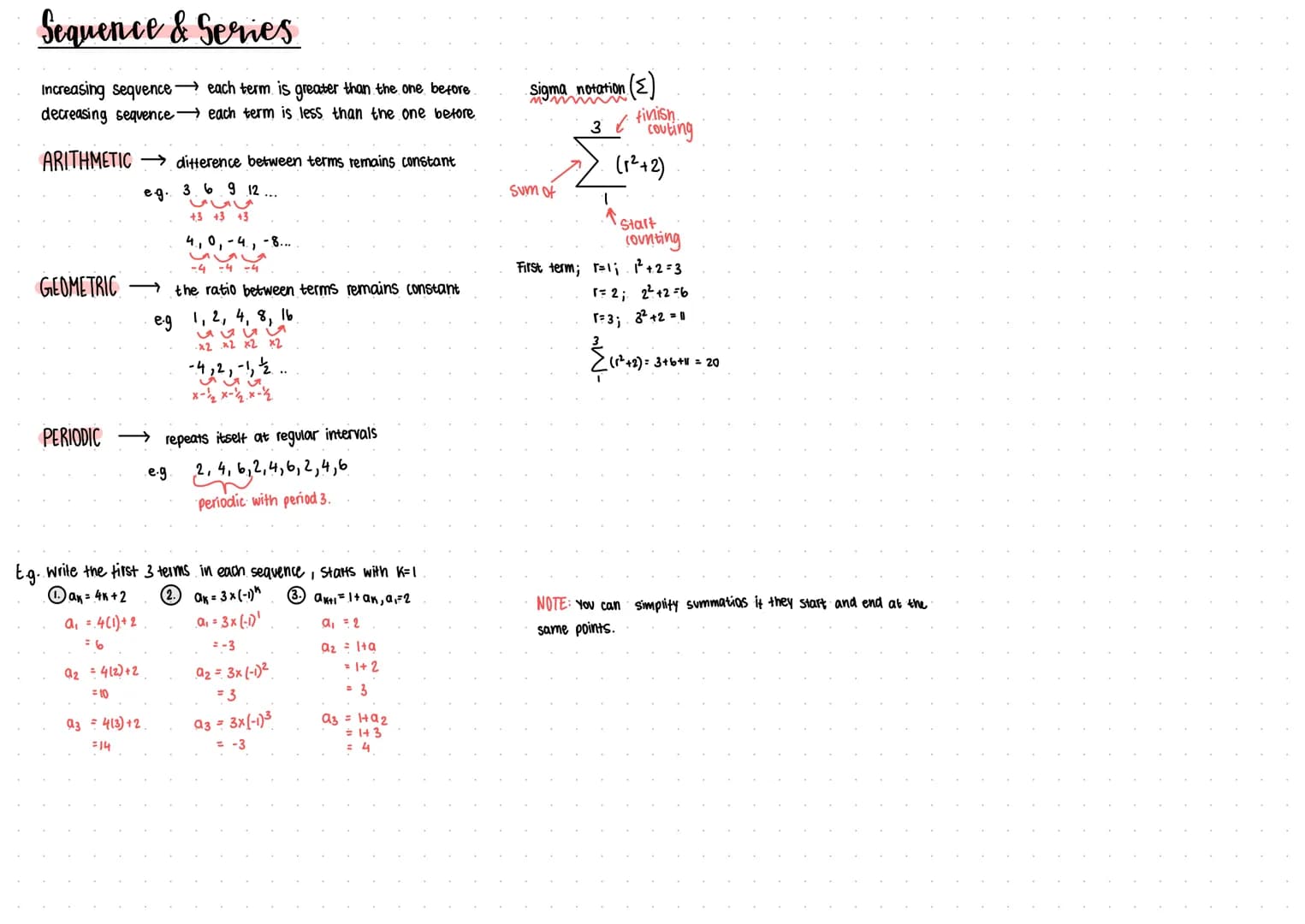
Sequences are basically number patterns, and there are several types you need to recognise. An increasing sequence gets bigger with each term, whilst a decreasing sequence gets smaller - pretty straightforward stuff that you've got this!
Arithmetic sequences have the same difference between consecutive terms. For example, 3, 6, 9, 12... adds 3 each time, whilst 4, 0, -4, -8... subtracts 4 each time. Geometric sequences multiply or divide by the same number each time - like 1, 2, 4, 8, 16 where you're doubling each term.
Periodic sequences are the rebels that just repeat themselves at regular intervals. The sequence 2, 4, 6, 2, 4, 6, 2, 4, 6... has a period of 3 because it repeats every three terms.
When you're finding terms using formulas like ak=4n+2, just substitute the position number for n. For a1, use n = 1 to get a1=4(1)+2=6. For recursive formulas like ak+1=1+ak, each term depends on the previous one.
Quick Tip: Always check what type of sequence you're dealing with first - it'll save you loads of time and help you choose the right approach.
Sigma notation $\sum$ is just a fancy way of writing "add up all these terms." The bottom number tells you where to start counting, the top tells you where to stop, and the expression tells you what to calculate for each position.



 Sociology
 Biology