Open the App

Subjects

Higher Chemistry: Comprehensive Notes on Structure and Bonding

1

0

user profile picture

Hannah Murdoch

12/8/2025

Chemistry

Higher Chemistry- Structure and Bonding

133

Dec 8, 2025

7 pages

Higher Chemistry: Comprehensive Notes on Structure and Bonding

Chemical bonding determines how atoms stick together and why substances... Show more

Page 1
Page 2
Page 3
Page 4
Page 5
Page 6
Page 7
1 / 7
Structure & Bonding.
Intra molecular Bonding i
Intramolecular bonding.
molecule
Covalent
tue nucle; and
There
with
electrons
non-polar /
e.g

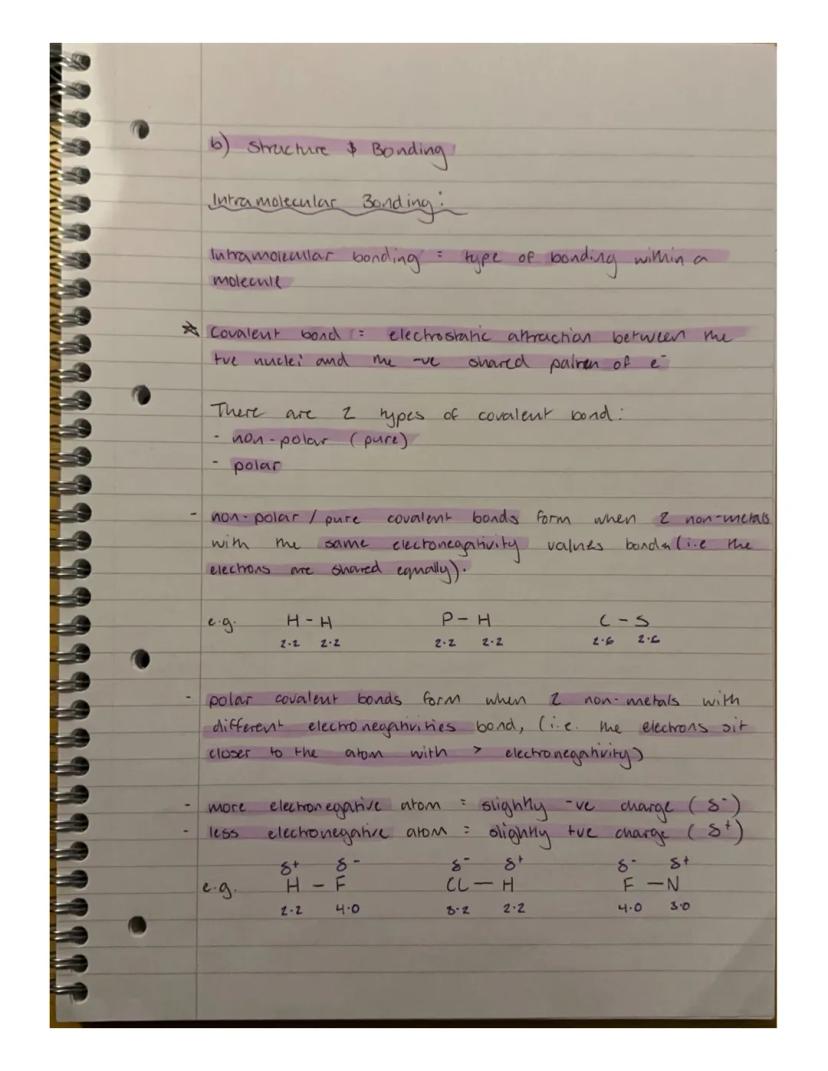
Intramolecular Bonding - The Strong Stuff Inside Molecules

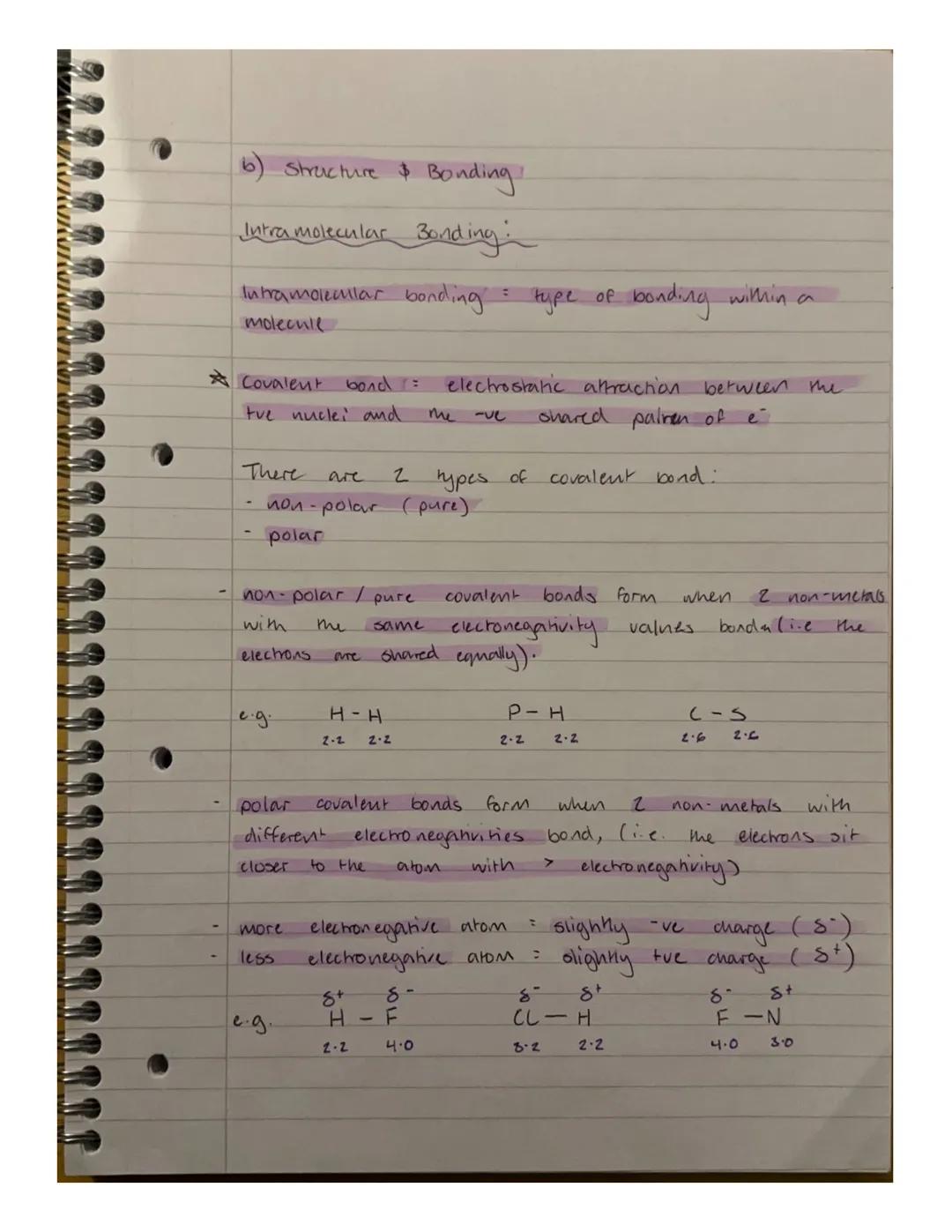
Ever wondered what actually holds atoms together inside molecules? Covalent bonds are the electrostatic attraction between positively charged nuclei and the negatively charged electrons they share. Think of it like two people sharing a blanket - sometimes fairly, sometimes not so much.

Non-polar covalent bonds form when two non-metals with identical electronegativity values share electrons equally. Examples include H-H, P-H, and C-S bonds where both atoms have the same "pulling power" for electrons.

Polar covalent bonds occur when atoms with different electronegativities bond together. The more electronegative atom (like fluorine) pulls the shared electrons closer, creating a slightly negative charge (δ-), whilst the other atom becomes slightly positive (δ+). Examples include H-F and Cl-H bonds.

Quick Tip: Remember that electronegativity differences determine bond type - small differences create polar covalent bonds, whilst identical values create non-polar bonds.

Structure & Bonding.
Intra molecular Bonding i
Intramolecular bonding.
molecule
Covalent
tue nucle; and
There
with
electrons
non-polar /
e.g

Ionic Bonding and Properties Comparison

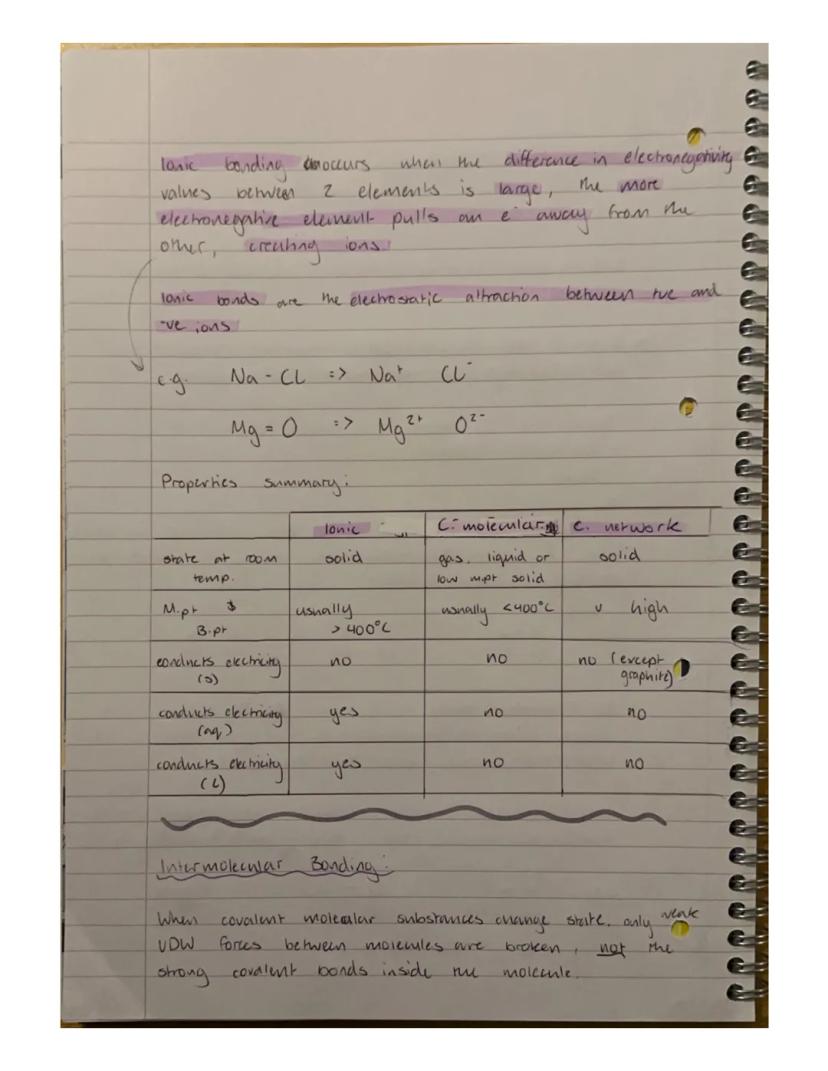
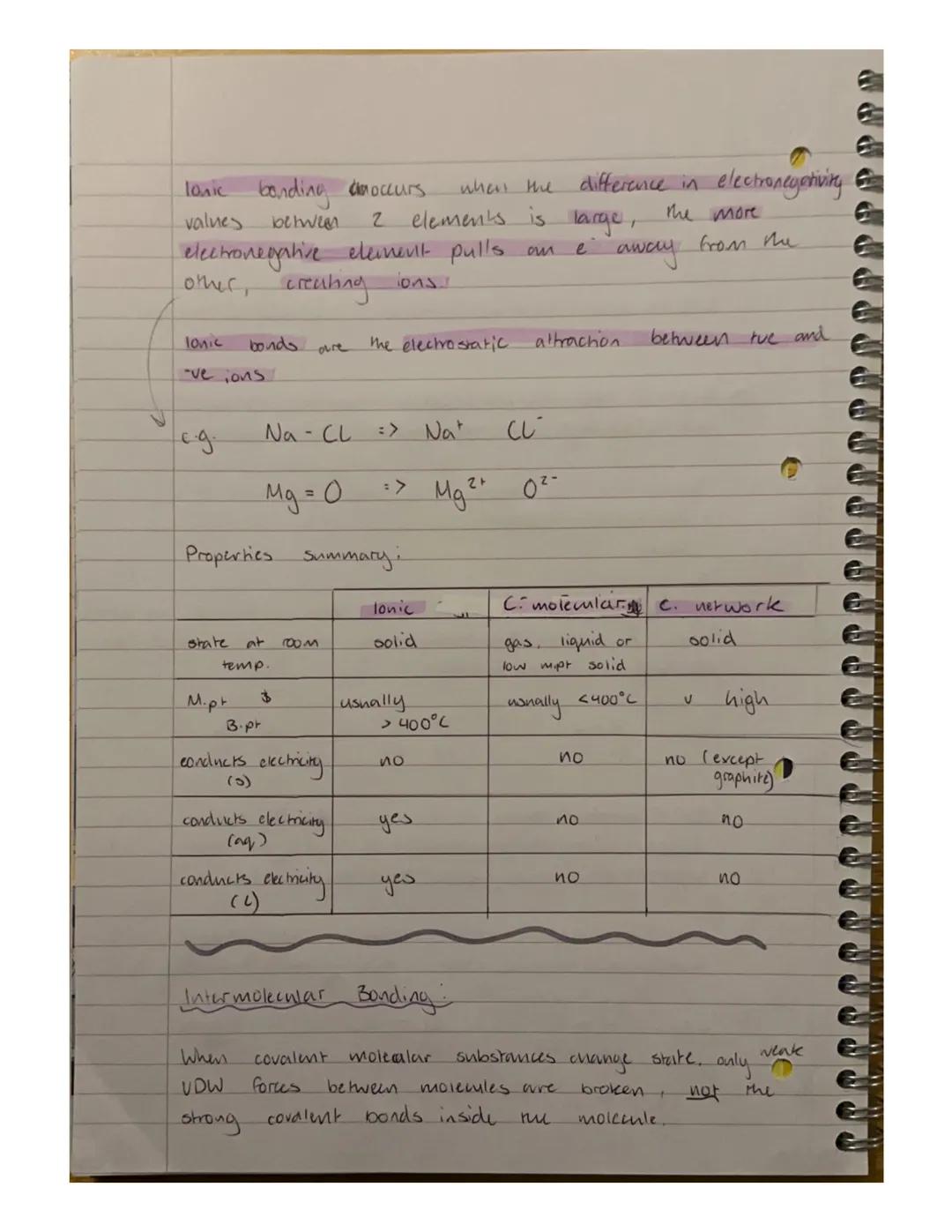
When the electronegativity difference becomes massive, ionic bonding takes over. The more electronegative element completely steals an electron, creating charged ions. Think Na-Cl becoming Na+ and Cl- - it's like one person taking the entire blanket!

Ionic bonds are simply the electrostatic attraction between these positive and negative ions. Examples include NaCl and MgO, where complete electron transfer occurs.

Different bond types create dramatically different properties. Ionic compounds are typically solid at room temperature with high melting points (>400°C) and conduct electricity when dissolved or melted. Covalent molecular substances are often gases or low-melting solids that don't conduct electricity.

Intermolecular bonding explains why covalent substances can change state - only weak forces between molecules break, not the strong covalent bonds within them.

Exam Focus: Learn the property differences between ionic, covalent molecular, and covalent network substances - they're exam favourites!

Structure & Bonding.
Intra molecular Bonding i
Intramolecular bonding.
molecule
Covalent
tue nucle; and
There
with
electrons
non-polar /
e.g

Van der Waals Forces - The Weak but Important Attractions

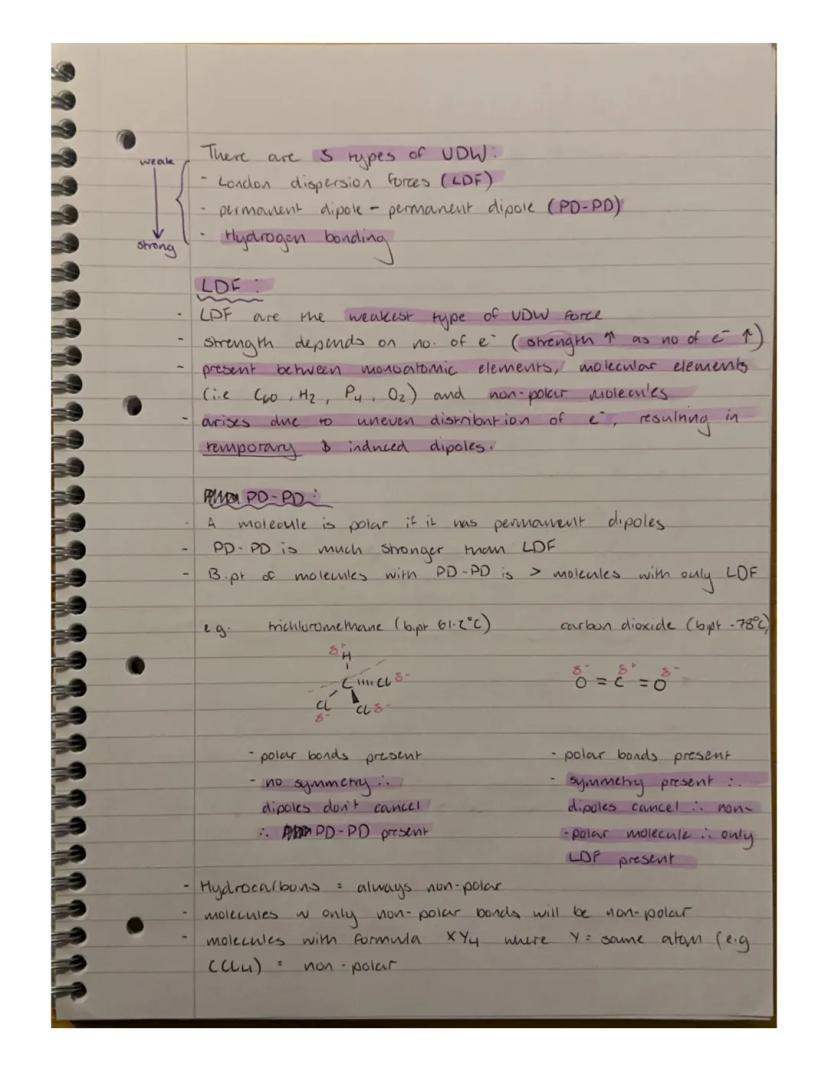
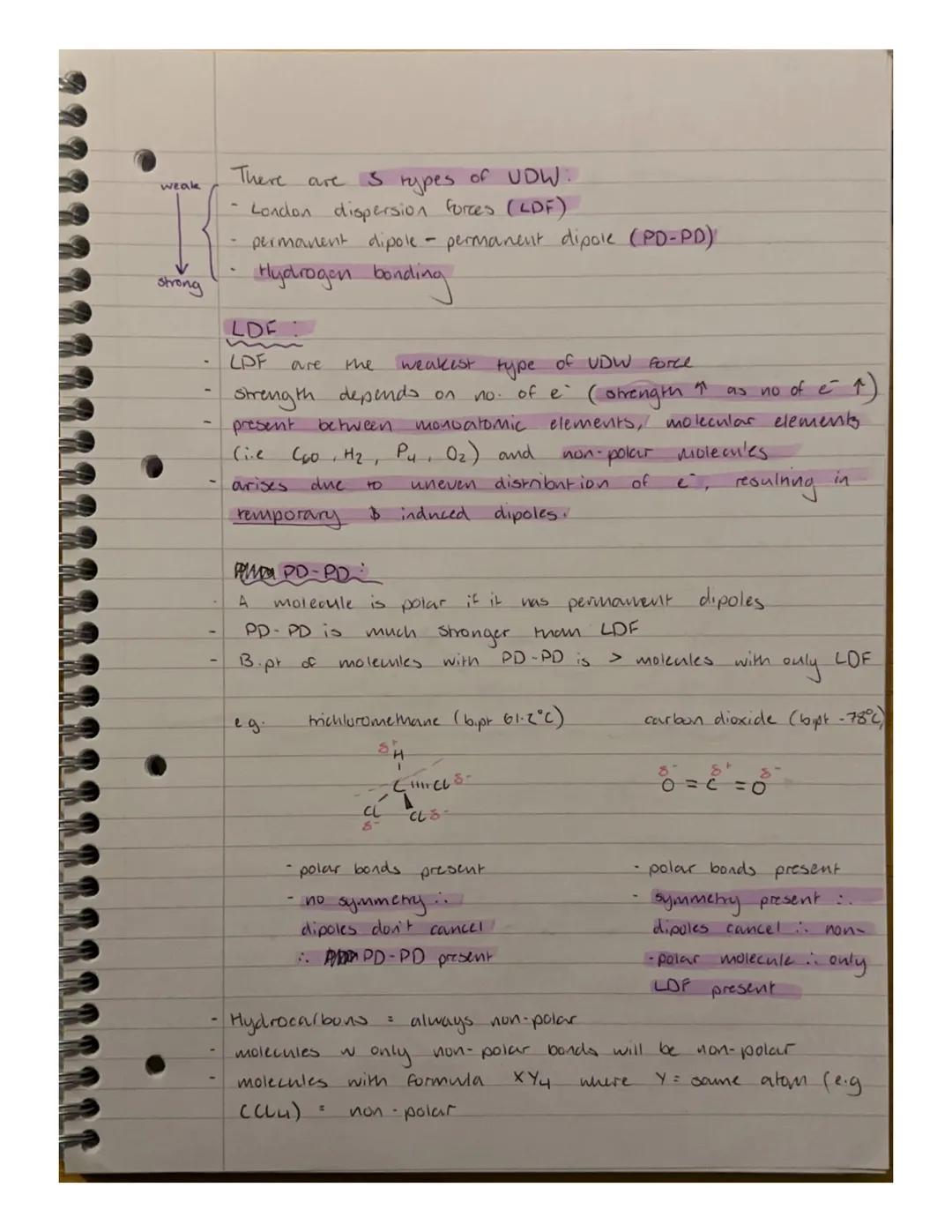
Between molecules, three types of Van der Waals (VDW) forces operate, ranging from weak to relatively strong. These determine how molecules interact when they're not actually bonded together.

London Dispersion Forces (LDF) are the weakest VDW forces, present in all molecules. Their strength increases with the number of electrons - more electrons mean stronger temporary dipoles and higher boiling points.

Permanent dipole-permanent dipole PDPDPD-PD interactions occur between polar molecules. These are much stronger than LDF. For example, trichloromethane (CHCl₃) has a higher boiling point than carbon dioxide because its dipoles don't cancel out due to asymmetry.

Remember: hydrocarbons are always non-polar, and molecules with formula XY₄ (like CCl₄) are non-polar due to symmetry.

Memory Trick: Think "Like attracts like" - polar molecules stick to other polar molecules through their permanent dipoles.

Structure & Bonding.
Intra molecular Bonding i
Intramolecular bonding.
molecule
Covalent
tue nucle; and
There
with
electrons
non-polar /
e.g

Hydrogen Bonding - The Strongest Intermolecular Force

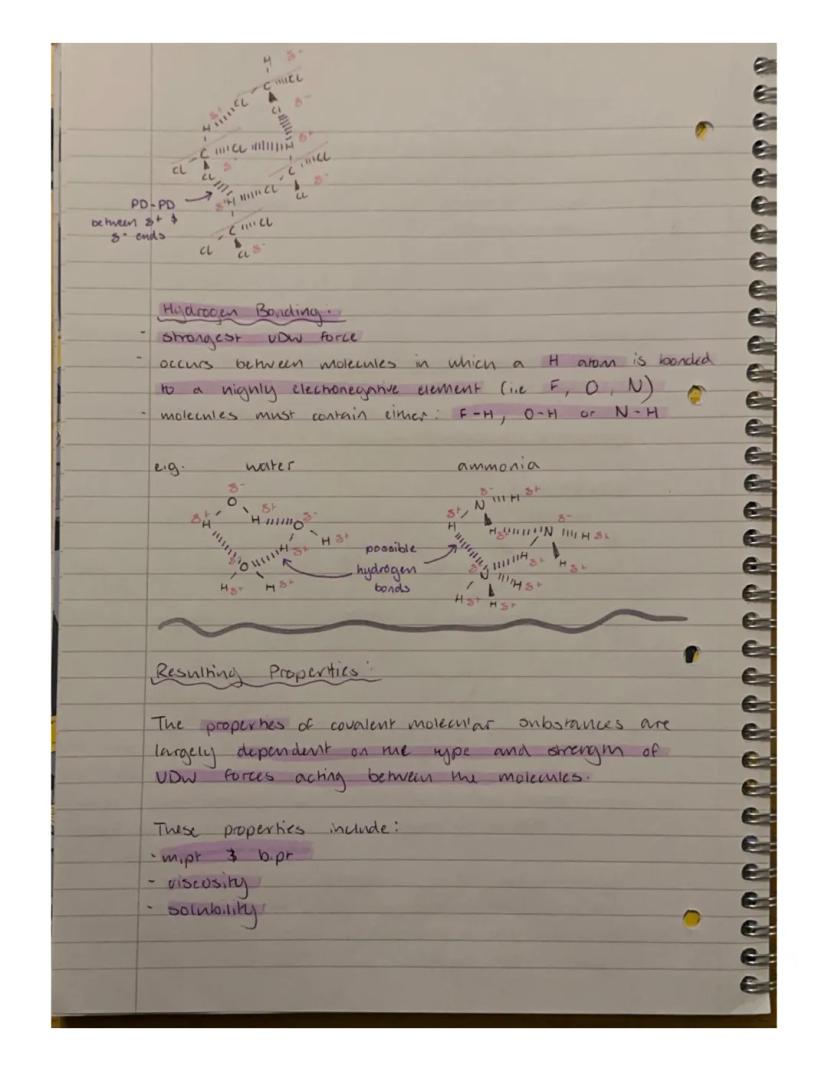
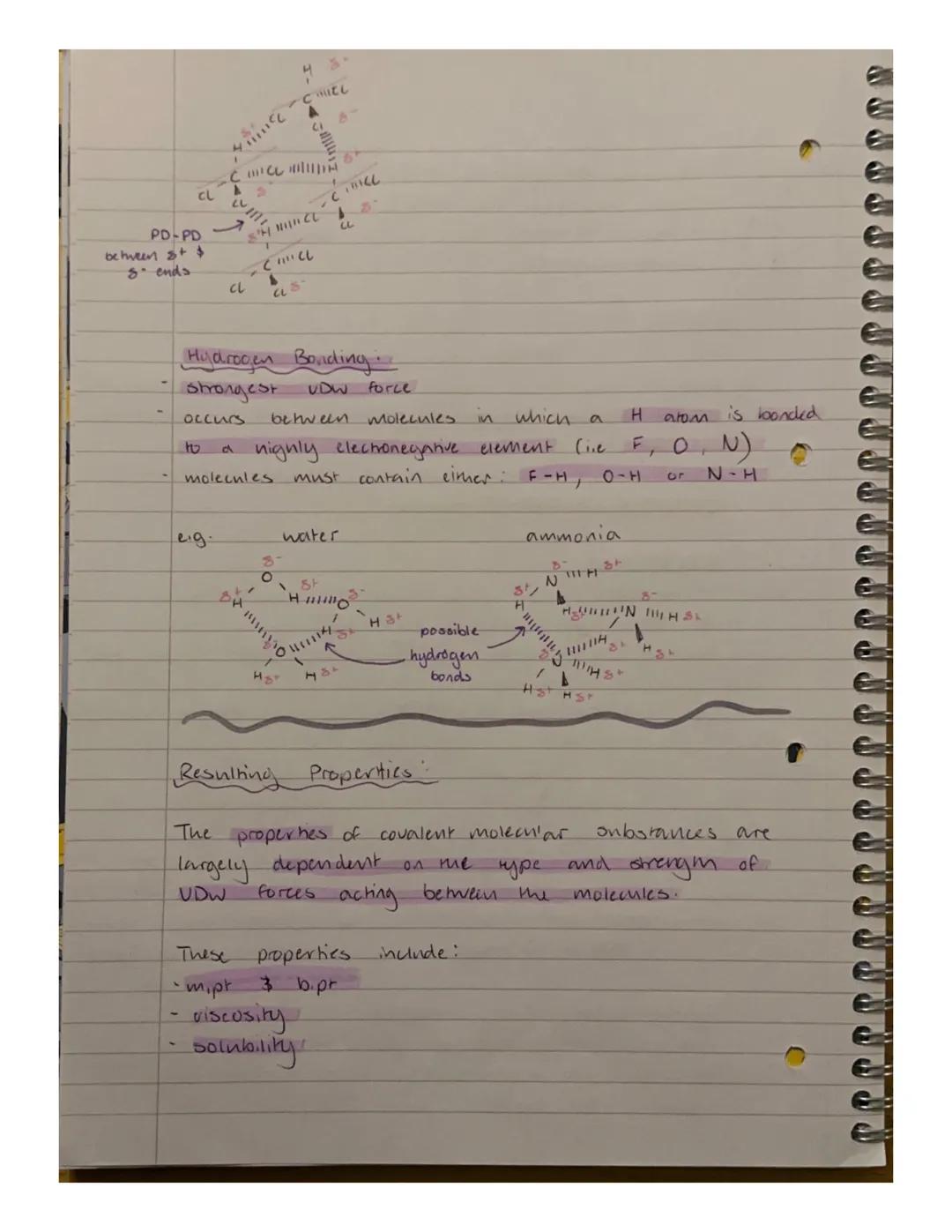
Hydrogen bonding is the strongest VDW force and occurs only when hydrogen bonds to highly electronegative atoms: fluorine, oxygen, or nitrogen. You'll spot it in molecules containing F-H, O-H, or N-H bonds.

Water and ammonia are classic examples. The hydrogen atoms become so positive (δ+) that they're strongly attracted to lone pairs on neighbouring molecules' oxygen or nitrogen atoms.

These intermolecular forces directly influence three key properties of covalent molecular substances: melting and boiling points, viscosity, and solubility. The stronger the intermolecular forces, the more energy needed to separate molecules.

Think of hydrogen bonding as molecular velcro - much stronger than ordinary attractions but still weaker than actual covalent bonds within molecules.

Key Point: Only F-H, O-H, and N-H can form hydrogen bonds - memorise this trinity for exam success!

Structure & Bonding.
Intra molecular Bonding i
Intramolecular bonding.
molecule
Covalent
tue nucle; and
There
with
electrons
non-polar /
e.g

Predicting Physical Properties

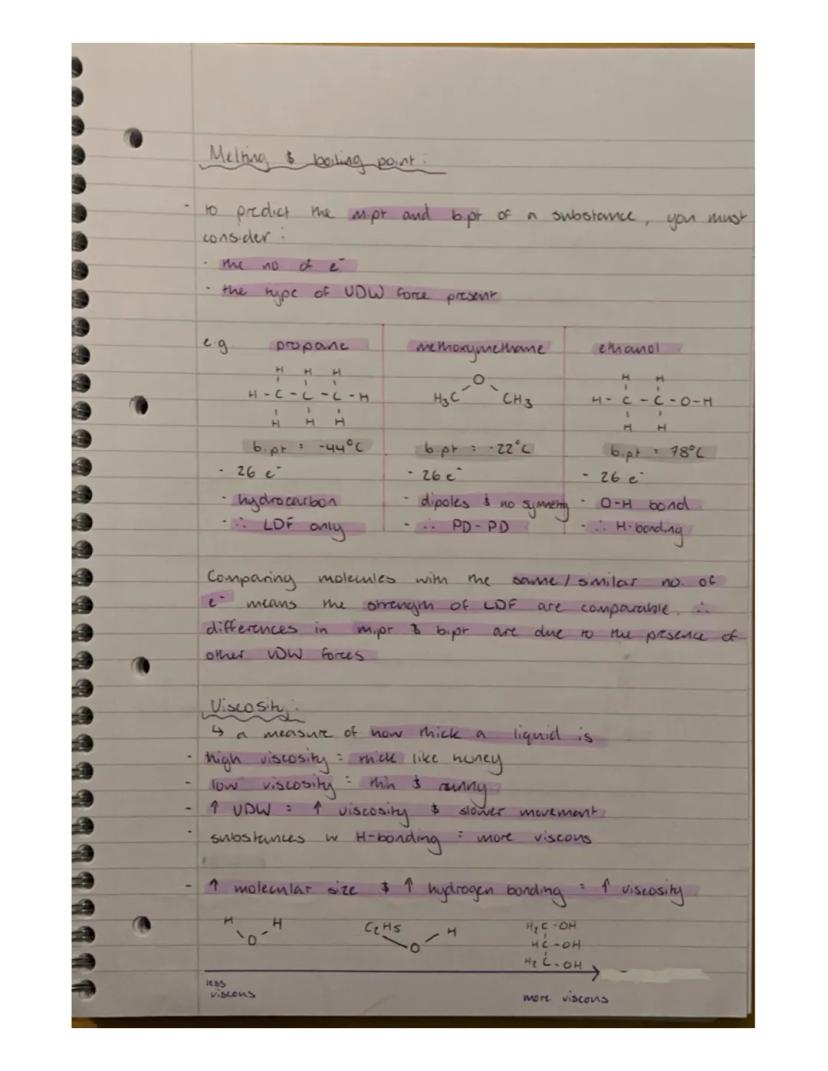
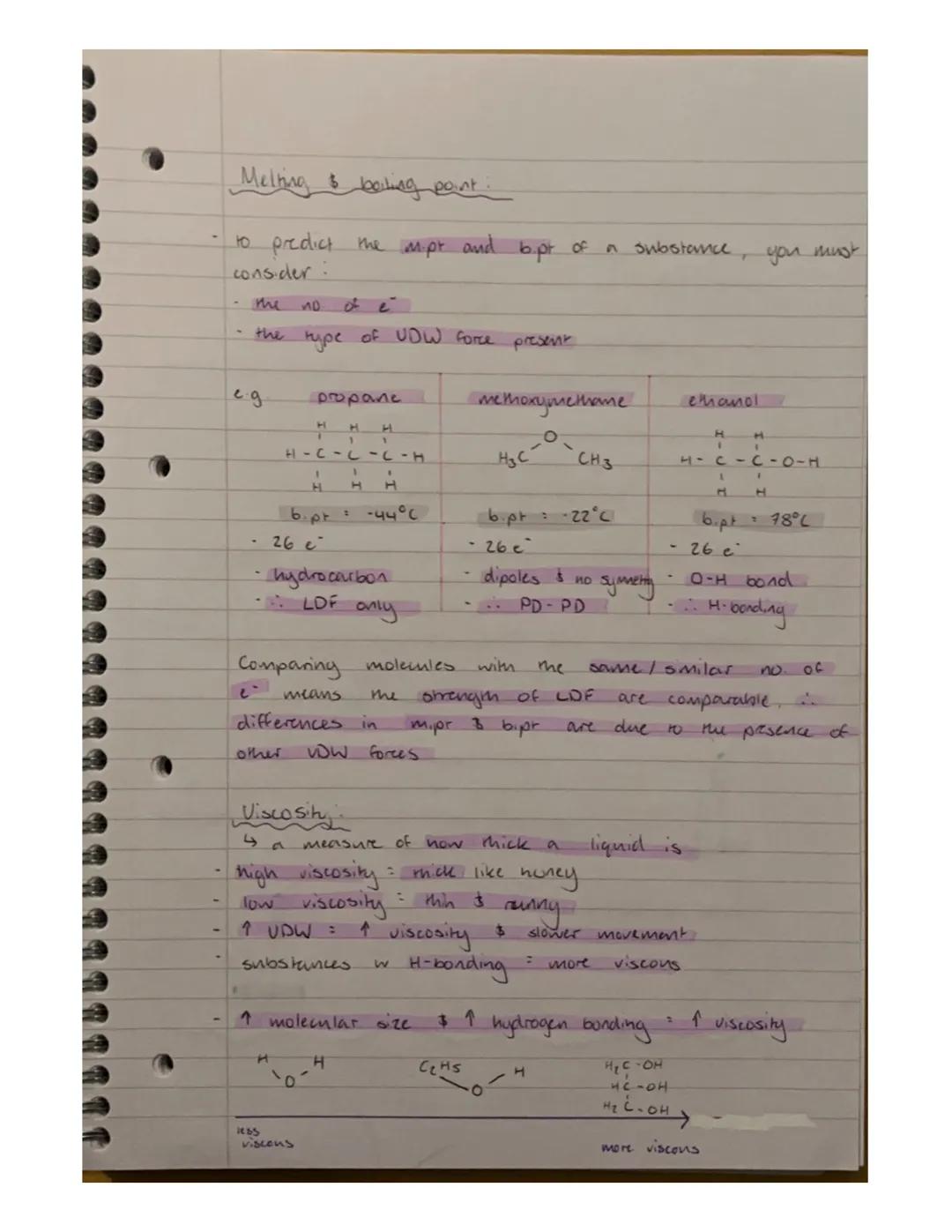
To predict melting and boiling points, consider both the number of electrons and the VDW forces present. Propane, methoxymethane, and ethanol all have 26 electrons, but their boiling points differ dramatically: -44°C, -22°C, and 78°C respectively.

The difference? Propane (hydrocarbon) has only LDF, methoxymethane has permanent dipole interactions, whilst ethanol has hydrogen bonding - the strongest intermolecular force.

Viscosity measures how thick liquids are. Stronger intermolecular forces create higher viscosity because molecules resist flowing past each other. Substances with hydrogen bonding are more viscous, and larger molecules with more hydrogen bonding sites become even thicker.

Compare methanol (CH₃OH) with ethanol (C₂H₅OH) - ethanol is more viscous due to its larger molecular size allowing more intermolecular interactions.

Real-world Connection: This explains why honey (lots of hydrogen bonding) pours slowly whilst petrol (only weak LDF) flows easily.


Structure & Bonding.
Intra molecular Bonding i
Intramolecular bonding.
molecule
Covalent
tue nucle; and
There
with
electrons
non-polar /
e.g

Solubility and Mixing Behaviour

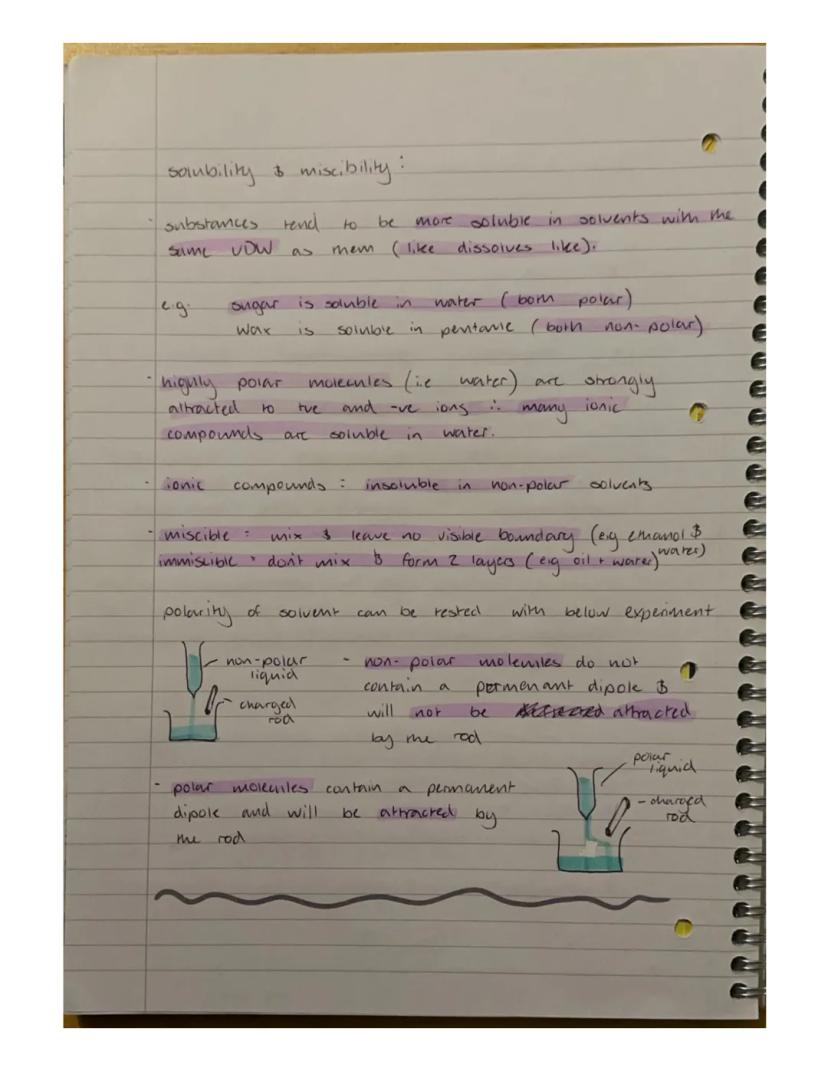
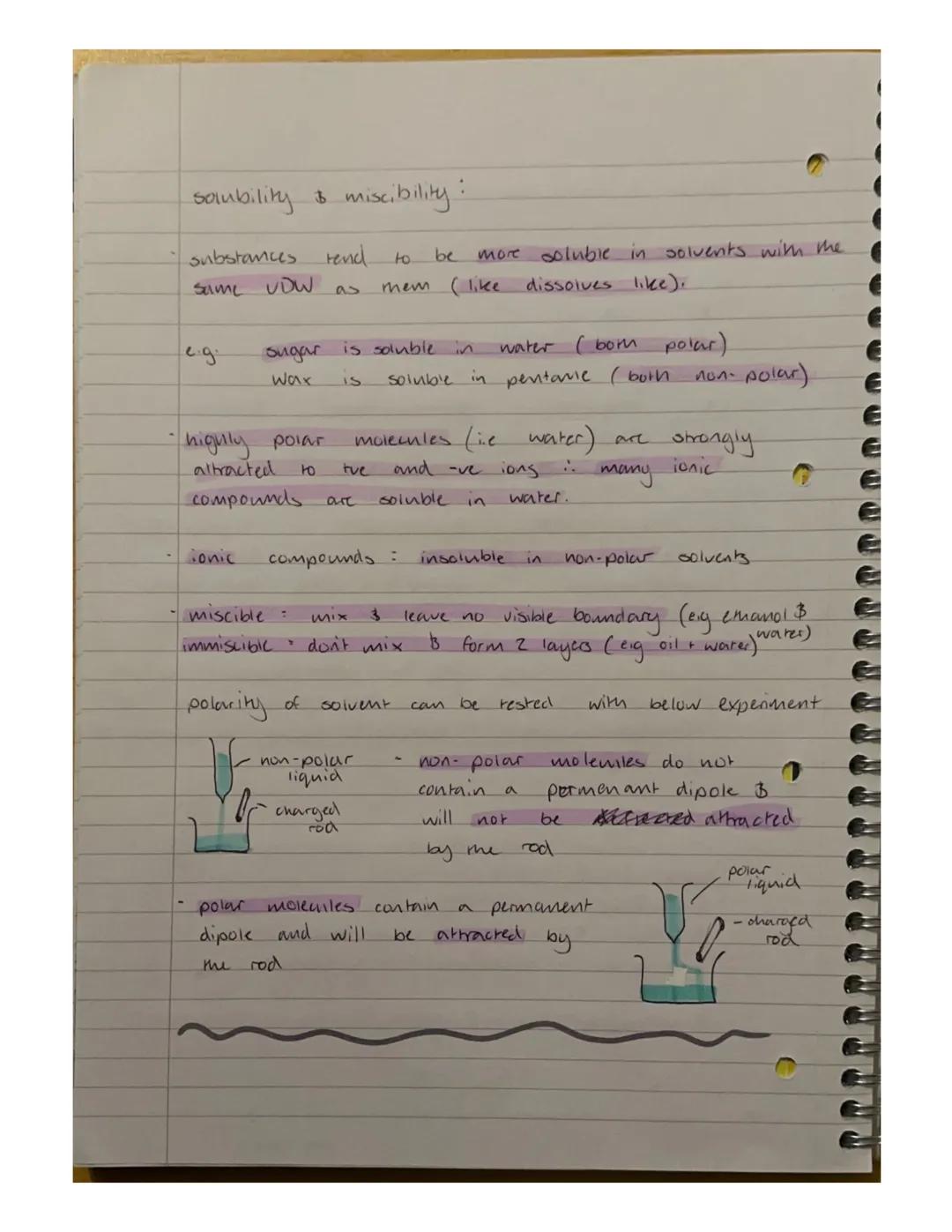
The golden rule for solubility is "like dissolves like" - substances dissolve best in solvents with similar intermolecular forces. Sugar dissolves in water (both polar), whilst wax dissolves in pentane bothnonpolarboth non-polar.

Ionic compounds are often soluble in highly polar solvents like water because polar molecules are strongly attracted to both positive and negative ions. However, they're insoluble in non-polar solvents.

Miscible substances mix completely with no visible boundary (like ethanol and water), whilst immiscible substances form separate layers (like oil and water). You can test solvent polarity using a charged rod - polar liquids bend toward the charge, non-polar liquids don't respond.

This explains why you can't make salad dressing without shaking - oil and vinegar have completely different intermolecular forces!

Lab Insight: The charged rod test is a simple way to identify polar vs non-polar liquids in practical work.

Structure & Bonding.
Intra molecular Bonding i
Intramolecular bonding.
molecule
Covalent
tue nucle; and
There
with
electrons
non-polar /
e.g

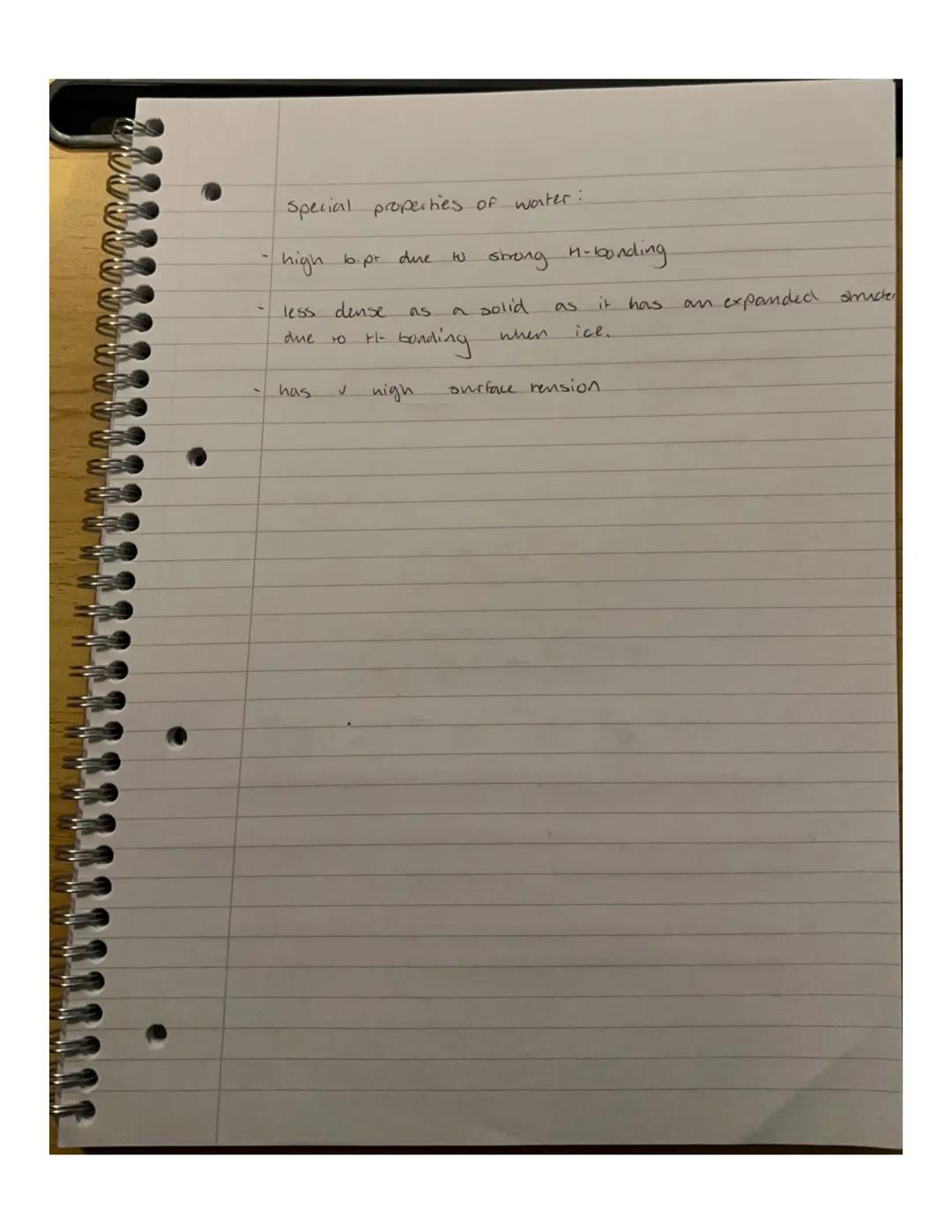
Water's Special Properties

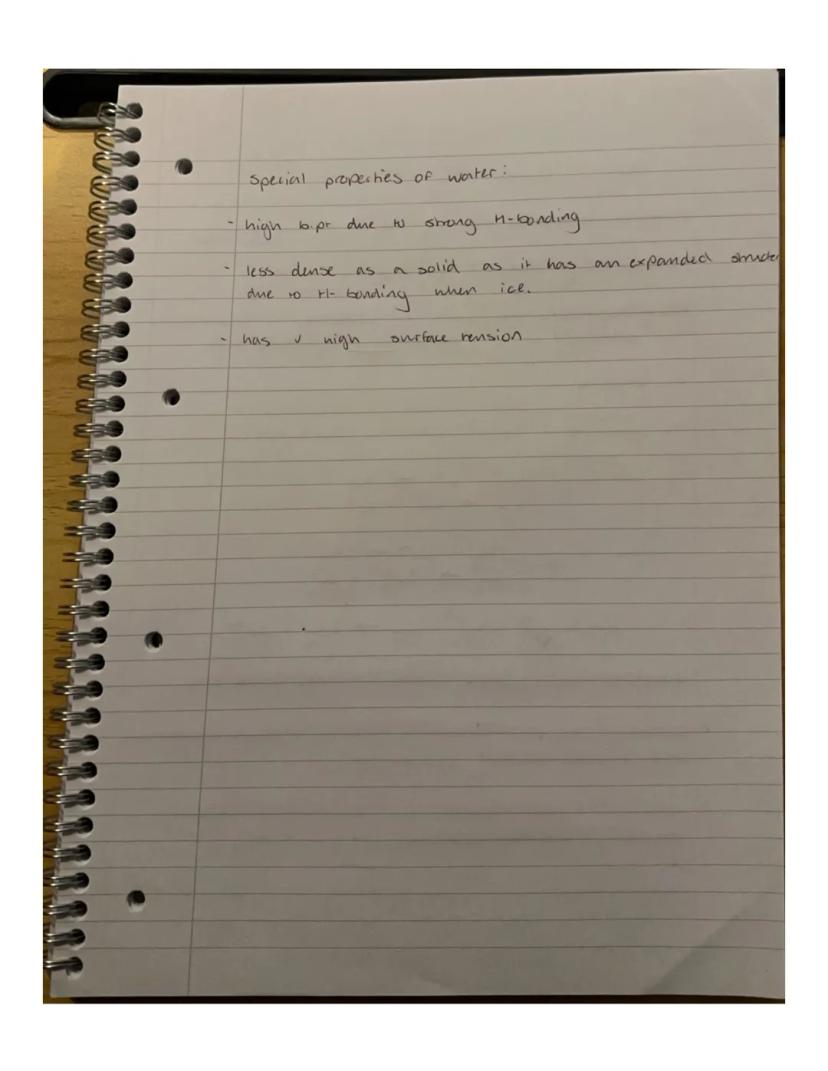
Water's unique properties all stem from its extensive hydrogen bonding network. Its high boiling point (100°C) seems unusual for such a small molecule, but hydrogen bonding requires extra energy to break.

Ice floats because it's less dense than liquid water - hydrogen bonding creates an expanded, ordered structure when water freezes. This is actually quite rare; most substances are denser as solids.

Water also has very high surface tension, allowing insects to walk on its surface. Again, this is down to those strong hydrogen bonds holding the surface molecules together like a flexible skin.

Environmental Impact: Ice floating on water insulates aquatic life below - if ice sank, lakes would freeze solid from bottom to top!


We thought you’d never ask...

What is the Knowunity AI companion?

Our AI companion is specifically built for the needs of students. Based on the millions of content pieces we have on the platform we can provide truly meaningful and relevant answers to students. But its not only about answers, the companion is even more about guiding students through their daily learning challenges, with personalised study plans, quizzes or content pieces in the chat and 100% personalisation based on the students skills and developments.

Where can I download the Knowunity app?

You can download the app in the Google Play Store and in the Apple App Store.

Is Knowunity really free of charge?

That's right! Enjoy free access to study content, connect with fellow students, and get instant help – all at your fingertips.

Most popular content: Hydrogen Bonding

Most popular content in Chemistry

Most popular content

Can't find what you're looking for? Explore other subjects.

Students love us — and so will you.

4.9/5

App Store

4.8/5

Google Play

The app is very easy to use and well designed. I have found everything I was looking for so far and have been able to learn a lot from the presentations! I will definitely use the app for a class assignment! And of course it also helps a lot as an inspiration.

Stefan S

iOS user

This app is really great. There are so many study notes and help [...]. My problem subject is French, for example, and the app has so many options for help. Thanks to this app, I have improved my French. I would recommend it to anyone.

Samantha Klich

Android user

Wow, I am really amazed. I just tried the app because I've seen it advertised many times and was absolutely stunned. This app is THE HELP you want for school and above all, it offers so many things, such as workouts and fact sheets, which have been VERY helpful to me personally.

Anna

iOS user

I think it’s very much worth it and you’ll end up using it a lot once you get the hang of it and even after looking at others notes you can still ask your Artificial intelligence buddy the question and ask to simplify it if you still don’t get it!!! In the end I think it’s worth it 😊👍 ⚠️Also DID I MENTION ITS FREEE YOU DON’T HAVE TO PAY FOR ANYTHING AND STILL GET YOUR GRADES IN PERFECTLY❗️❗️⚠️

Thomas R

iOS user

Knowunity is the BEST app I’ve used in a minute. This is not an ai review or anything this is genuinely coming from a 7th grade student (I know 2011 im young) but dude this app is a 10/10 i have maintained a 3.8 gpa and have plenty of time for gaming. I love it and my mom is just happy I got good grades

Brad T

Android user

Not only did it help me find the answer but it also showed me alternative ways to solve it. I was horrible in math and science but now I have an a in both subjects. Thanks for the help🤍🤍

David K

iOS user

The app's just great! All I have to do is enter the topic in the search bar and I get the response real fast. I don't have to watch 10 YouTube videos to understand something, so I'm saving my time. Highly recommended!

Sudenaz Ocak

Android user

In school I was really bad at maths but thanks to the app, I am doing better now. I am so grateful that you made the app.

Greenlight Bonnie

Android user

I found this app a couple years ago and it has only gotten better since then. I really love it because it can help with written questions and photo questions. Also, it can find study guides that other people have made as well as flashcard sets and practice tests. The free version is also amazing for students who might not be able to afford it. Would 100% recommend

Aubrey

iOS user

Best app if you're in Highschool or Junior high. I have been using this app for 2 school years and it's the best, it's good if you don't have anyone to help you with school work.😋🩷🎀

Marco B

iOS user

THE QUIZES AND FLASHCARDS ARE SO USEFUL AND I LOVE THE SCHOOLGPT. IT ALSO IS LITREALLY LIKE CHATGPT BUT SMARTER!! HELPED ME WITH MY MASCARA PROBLEMS TOO!! AS WELL AS MY REAL SUBJECTS ! DUHHH 😍😁😲🤑💗✨🎀😮

Elisha

iOS user

This app is phenomenal down to the correct info and the various topics you can study! I greatly recommend it for people who struggle with procrastination and those who need homework help. It has been perfectly accurate for world 1 history as far as I’ve seen! Geometry too!

Paul T

iOS user

The app is very easy to use and well designed. I have found everything I was looking for so far and have been able to learn a lot from the presentations! I will definitely use the app for a class assignment! And of course it also helps a lot as an inspiration.

Stefan S

iOS user

This app is really great. There are so many study notes and help [...]. My problem subject is French, for example, and the app has so many options for help. Thanks to this app, I have improved my French. I would recommend it to anyone.

Samantha Klich

Android user

Wow, I am really amazed. I just tried the app because I've seen it advertised many times and was absolutely stunned. This app is THE HELP you want for school and above all, it offers so many things, such as workouts and fact sheets, which have been VERY helpful to me personally.

Anna

iOS user

I think it’s very much worth it and you’ll end up using it a lot once you get the hang of it and even after looking at others notes you can still ask your Artificial intelligence buddy the question and ask to simplify it if you still don’t get it!!! In the end I think it’s worth it 😊👍 ⚠️Also DID I MENTION ITS FREEE YOU DON’T HAVE TO PAY FOR ANYTHING AND STILL GET YOUR GRADES IN PERFECTLY❗️❗️⚠️

Thomas R

iOS user

Knowunity is the BEST app I’ve used in a minute. This is not an ai review or anything this is genuinely coming from a 7th grade student (I know 2011 im young) but dude this app is a 10/10 i have maintained a 3.8 gpa and have plenty of time for gaming. I love it and my mom is just happy I got good grades

Brad T

Android user

Not only did it help me find the answer but it also showed me alternative ways to solve it. I was horrible in math and science but now I have an a in both subjects. Thanks for the help🤍🤍

David K

iOS user

The app's just great! All I have to do is enter the topic in the search bar and I get the response real fast. I don't have to watch 10 YouTube videos to understand something, so I'm saving my time. Highly recommended!

Sudenaz Ocak

Android user

In school I was really bad at maths but thanks to the app, I am doing better now. I am so grateful that you made the app.

Greenlight Bonnie

Android user

I found this app a couple years ago and it has only gotten better since then. I really love it because it can help with written questions and photo questions. Also, it can find study guides that other people have made as well as flashcard sets and practice tests. The free version is also amazing for students who might not be able to afford it. Would 100% recommend

Aubrey

iOS user

Best app if you're in Highschool or Junior high. I have been using this app for 2 school years and it's the best, it's good if you don't have anyone to help you with school work.😋🩷🎀

Marco B

iOS user

THE QUIZES AND FLASHCARDS ARE SO USEFUL AND I LOVE THE SCHOOLGPT. IT ALSO IS LITREALLY LIKE CHATGPT BUT SMARTER!! HELPED ME WITH MY MASCARA PROBLEMS TOO!! AS WELL AS MY REAL SUBJECTS ! DUHHH 😍😁😲🤑💗✨🎀😮

Elisha

iOS user

This app is phenomenal down to the correct info and the various topics you can study! I greatly recommend it for people who struggle with procrastination and those who need homework help. It has been perfectly accurate for world 1 history as far as I’ve seen! Geometry too!

Paul T

iOS user


Chemistry

133

Dec 8, 2025

7 pages

Higher Chemistry: Comprehensive Notes on Structure and Bonding

Chemical bonding determines how atoms stick together and why substances behave the way they do. Understanding the different types of bonds - from the strong forces within molecules to the weaker attractions between them - explains everything from why ice... Show more

Structure & Bonding.
Intra molecular Bonding i
Intramolecular bonding.
molecule
Covalent
tue nucle; and
There
with
electrons
non-polar /
e.g

Sign up to see the contentIt's free!

Access to all documents

Improve your grades

Join milions of students

By signing up you accept Terms of Service and Privacy Policy

Intramolecular Bonding - The Strong Stuff Inside Molecules

Ever wondered what actually holds atoms together inside molecules? Covalent bonds are the electrostatic attraction between positively charged nuclei and the negatively charged electrons they share. Think of it like two people sharing a blanket - sometimes fairly, sometimes not so much.

Non-polar covalent bonds form when two non-metals with identical electronegativity values share electrons equally. Examples include H-H, P-H, and C-S bonds where both atoms have the same "pulling power" for electrons.

Polar covalent bonds occur when atoms with different electronegativities bond together. The more electronegative atom (like fluorine) pulls the shared electrons closer, creating a slightly negative charge (δ-), whilst the other atom becomes slightly positive (δ+). Examples include H-F and Cl-H bonds.

Quick Tip: Remember that electronegativity differences determine bond type - small differences create polar covalent bonds, whilst identical values create non-polar bonds.

Structure & Bonding.
Intra molecular Bonding i
Intramolecular bonding.
molecule
Covalent
tue nucle; and
There
with
electrons
non-polar /
e.g

Sign up to see the contentIt's free!

Access to all documents

Improve your grades

Join milions of students

By signing up you accept Terms of Service and Privacy Policy

Ionic Bonding and Properties Comparison

When the electronegativity difference becomes massive, ionic bonding takes over. The more electronegative element completely steals an electron, creating charged ions. Think Na-Cl becoming Na+ and Cl- - it's like one person taking the entire blanket!

Ionic bonds are simply the electrostatic attraction between these positive and negative ions. Examples include NaCl and MgO, where complete electron transfer occurs.

Different bond types create dramatically different properties. Ionic compounds are typically solid at room temperature with high melting points (>400°C) and conduct electricity when dissolved or melted. Covalent molecular substances are often gases or low-melting solids that don't conduct electricity.

Intermolecular bonding explains why covalent substances can change state - only weak forces between molecules break, not the strong covalent bonds within them.

Exam Focus: Learn the property differences between ionic, covalent molecular, and covalent network substances - they're exam favourites!

Structure & Bonding.
Intra molecular Bonding i
Intramolecular bonding.
molecule
Covalent
tue nucle; and
There
with
electrons
non-polar /
e.g

Sign up to see the contentIt's free!

Access to all documents

Improve your grades

Join milions of students

By signing up you accept Terms of Service and Privacy Policy

Van der Waals Forces - The Weak but Important Attractions

Between molecules, three types of Van der Waals (VDW) forces operate, ranging from weak to relatively strong. These determine how molecules interact when they're not actually bonded together.

London Dispersion Forces (LDF) are the weakest VDW forces, present in all molecules. Their strength increases with the number of electrons - more electrons mean stronger temporary dipoles and higher boiling points.

Permanent dipole-permanent dipole PDPDPD-PD interactions occur between polar molecules. These are much stronger than LDF. For example, trichloromethane (CHCl₃) has a higher boiling point than carbon dioxide because its dipoles don't cancel out due to asymmetry.

Remember: hydrocarbons are always non-polar, and molecules with formula XY₄ (like CCl₄) are non-polar due to symmetry.

Memory Trick: Think "Like attracts like" - polar molecules stick to other polar molecules through their permanent dipoles.

Structure & Bonding.
Intra molecular Bonding i
Intramolecular bonding.
molecule
Covalent
tue nucle; and
There
with
electrons
non-polar /
e.g

Sign up to see the contentIt's free!

Access to all documents

Improve your grades

Join milions of students

By signing up you accept Terms of Service and Privacy Policy

Hydrogen Bonding - The Strongest Intermolecular Force

Hydrogen bonding is the strongest VDW force and occurs only when hydrogen bonds to highly electronegative atoms: fluorine, oxygen, or nitrogen. You'll spot it in molecules containing F-H, O-H, or N-H bonds.

Water and ammonia are classic examples. The hydrogen atoms become so positive (δ+) that they're strongly attracted to lone pairs on neighbouring molecules' oxygen or nitrogen atoms.

These intermolecular forces directly influence three key properties of covalent molecular substances: melting and boiling points, viscosity, and solubility. The stronger the intermolecular forces, the more energy needed to separate molecules.

Think of hydrogen bonding as molecular velcro - much stronger than ordinary attractions but still weaker than actual covalent bonds within molecules.

Key Point: Only F-H, O-H, and N-H can form hydrogen bonds - memorise this trinity for exam success!

Structure & Bonding.
Intra molecular Bonding i
Intramolecular bonding.
molecule
Covalent
tue nucle; and
There
with
electrons
non-polar /
e.g

Sign up to see the contentIt's free!

Access to all documents

Improve your grades

Join milions of students

By signing up you accept Terms of Service and Privacy Policy

Predicting Physical Properties

To predict melting and boiling points, consider both the number of electrons and the VDW forces present. Propane, methoxymethane, and ethanol all have 26 electrons, but their boiling points differ dramatically: -44°C, -22°C, and 78°C respectively.

The difference? Propane (hydrocarbon) has only LDF, methoxymethane has permanent dipole interactions, whilst ethanol has hydrogen bonding - the strongest intermolecular force.

Viscosity measures how thick liquids are. Stronger intermolecular forces create higher viscosity because molecules resist flowing past each other. Substances with hydrogen bonding are more viscous, and larger molecules with more hydrogen bonding sites become even thicker.

Compare methanol (CH₃OH) with ethanol (C₂H₅OH) - ethanol is more viscous due to its larger molecular size allowing more intermolecular interactions.

Real-world Connection: This explains why honey (lots of hydrogen bonding) pours slowly whilst petrol (only weak LDF) flows easily.
Structure & Bonding.
Intra molecular Bonding i
Intramolecular bonding.
molecule
Covalent
tue nucle; and
There
with
electrons
non-polar /
e.g

Sign up to see the contentIt's free!

Access to all documents

Improve your grades

Join milions of students

By signing up you accept Terms of Service and Privacy Policy

Solubility and Mixing Behaviour

The golden rule for solubility is "like dissolves like" - substances dissolve best in solvents with similar intermolecular forces. Sugar dissolves in water (both polar), whilst wax dissolves in pentane bothnonpolarboth non-polar.

Ionic compounds are often soluble in highly polar solvents like water because polar molecules are strongly attracted to both positive and negative ions. However, they're insoluble in non-polar solvents.

Miscible substances mix completely with no visible boundary (like ethanol and water), whilst immiscible substances form separate layers (like oil and water). You can test solvent polarity using a charged rod - polar liquids bend toward the charge, non-polar liquids don't respond.

This explains why you can't make salad dressing without shaking - oil and vinegar have completely different intermolecular forces!

Lab Insight: The charged rod test is a simple way to identify polar vs non-polar liquids in practical work.

Structure & Bonding.
Intra molecular Bonding i
Intramolecular bonding.
molecule
Covalent
tue nucle; and
There
with
electrons
non-polar /
e.g

Sign up to see the contentIt's free!

Access to all documents

Improve your grades

Join milions of students

By signing up you accept Terms of Service and Privacy Policy

Water's Special Properties

Water's unique properties all stem from its extensive hydrogen bonding network. Its high boiling point (100°C) seems unusual for such a small molecule, but hydrogen bonding requires extra energy to break.

Ice floats because it's less dense than liquid water - hydrogen bonding creates an expanded, ordered structure when water freezes. This is actually quite rare; most substances are denser as solids.

Water also has very high surface tension, allowing insects to walk on its surface. Again, this is down to those strong hydrogen bonds holding the surface molecules together like a flexible skin.

Environmental Impact: Ice floating on water insulates aquatic life below - if ice sank, lakes would freeze solid from bottom to top!

We thought you’d never ask...

What is the Knowunity AI companion?

Our AI companion is specifically built for the needs of students. Based on the millions of content pieces we have on the platform we can provide truly meaningful and relevant answers to students. But its not only about answers, the companion is even more about guiding students through their daily learning challenges, with personalised study plans, quizzes or content pieces in the chat and 100% personalisation based on the students skills and developments.

Where can I download the Knowunity app?

You can download the app in the Google Play Store and in the Apple App Store.

Is Knowunity really free of charge?

That's right! Enjoy free access to study content, connect with fellow students, and get instant help – all at your fingertips.

1

Smart Tools NEW

Transform this note into: ✓ 50+ Practice Questions ✓ Interactive Flashcards ✓ Full Mock Exam ✓ Essay Outlines

Mock Exam
Quiz
Flashcards
Essay

Similar Content

Understanding Matter's States

Explore the fundamental concepts of the particulate nature of matter, including the properties of solids, liquids, and gases, phase changes, kinetic molecular theory, Brownian motion, diffusion, and gas pressure. This summary provides a comprehensive overview for students studying chemistry.

ChemistryChemistry
10

States of Matter Explained

Explore the relationship between bonding, structure, and the properties of substances in this detailed overview of states of matter. Understand the characteristics of solids, liquids, and gases, and learn about phase changes, melting points, and the significance of state symbols in chemical reactions. Ideal for chemistry students seeking to grasp fundamental concepts in chemical bonding and phase transitions.

ChemistryChemistry
10

Unit 3 Intermolecular Forces Review + Practice Questions

This is a review over almost all of AP Chemistry's Unit 3 content. Some snips of AP Classroom's progress check questions are in here for practice. ⬜ Fiveable and AP Classroom were used to create this review. Credit is to them.

AP ChemistryAP Chemistry

Type of matter

These study notes will help you explain the type of matter such as solid, liquid, and gas, there are other definitions or terms that are part of the matter too.

ChemistryChemistry

Intermolecular Forces

These notes cover intermolecular forces, dispersion forces, dipole-dipole, properties of liquid, and hydrogen bonding.

ChemistryChemistry
College

General Chemistry Reviewer

This contains a short description about intermolecular forces, classification of hydrocarbons and etc.

ChemistryChemistry

Most popular content: Hydrogen Bonding

Most popular content in Chemistry

Most popular content

Can't find what you're looking for? Explore other subjects.

Students love us — and so will you.

4.9/5

App Store

4.8/5

Google Play

The app is very easy to use and well designed. I have found everything I was looking for so far and have been able to learn a lot from the presentations! I will definitely use the app for a class assignment! And of course it also helps a lot as an inspiration.

Stefan S

iOS user

This app is really great. There are so many study notes and help [...]. My problem subject is French, for example, and the app has so many options for help. Thanks to this app, I have improved my French. I would recommend it to anyone.

Samantha Klich

Android user

Wow, I am really amazed. I just tried the app because I've seen it advertised many times and was absolutely stunned. This app is THE HELP you want for school and above all, it offers so many things, such as workouts and fact sheets, which have been VERY helpful to me personally.

Anna

iOS user

I think it’s very much worth it and you’ll end up using it a lot once you get the hang of it and even after looking at others notes you can still ask your Artificial intelligence buddy the question and ask to simplify it if you still don’t get it!!! In the end I think it’s worth it 😊👍 ⚠️Also DID I MENTION ITS FREEE YOU DON’T HAVE TO PAY FOR ANYTHING AND STILL GET YOUR GRADES IN PERFECTLY❗️❗️⚠️

Thomas R

iOS user

Knowunity is the BEST app I’ve used in a minute. This is not an ai review or anything this is genuinely coming from a 7th grade student (I know 2011 im young) but dude this app is a 10/10 i have maintained a 3.8 gpa and have plenty of time for gaming. I love it and my mom is just happy I got good grades

Brad T

Android user

Not only did it help me find the answer but it also showed me alternative ways to solve it. I was horrible in math and science but now I have an a in both subjects. Thanks for the help🤍🤍

David K

iOS user

The app's just great! All I have to do is enter the topic in the search bar and I get the response real fast. I don't have to watch 10 YouTube videos to understand something, so I'm saving my time. Highly recommended!

Sudenaz Ocak

Android user

In school I was really bad at maths but thanks to the app, I am doing better now. I am so grateful that you made the app.

Greenlight Bonnie

Android user

I found this app a couple years ago and it has only gotten better since then. I really love it because it can help with written questions and photo questions. Also, it can find study guides that other people have made as well as flashcard sets and practice tests. The free version is also amazing for students who might not be able to afford it. Would 100% recommend

Aubrey

iOS user

Best app if you're in Highschool or Junior high. I have been using this app for 2 school years and it's the best, it's good if you don't have anyone to help you with school work.😋🩷🎀

Marco B

iOS user

THE QUIZES AND FLASHCARDS ARE SO USEFUL AND I LOVE THE SCHOOLGPT. IT ALSO IS LITREALLY LIKE CHATGPT BUT SMARTER!! HELPED ME WITH MY MASCARA PROBLEMS TOO!! AS WELL AS MY REAL SUBJECTS ! DUHHH 😍😁😲🤑💗✨🎀😮

Elisha

iOS user

This app is phenomenal down to the correct info and the various topics you can study! I greatly recommend it for people who struggle with procrastination and those who need homework help. It has been perfectly accurate for world 1 history as far as I’ve seen! Geometry too!

Paul T

iOS user

The app is very easy to use and well designed. I have found everything I was looking for so far and have been able to learn a lot from the presentations! I will definitely use the app for a class assignment! And of course it also helps a lot as an inspiration.

Stefan S

iOS user

This app is really great. There are so many study notes and help [...]. My problem subject is French, for example, and the app has so many options for help. Thanks to this app, I have improved my French. I would recommend it to anyone.

Samantha Klich

Android user

Wow, I am really amazed. I just tried the app because I've seen it advertised many times and was absolutely stunned. This app is THE HELP you want for school and above all, it offers so many things, such as workouts and fact sheets, which have been VERY helpful to me personally.

Anna

iOS user

I think it’s very much worth it and you’ll end up using it a lot once you get the hang of it and even after looking at others notes you can still ask your Artificial intelligence buddy the question and ask to simplify it if you still don’t get it!!! In the end I think it’s worth it 😊👍 ⚠️Also DID I MENTION ITS FREEE YOU DON’T HAVE TO PAY FOR ANYTHING AND STILL GET YOUR GRADES IN PERFECTLY❗️❗️⚠️

Thomas R

iOS user

Knowunity is the BEST app I’ve used in a minute. This is not an ai review or anything this is genuinely coming from a 7th grade student (I know 2011 im young) but dude this app is a 10/10 i have maintained a 3.8 gpa and have plenty of time for gaming. I love it and my mom is just happy I got good grades

Brad T

Android user

Not only did it help me find the answer but it also showed me alternative ways to solve it. I was horrible in math and science but now I have an a in both subjects. Thanks for the help🤍🤍

David K

iOS user

The app's just great! All I have to do is enter the topic in the search bar and I get the response real fast. I don't have to watch 10 YouTube videos to understand something, so I'm saving my time. Highly recommended!

Sudenaz Ocak

Android user

In school I was really bad at maths but thanks to the app, I am doing better now. I am so grateful that you made the app.

Greenlight Bonnie

Android user

I found this app a couple years ago and it has only gotten better since then. I really love it because it can help with written questions and photo questions. Also, it can find study guides that other people have made as well as flashcard sets and practice tests. The free version is also amazing for students who might not be able to afford it. Would 100% recommend

Aubrey

iOS user

Best app if you're in Highschool or Junior high. I have been using this app for 2 school years and it's the best, it's good if you don't have anyone to help you with school work.😋🩷🎀

Marco B

iOS user

THE QUIZES AND FLASHCARDS ARE SO USEFUL AND I LOVE THE SCHOOLGPT. IT ALSO IS LITREALLY LIKE CHATGPT BUT SMARTER!! HELPED ME WITH MY MASCARA PROBLEMS TOO!! AS WELL AS MY REAL SUBJECTS ! DUHHH 😍😁😲🤑💗✨🎀😮

Elisha

iOS user

This app is phenomenal down to the correct info and the various topics you can study! I greatly recommend it for people who struggle with procrastination and those who need homework help. It has been perfectly accurate for world 1 history as far as I’ve seen! Geometry too!

Paul T

iOS user