Ionic and Covalent Bonds
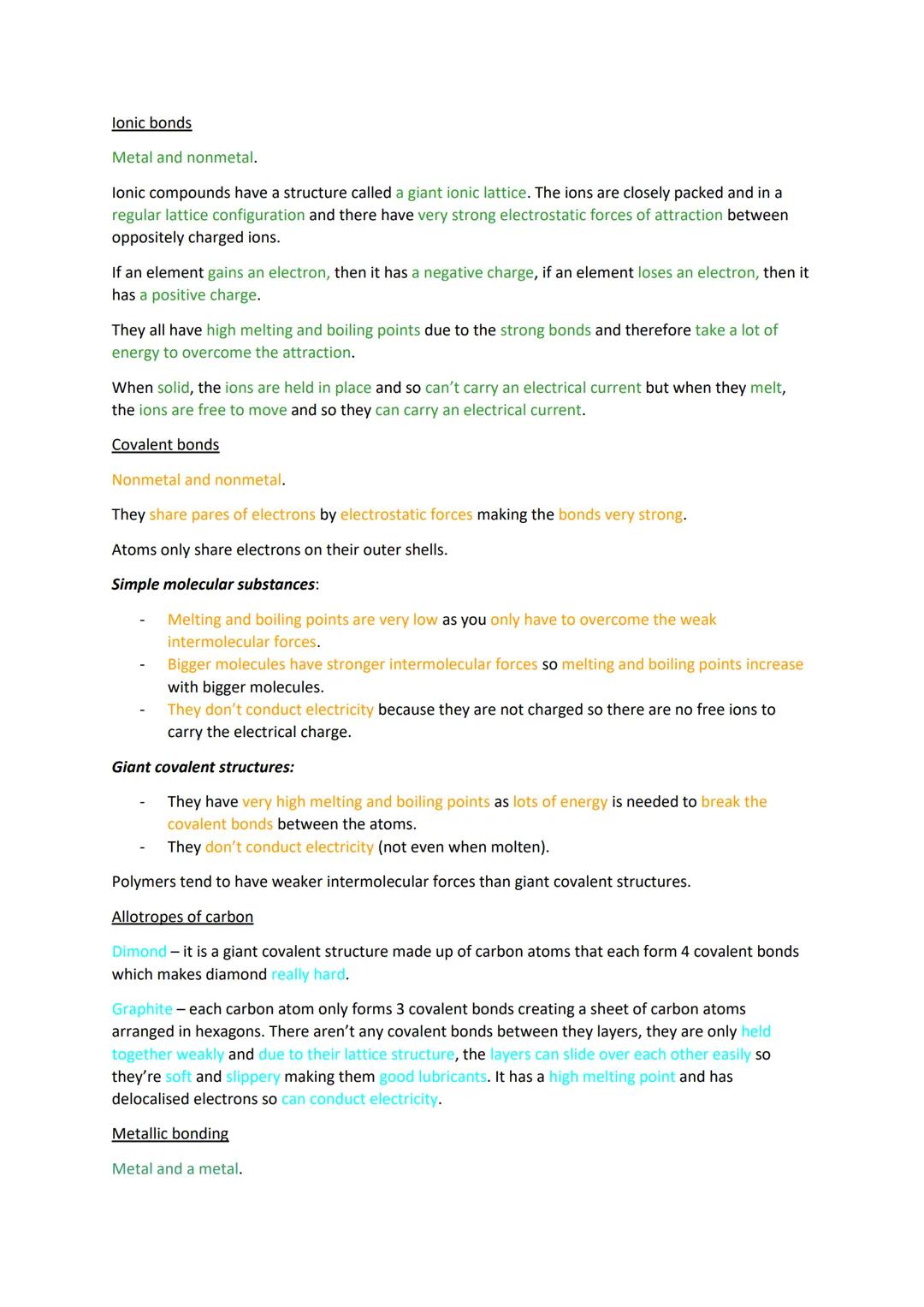
Ionic bonds form between metals and nonmetals when electrons transfer from one atom to another. When an atom loses an electron, it becomes positively charged; when it gains one, it becomes negatively charged.
These charged ions arrange themselves in a giant ionic lattice - think of it like a 3D chess board with positive and negative pieces alternating. The strong electrostatic forces between opposite charges give ionic compounds high melting and boiling points.
Here's something brilliant: ionic solids can't conduct electricity because the ions are stuck in place, but melt them and suddenly they become conductors as the ions can move freely!
Covalent bonds happen when two nonmetals share electrons rather than transferring them. Atoms only share electrons from their outer shells, creating very strong bonds through electrostatic forces.
Quick Tip: Remember "metals give, nonmetals take" for ionic bonds, but "nonmetals share" for covalent bonds!
Simple molecular substances have low melting points because you only need to break weak forces between molecules, not the strong covalent bonds within them. Bigger molecules have stronger intermolecular forces, so their melting points increase with size.
Giant covalent structures are completely different - they need massive amounts of energy to break apart because you're actually breaking strong covalent bonds between atoms.


 Chemistry
 English Literature
 Biology
 Sociology