
Ever wondered how your favourite TikTok dance spread across the...
 AP Human Geography43 views·Updated Jul 10, 2026·3 pages
AP Human Geography Unit 3 Vocabulary Guide

marker@itz.marker

1 / 3
1
of 3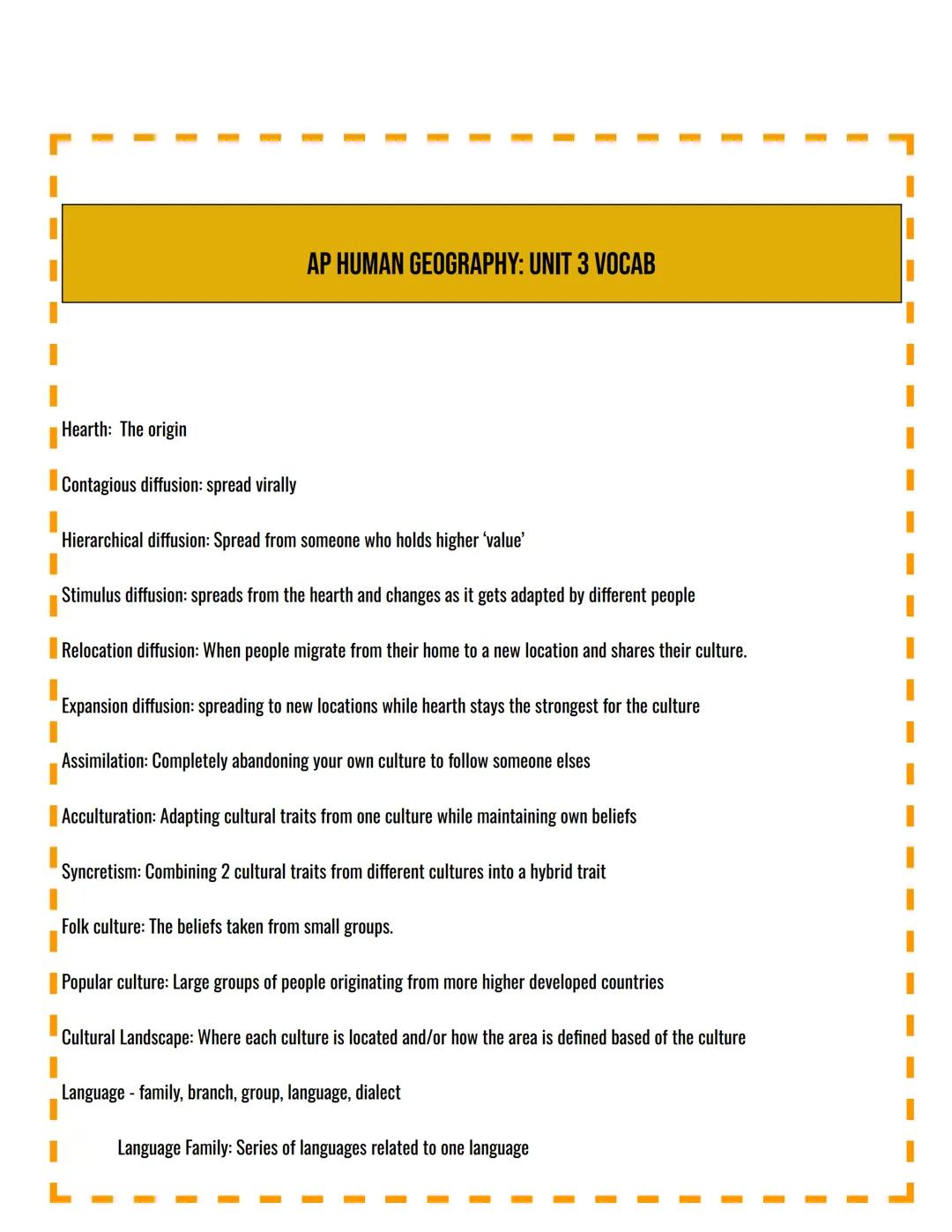
Cultural Diffusion and Change
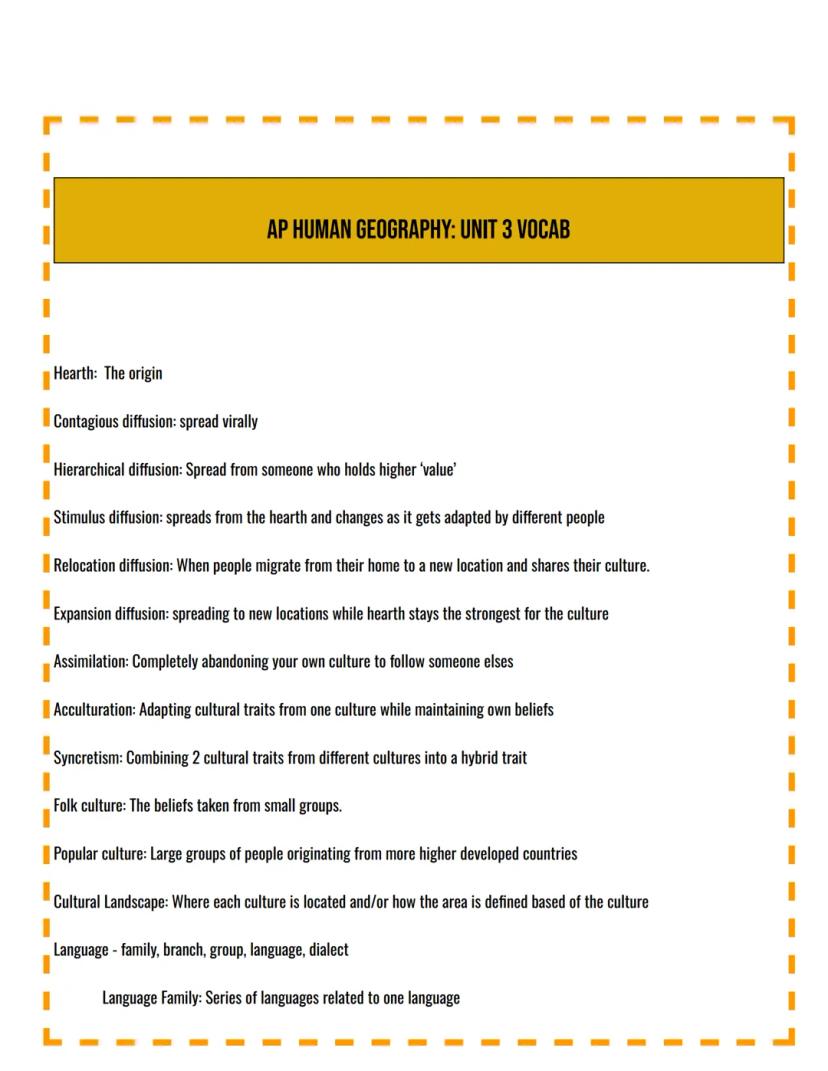
Think about how quickly a new slang word can spread through your school - that's contagious diffusion in action! It spreads virally from person to person, just like a meme going viral on social media.
Hierarchical diffusion works differently - it spreads from people with influence or status first. When celebrities start a fashion trend that then reaches regular people, that's hierarchical diffusion at work.
Sometimes cultures change as they spread. Stimulus diffusion happens when an idea travels from its hearth (origin point) but gets adapted along the way - like how McDonald's serves rice burgers in Asia instead of just regular buns.
Relocation diffusion occurs when people move and bring their culture with them, whilst expansion diffusion spreads to new places while keeping the original location strong. When people encounter new cultures, they might experience assimilation (completely adopting the new culture), acculturation (adapting some traits whilst keeping their own), or syncretism (blending cultures together).
Quick Tip: Remember that folk culture comes from small, local groups, while popular culture spreads from developed countries to large populations - think local Morris dancing versus global pop music!
2
of 3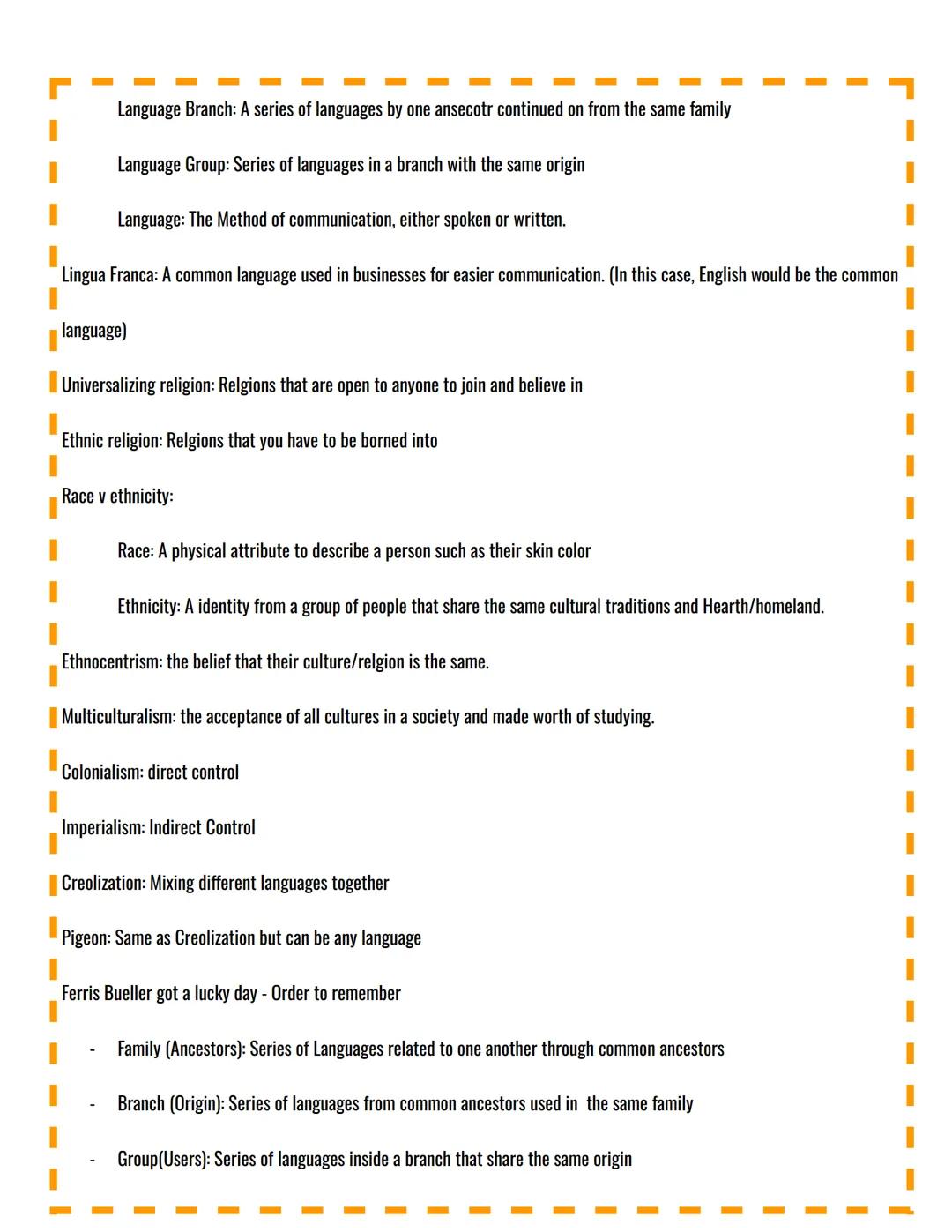
Language Families and Religion
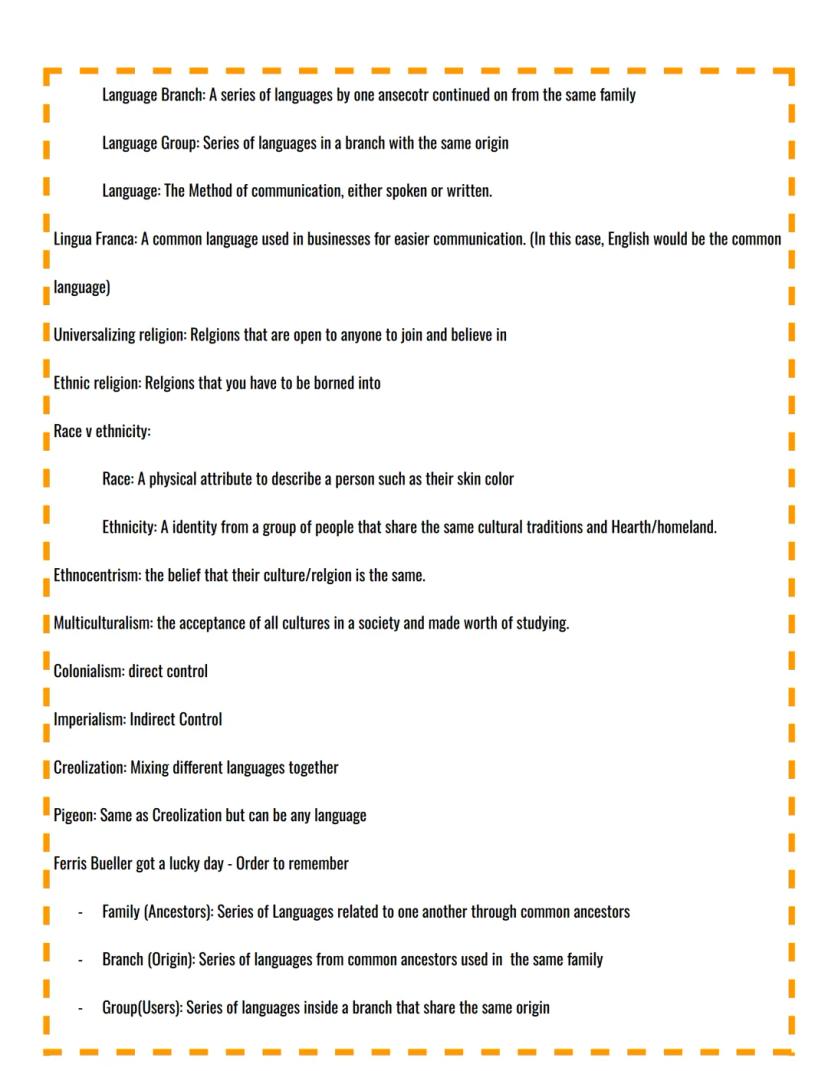
Languages aren't random - they're organised like a family tree! A language family includes all languages that share common ancestors. Within each family, you'll find language branches that split off, then language groups with the same origin, individual languages, and finally dialects (different accents or regional variations).
Here's a handy way to remember the order: "Ferris Bueller Got Lucky Day" - Family, Branch, Group, Language, Dialect. English belongs to the Indo-European family, Germanic branch, and West Germanic group.
Lingua franca is simply a common language used for business and communication between different groups - English fills this role globally today. When languages mix, you get creolization or pidgin languages.
Religion splits into two main types: universalizing religions (anyone can join, like Christianity or Islam) and ethnic religions (you're typically born into them, like Judaism or Hinduism). Understanding the difference between race (physical characteristics) and ethnicity (shared cultural traditions and homeland) is crucial for your exams.
Remember: Ethnocentrism means thinking your culture is superior, while multiculturalism celebrates and accepts all cultures as valuable.
3
of 3
Cultural Landscapes and Control
The cultural landscape shows you exactly where different cultures exist and how they've shaped the physical environment around them. You can literally see culture written across the land through architecture, place names, and land use patterns.
When studying historical control, distinguish between colonialism (direct political control over a territory) and imperialism (indirect influence and control). Both have massively shaped today's cultural and language patterns.
Exam Focus: These vocabulary terms frequently appear in multiple-choice questions, so make sure you can quickly distinguish between similar concepts like assimilation versus acculturation.
We thought you’d never ask...
Our AI companion is specifically built for the needs of students. Based on the millions of content pieces we have on the platform we can provide truly meaningful and relevant answers to students. But its not only about answers, the companion is even more about guiding students through their daily learning challenges, with personalised study plans, quizzes or content pieces in the chat and 100% personalisation based on the students skills and developments.
You can download the app in the Google Play Store and in the Apple App Store.
That's right! Enjoy free access to study content, connect with fellow students, and get instant help – all at your fingertips.
Similar Content
 Environmental Science
Most popular content in AP Human Geography
9I
AP Human GeographyIntroduction to Geographic Data
Practice identifying types of geographic data, including qualitative and quantitative sources like census data and satellite imagery.
9th5500
I
AP Human GeographyIntroduction to Human-Environmental Interaction
Practice the foundational concepts of environmental determinism and possibilism and their influence on early geographic thought.
9th4520
I
AP Human GeographyIntroduction to Map Properties and Scale
Practice identifying types of map distortion and calculating map scale to understand how physical reality is represented on a flat surface.
9th2860
U
AP Human GeographyUnit 2 Measuring Population Density quiz
Measuring Population Density
9th1720
P
AP Human GeographyPopulation: quiz #1!
Master the fundamentals of population with these easy flashcards designed for high school students. Explore key concepts, terms, and examples to ace your exams!
9th1910
I
AP Human GeographyIntroduction to Geographic Data Scales
Practice identifying and differentiating between local, regional, national, and global scales of analysis using maps and data sets.
9th1810
A
AP Human GeographyAP HUG UNIT 1
This is a little test to help you practice for AP HUG
10th1900
A
AP Human GeographyAPHUG Unit 1
10 questions just general info you should know if you have listened in your class :D
9th1580
AP Human GeographyAP Human Geography Unit 4 Vocabulary
Unit 4: Political Patterns and Processes
9th80365
Most popular content
9O
 AP US History
Origins and Dynamics of the Columbian Exchange
Analyze the ecological and economic motivations behind the initial transfer of goods, people, and diseases between the Old and New Worlds.
9th3,1280
I
AP US HistoryIntroduction to Early Cultural Interactions
Analyze the initial social and religious encounters between Europeans, Africans, and Indigenous peoples in the colonial Americas.
9th2,7730
M
AP US HistoryMotivations for European Exploration
Analyze the economic, religious, and political factors that drove European powers to the Americas during the 15th and 16th centuries.
9th1,7780
O
 AP World History
Origins of Ancient River Civilizations
Analyze the environmental factors and technological innovations that led to the rise of early states in Mesopotamia, Egypt, and the Indus Valley.
9th3,1870
F
AP PsychologyFoundations of Ethical Guidelines in Research
Practice the core principles of the APA ethical code including informed consent, debriefing, and the role of Institutional Review Boards.
9th1,3360
I
AP US HistoryIntroduction to Native American Societies
Examine the diverse social, political, and economic structures of North American indigenous groups prior to European contact.
9th1,1100
I
AP US HistoryIntroduction to the Spanish Encomienda System
Explore the fundamental economic and social structures of the Spanish colonial system, focusing on the encomienda and the casta social hierarchy.
9th8890
I
 AP Biology
Introduction to Biological Elements of Life
Practice identifying the essential elements including carbon, nitrogen, phosphorus, and sulfur that compose biological macromolecules.
9th1,7410
F
AP PsychologyFoundations of Research Design and Methodology
Practice distinguishing between different research methods including experiments, correlations, and case studies while identifying key variables.
9th6670
Students love us — and so will you.
4.6/5App Store
4.7/5Google Play
The app is very easy to use and well designed. I have found everything I was looking for so far and have been able to learn a lot from the presentations! I will definitely use the app for a class assignment! And of course it also helps a lot as an inspiration.
Stefan SiOS user
This app is really great. There are so many study notes and help [...]. My problem subject is French, for example, and the app has so many options for help. Thanks to this app, I have improved my French. I would recommend it to anyone.
Samantha KlichAndroid user
Wow, I am really amazed. I just tried the app because I've seen it advertised many times and was absolutely stunned. This app is THE HELP you want for school and above all, it offers so many things, such as workouts and fact sheets, which have been VERY helpful to me personally.
AnnaiOS user
AP Human Geography43 views·Updated Jul 10, 2026·3 pagesAP Human Geography Unit 3 Vocabulary Guide
marker@itz.marker
Ever wondered how your favourite TikTok dance spread across the world, or why English is used in international business? Cultural diffusion and language patterns shape everything around us, from the food we eat to the apps we use.
1
of 3
Sign up to see the content. It's free!
- Access to all documents
- Improve your grades
- Join milions of students
Cultural Diffusion and Change
Think about how quickly a new slang word can spread through your school - that's contagious diffusion in action! It spreads virally from person to person, just like a meme going viral on social media.
Hierarchical diffusion works differently - it spreads from people with influence or status first. When celebrities start a fashion trend that then reaches regular people, that's hierarchical diffusion at work.
Sometimes cultures change as they spread. Stimulus diffusion happens when an idea travels from its hearth (origin point) but gets adapted along the way - like how McDonald's serves rice burgers in Asia instead of just regular buns.
Relocation diffusion occurs when people move and bring their culture with them, whilst expansion diffusion spreads to new places while keeping the original location strong. When people encounter new cultures, they might experience assimilation (completely adopting the new culture), acculturation (adapting some traits whilst keeping their own), or syncretism (blending cultures together).
Quick Tip: Remember that folk culture comes from small, local groups, while popular culture spreads from developed countries to large populations - think local Morris dancing versus global pop music!
2
of 3Sign up to see the content. It's free!
- Access to all documents
- Improve your grades
- Join milions of students
Language Families and Religion
Languages aren't random - they're organised like a family tree! A language family includes all languages that share common ancestors. Within each family, you'll find language branches that split off, then language groups with the same origin, individual languages, and finally dialects (different accents or regional variations).
Here's a handy way to remember the order: "Ferris Bueller Got Lucky Day" - Family, Branch, Group, Language, Dialect. English belongs to the Indo-European family, Germanic branch, and West Germanic group.
Lingua franca is simply a common language used for business and communication between different groups - English fills this role globally today. When languages mix, you get creolization or pidgin languages.
Religion splits into two main types: universalizing religions (anyone can join, like Christianity or Islam) and ethnic religions (you're typically born into them, like Judaism or Hinduism). Understanding the difference between race (physical characteristics) and ethnicity (shared cultural traditions and homeland) is crucial for your exams.
Remember: Ethnocentrism means thinking your culture is superior, while multiculturalism celebrates and accepts all cultures as valuable.
3
of 3Sign up to see the content. It's free!
- Access to all documents
- Improve your grades
- Join milions of students
Cultural Landscapes and Control
The cultural landscape shows you exactly where different cultures exist and how they've shaped the physical environment around them. You can literally see culture written across the land through architecture, place names, and land use patterns.
When studying historical control, distinguish between colonialism (direct political control over a territory) and imperialism (indirect influence and control). Both have massively shaped today's cultural and language patterns.
Exam Focus: These vocabulary terms frequently appear in multiple-choice questions, so make sure you can quickly distinguish between similar concepts like assimilation versus acculturation.
We thought you’d never ask...
Our AI companion is specifically built for the needs of students. Based on the millions of content pieces we have on the platform we can provide truly meaningful and relevant answers to students. But its not only about answers, the companion is even more about guiding students through their daily learning challenges, with personalised study plans, quizzes or content pieces in the chat and 100% personalisation based on the students skills and developments.
You can download the app in the Google Play Store and in the Apple App Store.
That's right! Enjoy free access to study content, connect with fellow students, and get instant help – all at your fingertips.
Similar Content
Most popular content in AP Human Geography
9I
AP Human GeographyIntroduction to Geographic Data
Practice identifying types of geographic data, including qualitative and quantitative sources like census data and satellite imagery.
9th5500
I
AP Human GeographyIntroduction to Human-Environmental Interaction
Practice the foundational concepts of environmental determinism and possibilism and their influence on early geographic thought.
9th4520
I
AP Human GeographyIntroduction to Map Properties and Scale
Practice identifying types of map distortion and calculating map scale to understand how physical reality is represented on a flat surface.
9th2860
U
AP Human GeographyUnit 2 Measuring Population Density quiz
Measuring Population Density
9th1720
P
AP Human GeographyPopulation: quiz #1!
Master the fundamentals of population with these easy flashcards designed for high school students. Explore key concepts, terms, and examples to ace your exams!
9th1910
I
AP Human GeographyIntroduction to Geographic Data Scales
Practice identifying and differentiating between local, regional, national, and global scales of analysis using maps and data sets.
9th1810
A
AP Human GeographyAP HUG UNIT 1
This is a little test to help you practice for AP HUG
10th1900
A
AP Human GeographyAPHUG Unit 1
10 questions just general info you should know if you have listened in your class :D
9th1580
AP Human GeographyAP Human Geography Unit 4 Vocabulary
Unit 4: Political Patterns and Processes
9th80365
Most popular content
9O
AP US HistoryOrigins and Dynamics of the Columbian Exchange
Analyze the ecological and economic motivations behind the initial transfer of goods, people, and diseases between the Old and New Worlds.
9th3,1280
I
AP US HistoryIntroduction to Early Cultural Interactions
Analyze the initial social and religious encounters between Europeans, Africans, and Indigenous peoples in the colonial Americas.
9th2,7730
M
AP US HistoryMotivations for European Exploration
Analyze the economic, religious, and political factors that drove European powers to the Americas during the 15th and 16th centuries.
9th1,7780
O
AP World HistoryOrigins of Ancient River Civilizations
Analyze the environmental factors and technological innovations that led to the rise of early states in Mesopotamia, Egypt, and the Indus Valley.
9th3,1870
F
AP PsychologyFoundations of Ethical Guidelines in Research
Practice the core principles of the APA ethical code including informed consent, debriefing, and the role of Institutional Review Boards.
9th1,3360
I
AP US HistoryIntroduction to Native American Societies
Examine the diverse social, political, and economic structures of North American indigenous groups prior to European contact.
9th1,1100
I
AP US HistoryIntroduction to the Spanish Encomienda System
Explore the fundamental economic and social structures of the Spanish colonial system, focusing on the encomienda and the casta social hierarchy.
9th8890
I
AP BiologyIntroduction to Biological Elements of Life
Practice identifying the essential elements including carbon, nitrogen, phosphorus, and sulfur that compose biological macromolecules.
9th1,7410
F
AP PsychologyFoundations of Research Design and Methodology
Practice distinguishing between different research methods including experiments, correlations, and case studies while identifying key variables.
9th6670
Students love us — and so will you.
4.6/5App Store
4.7/5Google Play
The app is very easy to use and well designed. I have found everything I was looking for so far and have been able to learn a lot from the presentations! I will definitely use the app for a class assignment! And of course it also helps a lot as an inspiration.
Stefan SiOS user
This app is really great. There are so many study notes and help [...]. My problem subject is French, for example, and the app has so many options for help. Thanks to this app, I have improved my French. I would recommend it to anyone.
Samantha KlichAndroid user
Wow, I am really amazed. I just tried the app because I've seen it advertised many times and was absolutely stunned. This app is THE HELP you want for school and above all, it offers so many things, such as workouts and fact sheets, which have been VERY helpful to me personally.
AnnaiOS user