
Psychology has loads of different theories trying to explain why... Show more
 Criminology
 Biology
Sign up to see the contentIt's free!
Access to all documents
Improve your grades
Join milions of students
By signing up you accept Terms of Service and Privacy Policy
Subjects

Biology

Chemistry
AP Chemistry

English
AP English Literature
140
•
Dec 11, 2025
•

lola hammond
@lolahammond_hyow
Psychology has loads of different theories trying to explain why... Show more
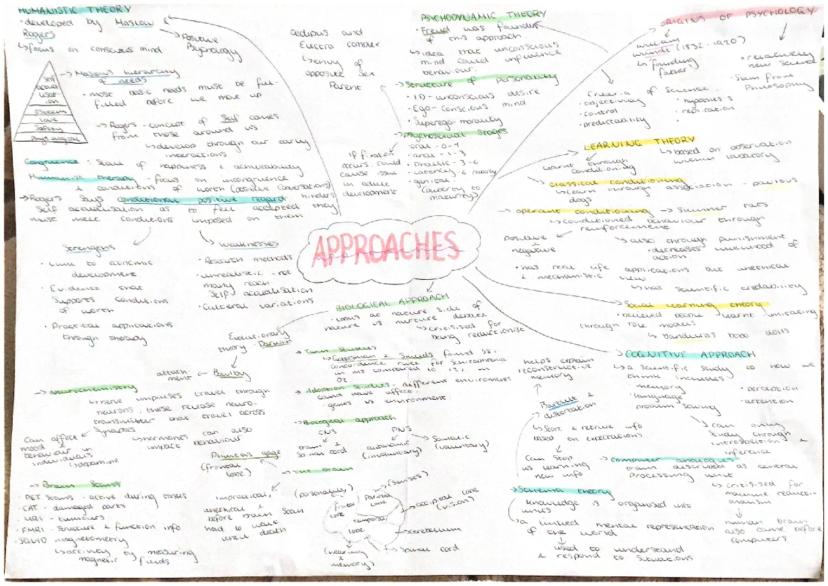
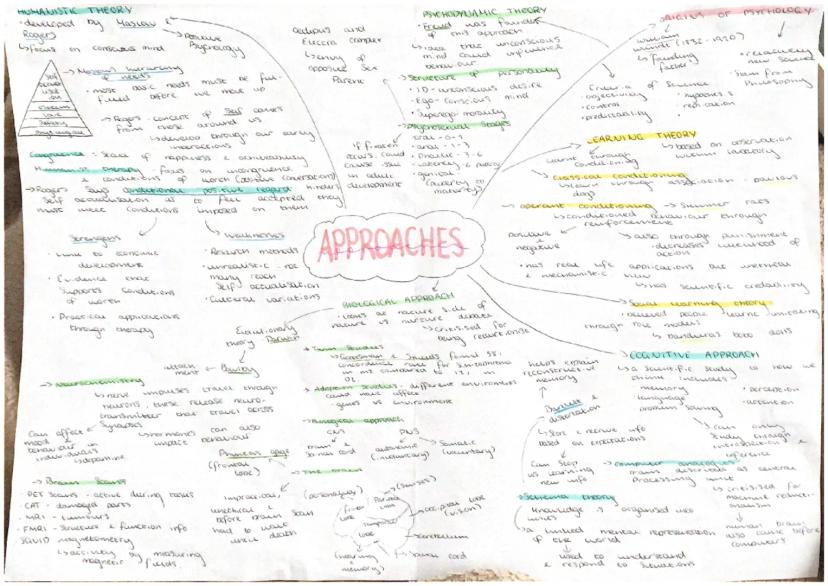
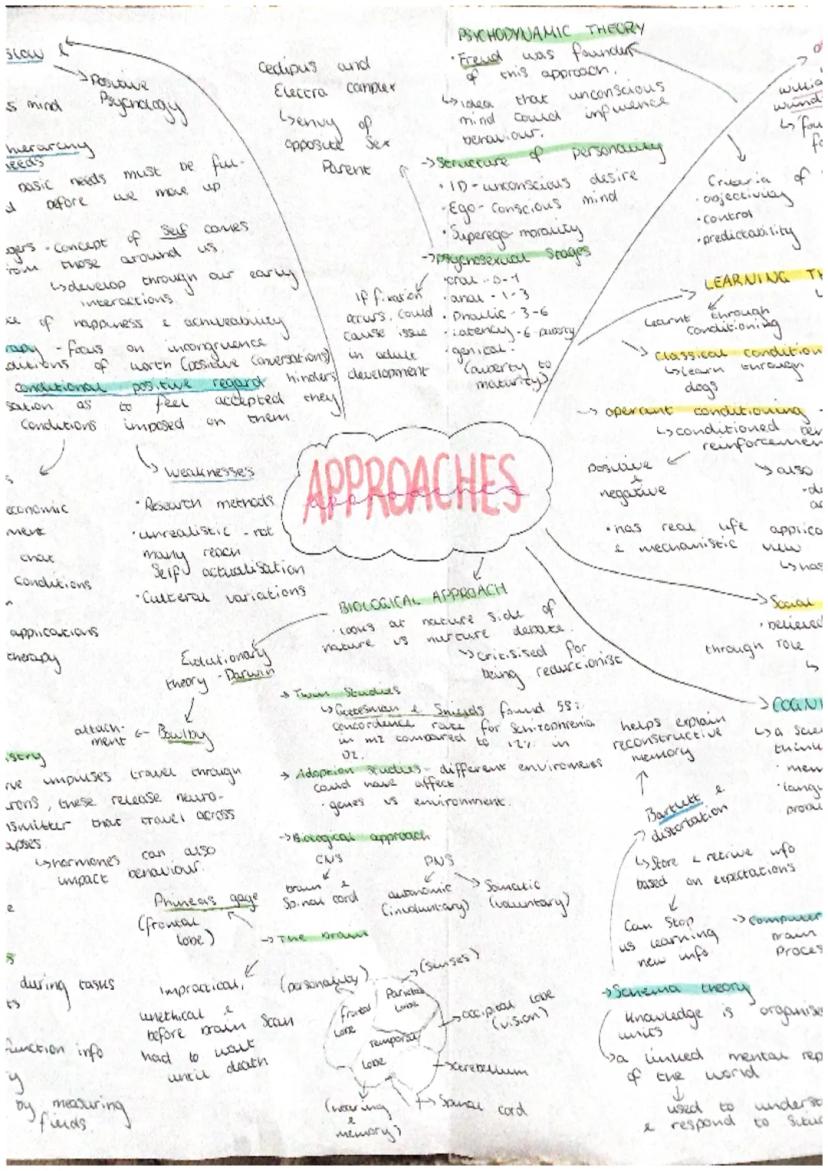
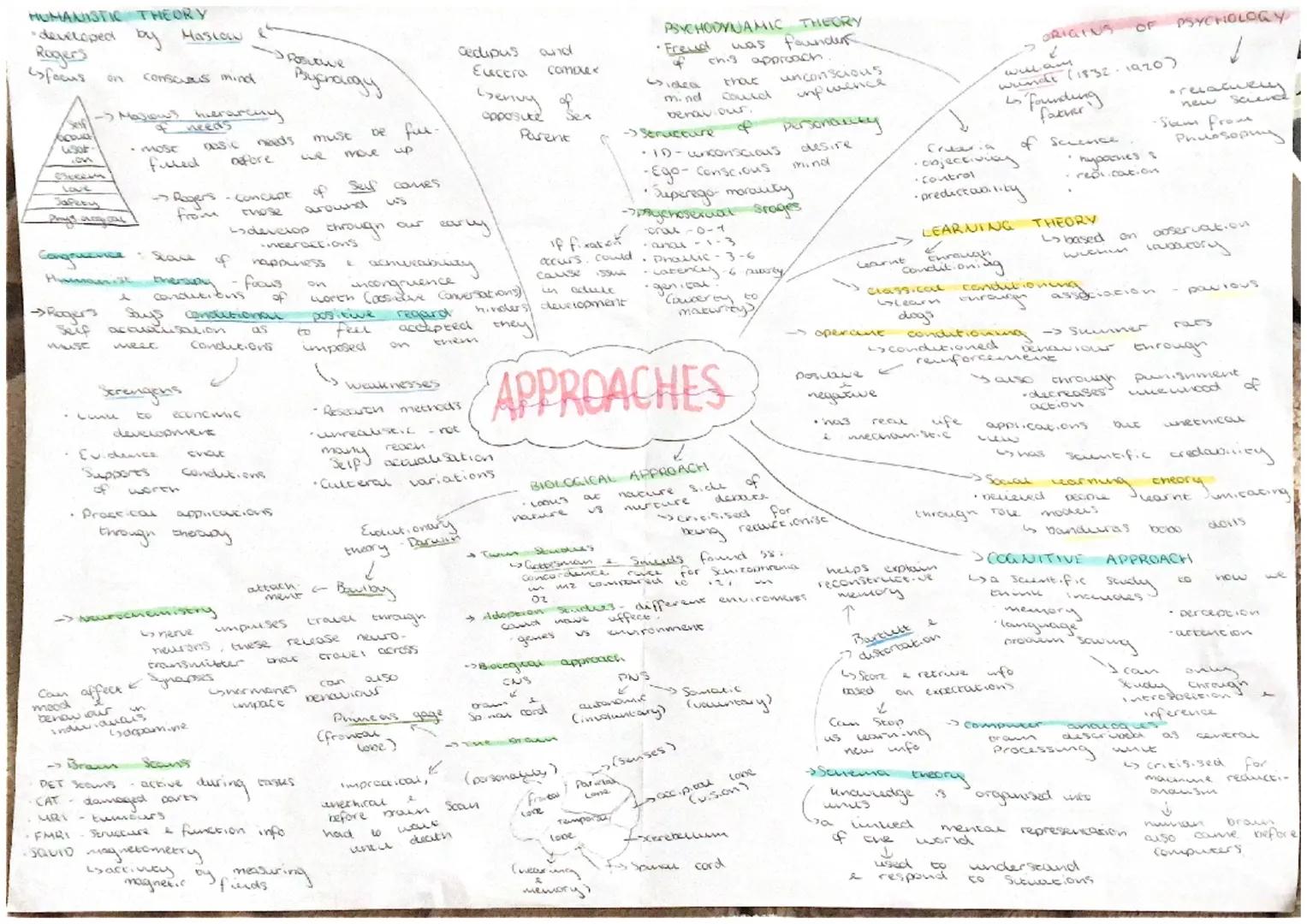
Ever wondered why you behave the way you do? Psychology offers several major theories that attempt to explain human behaviour, each with their own focus and methods.
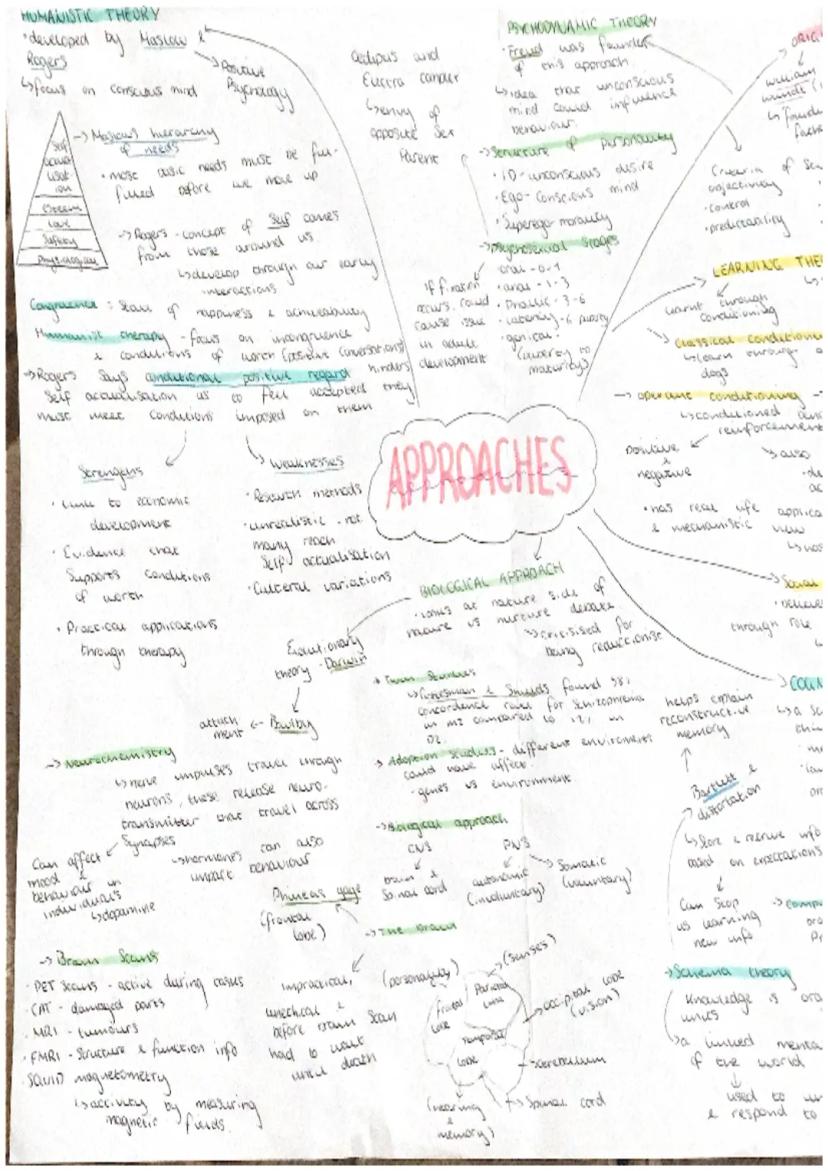
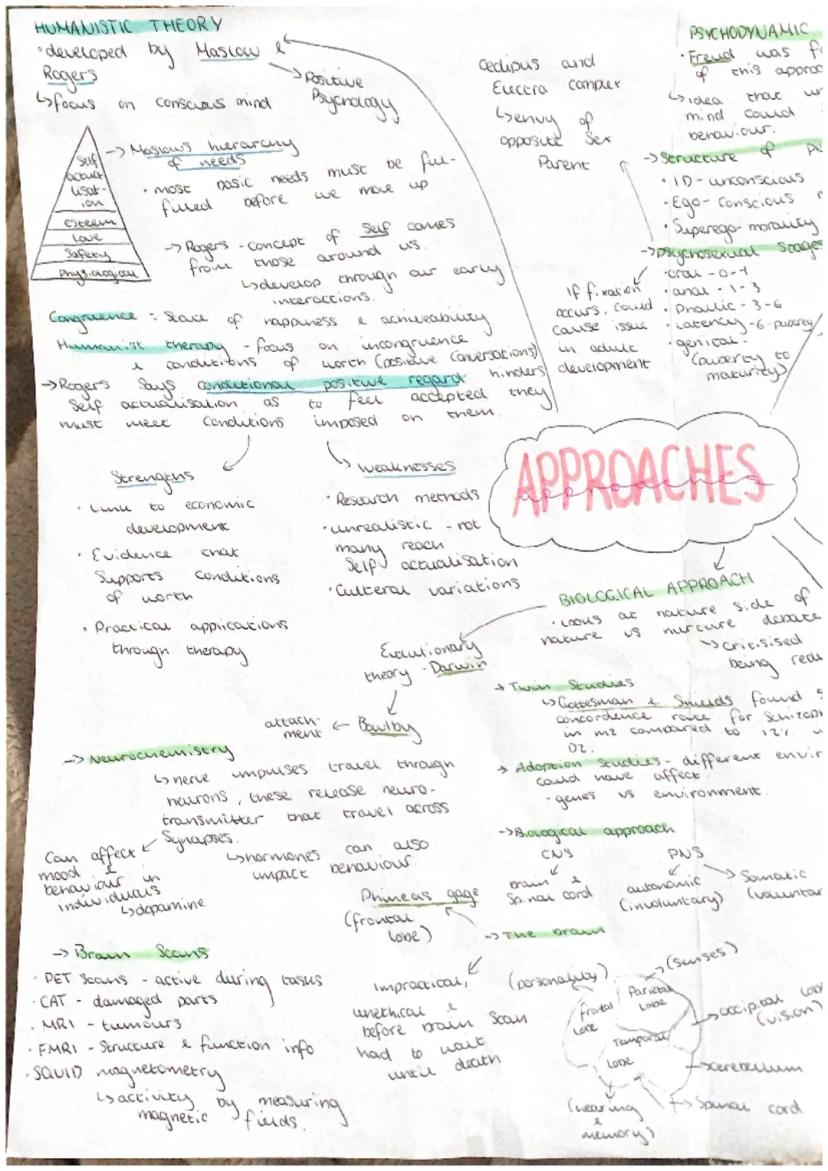
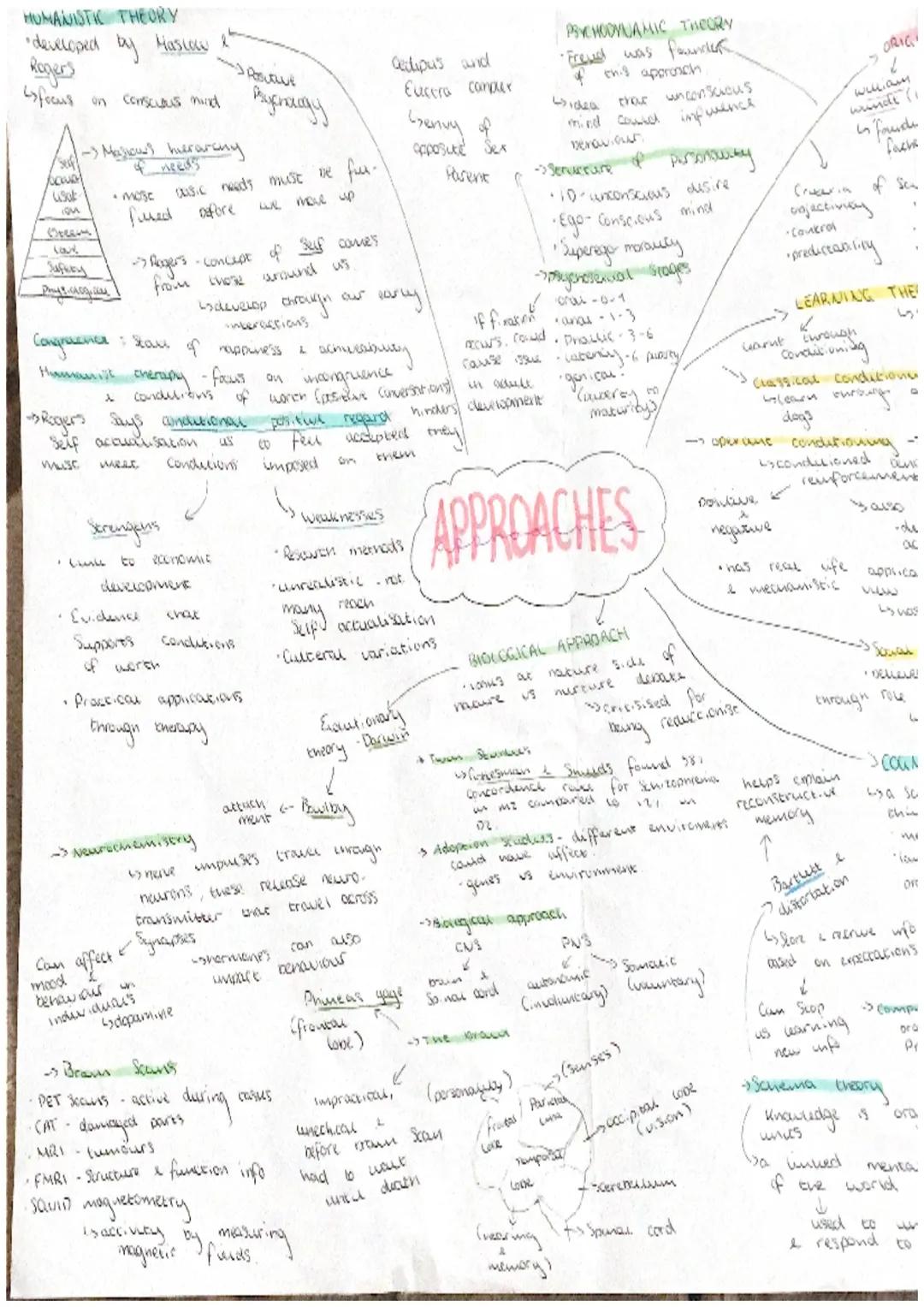
The humanistic approach developed by Maslow and Rogers focuses on conscious thoughts and self-development. Maslow's hierarchy of needs suggests we must fulfil basic needs (like food and safety) before moving up to higher needs like love and self-actualisation. Rogers believed our self-concept develops through early interactions with others.
Psychodynamic theory, founded by Freud, argues that our unconscious mind drives behaviour. It includes the structure of personality (ID, Ego, Superego) and psychosexual stages of development where fixation can cause adult problems.
Key Point: Each approach offers a different lens for understanding behaviour - conscious vs unconscious, nature vs nurture, individual vs social influences.
The biological approach examines how neurochemistry and brain structure affect behaviour. Neurotransmitters like dopamine cross synapses to influence mood and actions. Brain scans (fMRI, PET) help researchers study the brain-behaviour connection.
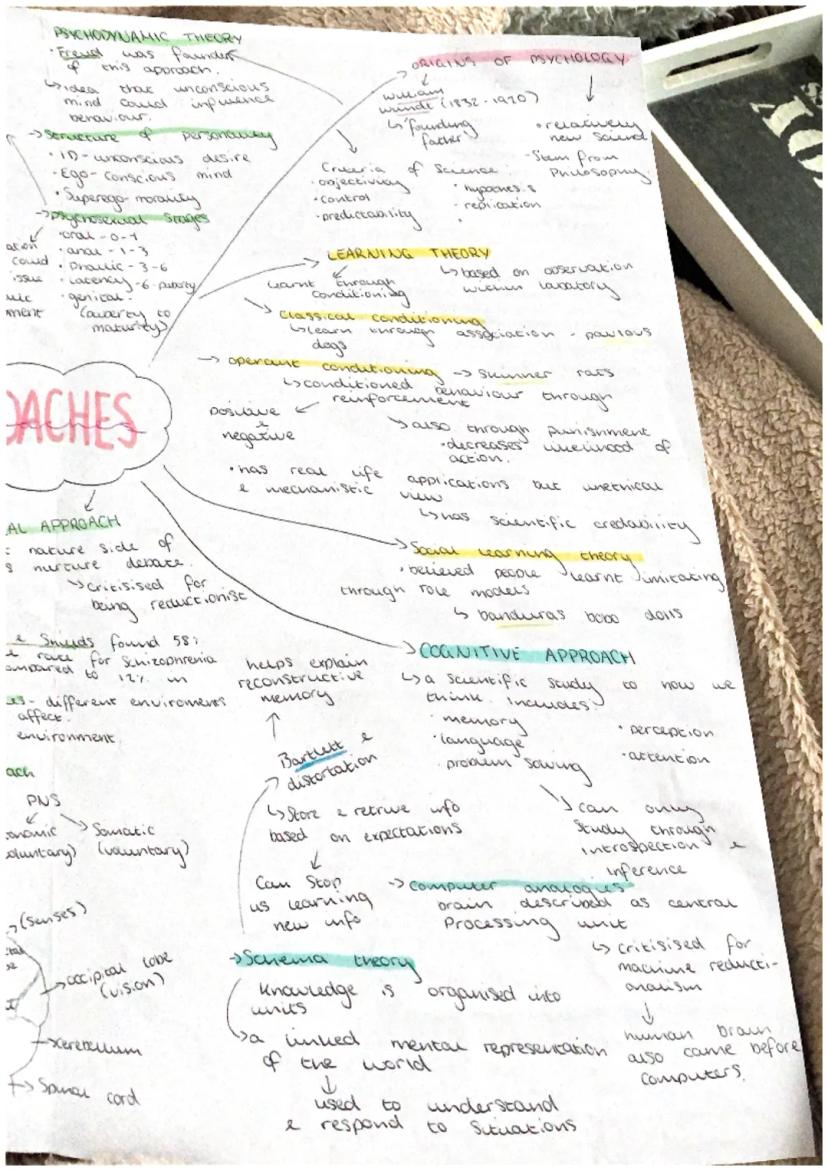
Learning theory focuses on how we acquire behaviours through classical conditioning (Pavlov's dogs) and operant conditioning (reinforcement and punishment). Social learning theory by Bandura shows we also learn by imitating role models.
Humanistic psychology puts you in the driver's seat of your own life. Maslow and Rogers believed humans are naturally good and motivated to reach their full potential.
Rogers' concept of self develops through our relationships with others. When we experience conditional positive regard (love with strings attached), we might develop incongruence - a mismatch between our true self and who we think we should be. Humanistic therapy focuses on creating conditions for personal growth.
The approach has strengths like emphasising personal growth and having practical therapy applications. However, it's criticised for being unrealistic and culturally biased towards Western individualistic values.
Freud's psychodynamic theory suggests our unconscious desires control behaviour. The personality has three parts: the ID (unconscious desires), Ego (conscious rational mind), and Superego (moral conscience). Problems can arise if we get stuck at any psychosexual stage during childhood development.
Remember: Freud believed childhood experiences, especially fixations during psychosexual stages, shape our adult personality and behaviour patterns.
The theory includes concepts like the Oedipus complex (boys' unconscious attraction to mothers) and Electra complex (girls' version). Whilst influential, it's criticised for being unscientific and based on limited case studies.
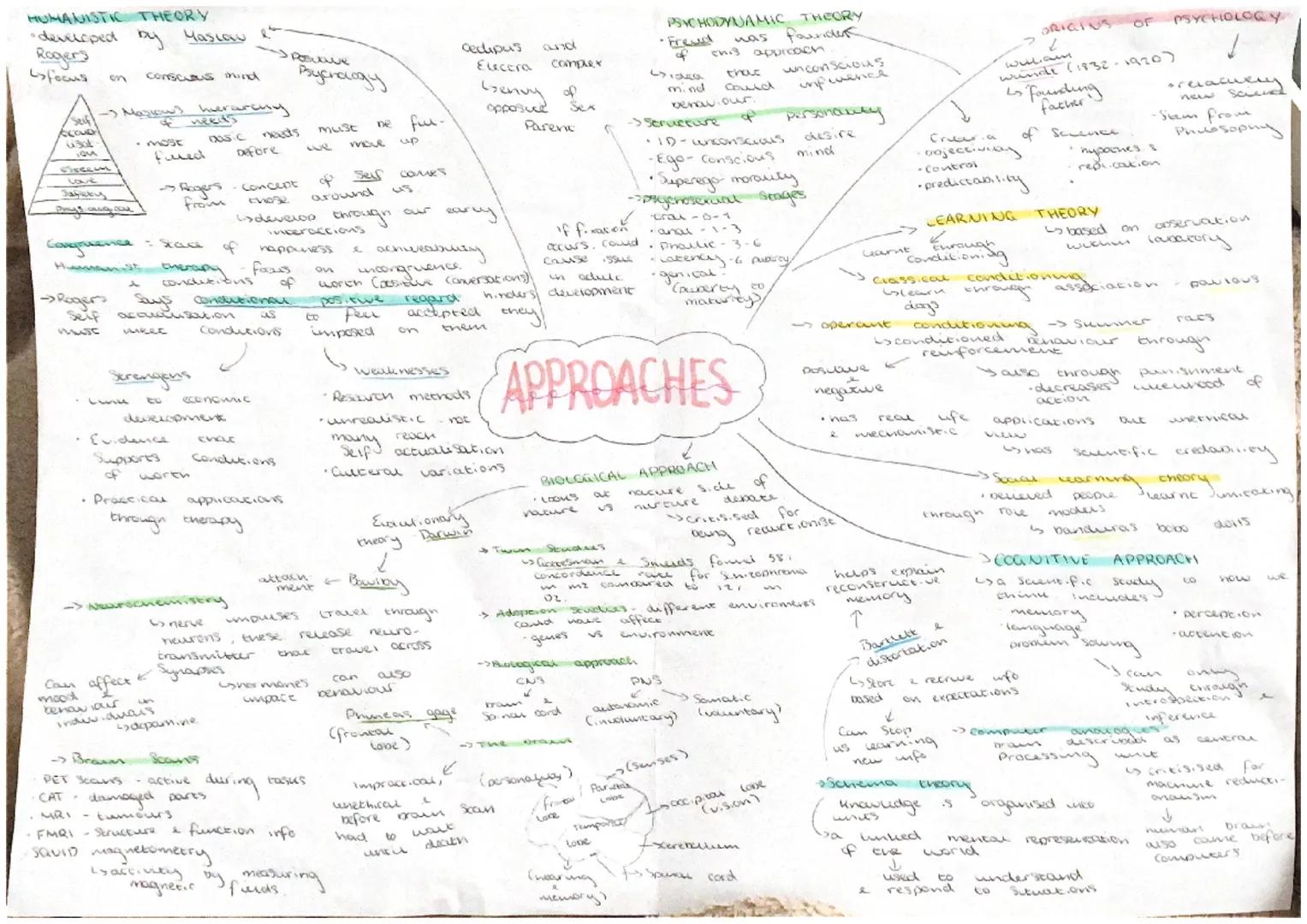
Learning theory proves you're constantly shaped by your environment. Classical conditioning shows how we learn through association - like Pavlov's dogs salivating at the sound of a bell.
Operant conditioning by Skinner focuses on consequences. Positive reinforcement increases behaviour (getting praise), whilst punishment decreases it. This has real-life applications in education and behaviour modification programs.
Social learning theory by Bandura added a crucial element - we learn by watching others. His famous Bobo doll experiment showed children imitating aggressive behaviour they'd observed. This explains how we pick up behaviours from role models around us.
The approach is praised for being scientific and having practical applications. However, it's criticised for being mechanistic (treating humans like machines) and potentially ignoring biological factors.
Study Tip: Remember the difference - classical conditioning links two stimuli together, operant conditioning links behaviour to consequences, social learning involves observation and imitation.
The biological approach examines the physical basis of behaviour. Neurochemistry involves nerve impulses travelling between neurons via neurotransmitters across synapses. Different neurotransmitters like dopamine affect mood and behaviour.
Brain scanning techniques like fMRI and PET scans allow researchers to observe brain activity in real-time. Twin studies and adoption studies help separate nature vs nurture influences on behaviour.
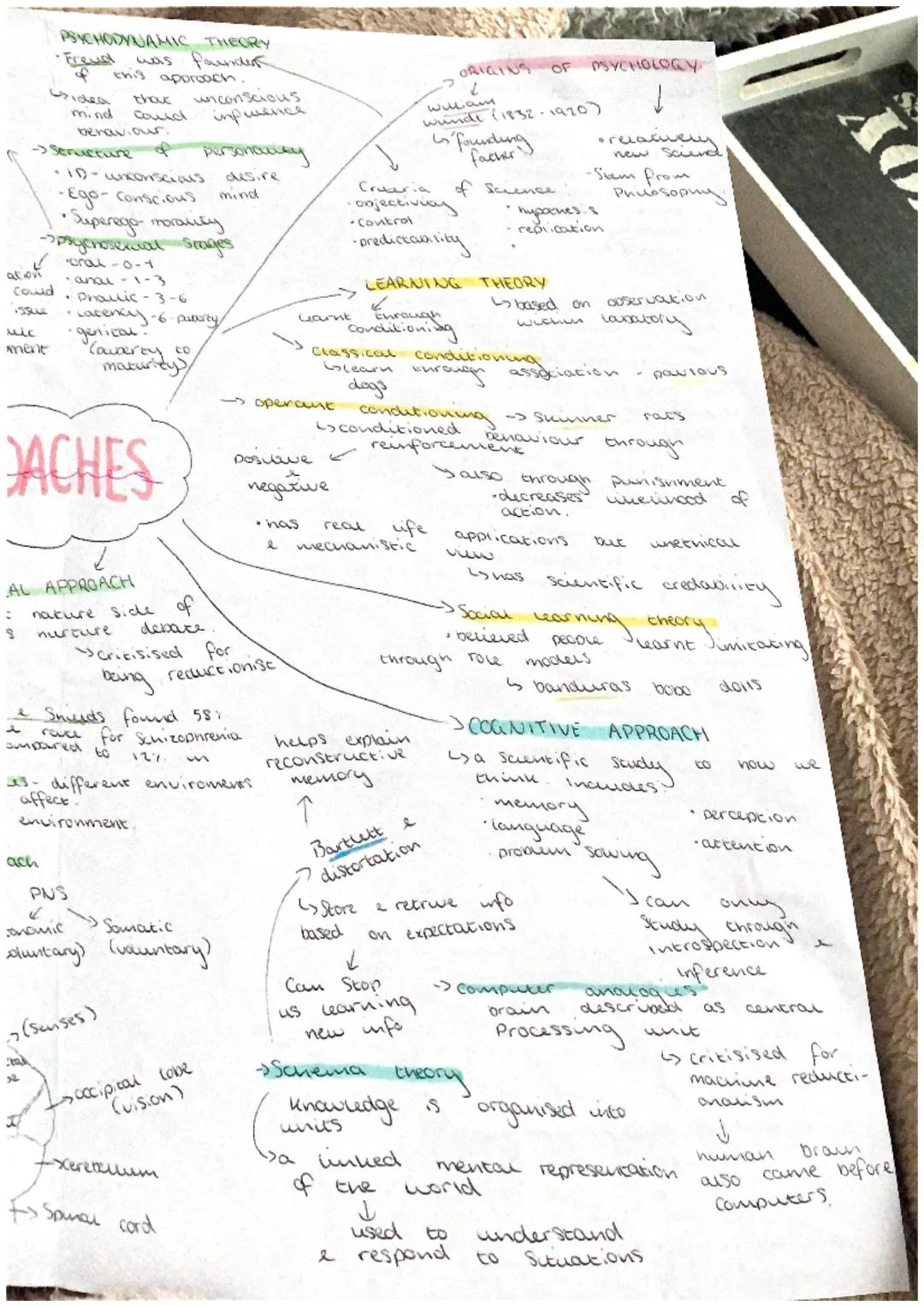
The cognitive approach treats your brain like a computer, focusing on how you process information. It studies memory, language, and problem-solving to understand mental processes.
Schema theory suggests we organise knowledge into mental frameworks that help us understand and respond to situations. However, schemas can also distort memory - Bartlett showed how we reconstruct memories based on our expectations rather than storing them like video recordings.
The approach uses the computer analogy - comparing human thinking to information processing systems with input, processing, and output stages. We study cognitive processes through controlled experiments and introspection (examining our own thoughts).
Cognitive psychology has revolutionised our understanding of attention, perception, and memory. It's highly scientific and has practical applications in education and therapy. However, it's criticised for being reductionist (oversimplifying complex human behaviour) and the computer analogy may be outdated.
Exam Tip: Schema theory explains why eyewitness testimony can be unreliable - we don't just recall events, we reconstruct them based on our existing knowledge and expectations.
Research methods in psychology aim for objectivity, control, and predictability. Wilhelm Wundt (1832-1920) is considered the founding father of scientific psychology, establishing the first psychology laboratory and separating it from philosophy.
Different approaches use various research methods - from Freud's case studies to behaviourists' controlled experiments to cognitive psychologists' laboratory studies.
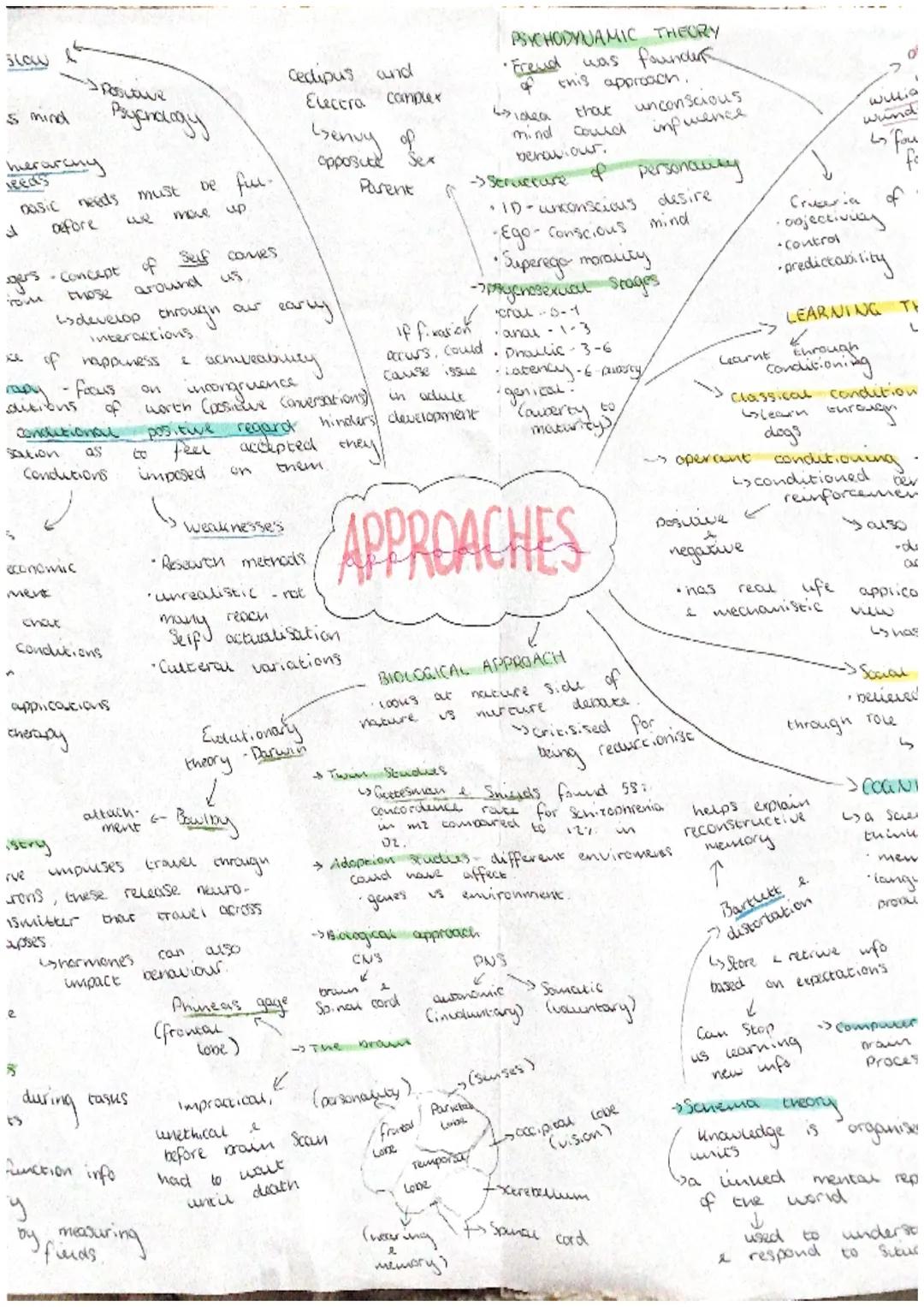
Your brain is remarkably organised, with different areas specialising in specific functions. Understanding brain structure helps explain how damage or changes affect behaviour.
The Central Nervous System (CNS) includes the brain and spinal cord, whilst the Peripheral Nervous System (PNS) has two branches: the autonomic (involuntary functions like heartbeat) and somatic (voluntary movement and senses).
Key brain areas include the frontal lobe , parietal lobe (touch and spatial awareness), temporal lobe (hearing and memory), occipital lobe (vision), and cerebellum (balance and coordination). The spinal cord connects the brain to the rest of the body.
Case studies like Phineas Gage show how brain damage affects behaviour. Gage's frontal lobe injury changed his personality dramatically, providing early evidence for localisation of function in the brain.
Real-World Application: Understanding brain structure helps explain conditions like Alzheimer's (memory problems from temporal lobe damage) or stroke effects (depending on which brain area is affected).
Modern brain scanning techniques have revolutionised neuroscience. fMRI shows brain structure and function, PET scans reveal brain activity during tasks, and SQUID magnetometry measures magnetic fields created by neural activity.
However, these techniques can be impractical and raise ethical concerns. Before modern scanning, researchers had to wait until patients died to examine their brains, limiting real-time understanding of brain-behaviour relationships.
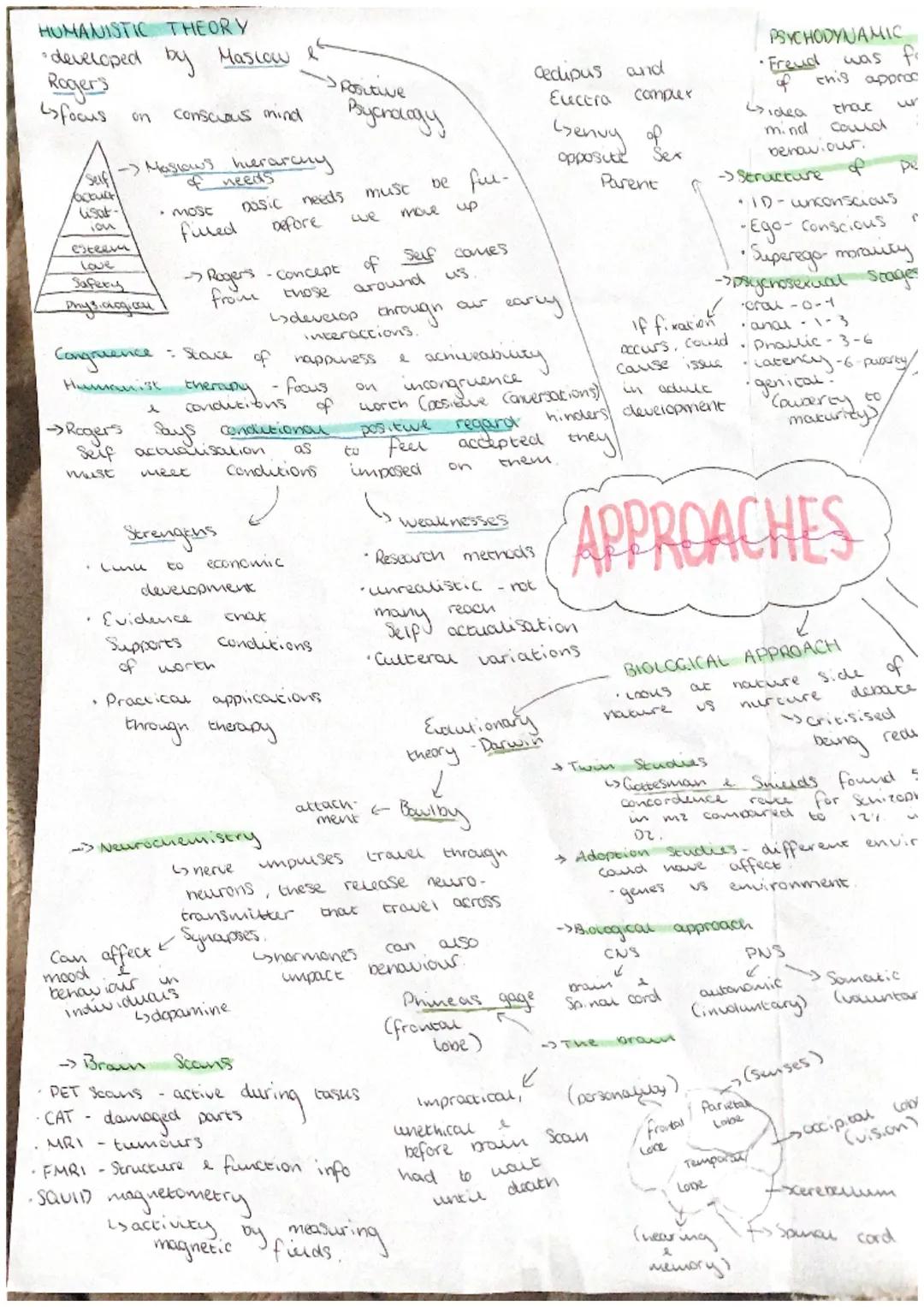
Each psychological approach offers valuable insights, but they also have significant limitations you need to understand for your exams.
Maslow's hierarchy shows how basic needs must be met before pursuing higher goals like self-actualisation. However, critics argue this model is culturally biased towards Western individualistic societies and unrealistic - not everyone reaches self-actualisation.
The biological approach provides scientific credibility through twin studies and adoption studies. Gottesman and Shields found 58% concordance for schizophrenia in identical twins compared to 12% in the general population, supporting genetic influences.
However, the approach is criticised for being reductionist - reducing complex human behaviour to just biological factors. The nature vs nurture debate shows both genes and environment interact to influence behaviour.
Evaluation Skill: Always consider both strengths and weaknesses when evaluating approaches. Look for scientific evidence, practical applications, but also limitations and cultural bias.
Research methods vary in their strengths and weaknesses. Laboratory experiments offer control and replicability but may lack ecological validity. Case studies provide rich detail but can't be generalised to wider populations.
Modern psychology increasingly recognises that multiple approaches together provide the most complete understanding of human behaviour. Rather than choosing one theory, psychologists often integrate insights from biological, cognitive, and social perspectives.
Our AI companion is specifically built for the needs of students. Based on the millions of content pieces we have on the platform we can provide truly meaningful and relevant answers to students. But its not only about answers, the companion is even more about guiding students through their daily learning challenges, with personalised study plans, quizzes or content pieces in the chat and 100% personalisation based on the students skills and developments.
You can download the app in the Google Play Store and in the Apple App Store.
That's right! Enjoy free access to study content, connect with fellow students, and get instant help – all at your fingertips.
Quotes from every main character
English LiteratureApp Store
Google Play
The app is very easy to use and well designed. I have found everything I was looking for so far and have been able to learn a lot from the presentations! I will definitely use the app for a class assignment! And of course it also helps a lot as an inspiration.
Stefan S
iOS user
This app is really great. There are so many study notes and help [...]. My problem subject is French, for example, and the app has so many options for help. Thanks to this app, I have improved my French. I would recommend it to anyone.
Samantha Klich
Android user
Wow, I am really amazed. I just tried the app because I've seen it advertised many times and was absolutely stunned. This app is THE HELP you want for school and above all, it offers so many things, such as workouts and fact sheets, which have been VERY helpful to me personally.
Anna
iOS user
I think it’s very much worth it and you’ll end up using it a lot once you get the hang of it and even after looking at others notes you can still ask your Artificial intelligence buddy the question and ask to simplify it if you still don’t get it!!! In the end I think it’s worth it 😊👍 ⚠️Also DID I MENTION ITS FREEE YOU DON’T HAVE TO PAY FOR ANYTHING AND STILL GET YOUR GRADES IN PERFECTLY❗️❗️⚠️
Thomas R
iOS user
Knowunity is the BEST app I’ve used in a minute. This is not an ai review or anything this is genuinely coming from a 7th grade student (I know 2011 im young) but dude this app is a 10/10 i have maintained a 3.8 gpa and have plenty of time for gaming. I love it and my mom is just happy I got good grades
Brad T
Android user
Not only did it help me find the answer but it also showed me alternative ways to solve it. I was horrible in math and science but now I have an a in both subjects. Thanks for the help🤍🤍
David K
iOS user
The app's just great! All I have to do is enter the topic in the search bar and I get the response real fast. I don't have to watch 10 YouTube videos to understand something, so I'm saving my time. Highly recommended!
Sudenaz Ocak
Android user
In school I was really bad at maths but thanks to the app, I am doing better now. I am so grateful that you made the app.
Greenlight Bonnie
Android user
I found this app a couple years ago and it has only gotten better since then. I really love it because it can help with written questions and photo questions. Also, it can find study guides that other people have made as well as flashcard sets and practice tests. The free version is also amazing for students who might not be able to afford it. Would 100% recommend
Aubrey
iOS user
Best app if you're in Highschool or Junior high. I have been using this app for 2 school years and it's the best, it's good if you don't have anyone to help you with school work.😋🩷🎀
Marco B
iOS user
THE QUIZES AND FLASHCARDS ARE SO USEFUL AND I LOVE THE SCHOOLGPT. IT ALSO IS LITREALLY LIKE CHATGPT BUT SMARTER!! HELPED ME WITH MY MASCARA PROBLEMS TOO!! AS WELL AS MY REAL SUBJECTS ! DUHHH 😍😁😲🤑💗✨🎀😮
Elisha
iOS user
This app is phenomenal down to the correct info and the various topics you can study! I greatly recommend it for people who struggle with procrastination and those who need homework help. It has been perfectly accurate for world 1 history as far as I’ve seen! Geometry too!
Paul T
iOS user
The app is very easy to use and well designed. I have found everything I was looking for so far and have been able to learn a lot from the presentations! I will definitely use the app for a class assignment! And of course it also helps a lot as an inspiration.
Stefan S
iOS user
This app is really great. There are so many study notes and help [...]. My problem subject is French, for example, and the app has so many options for help. Thanks to this app, I have improved my French. I would recommend it to anyone.
Samantha Klich
Android user
Wow, I am really amazed. I just tried the app because I've seen it advertised many times and was absolutely stunned. This app is THE HELP you want for school and above all, it offers so many things, such as workouts and fact sheets, which have been VERY helpful to me personally.
Anna
iOS user
I think it’s very much worth it and you’ll end up using it a lot once you get the hang of it and even after looking at others notes you can still ask your Artificial intelligence buddy the question and ask to simplify it if you still don’t get it!!! In the end I think it’s worth it 😊👍 ⚠️Also DID I MENTION ITS FREEE YOU DON’T HAVE TO PAY FOR ANYTHING AND STILL GET YOUR GRADES IN PERFECTLY❗️❗️⚠️
Thomas R
iOS user
Knowunity is the BEST app I’ve used in a minute. This is not an ai review or anything this is genuinely coming from a 7th grade student (I know 2011 im young) but dude this app is a 10/10 i have maintained a 3.8 gpa and have plenty of time for gaming. I love it and my mom is just happy I got good grades
Brad T
Android user
Not only did it help me find the answer but it also showed me alternative ways to solve it. I was horrible in math and science but now I have an a in both subjects. Thanks for the help🤍🤍
David K
iOS user
The app's just great! All I have to do is enter the topic in the search bar and I get the response real fast. I don't have to watch 10 YouTube videos to understand something, so I'm saving my time. Highly recommended!
Sudenaz Ocak
Android user
In school I was really bad at maths but thanks to the app, I am doing better now. I am so grateful that you made the app.
Greenlight Bonnie
Android user
I found this app a couple years ago and it has only gotten better since then. I really love it because it can help with written questions and photo questions. Also, it can find study guides that other people have made as well as flashcard sets and practice tests. The free version is also amazing for students who might not be able to afford it. Would 100% recommend
Aubrey
iOS user
Best app if you're in Highschool or Junior high. I have been using this app for 2 school years and it's the best, it's good if you don't have anyone to help you with school work.😋🩷🎀
Marco B
iOS user
THE QUIZES AND FLASHCARDS ARE SO USEFUL AND I LOVE THE SCHOOLGPT. IT ALSO IS LITREALLY LIKE CHATGPT BUT SMARTER!! HELPED ME WITH MY MASCARA PROBLEMS TOO!! AS WELL AS MY REAL SUBJECTS ! DUHHH 😍😁😲🤑💗✨🎀😮
Elisha
iOS user
This app is phenomenal down to the correct info and the various topics you can study! I greatly recommend it for people who struggle with procrastination and those who need homework help. It has been perfectly accurate for world 1 history as far as I’ve seen! Geometry too!
Paul T
iOS user
lola hammond
@lolahammond_hyow
Psychology has loads of different theories trying to explain why we think, feel, and act the way we do. These major approaches each focus on different aspects of human behaviour - from our unconscious desires to our brain chemistry to... Show more
Access to all documents
Improve your grades
Join milions of students
By signing up you accept Terms of Service and Privacy Policy
Ever wondered why you behave the way you do? Psychology offers several major theories that attempt to explain human behaviour, each with their own focus and methods.
The humanistic approach developed by Maslow and Rogers focuses on conscious thoughts and self-development. Maslow's hierarchy of needs suggests we must fulfil basic needs (like food and safety) before moving up to higher needs like love and self-actualisation. Rogers believed our self-concept develops through early interactions with others.
Psychodynamic theory, founded by Freud, argues that our unconscious mind drives behaviour. It includes the structure of personality (ID, Ego, Superego) and psychosexual stages of development where fixation can cause adult problems.
Key Point: Each approach offers a different lens for understanding behaviour - conscious vs unconscious, nature vs nurture, individual vs social influences.
The biological approach examines how neurochemistry and brain structure affect behaviour. Neurotransmitters like dopamine cross synapses to influence mood and actions. Brain scans (fMRI, PET) help researchers study the brain-behaviour connection.
Learning theory focuses on how we acquire behaviours through classical conditioning (Pavlov's dogs) and operant conditioning (reinforcement and punishment). Social learning theory by Bandura shows we also learn by imitating role models.
Access to all documents
Improve your grades
Join milions of students
By signing up you accept Terms of Service and Privacy Policy
Humanistic psychology puts you in the driver's seat of your own life. Maslow and Rogers believed humans are naturally good and motivated to reach their full potential.
Rogers' concept of self develops through our relationships with others. When we experience conditional positive regard (love with strings attached), we might develop incongruence - a mismatch between our true self and who we think we should be. Humanistic therapy focuses on creating conditions for personal growth.
The approach has strengths like emphasising personal growth and having practical therapy applications. However, it's criticised for being unrealistic and culturally biased towards Western individualistic values.
Freud's psychodynamic theory suggests our unconscious desires control behaviour. The personality has three parts: the ID (unconscious desires), Ego (conscious rational mind), and Superego (moral conscience). Problems can arise if we get stuck at any psychosexual stage during childhood development.
Remember: Freud believed childhood experiences, especially fixations during psychosexual stages, shape our adult personality and behaviour patterns.
The theory includes concepts like the Oedipus complex (boys' unconscious attraction to mothers) and Electra complex (girls' version). Whilst influential, it's criticised for being unscientific and based on limited case studies.
Access to all documents
Improve your grades
Join milions of students
By signing up you accept Terms of Service and Privacy Policy
Learning theory proves you're constantly shaped by your environment. Classical conditioning shows how we learn through association - like Pavlov's dogs salivating at the sound of a bell.
Operant conditioning by Skinner focuses on consequences. Positive reinforcement increases behaviour (getting praise), whilst punishment decreases it. This has real-life applications in education and behaviour modification programs.
Social learning theory by Bandura added a crucial element - we learn by watching others. His famous Bobo doll experiment showed children imitating aggressive behaviour they'd observed. This explains how we pick up behaviours from role models around us.
The approach is praised for being scientific and having practical applications. However, it's criticised for being mechanistic (treating humans like machines) and potentially ignoring biological factors.
Study Tip: Remember the difference - classical conditioning links two stimuli together, operant conditioning links behaviour to consequences, social learning involves observation and imitation.
The biological approach examines the physical basis of behaviour. Neurochemistry involves nerve impulses travelling between neurons via neurotransmitters across synapses. Different neurotransmitters like dopamine affect mood and behaviour.
Brain scanning techniques like fMRI and PET scans allow researchers to observe brain activity in real-time. Twin studies and adoption studies help separate nature vs nurture influences on behaviour.
Access to all documents
Improve your grades
Join milions of students
By signing up you accept Terms of Service and Privacy Policy
The cognitive approach treats your brain like a computer, focusing on how you process information. It studies memory, language, and problem-solving to understand mental processes.
Schema theory suggests we organise knowledge into mental frameworks that help us understand and respond to situations. However, schemas can also distort memory - Bartlett showed how we reconstruct memories based on our expectations rather than storing them like video recordings.
The approach uses the computer analogy - comparing human thinking to information processing systems with input, processing, and output stages. We study cognitive processes through controlled experiments and introspection (examining our own thoughts).
Cognitive psychology has revolutionised our understanding of attention, perception, and memory. It's highly scientific and has practical applications in education and therapy. However, it's criticised for being reductionist (oversimplifying complex human behaviour) and the computer analogy may be outdated.
Exam Tip: Schema theory explains why eyewitness testimony can be unreliable - we don't just recall events, we reconstruct them based on our existing knowledge and expectations.
Research methods in psychology aim for objectivity, control, and predictability. Wilhelm Wundt (1832-1920) is considered the founding father of scientific psychology, establishing the first psychology laboratory and separating it from philosophy.
Different approaches use various research methods - from Freud's case studies to behaviourists' controlled experiments to cognitive psychologists' laboratory studies.
Access to all documents
Improve your grades
Join milions of students
By signing up you accept Terms of Service and Privacy Policy
Your brain is remarkably organised, with different areas specialising in specific functions. Understanding brain structure helps explain how damage or changes affect behaviour.
The Central Nervous System (CNS) includes the brain and spinal cord, whilst the Peripheral Nervous System (PNS) has two branches: the autonomic (involuntary functions like heartbeat) and somatic (voluntary movement and senses).
Key brain areas include the frontal lobe , parietal lobe (touch and spatial awareness), temporal lobe (hearing and memory), occipital lobe (vision), and cerebellum (balance and coordination). The spinal cord connects the brain to the rest of the body.
Case studies like Phineas Gage show how brain damage affects behaviour. Gage's frontal lobe injury changed his personality dramatically, providing early evidence for localisation of function in the brain.
Real-World Application: Understanding brain structure helps explain conditions like Alzheimer's (memory problems from temporal lobe damage) or stroke effects (depending on which brain area is affected).
Modern brain scanning techniques have revolutionised neuroscience. fMRI shows brain structure and function, PET scans reveal brain activity during tasks, and SQUID magnetometry measures magnetic fields created by neural activity.
However, these techniques can be impractical and raise ethical concerns. Before modern scanning, researchers had to wait until patients died to examine their brains, limiting real-time understanding of brain-behaviour relationships.
Access to all documents
Improve your grades
Join milions of students
By signing up you accept Terms of Service and Privacy Policy
Each psychological approach offers valuable insights, but they also have significant limitations you need to understand for your exams.
Maslow's hierarchy shows how basic needs must be met before pursuing higher goals like self-actualisation. However, critics argue this model is culturally biased towards Western individualistic societies and unrealistic - not everyone reaches self-actualisation.
The biological approach provides scientific credibility through twin studies and adoption studies. Gottesman and Shields found 58% concordance for schizophrenia in identical twins compared to 12% in the general population, supporting genetic influences.
However, the approach is criticised for being reductionist - reducing complex human behaviour to just biological factors. The nature vs nurture debate shows both genes and environment interact to influence behaviour.
Evaluation Skill: Always consider both strengths and weaknesses when evaluating approaches. Look for scientific evidence, practical applications, but also limitations and cultural bias.
Research methods vary in their strengths and weaknesses. Laboratory experiments offer control and replicability but may lack ecological validity. Case studies provide rich detail but can't be generalised to wider populations.
Modern psychology increasingly recognises that multiple approaches together provide the most complete understanding of human behaviour. Rather than choosing one theory, psychologists often integrate insights from biological, cognitive, and social perspectives.
Our AI companion is specifically built for the needs of students. Based on the millions of content pieces we have on the platform we can provide truly meaningful and relevant answers to students. But its not only about answers, the companion is even more about guiding students through their daily learning challenges, with personalised study plans, quizzes or content pieces in the chat and 100% personalisation based on the students skills and developments.
You can download the app in the Google Play Store and in the Apple App Store.
That's right! Enjoy free access to study content, connect with fellow students, and get instant help – all at your fingertips.
2
Smart Tools NEW
Transform this note into: ✓ 50+ Practice Questions ✓ Interactive Flashcards ✓ Full Mock Exam ✓ Essay Outlines
Explore the key concepts of Humanistic Psychology, including self-actualisation, congruence, and client-centered therapy. This summary evaluates the strengths and limitations of the humanistic approach, emphasizing its focus on personal growth and the importance of unconditional positive regard. Ideal for students studying psychological approaches and Maslow's hierarchy of needs.
 Psychology
Explore the key concepts of Humanistic Psychology, including Maslow's Hierarchy of Needs, self-actualization, and the importance of unconditional positive regard in client-centered therapy. This summary highlights the strengths and limitations of the humanistic approach, particularly in relation to cultural biases and individual versus collectivist perspectives. Ideal for psychology students seeking to understand the practical applications of these theories.
PsychologyGoes over all 6 of Lawrence Kohlberg's stages of moral development, as well as the reasons why his theory isn't quite accurate.
 Psychology
Quotes from every main character
English LiteratureApp Store
Google Play
The app is very easy to use and well designed. I have found everything I was looking for so far and have been able to learn a lot from the presentations! I will definitely use the app for a class assignment! And of course it also helps a lot as an inspiration.
Stefan S
iOS user
This app is really great. There are so many study notes and help [...]. My problem subject is French, for example, and the app has so many options for help. Thanks to this app, I have improved my French. I would recommend it to anyone.
Samantha Klich
Android user
Wow, I am really amazed. I just tried the app because I've seen it advertised many times and was absolutely stunned. This app is THE HELP you want for school and above all, it offers so many things, such as workouts and fact sheets, which have been VERY helpful to me personally.
Anna
iOS user
I think it’s very much worth it and you’ll end up using it a lot once you get the hang of it and even after looking at others notes you can still ask your Artificial intelligence buddy the question and ask to simplify it if you still don’t get it!!! In the end I think it’s worth it 😊👍 ⚠️Also DID I MENTION ITS FREEE YOU DON’T HAVE TO PAY FOR ANYTHING AND STILL GET YOUR GRADES IN PERFECTLY❗️❗️⚠️
Thomas R
iOS user
Knowunity is the BEST app I’ve used in a minute. This is not an ai review or anything this is genuinely coming from a 7th grade student (I know 2011 im young) but dude this app is a 10/10 i have maintained a 3.8 gpa and have plenty of time for gaming. I love it and my mom is just happy I got good grades
Brad T
Android user
Not only did it help me find the answer but it also showed me alternative ways to solve it. I was horrible in math and science but now I have an a in both subjects. Thanks for the help🤍🤍
David K
iOS user
The app's just great! All I have to do is enter the topic in the search bar and I get the response real fast. I don't have to watch 10 YouTube videos to understand something, so I'm saving my time. Highly recommended!
Sudenaz Ocak
Android user
In school I was really bad at maths but thanks to the app, I am doing better now. I am so grateful that you made the app.
Greenlight Bonnie
Android user
I found this app a couple years ago and it has only gotten better since then. I really love it because it can help with written questions and photo questions. Also, it can find study guides that other people have made as well as flashcard sets and practice tests. The free version is also amazing for students who might not be able to afford it. Would 100% recommend
Aubrey
iOS user
Best app if you're in Highschool or Junior high. I have been using this app for 2 school years and it's the best, it's good if you don't have anyone to help you with school work.😋🩷🎀
Marco B
iOS user
THE QUIZES AND FLASHCARDS ARE SO USEFUL AND I LOVE THE SCHOOLGPT. IT ALSO IS LITREALLY LIKE CHATGPT BUT SMARTER!! HELPED ME WITH MY MASCARA PROBLEMS TOO!! AS WELL AS MY REAL SUBJECTS ! DUHHH 😍😁😲🤑💗✨🎀😮
Elisha
iOS user
This app is phenomenal down to the correct info and the various topics you can study! I greatly recommend it for people who struggle with procrastination and those who need homework help. It has been perfectly accurate for world 1 history as far as I’ve seen! Geometry too!
Paul T
iOS user
The app is very easy to use and well designed. I have found everything I was looking for so far and have been able to learn a lot from the presentations! I will definitely use the app for a class assignment! And of course it also helps a lot as an inspiration.
Stefan S
iOS user
This app is really great. There are so many study notes and help [...]. My problem subject is French, for example, and the app has so many options for help. Thanks to this app, I have improved my French. I would recommend it to anyone.
Samantha Klich
Android user
Wow, I am really amazed. I just tried the app because I've seen it advertised many times and was absolutely stunned. This app is THE HELP you want for school and above all, it offers so many things, such as workouts and fact sheets, which have been VERY helpful to me personally.
Anna
iOS user
I think it’s very much worth it and you’ll end up using it a lot once you get the hang of it and even after looking at others notes you can still ask your Artificial intelligence buddy the question and ask to simplify it if you still don’t get it!!! In the end I think it’s worth it 😊👍 ⚠️Also DID I MENTION ITS FREEE YOU DON’T HAVE TO PAY FOR ANYTHING AND STILL GET YOUR GRADES IN PERFECTLY❗️❗️⚠️
Thomas R
iOS user
Knowunity is the BEST app I’ve used in a minute. This is not an ai review or anything this is genuinely coming from a 7th grade student (I know 2011 im young) but dude this app is a 10/10 i have maintained a 3.8 gpa and have plenty of time for gaming. I love it and my mom is just happy I got good grades
Brad T
Android user
Not only did it help me find the answer but it also showed me alternative ways to solve it. I was horrible in math and science but now I have an a in both subjects. Thanks for the help🤍🤍
David K
iOS user
The app's just great! All I have to do is enter the topic in the search bar and I get the response real fast. I don't have to watch 10 YouTube videos to understand something, so I'm saving my time. Highly recommended!
Sudenaz Ocak
Android user
In school I was really bad at maths but thanks to the app, I am doing better now. I am so grateful that you made the app.
Greenlight Bonnie
Android user
I found this app a couple years ago and it has only gotten better since then. I really love it because it can help with written questions and photo questions. Also, it can find study guides that other people have made as well as flashcard sets and practice tests. The free version is also amazing for students who might not be able to afford it. Would 100% recommend
Aubrey
iOS user
Best app if you're in Highschool or Junior high. I have been using this app for 2 school years and it's the best, it's good if you don't have anyone to help you with school work.😋🩷🎀
Marco B
iOS user
THE QUIZES AND FLASHCARDS ARE SO USEFUL AND I LOVE THE SCHOOLGPT. IT ALSO IS LITREALLY LIKE CHATGPT BUT SMARTER!! HELPED ME WITH MY MASCARA PROBLEMS TOO!! AS WELL AS MY REAL SUBJECTS ! DUHHH 😍😁😲🤑💗✨🎀😮
Elisha
iOS user
This app is phenomenal down to the correct info and the various topics you can study! I greatly recommend it for people who struggle with procrastination and those who need homework help. It has been perfectly accurate for world 1 history as far as I’ve seen! Geometry too!
Paul T
iOS user