Bowlby's Attachment Theory
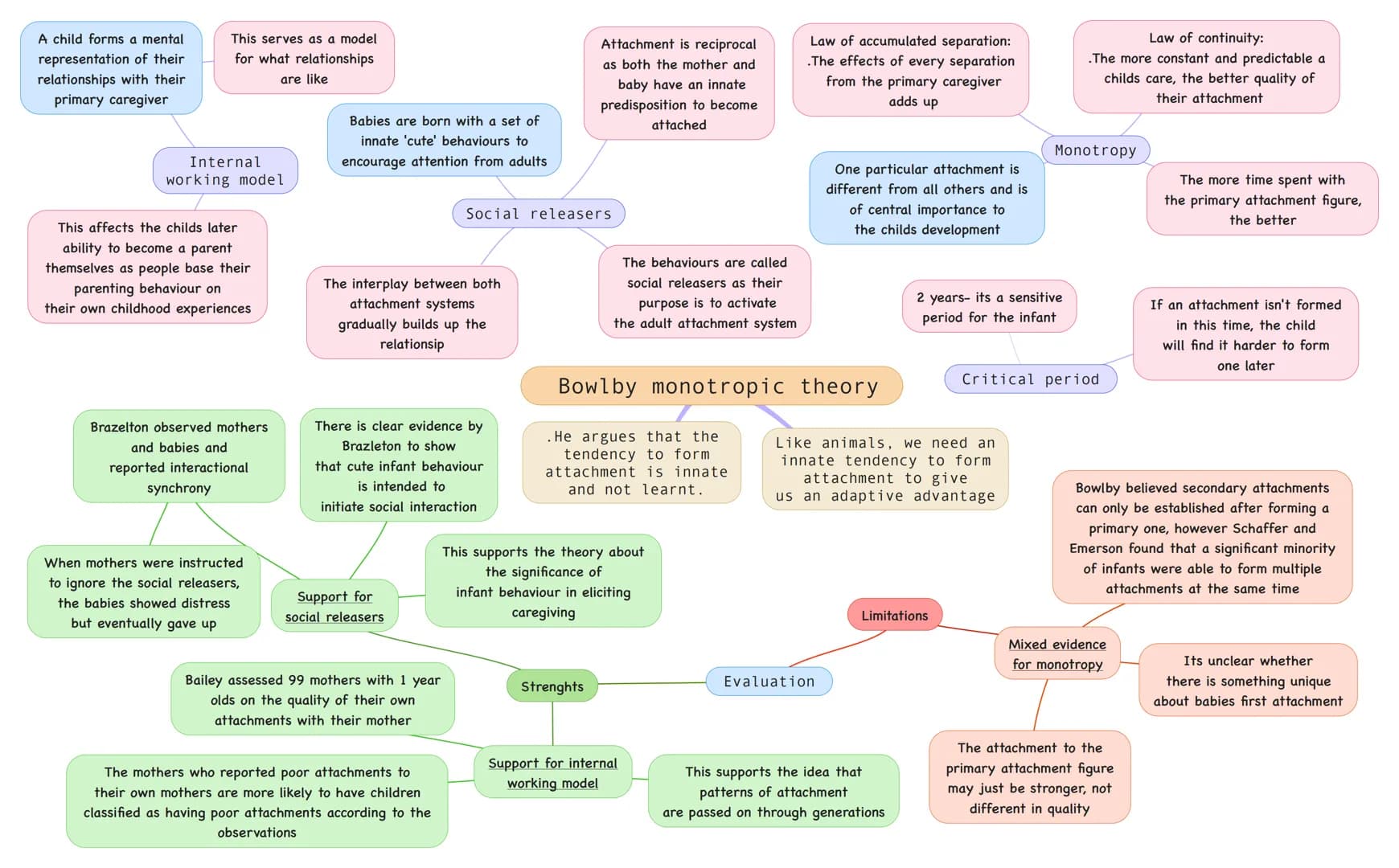
Bowlby's monotropic theory suggests we're born with an innate drive to form attachments - it's not something we learn, but rather a biological survival mechanism. Just like other animals, humans need this attachment system to give us an adaptive advantage in staying safe and thriving.
The theory centres around monotropy - the idea that one particular attachment is fundamentally different from all others and plays a central role in a child's development. Bowlby argued that the more time spent with this primary attachment figure, the better the outcome for the child.
Social releasers are those adorable baby behaviours (crying, smiling, gurgling) that are designed to grab adult attention and activate their caregiving instincts. Brazelton's research demonstrated this perfectly - when mothers ignored these social cues, babies became distressed but eventually gave up trying.
The internal working model is perhaps the most crucial concept here. This mental blueprint of relationships, formed through early experiences with caregivers, becomes the template for all future relationships. It even affects how people parent their own children later in life.
Key Insight: Bowlby identified a critical period of about 2 years for forming attachments - miss this window, and forming secure bonds becomes significantly harder later on.



 Psychology
 AP Psychology
 Sociology
 Biology