Understanding Cognitive Psychology
Think of your brain as the ultimate processing machine that's constantly working behind the scenes. Cognitive psychology studies exactly how you take in information from the world around you, process it, and then use it to navigate daily life successfully.
This field focuses on the internal operations of your mind - basically, what's happening in your head between experiencing something and responding to it. Unlike other areas of psychology that might look at behaviour alone, cognitive psychology digs into the mental processes that actually drive your actions.
Researchers use cognitive neuropsychology to understand how the mind works by studying people with brain damage. By seeing what changes when certain brain areas are affected, scientists can map out how different mental processes normally function.
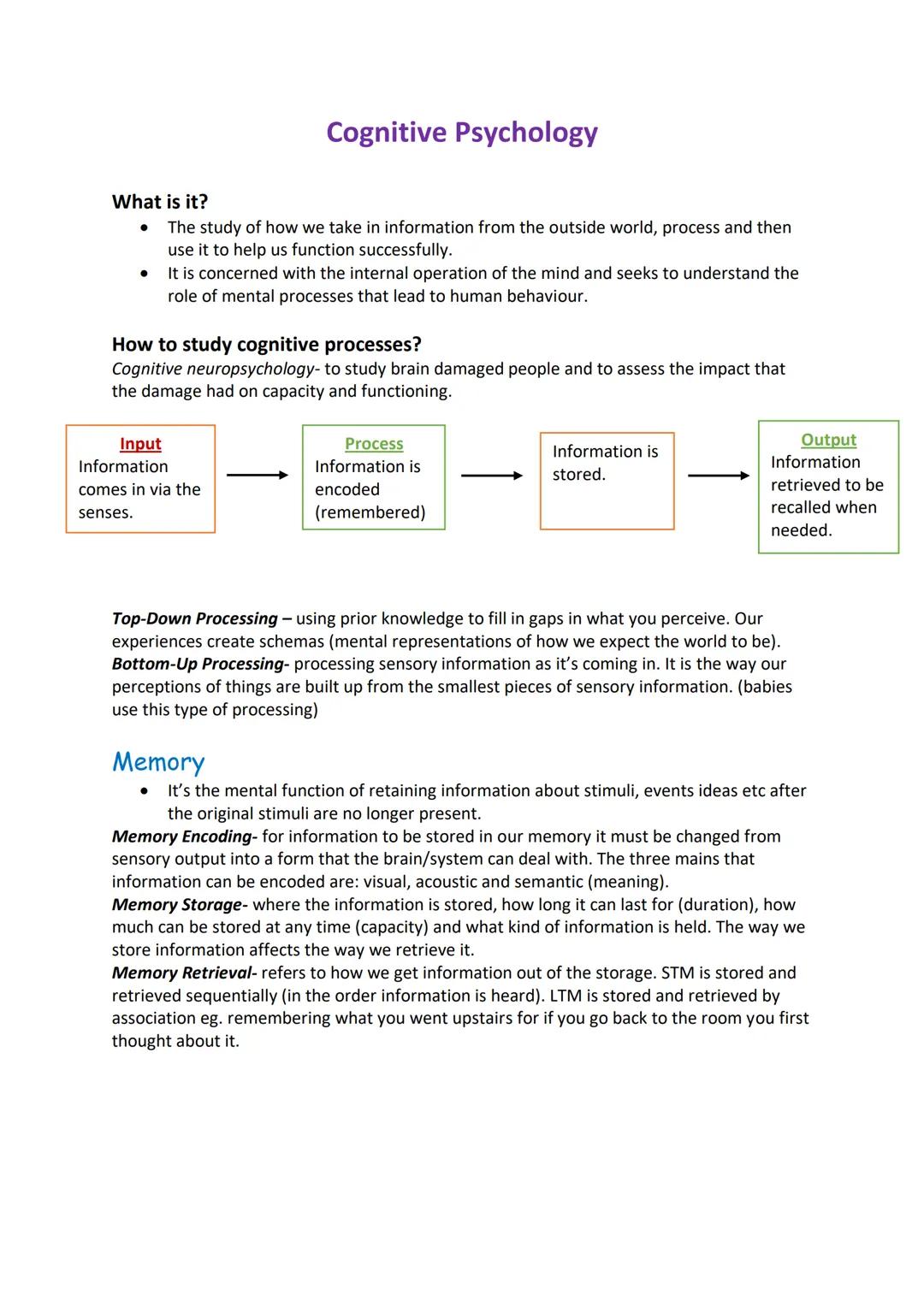
Your mind works like a computer system: input (information comes through your senses), process (information gets encoded and stored), and output (information gets retrieved when you need it). There are two main ways your brain processes incoming information: top-down processing uses your existing knowledge and experiences to fill in gaps, whilst bottom-up processing builds understanding from the raw sensory details coming in.
Quick Tip: Babies rely heavily on bottom-up processing since they don't have much prior experience to draw from yet!
How Memory Actually Works
Memory is your brain's filing system for keeping information about experiences, facts, and skills even after the original experience has ended. It's not just one simple process - memory involves three distinct stages that work together.
Memory encoding transforms sensory information into a format your brain can store. You can encode information visually (what something looks like), acoustically (how it sounds), or semantically (what it means). The way you encode something affects how well you'll remember it later.
Memory storage is where your brain keeps encoded information, and it varies in duration, capacity, and the type of information held. How you store memories directly impacts how easily you can retrieve them when needed.
Memory retrieval is getting stored information back out when you need it. Your short-term memory works sequentially - you remember things in the order you heard them. Long-term memory works through association - that's why going back to where you first thought of something often helps you remember what you were trying to recall.
Study Hack: Understanding these three stages can help you develop better revision strategies by focusing on how you encode, store, and retrieve information!



 Sociology
 Biology