Mathematical Fundamentals for Psychology Research
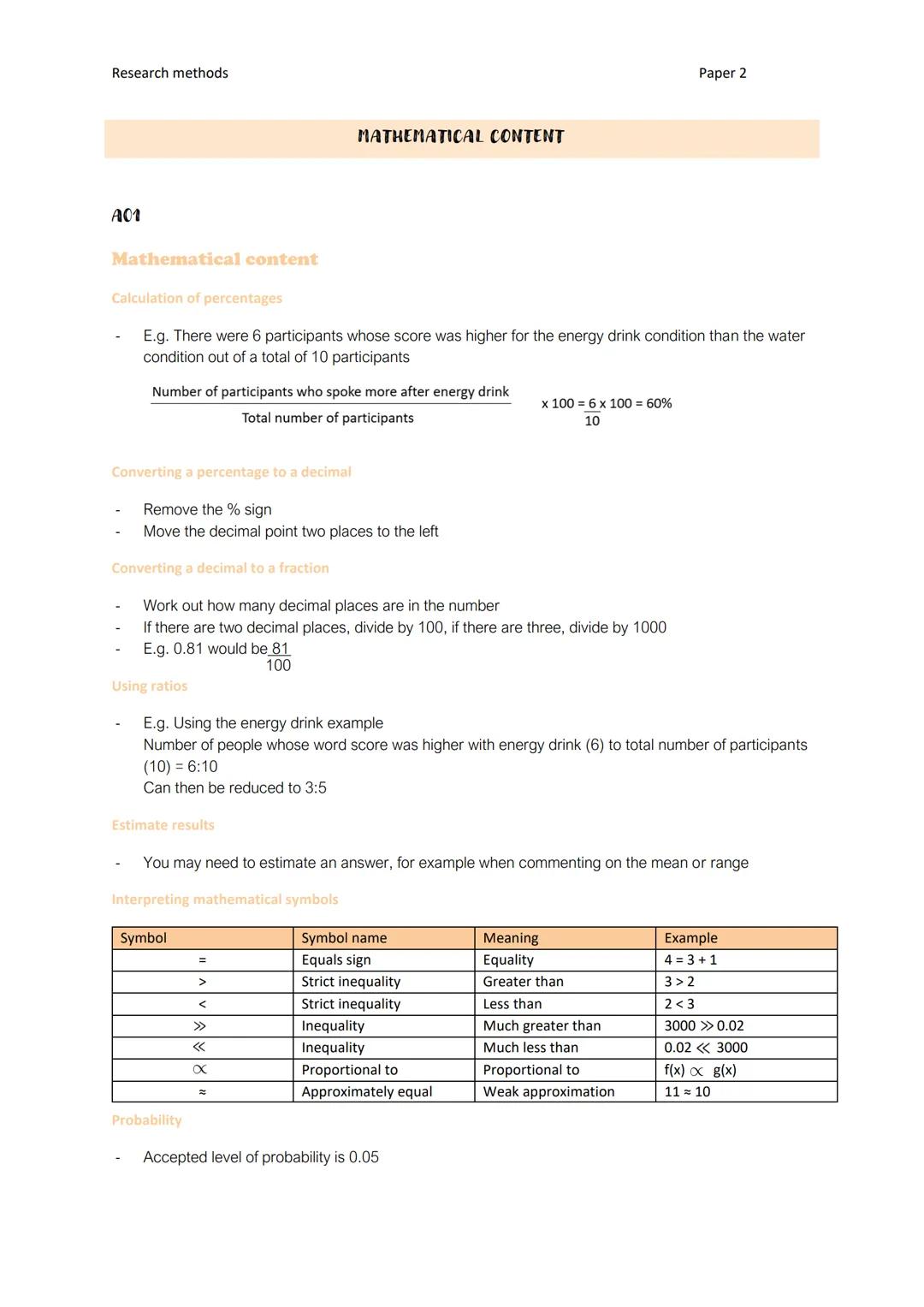
You'll need solid maths skills to interpret psychological research properly. Percentage calculations are everywhere in psychology - imagine testing whether energy drinks affect how much people talk, and 6 out of 10 participants spoke more after drinking energy compared to water.
The formula is simple: (6 ÷ 10) × 100 = 60%. Converting between percentages, decimals, and fractions is straightforward once you know the rules. Remove the % sign and move the decimal two places left to get decimals, then divide by the appropriate power of 10 for fractions.
Ratios help you compare groups effectively. Using our energy drink example, 6:10 participants improved, which simplifies to 3:5. This makes comparisons much clearer than raw numbers.
Key tip: Always check if your ratios can be simplified - it makes interpretation much easier!
Mathematical symbols like > (greater than), < (less than), and ≈ (approximately equal) appear constantly in research papers. Getting comfortable with these symbols now will save you time during exams and make reading research much smoother.



 Psychology
 AP Psychology
 Sociology
 Biology