

Explore how nations across Asia, Africa, and Latin America fought... Show more
 Algebra
 Biology
Sign up to see the contentIt's free!
Access to all documents
Improve your grades
Join milions of students
Knowunity AI
Subjects
Triangle Congruence and Similarity Theorems
Triangle Properties and Classification
Linear Equations and Graphs
Geometric Angle Relationships
Trigonometric Functions and Identities
Equation Solving Techniques
Circle Geometry Fundamentals
Division Operations and Methods
Basic Differentiation Rules
Exponent and Logarithm Properties
Show all topics
Human Organ Systems
Reproductive Cell Cycles
Biological Sciences Subdisciplines
Cellular Energy Metabolism
Autotrophic Energy Processes
Inheritance Patterns and Principles
Biomolecular Structure and Organization
Cell Cycle and Division Mechanics
Cellular Organization and Development
Biological Structural Organization
Show all topics
Chemical Sciences and Applications
Atomic Structure and Composition
Molecular Electron Structure Representation
Atomic Electron Behavior
Matter Properties and Water
Mole Concept and Calculations
Gas Laws and Behavior
Periodic Table Organization
Chemical Thermodynamics Fundamentals
Chemical Bond Types and Properties
Show all topics
European Renaissance and Enlightenment
European Cultural Movements 800-1920
American Revolution Era 1763-1797
American Civil War 1861-1865
Global Imperial Systems
Mongol and Chinese Dynasties
U.S. Presidents and World Leaders
Historical Sources and Documentation
World Wars Era and Impact
World Religious Systems
Show all topics
Classic and Contemporary Novels
Literary Character Analysis
Rhetorical Theory and Practice
Classic Literary Narratives
Reading Analysis and Interpretation
Narrative Structure and Techniques
English Language Components
Influential English-Language Authors
Basic Sentence Structure
Narrative Voice and Perspective
Show all topics
136
•
Updated Mar 28, 2026
•
Explore how nations across Asia, Africa, and Latin America fought... Show more
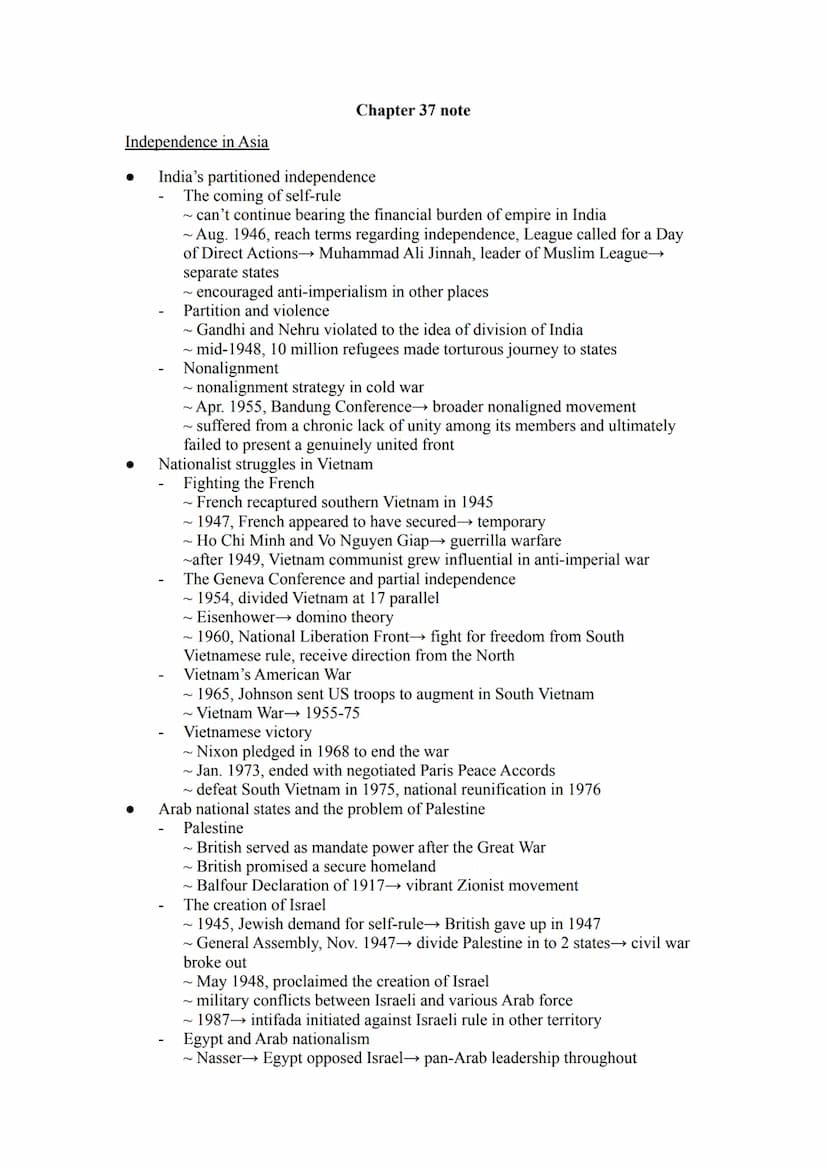

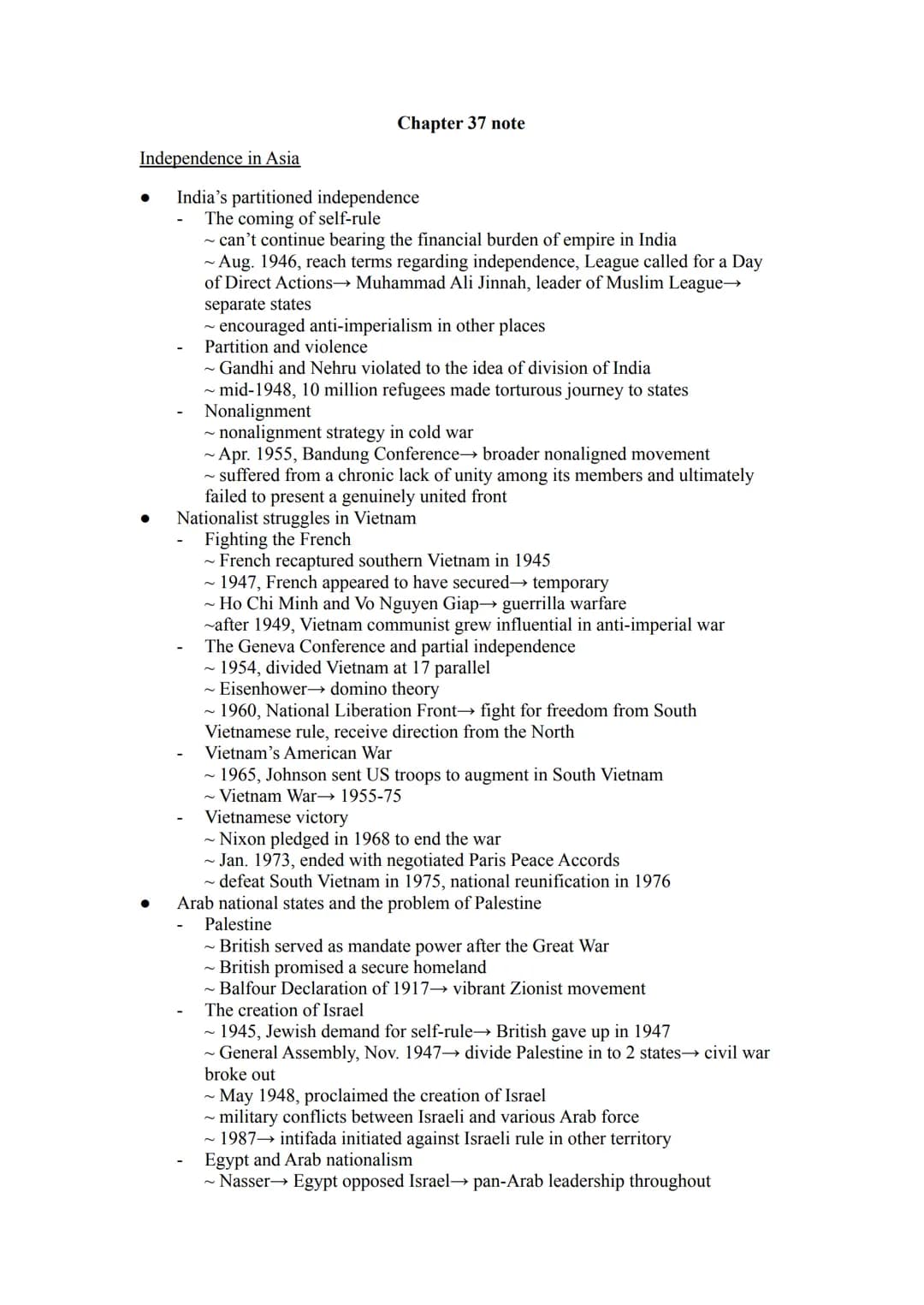
India's path to independence transformed the region but came at a heavy cost. In 1947, Britain relinquished control, but Muhammad Ali Jinnah's Muslim League demanded separate states, leading to the traumatic partition into India and Pakistan. This division triggered massive population exchanges with approximately 10 million refugees making dangerous journeys across new borders.
Under Jawaharlal Nehru's leadership, India pioneered the nonalignment strategy during the Cold War, refusing to fully align with either the US or Soviet bloc. This approach gained momentum at the 1955 Bandung Conference, inspiring other newly independent nations to chart their own course in international relations.
Vietnam's independence struggle began against French colonial rule, with Ho Chi Minh and Vo Nguyen Giap employing effective guerrilla warfare tactics. The 1954 Geneva Conference temporarily divided Vietnam at the 17th parallel, but continued conflict eventually led to the Vietnam War (1955-75). Despite America's military involvement, Vietnamese forces ultimately achieved national reunification in 1976.
Did you know? President Eisenhower's "domino theory" suggested that if one country fell to communism, neighboring nations would follow like falling dominoes – this reasoning was used to justify American intervention in Vietnam.
The creation of Israel in 1948 fundamentally altered the Middle East political landscape. Following the Holocaust, Jewish demands for self-rule intensified. The UN's 1947 plan to divide Palestine into two states triggered immediate conflict. Gamal Abdel Nasser's Egypt emerged as a center of Arab nationalism and opposition to Israel, culminating in the 1956 Suez Crisis when Egypt nationalized the canal.
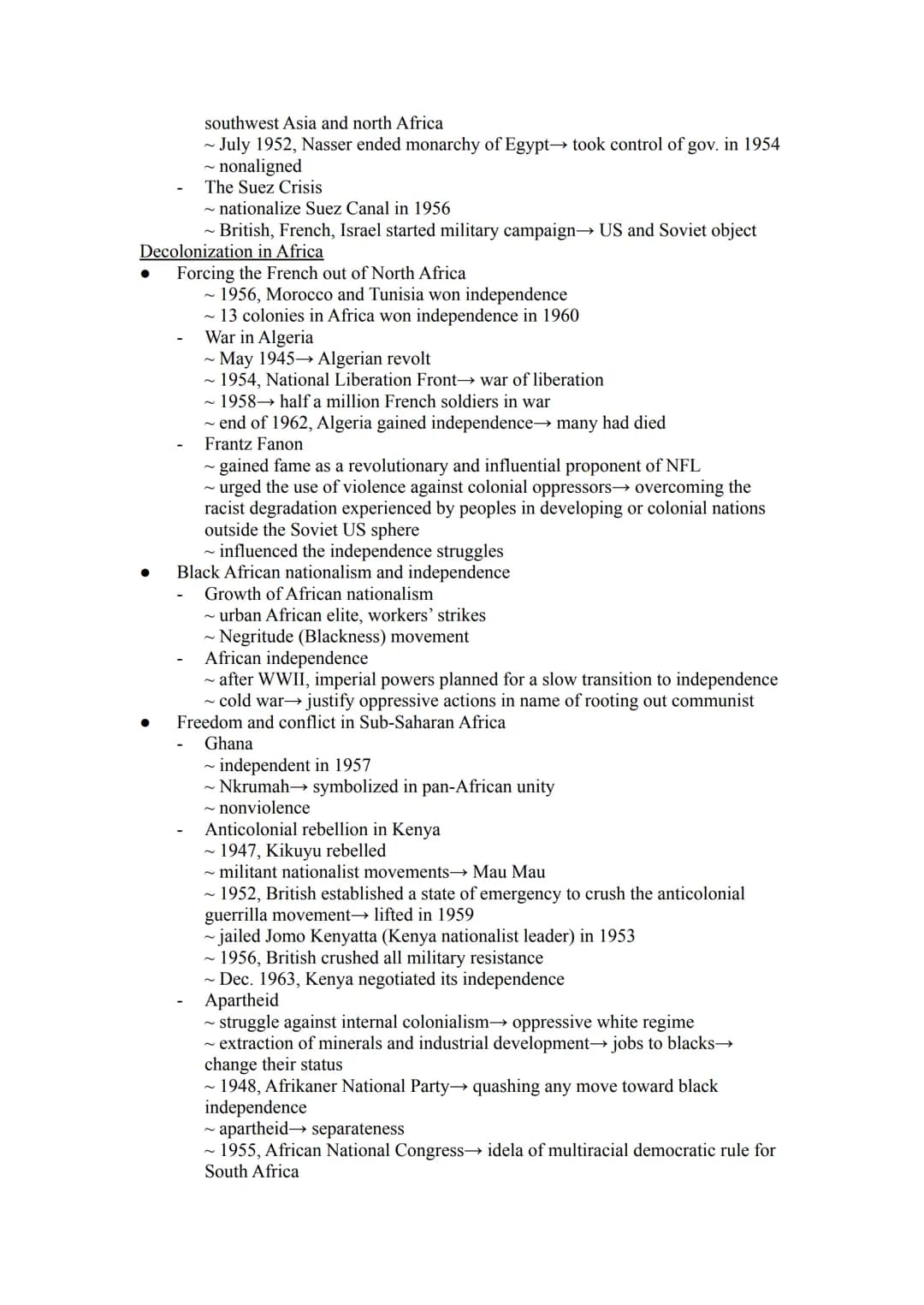
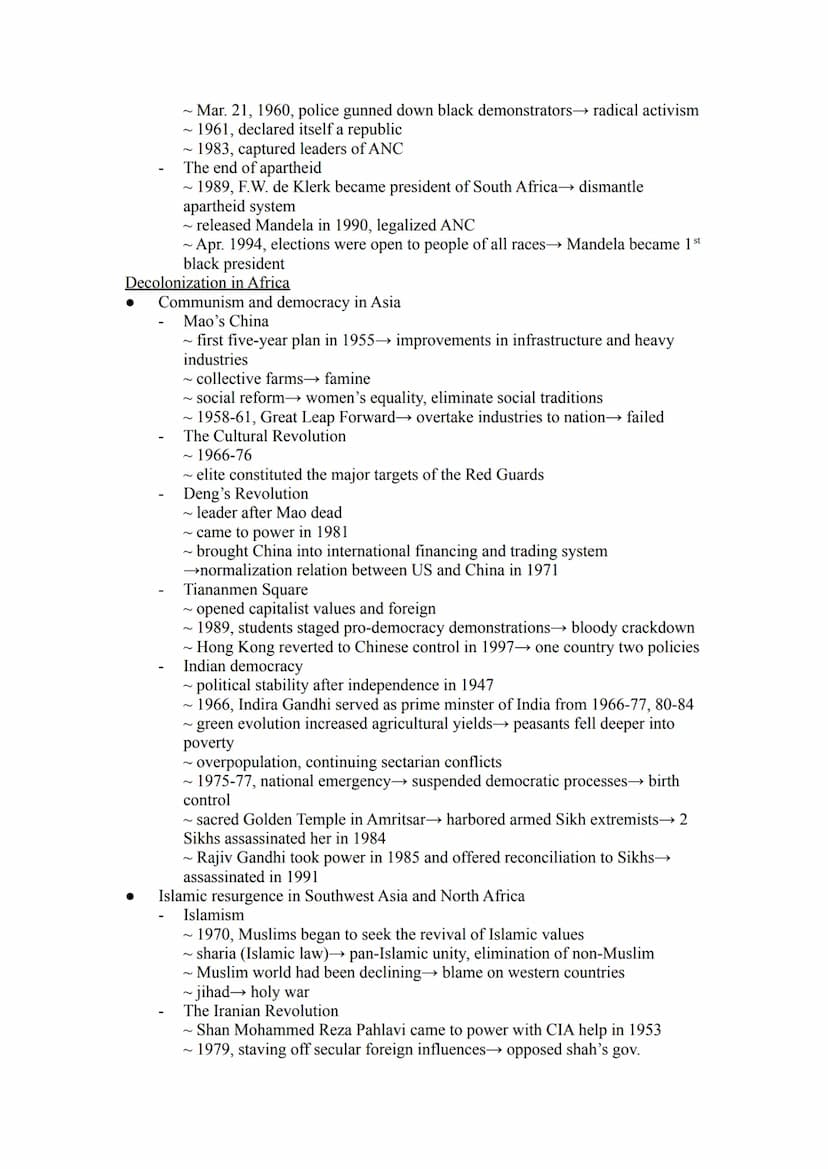
The wave of independence swept across Africa in the post-war period, with 13 African colonies gaining freedom in 1960 alone. Morocco and Tunisia won independence from France in 1956, but Algeria's path proved much bloodier. The Algerian National Liberation Front launched a war of liberation in 1954 that lasted until 1962, costing countless lives on both sides.
Revolutionary writer Frantz Fanon profoundly influenced independence movements with his arguments that violence against colonial oppressors was necessary to overcome racist degradation. His ideas resonated with many nationalist movements seeking to break free from European control and psychological domination.
Ghana became the trailblazer for Sub-Saharan African independence in 1957 under Kwame Nkrumah, who championed pan-African unity and nonviolent resistance. Meanwhile, Kenya's path involved the militant Mau Mau rebellion against British rule, with independence finally achieved in December 1963 after years of emergency rule and the imprisonment of nationalist leader Jomo Kenyatta.
Remember this: The Cold War complicated decolonization as imperial powers often justified oppressive actions by claiming they were fighting communist influence in these emerging nations.
South Africa's struggle against apartheid (separateness) represented a fight against internal colonialism. The oppressive system, formalized by the Afrikaner National Party in 1948, enforced rigid racial segregation despite growing resistance from the African National Congress (ANC). The 1960 Sharpeville massacre, where police killed black demonstrators, marked a turning point toward more radical activism. After decades of struggle, F.W. de Klerk began dismantling apartheid in 1989, leading to Nelson Mandela's release and his eventual election as South Africa's first black president in 1994.
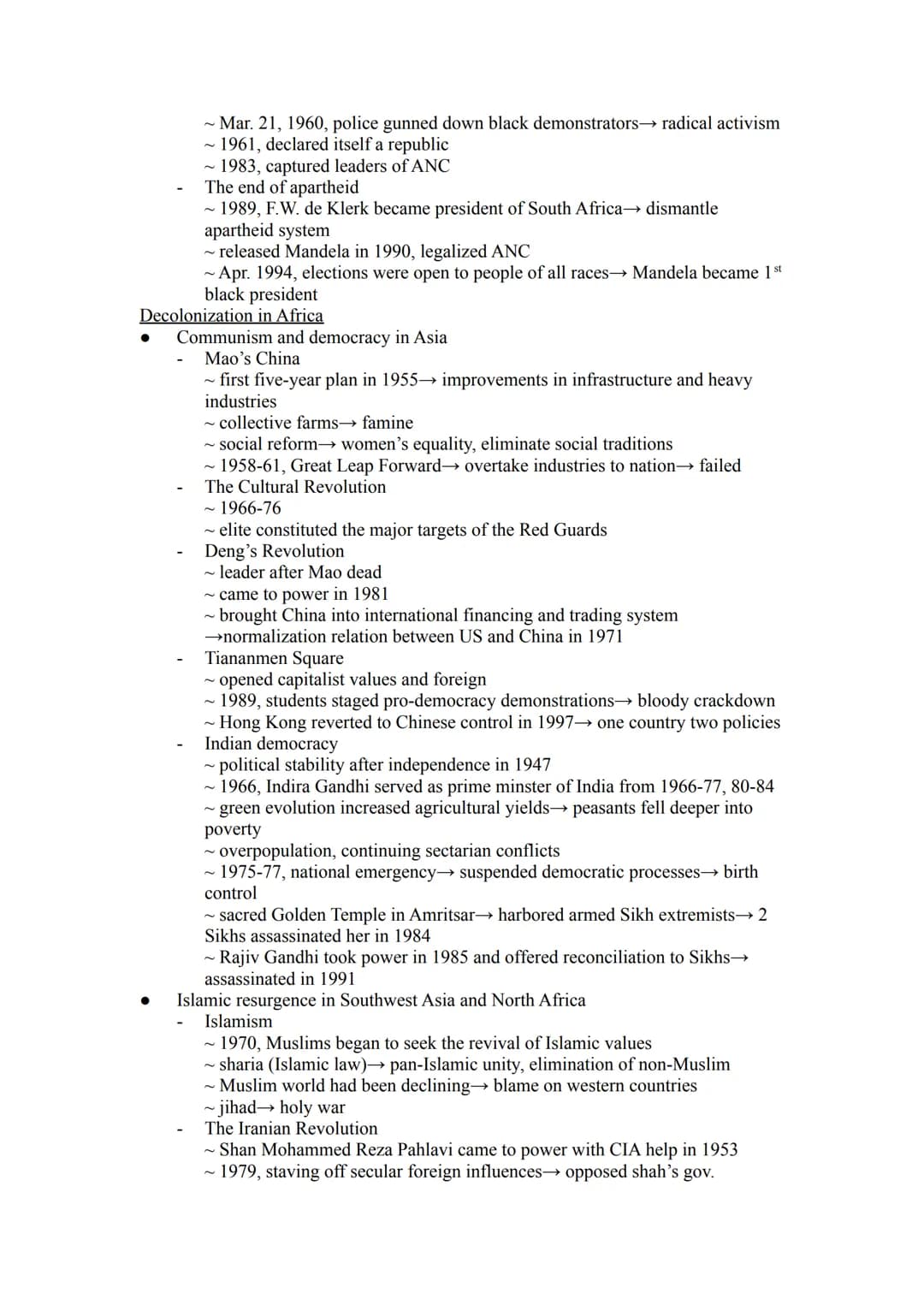
Communist China under Mao Zedong underwent dramatic transformations after 1949. The country's first five-year plan in 1955 improved infrastructure and heavy industries, but ambitious programs like the Great Leap Forward (1958-61) ended in catastrophic failure and widespread famine. The Cultural Revolution (1966-76) targeted intellectual and social elites through Mao's mobilized Red Guards.
After Mao's death, Deng Xiaoping transformed China's economy by opening it to international trade and introducing market reforms. This economic liberalization, however, didn't extend to politics. In 1989, the government violently crushed pro-democracy demonstrations in Tiananmen Square, showing the limits of China's openness despite its increasing global integration.
India maintained remarkable political stability following independence, though not without challenges. Indira Gandhi, who served as prime minister from 1966-77 and 1980-84, suspended democratic processes during a 1975-77 "national emergency." Despite agricultural improvements through the Green Revolution, many peasants fell deeper into poverty. Religious tensions continued to plague the nation, with Gandhi herself assassinated by Sikh extremists in 1984.
Important concept: The term "Islamism" refers to movements seeking to revive traditional Islamic values in governance and society, often in opposition to Western influence and secular governments.
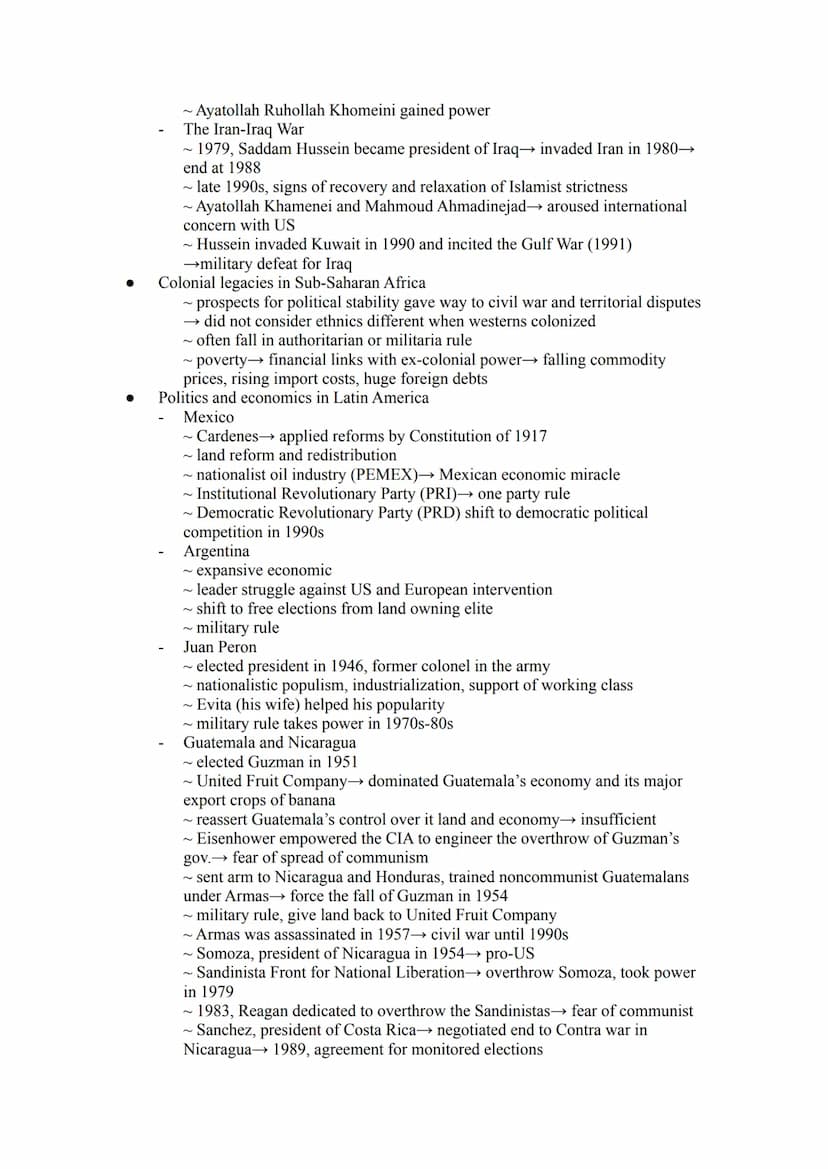
The Iranian Revolution of 1979 marked a pivotal moment in Islamic resurgence. After overthrowing the Western-backed Shah Mohammed Reza Pahlavi, Ayatollah Ruhollah Khomeini established an Islamic republic based on sharia law. This revolution reflected growing sentiment across the Muslim world that blamed Western influence for their societies' decline. The subsequent Iran-Iraq War (1980-88) further destabilized the region, as did Iraq's 1990 invasion of Kuwait that triggered the Gulf War.

Latin American nations struggled with the legacies of colonialism and external influence, particularly from the United States. Mexico's Institutional Revolutionary Party (PRI) maintained one-party rule for decades while implementing land reforms and nationalizing industries like oil (PEMEX), creating what became known as the "Mexican economic miracle." Only in the 1990s did Mexico begin shifting toward more democratic political competition.
Argentina's political landscape featured the charismatic leadership of Juan Perón, who was elected president in 1946. His nationalistic populism centered on industrialization and support for the working class, with his wife Evita boosting his popularity. However, Argentina later fell under military rule during the turbulent 1970s and 80s.
The United States frequently intervened in Central American politics, fearing communist influence. In Guatemala, the CIA engineered the overthrow of President Guzman in 1954 after he challenged the powerful United Fruit Company's control of the economy. This intervention led to decades of military rule and civil war. Similarly, in Nicaragua, the Reagan administration worked to undermine the Sandinista government that had overthrown the pro-US Somoza regime in 1979.
Connection point: The term "banana republic" originated from countries like Guatemala where American companies like United Fruit dominated both the economy and politics, often at the expense of local people.
Sub-Saharan African nations faced particular challenges after independence. Colonial borders had been drawn without consideration of ethnic differences, leading to civil wars and territorial disputes. Many countries fell under authoritarian or military rule while struggling with poverty, unfavorable trade relationships with former colonial powers, and mounting foreign debts.
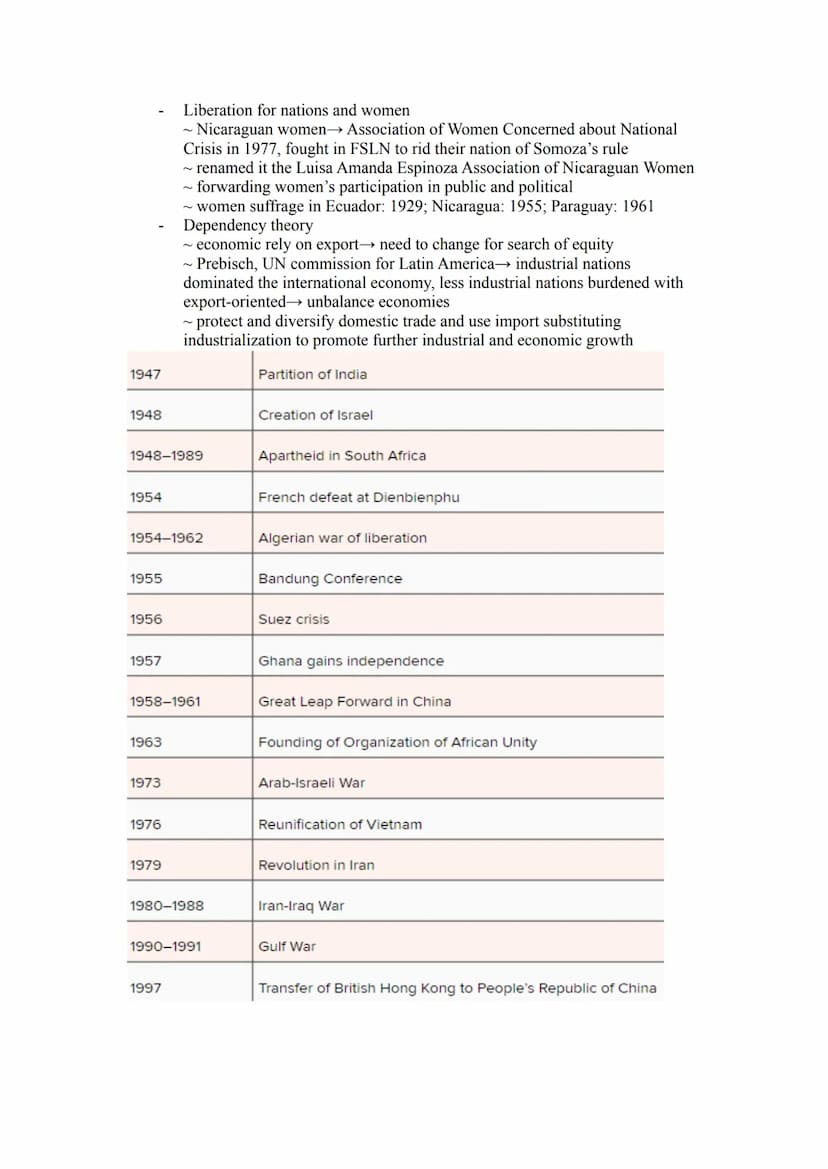
The dependency theory emerged from Latin American economists like Raúl Prebisch, who argued that the global economic system fundamentally disadvantaged developing nations. This theory suggested that industrial nations dominated international trade in ways that kept former colonies dependent on exporting raw materials while importing manufactured goods, creating perpetually unbalanced economies.
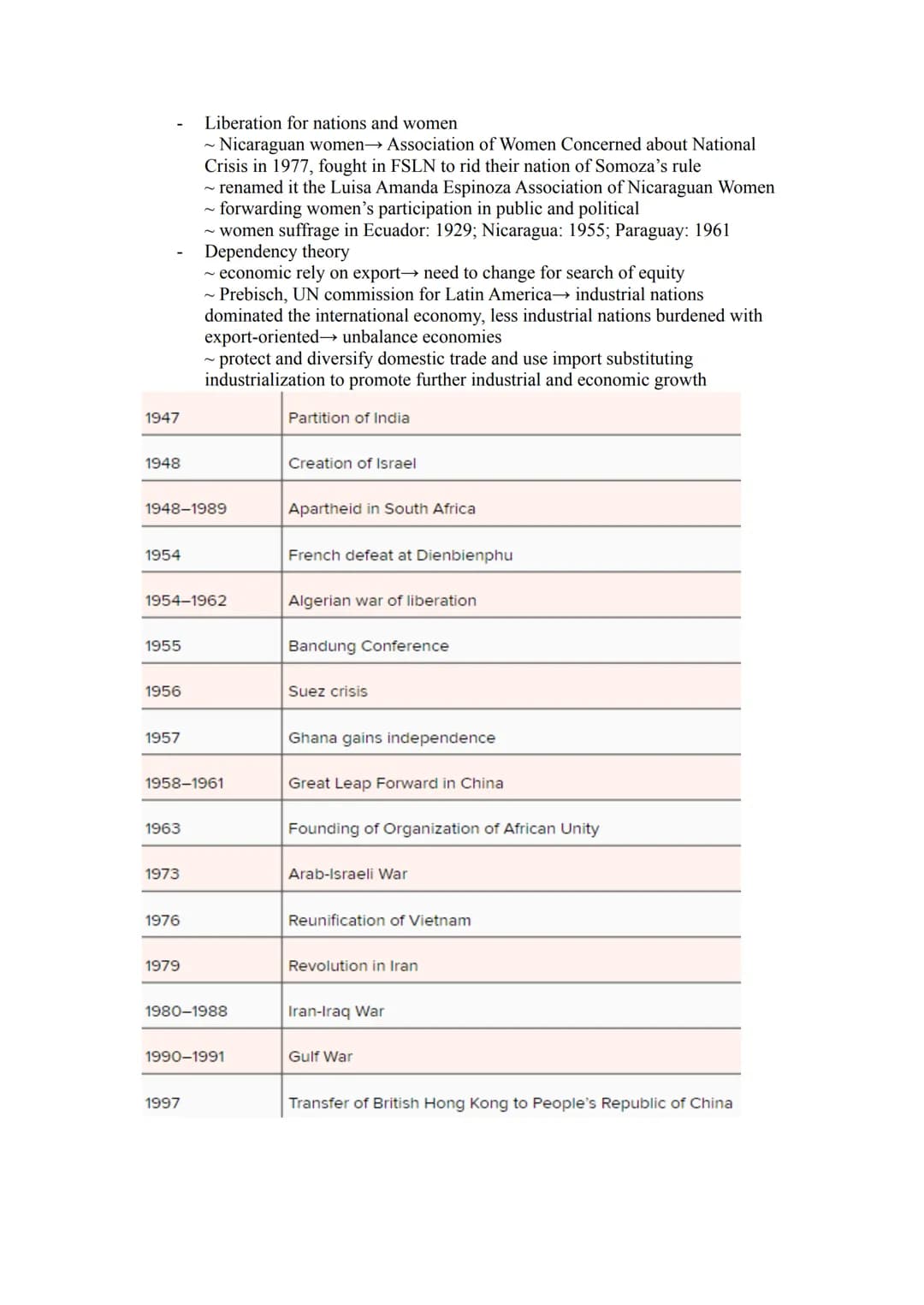
Women played crucial roles in liberation struggles across the developing world. In Nicaragua, women organized the Association of Women Concerned about National Crisis in 1977 and fought alongside men in the Sandinista Front to overthrow the Somoza dictatorship. After victory, they continued advocating for women's participation in public and political life, showing how national liberation often connected with gender equality movements.
Women's suffrage spread across Latin America at different rates, with Ecuador granting women voting rights in 1929, Nicaragua in 1955, and Paraguay not until 1961. These milestones reflected broader struggles for full citizenship and political participation throughout the decolonizing world.
The period from 1947 to 1997 witnessed momentous changes across the global landscape. Key events like India's partition (1947), Israel's creation (1948), and Ghana's independence (1957) marked early stages of decolonization. Later conflicts like the Arab-Israeli War (1973) and the Iran-Iraq War (1980-88) reflected ongoing tensions in post-colonial regions.
Big picture insight: Independence didn't automatically solve deep-rooted problems. Many newly independent nations struggled with economic challenges, political instability, and the continuing influence of former colonial powers.
South Africa's apartheid system (1948-1989) represented one of the most systematic forms of racial oppression, requiring decades of struggle before Nelson Mandela could lead the country toward multiracial democracy. Meanwhile, China's transformation from Mao's Great Leap Forward (1958-1961) to the handover of Hong Kong from Britain (1997) demonstrated how dramatically Asia's political and economic landscape had changed in just a few decades.
These independence movements collectively transformed the world order, ending centuries of European colonial dominance and creating dozens of new nations with their own aspirations, challenges, and contributions to global affairs. Their struggles continue to shape international relations and inspire movements for self-determination around the world.
Our AI companion is specifically built for the needs of students. Based on the millions of content pieces we have on the platform we can provide truly meaningful and relevant answers to students. But its not only about answers, the companion is even more about guiding students through their daily learning challenges, with personalised study plans, quizzes or content pieces in the chat and 100% personalisation based on the students skills and developments.
You can download the app in the Google Play Store and in the Apple App Store.
That's right! Enjoy free access to study content, connect with fellow students, and get instant help – all at your fingertips.
App Store
Google Play
The app is very easy to use and well designed. I have found everything I was looking for so far and have been able to learn a lot from the presentations! I will definitely use the app for a class assignment! And of course it also helps a lot as an inspiration.
Stefan S
iOS user
This app is really great. There are so many study notes and help [...]. My problem subject is French, for example, and the app has so many options for help. Thanks to this app, I have improved my French. I would recommend it to anyone.
Samantha Klich
Android user
Wow, I am really amazed. I just tried the app because I've seen it advertised many times and was absolutely stunned. This app is THE HELP you want for school and above all, it offers so many things, such as workouts and fact sheets, which have been VERY helpful to me personally.
Anna
iOS user
I think it’s very much worth it and you’ll end up using it a lot once you get the hang of it and even after looking at others notes you can still ask your Artificial intelligence buddy the question and ask to simplify it if you still don’t get it!!! In the end I think it’s worth it 😊👍 ⚠️Also DID I MENTION ITS FREEE YOU DON’T HAVE TO PAY FOR ANYTHING AND STILL GET YOUR GRADES IN PERFECTLY❗️❗️⚠️
Thomas R
iOS user
Knowunity is the BEST app I’ve used in a minute. This is not an ai review or anything this is genuinely coming from a 7th grade student (I know 2011 im young) but dude this app is a 10/10 i have maintained a 3.8 gpa and have plenty of time for gaming. I love it and my mom is just happy I got good grades
Brad T
Android user
Not only did it help me find the answer but it also showed me alternative ways to solve it. I was horrible in math and science but now I have an a in both subjects. Thanks for the help🤍🤍
David K
iOS user
The app's just great! All I have to do is enter the topic in the search bar and I get the response real fast. I don't have to watch 10 YouTube videos to understand something, so I'm saving my time. Highly recommended!
Sudenaz Ocak
Android user
In school I was really bad at maths but thanks to the app, I am doing better now. I am so grateful that you made the app.
Greenlight Bonnie
Android user
I found this app a couple years ago and it has only gotten better since then. I really love it because it can help with written questions and photo questions. Also, it can find study guides that other people have made as well as flashcard sets and practice tests. The free version is also amazing for students who might not be able to afford it. Would 100% recommend
Aubrey
iOS user
Best app if you're in Highschool or Junior high. I have been using this app for 2 school years and it's the best, it's good if you don't have anyone to help you with school work.😋🩷🎀
Marco B
iOS user
THE QUIZES AND FLASHCARDS ARE SO USEFUL AND I LOVE Knowunity AI. IT ALSO IS LITREALLY LIKE CHATGPT BUT SMARTER!! HELPED ME WITH MY MASCARA PROBLEMS TOO!! AS WELL AS MY REAL SUBJECTS ! DUHHH 😍😁😲🤑💗✨🎀😮
Elisha
iOS user
This app is phenomenal down to the correct info and the various topics you can study! I greatly recommend it for people who struggle with procrastination and those who need homework help. It has been perfectly accurate for world 1 history as far as I’ve seen! Geometry too!
Paul T
iOS user
The app is very easy to use and well designed. I have found everything I was looking for so far and have been able to learn a lot from the presentations! I will definitely use the app for a class assignment! And of course it also helps a lot as an inspiration.
Stefan S
iOS user
This app is really great. There are so many study notes and help [...]. My problem subject is French, for example, and the app has so many options for help. Thanks to this app, I have improved my French. I would recommend it to anyone.
Samantha Klich
Android user
Wow, I am really amazed. I just tried the app because I've seen it advertised many times and was absolutely stunned. This app is THE HELP you want for school and above all, it offers so many things, such as workouts and fact sheets, which have been VERY helpful to me personally.
Anna
iOS user
I think it’s very much worth it and you’ll end up using it a lot once you get the hang of it and even after looking at others notes you can still ask your Artificial intelligence buddy the question and ask to simplify it if you still don’t get it!!! In the end I think it’s worth it 😊👍 ⚠️Also DID I MENTION ITS FREEE YOU DON’T HAVE TO PAY FOR ANYTHING AND STILL GET YOUR GRADES IN PERFECTLY❗️❗️⚠️
Thomas R
iOS user
Knowunity is the BEST app I’ve used in a minute. This is not an ai review or anything this is genuinely coming from a 7th grade student (I know 2011 im young) but dude this app is a 10/10 i have maintained a 3.8 gpa and have plenty of time for gaming. I love it and my mom is just happy I got good grades
Brad T
Android user
Not only did it help me find the answer but it also showed me alternative ways to solve it. I was horrible in math and science but now I have an a in both subjects. Thanks for the help🤍🤍
David K
iOS user
The app's just great! All I have to do is enter the topic in the search bar and I get the response real fast. I don't have to watch 10 YouTube videos to understand something, so I'm saving my time. Highly recommended!
Sudenaz Ocak
Android user
In school I was really bad at maths but thanks to the app, I am doing better now. I am so grateful that you made the app.
Greenlight Bonnie
Android user
I found this app a couple years ago and it has only gotten better since then. I really love it because it can help with written questions and photo questions. Also, it can find study guides that other people have made as well as flashcard sets and practice tests. The free version is also amazing for students who might not be able to afford it. Would 100% recommend
Aubrey
iOS user
Best app if you're in Highschool or Junior high. I have been using this app for 2 school years and it's the best, it's good if you don't have anyone to help you with school work.😋🩷🎀
Marco B
iOS user
THE QUIZES AND FLASHCARDS ARE SO USEFUL AND I LOVE Knowunity AI. IT ALSO IS LITREALLY LIKE CHATGPT BUT SMARTER!! HELPED ME WITH MY MASCARA PROBLEMS TOO!! AS WELL AS MY REAL SUBJECTS ! DUHHH 😍😁😲🤑💗✨🎀😮
Elisha
iOS user
This app is phenomenal down to the correct info and the various topics you can study! I greatly recommend it for people who struggle with procrastination and those who need homework help. It has been perfectly accurate for world 1 history as far as I’ve seen! Geometry too!
Paul T
iOS user
Explore how nations across Asia, Africa, and Latin America fought for independence after World War II, reshaping the global landscape. From India's partition to Vietnam's struggle against colonial powers, these movements challenged imperialism and established new national identities while navigating... Show more
Access to all documents
Improve your grades
Join milions of students
India's path to independence transformed the region but came at a heavy cost. In 1947, Britain relinquished control, but Muhammad Ali Jinnah's Muslim League demanded separate states, leading to the traumatic partition into India and Pakistan. This division triggered massive population exchanges with approximately 10 million refugees making dangerous journeys across new borders.
Under Jawaharlal Nehru's leadership, India pioneered the nonalignment strategy during the Cold War, refusing to fully align with either the US or Soviet bloc. This approach gained momentum at the 1955 Bandung Conference, inspiring other newly independent nations to chart their own course in international relations.
Vietnam's independence struggle began against French colonial rule, with Ho Chi Minh and Vo Nguyen Giap employing effective guerrilla warfare tactics. The 1954 Geneva Conference temporarily divided Vietnam at the 17th parallel, but continued conflict eventually led to the Vietnam War (1955-75). Despite America's military involvement, Vietnamese forces ultimately achieved national reunification in 1976.
Did you know? President Eisenhower's "domino theory" suggested that if one country fell to communism, neighboring nations would follow like falling dominoes – this reasoning was used to justify American intervention in Vietnam.
The creation of Israel in 1948 fundamentally altered the Middle East political landscape. Following the Holocaust, Jewish demands for self-rule intensified. The UN's 1947 plan to divide Palestine into two states triggered immediate conflict. Gamal Abdel Nasser's Egypt emerged as a center of Arab nationalism and opposition to Israel, culminating in the 1956 Suez Crisis when Egypt nationalized the canal.
Access to all documents
Improve your grades
Join milions of students
The wave of independence swept across Africa in the post-war period, with 13 African colonies gaining freedom in 1960 alone. Morocco and Tunisia won independence from France in 1956, but Algeria's path proved much bloodier. The Algerian National Liberation Front launched a war of liberation in 1954 that lasted until 1962, costing countless lives on both sides.
Revolutionary writer Frantz Fanon profoundly influenced independence movements with his arguments that violence against colonial oppressors was necessary to overcome racist degradation. His ideas resonated with many nationalist movements seeking to break free from European control and psychological domination.
Ghana became the trailblazer for Sub-Saharan African independence in 1957 under Kwame Nkrumah, who championed pan-African unity and nonviolent resistance. Meanwhile, Kenya's path involved the militant Mau Mau rebellion against British rule, with independence finally achieved in December 1963 after years of emergency rule and the imprisonment of nationalist leader Jomo Kenyatta.
Remember this: The Cold War complicated decolonization as imperial powers often justified oppressive actions by claiming they were fighting communist influence in these emerging nations.
South Africa's struggle against apartheid (separateness) represented a fight against internal colonialism. The oppressive system, formalized by the Afrikaner National Party in 1948, enforced rigid racial segregation despite growing resistance from the African National Congress (ANC). The 1960 Sharpeville massacre, where police killed black demonstrators, marked a turning point toward more radical activism. After decades of struggle, F.W. de Klerk began dismantling apartheid in 1989, leading to Nelson Mandela's release and his eventual election as South Africa's first black president in 1994.
Access to all documents
Improve your grades
Join milions of students
Communist China under Mao Zedong underwent dramatic transformations after 1949. The country's first five-year plan in 1955 improved infrastructure and heavy industries, but ambitious programs like the Great Leap Forward (1958-61) ended in catastrophic failure and widespread famine. The Cultural Revolution (1966-76) targeted intellectual and social elites through Mao's mobilized Red Guards.
After Mao's death, Deng Xiaoping transformed China's economy by opening it to international trade and introducing market reforms. This economic liberalization, however, didn't extend to politics. In 1989, the government violently crushed pro-democracy demonstrations in Tiananmen Square, showing the limits of China's openness despite its increasing global integration.
India maintained remarkable political stability following independence, though not without challenges. Indira Gandhi, who served as prime minister from 1966-77 and 1980-84, suspended democratic processes during a 1975-77 "national emergency." Despite agricultural improvements through the Green Revolution, many peasants fell deeper into poverty. Religious tensions continued to plague the nation, with Gandhi herself assassinated by Sikh extremists in 1984.
Important concept: The term "Islamism" refers to movements seeking to revive traditional Islamic values in governance and society, often in opposition to Western influence and secular governments.
The Iranian Revolution of 1979 marked a pivotal moment in Islamic resurgence. After overthrowing the Western-backed Shah Mohammed Reza Pahlavi, Ayatollah Ruhollah Khomeini established an Islamic republic based on sharia law. This revolution reflected growing sentiment across the Muslim world that blamed Western influence for their societies' decline. The subsequent Iran-Iraq War (1980-88) further destabilized the region, as did Iraq's 1990 invasion of Kuwait that triggered the Gulf War.
Access to all documents
Improve your grades
Join milions of students
Latin American nations struggled with the legacies of colonialism and external influence, particularly from the United States. Mexico's Institutional Revolutionary Party (PRI) maintained one-party rule for decades while implementing land reforms and nationalizing industries like oil (PEMEX), creating what became known as the "Mexican economic miracle." Only in the 1990s did Mexico begin shifting toward more democratic political competition.
Argentina's political landscape featured the charismatic leadership of Juan Perón, who was elected president in 1946. His nationalistic populism centered on industrialization and support for the working class, with his wife Evita boosting his popularity. However, Argentina later fell under military rule during the turbulent 1970s and 80s.
The United States frequently intervened in Central American politics, fearing communist influence. In Guatemala, the CIA engineered the overthrow of President Guzman in 1954 after he challenged the powerful United Fruit Company's control of the economy. This intervention led to decades of military rule and civil war. Similarly, in Nicaragua, the Reagan administration worked to undermine the Sandinista government that had overthrown the pro-US Somoza regime in 1979.
Connection point: The term "banana republic" originated from countries like Guatemala where American companies like United Fruit dominated both the economy and politics, often at the expense of local people.
Sub-Saharan African nations faced particular challenges after independence. Colonial borders had been drawn without consideration of ethnic differences, leading to civil wars and territorial disputes. Many countries fell under authoritarian or military rule while struggling with poverty, unfavorable trade relationships with former colonial powers, and mounting foreign debts.
The dependency theory emerged from Latin American economists like Raúl Prebisch, who argued that the global economic system fundamentally disadvantaged developing nations. This theory suggested that industrial nations dominated international trade in ways that kept former colonies dependent on exporting raw materials while importing manufactured goods, creating perpetually unbalanced economies.
Access to all documents
Improve your grades
Join milions of students
Women played crucial roles in liberation struggles across the developing world. In Nicaragua, women organized the Association of Women Concerned about National Crisis in 1977 and fought alongside men in the Sandinista Front to overthrow the Somoza dictatorship. After victory, they continued advocating for women's participation in public and political life, showing how national liberation often connected with gender equality movements.
Women's suffrage spread across Latin America at different rates, with Ecuador granting women voting rights in 1929, Nicaragua in 1955, and Paraguay not until 1961. These milestones reflected broader struggles for full citizenship and political participation throughout the decolonizing world.
The period from 1947 to 1997 witnessed momentous changes across the global landscape. Key events like India's partition (1947), Israel's creation (1948), and Ghana's independence (1957) marked early stages of decolonization. Later conflicts like the Arab-Israeli War (1973) and the Iran-Iraq War (1980-88) reflected ongoing tensions in post-colonial regions.
Big picture insight: Independence didn't automatically solve deep-rooted problems. Many newly independent nations struggled with economic challenges, political instability, and the continuing influence of former colonial powers.
South Africa's apartheid system (1948-1989) represented one of the most systematic forms of racial oppression, requiring decades of struggle before Nelson Mandela could lead the country toward multiracial democracy. Meanwhile, China's transformation from Mao's Great Leap Forward (1958-1961) to the handover of Hong Kong from Britain (1997) demonstrated how dramatically Asia's political and economic landscape had changed in just a few decades.
These independence movements collectively transformed the world order, ending centuries of European colonial dominance and creating dozens of new nations with their own aspirations, challenges, and contributions to global affairs. Their struggles continue to shape international relations and inspire movements for self-determination around the world.
Our AI companion is specifically built for the needs of students. Based on the millions of content pieces we have on the platform we can provide truly meaningful and relevant answers to students. But its not only about answers, the companion is even more about guiding students through their daily learning challenges, with personalised study plans, quizzes or content pieces in the chat and 100% personalisation based on the students skills and developments.
You can download the app in the Google Play Store and in the Apple App Store.
That's right! Enjoy free access to study content, connect with fellow students, and get instant help – all at your fingertips.
2
Smart Tools NEW
Transform this note into: ✓ 50+ Practice Questions ✓ Interactive Flashcards ✓ Full Practice Test ✓ Essay Outlines
Notes taken from Heimler’s History live review on 4-8-23
 AP World History
AP World Notes
AP World HistoryHandwritten notes for APWH Period 1 (1200-1450) based on the information in Barron's AP World History: Modern Review textbook
AP World HistoryAP World History - hopefully this has everything that's going to be on the exam and what we covered in the course
AP World HistoryApp Store
Google Play
The app is very easy to use and well designed. I have found everything I was looking for so far and have been able to learn a lot from the presentations! I will definitely use the app for a class assignment! And of course it also helps a lot as an inspiration.
Stefan S
iOS user
This app is really great. There are so many study notes and help [...]. My problem subject is French, for example, and the app has so many options for help. Thanks to this app, I have improved my French. I would recommend it to anyone.
Samantha Klich
Android user
Wow, I am really amazed. I just tried the app because I've seen it advertised many times and was absolutely stunned. This app is THE HELP you want for school and above all, it offers so many things, such as workouts and fact sheets, which have been VERY helpful to me personally.
Anna
iOS user
I think it’s very much worth it and you’ll end up using it a lot once you get the hang of it and even after looking at others notes you can still ask your Artificial intelligence buddy the question and ask to simplify it if you still don’t get it!!! In the end I think it’s worth it 😊👍 ⚠️Also DID I MENTION ITS FREEE YOU DON’T HAVE TO PAY FOR ANYTHING AND STILL GET YOUR GRADES IN PERFECTLY❗️❗️⚠️
Thomas R
iOS user
Knowunity is the BEST app I’ve used in a minute. This is not an ai review or anything this is genuinely coming from a 7th grade student (I know 2011 im young) but dude this app is a 10/10 i have maintained a 3.8 gpa and have plenty of time for gaming. I love it and my mom is just happy I got good grades
Brad T
Android user
Not only did it help me find the answer but it also showed me alternative ways to solve it. I was horrible in math and science but now I have an a in both subjects. Thanks for the help🤍🤍
David K
iOS user
The app's just great! All I have to do is enter the topic in the search bar and I get the response real fast. I don't have to watch 10 YouTube videos to understand something, so I'm saving my time. Highly recommended!
Sudenaz Ocak
Android user
In school I was really bad at maths but thanks to the app, I am doing better now. I am so grateful that you made the app.
Greenlight Bonnie
Android user
I found this app a couple years ago and it has only gotten better since then. I really love it because it can help with written questions and photo questions. Also, it can find study guides that other people have made as well as flashcard sets and practice tests. The free version is also amazing for students who might not be able to afford it. Would 100% recommend
Aubrey
iOS user
Best app if you're in Highschool or Junior high. I have been using this app for 2 school years and it's the best, it's good if you don't have anyone to help you with school work.😋🩷🎀
Marco B
iOS user
THE QUIZES AND FLASHCARDS ARE SO USEFUL AND I LOVE Knowunity AI. IT ALSO IS LITREALLY LIKE CHATGPT BUT SMARTER!! HELPED ME WITH MY MASCARA PROBLEMS TOO!! AS WELL AS MY REAL SUBJECTS ! DUHHH 😍😁😲🤑💗✨🎀😮
Elisha
iOS user
This app is phenomenal down to the correct info and the various topics you can study! I greatly recommend it for people who struggle with procrastination and those who need homework help. It has been perfectly accurate for world 1 history as far as I’ve seen! Geometry too!
Paul T
iOS user
The app is very easy to use and well designed. I have found everything I was looking for so far and have been able to learn a lot from the presentations! I will definitely use the app for a class assignment! And of course it also helps a lot as an inspiration.
Stefan S
iOS user
This app is really great. There are so many study notes and help [...]. My problem subject is French, for example, and the app has so many options for help. Thanks to this app, I have improved my French. I would recommend it to anyone.
Samantha Klich
Android user
Wow, I am really amazed. I just tried the app because I've seen it advertised many times and was absolutely stunned. This app is THE HELP you want for school and above all, it offers so many things, such as workouts and fact sheets, which have been VERY helpful to me personally.
Anna
iOS user
I think it’s very much worth it and you’ll end up using it a lot once you get the hang of it and even after looking at others notes you can still ask your Artificial intelligence buddy the question and ask to simplify it if you still don’t get it!!! In the end I think it’s worth it 😊👍 ⚠️Also DID I MENTION ITS FREEE YOU DON’T HAVE TO PAY FOR ANYTHING AND STILL GET YOUR GRADES IN PERFECTLY❗️❗️⚠️
Thomas R
iOS user
Knowunity is the BEST app I’ve used in a minute. This is not an ai review or anything this is genuinely coming from a 7th grade student (I know 2011 im young) but dude this app is a 10/10 i have maintained a 3.8 gpa and have plenty of time for gaming. I love it and my mom is just happy I got good grades
Brad T
Android user
Not only did it help me find the answer but it also showed me alternative ways to solve it. I was horrible in math and science but now I have an a in both subjects. Thanks for the help🤍🤍
David K
iOS user
The app's just great! All I have to do is enter the topic in the search bar and I get the response real fast. I don't have to watch 10 YouTube videos to understand something, so I'm saving my time. Highly recommended!
Sudenaz Ocak
Android user
In school I was really bad at maths but thanks to the app, I am doing better now. I am so grateful that you made the app.
Greenlight Bonnie
Android user
I found this app a couple years ago and it has only gotten better since then. I really love it because it can help with written questions and photo questions. Also, it can find study guides that other people have made as well as flashcard sets and practice tests. The free version is also amazing for students who might not be able to afford it. Would 100% recommend
Aubrey
iOS user
Best app if you're in Highschool or Junior high. I have been using this app for 2 school years and it's the best, it's good if you don't have anyone to help you with school work.😋🩷🎀
Marco B
iOS user
THE QUIZES AND FLASHCARDS ARE SO USEFUL AND I LOVE Knowunity AI. IT ALSO IS LITREALLY LIKE CHATGPT BUT SMARTER!! HELPED ME WITH MY MASCARA PROBLEMS TOO!! AS WELL AS MY REAL SUBJECTS ! DUHHH 😍😁😲🤑💗✨🎀😮
Elisha
iOS user
This app is phenomenal down to the correct info and the various topics you can study! I greatly recommend it for people who struggle with procrastination and those who need homework help. It has been perfectly accurate for world 1 history as far as I’ve seen! Geometry too!
Paul T
iOS user