
Chemistry is the study of matter, its properties, and the... Show more
 Algebra
Sign up to see the contentIt's free!
Access to all documents
Improve your grades
Join milions of students
Knowunity AI
Subjects
Triangle Congruence and Similarity Theorems
Triangle Properties and Classification
Linear Equations and Graphs
Geometric Angle Relationships
Trigonometric Functions and Identities
Equation Solving Techniques
Circle Geometry Fundamentals
Division Operations and Methods
Basic Differentiation Rules
Exponent and Logarithm Properties
Show all topics
Human Organ Systems
Reproductive Cell Cycles
Biological Sciences Subdisciplines
Cellular Energy Metabolism
Autotrophic Energy Processes
Inheritance Patterns and Principles
Biomolecular Structure and Organization
Cell Cycle and Division Mechanics
Cellular Organization and Development
Biological Structural Organization
Show all topics
Chemical Sciences and Applications
Atomic Structure and Composition
Molecular Electron Structure Representation
Atomic Electron Behavior
Matter Properties and Water
Mole Concept and Calculations
Gas Laws and Behavior
Periodic Table Organization
Chemical Thermodynamics Fundamentals
Chemical Bond Types and Properties
Show all topics
European Renaissance and Enlightenment
European Cultural Movements 800-1920
American Revolution Era 1763-1797
American Civil War 1861-1865
Global Imperial Systems
Mongol and Chinese Dynasties
U.S. Presidents and World Leaders
Historical Sources and Documentation
World Wars Era and Impact
World Religious Systems
Show all topics
Classic and Contemporary Novels
Literary Character Analysis
Rhetorical Theory and Practice
Classic Literary Narratives
Reading Analysis and Interpretation
Narrative Structure and Techniques
English Language Components
Influential English-Language Authors
Basic Sentence Structure
Narrative Voice and Perspective
Show all topics
238
•
Feb 20, 2026
•

Jasy Rodriguez
@jasyrodriguez_fpij
Chemistry is the study of matter, its properties, and the... Show more
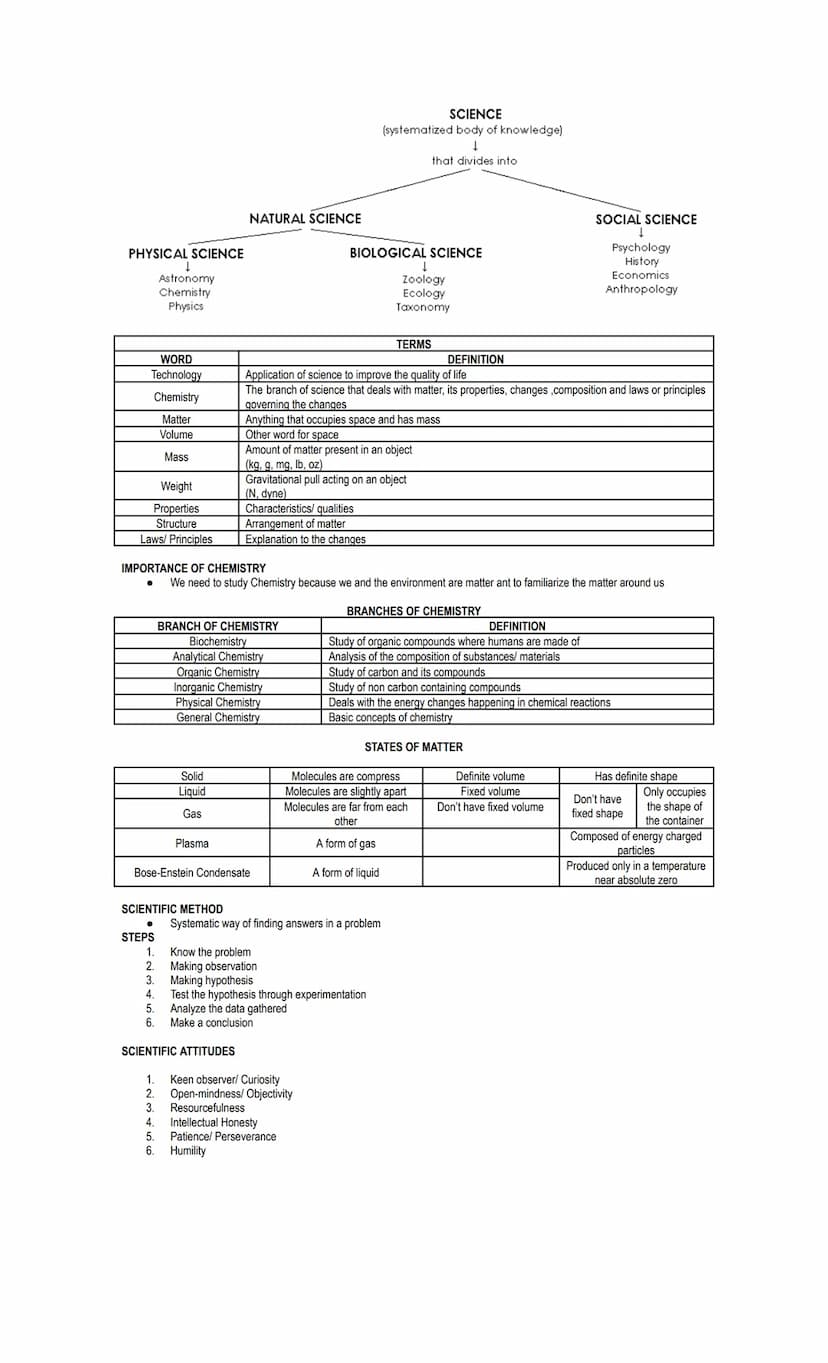

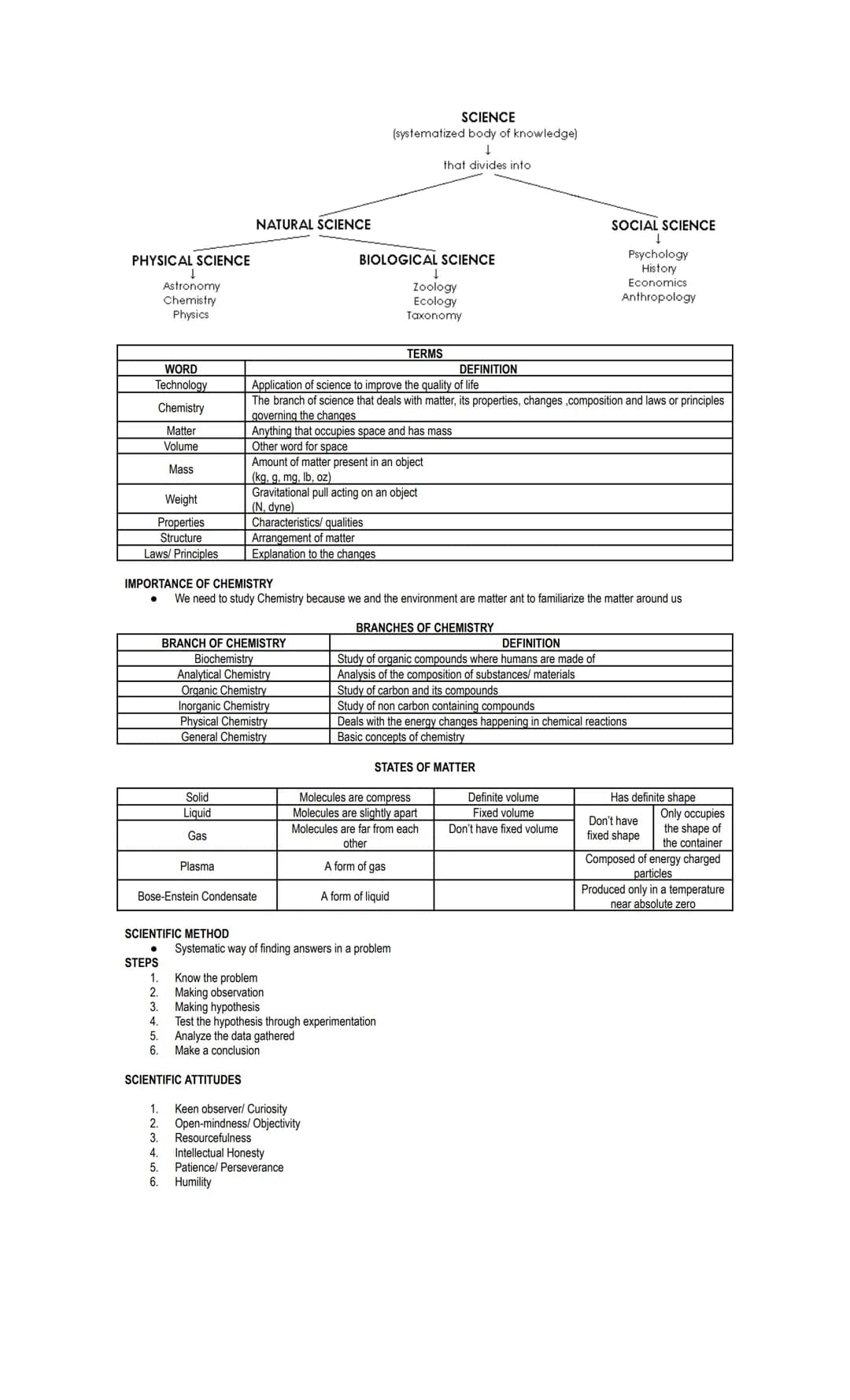
Science divides into three main branches: physical science (astronomy, chemistry, physics), natural science (zoology, ecology, taxonomy), and social science (psychology, history, economics, anthropology). Chemistry specifically deals with matter, its properties, changes, and the laws governing these changes.
Matter is anything that occupies space and has mass. We describe matter using key measurements like mass (amount of matter in kg or g) and volume (the space it occupies). When studying chemistry, we examine properties (characteristics) and structure (arrangement) of matter to understand how and why substances change.
Chemistry matters in your everyday life! It explains everything from how your body processes food to why your smartphone battery works. The field branches into specialized areas including biochemistry (study of compounds in living organisms), organic chemistry (carbon compounds), inorganic chemistry , and analytical chemistry (composition analysis).
Quick Fact: Matter exists in four states: solid (definite shape and volume), liquid (flows with definite volume), gas (no fixed shape or volume), and plasma (energized particles in stars). Scientists have even created a fifth state called Bose-Einstein condensate at temperatures near absolute zero!
When studying chemistry, scientists follow the scientific method: identify a problem, make observations, form a hypothesis, test through experiments, analyze data, and draw conclusions. Successful scientists demonstrate important attitudes like curiosity, open-mindedness, resourcefulness, honesty, perseverance, and healthy skepticism.
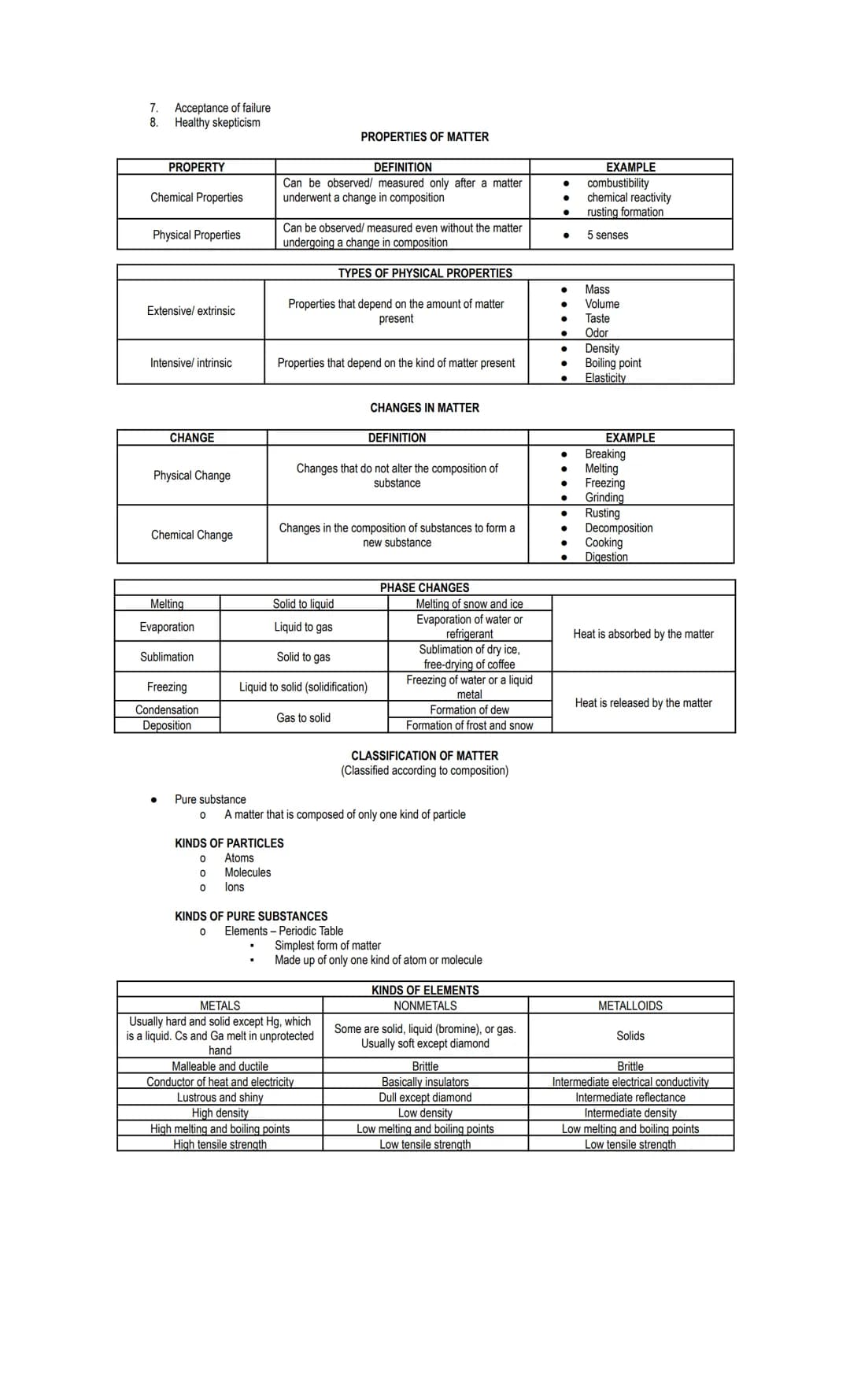
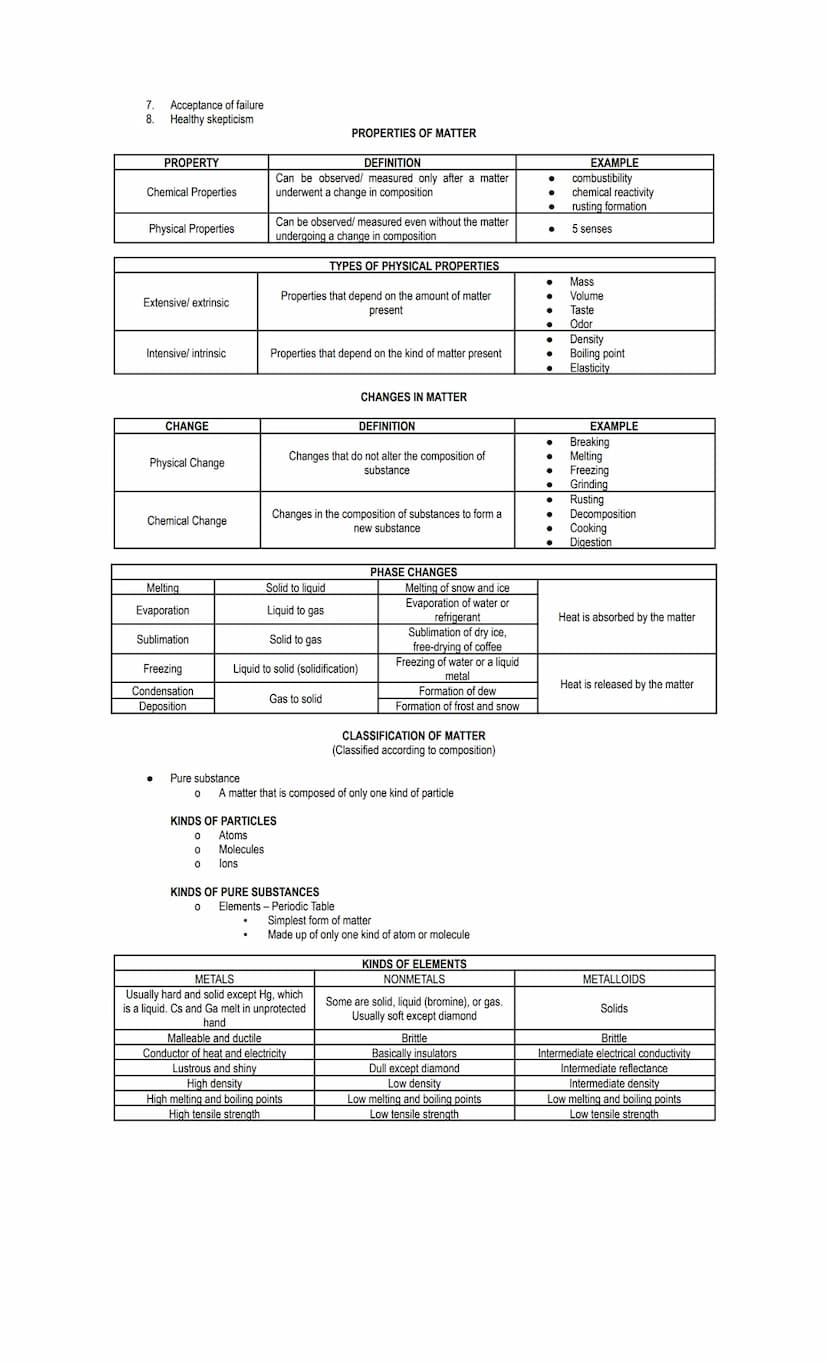
Matter has two main types of properties. Physical properties can be observed without changing the matter's composition (like color, taste, or odor). Chemical properties only appear when matter undergoes a change in composition (like combustibility or rusting). Physical properties further divide into extensive properties (depend on amount, like mass and volume) and intensive properties (depend on the type, like boiling point and density).
When matter changes, it can undergo either physical or chemical changes. Physical changes, like melting ice or grinding pepper, don't alter the substance's composition. Chemical changes create new substances with different properties – think about rusting metal, cooking food, or digestion in your body.
Matter transitions between states through phase changes. These include melting (solid to liquid), freezing (liquid to solid), evaporation (liquid to gas), condensation (gas to liquid), sublimation (solid directly to gas), and deposition (gas directly to solid). Heat is absorbed during melting, evaporation, and sublimation, while heat is released during freezing, condensation, and deposition.
Remember This: When water evaporates from your skin after swimming, it absorbs heat energy from your body – that's why you feel cool!
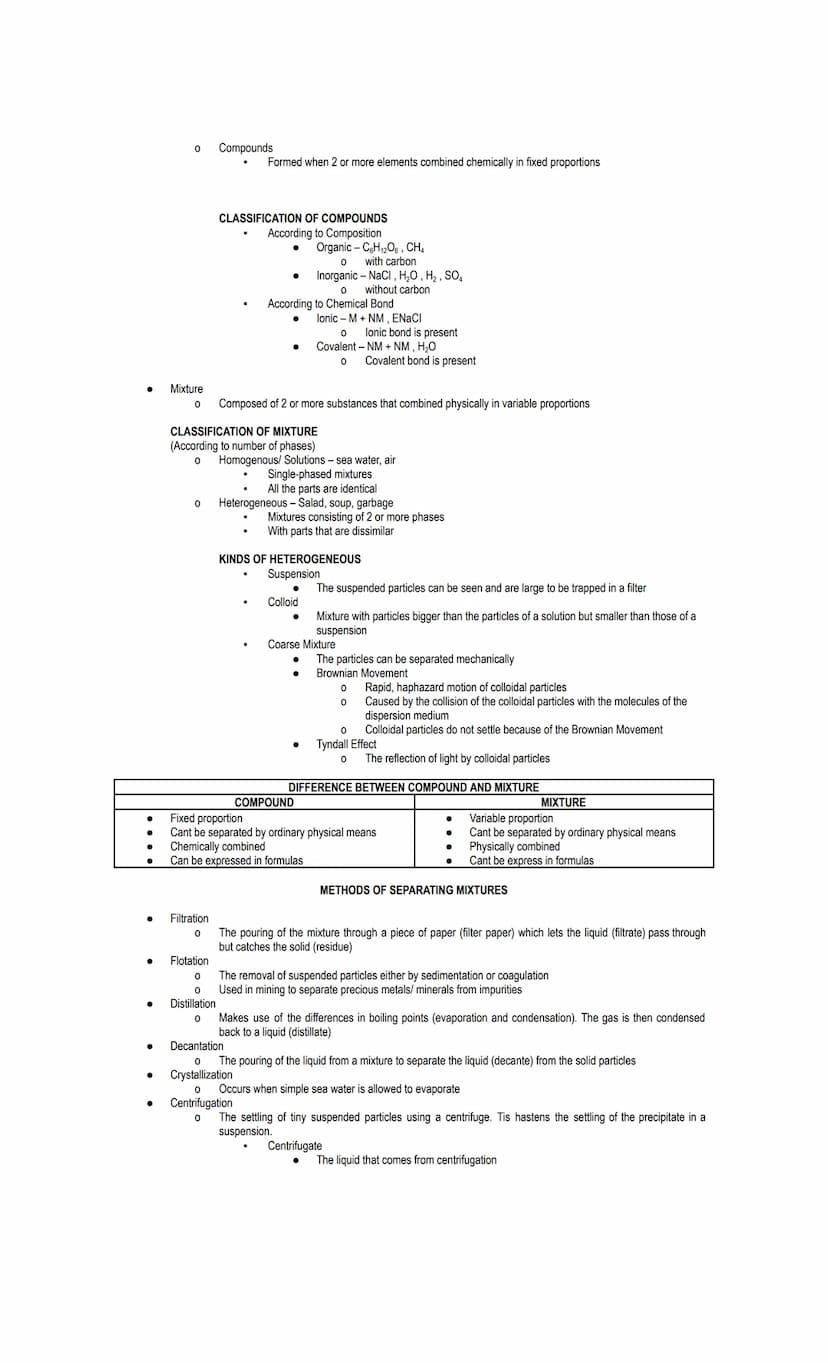
Scientists classify matter by its composition. Pure substances contain only one kind of particle (atoms, molecules, or ions) and divide into elements and compounds. Elements appear on the periodic table and can be metals (shiny, conductive, malleable), nonmetals (brittle, poor conductors), or metalloids (properties between metals and nonmetals). Compounds form when two or more elements combine chemically in fixed proportions.
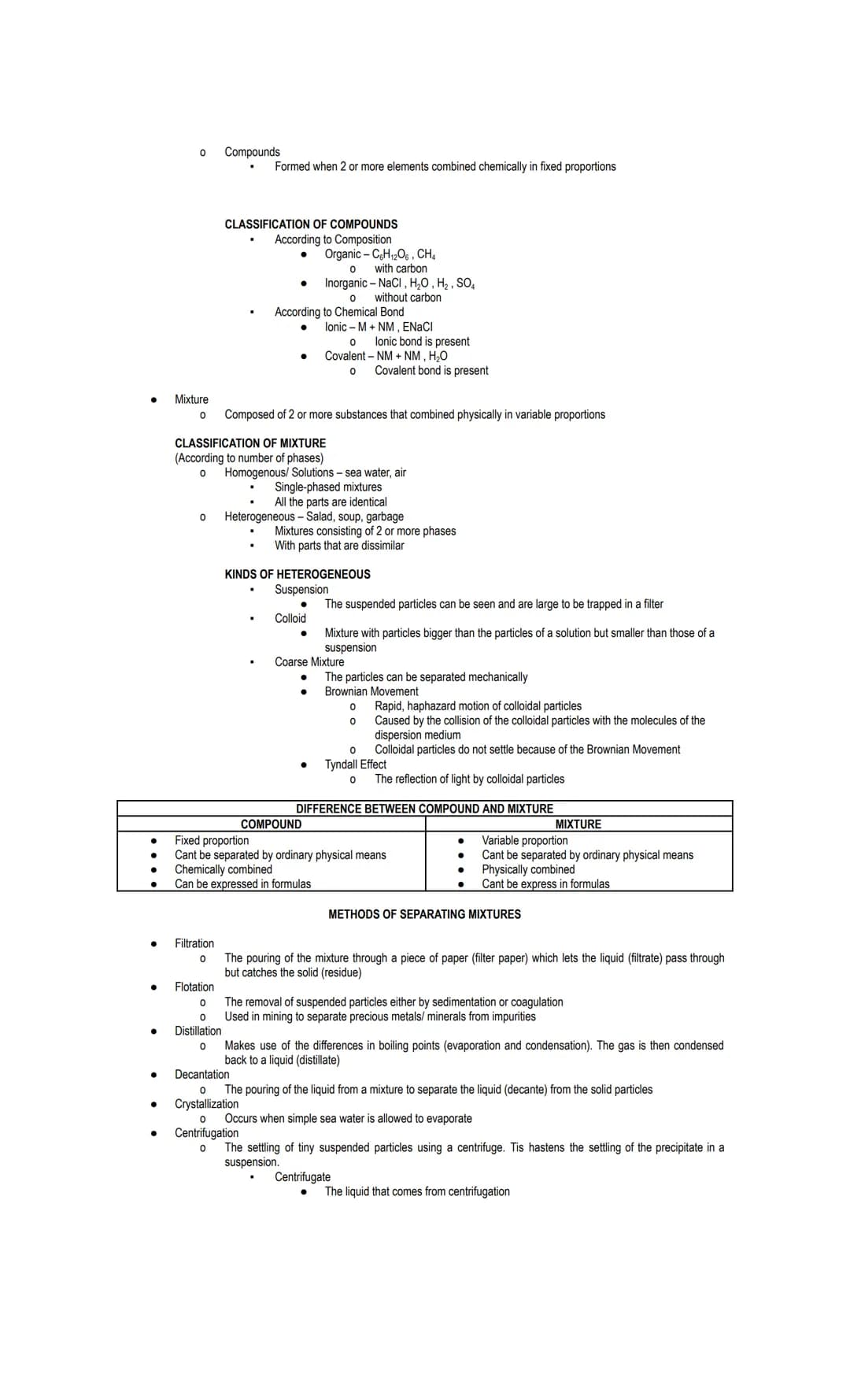
Mixtures combine two or more substances physically in variable proportions. Unlike compounds, mixtures can be separated using physical methods and don't form chemical bonds. Mixtures divide into two main types: homogeneous mixtures (solutions) have uniform composition throughout (like salt water), while heterogeneous mixtures show distinct parts (like vegetable soup).
Heterogeneous mixtures further divide into suspensions, colloids, and coarse mixtures. Suspensions have visible particles that settle over time. Colloids contain smaller particles that don't settle due to Brownian movement (random particle motion). Colloids also display the Tyndall effect, where light beams become visible when passing through them – think about how a flashlight beam looks in foggy air!
The key differences between compounds and mixtures are essential to understand. Compounds have fixed proportions, can't be separated by physical means, combine chemically, and have specific chemical formulas. Mixtures have variable proportions, separate easily by physical methods, combine physically, and don't have fixed formulas.
Lab Tip: When separating mixtures in science class, choose your method based on the properties of the components. Different separation techniques work for different types of mixtures!
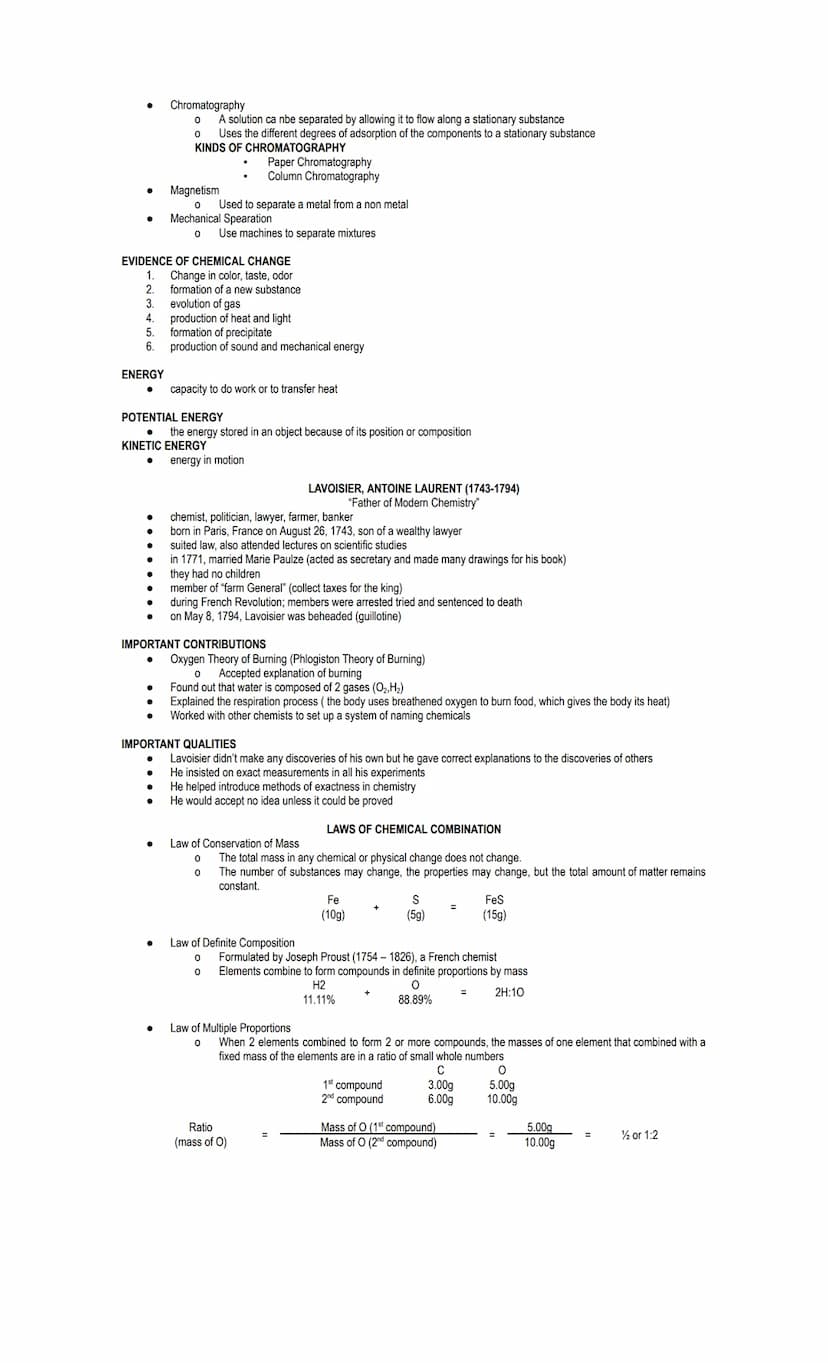
Scientists use various methods to separate mixtures. Filtration traps solids while letting liquids pass through. Distillation separates liquids with different boiling points. Chromatography separates components based on how they travel through a medium. Other methods include decantation (pouring off liquid), crystallization (forming crystals from solutions), centrifugation (spinning to separate), and magnetism (attracting magnetic materials).
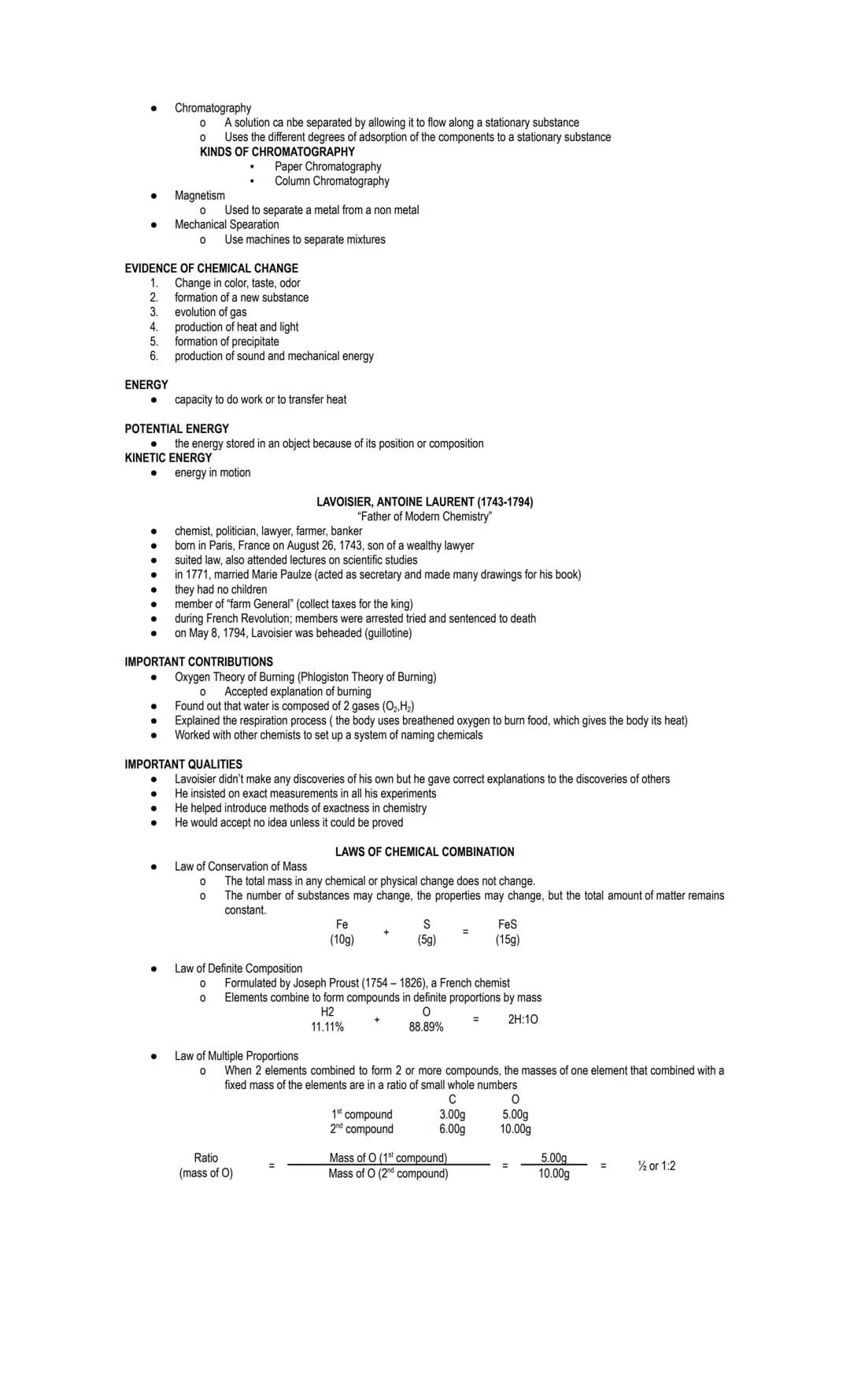
When a chemical change occurs, you'll notice telltale signs: color changes, formation of new substances, gas bubbles appearing, heat or light production, precipitate formation, or even sound production. These changes involve energy transfers – either releasing or absorbing energy.
Energy is the capacity to do work or transfer heat. It exists in two main forms: potential energy (stored energy due to position or composition) and kinetic energy (energy of motion). In chemical reactions, energy can transform between these forms, powering everything from car engines to your own body.
Antoine Lavoisier (1743-1794), known as the "Father of Modern Chemistry," made crucial discoveries despite not conducting original experiments. His careful analysis and precise measurements revolutionized chemistry. Lavoisier disproved the phlogiston theory, discovered water's composition (hydrogen and oxygen), explained respiration as burning food with oxygen, and helped create systematic chemical naming conventions.
Historical Note: Despite his scientific contributions, Lavoisier was beheaded during the French Revolution in 1794 because of his role as a tax collector. His colleague Lagrange remarked: "It took them only an instant to cut off that head, and a hundred years may not produce another like it."
Chemical reactions follow important laws. The Law of Conservation of Mass states that mass is neither created nor destroyed during chemical reactions – the total mass remains constant. The Law of Definite Composition (by Joseph Proust) states elements combine in definite proportions by mass. The Law of Multiple Proportions explains that when elements form multiple compounds, the masses combine in simple whole-number ratios.
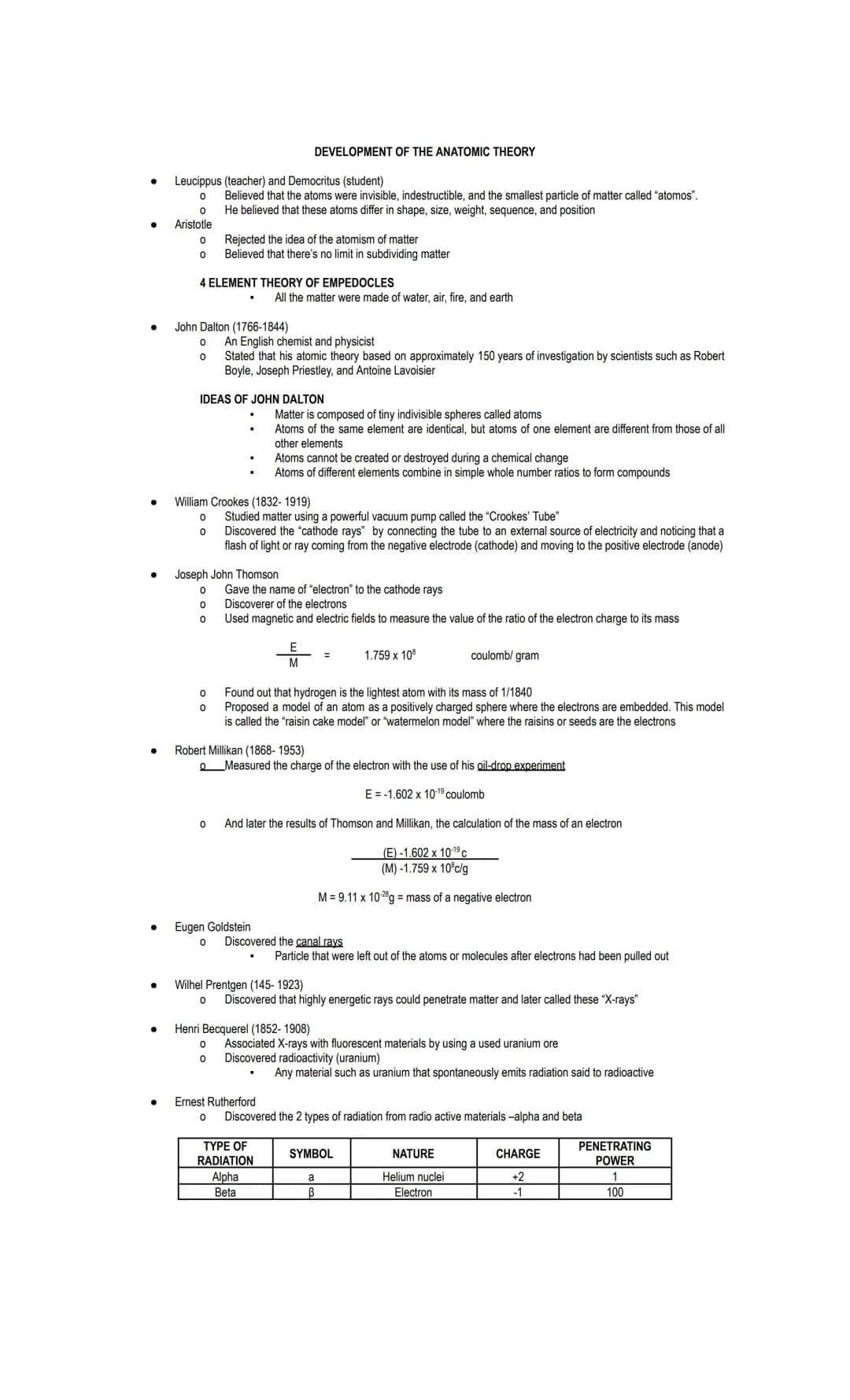
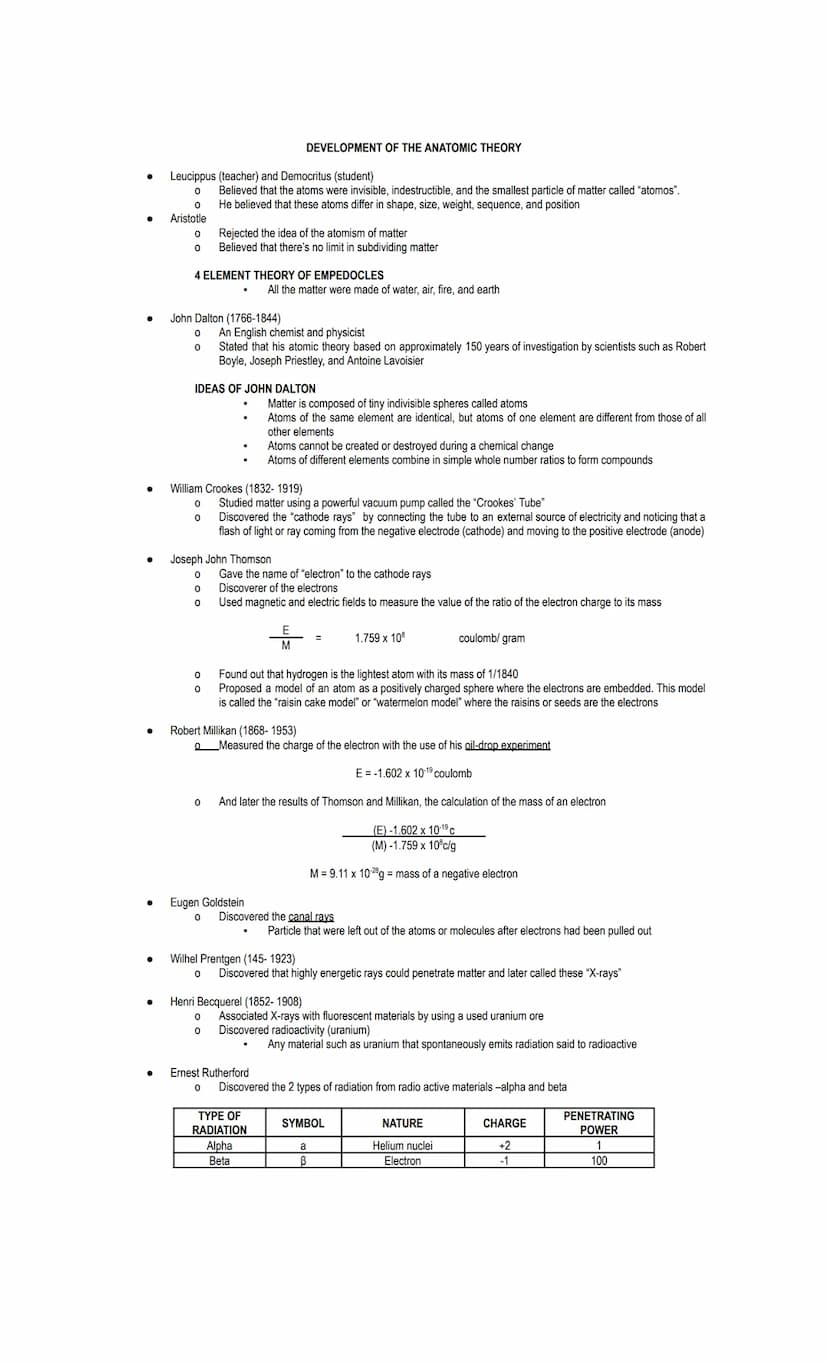
The concept of atoms has evolved dramatically over centuries. Ancient Greeks Leucippus and Democritus first proposed that matter consisted of tiny, indivisible particles called "atomos," differing in shape, size, and weight. Aristotle rejected this idea, believing matter could be infinitely divided, while Empedocles proposed that all matter consisted of four elements: water, air, fire, and earth.
John Dalton (1766-1844) revolutionized chemistry with his atomic theory. He proposed that matter is made of tiny, indivisible atoms; atoms of the same element are identical; atoms cannot be created or destroyed; and atoms combine in simple ratios to form compounds. His ideas formed the foundation for modern chemistry.
The discovery of subatomic particles changed everything. William Crookes discovered "cathode rays" using his vacuum tube experiments. J.J. Thomson identified these rays as electrons and proposed the "raisin cake model" of the atom – a positively charged sphere with embedded negative electrons. Robert Millikan measured the electron's charge through his famous oil-drop experiment.
Mind-Blowing Fact: The mass of an electron is only about 1/1840 the mass of a hydrogen atom! These incredibly tiny particles move at nearly the speed of light around the atomic nucleus.
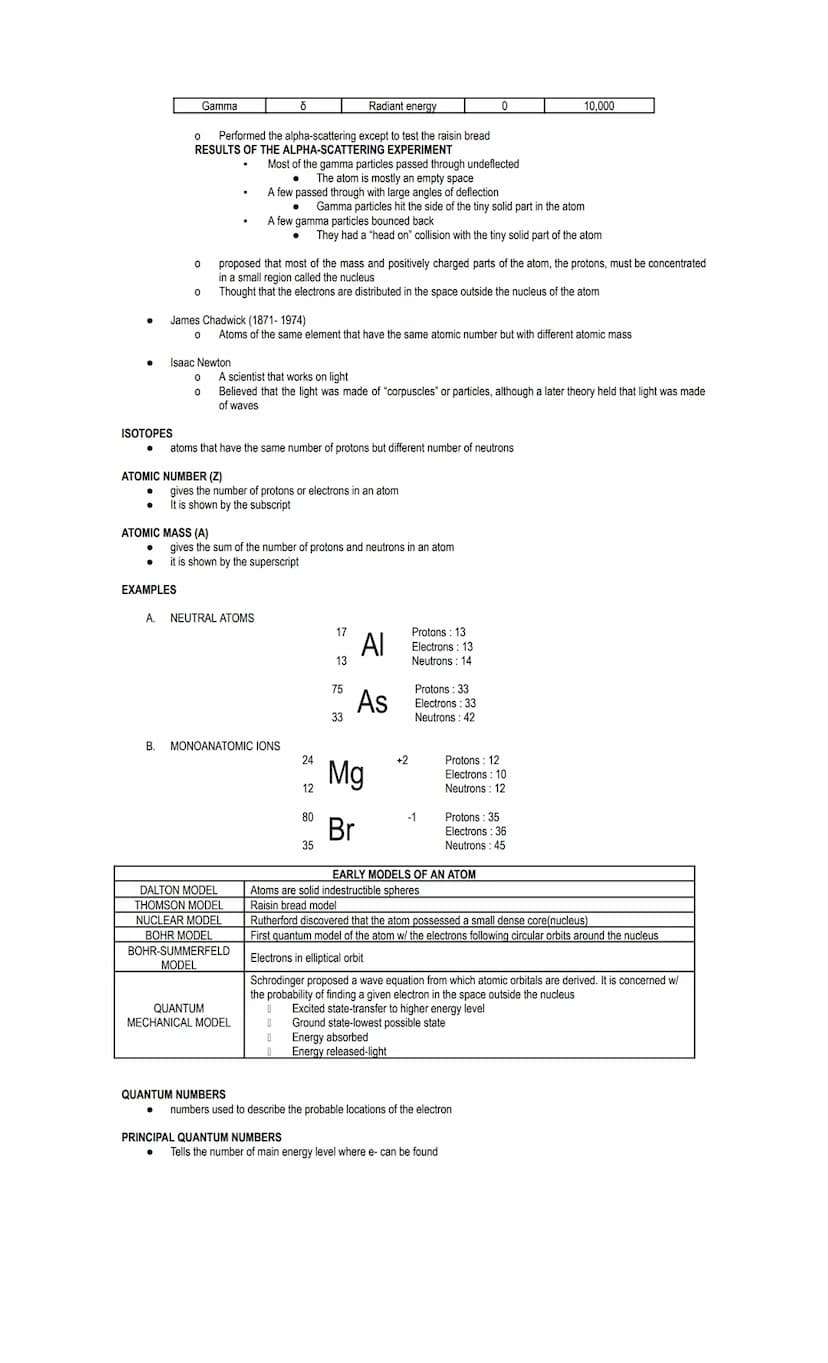
Ernest Rutherford's gold foil experiment revealed the nucleus. When he fired alpha particles at thin gold foil, most passed through, but some bounced back – proving atoms were mostly empty space with a dense, positive center. Later, James Chadwick discovered neutrons, completing our basic understanding of atomic structure. We now define atoms using atomic number (protons), atomic mass , and can identify isotopes (atoms with the same atomic number but different neutron counts).
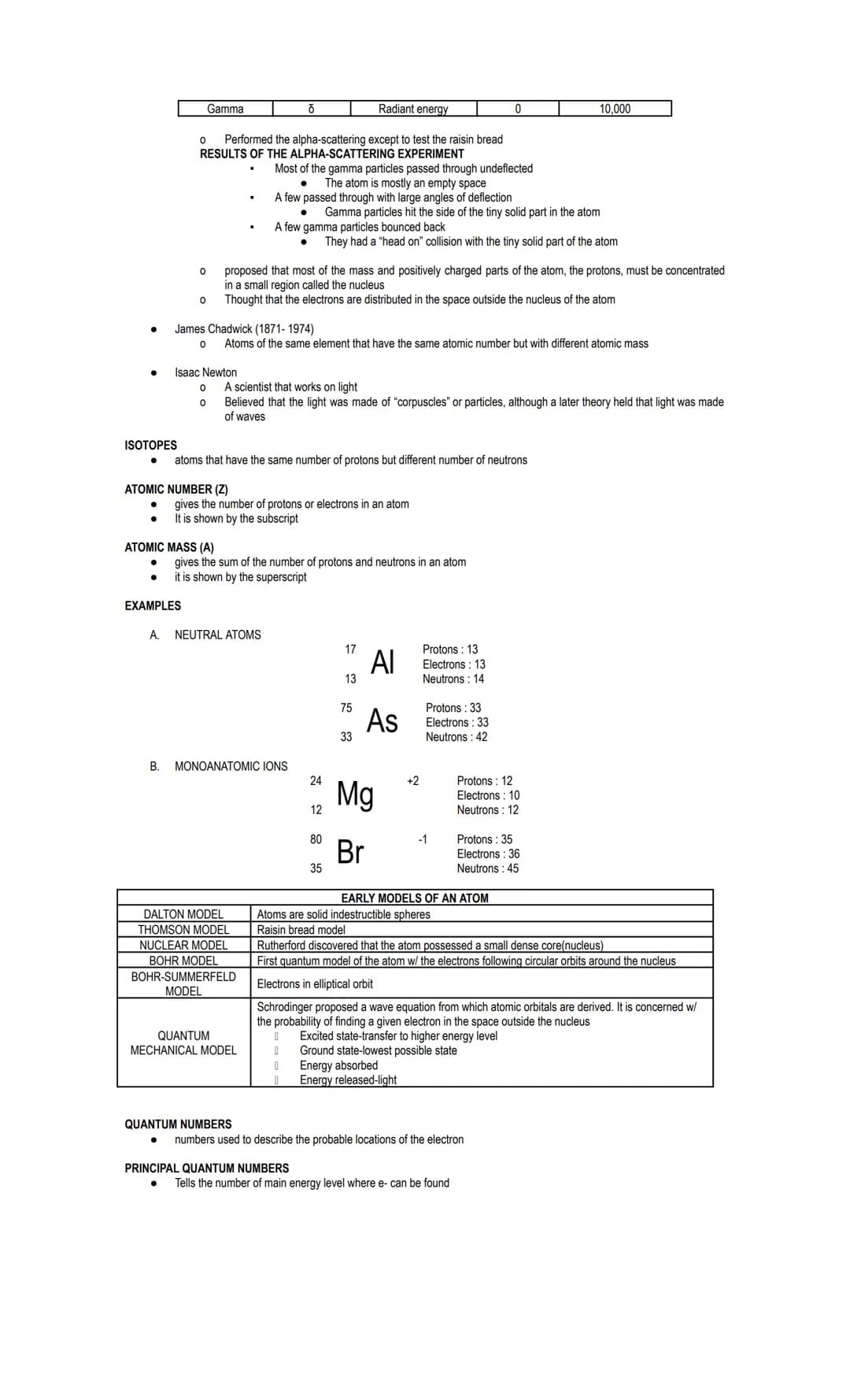
Atomic models evolved dramatically over time. Dalton's solid sphere model gave way to Thomson's "raisin bread" model, then Rutherford's nuclear model with electrons orbiting a positive nucleus. Niels Bohr introduced quantum ideas with electrons in fixed circular orbits, which Bohr-Summerfeld expanded to include elliptical paths. The modern quantum mechanical model describes electron locations as probability clouds rather than definite paths.
In the quantum model, electrons exist in energy states. The ground state is an electron's lowest energy level, while excited states occur when electrons absorb energy and jump to higher levels. When excited electrons return to lower levels, they release energy as light – explaining how fireworks create different colors!
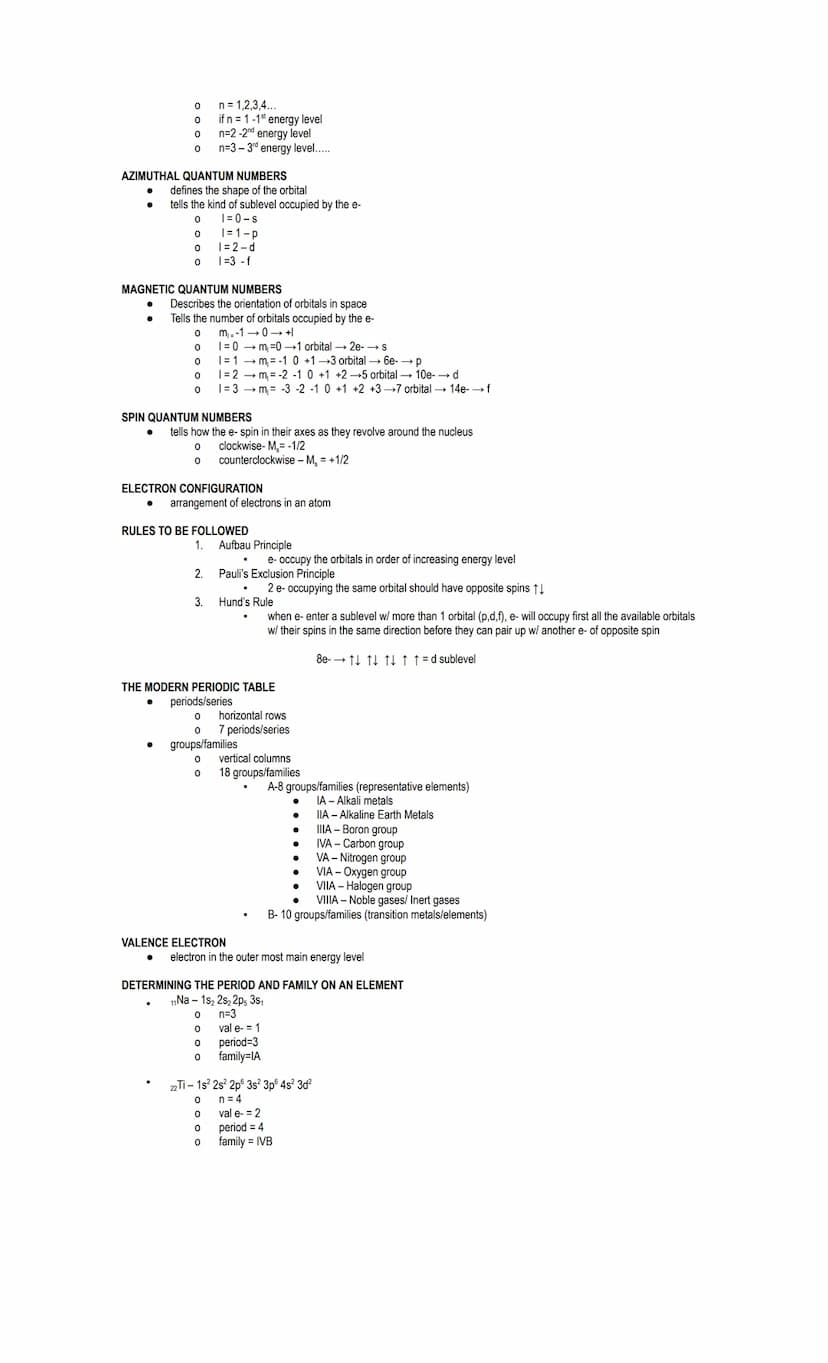
Quantum numbers describe electron locations and behaviors. The principal quantum number (n) identifies the main energy level . The azimuthal quantum number (l) defines orbital shapes (s, p, d, f). The magnetic quantum number (ml) describes orbital orientation in space. The spin quantum number (ms) indicates how electrons spin (clockwise or counterclockwise).
Visualization Tip: Think of electron orbitals like apartment buildings. The principal quantum number (n) is like the floor number, the azimuthal number (l) tells you what type of apartment , the magnetic number (ml) is the specific apartment number, and the spin number (ms) tells you if the tenant is facing north or south in bed!
Electrons fill orbitals according to specific rules. The Aufbau Principle states electrons fill lowest energy orbitals first. Pauli's Exclusion Principle says two electrons in the same orbital must have opposite spins. Hund's Rule explains that electrons will occupy all available orbitals in a sublevel singly before pairing up, always with parallel spins.
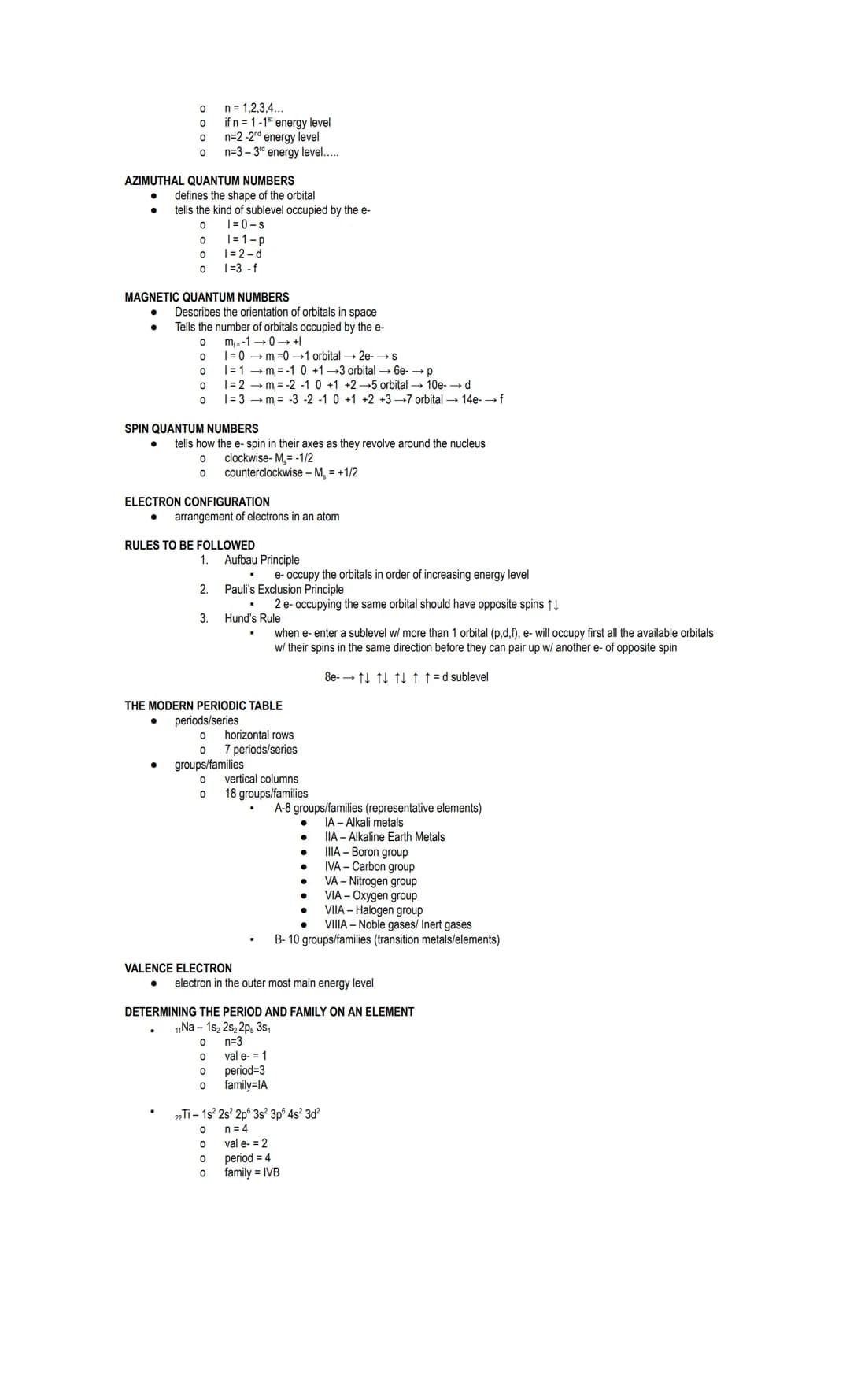
The modern periodic table organizes elements in 7 horizontal periods (rows) and 18 vertical groups (columns). Each element's position reveals crucial information about its properties and behavior. The table divides into representative elements (A groups) and transition elements (B groups).
The representative element families include: IA (alkali metals), IIA (alkaline earth metals), IIIA (boron group), IVA (carbon group), VA (nitrogen group), VIA (oxygen group), VIIA (halogens), and VIIIA (noble gases). Each family shares similar electron configurations and chemical behaviors.
Valence electrons – those in the outermost energy level – determine how elements react chemically. You can determine an element's period and group by examining its electron configuration. For example, sodium (Na) has the configuration 1s² 2s² 2p⁶ 3s¹, with its highest energy level n=3 and one valence electron, placing it in period 3, group IA.
Study Hack: To find an element's group number for main-group elements, just count its valence electrons! Group 1A has 1 valence electron, 2A has 2, and so on. For the "B" groups (transition metals), it gets more complex because d orbitals are involved.
Electron configurations follow predictable patterns based on the electron-filling order: 1s, 2s, 2p, 3s, 3p, 4s, 3d, 4p, and so on. By understanding these patterns, you can predict an element's properties and how it will behave in chemical reactions. This becomes essential for understanding bonding and molecular structure in more advanced chemistry concepts.
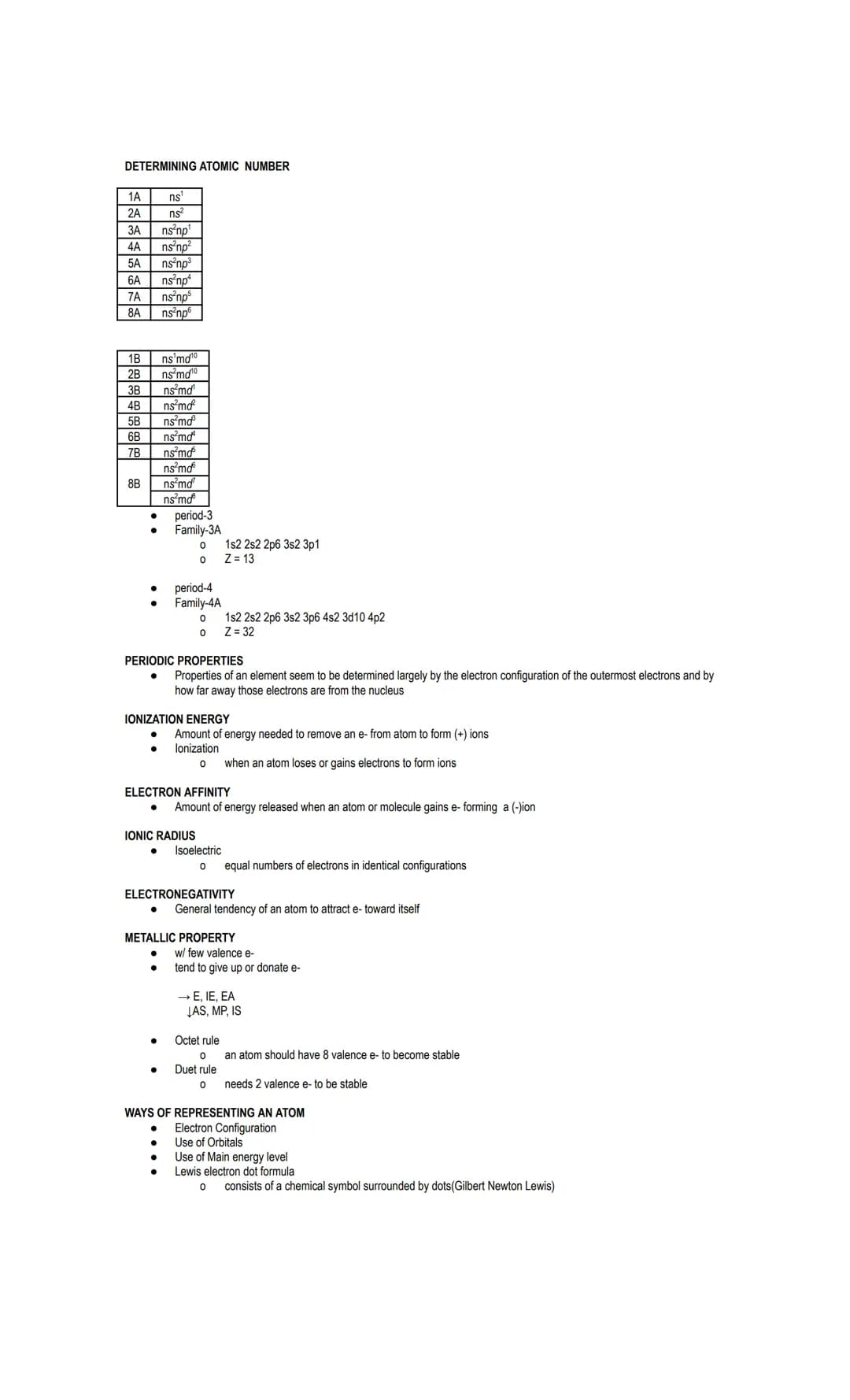
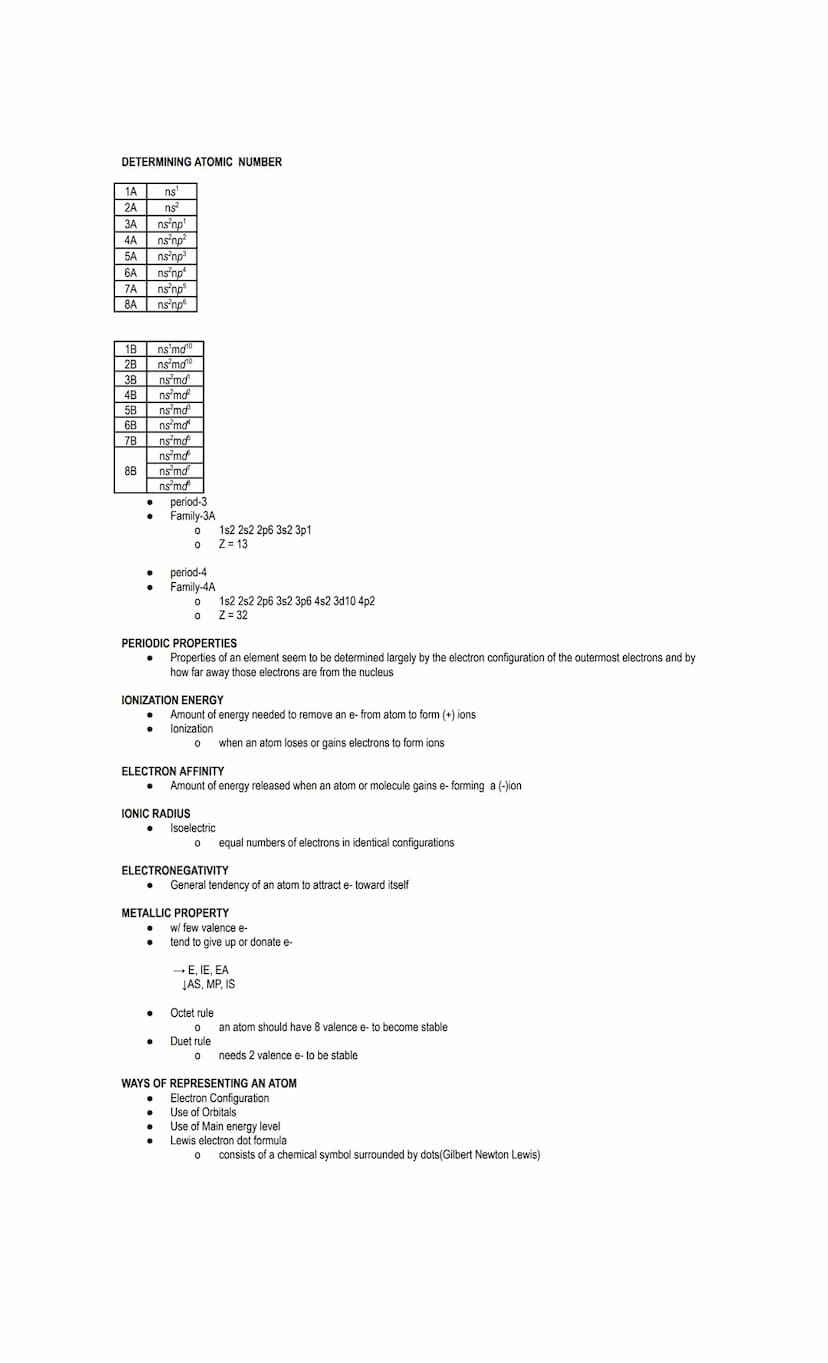
Elements within the periodic table show patterns in their properties. These periodic properties largely depend on valence electron configuration and the distance of those electrons from the nucleus. Understanding these trends helps predict chemical behavior.
Ionization energy measures how much energy is needed to remove an electron from an atom. It generally increases as you move right across a period (more protons pulling electrons) and decreases as you move down a group (valence electrons farther from nucleus). Electron affinity measures energy released when an atom gains an electron, following similar trends.
Electronegativity indicates how strongly atoms attract electrons in bonds. It increases across periods and decreases down groups. Atoms with high electronegativity (like fluorine) tend to gain electrons, while atoms with low electronegativity (like sodium) tend to lose electrons. Metallic character generally increases down groups and decreases across periods.
Connection to Real Life: Electronegativity explains why water (H₂O) molecules are polar. Oxygen strongly attracts the shared electrons, creating partial charges that make water an excellent solvent and give it unique properties!
Atoms strive for stability by achieving filled valence shells, following the octet rule (having eight valence electrons) or the duet rule for hydrogen and helium (having two valence electrons). We can represent atoms in several ways, including electron configurations (1s² 2s² 2p⁶) and Lewis dot structures, which use a chemical symbol surrounded by dots representing valence electrons. These representations help visualize how atoms will bond to form compounds.

Lewis dot structures provide a simple visual way to represent atoms and their valence electrons. This representation consists of the chemical symbol (representing the nucleus and inner electrons) surrounded by dots that show the valence electrons.
The dots are typically arranged in pairs around the four sides of the element symbol. This arrangement helps chemists quickly visualize how elements might bond with each other based on their valence electron configurations.
When drawing Lewis structures, you'll place dots one at a time around the symbol until you've represented all valence electrons. For example, carbon (with 4 valence electrons) would have one dot on each of the four sides of the C symbol.
Application Tip: Lewis dot structures are invaluable when predicting chemical bonds! Elements tend to gain, lose, or share electrons to achieve a full octet (8 valence electrons), and Lewis structures help you visualize how this happens.
Our AI companion is specifically built for the needs of students. Based on the millions of content pieces we have on the platform we can provide truly meaningful and relevant answers to students. But its not only about answers, the companion is even more about guiding students through their daily learning challenges, with personalised study plans, quizzes or content pieces in the chat and 100% personalisation based on the students skills and developments.
You can download the app in the Google Play Store and in the Apple App Store.
That's right! Enjoy free access to study content, connect with fellow students, and get instant help – all at your fingertips.
App Store
Google Play
The app is very easy to use and well designed. I have found everything I was looking for so far and have been able to learn a lot from the presentations! I will definitely use the app for a class assignment! And of course it also helps a lot as an inspiration.
Stefan S
iOS user
This app is really great. There are so many study notes and help [...]. My problem subject is French, for example, and the app has so many options for help. Thanks to this app, I have improved my French. I would recommend it to anyone.
Samantha Klich
Android user
Wow, I am really amazed. I just tried the app because I've seen it advertised many times and was absolutely stunned. This app is THE HELP you want for school and above all, it offers so many things, such as workouts and fact sheets, which have been VERY helpful to me personally.
Anna
iOS user
I think it’s very much worth it and you’ll end up using it a lot once you get the hang of it and even after looking at others notes you can still ask your Artificial intelligence buddy the question and ask to simplify it if you still don’t get it!!! In the end I think it’s worth it 😊👍 ⚠️Also DID I MENTION ITS FREEE YOU DON’T HAVE TO PAY FOR ANYTHING AND STILL GET YOUR GRADES IN PERFECTLY❗️❗️⚠️
Thomas R
iOS user
Knowunity is the BEST app I’ve used in a minute. This is not an ai review or anything this is genuinely coming from a 7th grade student (I know 2011 im young) but dude this app is a 10/10 i have maintained a 3.8 gpa and have plenty of time for gaming. I love it and my mom is just happy I got good grades
Brad T
Android user
Not only did it help me find the answer but it also showed me alternative ways to solve it. I was horrible in math and science but now I have an a in both subjects. Thanks for the help🤍🤍
David K
iOS user
The app's just great! All I have to do is enter the topic in the search bar and I get the response real fast. I don't have to watch 10 YouTube videos to understand something, so I'm saving my time. Highly recommended!
Sudenaz Ocak
Android user
In school I was really bad at maths but thanks to the app, I am doing better now. I am so grateful that you made the app.
Greenlight Bonnie
Android user
I found this app a couple years ago and it has only gotten better since then. I really love it because it can help with written questions and photo questions. Also, it can find study guides that other people have made as well as flashcard sets and practice tests. The free version is also amazing for students who might not be able to afford it. Would 100% recommend
Aubrey
iOS user
Best app if you're in Highschool or Junior high. I have been using this app for 2 school years and it's the best, it's good if you don't have anyone to help you with school work.😋🩷🎀
Marco B
iOS user
THE QUIZES AND FLASHCARDS ARE SO USEFUL AND I LOVE Knowunity AI. IT ALSO IS LITREALLY LIKE CHATGPT BUT SMARTER!! HELPED ME WITH MY MASCARA PROBLEMS TOO!! AS WELL AS MY REAL SUBJECTS ! DUHHH 😍😁😲🤑💗✨🎀😮
Elisha
iOS user
This app is phenomenal down to the correct info and the various topics you can study! I greatly recommend it for people who struggle with procrastination and those who need homework help. It has been perfectly accurate for world 1 history as far as I’ve seen! Geometry too!
Paul T
iOS user
The app is very easy to use and well designed. I have found everything I was looking for so far and have been able to learn a lot from the presentations! I will definitely use the app for a class assignment! And of course it also helps a lot as an inspiration.
Stefan S
iOS user
This app is really great. There are so many study notes and help [...]. My problem subject is French, for example, and the app has so many options for help. Thanks to this app, I have improved my French. I would recommend it to anyone.
Samantha Klich
Android user
Wow, I am really amazed. I just tried the app because I've seen it advertised many times and was absolutely stunned. This app is THE HELP you want for school and above all, it offers so many things, such as workouts and fact sheets, which have been VERY helpful to me personally.
Anna
iOS user
I think it’s very much worth it and you’ll end up using it a lot once you get the hang of it and even after looking at others notes you can still ask your Artificial intelligence buddy the question and ask to simplify it if you still don’t get it!!! In the end I think it’s worth it 😊👍 ⚠️Also DID I MENTION ITS FREEE YOU DON’T HAVE TO PAY FOR ANYTHING AND STILL GET YOUR GRADES IN PERFECTLY❗️❗️⚠️
Thomas R
iOS user
Knowunity is the BEST app I’ve used in a minute. This is not an ai review or anything this is genuinely coming from a 7th grade student (I know 2011 im young) but dude this app is a 10/10 i have maintained a 3.8 gpa and have plenty of time for gaming. I love it and my mom is just happy I got good grades
Brad T
Android user
Not only did it help me find the answer but it also showed me alternative ways to solve it. I was horrible in math and science but now I have an a in both subjects. Thanks for the help🤍🤍
David K
iOS user
The app's just great! All I have to do is enter the topic in the search bar and I get the response real fast. I don't have to watch 10 YouTube videos to understand something, so I'm saving my time. Highly recommended!
Sudenaz Ocak
Android user
In school I was really bad at maths but thanks to the app, I am doing better now. I am so grateful that you made the app.
Greenlight Bonnie
Android user
I found this app a couple years ago and it has only gotten better since then. I really love it because it can help with written questions and photo questions. Also, it can find study guides that other people have made as well as flashcard sets and practice tests. The free version is also amazing for students who might not be able to afford it. Would 100% recommend
Aubrey
iOS user
Best app if you're in Highschool or Junior high. I have been using this app for 2 school years and it's the best, it's good if you don't have anyone to help you with school work.😋🩷🎀
Marco B
iOS user
THE QUIZES AND FLASHCARDS ARE SO USEFUL AND I LOVE Knowunity AI. IT ALSO IS LITREALLY LIKE CHATGPT BUT SMARTER!! HELPED ME WITH MY MASCARA PROBLEMS TOO!! AS WELL AS MY REAL SUBJECTS ! DUHHH 😍😁😲🤑💗✨🎀😮
Elisha
iOS user
This app is phenomenal down to the correct info and the various topics you can study! I greatly recommend it for people who struggle with procrastination and those who need homework help. It has been perfectly accurate for world 1 history as far as I’ve seen! Geometry too!
Paul T
iOS user
Jasy Rodriguez
@jasyrodriguez_fpij
Chemistry is the study of matter, its properties, and the changes it undergoes. This fascinating science helps us understand everything around us, from the air we breathe to our own bodies. Learning chemistry gives you the tools to understand how... Show more
Access to all documents
Improve your grades
Join milions of students
Science divides into three main branches: physical science (astronomy, chemistry, physics), natural science (zoology, ecology, taxonomy), and social science (psychology, history, economics, anthropology). Chemistry specifically deals with matter, its properties, changes, and the laws governing these changes.
Matter is anything that occupies space and has mass. We describe matter using key measurements like mass (amount of matter in kg or g) and volume (the space it occupies). When studying chemistry, we examine properties (characteristics) and structure (arrangement) of matter to understand how and why substances change.
Chemistry matters in your everyday life! It explains everything from how your body processes food to why your smartphone battery works. The field branches into specialized areas including biochemistry (study of compounds in living organisms), organic chemistry (carbon compounds), inorganic chemistry , and analytical chemistry (composition analysis).
Quick Fact: Matter exists in four states: solid (definite shape and volume), liquid (flows with definite volume), gas (no fixed shape or volume), and plasma (energized particles in stars). Scientists have even created a fifth state called Bose-Einstein condensate at temperatures near absolute zero!
When studying chemistry, scientists follow the scientific method: identify a problem, make observations, form a hypothesis, test through experiments, analyze data, and draw conclusions. Successful scientists demonstrate important attitudes like curiosity, open-mindedness, resourcefulness, honesty, perseverance, and healthy skepticism.
Access to all documents
Improve your grades
Join milions of students
Matter has two main types of properties. Physical properties can be observed without changing the matter's composition (like color, taste, or odor). Chemical properties only appear when matter undergoes a change in composition (like combustibility or rusting). Physical properties further divide into extensive properties (depend on amount, like mass and volume) and intensive properties (depend on the type, like boiling point and density).
When matter changes, it can undergo either physical or chemical changes. Physical changes, like melting ice or grinding pepper, don't alter the substance's composition. Chemical changes create new substances with different properties – think about rusting metal, cooking food, or digestion in your body.
Matter transitions between states through phase changes. These include melting (solid to liquid), freezing (liquid to solid), evaporation (liquid to gas), condensation (gas to liquid), sublimation (solid directly to gas), and deposition (gas directly to solid). Heat is absorbed during melting, evaporation, and sublimation, while heat is released during freezing, condensation, and deposition.
Remember This: When water evaporates from your skin after swimming, it absorbs heat energy from your body – that's why you feel cool!
Scientists classify matter by its composition. Pure substances contain only one kind of particle (atoms, molecules, or ions) and divide into elements and compounds. Elements appear on the periodic table and can be metals (shiny, conductive, malleable), nonmetals (brittle, poor conductors), or metalloids (properties between metals and nonmetals). Compounds form when two or more elements combine chemically in fixed proportions.
Access to all documents
Improve your grades
Join milions of students
Mixtures combine two or more substances physically in variable proportions. Unlike compounds, mixtures can be separated using physical methods and don't form chemical bonds. Mixtures divide into two main types: homogeneous mixtures (solutions) have uniform composition throughout (like salt water), while heterogeneous mixtures show distinct parts (like vegetable soup).
Heterogeneous mixtures further divide into suspensions, colloids, and coarse mixtures. Suspensions have visible particles that settle over time. Colloids contain smaller particles that don't settle due to Brownian movement (random particle motion). Colloids also display the Tyndall effect, where light beams become visible when passing through them – think about how a flashlight beam looks in foggy air!
The key differences between compounds and mixtures are essential to understand. Compounds have fixed proportions, can't be separated by physical means, combine chemically, and have specific chemical formulas. Mixtures have variable proportions, separate easily by physical methods, combine physically, and don't have fixed formulas.
Lab Tip: When separating mixtures in science class, choose your method based on the properties of the components. Different separation techniques work for different types of mixtures!
Scientists use various methods to separate mixtures. Filtration traps solids while letting liquids pass through. Distillation separates liquids with different boiling points. Chromatography separates components based on how they travel through a medium. Other methods include decantation (pouring off liquid), crystallization (forming crystals from solutions), centrifugation (spinning to separate), and magnetism (attracting magnetic materials).
Access to all documents
Improve your grades
Join milions of students
When a chemical change occurs, you'll notice telltale signs: color changes, formation of new substances, gas bubbles appearing, heat or light production, precipitate formation, or even sound production. These changes involve energy transfers – either releasing or absorbing energy.
Energy is the capacity to do work or transfer heat. It exists in two main forms: potential energy (stored energy due to position or composition) and kinetic energy (energy of motion). In chemical reactions, energy can transform between these forms, powering everything from car engines to your own body.
Antoine Lavoisier (1743-1794), known as the "Father of Modern Chemistry," made crucial discoveries despite not conducting original experiments. His careful analysis and precise measurements revolutionized chemistry. Lavoisier disproved the phlogiston theory, discovered water's composition (hydrogen and oxygen), explained respiration as burning food with oxygen, and helped create systematic chemical naming conventions.
Historical Note: Despite his scientific contributions, Lavoisier was beheaded during the French Revolution in 1794 because of his role as a tax collector. His colleague Lagrange remarked: "It took them only an instant to cut off that head, and a hundred years may not produce another like it."
Chemical reactions follow important laws. The Law of Conservation of Mass states that mass is neither created nor destroyed during chemical reactions – the total mass remains constant. The Law of Definite Composition (by Joseph Proust) states elements combine in definite proportions by mass. The Law of Multiple Proportions explains that when elements form multiple compounds, the masses combine in simple whole-number ratios.
Access to all documents
Improve your grades
Join milions of students
The concept of atoms has evolved dramatically over centuries. Ancient Greeks Leucippus and Democritus first proposed that matter consisted of tiny, indivisible particles called "atomos," differing in shape, size, and weight. Aristotle rejected this idea, believing matter could be infinitely divided, while Empedocles proposed that all matter consisted of four elements: water, air, fire, and earth.
John Dalton (1766-1844) revolutionized chemistry with his atomic theory. He proposed that matter is made of tiny, indivisible atoms; atoms of the same element are identical; atoms cannot be created or destroyed; and atoms combine in simple ratios to form compounds. His ideas formed the foundation for modern chemistry.
The discovery of subatomic particles changed everything. William Crookes discovered "cathode rays" using his vacuum tube experiments. J.J. Thomson identified these rays as electrons and proposed the "raisin cake model" of the atom – a positively charged sphere with embedded negative electrons. Robert Millikan measured the electron's charge through his famous oil-drop experiment.
Mind-Blowing Fact: The mass of an electron is only about 1/1840 the mass of a hydrogen atom! These incredibly tiny particles move at nearly the speed of light around the atomic nucleus.
Ernest Rutherford's gold foil experiment revealed the nucleus. When he fired alpha particles at thin gold foil, most passed through, but some bounced back – proving atoms were mostly empty space with a dense, positive center. Later, James Chadwick discovered neutrons, completing our basic understanding of atomic structure. We now define atoms using atomic number (protons), atomic mass , and can identify isotopes (atoms with the same atomic number but different neutron counts).
Access to all documents
Improve your grades
Join milions of students
Atomic models evolved dramatically over time. Dalton's solid sphere model gave way to Thomson's "raisin bread" model, then Rutherford's nuclear model with electrons orbiting a positive nucleus. Niels Bohr introduced quantum ideas with electrons in fixed circular orbits, which Bohr-Summerfeld expanded to include elliptical paths. The modern quantum mechanical model describes electron locations as probability clouds rather than definite paths.
In the quantum model, electrons exist in energy states. The ground state is an electron's lowest energy level, while excited states occur when electrons absorb energy and jump to higher levels. When excited electrons return to lower levels, they release energy as light – explaining how fireworks create different colors!
Quantum numbers describe electron locations and behaviors. The principal quantum number (n) identifies the main energy level . The azimuthal quantum number (l) defines orbital shapes (s, p, d, f). The magnetic quantum number (ml) describes orbital orientation in space. The spin quantum number (ms) indicates how electrons spin (clockwise or counterclockwise).
Visualization Tip: Think of electron orbitals like apartment buildings. The principal quantum number (n) is like the floor number, the azimuthal number (l) tells you what type of apartment , the magnetic number (ml) is the specific apartment number, and the spin number (ms) tells you if the tenant is facing north or south in bed!
Electrons fill orbitals according to specific rules. The Aufbau Principle states electrons fill lowest energy orbitals first. Pauli's Exclusion Principle says two electrons in the same orbital must have opposite spins. Hund's Rule explains that electrons will occupy all available orbitals in a sublevel singly before pairing up, always with parallel spins.
Access to all documents
Improve your grades
Join milions of students
The modern periodic table organizes elements in 7 horizontal periods (rows) and 18 vertical groups (columns). Each element's position reveals crucial information about its properties and behavior. The table divides into representative elements (A groups) and transition elements (B groups).
The representative element families include: IA (alkali metals), IIA (alkaline earth metals), IIIA (boron group), IVA (carbon group), VA (nitrogen group), VIA (oxygen group), VIIA (halogens), and VIIIA (noble gases). Each family shares similar electron configurations and chemical behaviors.
Valence electrons – those in the outermost energy level – determine how elements react chemically. You can determine an element's period and group by examining its electron configuration. For example, sodium (Na) has the configuration 1s² 2s² 2p⁶ 3s¹, with its highest energy level n=3 and one valence electron, placing it in period 3, group IA.
Study Hack: To find an element's group number for main-group elements, just count its valence electrons! Group 1A has 1 valence electron, 2A has 2, and so on. For the "B" groups (transition metals), it gets more complex because d orbitals are involved.
Electron configurations follow predictable patterns based on the electron-filling order: 1s, 2s, 2p, 3s, 3p, 4s, 3d, 4p, and so on. By understanding these patterns, you can predict an element's properties and how it will behave in chemical reactions. This becomes essential for understanding bonding and molecular structure in more advanced chemistry concepts.
Access to all documents
Improve your grades
Join milions of students
Elements within the periodic table show patterns in their properties. These periodic properties largely depend on valence electron configuration and the distance of those electrons from the nucleus. Understanding these trends helps predict chemical behavior.
Ionization energy measures how much energy is needed to remove an electron from an atom. It generally increases as you move right across a period (more protons pulling electrons) and decreases as you move down a group (valence electrons farther from nucleus). Electron affinity measures energy released when an atom gains an electron, following similar trends.
Electronegativity indicates how strongly atoms attract electrons in bonds. It increases across periods and decreases down groups. Atoms with high electronegativity (like fluorine) tend to gain electrons, while atoms with low electronegativity (like sodium) tend to lose electrons. Metallic character generally increases down groups and decreases across periods.
Connection to Real Life: Electronegativity explains why water (H₂O) molecules are polar. Oxygen strongly attracts the shared electrons, creating partial charges that make water an excellent solvent and give it unique properties!
Atoms strive for stability by achieving filled valence shells, following the octet rule (having eight valence electrons) or the duet rule for hydrogen and helium (having two valence electrons). We can represent atoms in several ways, including electron configurations (1s² 2s² 2p⁶) and Lewis dot structures, which use a chemical symbol surrounded by dots representing valence electrons. These representations help visualize how atoms will bond to form compounds.
Access to all documents
Improve your grades
Join milions of students
Lewis dot structures provide a simple visual way to represent atoms and their valence electrons. This representation consists of the chemical symbol (representing the nucleus and inner electrons) surrounded by dots that show the valence electrons.
The dots are typically arranged in pairs around the four sides of the element symbol. This arrangement helps chemists quickly visualize how elements might bond with each other based on their valence electron configurations.
When drawing Lewis structures, you'll place dots one at a time around the symbol until you've represented all valence electrons. For example, carbon (with 4 valence electrons) would have one dot on each of the four sides of the C symbol.
Application Tip: Lewis dot structures are invaluable when predicting chemical bonds! Elements tend to gain, lose, or share electrons to achieve a full octet (8 valence electrons), and Lewis structures help you visualize how this happens.
Our AI companion is specifically built for the needs of students. Based on the millions of content pieces we have on the platform we can provide truly meaningful and relevant answers to students. But its not only about answers, the companion is even more about guiding students through their daily learning challenges, with personalised study plans, quizzes or content pieces in the chat and 100% personalisation based on the students skills and developments.
You can download the app in the Google Play Store and in the Apple App Store.
That's right! Enjoy free access to study content, connect with fellow students, and get instant help – all at your fingertips.
7
Smart Tools NEW
Transform this note into: ✓ 50+ Practice Questions ✓ Interactive Flashcards ✓ Full Practice Test ✓ Essay Outlines
Explore the step-by-step process of synthesizing soluble salts using sulfuric acid and copper oxide. This practical guide includes essential techniques, safety tips, and clear diagrams to enhance your understanding of solubility and reactions in chemistry. Ideal for chemistry students and practical lab sessions.
 Chemistry
This explains thermochemistry in a detailed way with some sample problems.
ChemistryExploring the electron configurations and valence electrons of various elements in the periodic table.
ChemistryThese A-Level Chemistry notes are designed to provide a thorough and in-depth understanding of the key concepts, principles, and theories that form the foundation of chemistry. Developed with the goal of assisting students in their A-Level studies, these
ChemistryExplore a comprehensive set of density calculation problems and solutions, covering various materials including tennis balls, ice, gold, and more. This resource includes step-by-step explanations for calculating density, volume, and mass, making it ideal for students preparing for exams in physics and chemistry.
 Combined Science
Learn about the importance of peptide bonds and protein structure in building and shaping proteins. And in addition, how sturctures like enzymes are important to our systems.
ChemistryApp Store
Google Play
The app is very easy to use and well designed. I have found everything I was looking for so far and have been able to learn a lot from the presentations! I will definitely use the app for a class assignment! And of course it also helps a lot as an inspiration.
Stefan S
iOS user
This app is really great. There are so many study notes and help [...]. My problem subject is French, for example, and the app has so many options for help. Thanks to this app, I have improved my French. I would recommend it to anyone.
Samantha Klich
Android user
Wow, I am really amazed. I just tried the app because I've seen it advertised many times and was absolutely stunned. This app is THE HELP you want for school and above all, it offers so many things, such as workouts and fact sheets, which have been VERY helpful to me personally.
Anna
iOS user
I think it’s very much worth it and you’ll end up using it a lot once you get the hang of it and even after looking at others notes you can still ask your Artificial intelligence buddy the question and ask to simplify it if you still don’t get it!!! In the end I think it’s worth it 😊👍 ⚠️Also DID I MENTION ITS FREEE YOU DON’T HAVE TO PAY FOR ANYTHING AND STILL GET YOUR GRADES IN PERFECTLY❗️❗️⚠️
Thomas R
iOS user
Knowunity is the BEST app I’ve used in a minute. This is not an ai review or anything this is genuinely coming from a 7th grade student (I know 2011 im young) but dude this app is a 10/10 i have maintained a 3.8 gpa and have plenty of time for gaming. I love it and my mom is just happy I got good grades
Brad T
Android user
Not only did it help me find the answer but it also showed me alternative ways to solve it. I was horrible in math and science but now I have an a in both subjects. Thanks for the help🤍🤍
David K
iOS user
The app's just great! All I have to do is enter the topic in the search bar and I get the response real fast. I don't have to watch 10 YouTube videos to understand something, so I'm saving my time. Highly recommended!
Sudenaz Ocak
Android user
In school I was really bad at maths but thanks to the app, I am doing better now. I am so grateful that you made the app.
Greenlight Bonnie
Android user
I found this app a couple years ago and it has only gotten better since then. I really love it because it can help with written questions and photo questions. Also, it can find study guides that other people have made as well as flashcard sets and practice tests. The free version is also amazing for students who might not be able to afford it. Would 100% recommend
Aubrey
iOS user
Best app if you're in Highschool or Junior high. I have been using this app for 2 school years and it's the best, it's good if you don't have anyone to help you with school work.😋🩷🎀
Marco B
iOS user
THE QUIZES AND FLASHCARDS ARE SO USEFUL AND I LOVE Knowunity AI. IT ALSO IS LITREALLY LIKE CHATGPT BUT SMARTER!! HELPED ME WITH MY MASCARA PROBLEMS TOO!! AS WELL AS MY REAL SUBJECTS ! DUHHH 😍😁😲🤑💗✨🎀😮
Elisha
iOS user
This app is phenomenal down to the correct info and the various topics you can study! I greatly recommend it for people who struggle with procrastination and those who need homework help. It has been perfectly accurate for world 1 history as far as I’ve seen! Geometry too!
Paul T
iOS user
The app is very easy to use and well designed. I have found everything I was looking for so far and have been able to learn a lot from the presentations! I will definitely use the app for a class assignment! And of course it also helps a lot as an inspiration.
Stefan S
iOS user
This app is really great. There are so many study notes and help [...]. My problem subject is French, for example, and the app has so many options for help. Thanks to this app, I have improved my French. I would recommend it to anyone.
Samantha Klich
Android user
Wow, I am really amazed. I just tried the app because I've seen it advertised many times and was absolutely stunned. This app is THE HELP you want for school and above all, it offers so many things, such as workouts and fact sheets, which have been VERY helpful to me personally.
Anna
iOS user
I think it’s very much worth it and you’ll end up using it a lot once you get the hang of it and even after looking at others notes you can still ask your Artificial intelligence buddy the question and ask to simplify it if you still don’t get it!!! In the end I think it’s worth it 😊👍 ⚠️Also DID I MENTION ITS FREEE YOU DON’T HAVE TO PAY FOR ANYTHING AND STILL GET YOUR GRADES IN PERFECTLY❗️❗️⚠️
Thomas R
iOS user
Knowunity is the BEST app I’ve used in a minute. This is not an ai review or anything this is genuinely coming from a 7th grade student (I know 2011 im young) but dude this app is a 10/10 i have maintained a 3.8 gpa and have plenty of time for gaming. I love it and my mom is just happy I got good grades
Brad T
Android user
Not only did it help me find the answer but it also showed me alternative ways to solve it. I was horrible in math and science but now I have an a in both subjects. Thanks for the help🤍🤍
David K
iOS user
The app's just great! All I have to do is enter the topic in the search bar and I get the response real fast. I don't have to watch 10 YouTube videos to understand something, so I'm saving my time. Highly recommended!
Sudenaz Ocak
Android user
In school I was really bad at maths but thanks to the app, I am doing better now. I am so grateful that you made the app.
Greenlight Bonnie
Android user
I found this app a couple years ago and it has only gotten better since then. I really love it because it can help with written questions and photo questions. Also, it can find study guides that other people have made as well as flashcard sets and practice tests. The free version is also amazing for students who might not be able to afford it. Would 100% recommend
Aubrey
iOS user
Best app if you're in Highschool or Junior high. I have been using this app for 2 school years and it's the best, it's good if you don't have anyone to help you with school work.😋🩷🎀
Marco B
iOS user
THE QUIZES AND FLASHCARDS ARE SO USEFUL AND I LOVE Knowunity AI. IT ALSO IS LITREALLY LIKE CHATGPT BUT SMARTER!! HELPED ME WITH MY MASCARA PROBLEMS TOO!! AS WELL AS MY REAL SUBJECTS ! DUHHH 😍😁😲🤑💗✨🎀😮
Elisha
iOS user
This app is phenomenal down to the correct info and the various topics you can study! I greatly recommend it for people who struggle with procrastination and those who need homework help. It has been perfectly accurate for world 1 history as far as I’ve seen! Geometry too!
Paul T
iOS user