
Chemistry is a fascinating science that explores how matter behaves... Show more
 Algebra
 Biology
Sign up to see the contentIt's free!
Access to all documents
Improve your grades
Join milions of students
Knowunity AI
Subjects
Triangle Congruence and Similarity Theorems
Triangle Properties and Classification
Linear Equations and Graphs
Geometric Angle Relationships
Trigonometric Functions and Identities
Equation Solving Techniques
Circle Geometry Fundamentals
Division Operations and Methods
Basic Differentiation Rules
Exponent and Logarithm Properties
Show all topics
Human Organ Systems
Reproductive Cell Cycles
Biological Sciences Subdisciplines
Cellular Energy Metabolism
Autotrophic Energy Processes
Inheritance Patterns and Principles
Biomolecular Structure and Organization
Cell Cycle and Division Mechanics
Cellular Organization and Development
Biological Structural Organization
Show all topics
Chemical Sciences and Applications
Atomic Structure and Composition
Molecular Electron Structure Representation
Atomic Electron Behavior
Matter Properties and Water
Mole Concept and Calculations
Gas Laws and Behavior
Periodic Table Organization
Chemical Thermodynamics Fundamentals
Chemical Bond Types and Properties
Show all topics
European Renaissance and Enlightenment
European Cultural Movements 800-1920
American Revolution Era 1763-1797
American Civil War 1861-1865
Global Imperial Systems
Mongol and Chinese Dynasties
U.S. Presidents and World Leaders
Historical Sources and Documentation
World Wars Era and Impact
World Religious Systems
Show all topics
Classic and Contemporary Novels
Literary Character Analysis
Rhetorical Theory and Practice
Classic Literary Narratives
Reading Analysis and Interpretation
Narrative Structure and Techniques
English Language Components
Influential English-Language Authors
Basic Sentence Structure
Narrative Voice and Perspective
Show all topics
208
•
Updated Mar 30, 2026
•

Shreya Bedi
@shreyabedi_oyaa
Chemistry is a fascinating science that explores how matter behaves... Show more

Um
The atomic
symbol for
confusion
1. What's the difference between qualitative and quan](/_next/image?url=https%3A%2F%2Fcontent-eu-central-1.knowunity.com%2FCONTENT%2FPXgiTiQPqDQblmhamnkT_image_page_1.webp&w=2048&q=75)
Ever wonder why some substances change completely when mixed while others just blend together? It all comes down to understanding the basic properties of matter.
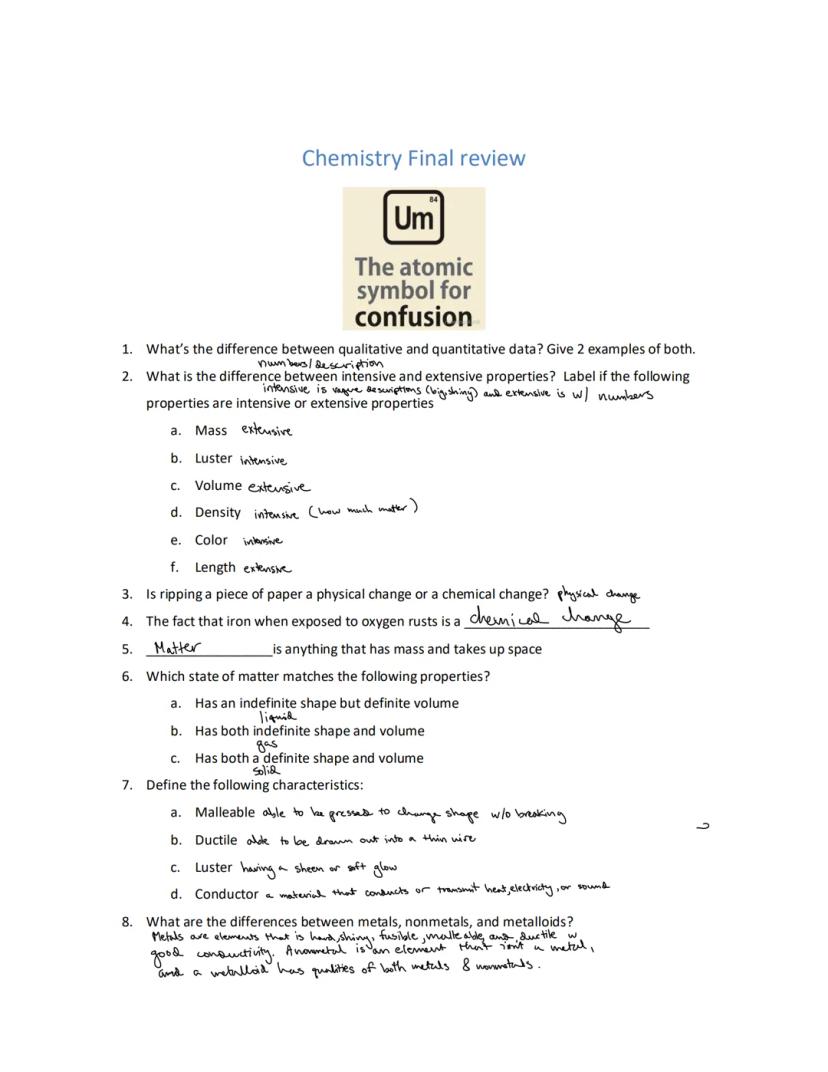
Matter is anything that has mass and takes up space. When describing matter, we use two types of data: qualitative data (descriptions without numbers like color or smell) and quantitative data (measurable information with numbers).
Properties of matter can be either intensive or extensive. Intensive properties don't depend on the amount of material (like density, color, or luster), while extensive properties do (like mass, volume, or length).
States of matter have different properties: solids have definite shape and volume, liquids have indefinite shape but definite volume, and gases have both indefinite shape and volume.
💡 When identifying chemical vs. physical changes, remember this: If a new substance forms (like iron rusting), it's a chemical change. If the substance remains the same (like ripping paper), it's a physical change.
Metals, nonmetals, and metalloids are classified by their properties. Metals are typically hard, shiny, malleable (can be hammered into shapes), ductile (can be drawn into wires), and good conductors. Nonmetals lack these metallic properties, while metalloids show characteristics of both.

Um
The atomic
symbol for
confusion
1. What's the difference between qualitative and quan](/_next/image?url=https%3A%2F%2Fcontent-eu-central-1.knowunity.com%2FCONTENT%2FPXgiTiQPqDQblmhamnkT_image_page_2.webp&w=2048&q=75)
When you measure your height in inches but need it in centimeters, how do you convert it? Understanding measurement units and conversions is crucial in chemistry!
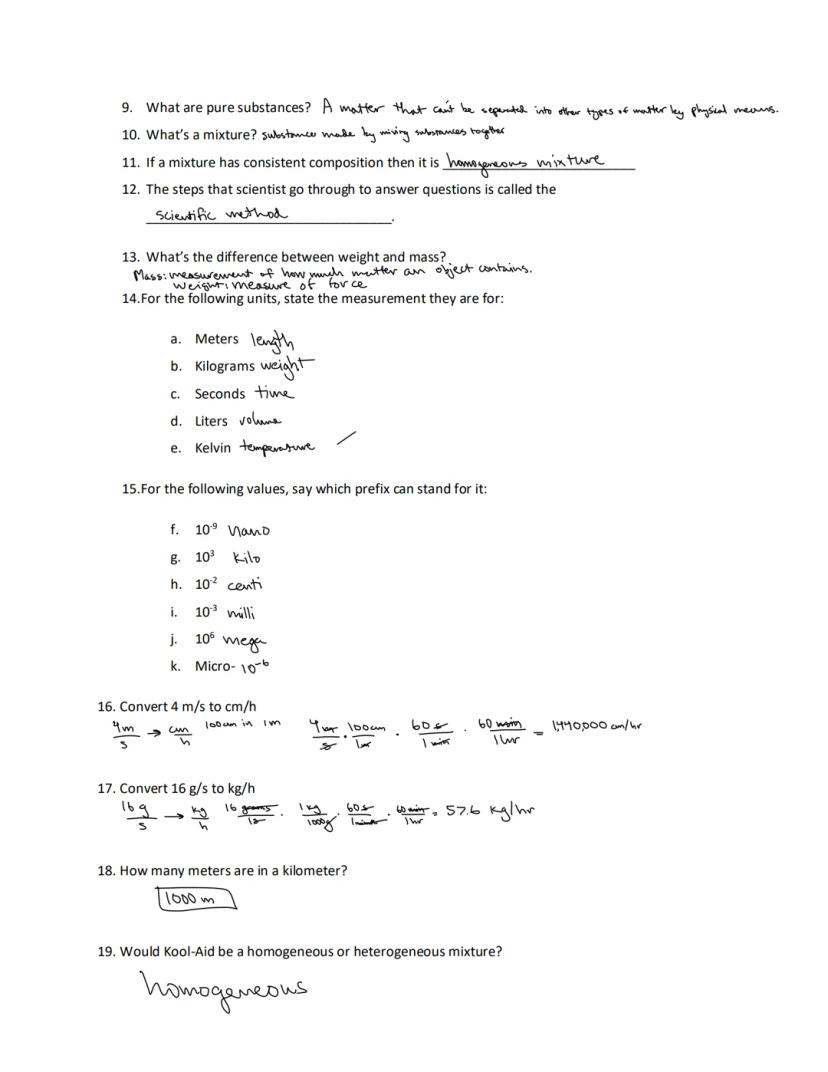
The scientific method is the process scientists use to answer questions about the world. It helps us understand concepts like the difference between mass (the amount of matter in an object) and weight (the measure of gravitational force on that matter).
Measurements in chemistry use specific units: meters for length, kilograms for mass, seconds for time, liters for volume, and Kelvin for temperature. These can be modified with prefixes like kilo (10³), centi (10²), milli (10⁻³), micro (10⁻⁶), nano (10⁻⁹), and mega (10⁶).
Converting between units requires understanding the relationships between them. For example, to convert 4 m/s to cm/h, you multiply by 100 cm/1 m and 3600 s/1 h to get 1,440,000 cm/h.
🔍 When working with mixtures, remember this key distinction: homogeneous mixtures have uniform composition throughout , while heterogeneous mixtures have varying composition in different regions.
Pure substances cannot be separated into other types of matter by physical means, unlike mixtures, which are made by combining different substances. The composition of a mixture determines whether it's homogeneous (consistent throughout) or heterogeneous (varies throughout).

Um
The atomic
symbol for
confusion
1. What's the difference between qualitative and quan](/_next/image?url=https%3A%2F%2Fcontent-eu-central-1.knowunity.com%2FCONTENT%2FPXgiTiQPqDQblmhamnkT_image_page_3.webp&w=2048&q=75)
Did you know that everything you touch is made of atoms that are mostly empty space? Understanding atomic structure helps explain why materials behave the way they do!
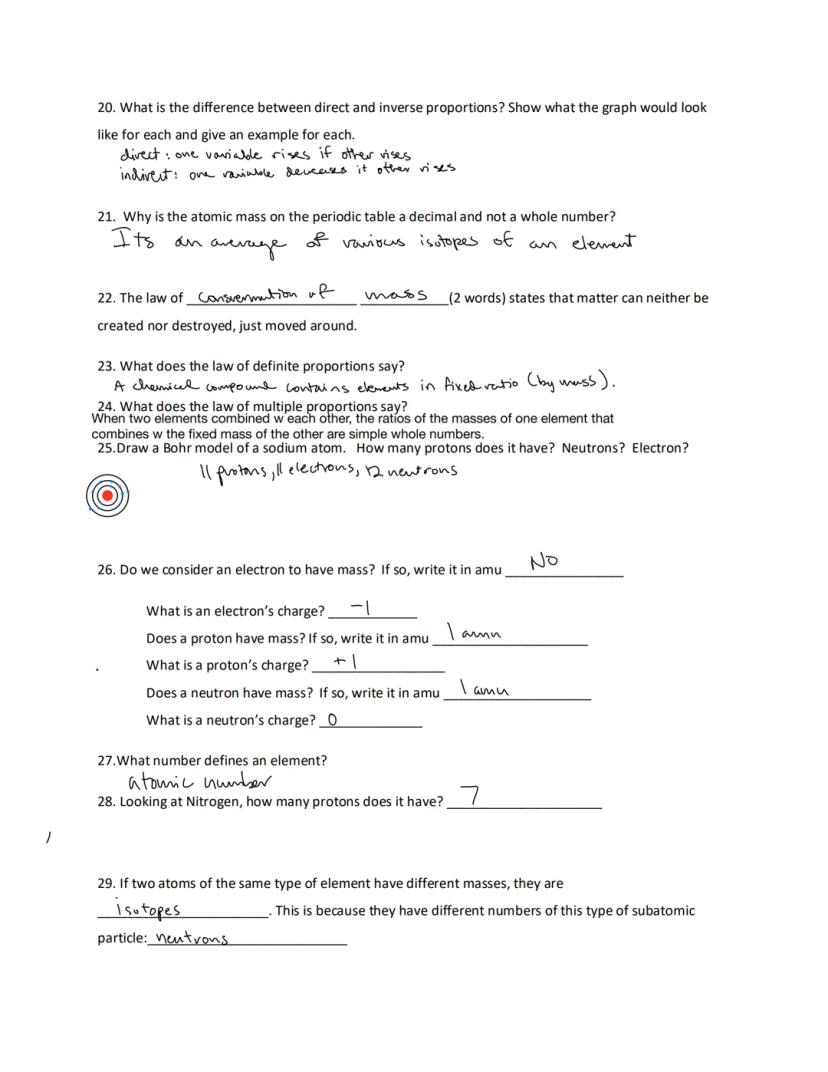
Proportions in chemistry follow specific patterns. In a direct proportion, variables increase together, while in an inverse proportion, one increases as the other decreases. These relationships appear frequently in chemistry formulas.
The structure of atoms includes three main subatomic particles: protons (positive charge, 1 amu), neutrons (no charge, 1 amu), and electrons (negative charge, negligible mass). The atomic number defines an element and equals the number of protons in the nucleus.
Several fundamental laws govern chemical reactions:
💡 Ever wonder why atomic masses on the periodic table aren't whole numbers? They're weighted averages of all naturally occurring isotopes of that element!
Isotopes are atoms of the same element (same number of protons) that have different masses due to different numbers of neutrons. For example, carbon-12 and carbon-14 are isotopes of carbon with different numbers of neutrons.

Um
The atomic
symbol for
confusion
1. What's the difference between qualitative and quan](/_next/image?url=https%3A%2F%2Fcontent-eu-central-1.knowunity.com%2FCONTENT%2FPXgiTiQPqDQblmhamnkT_image_page_4.webp&w=2048&q=75)
The arrangement of electrons in an atom determines how that element will behave chemically. It's like knowing the seating arrangement at a party to predict who will talk to whom!
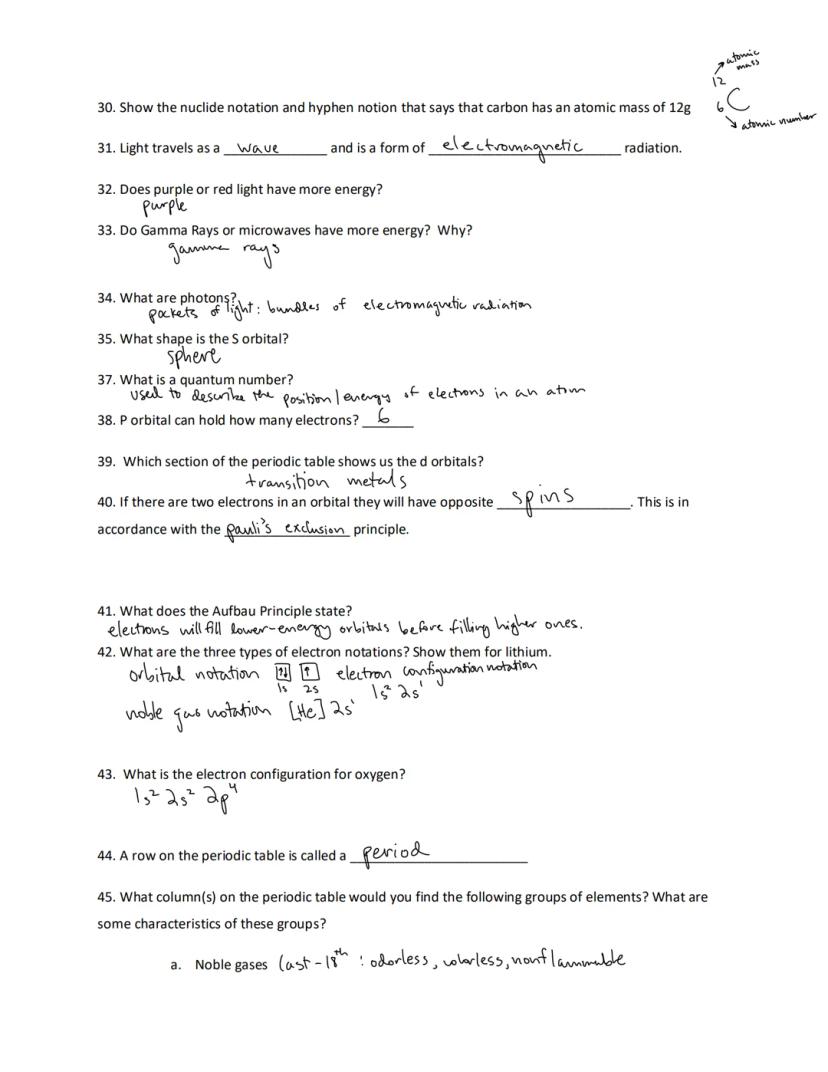
Light travels as waves and is a form of electromagnetic radiation. Light with shorter wavelengths (like purple) has more energy than light with longer wavelengths (like red). Similarly, gamma rays have much more energy than microwaves because of their shorter wavelength.
Photons are packets or bundles of electromagnetic radiation. The energy of these photons varies based on the wavelength of light, following the principles of quantum mechanics.
Electrons occupy specific energy levels around the nucleus. These are described by quantum numbers which determine the position and energy of electrons. Electrons fill orbitals following specific rules:
⚡ Electron configurations are like atomic fingerprints - they help explain why elements in the same column of the periodic table behave similarly!
Different orbital shapes can hold different numbers of electrons. The s orbital is sphere-shaped and holds 2 electrons, while the p orbital can hold 6 electrons. The d orbitals are found in the transition metals section of the periodic table.

Um
The atomic
symbol for
confusion
1. What's the difference between qualitative and quan](/_next/image?url=https%3A%2F%2Fcontent-eu-central-1.knowunity.com%2FCONTENT%2FPXgiTiQPqDQblmhamnkT_image_page_5.webp&w=2048&q=75)
As you move across the periodic table, elements' properties change in predictable patterns. These trends are like roadmaps that help chemists predict how elements will behave!
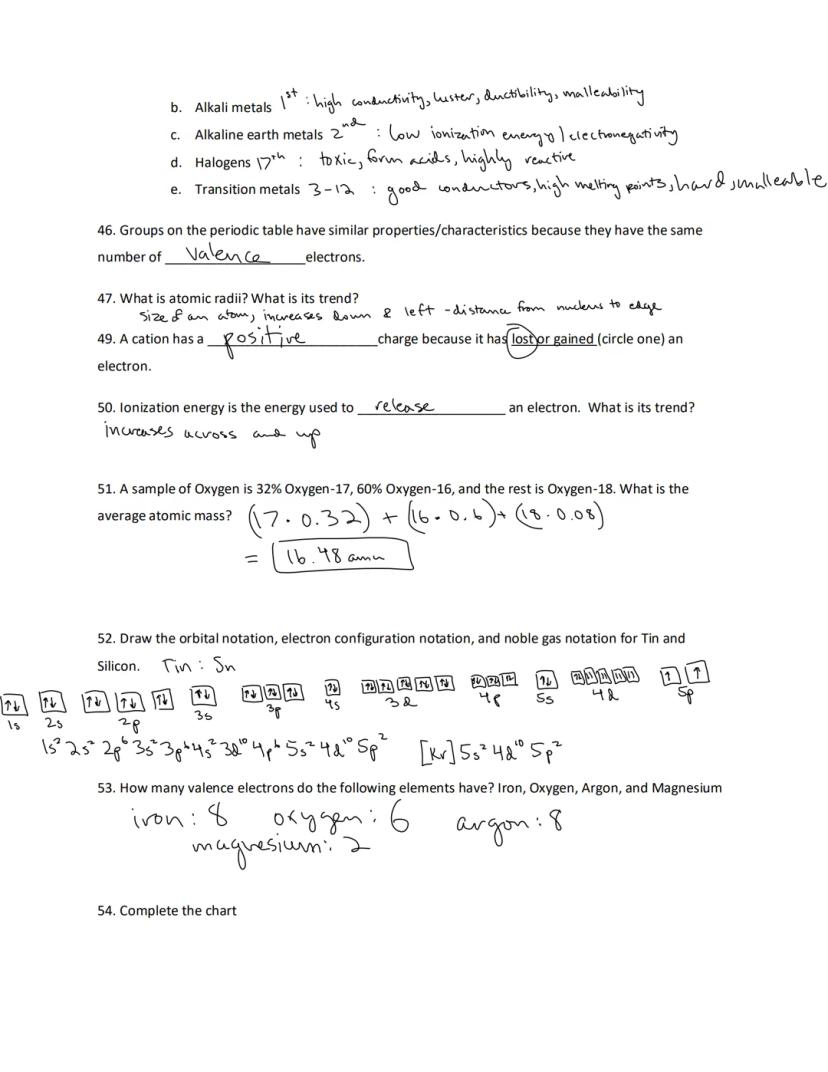
The periodic table organizes elements into rows (called periods) and columns (called groups). Elements in the same group have similar properties because they have the same number of valence electrons (outer electrons that participate in bonding).
Key groups on the periodic table include:
Several important trends exist across the periodic table:
🧪 When calculating average atomic mass, you multiply each isotope's mass by its abundance (as a decimal) and add them together. This is why atomic masses aren't whole numbers!
A cation has a positive charge because it has lost an electron. The average atomic mass of an element is calculated by multiplying each isotope's mass by its abundance percentage and adding the products together.

Um
The atomic
symbol for
confusion
1. What's the difference between qualitative and quan](/_next/image?url=https%3A%2F%2Fcontent-eu-central-1.knowunity.com%2FCONTENT%2FPXgiTiQPqDQblmhamnkT_image_page_6.webp&w=2048&q=75)
Chemical bonds are like relationships between atoms - some share equally, some take more than they give, and some completely transfer electrons to their partner!
Chemical bonds form between atoms to achieve stability. The two main types of bonds are:
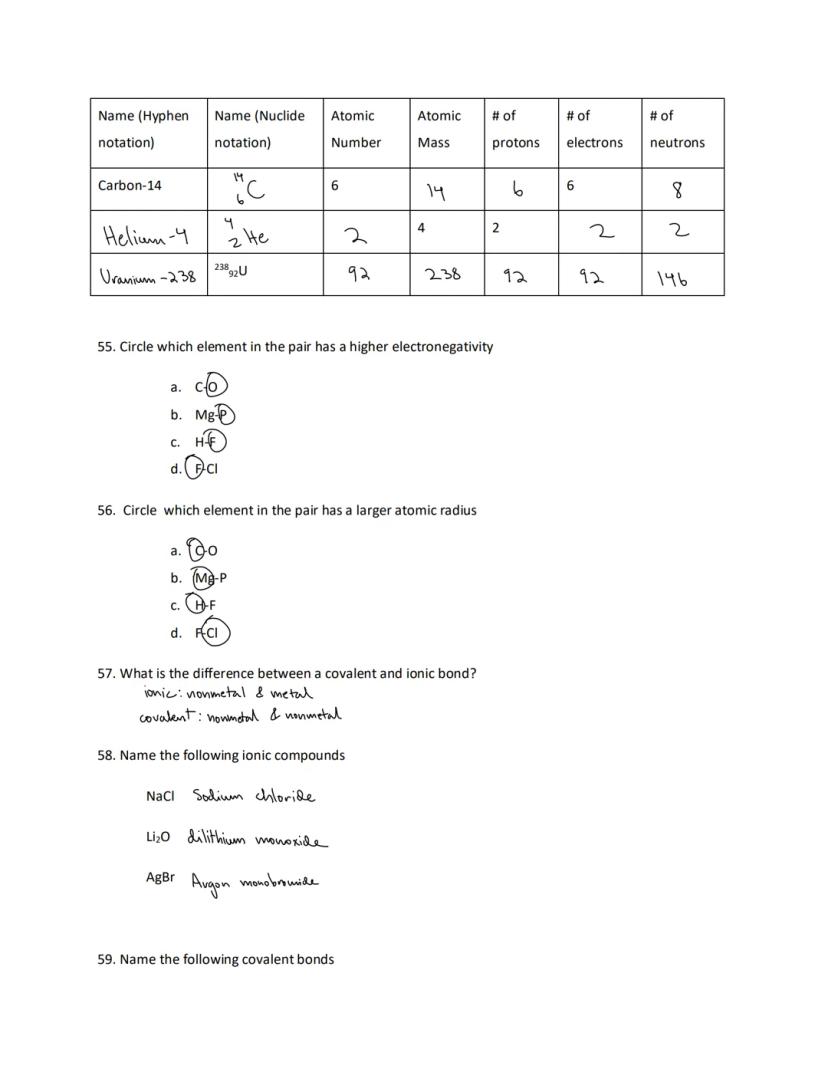
When naming ionic compounds, you state the metal name followed by the nonmetal with an "-ide" ending (like sodium chloride for NaCl). For covalent compounds, you use prefixes to indicate the number of atoms (like diphosphorus trioxide for P₂O₃).
Electronegativity plays a crucial role in determining bond types. Elements with higher electronegativity (like fluorine) attract electrons more strongly than elements with lower electronegativity (like hydrogen).
💡 To quickly predict bond type, look at the elements involved: metal + nonmetal = ionic bond; nonmetal + nonmetal = covalent bond.
Ionic compounds typically have high melting points, form crystalline solids, and conduct electricity when dissolved or melted. Covalent compounds often have lower melting points and many are soluble in water.
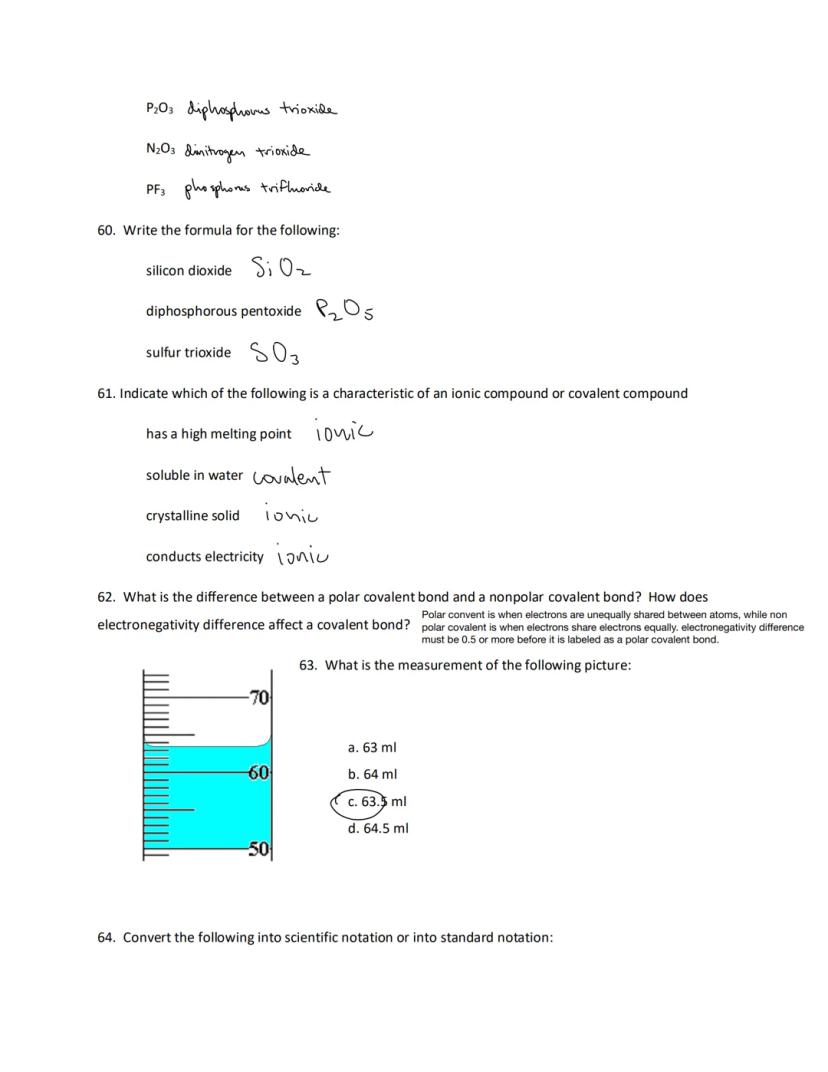
Polar covalent bonds form when electrons are shared unequally between atoms (electronegativity difference of 0.5 or more), while nonpolar covalent bonds form when electrons are shared equally (little to no electronegativity difference).

Um
The atomic
symbol for
confusion
1. What's the difference between qualitative and quan](/_next/image?url=https%3A%2F%2Fcontent-eu-central-1.knowunity.com%2FCONTENT%2FPXgiTiQPqDQblmhamnkT_image_page_7.webp&w=2048&q=75)
Reading scientific measurements accurately and understanding different types of bonds are essential skills in chemistry. They help you make sense of everything from lab data to molecule behavior!
When reading measurements from graduated cylinders, you need to look at the bottom of the meniscus (curved surface of the liquid). The correct reading for the picture shown would be 63 ml, as you need to read from the bottom of the curve.
Naming compounds follows specific rules:
The properties of compounds depend on their bond types:
🔬 When measuring liquids in a graduated cylinder, always read from the bottom of the meniscus (the curved surface) for the most accurate measurement!
Polar covalent bonds form when electrons are shared unequally between atoms with different electronegativities. A difference of 0.5 or more in electronegativity results in a polar bond, while smaller differences create nonpolar bonds where electrons are shared equally.

Um
The atomic
symbol for
confusion
1. What's the difference between qualitative and quan](/_next/image?url=https%3A%2F%2Fcontent-eu-central-1.knowunity.com%2FCONTENT%2FPXgiTiQPqDQblmhamnkT_image_page_8.webp&w=2048&q=75)
Scientific notation makes working with very large or small numbers manageable, while understanding radioactivity helps explain how elements can transform over time!
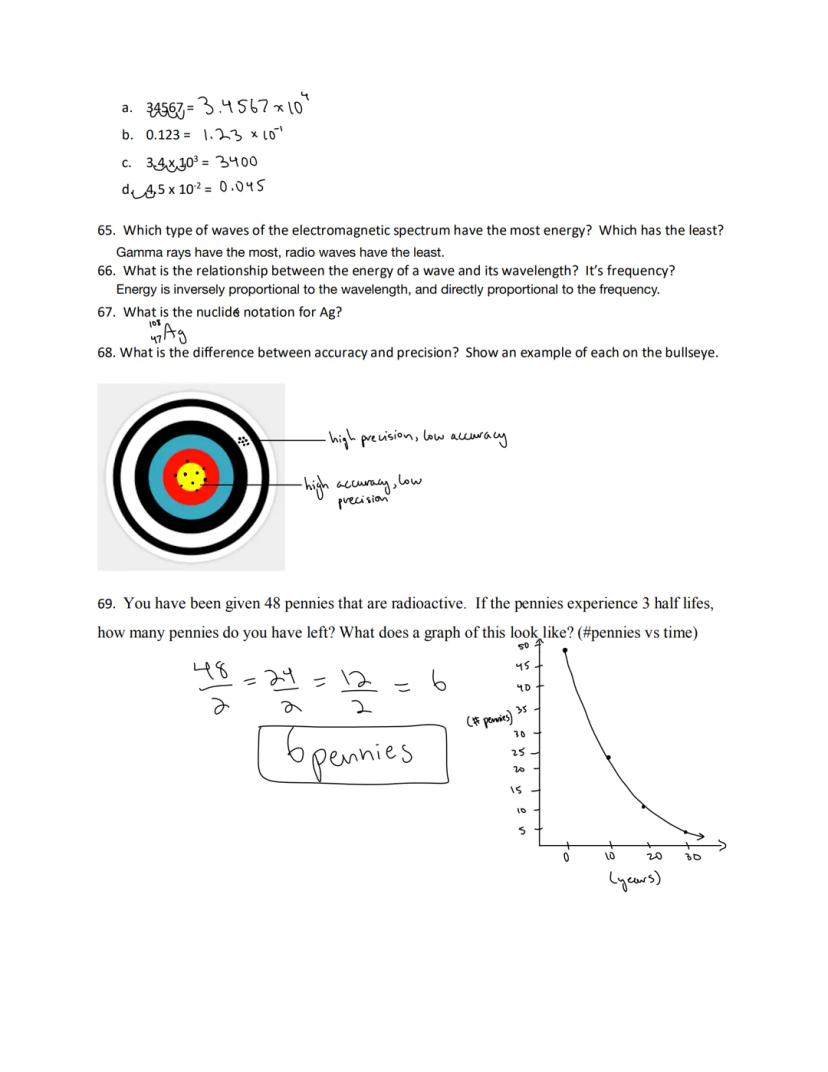
Scientific notation expresses numbers in the form a × 10ᵇ, where 1 ≤ a < 10 and b is an integer. For example:
The electromagnetic spectrum ranges from low-energy radio waves to high-energy gamma rays. Energy is inversely proportional to wavelength and directly proportional to frequency—as wavelength decreases, energy increases.
Accuracy refers to how close a measurement is to the true value, while precision refers to how close repeated measurements are to each other. A target analogy helps visualize this:
⚛️ During radioactive decay, the number of radioactive atoms decreases by half after each half-life. After 3 half-lives, you'll have only 1/8 of the original amount!
Radioactive decay follows a predictable pattern called half-life. Starting with 48 radioactive pennies, after one half-life you'd have 24, after two half-lives 12, and after three half-lives only 6 pennies would remain radioactive. The decay curve is exponential, not linear.
Our AI companion is specifically built for the needs of students. Based on the millions of content pieces we have on the platform we can provide truly meaningful and relevant answers to students. But its not only about answers, the companion is even more about guiding students through their daily learning challenges, with personalised study plans, quizzes or content pieces in the chat and 100% personalisation based on the students skills and developments.
You can download the app in the Google Play Store and in the Apple App Store.
That's right! Enjoy free access to study content, connect with fellow students, and get instant help – all at your fingertips.
Study notes on chemical nomenclature of chemistry
 AP Chemistry
App Store
Google Play
The app is very easy to use and well designed. I have found everything I was looking for so far and have been able to learn a lot from the presentations! I will definitely use the app for a class assignment! And of course it also helps a lot as an inspiration.
Stefan S
iOS user
This app is really great. There are so many study notes and help [...]. My problem subject is French, for example, and the app has so many options for help. Thanks to this app, I have improved my French. I would recommend it to anyone.
Samantha Klich
Android user
Wow, I am really amazed. I just tried the app because I've seen it advertised many times and was absolutely stunned. This app is THE HELP you want for school and above all, it offers so many things, such as workouts and fact sheets, which have been VERY helpful to me personally.
Anna
iOS user
I think it’s very much worth it and you’ll end up using it a lot once you get the hang of it and even after looking at others notes you can still ask your Artificial intelligence buddy the question and ask to simplify it if you still don’t get it!!! In the end I think it’s worth it 😊👍 ⚠️Also DID I MENTION ITS FREEE YOU DON’T HAVE TO PAY FOR ANYTHING AND STILL GET YOUR GRADES IN PERFECTLY❗️❗️⚠️
Thomas R
iOS user
Knowunity is the BEST app I’ve used in a minute. This is not an ai review or anything this is genuinely coming from a 7th grade student (I know 2011 im young) but dude this app is a 10/10 i have maintained a 3.8 gpa and have plenty of time for gaming. I love it and my mom is just happy I got good grades
Brad T
Android user
Not only did it help me find the answer but it also showed me alternative ways to solve it. I was horrible in math and science but now I have an a in both subjects. Thanks for the help🤍🤍
David K
iOS user
The app's just great! All I have to do is enter the topic in the search bar and I get the response real fast. I don't have to watch 10 YouTube videos to understand something, so I'm saving my time. Highly recommended!
Sudenaz Ocak
Android user
In school I was really bad at maths but thanks to the app, I am doing better now. I am so grateful that you made the app.
Greenlight Bonnie
Android user
I found this app a couple years ago and it has only gotten better since then. I really love it because it can help with written questions and photo questions. Also, it can find study guides that other people have made as well as flashcard sets and practice tests. The free version is also amazing for students who might not be able to afford it. Would 100% recommend
Aubrey
iOS user
Best app if you're in Highschool or Junior high. I have been using this app for 2 school years and it's the best, it's good if you don't have anyone to help you with school work.😋🩷🎀
Marco B
iOS user
THE QUIZES AND FLASHCARDS ARE SO USEFUL AND I LOVE Knowunity AI. IT ALSO IS LITREALLY LIKE CHATGPT BUT SMARTER!! HELPED ME WITH MY MASCARA PROBLEMS TOO!! AS WELL AS MY REAL SUBJECTS ! DUHHH 😍😁😲🤑💗✨🎀😮
Elisha
iOS user
This app is phenomenal down to the correct info and the various topics you can study! I greatly recommend it for people who struggle with procrastination and those who need homework help. It has been perfectly accurate for world 1 history as far as I’ve seen! Geometry too!
Paul T
iOS user
The app is very easy to use and well designed. I have found everything I was looking for so far and have been able to learn a lot from the presentations! I will definitely use the app for a class assignment! And of course it also helps a lot as an inspiration.
Stefan S
iOS user
This app is really great. There are so many study notes and help [...]. My problem subject is French, for example, and the app has so many options for help. Thanks to this app, I have improved my French. I would recommend it to anyone.
Samantha Klich
Android user
Wow, I am really amazed. I just tried the app because I've seen it advertised many times and was absolutely stunned. This app is THE HELP you want for school and above all, it offers so many things, such as workouts and fact sheets, which have been VERY helpful to me personally.
Anna
iOS user
I think it’s very much worth it and you’ll end up using it a lot once you get the hang of it and even after looking at others notes you can still ask your Artificial intelligence buddy the question and ask to simplify it if you still don’t get it!!! In the end I think it’s worth it 😊👍 ⚠️Also DID I MENTION ITS FREEE YOU DON’T HAVE TO PAY FOR ANYTHING AND STILL GET YOUR GRADES IN PERFECTLY❗️❗️⚠️
Thomas R
iOS user
Knowunity is the BEST app I’ve used in a minute. This is not an ai review or anything this is genuinely coming from a 7th grade student (I know 2011 im young) but dude this app is a 10/10 i have maintained a 3.8 gpa and have plenty of time for gaming. I love it and my mom is just happy I got good grades
Brad T
Android user
Not only did it help me find the answer but it also showed me alternative ways to solve it. I was horrible in math and science but now I have an a in both subjects. Thanks for the help🤍🤍
David K
iOS user
The app's just great! All I have to do is enter the topic in the search bar and I get the response real fast. I don't have to watch 10 YouTube videos to understand something, so I'm saving my time. Highly recommended!
Sudenaz Ocak
Android user
In school I was really bad at maths but thanks to the app, I am doing better now. I am so grateful that you made the app.
Greenlight Bonnie
Android user
I found this app a couple years ago and it has only gotten better since then. I really love it because it can help with written questions and photo questions. Also, it can find study guides that other people have made as well as flashcard sets and practice tests. The free version is also amazing for students who might not be able to afford it. Would 100% recommend
Aubrey
iOS user
Best app if you're in Highschool or Junior high. I have been using this app for 2 school years and it's the best, it's good if you don't have anyone to help you with school work.😋🩷🎀
Marco B
iOS user
THE QUIZES AND FLASHCARDS ARE SO USEFUL AND I LOVE Knowunity AI. IT ALSO IS LITREALLY LIKE CHATGPT BUT SMARTER!! HELPED ME WITH MY MASCARA PROBLEMS TOO!! AS WELL AS MY REAL SUBJECTS ! DUHHH 😍😁😲🤑💗✨🎀😮
Elisha
iOS user
This app is phenomenal down to the correct info and the various topics you can study! I greatly recommend it for people who struggle with procrastination and those who need homework help. It has been perfectly accurate for world 1 history as far as I’ve seen! Geometry too!
Paul T
iOS user
Shreya Bedi
@shreyabedi_oyaa
Chemistry is a fascinating science that explores how matter behaves and changes. This review covers essential chemistry concepts from atomic structure to chemical bonds that you'll need to understand for your final exam. Let's break down these key concepts into... Show more
Access to all documents
Improve your grades
Join milions of students
Ever wonder why some substances change completely when mixed while others just blend together? It all comes down to understanding the basic properties of matter.
Matter is anything that has mass and takes up space. When describing matter, we use two types of data: qualitative data (descriptions without numbers like color or smell) and quantitative data (measurable information with numbers).
Properties of matter can be either intensive or extensive. Intensive properties don't depend on the amount of material (like density, color, or luster), while extensive properties do (like mass, volume, or length).
States of matter have different properties: solids have definite shape and volume, liquids have indefinite shape but definite volume, and gases have both indefinite shape and volume.
💡 When identifying chemical vs. physical changes, remember this: If a new substance forms (like iron rusting), it's a chemical change. If the substance remains the same (like ripping paper), it's a physical change.
Metals, nonmetals, and metalloids are classified by their properties. Metals are typically hard, shiny, malleable (can be hammered into shapes), ductile (can be drawn into wires), and good conductors. Nonmetals lack these metallic properties, while metalloids show characteristics of both.
Access to all documents
Improve your grades
Join milions of students
When you measure your height in inches but need it in centimeters, how do you convert it? Understanding measurement units and conversions is crucial in chemistry!
The scientific method is the process scientists use to answer questions about the world. It helps us understand concepts like the difference between mass (the amount of matter in an object) and weight (the measure of gravitational force on that matter).
Measurements in chemistry use specific units: meters for length, kilograms for mass, seconds for time, liters for volume, and Kelvin for temperature. These can be modified with prefixes like kilo (10³), centi (10²), milli (10⁻³), micro (10⁻⁶), nano (10⁻⁹), and mega (10⁶).
Converting between units requires understanding the relationships between them. For example, to convert 4 m/s to cm/h, you multiply by 100 cm/1 m and 3600 s/1 h to get 1,440,000 cm/h.
🔍 When working with mixtures, remember this key distinction: homogeneous mixtures have uniform composition throughout , while heterogeneous mixtures have varying composition in different regions.
Pure substances cannot be separated into other types of matter by physical means, unlike mixtures, which are made by combining different substances. The composition of a mixture determines whether it's homogeneous (consistent throughout) or heterogeneous (varies throughout).
Access to all documents
Improve your grades
Join milions of students
Did you know that everything you touch is made of atoms that are mostly empty space? Understanding atomic structure helps explain why materials behave the way they do!
Proportions in chemistry follow specific patterns. In a direct proportion, variables increase together, while in an inverse proportion, one increases as the other decreases. These relationships appear frequently in chemistry formulas.
The structure of atoms includes three main subatomic particles: protons (positive charge, 1 amu), neutrons (no charge, 1 amu), and electrons (negative charge, negligible mass). The atomic number defines an element and equals the number of protons in the nucleus.
Several fundamental laws govern chemical reactions:
💡 Ever wonder why atomic masses on the periodic table aren't whole numbers? They're weighted averages of all naturally occurring isotopes of that element!
Isotopes are atoms of the same element (same number of protons) that have different masses due to different numbers of neutrons. For example, carbon-12 and carbon-14 are isotopes of carbon with different numbers of neutrons.
Access to all documents
Improve your grades
Join milions of students
The arrangement of electrons in an atom determines how that element will behave chemically. It's like knowing the seating arrangement at a party to predict who will talk to whom!
Light travels as waves and is a form of electromagnetic radiation. Light with shorter wavelengths (like purple) has more energy than light with longer wavelengths (like red). Similarly, gamma rays have much more energy than microwaves because of their shorter wavelength.
Photons are packets or bundles of electromagnetic radiation. The energy of these photons varies based on the wavelength of light, following the principles of quantum mechanics.
Electrons occupy specific energy levels around the nucleus. These are described by quantum numbers which determine the position and energy of electrons. Electrons fill orbitals following specific rules:
⚡ Electron configurations are like atomic fingerprints - they help explain why elements in the same column of the periodic table behave similarly!
Different orbital shapes can hold different numbers of electrons. The s orbital is sphere-shaped and holds 2 electrons, while the p orbital can hold 6 electrons. The d orbitals are found in the transition metals section of the periodic table.
Access to all documents
Improve your grades
Join milions of students
As you move across the periodic table, elements' properties change in predictable patterns. These trends are like roadmaps that help chemists predict how elements will behave!
The periodic table organizes elements into rows (called periods) and columns (called groups). Elements in the same group have similar properties because they have the same number of valence electrons (outer electrons that participate in bonding).
Key groups on the periodic table include:
Several important trends exist across the periodic table:
🧪 When calculating average atomic mass, you multiply each isotope's mass by its abundance (as a decimal) and add them together. This is why atomic masses aren't whole numbers!
A cation has a positive charge because it has lost an electron. The average atomic mass of an element is calculated by multiplying each isotope's mass by its abundance percentage and adding the products together.
Access to all documents
Improve your grades
Join milions of students
Chemical bonds are like relationships between atoms - some share equally, some take more than they give, and some completely transfer electrons to their partner!
Chemical bonds form between atoms to achieve stability. The two main types of bonds are:
When naming ionic compounds, you state the metal name followed by the nonmetal with an "-ide" ending (like sodium chloride for NaCl). For covalent compounds, you use prefixes to indicate the number of atoms (like diphosphorus trioxide for P₂O₃).
Electronegativity plays a crucial role in determining bond types. Elements with higher electronegativity (like fluorine) attract electrons more strongly than elements with lower electronegativity (like hydrogen).
💡 To quickly predict bond type, look at the elements involved: metal + nonmetal = ionic bond; nonmetal + nonmetal = covalent bond.
Ionic compounds typically have high melting points, form crystalline solids, and conduct electricity when dissolved or melted. Covalent compounds often have lower melting points and many are soluble in water.
Polar covalent bonds form when electrons are shared unequally between atoms (electronegativity difference of 0.5 or more), while nonpolar covalent bonds form when electrons are shared equally (little to no electronegativity difference).
Access to all documents
Improve your grades
Join milions of students
Reading scientific measurements accurately and understanding different types of bonds are essential skills in chemistry. They help you make sense of everything from lab data to molecule behavior!
When reading measurements from graduated cylinders, you need to look at the bottom of the meniscus (curved surface of the liquid). The correct reading for the picture shown would be 63 ml, as you need to read from the bottom of the curve.
Naming compounds follows specific rules:
The properties of compounds depend on their bond types:
🔬 When measuring liquids in a graduated cylinder, always read from the bottom of the meniscus (the curved surface) for the most accurate measurement!
Polar covalent bonds form when electrons are shared unequally between atoms with different electronegativities. A difference of 0.5 or more in electronegativity results in a polar bond, while smaller differences create nonpolar bonds where electrons are shared equally.
Access to all documents
Improve your grades
Join milions of students
Scientific notation makes working with very large or small numbers manageable, while understanding radioactivity helps explain how elements can transform over time!
Scientific notation expresses numbers in the form a × 10ᵇ, where 1 ≤ a < 10 and b is an integer. For example:
The electromagnetic spectrum ranges from low-energy radio waves to high-energy gamma rays. Energy is inversely proportional to wavelength and directly proportional to frequency—as wavelength decreases, energy increases.
Accuracy refers to how close a measurement is to the true value, while precision refers to how close repeated measurements are to each other. A target analogy helps visualize this:
⚛️ During radioactive decay, the number of radioactive atoms decreases by half after each half-life. After 3 half-lives, you'll have only 1/8 of the original amount!
Radioactive decay follows a predictable pattern called half-life. Starting with 48 radioactive pennies, after one half-life you'd have 24, after two half-lives 12, and after three half-lives only 6 pennies would remain radioactive. The decay curve is exponential, not linear.
Our AI companion is specifically built for the needs of students. Based on the millions of content pieces we have on the platform we can provide truly meaningful and relevant answers to students. But its not only about answers, the companion is even more about guiding students through their daily learning challenges, with personalised study plans, quizzes or content pieces in the chat and 100% personalisation based on the students skills and developments.
You can download the app in the Google Play Store and in the Apple App Store.
That's right! Enjoy free access to study content, connect with fellow students, and get instant help – all at your fingertips.
2
Smart Tools NEW
Transform this note into: ✓ 50+ Practice Questions ✓ Interactive Flashcards ✓ Full Practice Test ✓ Essay Outlines
Explains periodic properties of each of the elements
ChemistryYuther foyd's groundbreaking experiment with gold foil reveals small, positively charged particles and their impact on atomic structure.
ChemistryLearn about the role of valence electrons in atomic symbols and how to draw electron dot structures.
ChemistryNotes describing trends on the periodic table
ChemistryLists the 5 states of matter, how they can be defined when split, and introduces the parts of the symbols/labels on the Periodic Table
ChemistryExplore the fundamentals of atomic structure and the periodic table in this comprehensive summary. Key concepts include atomic composition, isotopes, ions, and the development of the periodic table by Mendeleev and Newlands. Ideal for students preparing for exams, this resource features clear explanations and a simplified mind map for better understanding.
ChemistryStudy notes on chemical nomenclature of chemistry
AP ChemistryApp Store
Google Play
The app is very easy to use and well designed. I have found everything I was looking for so far and have been able to learn a lot from the presentations! I will definitely use the app for a class assignment! And of course it also helps a lot as an inspiration.
Stefan S
iOS user
This app is really great. There are so many study notes and help [...]. My problem subject is French, for example, and the app has so many options for help. Thanks to this app, I have improved my French. I would recommend it to anyone.
Samantha Klich
Android user
Wow, I am really amazed. I just tried the app because I've seen it advertised many times and was absolutely stunned. This app is THE HELP you want for school and above all, it offers so many things, such as workouts and fact sheets, which have been VERY helpful to me personally.
Anna
iOS user
I think it’s very much worth it and you’ll end up using it a lot once you get the hang of it and even after looking at others notes you can still ask your Artificial intelligence buddy the question and ask to simplify it if you still don’t get it!!! In the end I think it’s worth it 😊👍 ⚠️Also DID I MENTION ITS FREEE YOU DON’T HAVE TO PAY FOR ANYTHING AND STILL GET YOUR GRADES IN PERFECTLY❗️❗️⚠️
Thomas R
iOS user
Knowunity is the BEST app I’ve used in a minute. This is not an ai review or anything this is genuinely coming from a 7th grade student (I know 2011 im young) but dude this app is a 10/10 i have maintained a 3.8 gpa and have plenty of time for gaming. I love it and my mom is just happy I got good grades
Brad T
Android user
Not only did it help me find the answer but it also showed me alternative ways to solve it. I was horrible in math and science but now I have an a in both subjects. Thanks for the help🤍🤍
David K
iOS user
The app's just great! All I have to do is enter the topic in the search bar and I get the response real fast. I don't have to watch 10 YouTube videos to understand something, so I'm saving my time. Highly recommended!
Sudenaz Ocak
Android user
In school I was really bad at maths but thanks to the app, I am doing better now. I am so grateful that you made the app.
Greenlight Bonnie
Android user
I found this app a couple years ago and it has only gotten better since then. I really love it because it can help with written questions and photo questions. Also, it can find study guides that other people have made as well as flashcard sets and practice tests. The free version is also amazing for students who might not be able to afford it. Would 100% recommend
Aubrey
iOS user
Best app if you're in Highschool or Junior high. I have been using this app for 2 school years and it's the best, it's good if you don't have anyone to help you with school work.😋🩷🎀
Marco B
iOS user
THE QUIZES AND FLASHCARDS ARE SO USEFUL AND I LOVE Knowunity AI. IT ALSO IS LITREALLY LIKE CHATGPT BUT SMARTER!! HELPED ME WITH MY MASCARA PROBLEMS TOO!! AS WELL AS MY REAL SUBJECTS ! DUHHH 😍😁😲🤑💗✨🎀😮
Elisha
iOS user
This app is phenomenal down to the correct info and the various topics you can study! I greatly recommend it for people who struggle with procrastination and those who need homework help. It has been perfectly accurate for world 1 history as far as I’ve seen! Geometry too!
Paul T
iOS user
The app is very easy to use and well designed. I have found everything I was looking for so far and have been able to learn a lot from the presentations! I will definitely use the app for a class assignment! And of course it also helps a lot as an inspiration.
Stefan S
iOS user
This app is really great. There are so many study notes and help [...]. My problem subject is French, for example, and the app has so many options for help. Thanks to this app, I have improved my French. I would recommend it to anyone.
Samantha Klich
Android user
Wow, I am really amazed. I just tried the app because I've seen it advertised many times and was absolutely stunned. This app is THE HELP you want for school and above all, it offers so many things, such as workouts and fact sheets, which have been VERY helpful to me personally.
Anna
iOS user
I think it’s very much worth it and you’ll end up using it a lot once you get the hang of it and even after looking at others notes you can still ask your Artificial intelligence buddy the question and ask to simplify it if you still don’t get it!!! In the end I think it’s worth it 😊👍 ⚠️Also DID I MENTION ITS FREEE YOU DON’T HAVE TO PAY FOR ANYTHING AND STILL GET YOUR GRADES IN PERFECTLY❗️❗️⚠️
Thomas R
iOS user
Knowunity is the BEST app I’ve used in a minute. This is not an ai review or anything this is genuinely coming from a 7th grade student (I know 2011 im young) but dude this app is a 10/10 i have maintained a 3.8 gpa and have plenty of time for gaming. I love it and my mom is just happy I got good grades
Brad T
Android user
Not only did it help me find the answer but it also showed me alternative ways to solve it. I was horrible in math and science but now I have an a in both subjects. Thanks for the help🤍🤍
David K
iOS user
The app's just great! All I have to do is enter the topic in the search bar and I get the response real fast. I don't have to watch 10 YouTube videos to understand something, so I'm saving my time. Highly recommended!
Sudenaz Ocak
Android user
In school I was really bad at maths but thanks to the app, I am doing better now. I am so grateful that you made the app.
Greenlight Bonnie
Android user
I found this app a couple years ago and it has only gotten better since then. I really love it because it can help with written questions and photo questions. Also, it can find study guides that other people have made as well as flashcard sets and practice tests. The free version is also amazing for students who might not be able to afford it. Would 100% recommend
Aubrey
iOS user
Best app if you're in Highschool or Junior high. I have been using this app for 2 school years and it's the best, it's good if you don't have anyone to help you with school work.😋🩷🎀
Marco B
iOS user
THE QUIZES AND FLASHCARDS ARE SO USEFUL AND I LOVE Knowunity AI. IT ALSO IS LITREALLY LIKE CHATGPT BUT SMARTER!! HELPED ME WITH MY MASCARA PROBLEMS TOO!! AS WELL AS MY REAL SUBJECTS ! DUHHH 😍😁😲🤑💗✨🎀😮
Elisha
iOS user
This app is phenomenal down to the correct info and the various topics you can study! I greatly recommend it for people who struggle with procrastination and those who need homework help. It has been perfectly accurate for world 1 history as far as I’ve seen! Geometry too!
Paul T
iOS user