

Earth's history spans billions of years, divided into distinct time... Show more
 Algebra
Sign up to see the contentIt's free!
Access to all documents
Improve your grades
Join milions of students
Knowunity AI
Subjects
Triangle Congruence and Similarity Theorems
Triangle Properties and Classification
Linear Equations and Graphs
Geometric Angle Relationships
Trigonometric Functions and Identities
Equation Solving Techniques
Circle Geometry Fundamentals
Division Operations and Methods
Basic Differentiation Rules
Exponent and Logarithm Properties
Show all topics
Human Organ Systems
Reproductive Cell Cycles
Biological Sciences Subdisciplines
Cellular Energy Metabolism
Autotrophic Energy Processes
Inheritance Patterns and Principles
Biomolecular Structure and Organization
Cell Cycle and Division Mechanics
Cellular Organization and Development
Biological Structural Organization
Show all topics
Chemical Sciences and Applications
Atomic Structure and Composition
Molecular Electron Structure Representation
Atomic Electron Behavior
Matter Properties and Water
Mole Concept and Calculations
Gas Laws and Behavior
Periodic Table Organization
Chemical Thermodynamics Fundamentals
Chemical Bond Types and Properties
Show all topics
European Renaissance and Enlightenment
European Cultural Movements 800-1920
American Revolution Era 1763-1797
American Civil War 1861-1865
Global Imperial Systems
Mongol and Chinese Dynasties
U.S. Presidents and World Leaders
Historical Sources and Documentation
World Wars Era and Impact
World Religious Systems
Show all topics
Classic and Contemporary Novels
Literary Character Analysis
Rhetorical Theory and Practice
Classic Literary Narratives
Reading Analysis and Interpretation
Narrative Structure and Techniques
English Language Components
Influential English-Language Authors
Basic Sentence Structure
Narrative Voice and Perspective
Show all topics
254
•
Feb 18, 2026
•
Earth's history spans billions of years, divided into distinct time... Show more


Looking at Earth's history is like opening a book that spans 4.56 billion years! This chapter explores how our planet has changed over vast periods of time.
You'll discover how geologists divide Earth's history into eras and periods, each marked by significant events and life forms. These divisions help scientists organize and understand the complex story of our planet's development.
Earth's history holds clues to understanding not just our past, but also our present environment and possibly our future.
Did you know? The history of human civilization represents less than 0.01% of Earth's total history!

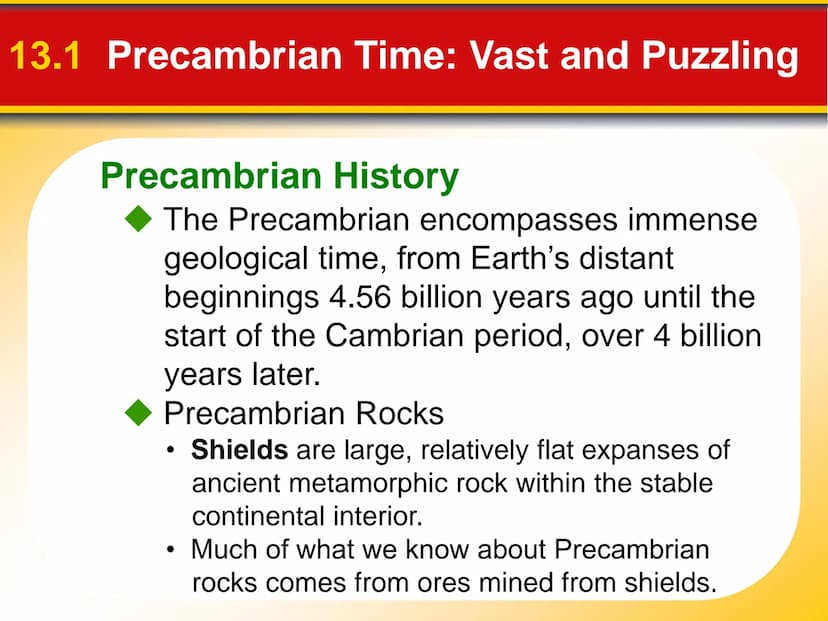
The Precambrian is the longest and most mysterious chapter of Earth's story, stretching from our planet's formation 4.56 billion years ago until the Cambrian period began (about 540 million years ago). That's over 4 billion years or nearly 90% of Earth's history!
Most of what we know about this time comes from shields - large, flat areas of ancient metamorphic rock that form the stable cores of continents. These ancient rocks have survived billions of years of Earth's changing processes.
Mining operations in shield regions have given scientists valuable insights into Precambrian geology. These rocks contain important mineral deposits that formed during Earth's early development.
Cool fact: The oldest rocks discovered on Earth are from the Precambrian and date back about 4 billion years!

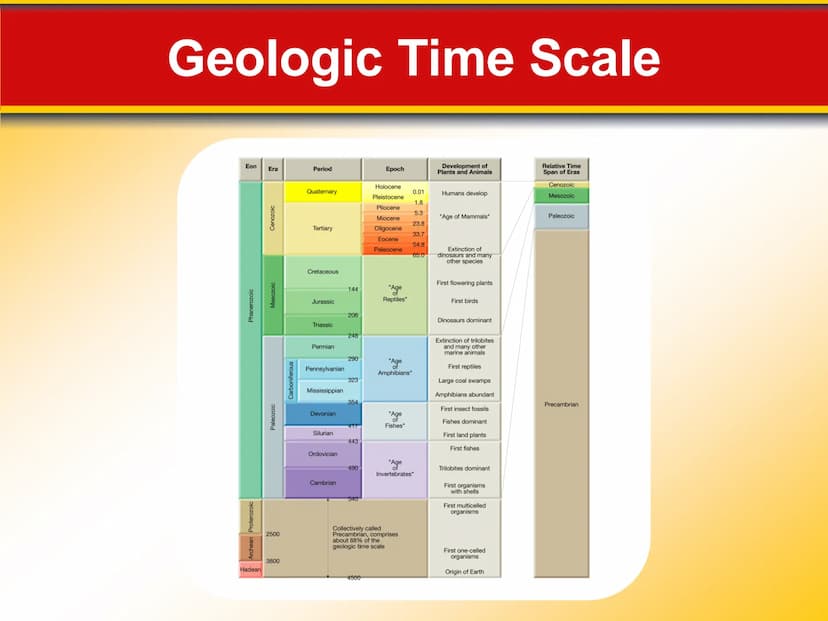
The geologic time scale is Earth's history organized into a giant timeline. It divides time into four main units: eons, eras, periods, and epochs - each smaller and more specific than the last.
The three most recent eras form the Phanerozoic Eon (meaning "visible life"): the Paleozoic ("ancient life"), Mesozoic ("middle life"), and Cenozoic ("recent life"). Each era saw distinctive life forms dominate - from trilobites to dinosaurs to mammals.
The Precambrian takes up about 88% of geologic time! It witnessed Earth's formation, the development of the first single-celled organisms, and eventually the first multicellular life forms.
Think about it: If Earth's history were compressed into a single 24-hour day, humans would appear just before 11:59 PM!
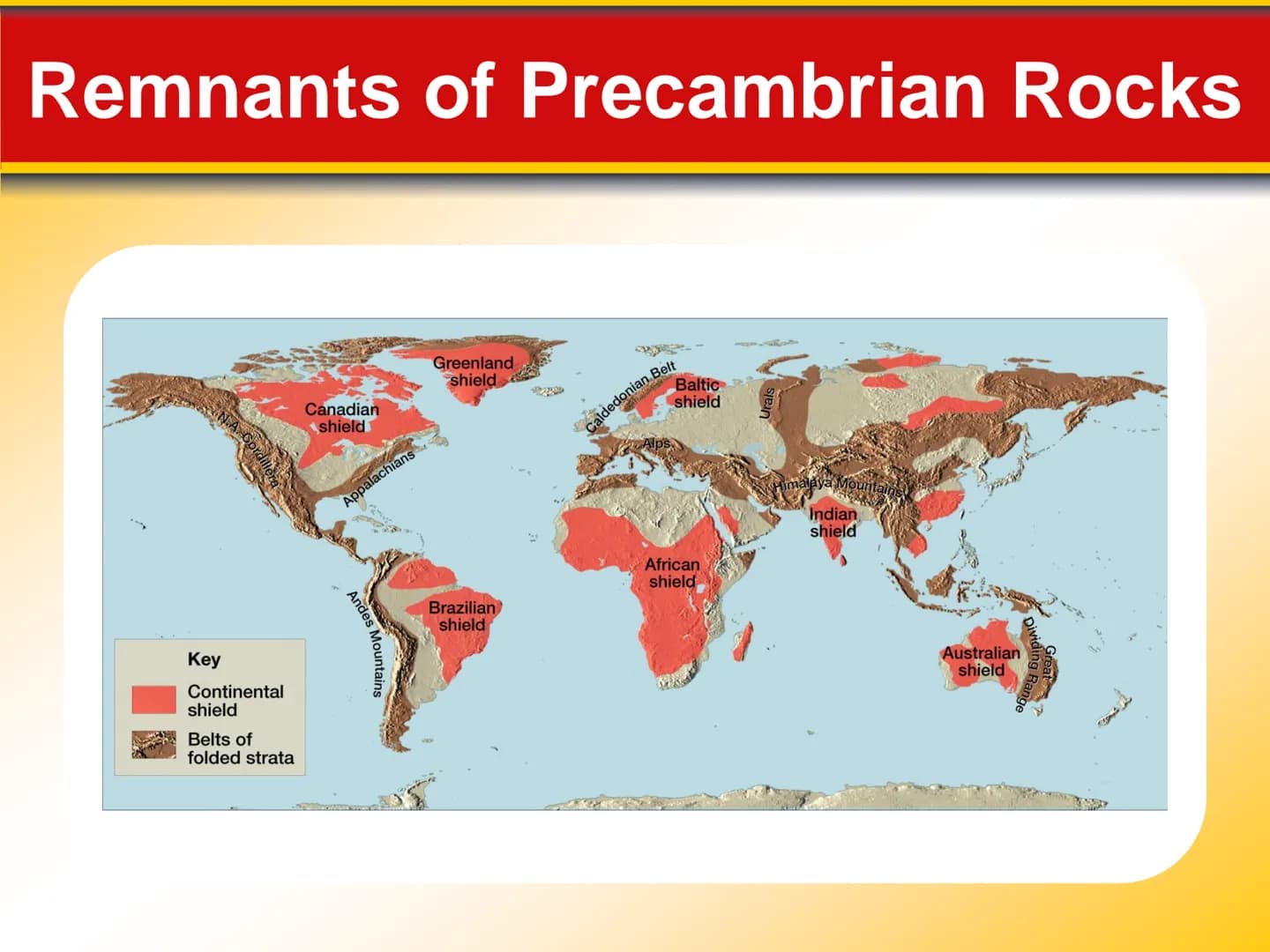
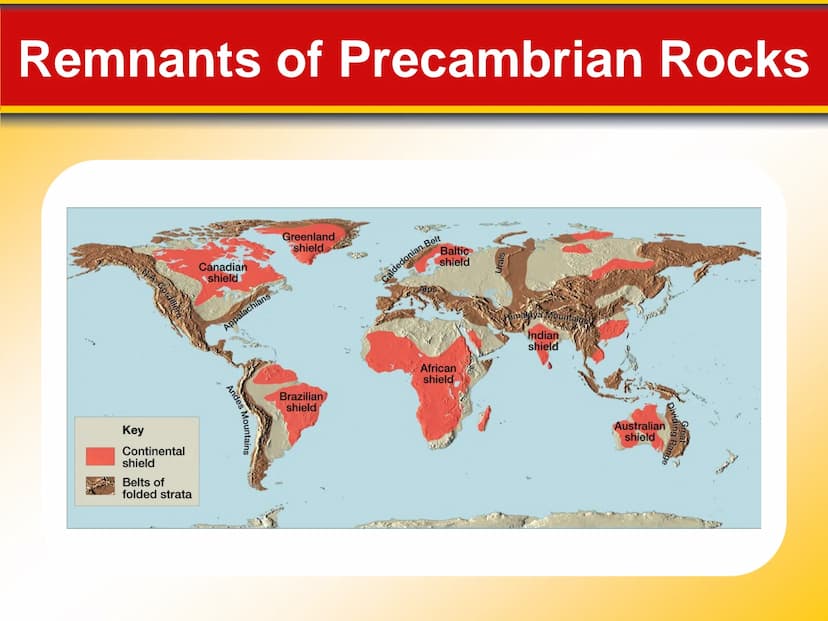
Continental shields are like windows into Earth's distant past. These exposed ancient rocks appear on every continent and represent the oldest, most stable parts of Earth's crust.
The largest shield regions include the Canadian shield in North America, the Brazilian shield in South America, the African shield, the Baltic shield in Europe, and the Australian shield. These regions have remained relatively unchanged for billions of years.
Around these stable shield areas, you'll find folded mountain belts like the Appalachians, Andes, Alps, Urals, and Himalayas. These younger formations tell the story of Earth's more recent geological activity.
Visual tip: Think of continental shields as the "cores" of continents, with younger mountain ranges forming around their edges.

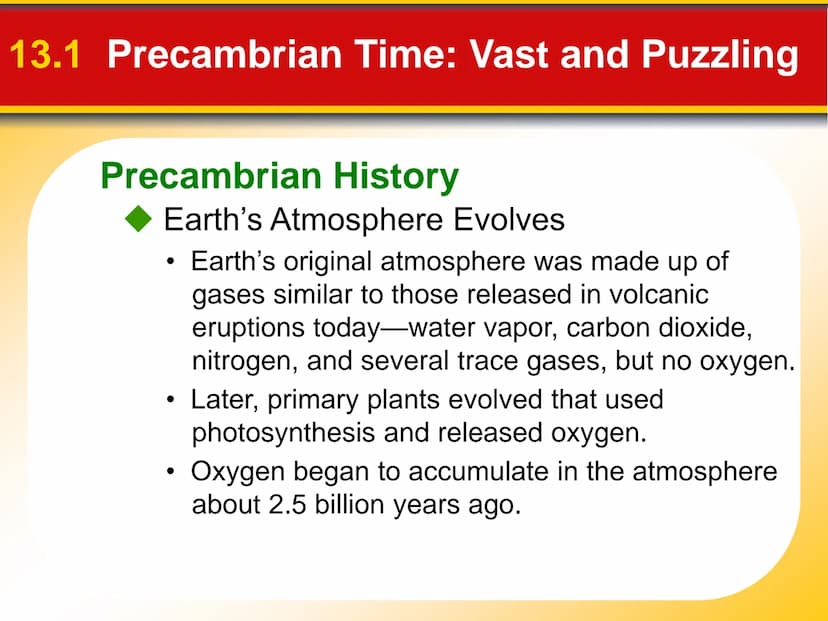
Earth's original atmosphere would have been completely unbreathable to us! It consisted mainly of volcanic gases like water vapor, carbon dioxide, and nitrogen - but crucially, no oxygen.
A major turning point came with the evolution of primitive plants that performed photosynthesis. These early organisms absorbed carbon dioxide and released oxygen as a waste product, gradually changing Earth's atmosphere.
Oxygen began accumulating in the atmosphere about 2.5 billion years ago. This dramatic change paved the way for the evolution of more complex life forms that depended on oxygen, including eventually, humans!
Mind-blowing fact: The oxygen we breathe today exists because of tiny organisms that lived billions of years ago!
Finding fossils from the Precambrian is extremely rare since most early organisms had soft bodies that decomposed without leaving traces. This makes the Precambrian particularly challenging for scientists to study.
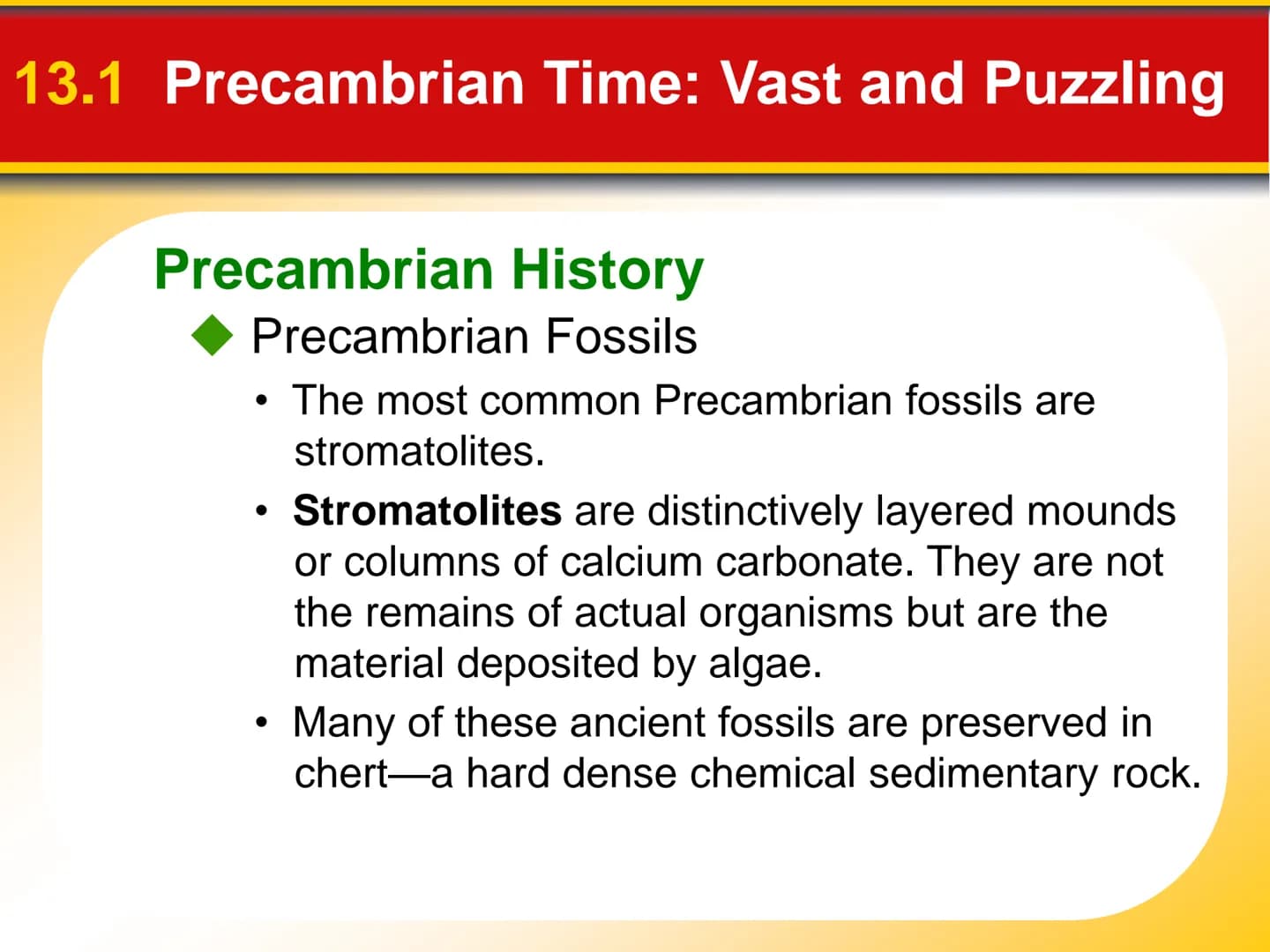
The most common Precambrian fossils are stromatolites - distinctive layered mounds or columns made of calcium carbonate. These aren't the actual organisms but structures created by ancient algae as they trapped sediment.
Many Precambrian fossils are preserved in chert, a hard dense chemical sedimentary rock that excellently preserves microscopic details. These precious fossils give us rare glimpses into Earth's earliest life forms.
Fascinating connection: You can still find living stromatolites today in a few places like Shark Bay, Australia - they look almost identical to ones that lived 3 billion years ago!
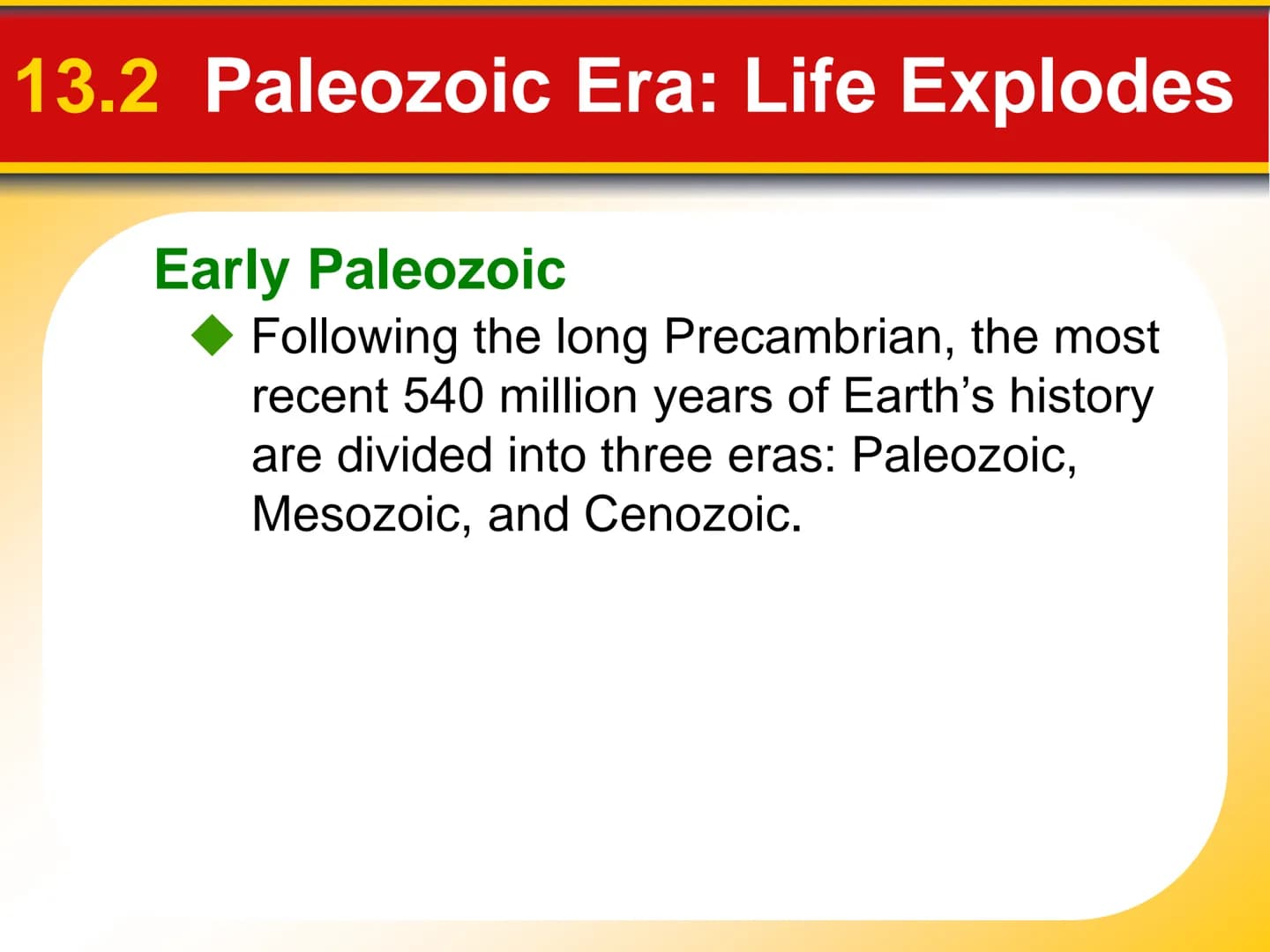
After the lengthy Precambrian came the Paleozoic Era, beginning about 540 million years ago. This marks the start of Earth's more "recent" history, divided into three major eras: the Paleozoic ("ancient life"), Mesozoic ("middle life"), and Cenozoic ("recent life").
The Paleozoic saw an extraordinary explosion of life forms, particularly in the oceans. This era represents a crucial turning point when life became much more diverse and complex than anything that existed before.
During this time, Earth's geography looked completely different from today, with continents in entirely different positions and combinations. These changing land arrangements greatly influenced the evolution of life.
Think about this: The Paleozoic Era began with simple marine creatures and ended with complex land animals and forests - an incredible transformation!
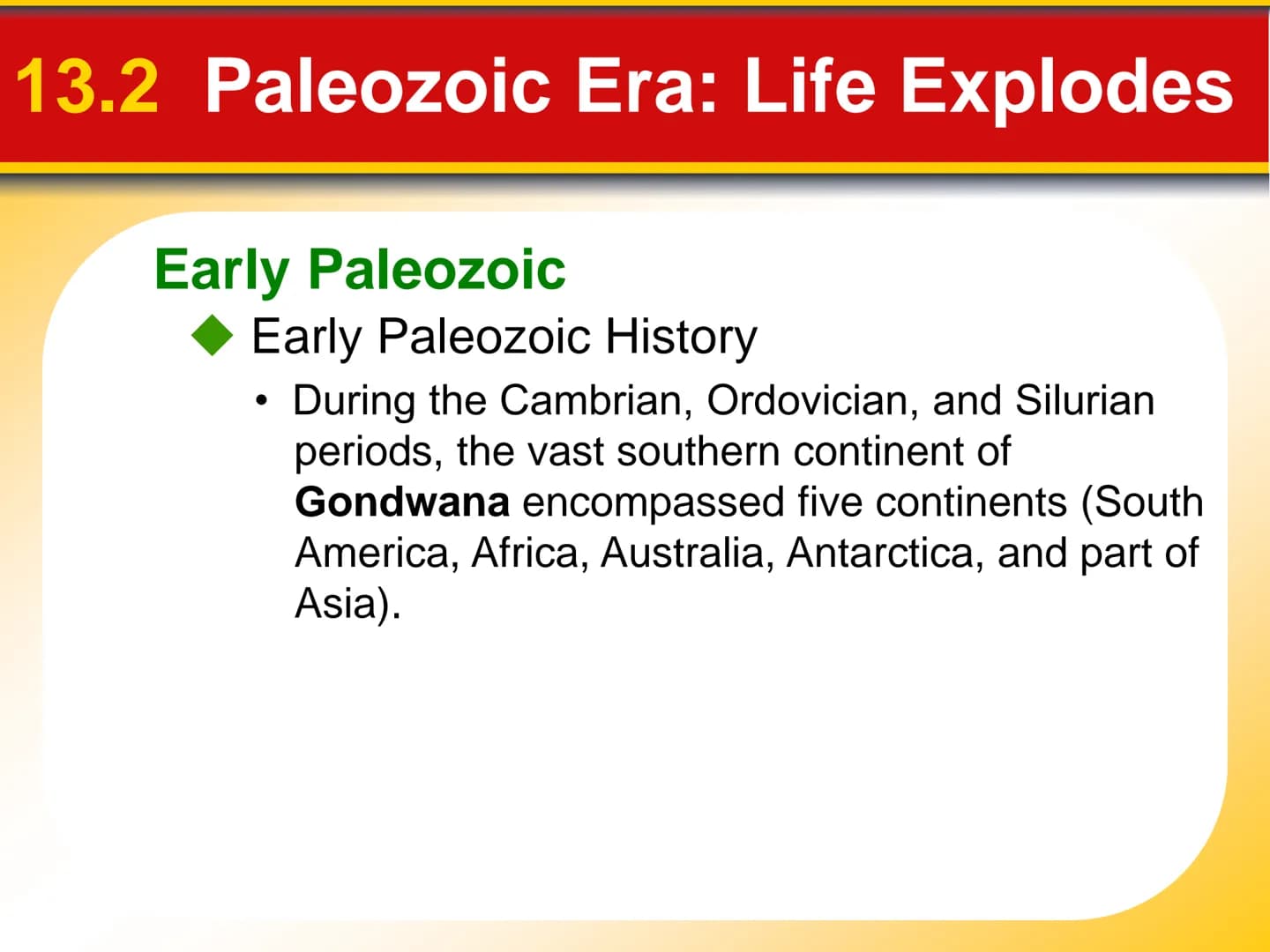
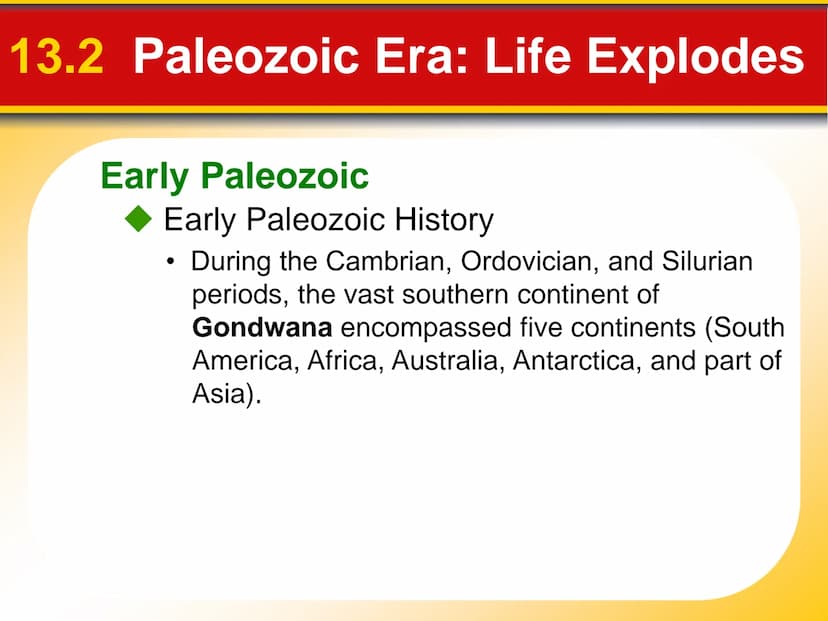
During the early Paleozoic (Cambrian, Ordovician, and Silurian periods), Earth's landmasses were arranged very differently than they are today. The most prominent feature was Gondwana, an enormous southern continent.
Gondwana was a supercontinent that included what would eventually become South America, Africa, Australia, Antarctica, and parts of Asia. This massive landmass dominated the southern hemisphere while smaller continents existed to the north.
The positions of these ancient continents affected everything from global climate patterns to the evolution and migration of species. As the Paleozoic progressed, these landmasses would begin moving toward new arrangements.
Visualization tip: If you could time-travel to early Paleozoic Earth, you'd need a completely different map!
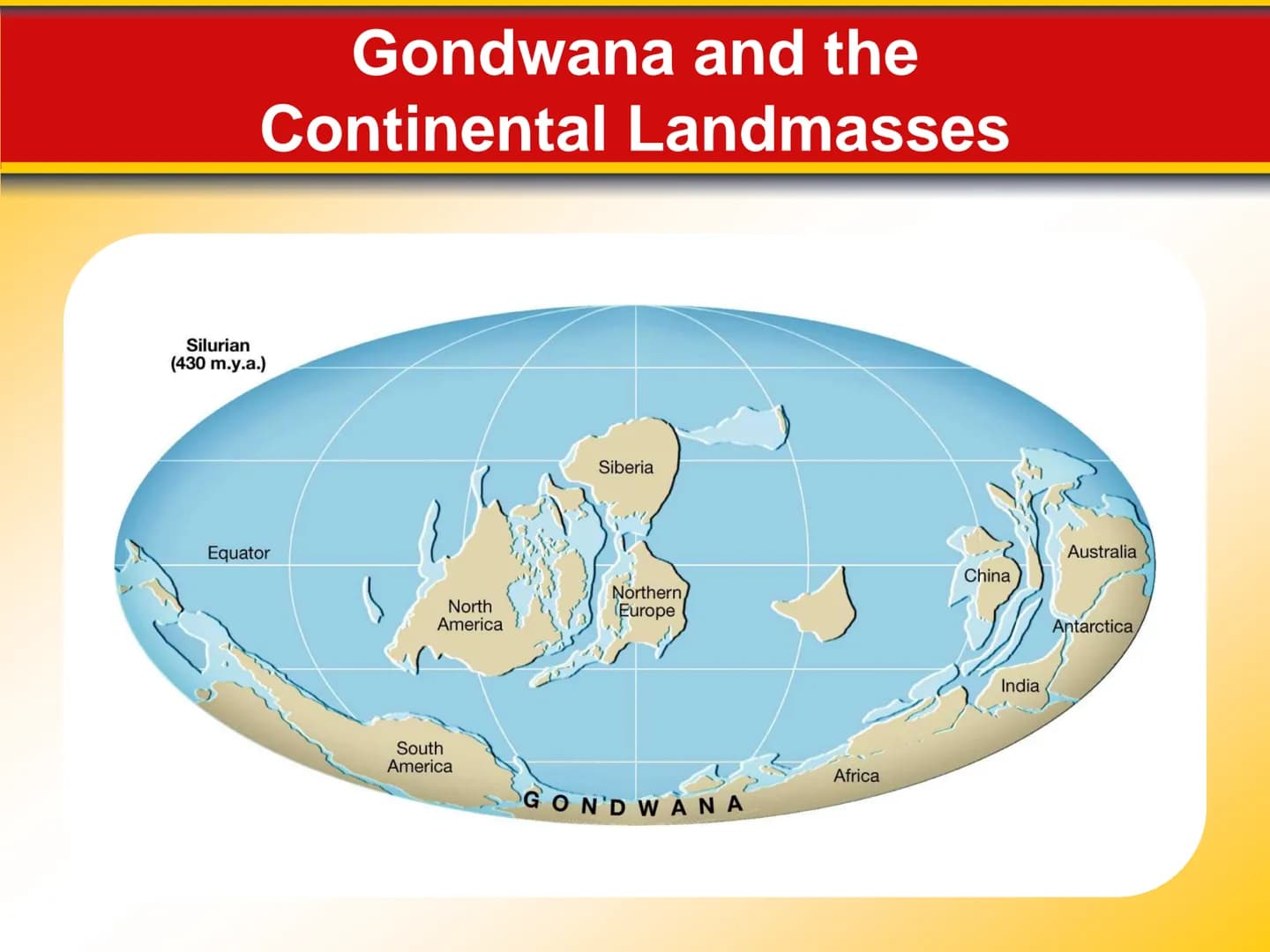
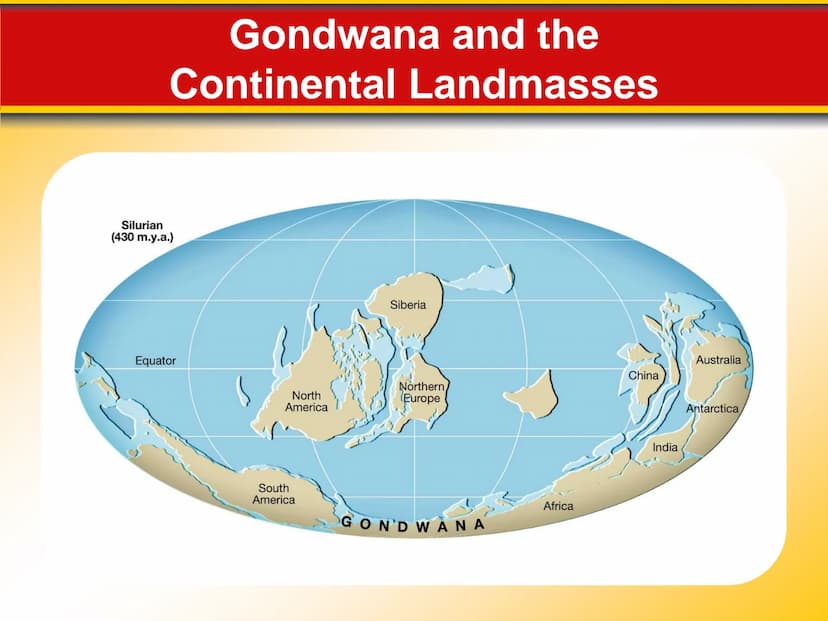
About 430 million years ago during the Silurian period, the supercontinent Gondwana dominated Earth's southern hemisphere. This massive landmass contained what would later become Africa, South America, Australia, Antarctica, and India.
North America and parts of Europe formed separate landmasses in the northern hemisphere, along with several other smaller continents like Siberia and China. The equator ran through very different regions than it does today.
This arrangement of continents created unique environmental conditions and opportunities for life to evolve. The oceans between these landmasses contained thriving ecosystems that would eventually leave behind rich fossil records.
Consider this: Every continent you're familiar with today was once part of a completely different arrangement - and will be again in the distant future!

During the early Paleozoic Era, life existed almost exclusively in the oceans. The land surfaces of Earth remained largely barren, with no plants or animals to populate them yet.
The seas, however, were teeming with increasing diversity. This period saw the evolution of many invertebrate species with hard shells and exoskeletons, which significantly improved their chances of becoming fossils compared to their Precambrian predecessors.
These marine ecosystems became increasingly complex, with various organisms developing specialized roles in their environments. The stage was being set for one of the most significant events in Earth's history: the eventual colonization of land.
Connection to today: Many modern marine animals are descendants of these early Paleozoic pioneers!
Our AI companion is specifically built for the needs of students. Based on the millions of content pieces we have on the platform we can provide truly meaningful and relevant answers to students. But its not only about answers, the companion is even more about guiding students through their daily learning challenges, with personalised study plans, quizzes or content pieces in the chat and 100% personalisation based on the students skills and developments.
You can download the app in the Google Play Store and in the Apple App Store.
That's right! Enjoy free access to study content, connect with fellow students, and get instant help – all at your fingertips.
App Store
Google Play
The app is very easy to use and well designed. I have found everything I was looking for so far and have been able to learn a lot from the presentations! I will definitely use the app for a class assignment! And of course it also helps a lot as an inspiration.
Stefan S
iOS user
This app is really great. There are so many study notes and help [...]. My problem subject is French, for example, and the app has so many options for help. Thanks to this app, I have improved my French. I would recommend it to anyone.
Samantha Klich
Android user
Wow, I am really amazed. I just tried the app because I've seen it advertised many times and was absolutely stunned. This app is THE HELP you want for school and above all, it offers so many things, such as workouts and fact sheets, which have been VERY helpful to me personally.
Anna
iOS user
I think it’s very much worth it and you’ll end up using it a lot once you get the hang of it and even after looking at others notes you can still ask your Artificial intelligence buddy the question and ask to simplify it if you still don’t get it!!! In the end I think it’s worth it 😊👍 ⚠️Also DID I MENTION ITS FREEE YOU DON’T HAVE TO PAY FOR ANYTHING AND STILL GET YOUR GRADES IN PERFECTLY❗️❗️⚠️
Thomas R
iOS user
Knowunity is the BEST app I’ve used in a minute. This is not an ai review or anything this is genuinely coming from a 7th grade student (I know 2011 im young) but dude this app is a 10/10 i have maintained a 3.8 gpa and have plenty of time for gaming. I love it and my mom is just happy I got good grades
Brad T
Android user
Not only did it help me find the answer but it also showed me alternative ways to solve it. I was horrible in math and science but now I have an a in both subjects. Thanks for the help🤍🤍
David K
iOS user
The app's just great! All I have to do is enter the topic in the search bar and I get the response real fast. I don't have to watch 10 YouTube videos to understand something, so I'm saving my time. Highly recommended!
Sudenaz Ocak
Android user
In school I was really bad at maths but thanks to the app, I am doing better now. I am so grateful that you made the app.
Greenlight Bonnie
Android user
I found this app a couple years ago and it has only gotten better since then. I really love it because it can help with written questions and photo questions. Also, it can find study guides that other people have made as well as flashcard sets and practice tests. The free version is also amazing for students who might not be able to afford it. Would 100% recommend
Aubrey
iOS user
Best app if you're in Highschool or Junior high. I have been using this app for 2 school years and it's the best, it's good if you don't have anyone to help you with school work.😋🩷🎀
Marco B
iOS user
THE QUIZES AND FLASHCARDS ARE SO USEFUL AND I LOVE Knowunity AI. IT ALSO IS LITREALLY LIKE CHATGPT BUT SMARTER!! HELPED ME WITH MY MASCARA PROBLEMS TOO!! AS WELL AS MY REAL SUBJECTS ! DUHHH 😍😁😲🤑💗✨🎀😮
Elisha
iOS user
This app is phenomenal down to the correct info and the various topics you can study! I greatly recommend it for people who struggle with procrastination and those who need homework help. It has been perfectly accurate for world 1 history as far as I’ve seen! Geometry too!
Paul T
iOS user
The app is very easy to use and well designed. I have found everything I was looking for so far and have been able to learn a lot from the presentations! I will definitely use the app for a class assignment! And of course it also helps a lot as an inspiration.
Stefan S
iOS user
This app is really great. There are so many study notes and help [...]. My problem subject is French, for example, and the app has so many options for help. Thanks to this app, I have improved my French. I would recommend it to anyone.
Samantha Klich
Android user
Wow, I am really amazed. I just tried the app because I've seen it advertised many times and was absolutely stunned. This app is THE HELP you want for school and above all, it offers so many things, such as workouts and fact sheets, which have been VERY helpful to me personally.
Anna
iOS user
I think it’s very much worth it and you’ll end up using it a lot once you get the hang of it and even after looking at others notes you can still ask your Artificial intelligence buddy the question and ask to simplify it if you still don’t get it!!! In the end I think it’s worth it 😊👍 ⚠️Also DID I MENTION ITS FREEE YOU DON’T HAVE TO PAY FOR ANYTHING AND STILL GET YOUR GRADES IN PERFECTLY❗️❗️⚠️
Thomas R
iOS user
Knowunity is the BEST app I’ve used in a minute. This is not an ai review or anything this is genuinely coming from a 7th grade student (I know 2011 im young) but dude this app is a 10/10 i have maintained a 3.8 gpa and have plenty of time for gaming. I love it and my mom is just happy I got good grades
Brad T
Android user
Not only did it help me find the answer but it also showed me alternative ways to solve it. I was horrible in math and science but now I have an a in both subjects. Thanks for the help🤍🤍
David K
iOS user
The app's just great! All I have to do is enter the topic in the search bar and I get the response real fast. I don't have to watch 10 YouTube videos to understand something, so I'm saving my time. Highly recommended!
Sudenaz Ocak
Android user
In school I was really bad at maths but thanks to the app, I am doing better now. I am so grateful that you made the app.
Greenlight Bonnie
Android user
I found this app a couple years ago and it has only gotten better since then. I really love it because it can help with written questions and photo questions. Also, it can find study guides that other people have made as well as flashcard sets and practice tests. The free version is also amazing for students who might not be able to afford it. Would 100% recommend
Aubrey
iOS user
Best app if you're in Highschool or Junior high. I have been using this app for 2 school years and it's the best, it's good if you don't have anyone to help you with school work.😋🩷🎀
Marco B
iOS user
THE QUIZES AND FLASHCARDS ARE SO USEFUL AND I LOVE Knowunity AI. IT ALSO IS LITREALLY LIKE CHATGPT BUT SMARTER!! HELPED ME WITH MY MASCARA PROBLEMS TOO!! AS WELL AS MY REAL SUBJECTS ! DUHHH 😍😁😲🤑💗✨🎀😮
Elisha
iOS user
This app is phenomenal down to the correct info and the various topics you can study! I greatly recommend it for people who struggle with procrastination and those who need homework help. It has been perfectly accurate for world 1 history as far as I’ve seen! Geometry too!
Paul T
iOS user
Earth's history spans billions of years, divided into distinct time periods that tell the story of our planet's development. From the mysterious Precambrian to the more recent Paleozoic Era, Earth has undergone dramatic changes in its physical features, atmosphere, and... Show more
Access to all documents
Improve your grades
Join milions of students
Looking at Earth's history is like opening a book that spans 4.56 billion years! This chapter explores how our planet has changed over vast periods of time.
You'll discover how geologists divide Earth's history into eras and periods, each marked by significant events and life forms. These divisions help scientists organize and understand the complex story of our planet's development.
Earth's history holds clues to understanding not just our past, but also our present environment and possibly our future.
Did you know? The history of human civilization represents less than 0.01% of Earth's total history!
Access to all documents
Improve your grades
Join milions of students
The Precambrian is the longest and most mysterious chapter of Earth's story, stretching from our planet's formation 4.56 billion years ago until the Cambrian period began (about 540 million years ago). That's over 4 billion years or nearly 90% of Earth's history!
Most of what we know about this time comes from shields - large, flat areas of ancient metamorphic rock that form the stable cores of continents. These ancient rocks have survived billions of years of Earth's changing processes.
Mining operations in shield regions have given scientists valuable insights into Precambrian geology. These rocks contain important mineral deposits that formed during Earth's early development.
Cool fact: The oldest rocks discovered on Earth are from the Precambrian and date back about 4 billion years!
Access to all documents
Improve your grades
Join milions of students
The geologic time scale is Earth's history organized into a giant timeline. It divides time into four main units: eons, eras, periods, and epochs - each smaller and more specific than the last.
The three most recent eras form the Phanerozoic Eon (meaning "visible life"): the Paleozoic ("ancient life"), Mesozoic ("middle life"), and Cenozoic ("recent life"). Each era saw distinctive life forms dominate - from trilobites to dinosaurs to mammals.
The Precambrian takes up about 88% of geologic time! It witnessed Earth's formation, the development of the first single-celled organisms, and eventually the first multicellular life forms.
Think about it: If Earth's history were compressed into a single 24-hour day, humans would appear just before 11:59 PM!
Access to all documents
Improve your grades
Join milions of students
Continental shields are like windows into Earth's distant past. These exposed ancient rocks appear on every continent and represent the oldest, most stable parts of Earth's crust.
The largest shield regions include the Canadian shield in North America, the Brazilian shield in South America, the African shield, the Baltic shield in Europe, and the Australian shield. These regions have remained relatively unchanged for billions of years.
Around these stable shield areas, you'll find folded mountain belts like the Appalachians, Andes, Alps, Urals, and Himalayas. These younger formations tell the story of Earth's more recent geological activity.
Visual tip: Think of continental shields as the "cores" of continents, with younger mountain ranges forming around their edges.
Access to all documents
Improve your grades
Join milions of students
Earth's original atmosphere would have been completely unbreathable to us! It consisted mainly of volcanic gases like water vapor, carbon dioxide, and nitrogen - but crucially, no oxygen.
A major turning point came with the evolution of primitive plants that performed photosynthesis. These early organisms absorbed carbon dioxide and released oxygen as a waste product, gradually changing Earth's atmosphere.
Oxygen began accumulating in the atmosphere about 2.5 billion years ago. This dramatic change paved the way for the evolution of more complex life forms that depended on oxygen, including eventually, humans!
Mind-blowing fact: The oxygen we breathe today exists because of tiny organisms that lived billions of years ago!
Access to all documents
Improve your grades
Join milions of students
Finding fossils from the Precambrian is extremely rare since most early organisms had soft bodies that decomposed without leaving traces. This makes the Precambrian particularly challenging for scientists to study.
The most common Precambrian fossils are stromatolites - distinctive layered mounds or columns made of calcium carbonate. These aren't the actual organisms but structures created by ancient algae as they trapped sediment.
Many Precambrian fossils are preserved in chert, a hard dense chemical sedimentary rock that excellently preserves microscopic details. These precious fossils give us rare glimpses into Earth's earliest life forms.
Fascinating connection: You can still find living stromatolites today in a few places like Shark Bay, Australia - they look almost identical to ones that lived 3 billion years ago!
Access to all documents
Improve your grades
Join milions of students
After the lengthy Precambrian came the Paleozoic Era, beginning about 540 million years ago. This marks the start of Earth's more "recent" history, divided into three major eras: the Paleozoic ("ancient life"), Mesozoic ("middle life"), and Cenozoic ("recent life").
The Paleozoic saw an extraordinary explosion of life forms, particularly in the oceans. This era represents a crucial turning point when life became much more diverse and complex than anything that existed before.
During this time, Earth's geography looked completely different from today, with continents in entirely different positions and combinations. These changing land arrangements greatly influenced the evolution of life.
Think about this: The Paleozoic Era began with simple marine creatures and ended with complex land animals and forests - an incredible transformation!
Access to all documents
Improve your grades
Join milions of students
During the early Paleozoic (Cambrian, Ordovician, and Silurian periods), Earth's landmasses were arranged very differently than they are today. The most prominent feature was Gondwana, an enormous southern continent.
Gondwana was a supercontinent that included what would eventually become South America, Africa, Australia, Antarctica, and parts of Asia. This massive landmass dominated the southern hemisphere while smaller continents existed to the north.
The positions of these ancient continents affected everything from global climate patterns to the evolution and migration of species. As the Paleozoic progressed, these landmasses would begin moving toward new arrangements.
Visualization tip: If you could time-travel to early Paleozoic Earth, you'd need a completely different map!
Access to all documents
Improve your grades
Join milions of students
About 430 million years ago during the Silurian period, the supercontinent Gondwana dominated Earth's southern hemisphere. This massive landmass contained what would later become Africa, South America, Australia, Antarctica, and India.
North America and parts of Europe formed separate landmasses in the northern hemisphere, along with several other smaller continents like Siberia and China. The equator ran through very different regions than it does today.
This arrangement of continents created unique environmental conditions and opportunities for life to evolve. The oceans between these landmasses contained thriving ecosystems that would eventually leave behind rich fossil records.
Consider this: Every continent you're familiar with today was once part of a completely different arrangement - and will be again in the distant future!
Access to all documents
Improve your grades
Join milions of students
During the early Paleozoic Era, life existed almost exclusively in the oceans. The land surfaces of Earth remained largely barren, with no plants or animals to populate them yet.
The seas, however, were teeming with increasing diversity. This period saw the evolution of many invertebrate species with hard shells and exoskeletons, which significantly improved their chances of becoming fossils compared to their Precambrian predecessors.
These marine ecosystems became increasingly complex, with various organisms developing specialized roles in their environments. The stage was being set for one of the most significant events in Earth's history: the eventual colonization of land.
Connection to today: Many modern marine animals are descendants of these early Paleozoic pioneers!
Our AI companion is specifically built for the needs of students. Based on the millions of content pieces we have on the platform we can provide truly meaningful and relevant answers to students. But its not only about answers, the companion is even more about guiding students through their daily learning challenges, with personalised study plans, quizzes or content pieces in the chat and 100% personalisation based on the students skills and developments.
You can download the app in the Google Play Store and in the Apple App Store.
That's right! Enjoy free access to study content, connect with fellow students, and get instant help – all at your fingertips.
5
Smart Tools NEW
Transform this note into: ✓ 50+ Practice Questions ✓ Interactive Flashcards ✓ Full Practice Test ✓ Essay Outlines
this notes talks about rock layers
 Earth and Space Science
A study notes that contain informations about relative and absolute dating
Earth and Space ScienceThis document tackles how the rocks record earth history, relative dating and correlation of rock layers.
Earth and Space ScienceNotes describing different trophic levels and the natural food web in nature
Earth and Space ScienceApp Store
Google Play
The app is very easy to use and well designed. I have found everything I was looking for so far and have been able to learn a lot from the presentations! I will definitely use the app for a class assignment! And of course it also helps a lot as an inspiration.
Stefan S
iOS user
This app is really great. There are so many study notes and help [...]. My problem subject is French, for example, and the app has so many options for help. Thanks to this app, I have improved my French. I would recommend it to anyone.
Samantha Klich
Android user
Wow, I am really amazed. I just tried the app because I've seen it advertised many times and was absolutely stunned. This app is THE HELP you want for school and above all, it offers so many things, such as workouts and fact sheets, which have been VERY helpful to me personally.
Anna
iOS user
I think it’s very much worth it and you’ll end up using it a lot once you get the hang of it and even after looking at others notes you can still ask your Artificial intelligence buddy the question and ask to simplify it if you still don’t get it!!! In the end I think it’s worth it 😊👍 ⚠️Also DID I MENTION ITS FREEE YOU DON’T HAVE TO PAY FOR ANYTHING AND STILL GET YOUR GRADES IN PERFECTLY❗️❗️⚠️
Thomas R
iOS user
Knowunity is the BEST app I’ve used in a minute. This is not an ai review or anything this is genuinely coming from a 7th grade student (I know 2011 im young) but dude this app is a 10/10 i have maintained a 3.8 gpa and have plenty of time for gaming. I love it and my mom is just happy I got good grades
Brad T
Android user
Not only did it help me find the answer but it also showed me alternative ways to solve it. I was horrible in math and science but now I have an a in both subjects. Thanks for the help🤍🤍
David K
iOS user
The app's just great! All I have to do is enter the topic in the search bar and I get the response real fast. I don't have to watch 10 YouTube videos to understand something, so I'm saving my time. Highly recommended!
Sudenaz Ocak
Android user
In school I was really bad at maths but thanks to the app, I am doing better now. I am so grateful that you made the app.
Greenlight Bonnie
Android user
I found this app a couple years ago and it has only gotten better since then. I really love it because it can help with written questions and photo questions. Also, it can find study guides that other people have made as well as flashcard sets and practice tests. The free version is also amazing for students who might not be able to afford it. Would 100% recommend
Aubrey
iOS user
Best app if you're in Highschool or Junior high. I have been using this app for 2 school years and it's the best, it's good if you don't have anyone to help you with school work.😋🩷🎀
Marco B
iOS user
THE QUIZES AND FLASHCARDS ARE SO USEFUL AND I LOVE Knowunity AI. IT ALSO IS LITREALLY LIKE CHATGPT BUT SMARTER!! HELPED ME WITH MY MASCARA PROBLEMS TOO!! AS WELL AS MY REAL SUBJECTS ! DUHHH 😍😁😲🤑💗✨🎀😮
Elisha
iOS user
This app is phenomenal down to the correct info and the various topics you can study! I greatly recommend it for people who struggle with procrastination and those who need homework help. It has been perfectly accurate for world 1 history as far as I’ve seen! Geometry too!
Paul T
iOS user
The app is very easy to use and well designed. I have found everything I was looking for so far and have been able to learn a lot from the presentations! I will definitely use the app for a class assignment! And of course it also helps a lot as an inspiration.
Stefan S
iOS user
This app is really great. There are so many study notes and help [...]. My problem subject is French, for example, and the app has so many options for help. Thanks to this app, I have improved my French. I would recommend it to anyone.
Samantha Klich
Android user
Wow, I am really amazed. I just tried the app because I've seen it advertised many times and was absolutely stunned. This app is THE HELP you want for school and above all, it offers so many things, such as workouts and fact sheets, which have been VERY helpful to me personally.
Anna
iOS user
I think it’s very much worth it and you’ll end up using it a lot once you get the hang of it and even after looking at others notes you can still ask your Artificial intelligence buddy the question and ask to simplify it if you still don’t get it!!! In the end I think it’s worth it 😊👍 ⚠️Also DID I MENTION ITS FREEE YOU DON’T HAVE TO PAY FOR ANYTHING AND STILL GET YOUR GRADES IN PERFECTLY❗️❗️⚠️
Thomas R
iOS user
Knowunity is the BEST app I’ve used in a minute. This is not an ai review or anything this is genuinely coming from a 7th grade student (I know 2011 im young) but dude this app is a 10/10 i have maintained a 3.8 gpa and have plenty of time for gaming. I love it and my mom is just happy I got good grades
Brad T
Android user
Not only did it help me find the answer but it also showed me alternative ways to solve it. I was horrible in math and science but now I have an a in both subjects. Thanks for the help🤍🤍
David K
iOS user
The app's just great! All I have to do is enter the topic in the search bar and I get the response real fast. I don't have to watch 10 YouTube videos to understand something, so I'm saving my time. Highly recommended!
Sudenaz Ocak
Android user
In school I was really bad at maths but thanks to the app, I am doing better now. I am so grateful that you made the app.
Greenlight Bonnie
Android user
I found this app a couple years ago and it has only gotten better since then. I really love it because it can help with written questions and photo questions. Also, it can find study guides that other people have made as well as flashcard sets and practice tests. The free version is also amazing for students who might not be able to afford it. Would 100% recommend
Aubrey
iOS user
Best app if you're in Highschool or Junior high. I have been using this app for 2 school years and it's the best, it's good if you don't have anyone to help you with school work.😋🩷🎀
Marco B
iOS user
THE QUIZES AND FLASHCARDS ARE SO USEFUL AND I LOVE Knowunity AI. IT ALSO IS LITREALLY LIKE CHATGPT BUT SMARTER!! HELPED ME WITH MY MASCARA PROBLEMS TOO!! AS WELL AS MY REAL SUBJECTS ! DUHHH 😍😁😲🤑💗✨🎀😮
Elisha
iOS user
This app is phenomenal down to the correct info and the various topics you can study! I greatly recommend it for people who struggle with procrastination and those who need homework help. It has been perfectly accurate for world 1 history as far as I’ve seen! Geometry too!
Paul T
iOS user