
Ever wondered how zoos evolved from ancient animal collections to... Show more
 Algebra
 Biology
Sign up to see the contentIt's free!
Access to all documents
Improve your grades
Join milions of students
Knowunity AI
Subjects
Triangle Congruence and Similarity Theorems
Triangle Properties and Classification
Linear Equations and Graphs
Geometric Angle Relationships
Trigonometric Functions and Identities
Equation Solving Techniques
Circle Geometry Fundamentals
Division Operations and Methods
Basic Differentiation Rules
Exponent and Logarithm Properties
Show all topics
Human Organ Systems
Reproductive Cell Cycles
Biological Sciences Subdisciplines
Cellular Energy Metabolism
Autotrophic Energy Processes
Inheritance Patterns and Principles
Biomolecular Structure and Organization
Cell Cycle and Division Mechanics
Cellular Organization and Development
Biological Structural Organization
Show all topics
Chemical Sciences and Applications
Atomic Structure and Composition
Molecular Electron Structure Representation
Atomic Electron Behavior
Matter Properties and Water
Mole Concept and Calculations
Gas Laws and Behavior
Periodic Table Organization
Chemical Thermodynamics Fundamentals
Chemical Bond Types and Properties
Show all topics
European Renaissance and Enlightenment
European Cultural Movements 800-1920
American Revolution Era 1763-1797
American Civil War 1861-1865
Global Imperial Systems
Mongol and Chinese Dynasties
U.S. Presidents and World Leaders
Historical Sources and Documentation
World Wars Era and Impact
World Religious Systems
Show all topics
Classic and Contemporary Novels
Literary Character Analysis
Rhetorical Theory and Practice
Classic Literary Narratives
Reading Analysis and Interpretation
Narrative Structure and Techniques
English Language Components
Influential English-Language Authors
Basic Sentence Structure
Narrative Voice and Perspective
Show all topics
207
•
Updated Mar 18, 2026
•

Grayson
@grayson_njhd
Ever wondered how zoos evolved from ancient animal collections to... Show more
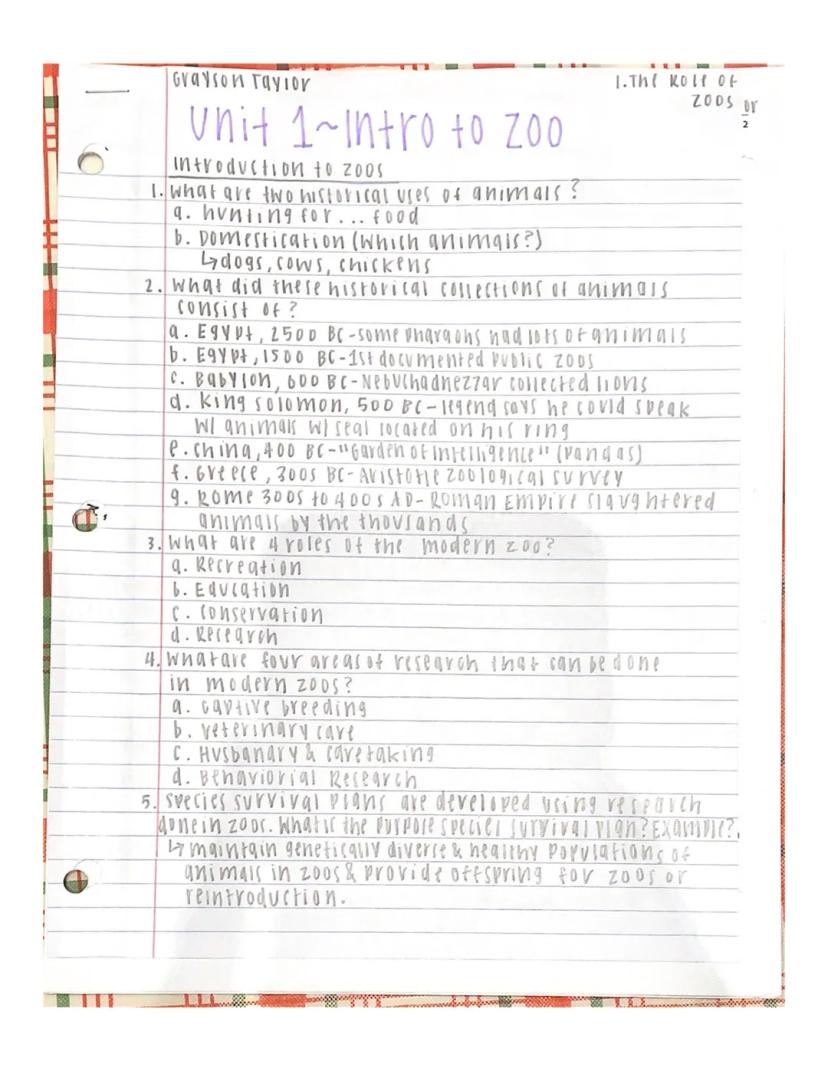
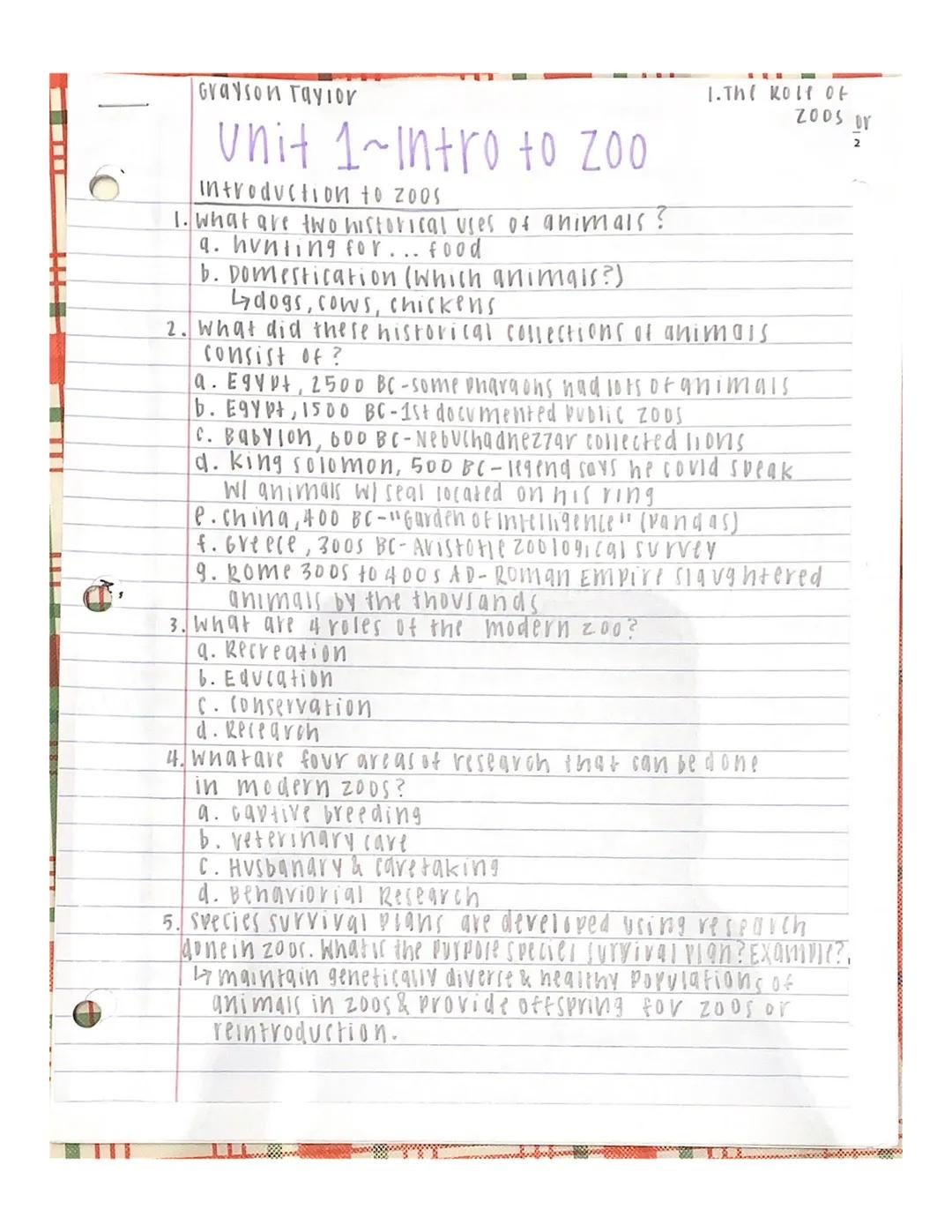
Zoos have evolved dramatically from their ancient origins. The earliest animal collections date back to Egypt around 2500 BC when pharaohs maintained personal menageries. By 1500 BC, Egypt established the first documented public zoos, while other ancient civilizations like Babylon and China created their own collections.
The modern zoo serves four essential roles: recreation, education, conservation, and research. Unlike ancient collections that often existed purely for entertainment or status, today's zoos conduct vital research in areas like captive breeding, veterinary care, husbandry techniques, and behavioral studies.
One of the most important modern zoo initiatives is the Species Survival Plan. These plans help maintain genetically diverse and healthy animal populations in captivity, providing offspring for other zoos or potentially reintroducing animals to the wild.
Did you know? The Roman Empire used their animal collections for massive spectacles where thousands of animals were slaughtered for entertainment - a stark contrast to the conservation focus of modern zoos!
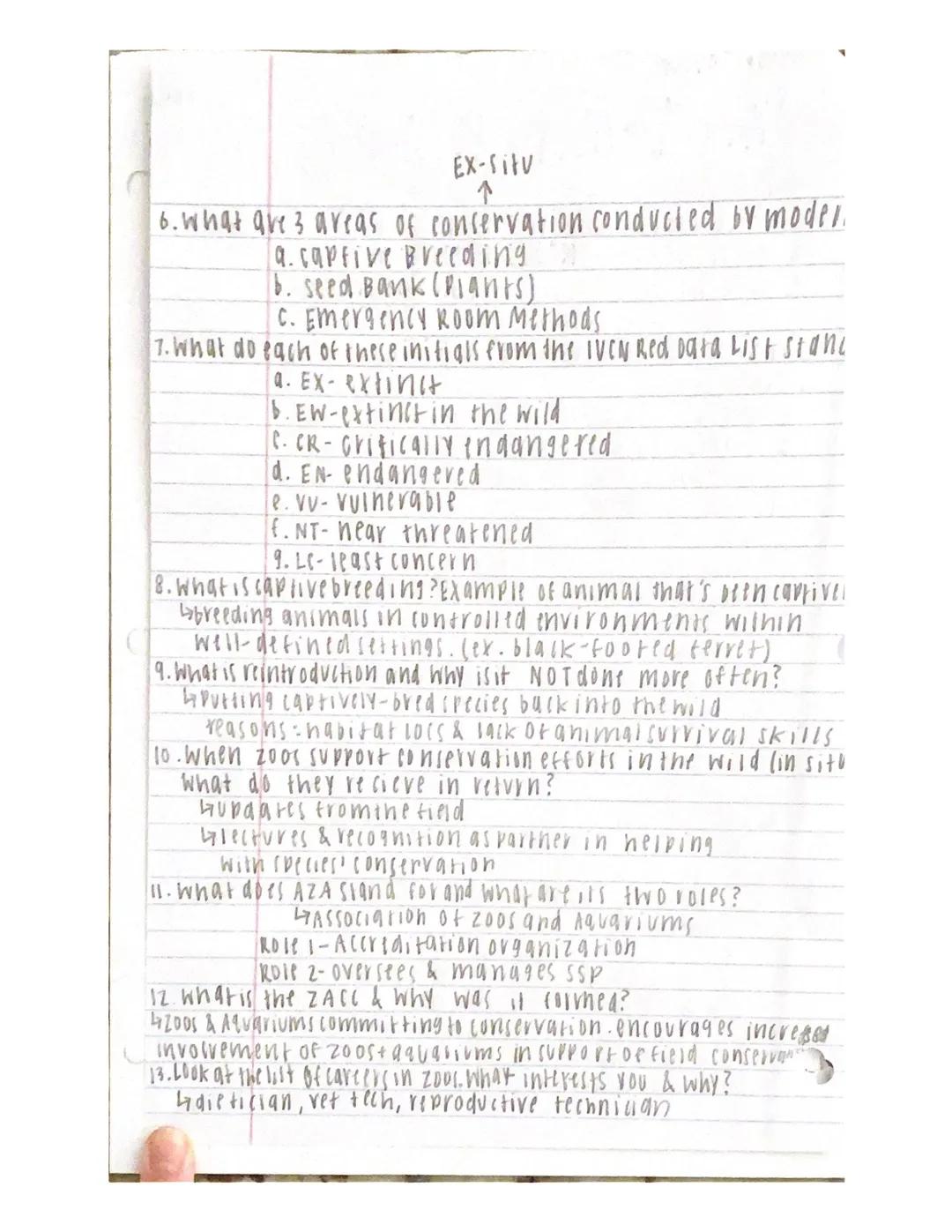
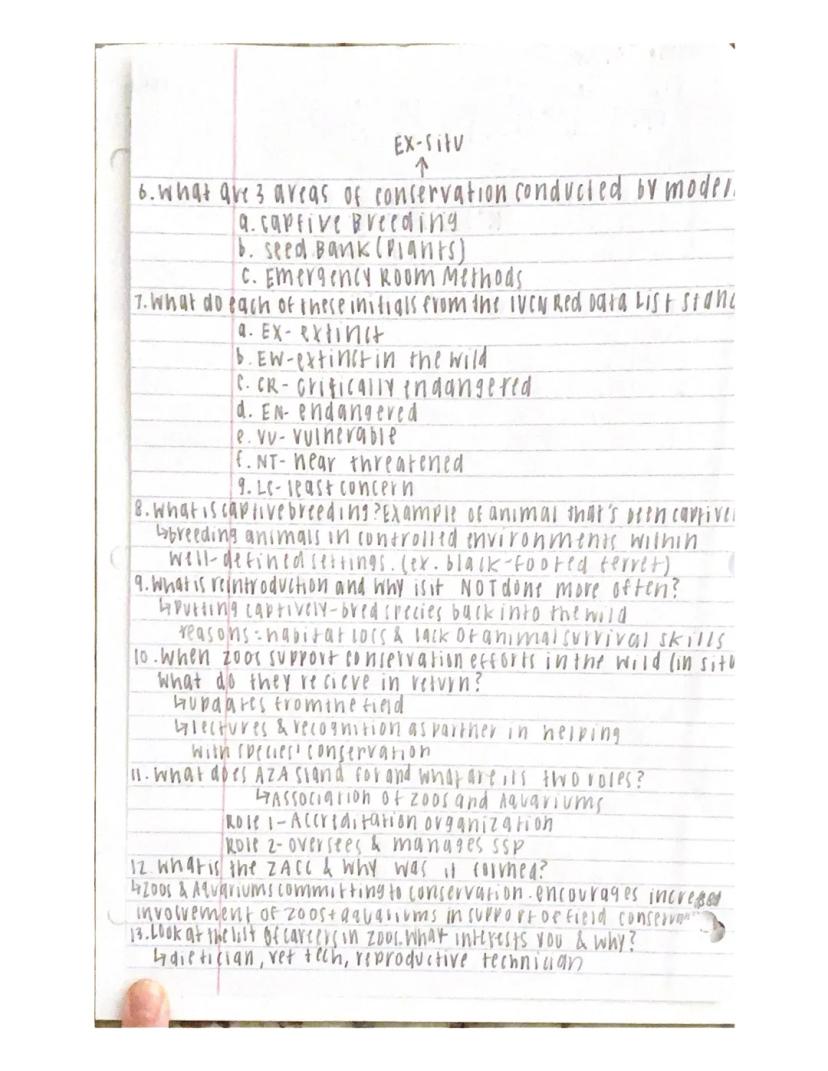
Modern zoos play a crucial role in conservation through three main approaches. Ex-situ conservation happens within the zoo through captive breeding programs and seed banks for plants. Emergency room methods provide urgent care for threatened species. In contrast, in-situ conservation supports animals in their natural habitats.
The IUCN Red List uses specific classifications to indicate a species' status in the wild: EX (Extinct), EW (Extinct in the Wild), CR (Critically Endangered), EN (Endangered), VU (Vulnerable), NT (Near Threatened), and LC (Least Concern). These designations help zoos prioritize their conservation efforts.
Captive breeding involves breeding animals in controlled environments, like the successful program for the black-footed ferret. Reintroduction - returning these animals to the wild - happens less frequently due to habitat loss and animals lacking survival skills.
Fun fact: When you see "AZA" (Association of Zoos and Aquariums), you're looking at an organization that both accredits quality zoos and oversees Species Survival Plans throughout North America!
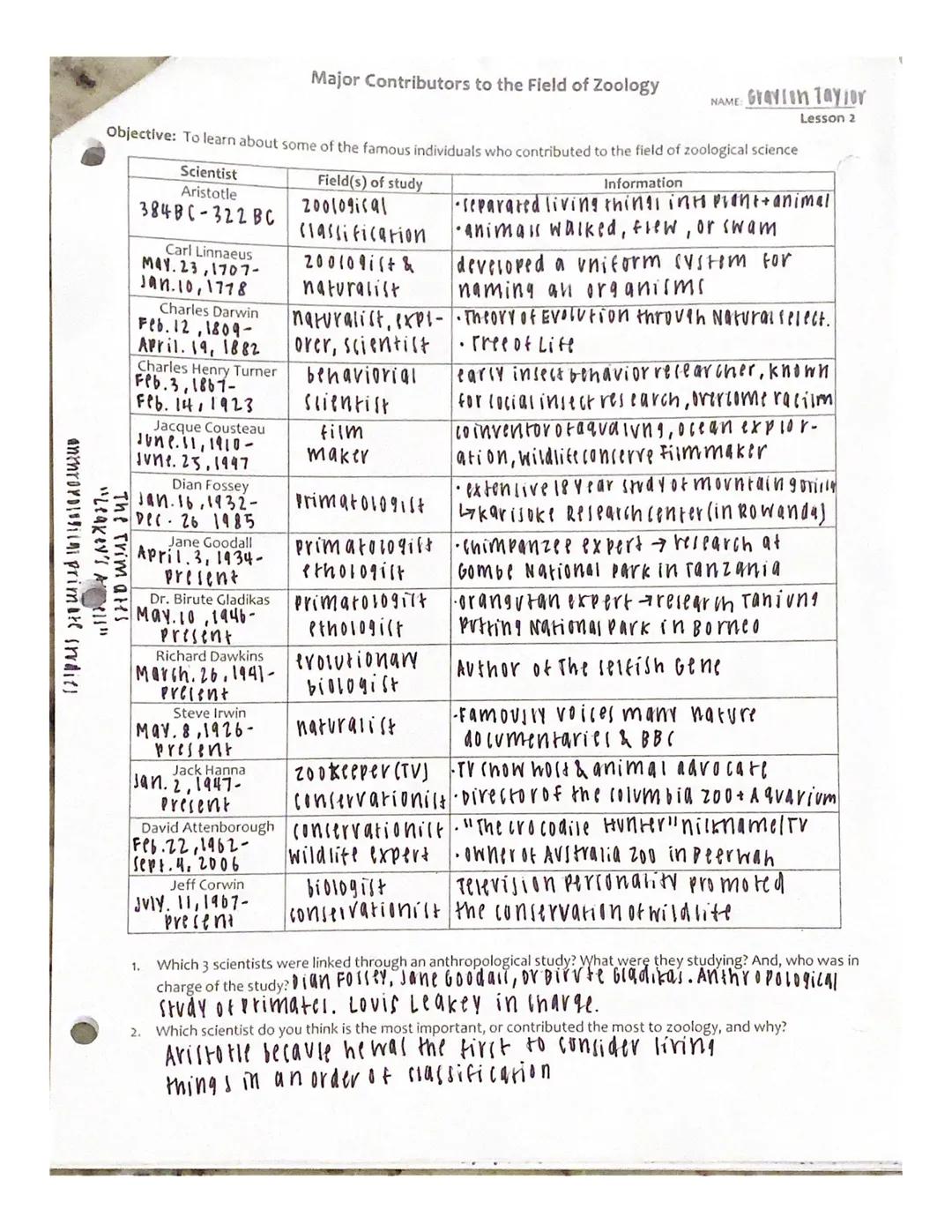
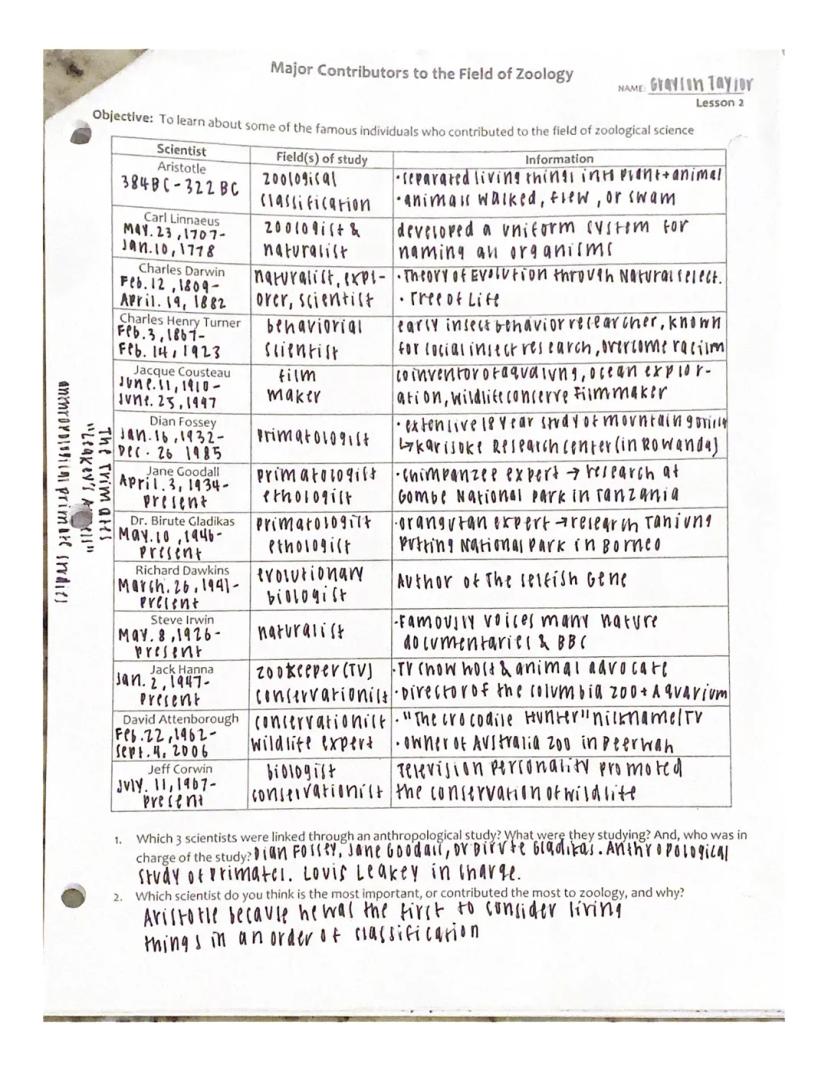
The field of zoology has been shaped by brilliant scientists throughout history. Ancient thinkers like Aristotle made the first attempts at animal classification, while Carl Linnaeus (1707-1778) developed the standardized naming system we still use today. Charles Darwin revolutionized biology with his theory of evolution through natural selection.
A fascinating chapter in zoology history was the "Leakey's Angels" - three pioneering women primatologists: Dian Fossey (mountain gorillas), Jane Goodall (chimpanzees), and Biruté Galdikas (orangutans). All three conducted groundbreaking field studies under the direction of anthropologist Louis Leakey.
Modern zoologists have found new ways to connect the public with wildlife. Figures like Jack Hanna, Steve Irwin (the "Crocodile Hunter"), and David Attenborough have brought animal conservation into living rooms worldwide through engaging television programs and documentaries.
Think about it: Which zoologist do you find most inspiring? Aristotle laid the foundation for animal classification over 2,300 years ago, but modern scientists like Jane Goodall continue breaking new ground in how we understand animal behavior and intelligence.
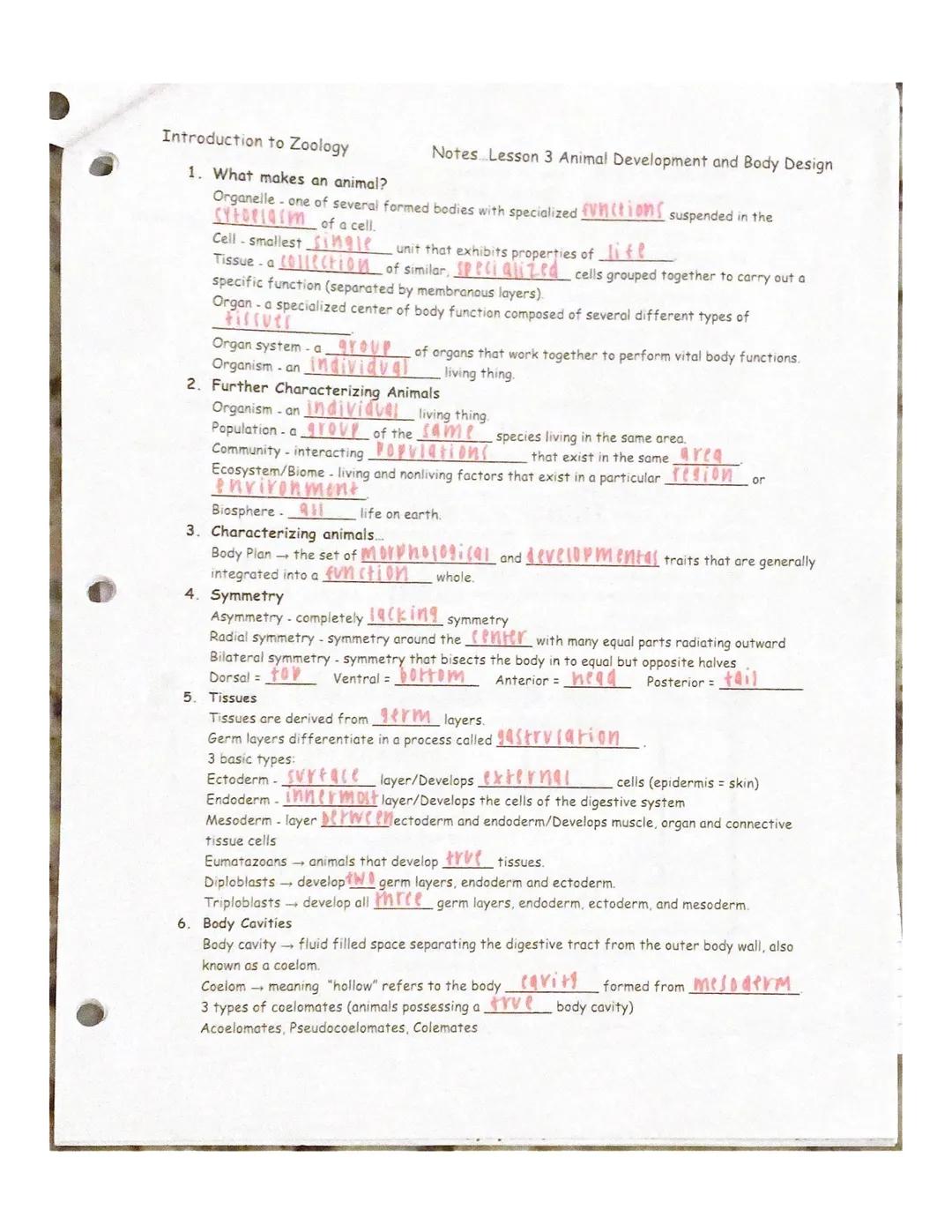
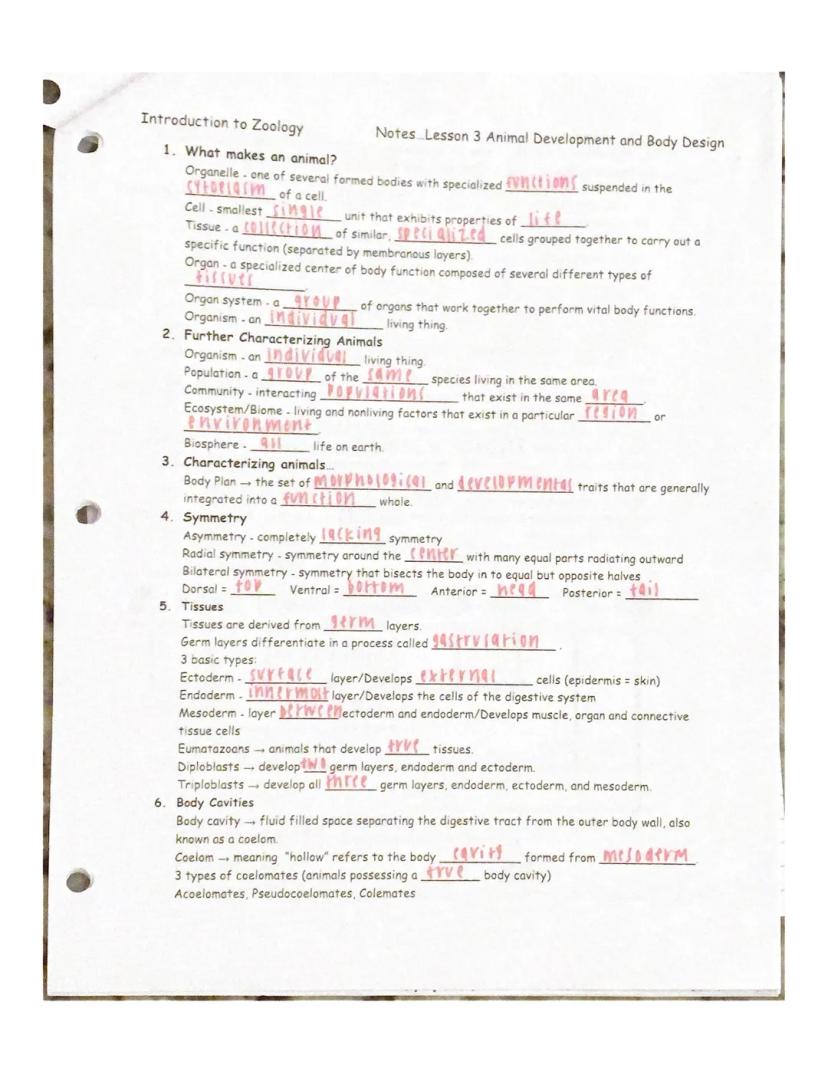
Animals are organized in increasingly complex levels, from tiny organelles (specialized structures within cells) up through cells, tissues, organs, organ systems, and finally the complete organism. This hierarchy extends beyond individual animals to populations, communities, ecosystems, and eventually the entire biosphere.
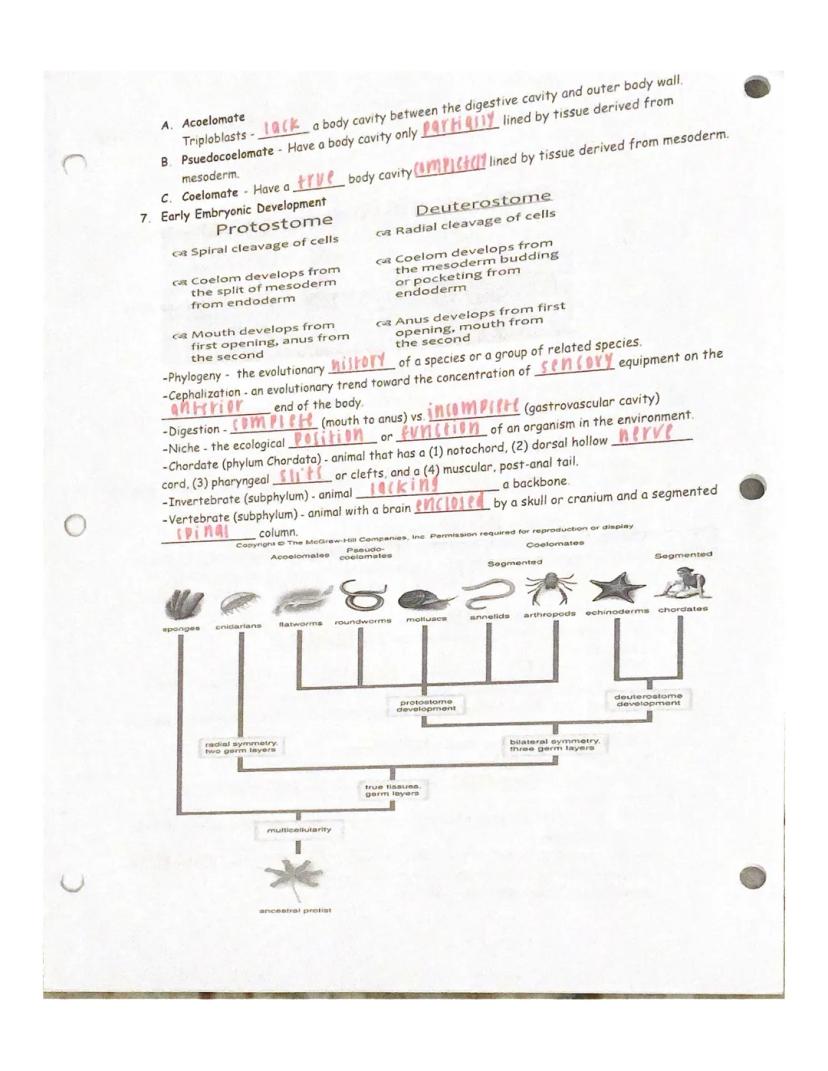
Body symmetry is a fundamental way to classify animals. Asymmetrical animals have no defined shape, while radial symmetry means parts radiate from a central point (like a starfish). Most animals, including humans, display bilateral symmetry with matching left and right sides. Bilateral animals have defined directions: dorsal (back), ventral (belly), anterior (head), and posterior (tail).
During early development, animal embryos form germ layers through a process called gastrulation. Ectoderm develops into skin and nerves, endoderm forms digestive structures, and mesoderm creates muscles and internal organs. Animals with true tissues (eumetazoans) may be diploblasts (two germ layers) or triploblasts (three germ layers).
Body cavity basics: The space between your digestive tract and body wall is a coelom. Animals are classified as acoelomates (no body cavity), pseudocoelomates (partial cavity), or coelomates (true body cavity) based on this internal structure!
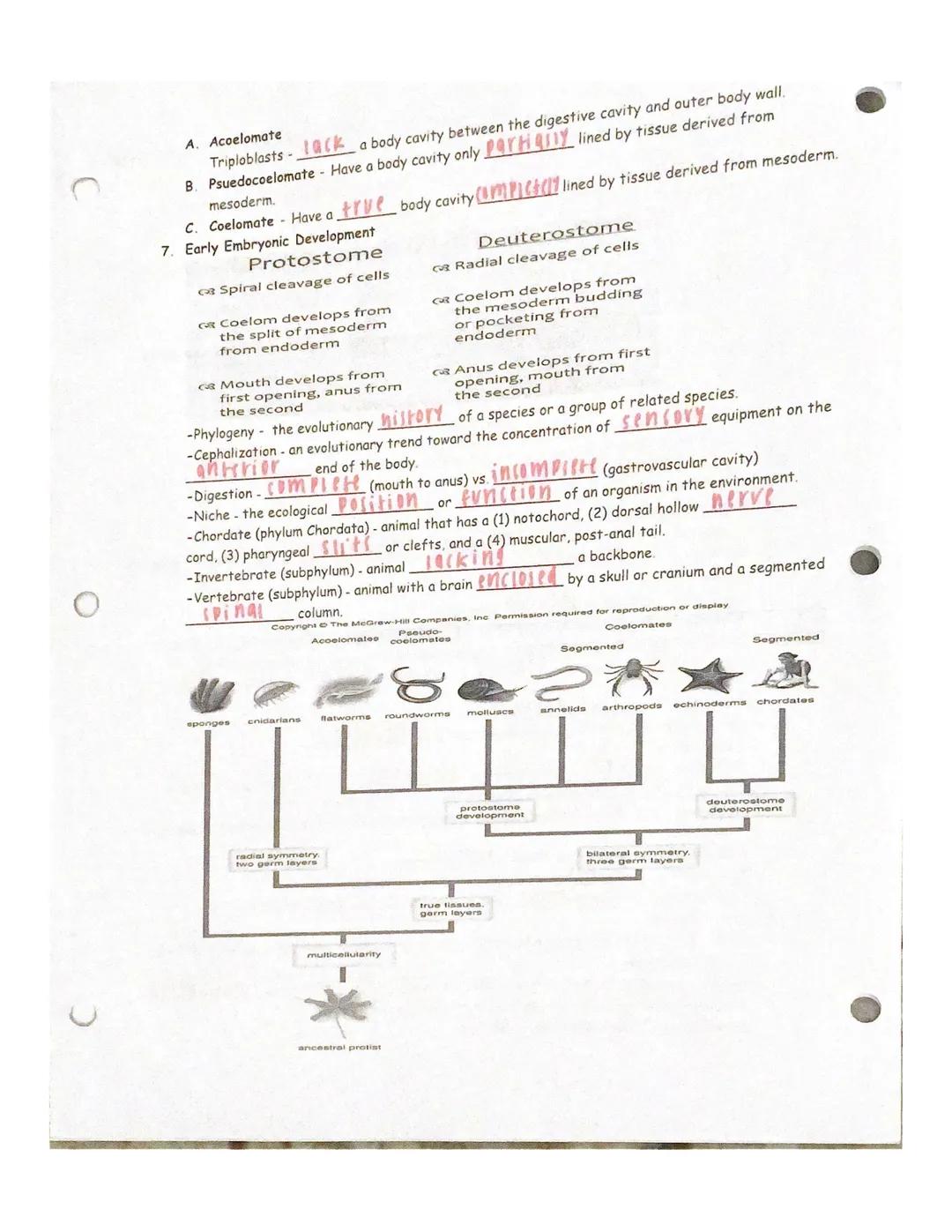
The way embryos develop helps scientists classify animals into major groups. Protostomes (including insects and mollusks) undergo spiral cell division and develop their mouth from the first embryonic opening. Deuterostomes (including humans and other chordates) show radial cell division and develop the anus from the first opening.
Animal groups differ in key physical features. Cephalization is the evolutionary trend of concentrating sensory organs at the head end of an animal. Digestive systems can be complete (with separate mouth and anus) or incomplete (with a single opening). A niche describes an organism's role in its ecosystem.
Chordates are animals defined by four key features: a notochord, dorsal hollow nerve cord, pharyngeal slits, and post-anal tail. This group divides into invertebrates (without backbones) and vertebrates (with backbones). Vertebrates have brains protected by skulls and segmented spinal columns.
Visualization tip: The evolutionary tree of animals resembles a branching path where each fork represents adaptations like segmentation, body cavities, or symmetry types. This helps you see relationships between seemingly different creatures like starfish and humans!
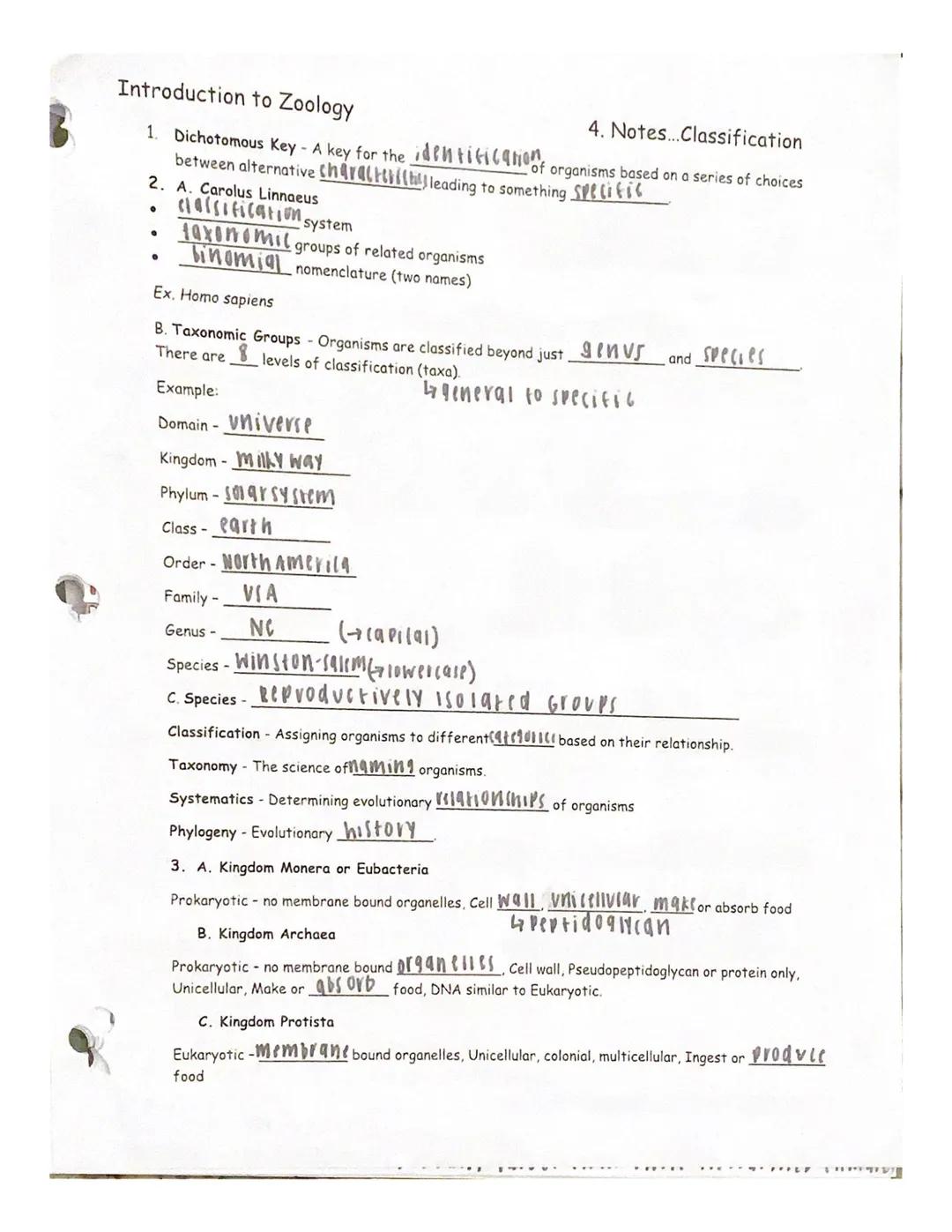
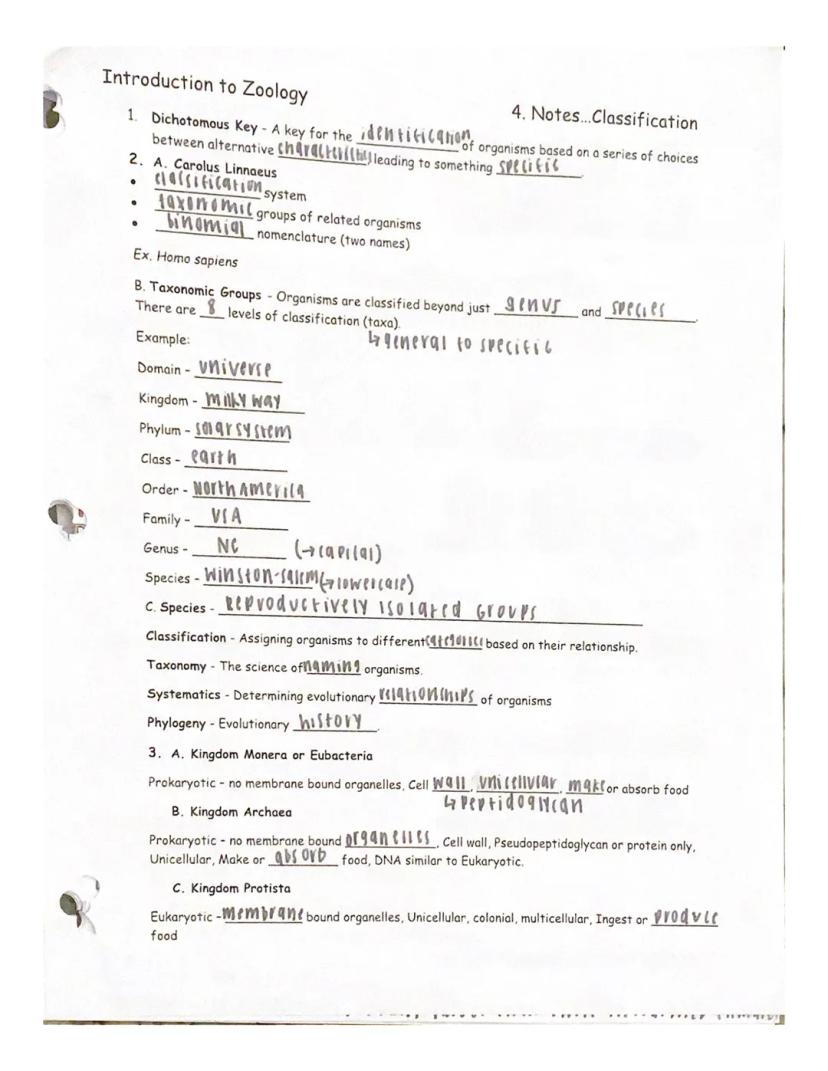
Identifying organisms starts with tools like a dichotomous key - a series of either/or choices that lead to a specific identification. The modern classification system was developed by Carolus Linnaeus, who created a hierarchy of taxonomic groups and introduced binomial nomenclature - the two-name system we use today (like Homo sapiens for humans).
The taxonomic hierarchy organizes life from broad to specific categories: Domain, Kingdom, Phylum, Class, Order, Family, Genus, and Species. Think of it as an address system for organisms, getting more specific with each level. A species represents a reproductively isolated group of organisms.
Scientists classify life into six kingdoms. Prokaryotic kingdoms include Monera/Eubacteria and Archaea - single-celled organisms without membrane-bound organelles. The four eukaryotic kingdoms are Protista , Fungi (with chitin cell walls), Plantae (multicellular photosynthesizers with cellulose cell walls), and Animalia (multicellular organisms that ingest food).
Classification connection: When scientists classify organisms, they're doing three related tasks: classification (assigning organisms to groups), taxonomy (naming those groups), and systematics (determining evolutionary relationships). All three help us understand life's diversity!
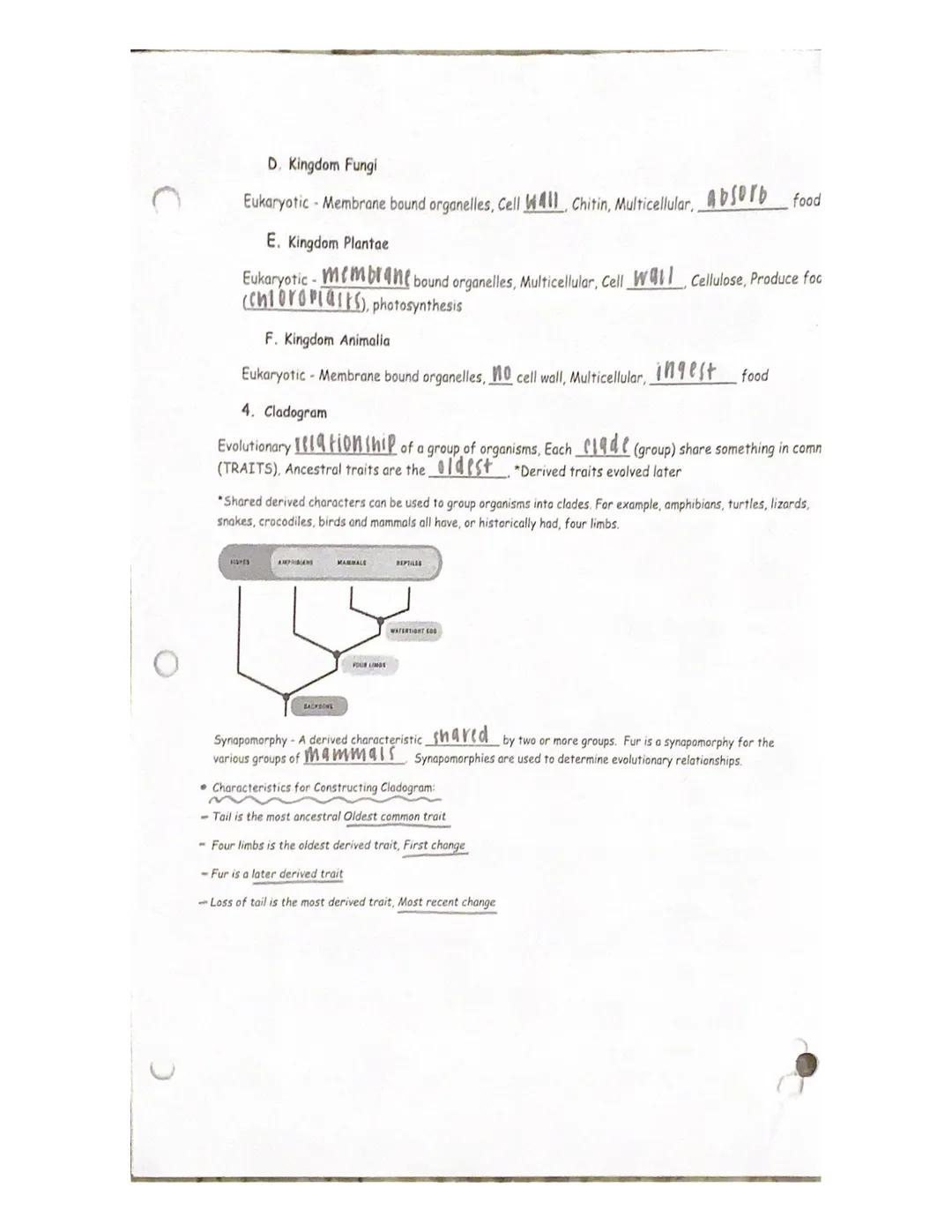
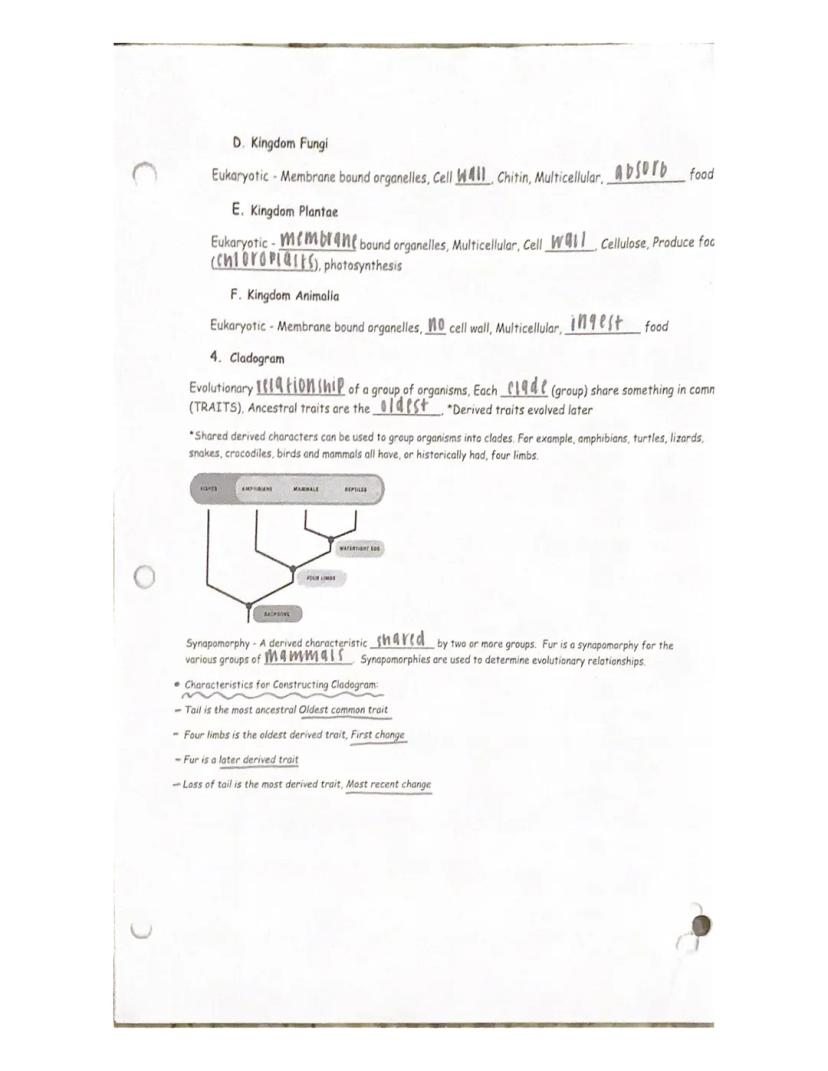
Cladograms are branching diagrams that show evolutionary relationships between organisms. Each branch point, or clade, represents organisms sharing common traits. These shared characteristics help scientists determine how closely related different species are to each other.
When analyzing a cladogram, ancestral traits are the oldest features shared by all members of a group, while derived traits evolved later and are found only in certain subgroups. For example, the presence of four limbs is a trait shared by amphibians, reptiles, and mammals, indicating a common ancestor.
A synapomorphy is a specialized term for a derived characteristic shared by two or more groups. For instance, fur is a synapomorphy for mammals. When constructing cladograms, scientists look at traits from oldest (most ancestral) to newest (most derived) to establish evolutionary timelines and relationships.
Cladogram tip: When reading a cladogram, remember that each branching point represents an evolutionary innovation! The tail might be the oldest trait, followed by four limbs, then fur, and finally the loss of a tail—showing a progression of adaptations over evolutionary time.
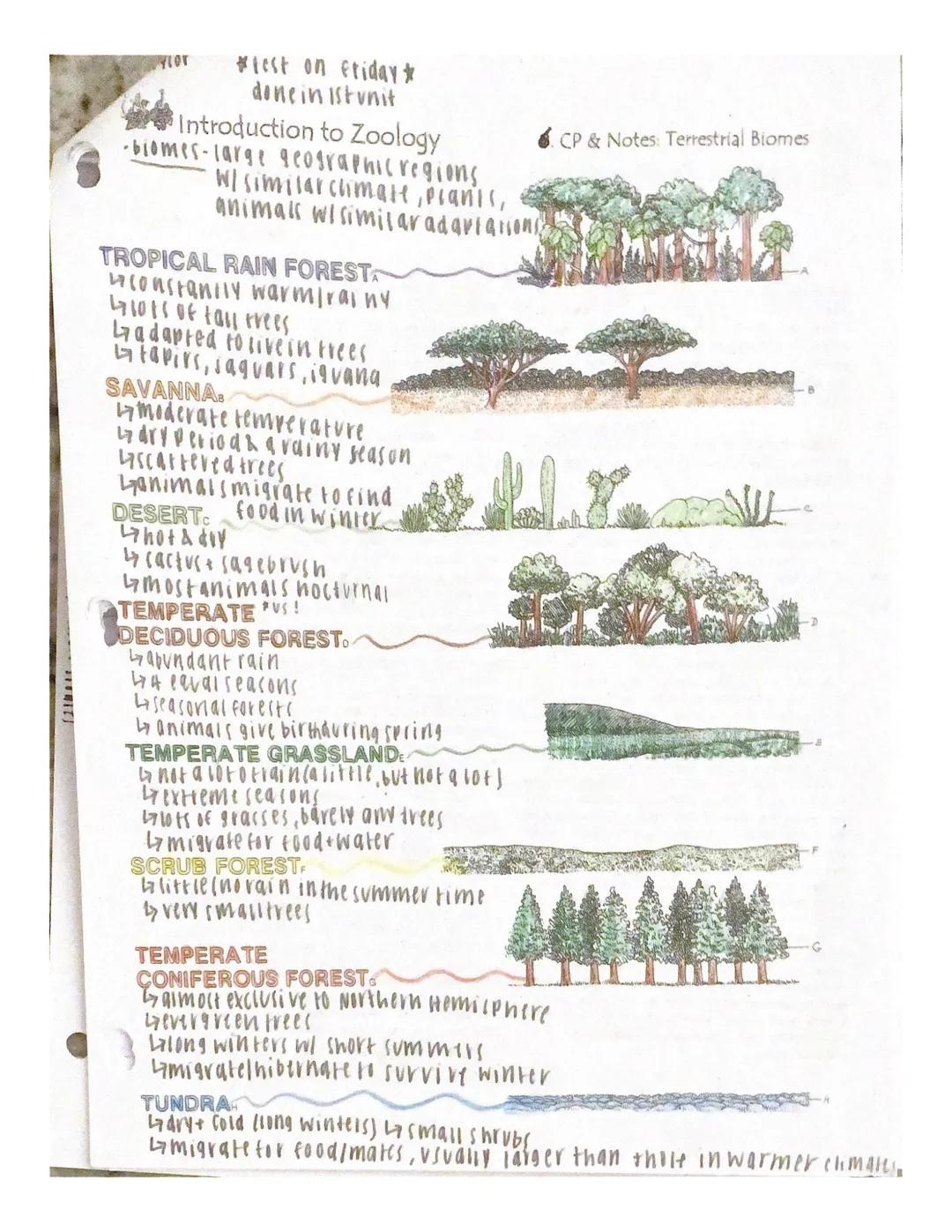
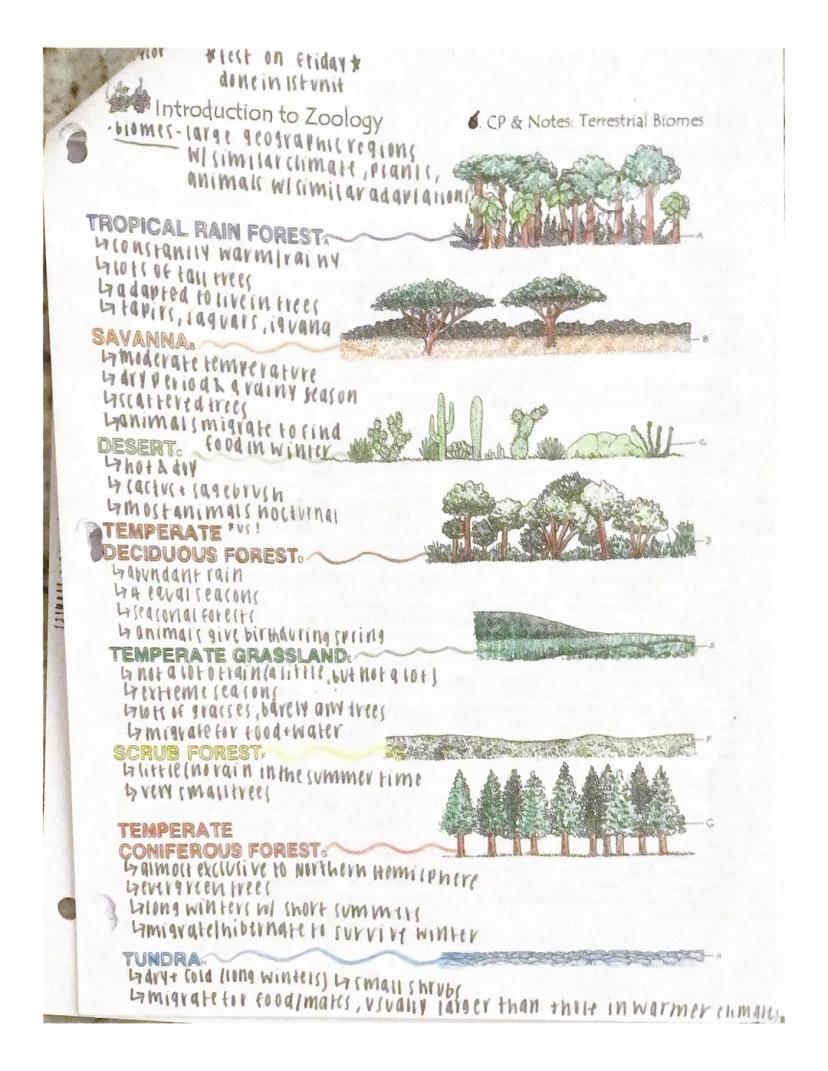
Biomes are large geographic regions with similar climate, plants, and animals that have adapted to those conditions. The tropical rainforest remains constantly warm and rainy, supporting tall trees and animals adapted to arboreal life like tapirs, jaguars, and iguanas.
The savanna experiences moderate temperatures with alternating rainy and dry seasons, featuring scattered trees and animals that migrate seasonally for food. In stark contrast, deserts are hot and dry with specialized plants like cacti and often nocturnal animals that avoid daytime heat.
North America features several distinct biomes. The temperate deciduous forest receives abundant rain with four defined seasons, where animals typically give birth in spring. The temperate grassland has extreme seasonal temperature variations with few trees, while the temperate coniferous forest is dominated by evergreen trees and animals that migrate or hibernate to survive long winters. The northernmost tundra biome remains dry and cold with small shrubs and typically larger animals that have adapted to the harsh climate.
Biome adaptation: Did you know animals in colder biomes are often larger than their relatives in warmer regions? This is Bergmann's rule – larger bodies retain heat better, which is crucial for survival in frigid environments like the tundra!
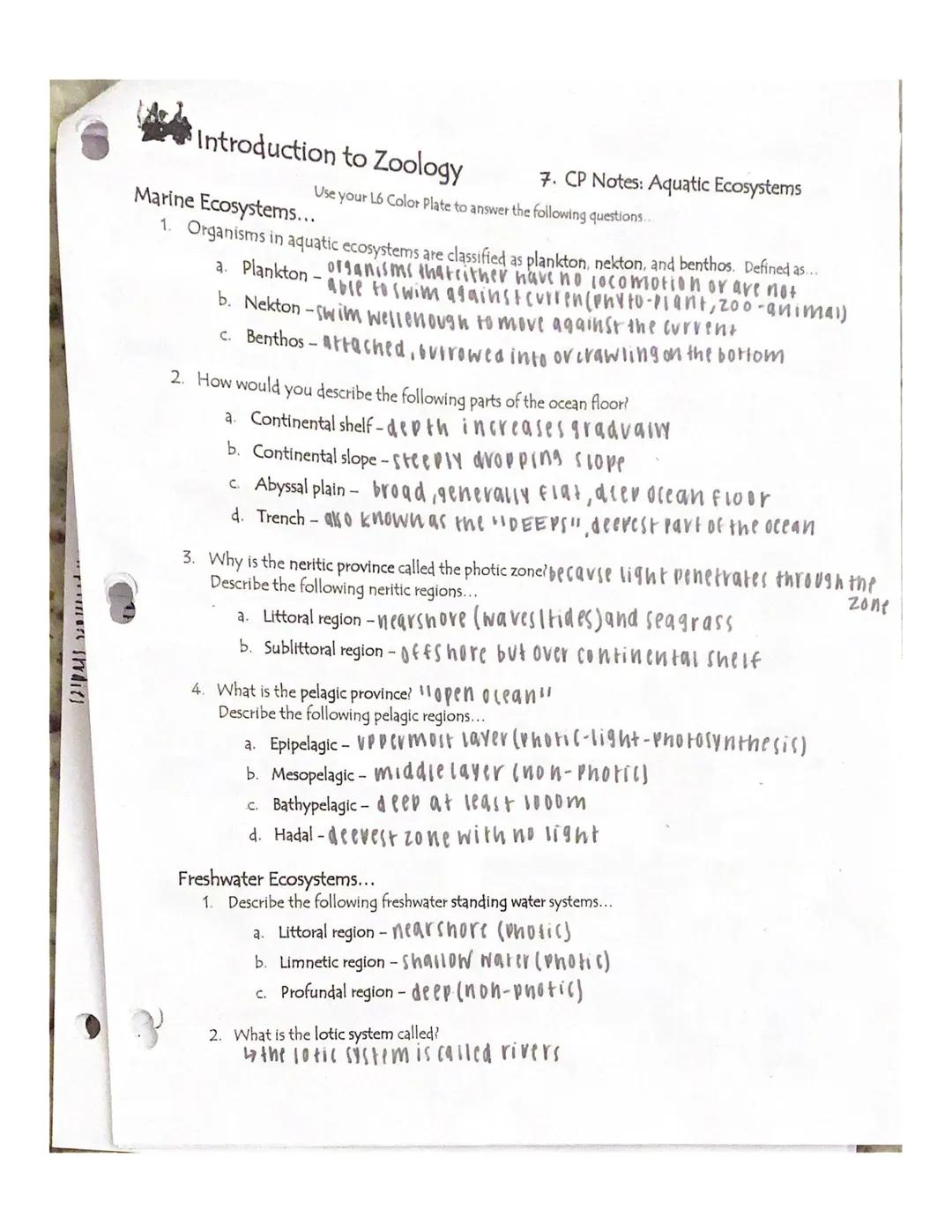
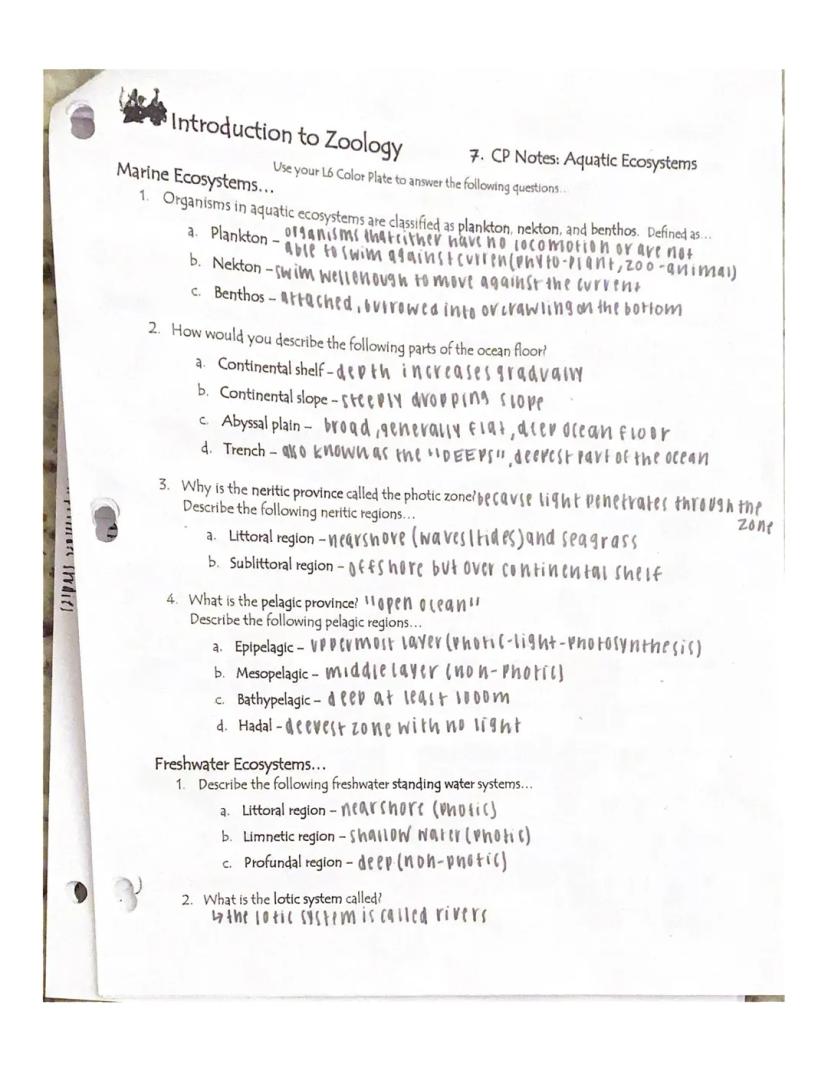
Aquatic organisms are classified into three main groups based on their mobility. Plankton either lack locomotion or can't swim against currents . Nekton can swim well enough to move against currents, while benthos are attached to, burrowed into, or crawling on the bottom.
The ocean floor has distinct regions: the gently sloping continental shelf near shore, the steeply dropping continental slope, the broad and flat abyssal plain, and the deepest trenches. The ocean divides into provinces based on light penetration and distance from shore.
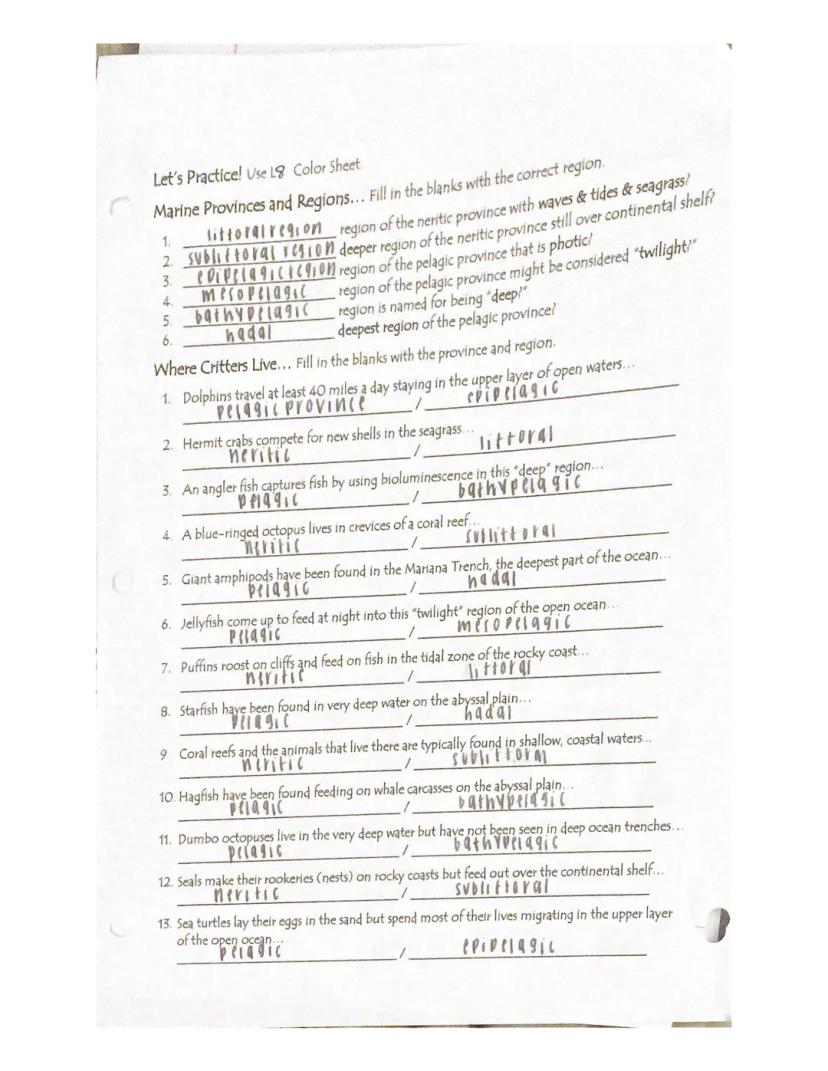
The neritic province (coastal waters) includes the littoral region (influenced by waves and tides) and the sublittoral region (offshore but still over the continental shelf). The pelagic province (open ocean) has layers based on depth: the light-filled epipelagic, the twilight mesopelagic, the dark bathypelagic, and the deepest hadal regions.
Ocean zones simplified: Think of the ocean as layers in a cake! The top layer gets sunlight (epipelagic), the middle gets some light (mesopelagic), the deeper layer is dark (bathypelagic), and the deepest trenches (hadal) are like the bottom of the pan – completely dark and under extreme pressure.
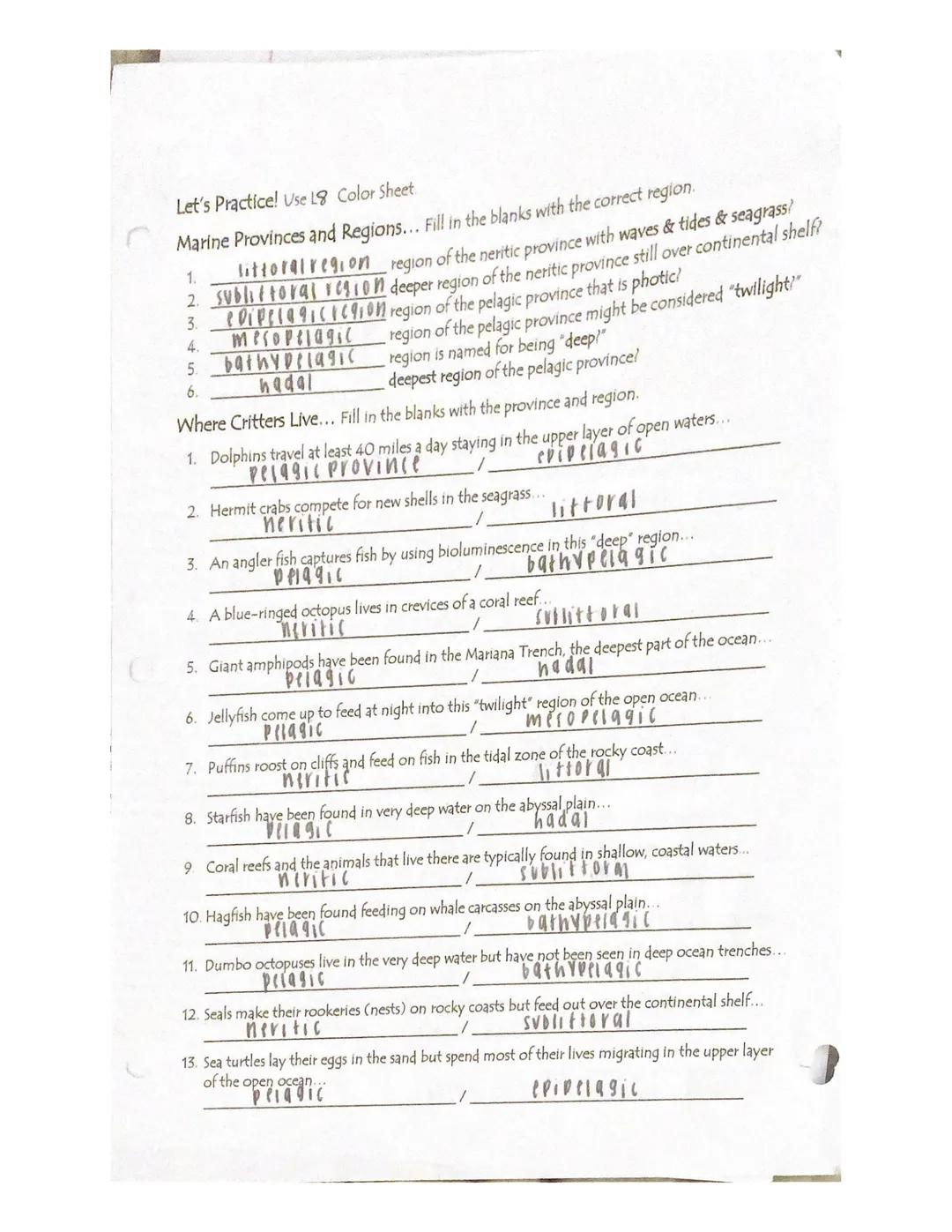
Marine ecosystems are organized by depth and distance from shore. The neritic province includes coastal waters with the littoral region (with waves, tides, and seagrass) and the sublittoral region (deeper water still over the continental shelf). The pelagic province covers the open ocean with distinct depth zones: the sunlit epipelagic, twilight mesopelagic, deep bathypelagic, and trench-level hadal regions.
Different marine creatures have adapted to specific ocean zones. Dolphins typically travel in the upper epipelagic zone, while bizarre creatures like anglerfish use bioluminescence to hunt in the dark bathypelagic zone. Coral reefs thrive in the sublittoral region, while specialized animals like the Dumbo octopus have adapted to extreme deep-water conditions.
Freshwater ecosystems include standing water (lentic systems) like lakes and flowing water (lotic systems) like rivers. Lentic systems have three main regions: the shore-adjacent littoral region, the shallow open-water limnetic region, and the deep, dark profundal region - each supporting different types of aquatic life.
Marine life distribution: Ever wonder why you'll never see a coral reef in the deep ocean? Light only penetrates the upper layers of water, and coral depends on photosynthetic algae that need sunlight. That's why reefs only exist in shallow, sunlit waters of the neritic province!
Our AI companion is specifically built for the needs of students. Based on the millions of content pieces we have on the platform we can provide truly meaningful and relevant answers to students. But its not only about answers, the companion is even more about guiding students through their daily learning challenges, with personalised study plans, quizzes or content pieces in the chat and 100% personalisation based on the students skills and developments.
You can download the app in the Google Play Store and in the Apple App Store.
That's right! Enjoy free access to study content, connect with fellow students, and get instant help – all at your fingertips.
App Store
Google Play
The app is very easy to use and well designed. I have found everything I was looking for so far and have been able to learn a lot from the presentations! I will definitely use the app for a class assignment! And of course it also helps a lot as an inspiration.
Stefan S
iOS user
This app is really great. There are so many study notes and help [...]. My problem subject is French, for example, and the app has so many options for help. Thanks to this app, I have improved my French. I would recommend it to anyone.
Samantha Klich
Android user
Wow, I am really amazed. I just tried the app because I've seen it advertised many times and was absolutely stunned. This app is THE HELP you want for school and above all, it offers so many things, such as workouts and fact sheets, which have been VERY helpful to me personally.
Anna
iOS user
I think it’s very much worth it and you’ll end up using it a lot once you get the hang of it and even after looking at others notes you can still ask your Artificial intelligence buddy the question and ask to simplify it if you still don’t get it!!! In the end I think it’s worth it 😊👍 ⚠️Also DID I MENTION ITS FREEE YOU DON’T HAVE TO PAY FOR ANYTHING AND STILL GET YOUR GRADES IN PERFECTLY❗️❗️⚠️
Thomas R
iOS user
Knowunity is the BEST app I’ve used in a minute. This is not an ai review or anything this is genuinely coming from a 7th grade student (I know 2011 im young) but dude this app is a 10/10 i have maintained a 3.8 gpa and have plenty of time for gaming. I love it and my mom is just happy I got good grades
Brad T
Android user
Not only did it help me find the answer but it also showed me alternative ways to solve it. I was horrible in math and science but now I have an a in both subjects. Thanks for the help🤍🤍
David K
iOS user
The app's just great! All I have to do is enter the topic in the search bar and I get the response real fast. I don't have to watch 10 YouTube videos to understand something, so I'm saving my time. Highly recommended!
Sudenaz Ocak
Android user
In school I was really bad at maths but thanks to the app, I am doing better now. I am so grateful that you made the app.
Greenlight Bonnie
Android user
I found this app a couple years ago and it has only gotten better since then. I really love it because it can help with written questions and photo questions. Also, it can find study guides that other people have made as well as flashcard sets and practice tests. The free version is also amazing for students who might not be able to afford it. Would 100% recommend
Aubrey
iOS user
Best app if you're in Highschool or Junior high. I have been using this app for 2 school years and it's the best, it's good if you don't have anyone to help you with school work.😋🩷🎀
Marco B
iOS user
THE QUIZES AND FLASHCARDS ARE SO USEFUL AND I LOVE Knowunity AI. IT ALSO IS LITREALLY LIKE CHATGPT BUT SMARTER!! HELPED ME WITH MY MASCARA PROBLEMS TOO!! AS WELL AS MY REAL SUBJECTS ! DUHHH 😍😁😲🤑💗✨🎀😮
Elisha
iOS user
This app is phenomenal down to the correct info and the various topics you can study! I greatly recommend it for people who struggle with procrastination and those who need homework help. It has been perfectly accurate for world 1 history as far as I’ve seen! Geometry too!
Paul T
iOS user
The app is very easy to use and well designed. I have found everything I was looking for so far and have been able to learn a lot from the presentations! I will definitely use the app for a class assignment! And of course it also helps a lot as an inspiration.
Stefan S
iOS user
This app is really great. There are so many study notes and help [...]. My problem subject is French, for example, and the app has so many options for help. Thanks to this app, I have improved my French. I would recommend it to anyone.
Samantha Klich
Android user
Wow, I am really amazed. I just tried the app because I've seen it advertised many times and was absolutely stunned. This app is THE HELP you want for school and above all, it offers so many things, such as workouts and fact sheets, which have been VERY helpful to me personally.
Anna
iOS user
I think it’s very much worth it and you’ll end up using it a lot once you get the hang of it and even after looking at others notes you can still ask your Artificial intelligence buddy the question and ask to simplify it if you still don’t get it!!! In the end I think it’s worth it 😊👍 ⚠️Also DID I MENTION ITS FREEE YOU DON’T HAVE TO PAY FOR ANYTHING AND STILL GET YOUR GRADES IN PERFECTLY❗️❗️⚠️
Thomas R
iOS user
Knowunity is the BEST app I’ve used in a minute. This is not an ai review or anything this is genuinely coming from a 7th grade student (I know 2011 im young) but dude this app is a 10/10 i have maintained a 3.8 gpa and have plenty of time for gaming. I love it and my mom is just happy I got good grades
Brad T
Android user
Not only did it help me find the answer but it also showed me alternative ways to solve it. I was horrible in math and science but now I have an a in both subjects. Thanks for the help🤍🤍
David K
iOS user
The app's just great! All I have to do is enter the topic in the search bar and I get the response real fast. I don't have to watch 10 YouTube videos to understand something, so I'm saving my time. Highly recommended!
Sudenaz Ocak
Android user
In school I was really bad at maths but thanks to the app, I am doing better now. I am so grateful that you made the app.
Greenlight Bonnie
Android user
I found this app a couple years ago and it has only gotten better since then. I really love it because it can help with written questions and photo questions. Also, it can find study guides that other people have made as well as flashcard sets and practice tests. The free version is also amazing for students who might not be able to afford it. Would 100% recommend
Aubrey
iOS user
Best app if you're in Highschool or Junior high. I have been using this app for 2 school years and it's the best, it's good if you don't have anyone to help you with school work.😋🩷🎀
Marco B
iOS user
THE QUIZES AND FLASHCARDS ARE SO USEFUL AND I LOVE Knowunity AI. IT ALSO IS LITREALLY LIKE CHATGPT BUT SMARTER!! HELPED ME WITH MY MASCARA PROBLEMS TOO!! AS WELL AS MY REAL SUBJECTS ! DUHHH 😍😁😲🤑💗✨🎀😮
Elisha
iOS user
This app is phenomenal down to the correct info and the various topics you can study! I greatly recommend it for people who struggle with procrastination and those who need homework help. It has been perfectly accurate for world 1 history as far as I’ve seen! Geometry too!
Paul T
iOS user
Grayson
@grayson_njhd
Ever wondered how zoos evolved from ancient animal collections to modern conservation centers? This introduction to zoology takes you on a journey through the history of zoos, important zoologists, animal classification, and diverse ecosystems. You'll learn about everything from animal... Show more
Access to all documents
Improve your grades
Join milions of students
Zoos have evolved dramatically from their ancient origins. The earliest animal collections date back to Egypt around 2500 BC when pharaohs maintained personal menageries. By 1500 BC, Egypt established the first documented public zoos, while other ancient civilizations like Babylon and China created their own collections.
The modern zoo serves four essential roles: recreation, education, conservation, and research. Unlike ancient collections that often existed purely for entertainment or status, today's zoos conduct vital research in areas like captive breeding, veterinary care, husbandry techniques, and behavioral studies.
One of the most important modern zoo initiatives is the Species Survival Plan. These plans help maintain genetically diverse and healthy animal populations in captivity, providing offspring for other zoos or potentially reintroducing animals to the wild.
Did you know? The Roman Empire used their animal collections for massive spectacles where thousands of animals were slaughtered for entertainment - a stark contrast to the conservation focus of modern zoos!
Access to all documents
Improve your grades
Join milions of students
Modern zoos play a crucial role in conservation through three main approaches. Ex-situ conservation happens within the zoo through captive breeding programs and seed banks for plants. Emergency room methods provide urgent care for threatened species. In contrast, in-situ conservation supports animals in their natural habitats.
The IUCN Red List uses specific classifications to indicate a species' status in the wild: EX (Extinct), EW (Extinct in the Wild), CR (Critically Endangered), EN (Endangered), VU (Vulnerable), NT (Near Threatened), and LC (Least Concern). These designations help zoos prioritize their conservation efforts.
Captive breeding involves breeding animals in controlled environments, like the successful program for the black-footed ferret. Reintroduction - returning these animals to the wild - happens less frequently due to habitat loss and animals lacking survival skills.
Fun fact: When you see "AZA" (Association of Zoos and Aquariums), you're looking at an organization that both accredits quality zoos and oversees Species Survival Plans throughout North America!
Access to all documents
Improve your grades
Join milions of students
The field of zoology has been shaped by brilliant scientists throughout history. Ancient thinkers like Aristotle made the first attempts at animal classification, while Carl Linnaeus (1707-1778) developed the standardized naming system we still use today. Charles Darwin revolutionized biology with his theory of evolution through natural selection.
A fascinating chapter in zoology history was the "Leakey's Angels" - three pioneering women primatologists: Dian Fossey (mountain gorillas), Jane Goodall (chimpanzees), and Biruté Galdikas (orangutans). All three conducted groundbreaking field studies under the direction of anthropologist Louis Leakey.
Modern zoologists have found new ways to connect the public with wildlife. Figures like Jack Hanna, Steve Irwin (the "Crocodile Hunter"), and David Attenborough have brought animal conservation into living rooms worldwide through engaging television programs and documentaries.
Think about it: Which zoologist do you find most inspiring? Aristotle laid the foundation for animal classification over 2,300 years ago, but modern scientists like Jane Goodall continue breaking new ground in how we understand animal behavior and intelligence.
Access to all documents
Improve your grades
Join milions of students
Animals are organized in increasingly complex levels, from tiny organelles (specialized structures within cells) up through cells, tissues, organs, organ systems, and finally the complete organism. This hierarchy extends beyond individual animals to populations, communities, ecosystems, and eventually the entire biosphere.
Body symmetry is a fundamental way to classify animals. Asymmetrical animals have no defined shape, while radial symmetry means parts radiate from a central point (like a starfish). Most animals, including humans, display bilateral symmetry with matching left and right sides. Bilateral animals have defined directions: dorsal (back), ventral (belly), anterior (head), and posterior (tail).
During early development, animal embryos form germ layers through a process called gastrulation. Ectoderm develops into skin and nerves, endoderm forms digestive structures, and mesoderm creates muscles and internal organs. Animals with true tissues (eumetazoans) may be diploblasts (two germ layers) or triploblasts (three germ layers).
Body cavity basics: The space between your digestive tract and body wall is a coelom. Animals are classified as acoelomates (no body cavity), pseudocoelomates (partial cavity), or coelomates (true body cavity) based on this internal structure!
Access to all documents
Improve your grades
Join milions of students
The way embryos develop helps scientists classify animals into major groups. Protostomes (including insects and mollusks) undergo spiral cell division and develop their mouth from the first embryonic opening. Deuterostomes (including humans and other chordates) show radial cell division and develop the anus from the first opening.
Animal groups differ in key physical features. Cephalization is the evolutionary trend of concentrating sensory organs at the head end of an animal. Digestive systems can be complete (with separate mouth and anus) or incomplete (with a single opening). A niche describes an organism's role in its ecosystem.
Chordates are animals defined by four key features: a notochord, dorsal hollow nerve cord, pharyngeal slits, and post-anal tail. This group divides into invertebrates (without backbones) and vertebrates (with backbones). Vertebrates have brains protected by skulls and segmented spinal columns.
Visualization tip: The evolutionary tree of animals resembles a branching path where each fork represents adaptations like segmentation, body cavities, or symmetry types. This helps you see relationships between seemingly different creatures like starfish and humans!
Access to all documents
Improve your grades
Join milions of students
Identifying organisms starts with tools like a dichotomous key - a series of either/or choices that lead to a specific identification. The modern classification system was developed by Carolus Linnaeus, who created a hierarchy of taxonomic groups and introduced binomial nomenclature - the two-name system we use today (like Homo sapiens for humans).
The taxonomic hierarchy organizes life from broad to specific categories: Domain, Kingdom, Phylum, Class, Order, Family, Genus, and Species. Think of it as an address system for organisms, getting more specific with each level. A species represents a reproductively isolated group of organisms.
Scientists classify life into six kingdoms. Prokaryotic kingdoms include Monera/Eubacteria and Archaea - single-celled organisms without membrane-bound organelles. The four eukaryotic kingdoms are Protista , Fungi (with chitin cell walls), Plantae (multicellular photosynthesizers with cellulose cell walls), and Animalia (multicellular organisms that ingest food).
Classification connection: When scientists classify organisms, they're doing three related tasks: classification (assigning organisms to groups), taxonomy (naming those groups), and systematics (determining evolutionary relationships). All three help us understand life's diversity!
Access to all documents
Improve your grades
Join milions of students
Cladograms are branching diagrams that show evolutionary relationships between organisms. Each branch point, or clade, represents organisms sharing common traits. These shared characteristics help scientists determine how closely related different species are to each other.
When analyzing a cladogram, ancestral traits are the oldest features shared by all members of a group, while derived traits evolved later and are found only in certain subgroups. For example, the presence of four limbs is a trait shared by amphibians, reptiles, and mammals, indicating a common ancestor.
A synapomorphy is a specialized term for a derived characteristic shared by two or more groups. For instance, fur is a synapomorphy for mammals. When constructing cladograms, scientists look at traits from oldest (most ancestral) to newest (most derived) to establish evolutionary timelines and relationships.
Cladogram tip: When reading a cladogram, remember that each branching point represents an evolutionary innovation! The tail might be the oldest trait, followed by four limbs, then fur, and finally the loss of a tail—showing a progression of adaptations over evolutionary time.
Access to all documents
Improve your grades
Join milions of students
Biomes are large geographic regions with similar climate, plants, and animals that have adapted to those conditions. The tropical rainforest remains constantly warm and rainy, supporting tall trees and animals adapted to arboreal life like tapirs, jaguars, and iguanas.
The savanna experiences moderate temperatures with alternating rainy and dry seasons, featuring scattered trees and animals that migrate seasonally for food. In stark contrast, deserts are hot and dry with specialized plants like cacti and often nocturnal animals that avoid daytime heat.
North America features several distinct biomes. The temperate deciduous forest receives abundant rain with four defined seasons, where animals typically give birth in spring. The temperate grassland has extreme seasonal temperature variations with few trees, while the temperate coniferous forest is dominated by evergreen trees and animals that migrate or hibernate to survive long winters. The northernmost tundra biome remains dry and cold with small shrubs and typically larger animals that have adapted to the harsh climate.
Biome adaptation: Did you know animals in colder biomes are often larger than their relatives in warmer regions? This is Bergmann's rule – larger bodies retain heat better, which is crucial for survival in frigid environments like the tundra!
Access to all documents
Improve your grades
Join milions of students
Aquatic organisms are classified into three main groups based on their mobility. Plankton either lack locomotion or can't swim against currents . Nekton can swim well enough to move against currents, while benthos are attached to, burrowed into, or crawling on the bottom.
The ocean floor has distinct regions: the gently sloping continental shelf near shore, the steeply dropping continental slope, the broad and flat abyssal plain, and the deepest trenches. The ocean divides into provinces based on light penetration and distance from shore.
The neritic province (coastal waters) includes the littoral region (influenced by waves and tides) and the sublittoral region (offshore but still over the continental shelf). The pelagic province (open ocean) has layers based on depth: the light-filled epipelagic, the twilight mesopelagic, the dark bathypelagic, and the deepest hadal regions.
Ocean zones simplified: Think of the ocean as layers in a cake! The top layer gets sunlight (epipelagic), the middle gets some light (mesopelagic), the deeper layer is dark (bathypelagic), and the deepest trenches (hadal) are like the bottom of the pan – completely dark and under extreme pressure.
Access to all documents
Improve your grades
Join milions of students
Marine ecosystems are organized by depth and distance from shore. The neritic province includes coastal waters with the littoral region (with waves, tides, and seagrass) and the sublittoral region (deeper water still over the continental shelf). The pelagic province covers the open ocean with distinct depth zones: the sunlit epipelagic, twilight mesopelagic, deep bathypelagic, and trench-level hadal regions.
Different marine creatures have adapted to specific ocean zones. Dolphins typically travel in the upper epipelagic zone, while bizarre creatures like anglerfish use bioluminescence to hunt in the dark bathypelagic zone. Coral reefs thrive in the sublittoral region, while specialized animals like the Dumbo octopus have adapted to extreme deep-water conditions.
Freshwater ecosystems include standing water (lentic systems) like lakes and flowing water (lotic systems) like rivers. Lentic systems have three main regions: the shore-adjacent littoral region, the shallow open-water limnetic region, and the deep, dark profundal region - each supporting different types of aquatic life.
Marine life distribution: Ever wonder why you'll never see a coral reef in the deep ocean? Light only penetrates the upper layers of water, and coral depends on photosynthetic algae that need sunlight. That's why reefs only exist in shallow, sunlit waters of the neritic province!
Our AI companion is specifically built for the needs of students. Based on the millions of content pieces we have on the platform we can provide truly meaningful and relevant answers to students. But its not only about answers, the companion is even more about guiding students through their daily learning challenges, with personalised study plans, quizzes or content pieces in the chat and 100% personalisation based on the students skills and developments.
You can download the app in the Google Play Store and in the Apple App Store.
That's right! Enjoy free access to study content, connect with fellow students, and get instant help – all at your fingertips.
3
Smart Tools NEW
Transform this note into: ✓ 50+ Practice Questions ✓ Interactive Flashcards ✓ Full Practice Test ✓ Essay Outlines
Explore the types of energy resources, including renewable and non-renewable sources, their environmental impacts, and applications in transport and heating. This summary covers key concepts such as fossil fuels, biofuels, and sustainable energy solutions, providing a comprehensive understanding for students studying energy resources.
 Physics
Explore key concepts in physics related to energy, power, and electricity. This resource covers topics such as energy transfer, Ohm's Law, radioactivity, and thermal energy, providing a comprehensive overview for GCSE Triple Science revision. Ideal for students preparing for exams, this summary includes essential equations and principles to enhance understanding.
PhysicsExplore the principles of electricity, including potential difference, resistance, and current flow in series and parallel circuits. This summary covers key concepts such as Ohm's law, the behavior of filament lamps, and the role of various circuit components. Ideal for students preparing for assessments in physics.
Physicsmomentum, impulse, conservation of momentum
PhysicsExplore key concepts of energy resources, including renewable and non-renewable types, their uses, and environmental impacts. This summary covers essential terms like fossil fuels, biofuels, and nuclear energy, providing insights into energy generation methods and their implications for climate change.
PhysicsExplore the key concepts of energy conservation and dissipation, including power, efficiency, and the relationship between force and extension in elastic materials. This summary covers essential terms and principles relevant to energy transfers in electrical appliances and the limitations of proportionality in force-extension graphs.
PhysicsApp Store
Google Play
The app is very easy to use and well designed. I have found everything I was looking for so far and have been able to learn a lot from the presentations! I will definitely use the app for a class assignment! And of course it also helps a lot as an inspiration.
Stefan S
iOS user
This app is really great. There are so many study notes and help [...]. My problem subject is French, for example, and the app has so many options for help. Thanks to this app, I have improved my French. I would recommend it to anyone.
Samantha Klich
Android user
Wow, I am really amazed. I just tried the app because I've seen it advertised many times and was absolutely stunned. This app is THE HELP you want for school and above all, it offers so many things, such as workouts and fact sheets, which have been VERY helpful to me personally.
Anna
iOS user
I think it’s very much worth it and you’ll end up using it a lot once you get the hang of it and even after looking at others notes you can still ask your Artificial intelligence buddy the question and ask to simplify it if you still don’t get it!!! In the end I think it’s worth it 😊👍 ⚠️Also DID I MENTION ITS FREEE YOU DON’T HAVE TO PAY FOR ANYTHING AND STILL GET YOUR GRADES IN PERFECTLY❗️❗️⚠️
Thomas R
iOS user
Knowunity is the BEST app I’ve used in a minute. This is not an ai review or anything this is genuinely coming from a 7th grade student (I know 2011 im young) but dude this app is a 10/10 i have maintained a 3.8 gpa and have plenty of time for gaming. I love it and my mom is just happy I got good grades
Brad T
Android user
Not only did it help me find the answer but it also showed me alternative ways to solve it. I was horrible in math and science but now I have an a in both subjects. Thanks for the help🤍🤍
David K
iOS user
The app's just great! All I have to do is enter the topic in the search bar and I get the response real fast. I don't have to watch 10 YouTube videos to understand something, so I'm saving my time. Highly recommended!
Sudenaz Ocak
Android user
In school I was really bad at maths but thanks to the app, I am doing better now. I am so grateful that you made the app.
Greenlight Bonnie
Android user
I found this app a couple years ago and it has only gotten better since then. I really love it because it can help with written questions and photo questions. Also, it can find study guides that other people have made as well as flashcard sets and practice tests. The free version is also amazing for students who might not be able to afford it. Would 100% recommend
Aubrey
iOS user
Best app if you're in Highschool or Junior high. I have been using this app for 2 school years and it's the best, it's good if you don't have anyone to help you with school work.😋🩷🎀
Marco B
iOS user
THE QUIZES AND FLASHCARDS ARE SO USEFUL AND I LOVE Knowunity AI. IT ALSO IS LITREALLY LIKE CHATGPT BUT SMARTER!! HELPED ME WITH MY MASCARA PROBLEMS TOO!! AS WELL AS MY REAL SUBJECTS ! DUHHH 😍😁😲🤑💗✨🎀😮
Elisha
iOS user
This app is phenomenal down to the correct info and the various topics you can study! I greatly recommend it for people who struggle with procrastination and those who need homework help. It has been perfectly accurate for world 1 history as far as I’ve seen! Geometry too!
Paul T
iOS user
The app is very easy to use and well designed. I have found everything I was looking for so far and have been able to learn a lot from the presentations! I will definitely use the app for a class assignment! And of course it also helps a lot as an inspiration.
Stefan S
iOS user
This app is really great. There are so many study notes and help [...]. My problem subject is French, for example, and the app has so many options for help. Thanks to this app, I have improved my French. I would recommend it to anyone.
Samantha Klich
Android user
Wow, I am really amazed. I just tried the app because I've seen it advertised many times and was absolutely stunned. This app is THE HELP you want for school and above all, it offers so many things, such as workouts and fact sheets, which have been VERY helpful to me personally.
Anna
iOS user
I think it’s very much worth it and you’ll end up using it a lot once you get the hang of it and even after looking at others notes you can still ask your Artificial intelligence buddy the question and ask to simplify it if you still don’t get it!!! In the end I think it’s worth it 😊👍 ⚠️Also DID I MENTION ITS FREEE YOU DON’T HAVE TO PAY FOR ANYTHING AND STILL GET YOUR GRADES IN PERFECTLY❗️❗️⚠️
Thomas R
iOS user
Knowunity is the BEST app I’ve used in a minute. This is not an ai review or anything this is genuinely coming from a 7th grade student (I know 2011 im young) but dude this app is a 10/10 i have maintained a 3.8 gpa and have plenty of time for gaming. I love it and my mom is just happy I got good grades
Brad T
Android user
Not only did it help me find the answer but it also showed me alternative ways to solve it. I was horrible in math and science but now I have an a in both subjects. Thanks for the help🤍🤍
David K
iOS user
The app's just great! All I have to do is enter the topic in the search bar and I get the response real fast. I don't have to watch 10 YouTube videos to understand something, so I'm saving my time. Highly recommended!
Sudenaz Ocak
Android user
In school I was really bad at maths but thanks to the app, I am doing better now. I am so grateful that you made the app.
Greenlight Bonnie
Android user
I found this app a couple years ago and it has only gotten better since then. I really love it because it can help with written questions and photo questions. Also, it can find study guides that other people have made as well as flashcard sets and practice tests. The free version is also amazing for students who might not be able to afford it. Would 100% recommend
Aubrey
iOS user
Best app if you're in Highschool or Junior high. I have been using this app for 2 school years and it's the best, it's good if you don't have anyone to help you with school work.😋🩷🎀
Marco B
iOS user
THE QUIZES AND FLASHCARDS ARE SO USEFUL AND I LOVE Knowunity AI. IT ALSO IS LITREALLY LIKE CHATGPT BUT SMARTER!! HELPED ME WITH MY MASCARA PROBLEMS TOO!! AS WELL AS MY REAL SUBJECTS ! DUHHH 😍😁😲🤑💗✨🎀😮
Elisha
iOS user
This app is phenomenal down to the correct info and the various topics you can study! I greatly recommend it for people who struggle with procrastination and those who need homework help. It has been perfectly accurate for world 1 history as far as I’ve seen! Geometry too!
Paul T
iOS user