
Welcome to a quick tour through AP Modern World History's...
 Social Studies102 views·Updated Jun 22, 2026·9 pages
Comprehensive AP World History Notes: Global Conflicts Post-1900

Catalina Collazos@catalinacollazos9
1 / 9
1
of 9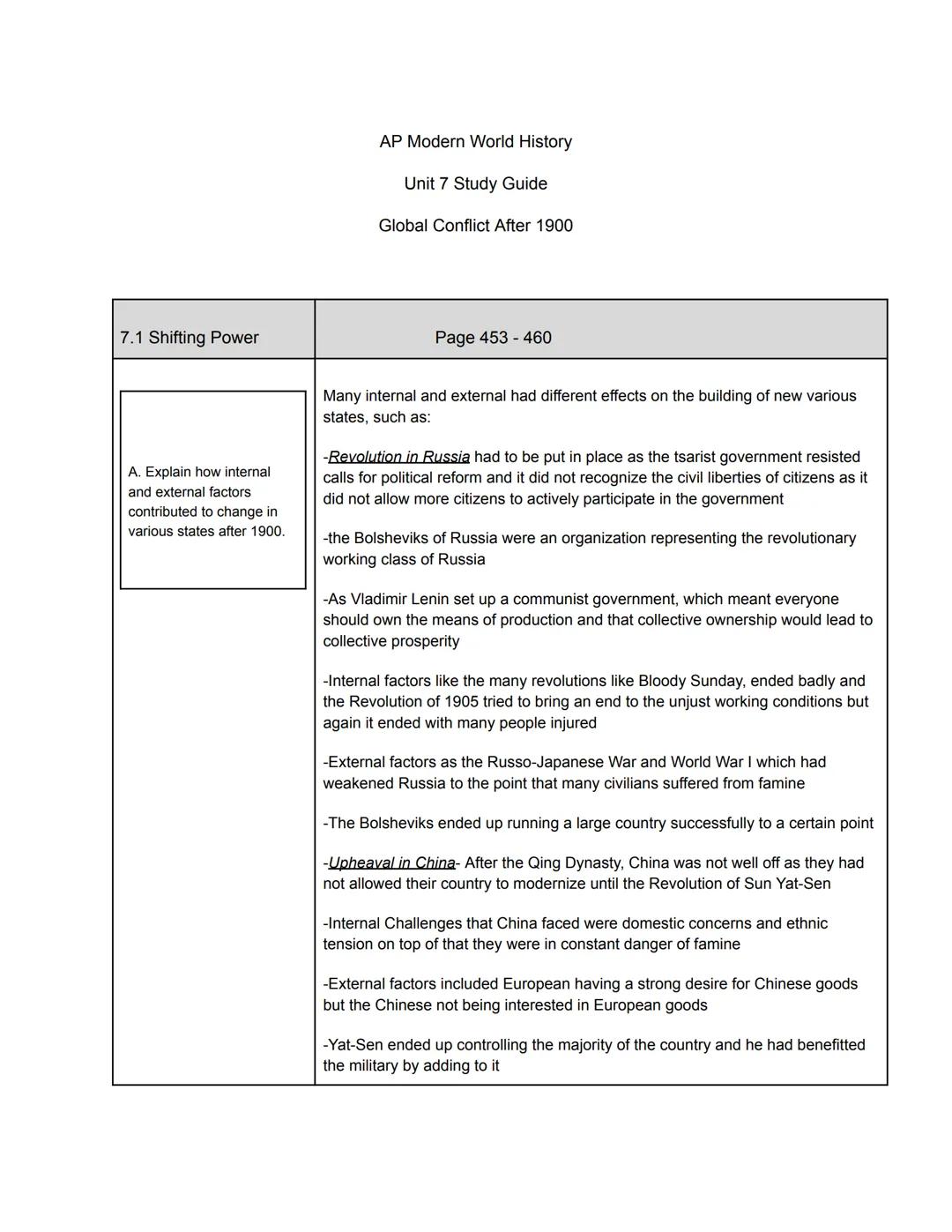
Shifting Power: Nations in Transition
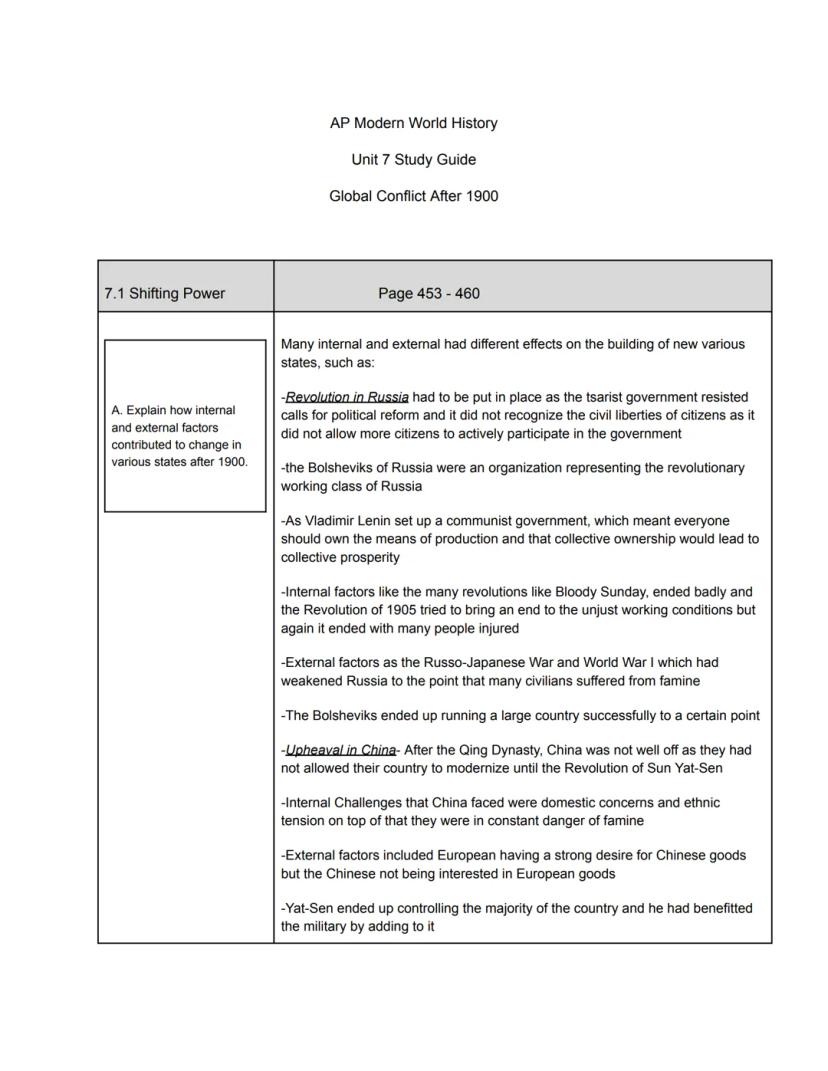
Ever wonder how countries completely changed their governments in the 1900s? After 1900, many nations underwent dramatic transformations due to both internal pressures and external forces.
In Russia, the tsarist government's resistance to political reform and denial of civil liberties sparked revolution. Internal factors like Bloody Sunday and the Revolution of 1905 showed growing discontent, while external pressures from the Russo-Japanese War and World War I weakened the country. Vladimir Lenin and the Bolsheviks ultimately established a communist government focused on collective ownership.
China faced similar upheaval after the Qing Dynasty fell. The country struggled with domestic concerns, ethnic tensions, and famine. Sun Yat-Sen led a revolution that helped China begin to modernize and strengthen its military presence.
Think About It: Revolutionary movements often occur when people feel they have no voice in their government. What conditions make revolution more likely in a society?
The Ottoman Empire collapsed due to a weak economy, leading to revolution by the Young Turks who promoted "Turkification." After supporting Germany in WWI (a fatal mistake), the empire was dismantled, eventually becoming modern Turkey under Mustafa Kemal. Meanwhile, Mexico transformed after dictator Porfirio Diaz was overthrown, creating a new constitution with goals to benefit average citizens.
2
of 9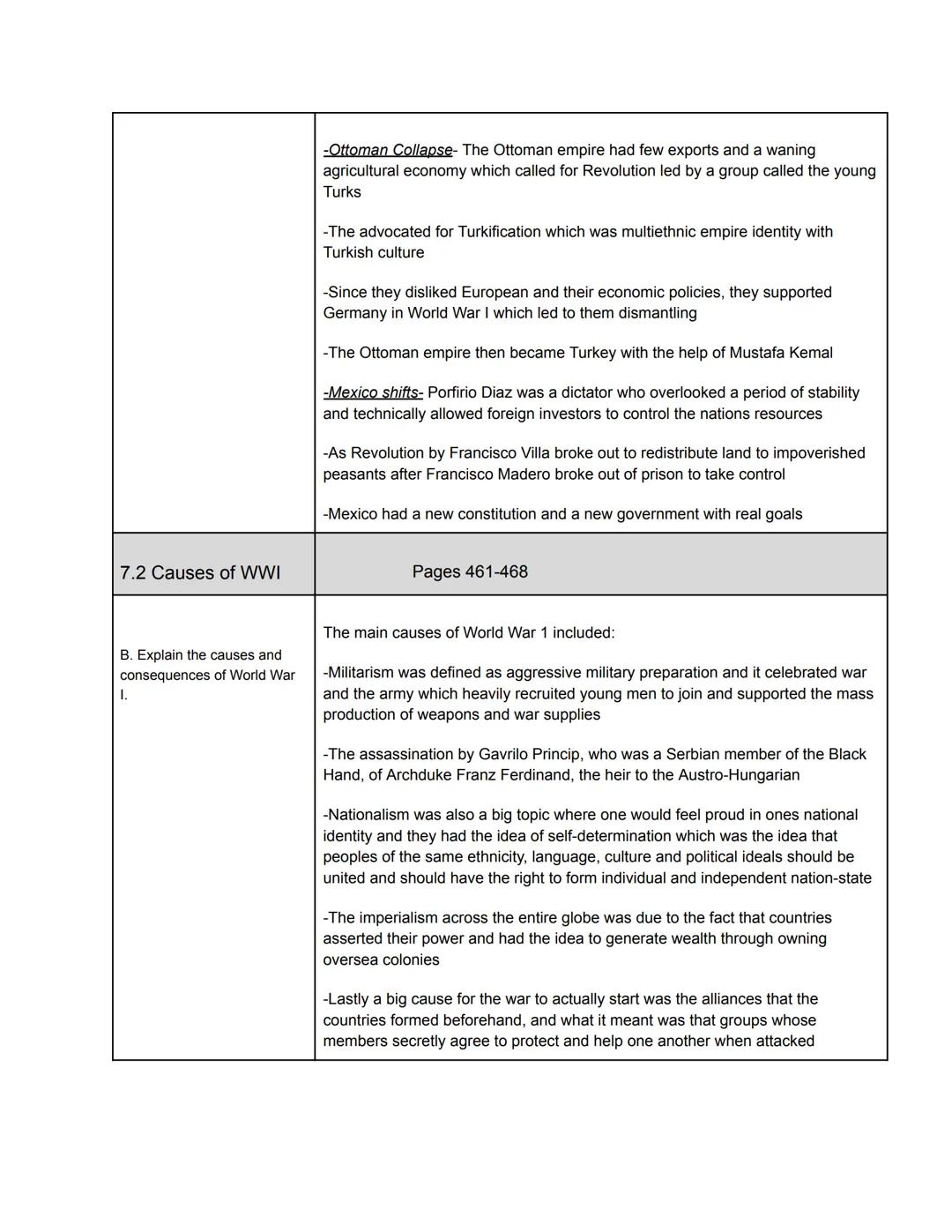
Causes of World War I
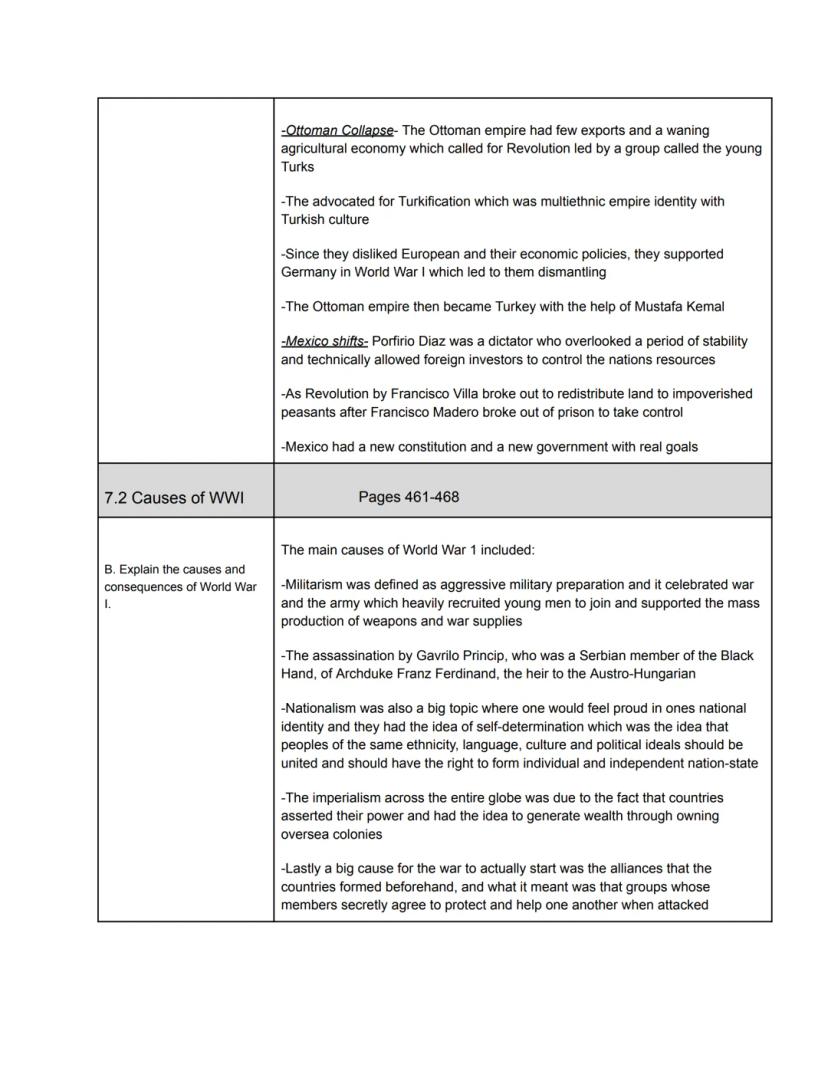
World War I didn't just happen overnight! Several major factors combined to create the perfect storm for global conflict.
Militarism played a huge role as countries aggressively built up their armies, glorified war, and mass-produced weapons. Young men were heavily recruited with promises of heroism and adventure. Meanwhile, nationalism - intense pride in one's national identity - fueled the idea that peoples of the same ethnicity, language and culture should form independent nation-states.
The spark that lit the powder keg was the assassination of Archduke Franz Ferdinand, heir to the Austro-Hungarian throne, by Gavrilo Princip, a Serbian member of the Black Hand organization. But this event alone wouldn't have caused a world war without other factors in place.
Important Connection: The secret alliances between countries meant that one conflict could quickly draw in multiple nations - like dominos falling!
Imperialism also contributed significantly as European powers competed for overseas colonies to assert their power and generate wealth. This global competition for territory created tensions that would eventually explode into warfare. The complex web of alliances meant that when one country was attacked, others were obligated to join the fight, rapidly escalating what might have been a regional conflict into a global one.
3
of 9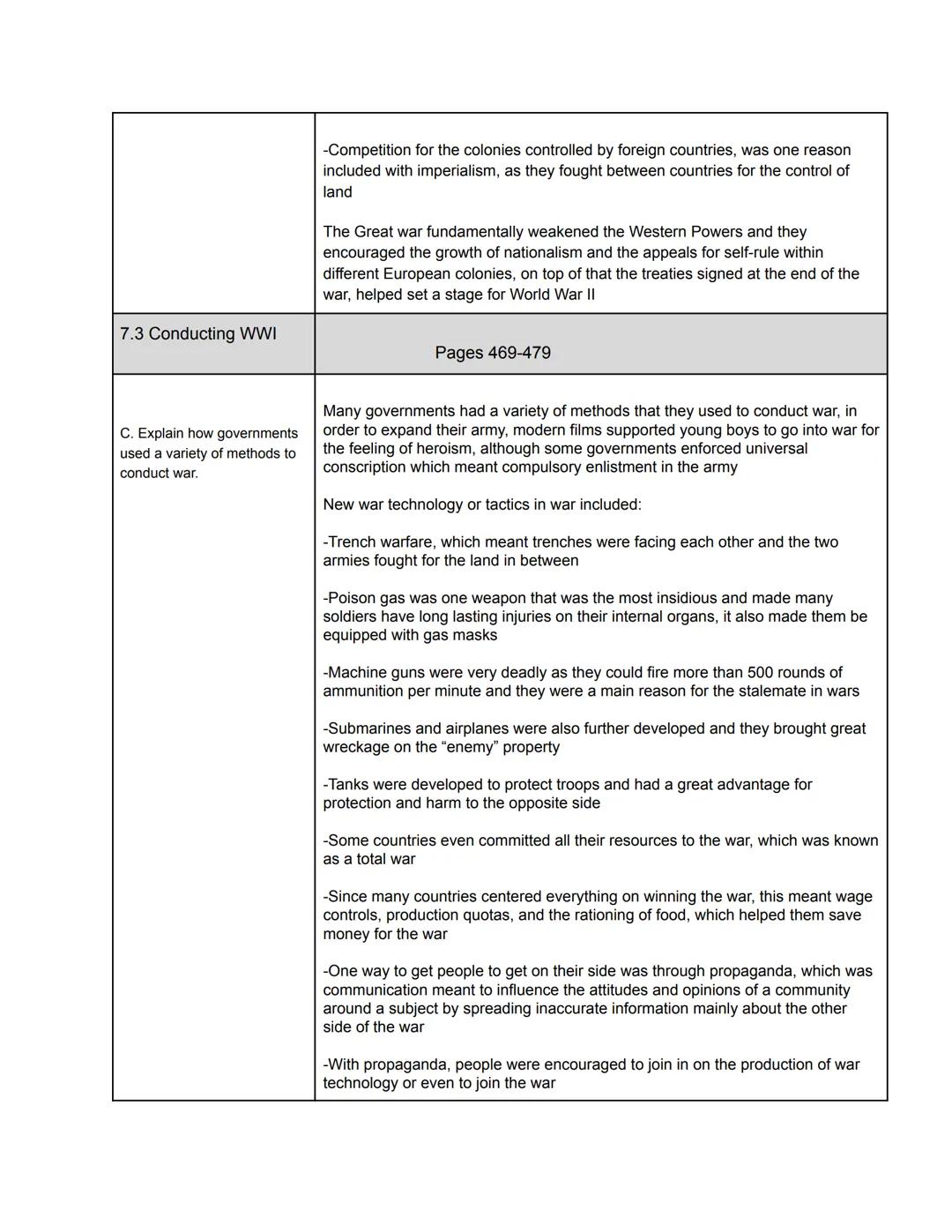
Conducting World War I
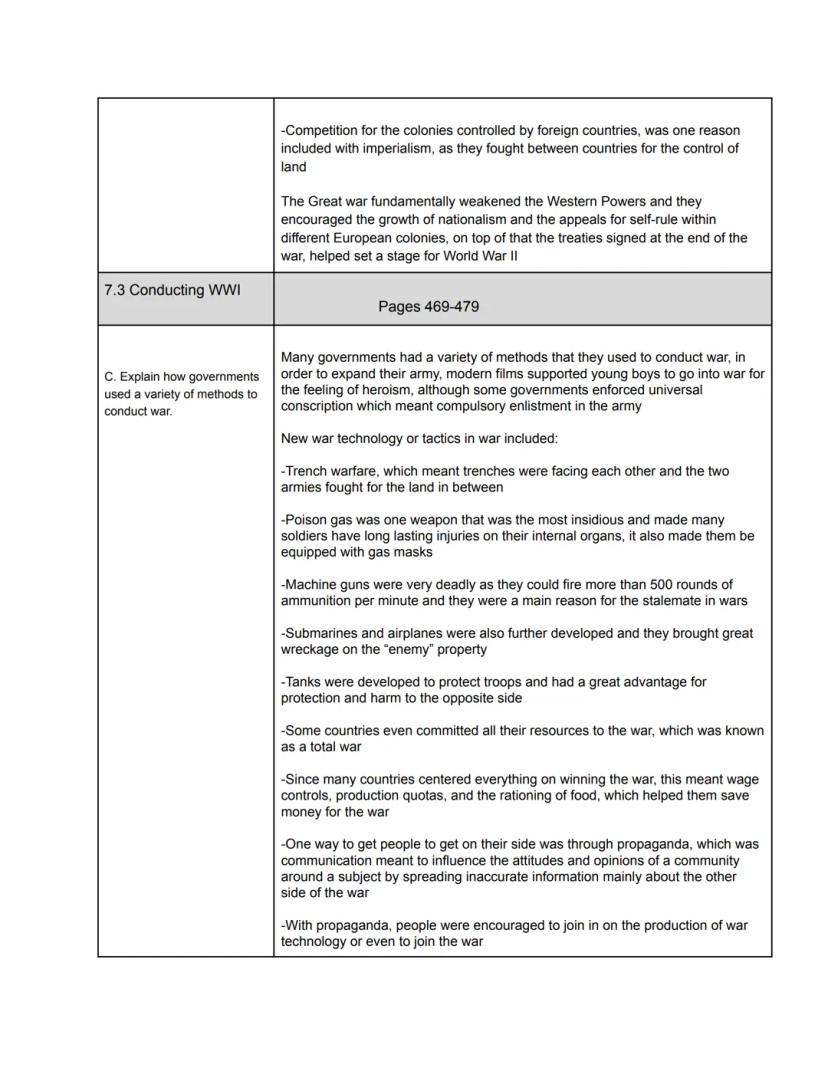
World War I completely changed how countries fight wars. Governments used several methods to build and maintain their war efforts.
Countries expanded their armies through both propaganda and universal conscription (forcing citizens to join the military). Films portrayed war as heroic to encourage young men to enlist. But the reality on the battlefield was far different thanks to deadly new technologies.
Trench warfare became the nightmare reality of WWI. Soldiers faced horrific conditions in opposing trenches while fighting for the land between them. New weapons made combat especially deadly: machine guns could fire 500+ rounds per minute, poison gas damaged internal organs, and submarines, airplanes, and tanks revolutionized battlefield tactics.
Did You Know? WWI was the first "total war" where countries devoted ALL their resources to the conflict - implementing wage controls, production quotas, and food rationing.
Governments also mastered the art of propaganda - communication designed to influence public opinion through often inaccurate information about the enemy. This propaganda encouraged citizens to support the war effort through production or enlistment. Colonial powers even extended the boundaries of the war by using their imperial territories for resources and troops, making this truly a "world" war.
4
of 9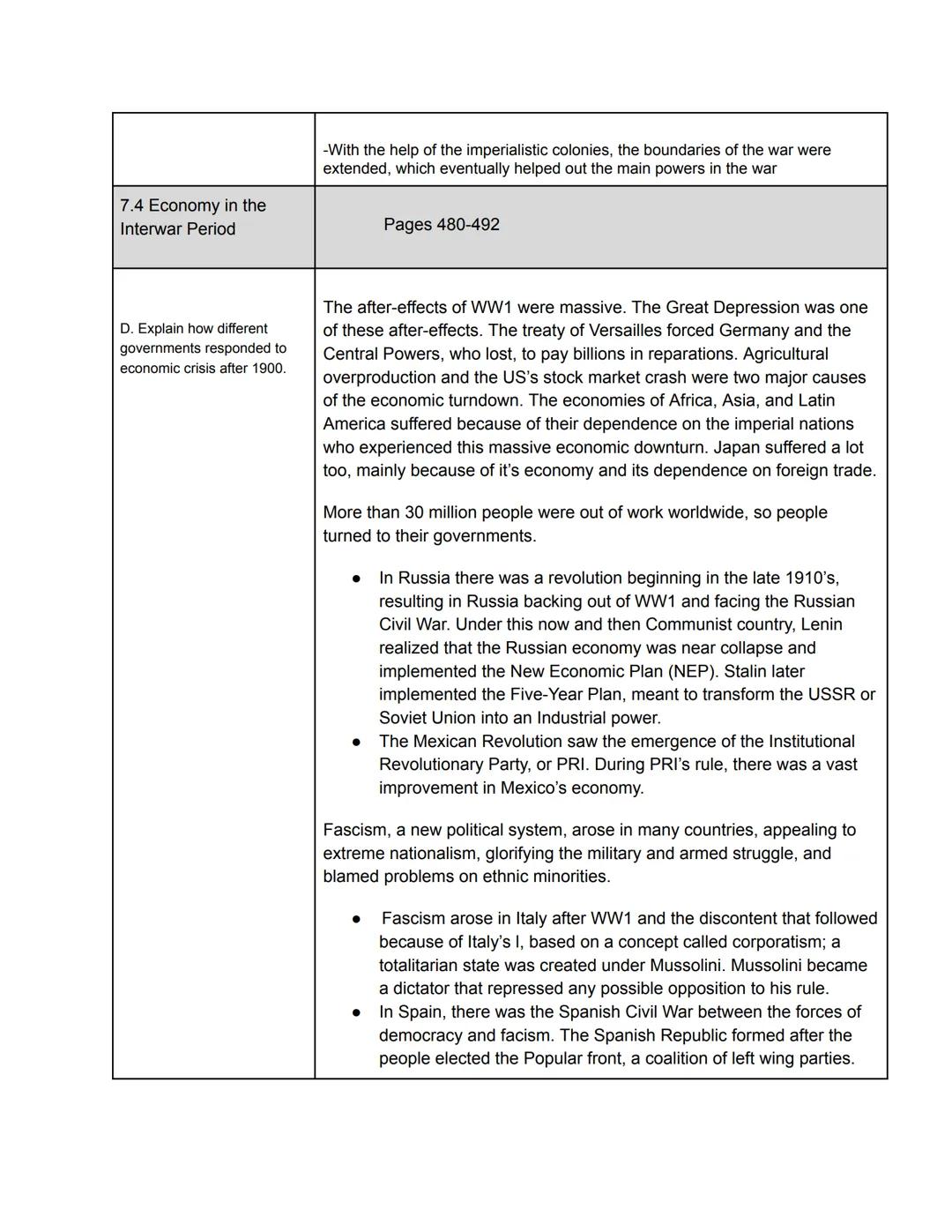
Economy in the Interwar Period
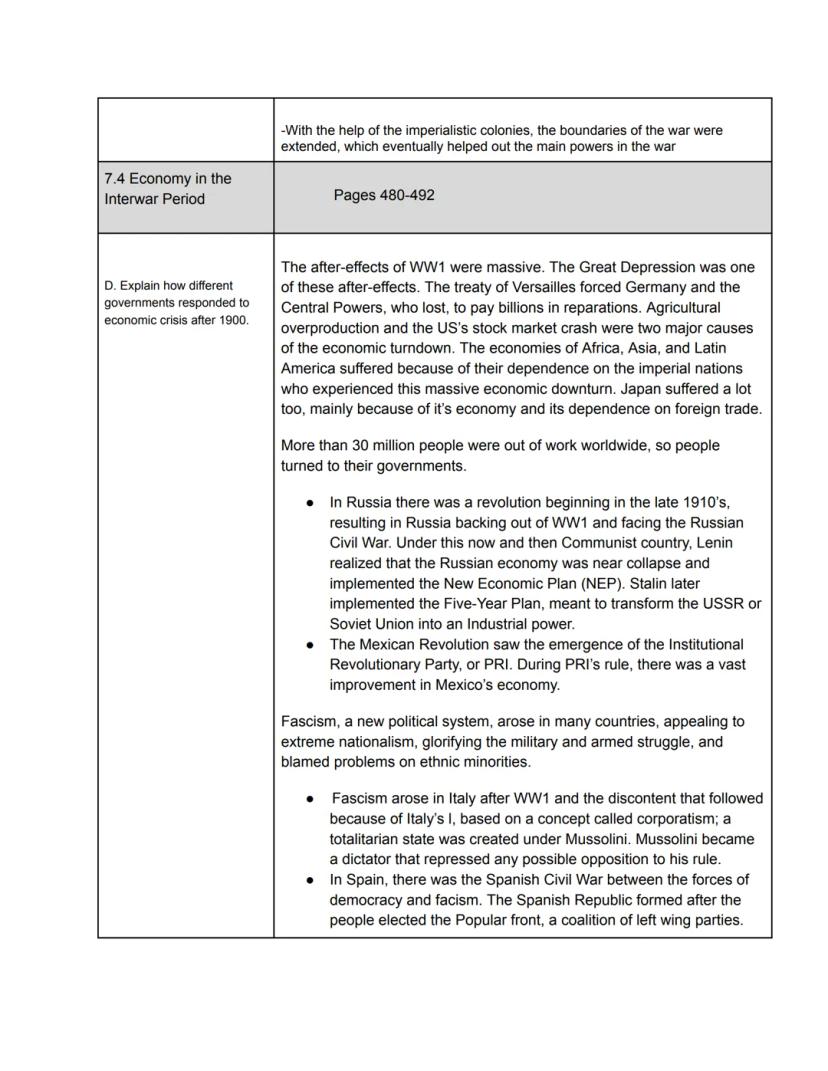
The aftermath of World War I left economies shattered and set the stage for global depression. The Treaty of Versailles forced Germany to pay billions in reparations, crippling its economy.
The Great Depression hit the world hard after the US stock market crash. Over 30 million people worldwide lost their jobs. Countries in Africa, Asia, and Latin America suffered terribly because they depended on trade with European nations. Even Japan's economy collapsed due to its reliance on foreign trade.
Different governments tried various approaches to fix their broken economies. In Russia, Lenin implemented the New Economic Plan (NEP) after the Russian Revolution and Civil War. Later, Stalin's Five-Year Plan aimed to transform the Soviet Union into an industrial powerhouse. Mexico saw economic improvement under the Institutional Revolutionary Party (PRI).
Critical Insight: Economic desperation often leads to extreme political movements!
The economic crisis created fertile ground for fascism - a political system based on extreme nationalism, military glorification, and blaming minorities for problems. Fascism rose in Italy under Mussolini, who created a totalitarian state based on "corporatism." In Spain, fascist forces led by Francisco Franco defeated democratic groups in the bloody Spanish Civil War. These economic and political shifts would soon lead to another global conflict.
5
of 9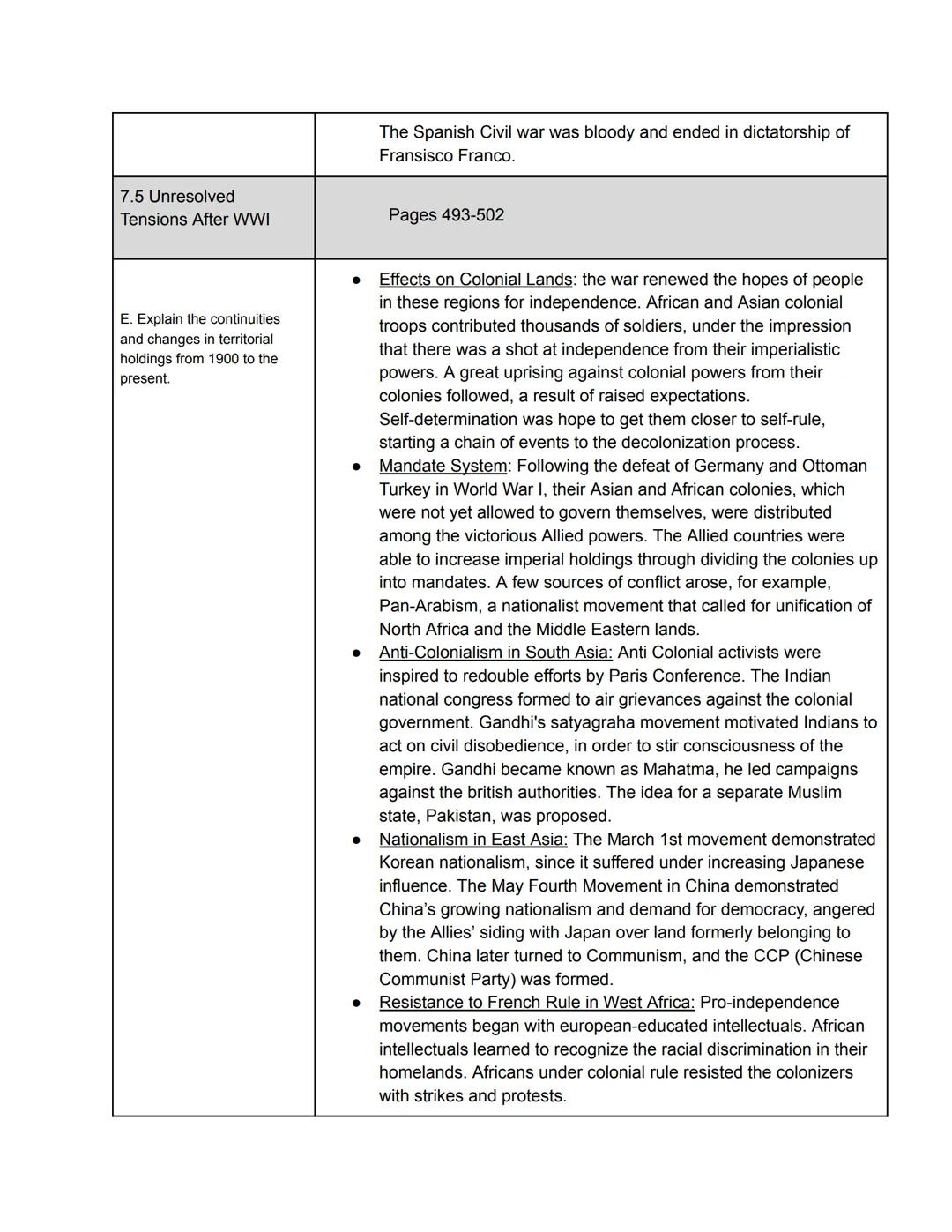
Unresolved Tensions After WWI
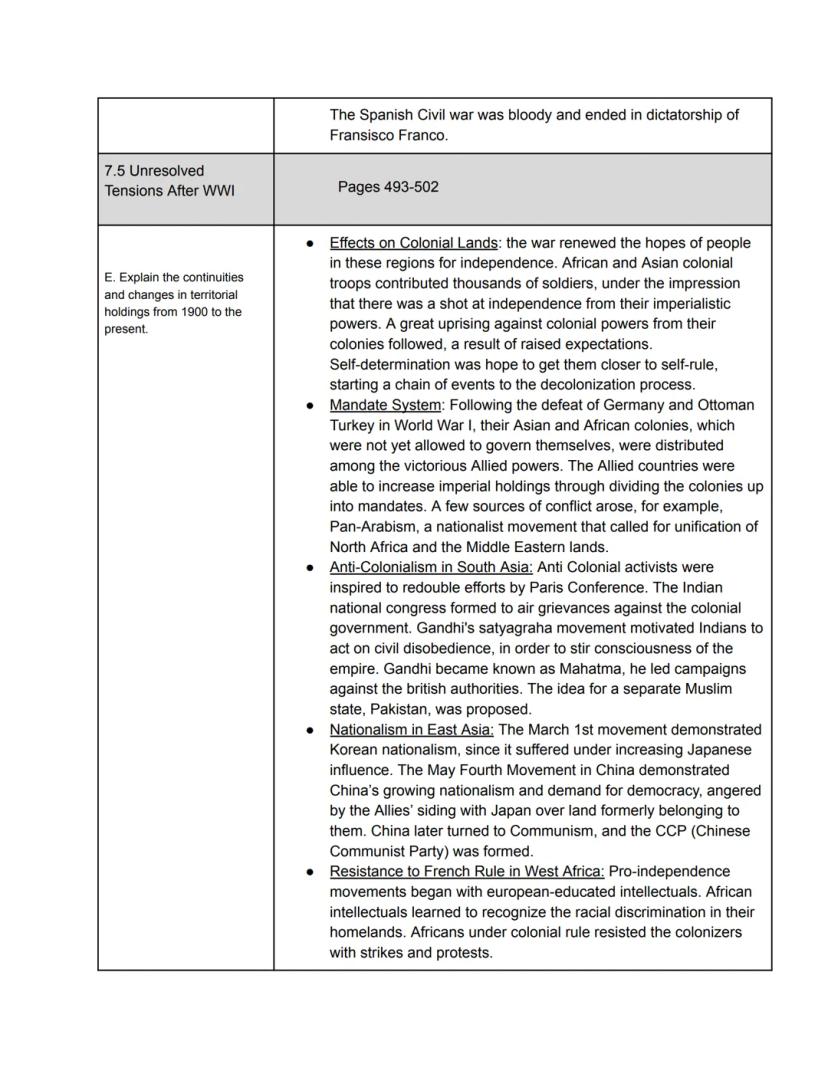
The end of World War I created more problems than it solved, especially for colonized peoples around the world.
Colonial troops who fought for European powers during WWI returned home with raised expectations for self-determination. Thousands of African and Asian soldiers had contributed to the war effort with hopes of gaining independence from imperial control. This triggered widespread uprisings against colonial powers and began the slow process of decolonization.
The mandate system allowed Allied countries to divide Germany's and Ottoman Turkey's former colonies among themselves after the war. This created new sources of conflict, including the rise of Pan-Arabism, a nationalist movement calling for unification of North African and Middle Eastern lands.
Connect the Dots: The unresolved issues after WWI directly led to the independence movements that would reshape the global map after WWII!
Anti-colonial movements gained momentum across the world. In India, Mahatma Gandhi led campaigns of civil disobedience against British authorities through his satyagraha movement. In East Asia, the March 1st movement demonstrated Korean nationalism against Japanese control, while China's May Fourth Movement demanded democracy. West African intellectuals recognized colonial discrimination and organized strikes and protests against French rule. These movements would eventually transform the global political landscape.
6
of 9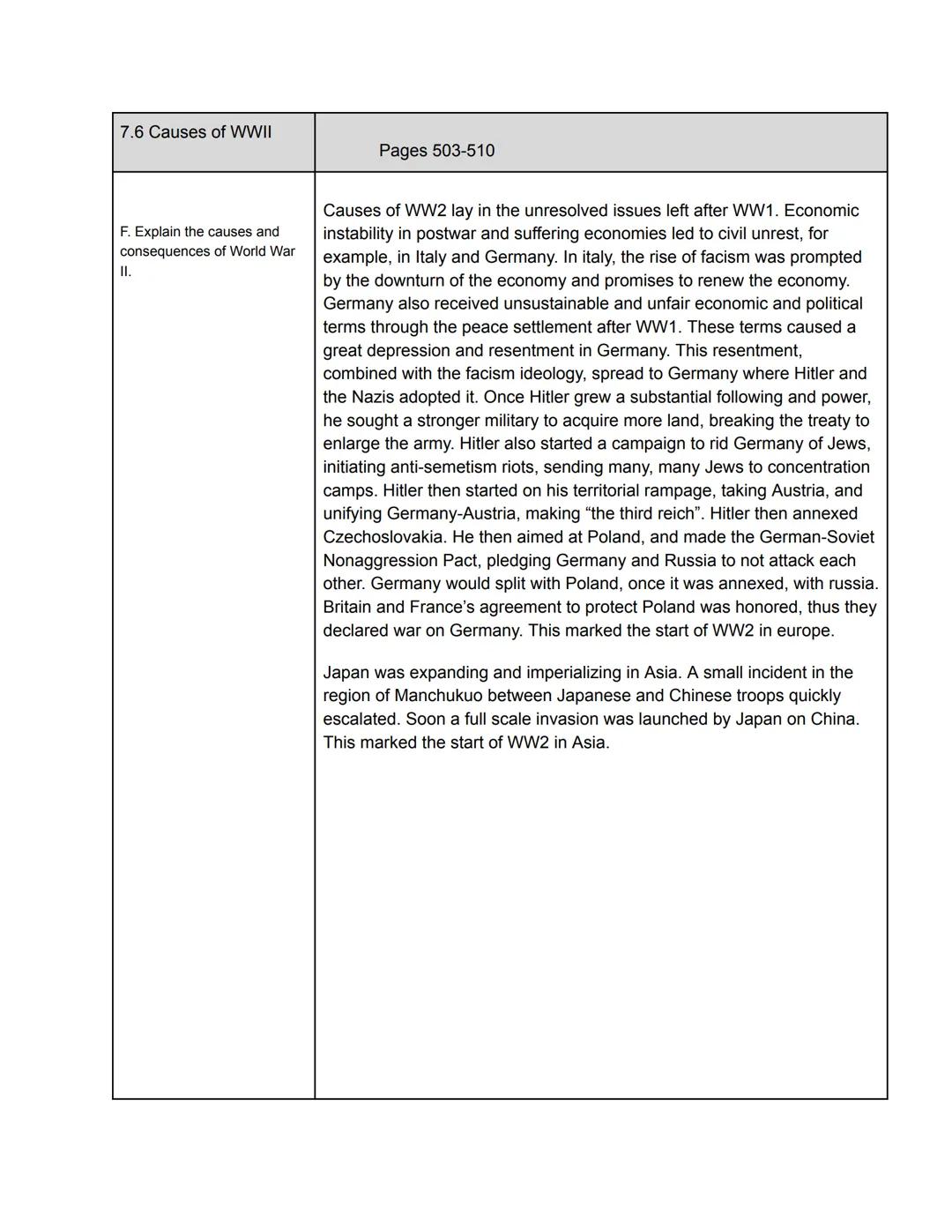
Causes of World War II
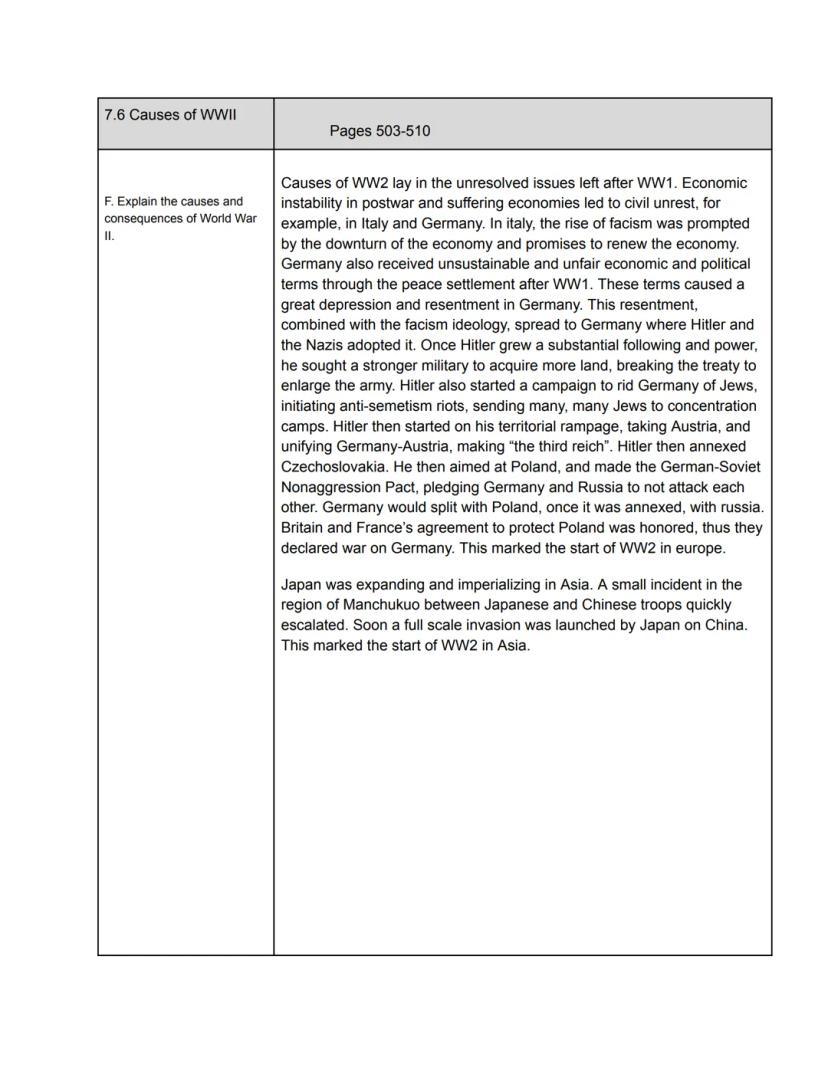
World War II grew directly from the unfinished business of World War I. The harsh economic punishments imposed on Germany created perfect conditions for conflict.
Economic suffering after WWI led to civil unrest across Europe. Italy embraced fascism under Mussolini with promises to restore economic prosperity. In Germany, the unfair peace settlement created deep resentment that Hitler and the Nazis exploited. Once in power, Hitler broke the treaty by rebuilding Germany's military and launched a campaign of anti-Semitism against Jewish citizens.
Hitler's territorial ambitions quickly expanded. He annexed Austria (unifying it with Germany as "the Third Reich") and then took Czechoslovakia. When he set his sights on Poland, Hitler made the German-Soviet Nonaggression Pact with Russia, agreeing to split Poland between them. When Germany invaded Poland in 1939, Britain and France honored their promise to protect Poland and declared war on Germany - marking the start of WWII in Europe.
Critical Point: World War II didn't have a single starting point - it began differently in Europe and Asia!
Meanwhile, Japan was expanding its empire in Asia. What began as a small incident between Japanese and Chinese troops in Manchukuo quickly escalated into a full-scale Japanese invasion of China in 1937, marking the beginning of World War II in Asia. The stage was set for the most devastating conflict in human history.
7
of 9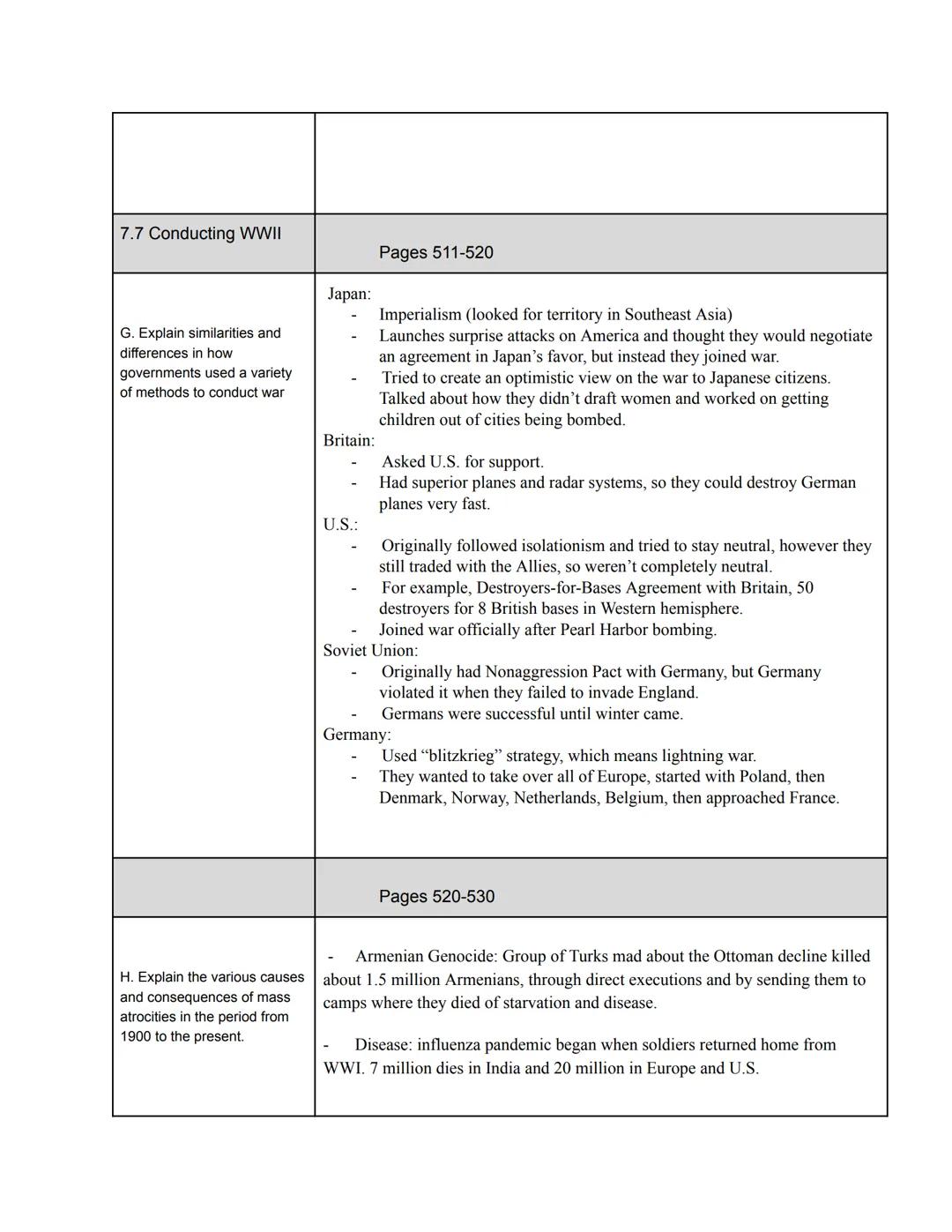
Conducting World War II and Mass Atrocities
World War II saw nations using different strategies to wage a truly global conflict.
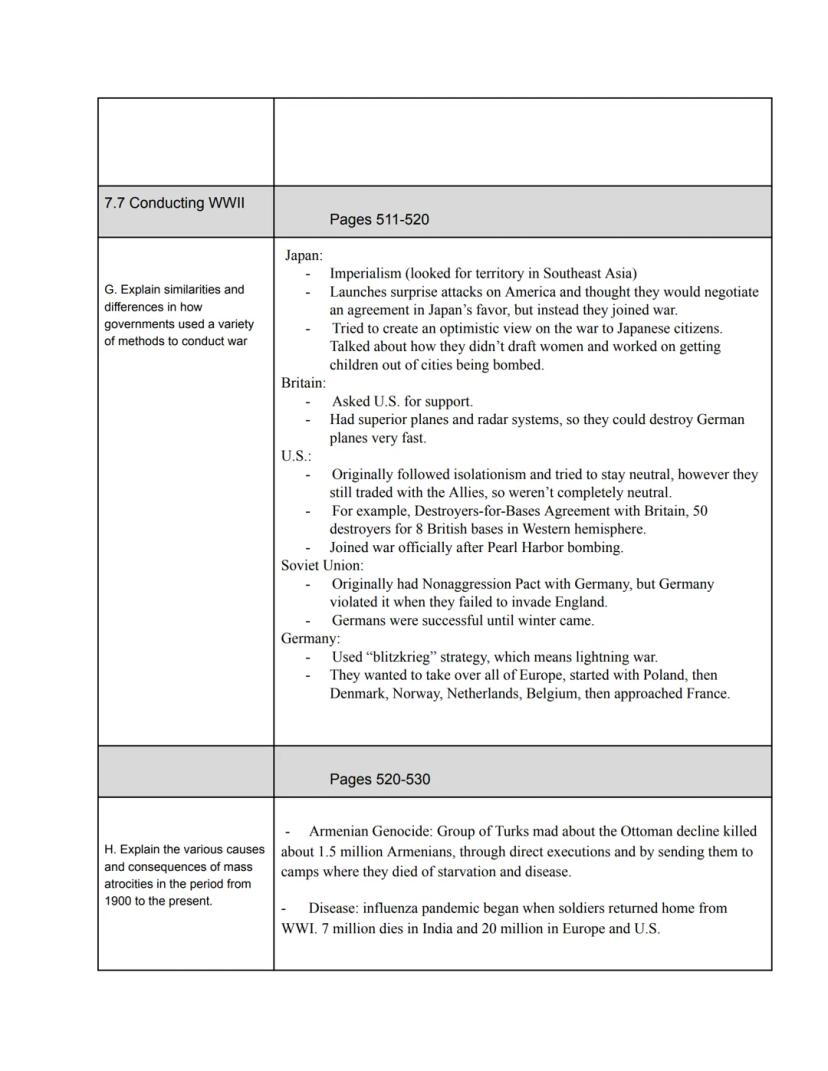
Japan sought territory in Southeast Asia and launched surprise attacks on America, thinking the US would negotiate rather than fight back (they were wrong!). Germany used the blitzkrieg (lightning war) strategy to quickly conquer Poland, Denmark, Norway, the Netherlands, Belgium, and part of France. The US initially stayed neutral but traded with the Allies through agreements like the Destroyers-for-Bases deal with Britain. After Pearl Harbor, America fully joined the war with superior planes and radar systems.
The Soviet Union initially had a Nonaggression Pact with Germany, but Hitler broke it when he failed to conquer England. German forces were successful until the brutal Russian winter stopped them.
Remember This: World War II saw civilian deaths far exceed military casualties, showing how modern warfare targets entire populations.
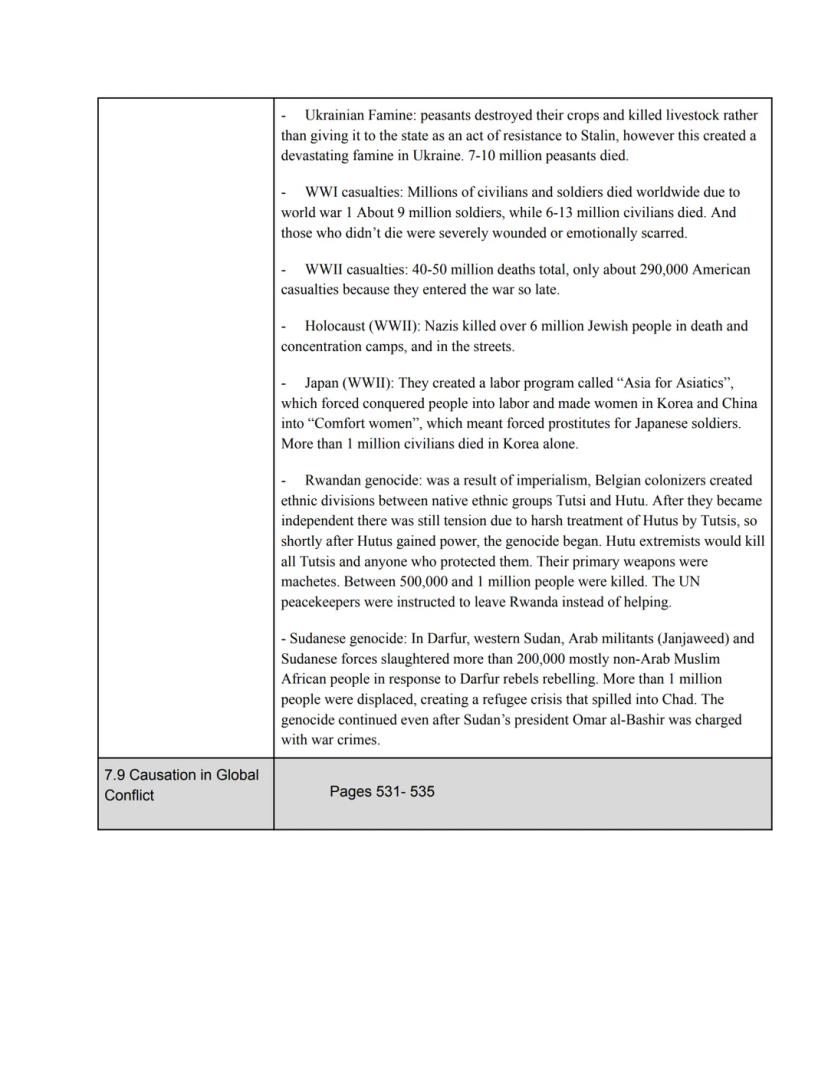
This period also saw horrific mass atrocities. The Holocaust resulted in the murder of over 6 million Jewish people in Nazi concentration camps. Japan's "Asia for Asiatics" program forced conquered peoples into labor and made Korean and Chinese women into "comfort women" (sex slaves) for Japanese soldiers. Earlier, the Armenian Genocide had killed 1.5 million Armenians, and Stalin's policies created a devastating famine in Ukraine killing 7-10 million. Later genocides in Rwanda and Sudan showed humanity hadn't learned its lesson, with hundreds of thousands killed while the world watched.
8
of 9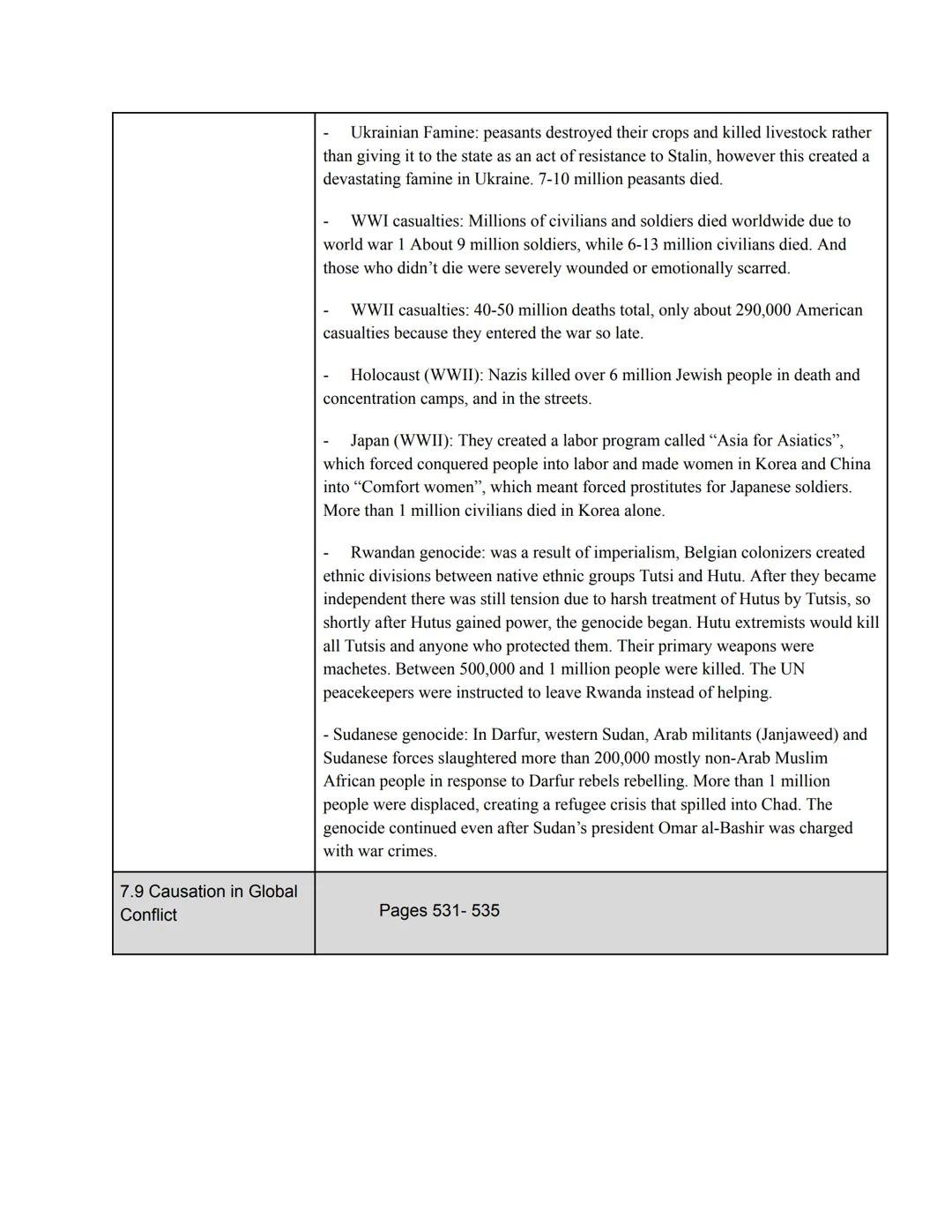
Causes and Consequences of Global Conflict
The human cost of 20th-century conflicts was staggering and reshaped our world forever.
World War I killed about 9 million soldiers and 6-13 million civilians. Those who survived often suffered severe physical wounds or emotional scars. The influenza pandemic that followed when soldiers returned home killed millions more - 7 million in India and 20 million across Europe and the US.
World War II was even more devastating, with 40-50 million total deaths. The US suffered fewer casualties (about 290,000) because they entered the war later. Beyond the battlefield, the war's aftermath created massive refugee crises and political instability.
Big Picture: The deadliest conflicts of the 20th century weren't just about territory - they were driven by ideological differences and economic competition.
More recent genocides show how ethnic divisions, often created by colonial powers, continue to cause devastating violence. In Rwanda, Belgian colonizers created divisions between the Tutsi and Hutu ethnic groups. After independence, Hutu extremists killed between 500,000 and 1 million Tutsis and their protectors, mostly with machetes. In Sudan's Darfur region, over 200,000 non-Arab Muslims were killed by Arab militants and Sudanese forces, creating a refugee crisis that spilled into neighboring countries.
9
of 9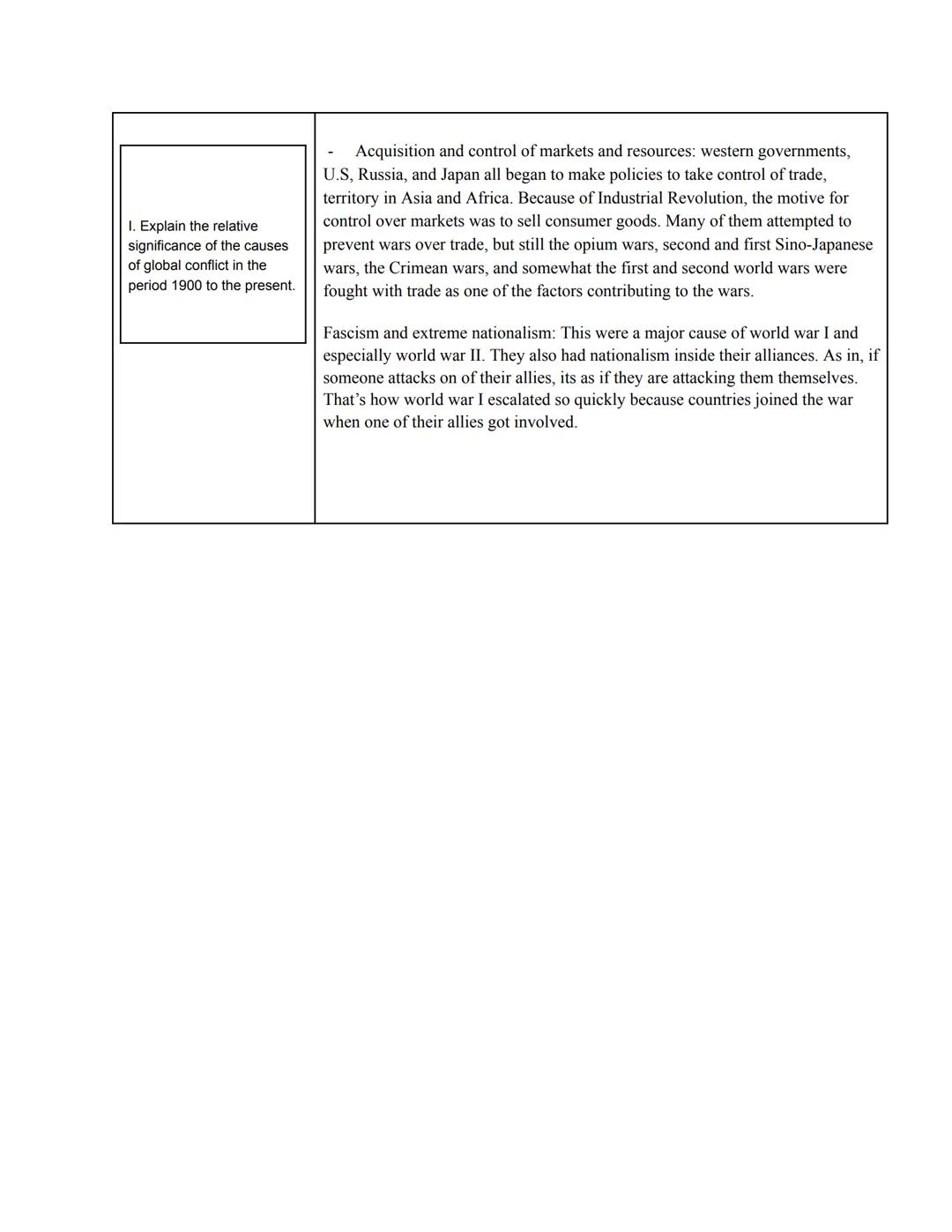
Causes of Global Conflict: The Big Picture
Looking at the big picture helps us understand why massive conflicts happened throughout the 20th century.
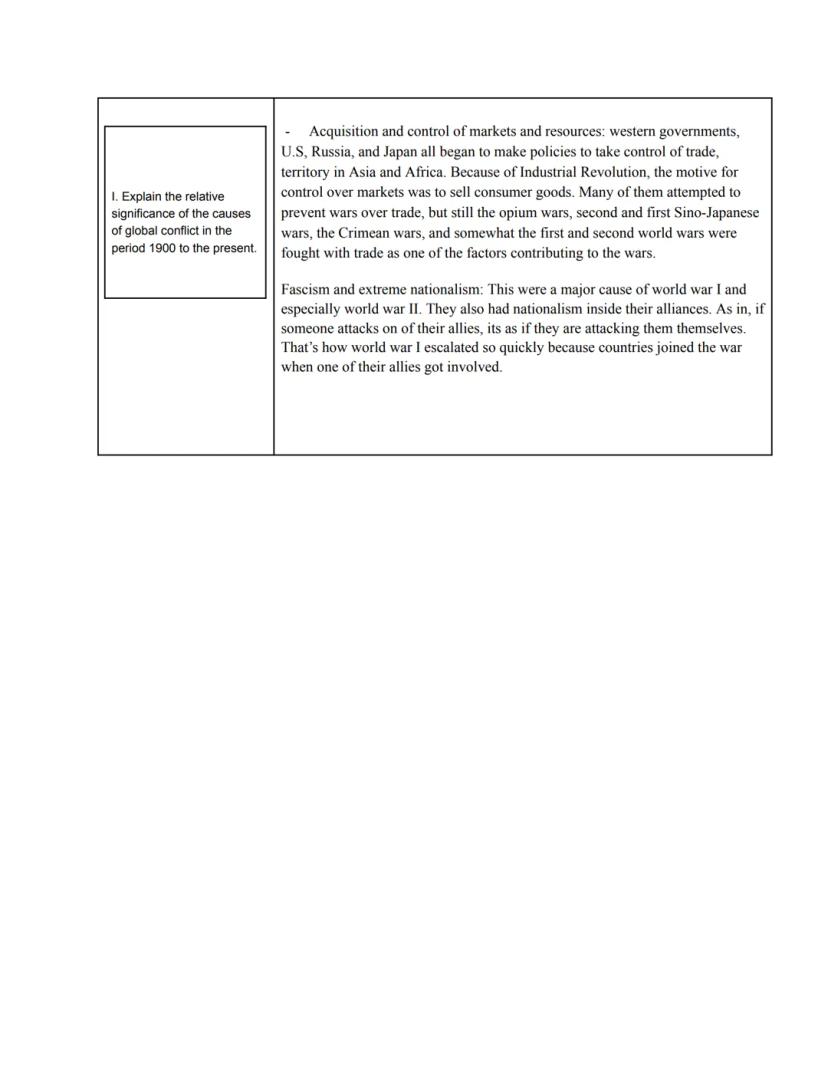
The acquisition and control of markets and resources drove many conflicts. After the Industrial Revolution, Western governments, the US, Russia, and Japan all competed to control trade and territory in Asia and Africa. They needed markets to sell consumer goods and access to raw materials. This competition contributed to the Opium Wars, the Sino-Japanese Wars, the Crimean Wars, and aspects of both World Wars.
Fascism and extreme nationalism were major factors in both World Wars, especially World War II. The idea that your country is superior to others and deserves more territory led to aggressive expansionist policies. Meanwhile, complex alliance systems meant that conflicts quickly escalated - when one country was attacked, its allies joined the fight as if they had been attacked themselves.
Think Critically: Notice how economic competition and extreme nationalism continue to create tensions between countries today. What current conflicts show these same patterns?
These causes help explain why the 20th century saw such devastating global conflicts. Understanding these patterns helps us recognize similar dangers in today's world and possibly prevent future catastrophes. The lessons of history show us that economic cooperation, respect for human rights, and peaceful resolution of conflicts are essential for avoiding the horrors of the past.
We thought you’d never ask...
What is the Knowunity AI companion?
Our AI companion is specifically built for the needs of students. Based on the millions of content pieces we have on the platform we can provide truly meaningful and relevant answers to students. But its not only about answers, the companion is even more about guiding students through their daily learning challenges, with personalised study plans, quizzes or content pieces in the chat and 100% personalisation based on the students skills and developments.
Where can I download the Knowunity app?
You can download the app in the Google Play Store and in the Apple App Store.
Is Knowunity really free of charge?
That's right! Enjoy free access to study content, connect with fellow students, and get instant help – all at your fingertips.
Similar Content
 Fun Stuff
Most popular content in US History
9C
 US History
civil rights movement quiz
Vocab
8th2220
Social StudiesThe Neolithic Revolution: From Hunter-Gatherers to Farming
Summarizes the key aspects of the Neolithic Revolution, detailing how humans moved from hunter-gatherer groups to settled agricultural societies.
6th2882
T
Social StudiesThe Revolutionary War Pt.1
Questions about the revolutionary war
9th840
Social StudiesMotives for European Exploration: Gold, God, and Glory
Learn about the key factors driving European exploration of the New World. This resource explains the "3 G's" motive: the pursuit of Gold, the spread of God, and the desire for Glory.
6th1821
 AP Human Geography
AP Human Geography Notes and Exam Prep Unit 1
A document covering Unit 1 of AP Human Geography from my 9th grade class 2021-2022
1,34776
AP Human GeographyAP Human Geography Notes and Exam Prep Unit 6
A document covering Unit 6 of AP Human Geography from my 9th grade class 2021-2022
1,29965
AP Human GeographyAP Human Geography Notes and Exam Prep Unit 5
A document covering Unit 5 of AP Human Geography from my 9th grade class 2021-2022
1,14943
AP Human GeographyAP Human Geography Notes and Exam Prep Unit 4
A document covering Unit 4 of AP Human Geography from my 9th grade class 2021-2022
98653
Social Studies8th grade Social Studies notes
Amendments Analysis
8th26225
Most popular content
9O
AP US HistoryOrigins and Dynamics of the Columbian Exchange
Analyze the ecological and economic motivations behind the initial transfer of goods, people, and diseases between the Old and New Worlds.
9th3,1280
I
AP US HistoryIntroduction to Early Cultural Interactions
Analyze the initial social and religious encounters between Europeans, Africans, and Indigenous peoples in the colonial Americas.
9th2,7730
O
 AP World History
Origins of Ancient River Civilizations
Analyze the environmental factors and technological innovations that led to the rise of early states in Mesopotamia, Egypt, and the Indus Valley.
9th3,1870
M
AP US HistoryMotivations for European Exploration
Analyze the economic, religious, and political factors that drove European powers to the Americas during the 15th and 16th centuries.
9th1,7780
F
AP PsychologyFoundations of Ethical Guidelines in Research
Practice the core principles of the APA ethical code including informed consent, debriefing, and the role of Institutional Review Boards.
9th1,3360
I
AP US HistoryIntroduction to Native American Societies
Examine the diverse social, political, and economic structures of North American indigenous groups prior to European contact.
9th1,1100
I
 AP Biology
Introduction to Biological Elements of Life
Practice identifying the essential elements including carbon, nitrogen, phosphorus, and sulfur that compose biological macromolecules.
9th1,7390
I
AP US HistoryIntroduction to the Spanish Encomienda System
Explore the fundamental economic and social structures of the Spanish colonial system, focusing on the encomienda and the casta social hierarchy.
9th8890
O
AP World HistoryOrigins and Continuity of the Byzantine Empire
Analyze the political and cultural transitions from the Roman Empire to the Byzantine Empire, focusing on the reign of Justinian I and his code.
9th1,6320
Can't find what you're looking for? Explore other subjects.
Students love us — and so will you.
4.6/5App Store
4.7/5Google Play
The app is very easy to use and well designed. I have found everything I was looking for so far and have been able to learn a lot from the presentations! I will definitely use the app for a class assignment! And of course it also helps a lot as an inspiration.
Stefan SiOS user
This app is really great. There are so many study notes and help [...]. My problem subject is French, for example, and the app has so many options for help. Thanks to this app, I have improved my French. I would recommend it to anyone.
Samantha KlichAndroid user
Wow, I am really amazed. I just tried the app because I've seen it advertised many times and was absolutely stunned. This app is THE HELP you want for school and above all, it offers so many things, such as workouts and fact sheets, which have been VERY helpful to me personally.
AnnaiOS user
Social Studies102 views·Updated Jun 22, 2026·9 pagesComprehensive AP World History Notes: Global Conflicts Post-1900
Catalina Collazos@catalinacollazos9
Welcome to a quick tour through AP Modern World History's Unit 7 on Global Conflict After 1900! We'll explore how powerful nations competed and clashed during the 20th century, from the causes of the World Wars to their devastating consequences,...
1
of 9
Sign up to see the content. It's free!
- Access to all documents
- Improve your grades
- Join milions of students
Shifting Power: Nations in Transition
Ever wonder how countries completely changed their governments in the 1900s? After 1900, many nations underwent dramatic transformations due to both internal pressures and external forces.
In Russia, the tsarist government's resistance to political reform and denial of civil liberties sparked revolution. Internal factors like Bloody Sunday and the Revolution of 1905 showed growing discontent, while external pressures from the Russo-Japanese War and World War I weakened the country. Vladimir Lenin and the Bolsheviks ultimately established a communist government focused on collective ownership.
China faced similar upheaval after the Qing Dynasty fell. The country struggled with domestic concerns, ethnic tensions, and famine. Sun Yat-Sen led a revolution that helped China begin to modernize and strengthen its military presence.
Think About It: Revolutionary movements often occur when people feel they have no voice in their government. What conditions make revolution more likely in a society?
The Ottoman Empire collapsed due to a weak economy, leading to revolution by the Young Turks who promoted "Turkification." After supporting Germany in WWI (a fatal mistake), the empire was dismantled, eventually becoming modern Turkey under Mustafa Kemal. Meanwhile, Mexico transformed after dictator Porfirio Diaz was overthrown, creating a new constitution with goals to benefit average citizens.
2
of 9Sign up to see the content. It's free!
- Access to all documents
- Improve your grades
- Join milions of students
Causes of World War I
World War I didn't just happen overnight! Several major factors combined to create the perfect storm for global conflict.
Militarism played a huge role as countries aggressively built up their armies, glorified war, and mass-produced weapons. Young men were heavily recruited with promises of heroism and adventure. Meanwhile, nationalism - intense pride in one's national identity - fueled the idea that peoples of the same ethnicity, language and culture should form independent nation-states.
The spark that lit the powder keg was the assassination of Archduke Franz Ferdinand, heir to the Austro-Hungarian throne, by Gavrilo Princip, a Serbian member of the Black Hand organization. But this event alone wouldn't have caused a world war without other factors in place.
Important Connection: The secret alliances between countries meant that one conflict could quickly draw in multiple nations - like dominos falling!
Imperialism also contributed significantly as European powers competed for overseas colonies to assert their power and generate wealth. This global competition for territory created tensions that would eventually explode into warfare. The complex web of alliances meant that when one country was attacked, others were obligated to join the fight, rapidly escalating what might have been a regional conflict into a global one.
3
of 9Sign up to see the content. It's free!
- Access to all documents
- Improve your grades
- Join milions of students
Conducting World War I
World War I completely changed how countries fight wars. Governments used several methods to build and maintain their war efforts.
Countries expanded their armies through both propaganda and universal conscription (forcing citizens to join the military). Films portrayed war as heroic to encourage young men to enlist. But the reality on the battlefield was far different thanks to deadly new technologies.
Trench warfare became the nightmare reality of WWI. Soldiers faced horrific conditions in opposing trenches while fighting for the land between them. New weapons made combat especially deadly: machine guns could fire 500+ rounds per minute, poison gas damaged internal organs, and submarines, airplanes, and tanks revolutionized battlefield tactics.
Did You Know? WWI was the first "total war" where countries devoted ALL their resources to the conflict - implementing wage controls, production quotas, and food rationing.
Governments also mastered the art of propaganda - communication designed to influence public opinion through often inaccurate information about the enemy. This propaganda encouraged citizens to support the war effort through production or enlistment. Colonial powers even extended the boundaries of the war by using their imperial territories for resources and troops, making this truly a "world" war.
4
of 9Sign up to see the content. It's free!
- Access to all documents
- Improve your grades
- Join milions of students
Economy in the Interwar Period
The aftermath of World War I left economies shattered and set the stage for global depression. The Treaty of Versailles forced Germany to pay billions in reparations, crippling its economy.
The Great Depression hit the world hard after the US stock market crash. Over 30 million people worldwide lost their jobs. Countries in Africa, Asia, and Latin America suffered terribly because they depended on trade with European nations. Even Japan's economy collapsed due to its reliance on foreign trade.
Different governments tried various approaches to fix their broken economies. In Russia, Lenin implemented the New Economic Plan (NEP) after the Russian Revolution and Civil War. Later, Stalin's Five-Year Plan aimed to transform the Soviet Union into an industrial powerhouse. Mexico saw economic improvement under the Institutional Revolutionary Party (PRI).
Critical Insight: Economic desperation often leads to extreme political movements!
The economic crisis created fertile ground for fascism - a political system based on extreme nationalism, military glorification, and blaming minorities for problems. Fascism rose in Italy under Mussolini, who created a totalitarian state based on "corporatism." In Spain, fascist forces led by Francisco Franco defeated democratic groups in the bloody Spanish Civil War. These economic and political shifts would soon lead to another global conflict.
5
of 9Sign up to see the content. It's free!
- Access to all documents
- Improve your grades
- Join milions of students
Unresolved Tensions After WWI
The end of World War I created more problems than it solved, especially for colonized peoples around the world.
Colonial troops who fought for European powers during WWI returned home with raised expectations for self-determination. Thousands of African and Asian soldiers had contributed to the war effort with hopes of gaining independence from imperial control. This triggered widespread uprisings against colonial powers and began the slow process of decolonization.
The mandate system allowed Allied countries to divide Germany's and Ottoman Turkey's former colonies among themselves after the war. This created new sources of conflict, including the rise of Pan-Arabism, a nationalist movement calling for unification of North African and Middle Eastern lands.
Connect the Dots: The unresolved issues after WWI directly led to the independence movements that would reshape the global map after WWII!
Anti-colonial movements gained momentum across the world. In India, Mahatma Gandhi led campaigns of civil disobedience against British authorities through his satyagraha movement. In East Asia, the March 1st movement demonstrated Korean nationalism against Japanese control, while China's May Fourth Movement demanded democracy. West African intellectuals recognized colonial discrimination and organized strikes and protests against French rule. These movements would eventually transform the global political landscape.
6
of 9Sign up to see the content. It's free!
- Access to all documents
- Improve your grades
- Join milions of students
Causes of World War II
World War II grew directly from the unfinished business of World War I. The harsh economic punishments imposed on Germany created perfect conditions for conflict.
Economic suffering after WWI led to civil unrest across Europe. Italy embraced fascism under Mussolini with promises to restore economic prosperity. In Germany, the unfair peace settlement created deep resentment that Hitler and the Nazis exploited. Once in power, Hitler broke the treaty by rebuilding Germany's military and launched a campaign of anti-Semitism against Jewish citizens.
Hitler's territorial ambitions quickly expanded. He annexed Austria (unifying it with Germany as "the Third Reich") and then took Czechoslovakia. When he set his sights on Poland, Hitler made the German-Soviet Nonaggression Pact with Russia, agreeing to split Poland between them. When Germany invaded Poland in 1939, Britain and France honored their promise to protect Poland and declared war on Germany - marking the start of WWII in Europe.
Critical Point: World War II didn't have a single starting point - it began differently in Europe and Asia!
Meanwhile, Japan was expanding its empire in Asia. What began as a small incident between Japanese and Chinese troops in Manchukuo quickly escalated into a full-scale Japanese invasion of China in 1937, marking the beginning of World War II in Asia. The stage was set for the most devastating conflict in human history.
7
of 9Sign up to see the content. It's free!
- Access to all documents
- Improve your grades
- Join milions of students
Conducting World War II and Mass Atrocities
World War II saw nations using different strategies to wage a truly global conflict.
Japan sought territory in Southeast Asia and launched surprise attacks on America, thinking the US would negotiate rather than fight back (they were wrong!). Germany used the blitzkrieg (lightning war) strategy to quickly conquer Poland, Denmark, Norway, the Netherlands, Belgium, and part of France. The US initially stayed neutral but traded with the Allies through agreements like the Destroyers-for-Bases deal with Britain. After Pearl Harbor, America fully joined the war with superior planes and radar systems.
The Soviet Union initially had a Nonaggression Pact with Germany, but Hitler broke it when he failed to conquer England. German forces were successful until the brutal Russian winter stopped them.
Remember This: World War II saw civilian deaths far exceed military casualties, showing how modern warfare targets entire populations.
This period also saw horrific mass atrocities. The Holocaust resulted in the murder of over 6 million Jewish people in Nazi concentration camps. Japan's "Asia for Asiatics" program forced conquered peoples into labor and made Korean and Chinese women into "comfort women" (sex slaves) for Japanese soldiers. Earlier, the Armenian Genocide had killed 1.5 million Armenians, and Stalin's policies created a devastating famine in Ukraine killing 7-10 million. Later genocides in Rwanda and Sudan showed humanity hadn't learned its lesson, with hundreds of thousands killed while the world watched.
8
of 9Sign up to see the content. It's free!
- Access to all documents
- Improve your grades
- Join milions of students
Causes and Consequences of Global Conflict
The human cost of 20th-century conflicts was staggering and reshaped our world forever.
World War I killed about 9 million soldiers and 6-13 million civilians. Those who survived often suffered severe physical wounds or emotional scars. The influenza pandemic that followed when soldiers returned home killed millions more - 7 million in India and 20 million across Europe and the US.
World War II was even more devastating, with 40-50 million total deaths. The US suffered fewer casualties (about 290,000) because they entered the war later. Beyond the battlefield, the war's aftermath created massive refugee crises and political instability.
Big Picture: The deadliest conflicts of the 20th century weren't just about territory - they were driven by ideological differences and economic competition.
More recent genocides show how ethnic divisions, often created by colonial powers, continue to cause devastating violence. In Rwanda, Belgian colonizers created divisions between the Tutsi and Hutu ethnic groups. After independence, Hutu extremists killed between 500,000 and 1 million Tutsis and their protectors, mostly with machetes. In Sudan's Darfur region, over 200,000 non-Arab Muslims were killed by Arab militants and Sudanese forces, creating a refugee crisis that spilled into neighboring countries.
9
of 9Sign up to see the content. It's free!
- Access to all documents
- Improve your grades
- Join milions of students
Causes of Global Conflict: The Big Picture
Looking at the big picture helps us understand why massive conflicts happened throughout the 20th century.
The acquisition and control of markets and resources drove many conflicts. After the Industrial Revolution, Western governments, the US, Russia, and Japan all competed to control trade and territory in Asia and Africa. They needed markets to sell consumer goods and access to raw materials. This competition contributed to the Opium Wars, the Sino-Japanese Wars, the Crimean Wars, and aspects of both World Wars.
Fascism and extreme nationalism were major factors in both World Wars, especially World War II. The idea that your country is superior to others and deserves more territory led to aggressive expansionist policies. Meanwhile, complex alliance systems meant that conflicts quickly escalated - when one country was attacked, its allies joined the fight as if they had been attacked themselves.
Think Critically: Notice how economic competition and extreme nationalism continue to create tensions between countries today. What current conflicts show these same patterns?
These causes help explain why the 20th century saw such devastating global conflicts. Understanding these patterns helps us recognize similar dangers in today's world and possibly prevent future catastrophes. The lessons of history show us that economic cooperation, respect for human rights, and peaceful resolution of conflicts are essential for avoiding the horrors of the past.
We thought you’d never ask...
What is the Knowunity AI companion?
Our AI companion is specifically built for the needs of students. Based on the millions of content pieces we have on the platform we can provide truly meaningful and relevant answers to students. But its not only about answers, the companion is even more about guiding students through their daily learning challenges, with personalised study plans, quizzes or content pieces in the chat and 100% personalisation based on the students skills and developments.
Where can I download the Knowunity app?
You can download the app in the Google Play Store and in the Apple App Store.
Is Knowunity really free of charge?
That's right! Enjoy free access to study content, connect with fellow students, and get instant help – all at your fingertips.
Similar Content
Most popular content in US History
9C
US Historycivil rights movement quiz
Vocab
8th2220
Social StudiesThe Neolithic Revolution: From Hunter-Gatherers to Farming
Summarizes the key aspects of the Neolithic Revolution, detailing how humans moved from hunter-gatherer groups to settled agricultural societies.
6th2882
T
Social StudiesThe Revolutionary War Pt.1
Questions about the revolutionary war
9th840
Social StudiesMotives for European Exploration: Gold, God, and Glory
Learn about the key factors driving European exploration of the New World. This resource explains the "3 G's" motive: the pursuit of Gold, the spread of God, and the desire for Glory.
6th1821
AP Human GeographyAP Human Geography Notes and Exam Prep Unit 1
A document covering Unit 1 of AP Human Geography from my 9th grade class 2021-2022
1,34776
AP Human GeographyAP Human Geography Notes and Exam Prep Unit 6
A document covering Unit 6 of AP Human Geography from my 9th grade class 2021-2022
1,29965
AP Human GeographyAP Human Geography Notes and Exam Prep Unit 5
A document covering Unit 5 of AP Human Geography from my 9th grade class 2021-2022
1,14943
AP Human GeographyAP Human Geography Notes and Exam Prep Unit 4
A document covering Unit 4 of AP Human Geography from my 9th grade class 2021-2022
98653
Social Studies8th grade Social Studies notes
Amendments Analysis
8th26225
Most popular content
9O
AP US HistoryOrigins and Dynamics of the Columbian Exchange
Analyze the ecological and economic motivations behind the initial transfer of goods, people, and diseases between the Old and New Worlds.
9th3,1280
I
AP US HistoryIntroduction to Early Cultural Interactions
Analyze the initial social and religious encounters between Europeans, Africans, and Indigenous peoples in the colonial Americas.
9th2,7730
O
AP World HistoryOrigins of Ancient River Civilizations
Analyze the environmental factors and technological innovations that led to the rise of early states in Mesopotamia, Egypt, and the Indus Valley.
9th3,1870
M
AP US HistoryMotivations for European Exploration
Analyze the economic, religious, and political factors that drove European powers to the Americas during the 15th and 16th centuries.
9th1,7780
F
AP PsychologyFoundations of Ethical Guidelines in Research
Practice the core principles of the APA ethical code including informed consent, debriefing, and the role of Institutional Review Boards.
9th1,3360
I
AP US HistoryIntroduction to Native American Societies
Examine the diverse social, political, and economic structures of North American indigenous groups prior to European contact.
9th1,1100
I
AP BiologyIntroduction to Biological Elements of Life
Practice identifying the essential elements including carbon, nitrogen, phosphorus, and sulfur that compose biological macromolecules.
9th1,7390
I
AP US HistoryIntroduction to the Spanish Encomienda System
Explore the fundamental economic and social structures of the Spanish colonial system, focusing on the encomienda and the casta social hierarchy.
9th8890
O
AP World HistoryOrigins and Continuity of the Byzantine Empire
Analyze the political and cultural transitions from the Roman Empire to the Byzantine Empire, focusing on the reign of Justinian I and his code.
9th1,6320
Can't find what you're looking for? Explore other subjects.
Students love us — and so will you.
4.6/5App Store
4.7/5Google Play
The app is very easy to use and well designed. I have found everything I was looking for so far and have been able to learn a lot from the presentations! I will definitely use the app for a class assignment! And of course it also helps a lot as an inspiration.
Stefan SiOS user
This app is really great. There are so many study notes and help [...]. My problem subject is French, for example, and the app has so many options for help. Thanks to this app, I have improved my French. I would recommend it to anyone.
Samantha KlichAndroid user
Wow, I am really amazed. I just tried the app because I've seen it advertised many times and was absolutely stunned. This app is THE HELP you want for school and above all, it offers so many things, such as workouts and fact sheets, which have been VERY helpful to me personally.
AnnaiOS user