
International Relations covers the complex interactions between nations in our... Show more
 Earth and Space Science
 AP Human Geography
 US History
 Algebra
 Biology
Sign up to see the contentIt's free!
Access to all documents
Improve your grades
Join milions of students
Knowunity AI
Subjects
Triangle Congruence and Similarity Theorems
Triangle Properties and Classification
Linear Equations and Graphs
Geometric Angle Relationships
Trigonometric Functions and Identities
Equation Solving Techniques
Circle Geometry Fundamentals
Division Operations and Methods
Basic Differentiation Rules
Exponent and Logarithm Properties
Show all topics
Human Organ Systems
Reproductive Cell Cycles
Biological Sciences Subdisciplines
Cellular Energy Metabolism
Autotrophic Energy Processes
Inheritance Patterns and Principles
Biomolecular Structure and Organization
Cell Cycle and Division Mechanics
Cellular Organization and Development
Biological Structural Organization
Show all topics
Chemical Sciences and Applications
Atomic Structure and Composition
Molecular Electron Structure Representation
Atomic Electron Behavior
Matter Properties and Water
Mole Concept and Calculations
Gas Laws and Behavior
Periodic Table Organization
Chemical Thermodynamics Fundamentals
Chemical Bond Types and Properties
Show all topics
European Renaissance and Enlightenment
European Cultural Movements 800-1920
American Revolution Era 1763-1797
American Civil War 1861-1865
Global Imperial Systems
Mongol and Chinese Dynasties
U.S. Presidents and World Leaders
Historical Sources and Documentation
World Wars Era and Impact
World Religious Systems
Show all topics
Classic and Contemporary Novels
Literary Character Analysis
Rhetorical Theory and Practice
Classic Literary Narratives
Reading Analysis and Interpretation
Narrative Structure and Techniques
English Language Components
Influential English-Language Authors
Basic Sentence Structure
Narrative Voice and Perspective
Show all topics
165
•
Updated Apr 4, 2026
•
payton federmann
@paytonfedermann_ytau
International Relations covers the complex interactions between nations in our... Show more
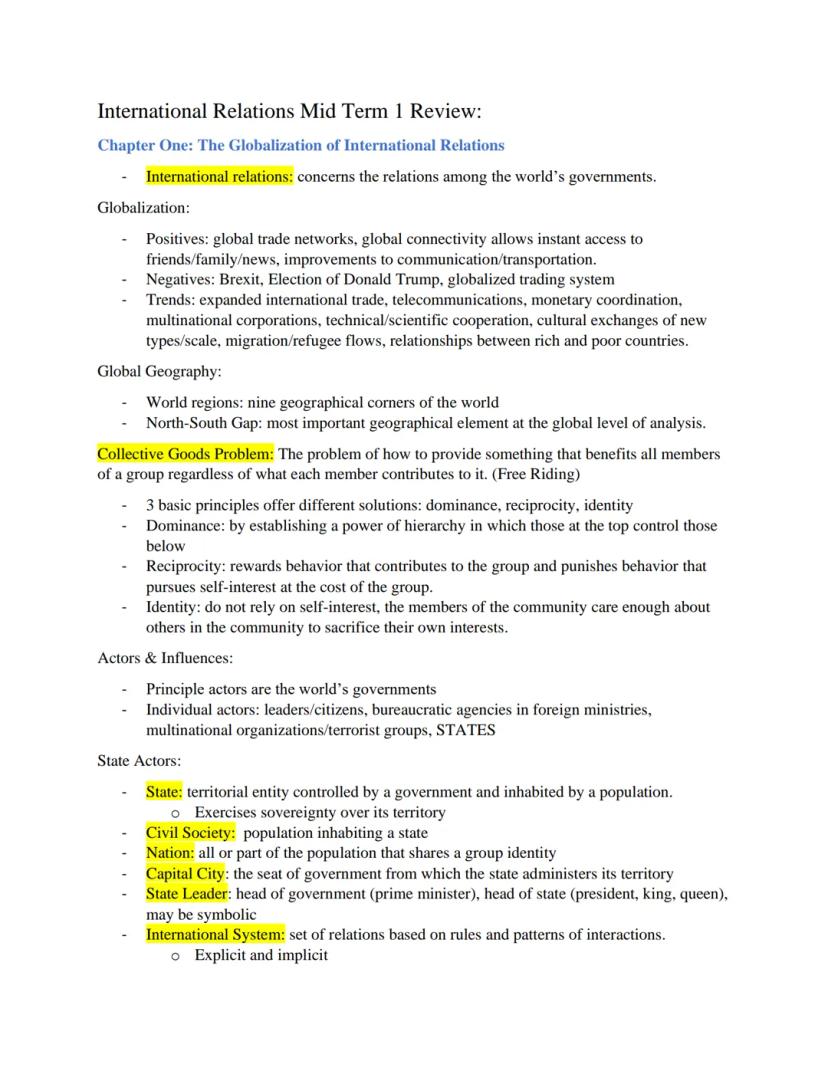
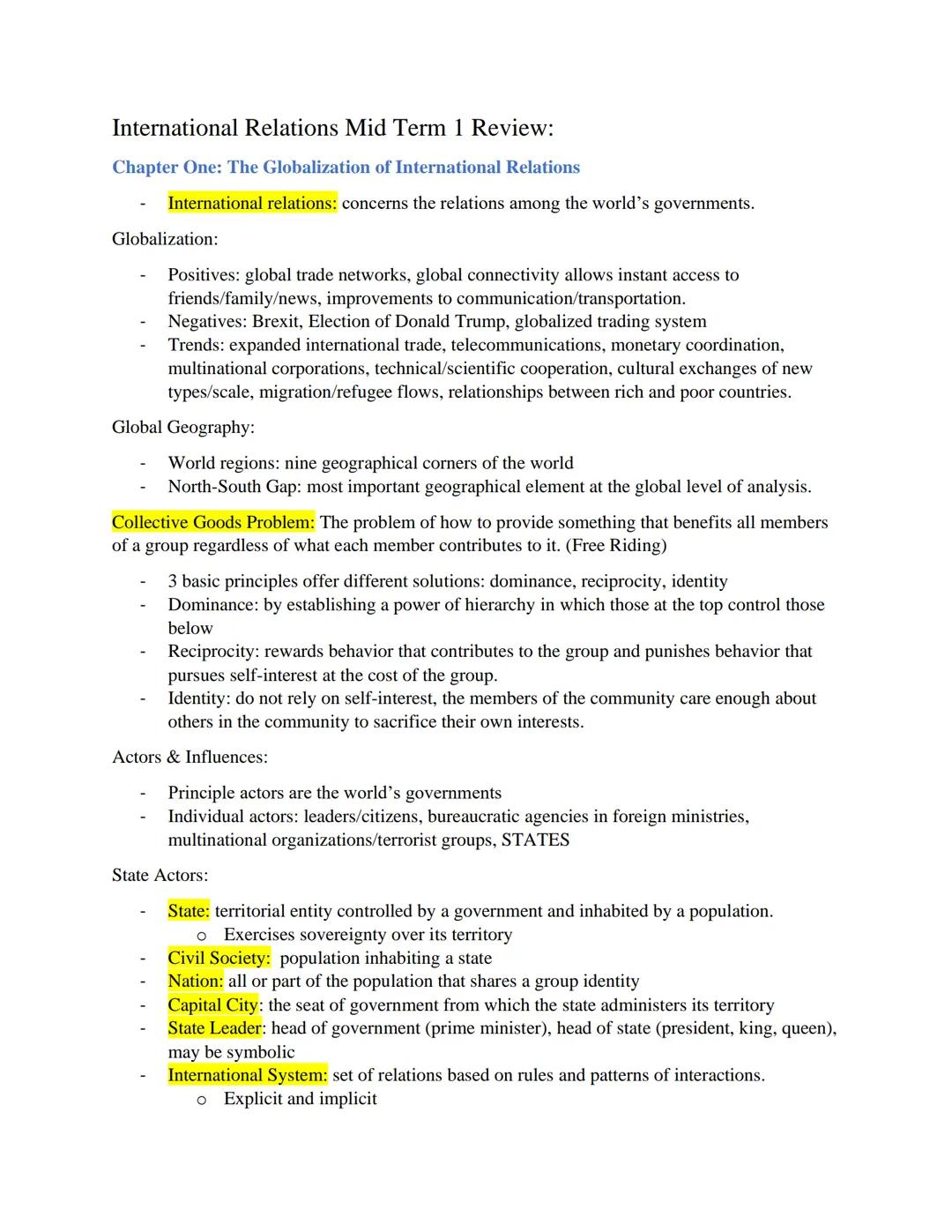
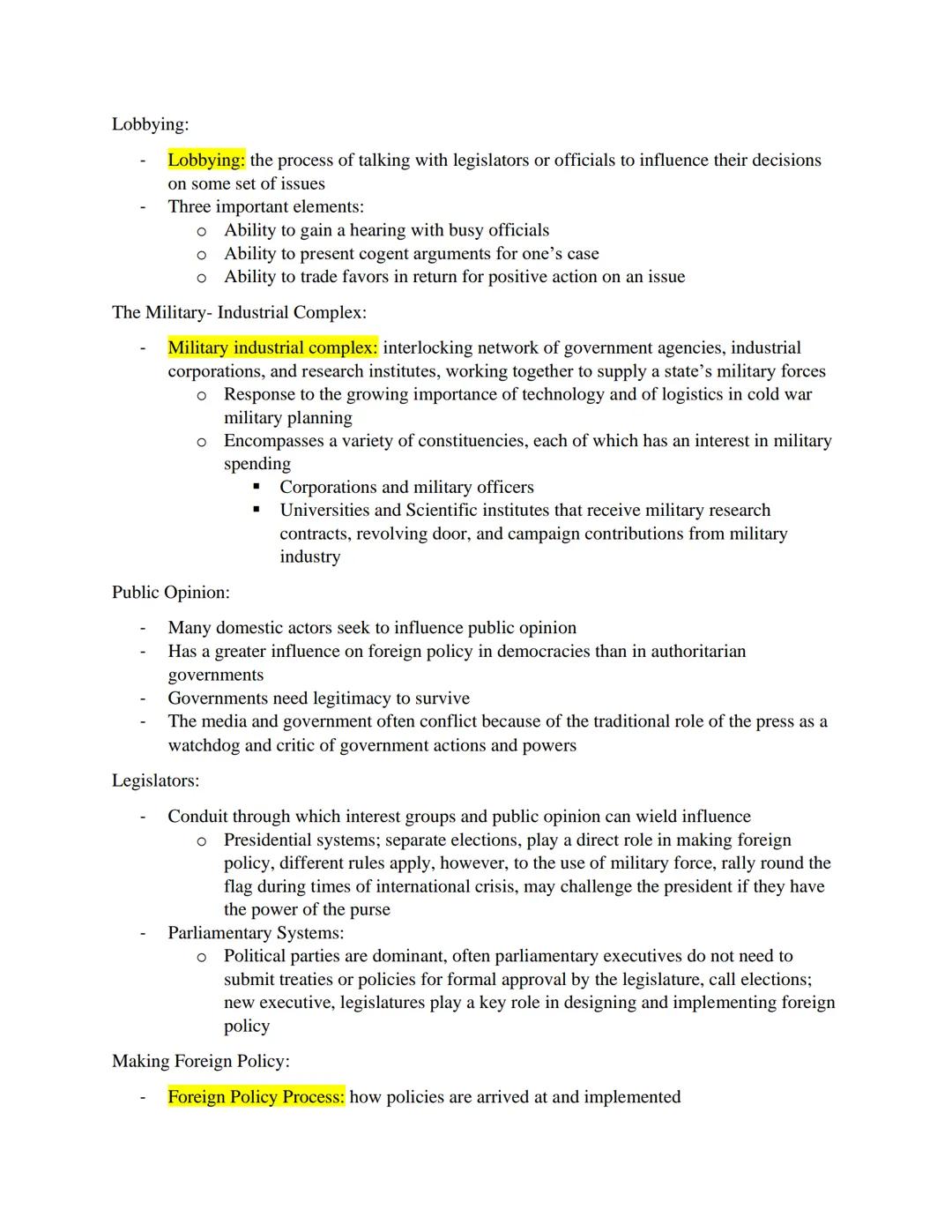
Ever wonder how countries interact with each other in our connected world? International relations focuses on relationships among the world's governments within a global system that's becoming increasingly interconnected. Globalization brings both benefits (global trade networks, instant communication) and challenges (Brexit, rising nationalism).
The world is divided by the North-South Gap, the most significant geographical division at the global level. This separation between wealthy and developing nations affects almost every aspect of international relations. When countries need to work together, they often face the Collective Goods Problem - how to provide something beneficial to everyone regardless of individual contributions.
Three principles offer solutions to international cooperation challenges: dominance (power hierarchies), reciprocity , and identity .
Quick Tip: When analyzing international events, consider which actors are involved - states remain the principal players, but non-state actors like multinational corporations and intergovernmental organizations are increasingly important.
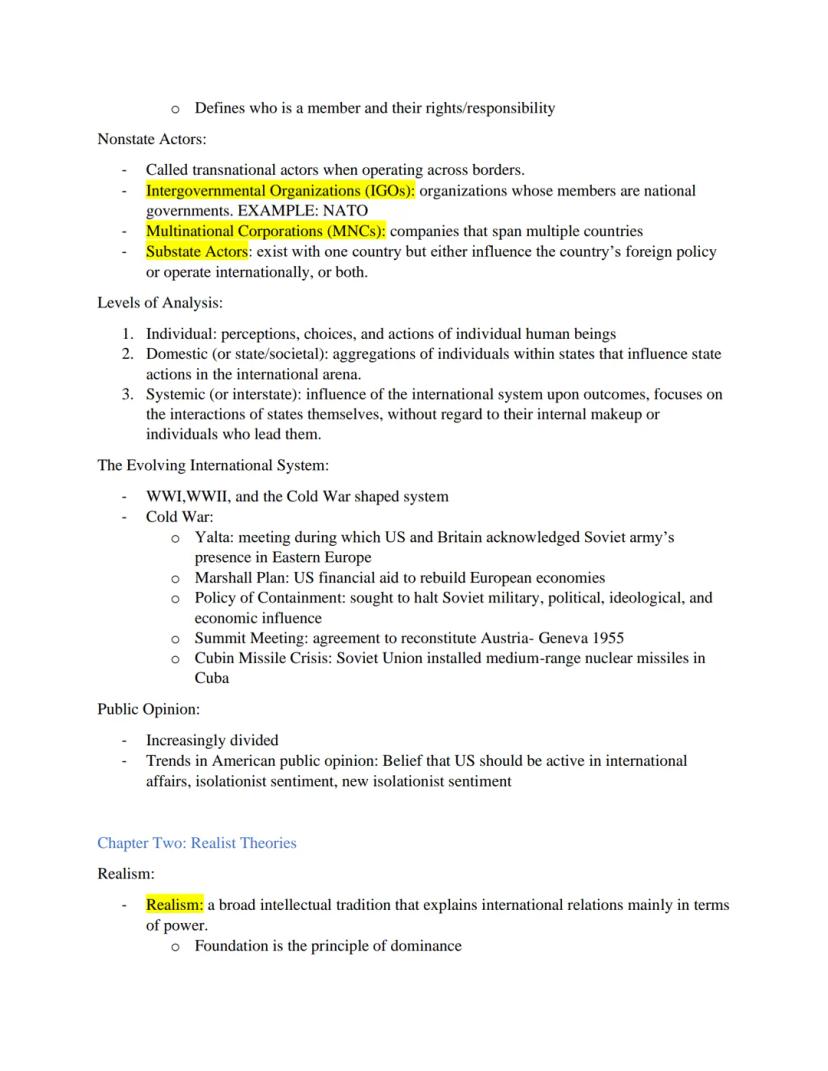
The international system operates at three levels of analysis: individual (human choices), domestic (internal state factors), and systemic (interactions between states). Major historical events like World Wars I and II and the Cold War have fundamentally shaped how this system functions today.
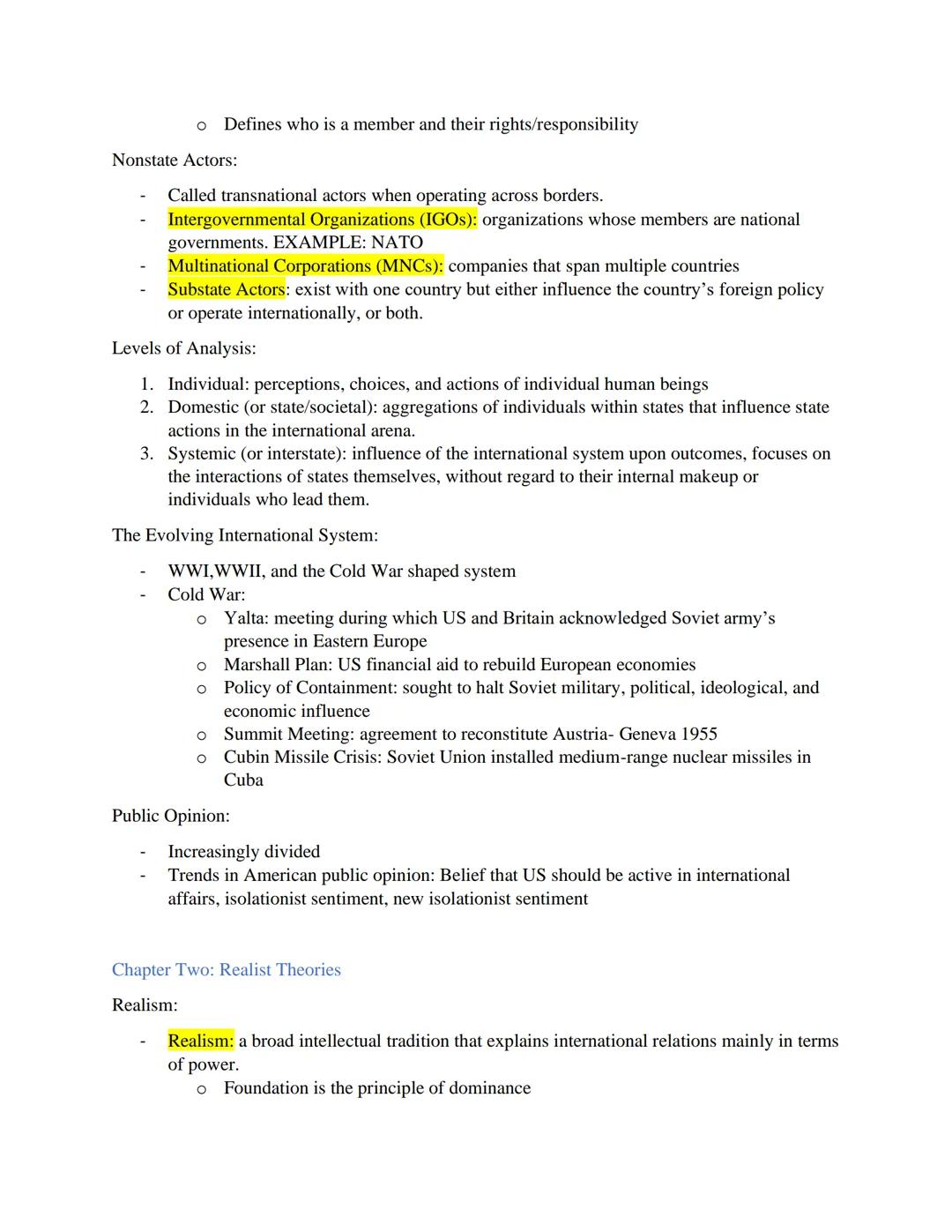
Imagine international politics as a chess game where power determines who wins. Realism explains international relations primarily through power dynamics rather than morality or cooperation. Realists believe the world operates on the principle of dominance – stronger states naturally control weaker ones in an endless competition.
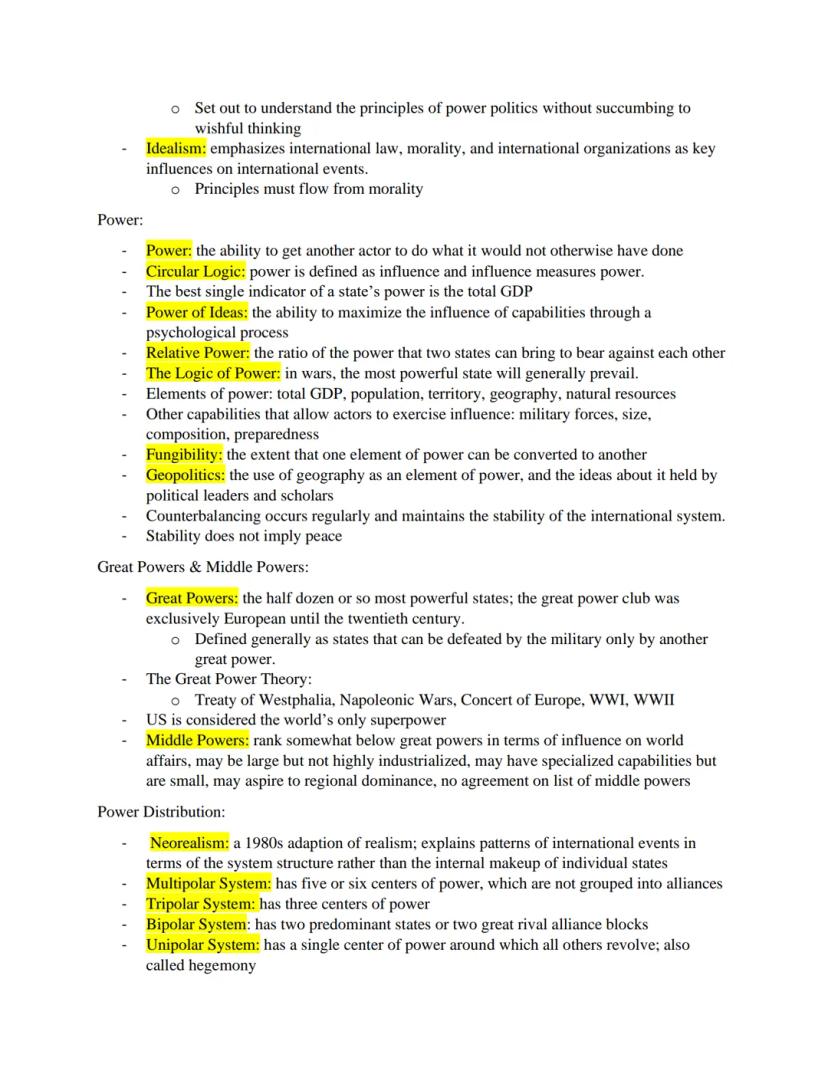
Power is the ability to make another actor do what it wouldn't otherwise do. While military strength matters, a state's total GDP is the best single indicator of its power. Other elements include population size, territory, geography, and natural resources. Great powers are typically defined as states that can only be defeated militarily by another great power.
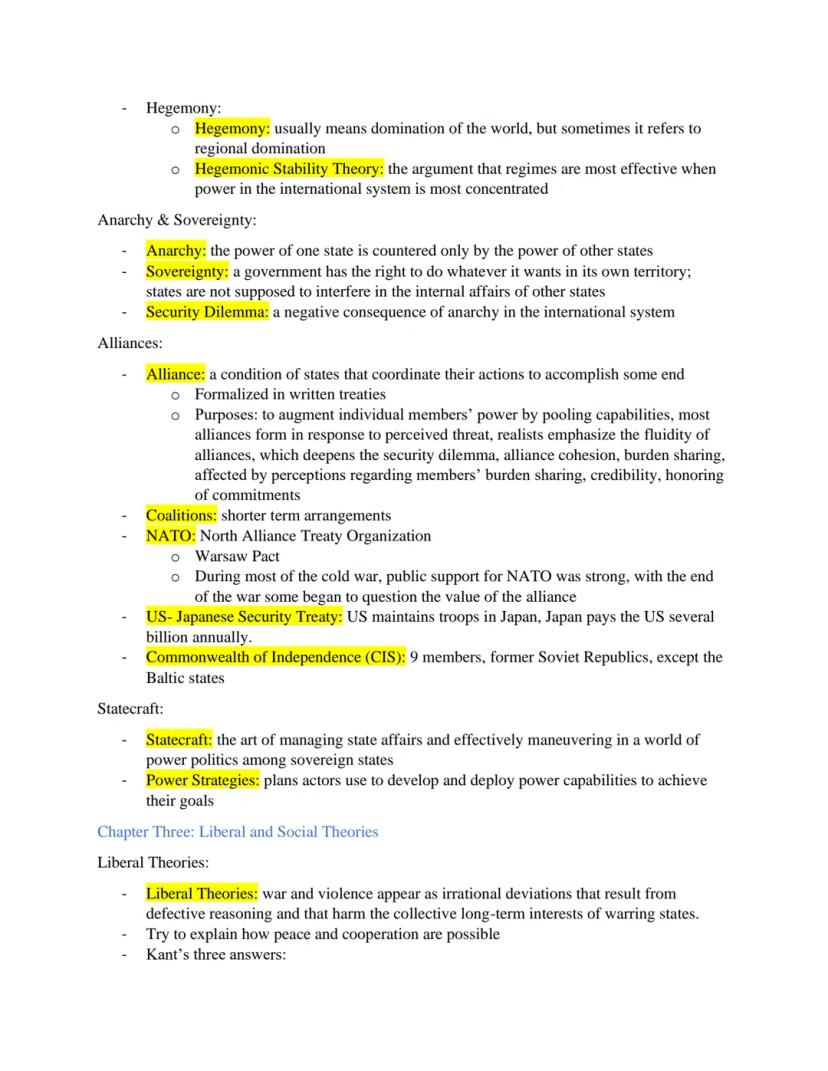
In the international system, states exist in a condition of anarchy – there's no higher authority above them to enforce rules. This creates a security dilemma where actions taken by one state to increase its security often make others feel threatened, potentially leading to conflict. To address this, states form alliances to coordinate their actions and pool their capabilities.
Remember: The international system can be organized in different ways: multipolar , bipolar (two dominant powers), or unipolar (single dominant power or hegemony).
Power distribution changes over time. Since the end of the Cold War, some argue the US became the world's only superpower, creating a unipolar moment. However, realists believe other powers will eventually rise to challenge this dominance, maintaining the balance of power that brings stability (though not necessarily peace) to the system.
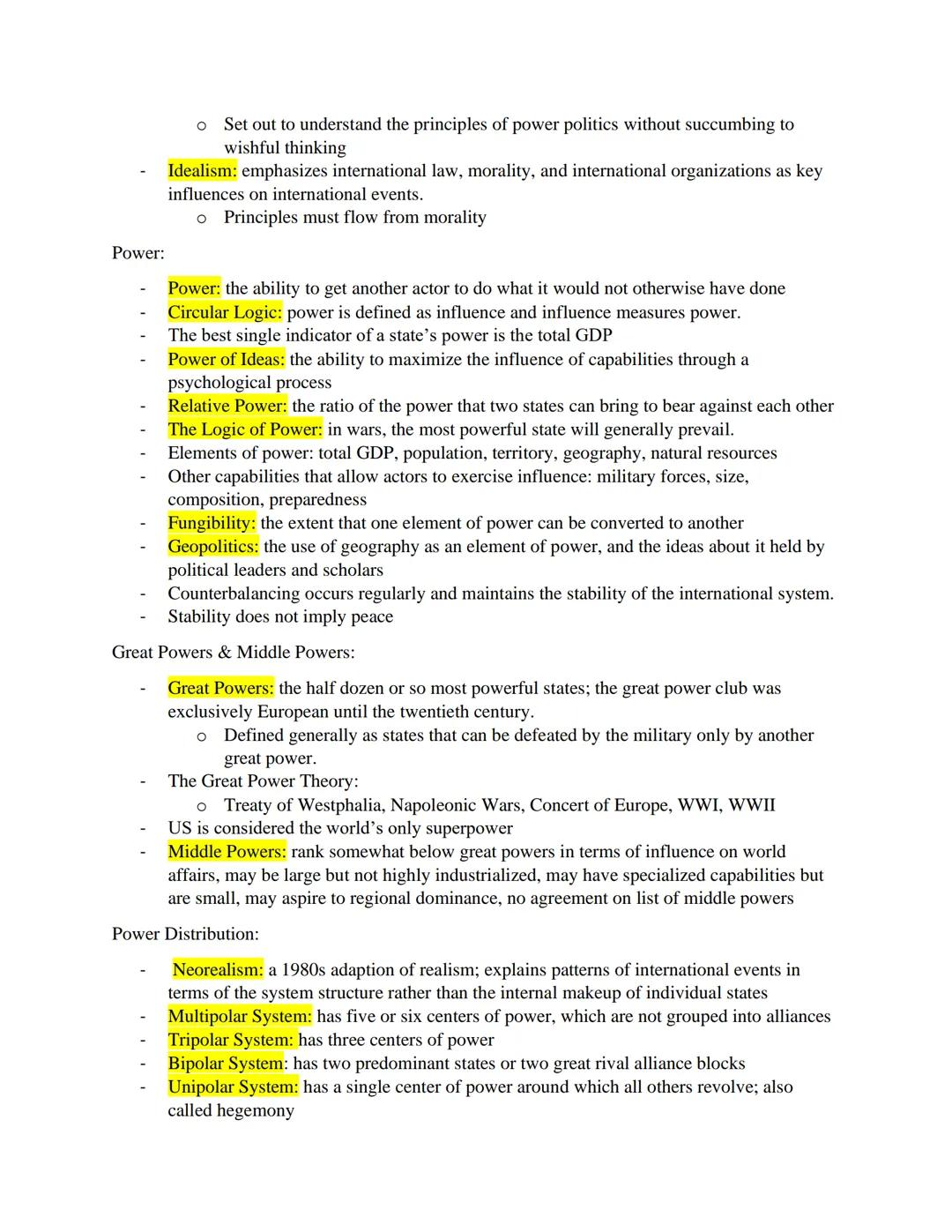
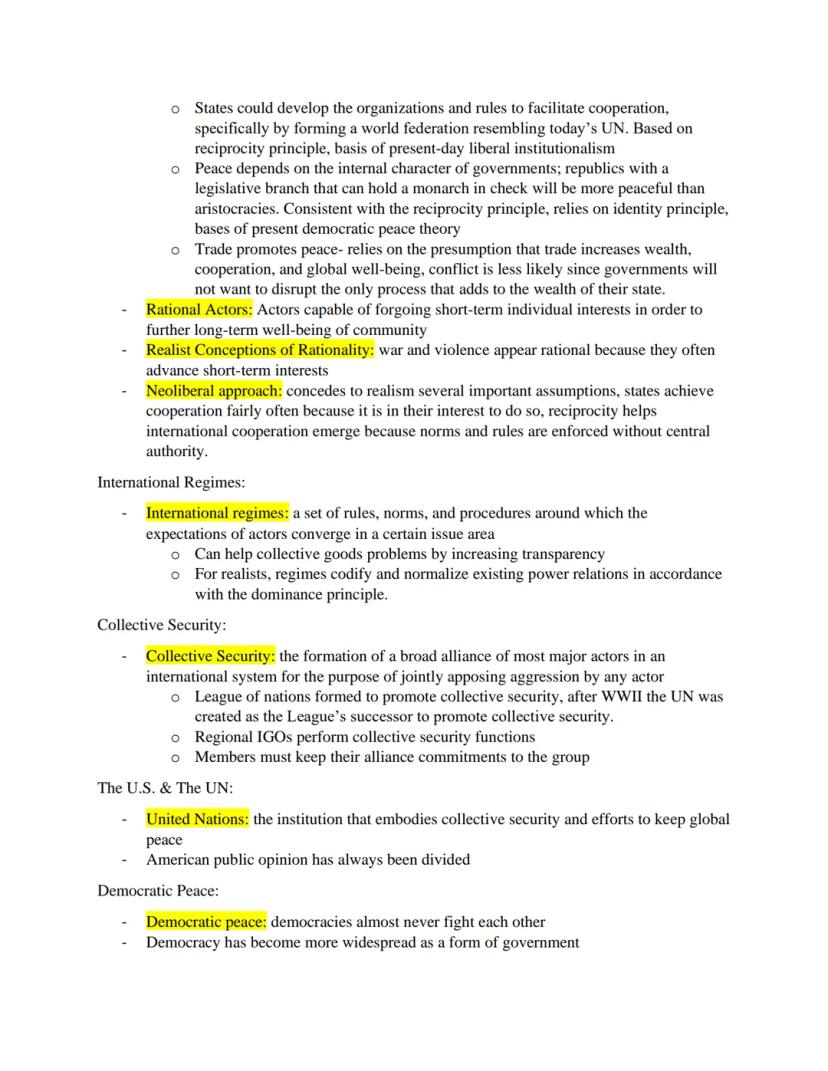
Unlike realists who focus on power, liberal theories see war and violence as irrational deviations that harm everyone's interests. These theories try to explain how peace and cooperation are possible in an anarchic world. Philosopher Immanuel Kant proposed three paths to peace: creating international organizations (like today's UN), spreading democracy, and increasing trade relations.
International regimes are sets of rules, norms, and procedures that help countries cooperate in specific areas. They can solve collective problems by increasing transparency and establishing expectations. The United Nations represents an attempt at collective security - a broad alliance of major actors jointly opposing aggression by any state.
The democratic peace theory suggests that democracies almost never fight each other. This idea has gained popularity as democracy has become more widespread globally, suggesting that promoting democratic governments might reduce international conflict.
Cool Connection: Notice how social media affects international relations today - when people across borders communicate directly, they can develop shared identities that transcend national boundaries, potentially reducing conflict.
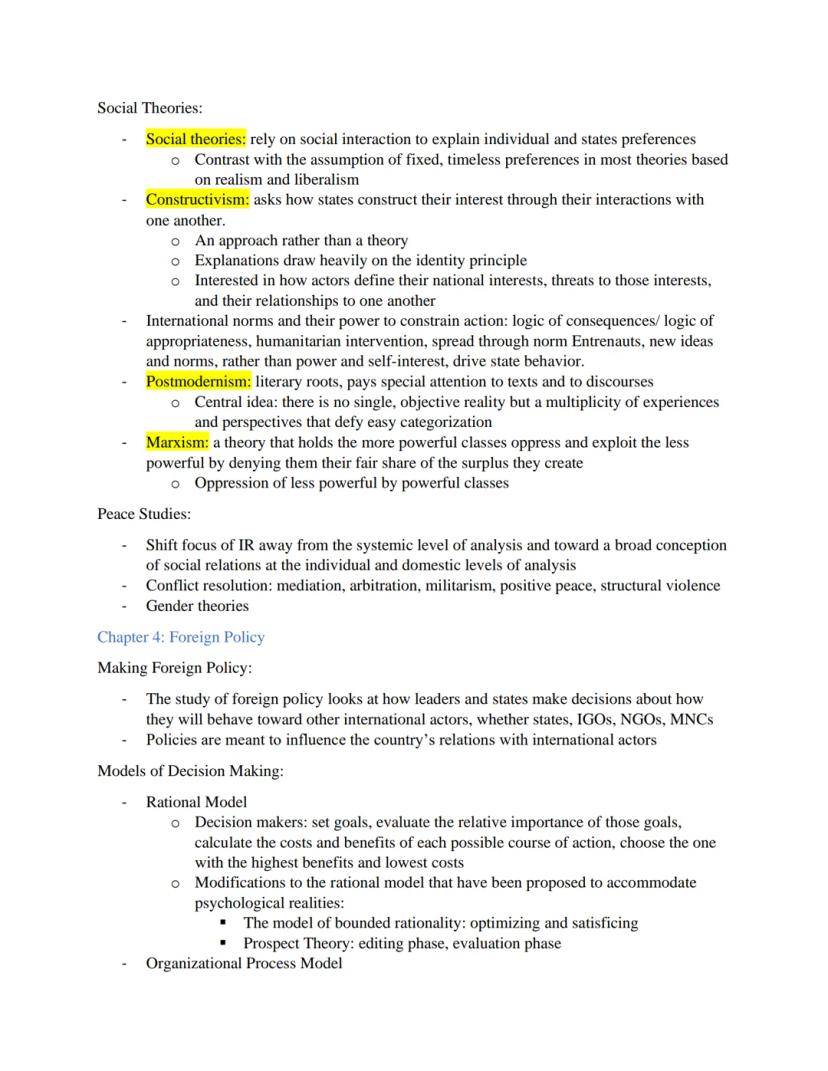
Social theories take a different approach by focusing on how states construct their interests through interaction with each other. Constructivism examines how countries define their national interests and relationships through social processes rather than fixed power calculations. These theories believe new ideas and norms, rather than just power and self-interest, can drive state behavior.
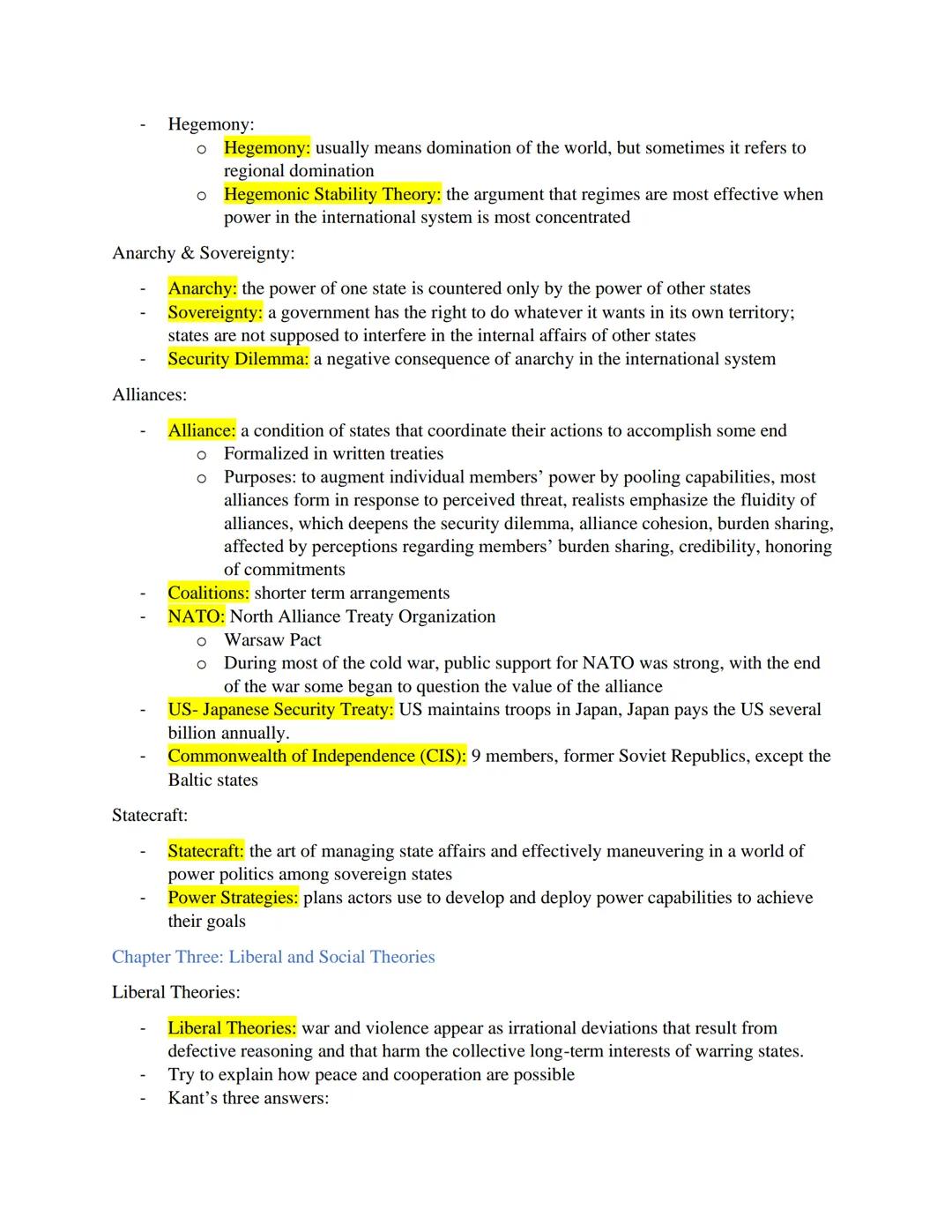
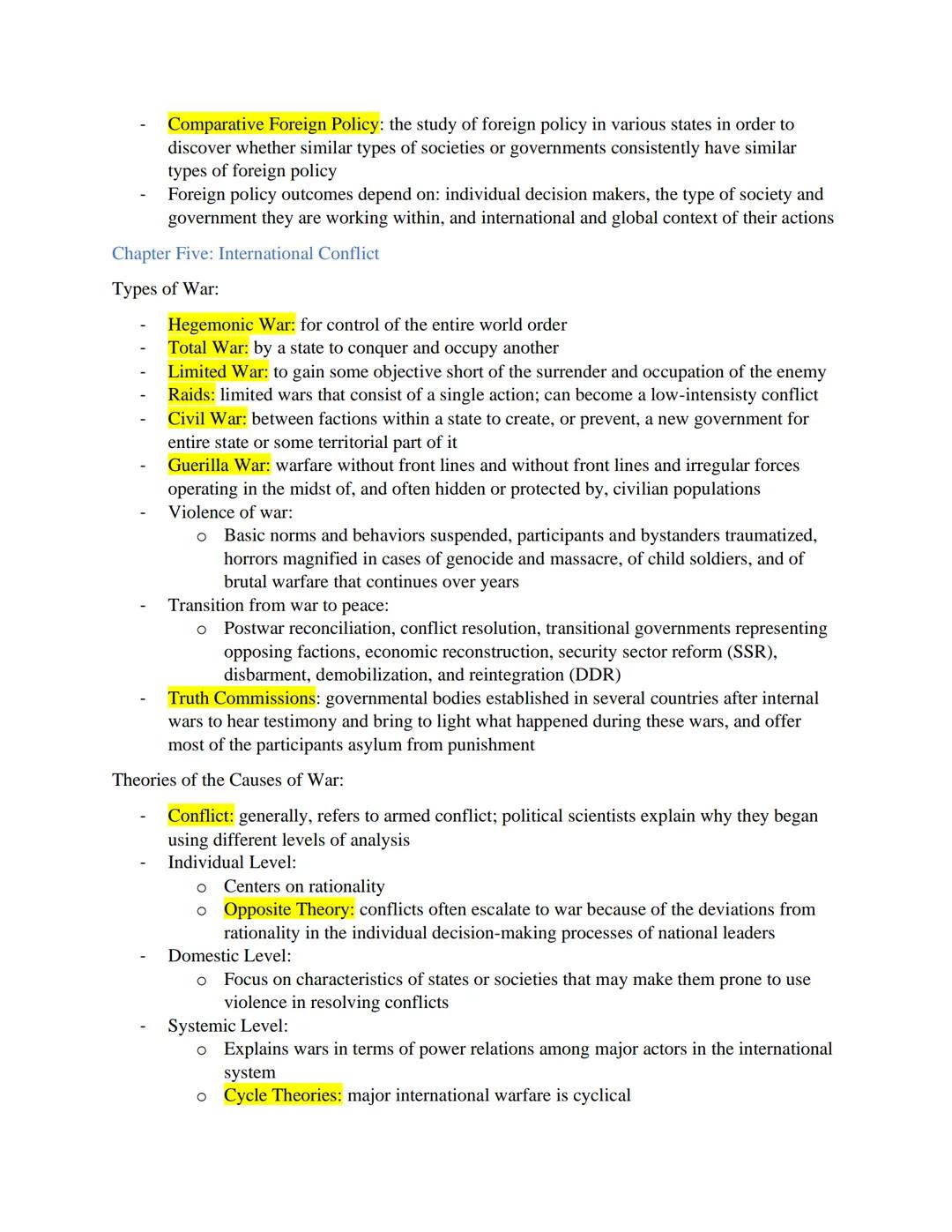
How do countries decide what to do on the world stage? Foreign policy involves complex decisions about how leaders and states will behave toward other international actors. The way these decisions get made can determine whether countries cooperate or conflict.
The rational model assumes decision makers carefully set goals, weigh options, and choose the most beneficial course of action. But humans aren't perfectly rational. Bounded rationality recognizes leaders often "satisfice" - choosing the first acceptable option rather than the perfect one - because they lack time and complete information.
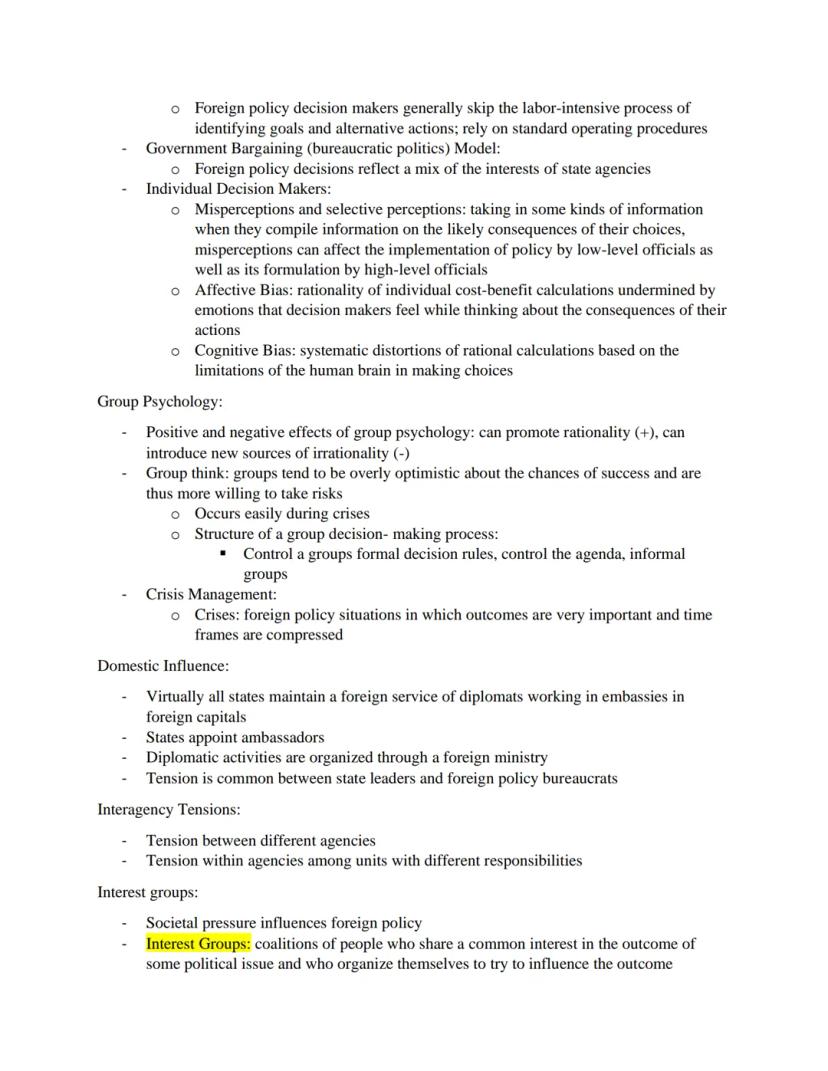
Organizations also shape decisions. The organizational process model shows how foreign policy makers often rely on standard procedures rather than starting from scratch. Meanwhile, the government bargaining model reveals how agencies with different interests negotiate for influence over policy decisions.
Reality Check: During crises, when decisions must be made quickly under stress, leaders are especially prone to mistakes. The Cuban Missile Crisis demonstrates how close the world can come to disaster when time pressures constrain decision making.
Individual psychology matters too. Misperceptions happen when leaders filter information to match existing beliefs. Group think occurs when teams become overconfident and take excessive risks because they value consensus over critical thinking. These psychological factors explain why countries sometimes make foreign policy choices that seem irrational to outside observers.
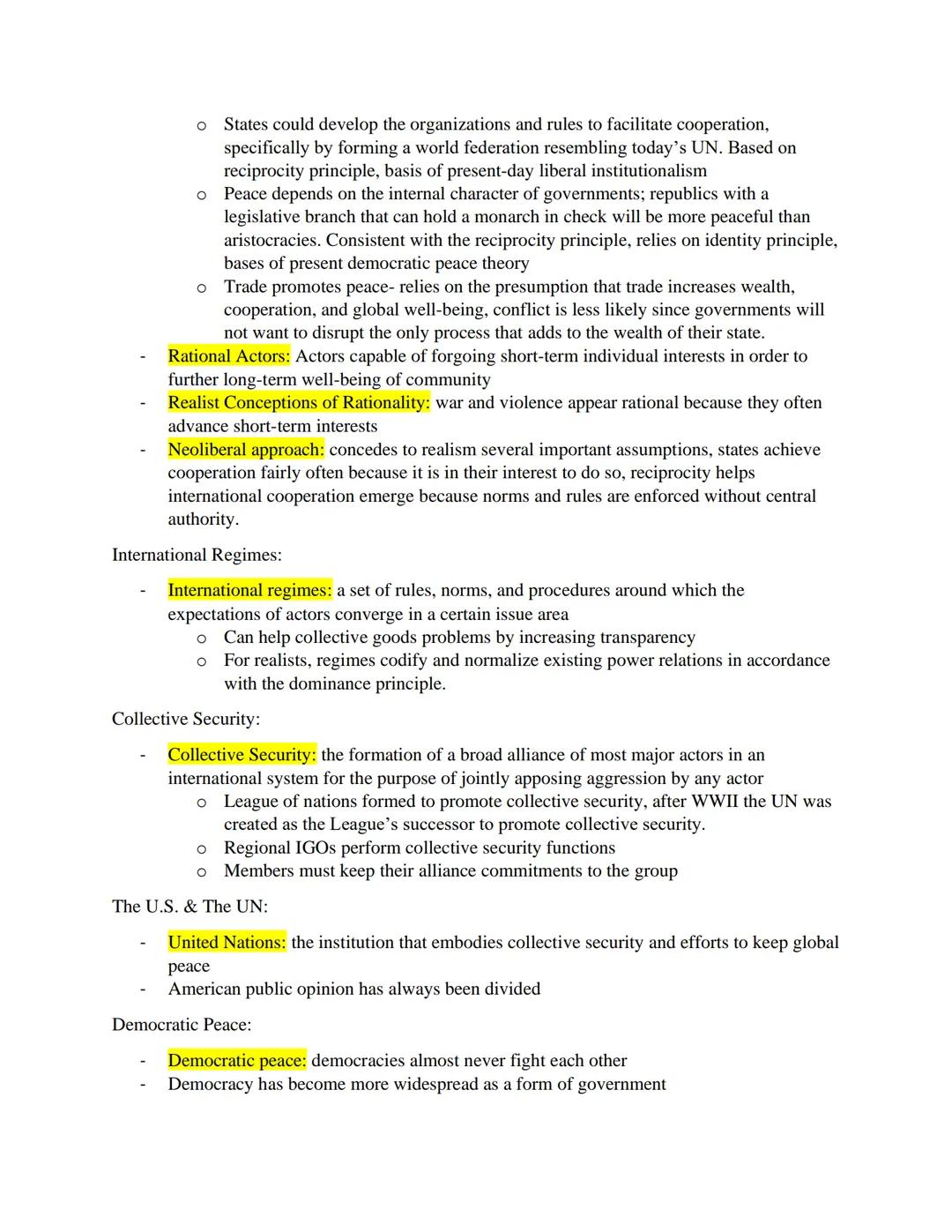
Foreign policy isn't made in a vacuum. Various domestic actors compete to influence their country's international behavior, creating a complex web of pressures on decision makers.
Government agencies often clash over foreign policy. Foreign ministries, defense departments, and intelligence agencies frequently have different priorities and perspectives. These interagency tensions can lead to inconsistent policies or internal power struggles that affect international relations.
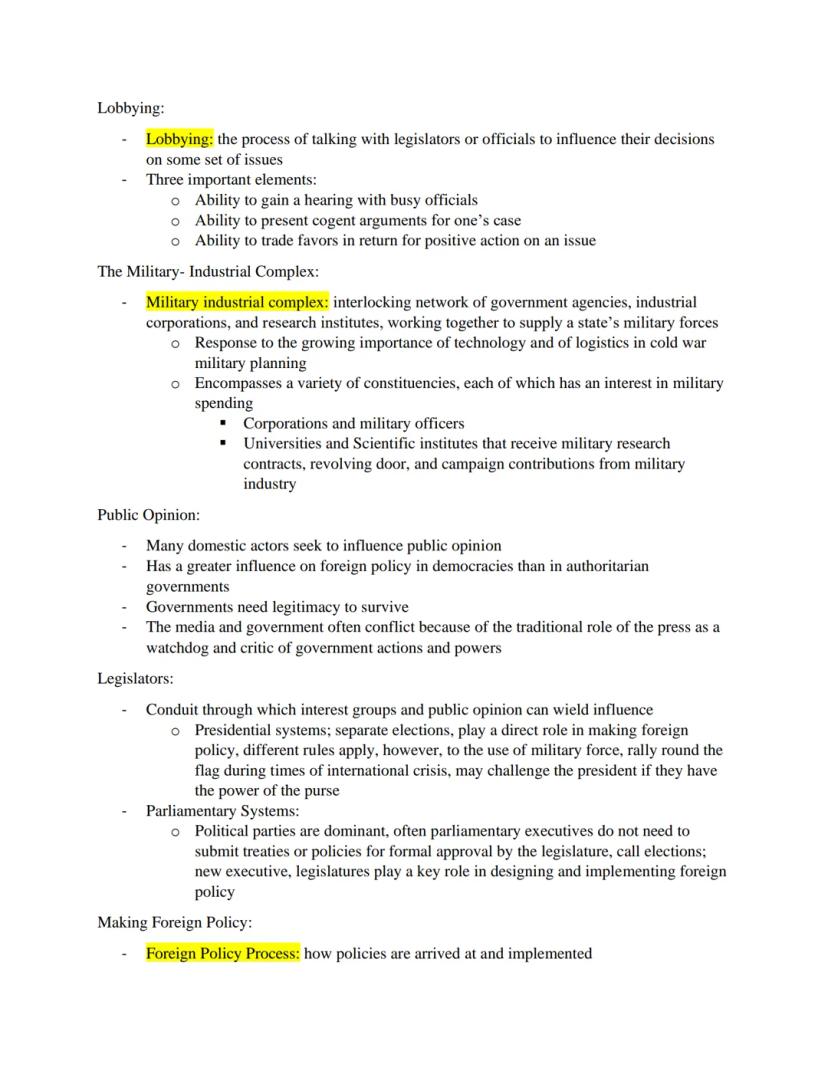
Interest groups organize to influence specific foreign policy issues they care about. Through lobbying, they present arguments to officials, trade favors for support, and build relationships with decision makers. The military-industrial complex represents a particularly powerful network of government agencies, corporations, and research institutes with shared interests in military spending.
Think About It: How much influence should public opinion have on foreign policy? While democracies give citizens more say, foreign affairs often involve complex issues that the public may not fully understand.
Public opinion affects foreign policy differently across systems. In democracies, leaders need public support, especially for major initiatives like war. The media plays a critical role by shaping how citizens view international events. Legislators serve as a conduit for public preferences, with varying powers depending on the system - presidential systems give legislators more independent authority, while parliamentary systems link executive and legislative power more closely.
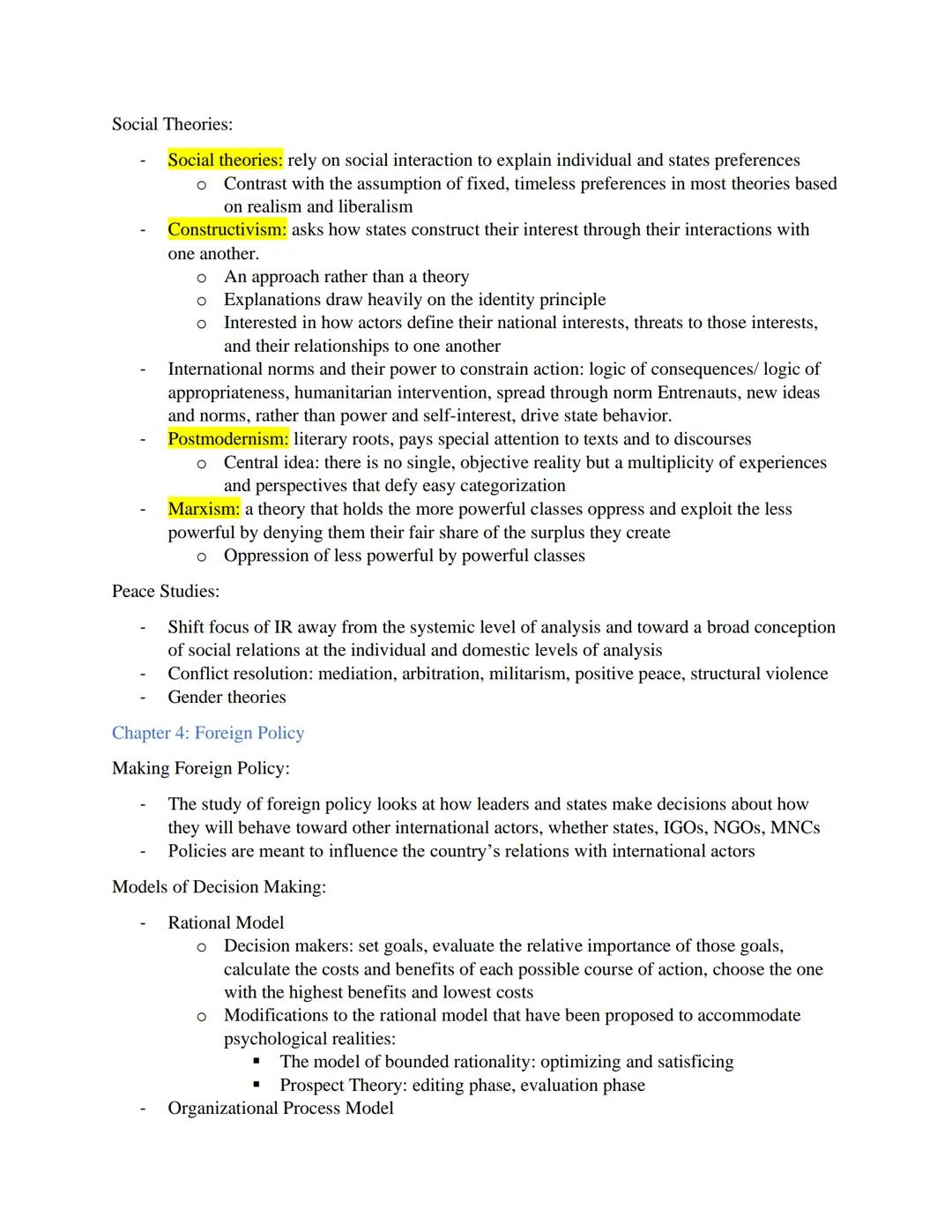
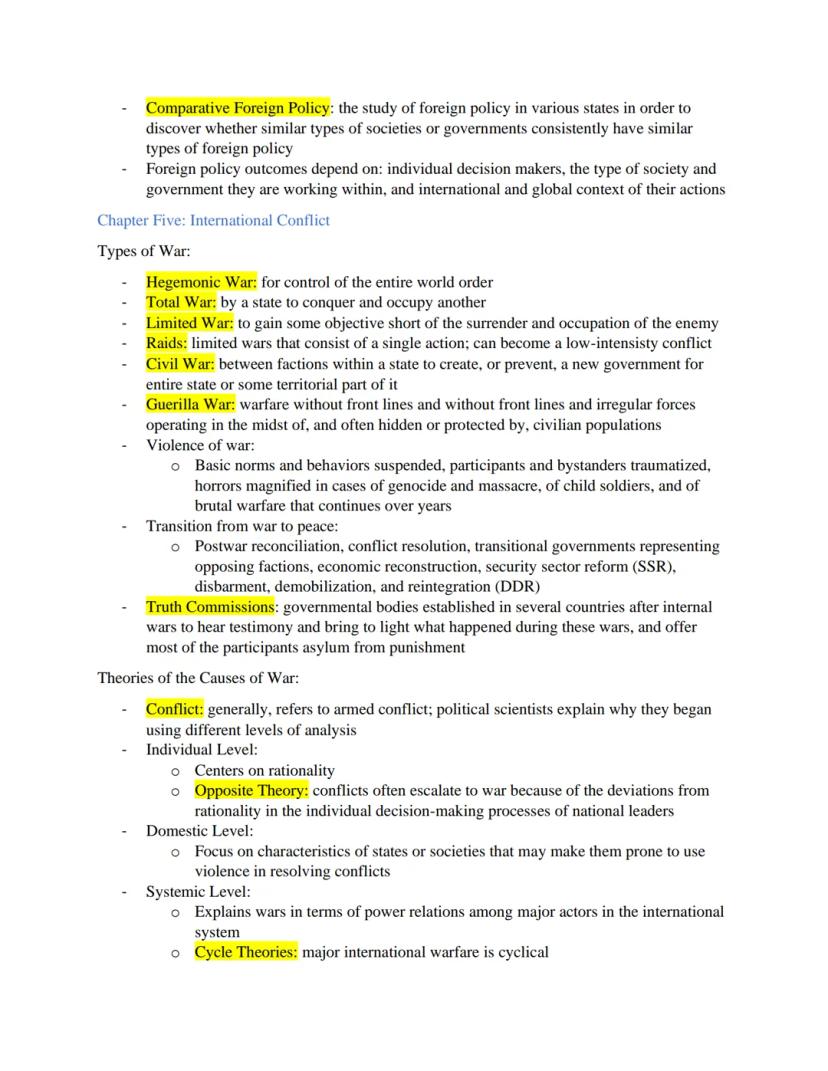
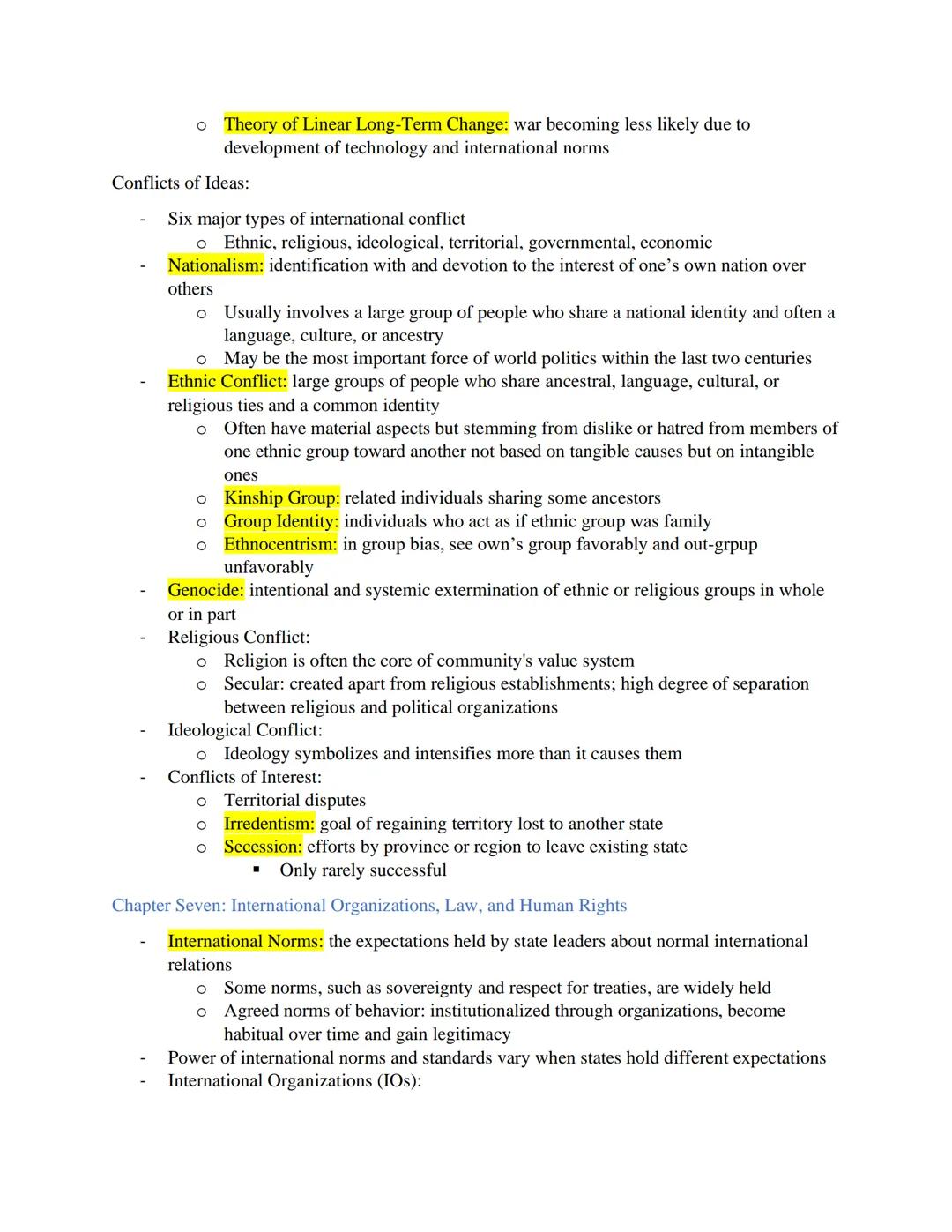
War takes many forms, each with distinct characteristics. Hegemonic wars are fought for control of the entire world order, while total wars aim to conquer and occupy another state. Limited wars pursue specific objectives without seeking the enemy's surrender, and civil wars involve fighting between factions within a single state.
The transition from war to peace requires multiple steps. Post-war reconciliation includes establishing transitional governments, rebuilding economies, and reforming security sectors. Truth commissions help societies face what happened during conflicts by bringing facts to light while offering participants some protection from punishment.
Conflicts can be explained at different levels of analysis. At the individual level, researchers examine how leaders make decisions that lead to war. The domestic level considers how state characteristics might make them prone to violence. The systemic level looks at power relations among major actors in the international system.
Important Insight: Wars often involve both material interests and identity issues. Understanding both dimensions is crucial for conflict resolution.
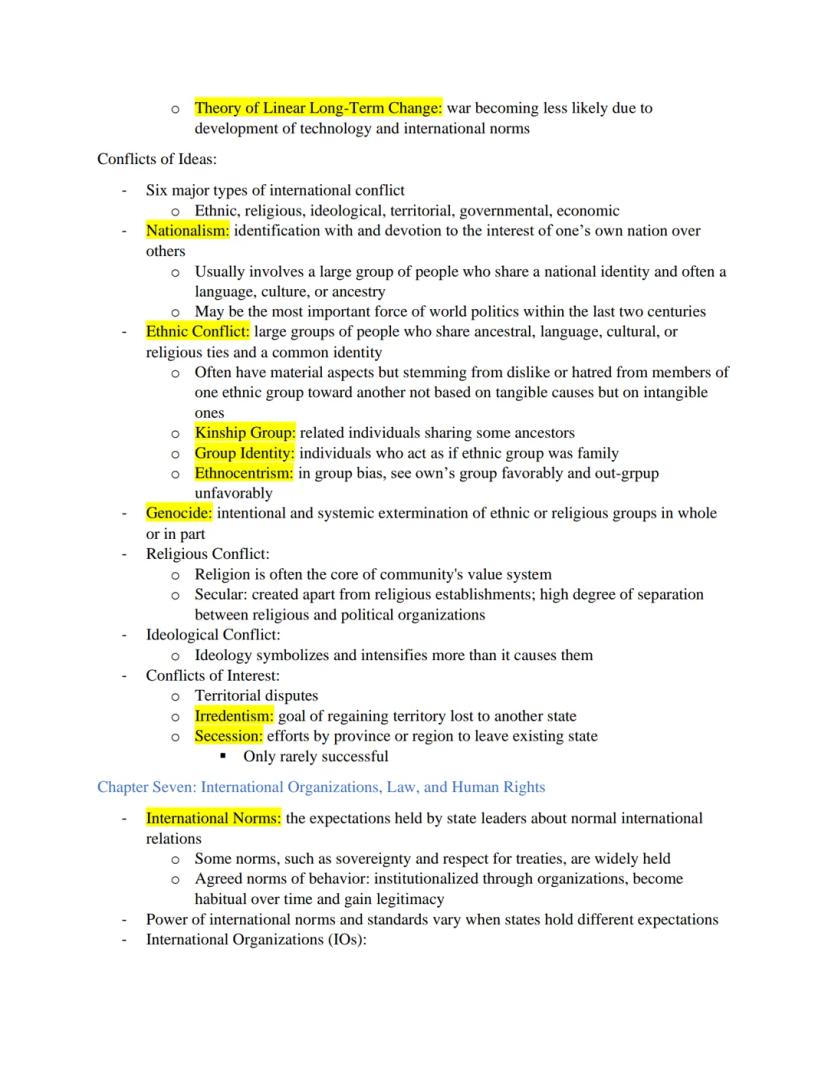
Nationalism - identification with one's own nation over others - may be the most powerful force in modern world politics. It fuels ethnic conflicts based on shared ancestral, language, or cultural ties. Religious and ideological differences can similarly drive international tensions, especially when combined with territorial disputes or government control issues.
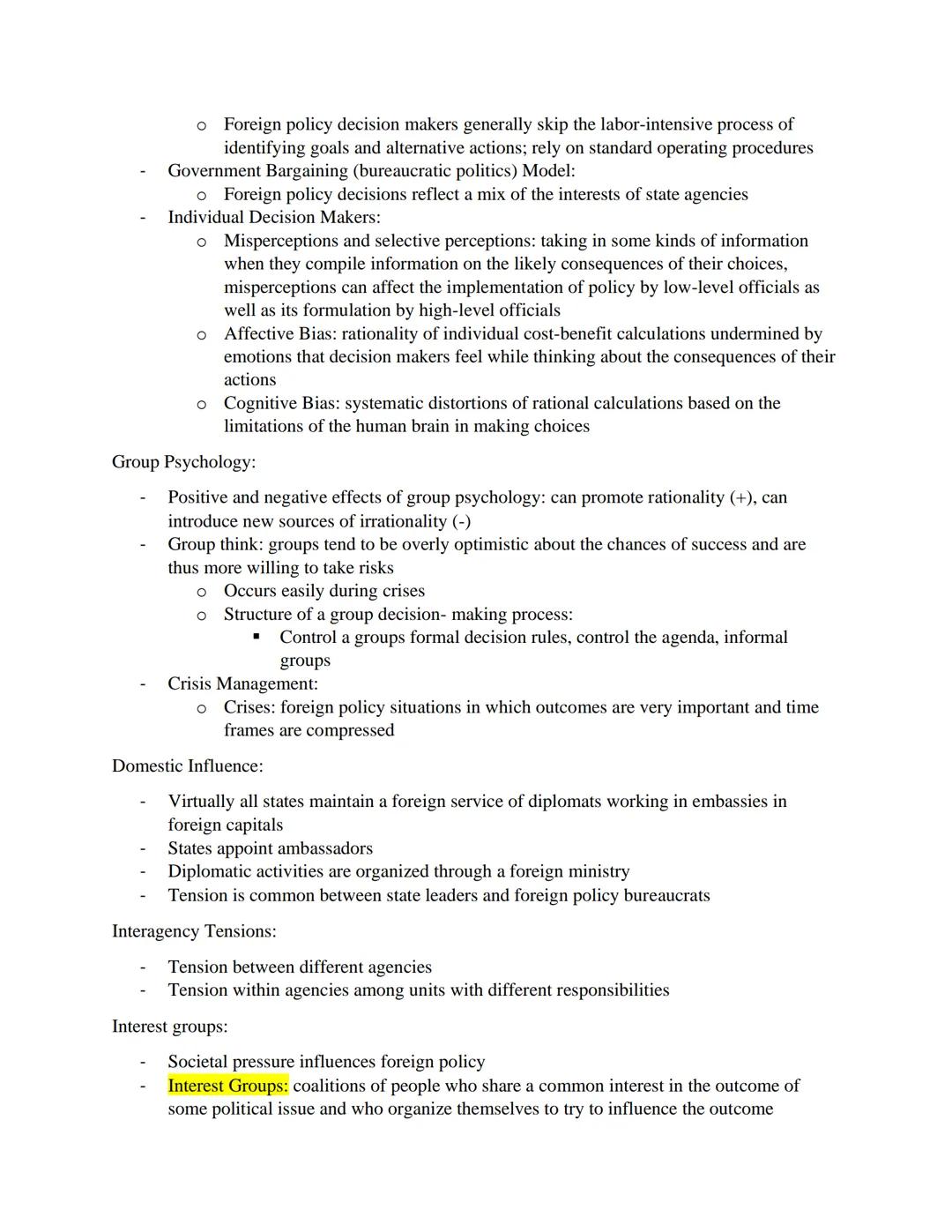
Countries interact within a framework of international norms - shared expectations about normal behavior between states. Some norms, like respecting sovereignty and honoring treaties, are widely accepted and form the foundation of international order. These norms gain strength when they become institutionalized through organizations and practiced over time.
International organizations (IOs) provide structures for countries to cooperate on shared challenges. They range from formal bodies with specific powers to loose forums for discussion. The most ambitious attempt at global governance is the United Nations, which embodies the principle of collective security - countries jointly opposing aggression by any state.
When conflicts arise, international law offers mechanisms for peaceful resolution. However, enforcing these laws remains challenging in a world of sovereign states. The effectiveness of international law depends largely on states' willingness to comply rather than external enforcement.
Key Connection: Notice how international norms evolve over time. Practices once considered acceptable (like colonialism) are now widely condemned, showing how shared expectations can change through advocacy and changing values.
Human rights have become increasingly important in international relations. The idea that all people deserve certain basic protections challenges the traditional notion of absolute sovereignty. When governments severely abuse their citizens, other countries may face difficult choices between respecting sovereignty and protecting human rights through intervention.
Our AI companion is specifically built for the needs of students. Based on the millions of content pieces we have on the platform we can provide truly meaningful and relevant answers to students. But its not only about answers, the companion is even more about guiding students through their daily learning challenges, with personalised study plans, quizzes or content pieces in the chat and 100% personalisation based on the students skills and developments.
You can download the app in the Google Play Store and in the Apple App Store.
That's right! Enjoy free access to study content, connect with fellow students, and get instant help – all at your fingertips.
App Store
Google Play
The app is very easy to use and well designed. I have found everything I was looking for so far and have been able to learn a lot from the presentations! I will definitely use the app for a class assignment! And of course it also helps a lot as an inspiration.
Stefan S
iOS user
This app is really great. There are so many study notes and help [...]. My problem subject is French, for example, and the app has so many options for help. Thanks to this app, I have improved my French. I would recommend it to anyone.
Samantha Klich
Android user
Wow, I am really amazed. I just tried the app because I've seen it advertised many times and was absolutely stunned. This app is THE HELP you want for school and above all, it offers so many things, such as workouts and fact sheets, which have been VERY helpful to me personally.
Anna
iOS user
I think it’s very much worth it and you’ll end up using it a lot once you get the hang of it and even after looking at others notes you can still ask your Artificial intelligence buddy the question and ask to simplify it if you still don’t get it!!! In the end I think it’s worth it 😊👍 ⚠️Also DID I MENTION ITS FREEE YOU DON’T HAVE TO PAY FOR ANYTHING AND STILL GET YOUR GRADES IN PERFECTLY❗️❗️⚠️
Thomas R
iOS user
Knowunity is the BEST app I’ve used in a minute. This is not an ai review or anything this is genuinely coming from a 7th grade student (I know 2011 im young) but dude this app is a 10/10 i have maintained a 3.8 gpa and have plenty of time for gaming. I love it and my mom is just happy I got good grades
Brad T
Android user
Not only did it help me find the answer but it also showed me alternative ways to solve it. I was horrible in math and science but now I have an a in both subjects. Thanks for the help🤍🤍
David K
iOS user
The app's just great! All I have to do is enter the topic in the search bar and I get the response real fast. I don't have to watch 10 YouTube videos to understand something, so I'm saving my time. Highly recommended!
Sudenaz Ocak
Android user
In school I was really bad at maths but thanks to the app, I am doing better now. I am so grateful that you made the app.
Greenlight Bonnie
Android user
I found this app a couple years ago and it has only gotten better since then. I really love it because it can help with written questions and photo questions. Also, it can find study guides that other people have made as well as flashcard sets and practice tests. The free version is also amazing for students who might not be able to afford it. Would 100% recommend
Aubrey
iOS user
Best app if you're in Highschool or Junior high. I have been using this app for 2 school years and it's the best, it's good if you don't have anyone to help you with school work.😋🩷🎀
Marco B
iOS user
THE QUIZES AND FLASHCARDS ARE SO USEFUL AND I LOVE Knowunity AI. IT ALSO IS LITREALLY LIKE CHATGPT BUT SMARTER!! HELPED ME WITH MY MASCARA PROBLEMS TOO!! AS WELL AS MY REAL SUBJECTS ! DUHHH 😍😁😲🤑💗✨🎀😮
Elisha
iOS user
This app is phenomenal down to the correct info and the various topics you can study! I greatly recommend it for people who struggle with procrastination and those who need homework help. It has been perfectly accurate for world 1 history as far as I’ve seen! Geometry too!
Paul T
iOS user
The app is very easy to use and well designed. I have found everything I was looking for so far and have been able to learn a lot from the presentations! I will definitely use the app for a class assignment! And of course it also helps a lot as an inspiration.
Stefan S
iOS user
This app is really great. There are so many study notes and help [...]. My problem subject is French, for example, and the app has so many options for help. Thanks to this app, I have improved my French. I would recommend it to anyone.
Samantha Klich
Android user
Wow, I am really amazed. I just tried the app because I've seen it advertised many times and was absolutely stunned. This app is THE HELP you want for school and above all, it offers so many things, such as workouts and fact sheets, which have been VERY helpful to me personally.
Anna
iOS user
I think it’s very much worth it and you’ll end up using it a lot once you get the hang of it and even after looking at others notes you can still ask your Artificial intelligence buddy the question and ask to simplify it if you still don’t get it!!! In the end I think it’s worth it 😊👍 ⚠️Also DID I MENTION ITS FREEE YOU DON’T HAVE TO PAY FOR ANYTHING AND STILL GET YOUR GRADES IN PERFECTLY❗️❗️⚠️
Thomas R
iOS user
Knowunity is the BEST app I’ve used in a minute. This is not an ai review or anything this is genuinely coming from a 7th grade student (I know 2011 im young) but dude this app is a 10/10 i have maintained a 3.8 gpa and have plenty of time for gaming. I love it and my mom is just happy I got good grades
Brad T
Android user
Not only did it help me find the answer but it also showed me alternative ways to solve it. I was horrible in math and science but now I have an a in both subjects. Thanks for the help🤍🤍
David K
iOS user
The app's just great! All I have to do is enter the topic in the search bar and I get the response real fast. I don't have to watch 10 YouTube videos to understand something, so I'm saving my time. Highly recommended!
Sudenaz Ocak
Android user
In school I was really bad at maths but thanks to the app, I am doing better now. I am so grateful that you made the app.
Greenlight Bonnie
Android user
I found this app a couple years ago and it has only gotten better since then. I really love it because it can help with written questions and photo questions. Also, it can find study guides that other people have made as well as flashcard sets and practice tests. The free version is also amazing for students who might not be able to afford it. Would 100% recommend
Aubrey
iOS user
Best app if you're in Highschool or Junior high. I have been using this app for 2 school years and it's the best, it's good if you don't have anyone to help you with school work.😋🩷🎀
Marco B
iOS user
THE QUIZES AND FLASHCARDS ARE SO USEFUL AND I LOVE Knowunity AI. IT ALSO IS LITREALLY LIKE CHATGPT BUT SMARTER!! HELPED ME WITH MY MASCARA PROBLEMS TOO!! AS WELL AS MY REAL SUBJECTS ! DUHHH 😍😁😲🤑💗✨🎀😮
Elisha
iOS user
This app is phenomenal down to the correct info and the various topics you can study! I greatly recommend it for people who struggle with procrastination and those who need homework help. It has been perfectly accurate for world 1 history as far as I’ve seen! Geometry too!
Paul T
iOS user
payton federmann
@paytonfedermann_ytau
International Relations covers the complex interactions between nations in our increasingly connected world. This study explores how countries develop relationships, navigate conflicts, and form alliances within the global system. Understanding these dynamics helps explain everything from trade agreements to war,... Show more
Access to all documents
Improve your grades
Join milions of students
Ever wonder how countries interact with each other in our connected world? International relations focuses on relationships among the world's governments within a global system that's becoming increasingly interconnected. Globalization brings both benefits (global trade networks, instant communication) and challenges (Brexit, rising nationalism).
The world is divided by the North-South Gap, the most significant geographical division at the global level. This separation between wealthy and developing nations affects almost every aspect of international relations. When countries need to work together, they often face the Collective Goods Problem - how to provide something beneficial to everyone regardless of individual contributions.
Three principles offer solutions to international cooperation challenges: dominance (power hierarchies), reciprocity , and identity .
Quick Tip: When analyzing international events, consider which actors are involved - states remain the principal players, but non-state actors like multinational corporations and intergovernmental organizations are increasingly important.
The international system operates at three levels of analysis: individual (human choices), domestic (internal state factors), and systemic (interactions between states). Major historical events like World Wars I and II and the Cold War have fundamentally shaped how this system functions today.
Access to all documents
Improve your grades
Join milions of students
Imagine international politics as a chess game where power determines who wins. Realism explains international relations primarily through power dynamics rather than morality or cooperation. Realists believe the world operates on the principle of dominance – stronger states naturally control weaker ones in an endless competition.
Power is the ability to make another actor do what it wouldn't otherwise do. While military strength matters, a state's total GDP is the best single indicator of its power. Other elements include population size, territory, geography, and natural resources. Great powers are typically defined as states that can only be defeated militarily by another great power.
In the international system, states exist in a condition of anarchy – there's no higher authority above them to enforce rules. This creates a security dilemma where actions taken by one state to increase its security often make others feel threatened, potentially leading to conflict. To address this, states form alliances to coordinate their actions and pool their capabilities.
Remember: The international system can be organized in different ways: multipolar , bipolar (two dominant powers), or unipolar (single dominant power or hegemony).
Power distribution changes over time. Since the end of the Cold War, some argue the US became the world's only superpower, creating a unipolar moment. However, realists believe other powers will eventually rise to challenge this dominance, maintaining the balance of power that brings stability (though not necessarily peace) to the system.
Access to all documents
Improve your grades
Join milions of students
Unlike realists who focus on power, liberal theories see war and violence as irrational deviations that harm everyone's interests. These theories try to explain how peace and cooperation are possible in an anarchic world. Philosopher Immanuel Kant proposed three paths to peace: creating international organizations (like today's UN), spreading democracy, and increasing trade relations.
International regimes are sets of rules, norms, and procedures that help countries cooperate in specific areas. They can solve collective problems by increasing transparency and establishing expectations. The United Nations represents an attempt at collective security - a broad alliance of major actors jointly opposing aggression by any state.
The democratic peace theory suggests that democracies almost never fight each other. This idea has gained popularity as democracy has become more widespread globally, suggesting that promoting democratic governments might reduce international conflict.
Cool Connection: Notice how social media affects international relations today - when people across borders communicate directly, they can develop shared identities that transcend national boundaries, potentially reducing conflict.
Social theories take a different approach by focusing on how states construct their interests through interaction with each other. Constructivism examines how countries define their national interests and relationships through social processes rather than fixed power calculations. These theories believe new ideas and norms, rather than just power and self-interest, can drive state behavior.
Access to all documents
Improve your grades
Join milions of students
How do countries decide what to do on the world stage? Foreign policy involves complex decisions about how leaders and states will behave toward other international actors. The way these decisions get made can determine whether countries cooperate or conflict.
The rational model assumes decision makers carefully set goals, weigh options, and choose the most beneficial course of action. But humans aren't perfectly rational. Bounded rationality recognizes leaders often "satisfice" - choosing the first acceptable option rather than the perfect one - because they lack time and complete information.
Organizations also shape decisions. The organizational process model shows how foreign policy makers often rely on standard procedures rather than starting from scratch. Meanwhile, the government bargaining model reveals how agencies with different interests negotiate for influence over policy decisions.
Reality Check: During crises, when decisions must be made quickly under stress, leaders are especially prone to mistakes. The Cuban Missile Crisis demonstrates how close the world can come to disaster when time pressures constrain decision making.
Individual psychology matters too. Misperceptions happen when leaders filter information to match existing beliefs. Group think occurs when teams become overconfident and take excessive risks because they value consensus over critical thinking. These psychological factors explain why countries sometimes make foreign policy choices that seem irrational to outside observers.
Access to all documents
Improve your grades
Join milions of students
Foreign policy isn't made in a vacuum. Various domestic actors compete to influence their country's international behavior, creating a complex web of pressures on decision makers.
Government agencies often clash over foreign policy. Foreign ministries, defense departments, and intelligence agencies frequently have different priorities and perspectives. These interagency tensions can lead to inconsistent policies or internal power struggles that affect international relations.
Interest groups organize to influence specific foreign policy issues they care about. Through lobbying, they present arguments to officials, trade favors for support, and build relationships with decision makers. The military-industrial complex represents a particularly powerful network of government agencies, corporations, and research institutes with shared interests in military spending.
Think About It: How much influence should public opinion have on foreign policy? While democracies give citizens more say, foreign affairs often involve complex issues that the public may not fully understand.
Public opinion affects foreign policy differently across systems. In democracies, leaders need public support, especially for major initiatives like war. The media plays a critical role by shaping how citizens view international events. Legislators serve as a conduit for public preferences, with varying powers depending on the system - presidential systems give legislators more independent authority, while parliamentary systems link executive and legislative power more closely.
Access to all documents
Improve your grades
Join milions of students
War takes many forms, each with distinct characteristics. Hegemonic wars are fought for control of the entire world order, while total wars aim to conquer and occupy another state. Limited wars pursue specific objectives without seeking the enemy's surrender, and civil wars involve fighting between factions within a single state.
The transition from war to peace requires multiple steps. Post-war reconciliation includes establishing transitional governments, rebuilding economies, and reforming security sectors. Truth commissions help societies face what happened during conflicts by bringing facts to light while offering participants some protection from punishment.
Conflicts can be explained at different levels of analysis. At the individual level, researchers examine how leaders make decisions that lead to war. The domestic level considers how state characteristics might make them prone to violence. The systemic level looks at power relations among major actors in the international system.
Important Insight: Wars often involve both material interests and identity issues. Understanding both dimensions is crucial for conflict resolution.
Nationalism - identification with one's own nation over others - may be the most powerful force in modern world politics. It fuels ethnic conflicts based on shared ancestral, language, or cultural ties. Religious and ideological differences can similarly drive international tensions, especially when combined with territorial disputes or government control issues.
Access to all documents
Improve your grades
Join milions of students
Countries interact within a framework of international norms - shared expectations about normal behavior between states. Some norms, like respecting sovereignty and honoring treaties, are widely accepted and form the foundation of international order. These norms gain strength when they become institutionalized through organizations and practiced over time.
International organizations (IOs) provide structures for countries to cooperate on shared challenges. They range from formal bodies with specific powers to loose forums for discussion. The most ambitious attempt at global governance is the United Nations, which embodies the principle of collective security - countries jointly opposing aggression by any state.
When conflicts arise, international law offers mechanisms for peaceful resolution. However, enforcing these laws remains challenging in a world of sovereign states. The effectiveness of international law depends largely on states' willingness to comply rather than external enforcement.
Key Connection: Notice how international norms evolve over time. Practices once considered acceptable (like colonialism) are now widely condemned, showing how shared expectations can change through advocacy and changing values.
Human rights have become increasingly important in international relations. The idea that all people deserve certain basic protections challenges the traditional notion of absolute sovereignty. When governments severely abuse their citizens, other countries may face difficult choices between respecting sovereignty and protecting human rights through intervention.
Access to all documents
Improve your grades
Join milions of students
Access to all documents
Improve your grades
Join milions of students
Access to all documents
Improve your grades
Join milions of students
Our AI companion is specifically built for the needs of students. Based on the millions of content pieces we have on the platform we can provide truly meaningful and relevant answers to students. But its not only about answers, the companion is even more about guiding students through their daily learning challenges, with personalised study plans, quizzes or content pieces in the chat and 100% personalisation based on the students skills and developments.
You can download the app in the Google Play Store and in the Apple App Store.
That's right! Enjoy free access to study content, connect with fellow students, and get instant help – all at your fingertips.
4
Smart Tools NEW
Transform this note into: ✓ 50+ Practice Questions ✓ Interactive Flashcards ✓ Full Practice Test ✓ Essay Outlines
AP World History notes on global conflict after 1900. In a Cornell style, full with details and descriptions of the major events for this course unit
 Social Studies
IB History World War 2 Notes on Japanese Imperialism and expansion. Notes for the HL International Baccalaureate History Course.
Social StudiesHistory Study Note
 Fun Stuff
App Store
Google Play
The app is very easy to use and well designed. I have found everything I was looking for so far and have been able to learn a lot from the presentations! I will definitely use the app for a class assignment! And of course it also helps a lot as an inspiration.
Stefan S
iOS user
This app is really great. There are so many study notes and help [...]. My problem subject is French, for example, and the app has so many options for help. Thanks to this app, I have improved my French. I would recommend it to anyone.
Samantha Klich
Android user
Wow, I am really amazed. I just tried the app because I've seen it advertised many times and was absolutely stunned. This app is THE HELP you want for school and above all, it offers so many things, such as workouts and fact sheets, which have been VERY helpful to me personally.
Anna
iOS user
I think it’s very much worth it and you’ll end up using it a lot once you get the hang of it and even after looking at others notes you can still ask your Artificial intelligence buddy the question and ask to simplify it if you still don’t get it!!! In the end I think it’s worth it 😊👍 ⚠️Also DID I MENTION ITS FREEE YOU DON’T HAVE TO PAY FOR ANYTHING AND STILL GET YOUR GRADES IN PERFECTLY❗️❗️⚠️
Thomas R
iOS user
Knowunity is the BEST app I’ve used in a minute. This is not an ai review or anything this is genuinely coming from a 7th grade student (I know 2011 im young) but dude this app is a 10/10 i have maintained a 3.8 gpa and have plenty of time for gaming. I love it and my mom is just happy I got good grades
Brad T
Android user
Not only did it help me find the answer but it also showed me alternative ways to solve it. I was horrible in math and science but now I have an a in both subjects. Thanks for the help🤍🤍
David K
iOS user
The app's just great! All I have to do is enter the topic in the search bar and I get the response real fast. I don't have to watch 10 YouTube videos to understand something, so I'm saving my time. Highly recommended!
Sudenaz Ocak
Android user
In school I was really bad at maths but thanks to the app, I am doing better now. I am so grateful that you made the app.
Greenlight Bonnie
Android user
I found this app a couple years ago and it has only gotten better since then. I really love it because it can help with written questions and photo questions. Also, it can find study guides that other people have made as well as flashcard sets and practice tests. The free version is also amazing for students who might not be able to afford it. Would 100% recommend
Aubrey
iOS user
Best app if you're in Highschool or Junior high. I have been using this app for 2 school years and it's the best, it's good if you don't have anyone to help you with school work.😋🩷🎀
Marco B
iOS user
THE QUIZES AND FLASHCARDS ARE SO USEFUL AND I LOVE Knowunity AI. IT ALSO IS LITREALLY LIKE CHATGPT BUT SMARTER!! HELPED ME WITH MY MASCARA PROBLEMS TOO!! AS WELL AS MY REAL SUBJECTS ! DUHHH 😍😁😲🤑💗✨🎀😮
Elisha
iOS user
This app is phenomenal down to the correct info and the various topics you can study! I greatly recommend it for people who struggle with procrastination and those who need homework help. It has been perfectly accurate for world 1 history as far as I’ve seen! Geometry too!
Paul T
iOS user
The app is very easy to use and well designed. I have found everything I was looking for so far and have been able to learn a lot from the presentations! I will definitely use the app for a class assignment! And of course it also helps a lot as an inspiration.
Stefan S
iOS user
This app is really great. There are so many study notes and help [...]. My problem subject is French, for example, and the app has so many options for help. Thanks to this app, I have improved my French. I would recommend it to anyone.
Samantha Klich
Android user
Wow, I am really amazed. I just tried the app because I've seen it advertised many times and was absolutely stunned. This app is THE HELP you want for school and above all, it offers so many things, such as workouts and fact sheets, which have been VERY helpful to me personally.
Anna
iOS user
I think it’s very much worth it and you’ll end up using it a lot once you get the hang of it and even after looking at others notes you can still ask your Artificial intelligence buddy the question and ask to simplify it if you still don’t get it!!! In the end I think it’s worth it 😊👍 ⚠️Also DID I MENTION ITS FREEE YOU DON’T HAVE TO PAY FOR ANYTHING AND STILL GET YOUR GRADES IN PERFECTLY❗️❗️⚠️
Thomas R
iOS user
Knowunity is the BEST app I’ve used in a minute. This is not an ai review or anything this is genuinely coming from a 7th grade student (I know 2011 im young) but dude this app is a 10/10 i have maintained a 3.8 gpa and have plenty of time for gaming. I love it and my mom is just happy I got good grades
Brad T
Android user
Not only did it help me find the answer but it also showed me alternative ways to solve it. I was horrible in math and science but now I have an a in both subjects. Thanks for the help🤍🤍
David K
iOS user
The app's just great! All I have to do is enter the topic in the search bar and I get the response real fast. I don't have to watch 10 YouTube videos to understand something, so I'm saving my time. Highly recommended!
Sudenaz Ocak
Android user
In school I was really bad at maths but thanks to the app, I am doing better now. I am so grateful that you made the app.
Greenlight Bonnie
Android user
I found this app a couple years ago and it has only gotten better since then. I really love it because it can help with written questions and photo questions. Also, it can find study guides that other people have made as well as flashcard sets and practice tests. The free version is also amazing for students who might not be able to afford it. Would 100% recommend
Aubrey
iOS user
Best app if you're in Highschool or Junior high. I have been using this app for 2 school years and it's the best, it's good if you don't have anyone to help you with school work.😋🩷🎀
Marco B
iOS user
THE QUIZES AND FLASHCARDS ARE SO USEFUL AND I LOVE Knowunity AI. IT ALSO IS LITREALLY LIKE CHATGPT BUT SMARTER!! HELPED ME WITH MY MASCARA PROBLEMS TOO!! AS WELL AS MY REAL SUBJECTS ! DUHHH 😍😁😲🤑💗✨🎀😮
Elisha
iOS user
This app is phenomenal down to the correct info and the various topics you can study! I greatly recommend it for people who struggle with procrastination and those who need homework help. It has been perfectly accurate for world 1 history as far as I’ve seen! Geometry too!
Paul T
iOS user