
X-rays revolutionized medicine and dentistry when discovered in 1895 by... Show more
 Fun Stuff
 Algebra
 Biology
Sign up to see the contentIt's free!
Access to all documents
Improve your grades
Join milions of students
Knowunity AI
Subjects
Triangle Congruence and Similarity Theorems
Triangle Properties and Classification
Linear Equations and Graphs
Geometric Angle Relationships
Trigonometric Functions and Identities
Equation Solving Techniques
Circle Geometry Fundamentals
Division Operations and Methods
Basic Differentiation Rules
Exponent and Logarithm Properties
Show all topics
Human Organ Systems
Reproductive Cell Cycles
Biological Sciences Subdisciplines
Cellular Energy Metabolism
Autotrophic Energy Processes
Inheritance Patterns and Principles
Biomolecular Structure and Organization
Cell Cycle and Division Mechanics
Cellular Organization and Development
Biological Structural Organization
Show all topics
Chemical Sciences and Applications
Atomic Structure and Composition
Molecular Electron Structure Representation
Atomic Electron Behavior
Matter Properties and Water
Mole Concept and Calculations
Gas Laws and Behavior
Periodic Table Organization
Chemical Thermodynamics Fundamentals
Chemical Bond Types and Properties
Show all topics
European Renaissance and Enlightenment
European Cultural Movements 800-1920
American Revolution Era 1763-1797
American Civil War 1861-1865
Global Imperial Systems
Mongol and Chinese Dynasties
U.S. Presidents and World Leaders
Historical Sources and Documentation
World Wars Era and Impact
World Religious Systems
Show all topics
Classic and Contemporary Novels
Literary Character Analysis
Rhetorical Theory and Practice
Classic Literary Narratives
Reading Analysis and Interpretation
Narrative Structure and Techniques
English Language Components
Influential English-Language Authors
Basic Sentence Structure
Narrative Voice and Perspective
Show all topics
62
•
Updated Mar 20, 2026
•

Amarri Manning
@marrianning_jvvh
X-rays revolutionized medicine and dentistry when discovered in 1895 by... Show more
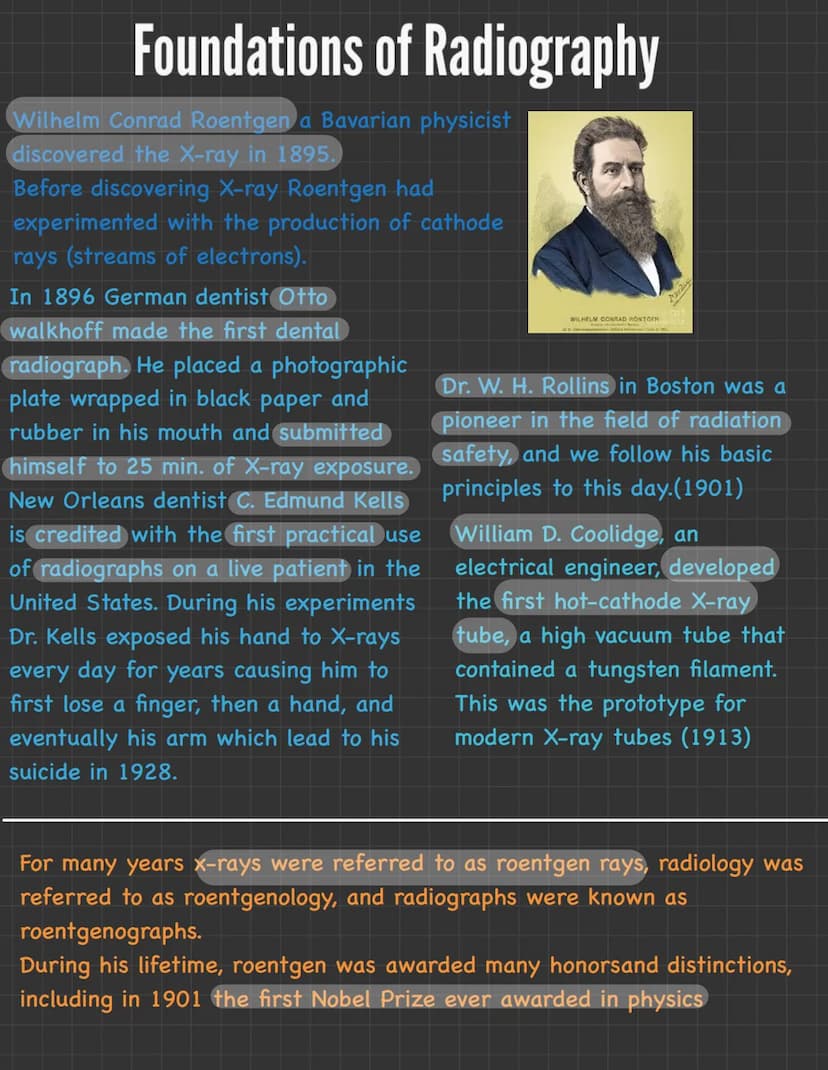

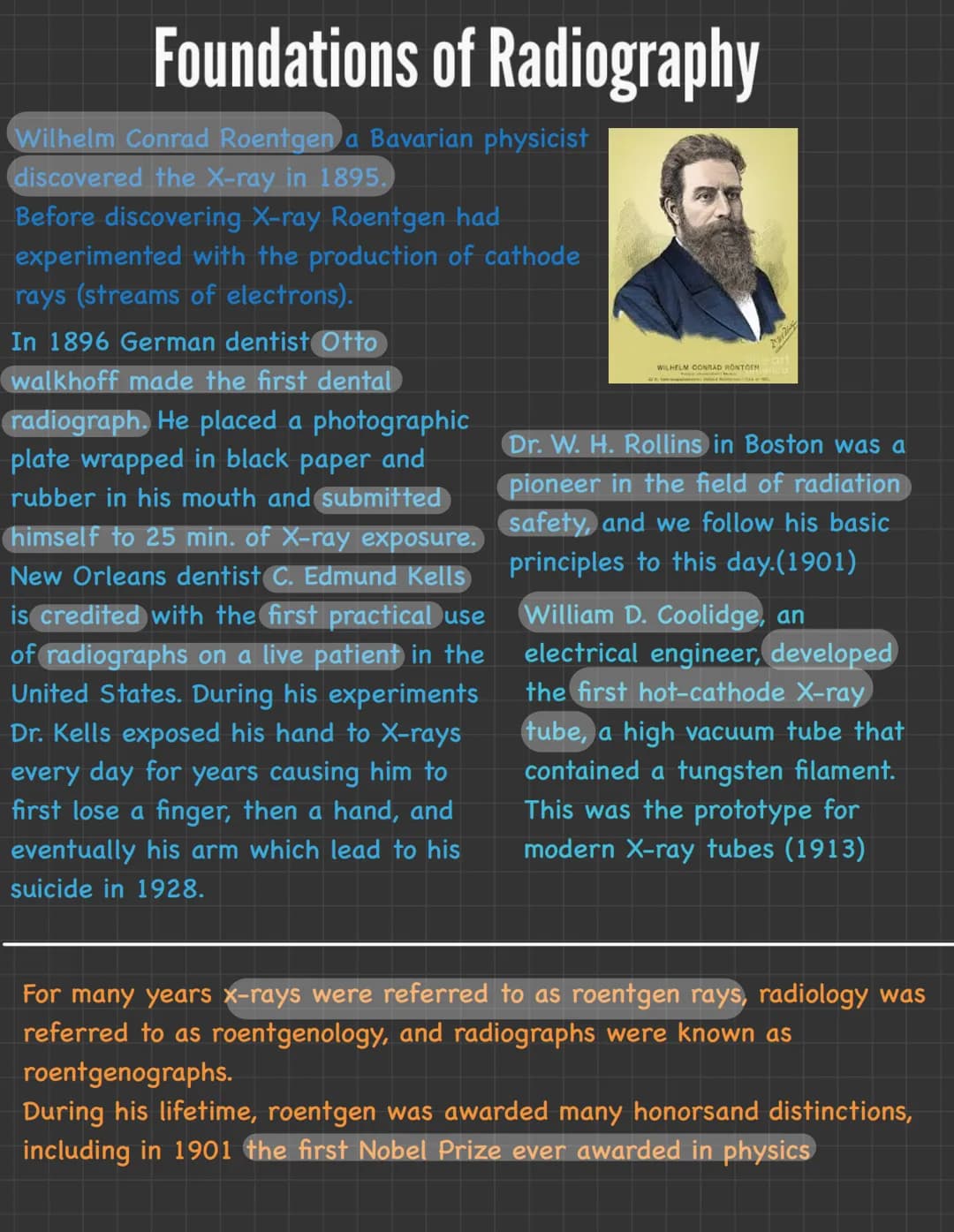
The story of dental X-rays began in 1895 when Bavarian physicist Wilhelm Conrad Roentgen discovered X-rays while experimenting with cathode rays. This groundbreaking discovery earned Roentgen the first-ever Nobel Prize in physics in 1901.
The dental world quickly adopted this technology. German dentist Otto Walkhoff made the first dental radiograph in 1896, subjecting himself to a dangerous 25-minute X-ray exposure. In the United States, C. Edmund Kells pioneered practical use of radiographs on patients, though with tragic consequences—years of exposure led to losing parts of his arm and eventually his life.
Early pioneers like Dr. W.H. Rollins established radiation safety principles we still follow today. Meanwhile, technological advances continued with William D. Coolidge developing the first hot-cathode X-ray tube in 1913, which became the prototype for modern X-ray equipment.
Remember This: Early dental X-rays were incredibly dangerous due to long exposure times and lack of safety protocols. Today's dental X-rays use minimal radiation and strict safety measures to protect both patients and dental professionals.
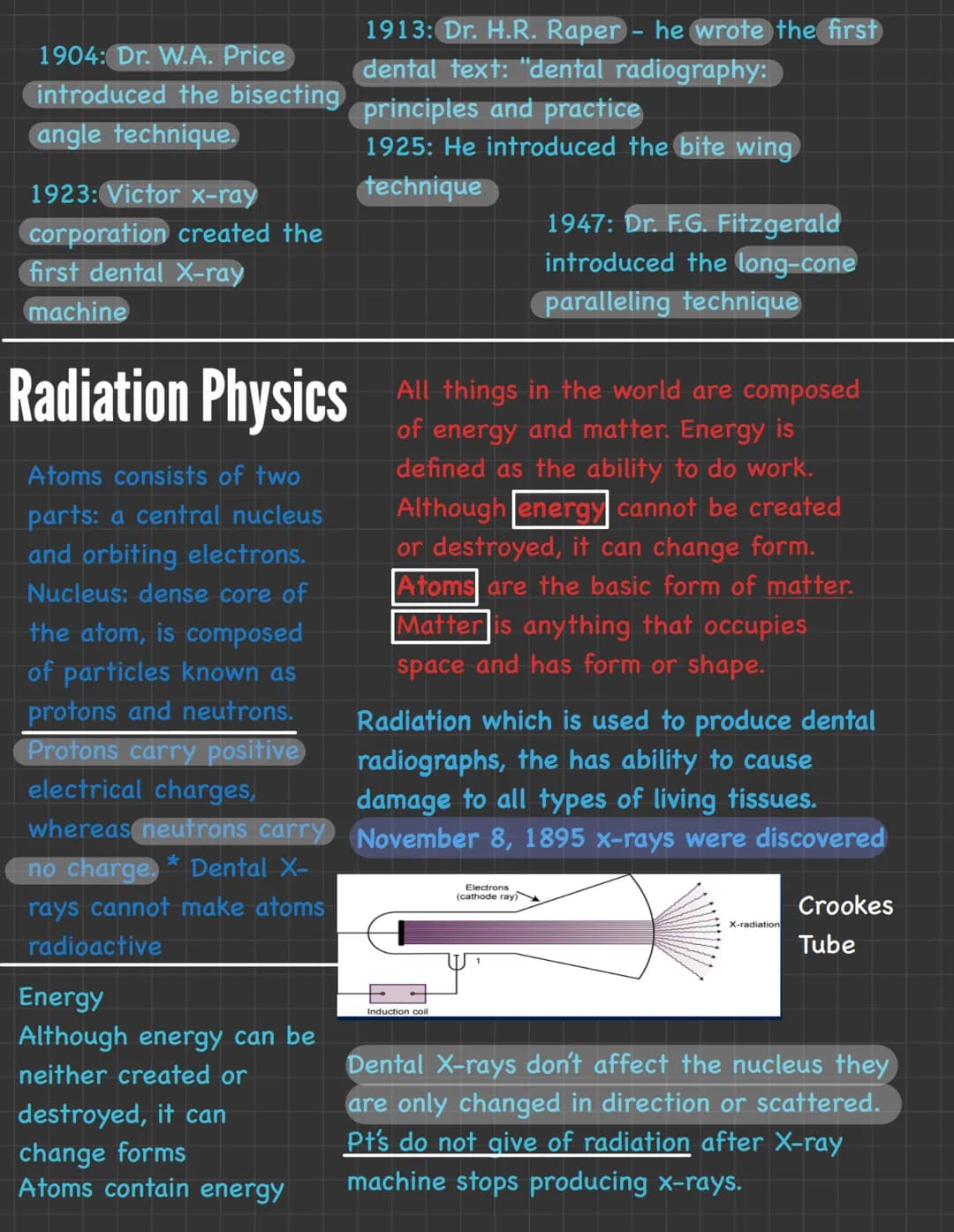
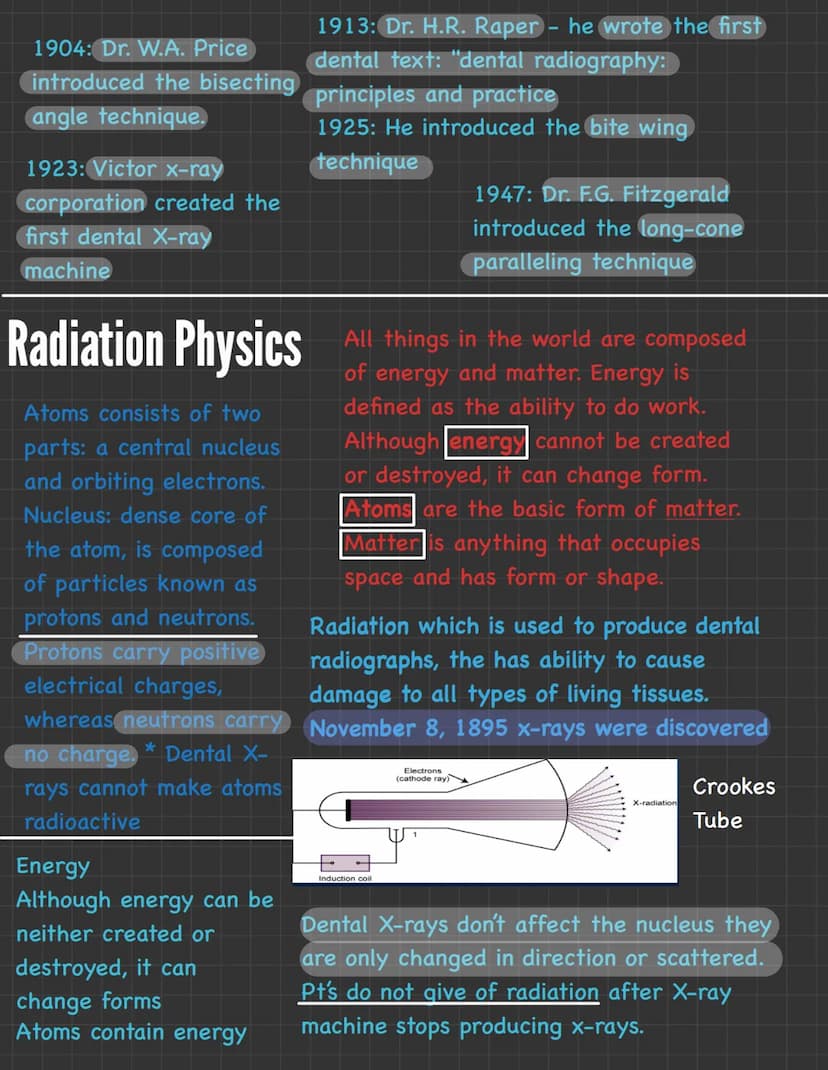
Everything in our world is composed of energy and matter. Matter is anything that occupies space and has form, while energy is the ability to do work. Though energy cannot be created or destroyed, it can change form—a principle essential to understanding X-rays.
The basic building blocks of matter are atoms, which consist of two main parts: a central nucleus (containing protons and neutrons) and orbiting electrons. Protons carry positive electrical charges, neutrons have no charge, and electrons are negatively charged. This atomic structure is what X-rays interact with.
When dental X-rays interact with matter, they affect the electrons, not the nucleus. This is why patients don't become radioactive after having X-rays taken—once the machine stops producing X-rays, no radiation remains in the patient.
Fun Fact: The paralleling technique that many dentists use today was introduced by Dr. F.G. Fitzgerald in 1947, while the common bite-wing X-ray technique was introduced by Dr. H.R. Raper in 1925.
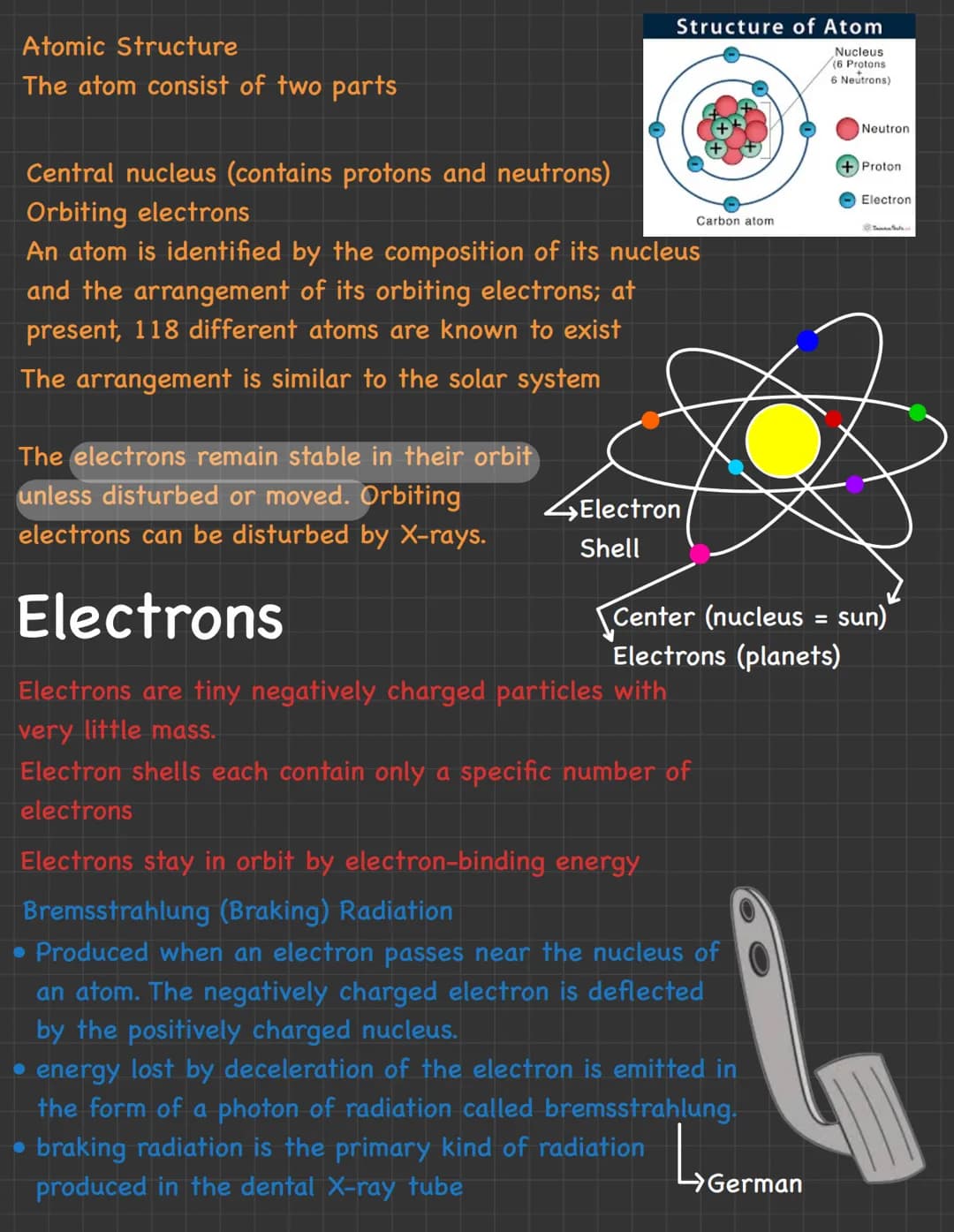
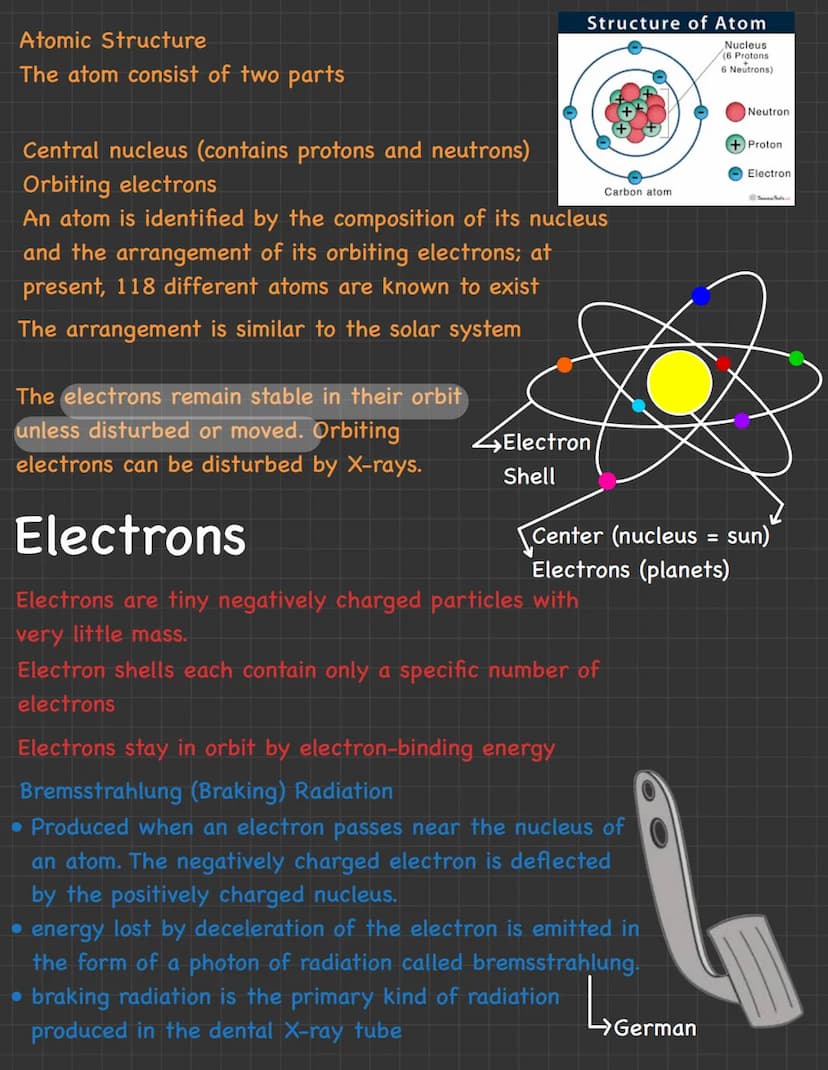
Atoms are like tiny solar systems with electrons orbiting around a central nucleus containing protons and neutrons. These orbiting electrons remain stable in their paths unless disturbed by outside forces like X-rays. There are currently 118 different known atoms, each identified by the unique composition of its nucleus and arrangement of electrons.
Electrons are tiny negatively charged particles held in their orbits by electron-binding energy. Each electron shell can only contain a specific number of electrons. This arrangement is crucial to understanding how X-rays interact with matter.
The main type of radiation produced in dental X-ray tubes is called Bremsstrahlung radiation. This occurs when an electron passes near an atom's nucleus and gets deflected by the positive charge. The energy lost during this deceleration is emitted as an X-ray photon. Think of it like slamming on the brakes in a car—the energy has to go somewhere!
Visualization Tip: Imagine atoms as tiny solar systems where the nucleus is the sun and electrons are planets orbiting around it. X-rays are like meteors that can knock these planets out of orbit!
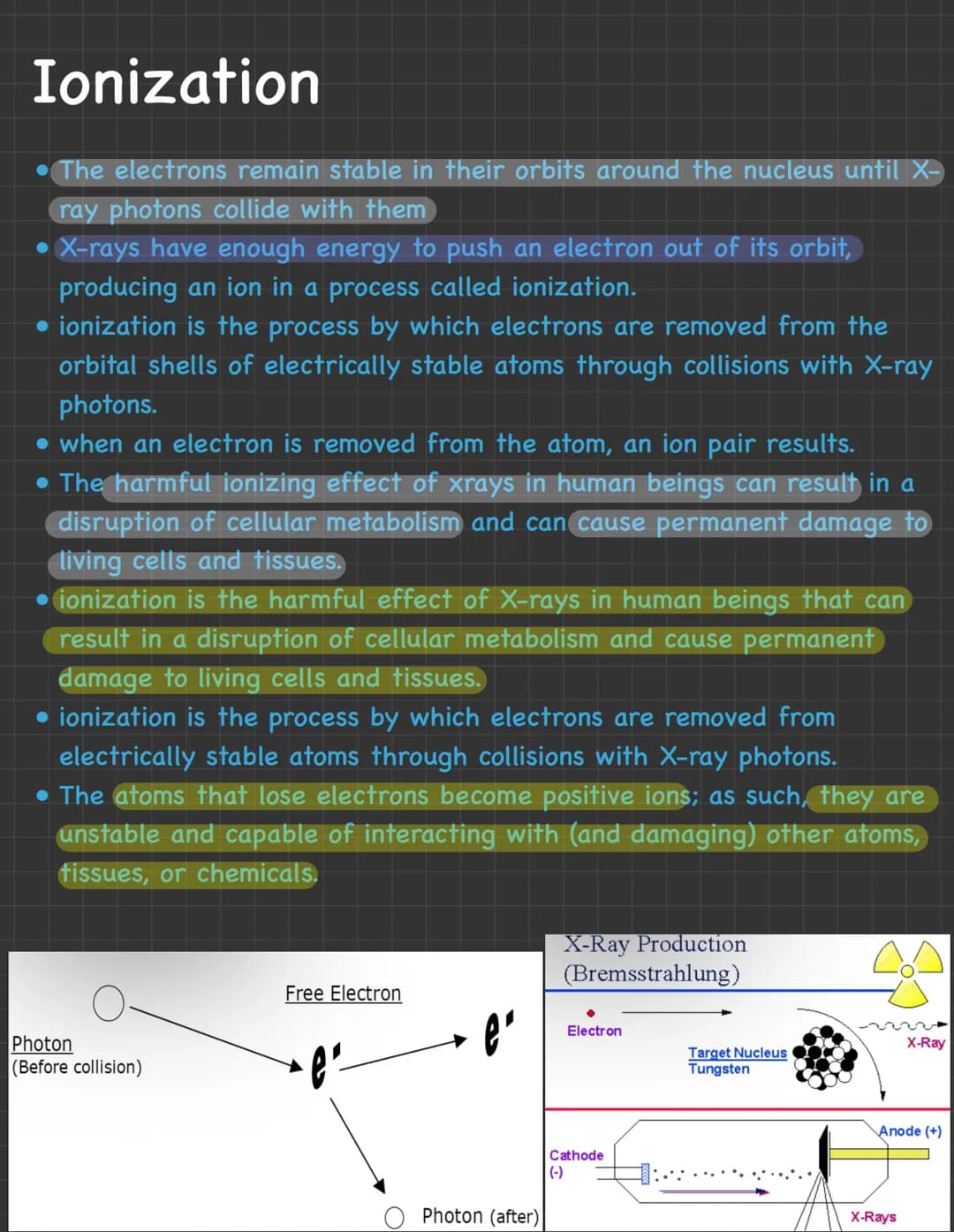
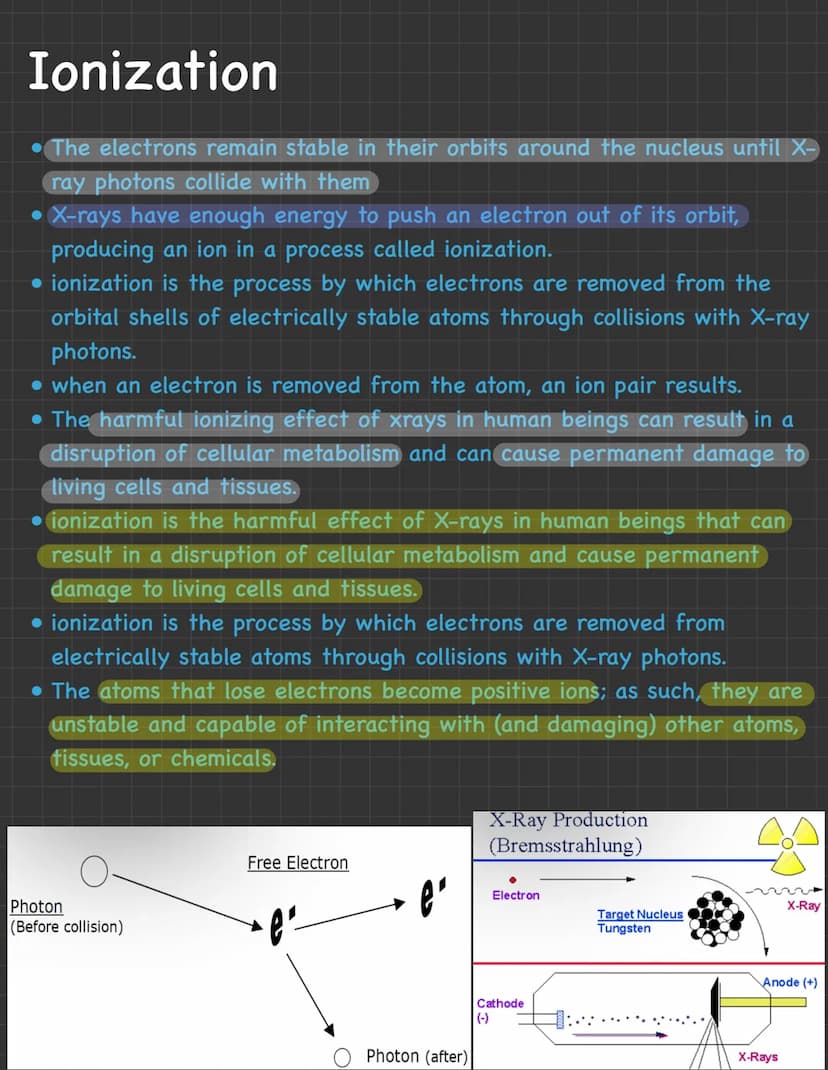
X-rays can push electrons out of their stable orbits through a process called ionization. When an X-ray photon collides with an electron, it can transfer enough energy to remove that electron from its atom, creating what's called an ion pair—a free electron and a positively charged atom.
This ionizing effect is what makes X-rays both useful and potentially harmful. The atoms that lose electrons become positive ions that are unstable and can interact with (and damage) other atoms, tissues, or chemicals. This disruption of cellular metabolism can cause permanent damage to living cells and tissues.
During X-ray production in dental machines, electrons from the cathode are accelerated toward the anode. When these high-speed electrons hit the tungsten target in the anode, some of their energy is converted into X-ray photons that can then be directed toward the patient.
Important Safety Note: The harmful effects of X-ray ionization are why dental professionals limit exposure time, use protective equipment, and follow strict safety protocols. Modern dental X-rays use very low radiation doses to minimize risks.
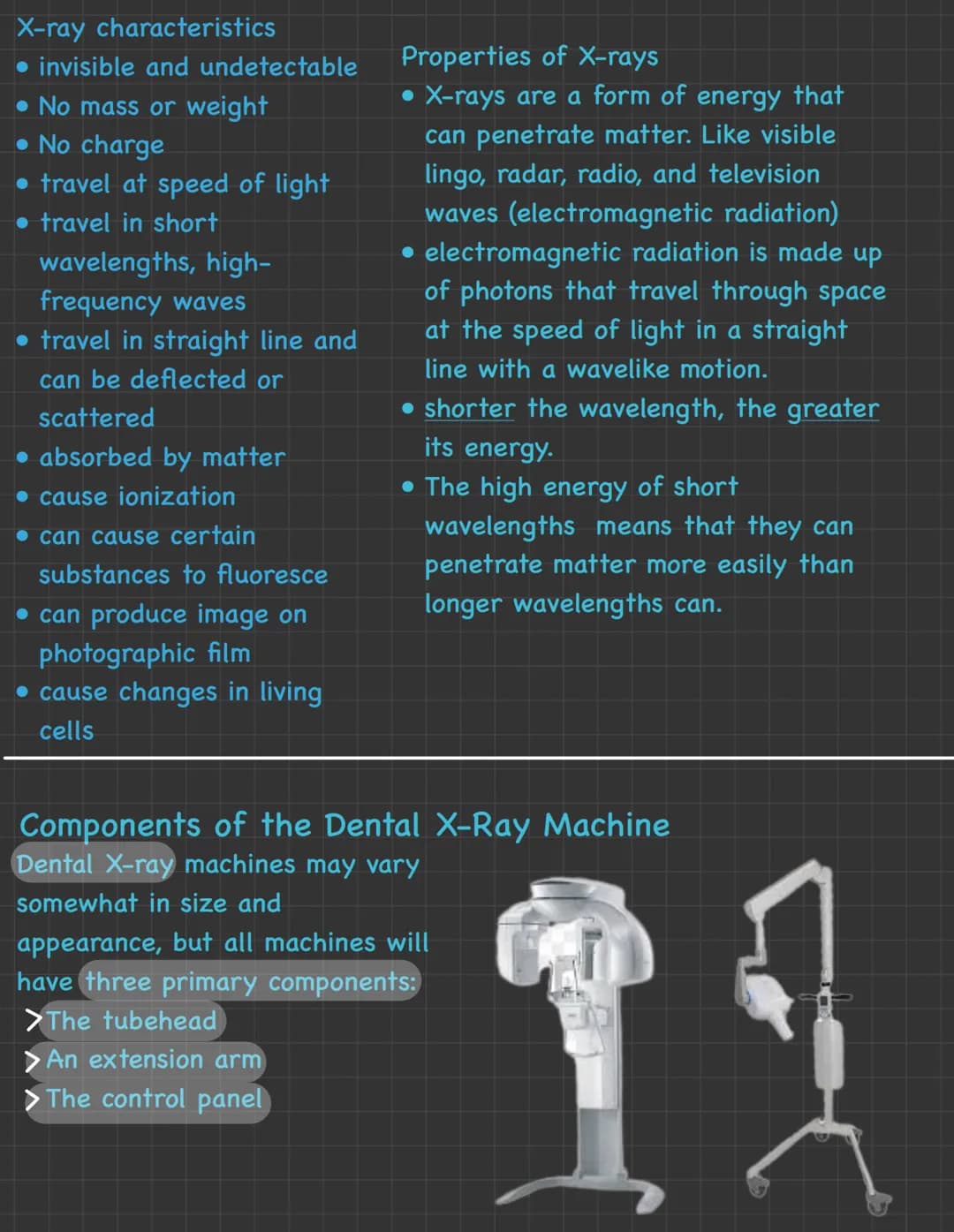
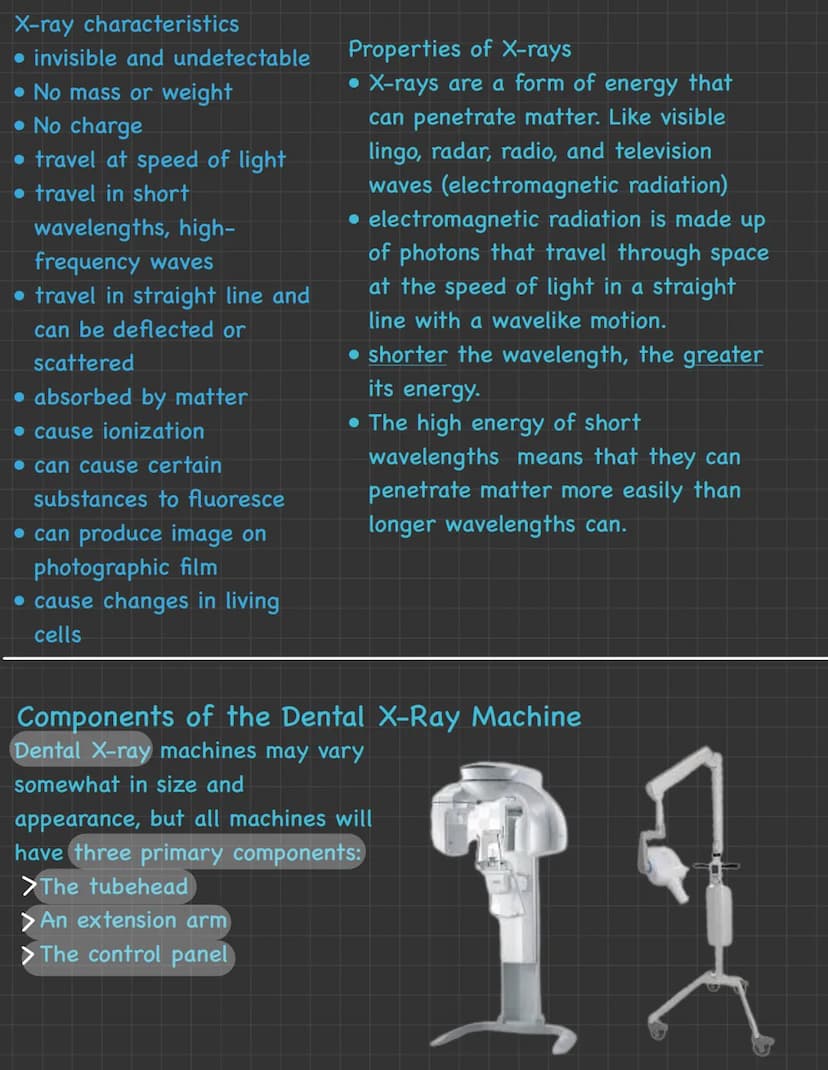
X-rays have unique characteristics that make them both useful and potentially dangerous. They're invisible and undetectable by human senses, have no mass or weight, and travel at the speed of light in straight lines. X-rays can penetrate matter, cause ionization, make certain substances fluoresce, and produce images on photographic film.
Like visible light, radio waves, and microwaves, X-rays are a form of electromagnetic radiation made up of photons that travel through space. The shorter the wavelength, the greater the energy and penetrating power. Dental X-rays use short wavelengths that can pass through soft tissue but are partially blocked by denser materials like teeth and bone.
Every dental X-ray machine has three primary components: the tubehead , an extension arm (for positioning), and a control panel (for adjusting settings). Though machines may vary in appearance, these basic components work together to create diagnostic images.
Clinical Connection: When X-rays pass through your mouth during a dental exam, they're absorbed differently by different structures. Teeth, fillings, and bone appear white on the image because they block most X-rays, while cavities and gum infections appear darker because X-rays pass through more easily.
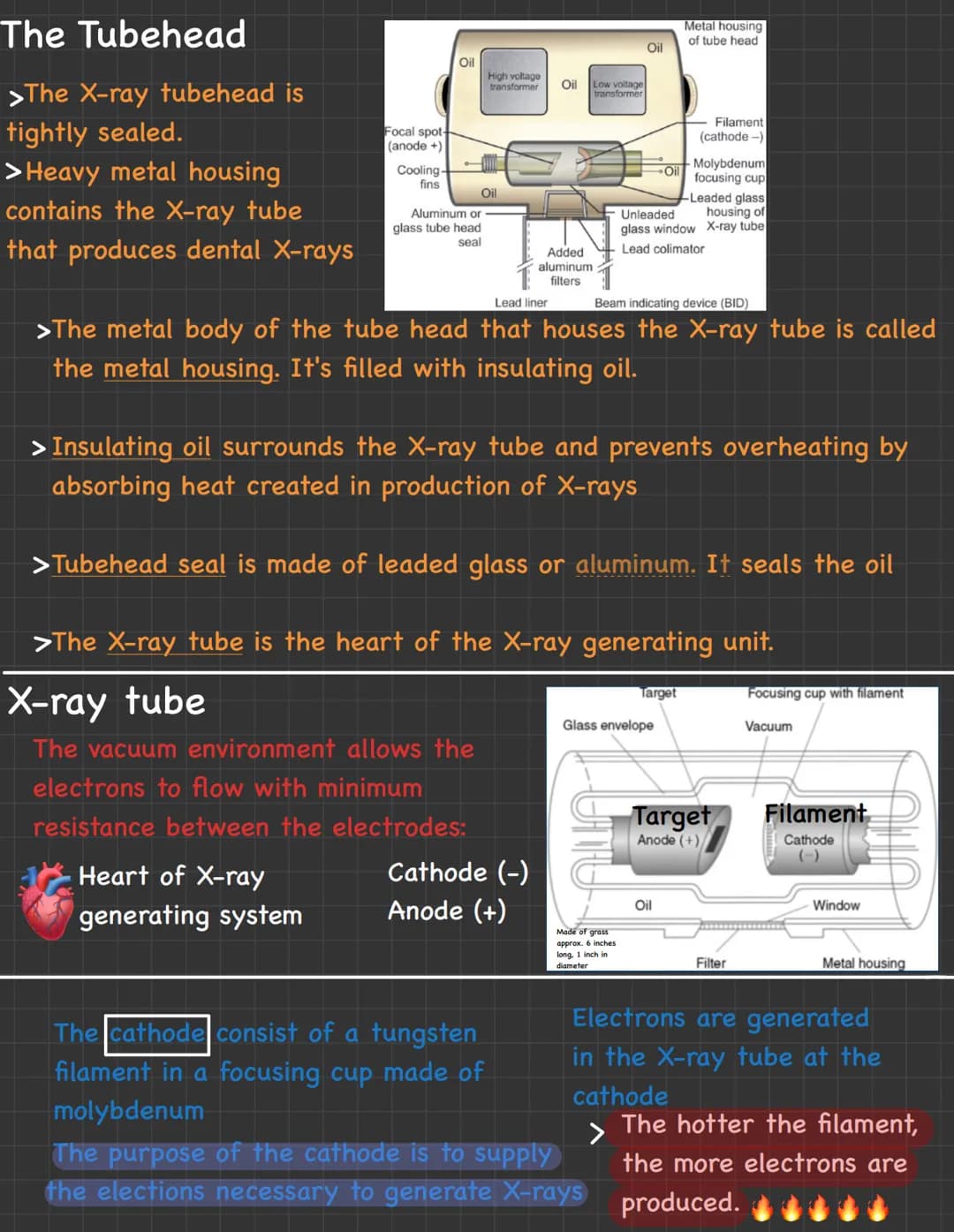
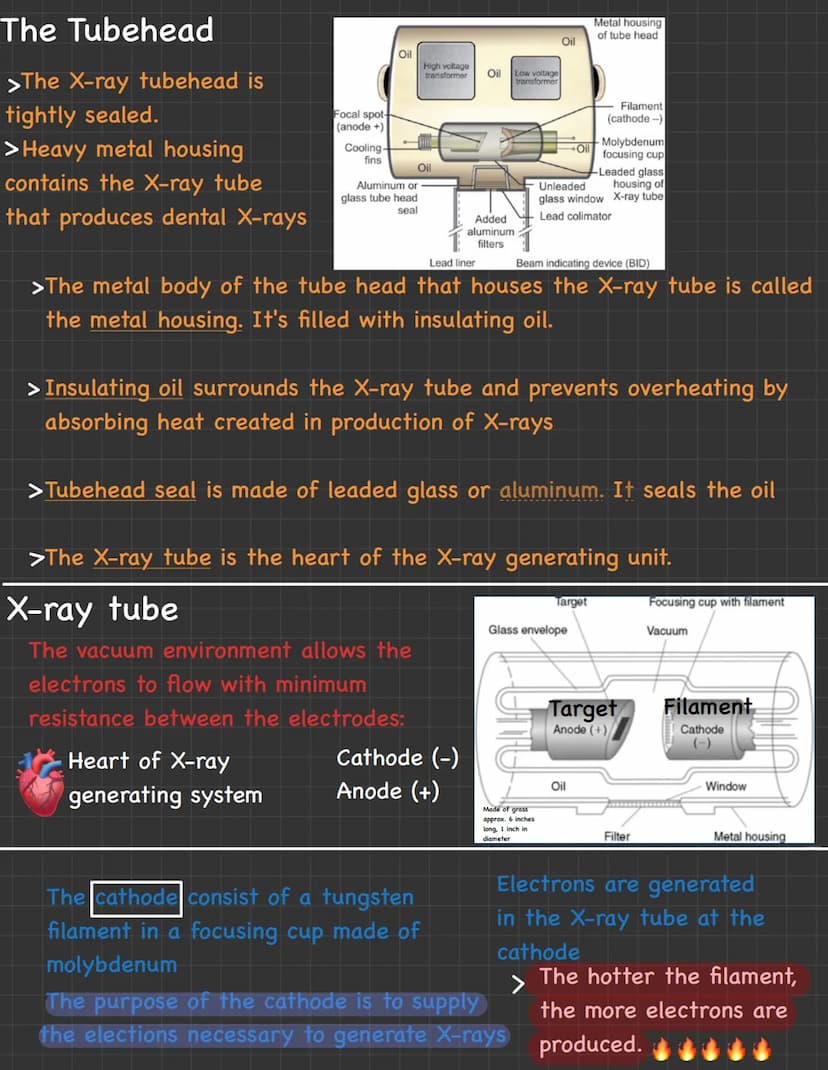
The tubehead is the sealed metal housing that contains the X-ray tube—the heart of the X-ray generating system. It's filled with insulating oil that absorbs heat created during X-ray production and prevents the machine from overheating. The tubehead seal, made of leaded glass or aluminum, keeps this oil contained.
Inside the tubehead, the X-ray tube consists of a glass vacuum chamber containing two main components: the cathode (negative electrode) and the anode (positive electrode). The vacuum environment allows electrons to flow freely between these electrodes with minimal resistance.
The cathode contains a tungsten filament inside a molybdenum focusing cup. When electricity passes through this filament, it heats up and releases electrons in a process called thermionic emission—the hotter the filament, the more electrons are produced. These electrons are then accelerated toward the anode where they'll create X-rays.
Technical Insight: The tungsten filament works like the filament in an old-fashioned light bulb. When electricity flows through it, it gets extremely hot and "boils off" electrons—the same principle that makes light bulbs glow also helps create dental X-rays!
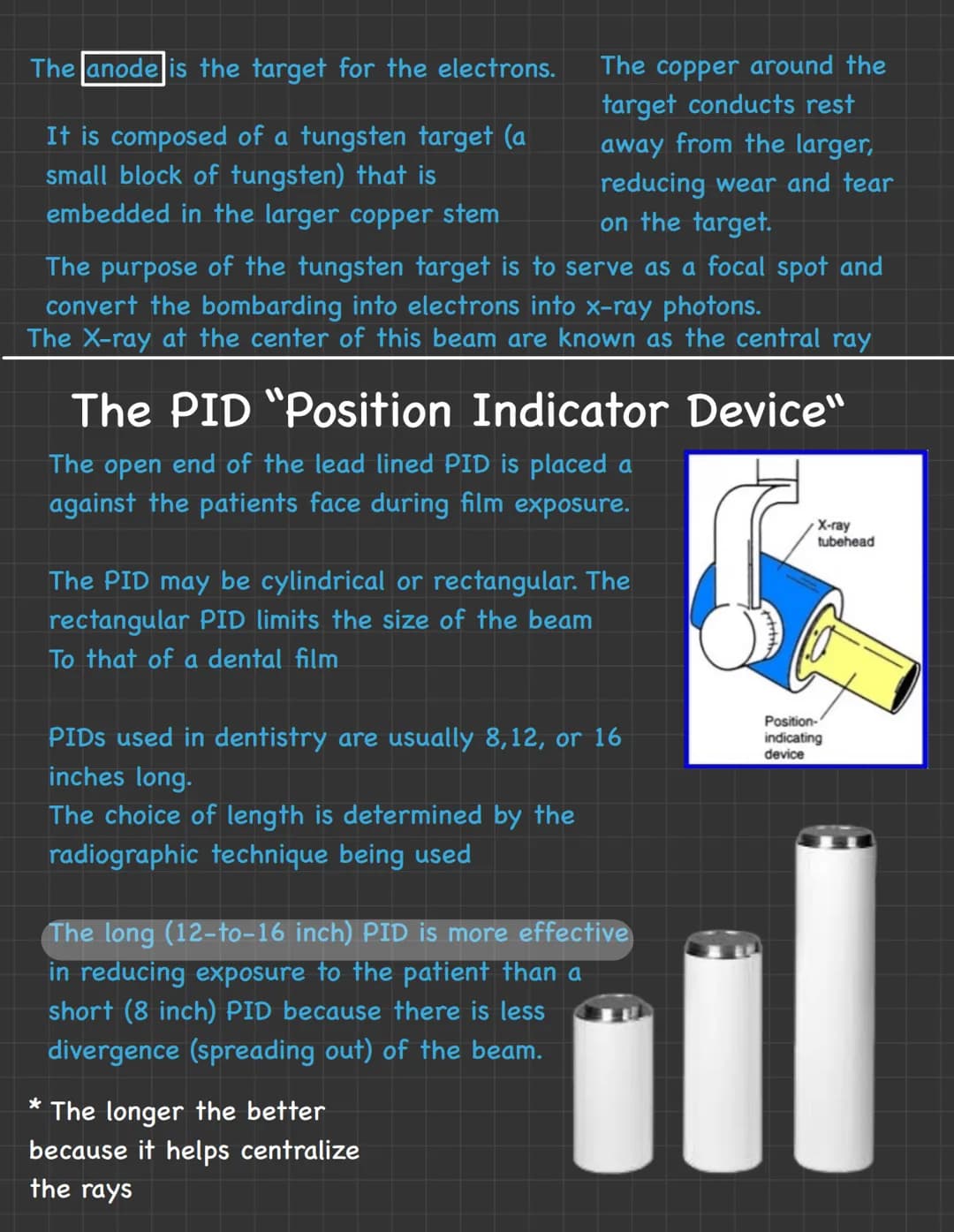
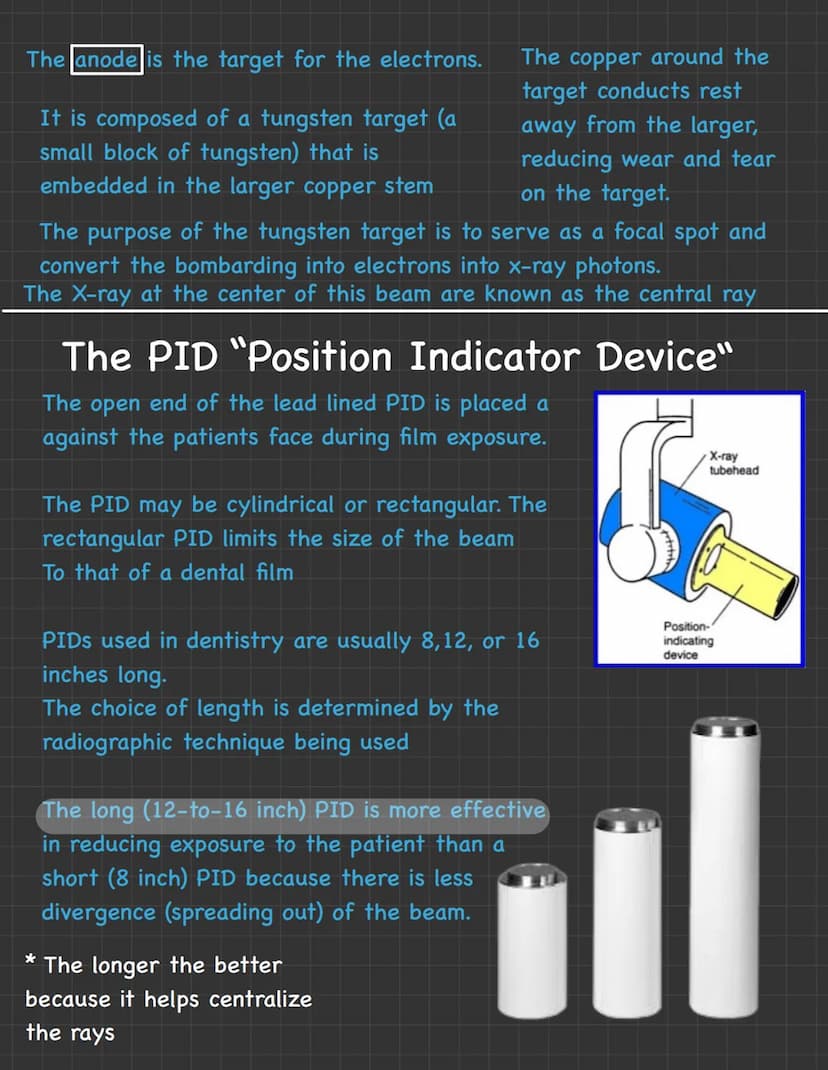
The anode serves as the target for electrons coming from the cathode. It contains a small block of tungsten embedded in a larger copper stem. When electrons strike this tungsten target, they're converted into X-ray photons. The copper surrounding the target conducts heat away, reducing wear and tear on the target.
The X-rays produced at the center of the beam are known as the central ray. These rays travel in a straight line from the focal spot in the anode through the patient's tissues to the film or sensor. The precision of this central ray is critical for creating clear diagnostic images.
The Position Indicator Device (PID) is the tube-like extension at the end of the tubehead that's placed against the patient's face during exposure. PIDs may be cylindrical or rectangular and come in different lengths (usually 8, 12, or 16 inches). Longer PIDs are more effective in reducing patient exposure than shorter ones because they reduce beam divergence.
Best Practice Tip: Longer PIDs are better because they help centralize the X-ray beam and reduce radiation exposure to the patient. This is why most modern dental offices use long rectangular PIDs rather than short round ones.

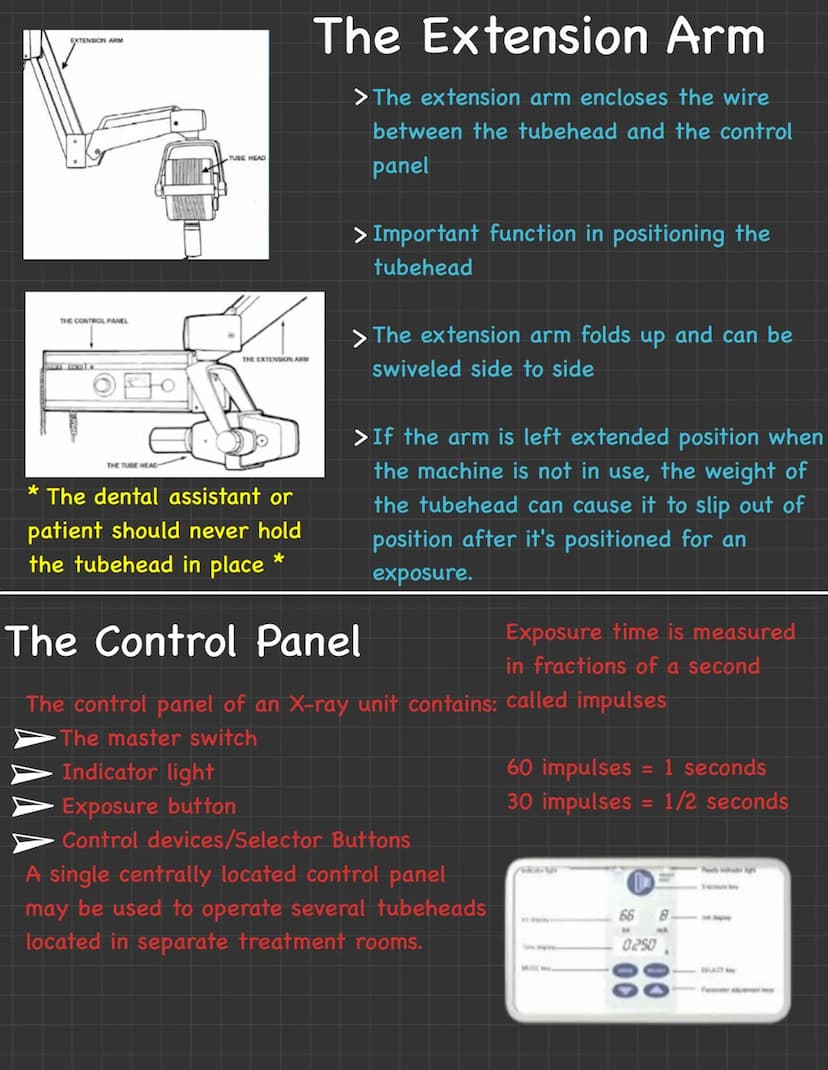
The extension arm connects the tubehead to the wall mount and encloses the wires running between the tubehead and control panel. It serves an important function in positioning the tubehead precisely for each exposure. The arm can fold up and swivel side to side for flexibility in positioning.
When not in use, the extension arm should be folded back rather than left extended. If left extended, the weight of the tubehead can cause it to slip out of position after it's been carefully positioned for an exposure. Remember that neither the dental assistant nor the patient should ever hold the tubehead in place during an exposure!
The control panel contains all the controls needed to operate the X-ray machine, including the master switch, indicator light, exposure button, and selector buttons. Exposure time is measured in impulses—fractions of a second . A single centrally located control panel may operate several tubeheads in different treatment rooms for efficiency.
Safety Alert: Never hold the tubehead in place during an exposure! This puts you at risk for unnecessary radiation exposure. The tubehead should be properly positioned and stable before activating the X-ray.

The milliamperage selector (mA) controls the amount of electric current passing through the tungsten filament. This determines the quantity of electrons produced—increasing the milliamperage increases the number of electrons available for X-ray production. Dental X-ray machines typically operate at 7-15 mA.
The kilovoltage selector (kVp) controls the penetrating power of the X-ray beam. Higher kVp settings produce X-rays that can penetrate denser tissues. Dental machines usually operate at 70-90 kVp. Think of mA as controlling the quantity of X-rays (how many) and kVp as controlling the quality (how powerful).
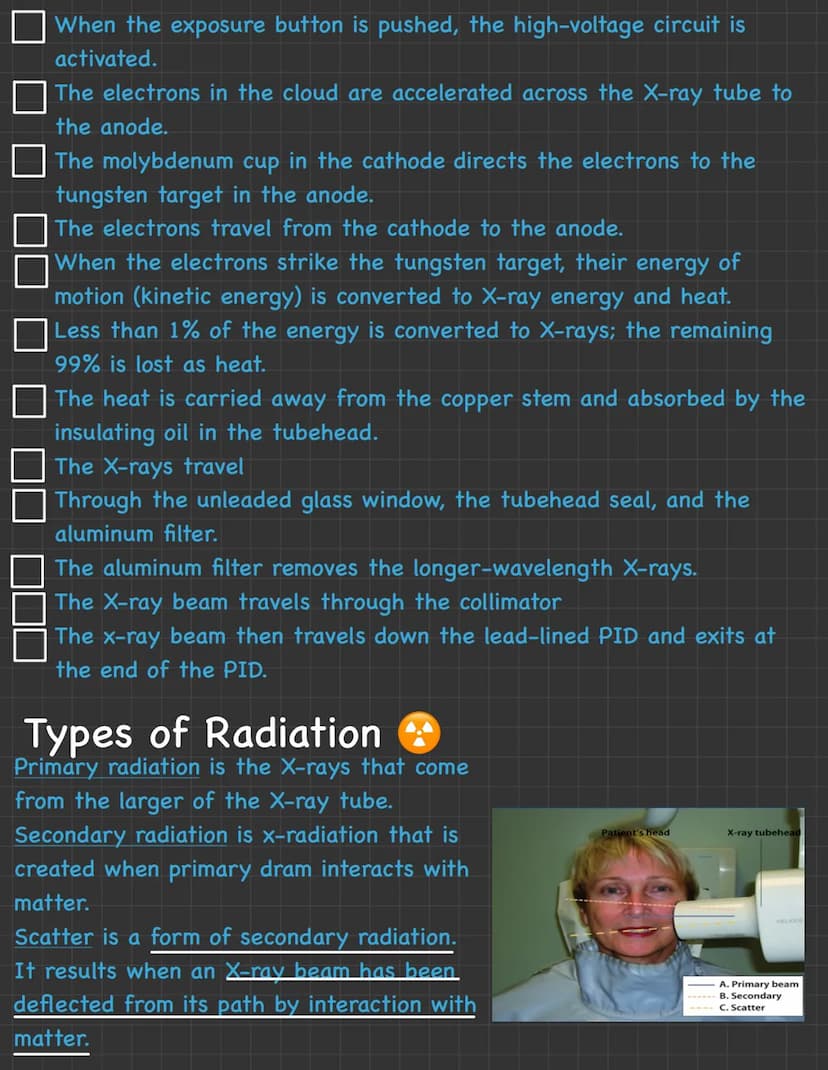
X-ray production begins when the machine is turned on and current enters the control panel. The current travels to the tubehead where it heats the tungsten filament in the cathode. This heating causes thermionic emission—electrons are released from the filament, forming an electron cloud around the cathode. When the exposure button is pressed, these electrons accelerate toward the anode to create X-rays.
Helpful Comparison: Think of mA as controlling how many X-ray photons are produced (quantity), while kVp controls how "energetic" or penetrating those X-rays are (quality). Both settings work together to create the optimal image.
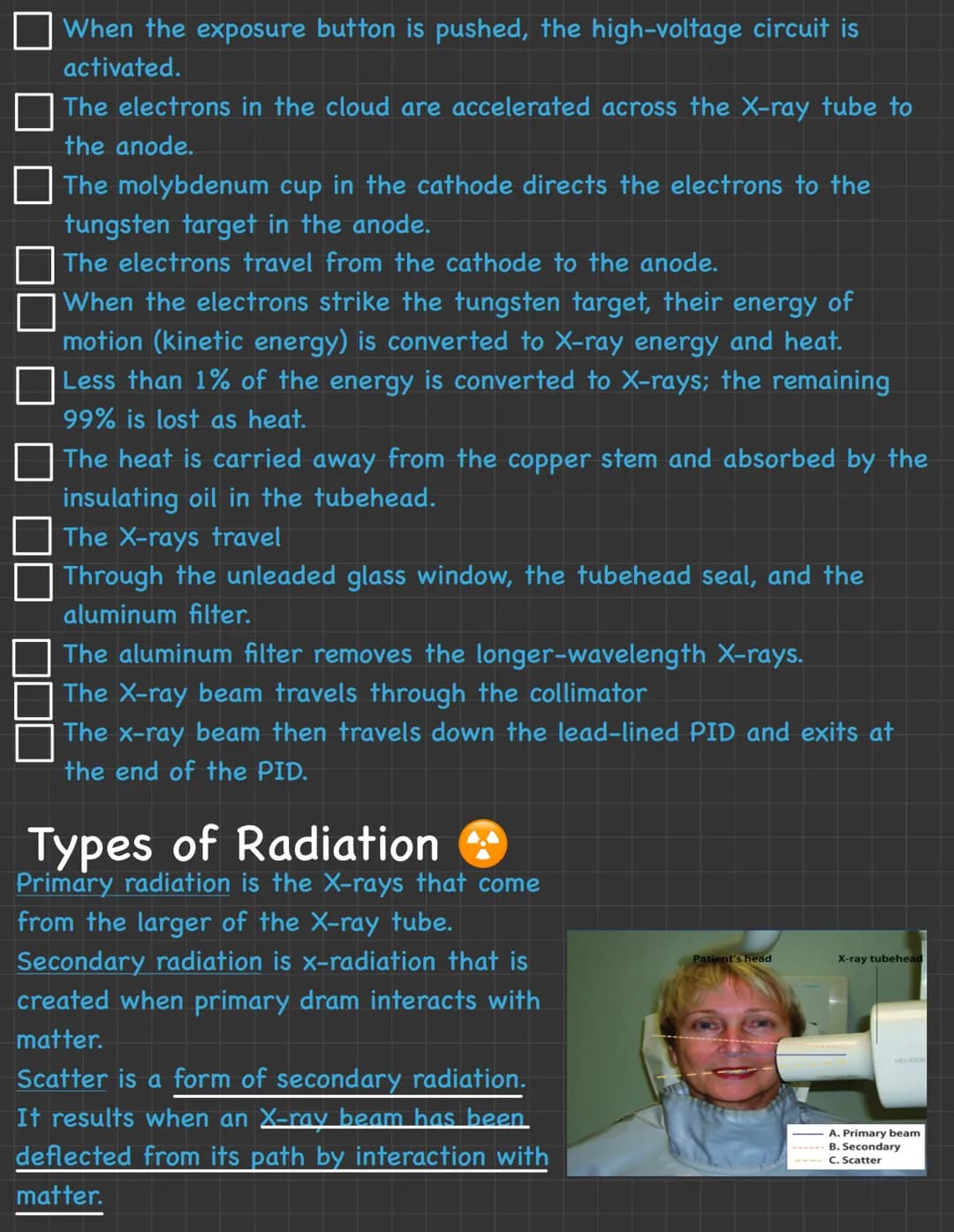
When you press the exposure button, a fascinating chain of events occurs in just a fraction of a second. The high-voltage circuit activates, accelerating electrons across the X-ray tube from cathode to anode. The molybdenum cup focuses these electrons onto the tungsten target in the anode.
When electrons strike the tungsten target, their kinetic energy converts to X-ray energy and heat. Surprisingly, less than 1% becomes useful X-rays—the remaining 99% is lost as heat, which is absorbed by the insulating oil. The X-rays then travel through the unleaded glass window, tubehead seal, and aluminum filter .
After passing through these components, the X-ray beam travels through the collimator and down the lead-lined PID before exiting toward the patient. The X-rays that come directly from the target are called primary radiation. When these X-rays interact with matter, they can create secondary radiation or scatter radiation—deflected X-rays that can reduce image quality and increase patient exposure.
Physics Insight: The incredible inefficiency of X-ray production explains why X-ray machines get hot during use and need cooling systems. Most of the electricity used becomes heat rather than diagnostic X-rays!
Our AI companion is specifically built for the needs of students. Based on the millions of content pieces we have on the platform we can provide truly meaningful and relevant answers to students. But its not only about answers, the companion is even more about guiding students through their daily learning challenges, with personalised study plans, quizzes or content pieces in the chat and 100% personalisation based on the students skills and developments.
You can download the app in the Google Play Store and in the Apple App Store.
That's right! Enjoy free access to study content, connect with fellow students, and get instant help – all at your fingertips.
App Store
Google Play
The app is very easy to use and well designed. I have found everything I was looking for so far and have been able to learn a lot from the presentations! I will definitely use the app for a class assignment! And of course it also helps a lot as an inspiration.
Stefan S
iOS user
This app is really great. There are so many study notes and help [...]. My problem subject is French, for example, and the app has so many options for help. Thanks to this app, I have improved my French. I would recommend it to anyone.
Samantha Klich
Android user
Wow, I am really amazed. I just tried the app because I've seen it advertised many times and was absolutely stunned. This app is THE HELP you want for school and above all, it offers so many things, such as workouts and fact sheets, which have been VERY helpful to me personally.
Anna
iOS user
I think it’s very much worth it and you’ll end up using it a lot once you get the hang of it and even after looking at others notes you can still ask your Artificial intelligence buddy the question and ask to simplify it if you still don’t get it!!! In the end I think it’s worth it 😊👍 ⚠️Also DID I MENTION ITS FREEE YOU DON’T HAVE TO PAY FOR ANYTHING AND STILL GET YOUR GRADES IN PERFECTLY❗️❗️⚠️
Thomas R
iOS user
Knowunity is the BEST app I’ve used in a minute. This is not an ai review or anything this is genuinely coming from a 7th grade student (I know 2011 im young) but dude this app is a 10/10 i have maintained a 3.8 gpa and have plenty of time for gaming. I love it and my mom is just happy I got good grades
Brad T
Android user
Not only did it help me find the answer but it also showed me alternative ways to solve it. I was horrible in math and science but now I have an a in both subjects. Thanks for the help🤍🤍
David K
iOS user
The app's just great! All I have to do is enter the topic in the search bar and I get the response real fast. I don't have to watch 10 YouTube videos to understand something, so I'm saving my time. Highly recommended!
Sudenaz Ocak
Android user
In school I was really bad at maths but thanks to the app, I am doing better now. I am so grateful that you made the app.
Greenlight Bonnie
Android user
I found this app a couple years ago and it has only gotten better since then. I really love it because it can help with written questions and photo questions. Also, it can find study guides that other people have made as well as flashcard sets and practice tests. The free version is also amazing for students who might not be able to afford it. Would 100% recommend
Aubrey
iOS user
Best app if you're in Highschool or Junior high. I have been using this app for 2 school years and it's the best, it's good if you don't have anyone to help you with school work.😋🩷🎀
Marco B
iOS user
THE QUIZES AND FLASHCARDS ARE SO USEFUL AND I LOVE Knowunity AI. IT ALSO IS LITREALLY LIKE CHATGPT BUT SMARTER!! HELPED ME WITH MY MASCARA PROBLEMS TOO!! AS WELL AS MY REAL SUBJECTS ! DUHHH 😍😁😲🤑💗✨🎀😮
Elisha
iOS user
This app is phenomenal down to the correct info and the various topics you can study! I greatly recommend it for people who struggle with procrastination and those who need homework help. It has been perfectly accurate for world 1 history as far as I’ve seen! Geometry too!
Paul T
iOS user
The app is very easy to use and well designed. I have found everything I was looking for so far and have been able to learn a lot from the presentations! I will definitely use the app for a class assignment! And of course it also helps a lot as an inspiration.
Stefan S
iOS user
This app is really great. There are so many study notes and help [...]. My problem subject is French, for example, and the app has so many options for help. Thanks to this app, I have improved my French. I would recommend it to anyone.
Samantha Klich
Android user
Wow, I am really amazed. I just tried the app because I've seen it advertised many times and was absolutely stunned. This app is THE HELP you want for school and above all, it offers so many things, such as workouts and fact sheets, which have been VERY helpful to me personally.
Anna
iOS user
I think it’s very much worth it and you’ll end up using it a lot once you get the hang of it and even after looking at others notes you can still ask your Artificial intelligence buddy the question and ask to simplify it if you still don’t get it!!! In the end I think it’s worth it 😊👍 ⚠️Also DID I MENTION ITS FREEE YOU DON’T HAVE TO PAY FOR ANYTHING AND STILL GET YOUR GRADES IN PERFECTLY❗️❗️⚠️
Thomas R
iOS user
Knowunity is the BEST app I’ve used in a minute. This is not an ai review or anything this is genuinely coming from a 7th grade student (I know 2011 im young) but dude this app is a 10/10 i have maintained a 3.8 gpa and have plenty of time for gaming. I love it and my mom is just happy I got good grades
Brad T
Android user
Not only did it help me find the answer but it also showed me alternative ways to solve it. I was horrible in math and science but now I have an a in both subjects. Thanks for the help🤍🤍
David K
iOS user
The app's just great! All I have to do is enter the topic in the search bar and I get the response real fast. I don't have to watch 10 YouTube videos to understand something, so I'm saving my time. Highly recommended!
Sudenaz Ocak
Android user
In school I was really bad at maths but thanks to the app, I am doing better now. I am so grateful that you made the app.
Greenlight Bonnie
Android user
I found this app a couple years ago and it has only gotten better since then. I really love it because it can help with written questions and photo questions. Also, it can find study guides that other people have made as well as flashcard sets and practice tests. The free version is also amazing for students who might not be able to afford it. Would 100% recommend
Aubrey
iOS user
Best app if you're in Highschool or Junior high. I have been using this app for 2 school years and it's the best, it's good if you don't have anyone to help you with school work.😋🩷🎀
Marco B
iOS user
THE QUIZES AND FLASHCARDS ARE SO USEFUL AND I LOVE Knowunity AI. IT ALSO IS LITREALLY LIKE CHATGPT BUT SMARTER!! HELPED ME WITH MY MASCARA PROBLEMS TOO!! AS WELL AS MY REAL SUBJECTS ! DUHHH 😍😁😲🤑💗✨🎀😮
Elisha
iOS user
This app is phenomenal down to the correct info and the various topics you can study! I greatly recommend it for people who struggle with procrastination and those who need homework help. It has been perfectly accurate for world 1 history as far as I’ve seen! Geometry too!
Paul T
iOS user
Amarri Manning
@marrianning_jvvh
X-rays revolutionized medicine and dentistry when discovered in 1895 by Wilhelm Conrad Roentgen. Understanding how X-rays work and how dental X-ray machines operate is essential for producing clear diagnostic images while keeping patients safe. This knowledge forms the foundation of... Show more
Access to all documents
Improve your grades
Join milions of students
The story of dental X-rays began in 1895 when Bavarian physicist Wilhelm Conrad Roentgen discovered X-rays while experimenting with cathode rays. This groundbreaking discovery earned Roentgen the first-ever Nobel Prize in physics in 1901.
The dental world quickly adopted this technology. German dentist Otto Walkhoff made the first dental radiograph in 1896, subjecting himself to a dangerous 25-minute X-ray exposure. In the United States, C. Edmund Kells pioneered practical use of radiographs on patients, though with tragic consequences—years of exposure led to losing parts of his arm and eventually his life.
Early pioneers like Dr. W.H. Rollins established radiation safety principles we still follow today. Meanwhile, technological advances continued with William D. Coolidge developing the first hot-cathode X-ray tube in 1913, which became the prototype for modern X-ray equipment.
Remember This: Early dental X-rays were incredibly dangerous due to long exposure times and lack of safety protocols. Today's dental X-rays use minimal radiation and strict safety measures to protect both patients and dental professionals.
Access to all documents
Improve your grades
Join milions of students
Everything in our world is composed of energy and matter. Matter is anything that occupies space and has form, while energy is the ability to do work. Though energy cannot be created or destroyed, it can change form—a principle essential to understanding X-rays.
The basic building blocks of matter are atoms, which consist of two main parts: a central nucleus (containing protons and neutrons) and orbiting electrons. Protons carry positive electrical charges, neutrons have no charge, and electrons are negatively charged. This atomic structure is what X-rays interact with.
When dental X-rays interact with matter, they affect the electrons, not the nucleus. This is why patients don't become radioactive after having X-rays taken—once the machine stops producing X-rays, no radiation remains in the patient.
Fun Fact: The paralleling technique that many dentists use today was introduced by Dr. F.G. Fitzgerald in 1947, while the common bite-wing X-ray technique was introduced by Dr. H.R. Raper in 1925.
Access to all documents
Improve your grades
Join milions of students
Atoms are like tiny solar systems with electrons orbiting around a central nucleus containing protons and neutrons. These orbiting electrons remain stable in their paths unless disturbed by outside forces like X-rays. There are currently 118 different known atoms, each identified by the unique composition of its nucleus and arrangement of electrons.
Electrons are tiny negatively charged particles held in their orbits by electron-binding energy. Each electron shell can only contain a specific number of electrons. This arrangement is crucial to understanding how X-rays interact with matter.
The main type of radiation produced in dental X-ray tubes is called Bremsstrahlung radiation. This occurs when an electron passes near an atom's nucleus and gets deflected by the positive charge. The energy lost during this deceleration is emitted as an X-ray photon. Think of it like slamming on the brakes in a car—the energy has to go somewhere!
Visualization Tip: Imagine atoms as tiny solar systems where the nucleus is the sun and electrons are planets orbiting around it. X-rays are like meteors that can knock these planets out of orbit!
Access to all documents
Improve your grades
Join milions of students
X-rays can push electrons out of their stable orbits through a process called ionization. When an X-ray photon collides with an electron, it can transfer enough energy to remove that electron from its atom, creating what's called an ion pair—a free electron and a positively charged atom.
This ionizing effect is what makes X-rays both useful and potentially harmful. The atoms that lose electrons become positive ions that are unstable and can interact with (and damage) other atoms, tissues, or chemicals. This disruption of cellular metabolism can cause permanent damage to living cells and tissues.
During X-ray production in dental machines, electrons from the cathode are accelerated toward the anode. When these high-speed electrons hit the tungsten target in the anode, some of their energy is converted into X-ray photons that can then be directed toward the patient.
Important Safety Note: The harmful effects of X-ray ionization are why dental professionals limit exposure time, use protective equipment, and follow strict safety protocols. Modern dental X-rays use very low radiation doses to minimize risks.
Access to all documents
Improve your grades
Join milions of students
X-rays have unique characteristics that make them both useful and potentially dangerous. They're invisible and undetectable by human senses, have no mass or weight, and travel at the speed of light in straight lines. X-rays can penetrate matter, cause ionization, make certain substances fluoresce, and produce images on photographic film.
Like visible light, radio waves, and microwaves, X-rays are a form of electromagnetic radiation made up of photons that travel through space. The shorter the wavelength, the greater the energy and penetrating power. Dental X-rays use short wavelengths that can pass through soft tissue but are partially blocked by denser materials like teeth and bone.
Every dental X-ray machine has three primary components: the tubehead , an extension arm (for positioning), and a control panel (for adjusting settings). Though machines may vary in appearance, these basic components work together to create diagnostic images.
Clinical Connection: When X-rays pass through your mouth during a dental exam, they're absorbed differently by different structures. Teeth, fillings, and bone appear white on the image because they block most X-rays, while cavities and gum infections appear darker because X-rays pass through more easily.
Access to all documents
Improve your grades
Join milions of students
The tubehead is the sealed metal housing that contains the X-ray tube—the heart of the X-ray generating system. It's filled with insulating oil that absorbs heat created during X-ray production and prevents the machine from overheating. The tubehead seal, made of leaded glass or aluminum, keeps this oil contained.
Inside the tubehead, the X-ray tube consists of a glass vacuum chamber containing two main components: the cathode (negative electrode) and the anode (positive electrode). The vacuum environment allows electrons to flow freely between these electrodes with minimal resistance.
The cathode contains a tungsten filament inside a molybdenum focusing cup. When electricity passes through this filament, it heats up and releases electrons in a process called thermionic emission—the hotter the filament, the more electrons are produced. These electrons are then accelerated toward the anode where they'll create X-rays.
Technical Insight: The tungsten filament works like the filament in an old-fashioned light bulb. When electricity flows through it, it gets extremely hot and "boils off" electrons—the same principle that makes light bulbs glow also helps create dental X-rays!
Access to all documents
Improve your grades
Join milions of students
The anode serves as the target for electrons coming from the cathode. It contains a small block of tungsten embedded in a larger copper stem. When electrons strike this tungsten target, they're converted into X-ray photons. The copper surrounding the target conducts heat away, reducing wear and tear on the target.
The X-rays produced at the center of the beam are known as the central ray. These rays travel in a straight line from the focal spot in the anode through the patient's tissues to the film or sensor. The precision of this central ray is critical for creating clear diagnostic images.
The Position Indicator Device (PID) is the tube-like extension at the end of the tubehead that's placed against the patient's face during exposure. PIDs may be cylindrical or rectangular and come in different lengths (usually 8, 12, or 16 inches). Longer PIDs are more effective in reducing patient exposure than shorter ones because they reduce beam divergence.
Best Practice Tip: Longer PIDs are better because they help centralize the X-ray beam and reduce radiation exposure to the patient. This is why most modern dental offices use long rectangular PIDs rather than short round ones.
Access to all documents
Improve your grades
Join milions of students
The extension arm connects the tubehead to the wall mount and encloses the wires running between the tubehead and control panel. It serves an important function in positioning the tubehead precisely for each exposure. The arm can fold up and swivel side to side for flexibility in positioning.
When not in use, the extension arm should be folded back rather than left extended. If left extended, the weight of the tubehead can cause it to slip out of position after it's been carefully positioned for an exposure. Remember that neither the dental assistant nor the patient should ever hold the tubehead in place during an exposure!
The control panel contains all the controls needed to operate the X-ray machine, including the master switch, indicator light, exposure button, and selector buttons. Exposure time is measured in impulses—fractions of a second . A single centrally located control panel may operate several tubeheads in different treatment rooms for efficiency.
Safety Alert: Never hold the tubehead in place during an exposure! This puts you at risk for unnecessary radiation exposure. The tubehead should be properly positioned and stable before activating the X-ray.
Access to all documents
Improve your grades
Join milions of students
The milliamperage selector (mA) controls the amount of electric current passing through the tungsten filament. This determines the quantity of electrons produced—increasing the milliamperage increases the number of electrons available for X-ray production. Dental X-ray machines typically operate at 7-15 mA.
The kilovoltage selector (kVp) controls the penetrating power of the X-ray beam. Higher kVp settings produce X-rays that can penetrate denser tissues. Dental machines usually operate at 70-90 kVp. Think of mA as controlling the quantity of X-rays (how many) and kVp as controlling the quality (how powerful).
X-ray production begins when the machine is turned on and current enters the control panel. The current travels to the tubehead where it heats the tungsten filament in the cathode. This heating causes thermionic emission—electrons are released from the filament, forming an electron cloud around the cathode. When the exposure button is pressed, these electrons accelerate toward the anode to create X-rays.
Helpful Comparison: Think of mA as controlling how many X-ray photons are produced (quantity), while kVp controls how "energetic" or penetrating those X-rays are (quality). Both settings work together to create the optimal image.
Access to all documents
Improve your grades
Join milions of students
When you press the exposure button, a fascinating chain of events occurs in just a fraction of a second. The high-voltage circuit activates, accelerating electrons across the X-ray tube from cathode to anode. The molybdenum cup focuses these electrons onto the tungsten target in the anode.
When electrons strike the tungsten target, their kinetic energy converts to X-ray energy and heat. Surprisingly, less than 1% becomes useful X-rays—the remaining 99% is lost as heat, which is absorbed by the insulating oil. The X-rays then travel through the unleaded glass window, tubehead seal, and aluminum filter .
After passing through these components, the X-ray beam travels through the collimator and down the lead-lined PID before exiting toward the patient. The X-rays that come directly from the target are called primary radiation. When these X-rays interact with matter, they can create secondary radiation or scatter radiation—deflected X-rays that can reduce image quality and increase patient exposure.
Physics Insight: The incredible inefficiency of X-ray production explains why X-ray machines get hot during use and need cooling systems. Most of the electricity used becomes heat rather than diagnostic X-rays!
Our AI companion is specifically built for the needs of students. Based on the millions of content pieces we have on the platform we can provide truly meaningful and relevant answers to students. But its not only about answers, the companion is even more about guiding students through their daily learning challenges, with personalised study plans, quizzes or content pieces in the chat and 100% personalisation based on the students skills and developments.
You can download the app in the Google Play Store and in the Apple App Store.
That's right! Enjoy free access to study content, connect with fellow students, and get instant help – all at your fingertips.
2
Smart Tools NEW
Transform this note into: ✓ 50+ Practice Questions ✓ Interactive Flashcards ✓ Full Practice Test ✓ Essay Outlines
Explore the key concepts of ergonomics, chair design, and evaluation criteria in this comprehensive study note. Understand the pros and cons of different chair types, their impact on health and wellbeing, and the importance of material choice. Ideal for health and social studies, this resource provides insights into workplace ergonomics and health determinants.
 Health & Social Care
microbiology history
 Health & Medicine
PDF Health
Health & MedicineRoutine Urinalysis
Health & Medicineheart notes, function
Health & MedicineHealth PDF
Health & MedicineApp Store
Google Play
The app is very easy to use and well designed. I have found everything I was looking for so far and have been able to learn a lot from the presentations! I will definitely use the app for a class assignment! And of course it also helps a lot as an inspiration.
Stefan S
iOS user
This app is really great. There are so many study notes and help [...]. My problem subject is French, for example, and the app has so many options for help. Thanks to this app, I have improved my French. I would recommend it to anyone.
Samantha Klich
Android user
Wow, I am really amazed. I just tried the app because I've seen it advertised many times and was absolutely stunned. This app is THE HELP you want for school and above all, it offers so many things, such as workouts and fact sheets, which have been VERY helpful to me personally.
Anna
iOS user
I think it’s very much worth it and you’ll end up using it a lot once you get the hang of it and even after looking at others notes you can still ask your Artificial intelligence buddy the question and ask to simplify it if you still don’t get it!!! In the end I think it’s worth it 😊👍 ⚠️Also DID I MENTION ITS FREEE YOU DON’T HAVE TO PAY FOR ANYTHING AND STILL GET YOUR GRADES IN PERFECTLY❗️❗️⚠️
Thomas R
iOS user
Knowunity is the BEST app I’ve used in a minute. This is not an ai review or anything this is genuinely coming from a 7th grade student (I know 2011 im young) but dude this app is a 10/10 i have maintained a 3.8 gpa and have plenty of time for gaming. I love it and my mom is just happy I got good grades
Brad T
Android user
Not only did it help me find the answer but it also showed me alternative ways to solve it. I was horrible in math and science but now I have an a in both subjects. Thanks for the help🤍🤍
David K
iOS user
The app's just great! All I have to do is enter the topic in the search bar and I get the response real fast. I don't have to watch 10 YouTube videos to understand something, so I'm saving my time. Highly recommended!
Sudenaz Ocak
Android user
In school I was really bad at maths but thanks to the app, I am doing better now. I am so grateful that you made the app.
Greenlight Bonnie
Android user
I found this app a couple years ago and it has only gotten better since then. I really love it because it can help with written questions and photo questions. Also, it can find study guides that other people have made as well as flashcard sets and practice tests. The free version is also amazing for students who might not be able to afford it. Would 100% recommend
Aubrey
iOS user
Best app if you're in Highschool or Junior high. I have been using this app for 2 school years and it's the best, it's good if you don't have anyone to help you with school work.😋🩷🎀
Marco B
iOS user
THE QUIZES AND FLASHCARDS ARE SO USEFUL AND I LOVE Knowunity AI. IT ALSO IS LITREALLY LIKE CHATGPT BUT SMARTER!! HELPED ME WITH MY MASCARA PROBLEMS TOO!! AS WELL AS MY REAL SUBJECTS ! DUHHH 😍😁😲🤑💗✨🎀😮
Elisha
iOS user
This app is phenomenal down to the correct info and the various topics you can study! I greatly recommend it for people who struggle with procrastination and those who need homework help. It has been perfectly accurate for world 1 history as far as I’ve seen! Geometry too!
Paul T
iOS user
The app is very easy to use and well designed. I have found everything I was looking for so far and have been able to learn a lot from the presentations! I will definitely use the app for a class assignment! And of course it also helps a lot as an inspiration.
Stefan S
iOS user
This app is really great. There are so many study notes and help [...]. My problem subject is French, for example, and the app has so many options for help. Thanks to this app, I have improved my French. I would recommend it to anyone.
Samantha Klich
Android user
Wow, I am really amazed. I just tried the app because I've seen it advertised many times and was absolutely stunned. This app is THE HELP you want for school and above all, it offers so many things, such as workouts and fact sheets, which have been VERY helpful to me personally.
Anna
iOS user
I think it’s very much worth it and you’ll end up using it a lot once you get the hang of it and even after looking at others notes you can still ask your Artificial intelligence buddy the question and ask to simplify it if you still don’t get it!!! In the end I think it’s worth it 😊👍 ⚠️Also DID I MENTION ITS FREEE YOU DON’T HAVE TO PAY FOR ANYTHING AND STILL GET YOUR GRADES IN PERFECTLY❗️❗️⚠️
Thomas R
iOS user
Knowunity is the BEST app I’ve used in a minute. This is not an ai review or anything this is genuinely coming from a 7th grade student (I know 2011 im young) but dude this app is a 10/10 i have maintained a 3.8 gpa and have plenty of time for gaming. I love it and my mom is just happy I got good grades
Brad T
Android user
Not only did it help me find the answer but it also showed me alternative ways to solve it. I was horrible in math and science but now I have an a in both subjects. Thanks for the help🤍🤍
David K
iOS user
The app's just great! All I have to do is enter the topic in the search bar and I get the response real fast. I don't have to watch 10 YouTube videos to understand something, so I'm saving my time. Highly recommended!
Sudenaz Ocak
Android user
In school I was really bad at maths but thanks to the app, I am doing better now. I am so grateful that you made the app.
Greenlight Bonnie
Android user
I found this app a couple years ago and it has only gotten better since then. I really love it because it can help with written questions and photo questions. Also, it can find study guides that other people have made as well as flashcard sets and practice tests. The free version is also amazing for students who might not be able to afford it. Would 100% recommend
Aubrey
iOS user
Best app if you're in Highschool or Junior high. I have been using this app for 2 school years and it's the best, it's good if you don't have anyone to help you with school work.😋🩷🎀
Marco B
iOS user
THE QUIZES AND FLASHCARDS ARE SO USEFUL AND I LOVE Knowunity AI. IT ALSO IS LITREALLY LIKE CHATGPT BUT SMARTER!! HELPED ME WITH MY MASCARA PROBLEMS TOO!! AS WELL AS MY REAL SUBJECTS ! DUHHH 😍😁😲🤑💗✨🎀😮
Elisha
iOS user
This app is phenomenal down to the correct info and the various topics you can study! I greatly recommend it for people who struggle with procrastination and those who need homework help. It has been perfectly accurate for world 1 history as far as I’ve seen! Geometry too!
Paul T
iOS user