
Apartheid in South Africa was one of history's most brutal... Show more
 World History
 Algebra
Sign up to see the contentIt's free!
Access to all documents
Improve your grades
Join milions of students
Knowunity AI
Subjects
Triangle Congruence and Similarity Theorems
Triangle Properties and Classification
Linear Equations and Graphs
Geometric Angle Relationships
Trigonometric Functions and Identities
Equation Solving Techniques
Circle Geometry Fundamentals
Division Operations and Methods
Basic Differentiation Rules
Exponent and Logarithm Properties
Show all topics
Human Organ Systems
Reproductive Cell Cycles
Biological Sciences Subdisciplines
Cellular Energy Metabolism
Autotrophic Energy Processes
Inheritance Patterns and Principles
Biomolecular Structure and Organization
Cell Cycle and Division Mechanics
Cellular Organization and Development
Biological Structural Organization
Show all topics
Chemical Sciences and Applications
Atomic Structure and Composition
Molecular Electron Structure Representation
Atomic Electron Behavior
Matter Properties and Water
Mole Concept and Calculations
Gas Laws and Behavior
Periodic Table Organization
Chemical Thermodynamics Fundamentals
Chemical Bond Types and Properties
Show all topics
European Renaissance and Enlightenment
European Cultural Movements 800-1920
American Revolution Era 1763-1797
American Civil War 1861-1865
Global Imperial Systems
Mongol and Chinese Dynasties
U.S. Presidents and World Leaders
Historical Sources and Documentation
World Wars Era and Impact
World Religious Systems
Show all topics
Classic and Contemporary Novels
Literary Character Analysis
Rhetorical Theory and Practice
Classic Literary Narratives
Reading Analysis and Interpretation
Narrative Structure and Techniques
English Language Components
Influential English-Language Authors
Basic Sentence Structure
Narrative Voice and Perspective
Show all topics
162
•
Feb 19, 2026
•
Hailey Hall
@haileyhall_afgu
Apartheid in South Africa was one of history's most brutal... Show more
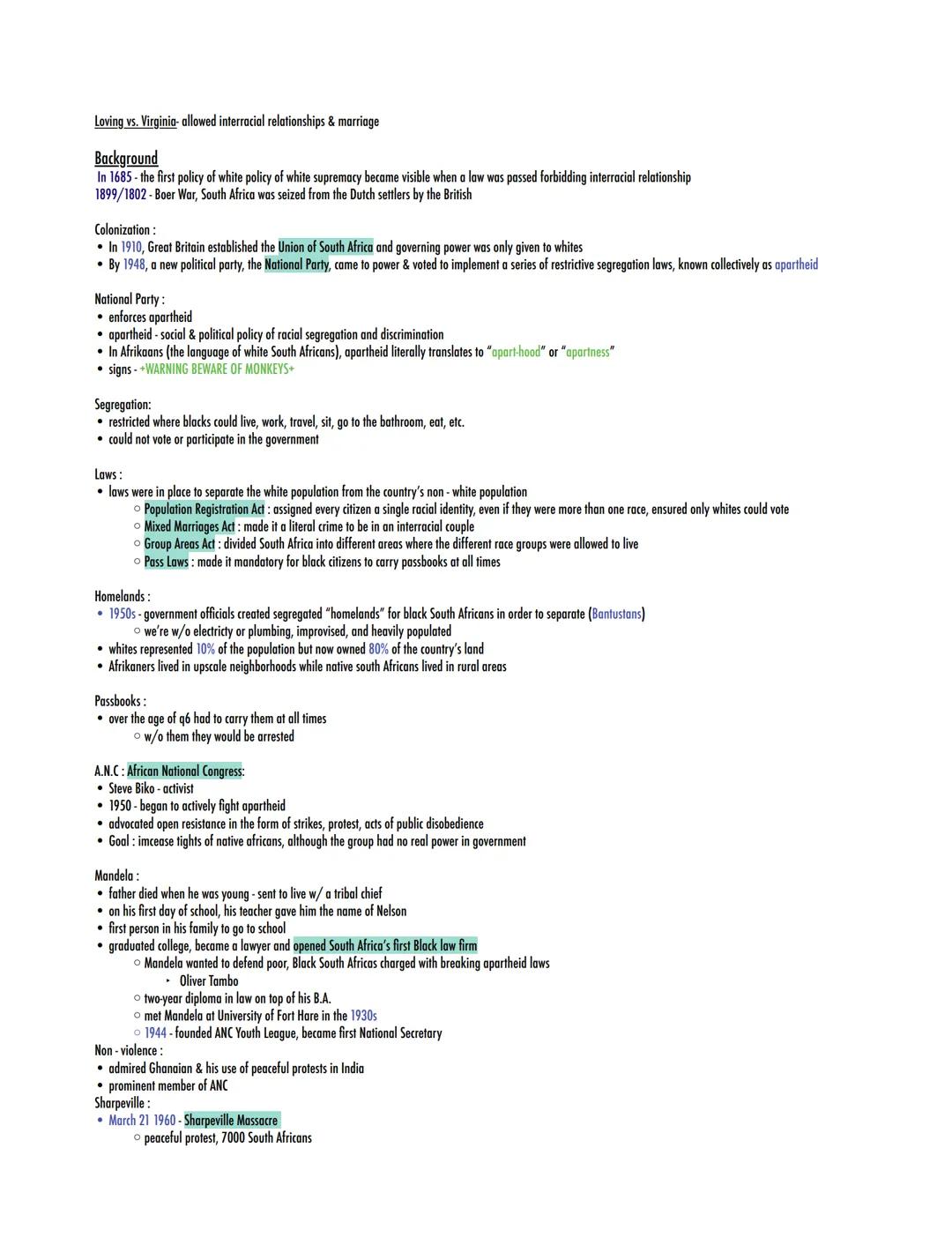
Racial segregation in South Africa has deep historical roots. As early as 1685, laws were passed forbidding interracial relationships, showing early signs of white supremacy policies. After the British seized South Africa from Dutch settlers in the Boer War, colonization intensified when Great Britain established the Union of South Africa in 1910, giving governing power exclusively to whites.
The system of apartheid (literally meaning "apartness" in Afrikaans) was formally implemented in 1948 when the National Party came to power. This comprehensive system of racial segregation restricted where Black South Africans could live, work, travel, eat, and even use the bathroom. Multiple laws enforced this separation, including the Population Registration Act (assigning each citizen a single racial identity), Mixed Marriages Act (criminalizing interracial relationships), and Group Areas Act (dividing living areas by race).
The government created segregated "homelands" (Bantustans) for Black South Africans in the 1950s. These areas lacked basic amenities like electricity and plumbing. Though whites represented only 10% of the population, they controlled 80% of the country's land. Every Black person over 16 had to carry passbooks at all times or face arrest.
Did you know? Signs in public spaces during apartheid sometimes literally read "WARNING BEWARE OF MONKEYS" to dehumanize Black South Africans and reinforce racial segregation.
In response to this oppression, the African National Congress (ANC) began actively fighting apartheid in 1950. Led by activists like Steve Biko and Nelson Mandela, the ANC advocated resistance through strikes and protests. Mandela, who became South Africa's first Black lawyer and opened the country's first Black law firm, initially favored non-violent protest inspired by Gandhi's methods in India.
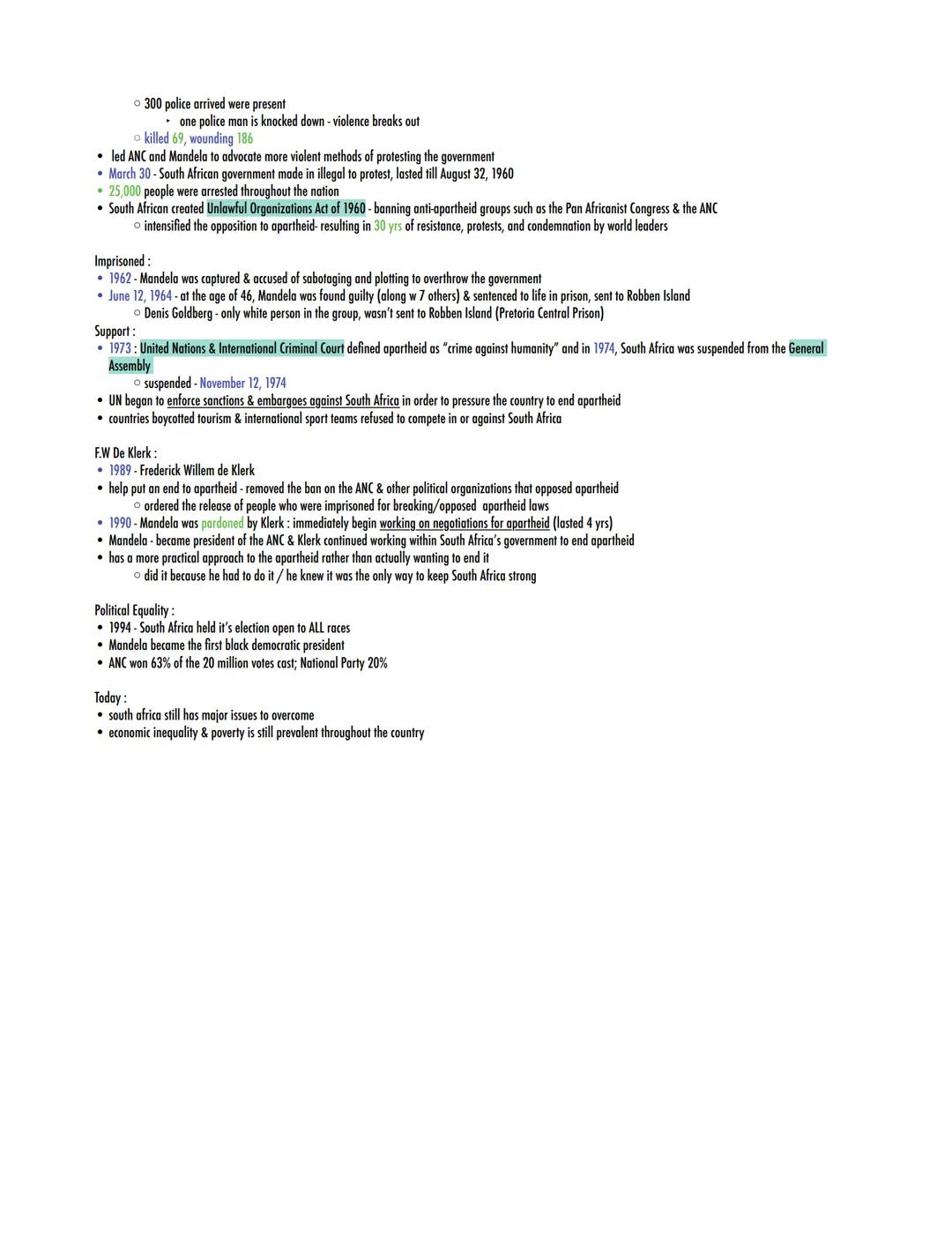
The turning point came with the Sharpeville Massacre on March 21, 1960. During a peaceful protest of 7,000 South Africans, police opened fire, killing 69 people and wounding 186. This tragedy pushed the ANC and Mandela to adopt more confrontational methods. In response, the government banned protests and passed the Unlawful Organizations Act, outlawing anti-apartheid groups like the ANC.
In 1962, Mandela was captured and accused of sabotage. By 1964, he was sentenced to life imprisonment on Robben Island, where he would remain for 27 years. The world began to take notice of South Africa's human rights violations. In 1973, the United Nations defined apartheid as a "crime against humanity" and suspended South Africa from the General Assembly in 1974. International sanctions, embargoes, and boycotts followed to pressure South Africa to end the system.
Change finally came in 1989 when F.W. de Klerk became president. Though motivated more by practicality than moral conviction, de Klerk removed bans on the ANC and other political organizations and ordered the release of political prisoners. Mandela was freed in 1990 and immediately began working with de Klerk on negotiations to end apartheid.
Remember this: The 1994 election was a watershed moment—South Africa's first democratic election open to all races resulted in Nelson Mandela becoming the country's first Black president, with the ANC winning 63% of the 20 million votes cast.
Despite this remarkable transition to democracy, modern South Africa still faces significant challenges. The legacy of apartheid lives on through economic inequality and widespread poverty throughout the country. The dismantling of legal segregation was just the beginning of a long journey toward true equality.
Our AI companion is specifically built for the needs of students. Based on the millions of content pieces we have on the platform we can provide truly meaningful and relevant answers to students. But its not only about answers, the companion is even more about guiding students through their daily learning challenges, with personalised study plans, quizzes or content pieces in the chat and 100% personalisation based on the students skills and developments.
You can download the app in the Google Play Store and in the Apple App Store.
That's right! Enjoy free access to study content, connect with fellow students, and get instant help – all at your fingertips.
App Store
Google Play
The app is very easy to use and well designed. I have found everything I was looking for so far and have been able to learn a lot from the presentations! I will definitely use the app for a class assignment! And of course it also helps a lot as an inspiration.
Stefan S
iOS user
This app is really great. There are so many study notes and help [...]. My problem subject is French, for example, and the app has so many options for help. Thanks to this app, I have improved my French. I would recommend it to anyone.
Samantha Klich
Android user
Wow, I am really amazed. I just tried the app because I've seen it advertised many times and was absolutely stunned. This app is THE HELP you want for school and above all, it offers so many things, such as workouts and fact sheets, which have been VERY helpful to me personally.
Anna
iOS user
I think it’s very much worth it and you’ll end up using it a lot once you get the hang of it and even after looking at others notes you can still ask your Artificial intelligence buddy the question and ask to simplify it if you still don’t get it!!! In the end I think it’s worth it 😊👍 ⚠️Also DID I MENTION ITS FREEE YOU DON’T HAVE TO PAY FOR ANYTHING AND STILL GET YOUR GRADES IN PERFECTLY❗️❗️⚠️
Thomas R
iOS user
Knowunity is the BEST app I’ve used in a minute. This is not an ai review or anything this is genuinely coming from a 7th grade student (I know 2011 im young) but dude this app is a 10/10 i have maintained a 3.8 gpa and have plenty of time for gaming. I love it and my mom is just happy I got good grades
Brad T
Android user
Not only did it help me find the answer but it also showed me alternative ways to solve it. I was horrible in math and science but now I have an a in both subjects. Thanks for the help🤍🤍
David K
iOS user
The app's just great! All I have to do is enter the topic in the search bar and I get the response real fast. I don't have to watch 10 YouTube videos to understand something, so I'm saving my time. Highly recommended!
Sudenaz Ocak
Android user
In school I was really bad at maths but thanks to the app, I am doing better now. I am so grateful that you made the app.
Greenlight Bonnie
Android user
I found this app a couple years ago and it has only gotten better since then. I really love it because it can help with written questions and photo questions. Also, it can find study guides that other people have made as well as flashcard sets and practice tests. The free version is also amazing for students who might not be able to afford it. Would 100% recommend
Aubrey
iOS user
Best app if you're in Highschool or Junior high. I have been using this app for 2 school years and it's the best, it's good if you don't have anyone to help you with school work.😋🩷🎀
Marco B
iOS user
THE QUIZES AND FLASHCARDS ARE SO USEFUL AND I LOVE Knowunity AI. IT ALSO IS LITREALLY LIKE CHATGPT BUT SMARTER!! HELPED ME WITH MY MASCARA PROBLEMS TOO!! AS WELL AS MY REAL SUBJECTS ! DUHHH 😍😁😲🤑💗✨🎀😮
Elisha
iOS user
This app is phenomenal down to the correct info and the various topics you can study! I greatly recommend it for people who struggle with procrastination and those who need homework help. It has been perfectly accurate for world 1 history as far as I’ve seen! Geometry too!
Paul T
iOS user
The app is very easy to use and well designed. I have found everything I was looking for so far and have been able to learn a lot from the presentations! I will definitely use the app for a class assignment! And of course it also helps a lot as an inspiration.
Stefan S
iOS user
This app is really great. There are so many study notes and help [...]. My problem subject is French, for example, and the app has so many options for help. Thanks to this app, I have improved my French. I would recommend it to anyone.
Samantha Klich
Android user
Wow, I am really amazed. I just tried the app because I've seen it advertised many times and was absolutely stunned. This app is THE HELP you want for school and above all, it offers so many things, such as workouts and fact sheets, which have been VERY helpful to me personally.
Anna
iOS user
I think it’s very much worth it and you’ll end up using it a lot once you get the hang of it and even after looking at others notes you can still ask your Artificial intelligence buddy the question and ask to simplify it if you still don’t get it!!! In the end I think it’s worth it 😊👍 ⚠️Also DID I MENTION ITS FREEE YOU DON’T HAVE TO PAY FOR ANYTHING AND STILL GET YOUR GRADES IN PERFECTLY❗️❗️⚠️
Thomas R
iOS user
Knowunity is the BEST app I’ve used in a minute. This is not an ai review or anything this is genuinely coming from a 7th grade student (I know 2011 im young) but dude this app is a 10/10 i have maintained a 3.8 gpa and have plenty of time for gaming. I love it and my mom is just happy I got good grades
Brad T
Android user
Not only did it help me find the answer but it also showed me alternative ways to solve it. I was horrible in math and science but now I have an a in both subjects. Thanks for the help🤍🤍
David K
iOS user
The app's just great! All I have to do is enter the topic in the search bar and I get the response real fast. I don't have to watch 10 YouTube videos to understand something, so I'm saving my time. Highly recommended!
Sudenaz Ocak
Android user
In school I was really bad at maths but thanks to the app, I am doing better now. I am so grateful that you made the app.
Greenlight Bonnie
Android user
I found this app a couple years ago and it has only gotten better since then. I really love it because it can help with written questions and photo questions. Also, it can find study guides that other people have made as well as flashcard sets and practice tests. The free version is also amazing for students who might not be able to afford it. Would 100% recommend
Aubrey
iOS user
Best app if you're in Highschool or Junior high. I have been using this app for 2 school years and it's the best, it's good if you don't have anyone to help you with school work.😋🩷🎀
Marco B
iOS user
THE QUIZES AND FLASHCARDS ARE SO USEFUL AND I LOVE Knowunity AI. IT ALSO IS LITREALLY LIKE CHATGPT BUT SMARTER!! HELPED ME WITH MY MASCARA PROBLEMS TOO!! AS WELL AS MY REAL SUBJECTS ! DUHHH 😍😁😲🤑💗✨🎀😮
Elisha
iOS user
This app is phenomenal down to the correct info and the various topics you can study! I greatly recommend it for people who struggle with procrastination and those who need homework help. It has been perfectly accurate for world 1 history as far as I’ve seen! Geometry too!
Paul T
iOS user
Hailey Hall
@haileyhall_afgu
Apartheid in South Africa was one of history's most brutal systems of racial segregation. From 1948 to 1994, the white minority government enforced legal racial separation that denied basic rights to the Black majority. This struggle for equality eventually led... Show more
Access to all documents
Improve your grades
Join milions of students
Racial segregation in South Africa has deep historical roots. As early as 1685, laws were passed forbidding interracial relationships, showing early signs of white supremacy policies. After the British seized South Africa from Dutch settlers in the Boer War, colonization intensified when Great Britain established the Union of South Africa in 1910, giving governing power exclusively to whites.
The system of apartheid (literally meaning "apartness" in Afrikaans) was formally implemented in 1948 when the National Party came to power. This comprehensive system of racial segregation restricted where Black South Africans could live, work, travel, eat, and even use the bathroom. Multiple laws enforced this separation, including the Population Registration Act (assigning each citizen a single racial identity), Mixed Marriages Act (criminalizing interracial relationships), and Group Areas Act (dividing living areas by race).
The government created segregated "homelands" (Bantustans) for Black South Africans in the 1950s. These areas lacked basic amenities like electricity and plumbing. Though whites represented only 10% of the population, they controlled 80% of the country's land. Every Black person over 16 had to carry passbooks at all times or face arrest.
Did you know? Signs in public spaces during apartheid sometimes literally read "WARNING BEWARE OF MONKEYS" to dehumanize Black South Africans and reinforce racial segregation.
In response to this oppression, the African National Congress (ANC) began actively fighting apartheid in 1950. Led by activists like Steve Biko and Nelson Mandela, the ANC advocated resistance through strikes and protests. Mandela, who became South Africa's first Black lawyer and opened the country's first Black law firm, initially favored non-violent protest inspired by Gandhi's methods in India.
Access to all documents
Improve your grades
Join milions of students
The turning point came with the Sharpeville Massacre on March 21, 1960. During a peaceful protest of 7,000 South Africans, police opened fire, killing 69 people and wounding 186. This tragedy pushed the ANC and Mandela to adopt more confrontational methods. In response, the government banned protests and passed the Unlawful Organizations Act, outlawing anti-apartheid groups like the ANC.
In 1962, Mandela was captured and accused of sabotage. By 1964, he was sentenced to life imprisonment on Robben Island, where he would remain for 27 years. The world began to take notice of South Africa's human rights violations. In 1973, the United Nations defined apartheid as a "crime against humanity" and suspended South Africa from the General Assembly in 1974. International sanctions, embargoes, and boycotts followed to pressure South Africa to end the system.
Change finally came in 1989 when F.W. de Klerk became president. Though motivated more by practicality than moral conviction, de Klerk removed bans on the ANC and other political organizations and ordered the release of political prisoners. Mandela was freed in 1990 and immediately began working with de Klerk on negotiations to end apartheid.
Remember this: The 1994 election was a watershed moment—South Africa's first democratic election open to all races resulted in Nelson Mandela becoming the country's first Black president, with the ANC winning 63% of the 20 million votes cast.
Despite this remarkable transition to democracy, modern South Africa still faces significant challenges. The legacy of apartheid lives on through economic inequality and widespread poverty throughout the country. The dismantling of legal segregation was just the beginning of a long journey toward true equality.
Our AI companion is specifically built for the needs of students. Based on the millions of content pieces we have on the platform we can provide truly meaningful and relevant answers to students. But its not only about answers, the companion is even more about guiding students through their daily learning challenges, with personalised study plans, quizzes or content pieces in the chat and 100% personalisation based on the students skills and developments.
You can download the app in the Google Play Store and in the Apple App Store.
That's right! Enjoy free access to study content, connect with fellow students, and get instant help – all at your fingertips.
8
Smart Tools NEW
Transform this note into: ✓ 50+ Practice Questions ✓ Interactive Flashcards ✓ Full Practice Test ✓ Essay Outlines
Explore the complexities of the Jack the Ripper case, including police failures, investigative methods, and the socio-political context of crime and punishment in Victorian London. This summary delves into the challenges faced by law enforcement and the historical background of medieval law enforcement practices. Ideal for students studying crime history and law enforcement evolution.
 History
Explore key concepts of crime and punishment from the Anglo-Saxon period to modern times. This comprehensive overview covers significant changes in law enforcement, notable cases, and the evolution of punishments, including the impact of the Industrial Revolution and religious conflicts. Ideal for history students preparing for exams or seeking a deeper understanding of societal shifts in crime and justice.
HistoryApp Store
Google Play
The app is very easy to use and well designed. I have found everything I was looking for so far and have been able to learn a lot from the presentations! I will definitely use the app for a class assignment! And of course it also helps a lot as an inspiration.
Stefan S
iOS user
This app is really great. There are so many study notes and help [...]. My problem subject is French, for example, and the app has so many options for help. Thanks to this app, I have improved my French. I would recommend it to anyone.
Samantha Klich
Android user
Wow, I am really amazed. I just tried the app because I've seen it advertised many times and was absolutely stunned. This app is THE HELP you want for school and above all, it offers so many things, such as workouts and fact sheets, which have been VERY helpful to me personally.
Anna
iOS user
I think it’s very much worth it and you’ll end up using it a lot once you get the hang of it and even after looking at others notes you can still ask your Artificial intelligence buddy the question and ask to simplify it if you still don’t get it!!! In the end I think it’s worth it 😊👍 ⚠️Also DID I MENTION ITS FREEE YOU DON’T HAVE TO PAY FOR ANYTHING AND STILL GET YOUR GRADES IN PERFECTLY❗️❗️⚠️
Thomas R
iOS user
Knowunity is the BEST app I’ve used in a minute. This is not an ai review or anything this is genuinely coming from a 7th grade student (I know 2011 im young) but dude this app is a 10/10 i have maintained a 3.8 gpa and have plenty of time for gaming. I love it and my mom is just happy I got good grades
Brad T
Android user
Not only did it help me find the answer but it also showed me alternative ways to solve it. I was horrible in math and science but now I have an a in both subjects. Thanks for the help🤍🤍
David K
iOS user
The app's just great! All I have to do is enter the topic in the search bar and I get the response real fast. I don't have to watch 10 YouTube videos to understand something, so I'm saving my time. Highly recommended!
Sudenaz Ocak
Android user
In school I was really bad at maths but thanks to the app, I am doing better now. I am so grateful that you made the app.
Greenlight Bonnie
Android user
I found this app a couple years ago and it has only gotten better since then. I really love it because it can help with written questions and photo questions. Also, it can find study guides that other people have made as well as flashcard sets and practice tests. The free version is also amazing for students who might not be able to afford it. Would 100% recommend
Aubrey
iOS user
Best app if you're in Highschool or Junior high. I have been using this app for 2 school years and it's the best, it's good if you don't have anyone to help you with school work.😋🩷🎀
Marco B
iOS user
THE QUIZES AND FLASHCARDS ARE SO USEFUL AND I LOVE Knowunity AI. IT ALSO IS LITREALLY LIKE CHATGPT BUT SMARTER!! HELPED ME WITH MY MASCARA PROBLEMS TOO!! AS WELL AS MY REAL SUBJECTS ! DUHHH 😍😁😲🤑💗✨🎀😮
Elisha
iOS user
This app is phenomenal down to the correct info and the various topics you can study! I greatly recommend it for people who struggle with procrastination and those who need homework help. It has been perfectly accurate for world 1 history as far as I’ve seen! Geometry too!
Paul T
iOS user
The app is very easy to use and well designed. I have found everything I was looking for so far and have been able to learn a lot from the presentations! I will definitely use the app for a class assignment! And of course it also helps a lot as an inspiration.
Stefan S
iOS user
This app is really great. There are so many study notes and help [...]. My problem subject is French, for example, and the app has so many options for help. Thanks to this app, I have improved my French. I would recommend it to anyone.
Samantha Klich
Android user
Wow, I am really amazed. I just tried the app because I've seen it advertised many times and was absolutely stunned. This app is THE HELP you want for school and above all, it offers so many things, such as workouts and fact sheets, which have been VERY helpful to me personally.
Anna
iOS user
I think it’s very much worth it and you’ll end up using it a lot once you get the hang of it and even after looking at others notes you can still ask your Artificial intelligence buddy the question and ask to simplify it if you still don’t get it!!! In the end I think it’s worth it 😊👍 ⚠️Also DID I MENTION ITS FREEE YOU DON’T HAVE TO PAY FOR ANYTHING AND STILL GET YOUR GRADES IN PERFECTLY❗️❗️⚠️
Thomas R
iOS user
Knowunity is the BEST app I’ve used in a minute. This is not an ai review or anything this is genuinely coming from a 7th grade student (I know 2011 im young) but dude this app is a 10/10 i have maintained a 3.8 gpa and have plenty of time for gaming. I love it and my mom is just happy I got good grades
Brad T
Android user
Not only did it help me find the answer but it also showed me alternative ways to solve it. I was horrible in math and science but now I have an a in both subjects. Thanks for the help🤍🤍
David K
iOS user
The app's just great! All I have to do is enter the topic in the search bar and I get the response real fast. I don't have to watch 10 YouTube videos to understand something, so I'm saving my time. Highly recommended!
Sudenaz Ocak
Android user
In school I was really bad at maths but thanks to the app, I am doing better now. I am so grateful that you made the app.
Greenlight Bonnie
Android user
I found this app a couple years ago and it has only gotten better since then. I really love it because it can help with written questions and photo questions. Also, it can find study guides that other people have made as well as flashcard sets and practice tests. The free version is also amazing for students who might not be able to afford it. Would 100% recommend
Aubrey
iOS user
Best app if you're in Highschool or Junior high. I have been using this app for 2 school years and it's the best, it's good if you don't have anyone to help you with school work.😋🩷🎀
Marco B
iOS user
THE QUIZES AND FLASHCARDS ARE SO USEFUL AND I LOVE Knowunity AI. IT ALSO IS LITREALLY LIKE CHATGPT BUT SMARTER!! HELPED ME WITH MY MASCARA PROBLEMS TOO!! AS WELL AS MY REAL SUBJECTS ! DUHHH 😍😁😲🤑💗✨🎀😮
Elisha
iOS user
This app is phenomenal down to the correct info and the various topics you can study! I greatly recommend it for people who struggle with procrastination and those who need homework help. It has been perfectly accurate for world 1 history as far as I’ve seen! Geometry too!
Paul T
iOS user