
Religion and ethics are deeply intertwined in many worldviews, but... Show more
 Algebra
Sign up to see the contentIt's free!
Access to all documents
Improve your grades
Join milions of students
Knowunity AI
Subjects
Triangle Congruence and Similarity Theorems
Triangle Properties and Classification
Linear Equations and Graphs
Geometric Angle Relationships
Trigonometric Functions and Identities
Equation Solving Techniques
Circle Geometry Fundamentals
Division Operations and Methods
Basic Differentiation Rules
Exponent and Logarithm Properties
Show all topics
Human Organ Systems
Reproductive Cell Cycles
Biological Sciences Subdisciplines
Cellular Energy Metabolism
Autotrophic Energy Processes
Inheritance Patterns and Principles
Biomolecular Structure and Organization
Cell Cycle and Division Mechanics
Cellular Organization and Development
Biological Structural Organization
Show all topics
Chemical Sciences and Applications
Atomic Structure and Composition
Molecular Electron Structure Representation
Atomic Electron Behavior
Matter Properties and Water
Mole Concept and Calculations
Gas Laws and Behavior
Periodic Table Organization
Chemical Thermodynamics Fundamentals
Chemical Bond Types and Properties
Show all topics
European Renaissance and Enlightenment
European Cultural Movements 800-1920
American Revolution Era 1763-1797
American Civil War 1861-1865
Global Imperial Systems
Mongol and Chinese Dynasties
U.S. Presidents and World Leaders
Historical Sources and Documentation
World Wars Era and Impact
World Religious Systems
Show all topics
Classic and Contemporary Novels
Literary Character Analysis
Rhetorical Theory and Practice
Classic Literary Narratives
Reading Analysis and Interpretation
Narrative Structure and Techniques
English Language Components
Influential English-Language Authors
Basic Sentence Structure
Narrative Voice and Perspective
Show all topics
523
•
Updated Feb 27, 2026
•

Marley Kukoleck
@marleykukoleck_qoxt
Religion and ethics are deeply intertwined in many worldviews, but... Show more
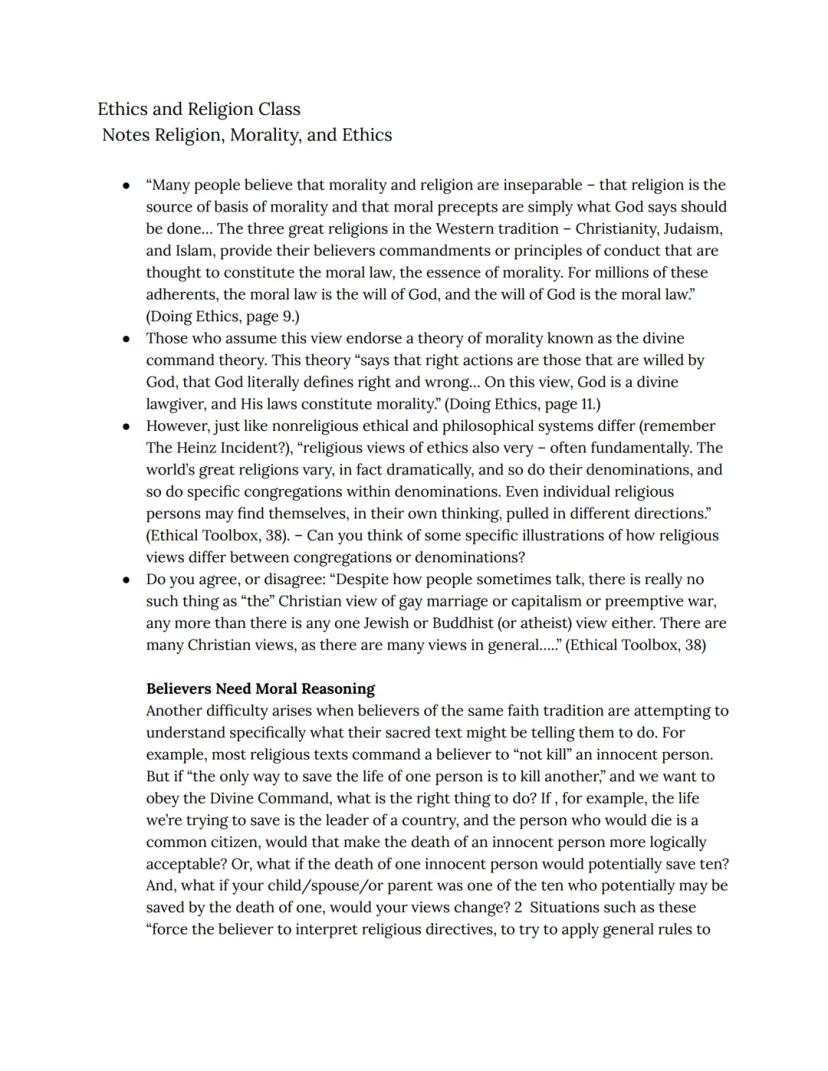
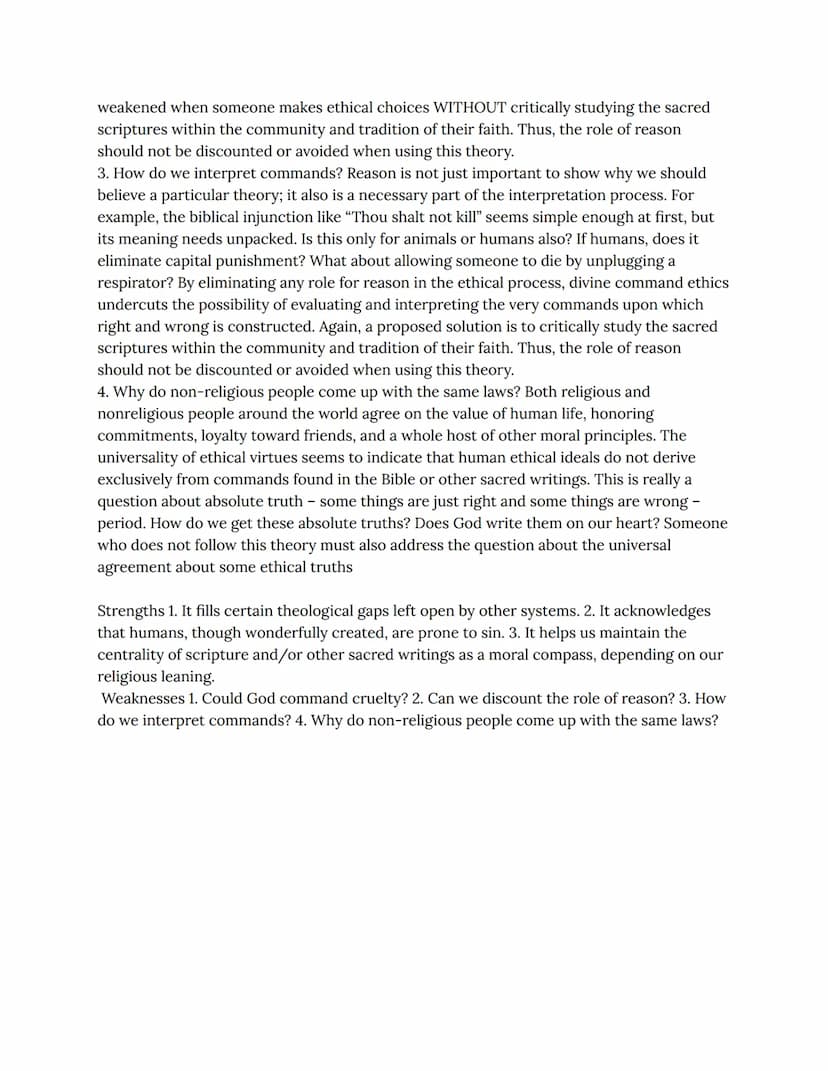
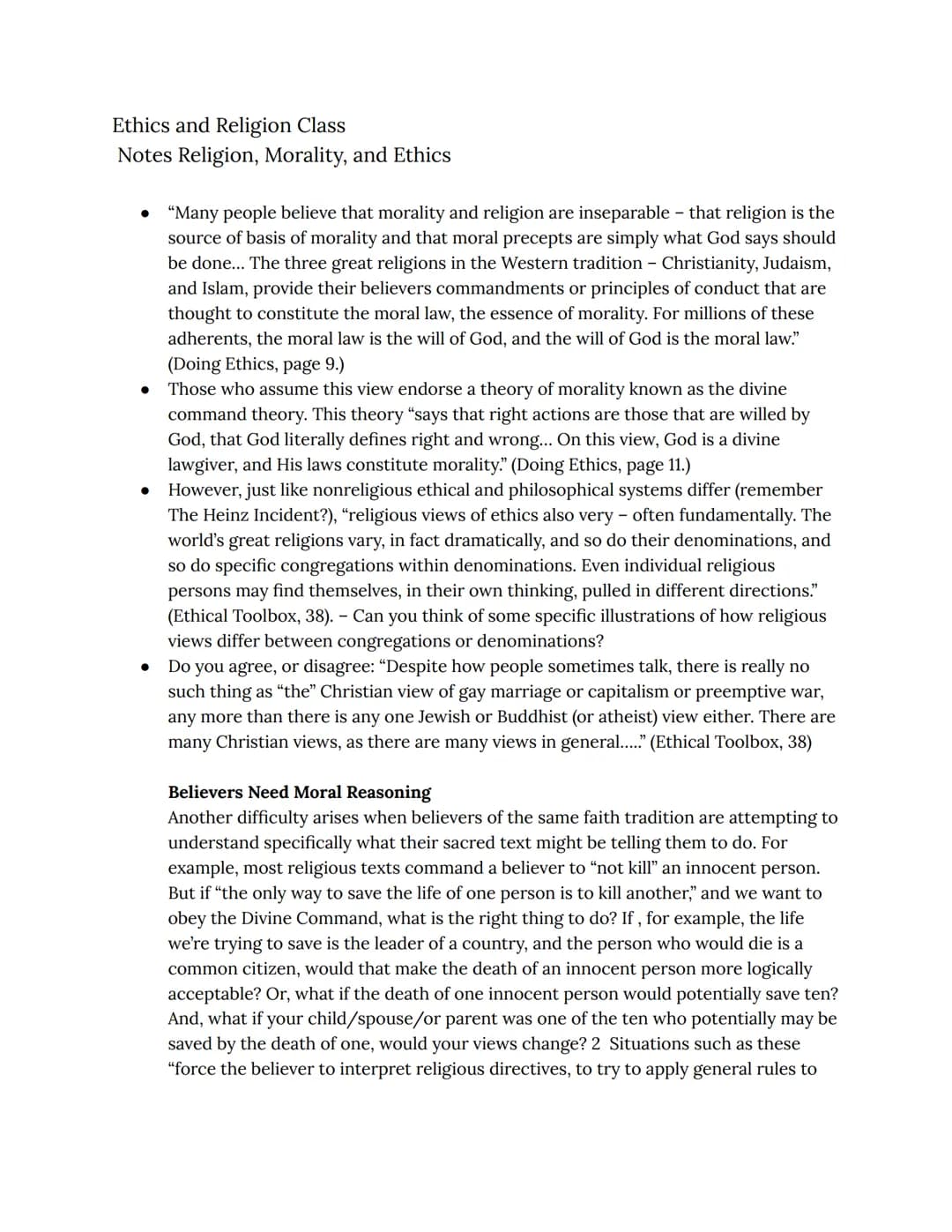
Many people believe morality comes directly from religion, with the idea that moral precepts are simply what God commands us to do. Christianity, Judaism, and Islam all provide believers with principles of conduct considered to be moral law.
This view aligns with the Divine Command Theory, which states that right actions are those willed by God—essentially making God the definer of right and wrong. However, religious views on ethics vary dramatically between religions, denominations, and even within specific congregations. There isn't one single "Christian view" on issues like gay marriage or war, but rather many perspectives within each faith tradition.
Even believers of the same faith face moral dilemmas when interpreting sacred texts. If a commandment says "do not kill," what happens in situations where killing one person might save many others? These complex scenarios force believers to interpret religious directives and apply general rules to specific cases.
Think About This: When facing an ethical dilemma, how do you balance what your religious texts say with practical reasoning? Religious beliefs provide guidance, but applying them to complex situations often requires careful thought.
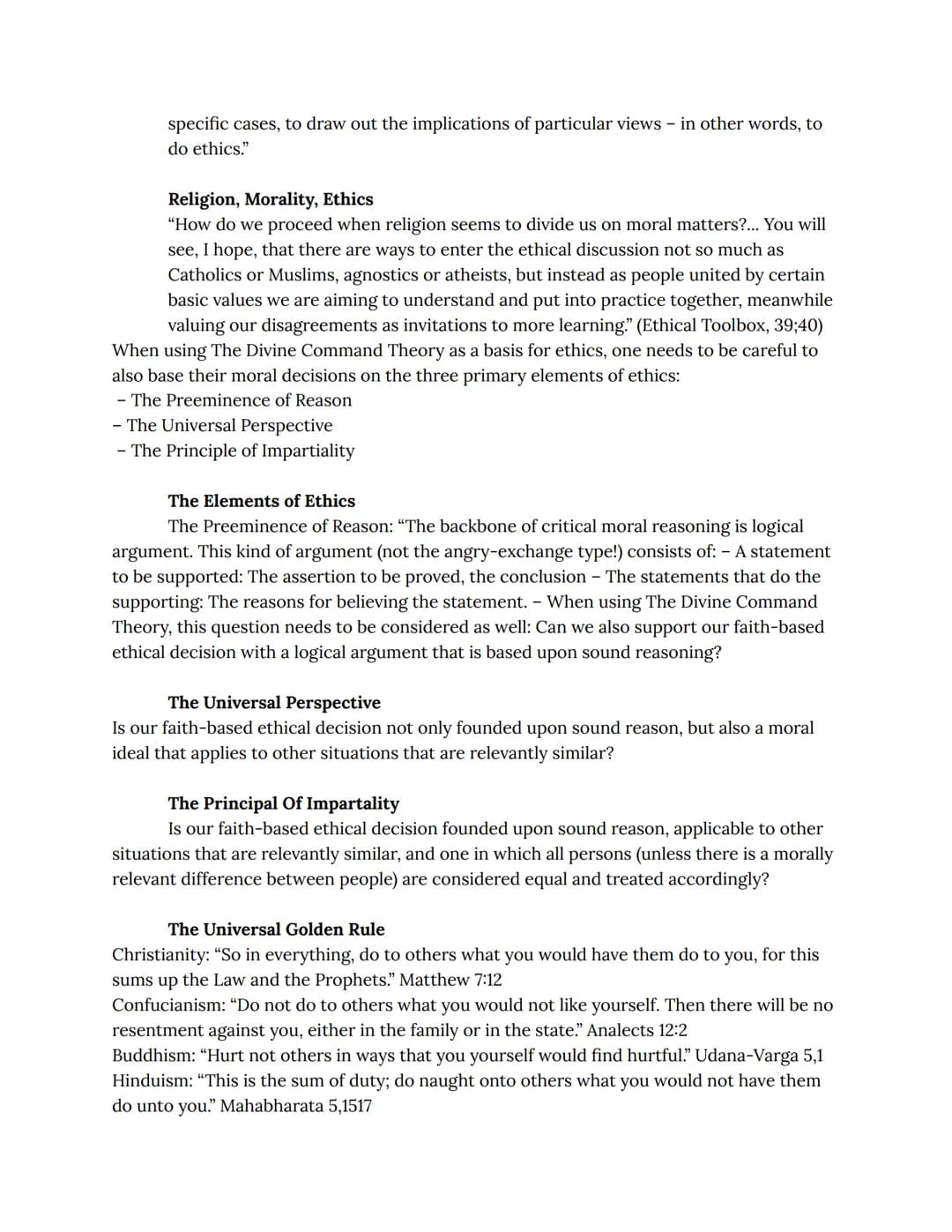
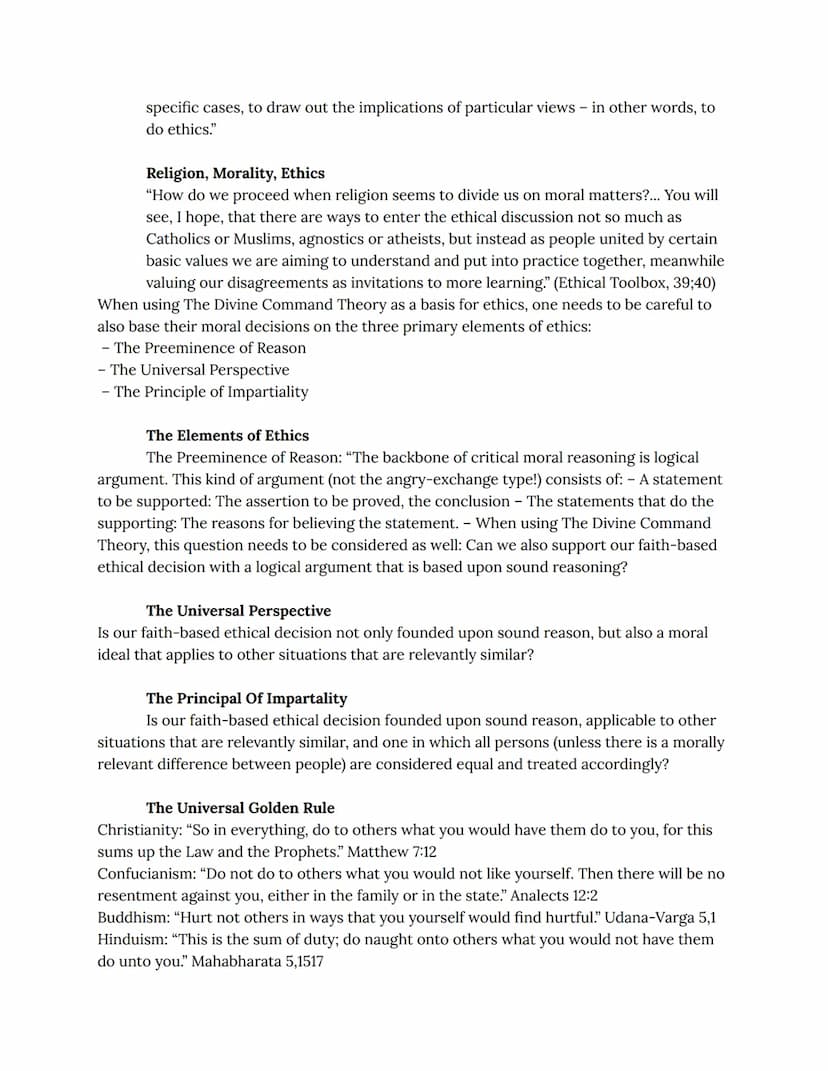
When using Divine Command Theory as the basis for ethical decisions, it's important to incorporate three primary elements of ethics: the preeminence of reason, the universal perspective, and the principle of impartiality.
The preeminence of reason means using logical arguments to support moral decisions, not just citing religious authority. This includes providing clear statements to be supported and reasons for believing them. Even faith-based decisions should be backed by sound reasoning.
The universal perspective asks whether our moral decision applies to other relevantly similar situations. Meanwhile, the principle of impartiality ensures we treat all people equally unless there's a morally relevant difference between them.
Interestingly, most major world religions share some version of the Golden Rule. Christianity teaches "do to others what you would have them do to you," while Buddhism instructs "hurt not others in ways that you yourself would find hurtful." This universal principle appears across traditions from Confucianism to Islam, suggesting common moral ground across diverse religious perspectives.
Important Insight: The Golden Rule appears in nearly identical forms across world religions, suggesting that certain moral principles transcend cultural and religious boundaries.
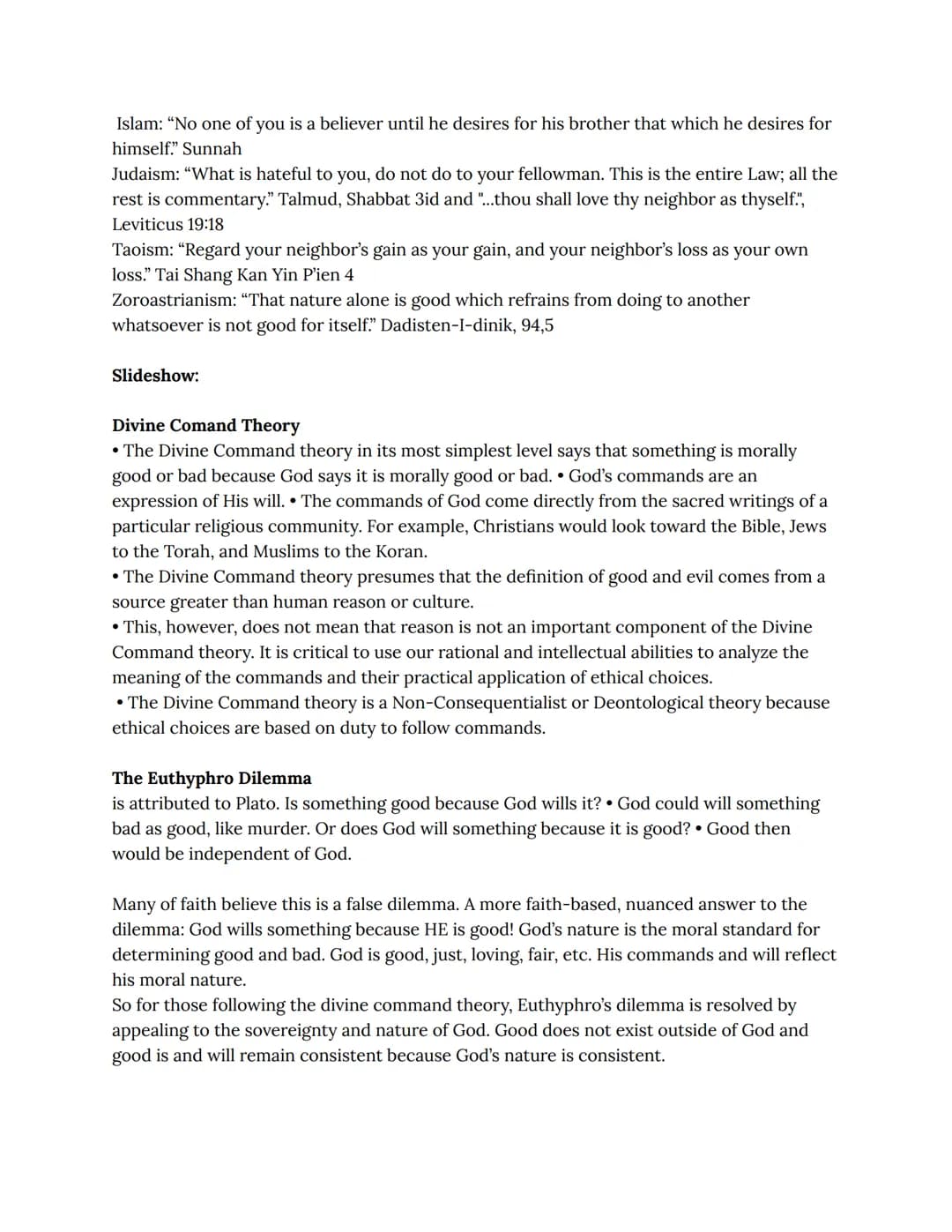
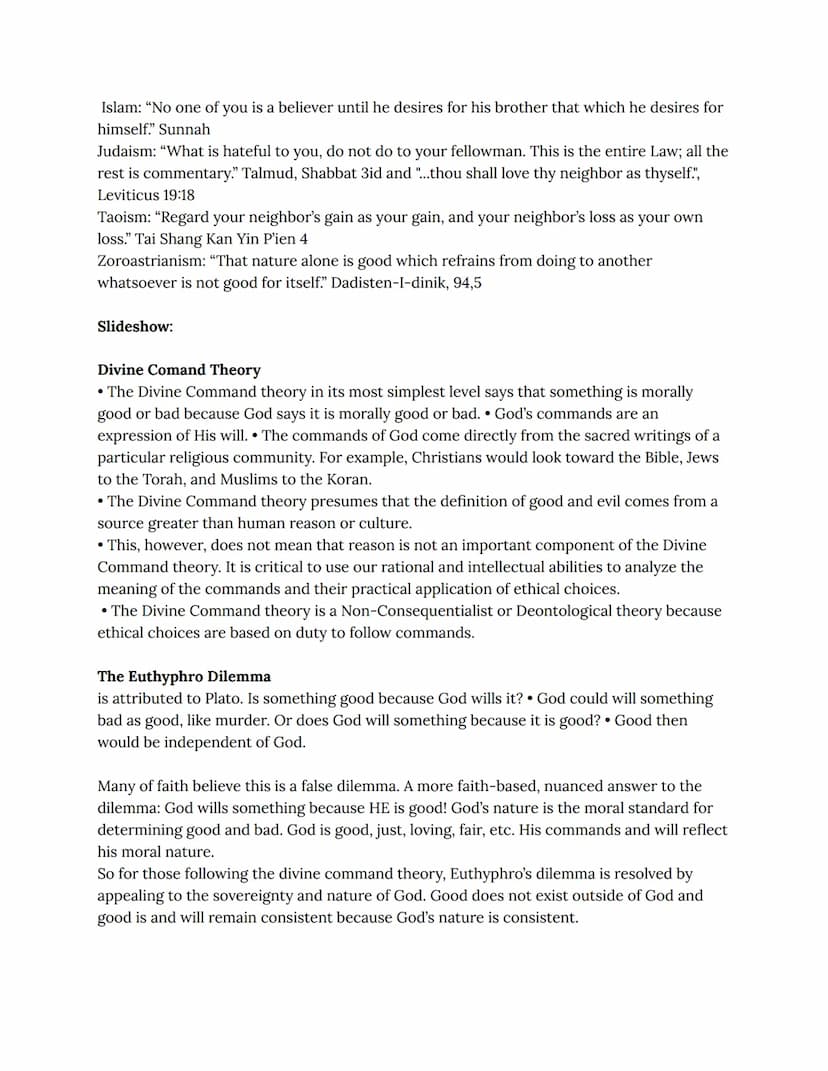
The Divine Command Theory at its simplest level states that something is morally good or bad because God says so. God's commands, expressed through sacred writings like the Bible, Torah, or Koran, define morality for believers. This theory assumes that good and evil are defined by a source greater than human reason or culture.
However, this doesn't mean reason isn't important. In fact, it's essential to use our intellectual abilities to analyze the meaning of divine commands and their practical application to ethical choices. Divine Command Theory is considered a non-consequentialist or deontological theory because it bases ethical choices on duty rather than outcomes.
An important philosophical challenge to this theory is the Euthyphro Dilemma: Is something good because God wills it, or does God will it because it's already good? If the former, God could theoretically command something bad (like murder) to be good. If the latter, goodness exists independently of God.
Many believers resolve this by arguing that God wills something because He is good—His nature is the moral standard. Good doesn't exist outside of God, and because God's nature is consistent, what is good remains consistent.
Consider This: The Euthyphro Dilemma forces us to think about the relationship between God and goodness. Does God define what's good, or does God recognize what's already good? Your answer shapes how you approach moral questions.
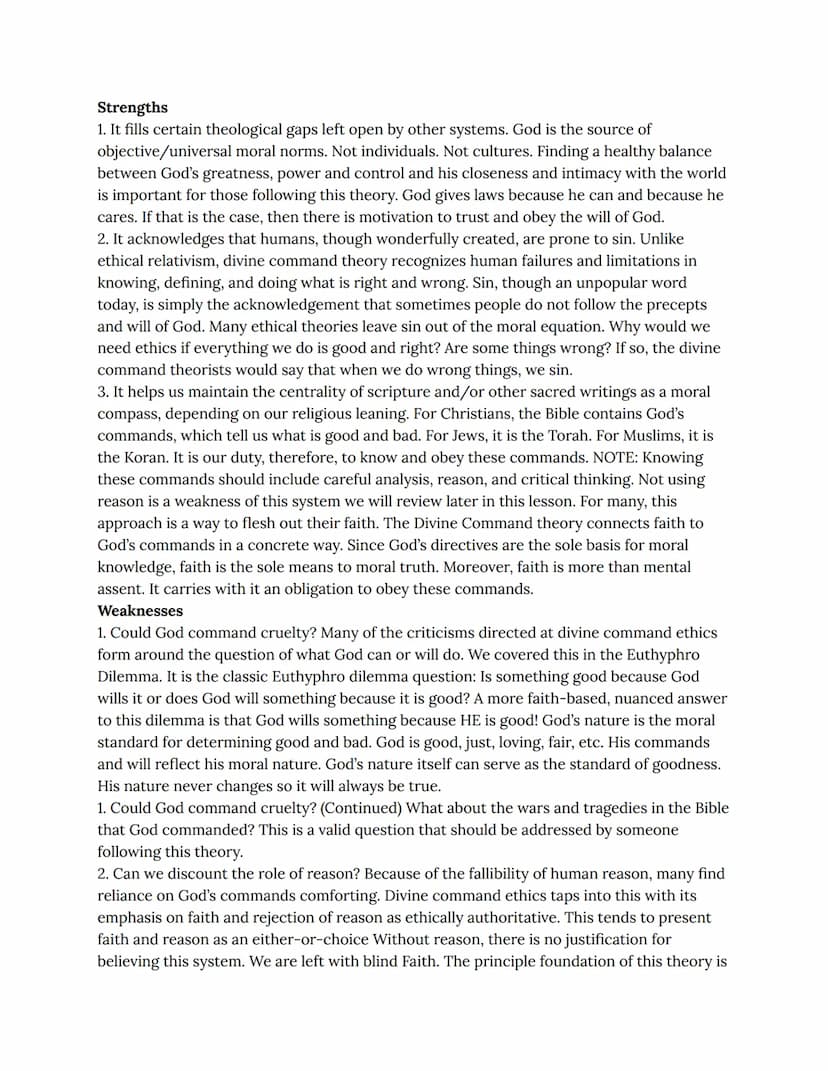
Divine Command Theory offers several compelling strengths for religious believers making ethical choices. First, it establishes God as the source of objective moral norms, not individuals or cultures. This provides a balance between viewing God as powerful yet intimately connected to humanity, giving believers motivation to trust and obey.
Second, unlike ethical relativism, this theory acknowledges human limitations and failures in determining right from wrong. The concept of sin—though unpopular today—recognizes that people sometimes fail to follow God's will, which explains why we need ethics in the first place.
Third, it maintains the centrality of sacred writings as moral guides. For Christians, the Bible contains God's commands; for Jews, the Torah; for Muslims, the Koran. Knowing these commands requires careful analysis and critical thinking, connecting faith to concrete action. Faith becomes more than mental agreement—it carries an obligation to obey these commands.
However, these strengths come with the responsibility to thoughtfully interpret sacred texts within your faith community and tradition. Simply following commands without understanding their context and meaning can lead to misapplication.
Remember: The strongest application of Divine Command Theory comes when believers combine faithful adherence to sacred texts with thoughtful reasoning and community interpretation—not blind obedience.
Despite its strengths, Divine Command Theory faces several important challenges. First, critics ask if God could command something cruel. While believers typically respond that God's good nature prevents this, difficult questions remain about wars and tragedies described in religious texts that God reportedly commanded.
Second, the theory sometimes undervalues reason in ethical decision-making. While human reasoning is fallible, completely rejecting reason leaves us with blind faith. Without critical study of sacred scriptures within faith communities, ethical choices lack foundation. Reason remains necessary both for believing the theory and for interpreting commands.
Third, interpreting commands is complex. Even a seemingly simple command like "Thou shalt not kill" raises questions: Does it apply to animals? Does it prohibit capital punishment or disconnecting life support? Without reasoning through these interpretations, we can't properly apply divine commands.
Finally, the universality of ethical principles across religious and non-religious populations raises questions. People worldwide generally agree on the value of human life, honesty, and loyalty—regardless of religious belief. This suggests ethical ideals may not derive exclusively from sacred texts, though believers might argue God writes these principles on all human hearts.
Critical Question: If both religious and non-religious people often reach similar moral conclusions, what might this tell us about the relationship between divine commands and human reasoning?
Our AI companion is specifically built for the needs of students. Based on the millions of content pieces we have on the platform we can provide truly meaningful and relevant answers to students. But its not only about answers, the companion is even more about guiding students through their daily learning challenges, with personalised study plans, quizzes or content pieces in the chat and 100% personalisation based on the students skills and developments.
You can download the app in the Google Play Store and in the Apple App Store.
That's right! Enjoy free access to study content, connect with fellow students, and get instant help – all at your fingertips.
App Store
Google Play
The app is very easy to use and well designed. I have found everything I was looking for so far and have been able to learn a lot from the presentations! I will definitely use the app for a class assignment! And of course it also helps a lot as an inspiration.
Stefan S
iOS user
This app is really great. There are so many study notes and help [...]. My problem subject is French, for example, and the app has so many options for help. Thanks to this app, I have improved my French. I would recommend it to anyone.
Samantha Klich
Android user
Wow, I am really amazed. I just tried the app because I've seen it advertised many times and was absolutely stunned. This app is THE HELP you want for school and above all, it offers so many things, such as workouts and fact sheets, which have been VERY helpful to me personally.
Anna
iOS user
I think it’s very much worth it and you’ll end up using it a lot once you get the hang of it and even after looking at others notes you can still ask your Artificial intelligence buddy the question and ask to simplify it if you still don’t get it!!! In the end I think it’s worth it 😊👍 ⚠️Also DID I MENTION ITS FREEE YOU DON’T HAVE TO PAY FOR ANYTHING AND STILL GET YOUR GRADES IN PERFECTLY❗️❗️⚠️
Thomas R
iOS user
Knowunity is the BEST app I’ve used in a minute. This is not an ai review or anything this is genuinely coming from a 7th grade student (I know 2011 im young) but dude this app is a 10/10 i have maintained a 3.8 gpa and have plenty of time for gaming. I love it and my mom is just happy I got good grades
Brad T
Android user
Not only did it help me find the answer but it also showed me alternative ways to solve it. I was horrible in math and science but now I have an a in both subjects. Thanks for the help🤍🤍
David K
iOS user
The app's just great! All I have to do is enter the topic in the search bar and I get the response real fast. I don't have to watch 10 YouTube videos to understand something, so I'm saving my time. Highly recommended!
Sudenaz Ocak
Android user
In school I was really bad at maths but thanks to the app, I am doing better now. I am so grateful that you made the app.
Greenlight Bonnie
Android user
I found this app a couple years ago and it has only gotten better since then. I really love it because it can help with written questions and photo questions. Also, it can find study guides that other people have made as well as flashcard sets and practice tests. The free version is also amazing for students who might not be able to afford it. Would 100% recommend
Aubrey
iOS user
Best app if you're in Highschool or Junior high. I have been using this app for 2 school years and it's the best, it's good if you don't have anyone to help you with school work.😋🩷🎀
Marco B
iOS user
THE QUIZES AND FLASHCARDS ARE SO USEFUL AND I LOVE Knowunity AI. IT ALSO IS LITREALLY LIKE CHATGPT BUT SMARTER!! HELPED ME WITH MY MASCARA PROBLEMS TOO!! AS WELL AS MY REAL SUBJECTS ! DUHHH 😍😁😲🤑💗✨🎀😮
Elisha
iOS user
This app is phenomenal down to the correct info and the various topics you can study! I greatly recommend it for people who struggle with procrastination and those who need homework help. It has been perfectly accurate for world 1 history as far as I’ve seen! Geometry too!
Paul T
iOS user
The app is very easy to use and well designed. I have found everything I was looking for so far and have been able to learn a lot from the presentations! I will definitely use the app for a class assignment! And of course it also helps a lot as an inspiration.
Stefan S
iOS user
This app is really great. There are so many study notes and help [...]. My problem subject is French, for example, and the app has so many options for help. Thanks to this app, I have improved my French. I would recommend it to anyone.
Samantha Klich
Android user
Wow, I am really amazed. I just tried the app because I've seen it advertised many times and was absolutely stunned. This app is THE HELP you want for school and above all, it offers so many things, such as workouts and fact sheets, which have been VERY helpful to me personally.
Anna
iOS user
I think it’s very much worth it and you’ll end up using it a lot once you get the hang of it and even after looking at others notes you can still ask your Artificial intelligence buddy the question and ask to simplify it if you still don’t get it!!! In the end I think it’s worth it 😊👍 ⚠️Also DID I MENTION ITS FREEE YOU DON’T HAVE TO PAY FOR ANYTHING AND STILL GET YOUR GRADES IN PERFECTLY❗️❗️⚠️
Thomas R
iOS user
Knowunity is the BEST app I’ve used in a minute. This is not an ai review or anything this is genuinely coming from a 7th grade student (I know 2011 im young) but dude this app is a 10/10 i have maintained a 3.8 gpa and have plenty of time for gaming. I love it and my mom is just happy I got good grades
Brad T
Android user
Not only did it help me find the answer but it also showed me alternative ways to solve it. I was horrible in math and science but now I have an a in both subjects. Thanks for the help🤍🤍
David K
iOS user
The app's just great! All I have to do is enter the topic in the search bar and I get the response real fast. I don't have to watch 10 YouTube videos to understand something, so I'm saving my time. Highly recommended!
Sudenaz Ocak
Android user
In school I was really bad at maths but thanks to the app, I am doing better now. I am so grateful that you made the app.
Greenlight Bonnie
Android user
I found this app a couple years ago and it has only gotten better since then. I really love it because it can help with written questions and photo questions. Also, it can find study guides that other people have made as well as flashcard sets and practice tests. The free version is also amazing for students who might not be able to afford it. Would 100% recommend
Aubrey
iOS user
Best app if you're in Highschool or Junior high. I have been using this app for 2 school years and it's the best, it's good if you don't have anyone to help you with school work.😋🩷🎀
Marco B
iOS user
THE QUIZES AND FLASHCARDS ARE SO USEFUL AND I LOVE Knowunity AI. IT ALSO IS LITREALLY LIKE CHATGPT BUT SMARTER!! HELPED ME WITH MY MASCARA PROBLEMS TOO!! AS WELL AS MY REAL SUBJECTS ! DUHHH 😍😁😲🤑💗✨🎀😮
Elisha
iOS user
This app is phenomenal down to the correct info and the various topics you can study! I greatly recommend it for people who struggle with procrastination and those who need homework help. It has been perfectly accurate for world 1 history as far as I’ve seen! Geometry too!
Paul T
iOS user
Marley Kukoleck
@marleykukoleck_qoxt
Religion and ethics are deeply intertwined in many worldviews, but their relationship is more complex than it might first appear. This study explores the Divine Command Theory—the idea that what is morally right is what God commands—and examines how religious... Show more
Access to all documents
Improve your grades
Join milions of students
Many people believe morality comes directly from religion, with the idea that moral precepts are simply what God commands us to do. Christianity, Judaism, and Islam all provide believers with principles of conduct considered to be moral law.
This view aligns with the Divine Command Theory, which states that right actions are those willed by God—essentially making God the definer of right and wrong. However, religious views on ethics vary dramatically between religions, denominations, and even within specific congregations. There isn't one single "Christian view" on issues like gay marriage or war, but rather many perspectives within each faith tradition.
Even believers of the same faith face moral dilemmas when interpreting sacred texts. If a commandment says "do not kill," what happens in situations where killing one person might save many others? These complex scenarios force believers to interpret religious directives and apply general rules to specific cases.
Think About This: When facing an ethical dilemma, how do you balance what your religious texts say with practical reasoning? Religious beliefs provide guidance, but applying them to complex situations often requires careful thought.
Access to all documents
Improve your grades
Join milions of students
When using Divine Command Theory as the basis for ethical decisions, it's important to incorporate three primary elements of ethics: the preeminence of reason, the universal perspective, and the principle of impartiality.
The preeminence of reason means using logical arguments to support moral decisions, not just citing religious authority. This includes providing clear statements to be supported and reasons for believing them. Even faith-based decisions should be backed by sound reasoning.
The universal perspective asks whether our moral decision applies to other relevantly similar situations. Meanwhile, the principle of impartiality ensures we treat all people equally unless there's a morally relevant difference between them.
Interestingly, most major world religions share some version of the Golden Rule. Christianity teaches "do to others what you would have them do to you," while Buddhism instructs "hurt not others in ways that you yourself would find hurtful." This universal principle appears across traditions from Confucianism to Islam, suggesting common moral ground across diverse religious perspectives.
Important Insight: The Golden Rule appears in nearly identical forms across world religions, suggesting that certain moral principles transcend cultural and religious boundaries.
Access to all documents
Improve your grades
Join milions of students
The Divine Command Theory at its simplest level states that something is morally good or bad because God says so. God's commands, expressed through sacred writings like the Bible, Torah, or Koran, define morality for believers. This theory assumes that good and evil are defined by a source greater than human reason or culture.
However, this doesn't mean reason isn't important. In fact, it's essential to use our intellectual abilities to analyze the meaning of divine commands and their practical application to ethical choices. Divine Command Theory is considered a non-consequentialist or deontological theory because it bases ethical choices on duty rather than outcomes.
An important philosophical challenge to this theory is the Euthyphro Dilemma: Is something good because God wills it, or does God will it because it's already good? If the former, God could theoretically command something bad (like murder) to be good. If the latter, goodness exists independently of God.
Many believers resolve this by arguing that God wills something because He is good—His nature is the moral standard. Good doesn't exist outside of God, and because God's nature is consistent, what is good remains consistent.
Consider This: The Euthyphro Dilemma forces us to think about the relationship between God and goodness. Does God define what's good, or does God recognize what's already good? Your answer shapes how you approach moral questions.
Access to all documents
Improve your grades
Join milions of students
Divine Command Theory offers several compelling strengths for religious believers making ethical choices. First, it establishes God as the source of objective moral norms, not individuals or cultures. This provides a balance between viewing God as powerful yet intimately connected to humanity, giving believers motivation to trust and obey.
Second, unlike ethical relativism, this theory acknowledges human limitations and failures in determining right from wrong. The concept of sin—though unpopular today—recognizes that people sometimes fail to follow God's will, which explains why we need ethics in the first place.
Third, it maintains the centrality of sacred writings as moral guides. For Christians, the Bible contains God's commands; for Jews, the Torah; for Muslims, the Koran. Knowing these commands requires careful analysis and critical thinking, connecting faith to concrete action. Faith becomes more than mental agreement—it carries an obligation to obey these commands.
However, these strengths come with the responsibility to thoughtfully interpret sacred texts within your faith community and tradition. Simply following commands without understanding their context and meaning can lead to misapplication.
Remember: The strongest application of Divine Command Theory comes when believers combine faithful adherence to sacred texts with thoughtful reasoning and community interpretation—not blind obedience.
Access to all documents
Improve your grades
Join milions of students
Despite its strengths, Divine Command Theory faces several important challenges. First, critics ask if God could command something cruel. While believers typically respond that God's good nature prevents this, difficult questions remain about wars and tragedies described in religious texts that God reportedly commanded.
Second, the theory sometimes undervalues reason in ethical decision-making. While human reasoning is fallible, completely rejecting reason leaves us with blind faith. Without critical study of sacred scriptures within faith communities, ethical choices lack foundation. Reason remains necessary both for believing the theory and for interpreting commands.
Third, interpreting commands is complex. Even a seemingly simple command like "Thou shalt not kill" raises questions: Does it apply to animals? Does it prohibit capital punishment or disconnecting life support? Without reasoning through these interpretations, we can't properly apply divine commands.
Finally, the universality of ethical principles across religious and non-religious populations raises questions. People worldwide generally agree on the value of human life, honesty, and loyalty—regardless of religious belief. This suggests ethical ideals may not derive exclusively from sacred texts, though believers might argue God writes these principles on all human hearts.
Critical Question: If both religious and non-religious people often reach similar moral conclusions, what might this tell us about the relationship between divine commands and human reasoning?
Our AI companion is specifically built for the needs of students. Based on the millions of content pieces we have on the platform we can provide truly meaningful and relevant answers to students. But its not only about answers, the companion is even more about guiding students through their daily learning challenges, with personalised study plans, quizzes or content pieces in the chat and 100% personalisation based on the students skills and developments.
You can download the app in the Google Play Store and in the Apple App Store.
That's right! Enjoy free access to study content, connect with fellow students, and get instant help – all at your fingertips.
4
Smart Tools NEW
Transform this note into: ✓ 50+ Practice Questions ✓ Interactive Flashcards ✓ Full Practice Test ✓ Essay Outlines
Explore the pivotal events and strategies of the Battle of Bannockburn (June 1314) that led to Scottish success against English forces. This revision guide covers key moments, leadership decisions, and battlefield tactics that shaped the outcome. Ideal for students preparing for exams or seeking a deeper understanding of this significant historical event.
 History
Explore the complexities of the 1066 succession crisis in England, focusing on Edward the Confessor's lack of a direct heir and the resulting claims from Harold Godwinson, William of Normandy, and Harald Hardrada. This essay examines the political dynamics, promises made, and the implications of Saxon customs on the rivalry for the throne. Ideal for Grade 8 students studying Anglo-Saxon and Norman England.
HistoryExplore essential terminology related to crime and punishment across various historical periods. This summary covers key concepts such as anarchism, rehabilitation, hate crimes, and the roles of law enforcement. Ideal for students studying the evolution of criminal justice and societal responses to crime.
Historytopics covered: 1) International Organizations 2) Terrorism 3) Ethnic and Religious Conflict 4) Genocide 5) Impact of Science and Technology 6) Demographics and Population 7) Economic Globalization 8) Poverty and Disease
 World History
All of the World History notes I took in 9th grade
World HistoryIn this know, we cover ancient Mesopotamia, different societies, their cultural achievements and more.
World HistoryApp Store
Google Play
The app is very easy to use and well designed. I have found everything I was looking for so far and have been able to learn a lot from the presentations! I will definitely use the app for a class assignment! And of course it also helps a lot as an inspiration.
Stefan S
iOS user
This app is really great. There are so many study notes and help [...]. My problem subject is French, for example, and the app has so many options for help. Thanks to this app, I have improved my French. I would recommend it to anyone.
Samantha Klich
Android user
Wow, I am really amazed. I just tried the app because I've seen it advertised many times and was absolutely stunned. This app is THE HELP you want for school and above all, it offers so many things, such as workouts and fact sheets, which have been VERY helpful to me personally.
Anna
iOS user
I think it’s very much worth it and you’ll end up using it a lot once you get the hang of it and even after looking at others notes you can still ask your Artificial intelligence buddy the question and ask to simplify it if you still don’t get it!!! In the end I think it’s worth it 😊👍 ⚠️Also DID I MENTION ITS FREEE YOU DON’T HAVE TO PAY FOR ANYTHING AND STILL GET YOUR GRADES IN PERFECTLY❗️❗️⚠️
Thomas R
iOS user
Knowunity is the BEST app I’ve used in a minute. This is not an ai review or anything this is genuinely coming from a 7th grade student (I know 2011 im young) but dude this app is a 10/10 i have maintained a 3.8 gpa and have plenty of time for gaming. I love it and my mom is just happy I got good grades
Brad T
Android user
Not only did it help me find the answer but it also showed me alternative ways to solve it. I was horrible in math and science but now I have an a in both subjects. Thanks for the help🤍🤍
David K
iOS user
The app's just great! All I have to do is enter the topic in the search bar and I get the response real fast. I don't have to watch 10 YouTube videos to understand something, so I'm saving my time. Highly recommended!
Sudenaz Ocak
Android user
In school I was really bad at maths but thanks to the app, I am doing better now. I am so grateful that you made the app.
Greenlight Bonnie
Android user
I found this app a couple years ago and it has only gotten better since then. I really love it because it can help with written questions and photo questions. Also, it can find study guides that other people have made as well as flashcard sets and practice tests. The free version is also amazing for students who might not be able to afford it. Would 100% recommend
Aubrey
iOS user
Best app if you're in Highschool or Junior high. I have been using this app for 2 school years and it's the best, it's good if you don't have anyone to help you with school work.😋🩷🎀
Marco B
iOS user
THE QUIZES AND FLASHCARDS ARE SO USEFUL AND I LOVE Knowunity AI. IT ALSO IS LITREALLY LIKE CHATGPT BUT SMARTER!! HELPED ME WITH MY MASCARA PROBLEMS TOO!! AS WELL AS MY REAL SUBJECTS ! DUHHH 😍😁😲🤑💗✨🎀😮
Elisha
iOS user
This app is phenomenal down to the correct info and the various topics you can study! I greatly recommend it for people who struggle with procrastination and those who need homework help. It has been perfectly accurate for world 1 history as far as I’ve seen! Geometry too!
Paul T
iOS user
The app is very easy to use and well designed. I have found everything I was looking for so far and have been able to learn a lot from the presentations! I will definitely use the app for a class assignment! And of course it also helps a lot as an inspiration.
Stefan S
iOS user
This app is really great. There are so many study notes and help [...]. My problem subject is French, for example, and the app has so many options for help. Thanks to this app, I have improved my French. I would recommend it to anyone.
Samantha Klich
Android user
Wow, I am really amazed. I just tried the app because I've seen it advertised many times and was absolutely stunned. This app is THE HELP you want for school and above all, it offers so many things, such as workouts and fact sheets, which have been VERY helpful to me personally.
Anna
iOS user
I think it’s very much worth it and you’ll end up using it a lot once you get the hang of it and even after looking at others notes you can still ask your Artificial intelligence buddy the question and ask to simplify it if you still don’t get it!!! In the end I think it’s worth it 😊👍 ⚠️Also DID I MENTION ITS FREEE YOU DON’T HAVE TO PAY FOR ANYTHING AND STILL GET YOUR GRADES IN PERFECTLY❗️❗️⚠️
Thomas R
iOS user
Knowunity is the BEST app I’ve used in a minute. This is not an ai review or anything this is genuinely coming from a 7th grade student (I know 2011 im young) but dude this app is a 10/10 i have maintained a 3.8 gpa and have plenty of time for gaming. I love it and my mom is just happy I got good grades
Brad T
Android user
Not only did it help me find the answer but it also showed me alternative ways to solve it. I was horrible in math and science but now I have an a in both subjects. Thanks for the help🤍🤍
David K
iOS user
The app's just great! All I have to do is enter the topic in the search bar and I get the response real fast. I don't have to watch 10 YouTube videos to understand something, so I'm saving my time. Highly recommended!
Sudenaz Ocak
Android user
In school I was really bad at maths but thanks to the app, I am doing better now. I am so grateful that you made the app.
Greenlight Bonnie
Android user
I found this app a couple years ago and it has only gotten better since then. I really love it because it can help with written questions and photo questions. Also, it can find study guides that other people have made as well as flashcard sets and practice tests. The free version is also amazing for students who might not be able to afford it. Would 100% recommend
Aubrey
iOS user
Best app if you're in Highschool or Junior high. I have been using this app for 2 school years and it's the best, it's good if you don't have anyone to help you with school work.😋🩷🎀
Marco B
iOS user
THE QUIZES AND FLASHCARDS ARE SO USEFUL AND I LOVE Knowunity AI. IT ALSO IS LITREALLY LIKE CHATGPT BUT SMARTER!! HELPED ME WITH MY MASCARA PROBLEMS TOO!! AS WELL AS MY REAL SUBJECTS ! DUHHH 😍😁😲🤑💗✨🎀😮
Elisha
iOS user
This app is phenomenal down to the correct info and the various topics you can study! I greatly recommend it for people who struggle with procrastination and those who need homework help. It has been perfectly accurate for world 1 history as far as I’ve seen! Geometry too!
Paul T
iOS user