

World War I reshaped global politics and society from 1914... Show more
 US History
 Algebra
 Biology
Sign up to see the contentIt's free!
Access to all documents
Improve your grades
Join milions of students
Knowunity AI
Subjects
Triangle Congruence and Similarity Theorems
Triangle Properties and Classification
Linear Equations and Graphs
Geometric Angle Relationships
Trigonometric Functions and Identities
Equation Solving Techniques
Circle Geometry Fundamentals
Division Operations and Methods
Basic Differentiation Rules
Exponent and Logarithm Properties
Show all topics
Human Organ Systems
Reproductive Cell Cycles
Biological Sciences Subdisciplines
Cellular Energy Metabolism
Autotrophic Energy Processes
Inheritance Patterns and Principles
Biomolecular Structure and Organization
Cell Cycle and Division Mechanics
Cellular Organization and Development
Biological Structural Organization
Show all topics
Chemical Sciences and Applications
Atomic Structure and Composition
Molecular Electron Structure Representation
Atomic Electron Behavior
Matter Properties and Water
Mole Concept and Calculations
Gas Laws and Behavior
Periodic Table Organization
Chemical Thermodynamics Fundamentals
Chemical Bond Types and Properties
Show all topics
European Renaissance and Enlightenment
European Cultural Movements 800-1920
American Revolution Era 1763-1797
American Civil War 1861-1865
Global Imperial Systems
Mongol and Chinese Dynasties
U.S. Presidents and World Leaders
Historical Sources and Documentation
World Wars Era and Impact
World Religious Systems
Show all topics
Classic and Contemporary Novels
Literary Character Analysis
Rhetorical Theory and Practice
Classic Literary Narratives
Reading Analysis and Interpretation
Narrative Structure and Techniques
English Language Components
Influential English-Language Authors
Basic Sentence Structure
Narrative Voice and Perspective
Show all topics
277
•
Updated Mar 18, 2026
•
World War I reshaped global politics and society from 1914... Show more
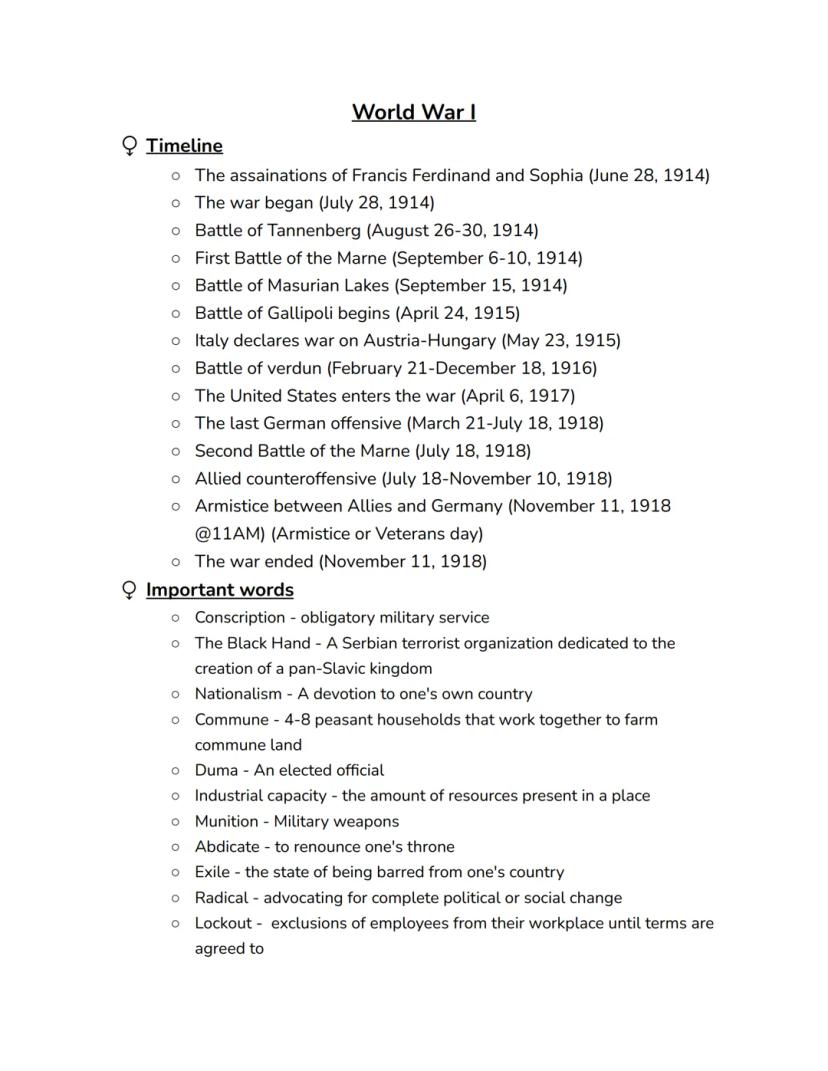
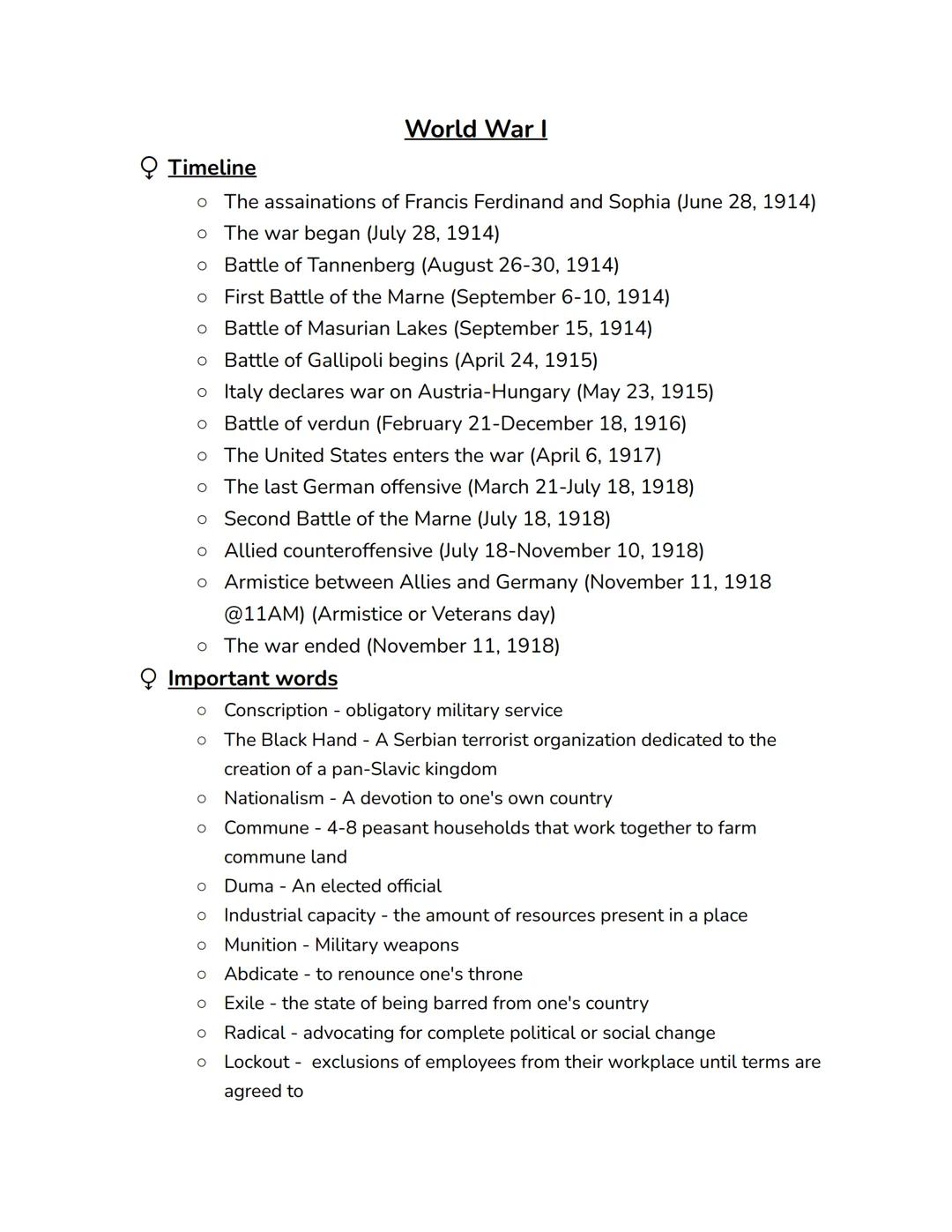
World War I erupted on July 28, 1914, following the assassination of Archduke Francis Ferdinand and his wife Sophia on June 28. The conflict quickly escalated from a regional dispute to a global war involving the world's major powers.
Key battles shaped the war's progression. The Battle of Tannenberg (August 1914) marked an early German victory against Russia, while the First Battle of the Marne (September 1914) halted Germany's initial advance into France. Later conflicts like the Battle of Verdun (1916) became grueling struggles of attrition, resulting in massive casualties. The war concluded with an armistice on November 11, 1918.
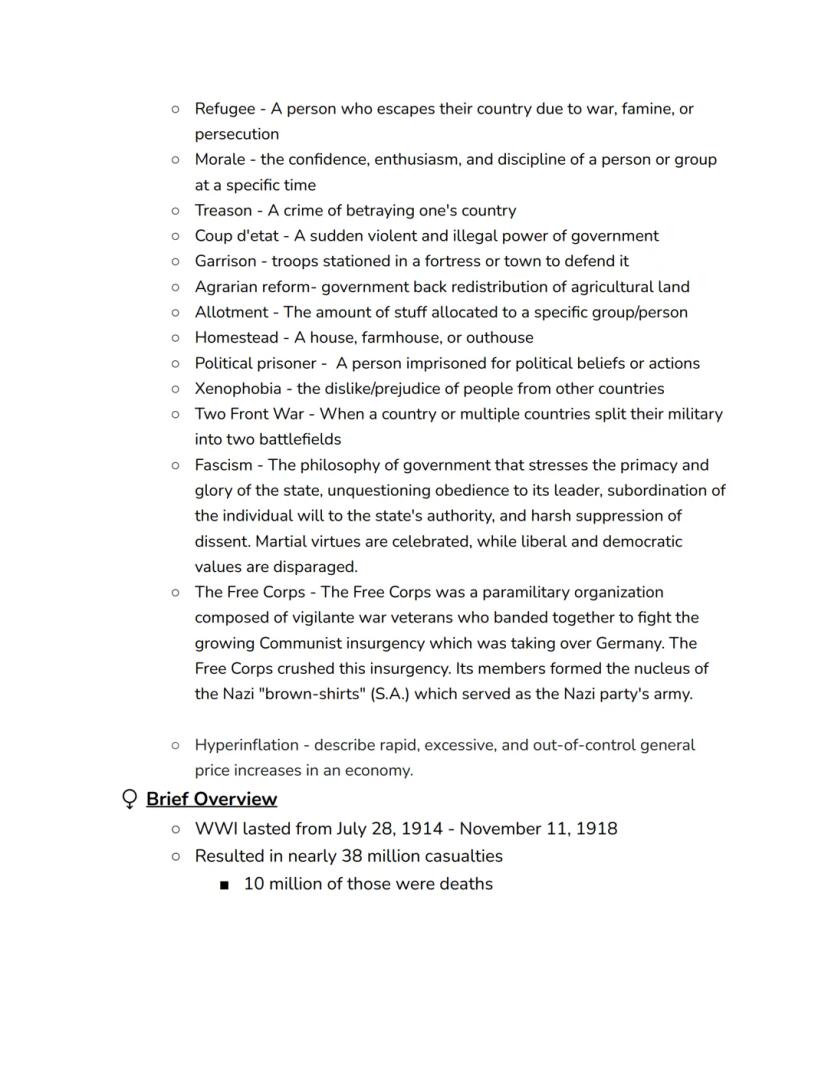
Several concepts are crucial for understanding the war's context. Nationalism drove intense devotion to one's country, while conscription (mandatory military service) supplied armies with millions of soldiers. Various political terms like coup d'état (sudden overthrow of government) and radical movements reflected the social upheaval of the era.
Did you know? The "eleventh hour of the eleventh day of the eleventh month" marks when the armistice took effect (11 AM on November 11, 1918), which is why we observe Veterans Day (originally Armistice Day) on November 11.
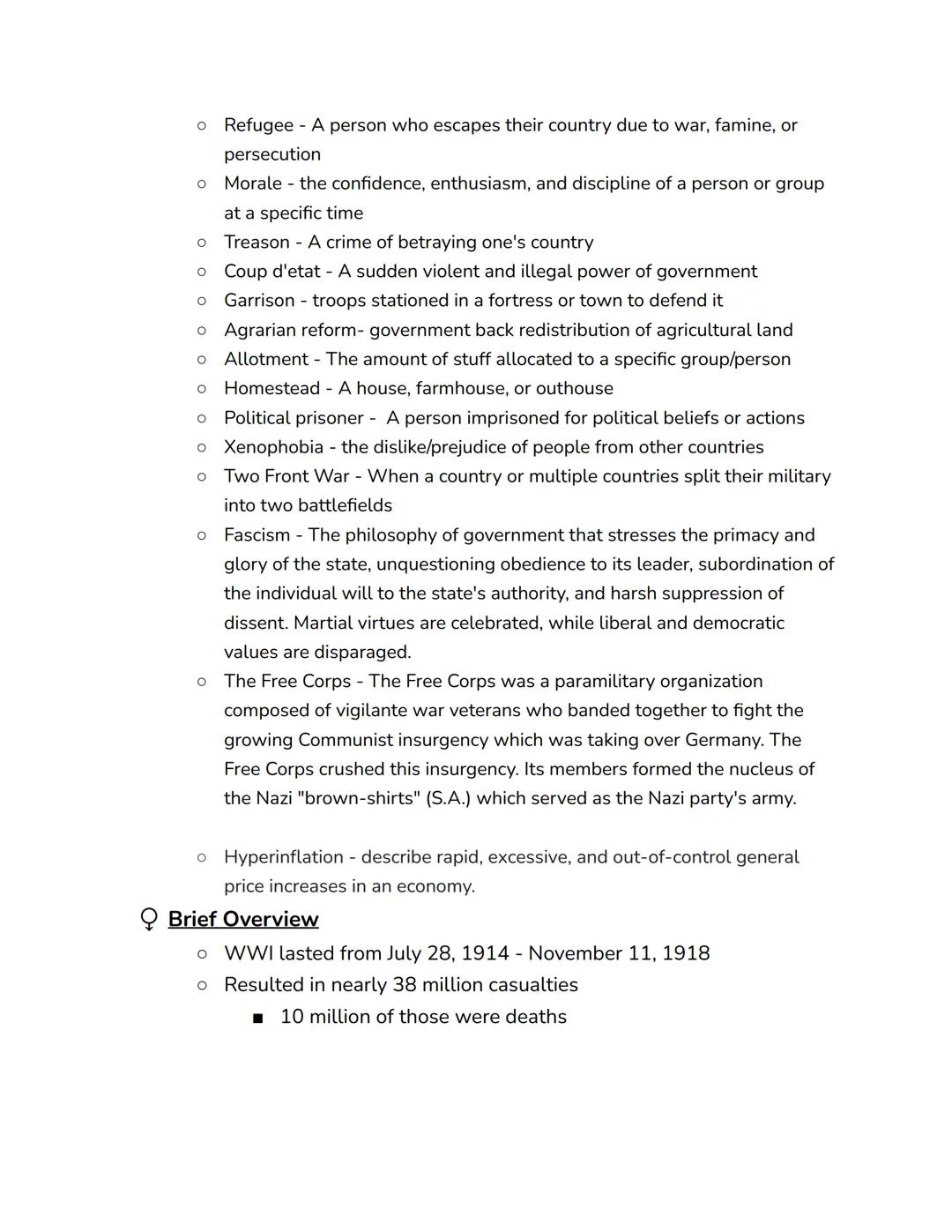
The First World War introduced new political and social terminology that still impacts our world today. Fascism emerged as a political philosophy stressing unquestioning obedience to the state and its leader while suppressing dissent. The economic devastation led to hyperinflation in countries like Germany, where money became nearly worthless.
Displaced populations became a major humanitarian crisis, with refugees fleeing combat zones. Military conditions eroded morale among troops, especially in the brutal trench warfare of the Western Front. Political prisoners and xenophobia (fear of foreigners) increased as nations became more suspicious of "enemy" populations.
World War I had a devastating human cost. The conflict resulted in nearly 38 million casualties, with approximately 10 million deaths. These staggering figures represented a scale of loss unprecedented in modern warfare, affecting almost every family in the participating nations.
Remember this: A "Two-Front War" forced countries like Germany to split their military resources between multiple battlefields simultaneously, creating significant strategic challenges that ultimately contributed to their defeat.
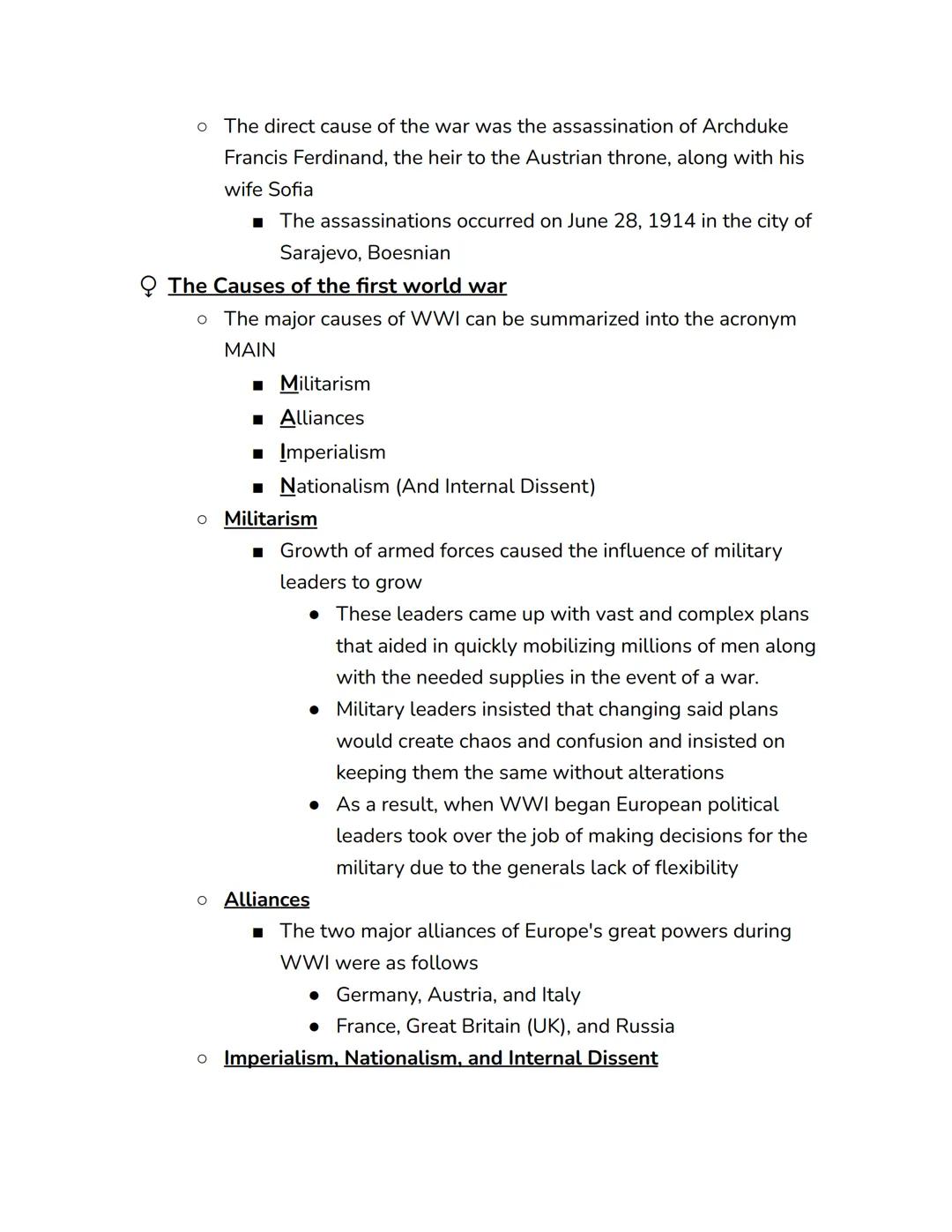
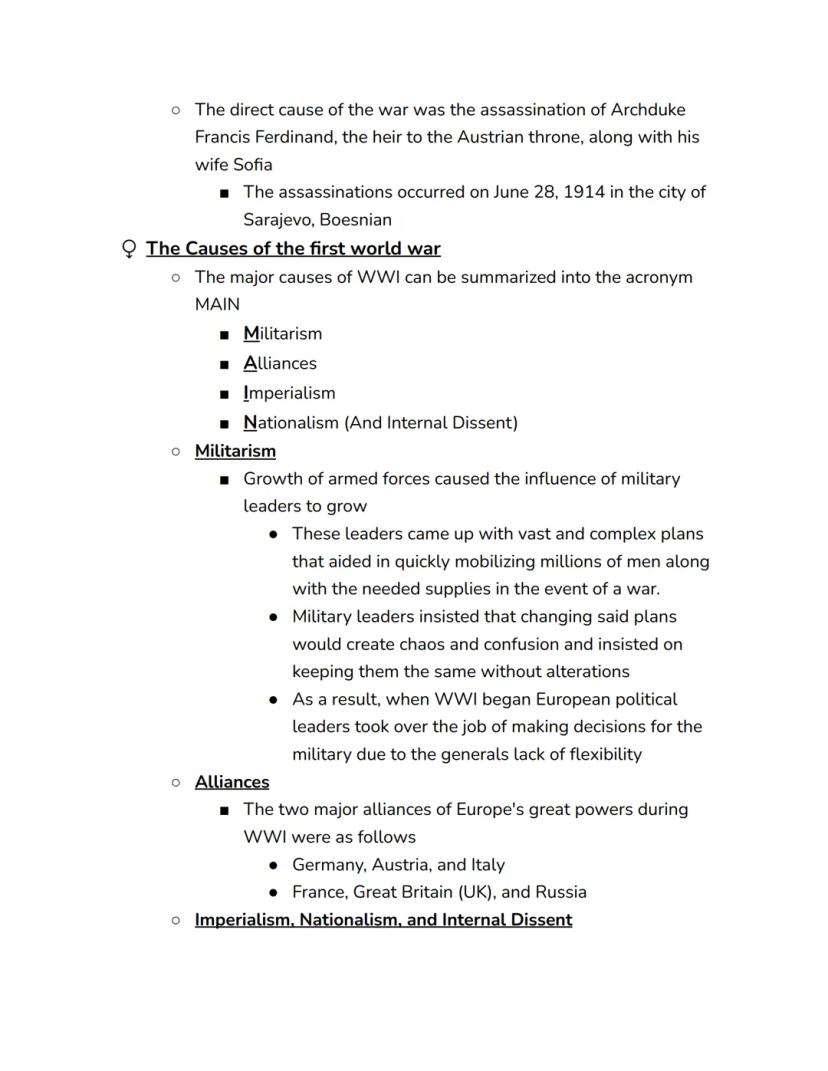
The causes of World War I can be summarized using the acronym MAIN: Militarism, Alliances, Imperialism, and Nationalism. These interconnected factors created a powder keg that needed only a spark to explode.
Militarism led to the rapid growth of armed forces and increasing influence of military leaders. Military planners developed complex mobilization plans that were difficult to alter once set in motion. When war came, these inflexible plans helped escalate the conflict, as political leaders were told that changing course would create chaos.
Alliances divided Europe into opposing camps: Germany, Austria, and Italy versus France, Great Britain, and Russia. These alliance systems meant that a conflict between two nations could quickly draw in multiple powers.
Imperialism and Nationalism heightened tensions as European powers competed for colonies and trade. Not all ethnic groups had achieved nationhood at this time, creating unrest among minorities like the Slavs in the Balkans. Meanwhile, powerful socialist labor movements threatened conservative leaders who feared revolution, adding to the atmosphere of tension.
Think about it: How might World War I have been different if military leaders had been willing to adapt their plans once the war began? The inflexible nature of military planning contributed significantly to the war's escalation.
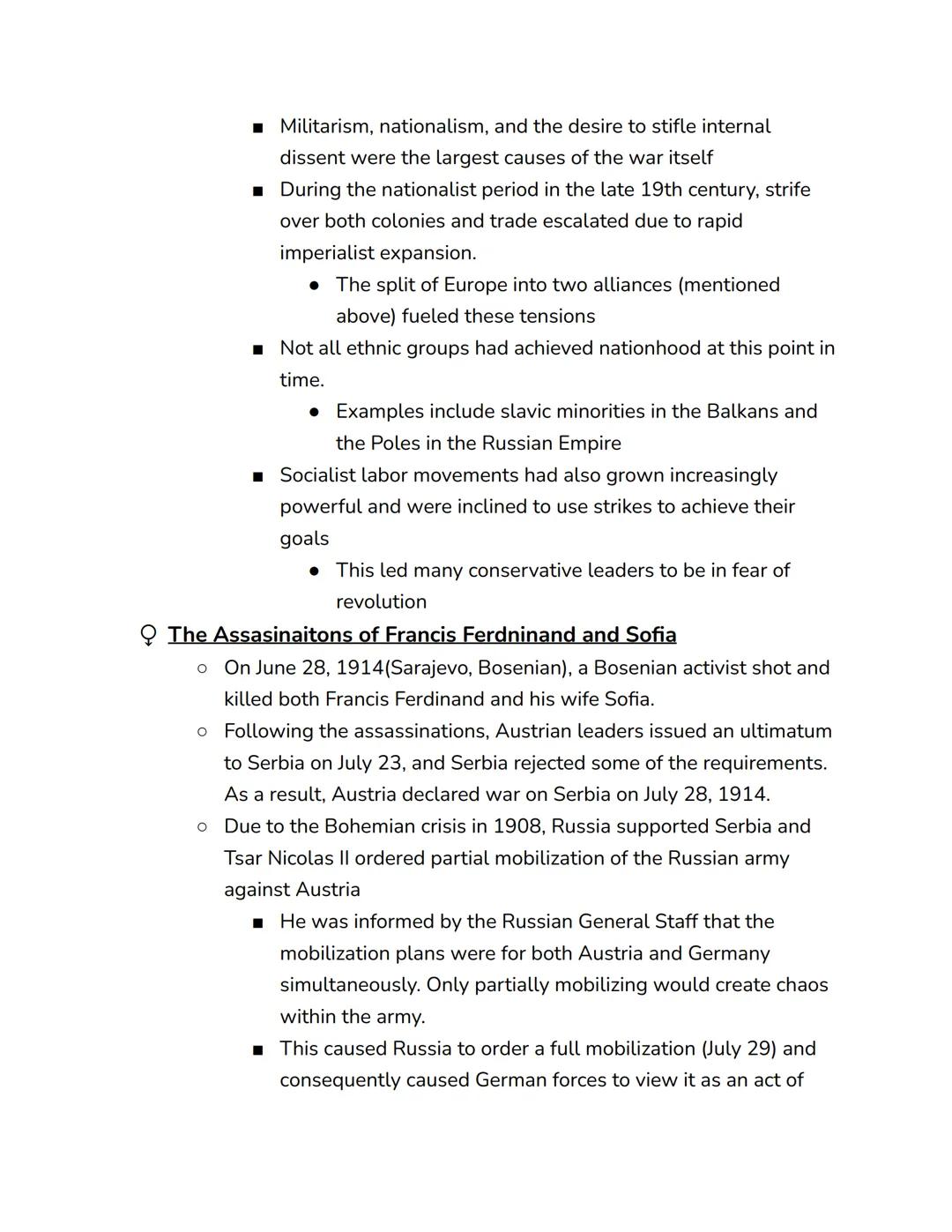
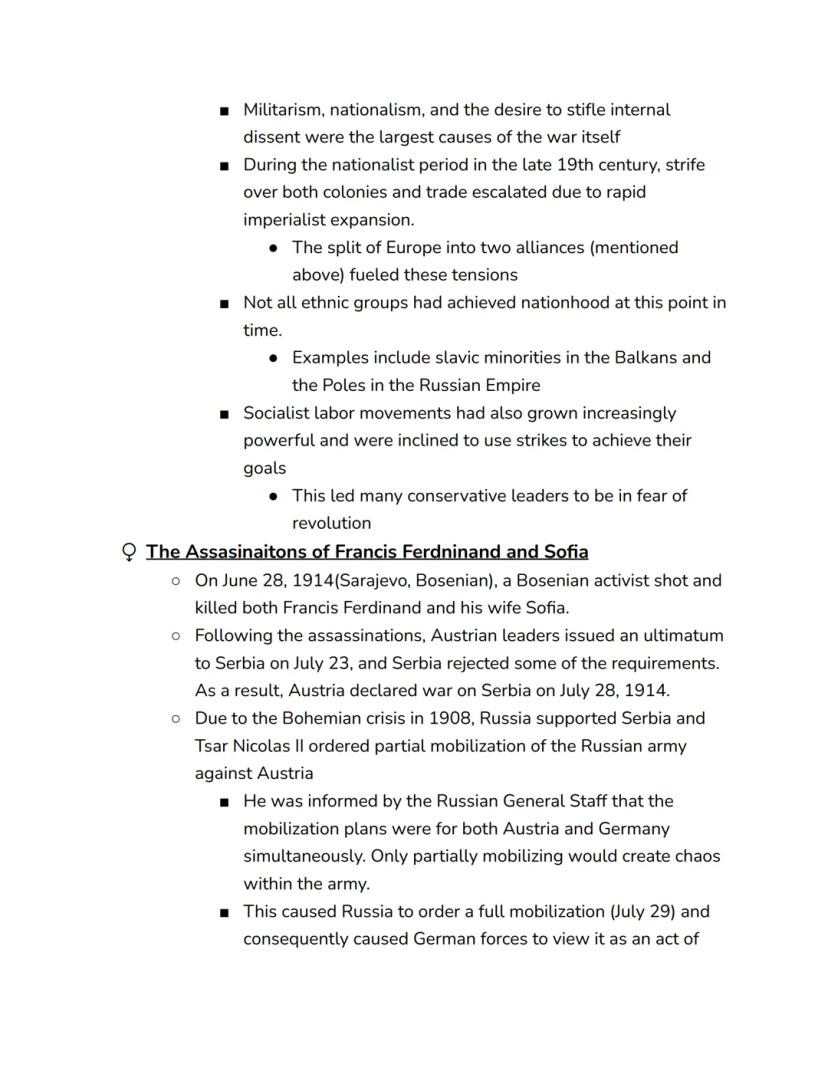
The trigger for World War I came on June 28, 1914, when a Bosnian activist assassinated Archduke Francis Ferdinand and his wife Sofia in Sarajevo. This event set in motion a chain reaction of ultimatums and declarations of war that would engulf Europe.
Austria issued an ultimatum to Serbia following the assassinations, and when some demands were rejected, declared war on July 28. Russia, supporting its Slavic ally Serbia, ordered partial mobilization against Austria. However, Russian military planners insisted that their plans were designed for simultaneous mobilization against both Austria and Germany, forcing a full mobilization on July 29.
Germany viewed Russia's mobilization as an act of war and issued its own ultimatum demanding Russia halt its preparations. When Russia refused, Germany declared war on August 1, 1914. The conflict was now spreading rapidly across Europe.
Critical concept: Military mobilization plans were extremely complex and, once started, were difficult to modify or halt. This "all-or-nothing" approach to military preparations meant that a crisis could quickly escalate to full-scale war, as happened in 1914.
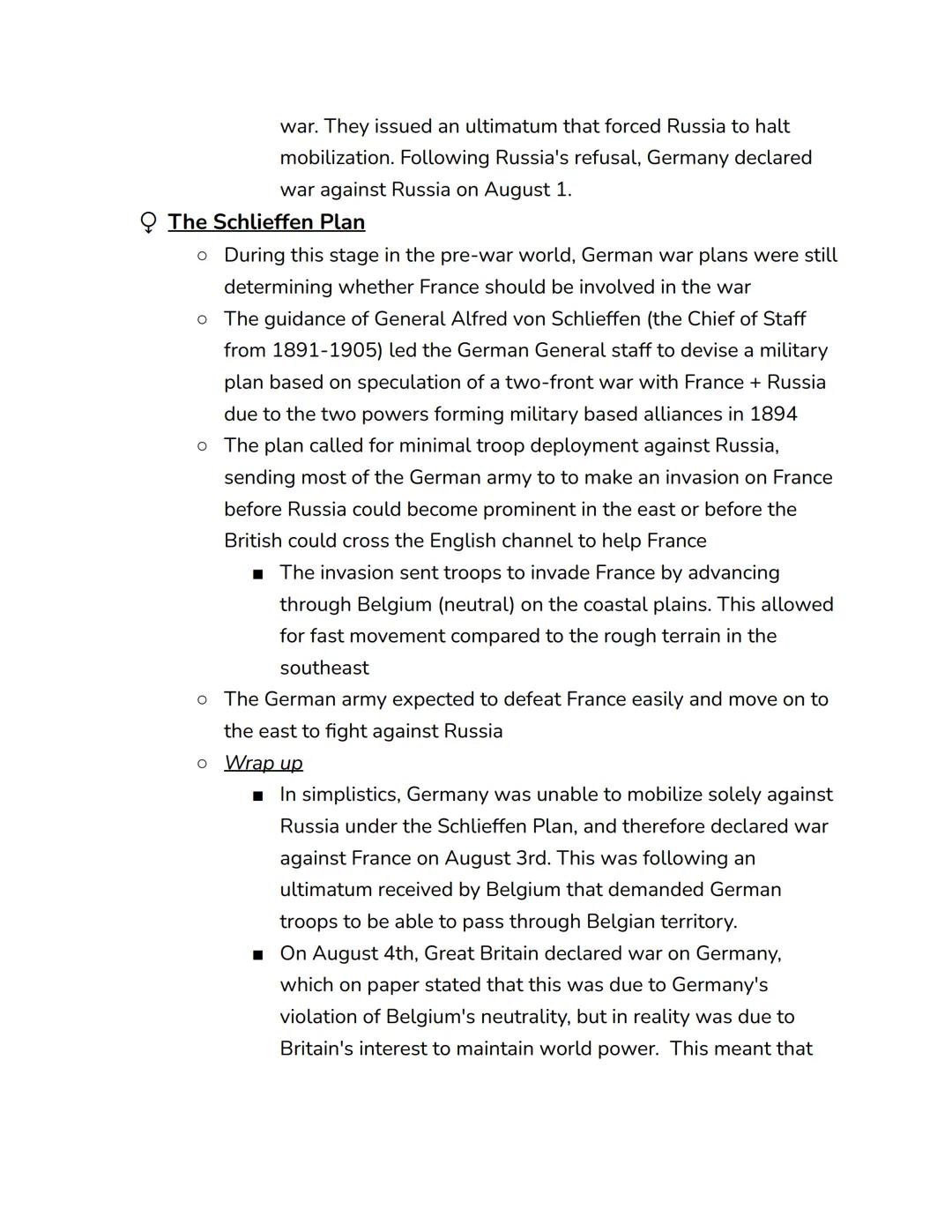
Germany's military strategy, known as the Schlieffen Plan, dramatically influenced how the war unfolded. Developed by General Alfred von Schlieffen, this plan addressed the nightmare scenario of a two-front war against both France and Russia.
The Schlieffen Plan called for a minimal defensive deployment against Russia while concentrating German forces for a massive, rapid invasion of France. German troops would sweep through neutral Belgium to outflank French defenses, allowing for quick movement through the coastal plains rather than facing the rough terrain of the southeast.
After defeating France in a quick campaign, Germany would then redirect its forces east to deal with Russia, which was expected to mobilize more slowly. This strategy determined Germany's actions in the opening days of the war.
Remember: The German violation of Belgian neutrality brought Great Britain into the war on August 4. While Britain cited this violation as its reason for declaring war, many historians believe Britain's true motivation was preserving its status as a world power against German expansion.
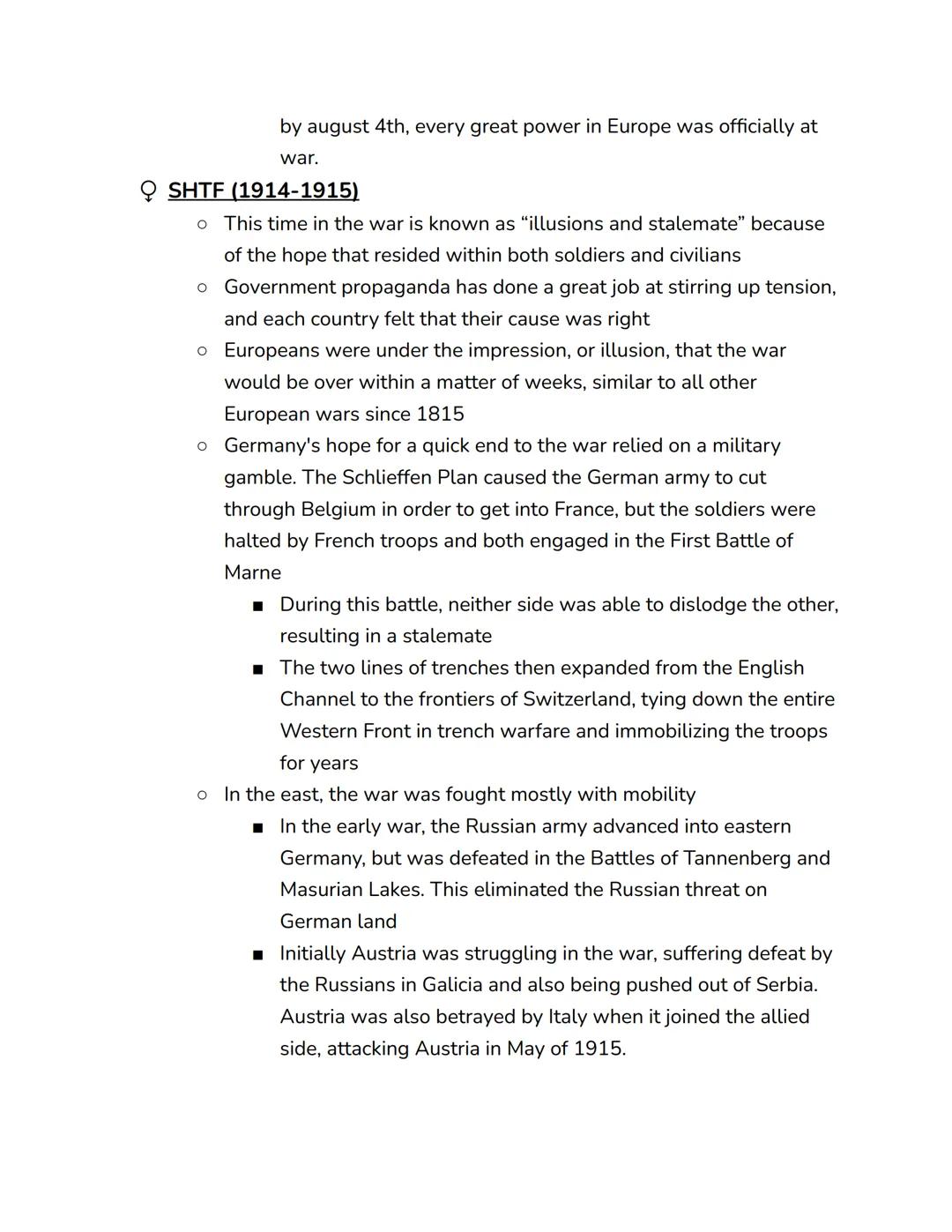
The early phase of World War I is often called "illusions and stalemate" because of the false hope that the conflict would end quickly. Government propaganda had effectively stirred up tensions, convincing citizens in each country that their cause was just.
Most Europeans believed the war would last only weeks, similar to previous European conflicts since 1815. Germany's gamble for a quick victory through the Schlieffen Plan initially went according to plan as troops moved through Belgium toward France. However, French resistance at the First Battle of the Marne halted the German advance, resulting in a stalemate.
This stalemate led to the development of trench warfare on the Western Front, with opposing lines of trenches extending from the English Channel to Switzerland. Unlike the static Western Front, the Eastern Front remained more mobile. The Russian army initially advanced into eastern Germany but suffered devastating defeats at Tannenberg and Masurian Lakes.
Shocking fact: By the end of 1915, Russian casualties stood at 2.5 million killed, captured, or wounded - a devastating toll that pushed Russia toward revolution and eventual withdrawal from the war.
The years 1916-1917 earned the grim nickname "The Great Slaughter" due to the unprecedented casualties of trench warfare. Over 700,000 men lost their lives attempting to break through enemy lines, with poisonous gas adding to the horrors of the battlefield.
Soldiers endured unimaginable conditions, living in trenches alongside decomposing bodies while rats and other vermin thrived in the environment. These conditions led to widespread disease and psychological trauma among troops.
Meanwhile, the Russian Revolution was brewing as the war exposed the weaknesses of Tsarist rule. Between 1914 and 1916, Russia suffered catastrophic military losses with over 2 million soldiers killed and 4-6 million captured or injured. These losses resulted largely from Russia's inability to arm its massive army adequately.
Tsar Nicholas II personally took command of the armed forces despite lacking military training. His absence from the capital left his German-born wife Alexandra and the controversial mystic Rasputin with increasing influence, further undermining public confidence in the regime.
Important insight: The Russian military disaster directly contributed to the collapse of the 300-year Romanov dynasty. Poor leadership, inadequate supplies, and massive casualties undermined the legitimacy of the tsarist government.
The strain of war led to revolution in Russia, beginning with the March Revolution of 1917. The crisis began when women in Saint Petersburg (Petrograd) protested bread rationing, marching through streets chanting "Peace and Bread" and "Down with Autocracy." These women, who worked 12-hour shifts while caring for hungry children, were soon joined by other workers.
When Tsar Nicholas ordered military intervention, many soldiers instead joined the protestors. The Tsar's legislative body attempted to resolve the crisis by establishing a Provisional Government on March 15, leading to Nicholas's abdication that same day.
The Provisional Government faced immediate challenges. Its decision to continue the war alienated workers and peasants who demanded peace. It also competed for authority with the Soviet councils that represented the radical interests of the lower classes, particularly socialists including the Marxist Social Democrats.
These Social Democrats split into the moderate Mensheviks and the radical Bolsheviks, led by Vladimir Lenin. This division set the stage for further revolutionary activity that would eventually bring Lenin and the Bolsheviks to power.
Connect the dots: The Russian Revolution directly affected the war's outcome. When the Bolsheviks took power in November 1917, they quickly negotiated peace with Germany, allowing Germany to transfer troops to the Western Front for one final offensive in 1918.
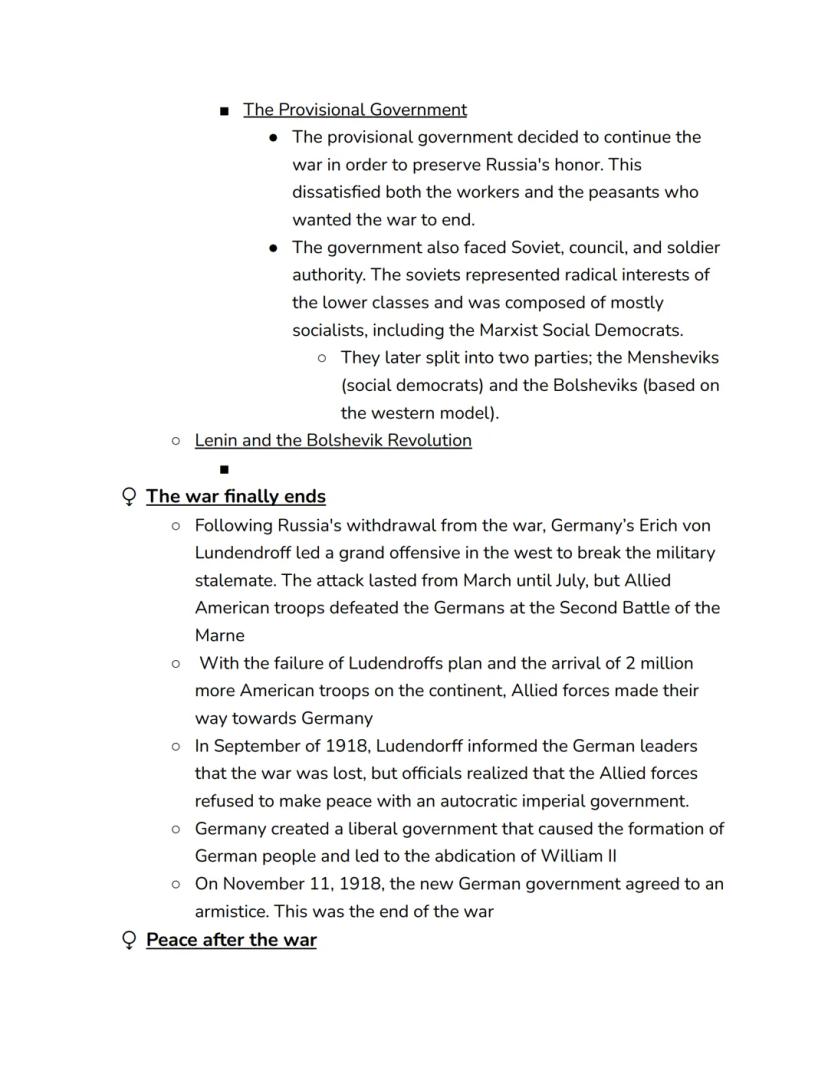
Following Russia's withdrawal from the war, Germany launched a massive offensive on the Western Front between March and July 1918, led by General Erich von Ludendorff. Despite initial successes, Allied forces reinforced by American troops defeated the Germans at the Second Battle of the Marne.
With the failure of Ludendorff's offensive and the arrival of 2 million American troops, Allied forces pushed toward Germany. By September 1918, Ludendorff informed German leaders that the war was lost. German officials soon realized that the Allies refused to make peace with the imperial government, leading to political reform.
Germany created a liberal government, and Emperor William II abdicated. On November 11, 1918, the new German government agreed to an armistice, effectively ending the war. The victorious Allied nations gathered in Paris in January 1919 to negotiate peace terms.
Critical turning point: The arrival of American troops in 1918 proved decisive in ending the war. Fresh American forces tipped the balance against exhausted German troops who had been fighting for four years.
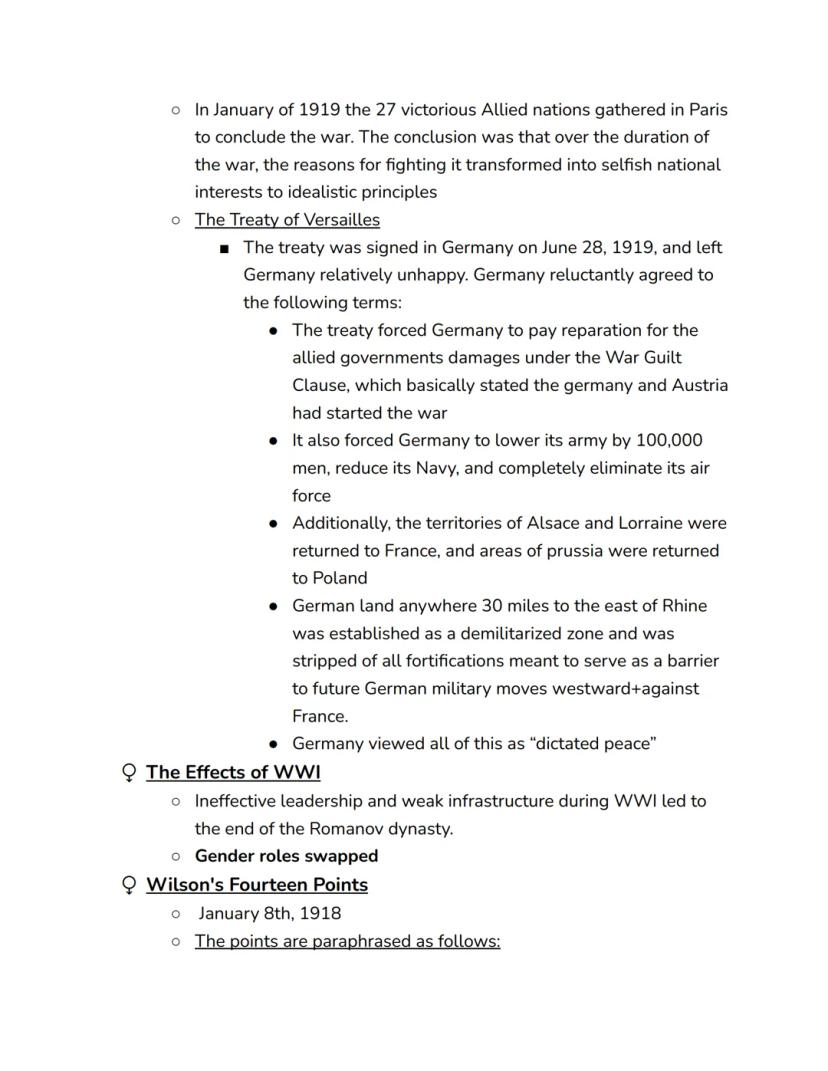
The Treaty of Versailles, signed on June 28, 1919, formally ended the war with Germany. The treaty imposed harsh terms that left Germany resentful and economically devastated:
Germany was forced to accept the "War Guilt Clause," which blamed Germany and Austria for starting the conflict. This clause justified requiring Germany to pay massive reparations for war damages suffered by Allied governments.
The treaty also severely limited Germany's military power, reducing its army to 100,000 men, shrinking its navy, and completely eliminating its air force. Territorial changes included returning Alsace and Lorraine to France and restoring Polish territories.
A demilitarized zone was established 30 miles east of the Rhine River to prevent future German aggression against France. Germans viewed these terms as a "dictated peace" rather than a negotiated settlement.
Connect to today: Many historians believe the harsh terms of the Treaty of Versailles created the economic and political conditions that allowed Adolf Hitler to rise to power in Germany during the 1930s. The treaty's legacy directly contributed to World War II.
Our AI companion is specifically built for the needs of students. Based on the millions of content pieces we have on the platform we can provide truly meaningful and relevant answers to students. But its not only about answers, the companion is even more about guiding students through their daily learning challenges, with personalised study plans, quizzes or content pieces in the chat and 100% personalisation based on the students skills and developments.
You can download the app in the Google Play Store and in the Apple App Store.
That's right! Enjoy free access to study content, connect with fellow students, and get instant help – all at your fingertips.
App Store
Google Play
The app is very easy to use and well designed. I have found everything I was looking for so far and have been able to learn a lot from the presentations! I will definitely use the app for a class assignment! And of course it also helps a lot as an inspiration.
Stefan S
iOS user
This app is really great. There are so many study notes and help [...]. My problem subject is French, for example, and the app has so many options for help. Thanks to this app, I have improved my French. I would recommend it to anyone.
Samantha Klich
Android user
Wow, I am really amazed. I just tried the app because I've seen it advertised many times and was absolutely stunned. This app is THE HELP you want for school and above all, it offers so many things, such as workouts and fact sheets, which have been VERY helpful to me personally.
Anna
iOS user
I think it’s very much worth it and you’ll end up using it a lot once you get the hang of it and even after looking at others notes you can still ask your Artificial intelligence buddy the question and ask to simplify it if you still don’t get it!!! In the end I think it’s worth it 😊👍 ⚠️Also DID I MENTION ITS FREEE YOU DON’T HAVE TO PAY FOR ANYTHING AND STILL GET YOUR GRADES IN PERFECTLY❗️❗️⚠️
Thomas R
iOS user
Knowunity is the BEST app I’ve used in a minute. This is not an ai review or anything this is genuinely coming from a 7th grade student (I know 2011 im young) but dude this app is a 10/10 i have maintained a 3.8 gpa and have plenty of time for gaming. I love it and my mom is just happy I got good grades
Brad T
Android user
Not only did it help me find the answer but it also showed me alternative ways to solve it. I was horrible in math and science but now I have an a in both subjects. Thanks for the help🤍🤍
David K
iOS user
The app's just great! All I have to do is enter the topic in the search bar and I get the response real fast. I don't have to watch 10 YouTube videos to understand something, so I'm saving my time. Highly recommended!
Sudenaz Ocak
Android user
In school I was really bad at maths but thanks to the app, I am doing better now. I am so grateful that you made the app.
Greenlight Bonnie
Android user
I found this app a couple years ago and it has only gotten better since then. I really love it because it can help with written questions and photo questions. Also, it can find study guides that other people have made as well as flashcard sets and practice tests. The free version is also amazing for students who might not be able to afford it. Would 100% recommend
Aubrey
iOS user
Best app if you're in Highschool or Junior high. I have been using this app for 2 school years and it's the best, it's good if you don't have anyone to help you with school work.😋🩷🎀
Marco B
iOS user
THE QUIZES AND FLASHCARDS ARE SO USEFUL AND I LOVE Knowunity AI. IT ALSO IS LITREALLY LIKE CHATGPT BUT SMARTER!! HELPED ME WITH MY MASCARA PROBLEMS TOO!! AS WELL AS MY REAL SUBJECTS ! DUHHH 😍😁😲🤑💗✨🎀😮
Elisha
iOS user
This app is phenomenal down to the correct info and the various topics you can study! I greatly recommend it for people who struggle with procrastination and those who need homework help. It has been perfectly accurate for world 1 history as far as I’ve seen! Geometry too!
Paul T
iOS user
The app is very easy to use and well designed. I have found everything I was looking for so far and have been able to learn a lot from the presentations! I will definitely use the app for a class assignment! And of course it also helps a lot as an inspiration.
Stefan S
iOS user
This app is really great. There are so many study notes and help [...]. My problem subject is French, for example, and the app has so many options for help. Thanks to this app, I have improved my French. I would recommend it to anyone.
Samantha Klich
Android user
Wow, I am really amazed. I just tried the app because I've seen it advertised many times and was absolutely stunned. This app is THE HELP you want for school and above all, it offers so many things, such as workouts and fact sheets, which have been VERY helpful to me personally.
Anna
iOS user
I think it’s very much worth it and you’ll end up using it a lot once you get the hang of it and even after looking at others notes you can still ask your Artificial intelligence buddy the question and ask to simplify it if you still don’t get it!!! In the end I think it’s worth it 😊👍 ⚠️Also DID I MENTION ITS FREEE YOU DON’T HAVE TO PAY FOR ANYTHING AND STILL GET YOUR GRADES IN PERFECTLY❗️❗️⚠️
Thomas R
iOS user
Knowunity is the BEST app I’ve used in a minute. This is not an ai review or anything this is genuinely coming from a 7th grade student (I know 2011 im young) but dude this app is a 10/10 i have maintained a 3.8 gpa and have plenty of time for gaming. I love it and my mom is just happy I got good grades
Brad T
Android user
Not only did it help me find the answer but it also showed me alternative ways to solve it. I was horrible in math and science but now I have an a in both subjects. Thanks for the help🤍🤍
David K
iOS user
The app's just great! All I have to do is enter the topic in the search bar and I get the response real fast. I don't have to watch 10 YouTube videos to understand something, so I'm saving my time. Highly recommended!
Sudenaz Ocak
Android user
In school I was really bad at maths but thanks to the app, I am doing better now. I am so grateful that you made the app.
Greenlight Bonnie
Android user
I found this app a couple years ago and it has only gotten better since then. I really love it because it can help with written questions and photo questions. Also, it can find study guides that other people have made as well as flashcard sets and practice tests. The free version is also amazing for students who might not be able to afford it. Would 100% recommend
Aubrey
iOS user
Best app if you're in Highschool or Junior high. I have been using this app for 2 school years and it's the best, it's good if you don't have anyone to help you with school work.😋🩷🎀
Marco B
iOS user
THE QUIZES AND FLASHCARDS ARE SO USEFUL AND I LOVE Knowunity AI. IT ALSO IS LITREALLY LIKE CHATGPT BUT SMARTER!! HELPED ME WITH MY MASCARA PROBLEMS TOO!! AS WELL AS MY REAL SUBJECTS ! DUHHH 😍😁😲🤑💗✨🎀😮
Elisha
iOS user
This app is phenomenal down to the correct info and the various topics you can study! I greatly recommend it for people who struggle with procrastination and those who need homework help. It has been perfectly accurate for world 1 history as far as I’ve seen! Geometry too!
Paul T
iOS user
World War I reshaped global politics and society from 1914 to 1918, leaving nearly 38 million casualties in its wake. What began with an assassination spiraled into a global conflict that redefined national boundaries, toppled empires, and set the stage... Show more
Access to all documents
Improve your grades
Join milions of students
World War I erupted on July 28, 1914, following the assassination of Archduke Francis Ferdinand and his wife Sophia on June 28. The conflict quickly escalated from a regional dispute to a global war involving the world's major powers.
Key battles shaped the war's progression. The Battle of Tannenberg (August 1914) marked an early German victory against Russia, while the First Battle of the Marne (September 1914) halted Germany's initial advance into France. Later conflicts like the Battle of Verdun (1916) became grueling struggles of attrition, resulting in massive casualties. The war concluded with an armistice on November 11, 1918.
Several concepts are crucial for understanding the war's context. Nationalism drove intense devotion to one's country, while conscription (mandatory military service) supplied armies with millions of soldiers. Various political terms like coup d'état (sudden overthrow of government) and radical movements reflected the social upheaval of the era.
Did you know? The "eleventh hour of the eleventh day of the eleventh month" marks when the armistice took effect (11 AM on November 11, 1918), which is why we observe Veterans Day (originally Armistice Day) on November 11.
Access to all documents
Improve your grades
Join milions of students
The First World War introduced new political and social terminology that still impacts our world today. Fascism emerged as a political philosophy stressing unquestioning obedience to the state and its leader while suppressing dissent. The economic devastation led to hyperinflation in countries like Germany, where money became nearly worthless.
Displaced populations became a major humanitarian crisis, with refugees fleeing combat zones. Military conditions eroded morale among troops, especially in the brutal trench warfare of the Western Front. Political prisoners and xenophobia (fear of foreigners) increased as nations became more suspicious of "enemy" populations.
World War I had a devastating human cost. The conflict resulted in nearly 38 million casualties, with approximately 10 million deaths. These staggering figures represented a scale of loss unprecedented in modern warfare, affecting almost every family in the participating nations.
Remember this: A "Two-Front War" forced countries like Germany to split their military resources between multiple battlefields simultaneously, creating significant strategic challenges that ultimately contributed to their defeat.
Access to all documents
Improve your grades
Join milions of students
The causes of World War I can be summarized using the acronym MAIN: Militarism, Alliances, Imperialism, and Nationalism. These interconnected factors created a powder keg that needed only a spark to explode.
Militarism led to the rapid growth of armed forces and increasing influence of military leaders. Military planners developed complex mobilization plans that were difficult to alter once set in motion. When war came, these inflexible plans helped escalate the conflict, as political leaders were told that changing course would create chaos.
Alliances divided Europe into opposing camps: Germany, Austria, and Italy versus France, Great Britain, and Russia. These alliance systems meant that a conflict between two nations could quickly draw in multiple powers.
Imperialism and Nationalism heightened tensions as European powers competed for colonies and trade. Not all ethnic groups had achieved nationhood at this time, creating unrest among minorities like the Slavs in the Balkans. Meanwhile, powerful socialist labor movements threatened conservative leaders who feared revolution, adding to the atmosphere of tension.
Think about it: How might World War I have been different if military leaders had been willing to adapt their plans once the war began? The inflexible nature of military planning contributed significantly to the war's escalation.
Access to all documents
Improve your grades
Join milions of students
The trigger for World War I came on June 28, 1914, when a Bosnian activist assassinated Archduke Francis Ferdinand and his wife Sofia in Sarajevo. This event set in motion a chain reaction of ultimatums and declarations of war that would engulf Europe.
Austria issued an ultimatum to Serbia following the assassinations, and when some demands were rejected, declared war on July 28. Russia, supporting its Slavic ally Serbia, ordered partial mobilization against Austria. However, Russian military planners insisted that their plans were designed for simultaneous mobilization against both Austria and Germany, forcing a full mobilization on July 29.
Germany viewed Russia's mobilization as an act of war and issued its own ultimatum demanding Russia halt its preparations. When Russia refused, Germany declared war on August 1, 1914. The conflict was now spreading rapidly across Europe.
Critical concept: Military mobilization plans were extremely complex and, once started, were difficult to modify or halt. This "all-or-nothing" approach to military preparations meant that a crisis could quickly escalate to full-scale war, as happened in 1914.
Access to all documents
Improve your grades
Join milions of students
Germany's military strategy, known as the Schlieffen Plan, dramatically influenced how the war unfolded. Developed by General Alfred von Schlieffen, this plan addressed the nightmare scenario of a two-front war against both France and Russia.
The Schlieffen Plan called for a minimal defensive deployment against Russia while concentrating German forces for a massive, rapid invasion of France. German troops would sweep through neutral Belgium to outflank French defenses, allowing for quick movement through the coastal plains rather than facing the rough terrain of the southeast.
After defeating France in a quick campaign, Germany would then redirect its forces east to deal with Russia, which was expected to mobilize more slowly. This strategy determined Germany's actions in the opening days of the war.
Remember: The German violation of Belgian neutrality brought Great Britain into the war on August 4. While Britain cited this violation as its reason for declaring war, many historians believe Britain's true motivation was preserving its status as a world power against German expansion.
Access to all documents
Improve your grades
Join milions of students
The early phase of World War I is often called "illusions and stalemate" because of the false hope that the conflict would end quickly. Government propaganda had effectively stirred up tensions, convincing citizens in each country that their cause was just.
Most Europeans believed the war would last only weeks, similar to previous European conflicts since 1815. Germany's gamble for a quick victory through the Schlieffen Plan initially went according to plan as troops moved through Belgium toward France. However, French resistance at the First Battle of the Marne halted the German advance, resulting in a stalemate.
This stalemate led to the development of trench warfare on the Western Front, with opposing lines of trenches extending from the English Channel to Switzerland. Unlike the static Western Front, the Eastern Front remained more mobile. The Russian army initially advanced into eastern Germany but suffered devastating defeats at Tannenberg and Masurian Lakes.
Shocking fact: By the end of 1915, Russian casualties stood at 2.5 million killed, captured, or wounded - a devastating toll that pushed Russia toward revolution and eventual withdrawal from the war.
Access to all documents
Improve your grades
Join milions of students
The years 1916-1917 earned the grim nickname "The Great Slaughter" due to the unprecedented casualties of trench warfare. Over 700,000 men lost their lives attempting to break through enemy lines, with poisonous gas adding to the horrors of the battlefield.
Soldiers endured unimaginable conditions, living in trenches alongside decomposing bodies while rats and other vermin thrived in the environment. These conditions led to widespread disease and psychological trauma among troops.
Meanwhile, the Russian Revolution was brewing as the war exposed the weaknesses of Tsarist rule. Between 1914 and 1916, Russia suffered catastrophic military losses with over 2 million soldiers killed and 4-6 million captured or injured. These losses resulted largely from Russia's inability to arm its massive army adequately.
Tsar Nicholas II personally took command of the armed forces despite lacking military training. His absence from the capital left his German-born wife Alexandra and the controversial mystic Rasputin with increasing influence, further undermining public confidence in the regime.
Important insight: The Russian military disaster directly contributed to the collapse of the 300-year Romanov dynasty. Poor leadership, inadequate supplies, and massive casualties undermined the legitimacy of the tsarist government.
Access to all documents
Improve your grades
Join milions of students
The strain of war led to revolution in Russia, beginning with the March Revolution of 1917. The crisis began when women in Saint Petersburg (Petrograd) protested bread rationing, marching through streets chanting "Peace and Bread" and "Down with Autocracy." These women, who worked 12-hour shifts while caring for hungry children, were soon joined by other workers.
When Tsar Nicholas ordered military intervention, many soldiers instead joined the protestors. The Tsar's legislative body attempted to resolve the crisis by establishing a Provisional Government on March 15, leading to Nicholas's abdication that same day.
The Provisional Government faced immediate challenges. Its decision to continue the war alienated workers and peasants who demanded peace. It also competed for authority with the Soviet councils that represented the radical interests of the lower classes, particularly socialists including the Marxist Social Democrats.
These Social Democrats split into the moderate Mensheviks and the radical Bolsheviks, led by Vladimir Lenin. This division set the stage for further revolutionary activity that would eventually bring Lenin and the Bolsheviks to power.
Connect the dots: The Russian Revolution directly affected the war's outcome. When the Bolsheviks took power in November 1917, they quickly negotiated peace with Germany, allowing Germany to transfer troops to the Western Front for one final offensive in 1918.
Access to all documents
Improve your grades
Join milions of students
Following Russia's withdrawal from the war, Germany launched a massive offensive on the Western Front between March and July 1918, led by General Erich von Ludendorff. Despite initial successes, Allied forces reinforced by American troops defeated the Germans at the Second Battle of the Marne.
With the failure of Ludendorff's offensive and the arrival of 2 million American troops, Allied forces pushed toward Germany. By September 1918, Ludendorff informed German leaders that the war was lost. German officials soon realized that the Allies refused to make peace with the imperial government, leading to political reform.
Germany created a liberal government, and Emperor William II abdicated. On November 11, 1918, the new German government agreed to an armistice, effectively ending the war. The victorious Allied nations gathered in Paris in January 1919 to negotiate peace terms.
Critical turning point: The arrival of American troops in 1918 proved decisive in ending the war. Fresh American forces tipped the balance against exhausted German troops who had been fighting for four years.
Access to all documents
Improve your grades
Join milions of students
The Treaty of Versailles, signed on June 28, 1919, formally ended the war with Germany. The treaty imposed harsh terms that left Germany resentful and economically devastated:
Germany was forced to accept the "War Guilt Clause," which blamed Germany and Austria for starting the conflict. This clause justified requiring Germany to pay massive reparations for war damages suffered by Allied governments.
The treaty also severely limited Germany's military power, reducing its army to 100,000 men, shrinking its navy, and completely eliminating its air force. Territorial changes included returning Alsace and Lorraine to France and restoring Polish territories.
A demilitarized zone was established 30 miles east of the Rhine River to prevent future German aggression against France. Germans viewed these terms as a "dictated peace" rather than a negotiated settlement.
Connect to today: Many historians believe the harsh terms of the Treaty of Versailles created the economic and political conditions that allowed Adolf Hitler to rise to power in Germany during the 1930s. The treaty's legacy directly contributed to World War II.
Our AI companion is specifically built for the needs of students. Based on the millions of content pieces we have on the platform we can provide truly meaningful and relevant answers to students. But its not only about answers, the companion is even more about guiding students through their daily learning challenges, with personalised study plans, quizzes or content pieces in the chat and 100% personalisation based on the students skills and developments.
You can download the app in the Google Play Store and in the Apple App Store.
That's right! Enjoy free access to study content, connect with fellow students, and get instant help – all at your fingertips.
30
Smart Tools NEW
Transform this note into: ✓ 50+ Practice Questions ✓ Interactive Flashcards ✓ Full Practice Test ✓ Essay Outlines
Explore the transformative impact of World War I on medical practices, focusing on trench conditions, disease management, and advancements in surgical techniques. This report analyzes the challenges faced by soldiers and the rapid evolution of medical responses during the war, highlighting key diseases like trench foot and the effects of chemical warfare. Ideal for students studying the intersection of history and medicine.
 History
Explore a comprehensive overview of significant battles in World War I, including the Battle of Verdun, the Battle of Gaza, and the First Battle of the Marne. This summary highlights the outcomes, strategies, and key events of each battle, providing essential insights for students studying the Western Front and major conflicts of the war.
HistoryExplains the causes of world war 1, alliances, imperialism, and nationalism.
 World History
Mongols
World HistorySignificant events of WWII
World Historyworld history
World HistoryApp Store
Google Play
The app is very easy to use and well designed. I have found everything I was looking for so far and have been able to learn a lot from the presentations! I will definitely use the app for a class assignment! And of course it also helps a lot as an inspiration.
Stefan S
iOS user
This app is really great. There are so many study notes and help [...]. My problem subject is French, for example, and the app has so many options for help. Thanks to this app, I have improved my French. I would recommend it to anyone.
Samantha Klich
Android user
Wow, I am really amazed. I just tried the app because I've seen it advertised many times and was absolutely stunned. This app is THE HELP you want for school and above all, it offers so many things, such as workouts and fact sheets, which have been VERY helpful to me personally.
Anna
iOS user
I think it’s very much worth it and you’ll end up using it a lot once you get the hang of it and even after looking at others notes you can still ask your Artificial intelligence buddy the question and ask to simplify it if you still don’t get it!!! In the end I think it’s worth it 😊👍 ⚠️Also DID I MENTION ITS FREEE YOU DON’T HAVE TO PAY FOR ANYTHING AND STILL GET YOUR GRADES IN PERFECTLY❗️❗️⚠️
Thomas R
iOS user
Knowunity is the BEST app I’ve used in a minute. This is not an ai review or anything this is genuinely coming from a 7th grade student (I know 2011 im young) but dude this app is a 10/10 i have maintained a 3.8 gpa and have plenty of time for gaming. I love it and my mom is just happy I got good grades
Brad T
Android user
Not only did it help me find the answer but it also showed me alternative ways to solve it. I was horrible in math and science but now I have an a in both subjects. Thanks for the help🤍🤍
David K
iOS user
The app's just great! All I have to do is enter the topic in the search bar and I get the response real fast. I don't have to watch 10 YouTube videos to understand something, so I'm saving my time. Highly recommended!
Sudenaz Ocak
Android user
In school I was really bad at maths but thanks to the app, I am doing better now. I am so grateful that you made the app.
Greenlight Bonnie
Android user
I found this app a couple years ago and it has only gotten better since then. I really love it because it can help with written questions and photo questions. Also, it can find study guides that other people have made as well as flashcard sets and practice tests. The free version is also amazing for students who might not be able to afford it. Would 100% recommend
Aubrey
iOS user
Best app if you're in Highschool or Junior high. I have been using this app for 2 school years and it's the best, it's good if you don't have anyone to help you with school work.😋🩷🎀
Marco B
iOS user
THE QUIZES AND FLASHCARDS ARE SO USEFUL AND I LOVE Knowunity AI. IT ALSO IS LITREALLY LIKE CHATGPT BUT SMARTER!! HELPED ME WITH MY MASCARA PROBLEMS TOO!! AS WELL AS MY REAL SUBJECTS ! DUHHH 😍😁😲🤑💗✨🎀😮
Elisha
iOS user
This app is phenomenal down to the correct info and the various topics you can study! I greatly recommend it for people who struggle with procrastination and those who need homework help. It has been perfectly accurate for world 1 history as far as I’ve seen! Geometry too!
Paul T
iOS user
The app is very easy to use and well designed. I have found everything I was looking for so far and have been able to learn a lot from the presentations! I will definitely use the app for a class assignment! And of course it also helps a lot as an inspiration.
Stefan S
iOS user
This app is really great. There are so many study notes and help [...]. My problem subject is French, for example, and the app has so many options for help. Thanks to this app, I have improved my French. I would recommend it to anyone.
Samantha Klich
Android user
Wow, I am really amazed. I just tried the app because I've seen it advertised many times and was absolutely stunned. This app is THE HELP you want for school and above all, it offers so many things, such as workouts and fact sheets, which have been VERY helpful to me personally.
Anna
iOS user
I think it’s very much worth it and you’ll end up using it a lot once you get the hang of it and even after looking at others notes you can still ask your Artificial intelligence buddy the question and ask to simplify it if you still don’t get it!!! In the end I think it’s worth it 😊👍 ⚠️Also DID I MENTION ITS FREEE YOU DON’T HAVE TO PAY FOR ANYTHING AND STILL GET YOUR GRADES IN PERFECTLY❗️❗️⚠️
Thomas R
iOS user
Knowunity is the BEST app I’ve used in a minute. This is not an ai review or anything this is genuinely coming from a 7th grade student (I know 2011 im young) but dude this app is a 10/10 i have maintained a 3.8 gpa and have plenty of time for gaming. I love it and my mom is just happy I got good grades
Brad T
Android user
Not only did it help me find the answer but it also showed me alternative ways to solve it. I was horrible in math and science but now I have an a in both subjects. Thanks for the help🤍🤍
David K
iOS user
The app's just great! All I have to do is enter the topic in the search bar and I get the response real fast. I don't have to watch 10 YouTube videos to understand something, so I'm saving my time. Highly recommended!
Sudenaz Ocak
Android user
In school I was really bad at maths but thanks to the app, I am doing better now. I am so grateful that you made the app.
Greenlight Bonnie
Android user
I found this app a couple years ago and it has only gotten better since then. I really love it because it can help with written questions and photo questions. Also, it can find study guides that other people have made as well as flashcard sets and practice tests. The free version is also amazing for students who might not be able to afford it. Would 100% recommend
Aubrey
iOS user
Best app if you're in Highschool or Junior high. I have been using this app for 2 school years and it's the best, it's good if you don't have anyone to help you with school work.😋🩷🎀
Marco B
iOS user
THE QUIZES AND FLASHCARDS ARE SO USEFUL AND I LOVE Knowunity AI. IT ALSO IS LITREALLY LIKE CHATGPT BUT SMARTER!! HELPED ME WITH MY MASCARA PROBLEMS TOO!! AS WELL AS MY REAL SUBJECTS ! DUHHH 😍😁😲🤑💗✨🎀😮
Elisha
iOS user
This app is phenomenal down to the correct info and the various topics you can study! I greatly recommend it for people who struggle with procrastination and those who need homework help. It has been perfectly accurate for world 1 history as far as I’ve seen! Geometry too!
Paul T
iOS user