
Civics is all about understanding how our government works, what... Show more
 Social Studies162 views·Updated May 12, 2026·3 pages
Essential Civics Study Guide for Students
J
jasmine rivera@jasminerivera_fstk
1 / 3
1
of 3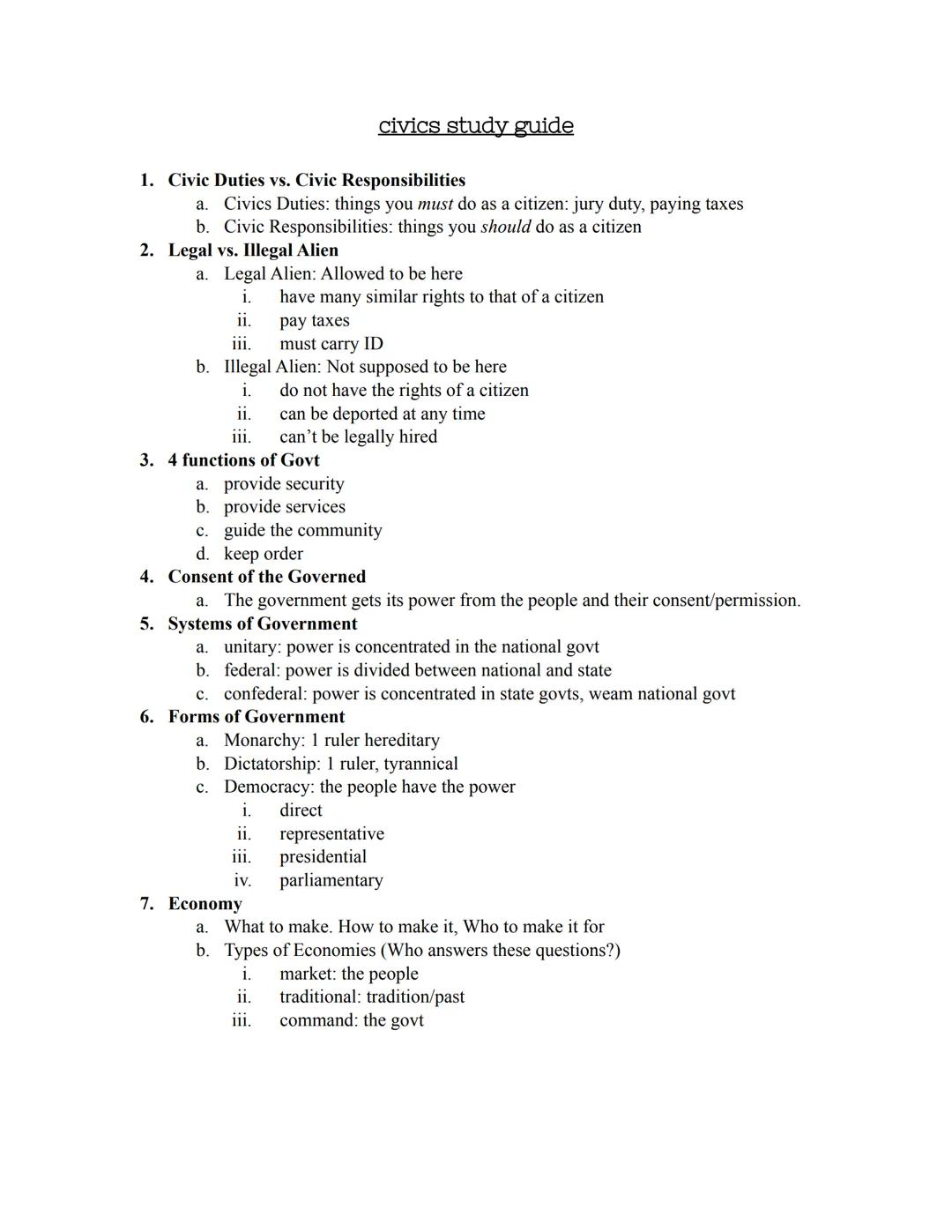
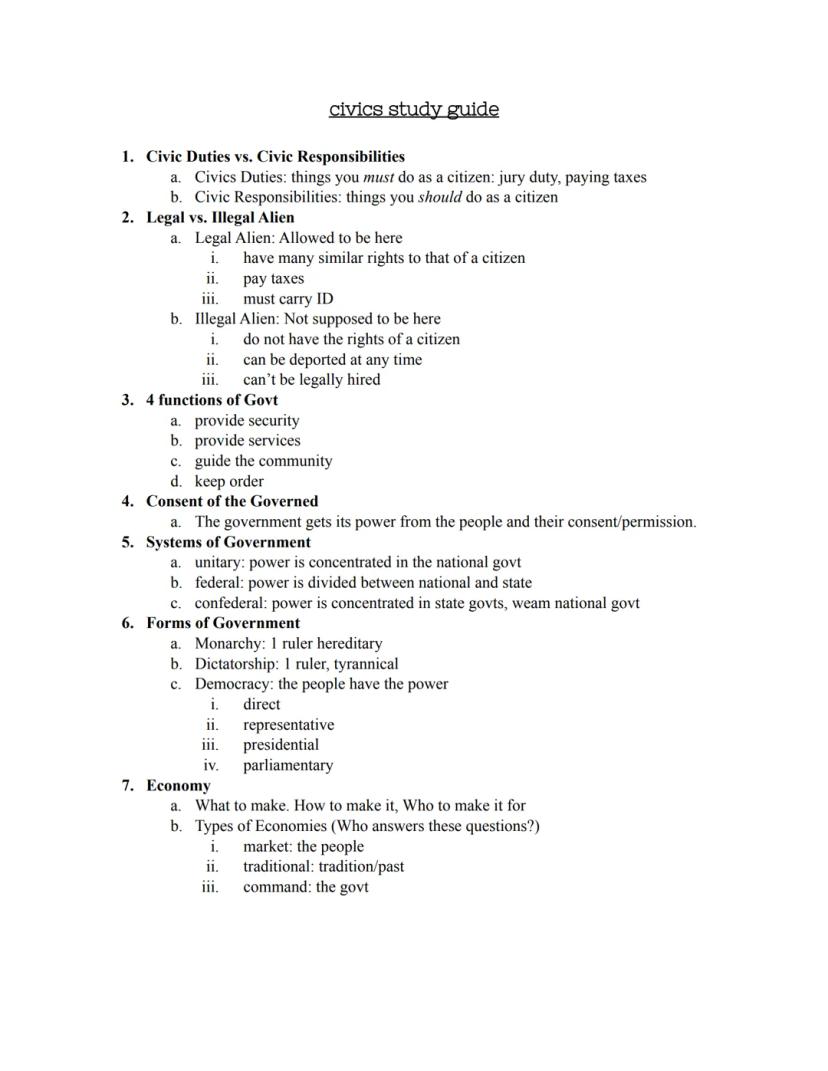
Civics Basics & Government Systems
Ever wondered what you must do versus what you should do as a citizen? Civic duties are legal requirements like paying taxes and serving on juries. Civic responsibilities are things you should do to be a good citizen, but aren't legally required.
Immigration status matters in a legal system. Legal aliens can live in the US with many similar rights to citizens—they pay taxes and must carry ID. Illegal aliens lack these rights and can be deported at any time.
Government serves four essential functions: providing security, delivering services, guiding the community, and keeping order. In America, government gets its power through consent of the governed—meaning power comes from the people, not the other way around!
Quick Tip: Think of government systems like a power diagram. In a unitary system, power flows from the top down. In a federal system (like the US), power is shared between national and state levels. In a confederal system, the states hold most power.
Countries organize their leadership differently too. Monarchies have hereditary rulers, dictatorships have tyrannical single rulers, and democracies put power in the hands of the people—either directly or through representatives.
Every economy answers three questions: what to make, how to make it, and who to make it for. The answers come from different sources depending on the system: the people (market economy), tradition (traditional economy), or the government (command economy).
2
of 3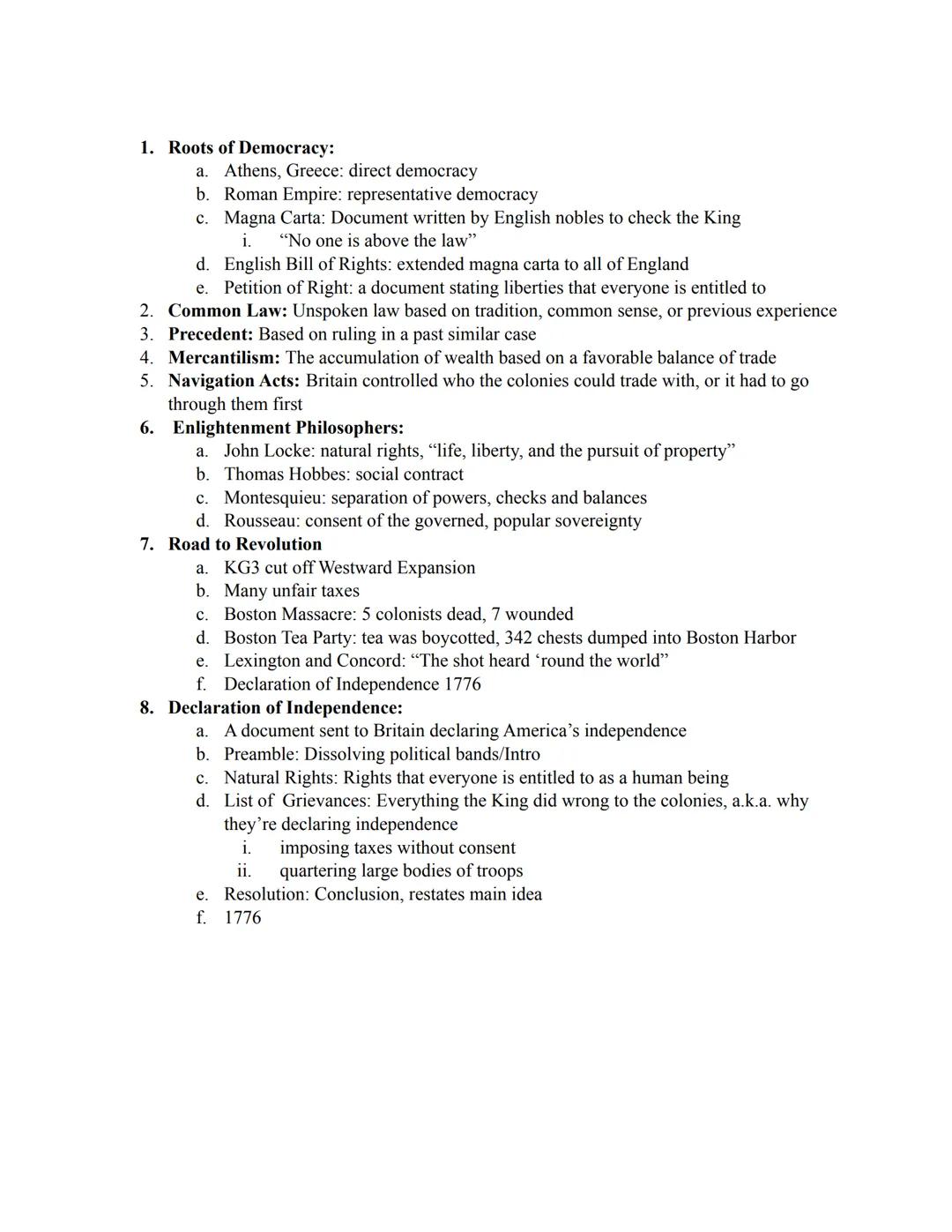
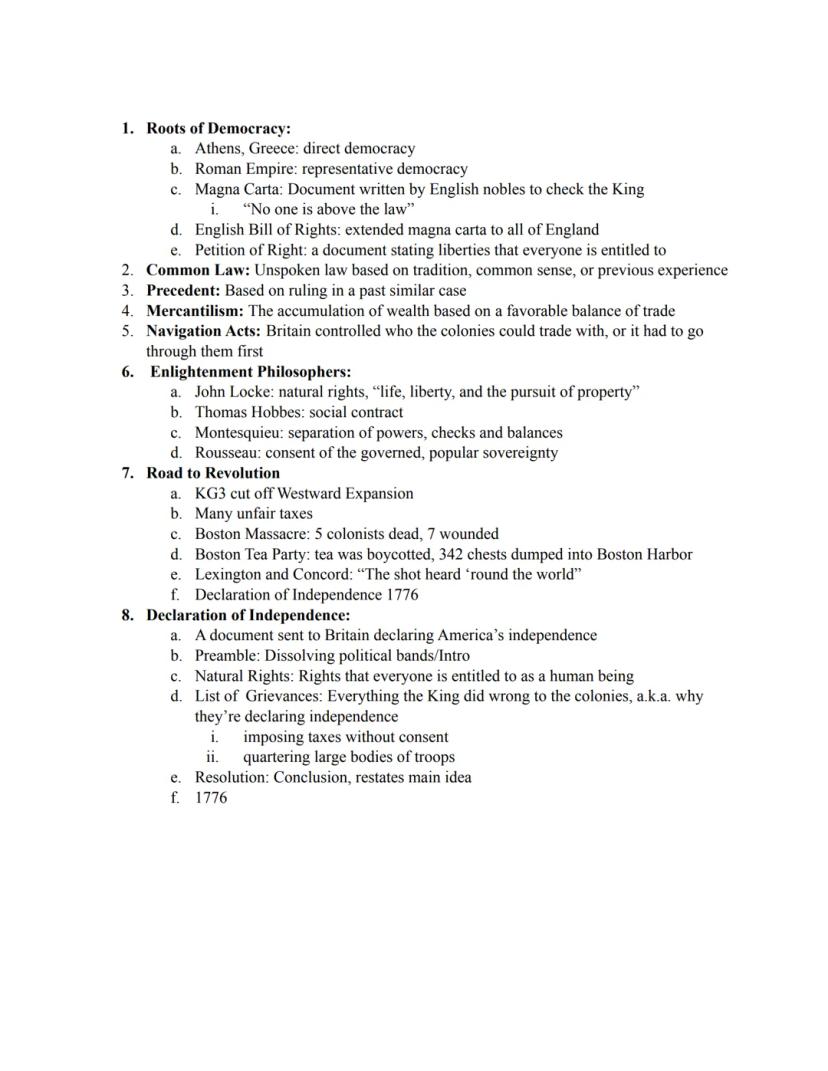
Foundations of American Democracy
Democracy didn't just appear out of nowhere! It has roots in Athens, Greece with direct democracy and the Roman Empire with representative democracy. Key documents like the Magna Carta established that "no one is above the law," while the English Bill of Rights and Petition of Right extended liberties to ordinary people.
Our legal system relies heavily on common law (unwritten rules based on tradition and common sense) and precedent (decisions based on similar past cases). These principles still guide courts today!
Economic tensions helped spark the American Revolution. Under mercantilism, Britain accumulated wealth through controlled trade. The Navigation Acts forced colonies to trade through Britain, creating resentment.
Remember This: Enlightenment philosophers provided the intellectual foundation for American democracy. Their ideas appear throughout our founding documents!
Enlightenment philosophers like John Locke (natural rights), Thomas Hobbes (social contract), Montesquieu (separation of powers), and Rousseau (consent of the governed) inspired America's founders. Their ideas shaped how we think about government's purpose and limits.
The road to revolution included several flashpoints: King George III limiting westward expansion, unfair taxes, the Boston Massacre, the Boston Tea Party, and battles at Lexington and Concord. All this culminated in the Declaration of Independence (1776), which outlined natural rights, listed grievances against the king, and formally announced America's break from Britain.
3
of 3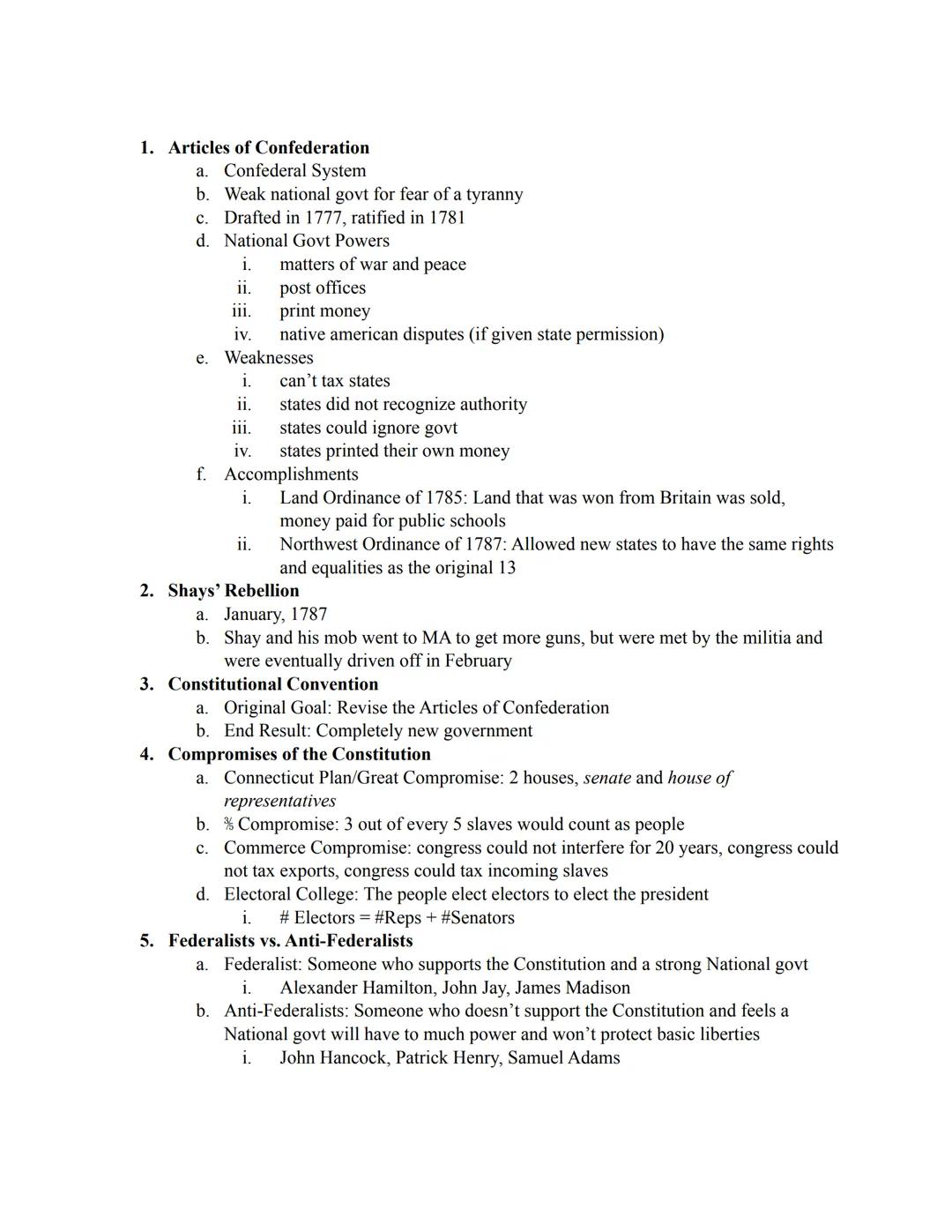
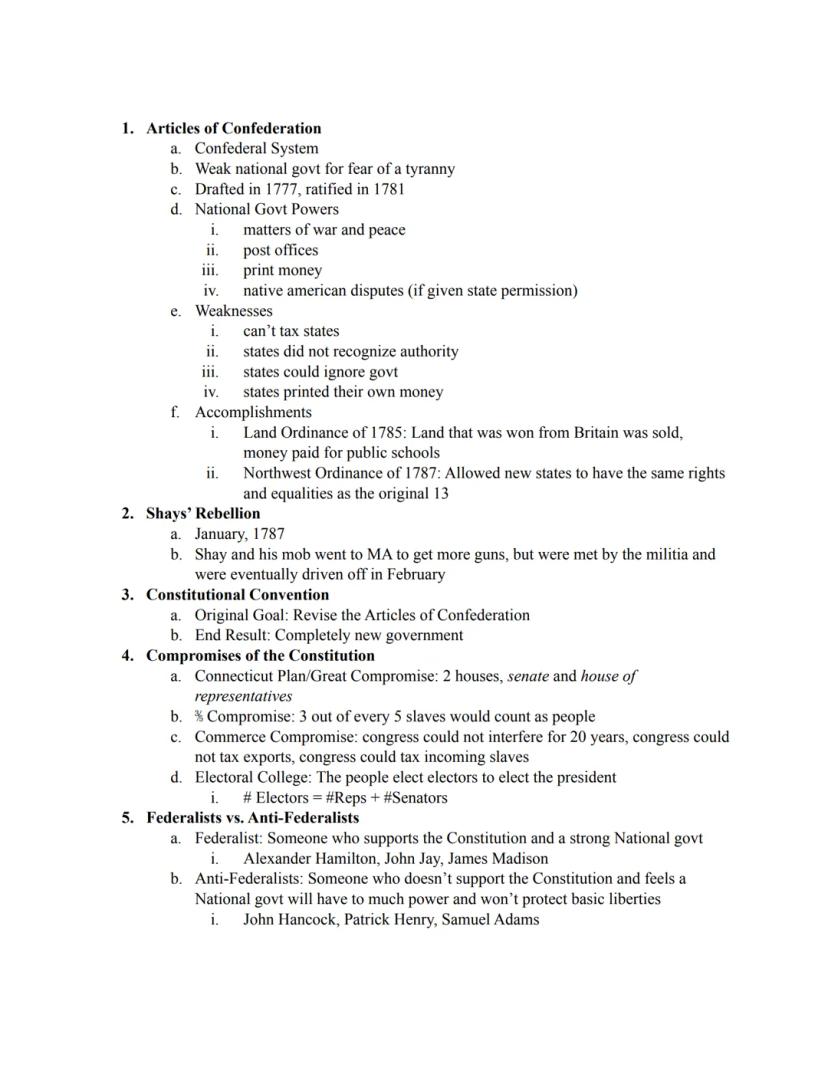
From Articles to Constitution
After independence, America first tried a government under the Articles of Confederation. This created a weak national government with limited powers—it could manage war and peace, run post offices, print money, and handle Native American disputes (with state permission). But this system had serious problems!
The Articles' weaknesses became obvious quickly: the national government couldn't tax states, states printed their own money, and states often ignored the national government entirely. Despite these flaws, the Articles achieved some important things, like establishing how to sell western lands and setting up a process for new states to join the union.
Shays' Rebellion in 1787 highlighted the government's weakness when Daniel Shay led a mob seeking weapons in Massachusetts. Though eventually defeated by militia, this uprising scared many leaders into wanting a stronger central government.
Fun Fact: The Constitutional Convention was only supposed to fix the Articles of Confederation, but delegates ended up creating an entirely new government system instead!
Creating the Constitution required major compromises. The Great Compromise established our two-house legislature. The Three-Fifths Compromise counted slaves partially for representation purposes. The Commerce Compromise set rules for trade and taxation. And the Electoral College created our indirect presidential election system.
The debate over ratification divided Americans into two camps: Federalists (like Hamilton, Jay, and Madison) who supported a strong national government, and Anti-Federalists (like Hancock, Henry, and Adams) who worried about protecting individual liberties from government power. This debate shaped how we understand the balance between government authority and personal freedom to this day.
We thought you’d never ask...
What is the Knowunity AI companion?
Our AI companion is specifically built for the needs of students. Based on the millions of content pieces we have on the platform we can provide truly meaningful and relevant answers to students. But its not only about answers, the companion is even more about guiding students through their daily learning challenges, with personalised study plans, quizzes or content pieces in the chat and 100% personalisation based on the students skills and developments.
Where can I download the Knowunity app?
You can download the app in the Google Play Store and in the Apple App Store.
Is Knowunity really free of charge?
That's right! Enjoy free access to study content, connect with fellow students, and get instant help – all at your fingertips.
Most popular content in US History
9C
 US History
civil rights movement quiz
Vocab
8th2030
Social StudiesThe Neolithic Revolution: From Hunter-Gatherers to Farming
Summarizes the key aspects of the Neolithic Revolution, detailing how humans moved from hunter-gatherer groups to settled agricultural societies.
6th2862
T
Social StudiesThe Revolutionary War Pt.1
Questions about the revolutionary war
9th770
Social StudiesMotives for European Exploration: Gold, God, and Glory
Learn about the key factors driving European exploration of the New World. This resource explains the "3 G's" motive: the pursuit of Gold, the spread of God, and the desire for Glory.
6th1791
 AP Human Geography
AP Human Geography Notes and Exam Prep Unit 1
A document covering Unit 1 of AP Human Geography from my 9th grade class 2021-2022
1,34476
AP Human GeographyAP Human Geography Notes and Exam Prep Unit 6
A document covering Unit 6 of AP Human Geography from my 9th grade class 2021-2022
1,29765
AP Human GeographyAP Human Geography Notes and Exam Prep Unit 5
A document covering Unit 5 of AP Human Geography from my 9th grade class 2021-2022
1,14943
W
 Earth and Space Science
World Oceans - Sixth Grade
Can you guess all the oceans? This will test your knowledge on the location of each ocean, describing bordering countries, seas, lands, and other oceans.
6th1380
AP Human GeographyAP Human Geography Notes and Exam Prep Unit 4
A document covering Unit 4 of AP Human Geography from my 9th grade class 2021-2022
98653
Most popular content
9O
AP US HistoryOrigins and Dynamics of the Columbian Exchange
Analyze the ecological and economic motivations behind the initial transfer of goods, people, and diseases between the Old and New Worlds.
9th3,1280
I
AP US HistoryIntroduction to Early Cultural Interactions
Analyze the initial social and religious encounters between Europeans, Africans, and Indigenous peoples in the colonial Americas.
9th2,7730
O
AP World HistoryOrigins of Ancient River Civilizations
Analyze the environmental factors and technological innovations that led to the rise of early states in Mesopotamia, Egypt, and the Indus Valley.
9th3,1860
M
AP US HistoryMotivations for European Exploration
Analyze the economic, religious, and political factors that drove European powers to the Americas during the 15th and 16th centuries.
9th1,7780
F
AP PsychologyFoundations of Ethical Guidelines in Research
Practice the core principles of the APA ethical code including informed consent, debriefing, and the role of Institutional Review Boards.
9th1,3360
I
AP US HistoryIntroduction to Native American Societies
Examine the diverse social, political, and economic structures of North American indigenous groups prior to European contact.
9th1,1100
I
 AP Biology
Introduction to Biological Elements of Life
Practice identifying the essential elements including carbon, nitrogen, phosphorus, and sulfur that compose biological macromolecules.
9th1,7360
I
AP US HistoryIntroduction to the Spanish Encomienda System
Explore the fundamental economic and social structures of the Spanish colonial system, focusing on the encomienda and the casta social hierarchy.
9th8890
O
AP World HistoryOrigins and Continuity of the Byzantine Empire
Analyze the political and cultural transitions from the Roman Empire to the Byzantine Empire, focusing on the reign of Justinian I and his code.
9th1,6320
Can't find what you're looking for? Explore other subjects.
Students love us — and so will you.
4.6/5App Store
4.7/5Google Play
The app is very easy to use and well designed. I have found everything I was looking for so far and have been able to learn a lot from the presentations! I will definitely use the app for a class assignment! And of course it also helps a lot as an inspiration.
Stefan SiOS user
This app is really great. There are so many study notes and help [...]. My problem subject is French, for example, and the app has so many options for help. Thanks to this app, I have improved my French. I would recommend it to anyone.
Samantha KlichAndroid user
Wow, I am really amazed. I just tried the app because I've seen it advertised many times and was absolutely stunned. This app is THE HELP you want for school and above all, it offers so many things, such as workouts and fact sheets, which have been VERY helpful to me personally.
AnnaiOS user
Social Studies162 views·Updated May 12, 2026·3 pagesEssential Civics Study Guide for Students
J
jasmine rivera@jasminerivera_fstk
Civics is all about understanding how our government works, what rights and duties we have as citizens, and how our democracy came to be. This guide breaks down the essential concepts you'll need to know for your civics class, from... Show more
1
of 3Sign up to see the content. It's free!
- Access to all documents
- Improve your grades
- Join milions of students
Civics Basics & Government Systems
Ever wondered what you must do versus what you should do as a citizen? Civic duties are legal requirements like paying taxes and serving on juries. Civic responsibilities are things you should do to be a good citizen, but aren't legally required.
Immigration status matters in a legal system. Legal aliens can live in the US with many similar rights to citizens—they pay taxes and must carry ID. Illegal aliens lack these rights and can be deported at any time.
Government serves four essential functions: providing security, delivering services, guiding the community, and keeping order. In America, government gets its power through consent of the governed—meaning power comes from the people, not the other way around!
Quick Tip: Think of government systems like a power diagram. In a unitary system, power flows from the top down. In a federal system (like the US), power is shared between national and state levels. In a confederal system, the states hold most power.
Countries organize their leadership differently too. Monarchies have hereditary rulers, dictatorships have tyrannical single rulers, and democracies put power in the hands of the people—either directly or through representatives.
Every economy answers three questions: what to make, how to make it, and who to make it for. The answers come from different sources depending on the system: the people (market economy), tradition (traditional economy), or the government (command economy).
2
of 3Sign up to see the content. It's free!
- Access to all documents
- Improve your grades
- Join milions of students
Foundations of American Democracy
Democracy didn't just appear out of nowhere! It has roots in Athens, Greece with direct democracy and the Roman Empire with representative democracy. Key documents like the Magna Carta established that "no one is above the law," while the English Bill of Rights and Petition of Right extended liberties to ordinary people.
Our legal system relies heavily on common law (unwritten rules based on tradition and common sense) and precedent (decisions based on similar past cases). These principles still guide courts today!
Economic tensions helped spark the American Revolution. Under mercantilism, Britain accumulated wealth through controlled trade. The Navigation Acts forced colonies to trade through Britain, creating resentment.
Remember This: Enlightenment philosophers provided the intellectual foundation for American democracy. Their ideas appear throughout our founding documents!
Enlightenment philosophers like John Locke (natural rights), Thomas Hobbes (social contract), Montesquieu (separation of powers), and Rousseau (consent of the governed) inspired America's founders. Their ideas shaped how we think about government's purpose and limits.
The road to revolution included several flashpoints: King George III limiting westward expansion, unfair taxes, the Boston Massacre, the Boston Tea Party, and battles at Lexington and Concord. All this culminated in the Declaration of Independence (1776), which outlined natural rights, listed grievances against the king, and formally announced America's break from Britain.
3
of 3Sign up to see the content. It's free!
- Access to all documents
- Improve your grades
- Join milions of students
From Articles to Constitution
After independence, America first tried a government under the Articles of Confederation. This created a weak national government with limited powers—it could manage war and peace, run post offices, print money, and handle Native American disputes (with state permission). But this system had serious problems!
The Articles' weaknesses became obvious quickly: the national government couldn't tax states, states printed their own money, and states often ignored the national government entirely. Despite these flaws, the Articles achieved some important things, like establishing how to sell western lands and setting up a process for new states to join the union.
Shays' Rebellion in 1787 highlighted the government's weakness when Daniel Shay led a mob seeking weapons in Massachusetts. Though eventually defeated by militia, this uprising scared many leaders into wanting a stronger central government.
Fun Fact: The Constitutional Convention was only supposed to fix the Articles of Confederation, but delegates ended up creating an entirely new government system instead!
Creating the Constitution required major compromises. The Great Compromise established our two-house legislature. The Three-Fifths Compromise counted slaves partially for representation purposes. The Commerce Compromise set rules for trade and taxation. And the Electoral College created our indirect presidential election system.
The debate over ratification divided Americans into two camps: Federalists (like Hamilton, Jay, and Madison) who supported a strong national government, and Anti-Federalists (like Hancock, Henry, and Adams) who worried about protecting individual liberties from government power. This debate shaped how we understand the balance between government authority and personal freedom to this day.
We thought you’d never ask...
What is the Knowunity AI companion?
Our AI companion is specifically built for the needs of students. Based on the millions of content pieces we have on the platform we can provide truly meaningful and relevant answers to students. But its not only about answers, the companion is even more about guiding students through their daily learning challenges, with personalised study plans, quizzes or content pieces in the chat and 100% personalisation based on the students skills and developments.
Where can I download the Knowunity app?
You can download the app in the Google Play Store and in the Apple App Store.
Is Knowunity really free of charge?
That's right! Enjoy free access to study content, connect with fellow students, and get instant help – all at your fingertips.
Most popular content in US History
9C
US Historycivil rights movement quiz
Vocab
8th2030
Social StudiesThe Neolithic Revolution: From Hunter-Gatherers to Farming
Summarizes the key aspects of the Neolithic Revolution, detailing how humans moved from hunter-gatherer groups to settled agricultural societies.
6th2862
T
Social StudiesThe Revolutionary War Pt.1
Questions about the revolutionary war
9th770
Social StudiesMotives for European Exploration: Gold, God, and Glory
Learn about the key factors driving European exploration of the New World. This resource explains the "3 G's" motive: the pursuit of Gold, the spread of God, and the desire for Glory.
6th1791
AP Human GeographyAP Human Geography Notes and Exam Prep Unit 1
A document covering Unit 1 of AP Human Geography from my 9th grade class 2021-2022
1,34476
AP Human GeographyAP Human Geography Notes and Exam Prep Unit 6
A document covering Unit 6 of AP Human Geography from my 9th grade class 2021-2022
1,29765
AP Human GeographyAP Human Geography Notes and Exam Prep Unit 5
A document covering Unit 5 of AP Human Geography from my 9th grade class 2021-2022
1,14943
W
Earth and Space ScienceWorld Oceans - Sixth Grade
Can you guess all the oceans? This will test your knowledge on the location of each ocean, describing bordering countries, seas, lands, and other oceans.
6th1380
AP Human GeographyAP Human Geography Notes and Exam Prep Unit 4
A document covering Unit 4 of AP Human Geography from my 9th grade class 2021-2022
98653
Most popular content
9O
AP US HistoryOrigins and Dynamics of the Columbian Exchange
Analyze the ecological and economic motivations behind the initial transfer of goods, people, and diseases between the Old and New Worlds.
9th3,1280
I
AP US HistoryIntroduction to Early Cultural Interactions
Analyze the initial social and religious encounters between Europeans, Africans, and Indigenous peoples in the colonial Americas.
9th2,7730
O
AP World HistoryOrigins of Ancient River Civilizations
Analyze the environmental factors and technological innovations that led to the rise of early states in Mesopotamia, Egypt, and the Indus Valley.
9th3,1860
M
AP US HistoryMotivations for European Exploration
Analyze the economic, religious, and political factors that drove European powers to the Americas during the 15th and 16th centuries.
9th1,7780
F
AP PsychologyFoundations of Ethical Guidelines in Research
Practice the core principles of the APA ethical code including informed consent, debriefing, and the role of Institutional Review Boards.
9th1,3360
I
AP US HistoryIntroduction to Native American Societies
Examine the diverse social, political, and economic structures of North American indigenous groups prior to European contact.
9th1,1100
I
AP BiologyIntroduction to Biological Elements of Life
Practice identifying the essential elements including carbon, nitrogen, phosphorus, and sulfur that compose biological macromolecules.
9th1,7360
I
AP US HistoryIntroduction to the Spanish Encomienda System
Explore the fundamental economic and social structures of the Spanish colonial system, focusing on the encomienda and the casta social hierarchy.
9th8890
O
AP World HistoryOrigins and Continuity of the Byzantine Empire
Analyze the political and cultural transitions from the Roman Empire to the Byzantine Empire, focusing on the reign of Justinian I and his code.
9th1,6320
Can't find what you're looking for? Explore other subjects.
Students love us — and so will you.
4.6/5App Store
4.7/5Google Play
The app is very easy to use and well designed. I have found everything I was looking for so far and have been able to learn a lot from the presentations! I will definitely use the app for a class assignment! And of course it also helps a lot as an inspiration.
Stefan SiOS user
This app is really great. There are so many study notes and help [...]. My problem subject is French, for example, and the app has so many options for help. Thanks to this app, I have improved my French. I would recommend it to anyone.
Samantha KlichAndroid user
Wow, I am really amazed. I just tried the app because I've seen it advertised many times and was absolutely stunned. This app is THE HELP you want for school and above all, it offers so many things, such as workouts and fact sheets, which have been VERY helpful to me personally.
AnnaiOS user