
Electric circuits are fundamental components in modern technology, consisting of...
 Physics110 views·Updated Jul 12, 2026·2 pages
Electric Circuits: Series and Parallel Circuits for Kids - Advantages, Disadvantages, and Cool Symbols
1
of 2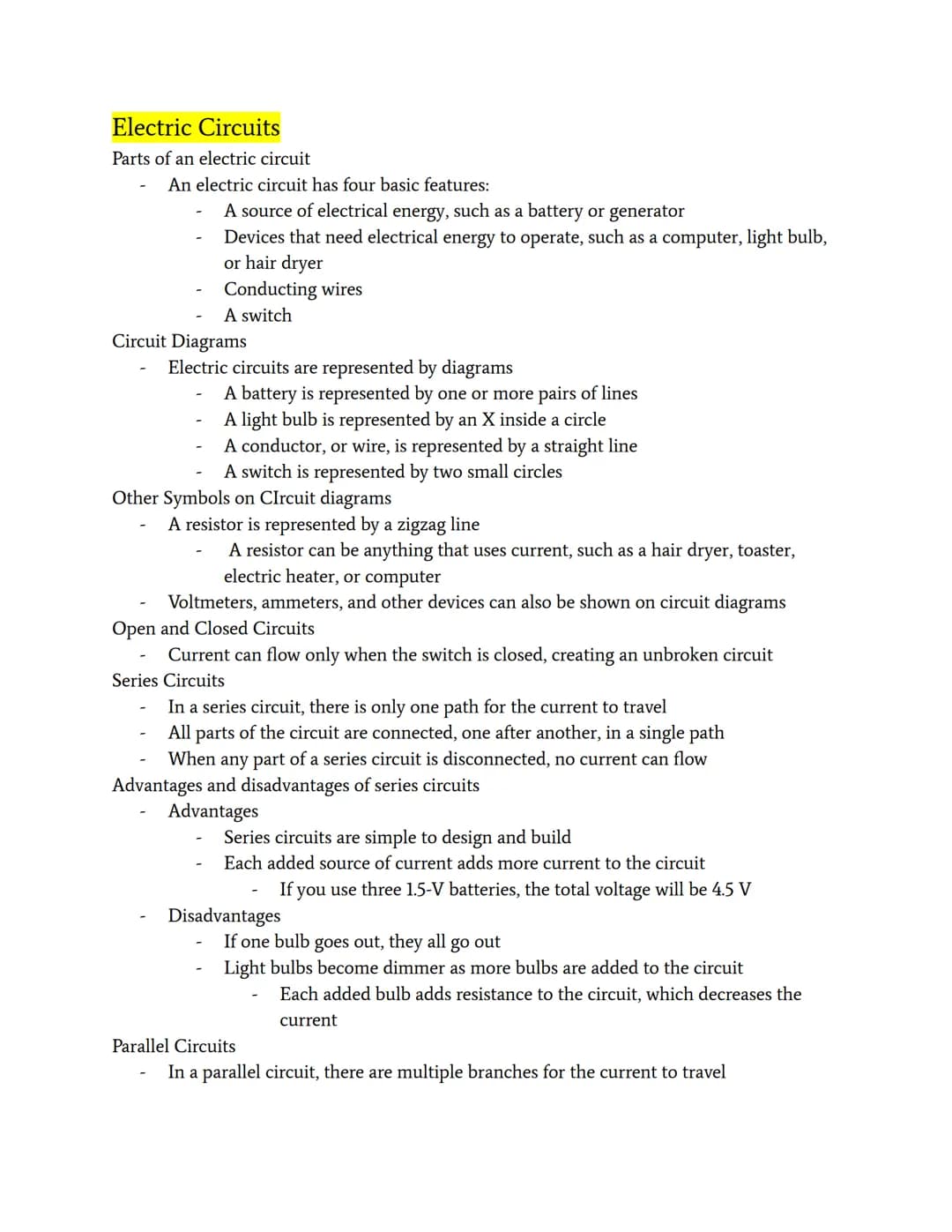
Parallel Circuits: Multiple Paths for Current
Parallel circuits offer an alternative configuration with multiple branches for current flow. This arrangement provides several benefits over series circuits:
Definition: Parallel circuit - An electrical circuit where components are connected across multiple branches, allowing independent current flow through each branch.
Advantages of parallel circuit:
- Continued functionality if one branch fails
- Consistent brightness of light bulbs
- Decreased total resistance when adding branches
- Increased current flow
- Greater flexibility in component arrangement
Example: In a home electrical system, outlets are typically wired in parallel, allowing individual appliances to operate independently.
Disadvantages of parallel circuit:
- More complex design and construction
- Potential for uneven current distribution
- Higher total current draw from the power source
- Increased wiring requirements
- More challenging troubleshooting process
Highlight: Understanding the differences between series and parallel circuits is crucial for designing efficient and reliable electrical systems.
The guide emphasizes the importance of recognizing circuit symbols and functions, as well as understanding wiring diagram symbols and meanings for effective circuit analysis and design. This knowledge is essential for students and professionals working with electrical systems, from simple household wiring to complex industrial applications.
2
of 2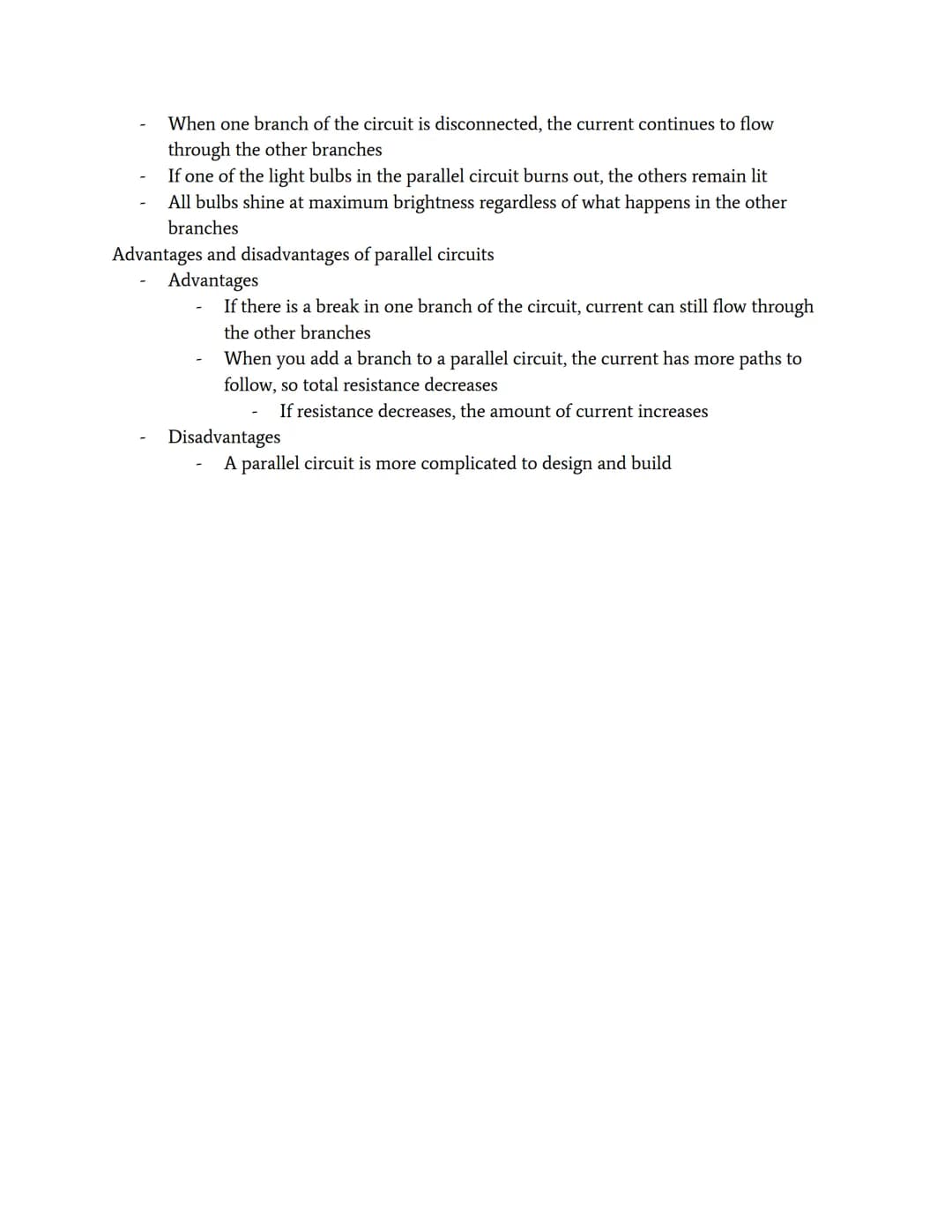
Electric Circuits: Components and Diagrams
Electric circuits are the backbone of modern electrical systems, comprising four essential elements:
- A source of electrical energy (e.g., battery or generator)
- Devices that consume electrical energy (e.g., computer, light bulb, hair dryer)
- Conducting wires
- A switch
Circuit diagrams are visual representations of electric circuits, using standardized symbols to depict various components:
Vocabulary: Circuit diagram - A schematic representation of an electrical circuit using standardized symbols.
- Battery: One or more pairs of lines
- Light bulb: An X inside a circle
- Conductor/wire: A straight line
- Switch: Two small circles
- Resistor: A zigzag line
Highlight: Resistors can represent any current-consuming device, such as hair dryers, toasters, or computers.
The guide also introduces the concepts of open and closed circuits:
Definition: Closed circuit - An unbroken path that allows current to flow when the switch is closed.
Series Circuits are characterized by a single path for current flow, where all components are connected one after another. This configuration has both advantages and disadvantages:
Highlight: In a series circuit, if one component fails, the entire circuit is disrupted.
Advantages of series circuits:
- Simple design and construction
- Cumulative voltage from multiple sources
5 disadvantages of series circuits:
- All components fail if one fails
- Light bulbs dim as more are added
- Increased resistance with each added component
- Decreased current flow
- Limited flexibility in component arrangement
We thought you’d never ask...
Our AI companion is specifically built for the needs of students. Based on the millions of content pieces we have on the platform we can provide truly meaningful and relevant answers to students. But its not only about answers, the companion is even more about guiding students through their daily learning challenges, with personalised study plans, quizzes or content pieces in the chat and 100% personalisation based on the students skills and developments.
You can download the app in the Google Play Store and in the Apple App Store.
That's right! Enjoy free access to study content, connect with fellow students, and get instant help – all at your fingertips.
Similar Content
Most popular content in AP Physics 1
9AP Physics 1Newton's Second Law of Motion
A detailed explanation of Concept of Newton's Second Law of Motion, Examples, Formulas, and Sample Problems with solution.
43014
PhysicsTranslational Motion and Rotational Motion
Applications of Translational and Rotational Motion
11th1781
P
Physicsphysical science 8th grade
test your abilities
8th1400
PhysicsPhysics Reviewer
This is an extensive physics reviewer.
College1,53634
PhysicsSimple Machines PowerPoint
This presentation offers an explanation of simple machines and how to solve for mechanical advantage, ideal mechanical advantage, and efficiency of each machine. It also provides definitions and examples.
9th30713
PhysicsIntroduction to civil engineering 1
Lecture notes 1
College28711
PhysicsIntroduction to civil engineering 2
Study notes for introduction to civil engineering
College1614
PhysicsDimensional Analysis
Notes about the topic
811
Physicsmomentum and impulse
momentum, impulse, conservation of momentum
99727
Most popular content
9O
 AP US History
Origins and Dynamics of the Columbian Exchange
Analyze the ecological and economic motivations behind the initial transfer of goods, people, and diseases between the Old and New Worlds.
9th3,1280
I
AP US HistoryIntroduction to Early Cultural Interactions
Analyze the initial social and religious encounters between Europeans, Africans, and Indigenous peoples in the colonial Americas.
9th2,7730
F
 AP Psychology
Foundations of Ethical Guidelines in Research
Practice the core principles of the APA ethical code including informed consent, debriefing, and the role of Institutional Review Boards.
9th1,3360
M
AP US HistoryMotivations for European Exploration
Analyze the economic, religious, and political factors that drove European powers to the Americas during the 15th and 16th centuries.
9th1,7780
O
 AP World History
Origins of Ancient River Civilizations
Analyze the environmental factors and technological innovations that led to the rise of early states in Mesopotamia, Egypt, and the Indus Valley.
9th3,1870
F
AP PsychologyFoundations of Research Design and Methodology
Practice distinguishing between different research methods including experiments, correlations, and case studies while identifying key variables.
9th6670
I
AP US HistoryIntroduction to Native American Societies
Examine the diverse social, political, and economic structures of North American indigenous groups prior to European contact.
9th1,1100
I
 SAT®
SAT®Introduction to SAT Error Pattern Analysis
Practice identifying common reasoning traps and misinterpretations in SAT reading and math stimuli to understand why distractors are plausible.
9th2,0350
H
AP PsychologyHistorical Foundations of Psychology
Practice distinguishing between structuralism, functionalism, and the early philosophical roots of psychological science.
9th1,0940
Students love us — and so will you.
4.6/5App Store
4.7/5Google Play
The app is very easy to use and well designed. I have found everything I was looking for so far and have been able to learn a lot from the presentations! I will definitely use the app for a class assignment! And of course it also helps a lot as an inspiration.
Stefan SiOS user
This app is really great. There are so many study notes and help [...]. My problem subject is French, for example, and the app has so many options for help. Thanks to this app, I have improved my French. I would recommend it to anyone.
Samantha KlichAndroid user
Wow, I am really amazed. I just tried the app because I've seen it advertised many times and was absolutely stunned. This app is THE HELP you want for school and above all, it offers so many things, such as workouts and fact sheets, which have been VERY helpful to me personally.
AnnaiOS user
Physics110 views·Updated Jul 12, 2026·2 pagesElectric Circuits: Series and Parallel Circuits for Kids - Advantages, Disadvantages, and Cool Symbols
Electric circuits are fundamental components in modern technology, consisting of energy sources, devices, conducting wires, and switches. This guide explores the basics of electric circuits, including their types, components, and representations in circuit diagrams. It also delves into the advantages...
1
of 2
Sign up to see the content. It's free!
- Access to all documents
- Improve your grades
- Join milions of students
Parallel Circuits: Multiple Paths for Current
Parallel circuits offer an alternative configuration with multiple branches for current flow. This arrangement provides several benefits over series circuits:
Definition: Parallel circuit - An electrical circuit where components are connected across multiple branches, allowing independent current flow through each branch.
Advantages of parallel circuit:
- Continued functionality if one branch fails
- Consistent brightness of light bulbs
- Decreased total resistance when adding branches
- Increased current flow
- Greater flexibility in component arrangement
Example: In a home electrical system, outlets are typically wired in parallel, allowing individual appliances to operate independently.
Disadvantages of parallel circuit:
- More complex design and construction
- Potential for uneven current distribution
- Higher total current draw from the power source
- Increased wiring requirements
- More challenging troubleshooting process
Highlight: Understanding the differences between series and parallel circuits is crucial for designing efficient and reliable electrical systems.
The guide emphasizes the importance of recognizing circuit symbols and functions, as well as understanding wiring diagram symbols and meanings for effective circuit analysis and design. This knowledge is essential for students and professionals working with electrical systems, from simple household wiring to complex industrial applications.
2
of 2Sign up to see the content. It's free!
- Access to all documents
- Improve your grades
- Join milions of students
Electric Circuits: Components and Diagrams
Electric circuits are the backbone of modern electrical systems, comprising four essential elements:
- A source of electrical energy (e.g., battery or generator)
- Devices that consume electrical energy (e.g., computer, light bulb, hair dryer)
- Conducting wires
- A switch
Circuit diagrams are visual representations of electric circuits, using standardized symbols to depict various components:
Vocabulary: Circuit diagram - A schematic representation of an electrical circuit using standardized symbols.
- Battery: One or more pairs of lines
- Light bulb: An X inside a circle
- Conductor/wire: A straight line
- Switch: Two small circles
- Resistor: A zigzag line
Highlight: Resistors can represent any current-consuming device, such as hair dryers, toasters, or computers.
The guide also introduces the concepts of open and closed circuits:
Definition: Closed circuit - An unbroken path that allows current to flow when the switch is closed.
Series Circuits are characterized by a single path for current flow, where all components are connected one after another. This configuration has both advantages and disadvantages:
Highlight: In a series circuit, if one component fails, the entire circuit is disrupted.
Advantages of series circuits:
- Simple design and construction
- Cumulative voltage from multiple sources
5 disadvantages of series circuits:
- All components fail if one fails
- Light bulbs dim as more are added
- Increased resistance with each added component
- Decreased current flow
- Limited flexibility in component arrangement
We thought you’d never ask...
Our AI companion is specifically built for the needs of students. Based on the millions of content pieces we have on the platform we can provide truly meaningful and relevant answers to students. But its not only about answers, the companion is even more about guiding students through their daily learning challenges, with personalised study plans, quizzes or content pieces in the chat and 100% personalisation based on the students skills and developments.
You can download the app in the Google Play Store and in the Apple App Store.
That's right! Enjoy free access to study content, connect with fellow students, and get instant help – all at your fingertips.
Similar Content
Most popular content in AP Physics 1
9AP Physics 1Newton's Second Law of Motion
A detailed explanation of Concept of Newton's Second Law of Motion, Examples, Formulas, and Sample Problems with solution.
43014
PhysicsTranslational Motion and Rotational Motion
Applications of Translational and Rotational Motion
11th1781
P
Physicsphysical science 8th grade
test your abilities
8th1400
PhysicsPhysics Reviewer
This is an extensive physics reviewer.
College1,53634
PhysicsSimple Machines PowerPoint
This presentation offers an explanation of simple machines and how to solve for mechanical advantage, ideal mechanical advantage, and efficiency of each machine. It also provides definitions and examples.
9th30713
PhysicsIntroduction to civil engineering 1
Lecture notes 1
College28711
PhysicsIntroduction to civil engineering 2
Study notes for introduction to civil engineering
College1614
PhysicsDimensional Analysis
Notes about the topic
811
Physicsmomentum and impulse
momentum, impulse, conservation of momentum
99727
Most popular content
9O
AP US HistoryOrigins and Dynamics of the Columbian Exchange
Analyze the ecological and economic motivations behind the initial transfer of goods, people, and diseases between the Old and New Worlds.
9th3,1280
I
AP US HistoryIntroduction to Early Cultural Interactions
Analyze the initial social and religious encounters between Europeans, Africans, and Indigenous peoples in the colonial Americas.
9th2,7730
F
AP PsychologyFoundations of Ethical Guidelines in Research
Practice the core principles of the APA ethical code including informed consent, debriefing, and the role of Institutional Review Boards.
9th1,3360
M
AP US HistoryMotivations for European Exploration
Analyze the economic, religious, and political factors that drove European powers to the Americas during the 15th and 16th centuries.
9th1,7780
O
AP World HistoryOrigins of Ancient River Civilizations
Analyze the environmental factors and technological innovations that led to the rise of early states in Mesopotamia, Egypt, and the Indus Valley.
9th3,1870
F
AP PsychologyFoundations of Research Design and Methodology
Practice distinguishing between different research methods including experiments, correlations, and case studies while identifying key variables.
9th6670
I
AP US HistoryIntroduction to Native American Societies
Examine the diverse social, political, and economic structures of North American indigenous groups prior to European contact.
9th1,1100
I
SAT®Introduction to SAT Error Pattern Analysis
Practice identifying common reasoning traps and misinterpretations in SAT reading and math stimuli to understand why distractors are plausible.
9th2,0350
H
AP PsychologyHistorical Foundations of Psychology
Practice distinguishing between structuralism, functionalism, and the early philosophical roots of psychological science.
9th1,0940
Students love us — and so will you.
4.6/5App Store
4.7/5Google Play
The app is very easy to use and well designed. I have found everything I was looking for so far and have been able to learn a lot from the presentations! I will definitely use the app for a class assignment! And of course it also helps a lot as an inspiration.
Stefan SiOS user
This app is really great. There are so many study notes and help [...]. My problem subject is French, for example, and the app has so many options for help. Thanks to this app, I have improved my French. I would recommend it to anyone.
Samantha KlichAndroid user
Wow, I am really amazed. I just tried the app because I've seen it advertised many times and was absolutely stunned. This app is THE HELP you want for school and above all, it offers so many things, such as workouts and fact sheets, which have been VERY helpful to me personally.
AnnaiOS user