

The Cold War era marked a global struggle between communist... Show more
 US History
 Algebra
Sign up to see the contentIt's free!
Access to all documents
Improve your grades
Join milions of students
Knowunity AI
Subjects
Triangle Congruence and Similarity Theorems
Triangle Properties and Classification
Linear Equations and Graphs
Geometric Angle Relationships
Trigonometric Functions and Identities
Equation Solving Techniques
Circle Geometry Fundamentals
Division Operations and Methods
Basic Differentiation Rules
Exponent and Logarithm Properties
Show all topics
Human Organ Systems
Reproductive Cell Cycles
Biological Sciences Subdisciplines
Cellular Energy Metabolism
Autotrophic Energy Processes
Inheritance Patterns and Principles
Biomolecular Structure and Organization
Cell Cycle and Division Mechanics
Cellular Organization and Development
Biological Structural Organization
Show all topics
Chemical Sciences and Applications
Atomic Structure and Composition
Molecular Electron Structure Representation
Atomic Electron Behavior
Matter Properties and Water
Mole Concept and Calculations
Gas Laws and Behavior
Periodic Table Organization
Chemical Thermodynamics Fundamentals
Chemical Bond Types and Properties
Show all topics
European Renaissance and Enlightenment
European Cultural Movements 800-1920
American Revolution Era 1763-1797
American Civil War 1861-1865
Global Imperial Systems
Mongol and Chinese Dynasties
U.S. Presidents and World Leaders
Historical Sources and Documentation
World Wars Era and Impact
World Religious Systems
Show all topics
Classic and Contemporary Novels
Literary Character Analysis
Rhetorical Theory and Practice
Classic Literary Narratives
Reading Analysis and Interpretation
Narrative Structure and Techniques
English Language Components
Influential English-Language Authors
Basic Sentence Structure
Narrative Voice and Perspective
Show all topics
195
•
Feb 17, 2026
•
The Cold War era marked a global struggle between communist... Show more
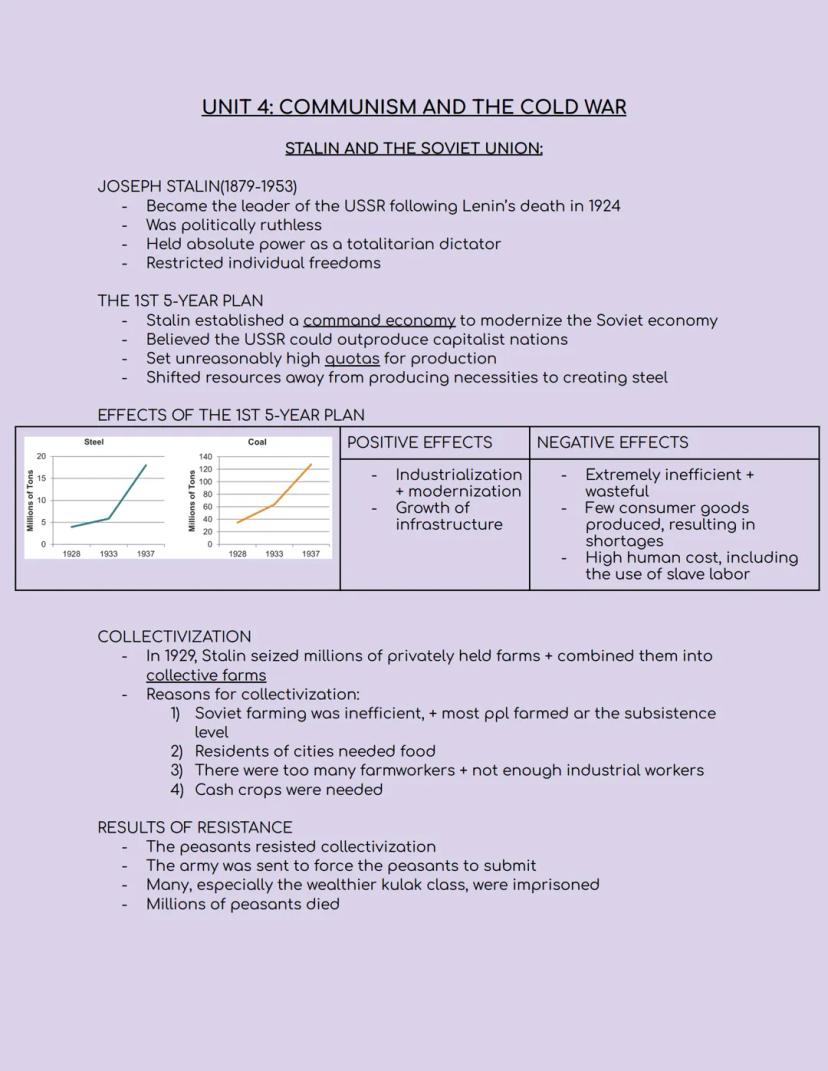

Joseph Stalin transformed the USSR into a powerful but oppressive state after taking power in 1924. As a totalitarian dictator, he ruthlessly eliminated opposition and restricted individual freedoms to maintain absolute control.
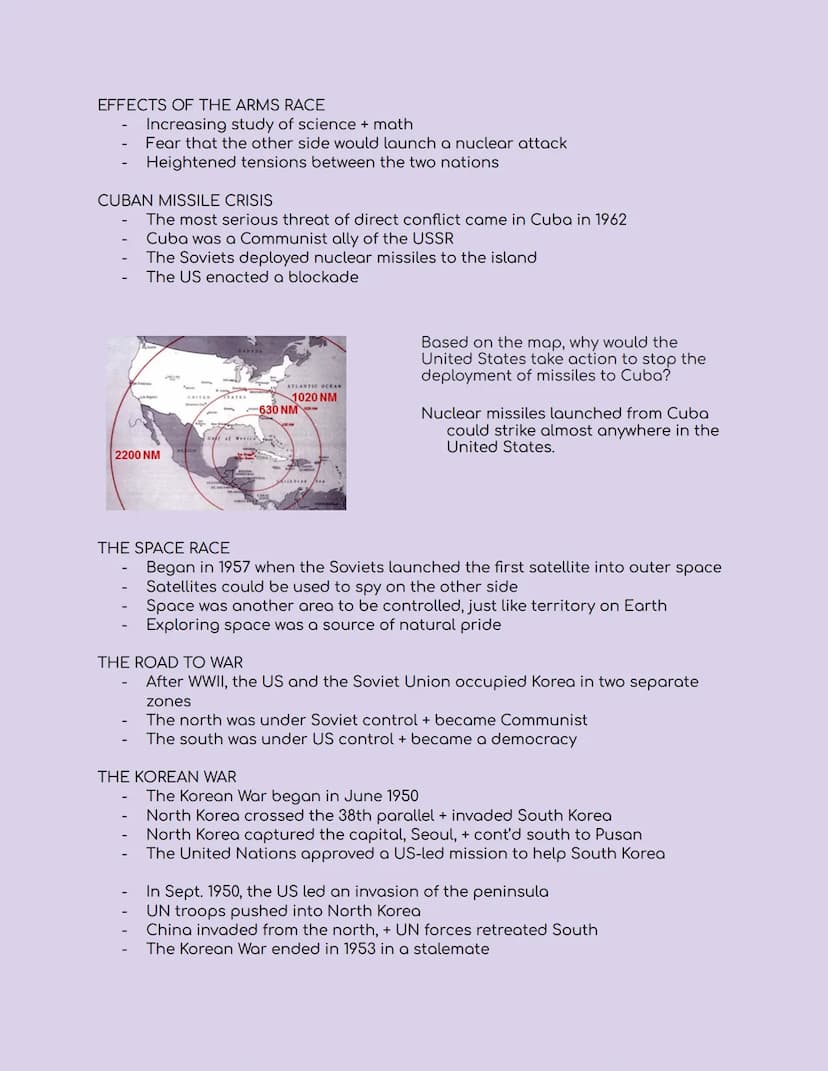
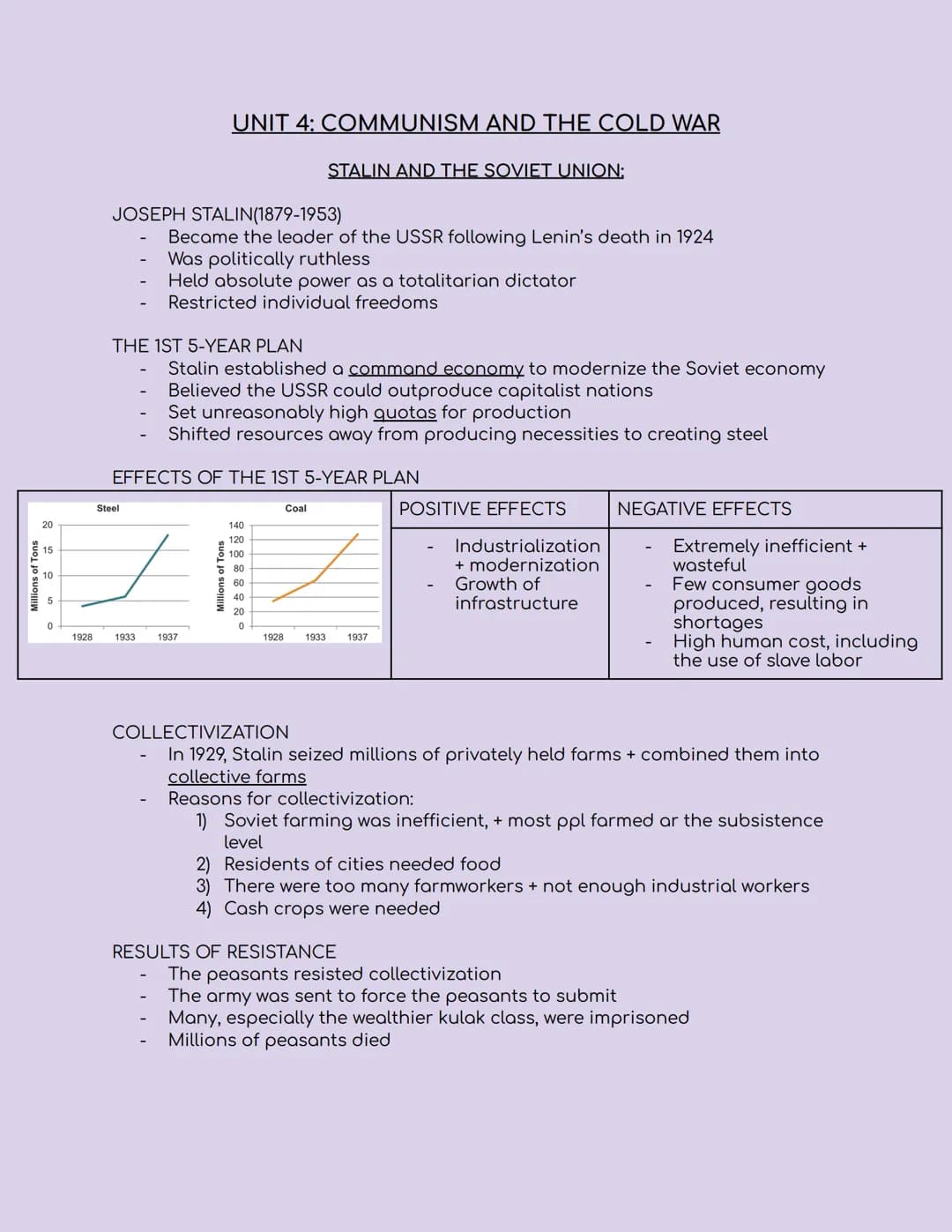
Stalin established a command economy through his First Five-Year Plan, setting ambitious production quotas to modernize Soviet industry. While this led to impressive growth in steel and coal production, it came with severe human costs. Resources shifted from consumer goods to heavy industry, creating widespread shortages and inefficiency.
In 1929, Stalin introduced collectivization, seizing private farms and combining them into collective farms controlled by the government. The goal was to increase agricultural efficiency and free up workers for industry. When peasants resisted, especially the wealthier "kulak" class, Stalin's forces responded brutally, imprisoning millions and causing devastating famines.
Did you know? Stalin's economic policies achieved rapid industrialization, but at the cost of millions of lives through famine, forced labor, and political purges.
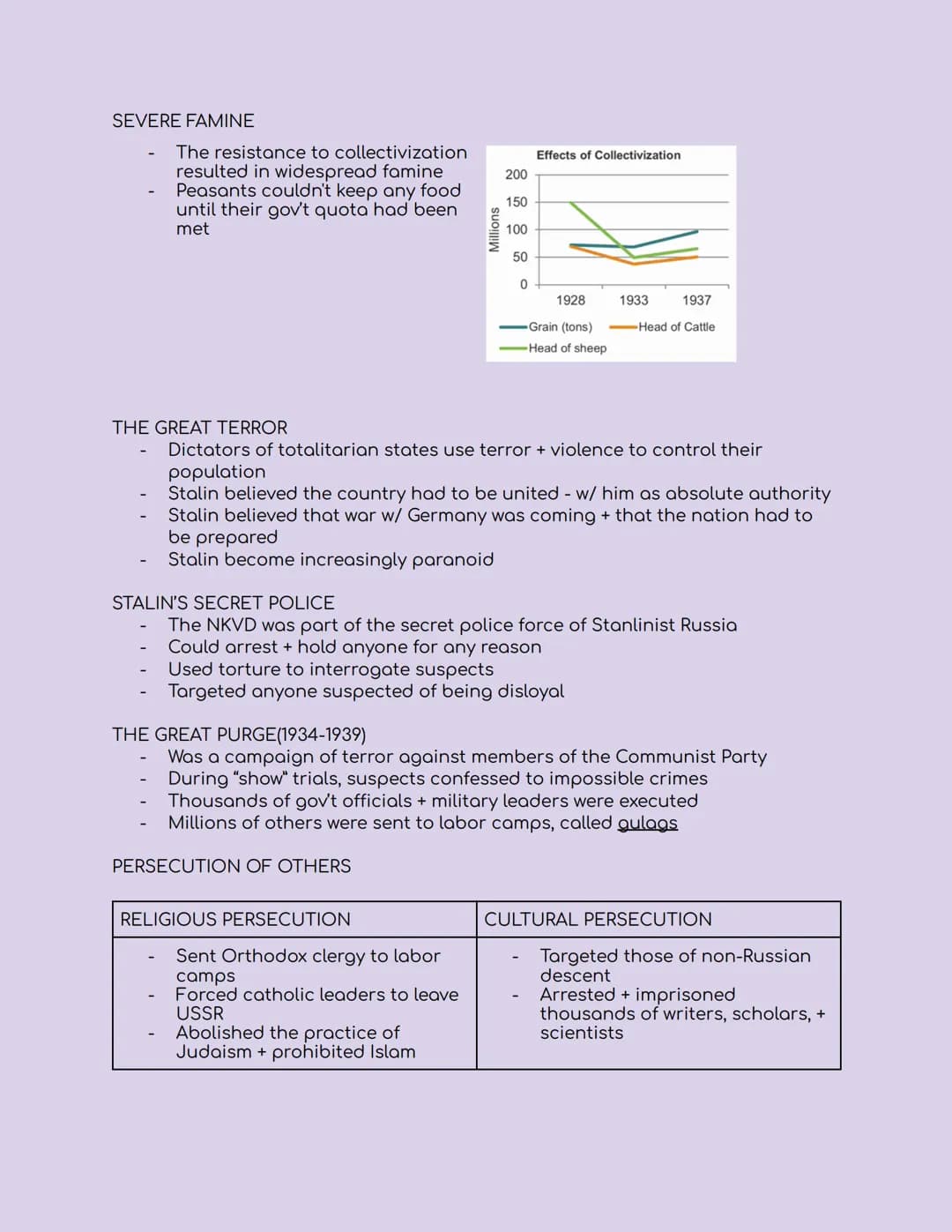
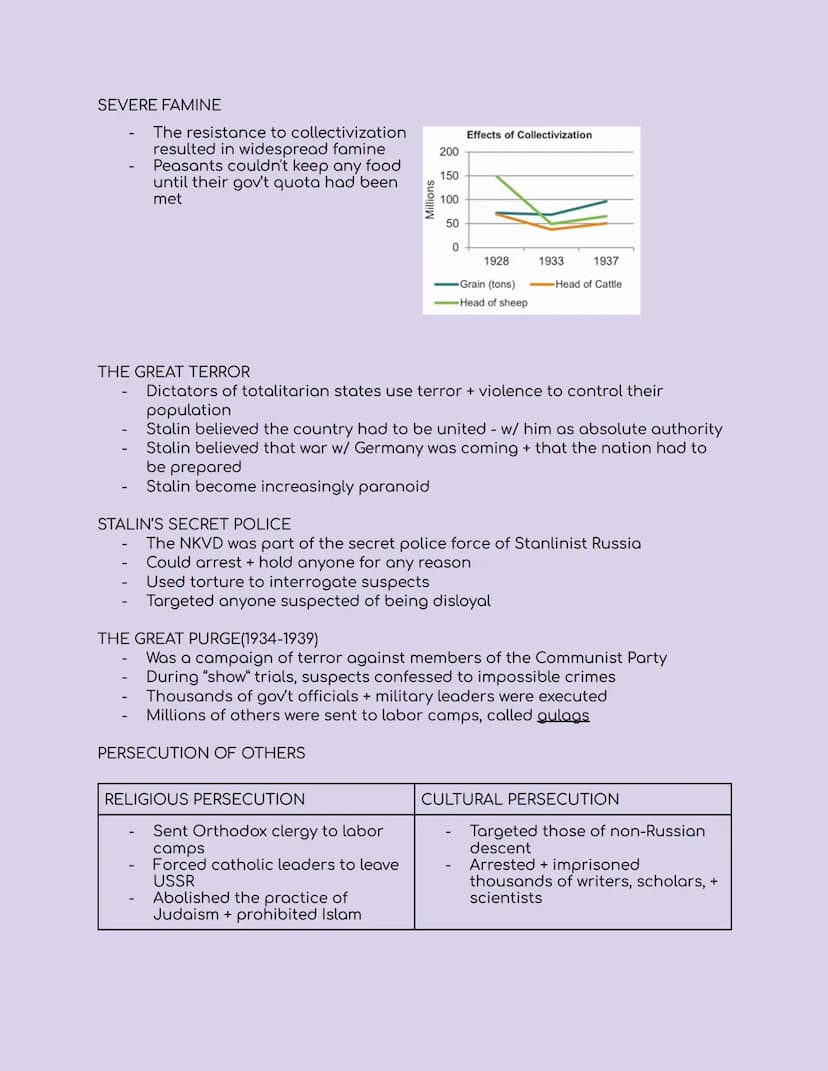
Stalin's collectivization policies led to a severe famine that killed millions of people. Peasants weren't allowed to keep food until government quotas were met, leaving many to starve despite their labor.
The Great Terror became Stalin's primary method of controlling the Soviet population. Driven by his growing paranoia and belief that the country needed to be unified under his authority, Stalin used fear and violence to eliminate perceived threats, particularly as tensions with Germany increased.
Stalin's secret police force, the NKVD, could arrest anyone without cause. They tortured suspects and targeted those suspected of disloyalty. During the Great Purge (1934-1939), thousands of government officials and military leaders were executed in public "show trials" where suspects confessed to impossible crimes. Millions more were sent to labor camps called gulags.
Stalin's regime also targeted religious and cultural freedoms. Orthodox clergy were sent to labor camps, Catholic leaders were forced to leave the USSR, and the practice of Judaism and Islam was prohibited. Those of non-Russian descent faced persecution, with writers, scholars, and scientists often imprisoned.
Remember this: The Great Purge eliminated potential opposition within the Communist Party through false confessions, executions, and labor camp sentences.
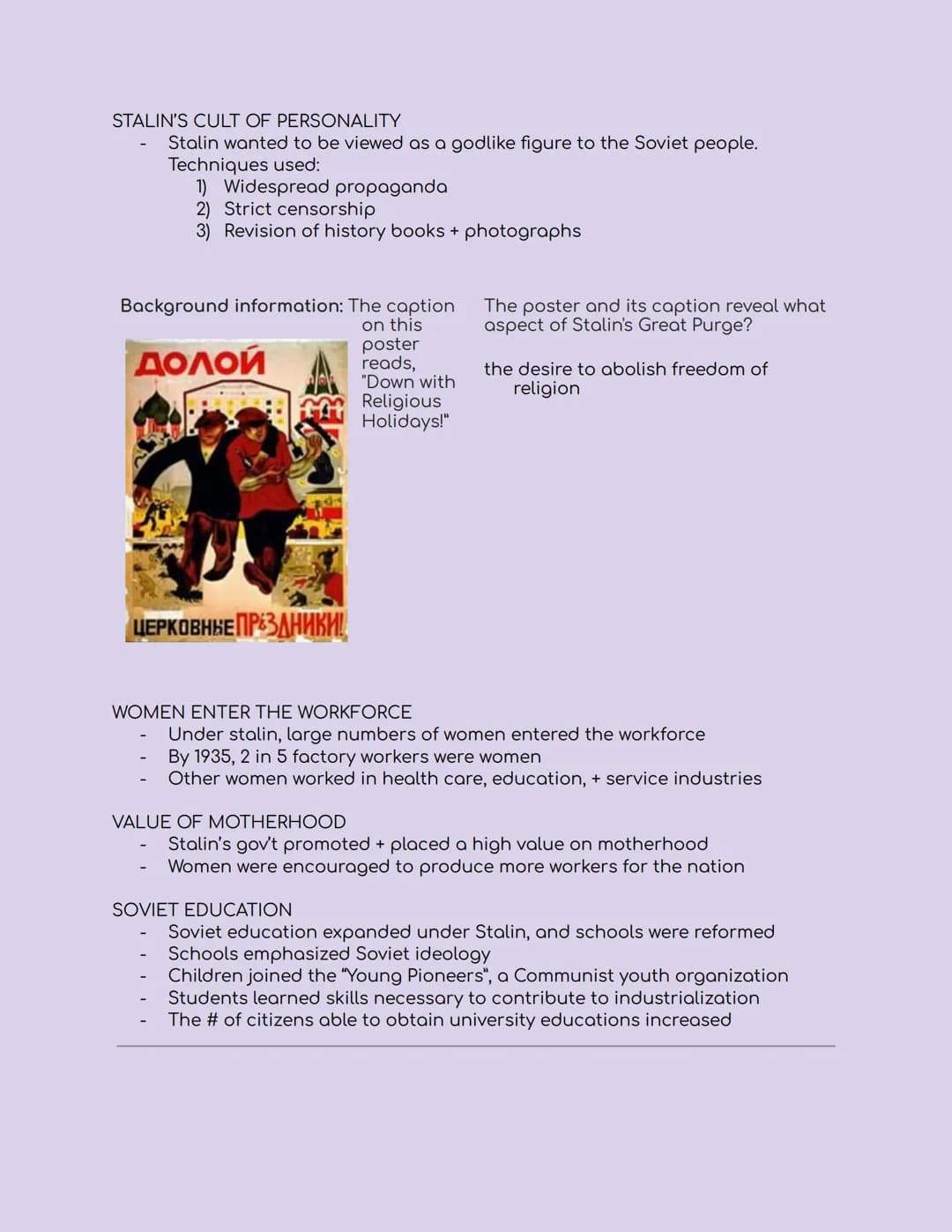
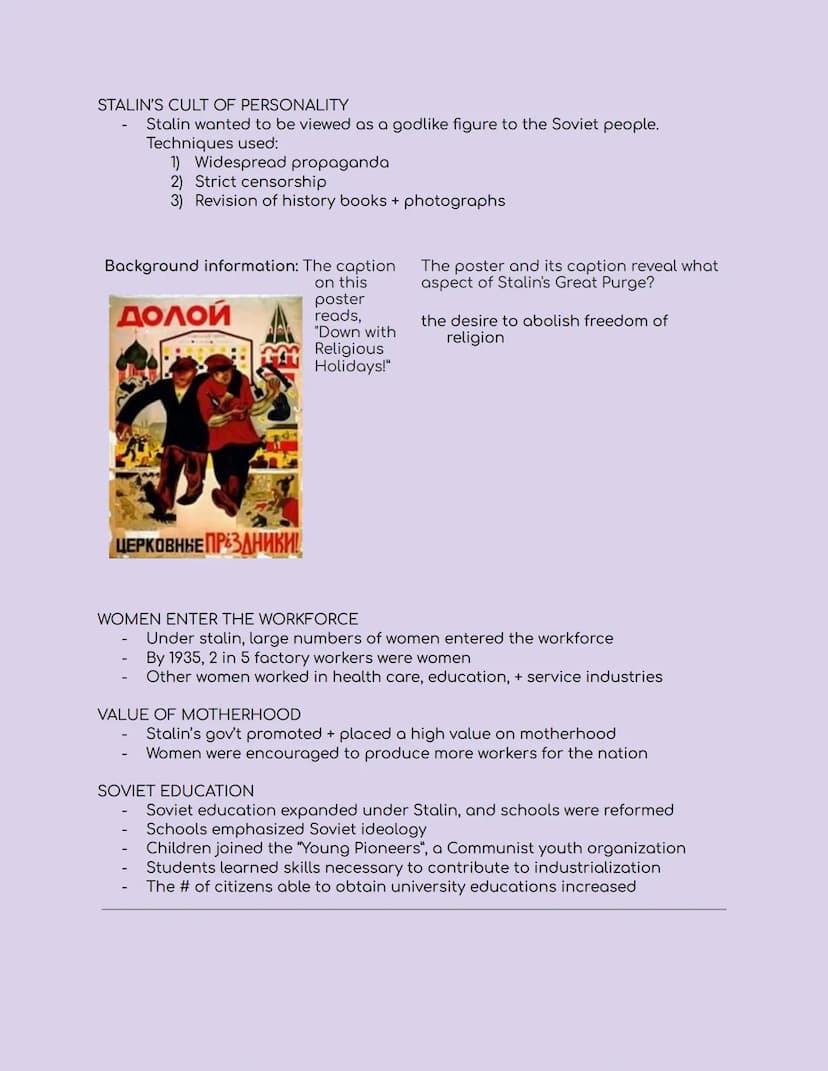
Stalin created a powerful cult of personality to be viewed as a godlike figure by Soviet citizens. He used widespread propaganda, strict censorship, and revised history books and photographs to enhance his image and eliminate references to rivals.
Under Stalin, Soviet women entered the workforce in unprecedented numbers. By 1935, two in five factory workers were women, with others working in healthcare, education, and service industries. Despite promoting workplace equality, the government still emphasized the value of motherhood, encouraging women to produce more workers for the nation.
Soviet education expanded dramatically during Stalin's rule. Schools were reformed to emphasize Soviet ideology, and children joined the "Young Pioneers," a Communist youth organization. The educational system focused on teaching skills necessary for industrialization, and more citizens gained access to university education than ever before.
Think about it: Stalin's propaganda machine altered photos to remove people who had fallen out of favor, essentially erasing them from Soviet history. This manipulation of historical records helped maintain his image of infallibility.
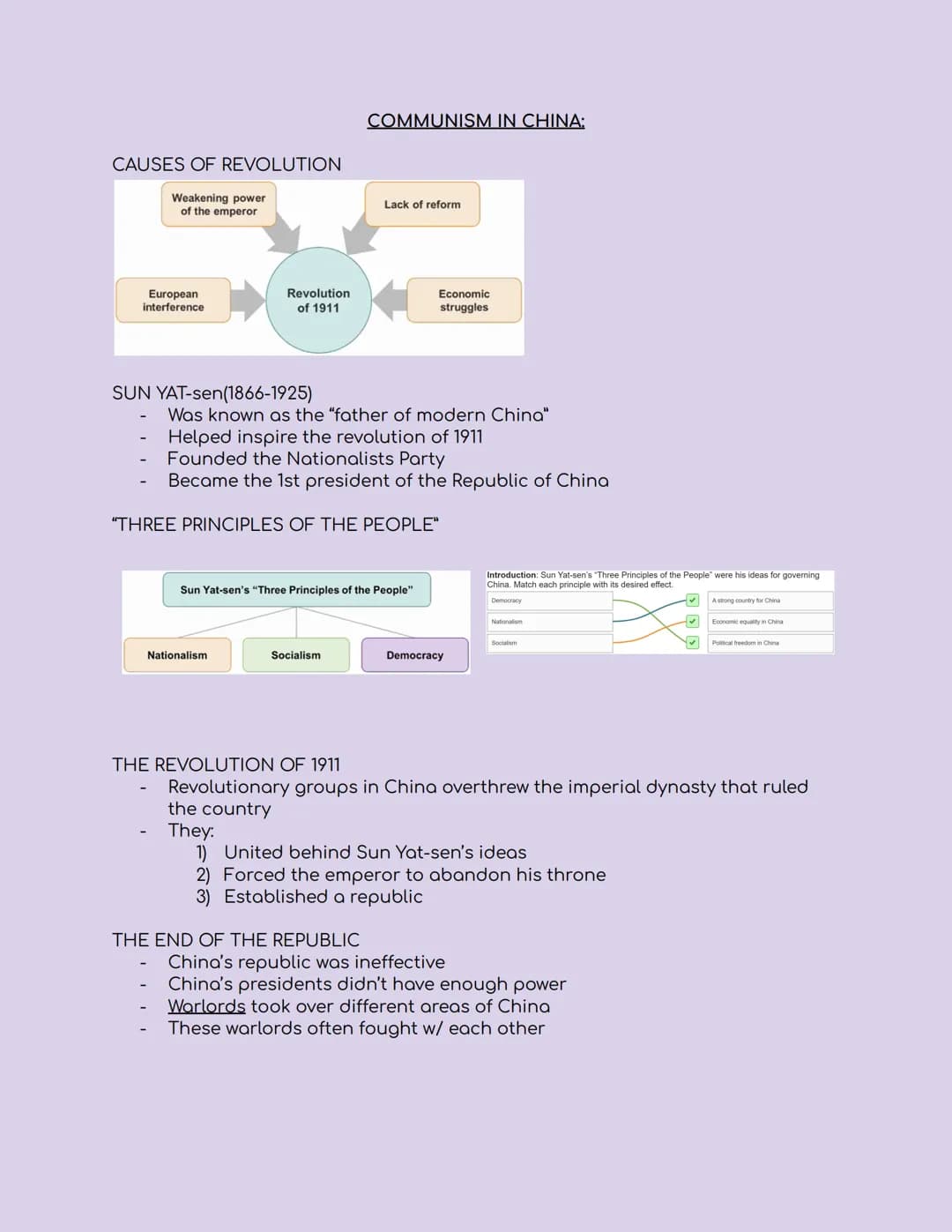
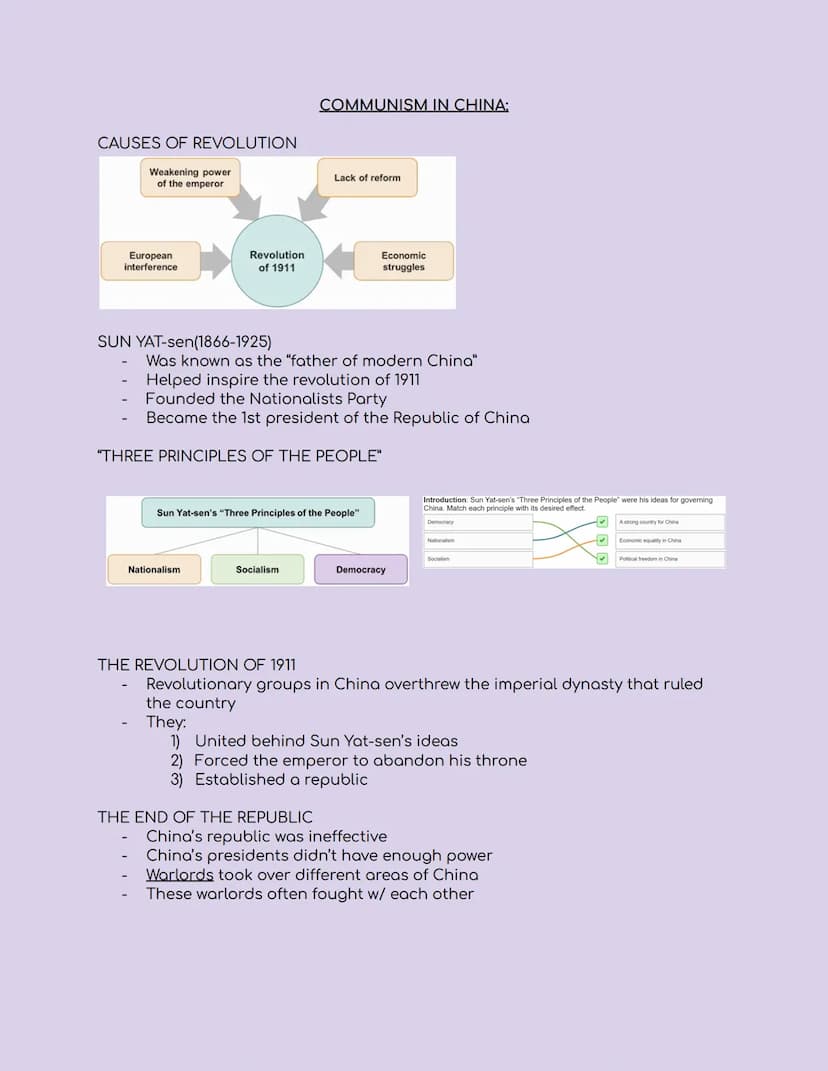
China's imperial system collapsed in the 1911 Revolution due to several factors: the emperor's weakening power, lack of meaningful reforms, European interference, and economic struggles. This revolution was inspired by Sun Yat-sen, known as the "father of modern China."
Sun Yat-sen founded the Nationalist Party and became China's first president. His vision was guided by the "Three Principles of the People": nationalism (creating a strong country), socialism (establishing economic equality), and democracy (providing political freedom).
Revolutionary groups united behind Sun's ideas to overthrow the imperial dynasty and establish a republic. However, this new republic proved ineffective because China's presidents lacked sufficient power. The country soon fell into a period of chaos where warlords took control of different regions and frequently fought each other.
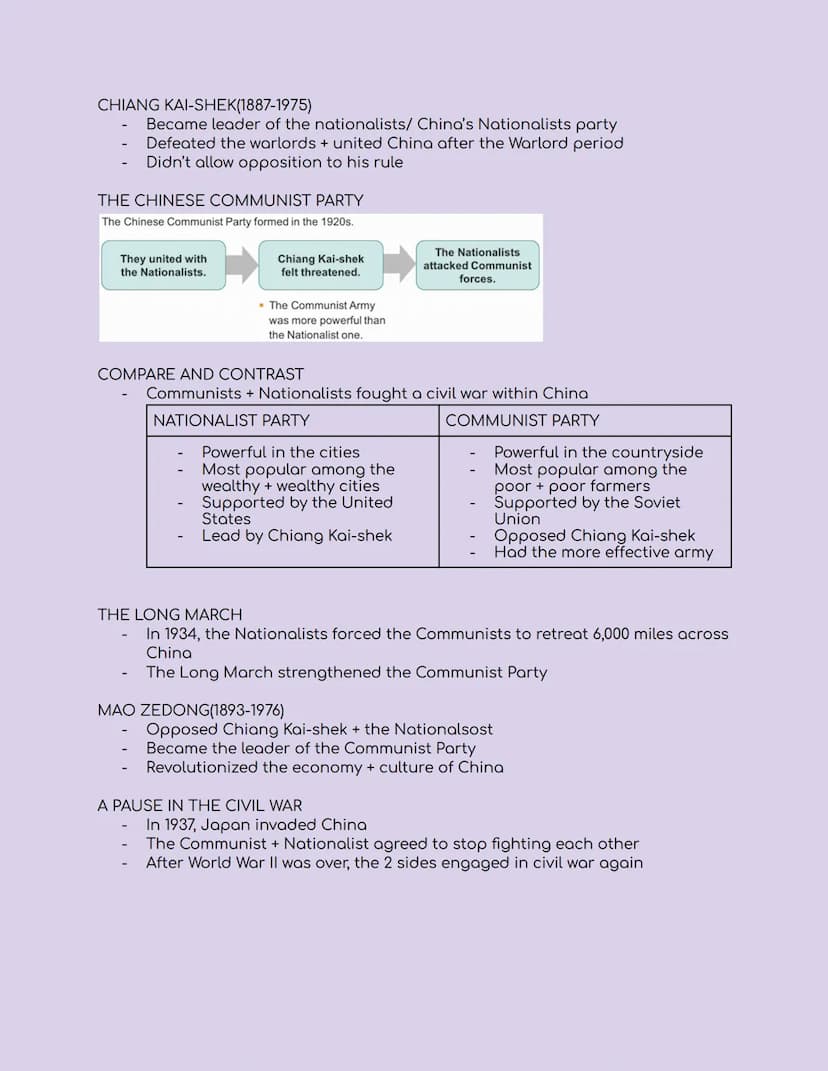
After Sun Yat-sen's death, Chiang Kai-shek emerged as the leader of the Nationalist Party. He managed to defeat the warlords and reunite China, but didn't tolerate opposition to his rule. Meanwhile, the Chinese Communist Party formed in the 1920s and initially allied with the Nationalists before Chiang turned against them, fearing their growing power.
Important context: The struggle between Nationalists and Communists would define Chinese politics for decades, with the Communists gaining support primarily in rural areas while the Nationalists remained stronger in cities.

The Chinese Civil War pitted the Nationalist Party against the Communist Party, each with different bases of support. The Nationalist Party was powerful in cities and popular among the wealthy, receiving support from the United States. The Communist Party found strength in the countryside among poor farmers and had Soviet backing.
In 1934, the Nationalists forced the Communists to retreat 6,000 miles across China in what became known as the Long March. Though grueling, this journey actually strengthened the Communist Party and solidified Mao Zedong's leadership position.
The civil war paused in 1937 when Japan invaded China, forcing the Communists and Nationalists to temporarily unite against a common enemy. However, after World War II ended, they resumed their conflict.
The Communists ultimately won the civil war through more effective military tactics and stronger popular support. They drove the Nationalists off mainland China to Taiwan, allowing Mao to establish the People's Republic of China in 1949. The new Communist government seized property from landlords to give to farmers and took control of private businesses.
Connect the dots: The Communist victory in China in 1949 created another major communist power in Asia just as the Cold War was intensifying globally, significantly affecting U.S. foreign policy in the region.
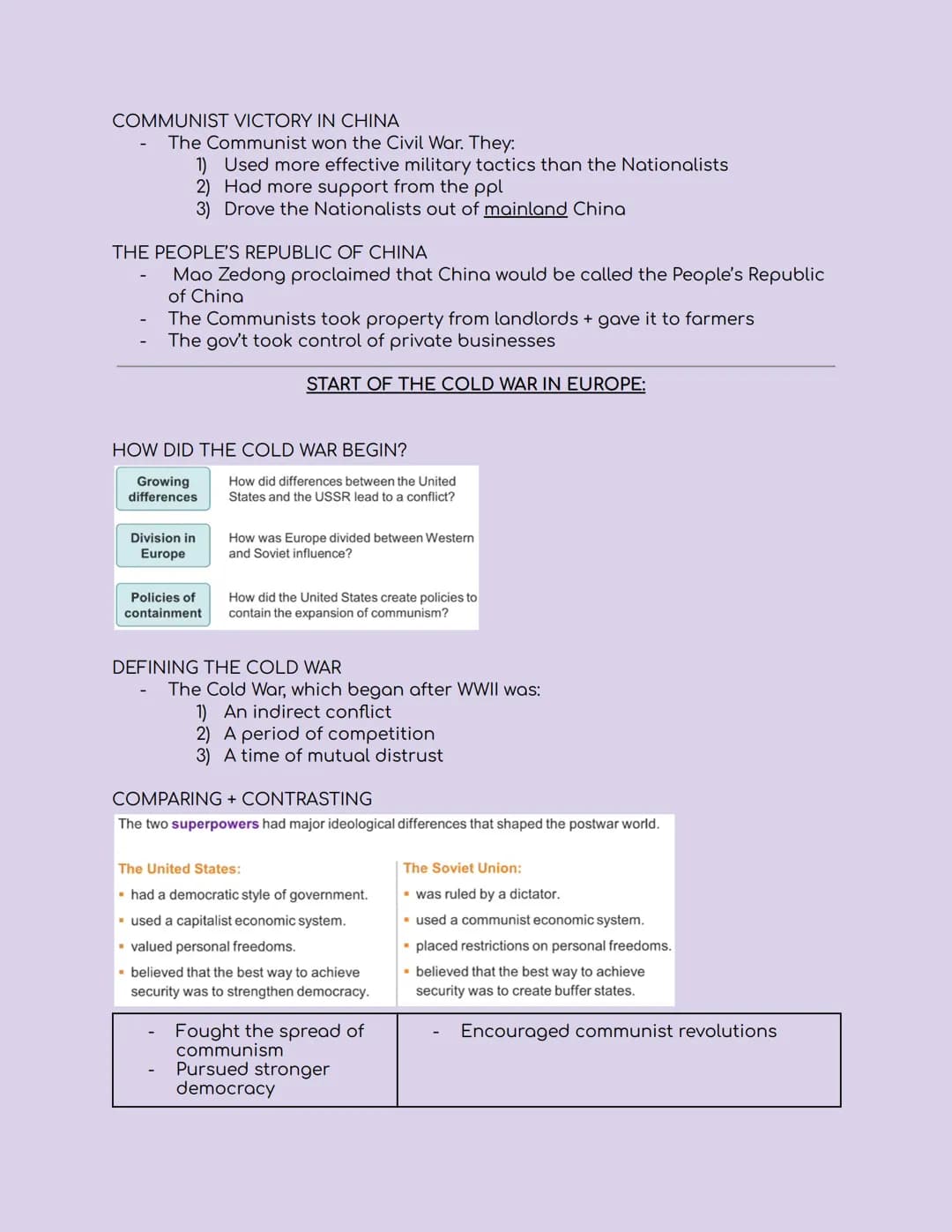
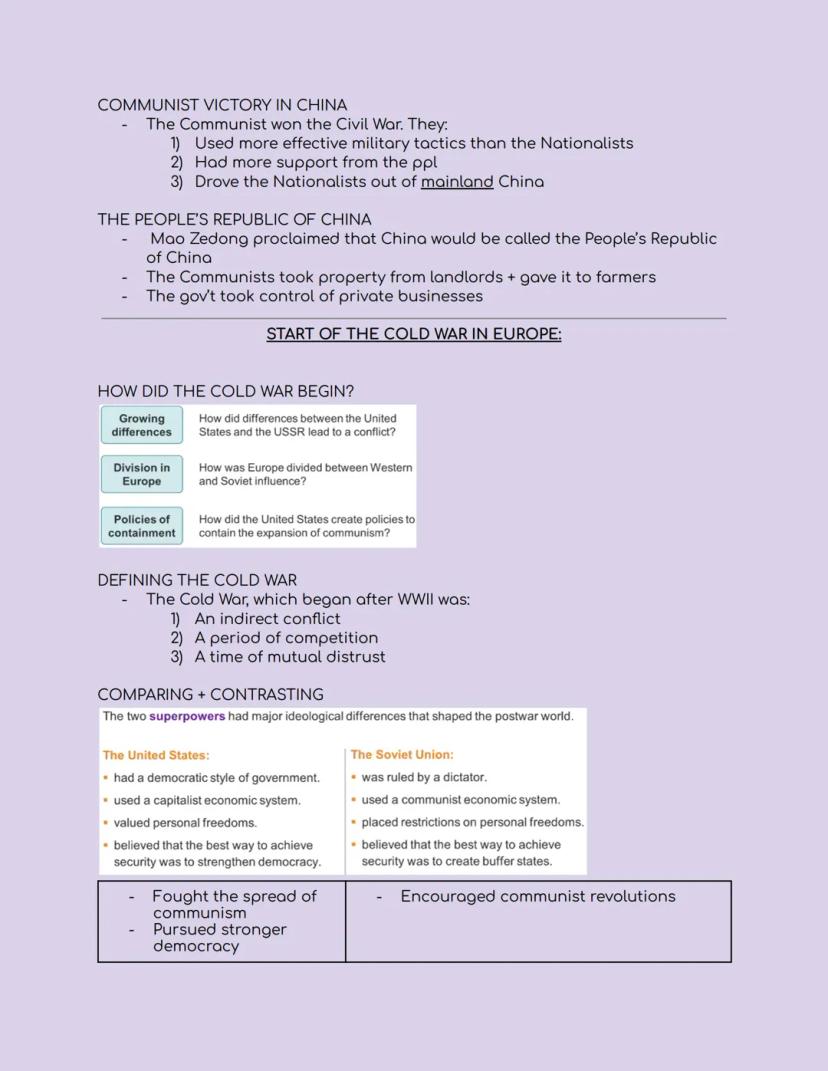
The Cold War began after World War II as an indirect conflict between the United States and Soviet Union. Rather than direct military confrontation, it was characterized by competition, proxy wars, and mutual distrust between the world's two superpowers.
The conflict was fundamentally rooted in ideological differences. The United States had a democratic government, capitalist economy, and valued personal freedoms. The Soviet Union was ruled by a dictator, used a communist economic system, and restricted personal freedoms. Each superpower believed their system was superior and felt threatened by the other.
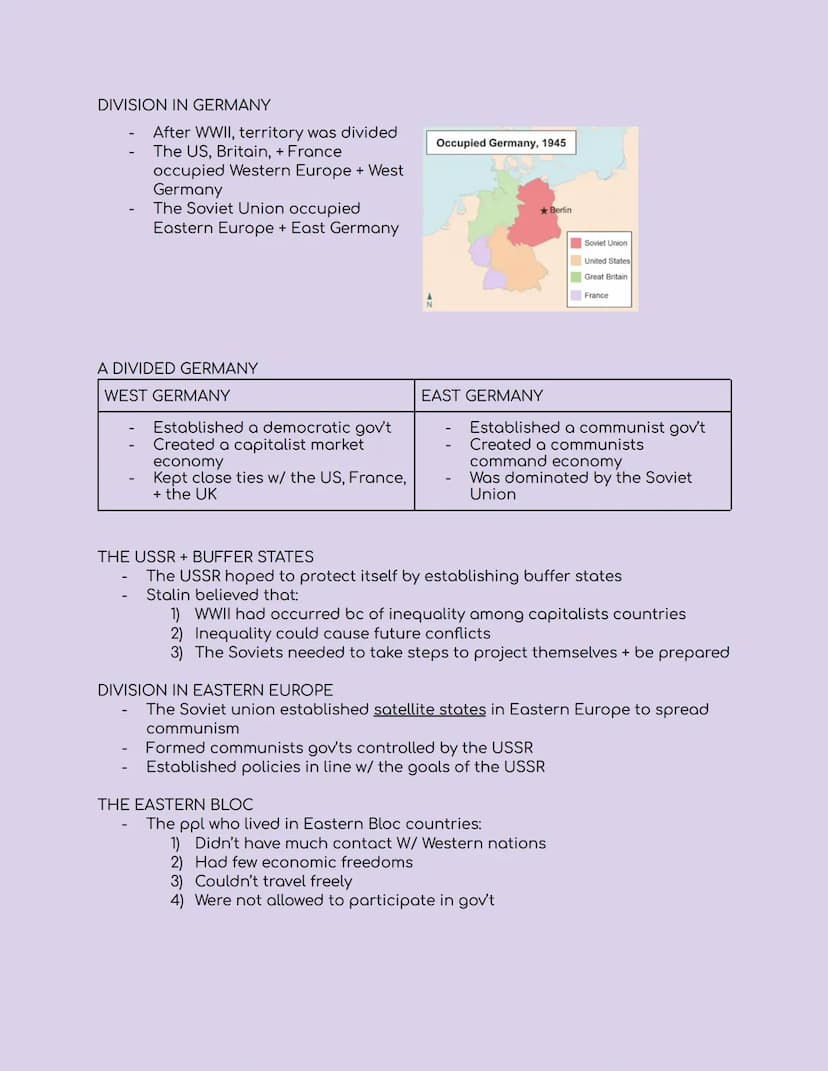
After WWII, Europe became physically divided. The US, Britain, and France occupied Western Europe and West Germany, while the Soviet Union controlled Eastern Europe and East Germany. This division extended to political systems, with West Germany establishing a democratic government and capitalist economy while East Germany became a communist state dominated by the Soviet Union.
The USSR established buffer states in Eastern Europe to protect itself from potential future conflicts. These "satellite states" formed the Eastern Bloc, where citizens had few freedoms, limited contact with Western nations, restricted travel, and little political participation.
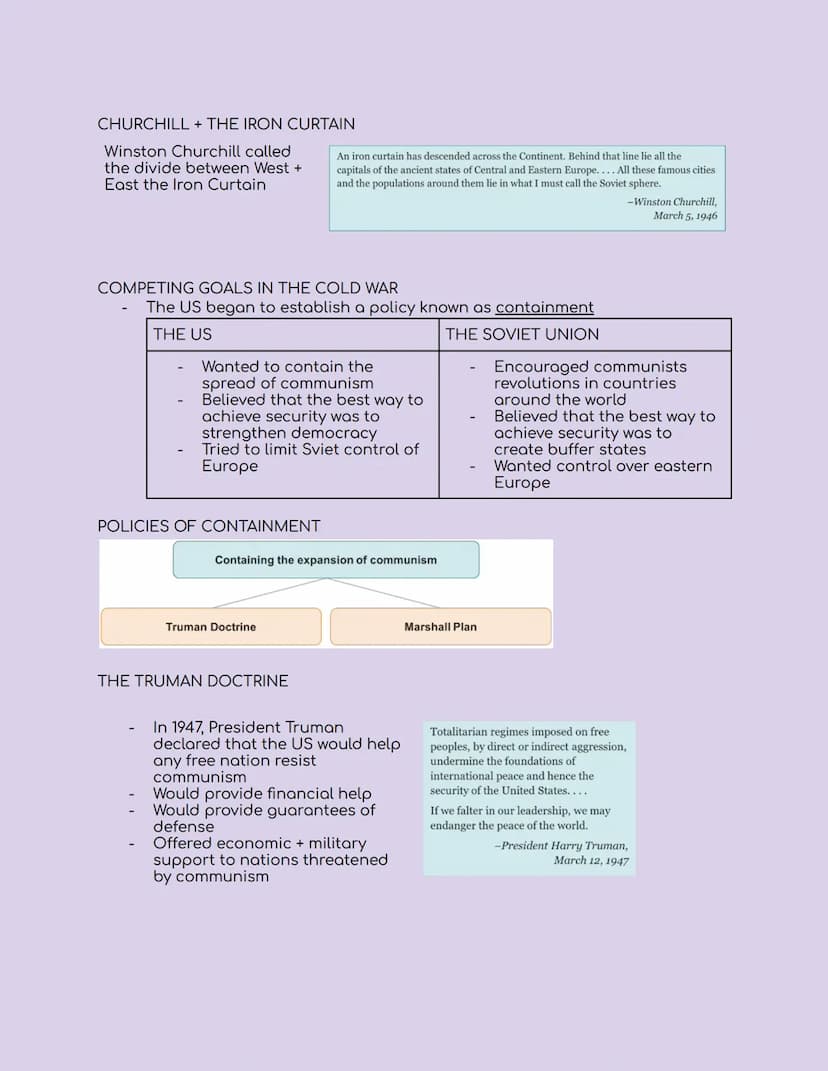
Key concept: British Prime Minister Winston Churchill famously described this division as an "Iron Curtain" that had descended across Europe, separating the democratic West from the Soviet-controlled East.
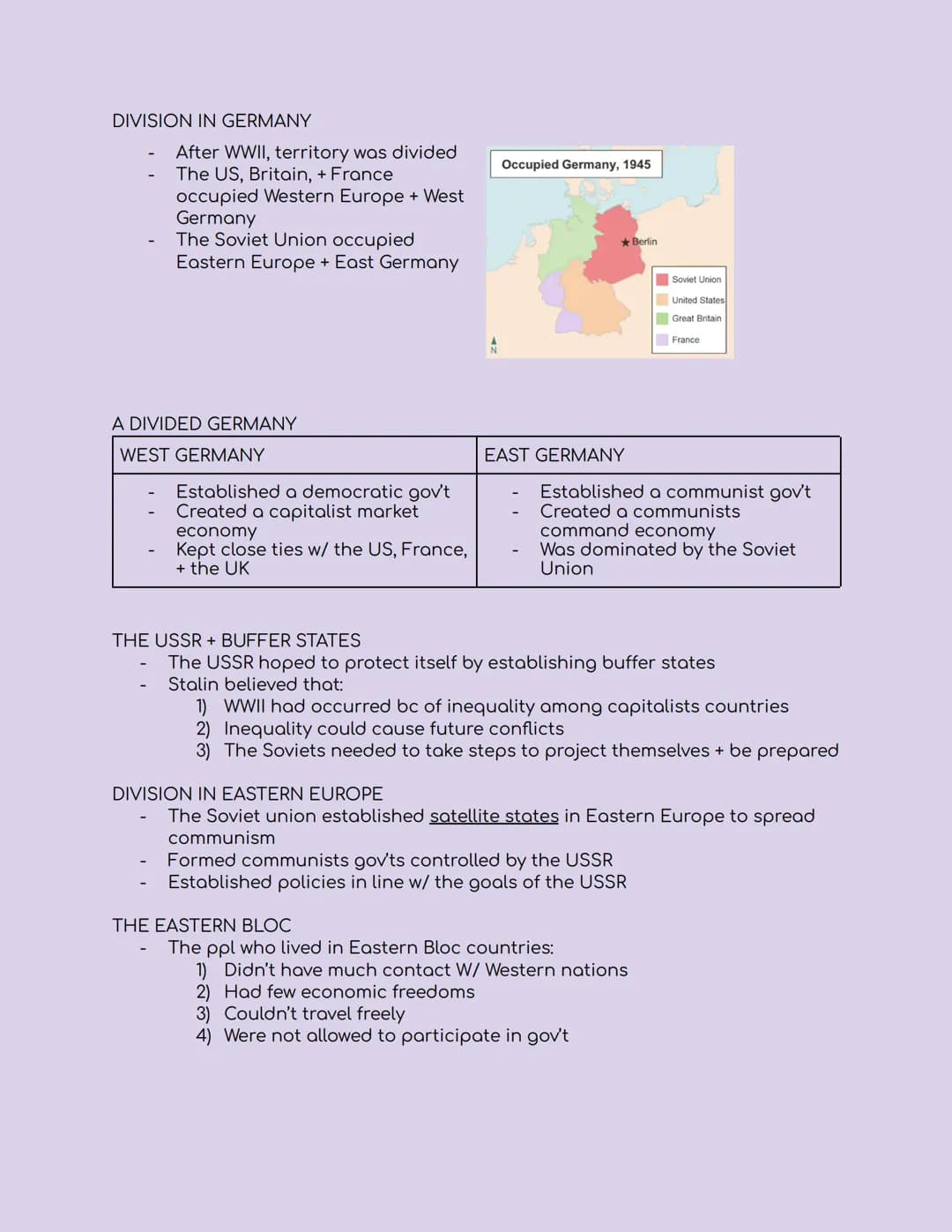
As Cold War tensions grew, the United States developed a policy known as containment to limit the spread of communism worldwide. Meanwhile, the Soviet Union actively encouraged communist revolutions in countries around the world and sought to maintain control over Eastern Europe.
The Truman Doctrine, announced in 1947, declared that the US would provide financial help and defense guarantees to any free nation resisting communism. This was followed by the Marshall Plan in 1948, which provided economic aid to help rebuild war-damaged European countries, stabilize the region, and strengthen these nations against communist influence.
The Soviet Union distrusted these American initiatives, viewing them as plans for extending US dominance and influence globally. This mutual distrust led to increasingly aggressive policies on both sides.
Think critically: How did American financial aid serve both humanitarian and strategic purposes during the early Cold War? The Marshall Plan helped rebuild devastated European economies while simultaneously creating stronger allies against Soviet influence.
The Cold War reached its height with a dangerous arms race between the superpowers. Both the US and Soviet Union built increasingly destructive weapons, including hydrogen bombs millions of times stronger than the first atomic weapons. They also developed intercontinental ballistic missiles (ICBMs) that could deliver nuclear warheads over long distances.
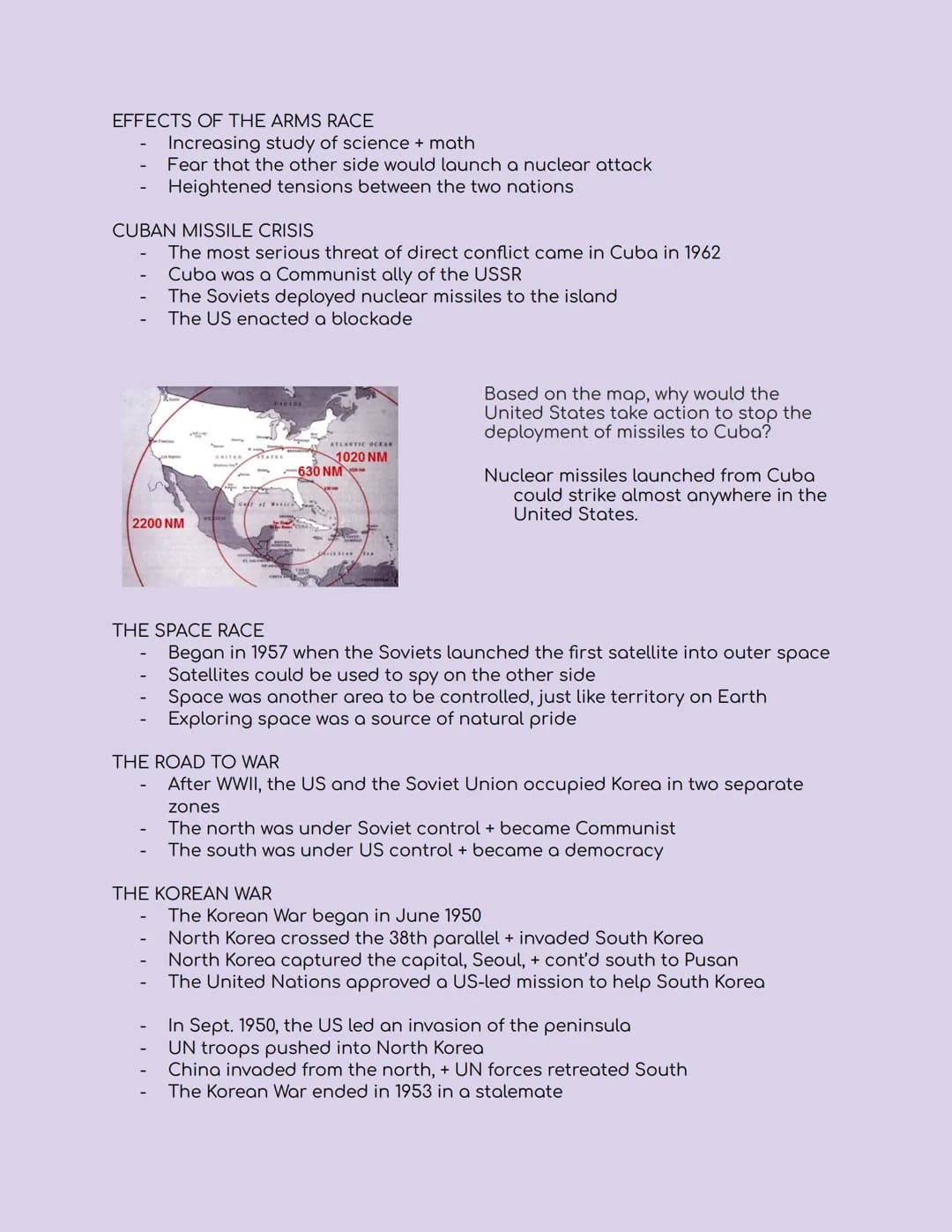
This arms race had profound effects on both societies, including increased emphasis on science and math education, widespread fear of nuclear attack, and heightened tensions between the two nations. The most serious threat of direct conflict came during the Cuban Missile Crisis of 1962, when the Soviets deployed nuclear missiles to Cuba, just 90 miles from US shores.
The arms race extended into space when the Soviets launched the first satellite in 1957, beginning the Space Race. Beyond scientific achievement, satellites could be used for military surveillance, making space another contested frontier.
The first major Cold War conflict erupted in Korea. After WWII, Korea was divided along the 38th parallel, with the Soviet-controlled North becoming communist and the US-backed South becoming democratic. When North Korea invaded South Korea in 1950, the United Nations approved a US-led mission to help South Korea. The war ended in a stalemate in 1953, but cost millions of lives and increased concerns about communist expansion.
Connect the dots: The Korean War established a pattern that would repeat throughout the Cold War—regional conflicts becoming proxy battles between communist and democratic powers.
The Vietnam War became another critical Cold War conflict. After Vietnam gained independence from French colonization, it was divided in 1954 into a Communist North and non-Communist South. The US intervened based on the domino theory—the belief that if one country fell to communism, neighboring countries would follow like falling dominoes.
Ho Chi Minh supported and armed the Vietcong rebels in South Vietnam, who used effective guerrilla warfare tactics against conventional US military approaches. American military presence gradually increased to 500,000 troops by 1959, but by 1975, North Vietnam had prevailed and annexed South Vietnam, unifying the country under communist rule.
The Vietnam War had far-reaching consequences. Communism spread to neighboring Laos and Cambodia, while in the United States, the conflict sparked intense protests and anti-government sentiment. The war resulted in 58,000 American deaths and approximately 3 million Vietnamese casualties.
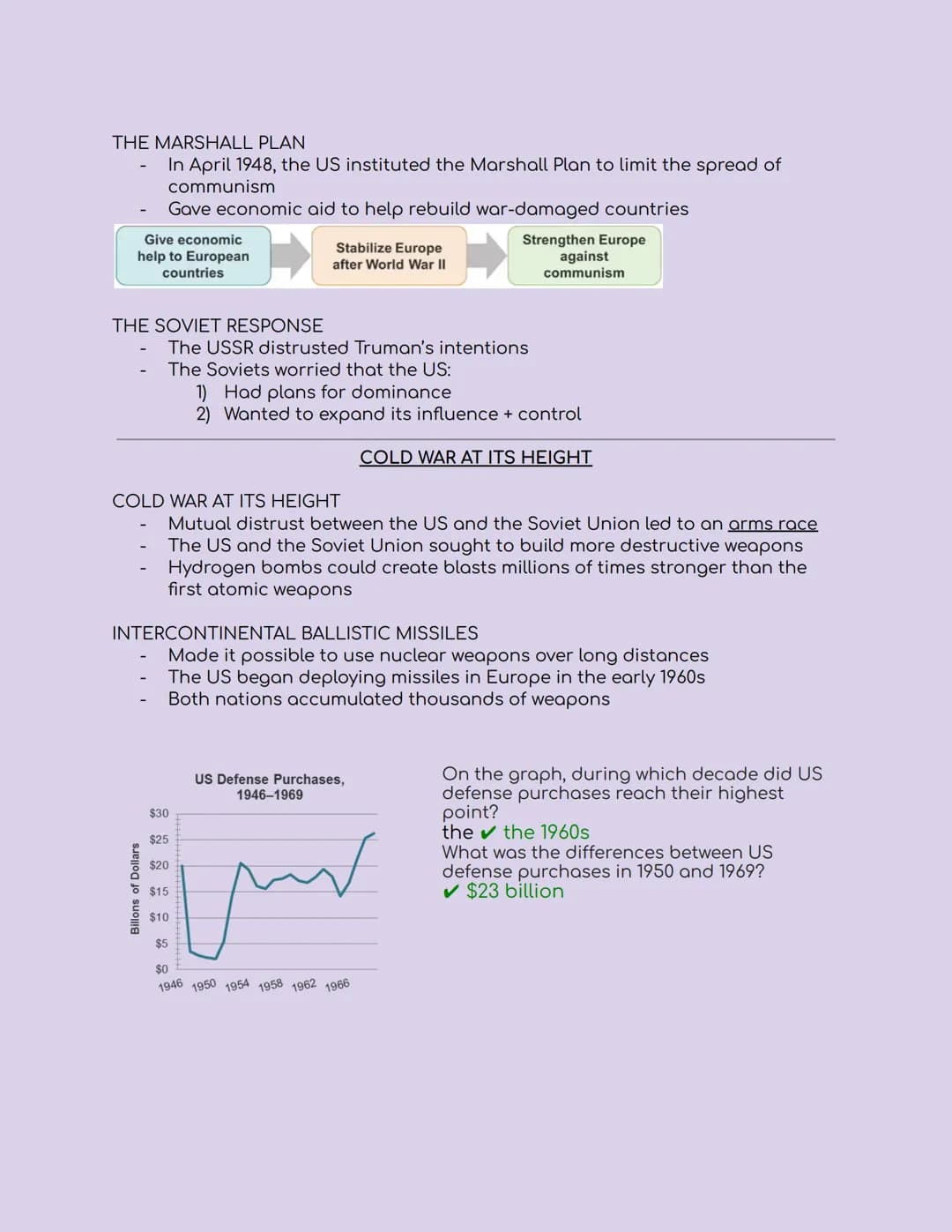
Throughout the Cold War, defense spending skyrocketed as both superpowers raced to build military advantage. US defense purchases reached their peak in the 1960s, reflecting the enormous economic impact of the conflict.
Important perspective: The Vietnam War demonstrated the limitations of military power against determined revolutionary movements and significantly reduced American public support for foreign interventions against communism.
During the Cold War, the US and USSR engaged in proxy wars across the globe, particularly in former European colonies facing instability and poverty. Both superpowers used various techniques to gain influence, including sponsoring revolutions and counter-revolutions, providing military and economic aid, authorizing assassinations, conducting covert activities, and creating strategic alliances.
The Organization of American States (OAS) was created in 1948 to help nations in the Western Hemisphere resist communism by promoting democracy, economic development, and collective defense. Meanwhile, conflicts like the Suez Crisis demonstrated how Cold War tensions could transform regional disputes into international crises.
The Soviet invasion of Afghanistan in 1978 became a significant Cold War battleground. When Soviet-backed communists overthrew the Afghan government, Islamist fighters called mujahideen rebelled. The USSR faced unexpected resistance, especially after the US began providing weapons and training to the rebels. Eventually, the Soviets were forced to withdraw, a failure that contributed to the USSR's decline.
In Latin America, the US intervened in multiple countries to prevent communist influence. In Guatemala, the CIA staged a coup in the 1950s against a president they believed was a communist sympathizer, resulting in decades of military dictatorship and civil war. Similarly, in Nicaragua, the US supported the Contras against the Soviet-backed Sandinista government, leading to the controversial Iran-Contra Affair when the Reagan administration secretly continued funding the Contras after Congress had prohibited it.
Consider this: Cold War interventions often had long-lasting consequences for the countries involved, frequently resulting in decades of instability, violence, and human rights abuses long after the superpowers had moved on.
Our AI companion is specifically built for the needs of students. Based on the millions of content pieces we have on the platform we can provide truly meaningful and relevant answers to students. But its not only about answers, the companion is even more about guiding students through their daily learning challenges, with personalised study plans, quizzes or content pieces in the chat and 100% personalisation based on the students skills and developments.
You can download the app in the Google Play Store and in the Apple App Store.
That's right! Enjoy free access to study content, connect with fellow students, and get instant help – all at your fingertips.
App Store
Google Play
The app is very easy to use and well designed. I have found everything I was looking for so far and have been able to learn a lot from the presentations! I will definitely use the app for a class assignment! And of course it also helps a lot as an inspiration.
Stefan S
iOS user
This app is really great. There are so many study notes and help [...]. My problem subject is French, for example, and the app has so many options for help. Thanks to this app, I have improved my French. I would recommend it to anyone.
Samantha Klich
Android user
Wow, I am really amazed. I just tried the app because I've seen it advertised many times and was absolutely stunned. This app is THE HELP you want for school and above all, it offers so many things, such as workouts and fact sheets, which have been VERY helpful to me personally.
Anna
iOS user
I think it’s very much worth it and you’ll end up using it a lot once you get the hang of it and even after looking at others notes you can still ask your Artificial intelligence buddy the question and ask to simplify it if you still don’t get it!!! In the end I think it’s worth it 😊👍 ⚠️Also DID I MENTION ITS FREEE YOU DON’T HAVE TO PAY FOR ANYTHING AND STILL GET YOUR GRADES IN PERFECTLY❗️❗️⚠️
Thomas R
iOS user
Knowunity is the BEST app I’ve used in a minute. This is not an ai review or anything this is genuinely coming from a 7th grade student (I know 2011 im young) but dude this app is a 10/10 i have maintained a 3.8 gpa and have plenty of time for gaming. I love it and my mom is just happy I got good grades
Brad T
Android user
Not only did it help me find the answer but it also showed me alternative ways to solve it. I was horrible in math and science but now I have an a in both subjects. Thanks for the help🤍🤍
David K
iOS user
The app's just great! All I have to do is enter the topic in the search bar and I get the response real fast. I don't have to watch 10 YouTube videos to understand something, so I'm saving my time. Highly recommended!
Sudenaz Ocak
Android user
In school I was really bad at maths but thanks to the app, I am doing better now. I am so grateful that you made the app.
Greenlight Bonnie
Android user
I found this app a couple years ago and it has only gotten better since then. I really love it because it can help with written questions and photo questions. Also, it can find study guides that other people have made as well as flashcard sets and practice tests. The free version is also amazing for students who might not be able to afford it. Would 100% recommend
Aubrey
iOS user
Best app if you're in Highschool or Junior high. I have been using this app for 2 school years and it's the best, it's good if you don't have anyone to help you with school work.😋🩷🎀
Marco B
iOS user
THE QUIZES AND FLASHCARDS ARE SO USEFUL AND I LOVE Knowunity AI. IT ALSO IS LITREALLY LIKE CHATGPT BUT SMARTER!! HELPED ME WITH MY MASCARA PROBLEMS TOO!! AS WELL AS MY REAL SUBJECTS ! DUHHH 😍😁😲🤑💗✨🎀😮
Elisha
iOS user
This app is phenomenal down to the correct info and the various topics you can study! I greatly recommend it for people who struggle with procrastination and those who need homework help. It has been perfectly accurate for world 1 history as far as I’ve seen! Geometry too!
Paul T
iOS user
The app is very easy to use and well designed. I have found everything I was looking for so far and have been able to learn a lot from the presentations! I will definitely use the app for a class assignment! And of course it also helps a lot as an inspiration.
Stefan S
iOS user
This app is really great. There are so many study notes and help [...]. My problem subject is French, for example, and the app has so many options for help. Thanks to this app, I have improved my French. I would recommend it to anyone.
Samantha Klich
Android user
Wow, I am really amazed. I just tried the app because I've seen it advertised many times and was absolutely stunned. This app is THE HELP you want for school and above all, it offers so many things, such as workouts and fact sheets, which have been VERY helpful to me personally.
Anna
iOS user
I think it’s very much worth it and you’ll end up using it a lot once you get the hang of it and even after looking at others notes you can still ask your Artificial intelligence buddy the question and ask to simplify it if you still don’t get it!!! In the end I think it’s worth it 😊👍 ⚠️Also DID I MENTION ITS FREEE YOU DON’T HAVE TO PAY FOR ANYTHING AND STILL GET YOUR GRADES IN PERFECTLY❗️❗️⚠️
Thomas R
iOS user
Knowunity is the BEST app I’ve used in a minute. This is not an ai review or anything this is genuinely coming from a 7th grade student (I know 2011 im young) but dude this app is a 10/10 i have maintained a 3.8 gpa and have plenty of time for gaming. I love it and my mom is just happy I got good grades
Brad T
Android user
Not only did it help me find the answer but it also showed me alternative ways to solve it. I was horrible in math and science but now I have an a in both subjects. Thanks for the help🤍🤍
David K
iOS user
The app's just great! All I have to do is enter the topic in the search bar and I get the response real fast. I don't have to watch 10 YouTube videos to understand something, so I'm saving my time. Highly recommended!
Sudenaz Ocak
Android user
In school I was really bad at maths but thanks to the app, I am doing better now. I am so grateful that you made the app.
Greenlight Bonnie
Android user
I found this app a couple years ago and it has only gotten better since then. I really love it because it can help with written questions and photo questions. Also, it can find study guides that other people have made as well as flashcard sets and practice tests. The free version is also amazing for students who might not be able to afford it. Would 100% recommend
Aubrey
iOS user
Best app if you're in Highschool or Junior high. I have been using this app for 2 school years and it's the best, it's good if you don't have anyone to help you with school work.😋🩷🎀
Marco B
iOS user
THE QUIZES AND FLASHCARDS ARE SO USEFUL AND I LOVE Knowunity AI. IT ALSO IS LITREALLY LIKE CHATGPT BUT SMARTER!! HELPED ME WITH MY MASCARA PROBLEMS TOO!! AS WELL AS MY REAL SUBJECTS ! DUHHH 😍😁😲🤑💗✨🎀😮
Elisha
iOS user
This app is phenomenal down to the correct info and the various topics you can study! I greatly recommend it for people who struggle with procrastination and those who need homework help. It has been perfectly accurate for world 1 history as far as I’ve seen! Geometry too!
Paul T
iOS user
The Cold War era marked a global struggle between communist and democratic ideologies following World War II. From Stalin's totalitarian Soviet Union to Mao's Communist China, and through the complex conflicts between the United States and USSR, this period reshaped... Show more
Access to all documents
Improve your grades
Join milions of students
Joseph Stalin transformed the USSR into a powerful but oppressive state after taking power in 1924. As a totalitarian dictator, he ruthlessly eliminated opposition and restricted individual freedoms to maintain absolute control.
Stalin established a command economy through his First Five-Year Plan, setting ambitious production quotas to modernize Soviet industry. While this led to impressive growth in steel and coal production, it came with severe human costs. Resources shifted from consumer goods to heavy industry, creating widespread shortages and inefficiency.
In 1929, Stalin introduced collectivization, seizing private farms and combining them into collective farms controlled by the government. The goal was to increase agricultural efficiency and free up workers for industry. When peasants resisted, especially the wealthier "kulak" class, Stalin's forces responded brutally, imprisoning millions and causing devastating famines.
Did you know? Stalin's economic policies achieved rapid industrialization, but at the cost of millions of lives through famine, forced labor, and political purges.
Access to all documents
Improve your grades
Join milions of students
Stalin's collectivization policies led to a severe famine that killed millions of people. Peasants weren't allowed to keep food until government quotas were met, leaving many to starve despite their labor.
The Great Terror became Stalin's primary method of controlling the Soviet population. Driven by his growing paranoia and belief that the country needed to be unified under his authority, Stalin used fear and violence to eliminate perceived threats, particularly as tensions with Germany increased.
Stalin's secret police force, the NKVD, could arrest anyone without cause. They tortured suspects and targeted those suspected of disloyalty. During the Great Purge (1934-1939), thousands of government officials and military leaders were executed in public "show trials" where suspects confessed to impossible crimes. Millions more were sent to labor camps called gulags.
Stalin's regime also targeted religious and cultural freedoms. Orthodox clergy were sent to labor camps, Catholic leaders were forced to leave the USSR, and the practice of Judaism and Islam was prohibited. Those of non-Russian descent faced persecution, with writers, scholars, and scientists often imprisoned.
Remember this: The Great Purge eliminated potential opposition within the Communist Party through false confessions, executions, and labor camp sentences.
Access to all documents
Improve your grades
Join milions of students
Stalin created a powerful cult of personality to be viewed as a godlike figure by Soviet citizens. He used widespread propaganda, strict censorship, and revised history books and photographs to enhance his image and eliminate references to rivals.
Under Stalin, Soviet women entered the workforce in unprecedented numbers. By 1935, two in five factory workers were women, with others working in healthcare, education, and service industries. Despite promoting workplace equality, the government still emphasized the value of motherhood, encouraging women to produce more workers for the nation.
Soviet education expanded dramatically during Stalin's rule. Schools were reformed to emphasize Soviet ideology, and children joined the "Young Pioneers," a Communist youth organization. The educational system focused on teaching skills necessary for industrialization, and more citizens gained access to university education than ever before.
Think about it: Stalin's propaganda machine altered photos to remove people who had fallen out of favor, essentially erasing them from Soviet history. This manipulation of historical records helped maintain his image of infallibility.
Access to all documents
Improve your grades
Join milions of students
China's imperial system collapsed in the 1911 Revolution due to several factors: the emperor's weakening power, lack of meaningful reforms, European interference, and economic struggles. This revolution was inspired by Sun Yat-sen, known as the "father of modern China."
Sun Yat-sen founded the Nationalist Party and became China's first president. His vision was guided by the "Three Principles of the People": nationalism (creating a strong country), socialism (establishing economic equality), and democracy (providing political freedom).
Revolutionary groups united behind Sun's ideas to overthrow the imperial dynasty and establish a republic. However, this new republic proved ineffective because China's presidents lacked sufficient power. The country soon fell into a period of chaos where warlords took control of different regions and frequently fought each other.
After Sun Yat-sen's death, Chiang Kai-shek emerged as the leader of the Nationalist Party. He managed to defeat the warlords and reunite China, but didn't tolerate opposition to his rule. Meanwhile, the Chinese Communist Party formed in the 1920s and initially allied with the Nationalists before Chiang turned against them, fearing their growing power.
Important context: The struggle between Nationalists and Communists would define Chinese politics for decades, with the Communists gaining support primarily in rural areas while the Nationalists remained stronger in cities.
Access to all documents
Improve your grades
Join milions of students
The Chinese Civil War pitted the Nationalist Party against the Communist Party, each with different bases of support. The Nationalist Party was powerful in cities and popular among the wealthy, receiving support from the United States. The Communist Party found strength in the countryside among poor farmers and had Soviet backing.
In 1934, the Nationalists forced the Communists to retreat 6,000 miles across China in what became known as the Long March. Though grueling, this journey actually strengthened the Communist Party and solidified Mao Zedong's leadership position.
The civil war paused in 1937 when Japan invaded China, forcing the Communists and Nationalists to temporarily unite against a common enemy. However, after World War II ended, they resumed their conflict.
The Communists ultimately won the civil war through more effective military tactics and stronger popular support. They drove the Nationalists off mainland China to Taiwan, allowing Mao to establish the People's Republic of China in 1949. The new Communist government seized property from landlords to give to farmers and took control of private businesses.
Connect the dots: The Communist victory in China in 1949 created another major communist power in Asia just as the Cold War was intensifying globally, significantly affecting U.S. foreign policy in the region.
Access to all documents
Improve your grades
Join milions of students
The Cold War began after World War II as an indirect conflict between the United States and Soviet Union. Rather than direct military confrontation, it was characterized by competition, proxy wars, and mutual distrust between the world's two superpowers.
The conflict was fundamentally rooted in ideological differences. The United States had a democratic government, capitalist economy, and valued personal freedoms. The Soviet Union was ruled by a dictator, used a communist economic system, and restricted personal freedoms. Each superpower believed their system was superior and felt threatened by the other.
After WWII, Europe became physically divided. The US, Britain, and France occupied Western Europe and West Germany, while the Soviet Union controlled Eastern Europe and East Germany. This division extended to political systems, with West Germany establishing a democratic government and capitalist economy while East Germany became a communist state dominated by the Soviet Union.
The USSR established buffer states in Eastern Europe to protect itself from potential future conflicts. These "satellite states" formed the Eastern Bloc, where citizens had few freedoms, limited contact with Western nations, restricted travel, and little political participation.
Key concept: British Prime Minister Winston Churchill famously described this division as an "Iron Curtain" that had descended across Europe, separating the democratic West from the Soviet-controlled East.
Access to all documents
Improve your grades
Join milions of students
As Cold War tensions grew, the United States developed a policy known as containment to limit the spread of communism worldwide. Meanwhile, the Soviet Union actively encouraged communist revolutions in countries around the world and sought to maintain control over Eastern Europe.
The Truman Doctrine, announced in 1947, declared that the US would provide financial help and defense guarantees to any free nation resisting communism. This was followed by the Marshall Plan in 1948, which provided economic aid to help rebuild war-damaged European countries, stabilize the region, and strengthen these nations against communist influence.
The Soviet Union distrusted these American initiatives, viewing them as plans for extending US dominance and influence globally. This mutual distrust led to increasingly aggressive policies on both sides.
Think critically: How did American financial aid serve both humanitarian and strategic purposes during the early Cold War? The Marshall Plan helped rebuild devastated European economies while simultaneously creating stronger allies against Soviet influence.
Access to all documents
Improve your grades
Join milions of students
The Cold War reached its height with a dangerous arms race between the superpowers. Both the US and Soviet Union built increasingly destructive weapons, including hydrogen bombs millions of times stronger than the first atomic weapons. They also developed intercontinental ballistic missiles (ICBMs) that could deliver nuclear warheads over long distances.
This arms race had profound effects on both societies, including increased emphasis on science and math education, widespread fear of nuclear attack, and heightened tensions between the two nations. The most serious threat of direct conflict came during the Cuban Missile Crisis of 1962, when the Soviets deployed nuclear missiles to Cuba, just 90 miles from US shores.
The arms race extended into space when the Soviets launched the first satellite in 1957, beginning the Space Race. Beyond scientific achievement, satellites could be used for military surveillance, making space another contested frontier.
The first major Cold War conflict erupted in Korea. After WWII, Korea was divided along the 38th parallel, with the Soviet-controlled North becoming communist and the US-backed South becoming democratic. When North Korea invaded South Korea in 1950, the United Nations approved a US-led mission to help South Korea. The war ended in a stalemate in 1953, but cost millions of lives and increased concerns about communist expansion.
Connect the dots: The Korean War established a pattern that would repeat throughout the Cold War—regional conflicts becoming proxy battles between communist and democratic powers.
Access to all documents
Improve your grades
Join milions of students
The Vietnam War became another critical Cold War conflict. After Vietnam gained independence from French colonization, it was divided in 1954 into a Communist North and non-Communist South. The US intervened based on the domino theory—the belief that if one country fell to communism, neighboring countries would follow like falling dominoes.
Ho Chi Minh supported and armed the Vietcong rebels in South Vietnam, who used effective guerrilla warfare tactics against conventional US military approaches. American military presence gradually increased to 500,000 troops by 1959, but by 1975, North Vietnam had prevailed and annexed South Vietnam, unifying the country under communist rule.
The Vietnam War had far-reaching consequences. Communism spread to neighboring Laos and Cambodia, while in the United States, the conflict sparked intense protests and anti-government sentiment. The war resulted in 58,000 American deaths and approximately 3 million Vietnamese casualties.
Throughout the Cold War, defense spending skyrocketed as both superpowers raced to build military advantage. US defense purchases reached their peak in the 1960s, reflecting the enormous economic impact of the conflict.
Important perspective: The Vietnam War demonstrated the limitations of military power against determined revolutionary movements and significantly reduced American public support for foreign interventions against communism.
Access to all documents
Improve your grades
Join milions of students
During the Cold War, the US and USSR engaged in proxy wars across the globe, particularly in former European colonies facing instability and poverty. Both superpowers used various techniques to gain influence, including sponsoring revolutions and counter-revolutions, providing military and economic aid, authorizing assassinations, conducting covert activities, and creating strategic alliances.
The Organization of American States (OAS) was created in 1948 to help nations in the Western Hemisphere resist communism by promoting democracy, economic development, and collective defense. Meanwhile, conflicts like the Suez Crisis demonstrated how Cold War tensions could transform regional disputes into international crises.
The Soviet invasion of Afghanistan in 1978 became a significant Cold War battleground. When Soviet-backed communists overthrew the Afghan government, Islamist fighters called mujahideen rebelled. The USSR faced unexpected resistance, especially after the US began providing weapons and training to the rebels. Eventually, the Soviets were forced to withdraw, a failure that contributed to the USSR's decline.
In Latin America, the US intervened in multiple countries to prevent communist influence. In Guatemala, the CIA staged a coup in the 1950s against a president they believed was a communist sympathizer, resulting in decades of military dictatorship and civil war. Similarly, in Nicaragua, the US supported the Contras against the Soviet-backed Sandinista government, leading to the controversial Iran-Contra Affair when the Reagan administration secretly continued funding the Contras after Congress had prohibited it.
Consider this: Cold War interventions often had long-lasting consequences for the countries involved, frequently resulting in decades of instability, violence, and human rights abuses long after the superpowers had moved on.
Our AI companion is specifically built for the needs of students. Based on the millions of content pieces we have on the platform we can provide truly meaningful and relevant answers to students. But its not only about answers, the companion is even more about guiding students through their daily learning challenges, with personalised study plans, quizzes or content pieces in the chat and 100% personalisation based on the students skills and developments.
You can download the app in the Google Play Store and in the Apple App Store.
That's right! Enjoy free access to study content, connect with fellow students, and get instant help – all at your fingertips.
3
Smart Tools NEW
Transform this note into: ✓ 50+ Practice Questions ✓ Interactive Flashcards ✓ Full Practice Test ✓ Essay Outlines
Explore the key factors and events that led to US involvement in the Vietnam War, including the Domino Theory, Gulf of Tonkin Incident, and major military strategies. This summary covers the tactics used by both US forces and the Vietcong, the Tet Offensive, and the political implications of the war. Ideal for students studying US history and military conflicts.
 History
Renaissance to the English Reformation
 World History
Explore the key events and significance of the 1569 Revolt of the Northern Earls, a pivotal rebellion aimed at restoring Catholicism in England. This summary covers the motivations behind the uprising, the roles of key figures like Mary, Queen of Scots, and the political dynamics of the time. Understand why the rebellion failed and its impact on Elizabethan policies towards Catholics. Ideal for students studying Tudor history and religious conflicts.
HistoryMongols
World HistorySignificant events of WWII
World Historyworld history
World HistoryApp Store
Google Play
The app is very easy to use and well designed. I have found everything I was looking for so far and have been able to learn a lot from the presentations! I will definitely use the app for a class assignment! And of course it also helps a lot as an inspiration.
Stefan S
iOS user
This app is really great. There are so many study notes and help [...]. My problem subject is French, for example, and the app has so many options for help. Thanks to this app, I have improved my French. I would recommend it to anyone.
Samantha Klich
Android user
Wow, I am really amazed. I just tried the app because I've seen it advertised many times and was absolutely stunned. This app is THE HELP you want for school and above all, it offers so many things, such as workouts and fact sheets, which have been VERY helpful to me personally.
Anna
iOS user
I think it’s very much worth it and you’ll end up using it a lot once you get the hang of it and even after looking at others notes you can still ask your Artificial intelligence buddy the question and ask to simplify it if you still don’t get it!!! In the end I think it’s worth it 😊👍 ⚠️Also DID I MENTION ITS FREEE YOU DON’T HAVE TO PAY FOR ANYTHING AND STILL GET YOUR GRADES IN PERFECTLY❗️❗️⚠️
Thomas R
iOS user
Knowunity is the BEST app I’ve used in a minute. This is not an ai review or anything this is genuinely coming from a 7th grade student (I know 2011 im young) but dude this app is a 10/10 i have maintained a 3.8 gpa and have plenty of time for gaming. I love it and my mom is just happy I got good grades
Brad T
Android user
Not only did it help me find the answer but it also showed me alternative ways to solve it. I was horrible in math and science but now I have an a in both subjects. Thanks for the help🤍🤍
David K
iOS user
The app's just great! All I have to do is enter the topic in the search bar and I get the response real fast. I don't have to watch 10 YouTube videos to understand something, so I'm saving my time. Highly recommended!
Sudenaz Ocak
Android user
In school I was really bad at maths but thanks to the app, I am doing better now. I am so grateful that you made the app.
Greenlight Bonnie
Android user
I found this app a couple years ago and it has only gotten better since then. I really love it because it can help with written questions and photo questions. Also, it can find study guides that other people have made as well as flashcard sets and practice tests. The free version is also amazing for students who might not be able to afford it. Would 100% recommend
Aubrey
iOS user
Best app if you're in Highschool or Junior high. I have been using this app for 2 school years and it's the best, it's good if you don't have anyone to help you with school work.😋🩷🎀
Marco B
iOS user
THE QUIZES AND FLASHCARDS ARE SO USEFUL AND I LOVE Knowunity AI. IT ALSO IS LITREALLY LIKE CHATGPT BUT SMARTER!! HELPED ME WITH MY MASCARA PROBLEMS TOO!! AS WELL AS MY REAL SUBJECTS ! DUHHH 😍😁😲🤑💗✨🎀😮
Elisha
iOS user
This app is phenomenal down to the correct info and the various topics you can study! I greatly recommend it for people who struggle with procrastination and those who need homework help. It has been perfectly accurate for world 1 history as far as I’ve seen! Geometry too!
Paul T
iOS user
The app is very easy to use and well designed. I have found everything I was looking for so far and have been able to learn a lot from the presentations! I will definitely use the app for a class assignment! And of course it also helps a lot as an inspiration.
Stefan S
iOS user
This app is really great. There are so many study notes and help [...]. My problem subject is French, for example, and the app has so many options for help. Thanks to this app, I have improved my French. I would recommend it to anyone.
Samantha Klich
Android user
Wow, I am really amazed. I just tried the app because I've seen it advertised many times and was absolutely stunned. This app is THE HELP you want for school and above all, it offers so many things, such as workouts and fact sheets, which have been VERY helpful to me personally.
Anna
iOS user
I think it’s very much worth it and you’ll end up using it a lot once you get the hang of it and even after looking at others notes you can still ask your Artificial intelligence buddy the question and ask to simplify it if you still don’t get it!!! In the end I think it’s worth it 😊👍 ⚠️Also DID I MENTION ITS FREEE YOU DON’T HAVE TO PAY FOR ANYTHING AND STILL GET YOUR GRADES IN PERFECTLY❗️❗️⚠️
Thomas R
iOS user
Knowunity is the BEST app I’ve used in a minute. This is not an ai review or anything this is genuinely coming from a 7th grade student (I know 2011 im young) but dude this app is a 10/10 i have maintained a 3.8 gpa and have plenty of time for gaming. I love it and my mom is just happy I got good grades
Brad T
Android user
Not only did it help me find the answer but it also showed me alternative ways to solve it. I was horrible in math and science but now I have an a in both subjects. Thanks for the help🤍🤍
David K
iOS user
The app's just great! All I have to do is enter the topic in the search bar and I get the response real fast. I don't have to watch 10 YouTube videos to understand something, so I'm saving my time. Highly recommended!
Sudenaz Ocak
Android user
In school I was really bad at maths but thanks to the app, I am doing better now. I am so grateful that you made the app.
Greenlight Bonnie
Android user
I found this app a couple years ago and it has only gotten better since then. I really love it because it can help with written questions and photo questions. Also, it can find study guides that other people have made as well as flashcard sets and practice tests. The free version is also amazing for students who might not be able to afford it. Would 100% recommend
Aubrey
iOS user
Best app if you're in Highschool or Junior high. I have been using this app for 2 school years and it's the best, it's good if you don't have anyone to help you with school work.😋🩷🎀
Marco B
iOS user
THE QUIZES AND FLASHCARDS ARE SO USEFUL AND I LOVE Knowunity AI. IT ALSO IS LITREALLY LIKE CHATGPT BUT SMARTER!! HELPED ME WITH MY MASCARA PROBLEMS TOO!! AS WELL AS MY REAL SUBJECTS ! DUHHH 😍😁😲🤑💗✨🎀😮
Elisha
iOS user
This app is phenomenal down to the correct info and the various topics you can study! I greatly recommend it for people who struggle with procrastination and those who need homework help. It has been perfectly accurate for world 1 history as far as I’ve seen! Geometry too!
Paul T
iOS user